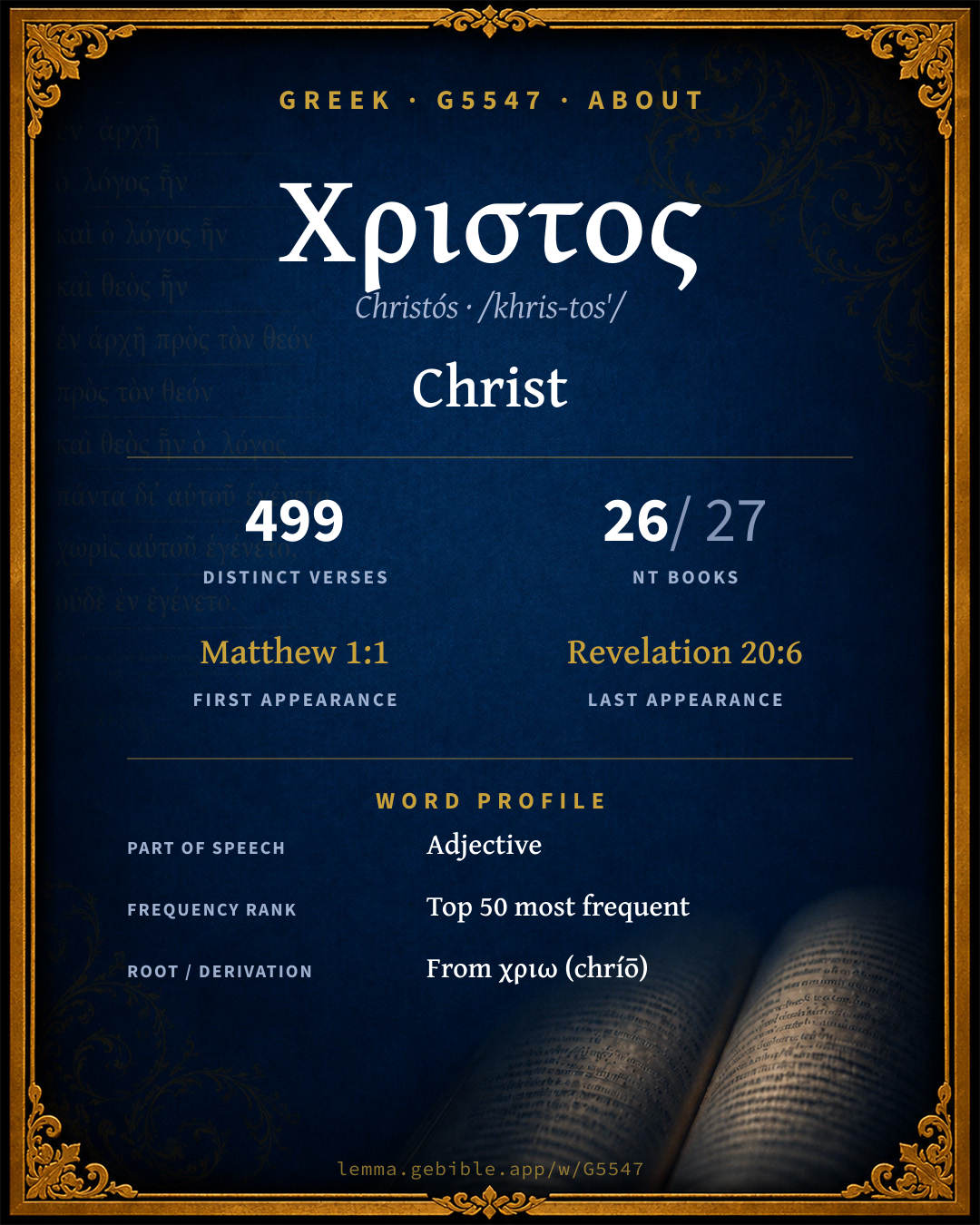
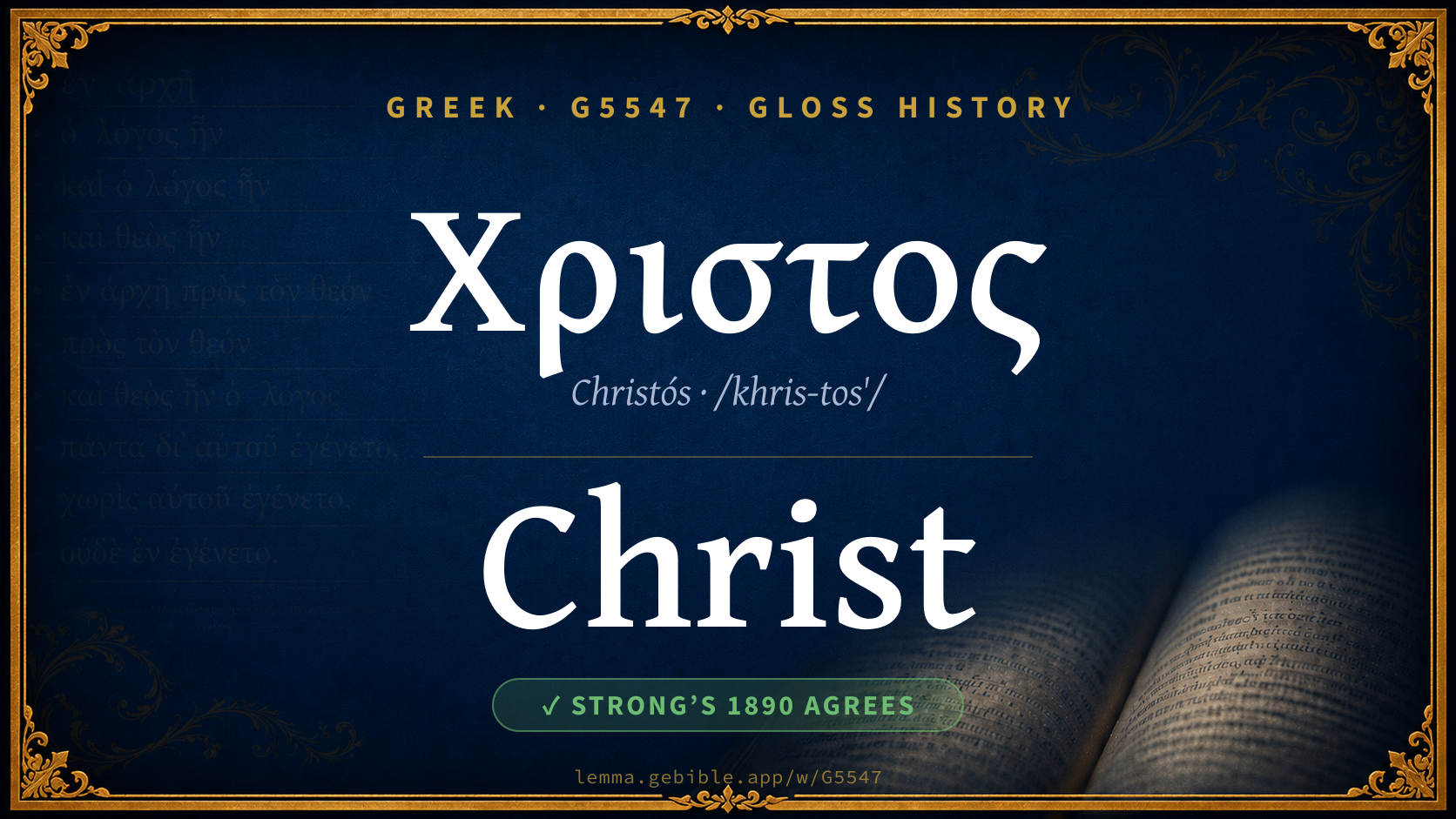
Χριστός
Christ
Thayer's lists 3 entries for ‘Christ’ fuller range ↓
Full lexicon entry — Thayer's Greek Lexicon
From Thayer's Greek Lexicon
Where this word appears
See every Genitive-case word in the Greek New Testament →
Grammar key — what these labels mean
Part of speech
- Noun
- A naming word — a person, place, thing, or idea.
Case
- Genitive
- The case of source, possession, or “of” — answers “whose / from what.”
- Nominative
- The case of the subject (and the predicate nominative).
- Dative
- The case of the indirect object, means, or location — “to / for / with / in.”
- Accusative
- The case of the direct object and of extent.
- Vocative
- The case of direct address (“O Lord”).
Gender
- Masculine
- Grammatically masculine.
Number
- Singular
- One.
Grammatical forms
- Noun, Genitive, Singular, Masculine 249 times (47%)
- Noun, Nominative, Singular, Masculine 112 times (21%)
- Noun, Dative, Singular, Masculine 103 times (19%)
- Noun, Accusative, Singular, Masculine 65 times (12%)
- Noun, Vocative, Singular, Masculine 1 time (0%)
Parsed forms decoded from the imported morphology (Robinson–Tischendorf, public domain), counted across 530 parsed occurrences — not distinct verses.
Page 1 of 3 — showing verses 1–200 of 499 distinct verses where G5547 appears, across 26 books. Click any verse to open its interlinear word-by-word view. Verse text shown in the World English Bible for context — . Each verse’s Greek form is shown with its reference; the English is not keyword-highlighted, since the data carries no word-level English alignment. Use “Compare translations” on any verse to read it across multiple English versions. This concordance covers the Greek New Testament; Septuagint (Greek Old Testament) occurrences of this word are not indexed here.
Matthew 16 verses
- Matthew 1:1 Χριστοῦ n gen sg masc The book of the generation of Jesus Christ, the son of David, the son of Abraham.
- Matthew 1:16 Χριστός n nom sg masc Jacob became the father of Joseph, the husband of Mary, from whom was born Jesus, who is called Christ.
- Matthew 1:17 Χριστοῦ n gen sg masc So all the generations from Abraham to David are fourteen generations; from David to the exile to Babylon fourteen generations; and from the carrying away to Babylon to the Christ, fourteen generations.
- Matthew 1:18 Χριστοῦ n gen sg masc Now the birth of Jesus Christ was like this; for after his mother, Mary, was engaged to Joseph, before they came together, she was found pregnant by the Holy Spirit.
- Matthew 2:4 Χριστὸς n nom sg masc Gathering together all the chief priests and scribes of the people, he asked them where the Christ would be born.
- Matthew 11:2 Χριστοῦ n gen sg masc Now when John heard in the prison the works of Christ, he sent two of his disciples
- Matthew 16:16 Χριστὸς n nom sg masc Simon Peter answered, "You are the Christ, the Son of the living God."
- Matthew 16:20 Χριστός n nom sg masc Then he charged the disciples that they should tell no one that he is Jesus the Christ.
- Matthew 22:42 Χριστοῦ n gen sg masc saying, "What do you think of the Christ? Whose son is he?" They said to him, "Of David."
- Matthew 23:10 Χριστός n nom sg masc Neither be called masters, for one is your master, the Christ.
- Matthew 24:5 Χριστός n nom sg masc For many will come in my name, saying, 'I am the Christ,' and will lead many astray.
- Matthew 24:23 Χριστός n nom sg masc "Then if any man tells you, 'Behold, here is the Christ,' or, 'There,' don't believe it.
- Matthew 26:63 Χριστὸς n nom sg masc But Jesus held his peace. The high priest answered him, "I adjure you by the living God, that you tell us whether you are the Christ, the Son of God."
- Matthew 26:68 Χριστέ n voc sg masc saying, "Prophesy to us, you Christ! Who hit you?"
- Matthew 27:17 Χριστόν n acc sg masc When therefore they were gathered together, Pilate said to them, "Whom do you want me to release to you? Barabbas, or Jesus, who is called Christ?"
- Matthew 27:22 Χριστόν n acc sg masc Pilate said to them, "What then shall I do to Jesus, who is called Christ?" They all said to him, "Let him be crucified!"
Mark 7 verses
- Mark 1:1 Χριστοῦ n gen sg masc The beginning of the Gospel of Jesus Christ, the Son of God.
- Mark 8:29 Χριστός n nom sg masc He said to them, "But who do you say that I am?" Peter answered, "You are the Christ."
- Mark 9:41 Χριστοῦ n gen sg masc For whoever will give you a cup of water to drink in my name, because you are Christ's, most assuredly I tell you, he will in no way lose his reward.
- Mark 12:35 Χριστὸς n nom sg masc Jesus responded, as he taught in the temple, "How is it that the scribes say that the Christ is the son of David?
- Mark 13:21 Χριστός n nom sg masc Then if anyone tells you, 'Look, here is the Christ!' or, 'Look, there!' don't believe it.
- Mark 14:61 Χριστὸς n nom sg masc But he stayed quiet, and answered nothing. Again the high priest asked him, "Are you the Christ, the Son of the Blessed?"
- Mark 15:32 Χριστὸς n nom sg masc Let the Christ, the King of Israel, now come down from the cross, that we may see and believe him." Those who were crucified with him insulted him.
Luke 12 verses
- Luke 2:11 Χριστὸς n nom sg masc For there is born to you, this day, in the city of David, a Savior, who is Christ the Lord.
- Luke 2:26 Χριστὸν n acc sg masc It had been revealed to him by the Holy Spirit that he should not see death before he had seen the Lord's Christ.
- Luke 3:15 Χριστός n nom sg masc As the people were in expectation, and all men reasoned in their hearts concerning John, whether perhaps he was the Christ,
- Luke 4:41 Χριστὸν n acc sg masc Demons also came out from many, crying out, and saying, "You are the Christ, the Son of God!" Rebuking them, he didn't allow them to speak, because they knew that he was the Christ.
- Luke 9:20 Χριστὸν n acc sg masc He said to them, "But who do you say that I am?" Peter answered, "The Christ of God."
- Luke 20:41 Χριστὸν n acc sg masc He said to them, "Why do they say that the Christ is David's son?
- Luke 22:66 Χριστός n nom sg masc As soon as it was day, the assembly of the elders of the people was gathered together, both chief priests and scribes, and they led him away into their council, saying,
- Luke 23:2 Χριστὸν n acc sg masc They began to accuse him, saying, "We found this man perverting the nation, forbidding paying taxes to Caesar, and saying that he himself is Christ, a king."
- Luke 23:35 Χριστὸς n nom sg masc The people stood watching. The rulers with them also scoffed at him, saying, "He saved others. Let him save himself, if this is the Christ of God, his chosen one!"
- Luke 23:39 Χριστός n nom sg masc One of the criminals who was hanged insulted him, saying, "If you are the Christ, save yourself and us!"
- Luke 24:26 Χριστὸν n acc sg masc Didn't the Christ have to suffer these things and to enter into his glory?"
- Luke 24:46 Χριστὸν n acc sg masc He said to them, "Thus it is written, and thus it was necessary for the Christ to suffer and to rise from the dead the third day,
John 18 verses
- John 1:17 Χριστοῦ n gen sg masc For the law was given through Moses. Grace and truth came through Jesus Christ.
- John 1:20 Χριστός n nom sg masc He confessed, and didn't deny, but he confessed, "I am not the Christ."
- John 1:25 Χριστὸς n nom sg masc They asked him, "Why then do you baptize, if you are not the Christ, nor Elijah, nor the Prophet?"
- John 1:42 Χριστός n nom sg masc He brought him to Jesus. Jesus looked at him, and said, "You are Simon the son of Jonah. You shall be called Cephas" (which is by interpretation, Peter).
- John 3:28 Χριστός n nom sg masc You yourselves testify that I said, 'I am not the Christ,' but, 'I have been sent before him.'
- John 4:25 Χριστός n nom sg masc The woman said to him, "I know that Messiah comes," (he who is called Christ). "When he has come, he will declare to us all things."
- John 4:29 Χριστός n nom sg masc "Come, see a man who told me everything that I did. Can this be the Christ?"
- John 7:26 Χριστός n nom sg masc Behold, he speaks openly, and they say nothing to him. Can it be that the rulers indeed know that this is truly the Christ?
- John 7:27 Χριστὸς n nom sg masc However we know where this man comes from, but when the Christ comes, no one will know where he comes from."
- John 7:31 Χριστὸς n nom sg masc But of the multitude, many believed in him. They said, "When the Christ comes, he won't do more signs than those which this man has done, will he?"
- John 7:41 Χριστός Χριστὸς n nom sg masc n nom sg masc Others said, "This is the Christ." But some said, "What, does the Christ come out of Galilee?
- John 7:42 Χριστὸς n nom sg masc Hasn't the Scripture said that the Christ comes of the seed of David, and from Bethlehem, the village where David was?"
- John 9:22 Χριστόν n acc sg masc His parents said these things because they feared the Jews; for the Jews had already agreed that if any man would confess him as Christ, he would be put out of the synagogue.
- John 10:24 Χριστός n nom sg masc The Jews therefore came around him and said to him, "How long will you hold us in suspense? If you are the Christ, tell us plainly."
- John 11:27 Χριστὸς n nom sg masc She said to him, "Yes, Lord. I have come to believe that you are the Christ, God's Son, he who comes into the world."
- John 12:34 Χριστὸς n nom sg masc The multitude answered him, "We have heard out of the law that the Christ remains forever. How do you say, 'The Son of Man must be lifted up?' Who is this Son of Man?"
- John 17:3 Χριστόν n acc sg masc This is eternal life, that they should know you, the only true God, and him whom you sent, Jesus Christ.
- John 20:31 Χριστὸς n nom sg masc but these are written, that you may believe that Jesus is the Christ, the Son of God, and that believing you may have life in his name.
Acts 25 verses
- Acts 2:31 Χριστοῦ n gen sg masc he foreseeing this spoke about the resurrection of the Christ, that neither was his soul left in Hades, nor did his flesh see decay.
- Acts 2:36 Χριστὸν n acc sg masc "Let all the house of Israel therefore know assuredly that God has made him both Lord and Christ, this Jesus whom you crucified."
- Acts 2:38 Χριστοῦ n gen sg masc Peter said to them, "Repent, and be baptized, everyone of you, in the name of Jesus Christ for the forgiveness of sins, and you will receive the gift of the Holy Spirit.
- Acts 3:6 Χριστοῦ n gen sg masc But Peter said, "Silver and gold have I none, but what I have, that I give you. In the name of Jesus Christ of Nazareth, get up and walk!"
- Acts 3:18 Χριστὸν n acc sg masc But the things which God announced by the mouth of all his prophets, that Christ should suffer, he thus fulfilled.
- Acts 3:20 Χριστόν n acc sg masc and that he may send Christ Jesus, who was ordained for you before,
- Acts 4:10 Χριστοῦ n gen sg masc be it known to you all, and to all the people of Israel, that in the name of Jesus Christ of Nazareth, whom you crucified, whom God raised from the dead, in him does this man stand here before you whole.
- Acts 4:26 Χριστοῦ n gen sg masc The kings of the earth take a stand, And the rulers take council together, Against the Lord, and against his Christ.'
- Acts 4:33 Χριστοῦ n gen sg masc With great power, the apostles gave their testimony of the resurrection of the Lord Jesus. Great grace was on them all.
- Acts 5:42 Χριστόν n acc sg masc Every day, in the temple and at home, they never stopped teaching and preaching Jesus, the Christ.
- Acts 8:5 Χριστόν n acc sg masc Philip went down to the city of Samaria, and proclaimed to them the Christ.
- Acts 8:12 Χριστοῦ n gen sg masc But when they believed Philip preaching good news concerning the Kingdom of God and the name of Jesus Christ, they were baptized, both men and women.
- Acts 9:22 Χριστός n nom sg masc But Saul increased more in strength, and confounded the Jews who lived at Damascus, proving that this is the Christ.
- Acts 9:34 Χριστός n nom sg masc Peter said to him, "Aeneas, Jesus Christ heals you. Get up and make your bed!" Immediately he arose.
- Acts 10:36 Χριστοῦ n gen sg masc The word which he sent to the children of Israel, preaching good news of peace by Jesus Christ--he is Lord of all--
- Acts 10:48 Χριστοῦ n gen sg masc He commanded them to be baptized in the name of Jesus Christ. Then they asked him to stay some days.
- Acts 11:17 Χριστόν n acc sg masc If then God gave to them the same gift as us, when we believed in the Lord Jesus Christ, who was I, that I could withstand God?"
- Acts 15:26 Χριστοῦ n gen sg masc men who have risked their lives for the name of our Lord Jesus Christ.
- Acts 16:18 Χριστοῦ n gen sg masc She was doing this for many days. But Paul, becoming greatly annoyed, turned and said to the spirit, "I charge you in the name of Jesus Christ to come out of her!" It came out that very hour.
- Acts 17:3 Χριστὸν Χριστός n acc sg masc n nom sg masc explaining and demonstrating that the Christ had to suffer and rise again from the dead, and saying, "This Jesus, whom I proclaim to you, is the Christ."
- Acts 18:5 Χριστόν n acc sg masc But when Silas and Timothy came down from Macedonia, Paul was compelled by the Spirit, testifying to the Jews that Jesus was the Christ.
- Acts 18:28 Χριστὸν n acc sg masc for he powerfully refuted the Jews, publicly showing by the Scriptures that Jesus was the Christ.
- Acts 20:21 Χριστόν n acc sg masc testifying both to Jews and to Greeks repentance toward God, and faith toward our Lord Jesus.
- Acts 24:24 Χριστὸν n acc sg masc But after some days, Felix came with Drusilla, his wife, who was a Jewess, and sent for Paul, and heard him concerning the faith in Christ Jesus.
- Acts 26:23 Χριστός n nom sg masc how the Christ must suffer, and how, by the resurrection of the dead, he would be first to proclaim light both to these people and to the Gentiles."
Romans 65 verses
- Romans 1:1 Χριστοῦ n gen sg masc Paul, a servant of Jesus Christ, called to be an apostle, set apart for the Gospel of God,
- Romans 1:4 Χριστοῦ n gen sg masc who was declared to be the Son of God with power, according to the Spirit of holiness, by the resurrection from the dead, Jesus Christ our Lord,
- Romans 1:6 Χριστοῦ n gen sg masc among whom you are also called to belong to Jesus Christ;
- Romans 1:7 Χριστοῦ n gen sg masc to all who are in Rome, beloved of God, called to be saints: Grace to you and peace from God our Father and the Lord Jesus Christ.
- Romans 1:8 Χριστοῦ n gen sg masc First, I thank my God through Jesus Christ for all of you, that your faith is proclaimed throughout the whole world.
- Romans 2:16 Χριστοῦ n gen sg masc in the day when God will judge the secrets of men, according to my Gospel, by Jesus Christ.
- Romans 3:22 Χριστοῦ n gen sg masc even the righteousness of God through faith in Jesus Christ to all and on all those who believe. For there is no distinction,
- Romans 3:24 Χριστῷ n dat sg masc being justified freely by his grace through the redemption that is in Christ Jesus;
- Romans 5:1 Χριστοῦ n gen sg masc Being therefore justified by faith, we have peace with God through our Lord Jesus Christ;
- Romans 5:6 Χριστὸς n nom sg masc For while we were yet weak, at the right time Christ died for the ungodly.
- Romans 5:8 Χριστὸς n nom sg masc But God commends his own love toward us, in that while we were yet sinners, Christ died for us.
- Romans 5:11 Χριστοῦ n gen sg masc Not only so, but we also rejoice in God through our Lord Jesus Christ, through whom we have now received the reconciliation.
- Romans 5:15 Χριστοῦ n gen sg masc But the free gift isn't like the trespass. For if by the trespass of the one the many died, much more did the grace of God, and the gift by the grace of the one man, Jesus Christ, abound to the many.
- Romans 5:17 Χριστοῦ n gen sg masc For if by the trespass of the one, death reigned through the one; so much more will those who receive the abundance of grace and of the gift of righteousness reign in life through the one, Jesus Christ.
- Romans 5:21 Χριστοῦ n gen sg masc that as sin reigned in death, even so might grace reign through righteousness to eternal life through Jesus Christ our Lord.
- Romans 6:3 Χριστὸν n acc sg masc Or don't you know that all we who were baptized into Christ Jesus were baptized into his death?
- Romans 6:4 Χριστὸς n nom sg masc We were buried therefore with him through baptism to death, that just like Christ was raised from the dead through the glory of the Father, so we also might walk in newness of life.
- Romans 6:8 Χριστῷ n dat sg masc But if we died with Christ, we believe that we will also live with him;
- Romans 6:9 Χριστὸς n nom sg masc knowing that Christ, being raised from the dead, dies no more. Death no more has dominion over him!
- Romans 6:11 Χριστῷ n dat sg masc Thus also consider yourselves also to be dead to sin, but alive to God in Christ Jesus our Lord.
- Romans 6:23 Χριστῷ n dat sg masc For the wages of sin is death, but the free gift of God is eternal life in Christ Jesus our Lord.
- Romans 7:4 Χριστοῦ n gen sg masc Therefore, my brothers, you also were made dead to the law through the body of Christ, that you would be joined to another, to him who was raised from the dead, that we might bring forth fruit to God.
- Romans 7:25 Χριστοῦ n gen sg masc I thank God through Jesus Christ, our Lord! So then with the mind, I myself serve God's law, but with the flesh, the sin's law.
- Romans 8:1 Χριστῷ n dat sg masc There is therefore now no condemnation to those who are in Christ Jesus, who don't walk according to the flesh, but according to the Spirit.
- Romans 8:2 Χριστῷ n dat sg masc For the law of the Spirit of life in Christ Jesus made me free from the law of sin and of death.
- Romans 8:9 Χριστοῦ n gen sg masc But you are not in the flesh but in the Spirit, if it is so that the Spirit of God dwells in you. But if any man doesn't have the Spirit of Christ, he is not his.
- Romans 8:10 Χριστὸς n nom sg masc If Christ is in you, the body is dead because of sin, but the spirit is alive because of righteousness.
- Romans 8:11 Χριστὸν n acc sg masc But if the Spirit of him who raised up Jesus from the dead dwells in you, he who raised up Christ Jesus from the dead will also give life to your mortal bodies through his Spirit who dwells in you.
- Romans 8:17 Χριστοῦ n gen sg masc and if children, then heirs; heirs of God, and joint-heirs with Christ; if indeed we suffer with him, that we may also be glorified with him.
- Romans 8:34 Χριστὸς n nom sg masc Who is he who condemns? It is Christ who died, yes rather, who was raised from the dead, who is at the right hand of God, who also makes intercession for us.
- Romans 8:35 Χριστοῦ n gen sg masc Who shall separate us from the love of Christ? Could oppression, or anguish, or persecution, or famine, or nakedness, or peril, or sword?
- Romans 8:39 Χριστῷ n dat sg masc nor height, nor depth, nor any other created thing, will be able to separate us from the love of God, which is in Christ Jesus our Lord.
- Romans 9:1 Χριστῷ n dat sg masc I tell the truth in Christ. I am not lying, my conscience testifying with me in the Holy Spirit,
- Romans 9:3 Χριστοῦ n gen sg masc For I could wish that I myself were accursed from Christ for my brothers' sake, my relatives according to the flesh,
- Romans 9:5 Χριστὸς n nom sg masc of whom are the fathers, and from whom is Christ as concerning the flesh, who is over all, God, blessed forever. Amen.
- Romans 10:4 Χριστὸς n nom sg masc For Christ is the fulfillment of the law for righteousness to everyone who believes.
- Romans 10:6 Χριστὸν n acc sg masc But the righteousness which is of faith says this, "Don't say in your heart, 'Who will ascend into heaven?' (that is, to bring Christ down);
- Romans 10:7 Χριστὸν n acc sg masc or, 'Who will descend into the abyss?' (that is, to bring Christ up from the dead.)"
- Romans 10:17 Χριστοῦ n gen sg masc So faith comes by hearing, and hearing by the word of God.
- Romans 12:5 Χριστῷ n dat sg masc so we, who are many, are one body in Christ, and individually members one of another.
- Romans 13:14 Χριστόν n acc sg masc But put on the Lord Jesus Christ, and make no provision for the flesh, for its lusts.
- Romans 14:9 Χριστὸς n nom sg masc For to this end Christ died, rose, and lived again, that he might be Lord of both the dead and the living.
- Romans 14:15 Χριστὸς n nom sg masc Yet if because of food your brother is grieved, you walk no longer in love. Don't destroy with your food him for whom Christ died.
- Romans 14:18 Χριστῷ n dat sg masc For he who serves Christ in these things is acceptable to God and approved by men.
- Romans 15:3 Χριστὸς n nom sg masc For even Christ didn't please himself. But, as it is written, "The reproaches of those who reproached you fell on me."
- Romans 15:5 Χριστὸν n acc sg masc Now the God of patience and of encouragement grant you to be of the same mind one with another according to Christ Jesus,
- Romans 15:6 Χριστοῦ n gen sg masc that with one accord you may with one mouth glorify the God and Father of our Lord Jesus Christ.
- Romans 15:7 Χριστὸς n nom sg masc Therefore receive one another, even as Christ also received you, to the glory of God.
- Romans 15:8 Χριστὸν n acc sg masc Now I say that Christ has been made a minister of the circumcision for the truth of God, that he might confirm the promises given to the fathers,
- Romans 15:16 Χριστοῦ n gen sg masc that I should be a servant of Christ Jesus to the Gentiles, ministering as a priest the Gospel of God, that the offering up of the Gentiles might be made acceptable, sanctified by the Holy Spirit.
- Romans 15:17 Χριστῷ n dat sg masc I have therefore my boasting in Christ Jesus in things pertaining to God.
- Romans 15:18 Χριστὸς n nom sg masc For I will not dare to speak of any things except those which Christ worked through me, for the obedience of the Gentiles, by word and deed,
- Romans 15:19 Χριστοῦ n gen sg masc in the power of signs and wonders, in the power of God's Spirit; so that from Jerusalem, and around as far as to Illyricum, I have fully preached the Gospel of Christ;
- Romans 15:20 Χριστός n nom sg masc yes, making it my aim to preach the Gospel, not where Christ was already named, that I might not build on another's foundation.
- Romans 15:29 Χριστοῦ n gen sg masc I know that, when I come to you, I will come in the fullness of the blessing of the Gospel of Christ.
- Romans 15:30 Χριστοῦ n gen sg masc Now I beg you, brothers, by our Lord Jesus Christ, and by the love of the Spirit, that you strive together with me in your prayers to God for me,
- Romans 16:3 Χριστῷ n dat sg masc Greet Prisca and Aquila, my fellow workers in Christ Jesus,
- Romans 16:5 Χριστόν n acc sg masc Greet the assembly that is in their house. Greet Epaenetus, my beloved, who is the first fruits of Achaia to Christ.
- Romans 16:7 Χριστῷ n dat sg masc Greet Andronicus and Junias, my relatives and my fellow prisoners, who are notable among the apostles, who also were in Christ before me.
- Romans 16:9 Χριστῷ n dat sg masc Greet Urbanus, our fellow worker in Christ, and Stachys, my beloved.
- Romans 16:10 Χριστῷ n dat sg masc Greet Apelles, the approved in Christ. Greet those who are of the household of Aristobulus.
- Romans 16:16 Χριστοῦ n gen sg masc Greet one another with a holy kiss. The assemblies of Christ greet you.
- Romans 16:18 Χριστῷ n dat sg masc For those who are such don't serve our Lord, Jesus Christ, but their own belly; and by their smooth and flattering speech, they deceive the hearts of the innocent.
- Romans 16:25 Χριστοῦ n gen sg masc
- Romans 16:27 Χριστοῦ n gen sg masc
1 Corinthians 54 verses
- 1 Corinthians 1:1 Χριστοῦ n gen sg masc Paul, called to be an apostle of Jesus Christ through the will of God, and our brother Sosthenes,
- 1 Corinthians 1:2 Χριστῷ Χριστοῦ n dat sg masc n gen sg masc to the assembly of God which is at Corinth; those who are sanctified in Christ Jesus, called to be saints, with all who call on the name of our Lord Jesus Christ in every place, both theirs and ours:
- 1 Corinthians 1:3 Χριστοῦ n gen sg masc Grace to you and peace from God our Father and the Lord Jesus Christ.
- 1 Corinthians 1:4 Χριστῷ n dat sg masc I always thank my God concerning you, for the grace of God which was given you in Christ Jesus;
- 1 Corinthians 1:6 Χριστοῦ n gen sg masc even as the testimony of Christ was confirmed in you:
- 1 Corinthians 1:7 Χριστοῦ n gen sg masc so that you come behind in no gift; waiting for the revelation of our Lord Jesus Christ;
- 1 Corinthians 1:8 Χριστοῦ n gen sg masc who will also confirm you until the end, blameless in the day of our Lord Jesus Christ.
- 1 Corinthians 1:9 Χριστοῦ n gen sg masc God is faithful, through whom you were called into the fellowship of his Son, Jesus Christ, our Lord.
- 1 Corinthians 1:10 Χριστοῦ n gen sg masc Now I beg you, brothers, through the name of our Lord, Jesus Christ, that you all speak the same thing and that there be no divisions among you, but that you be perfected together in the same mind and in the same judgment.
- 1 Corinthians 1:12 Χριστοῦ n gen sg masc Now I mean this, that each one of you says, "I follow Paul," "I follow Apollos," "I follow Cephas," and, "I follow Christ."
- 1 Corinthians 1:13 Χριστός n nom sg masc Is Christ divided? Was Paul crucified for you? Or were you baptized into the name of Paul?
- 1 Corinthians 1:17 Χριστὸς Χριστοῦ n nom sg masc n gen sg masc For Christ sent me not to baptize, but to preach the Gospel--not in wisdom of words, so that the cross of Christ wouldn't be made void.
- 1 Corinthians 1:23 Χριστὸν n acc sg masc but we preach Christ crucified; a stumbling block to Jews, and foolishness to Greeks,
- 1 Corinthians 1:24 Χριστὸν n acc sg masc but to those who are called, both Jews and Greeks, Christ is the power of God and the wisdom of God.
- 1 Corinthians 1:30 Χριστῷ n dat sg masc But of him, you are in Christ Jesus, who was made to us wisdom from God, and righteousness and sanctification, and redemption:
- 1 Corinthians 2:2 Χριστὸν n acc sg masc For I determined not to know anything among you, except Jesus Christ, and him crucified.
- 1 Corinthians 2:16 Χριστοῦ n gen sg masc "For who has known the mind of the Lord, that he should instruct him?" But we have Christ's mind.
- 1 Corinthians 3:1 Χριστῷ n dat sg masc Brothers, I couldn't speak to you as to spiritual, but as to fleshly, as to babies in Christ.
- 1 Corinthians 3:11 Χριστός n nom sg masc For no one can lay any other foundation than that which has been laid, which is Jesus Christ.
- 1 Corinthians 3:23 Χριστοῦ Χριστὸς n gen sg masc n nom sg masc and you are Christ's, and Christ is God's.
- 1 Corinthians 4:1 Χριστοῦ n gen sg masc So let a man think of us as Christ's servants, and stewards of God's mysteries.
- 1 Corinthians 4:10 Χριστόν Χριστῷ n acc sg masc n dat sg masc We are fools for Christ's sake, but you are wise in Christ. We are weak, but you are strong. You have honor, but we have dishonor.
- 1 Corinthians 4:15 Χριστῷ Χριστῷ n dat sg masc n dat sg masc For though you have ten thousand tutors in Christ, yet not many fathers. For in Christ Jesus, I became your father through the Gospel.
- 1 Corinthians 4:17 Χριστῷ n dat sg masc Because of this I have sent Timothy to you, who is my beloved and faithful child in the Lord, who will remind you of my ways which are in Christ, even as I teach everywhere in every assembly.
- 1 Corinthians 5:7 Χριστός n nom sg masc Purge out the old yeast, that you may be a new lump, even as you are unleavened. For indeed Christ, our Passover, has been sacrificed in our place.
- 1 Corinthians 6:11 Χριστοῦ n gen sg masc Such were some of you, but you were washed. But you were sanctified. But you were justified in the name of the Lord Jesus, and in the Spirit of our God.
- 1 Corinthians 6:15 Χριστοῦ Χριστοῦ n gen sg masc n gen sg masc Don't you know that your bodies are members of Christ? Shall I then take the members of Christ, and make them members of a prostitute? May it never be!
- 1 Corinthians 7:22 Χριστοῦ n gen sg masc For he who was called in the Lord being a bondservant is the Lord's free man. Likewise he who was called being free is Christ's bondservant.
- 1 Corinthians 8:6 Χριστός n nom sg masc yet to us there is one God, the Father, of whom are all things, and we for him; and one Lord, Jesus Christ, through whom are all things, and we live through him.
- 1 Corinthians 8:11 Χριστὸς n nom sg masc And through your knowledge, he who is weak perishes, the brother for whose sake Christ died.
- 1 Corinthians 8:12 Χριστὸν n acc sg masc Thus, sinning against the brothers, and wounding their conscience when it is weak, you sin against Christ.
- 1 Corinthians 9:12 Χριστοῦ n gen sg masc If others partake of this right over you, don't we yet more? Nevertheless we did not use this right, but we bear all things, that we may cause no hindrance to the Gospel of Christ.
- 1 Corinthians 9:21 Χριστοῦ n gen sg masc to those who are without law, as without law (not being without law toward God, but under law toward Christ), that I might win those who are without law.
- 1 Corinthians 10:4 Χριστός n nom sg masc and all drank the same spiritual drink. For they drank of a spiritual rock that followed them, and the rock was Christ.
- 1 Corinthians 10:16 Χριστοῦ Χριστοῦ n gen sg masc n gen sg masc The cup of blessing which we bless, isn't it a communion of the blood of Christ? The bread which we break, isn't it a communion of the body of Christ?
- 1 Corinthians 11:1 Χριστοῦ n gen sg masc Be imitators of me, even as I also am of Christ.
- 1 Corinthians 11:3 Χριστός Χριστοῦ n nom sg masc n gen sg masc But I would have you know that the head of every man is Christ, and the head of the woman is the man, and the head of Christ is God.
- 1 Corinthians 12:12 Χριστός n nom sg masc For as the body is one, and has many members, and all the members of the body, being many, are one body; so also is Christ.
- 1 Corinthians 12:27 Χριστοῦ n gen sg masc Now you are the body of Christ, and members individually.
- 1 Corinthians 15:3 Χριστὸς n nom sg masc For I delivered to you first of all that which I also received: that Christ died for our sins according to the Scriptures,
- 1 Corinthians 15:12 Χριστὸς n nom sg masc Now if Christ is preached, that he has been raised from the dead, how do some among you say that there is no resurrection of the dead?
- 1 Corinthians 15:13 Χριστὸς n nom sg masc But if there is no resurrection of the dead, neither has Christ been raised.
- 1 Corinthians 15:14 Χριστὸς n nom sg masc If Christ has not been raised, then our preaching is in vain, and your faith also is in vain.
- 1 Corinthians 15:15 Χριστόν n acc sg masc Yes, we are found false witnesses of God, because we testified about God that he raised up Christ, whom he didn't raise up, if it is so that the dead are not raised.
- 1 Corinthians 15:16 Χριστὸς n nom sg masc For if the dead aren't raised, neither has Christ been raised.
- 1 Corinthians 15:17 Χριστὸς n nom sg masc If Christ has not been raised, your faith is vain; you are still in your sins.
- 1 Corinthians 15:18 Χριστῷ n dat sg masc Then they also who are fallen asleep in Christ have perished.
- 1 Corinthians 15:19 Χριστῷ n dat sg masc If we have only hoped in Christ in this life, we are of all men most pitiable.
- 1 Corinthians 15:20 Χριστὸς n nom sg masc But now Christ has been raised from the dead. He became the first fruits of those who are asleep.
- 1 Corinthians 15:22 Χριστῷ n dat sg masc For as in Adam all die, so also in Christ all will be made alive.
- 1 Corinthians 15:23 Χριστός Χριστοῦ n nom sg masc n gen sg masc But each in his own order: Christ the first fruits, then those who are Christ's, at his coming.
- 1 Corinthians 15:31 Χριστῷ n dat sg masc I affirm, by the boasting in you which I have in Christ Jesus our Lord, I die daily.
- 1 Corinthians 15:57 Χριστοῦ n gen sg masc But thanks be to God, who gives us the victory through our Lord Jesus Christ.
- 1 Corinthians 16:24 Χριστῷ n dat sg masc My love to all of you in Christ Jesus. Amen.
2 Corinthians 44 verses
- 2 Corinthians 1:1 Χριστοῦ n gen sg masc Paul, an apostle of Christ Jesus through the will of God, and Timothy our brother, to the assembly of God which is at Corinth, with all the saints who are in the whole of Achaia:
- 2 Corinthians 1:2 Χριστοῦ n gen sg masc Grace to you and peace from God our Father and the Lord Jesus Christ.
- 2 Corinthians 1:3 Χριστοῦ n gen sg masc Blessed be the God and Father of our Lord Jesus Christ, the Father of mercies and God of all comfort;
About this entry
At a glance — auto-summarized from this page’s data, not written by a person. Every figure links to its source below. This summary describes the numbers; it doesn’t interpret them.
“Christ” is the headline sense of the Greek name Χριστος (Christós). Scripture first uses it in Matthew 1:1. With 499 verses in 26 books, it is a common word in the Greek New Testament. The sections below give every occurrence and version rendering.
Gloss history
Strong's 1890 vs modern scholarship
About this word
Strong's G5547 catalogs a Greek word from the Greek New Testament.
These counts are not copied from any lexicon or concordance. They are computed here, from the morphology-tagged Greek New Testament. What Lemma adds →
- 499
- distinct verses
- The word appears in 499 distinct verses.
- 26 / 27
- NT books
- The word appears in 26 of 27 New Testament books.
- #37
- by frequency
- Top 50 most frequent Greek words (rank 37 of 5,347 Greek words by occurrence).
View all 499 occurrences in the concordance →
Most concentrated in
- Romans 65 verses 13%
- 1 Corinthians 54 verses 11%
- 2 Corinthians 44 verses 9%
By section of the New Testament
By traditional corpus
Conventional, traditional groupings — biblical authorship is debated, so this is a traditional corpus grouping, not an authorship claim. Some books belong to more than one corpus (Luke is in both the Gospels and the Lukan corpus, and so on), so these shares overlap and need not total 100%. Each figure is a share of the word’s 499 distinct verses.
- Pauline corpus 357 verses · 72%
- Gospels 53 verses · 11%
- General (Catholic) Epistles 45 verses · 9%
- Lukan (Luke–Acts) 37 verses · 7%
- Johannine 36 verses · 7%
- Hebrews 12 verses · 2%
- Revelation 7 verses · 1%
How translations render this word
Counts come from each version’s own published word-to-Strong’s tagging or interlinear alignment — an approximate guide to how each version renders this word, not a word-level alignment the data otherwise carries. Because each total is that version’s own tagged count, the per-version totals vary from one another and need not match the appearance or distinct-verse counts above. These counts may also differ from a printed concordance because Lemma counts each distinctly tagged rendering and does not collapse phrase taggings into a single head-word total. This is a fixed set of word-tagged versions (KJV, ASV, BSB, ULT) and does not change with the reading translation you choose elsewhere. Each version’s license is shown beside its name below (and on Sources).
- King James Version: Christ 538×, Christ's 12×, Is christ 5×
- American Standard Version: Christ 486×, Is christ 5×, Lord 4×
- Berean Standard Bible: Christ 519×, Christ’s 5×
- unfoldingWord Literal Text: Christ 528×, Christ s 3×, Is 2×
King James Version Public Domain
Renders G5547 across 569 tagged occurrences — most commonly:
Plus 12 renderings that appear only once — usually multi-word phrases or single function words the recovered tagging swept in, not distinct renderings.
American Standard Version Public Domain
Renders G5547 across 526 tagged occurrences — most commonly:
Plus 21 renderings that appear only once — usually multi-word phrases or single function words the recovered tagging swept in, not distinct renderings. Not rendered by a distinct English word in 7 further occurrences.
Berean Standard Bible Public Domain
Renders G5547 across 528 tagged occurrences — most commonly:
Plus 4 renderings that appear only once — usually multi-word phrases or single function words the recovered tagging swept in, not distinct renderings. Not rendered by a distinct English word in 3 further occurrences.
unfoldingWord Literal Text CC BY-SA 4.0
Renders G5547 across 540 tagged occurrences — most commonly:
Plus 1 rendering that appears only once — usually multi-word phrases or single function words the recovered tagging swept in, not distinct renderings.
Senses in Thayer's
The 3 senses Thayer's distinguishes for this word, in lexicon order (not ranked by frequency or importance). The full entry — with sub-senses — is in the Lexicon Entry tab.
- Christ = "anointed"
- Christ was the Messiah, the Son of God
- anointed
Word origin
Derived from χριω (chríō) (G5548) — to anoint.
From G5548 ; anointed that is the messiah an epithet of Jesus : - christ.
— Strong’s Exhaustive Concordance (1890), public domain.
Forms in the corpus
The 7 distinct written forms G5547 takes in the Greek New Testament, most frequent first — each parse links to that case’s occurrences in the concordance.
| Form | Parsing | Example | Uses |
|---|---|---|---|
| Χριστοῦ Christoû | Noun, Genitive, Singular, Masculine | Matthew 1:1 | 249 |
| Χριστῷ Christō̂ | Noun, Dative, Singular, Masculine | Romans 3:24 | 103 |
| Χριστὸς Christòs | Noun, Nominative, Singular, Masculine | Matthew 2:4 | 71 |
| Χριστὸν Christòn | Noun, Accusative, Singular, Masculine | Luke 2:26 | 44 |
| Χριστός Christós | Noun, Nominative, Singular, Masculine | Matthew 1:16 | 41 |
| Χριστόν Christón | Noun, Accusative, Singular, Masculine | Matthew 27:17 | 21 |
| Χριστέ Christé | Noun, Vocative, Singular, Masculine | Matthew 26:68 | 1 |
Same root — word family
Other Thayer's entries built from the same root as G5547, grouped by Strong’s listed origin. These share a root / origin per the lexicon — not necessarily a shared meaning. Each links to that word’s own entry.
Derives from
Shares the same root
Proper names from this root
People and places named from this root — a name, not an additional meaning of the word.
Compare all same-root words → 1 of the same-root words is a proper name (a person or place). They share a root, not necessarily a meaning.
Bible dictionary
Public-domain dictionary articles matched to this entry by name (Christ). A biblical name can be shared by more than one person or place, so an article may treat several.
Easton's Bible Dictionary · M. G. Easton, 1897
Anointed, the Greek translation of the Hebrew word rendered "Messiah" (q.v.), the official title of our Lord, occurring five hundred and fourteen times in the New Testament. It denotes that he was anointed or consecrated to his great redemptive work as Prophet, Priest, and King of his people. He is Jesus the Christ (Acts 17:3; 18:5; Matt. 22:42), the Anointed One. He is thus spoken of by Isaiah (61:1), and by Daniel (9:24-26), who styles him "Messiah the Prince."
The Messiah is the same person as "the seed of the woman" (Gen. 3:15), "the seed of Abraham" (Gen. 22:18), the "Prophet like unto Moses" (Deut. 18:15), "the priest after the order of Melchizedek" (Ps. 110:4), "the rod out of the stem of Jesse" (Isa. 11:1, 10), the "Immanuel," the virgin's son (Isa. 7:14), "the branch of Jehovah" (Isa. 4:2), and "the messenger of the covenant" (Mal. 3:1). This is he "of whom Moses in the law and the prophets did write." The Old Testament Scripture is full of prophetic declarations regarding the Great Deliverer and the work he was to accomplish. Jesus the Christ is Jesus the Great Deliverer, the Anointed One, the Saviour of men. This name denotes that Jesus was divinely appointed, commissioned, and accredited as the Saviour of men (Heb. 5:4; Isa. 11:2-4; 49:6; John 5:37; Acts 2:22).
To believe that "Jesus is the Christ" is to believe that he is the Anointed, the Messiah of the prophets, the Saviour sent of God, that he was, in a word, what he claimed to be. This is to believe the gospel, by the faith of which alone men can be brought unto God. That Jesus is the Christ is the testimony of God, and the faith of this constitutes a Christian (1 Cor. 12:3; 1 John 5:1).
Smith's Bible Dictionary · William Smith, 1863
[Jesus]
Hitchcock's Bible Names Dictionary · Roswell D. Hitchcock, 1869
anointed
Classic public-domain reference works; full attribution on Sources.
Septuagint usage
The same Greek word Χριστος appears 41 times in the Greek Old Testament (Septuagint), across 40 verses in 11 books.
- 41
- LXX occurrences
- Tagged occurrences of this Greek word in the Septuagint.
- 40
- verses
- Distinct Septuagint verses containing this word.
- 11 / 39
- OT books
- The word appears in 11 of the 39 Old Testament books.
Sample Septuagint occurrences
- Leviticus 4:5 χριστός
- 1 Samuel 2:10 χριστός
- 2 Samuel 1:14 χριστός
- 1 Chronicles 16:22 χριστός
- 2 Chronicles 6:42 χριστός
- Psalms 2:2 χριστός
- Isaiah 45:1 χριστός
- Lamentations 4:20 χριστός
- Daniel 9:26 χριστός
- Amos 4:13 χριστός
- Habakkuk 3:13 χριστός
Septuagint occurrences (same lexeme)
Every verse where the same Strong’s number (G5547) appears in the Greek Septuagint. Verse text shown in the World English Bible for context; the Greek form is the matched word — the English is not keyword-highlighted.
- Leviticus 4:5 χριστός The anointed priest shall take some of the blood of the bull, and bring it to the Tent of Meeting.
- Leviticus 4:16 χριστός The anointed priest shall bring of the blood of the bull to the Tent of Meeting:
- Leviticus 6:15 χριστός He shall take from there his handful of the fine flour of the meal offering, and of its oil, and all the frankincense which is on the meal offering, and shall burn it on the altar for a sweet savor, as its memorial, to Yahweh.
- Leviticus 21:10 χριστός "'He who is the high priest among his brothers, upon whose head the anointing oil is poured, and that is consecrated to put on the garments, shall not let the hair of his head hang loose, nor tear his clothes;
- Leviticus 21:12 χριστός neither shall he go out of the sanctuary, nor profane the sanctuary of his God; for the crown of the anointing oil of his God is upon him. I am Yahweh.
- 1 Samuel 2:10 χριστός Those who strive with Yahweh shall be broken to pieces; Against them will he thunder in the sky: Yahweh will judge the ends of the earth; He will give strength to his king, Exalt the horn of his anointed.
- 1 Samuel 2:35 χριστός I will raise me up a faithful priest, that shall do according to that which is in my heart and in my mind: and I will build him a sure house; and he shall walk before my anointed forever.
- 1 Samuel 12:3 χριστός Here I am: witness against me before Yahweh, and before his anointed: whose ox have I taken? or whose donkey have I taken? or whom have I defrauded? whom have I oppressed? or of whose hand have I taken a ransom to blind my eyes therewith? and I will restore it you.
- 1 Samuel 12:5 χριστός He said to them, Yahweh is witness against you, and his anointed is witness this day, that you have not found anything in my hand. They said, He is witness.
- 1 Samuel 16:6 χριστός It happened, when they had come, that he looked at Eliab, and said, Surely Yahweh's anointed is before him.
- 1 Samuel 24:7 χριστός So David checked his men with these words, and didn't allow them to rise against Saul. Saul rose up out of the cave, and went on his way.
- 1 Samuel 24:11 χριστός Moreover, my father, behold, yes, see the skirt of your robe in my hand; for in that I cut off the skirt of your robe, and didn't kill you, know you and see that there is neither evil nor disobedience in my hand, and I have not sinned against you, though you hunt after my life to take it.
- 1 Samuel 26:9 χριστός David said to Abishai, Don't destroy him; for who can put forth his hand against Yahweh's anointed, and be guiltless?
- 1 Samuel 26:11 χριστός Yahweh forbid that I should put forth my hand against Yahweh's anointed: but now please take the spear that is at his head, and the jar of water, and let us go.
- 1 Samuel 26:16 χριστός This thing isn't good that you have done. As Yahweh lives, you are worthy to die, because you have not kept watch over your lord, Yahweh's anointed. Now see where the king's spear is, and the jar of water that was at his head.
- 1 Samuel 26:23 χριστός Yahweh will render to every man his righteousness and his faithfulness; because Yahweh delivered you into my hand today, and I wouldn't put forth my hand against Yahweh's anointed.
- 2 Samuel 1:14 χριστός David said to him, How were you not afraid to put forth your hand to destroy Yahweh's anointed?
- 2 Samuel 1:16 χριστός David said to him, Your blood be on your head; for your mouth has testified against you, saying, I have slain Yahweh's anointed.
- 2 Samuel 2:5 χριστός David sent messengers to the men of Jabesh Gilead, and said to them, Blessed be you of Yahweh, that you have shown this kindness to your lord, even to Saul, and have buried him.
- 2 Samuel 19:22 χριστός David said, What have I to do with you, you sons of Zeruiah, that you should this day be adversaries to me? shall there any man be put to death this day in Israel? for don't I know that I am this day king over Israel?
- 2 Samuel 22:51 χριστός Great deliverance gives he to his king, Shows loving kindness to his anointed, To David and to his seed, forevermore.
- 2 Samuel 23:1 χριστός Now these are the last words of David. David the son of Jesse says, The man who was raised on high says, The anointed of the God of Jacob, The sweet psalmist of Israel:
- 1 Chronicles 16:22 χριστός [Saying], Don't touch my anointed ones, Do my prophets no harm.
- 2 Chronicles 6:42 χριστός Yahweh God, don't turn away the face of your anointed: remember [your] loving kindnesses to David your servant.
- 2 Chronicles 22:7 χριστός Now the destruction of Ahaziah was of God, in that he went to Joram: for when he was come, he went out with Jehoram against Jehu the son of Nimshi, whom Yahweh had anointed to cut off the house of Ahab.
- Psalms 2:2 χριστός The kings of the earth take a stand, And the rulers take counsel together, Against Yahweh, and against his anointed, saying,
- Psalms 17:51 χριστός
- Psalms 19:7 χριστός Yahweh's law is perfect, restoring the soul. Yahweh's testimony is sure, making wise the simple.
- Psalms 27:8 χριστός When you said, "Seek my face," My heart said to you, "I will seek your face, Yahweh."
- Psalms 83:10 χριστός Who perished at Endor, Who became as dung for the earth.
- Psalms 88:39 χριστός
- Psalms 88:52 χριστός
- Psalms 104:15 χριστός Wine that makes glad the heart of man, Oil to make his face to shine, And bread that strengthens man's heart.
- Psalms 131:10 χριστός
- Psalms 131:17 χριστός
- Isaiah 45:1 χριστός Thus says Yahweh to his anointed, to Cyrus, whose right hand I have held, to subdue nations before him, and I will loose the loins of kings; to open the doors before him, and the gates shall not be shut:
- Lamentations 4:20 χριστός The breath of our nostrils, the anointed of Yahweh, was taken in their pits; Of whom we said, Under his shadow we shall live among the nations.
- Daniel 9:26 χριστός After the sixty-two weeks the Anointed One shall be cut off, and shall have nothing: and the people of the prince who shall come shall destroy the city and the sanctuary; and the end of it shall be with a flood, and even to the end shall be war; desolations are determined.
- Amos 4:13 χριστός For, behold, he who forms the mountains, And creates the wind, And declares to man what is his thought; Who makes the morning darkness, And treads on the high places of the Earth: Yahweh, the God of hosts, is his name."
- Habakkuk 3:13 χριστός You went forth for the salvation of your people, For the salvation of your anointed. You crushed the head of the land of wickedness. You stripped them head to foot. Selah.
These are occurrences of the same Greek lexeme (G5547) in the Septuagint — not a translation of any one Hebrew word. The store carries no word-level Hebrew↔Greek alignment, so no Hebrew original is asserted here. Counts come from the recovered LXX Strong's tagging — high-frequency vocabulary is well covered, while rare or late forms may be untagged — so they reflect tagged occurrences and may slightly undercount.