1 Corinthians 15:57

Greek (Tischendorf 8th ed.) 1 Corinthians 15:57 appears in the Greek New Testament. The text above is from the Tischendorf 8th edition. Each word links to its Strong’s number and a concise gloss. Click any word for its full Thayer’s Greek Lexicon entry.
Download image
Cite this verse

1 Corinthians 15:57 (World English Bible). Public Domain. Lemma interlinear Bible study tool, https://lemma.gebible.app/v/1-corinthians/15/57.

Show BibTeX & RIS
BibTeX
RIS
English Translation
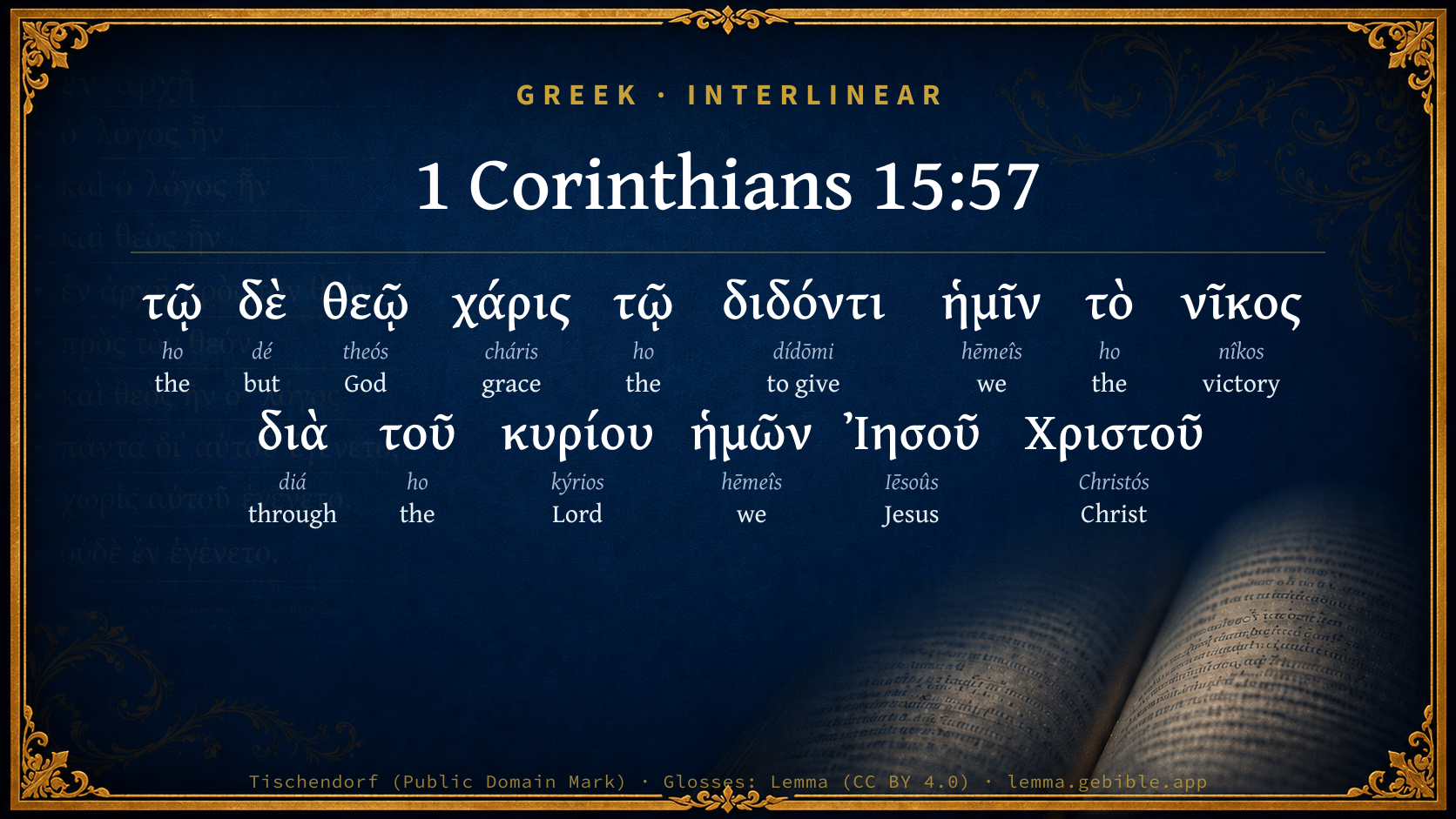
But thanks be to God, who gives us the victory through our Lord Jesus Christ.
World English Bible · Public Domain
Download a study sheet

One document with this verse’s original text, its word-by-word gloss line, the meaning frame, cross-references with their text, attributed commentary, and full source and license credits — printable, and it pastes into notes with its structure intact.

This verse Autodidact and up

Study sheet (.html) Plain text (.txt)

A passage Seminary Student

Up to 50 verses in one chapter. A passage sheet keeps up to 6 commentary sources and 12 cross-references per verse, in the order this page ranks them, and says so on the sheet whenever that leaves anything out. Ask for a single verse and you get the Autodidact verse sheet above.

Everything on this page stays free to read, with no account — the sheet is a download of what is already on screen, not access to it.

Want to remove ads? Support Godless Engineer
Compare translations 3

The same verse in 3 English versions, stacked beneath the original-language interlinear above. Click any original word for its lexicon entry.

Each is an independent rendering of the whole verse — the interlinear is not word-aligned to these translations.

Highlighted words mark where these versions differ — a whole-verse word diff, not a word-by-word alignment.

  • World English Bible Public Domain
    But thanks be to God, who gives us the victory through our Lord Jesus Christ.
  • King James Version Public Domain
    But thanks be to God, which giveth us the victory through our Lord Jesus Christ.
  • unfoldingWord Literal Text CC BY-SA 4.0
    But thanks to God, the one giving us the victory through our Lord Jesus Christ!

unfoldingWord Literal Text — © unfoldingWord, licensed CC BY-SA 4.0. Word-aligned USFM3 via Door43 (git.door43.org/unfoldingWord/en_ult).

Versions to compare (up to 4)

3 of 4 selected

Show all 19 translations

Every available English version of this verse, each an independent rendering of the whole verse.

  • World English Bible Public Domain
    But thanks be to God, who gives us the victory through our Lord Jesus Christ.
  • Berean Standard Bible Public Domain
    But thanks be to God, who gives us the victory through our Lord Jesus Christ!
  • Majority Standard Bible Public Domain
    But thanks be to God, who gives us the victory through our Lord Jesus Christ!
  • King James Version Public Domain
    But thanks be to God, which giveth us the victory through our Lord Jesus Christ.
  • American Standard Version (1901) Public Domain
    but thanks be to God, who giveth us the victory through our Lord Jesus Christ.
  • Revised Version (1885) Public Domain
    but thanks be to God, which giveth us the victory through our Lord Jesus Christ.
  • Geneva Bible (1599) Public Domain
    But thankes be vnto God, which hath giuen vs victorie through our Lord Iesus Christ.
  • Douay-Rheims (1899) Public Domain
    But thanks be to God, who hath given us the victory through our Lord Jesus Christ.
  • Young's Literal Translation Public Domain
    and to God -- thanks, to Him who is giving us the victory through our Lord Jesus Christ;
  • Literal Standard Version CC BY-SA 4.0
    and to God—thanks, to Him who is giving us the victory through our Lord Jesus Christ;
  • Unlocked Literal Bible CC BY-SA 4.0
    But thanks be to God, who gives us the victory through our Lord Jesus Christ!
  • unfoldingWord Literal Text CC BY-SA 4.0
    But thanks to God, the one giving us the victory through our Lord Jesus Christ!
  • Darby Bible Public Domain
    but thanks to God, who gives us the victory by our Lord Jesus Christ.
  • World Messianic Bible Public Domain
    But thanks be to God, who gives us the victory through our Lord Yeshua the Messiah.
  • Webster's Bible Public Domain
    But thanks be to God, who giveth us the victory, through our Lord Jesus Christ.
  • Free Bible Version CC BY-SA 4.0
    but praise God who gives us the victory through our Lord Jesus Christ.
  • Bible in Basic English Public Domain
    But praise be to God who gives us strength to overcome through our Lord Jesus Christ.
  • Text-Critical English NT CC BY 4.0
    But thanks be to God, who gives us victory through our Lord Jesus Christ.
  • Tyndale New Testament (1534) Public Domain
    But thankes be vnto God which hath geven vs victory thorow oure Lorde Iesus Christ.

Literal Standard Version (2020), Covenant Press — licensed CC BY-SA 4.0. Text via the HelloAO Bible API (eBible.org). Unlocked Literal Bible (unfoldingWord) — licensed CC BY-SA 4.0. Text via the HelloAO Bible API (eBible.org). unfoldingWord Literal Text — © unfoldingWord, licensed CC BY-SA 4.0. Word-aligned USFM3 via Door43 (git.door43.org/unfoldingWord/en_ult). Free Bible Version, Dr. Jonathan Gallagher — licensed CC BY-SA 4.0. Text via the HelloAO Bible API (eBible.org).

Word by word

More ways to search: Search by grammar → Find every occurrence → Compare this word →

Practice this passage: Drill this verse → Learn its vocabulary →

νῖκος
nîkos
G3534
“victory”
Noun, Accusative, Singular, Neuter
Part of Speech
Noun
Case
Accusative
Number
Singular
Gender
Neuter
Full Thayer's Definition

Origin: from G3529

TDNT: 19:42,6

1. victory 2. to utterly vanquish
  1. τῷ ho G3588 “the” Article, Dative, Singular, Masculine
  2. δὲ dé G1161 “but” Conjunction
  3. θεῷ theós G2316 “God” Noun, Dative, Singular, Masculine
  4. χάρις cháris G5485 “grace” Noun, Nominative, Singular, Feminine
  5. τῷ ho G3588 “the” Article, Dative, Singular, Masculine
  6. διδόντι dídōmi G1325 “to give” Verb, Present, Active, Participle, Dative, Singular, Masculine
  7. ἡμῖν hēmeîs G2249 “we” Personal pronoun, 1st person, Dative, Plural
  8. τὸ ho G3588 “the” Article, Accusative, Singular, Neuter
  9. διὰ diá G1223 “through” Preposition
  10. τοῦ ho G3588 “the” Article, Genitive, Singular, Masculine
  11. κυρίου kýrios G2962 “Lord” Noun, Genitive, Singular, Masculine
  12. ἡμῶν hēmeîs G2249 “we” Personal pronoun, 1st person, Genitive, Plural
  13. Ἰησοῦ Iēsoûs G2424 “Jesus” Noun, Genitive, Singular, Masculine
  14. Χριστοῦ Christós G5547 “Christ” Noun, Genitive, Singular, Masculine

About this verse

These counts appear in no published source. They are computed here, from the morphology-tagged text and Lemma’s own curated glosses. What Lemma adds →

15
words
11
distinct lemmas
Pauline Epistles
section

Notable vocabulary

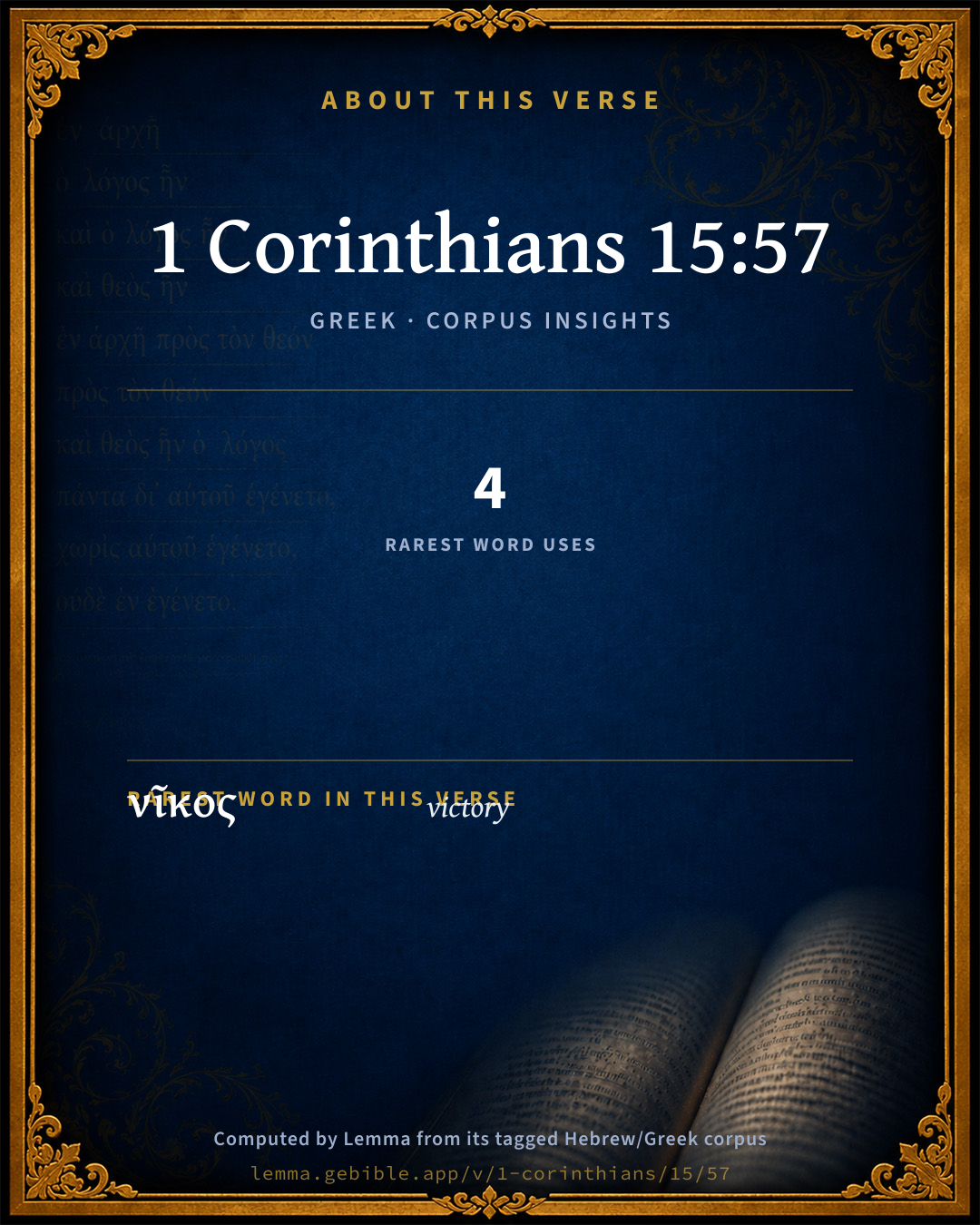
The rarest word here is νῖκος victory G3534 — appearing just 4 times in the whole Greek New Testament.

Shared distinctive vocabulary

νῖκος victory G3534 occurs in 4 verses of the Greek New Testament. Also found in:

Repetition

Words recur within this verse:

Cross-references

16

Topical passages linked to 1 Corinthians 15:57 in the Treasury of Scripture Knowledge — connected by theme and wording, ordered by reader-vote popularity; previews shown in the World English Bible.

  • 2 Corinthians 2:14 Now thanks be to God, who always leads us in triumph in Christ, and reveals through us the sweet aroma of his knowledge in every place.
  • Romans 8:37 No, in all these things, we are more than conquerors through him who loved us.
  • 1 John 5:4–5 For whatever is born of God overcomes the world. This is the victory that has overcome the world: your faith.
  • Proverbs 21:31 The horse is prepared for the day of battle; But victory is with Yahweh.
  • Revelation 12:11 They overcame him because of the Lamb's blood, and because of the word of their testimony. They didn't love their life, even to death.
  • John 16:33 I have told you these things, that in me you may have peace. In the world you have oppression; but cheer up! I have overcome the world."
  • 2 Corinthians 9:15 Now thanks be to God for his unspeakable gift!
  • Psalms 98:1 Sing to Yahweh a new song, For he has done marvelous things! His right hand, and his holy arm, have worked salvation for him.
  • Revelation 15:2–3 I saw something like a sea of glass mixed with fire, and those who overcame the beast, his image, and the number of his name, standing on the sea of glass, having harps of God.
  • Romans 7:25 I thank God through Jesus Christ, our Lord! So then with the mind, I myself serve God's law, but with the flesh, the sin's law.
  • Ephesians 5:20 giving thanks always concerning all things in the name of our Lord Jesus Christ, to God, even the Father;
  • 1 Chronicles 22:11 Now, my son, Yahweh be with you; and prosper you, and build the house of Yahweh your God, as he has spoken concerning you.
  • 1 Corinthians 15:51 Behold, I tell you a mystery. We will not all sleep, but we will all be changed,
  • 2 Corinthians 1:11 you also helping together on our behalf by your supplication; that, for the gift bestowed on us by means of many, thanks may be given by many persons on your behalf.
  • 2 Kings 5:1 Now Naaman, captain of the host of the king of Syria, was a great man with his master, and honorable, because by him Yahweh had given victory to Syria: he was also a mighty man of valor, [but he was] a leper.
  • Acts 27:35 When he had said this, and had taken bread, he gave thanks to God in the presence of all, and he broke it, and began to eat.

Cross-references courtesy of OpenBible.info (CC BY 4.0).

Commentary

Notes on 1 Corinthians 15:57 from classic Christian and Jewish commentators (each source and its license shown beneath its notes). The classic Christian expositions comment on the surrounding passage and are grouped to its opening verse, so a note may address several verses; the Jewish commentaries on the Tanakh (Rashi and others) are per-verse, so they appear only where the commentator wrote on this verse.

Lemma curates 59 commentaries, every one of them public domain or Creative Commons licensed, each selected and text-cleaned for this edition rather than reprinted as found. About our sources →

Tyndale Open Study Notes

Tyndale Open Resources

15:57 The death and resurrection of Christ ends the dominating power of sin and death (see Rom 6:14; 8:2; 10:4).

Tyndale Open Study Notes — © Tyndale Open Resources, licensed CC BY-SA 4.0. Text via the HelloAO Bible API.

Bengel's Gnomon

Johann Albrecht Bengel

1Co 15:57. Τῷ δὲ Θεῷ χάρις, but thanks be to God) It had not been of our accomplishment [in our power to effect].—δὲ, but) Although both the law and sin, and death and hell, opposed us, yet we have overcome. This is the sentiment; but the mode or ἦθος, [expression of feeling] is added, thanks be to God.—τῷ διδόντι,[150] who gives) the present, to suit the state of believers.[151]—ΤῸ ΝῖΚΟς, the victory) a repetition, suitable to the triumph: death and hell had aimed at the victory.—Χριστοῦ, Christ) in the faith of whom, we [being dead], dying to the law, have obtained life, 1Co 15:3 and following verses.

[150] Διδόντι is read by ABCGg. But D (Λ) f Vulg. δόντι.—ED.

[151] Nevertheless both the margin of the 2d Ed. and the Germ. Ver., prefer the reading δόντι, and therefore the past tense.—E. B.

Bengel's Gnomon of the New Testament — English translation (T&T Clark, Edinburgh, 1860) — public domain. Text from a community e-Sword module.

Hodge's Commentary on Romans, Ephesians & First Corinthians

Charles Hodge

1Co_15:57

But thanks (be) to God, which giveth us the victory through our Lord Jesus Christ.

The victory here meant is, of course, the victory over death and the grave. Thanks be to God, who delivers us from the power of death, redeeming even our bodies from the grave, and making us partakers of everlasting life. This is done through Jesus Christ our Lord, i.e. our divine possessor and absolute ruler. It is through him, and through him alone.

1. Because he has satisfied the demands of the law. It has no power to condemn those who are clothed in his righteousness. There is no condemnation to those who are in Christ Jesus, Rom_8:1. Who shall lay any thing to the charge of Gods elect? It is God that justifieth, who is he that condemneth? Rom_8:33, Rom_8:34. Christ by his death hath destroyed him that had the power of death, that is, the devil, and delivered them who through fear of death were all their lifetime subject to bondage, Heb_2:14, Heb_2:15. That is, in virtue of the death of Christ, by which the demands of justice are satisfied, Satan, the great executioner of divine justice, has no longer the right or power to detain the people of Christ under the power of death. If, therefore, it be the law which gives sin its reality and strength, and if sin gives death its sting, he who satisfies the law destroys the strength of sin, and consequently the sting of death. It is thus that Christ deprives death of all power to injure his people. It is for them disarmed and rendered as harmless as an infant.

2. But Christ not only gives us this victory through his justifying righteousness, but by his almighty power, he new creates the soul after the image of God, and, what is here principally intended, he repairs all the evils which death had inflicted. He restores us to that state, and even to more than that state, from which sin had cast us down. He rescues our bodies from the grave, and fashions them like unto his glorious body, even by that power whereby he is able to subdue all things unto himself, Phi_3:21.

Had it not been for Christ, death would have reigned for ever over our fallen race; but thanks be to God, Christ hath given us the victory; so that the believer may even now say, O death, where is thy sting? O grave, where is thy victory?

Charles Hodge — Commentary on Romans (1835), First Corinthians (1857), and Ephesians (1856) — public domain. Text from a community e-Sword module.

Jamieson, Fausset & Brown

Robert Jamieson, A. R. Fausset & David Brown

to God--The victory was in no way due to ourselves (Psa 98:1).

giveth--a present certainty.

the victory--which death and Hades ("the grave") had aimed at, but which, notwithstanding the opposition of them, as well as of the law and sin, we have gained. The repetition of the word (Co1 15:54-55) is appropriate to the triumph gained.

Jamieson, Fausset & Brown — Commentary Critical and Explanatory on the Whole Bible (1871) — public domain (CC PDM 1.0). Text via the HelloAO Bible API.

Adam Clarke's Commentary

Verse 57. But thanks be to God] What the law could not do, because it is law, (and law cannot provide pardon,) is done by the Gospel of our Lord Jesus Christ: he has died to slay death; he has risen again to bring mankind from under the empire of hades. All this he has done through his mere unmerited mercy; and eternal thanks are due to God for this unspeakable gift. He has given us the victory over sin, Satan, death, the grave, and hell.

Adam Clarke's Commentary on the Bible (1810–1826) — public domain. Text from a community e-Sword/MySword module.

Ellicott's Commentary for English Readers

(57) But thanks be to God.—The future is so certain that the Apostle speaks of it as a subject for present thanksgiving; the victory is one which God gives now through Jesus Christ. His resurrection is the pledge of our resurrection. His death is the power by which we are enabled to conquer that lower self, from whose crucifixion and death we shall rise to the higher incorruptible life of the resurrection day. With this earnest and enthusiastic expression of praise to God the argument concludes. Through arguments historical, moral, philosophical; through explanations from the analogy of Nature, and from the theology of Old and New Testament history, the Apostle has led his readers, vindicating the truth and illustrating the manner of the Resurrection of the Dead. He projects his mind into the future, and, standing in thought with ransomed and raised Humanity after death has been vanquished and the grave been spoiled, he joins in the shout of triumphant praise which shall then ascend to Christ and God.

A Bible Commentary for English Readers, edited by Charles John Ellicott (1878–1897) — public domain. Text from a community e-Sword module.

The Cambridge Bible for Schools and Colleges

gen. ed. J. J. S. Perowne

57. But thanks be to God, which giveth us the victory through our Lord Jesus Christ] This sense of having transgressed that righteous law need disturb us no longer. Our shortcomings have been fully atoned for by the Life and Death of Jesus Christ. The mortal part of us must pay the penalty due to sin (Rom_6:23), but the spiritual part remains unsubdued, because it is united to Him Who has fulfilled the law, has taken our condemnation upon Himself, has acknowledged its justice on our behalf, and has enabled us through fellowship with Him to attain to the victory over evil which He Himself has attained.

The Cambridge Bible for Schools and Colleges (gen. ed. J. J. S. Perowne; Cambridge University Press, 1878–1918) — public domain. Text from a community e-Sword module.

Trapp's Complete Commentary

John Trapp

57 But thanks be to God, which giveth us the victory through our Lord Jesus Christ.

Ver. 57. But thanks be to God, &c.] Here St Paul, Christ’s chief herald, proclaims his victory with a world of solemnity and triumph.

John Trapp, A Commentary or Exposition upon All the Books of the Old and New Testament (1647–1656) — public domain. Text from a community e-Sword module.

Albert Barnes' Notes on the Bible

But thanks be to God; - See the notes at Rom 7:25.

Which giveth us the victory - Us who are Christians; all Christians. The victory over sin, death, and the grave. God alone is the author of this victory. He formed the plan; he executed it in the gift of his Son; and he gives it to us personally when we come to die.

Through our Lord Jesus Christ - By his death, thus destroying the power of death; by his resurrection and triumph over the grave; and by his grace imparted to us to enable us to sustain the pains of death, and giving to us the hope of a glorious resurrection; compare the note at Rom 7:25; Rom 8:37.

Albert Barnes' Notes on the Bible (1834–1885) — public domain. Text from a community e-Sword/MySword module.

Matthew Poole's English Annotations

The victory over sin and over death, we have both through the death and the resurrection of our Lord Jesus Christ; who by his death both delivered us from the guilt of sin, and also from the power of sin; and who through death destroyed him who had the power of death, even the devil.

Matthew Poole's English Annotations on the Holy Bible (1683–1685) — public domain. Text from a community e-Sword/MySword module.

Whedon's Commentary on the Bible

Daniel D. Whedon

57. But—There is one who has satisfied the law; has thence taken out the strength of sin; thence destroyed the sting of death; and so wrought the resurrection. This exposition shows that the reference to the law is logically in the straight line of Paul’s argument. It shows, we think, the infelicity of Stanley’s remark: “It seems as if he could not mention sin, without adding that the strength of sin is the law.” As if the apostle’s pen, like a garrulous man’s tongue, ran on its own account in the grooves of habit, loose from brain or thought. Yet it is a pertinent remark of Stanley’s, that this apparently “is the germ of what is afterwards fully developed in Rom_5:12-21; Rom_7:7-24.” And Rom_7:25 is an echo of this verse.

The victory—That over hades, in 1Co_15:55, by the resurrection, through our Lord Jesus Christ.

Daniel D. Whedon (gen. ed.), Commentary on the Old and New Testaments (1874–1909) — public domain. Text from a community e-Sword module.

The Pulpit Commentary

Thanks be to God, which giveth us the victory. The victory consists in the defeat of death by the Resurrection, and the forgiveness of sin through Christ"s atone-merit, and the nailing to his cross of the torn and abrogated Law which made us slaves to sin and death. (Col_2:14) "In all these things we are more than conquerors through him that loved us". (Rom_8:37) Through our Lord Jesus Christ. Who, by fulfilling the Law, has robbed it of its condemning power, (Rom_8:1) and by his death "hath destroyed him that had the power of death, that is the devil". (Heb_2:14, Heb_2:15)

The Pulpit Commentary (1880–1919), ed. H.D.M. Spence-Jones & Joseph S. Exell — public domain. Text from a community e-Sword module.

John Wesley's Explanatory Notes

But thanks be to God, who hath given us the victory - Over sin, death, and hades.

John Wesley, Explanatory Notes Upon the Whole Bible (1754–1765) — public domain. Text via the GEBible commentary corpus.

Burkitt's Expository Notes on the New Testament

William Burkitt

But thanks be to God, which giveth us the victory-- Over sin, death, and the law.

Through our Lord Jesus Christ. That is, through the death and resurrection of our Lord Jesus Christ.

Observe here, 1. An enemy encountered, death: death armed by sin, and strengthened by the law. . This is often a surprising enemy, an amazing enemy, a spoiling and destroying enemy, an inevitable and unavoidable enemy.

Observe, 2. Victory over this enemy declared: the destruction of death, as to its terror and power. Death is overcome. But how? Non ut ne sit, but ut non obsit; not that it should not be, but that it should not hurt. Death has lost its sting, that it cannot annoy; it has lost its terror, that it cannot amaze; it has lost its power, that it cannot destroy.

Observe, 3. The victors or conquerors over this enemy--who are first Christ, and then all that are Christ’s, all that harvest of which Christ is the first-fruits.

Observe, 4. The triumph proclaimed, Thanks be to God which giveth us the victory.

From the whole learn, That all believers are victorious over death, through our Lord Jesus Christ. They may triumph over death through Christ, because he has disarmed it by his death and satisfaction, he has destroyed it by his resurrection; and Christ’s victories become the believer’s by participation and communion with him. As they communicate with him in the value of his satisfaction, so they communicate with him in the virtue of his resurrection.

Let us therefore triumph with the apostle, and say, Thanks be to God; with the prophet, Awake and sing, ye that dwell in the dust. Thus victory was won by Christ, it is won by us; it was dear to Christ: it is cheap to us: we overcome, but it is by the blood of the Lamb. Let us therefore, living and dying, say, Thanks be to God, who giveth us the victory, through our Lord Jesus Christ.

William Burkitt's Expository Notes on the New Testament (1700–1703) — public domain. Text from a community e-Sword module.

Godbey's Commentary on the New Testament

William B. Godbey

57. “Thanks be unto God, who giveth us the victory through our Lord Jesus Christ.” This victory comes when we receive the glorious sanctifying power, which takes away the sin-principle, thus utterly and eternally disarming death of all his terrors.

William B. Godbey, Commentary on the New Testament (1896–1900) — public domain. Text from a community e-Sword module.

McGarvey & Pendleton's Commentaries

J. W. McGarvey

but thanks be to God [ Psa_98:1 ], who giveth us the victory through our Lord Jesus Christ . [Death is here spoken of under the figure of a serpent. Sin is the bite or sting with which he slays men, and the power or poisonous strength of sin is found in the curse which the law pronounces upon the sinner. By the triple power of law, sin and death, the glory of man was brought to nought; but thanks are due to God, who restored glory to man through Jesus Christ. Christ gave man the victory over the law, for he nailed it to his cross ( Col_2:14 ); he gave him victory over sin, for he made atonement for sin ( Heb_7:27 ); and he gave him victory over death by his resurrection, which is the earnest of the general resurrection. Wonderful threefold victory!]

J. W. McGarvey (with Philip Y. Pendleton), Commentaries on the New Testament (The Fourfold Gospel, 1914; Acts; and the epistles) — public domain. Text from a community e-Sword/MySword module.

The People's New Testament

B. W. Johnson

57. Thanks be to God. For the victory over sin and death through Christ.

B. W. Johnson's The People's New Testament with Notes (1889–1891) — public domain. Electronic text from the Christian Classics Ethereal Library (CCEL) ThML edition.

Cambridge Greek Testament for Schools and Colleges

57. τῷ διδόντι ἡμῖν τὸ νῖκος. This sense of having transgressed that righteous law need disturb us no longer. Our shortcomings have been fully atoned for by the Life and Death of Jesus Christ and by our participation first in that Death, and next in that Life. The mortal part of us must pay the penalty due to sin (Rom 6:23), but the spiritual part remains unaffected by that punishment, because it is united to Him Who has fulfilled the law, has taken our condemnation upon Himself, has acknowledged its justice on our behalf, and has enabled us through fellowship with Him to attain to the victory over evil which He Himself has attained. To that spiritual part God ‘giveth a body as it pleaseth him,’ and to every man a body of his own. See 1Co 15:38. διδόντι is usually explained as referring to the certainty of the gift. But it is perhaps better to refer it to its continuousness. He is now giving us the victory, and therein we have an earnest of its future endurance. Cf. 1Jn 5:4-5; Rev 2:7, &c.

Cambridge Greek Testament for Schools and Colleges (Cambridge University Press, 1896; 21 vols, various authors incl. Carr, Maclear, Plummer, Farrar, Lumby, Moule, M. R. James, Simcox) — public domain. Text from a community e-Sword module.

Alford’s Greek Testament

Henry Alford

57.] For this blessed consummation of victory over death, he breaks out in thanks to God, who gives it to us (present, as being certain) through our Lord Jesus Christ (the Name in full, as befits the solemnity and majesty of the thanksgiving).

Henry Alford, The Greek Testament (1849–1861) — public domain. Text from a community e-Sword module.

International Critical Commentary

57. τῷ δὲ Θεῷ χάρις. Sudden transition to thanksgiving, as in 2Co 2:14; Rom 7:25; 1Ti 1:17.

τῷ διδόντι ἡμῖν τὸ νῖκος. Pres, partic.; ‘Who is giving us the victory’: it is a process which is continually going on, as Christians appropriate what has been won for them by Christ, and in His strength conquer sin; 2Co 12:9; 1Th 4:8; comp. Rom 8:37* Quite naturally, St Paul retains the rarer form νῖκος, which has already been used (vv. 54, 55). In LXX, νῖκος is nearly as common as νίκη (1Jn 5:4).

International Critical Commentary — older volumes (1896–1929), various authors — public domain. Text from a community e-Sword module.

Vincent's Word Studies in the New Testament

Marvin R. Vincent

Giveth. The present participle marking the certainty of the future victory. 135 Contrast Sir Walter Raleigh's words in concluding his "History of the World." " It is therefore Death alone that can make any man suddenly know himself. He tells the proud and insolent that they are but abjects, and humbles them at the instant; makes them cry, complain, and repent; yea, even to hate their forepassed happiness. He takes the account of the rich, and proves him a beggar - a naked beggar - which hath interest in nothing, but in the gravel that fills his mouth. He holds a glass before the eyes of the most beautiful, and makes them see therein their deformity and rottenness; and they acknowledge it.

"O eloquent, just and mighty Death ! whom none could advise, thou hast persuaded; what none hath dared, thou hast done; and whom all the world hath flattered, thou only hast cast out of the world and despised. Thou hast drawn together all the far - stretched greatness, all the pride, cruelty, and ambition of man; and covered it all over with these two narrow words : HIC JACET."

Marvin R. Vincent, Word Studies in the New Testament (1887–1900) — public domain. Text from a community e-Sword/MySword module.

Godet's Commentaries

Frédéric Louis Godet

Vv. 57. “But thanks to God, which giveth us the victory through our Lord Jesus Christ!” — Christ’s victory over death has two aspects: the one relating to Himself; the other concerning men. He first of all conquered sin in relation to Himself by denying to it the right of existence in Him, condemning it to non-existence in His flesh, similar though it was to our sinful flesh (Rom 8:3); and thereby He disarmed the law so far as it concerned Himself. His life being the law in living realization, He had it for Him and not against Him. This twofold personal victory was the foundation of His own resurrection. Thereafter He continued to act that this victory might extend to us. And first He freed us from the burden of condemnation which the law laid on us, and whereby it was ever interposing between us and communion with God. He recognised in our name the right of God over the sinner, He consented to satisfy it to the utmost in His own person. Whoever appropriates this death as undergone in his room and stead and for himself, sees the door of reconciliation to God open before him, as if he had himself expiated all his sins. The separation established by the law no longer exists; the law is disarmed. By that very fact sin also is vanquished. Reconciled to God, the believer receives Christ’s Spirit, who works in him an absolute breach of will with sin and complete devotion to God. The yoke of sin is at an end; the dominion of God is restored in the heart. The two foundations of the reign of death are thus destroyed. Let Christ appear, and this reign will crumble in the dust for ever. Thus is fulfilled the saying of the apostle, 1Co 15:21 : “By man came death; by man cometh the resurrection.” Resurrection is a human work, no less than death itself. It should be remarked that the apostle does not say: gave, but: “giveth us the victory.” Here he is not thinking only of the objective victory which Christ gained once for all in His person, for Himself and us; but of that which He gains daily in believers for whose resurrection He paves the way by destroying the power of the law, which condemns, and that of sin, which leads astray.

It only remains for the apostle to draw from the solemn situation thus described a practical conclusion. This is what he does in few words in 1Co 15:58.

Frédéric Louis Godet — Commentaries on Luke, John, Romans, and 1 Corinthians — English translation (T&T Clark, Edinburgh, 1870s–1890s) — public domain. Text from a community e-Sword module.

Lesson kit

Teaching starters — assembled from the data on this page, not authored interpretation. Every prompt links to the verse data it draws on. Edit before teaching.

1 Corinthians, in the Pauline Epistles, opens this verse with 15 words (11 distinct Greek lemmas). Its most distinctive word is nîkos (“victory”). A historical commentator’s framing appears above. Read the whole chapter for the surrounding context.

Discussion questions

  1. The word nîkos carries the sense “victory.” How does it shape the verse?
  2. How does Matthew 12:20, which shares the word «victory», read alongside this verse?
  3. What does the repetition of “the” (4× in this one verse) do in this verse?
  4. These translations render this verse differently; the difference is in the English rendering, not the original. What questions does that raise?
  5. Compare how Tyndale Open Study Notes and Bengel's Gnomon read this verse. Where do they agree or differ?

Things to notice

Reading settings

Reading text

Shown beneath each verse's original-language words.

Old Testament
Old Testament edition

Read the OT as the Masoretic Hebrew (MT) or the Greek Septuagint (LXX).

English shown for the Greek Septuagint (in the Hebrew ↔ Greek comparison).

Comparing translations? Open the Compare panel on any verse page to stack up to four side by side.