
1 Corinthians 15:19

Greek (Tischendorf 8th ed.) 1 Corinthians 15:19 appears in the Greek New Testament. The text above is from the Tischendorf 8th edition. Each word links to its Strong’s number and a concise gloss. Click any word for its full Thayer’s Greek Lexicon entry.
Download image
Cite this verse

1 Corinthians 15:19 (World English Bible). Public Domain. Lemma interlinear Bible study tool, https://lemma.gebible.app/v/1-corinthians/15/19.

Show BibTeX & RIS
BibTeX
RIS
English Translation
If we have only hoped in Christ in this life, we are of all men most pitiable.
World English Bible · Public Domain
Highlights
  • 1 first appearance in the Greek New Testament
Full analysis ↓
Download a study sheet

One document with this verse’s original text, its word-by-word gloss line, the meaning frame, cross-references with their text, attributed commentary, and full source and license credits — printable, and it pastes into notes with its structure intact.

This verse Autodidact and up

Study sheet (.html) Plain text (.txt)

A passage Seminary Student

Up to 50 verses in one chapter. A passage sheet keeps up to 6 commentary sources and 12 cross-references per verse, in the order this page ranks them, and says so on the sheet whenever that leaves anything out. Ask for a single verse and you get the Autodidact verse sheet above.

Everything on this page stays free to read, with no account — the sheet is a download of what is already on screen, not access to it.

Want to remove ads? Support Godless Engineer
Compare translations 3

The same verse in 3 English versions, stacked beneath the original-language interlinear above. Click any original word for its lexicon entry.

Each is an independent rendering of the whole verse — the interlinear is not word-aligned to these translations.

Highlighted words mark where these versions differ — a whole-verse word diff, not a word-by-word alignment.

  • World English Bible Public Domain
    If we have only hoped in Christ in this life, we are of all men most pitiable.
  • King James Version Public Domain
    If in this life only we have hope in Christ, we are of all men most miserable.
  • unfoldingWord Literal Text CC BY-SA 4.0
    If only in this life we have hope in Christ, of all people we are most pitiful.

unfoldingWord Literal Text — © unfoldingWord, licensed CC BY-SA 4.0. Word-aligned USFM3 via Door43 (git.door43.org/unfoldingWord/en_ult).

Versions to compare (up to 4)

3 of 4 selected

Show all 19 translations

Every available English version of this verse, each an independent rendering of the whole verse.

  • World English Bible Public Domain
    If we have only hoped in Christ in this life, we are of all men most pitiable.
  • Berean Standard Bible Public Domain
    If our hope in Christ is for this life alone, we are to be pitied more than all men.
  • Majority Standard Bible Public Domain
    If our hope in Christ is for this life alone, we are to be pitied more than all men.
  • King James Version Public Domain
    If in this life only we have hope in Christ, we are of all men most miserable.
  • American Standard Version (1901) Public Domain
    If we have only hoped in Christ in this life, we are of all men most pitiable.
  • Revised Version (1885) Public Domain
    If in this life only we have hoped in Christ, we are of all men most pitiable.
  • Geneva Bible (1599) Public Domain
    If in this life onely wee haue hope in Christ, we are of all men the most miserable.
  • Douay-Rheims (1899) Public Domain
    If in this life only we have hope in Christ, we are of all men most miserable.
  • Young's Literal Translation Public Domain
    if in this life we have hope in Christ only, of all men we are most to be pitied.
  • Literal Standard Version CC BY-SA 4.0
    if we only have hope in Christ in this life, we are to be most pitied of all men.
  • Unlocked Literal Bible CC BY-SA 4.0
    If only in this life we have hope in Christ, of all people we are most to be pitied.
  • unfoldingWord Literal Text CC BY-SA 4.0
    If only in this life we have hope in Christ, of all people we are most pitiful.
  • Darby Bible Public Domain
    If in this life only we have hope in Christ, we are [the] most miserable of all men.
  • World Messianic Bible Public Domain
    If we have only hoped in Messiah in this life, we are of all men most pitiable.
  • Webster's Bible Public Domain
    If in this life only we have hope in Christ, we are of all men most miserable.
  • Free Bible Version CC BY-SA 4.0
    If our hope in Christ is only for this life, we're the most pitiful people of all!
  • Bible in Basic English Public Domain
    If in this life only we have hope in Christ, we are of all men most unhappy.
  • Text-Critical English NT CC BY 4.0
    If for this life only we have hoped in Christ, we are of all people most to be pitied.
  • Tyndale New Testament (1534) Public Domain
    If in this lyfe only we beleve on christ then are we of all men the miserablest.

Literal Standard Version (2020), Covenant Press — licensed CC BY-SA 4.0. Text via the HelloAO Bible API (eBible.org). Unlocked Literal Bible (unfoldingWord) — licensed CC BY-SA 4.0. Text via the HelloAO Bible API (eBible.org). unfoldingWord Literal Text — © unfoldingWord, licensed CC BY-SA 4.0. Word-aligned USFM3 via Door43 (git.door43.org/unfoldingWord/en_ult). Free Bible Version, Dr. Jonathan Gallagher — licensed CC BY-SA 4.0. Text via the HelloAO Bible API (eBible.org).

Word by word

More ways to search: Search by grammar → Find every occurrence → Compare this word →

Practice this passage: Drill this verse → Learn its vocabulary →

ἐλεεινότεροι
eleeinós
G1652
“to be miserable”
Adjective, Nominative, Plural, Masculine, Comparative
Part of Speech
Adjective
Case
Nominative
Number
Plural
Gender
Masculine
Degree
Comparative
Full Thayer's Definition

Origin: from G1656

TDNT: None

1. to be pitied, miserable
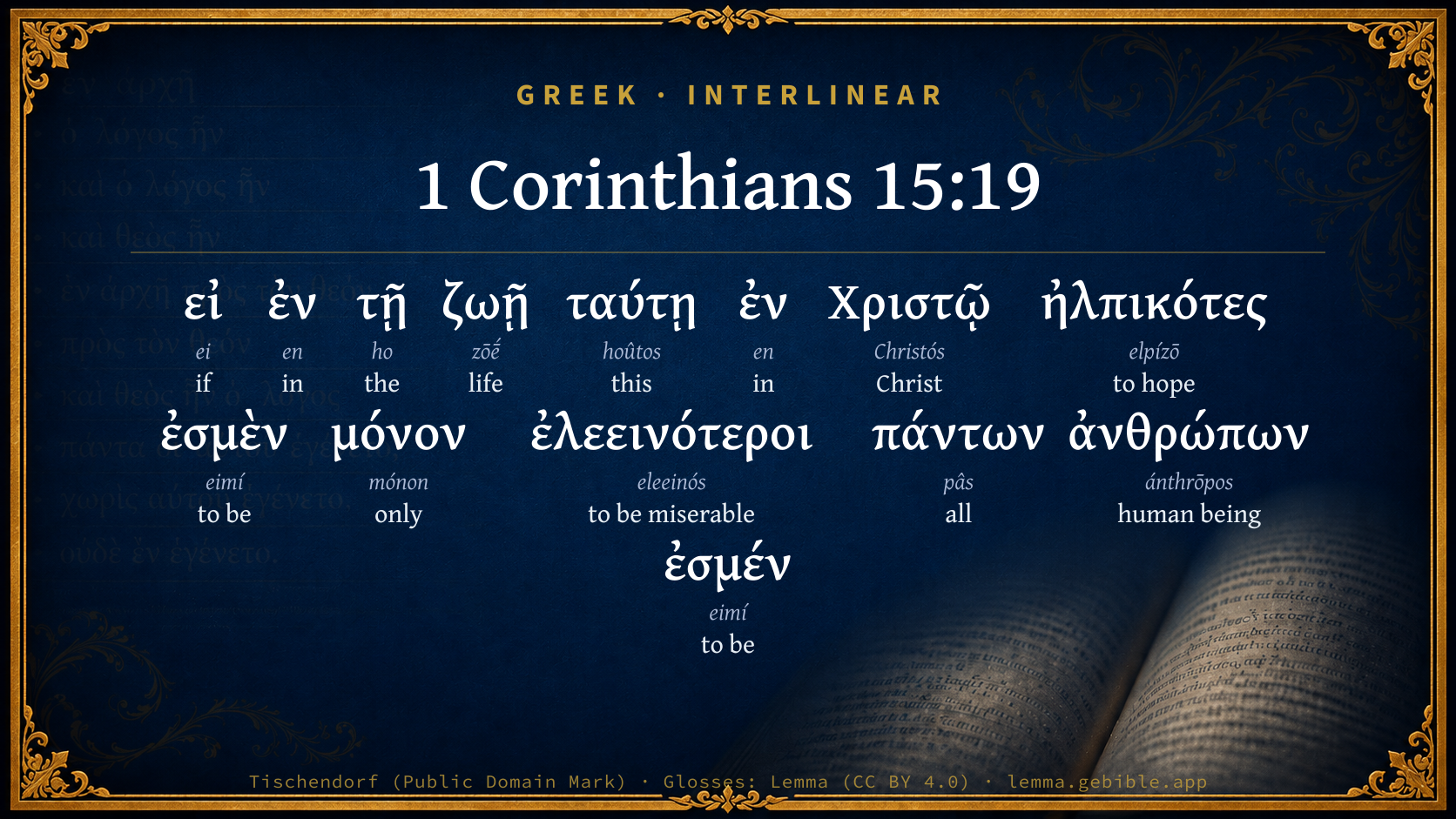
  1. εἰ ei G1487 “if” Conditional
  2. ἐν en G1722 “in” Preposition
  3. τῇ ho G3588 “the” Article, Dative, Singular, Feminine
  4. ζωῇ zōḗ G2222 “life” Noun, Dative, Singular, Feminine
  5. ταύτῃ hoûtos G3778 “this” Demonstrative pronoun, Dative, Singular, Feminine
  6. ἐν en G1722 “in” Preposition
  7. Χριστῷ Christós G5547 “Christ” Noun, Dative, Singular, Masculine
  8. ἠλπικότες elpízō G1679 “to hope” Verb, Perfect, Active, Participle, Nominative, Plural, Masculine
  9. ἐσμὲν eimí G1510 “to be” Verb, Present, Active, Indicative, 1st person, Plural
  10. μόνον mónon G3440 “only” Adverb
  11. πάντων pâs G3956 “all” Adjective, Genitive, Plural, Masculine
  12. ἀνθρώπων ánthrōpos G444 “human being” Noun, Genitive, Plural, Masculine
  13. ἐσμέν eimí G1510 “to be” Verb, Present, Active, Indicative, 1st person, Plural

About this verse

These counts appear in no published source. They are computed here, from the morphology-tagged text and Lemma’s own curated glosses. What Lemma adds →

14
words
12
distinct lemmas
Pauline Epistles
section

Notable vocabulary

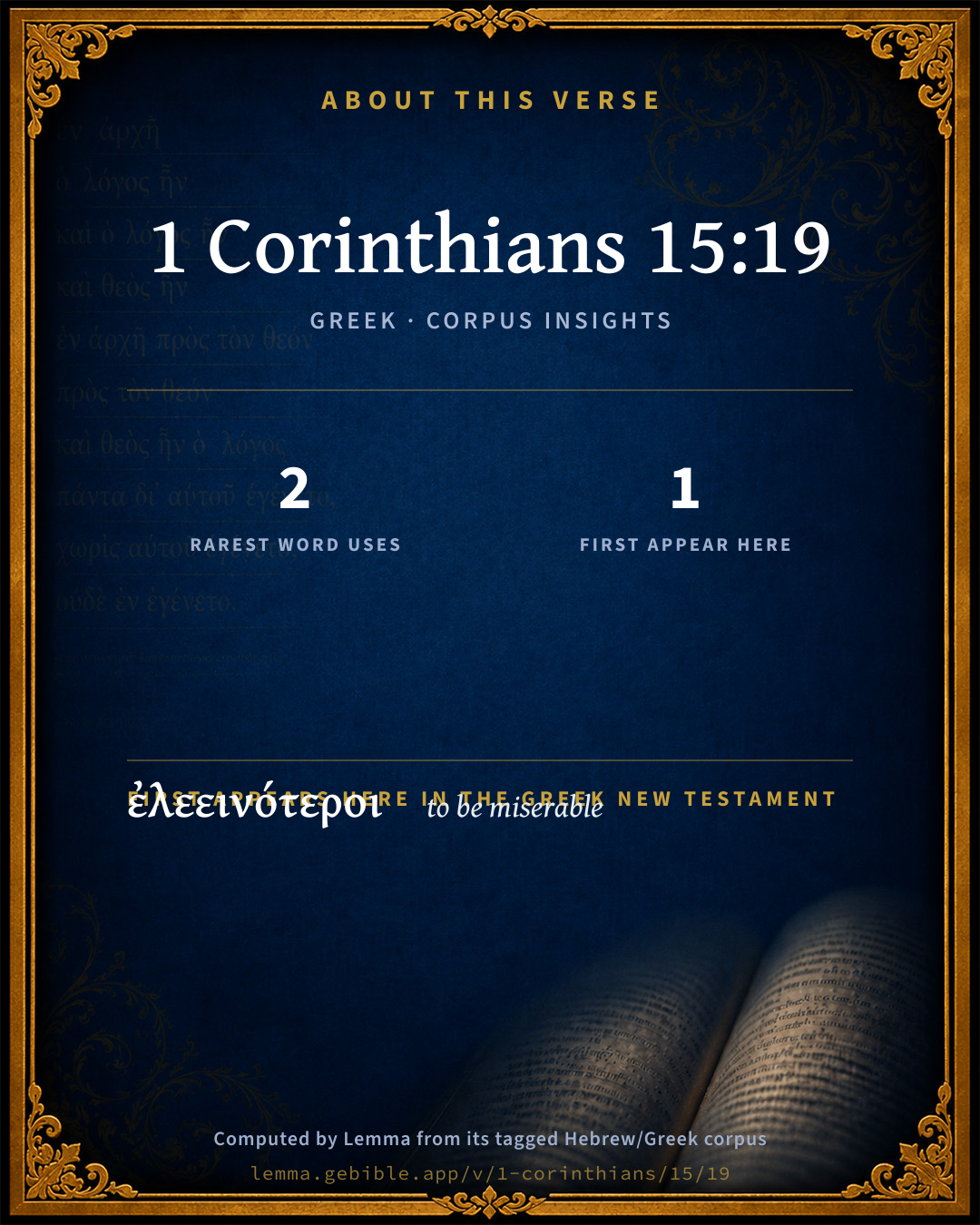
The rarest word here is ἐλεεινότεροι to be miserable G1652 — appearing just 2 times in the whole Greek New Testament.

First appearance in Scripture

This word makes its first canonical appearance in the Greek New Testament here:

  • ἐλεεινότεροι to be miserable G1652

Shared distinctive vocabulary

ἐλεεινότεροι to be miserable G1652 occurs in 2 verses of the Greek New Testament. Also found in:
Repetition

Words recur within this verse:

Cross-references

19

Topical passages linked to 1 Corinthians 15:19 in the Treasury of Scripture Knowledge — connected by theme and wording, ordered by reader-vote popularity; previews shown in the World English Bible.

  • 1 Peter 1:21 who through him are believers in God, who raised him from the dead, and gave him glory; so that your faith and hope might be in God.
  • Revelation 14:13 I heard the voice from heaven saying, "Write, 'Blessed are the dead who die in the Lord from now on.'" "Yes," says the Spirit, "that they may rest from their labors; for their works follow with them."
  • 2 Timothy 1:12 For this cause I suffer also these things. Yet I am not ashamed, for I know him whom I have believed, and I am persuaded that he is able to guard that which I have committed to him against that day.
  • 1 Corinthians 4:9–13 For, I think that God has displayed us, the apostles, last of all, like men sentenced to death. For we are made a spectacle to the world, both to angels and men.
  • 2 Timothy 3:12 Yes, and all who desire to live godly in Christ Jesus will suffer persecution.
  • Acts 14:22 confirming the souls of the disciples, exhorting them to continue in the faith, and that through many afflictions we must enter into the Kingdom of God.
  • Luke 21:34 "So be careful, or your hearts will be loaded down with carousing, drunkenness, and cares of this life, and that day will come on you suddenly.
  • Luke 8:14 That which fell among the thorns, these are those who have heard, and as they go on their way they are choked with cares, riches, and pleasures of life, and bring no fruit to maturity.
  • John 16:33 I have told you these things, that in me you may have peace. In the world you have oppression; but cheer up! I have overcome the world."
  • Ephesians 1:12–13 to the end that we should be to the praise of his glory, we who had before hoped in Christ:
  • Ecclesiastes 6:11 For there are many words that create vanity. What does that profit man?
  • Matthew 10:21–25 "Brother will deliver up brother to death, and the father his child. Children will rise up against parents, and cause them to be put to death.
  • Matthew 24:9 Then they will deliver you up to oppression, and will kill you. You will be hated by all of the nations for my name's sake.
  • 1 Thessalonians 1:3 remembering without ceasing your work of faith and labor of love and patience of hope in our Lord Jesus Christ, before our God and Father.
  • Psalms 17:14 From men by your hand, Yahweh, From men of the world, whose portion is in this life. You fill the belly of your cherished ones. Your sons have plenty, And they store up wealth for their children.
  • John 16:2 They will put you out of the synagogues. Yes, the time comes that whoever kills you will think that he offers service to God.
  • 1 Corinthians 6:3–4 Don't you know that we will judge angels? How much more, things that pertain to this life?
  • 2 Timothy 2:4 No soldier on service entangles himself in the affairs of life, that he may please him who enrolled him as a soldier.
  • Ecclesiastes 9:9 Live joyfully with the wife whom you love all the days of your life of vanity, which he has given you under the sun, all your days of vanity: for that is your portion in life, and in your labor in which you labor under the sun.

Cross-references courtesy of OpenBible.info (CC BY 4.0).

Commentary

Notes on 1 Corinthians 15:19 from classic Christian and Jewish commentators (each source and its license shown beneath its notes). The classic Christian expositions comment on the surrounding passage and are grouped to its opening verse, so a note may address several verses; the Jewish commentaries on the Tanakh (Rashi and others) are per-verse, so they appear only where the commentator wrote on this verse.

Lemma curates 59 commentaries, every one of them public domain or Creative Commons licensed, each selected and text-cleaned for this edition rather than reprinted as found. About our sources →

The Biblical Illustrator

Joseph S. Exell

1Co_15:19

If in this life only we have hope in Christ, we are of all men most miserable.

Observe

I. What is implied.

1. That all men are miserable.

2. In different degrees, but are comforted by hope.

II. What is assumed.

1. That our hope in Christ is false.

2. That it only extends to this life.

III. What is hypothetically asserted. That in such a case we are subject to greater--

1. Delusion.

2. Sacrifice.

3. Disappointment.

4. Sense of destitution.

IV. What is the fact.

1. We are not most miserable.

2. Our hope is sure. (J. Lyth, D.D.)

One life only an argument against God

If human life, redeemed by Christ, be limited to this world, God has committed a cruel mistake in creating man. The greatness of man becomes a terrible charge against God. He has created appetites which He cannot satisfy, excited hopes which must perish, built a great ship and must destroy it because He cannot create a sea in which it can float. What would be thought of a man who built a splendid chariot and could not get it out of the workshop? A man believes in Christ, and so becomes identified with all that is known of purity, joy, and hope. He rejects the promises of the world; he gets all that the world can give and finds that it is a stone, not bread; his whole life becomes a hunger after something higher. Having thus developed he is told that his grave is dug, and that into it must be thrown every dream, hope, desire. This world is enough for creatures destitute of aspiration--for the lion and the eagle. They cannot hope, pray, aspire. One life only is an argument against--

I. Gods goodness. Take men like the psalmists. They often sang as if they had laid hold of eternal life. They declared Jehovah to be all their salvation and all their desire. To all this Gods answer is extinction. Can a more revolting blasphemy be conceived?

II. His wisdom. Could not man have been made so as to be satisfied with the present world? We know how our generosity may become a pain and temptation to those upon whom we have bestowed it. Our gifts may be large enough to create dissatisfaction with our daily lot, yet too small to secure contentment with another. If it is not Gods purpose to continue the consciousness with which He has endowed us, He has, so to speak, overbuilt Himself in creation. He should either have gone farther, or not so far.

III. His power. But herein is God unlike His creatures. Impair one of Gods attributes and you overturn the whole Godhead. Man may have special excellences and redeeming points of character; but in the case of God every point must be of equal strength and glory. Suppose His goodness to be infinite, and His power limited; then He is Jehovah no more. When He created man, did He not know that His power was incomplete? Has He been taught the insufficiency of His strength by results which He failed to foresee? Conclusion:

1. We have before us, then, a strong presumptive argument in favour of another and higher life. That life suggests itself as the required complement of our present existence, and urges itself upon us in vindication of all that is Divine in God. Whatever speculative difficulties may arise in connection with immortality, the practical difficulties of the negative theory are insurmountable.

2. The theory of our life only bears more vividly up m the mediation of Christ. How bitter the irony of His appeals, how wasteful the sacrifice of His life, if a few pulsations be the measure of our existence. He spoke much of the life eternal: did it all mean that His most loving followers must be blotted out of existence? If so, His attempts at redemption aggravated the original injustice of our creation.

3. Granted that you never doubted the existence of the future life, this discussion is of the first importance. We may be called upon to give to others a reason for the hope that is in us, and we may feel more keenly the obligations which another life imposes on us to live nobly in this present world. If there is another life--

(1) In what relation does our present existence stand to it? Is it disciplinary?

(2) What will be its effect in regard to, the moral confusion and restlessness of our present existence. Here virtue is often undervalued and vice successful. Is the glory of the Divine righteousness to shine through all the obscurities of the Divine government? Christian hope answers, Yes!

(3) Can they be wise who exhaust themselves within the limits of the present world? What a fool is the mere money-gatherer! How deluded is he who mistakes the part for the whole.

(4) Is not he the wise man who regulates the present by all that is solemn and sublime in the future? (J. Parker, D.D.)

Hope in this world only

I. What the text implies.

1. That there is misery amongst men on this earth. This is obvious. Man is born to trouble. But great as it is--

(1) It is not as great as man deserves. All suffering springs from sin. Misery does not grow out of the constitution of things.

(2) It is not as great as mans happiness. For days and weeks of affliction he has months and years of happiness.

(3) It is not as great as the good it will ultimately work out.

2. That misery amongst men exists in different degrees. Paul speaks of the most miserable. There is a great inequality of suffering here. There must come a day for eternal justice to balance these accounts.

3. That the degree of misery is sometimes regulated by hope. Paul speaks of hope as having to do with making men most miserable. Man is ever living in the future; he seldom turns willingly to the past; his past sins terrify him, and even his past pleasures depress him. The present satisfies him not. His home is in the future. It is obvious that a principle so powerful must exert a wonderful influence, either for weal or woe. If the hope is directed to right objects, and rightly founded, it will be as a firm anchor, holding his ship securely amidst the tumultuous billows of his stormy life. But should his hope be not rightly directed and grounded, it is clear that though it may afford him for a time some amount of enjoyment, it will ultimately end in his confusion and distress.

4. That the hope of a Christian, if false, will make him of all men most miserable.

II. What the text means.

1. Not--

(1) That apart from the resurrection of Christ, man has no evidence of a future state. All the Jews except the Sadducees believed in the existence of a future retribution; and Paul as a philosopher knew that human nature and human history prophesied a future state.

(2) That on the supposition that there is no future life, the practice of virtue here would place man in a worse condition than that of vice. This would not be true; the life of virtue as embodied in Christianity would give a man considerable advantage even in this world.

(3) That apart from a future state a godly life is not binding on man. Were there no heaven, no hell, mans obligation to love his Maker with all his heart, soul, strength, would still remain.

2. Two things must be distinctly kept in mind in order fully to apprehend the idea of the apostle.

(1) That he is speaking of himself and his evangelical contemporaries. The sufferings which they brought upon themselves in consequence of their faith in Christianity, and their efforts to extend it through the world, were unique in their enormity. In this age our faith in Christianity, and our endeavours to propagate it, entail little or no inconvenience.

(2) That he supposes the disappointed to survive the discovery of the delusion. The very first flash of the terrible truth, that there was no future blessedness, would scathe their spirits into everlasting annihilation, and there would of course be no misery at all in the case. We must suppose the apostle therefore having the idea that there was a future state, in which he should live in vivid memories of the past. Up to the time of discovery, however great their suffering, Christians could not be most miserable. An enthusiast, whatever his physical affections, is happy; he revels amidst the hallucinations of his own brain, and requires none of your pity if he survive not the discovery of his delusion.

III. These suppositions enables us to see that the misery of which the apostle speaks is the misery of a tremendous disappointment. Note--

1. The power which the blighted hope had obtained over the whole soul. There are some hopes that take but a slight hold upon the heart: But there are hopes like the tree that strikes its roots deep into the very fibre of our nature. When such hopes are torn away, it is as the giving up of the ghost. Imagine the case of a man who had thrown his whole being into Christianity, being met at the moment when his hopes were at their zenith, and when his death was at hand, with the conviction that all was a delusion; and you have a man of all men most miserable. Imagine that man still further fixed in a future state of deep despair, and regarding himself as the hopeless victim of a life of folly. Would he not say, Fool that I have been in spending a whole life in aiming at objects that were purely visionary. Had I been wise I should have adopted the maxim, Let us eat and drink, for to-morrow we die.

2. The deception which the blighted hope prompted its subjects to practise. The apostle declares that on the assumption that Christ rose from the dead, they were false witnesses of God. Most assuredly if there be no future state of blessedness, the whole life of the Christian is a living lie. His deception is--

(1) Earnest. He counts not his life dear unto him, if he can only make men participate in his creed.

(2) Systematic. It is not an occasional or spasmodic effort; it is the organised purpose of his being. He rears temples, forms societies, circulates books, preaches discourses, in order to win men over to his views.

(3) Influential. He succeeds in his proselytism. Such is the deception Christians practise on the hypothesis that there is no future life in Him. How much would the memory of their deception heighten the misery of their disappointment on the discovery of their own terrible mistake! The feeling that they themselves had been deluded would be well-nigh intolerable; but the feeling that they had deluded others would be crushing.

3. The destitution in which the departure of the hope would involve the soul. Christianity works a most radical change in a man. It effects a regeneration. Under its influence man becomes a new creation; old things pass away, all things become new; what he once loved he loathes, what he once sought he shuns, what he once valued he despises, what things were gain to him he counts loss. On the discovery therefore of the delusion, he would be left in possession of tastes and desires for which there was no provision. A thousand times worse is the state of such a soul than that of a parched traveller, who, beneath the agonising fires of thirst, falls prostrate on the Oriental sands, many leagues away from the refreshing streams. Conclusion: Thank God this is only hypothetic. The apostle does not speak as if he had any doubt, but in order to bring out the glorious fact on which it rests with greater fire and force. But now is Christ risen from the dead, etc.

We have hope in a blessed future, and therefore--

1. When bereavement snatches from our embrace the dearest objects of our heart, let us not sorrow as do others.

2. Let us not envy the wicked in their prosperity, but bear up with fortitude, knowing that our light afflictions which are but for a moment, etc.

3. Let us labour earnestly to indoctrinate all within our reach with the soul-saving principles of the everlasting word. (D. Thomas, D.D.)

Life most miserable without hope in Christ

These words have been a cause of much distress. Christians have felt that their hope in Christ made this life joyful to them. No doubt the very name hope implies a looking forward. But they do not find that the mere thought of a change in their position constitutes their blessedness. Lo, I am with you always; My peace I give unto you; there, they say, is the secret of it. Certainly they have a right to claim St. Paul in general as the witness and highest authority for their persuasion. All things are yours, etc., he said to these very Corinthians. He speaks of himself as rejoicing in tribulation. He wished that Aguippa, Festus, and Bernice, and all who heard him, were both almost and altogether such as he was, except those bonds. Was, then, that so terrible an exception, that he regarded the worshippers of false gods less miserable, as far as this life went, than he was? Does any one who knows anything of St. Pauls life and words believe this? Those very bonds became a cause of exultation to him, because through them Christs name was made known in Rome. He counted, not some future promised felicity, but his office as an apostle of the Gentiles, which caused him to be the offscouring of all things, the highest privilege ever bestowed upon a mortal. Is this a man who was likely to say, I am utterly miserable here; but I can endure my lot, for I shall he well paid hereafter? But if that is not the meaning of the words, what is it?

1. The Corinthians had heard him say, We are risen with Christ. A party of them had built on this the conclusion that their spiritual resurrection was all that Christ had procured for them. St. Paul shows them that they were turning this half-truth, not to the destruction of the other half merely, but of itself. If they were not to rise in their bodies, Christ their Lord had not risen in His body. The very ground of the spiritual resurrection, of which they boasted, was their union with Him. God had justified them in Him. The new doctrine, in effect, disclaimed, his relation between them and Him. It left them a set of poor, separated, unredeemed creatures; yet in their sins. It was very miserable to believe such a contradiction as this would be.

2. Christ had broken through the barriers of death, had brought the visible and the invisible world into one. Those who said The Resurrection only concerns us here, established this separation again, and treated Death as to all intents and purposes the ultimate ruler, Life as shut up within threescore years and ten of conflict. This was to confound the dim hope of all nations. When the sense of present misery was very acute, there was a prophecy, arising in some minds almost to a conviction, that the other side of death might offer a compensation. Had not St. Paul a right to say then If we possess all that Christ came to give us, He has taken from us something which He has not taken from any others. That which has never been altogether a blank to them, in which there have been some bright Elysian spots, has become entirely a blank to us. But it may be said, The apostle speaks of a hope in Christ. What could such a hope have to do with dreams of Greeks or Goths respecting an Elysium or a Walhalla? Being heathens, they certainly could not hope in Him. But the principle which underlies all the apostles teaching is that when Christ took flesh and dwelt among men, He declared Himself to be that King, whose manifestation in His own true and proper nature all had been desiring. If this be so, I cannot imagine how he could describe any hope which had ever been entertained by any human being, except as a hope in Christ. The gods whom Greeks or Goths worshipped could have kindled no hopes in them, only a vague, inconceivable dread. Whatever hope they had came from a secret source, a hidden root. The apostle, then, might truly say, that if the Corinthians who professed to believe that Jesus was the Christ, made His work upon earth an excuse for not looking beyond the earth, they had parted with some of the hope in Christ which their heathen brethren possessed.

3. But there is an ampler justification of the apostles words. He had a much deeper impression of the misery of the world around him than any person who did not believe in the gospel could have had. The devil-worship and the sin which prevailed was revolting to him who worshipped a God of love, and who believed that the Spirit of Christ had come among men to make them after His image. Feeling as he did their misery, it would absolutely have crushed him if in this life only he had had hope in Christ, if he could have measured the future of mankind merely by anything that he saw or had yet experienced. The thought which we should often bring before ourselves as we walk our streets, and as we read of what is doing in other parts of the world, is--Are our hopes in Christ, for those whom we see perishing in filth, in ignorance, in moral debasement, only hopes for this life? Is the wisdom of rulers, the godliness of teachers, the benevolence of societies, all which seems to us to intervene between them and utter, absolute ruin? Oh, then, surely we must be of all men most miserable! To think of all the wickedness which is crowded into the most fortunate corner of this earth, and not to feel something very like despair, is very difficult. It would be impossible, if we were not encouraged and commanded to place our hopes, not in what we are doing, but in what Christ has done by His death, resurrection, ascension, and gift of the Holy Spirit. If we think that nothing is given yet; that we are merely to look for something to come, we are most miserable. If we think that all has been given--that we have nothing to long for--we are most miserable. But if we accept the signs and pledges of a perfect sacrifice made once for all, the vision of Him who died once and reigneth for evermore will become brighter and clearer. (F. D. Maurice, M.A.)

Alas for us, if thou wert all, and nought beyond, O earth

The apostle does not say that all men are now miserable if there be no hope of the world to come. There are very many who never think of another life, who are quite happy in their way. But he speaks of Christian people, who are known by this, that they have hope in Christ--hope in His blood for pardon, in His righteousness for justification, in His power for support, in His resurrection for eternal glory.

I. We are not of all men most miserable. He who shall affirm that Christianity makes men miserable is an utter stranger to it. For see--

1. To what a position it exalts us! It makes us sons of God. Shall His foes have mirth, and His own home-born be wretched? We are married unto Christ, and shall our great Bridegroom permit His spouse to linger in grief? The Christian is a king, and shall the king be the most melancholy of men?

2. What God has done for us! The Christian knows that his sins are forgiven. And shall the pardoned offender be less happy than the man upon whom the wrath of God abideth? Moreover, we are made temples of the Holy Ghost, and are these dark, dolorous places? Our God is a God of love, and it is His very nature to make His creatures happy.

3. Their actual joy and peace. Our joy may not be like that of the sinner, noisy and boisterous. As the crackling of thorns under a pot--a great deal of blaze and much noise, and then a handful of ashes, and it is all over. The Chiristians joy does not depend upon circumstances. We have seen the happiest men in the most sorrowful conditions. Every Christian will bear wines that he has found his sad times to be his glad times, his losses to be his gains, his sickness means to promote his souls health. We can rejoice even in death.

II. Without the hope of another life we should be of all men most miserable. This is true, not merely of persecuted, and despised, and poverty-stricken Christians, but of all believers. Note that the Christian--

1. Has renounced those common and ordinary sources of joy from which other men drink. We must have some pleasure. Well, then, there is a vessel filled with muddy, filthy water which the camels feet have stirred: shall I drink it? I see yonder a cool, clear stream, and I say, I will not drink this; I will drink of that. But if it be but the deceitful mirage, then I am worse off than those who were content with the muddy water. So the Christian passes by the pleasures of sin, because he says, I do not care for them, my happiness flows from the river which springs from the throne of God and flows to me through Christ--I will drink of that, but if that were proved to be a deception, then were we more wretched than the profligate.

2. Has learned the vanity of all earthly joys. We have chosen eternal things which are satisfying to the soul. Bat it is the most unhappy to know that this world is vain, if there be not another world abundantly to compensate for all our ills. There is a poor lunatic in Bedlam plaiting straw into a crown which he puts upon his head, and calls himself a king. Do you think that I would undeceive him? Nay, verily. If the delusion makes the man happy, by all means let him indulge in it; but you and I have been undeceived; our dream of perfect bliss beneath the skies is gone for ever; what then if there be no world to come?

3. Has had high, noble, and great expectations, and this is a very sad thing for us if our expectations be not fulfilled. I have known poor men expecting a legacy, and the relative has died and left them nothing; their poverty has ever afterwards seemed to be a heavier drag than before. Poverty is infinitely better endured by persons who were always poor, than by those who have been rich. The Christian has learned to think of eternity, of God, of Christ, and if indeed it be all false, the best thing he could do would be to sit down and weep for ever.

4. Has learned to look upon everything here as fleeting. Well, this is a very unhappy thing, if there be no world to come.

III. Our chief joy in the hope of the world to come. There is--

1. Rest.

2. Victory.

3. Happiness.

4. Perfection.

IV. Thus the future operates upon the present. Here is a man who has a machine for his factory. He wants steam power to work this machine. An engineer puts up a steam engine in a shed at some distance. Well, said the other, I asked you to bring steam power here, to operate upon my machine. That is precisely, says he, what I have done. I put the engine there, you have but to connect it by a band and your machine works as fast as you like; it is not necessary that I should put it just under your nose. So God has been pleased to make our hopes of the future a great engine wherewith the Christian may work the ordinary machine of every-day life, for the band of faith connects the two, and makes all the wheels of ordinary life revolve with rapidity and regularity. To speak against preaching the future as though it would make people neglect the present is as though somebody would say, There, take away the moon, and blot out the sun. What is the use of them--they are not in this world! Precisely so, but take away the moon and you have removed the tides, and the sea becomes a stagnant, putrid pool. Then take away the sun, and light, and heat, and life; everything is gone. Do you believe that apostles and martyrs would ever have sacrificed their lives for truths sake if they had not looked for a hereafter? In the heat of excitement, the soldier may die for honour, but to die in tortures and mockeries in cold blood needs a hope beyond the grave. Would yon poor man go on toiling year after year, refusing to sacrifice his conscience for gain; would yon poor needle-girl refuse to become the slave of lust if she did not see something brighter than earth can picture to her as the reward of sin? The most practical thing in all the world is the hope of the world to come; for it is just this which keeps us from being miserable; and to keep a man from being miserable it is to do a great thing for him, for a miserable Christian--what is the use of him? But the man who has a hope of the next world goes about his work strong, for the joy of the Lord is our strength.

V. This will let us see clearly what our future is to be. There are some persons here to whom my text has nothing whatever to say. Suppose there were no hereafter, would they be more miserable? Why, no; they would be more happy. Do you see, then, this proves that you are not a Christian; for if you were, the taking away of a hereafter would make you miserable. Well, then, what have I to say to you? Why just this--that in the world to come you will be of all men most miserable. What will become of you? said an infidel once to a Christian man, supposing there should be no heaven? Well, said he, I like to have two strings to my bow. If there be no hereafter I am as well off as you are; if there be I am infinitely better off. (C. H. Spurgeon.)

The importance of the Resurrection

St. Paul, in this great passage, makes Christianity answer with its life for the truth of our Lords resurrection from the dead (1Co_15:14). If in this life only we have hope in Christ, we have made a capital mistake, and are of all men most miserable.

I. What, then, is the hope respecting a future which we owe to our risen Lord? Is it the hope that we shall exist for ever? Is our continuous existence hereafter altogether dependent upon faith in and communion with the risen Christ? No, our immortality is not a gift of the Redeemer; it is the gift of the Creator. Belief in a future state does not begin with Christianity. It is as deeply rooted in the human soul as belief in God. In some sense it is wellnigh universal. The honour so widely paid to the graves of ancestors is a natural expression of belief in their survival after death. It was this belief which made an ancient Egyptian deem the embalming of his mummy the most important thing that could happen to him: it was this belief which built, the pyramids, which rendered the Greek mysteries of Eleusis so welcome to those upon whom the old popular religion had lost its power, and which made great thinkers, such as Plato, at least in their higher moods, capable of thoughts and aspirations which Christians, in all ages, have welcomed as almost anticipating their own.

II. But to what sort of immortality does this anticipation point? It is not the immortality--

1. Of the race. How is this shadowy survival entitled to the name of immortality? A race of beings does not live apart from the individuals which compose it.

2. Of fame. How many of us will have a place in the public memory and live in history? For most of us life is made up of duties of so humble a kind that they hardly have a place in our own memories from day to day, much less in those of others. But if there is no life after death, what is to become of them, that is, what is to become of this kind of immortality in the case of the greater part of the human race? Is not this immortality only a perpetuation of inequalities which disfigure our earthly life, and of which a future of absolute truth and justice would know nothing?

3. Of our good deeds. To say that a man lives in his good actions may be Christian language (Rev_14:13). To this day the saints of the Bible history live in the works which are recorded of them. But, there are actions in all true and saintly lives which are known only to God, and which, so far as we can see, have no certain consequences here. But if the soul perishes at death, in what sense are they immortal? And are our good deeds our only deeds? Have not our evil deeds--some of them--consequences; and do these consequences punish the agent, if he really perishes at death? Others than he are punished. No; the immortality of our actions is not an immortality which satisfies the yearnings of the heart of man, since this yearning is based always and especially on its sense of justice.

II. What, then, is the hope in Christ which redeems Christian life from the failure and misery alluded to in the text. It is the hope, that through His precious death and His glorious resurrection, our inevitable immortality will be an immortality of bliss. Of course it is not denied that He has brought life and immortality to light. For multitudes before He came it was a vague and dreary anticipation: He has made it a blessed and welcome certainty. He has familiarised us with the idea that all live unto God (Luk_20:37-38); and He has further taught the future resurrection of the body, as completing the life beyond the grave (Joh_6:40). He thus has altogether removed the question from the region of speculation into that of certainty, founded upon experience; since when He rose from death He was Himself but the first-fruits from the dead. But the hope in Christ is the hope of a blessed immortality. This He has won for us by His one perfect and sufficient sacrifice on the Cross, whereby our sins are blotted out, and the grace of His Spirit and His new nature is secured to us, so as to fit us, by sanctification, for His eternal presence. Apart from this conviction, Christianity is a worthless dream; the efforts and sacrifices of the Christian life are wasted; we are the victims of a great delusion; we are of all men most miserable. Conclusion:

1. There are signs in our day that faith in a future after death is less taken for granted than was the case a generation ago. One of these signs is the increased number of suicides all over Europe. There are not merely the pathetic suicides of the very wretched, there are the suicides of votaries of pleasure, who having exhausted all the facilities of enjoyment, throw it away like a toy which has ceased to please. Suicides like these mean that the opportunities for enjoyment have in certain classes outrun the power to enjoy. Suicides are only possible when through continuous enervation of the moral nature the awful realities of immortality have been lost sight of: and their increase is a serious symptom of what must be passing in large classes of minds.

2. Much seems to show that in the modern world two entirely different beliefs about man are confounded with each other. According to one of these man is really only the highest of the beasts that perish. Opposed to this idea is the Christian belief that man differs from the lower creatures altogether, except in the fact that he owns a body, which is governed by the same laws as theirs. For man, his body, instead of being the substantive and central part of his being, is an appendage. The soul of man no more dies when it leaves the body than the musical genius which makes that organ do so much to aid the devotion of Gods people forfeits its knowledge and its skill when it ceases to touch the key-board. In man the central or substantive feature is the soul; and of the life of the soul, this earthly life in the body is but a very small portion indeed. It is related to what follows, as is a brief preface to a very voluminous book: it throws light on what is to come; it is relatively insignificant. The things which are seen are temporal: the things which are not seen are eternal. (Canon Liddon.)

The penalty of piety and its promise

These words

I. Demand explanation of us.

1. Only the heavenly hope could compensate for the severity of their earthly experiences (2Co_6:11.). Speaking for himself, and having in view all of every kind that he was enduring for the sake of the gospel, he felt that all the peace and comfort which solaced other mens lives were absent from his own, and he concluded that without that grand compensation which was in store, he and they were the most to be pitied of all men.

2. In that case they were the victims of a miserable delusion. They were basing their whole life on a faith which was a falsehood; they were building everything on a rotten foundation; they were spending all their energies and surrendering all their opportunities to teach men that which their disciples were bound to disbelieve (1Co_15:14). They might well be pitied as the dupes of a dream.

II. Provide suggestions for us.

1. That there are consequences attending unswerving faithfulness we must all be prepared to meet. Not now the lash or the dungeon. It may be the biting sarcasm or the polite irony, etc. But it must be that all who will live godly in Christ Jesus shall suffer persecution (2Ti_3:12).

2. That delusion is always pitiable. Men may be buoyed up by false hopes, and it may seem at a superficial glance that the cherishing of the error is positively gainful. But it is always better to walk in the light than to wander in the darkness. They who give way to plausible but unsound doctrine are to be pitied, however fair in the face these doctrines may be, however excellent be the spirit and intention of those that hold them.

3. That genuine piety has within it sources of pure and lasting joy (1Ti_4:8; 1Ti_6:6); and if the Manor Sorrows could speak of His joy so may we. (W. Clarkson, B.A.)

The Biblical Illustrator, edited by Joseph S. Exell (c. 1880s–1900s) — public domain. Text from a community e-Sword module.

Joseph Benson's Commentary

1Co 15:19. If in this life only we have hope in Christ — We, who are exposed to such a variety of dangers and sufferings, for his sake; we are of all men most miserable — Ελεεινοτεροι, most to be pitied; that is, if we look for nothing beyond the grave. But if we have a divine evidence of things not seen; if we have a hope full of immortality; if we now taste the powers of the world to come, and see the crown that fadeth not away; then, notwithstanding all our present trials, we are more happy than all men. Some have argued from this verse, that if there were no future state, piety and virtue would make men more miserable in this world than they otherwise would be. But, as Dr. Doddridge observes, it is evident the apostle is not speaking here of the case of good men in general, if their hopes of future happiness should be disappointed; but of the case of the first Christians, and especially of the apostles and other preachers of Christianity, amid the hardships and persecutions to which they were continually exposed. If they had not known that there was a state of immortal felicity and glory before them, and if they had not been supported amid their various sufferings with a well-grounded and lively hope of it, they must have been peculiarly miserable. For besides all the external calamities to which they were exposed, they must have been perpetually subjected to the upbraidings of their own minds, for sacrificing every view of happiness in this world or another, to advance what they knew to be a pernicious falsehood. It must be observed, the apostle does not say, that if there should be no resurrection of the body, the Christian could only hope in Christ in this life; for if the soul be immortal, and may be happy after its separation from the body, that would not follow. But he argues thus: If Christ is not risen for our justification, we are yet under the guilt of sin, 1Co 15:17; and if so, both soul and body must perish after death, 1Co 15:18; and then the hope of Christians must terminate with this life, which being more especially to many of them a life of misery, by reason of the sufferings to which their faith here often exposes them, they would of all men be most miserable. Macknight considers the apostle as answering an objection, which he supposes the reader to have made in his own mind, namely, this: “The apostles know that Christ hath not risen, and that there will be no resurrection of the dead, but they preach these things for the sake of some present advantage.” “To this Paul replies, If in this life only we have hope, &c., we are of all men the most miserable — Because, by preaching Christ’s resurrection, we expose ourselves to every possible present evil, and if there is to be no resurrection of the dead, there is no future state in which we can enjoy anything. This argument is levelled against the Sadducees, who, believing the soul to be material, affirmed that it perishes with the body; and will have no existence after death, the body being never to be raised. The apostle’s argument is equally conclusive on supposition that the soul is immaterial, and that it will exist and enjoy [happiness] after death, although the body is not raised. For if the apostles were false witnesses and impostors, they could look for no happiness from God after death.”

Joseph Benson's Commentary on the Old and New Testaments (1811–1818) — public domain. Text from a community e-Sword module.

Tyndale Open Study Notes

Tyndale Open Resources

15:19 Without eternal life, faithful believers are more to be pitied than anyone in the world because they suffer persecution and deprivation. But they find their joy in anticipating what lies beyond this life, as did both Jesus (see Heb 12:2) and Paul (see 2 Cor 4:16-18; Phil 1:21-23; 3:7-11).

Tyndale Open Study Notes — © Tyndale Open Resources, licensed CC BY-SA 4.0. Text via the HelloAO Bible API.

Bengel's Gnomon

Johann Albrecht Bengel

1Co 15:19. Εἰ, if) The statement of those topics which are discussed at 1Co 15:20, etc., precedes this verse and 1Co 15:18: and in this verse, there is a statement of those topics, which are treated of at 1Co 15:29-34.—ἐν, in) ἐν, as far as concerns, i.e. if our hope in Christ revolves so as to be fixed wholly within the bounds of this present life, only, μόνον.—ζωῇ, life) Scripture does not readily call this life, life; oftener, it call it αἰῶνα, the age: here it is spoken of after the manner of men, as Luk 16:25.—ἠλπικότες ἐσμὲν, we have hoped) we have believed with joyful anticipation of the future.—ἑλεεινότεροι, more miserable) the comparative degree is here in its strict sense: for if it had the force of the superlative, the article would have been put before it: We are more miserable than all men: the rest, viz. all other men, are not buoyed up with false hope, and freely enjoy the present life; we, if the dead rise not, are foolishly buoyed up with false hope, and through denying ourselves and renouncing the world, we lose the certain enjoyment of the present life, and are doubly miserable. Even now Christians are happy, but not in the things, by which the happiness of other men is maintained; and, if we take away the hope of another life, our present spiritual joy is diminished. Believers have immediate joy in God and therefore they are happy; but if there be no resurrection that joy is greatly weakened. This is the second weighty consideration; the first is, that the happiness of Christians is not placed in worldly things. By both of these weighty considerations, happiness from the hope of the resurrection is confirmed.

Bengel's Gnomon of the New Testament — English translation (T&T Clark, Edinburgh, 1860) — public domain. Text from a community e-Sword module.

Meyer's Critical & Exegetical Commentary

Heinrich August Wilhelm Meyer

1Co_15:19. Sad lot of the Christians (not simply of the apostles, as Grotius and Rosenmüller would have it), if this οἱ κοιμηθέντες ἐν Χ. ἀπώλοντο turn out to be true! If we are nothing more than such, as in this life have their hope in Christ,not at the same time such, as even when κοιμηθέντες will hope in Christ,[41]then are we more wretched, etc. In other words: If the hope of the future glory (this object of the Christian hope is obvious of itself, 1Co_13:13; Rom_5:2), which the Christian during his temporal life places in Christ, comes to nought with this life, inasmuch as death transports him into a condition through which the Christian hope proves itself to be a delusion,namely, into the condition of ἀπώλεια,then are we Christians more wretched, etc.

The correct reading is ΕἸ ἘΝ Τῇ Ζ. ΤΑΎΤῌ ἘΝ Χ. ἨΛΠ. ἘΣΜ. ΜΌΝΟΝ. See the critical remarks. In ἘΝ Τ. ΖΩῇ ΤΑΎΤῌ the main emphasis falls upon Τῇ ΖΩῇ, as the opposite of κοιμηθέντες (comp. Rom_8:38; 1Co_3:22; Php_1:20; Luk_16:25), not upon ΤΑΎΤῌ (so commonly); and ΜΌΝΟΝ belongs to the whole ἘΝ Τ. Ζ. Τ. ἘΝ Χ. ἨΛΠΙΚΌΤΕς ἘΣΜΈΝ, so that the adverb is put last for emphasis (Kühner, ad Xen. Anab. ii. 5. 14, ii. 6. 1), not simply to ἐν τ. ζ. ταύτῃ, as it is usually explained: If we are such as only for this life (dum hic vivimus, Piscator) have placed their hope in Christ, Billroth. This trajection of μόνον would be in the highest degree violent and irrational. The perfect ἨΛΠΙΚΌΤΕς indicates the continued subsistence during this life of the hope cherished; 2Co_1:10; 1Ti_4:10, al. See Bernhardy, p. 378; Ast, ad Plat. Legg. p. 408. Comp. the ἔολπα so frequent in Homer; Duncan, Lex., ed. Rost, p. 368. That the hope has an end with the present life, is not implied in the perfect (Hofmann), but in the whole statement from εἰ on to ΜΌΝΟΝ. The participle again with ἐσμέν does not stand for the tempus finitum, but the predicate is brought into peculiar relief (Kühner, II. p. 40), so that it is not said what we do, but what we are (Hoffer). Comp. as early as Erasmus, Annot. As regards ἐν Χριστῷ, comp. Eph_1:12; 1Ti_6:17; the hope is in Christo reposita, rests in Christ. Comp. πιστεύειν ἐν; see on Gal_3:26. Rückert is wrong in connecting ἘΝ Χ. with ΜΌΝΟΝ (equivalent to ἘΝ ΜΌΝῼ Τῷ Χ.): If we in the course of this life have placed our whole confidence on Christ alone, have (at the end of our life) disdained every other ground of hope and despised every other source of happiness, and yet Christ is not risen … is able to perform nothing of what was promised; then are we the most unhappy, etc. Against this may be decisively urged both the position of μόνον and the wholly arbitrary way in which the conditioning main idea is supplied (and if yet Christ is not risen). According to Baur, what is meant to be said is: if the whole contents of our life were the mere hoping, which, namely, never passes into fulfilment. But in that way a pregnancy of meaning is made to underlie the ἨΛΠΙΚΌΤΕς, which must have been at least indicated by the arrangement: ΕἸ ἨΛΠΙΚΌΤΕς ΜΌΝΟΝ ἘΣΜῈΝ Κ.Τ.Λ.

ἘΛΕΕΙΝΌΤΕΡΟΙ ΠΆΝΤ.] more worthy of compassion than all men, namely, who are in existence besides us Christians. Comp. the passages in Wetstein. Regarding the form ἐλεεινός, which is current with Plato also (in opposition to Ast) and others, instead of ἘΛΕΙΝΌς, see Lobeck, ad Phryn. p. 87; Bornemann, ad Xen. Anab. iv. 4. 11, Lips. In how far the Christianssupposing them to be nothing more than persons who build their hope upon Christ so long as they live, who therefore after their death will see the hope of their life concerning the future δόξα vanish awayare the most wretched of all men, is clear of itself from their distinctive position, inasmuch, namely, as for the sake of what is hoped for they take upon themselves privation, self-denial, suffering, and distresses (Rom_8:18; 2Co_4:17 f.; Col_3:3), and then in death notwithstanding fall a prey to the ἈΠΏΛΕΙΑ. In this connection of the condition until death with the disappointment after death would lie the ἐλεεινόν, the tragic nothingness of the Christian moral eudaemonism, which sees in Christ its historical basis and divine warrant. The unbelieving, on the contrary, live on carelessly and in the enjoyment of the moment. Comp. 1Co_15:32, and see Calvins exposition.

[41] The conception of the ἐλπίς does not so coincide here with that of the πίστις, as Lipsius assumes, Rechtfertigungsl. p. 209.

Meyer — Critical and Exegetical Commentary on the New Testament — English translation by Peter Christie, edited by Frederick Crombie (T&T Clark, 1880) — public domain. Text from a community e-Sword module.

Expositor's Greek Testament

ed. W. Robertson Nicoll

1Co 15:19 expresses the infinite bitterness of such a deception. In the right order of words (see txtl. note), μόνον is attached to ἠλπικότες ( cf. Luk 24:21 ): “If in this life we have only had hope in Christ” no present deliverance from sin, no future inheritance in heaven “we are more than all men to be pitied”. for a hope without legitimate basis or ultimate fruition, Christians have sacrificed all material good! ( cf. 1Co 15:30 ff., 1Co 4:11 ff.; Heb 10:32-39 , Luk 18:22 , etc.). ἠλπικότες ἐσμὲν = ἠλπίκαμεν (1Ti 4:10 ), with stress laid on the actual condition of those who have formed this futile hope. ἐν Χριστῷ points to Christ as the ground of Christian hope ( cf. Phi 2:19 ). ἐν τῇ ζωῇ ταύτῃ brings to mind all that the Christian forfeits here and now losing “this life” for the vain promise of another, letting earth go in grasping at a fancied heaven; no wonder the world pities us! Ed [2333] ad loc [2334] answers well the censure passed on the Ap., as though he made the worth of goodness depend on its future reward: (1) P. does not say “we are more worthless ” a good man may be very “pitiable,” and all the more because of his worth; (2) on Paul’s hypothesis (1Co 15:17 ), moral character is undermined, while future happiness is destroyed, by denial of the Resurrection.

[2333] T. C. Edwards’ Commentary on the First Ep. to the Corinthians . 2

[2334] ad locum , on this passage.

The Expositor's Greek Testament, edited by W. Robertson Nicoll (1897–1910) — public domain. Text from a community e-Sword module.

Hodge's Commentary on Romans, Ephesians & First Corinthians

Charles Hodge

1Co_15:19

If in this life only we have hope in Christ, we are of all men most miserable.

Not only the future, but even the present is lost, if Christ be not risen. Not only did the departed sink into perdition when they died, but we, who are alive, are more miserable than other men. This is the last conclusion which the apostle draws from the denial of the resurrection. If in this life only, the word μόνον, only, admits of a threefold connection. Although it stands at the end of the clause it may be connected, as in our translation, with the words in this life. If in this life only. That is,

1. If all the good we expect from Christ is to be enjoyed in this life, we are more miserable than other men. We are constantly exposed to all manner of persecutions and sufferings, while they are at their ease.

2. It may be connected with the word Christ. This is a very natural construction, according to the position of the words in the common text, for (ἐν Χριστῷ μόνον), in Christ only, stand together. The sense would then be, If we have set all our hopes on Christ, and he fails us, we are of all men most miserable. This, however, supposes the important clause, on which every thing depends (if he fails us), to be omitted. It also leaves the words in this life without importance.

3. Recent editors, following the older manuscripts, place ἐν Χριστῷ before the verb, and make μόνον qualify the whole clause. If we have only hoped in Christ, and there is to be no fulfilling of our hopes, we are more miserable than others. Or, If we are only such (nothing more than such) who in life, and not in death, have hope in Christ, etc. The apposition between the dead in 1Co_15:18, and the living in this verse, is in favor of the first-mentioned explanation. Those who died in Christ, perished when they died. And we, if all our hopes in Christ are confined to this life, are the most miserable of men. We have hoped. The Greek is ἠλπικότες ἐσμέν, which, as the commentators remark, expresses not what we do, but what we are. We are hopers.

This passage does not teach that Christians are in this life more miserable than other men. This is contrary to experience. Christians are unspeakably happier than other men. All that Paul means to say is, that if you take Christ from Christians, you take their all. He is the source not only of their future, but of their present happiness. Without him they are yet in their sins, under the curse of the law, unreconciled to God, having no hope, and without God in the world; and yet subject to all the peculiar trials incident to a Christian profession, which in the apostolic age often included the loss of all things.

Charles Hodge — Commentary on Romans (1835), First Corinthians (1857), and Ephesians (1856) — public domain. Text from a community e-Sword module.

Geneva Bible (1599)

Geneva Bible translators

The third argument, which is also taken from an absurdity: for unless there be another life, wherein such as trust and believe in Christ shall be blessed, they were the most miserable of all creatures, because in this life they are the most miserable.

Geneva Bible (1599) marginal notes — public domain. Text via Bolls.life.

Jamieson, Fausset & Brown

Robert Jamieson, A. R. Fausset & David Brown

If our hopes in Christ were limited to this life only, we should be, of all men, most to be pitied; namely, because, while others live unmolested, we are exposed to every trial and persecution, and, after all, are doomed to bitter disappointment in our most cherished hope; for all our hope of salvation, even of the soul (not merely of the body), hangs on the resurrection of Christ, without which His death would be of no avail to us (Eph 1:19-20; Pe1 1:3). The heathen are "without hope" (Eph 2:12; Th1 4:13). We should be even worse, for we should be also without present enjoyment (Co1 4:9).

Jamieson, Fausset & Brown — Commentary Critical and Explanatory on the Whole Bible (1871) — public domain (CC PDM 1.0). Text via the HelloAO Bible API.

Adam Clarke's Commentary

Verse 19. If in this life only we have hope] It would be better to translate and point this verse as follows:-

And, if in this life we have hoped in Christ only, we are more to be pitied than all men. If, in this life, we have no other hope and confidence but in Christ, (and if he be still dead, and not yet risen,) we are more to be pitied than any other men; we are sadly deceived; we have denied ourselves, and been denied by others; have mortified ourselves, and been persecuted by our fellow creatures on account of our belief and hope in One who is not existing, and therefore can neither succour us here, nor reward us hereafter. Bishop Pearce.

Adam Clarke's Commentary on the Bible (1810–1826) — public domain. Text from a community e-Sword/MySword module.

The Cambridge Bible for Schools and Colleges

gen. ed. J. J. S. Perowne

19. we are of all men most miserable] Literally, more to be pitied than all men. Because of the sufferings and labours and persecutions they endured for a creed which was false after all. See notes on ch. 1Co_4:9-13.

The Cambridge Bible for Schools and Colleges (gen. ed. J. J. S. Perowne; Cambridge University Press, 1878–1918) — public domain. Text from a community e-Sword module.

John Gill's Exposition

But now is Christ risen from the dead,.... As was before proved by ocular testimonies, and before preached and asserted; and now reassumed and concluded, from the glaring contradictions, and dreadful absurdities that follow the denial of it:

and became the firstfruits of them that slept; who were already fallen asleep; respecting chiefly the saints that died before the resurrection of Christ; and if Christ was the firstfruit of them, there is no difficulty of conceiving how he is the firstfruits of those that die since. The allusion is to the firstfruits of the earth, which were offered to the Lord: and especially to the sheaf of the firstfruits, which was waved by the priest before him, Deu 26:2 and to which Christ, in his resurrection from the dead, is here compared. The firstfruits were what first sprung out of the earth, were soonest ripe, and were first reaped and gathered in, and then offered unto the Lord; so Christ first rose from the dead, and ascended to heaven, and presented himself to God; as the representative of his people; for though there were others that were raised before him, as the widow of Sarepta's son by Elijah, the Shunammite's son by Elisha, and the man that touched the prophet's bones when put into his grave, and Jairus's daughter, the widow of Naam's son, and Lazarus by Christ; yet as these did not rise by their own power, so only to a mortal life: but Christ, as he raised himself by his own power, so he rose again to an immortal life, and was the first that ever did so; he was the first to whom God showed, and who first trod this path of life. The firstfruits were the best, what was then ripest, and so most valuable; Christ is the first, and rose the first in dignity, as well as in time; he rose as the head of the body, as the firstborn, the beginning, that in all things he might have, and appear to have, as he ought to have, the pre-eminence. The firstfruits sanctified the rest of the harvest, represented the whole, gave right to the ingathering of it, and ensured it; Christ by lying in the grave, and rising out of it, sanctified it for his people, and in his resurrection represented them; they rose with him, and in him; and their resurrection is secured by his; because he lives, they shall live also. The firstfruits were only such, and all this to the fruits of the earth, that were of the same kind with them, not to tares and chaff, to briers and thorns; so Christ, in rising from the dead, is only the firstfruits of the saints; of such as are the fruits of his death and of his grace, who have the fruits of his Spirit in them, and are filled with the fruits of righteousness by him; just as he is the firstborn from the dead, with respect to the many brethren, whom he stands in the relation of a firstborn: once more, as the allusion is particularly to the sheaf of the firstfruits, it is to be observed, that that was waved before the Lord, the morrow after the sabbath, Lev 23:11 which, as the Jews (f) interpret, was the morrow after the first good day, or festival of the passover; the passover was on the fourteenth day of the month; the festival, or Chagiga, on the fifteenth, and which, in the year that Christ suffered, was a sabbath day also; and the morrow after that, the sheaf of the firstfruits was waved; now Christ suffered on the passover, rested in the grave on the seventh day sabbath, and on the morrow after that, rose from the dead, the very day that the first fruits were offered to the Lord: so that the allusion and phrase are very appropriately used by the apostle.

(f) Targum & Jarchi in Lev. xxiii. 11.

John Gill's Exposition of the Whole Bible (1746–1763) — public domain (CC PDM 1.0). Text via the HelloAO Bible API.

Trapp's Complete Commentary

John Trapp

19 If in this life only we have hope in Christ, we are of all men most miserable.

Ver. 19. Most miserable] Because none out of hell ever suffered more than the saints have done.

John Trapp, A Commentary or Exposition upon All the Books of the Old and New Testament (1647–1656) — public domain. Text from a community e-Sword module.

Albert Barnes' Notes on the Bible

If in this life only we have hope in Christ - If our hope in Christ shall not be followed by the resurrection of the dead and future glory, and if all our hopes shall be disappointed.

We are ... - Doddridge, Macknight, Grotius, and some others, suppose that this refers to the apostles only, and that the sense is, that if there was no resurrection, they, of all people would be most to be pitied, since they had exposed themselves to such a variety of dangers and trials, in which nothing could sustain them but the hope of immortality. If they failed in that they failed in everything. They were regarded as the most vile of the human family; they suffered more from persecution, poverty, and perils than other people; and if, after all, they were to be deprived of all their hopes, and disappointed in their expectation of the resurrection, their condition would be more deplorable than that of any other people. But there is no good reason for supposing that the word “we,” here, is to be limited to the apostles. For:

Paul had not mentioned the apostles particularly in the previous verses; and, The argument demands that it should be understood of all Christians, and the declaration is as true, substantially, of all Christians as it was of the apostles.

Of all men most miserable - More to be pitied or commiserated than any other class of people. The word used here (ἐληινότεροι elēinoteroi) means, properly, more deserving of pity, more pitiable. It may mean sometimes, more wretched or unhappy; but this is not necessarily its meaning, nor is it its meaning here. It refers rather to their condition and hopes than to their personal feeling; and does not mean that Christians are unhappy, or that their religion does not produce comfort, but that their condition would be most deplorable; they would be more deserving of pity than any other class of people. This would be:

(1) Because no other people had so elevated hopes, and, of course, no others could experience so great disappointment.

(2) They were subjected to more trials than any other class of people. They were persecuted and reviled, and subjected to toil, and privation, and want, on account of their religion; and if, after all, they were to be disappointed, their condition was truly deplorable.

(3) They do not indulge in the pleasures of this life; they do not give themselves, as ethers do, to the enjoyments of this world. They voluntarily subject themselves to trial and self-denial; and if they are not admitted to eternal life, they are not only disappointed in this but they are cut off from the sources of happiness which their fellow-men enjoy in this world - Calvin.

(4) On the whole, therefore, there would be disappointed hopes, and trials, and poverty, and want, and all for nothing; and no condition could be conceived to be more deplorable than where a man was looking for eternal life, and for it subjecting himself to a life of want, and poverty, persecution, and tears, and should be finally disappointed. This passage, therefore, does not mean that virtue and piety are not attended with happiness; it does not mean that, even if there were no future state, a man would not be more happy if he walked in the paths of virtue than if he lived a life of sin; it does not mean that the Christian has no happiness in “religion itself” - in the love of God, and in prayer, and praise, and in purity of life. In all this he has enjoyment and even if there were no heaven, a life of virtue and piety would be more happy than a life of sin. But it means that the condition of the Christian would be more “deplorable” than that of other people; he would be more to be pitied. All his high hopes would be disappointed. Other people have no such hopes to be dashed to the ground; and, of course, no other people would be such objects of pity and compassion. The “argument” in this verse is derived from the high hopes of the Christian. “Could they believe that all their hopes were to be frustrated? Could they subject themselves to all these trials and privations, without believing that they would rise from the dead? Were they prepared, by the denial of the doctrine of the resurrection, to put themselves in the condition of the most miserable and wretched of the human family - to “admit” that they were in a condition most to be deplored?

Albert Barnes' Notes on the Bible (1834–1885) — public domain. Text from a community e-Sword/MySword module.

Matthew Poole's English Annotations

The apostle here argueth the resurrection of believers from a new head. It is not reasonable for any to imagine, that those who believe in Jesus Christ should of all others be the most miserable; but this they must be, if there be no resurrection from the dead. He enlargeth upon this head or argument further, 1Co 15:30,31. The reason of it is, because it must then follow, that they could have no hope in Christ beyond this life; and the condition of the apostles, and the generality of Christians, at least in those first and furious times, was a most afflicted state and condition. The apostle was in jeopardy every hour, 1Co 15:30, he died daily, 1Co 15:31. If any say: How doth this follow? For their souls might be in glory, though their bodies, once dead, were not raised? It is answered:

1. That it still must hold as to their bodily, fleshy part.

2. That those who denied the resurrection of the body, denied also the immortality of the soul.

3. That Paul speaketh upon the supposition of the Divine ordination; God having so ordered it, that the death of Christ, without his resurrection, should be of no avail to us to save either soul or body; and that our souls and bodies should not be separately, but jointly, glorified upon their re-union in the end of the world: 1Pe 1:3, we are said to be begotten to a lively hope by the resurrection of Jesus Christ from the dead.

Matthew Poole's English Annotations on the Holy Bible (1683–1685) — public domain. Text from a community e-Sword/MySword module.

Whedon's Commentary on the Bible

Daniel D. Whedon

19. In this life—The Sadducees, Stoics, and Epicureans held to rewards of virtue in this life. Paul could concede that; but when they proceeded to add in this life only, he objected.

Most miserable—Rather, most pitiable. They were more pitiable than either of the above three sects, because they underwent persecution, privation, and martyrdom; but still more because, on the supposition stated, they did all this inflated with false visions of eternal glory hereafter. And so pagan authors held the Christian readiness for suffering and death an infatuation. Said the philosopher Epictetus, “Is it possible that a man may arrive at this temper and become indifferent to those things, from madness or from habit, like the Galileans?” And the Emperor Marcus Aurelius said, “Let this preparedness of mind (for death) arise from its own judgment, and not from obstinacy, like the Christians.”

Daniel D. Whedon (gen. ed.), Commentary on the Old and New Testaments (1874–1909) — public domain. Text from a community e-Sword module.

The Pulpit Commentary

If in this life only we have hope in Christ. The word to which "in Christ" should be joined is uncertain; the order st the original is, "If in this life in Christ we have hoped only." The "only" seems therefore to qualify the whole sentence: "If we have merely hoped in Christ, and that only in this life." We are of all men most miserable; literally, we are more pitiable than all men. The remark only has an absolute bearing when Christians really are suffering from persecutions, as they did in St. Paul"s (2Co_1:5; 2Ti_3:12) But to some extent all Christians have to bear their cross, and if all that they give up and suffer is sacrificed to a delusion, they deserve most pity in one sense, because they have been most conspicuously befooled. In another sense they are still the happiest of men; for their delusion, judged by its fruits, is more blessed than the dreary blank which is the only alternative.

The Pulpit Commentary (1880–1919), ed. H.D.M. Spence-Jones & Joseph S. Exell — public domain. Text from a community e-Sword module.

John Wesley's Explanatory Notes

If in this life only we have hope - If we look for nothing beyond the grave. But if we have a divine evidence of things not seen, if we have "a hope full of immortality," if we now taste of "the powers of the world to come," and see "the crown that fadeth not away," then, notwithstanding" all our present trials, we are more happy than all men.

John Wesley, Explanatory Notes Upon the Whole Bible (1754–1765) — public domain. Text via the GEBible commentary corpus.

Godbey's Commentary on the New Testament

William B. Godbey

19. “If in this life only we have hope in Christ, we are of all men the most miserable.” This follows as a legitimate sequence from the terrible persecutions which at that time everywhere set against them, and in which, not many years after this writing, Paul lost his head at Nero’s block. Since their leader had been cruelly murdered by the authorities of Church and State, they had no right to expect anything else but a similar fate. Hence, living amid the contempt and maltreatment of a wicked world, in a fallen church, in daily anticipation of martyrdom, they were certainly the most miserable people of the world if their hope was lost.

William B. Godbey, Commentary on the New Testament (1896–1900) — public domain. Text from a community e-Sword module.

McGarvey & Pendleton's Commentaries

J. W. McGarvey

If we have only hoped in Christ in this life, we are of all men most pitiable . [ 2Co_1:5-9 ; 1Co_11:23-32 ; 2Ti_3:12 . If, as the rationalists affirmed, there was no such thing as a resurrection, then Christ was not raised from the dead, and if he was not raised, the apostles and others who witnessed as to his resurrection had borne false testimony as to God, accusing him of doing what he had never done. They were also false witnesses as to the Corinthians, having given them a vain faith as to forgiveness and eternal life, when in reality they were yet in their sins, and doomed to receive the wages of sin which is death. They were also false witnesses as to the dead, for, instead of falling asleep in Jesus, the dead had perished. Moreover, they and other witnesses who had done all this, were wholly without excuse; for they had made others miserable without any profit whatever to themselves. If there was no resurrection and future reward for these witnesses, they must have testified falsely, hoping for some gain in this present life; but instead of such gain, these witnesses had drawn upon themselves from every quarter such storms of persecution as made their lives most pitiable--miserable enough to induce them to abandon so profitless a falsehood. The absolute self-sacrifice of such a life as Paul's can be explained only by admitting that he believed his own testimony, and truly hoped for a resurrection and blessings in the future state. At this point he ceases to be the persuasive logician, and speaks as the authoritative, inspired prophet. Against the vain and erroneous reasonings of men he places the infallible and unfailing revelations of the Spirit]

J. W. McGarvey (with Philip Y. Pendleton), Commentaries on the New Testament (The Fourfold Gospel, 1914; Acts; and the epistles) — public domain. Text from a community e-Sword/MySword module.

The People's New Testament

B. W. Johnson

19. If in this life, only, we have hope in Christ. If there is no life beyond, no hope of it, then Christians who deny themselves in this life and endure persecutions and sufferings for the sake of eternal life, are of all men the most miserable. They “lose life” and gain no eternal life. Such are the consequences of this false belief.

B. W. Johnson's The People's New Testament with Notes (1889–1891) — public domain. Electronic text from the Christian Classics Ethereal Library (CCEL) ThML edition.

Cambridge Greek Testament for Schools and Colleges

19. ἠλπικότες ἐσμέν. The meaning of this form differs to a certain extent from that of the simple perfect. The latter relates to the action of the persons referred to. The participle with ἐσμέν refers to their condition.

ἐλεεινότεροι πάντων ἀνθρώπων. Literally, more to be pitied than all men. Because of the sufferings and labours and persecutions they endured for a creed which was false after all. See notes on ch. 1Co 4:9-13.

Cambridge Greek Testament for Schools and Colleges (Cambridge University Press, 1896; 21 vols, various authors incl. Carr, Maclear, Plummer, Farrar, Lumby, Moule, M. R. James, Simcox) — public domain. Text from a community e-Sword module.

Alford’s Greek Testament

Henry Alford

19.] Assuming this ἀπώλεια of the dead in Christ, the state of Christians is indeed miserable. It has perhaps not been enough seen that there are here two emphases, and that μόνον belongs to the aggregate of both. According to the ordinary interpretation, ‘If in this life only we have hope in Christ …,’ it would be implied that in reality we shall have hope in Christ in another state also, which would not agree with the perfect ἠλπικότες ἐσμέν. The right arrangement of the Greek gives the key to the sentence: εἰ (ἐν τῇ ζωῇ ταύτῃ ἐν χριστῷ ἠλπικότες ἐσμὲν) μόνον,—‘if all we have done is merely having hoped in Christ in this life,’ ‘if it is there to end, and that hope have no result …’

The perf. ἠλπικότες ἐσμ. implies the endurance of the hope through our lives.

ἐλεειν. πάντ.] We are most to he pitied (most miserable) of all men; viz. because they, all other men, live at ease,—we on the contrary are ever exposed to danger and death: because our hope is more intense than that of all others, and leads us to forego more: and to be disappointed in it, would be the height of misery.

Henry Alford, The Greek Testament (1849–1861) — public domain. Text from a community e-Sword module.

International Critical Commentary

19. εἰ ἐν τῇ ζωῇ ταύτῃ ἐν Χριστῷ ἠλπικότες ἐσμὲν μόνον. The first and last words, ‘in this life’ and ‘only,’ are emphatic; nevertheless, they should not be taken together; ‘in this life only.’ The μόνον qualifies either ἠλπικότες or the whole clause, and ἐσμέν is the copula, not the auxiliary to the participle to form an analytical tense. ‘If we are having only hope in Christ in this life’; or, ‘If in this life we are hopers in Christ and have nothing beyond’; i.e. If all that Christians have got is hope in Christ, without possibility of life with Him hereafter, what can be more pathetic? See RV. marg.

ἐλεεινότεροι πάντων ἀνθρώπων ἐσμέν. ‘We are more to be pitied than all men’; not ‘more miserable,’ ‘more wretched,’ but ‘more deserving of compassion.’* In that case, Christians would be toiling and suffering here under a great delusion, a hope that has no foundation and will never be fulfilled—and such a glorious hope! For ἐλεεινός see Rev 3:17 and LXX of Dan 9:23, Dan 9:10:11, Dan 9:19.

The right order is ἐν Χριστῷ ἠλπ. ἐσμὲν (א A B D* E F G), not ἠλπ. ἐσμὲν ἐν Χρ. (K L P); and πἀντων ἀνθρ. ἐσμέν (א A B E F G K L P), not ἐσμέν π. ἀνθρ. (D, Latt., Orig.).

International Critical Commentary — older volumes (1896–1929), various authors — public domain. Text from a community e-Sword module.

Vincent's Word Studies in the New Testament

Marvin R. Vincent

Only. To be taken with the whole clause, at the end of which it stands emphatically. If in this life we are hopers in Christ, and if that is all. If we are not such as shall have hope in Christ after we shall have fallen asleep.

Marvin R. Vincent, Word Studies in the New Testament (1887–1900) — public domain. Text from a community e-Sword/MySword module.

Godet's Commentaries

Frédéric Louis Godet

Vv. 19. “If in this life only we have hoped in Christ, we are of all men most miserable.”

Rückert makes the adverb only apply to the regimen in Christ: “If we have rested all our hopes here below on Christ only...” But in order that this conditional proposition might form a ground for the following inference, Paul would have required to add the idea: and this one hope ended in deceiving us. The position of μόνον, only, in the Greek clause, shows, besides, that this adverb bears on the clause as a whole, verb and subordinate clauses included: “If we are men who have only our hope in Christ during the course of this life...” The opposite, they are men whose hope in Christ is eternally realized above. — We must not translate ἐν, in, in the sense of εἰς, for, which would lead to a slightly different idea.

The word ζωή is used here in the sense of βίος, as in Luk 1:75; Luk 16:25, etc.

The position of the words ἐν Χριστῷ, in Christ, after ταυτῇ, is certainly the true one.

The apostle has been charged, on the ground of the last words of the verse, with taking up a very inferior moral standpoint, because he seems to say that the practice of virtue has no value in itself, but acquires it only by the reward which crowns it. Stoicism, with its maxim: “Virtue is its own best reward,” is, it is alleged, far superior to the apostle’s standpoint. But it is forgotten that it is not the fulfilment of the simple moral law which is here in question; no natural duty imposes on man a life of labours, privations, and sufferings of all kinds, such as that which the apostle accepted, and which should be accepted by Christians in general in the service of Christ. The free choice of such a life can only be justified by the hope of the most excellent blessings, and these blessings consist by no means of certain external pleasures granted by way of reward, but in the satisfaction of the noblest and most elevated wants of human nature, of the aspiration after holiness and life eternal. To see these blessings escape you, when all inferior ones have been sacrificed to gain them,—to have renounced earth for heaven, and instead of heaven to find hell, like other sinners,—for it is salvation that is in question here,—would not this be a still sadder condition than that of worldly men who at least allowed themselves on the earth a comfortable life and the lawful pleasures which were within their reach? To the sufferings accumulated during this life there would come to be added the most cruel deception after this life. Is there not here enough to justify the apostle’s exclamation in the view of sound sense?

Thus, the resurrection of the dead falling, everything falls: (1) the resurrection of Christ Himself, 1Co 15:12-13; (2) the veracity of the apostolic testimony and the reality of the great object of Christian faith, 1Co 15:14-15; (3) salvation itself, with its eternal blessings, 1Co 15:16-19.

And now let us replace the foundation, which by supposition we had for a moment removed: the whole majestic edifice of the Christian salvation rises again before us even to its sublime consummation! Such are the contents of the following description, 1Co 15:20-28. The resurrection of the dead, closely bound up with the resurrection of Christ, appears as the fundamental fact on which rests the Christian hope to its furthest limit.

Frédéric Louis Godet — Commentaries on Luke, John, Romans, and 1 Corinthians — English translation (T&T Clark, Edinburgh, 1870s–1890s) — public domain. Text from a community e-Sword module.

Lesson kit

Teaching starters — assembled from the data on this page, not authored interpretation. Every prompt links to the verse data it draws on. Edit before teaching.

1 Corinthians, in the Pauline Epistles, opens this verse with 14 words (12 distinct Greek lemmas). Its most distinctive word is eleeinós (“to be miserable”). A historical commentator’s framing appears above. Read the whole chapter for the surrounding context.

Discussion questions

  1. What does “to be miserable” (eleeinós) contribute to the verse as a whole?
  2. This is the first place “to be miserable” appears in Scripture (first appears here). What does its debut here establish?
  3. How does Revelation 3:17, which shares the word «to be miserable», read alongside this verse?
  4. What does the repetition of “to be” (2× in this one verse) do in this verse?
  5. The translations on this page render this verse differently — a whole-verse word diff, not a word-by-word alignment. What might account for the different wordings?
  6. Compare how The Biblical Illustrator and Joseph Benson's Commentary read this verse. Where do they agree or differ?

Things to notice

  • 1 word makes its first canonical appearance in Scripture here.
  • These translations choose different wording for 7 words in this verse.
  • “to be” occurs 2× in this single verse.
  • 12 distinct Greek lemmas span 14 words in this verse.

Reading settings

Reading text

Shown beneath each verse's original-language words.

Old Testament
Old Testament edition

Read the OT as the Masoretic Hebrew (MT) or the Greek Septuagint (LXX).

English shown for the Greek Septuagint (in the Hebrew ↔ Greek comparison).

Comparing translations? Open the Compare panel on any verse page to stack up to four side by side.