
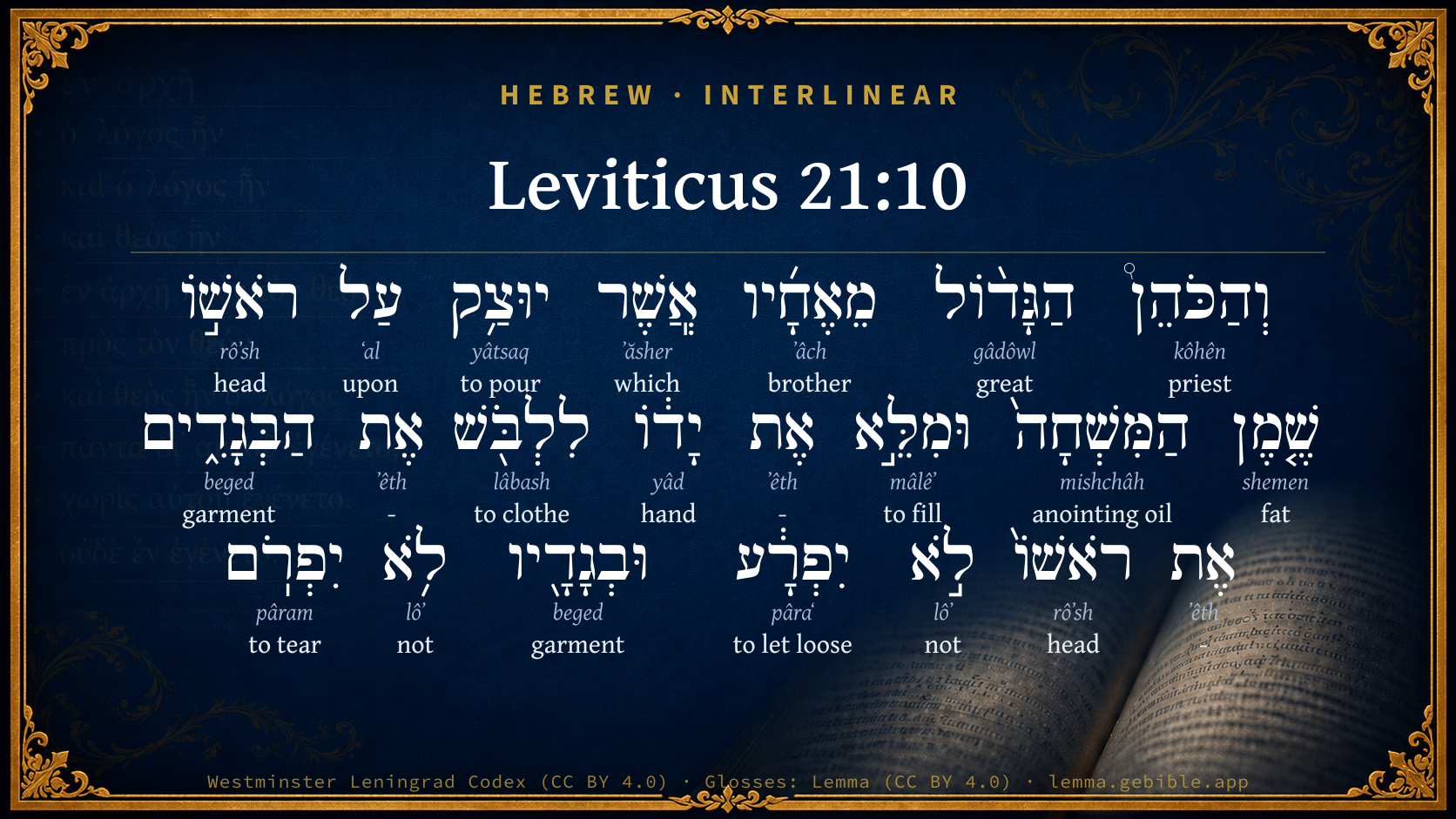
Leviticus 21:10

Hebrew (Westminster Leningrad Codex) Leviticus 21:10 appears in the Hebrew Old Testament. The text above is from the Westminster Leningrad Codex. Each word links to its Strong’s number, a concise gloss, and parsing drawn from the Open Scriptures Hebrew Bible morphology. Click any word for its full Brown-Driver-Briggs (BDB) entry.
Download image
Cite this verse

Leviticus 21:10 (World English Bible). Public Domain. Lemma interlinear Bible study tool, https://lemma.gebible.app/v/leviticus/21/10.

Show BibTeX & RIS
BibTeX
RIS
English Translation
"'He who is the high priest among his brothers, upon whose head the anointing oil is poured, and that is consecrated to put on the garments, shall not let the hair of his head hang loose, nor tear his clothes;
World English Bible · Public Domain
Download a study sheet

One document with this verse’s original text, its word-by-word gloss line, the meaning frame, cross-references with their text, attributed commentary, and full source and license credits — printable, and it pastes into notes with its structure intact.

This verse Autodidact and up

Study sheet (.html) Plain text (.txt)

A passage Seminary Student

Up to 50 verses in one chapter. A passage sheet keeps up to 6 commentary sources and 12 cross-references per verse, in the order this page ranks them, and says so on the sheet whenever that leaves anything out. Ask for a single verse and you get the Autodidact verse sheet above.

Everything on this page stays free to read, with no account — the sheet is a download of what is already on screen, not access to it.

Want to remove ads? Support Godless Engineer
Compare translations 3

The same verse in 3 English versions, stacked beneath the original-language interlinear above. Click any original word for its lexicon entry.

Each is an independent rendering of the whole verse — the interlinear is not word-aligned to these translations.

Highlighted words mark where these versions differ — a whole-verse word diff, not a word-by-word alignment.

  • World English Bible Public Domain
    "'He who is the high priest among his brothers, upon whose head the anointing oil is poured, and that is consecrated to put on the garments, shall not let the hair of his head hang loose, nor tear his clothes;
  • King James Version Public Domain
    And he that is the high priest among his brethren, upon whose head the anointing oil was poured, and that is consecrated to put on the garments, shall not uncover his head, nor rend his clothes;
  • unfoldingWord Literal Text CC BY-SA 4.0
    And the great priest from his brothers, on whose head the oil of anointing was poured and whose hand is filled to wear the clothing, his head he shall not let be unbound, and his clothes he shall not tear.

unfoldingWord Literal Text — © unfoldingWord, licensed CC BY-SA 4.0. Word-aligned USFM3 via Door43 (git.door43.org/unfoldingWord/en_ult).

Versions to compare (up to 4)

3 of 4 selected

Show all 18 translations

Every available English version of this verse, each an independent rendering of the whole verse.

  • World English Bible Public Domain
    "'He who is the high priest among his brothers, upon whose head the anointing oil is poured, and that is consecrated to put on the garments, shall not let the hair of his head hang loose, nor tear his clothes;
  • Berean Standard Bible Public Domain
    The priest who is highest among his brothers, who has had the anointing oil poured on his head and has been ordained to wear the priestly garments, must not let his hair hang loose or tear his garments.
  • Majority Standard Bible Public Domain
    The priest who is highest among his brothers, who has had the anointing oil poured on his head and has been ordained to wear the priestly garments, must not let his hair hang loose or tear his garments.
  • King James Version Public Domain
    And he that is the high priest among his brethren, upon whose head the anointing oil was poured, and that is consecrated to put on the garments, shall not uncover his head, nor rend his clothes;
  • American Standard Version (1901) Public Domain
    And he that is the high priest among his brethren, upon whose head the anointing oil is poured, and that is consecrated to put on the garments, shall not let the hair of his head go loose, nor rend his clothes;
  • Revised Version (1885) Public Domain
    And he that is the high priest among his brethren, upon whose head the anointing oil is poured, and that is consecrated to put on the garments, shall not let the hair of his head go loose, nor rend his clothes;
  • Geneva Bible (1599) Public Domain
    Also ye hie Priest among his brethren, (vpon whose head the anointing oyle was powred, and hath consecrated his hand to put on the garments) shall not vncouer his head, nor rent his clothes,
  • Douay-Rheims (1899) Public Domain
    The high priest, that is to say, the priest, is the greatest among his brethren. upon whose head the oil of unction hath been poured, and whose hands have been consecrated for the priesthood, and who hath been vested with the holy vestments, shall not uncover his head, he shall not rend his garments:
  • Young's Literal Translation Public Domain
    `And the high priest of his brethren, on whose head is poured the anointing oil, and hath consecrated his hand to put on the garments, his head doth not uncover, nor rend his garments,
  • Literal Standard Version CC BY-SA 4.0
    And the high priest of his brothers, on whose head the anointing oil is poured, and who has consecrated his hand to put on the garments, does not uncover his head, nor tear his garments,
  • Unlocked Literal Bible CC BY-SA 4.0
    The one who is the high priest among his brothers, on whose head the anointing oil has been poured, and who has been consecrated to wear the special garments of the high priest, must not wear his hair loose or tear his clothes.
  • unfoldingWord Literal Text CC BY-SA 4.0
    And the great priest from his brothers, on whose head the oil of anointing was poured and whose hand is filled to wear the clothing, his head he shall not let be unbound, and his clothes he shall not tear.
  • Darby Bible Public Domain
    And the high priest among his brethren, on whose head the anointing oil was poured, and who is consecrated to put on the garments, shall not uncover his head, nor rend his garments.
  • World Messianic Bible Public Domain
    “‘He who is the high priest among his brothers, upon whose head the anointing oil is poured, and who is consecrated to put on the garments, shall not let the hair of his head hang loose, or tear his clothes.
  • Webster's Bible Public Domain
    And he that is the high priest among his brethren, upon whose head the anointing oil was poured, and that is consecrated to put on the garments, shall not uncover his head, nor rend his clothes;
  • Free Bible Version CC BY-SA 4.0
    The high priest has the highest place among the other priests. He has been anointed with olive oil poured on his head and has been ordained to wear the priestly clothing. He must not leave his hair uncombed or tear his clothes.
  • Bible in Basic English Public Domain
    And he who is the chief priest among his brothers, on whose head the holy oil has been put, who is marked out to put on the holy robes, may not let his hair go loose or have his clothing out of order as a sign of sorrow.
  • JPS Tanakh (1917) Public Domain
    And the priest that is highest among his brethren, upon whose head the anointing oil is poured, and that is consecrated to put on the garments, shall not let the hair of his head go loose, nor rend his clothes;

Literal Standard Version (2020), Covenant Press — licensed CC BY-SA 4.0. Text via the HelloAO Bible API (eBible.org). Unlocked Literal Bible (unfoldingWord) — licensed CC BY-SA 4.0. Text via the HelloAO Bible API (eBible.org). unfoldingWord Literal Text — © unfoldingWord, licensed CC BY-SA 4.0. Word-aligned USFM3 via Door43 (git.door43.org/unfoldingWord/en_ult). Free Bible Version, Dr. Jonathan Gallagher — licensed CC BY-SA 4.0. Text via the HelloAO Bible API (eBible.org).

Word by word

More ways to search: Search by grammar → Find every occurrence → Compare this word →

Practice this passage: Drill this verse → Learn its vocabulary →

יִפְרֹֽם
pâram
H6533
“to tear”
Verb, Qal, Imperfect, 3rd Person, Masculine, Singular
Part of Speech
Verb
Stem
Qal
Form
Imperfect
Person
3rd Person
Gender
Masculine
Number
Singular
Full BDB Definition

Origin: a primitive root

TWOT: 1819

(Qal) to tear, rend garment, rip
  1. וְהַכֹּהֵן֩ kôhên H3548 “and · the · priest” Conjunction + Particle, Definite Article + Noun, Common, Masculine, Singular, Absolute
  2. הַגָּד֨וֹל gâdôwl H1419 “the · great” Particle, Definite Article + Adjective, Adjective, Masculine, Singular, Absolute
  3. מֵאֶחָ֜יו ʼâch H251 “from · brothers · his” Preposition + Noun, Common, Masculine, Plural, Construct + Suffix, Personal, 3rd Person, Masculine, Singular
  4. אֲֽשֶׁר ʼăsher H834 “which” Particle, Relative
  5. יוּצַ֥ק yâtsaq H3332 “to pour” Verb, Hophal, Imperfect, 3rd Person, Masculine, Singular
  6. עַל ʻal H5921 “upon” Preposition
  7. רֹאשׁ֣וֹ rôʼsh H7218 “head · his” Noun, Common, Masculine, Singular, Construct + Suffix, Personal, 3rd Person, Masculine, Singular
  8. שֶׁ֤מֶן shemen H8081 “fat of” Noun, Common, Masculine, Singular, Construct
  9. הַמִּשְׁחָה֙ mishchâh H4888 “the · anointing oil” Particle, Definite Article + Noun, Common, Feminine, Singular, Absolute
  10. וּמִלֵּ֣א mâlêʼ H4390 “and · to fill” Conjunction + Verb, Piel, Sequential Perfect, 3rd Person, Masculine, Singular
  11. אֶת ʼêth H853 “-” Particle, Direct Object
  12. יָד֔וֹ yâd H3027 “hand · his” Noun, Common, Both, Singular, Construct + Suffix, Personal, 3rd Person, Masculine, Singular
  13. לִלְבֹּ֖שׁ lâbash H3847 “to clothe” Preposition + Verb, Qal, Infinitive Construct
  14. אֶת ʼêth H853 “-” Particle, Direct Object
  15. הַבְּגָדִ֑ים beged H899 “the · garments” Particle, Definite Article + Noun, Common, Masculine, Plural, Absolute
  16. אֶת ʼêth H853 “-” Particle, Direct Object
  17. רֹאשׁוֹ֙ rôʼsh H7218 “head · his” Noun, Common, Masculine, Singular, Construct + Suffix, Personal, 3rd Person, Masculine, Singular
  18. לֹ֣א lôʼ H3808 “not” Particle, Negative
  19. יִפְרָ֔ע pâraʻ H6544 “to let loose” Verb, Qal, Imperfect, 3rd Person, Masculine, Singular
  20. וּבְגָדָ֖יו beged H899 “and · garments · his” Conjunction + Noun, Common, Masculine, Plural, Construct + Suffix, Personal, 3rd Person, Masculine, Singular
  21. לֹ֥א lôʼ H3808 “not” Particle, Negative

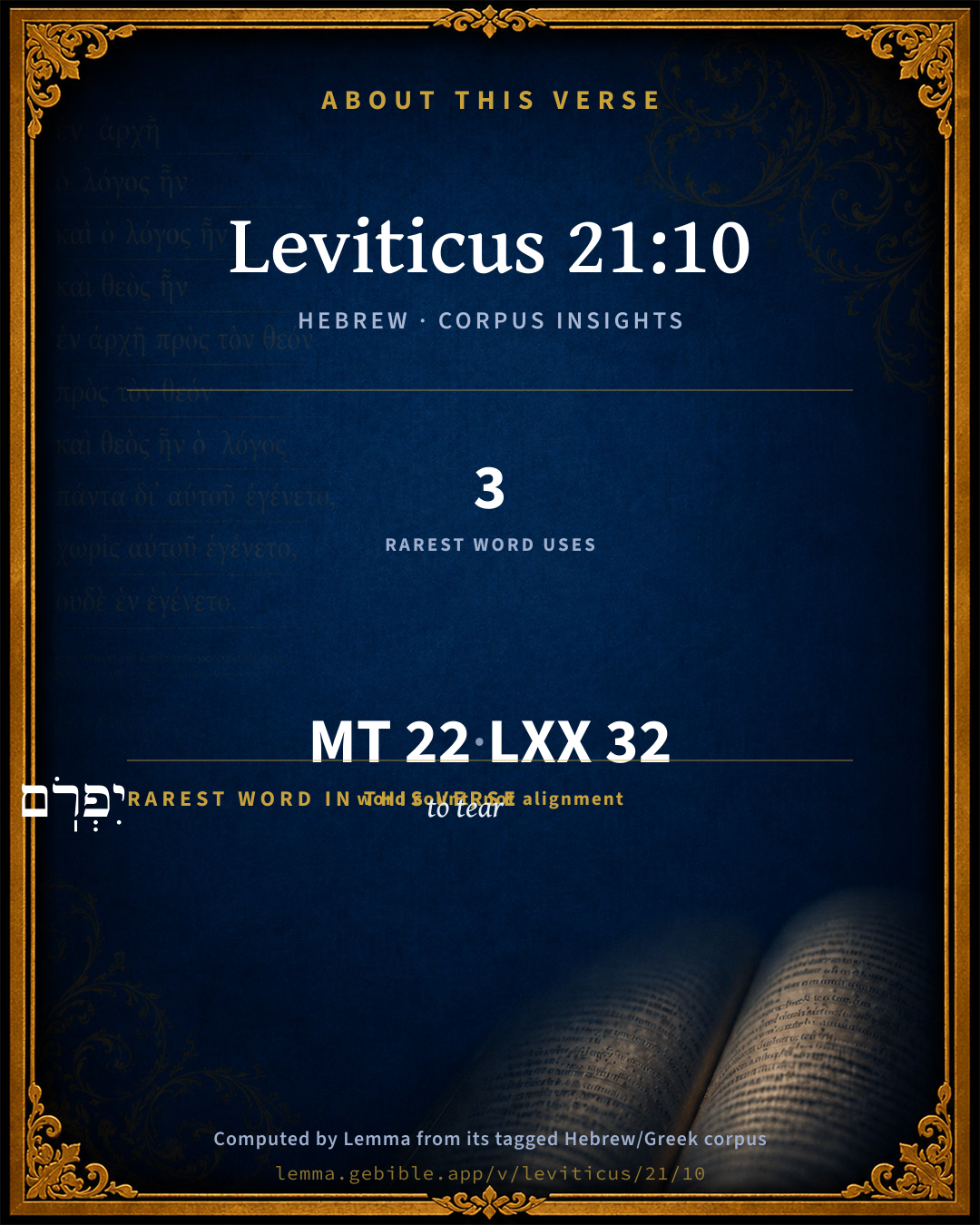
About this verse

These counts appear in no published source. They are computed here, from the morphology-tagged text and Lemma’s own curated glosses. What Lemma adds →

22
words
17
distinct lemmas
Pentateuch
section

Notable vocabulary

The rarest word here is יִפְרֹֽם to tear H6533 — appearing just 3 times in the whole Hebrew Bible.

Shared distinctive vocabulary

יִפְרֹֽם to tear H6533 occurs in 3 verses of the Hebrew Bible. Also found in:

Grammatical profile

  • 5 verbs
  • 9 nouns
  • 1 adjective
  • 1 preposition
  • 6 particles

Verb forms

  • יוּצַ֥ק Hophal · Imperfect
  • וּמִלֵּ֣א Piel · Sequential Perfect
  • לִלְבֹּ֖שׁ Qal · Infinitive Construct
  • יִפְרָ֔ע Qal · Imperfect
  • יִפְרֹֽם Qal · Imperfect

Repetition

Words recur within this verse — often emphatic in Hebrew:

  • רֹאשׁ֣וֹ head H7218 ×2
  • הַבְּגָדִ֑ים garment H899 ×2
  • לֹ֣א not H3808 ×2

Hebrew & Septuagint length

In English translation the verse runs 40 words from the Hebrew and 45 from the Septuagint (LXX English) — closely comparable.

A rough comparison of the two English renderings, which tokenize alike — not a word-level alignment.

Word counts can differ between the Hebrew and the Greek without any difference in meaning — e.g. the Hebrew direct-object marker אֵת has no separate Greek word, and Greek often adds the article ὁ.

In the original languages it is 22 Hebrew tokens and 32 Greek tokens — but the two are counted differently (Hebrew bundles its prefixes and suffixes into one token; the Greek is in lemma form), so that isn’t a like-for-like length.

Cross-references

14

Topical passages linked to Leviticus 21:10 in the Treasury of Scripture Knowledge — connected by theme and wording, ordered by reader-vote popularity; previews shown in the World English Bible.

  • Leviticus 10:6–7 Moses said to Aaron, and to Eleazar and to Ithamar, his sons, "Don't let the hair of your heads go loose, neither tear your clothes; that you don't die, and that he not be angry with all the congregation: but let your brothers, the whole house of Israel, bewail the burning which Yahweh has kindled.
  • Leviticus 16:32 The priest, who is anointed and who is consecrated to be priest in his father's place, shall make the atonement, and shall put on the linen garments, even the holy garments.
  • Matthew 26:65 Then the high priest tore his clothing, saying, "He has spoken blasphemy! Why do we need any more witnesses? Behold, now you have heard his blasphemy.
  • Exodus 29:29–30 "The holy garments of Aaron shall be for his sons after him, to be anointed in them, and to be consecrated in them.
  • Leviticus 8:12 He poured some of the anointing oil on Aaron's head, and anointed him, to sanctify him.
  • Numbers 35:25 and the congregation shall deliver the manslayer out of the hand of the avenger of blood, and the congregation shall restore him to his city of refuge, where he was fled: and he shall dwell therein until the death of the high priest, who was anointed with the holy oil.
  • Genesis 37:34 Jacob tore his clothes, and put sackcloth on his loins, and mourned for his son many days.
  • Exodus 28:2–4 You shall make holy garments for Aaron your brother, for glory and for beauty.
  • Leviticus 8:7–9 He put the coat on him, tied the sash on him, clothed him with the robe, put the ephod on him, and he tied the skillfully woven band of the ephod on him, and fastened it to him with it.
  • Leviticus 13:45 "The leper in whom the plague is shall wear torn clothes, and the hair of his head shall hang loose. He shall cover his upper lip, and shall cry, 'Unclean! Unclean!'
  • 2 Samuel 15:30 David went up by the ascent of the [Mount of] Olives, and wept as he went up; and he had his head covered, and went barefoot: and all the people who were with him covered every man his head, and they went up, weeping as they went up.
  • Esther 6:12 Mordecai came again to the king's gate. But Haman hurried to his house, mourning and having his head covered.
  • Psalms 133:2 It is like the precious oil on the head, That ran down on the beard, Even Aaron's beard; That came down on the edge of his robes;
  • Job 1:20 Then Job arose, and tore his robe, and shaved his head, and fell down on the ground, and worshiped.

Cross-references courtesy of OpenBible.info (CC BY 4.0).

Hebrew and Greek witnesses Masoretic Hebrew ↔ Greek Septuagint

The same verse in the two great witnesses to the Old Testament, shown verse-for-verse.

These are two independent witnesses, not word-aligned to each other, and the Septuagint is shown in lemma (dictionary) form.

Hebrew Leviticus 21:10 Masoretic · Westminster Leningrad Codex

וְהַכֹּהֵן֩ הַגָּד֨וֹל מֵאֶחָ֜יו אֲֽשֶׁר יוּצַ֥ק עַל רֹאשׁ֣וֹ שֶׁ֤מֶן הַמִּשְׁחָה֙ וּמִלֵּ֣א אֶת יָד֔וֹ לִלְבֹּ֖שׁ אֶת הַבְּגָדִ֑ים אֶת רֹאשׁוֹ֙ לֹ֣א יִפְרָ֔ע וּבְגָדָ֖יו לֹ֥א יִפְרֹֽם

"'He who is the high priest among his brothers, upon whose head the anointing oil is poured, and that is consecrated to put on the garments, shall not let the hair of his head hang loose, nor tear his clothes;

World English Bible · Public Domain

Greek LXX Leviticus 21:10 Septuagint · lemma form

καί ὁ ἱερεύς ὁ μέγας ἀπό ὁ ἀδελφός αὐτός ὁ ἐπιχέω ἐπί ὁ κεφαλή ὁ ἔλαιον ὁ χριστός καί τελειόω ἐνδύω ὁ ἱμάτιον ὁ κεφαλή οὐ ἀποκιδαρόω καί ὁ ἱμάτιον οὐ διαῥήγνυμι

And the priest that is chief among his brethren, the oil having been poured upon the head of the anointed one, and he having been consecrated to put on the garments, shall not take the mitre off his head, and shall not rend his garments:

LXX2012 (modern English Septuagint) · Public Domain

On this verse, Haydock's Catholic Bible Commentary discusses the Septuagint’s reading. Read the note in Commentary ↓

Hebrew: Westminster Leningrad Codex (CC BY 4.0). Greek: Septuagint (public domain); English from LXX2012 (modern English Septuagint) (Public Domain). How the Septuagint differs from the Hebrew →

Targum (Aramaic paraphrase)

2

The Targum is the ancient Jewish Aramaic paraphrase of the Hebrew Scriptures — an interpretive translation, not the Hebrew text itself. Onkelos (literal) and Pseudo-Jonathan (expansive) render the Torah, and Jonathan the Prophets. Coverage is partial: where no permissively-licensed English translation exists for a verse, only the Aramaic is shown. This is verse-level text, not a word-by-word alignment to the Hebrew.

  1. Targum Onkelos Torah (Genesis–Deuteronomy)
    וְכַהֲנָא דְאִתְרַבָּא מֵאֲחוֹהִי דְיִתָּרִיק עַל רֵישֵׁהּ מִשְׁחָא דִרְבוּתָא וְדִי קָרִיב יָת קֻרְבָּנֵהּ לְמִלְבָּשׁ יָת לְבוּשַׁיָא יָת רֵישֵׁהּ לָא יְרַבֵּי פֵרוּעַ וּלְבוּשׁוֹהִי לָא יִבְזַע

    (no public-domain English translation for this verse)

    Targum Onkelos — Aramaic: “Onkelos Genesis” (public domain); “Onkelos Exodus” (public domain); “Onkelos Leviticus” (public domain); “Onkelos Numbers” (public domain); “Onkelos Deuteronomy” (public domain). English: “Sefaria Community Translation” (CC0 1.0 (public-domain dedication)); “J.W. Etheridge. The Targums of Onkelos and Jonathan Ben Uzziel on the Pentateuch. London: Longmans, Green, 1862” (public domain). Text via Sefaria.

  2. Targum Pseudo-Jonathan Torah (Genesis–Deuteronomy)
    וְכַהֲנָא רַבָּא דְמִתְרַבְרַב עַל אָחוֹי דִי יִתְרוֹק עַל רֵישֵׁיהּ מִשְׁחָא דִרְבוּתָא וּדְיִקְרַב יַת קוּרְבָּנֵיהּ לְמִלְבּוֹשׁ יַת לְבוּשַׁיָא יַת רֵישֵׁיהּ לָא יִרְבֵּי פֵירוּעַ וּלְבוּשׁוֹי לָא יְבַזַע בְּשַׁעַת אֲנִיקֵי

    And the high priest who hath been anointed over his brethren, and upon whose head the anointing oil was poured, and who offered his oblation to be arrayed in the (holy) robes, shall not make his head bare, nor either rend or tear his garment in the hour of grief.

    Targum Pseudo-Jonathan — Aramaic: “Targum Jonathan on Genesis” (public domain); “Targum Jonathan on Exodus” (public domain); “Targum Jonathan on Leviticus” (public domain); “Targum Jonathan on Numbers” (public domain); “Targum Jonathan on Deuteronomy” (public domain). English: “The Targum of Jonathan ben Uzziel, trans. J. W. Etheridge, London, 1862” (public domain). Text via Sefaria.

Commentary

Notes on Leviticus 21:10 from classic Christian and Jewish commentators (each source and its license shown beneath its notes). The classic Christian expositions comment on the surrounding passage and are grouped to its opening verse, so a note may address several verses; the Jewish commentaries on the Tanakh (Rashi and others) are per-verse, so they appear only where the commentator wrote on this verse.

Lemma curates 59 commentaries, every one of them public domain or Creative Commons licensed, each selected and text-cleaned for this edition rather than reprinted as found. About our sources →

Matthew Henry's Commentary

More was expected from a priest than from other people, but more from the high priest than from other priests, because upon his head the anointing oil was poured, and he was consecrated to put on the garments (Lev 21:10), both which were typical of the anointing and adorning of the Lord Jesus, with all the gifts and graces of the Holy Spirit, which he received without measure. It is called the crown of the anointing oil of his God (Lev 21:12); for the anointing of the Spirit is, to all that have it, a crown of glory, and a diadem of beauty. The high priest being thus dignified,

I. He must not defile himself at all for the dead, no, nor for his nearest relations, his father or his mother, much less his child or brother, Lev 21:11. 1. He must not use the common expressions of sorrow on those occasions, such as uncovering his head, and rending his clothes (Lev 21:10), so perfectly unconcerned must he show himself in all the crosses and comforts of this life: even his natural affection must be swallowed up in compassion to the ignorant, and a feeling of their infirmities, and a tender concern for the household of God, which he was made the ruler of. Thus being the holy one that was entrusted with the thummim and the urim he must not know father or mother, Deu 33:8, Deu 33:9. 2. He must not go in to any dead body, Lev 21:11. If any of the inferior priests were under a ceremonial pollution, there were other priests that might supply their places; but, if the high priest were defiled, there would be a greater want of him. And the forbidding of him to go to any house of mourning, or attend any funeral, would be an indication to the people of the greatness of that dignity to which he was advanced. Our Lord Jesus, the great high priest of our profession, touched the dead body of Jairus's daughter, the bier of the widow's son, and the grave of Lazarus, to show that he came to altar the property of death, and to take off the terror of it, by breaking the power of it. Now that it cannot destroy it does not defile. 3. He must not go out of the sanctuary (Lev 21:12); that is, whenever he was attending or officiating in the sanctuary, where usually he tarried in his own apartment all day, he must not go out upon any occasion whatsoever, nor cut short his attendance on the living God, no, not to pay his last respects to a dying relation. It was a profanation of the sanctuary to leave it, while his presence was requisite there, upon any such occasion; for thereby he preferred some other business before the service of God and the business of his profession, to which he ought to make every thing else give place. Thus our Lord Jesus would not leave off preaching to speak with his mother and brethren, Mat 12:48.

II. He might not marry a widow (as other priests might), much less one divorced, or a harlot, Lev 21:13, Lev 21:14. The reason of this was to put a difference between him and other priests in this matter; and (as some suggest) that he might be a type of Christ, to whom the church was to be presented a chaste virgin, Co2 11:2. See Eze 44:22. Christ must have our first love, our pure love, our entire love; thus the virgins love thee (Sol 1:3), and such only are fit to follow the Lamb, Rev 14:4.

III. He might not profane his seed among his people, Lev 21:15. Some understand it as forbidding him to marry any of an inferior rank, which would be a disparagement to his family. Jehoiada indeed married of his own tribe, but then it was into the royal family, Ch2 22:11. This was not to teach him to be proud, but to teach him to be pure, and to do nothing unbecoming his office and the worthy name by which he was called. Or it may be a caution to him in disposing of his children; he must not profane his seed by marrying them unsuitably. Ministers' children are profaned if they be unequally yoked with unbelievers.

Matthew Henry's Commentary on the Whole Bible (1708–1710) — public domain (CC PDM 1.0). Text via the HelloAO Bible API.

Trapp's Complete Commentary

John Trapp

Lev 21:10 And [he that is] the high priest among his brethren, upon whose head the anointing oil was poured, and that is consecrated to put on the garments, shall not uncover his head, nor rend his clothes;

Ver. 10. Shall not uncover his head.] So neither doth the Mufti among the Turks, nor the Pope of Rome uncover to any man: but this is their pride and stateliness.

John Trapp, A Commentary or Exposition upon All the Books of the Old and New Testament (1647–1656) — public domain. Text from a community e-Sword module.

Joseph Benson's Commentary

Lev 21:10. The garments — Those holy garments which were peculiar to him. Shall not uncover his head — This being then the posture of mourners, (Lev 10:6,) though afterward the custom was changed, and mourners covered their heads, 2Sa 15:30; Est 6:12. Nor rend his clothes — Another expression of mourning.

Joseph Benson's Commentary on the Old and New Testaments (1811–1818) — public domain. Text from a community e-Sword module.

Tyndale Open Study Notes

Tyndale Open Resources

21:10-15 The restrictions made on the common priests (21:1-4) applied even more stringently to the high priest because he had to represent all Israel, including the other priests. • The priest must never leave his hair uncombed or tear his clothing in mourning, so that he would always be fit to minister. Although the common priest was permitted to marry a widow, the high priest was allowed to marry only a virgin. This made certain that the future high priest and the common priests descended from that union would have an unquestioned lineage (21:15).

Tyndale Open Study Notes — © Tyndale Open Resources, licensed CC BY-SA 4.0. Text via the HelloAO Bible API.

Geneva Bible (1599)

Geneva Bible translators

He shall use no such ceremonies as the mourners observed.

Geneva Bible (1599) marginal notes — public domain. Text via Bolls.life.

Jamieson, Fausset & Brown

Robert Jamieson, A. R. Fausset & David Brown

he that is the high priest among his brethren . . . shall not uncover his head, nor rend his clothes--The indulgence in the excepted cases of family bereavement, mentioned above [Lev 21:2-3], which was granted to the common priests, was denied to him; for his absence from the sanctuary for the removal of any contracted defilement could not have been dispensed with, neither could he have acted as intercessor for the people, unless ceremonially clean. Moreover, the high dignity of his office demanded a corresponding superiority in personal holiness, and stringent rules were prescribed for the purpose of upholding the suitable dignity of his station and family. The same rules are extended to the families of Christian ministers (Ti1 3:2; Tit 1:6).

Jamieson, Fausset & Brown — Commentary Critical and Explanatory on the Whole Bible (1871) — public domain (CC PDM 1.0). Text via the HelloAO Bible API.

Adam Clarke's Commentary

Verse 10. He that is the high priest] This is the first place where this title is introduced; the title is very emphatic, הכהן הגדול haccohen haggadol, that priest, the great one. For the meaning of כהן cohen, see the note on "Ge 14:18". As the chief or high priest was a representative of our blessed Lord, therefore he was required to be especially holy; and he is represented as God's king among the people.

Adam Clarke's Commentary on the Bible (1810–1826) — public domain. Text from a community e-Sword/MySword module.

Ellicott's Commentary for English Readers

(10) And he that is the high priest among his brethren.—That is, among his priestly brethren, the one who is distinguished among them by this office.

Upon whose head the anointing oil was poured.—This profuse pouring of oil was the distinctive feature in the consecration of the high priest. (See Lev_8:12.)

Consecrated to put on the garments.—Better, consecrated by putting on the garments. The robing of the high priest by Moses, as well as the anointing him, constituted part of the consecration ceremony. (See Lev_8:7-11.)

Shall not uncover his head.—Better, shall not let his head be dishevelled, which was a sign of mourning. (See Lev_10:6.)

Nor rend his clothes.—That is, “in the time of distress,” as the ancient Chaldee version of Jonathan rightly adds after it. Sustaining this high position, and being the intercessor between God and man, such outward expressions of sorrow might lead those in whose behalf he ministers in the sanctuary to believe that he thereby impugns the justice of the Divine judgment.

A Bible Commentary for English Readers, edited by Charles John Ellicott (1878–1897) — public domain. Text from a community e-Sword module.

The Cambridge Bible for Schools and Colleges

gen. ed. J. J. S. Perowne

10. The reference to the anointing and vesting may be taken from Pin which source it now appears in Exo_29:5 ff.

that is consecrated] See R.V. mg. and note on Lev_8:33.

shall not let the hair of his head go loose] so as to preserve a seemly appearance in contrast to that of the leper. See on Lev_10:6. A.V. wrongly, ‘shall not uncover his head.’

nor rend his clothes] as was the custom in sign of mourning (2Sa_1:11; 2Sa_3:31, etc.).

10–15. Corresponding regulations, but of a somewhat stricter character, for the high priest

The Cambridge Bible for Schools and Colleges (gen. ed. J. J. S. Perowne; Cambridge University Press, 1878–1918) — public domain. Text from a community e-Sword module.

John Gill's Exposition

And he that is the high priest among his brethren,.... Either among his brethren, the priests, being in office above them; or among his brethren the Israelites, among and over whom he is high priest; or, as others render it, "the priest who is greater than his brethren" (d), in an higher office; the Jews say (e) the high priest was to be greater than his brethren, in beauty, in strength, in wisdom, and in riches; and if he had not money enough, all the priests were to give him of theirs, everyone according to his riches, until he became the richest among them all:

upon whose head the anointing oil was poured; as it was poured upon Aaron at his consecration, and those that succeeded him, Exo 29:7 Lev 8:12,

and that is consecrated to put on the garments; the eight garments with which the high priest was clothed at the time of his consecration, Lev 8:7; and in which he and his sons are said to be consecrated, Exo 29:29; in order to which he was "to fill his hand"; as the phrase here is, that is, with the fat and right shoulder of the ram of consecration, and with the loaf of bread, and cake of oiled bread, and wafer, Exo 29:23; in all which he was a type of Christ, the great High Priest, as he is often called, who is greater than his brethren in all the above things, the high priest exceeded his brethren, except in worldly riches; and yet the earth also is his, and the fulness thereof, well as he is fairer than the children of men, stronger than the strong man armed, and the treasures of wisdom and knowledge are hid in him; he is anointed also with the oil of gladness above his fellows; and all his garments smell of myrrh, aloes, and cassia, and is consecrated an high priest for evermore: of the high priest it is said, he

shall not uncover his head: that is, on account of the dead; not take off his mitre, or in any such way express mourning for the dead; or shall not nourish his hair or let it grow, as the Targums of Onkelos and Jonathan; and so Jarchi interprets it, he shall not let the hair grow for mourning; and what is nourishing of the hair? when it is let grow more than thirty days:

nor rend his clothes; that is, on the same account, and therefore Jonathan adds, in the hour of distress, or mourning for the dead; otherwise, in case of blasphemy, he might rend his clothes, see Mat 26:65; and indeed, according to the Jewish canons, he might rend his clothes in mourning, only in a different manner from common priests; for so they say (f),"he may not rend for the dead, as other priests,''as it is said: "nor rend his clothes"; and if he rends he is to be beaten, but he may rend below over against (or near) his feet; and so in the Misnah (g), an high priest rends below, and a common priest above; See Gill on Lev 10:6.

(d) So Pagninus, Ainsworth, and others. (e) T. Bab. Yoma, fol. 18. 1. Horayot, fol. 9. 1. Cholin, fol. 134. 2. Maimon. Cele Hamikdash, c. 5. sect. 1. & in Misn. Yoma, c. 1. sect. 3. & Bartenora in ib. (f) Maimon. Cele Hamikdash, c. 5. sect. 6. (g) Horayot, c. 3. sect. 5.

John Gill's Exposition of the Whole Bible (1746–1763) — public domain (CC PDM 1.0). Text via the HelloAO Bible API.

Albert Barnes' Notes on the Bible

It was the distinguishing mark of the anointing of the high priest, that the holy oil was poured upon his head like a crown (compare Lev 8:12).

Uncover his head - Rather, let his hair be disheveled. See the note at Lev 10:6.

Albert Barnes' Notes on the Bible (1834–1885) — public domain. Text from a community e-Sword/MySword module.

Haydock's Catholic Bible Commentary

Head. Septuagint, "by taking off his cidaris, or tiara." He shall not shave his head, chap. x. 6. --- Garments, at funerals, nor the sacred vestments at all. (Calmet)

George Leo Haydock (1774–1849), Haydock's Catholic Family Bible and Commentary, 1859 edition — public domain. Excludes Psalms (Douay-Rheims chapter numbering differs from Protestant) and Deuterocanonical books (Catholic canon only).

Matthew Poole's English Annotations

Upon whose head the anointing oil was poured, Lev 8:12; which was only sprinkled upon inferior priests, blood also being mixed with it, Lev 8:30.

The garments, to wit, those holy garments which were peculiar to him, as well as those common to others.

Shall not uncover his head; this being then the posture of mourners, Lev 10:6, though afterwards the custom was changed, and mourners covered their heads, 2Sa 15:30; Est 6:12. Or if this custom was now in use, the meaning may be, he shall not put off the priestly covering or mitre, which was necessary for him to do, if he had put on the mourner’s covering upon his head, otherwise the holy covering had been defiled, but he shall continue in the exercise of his office, which is signified by keeping on his priestly garments.

Matthew Poole's English Annotations on the Holy Bible (1683–1685) — public domain. Text from a community e-Sword/MySword module.

Whedon's Commentary on the Bible

Daniel D. Whedon

10. High priest… shall not uncover his head — Aaron was forbidden to mourn for his own sons. See Lev_10:6. This is the first occurrence of “high priest” in the Pentateuch. He is otherwise described as the priest, and is more precisely designated by the expression, “which was anointed with the holy oil.”

Daniel D. Whedon (gen. ed.), Commentary on the Old and New Testaments (1874–1909) — public domain. Text from a community e-Sword module.

The Pulpit Commentary

Vers. 10-15. The high priest, upon whose head the anointing off was poured, and that is consecrated to put on the garments, symbolizing in his person the Holy One in a more special manner than the other priests, has to aim so much the more at symbolical holiness. He may not, therefore. incur legal uncleanness by taking part in the funeral rites, even of his father or mother, not being permitted to absent himself from the sanctuary, which he would have to do if he had thus ceremonially defiled himself. Nor is it enough that he should abstain from taking an immoral or a divorced wife; he may only wed a virgin and of his own people, whereas the other priests might marry widows and the daughters of strangers dwelling among the Israelites. In the ordinances for priests given in Ezekiel 44, the ordinary priests, as well as the high priest, are forbidden to marry widows, unless they be the widows of priests. (Eze_44:22)

The Pulpit Commentary (1880–1919), ed. H.D.M. Spence-Jones & Joseph S. Exell — public domain. Text from a community e-Sword module.

John Wesley's Explanatory Notes

The garments - Those holy garments, which were peculiar to him. Shall not uncover his head - This being then the posture of mourners, chap. x, 6, though afterwards the custom was changed and mourners covered their heads, 2 Sam. xv, 30, Esth vi, 12. Nor rent his clothes - Another expression of mourning.

John Wesley, Explanatory Notes Upon the Whole Bible (1754–1765) — public domain. Text via the GEBible commentary corpus.

Keil & Delitzsch

C. F. Keil & F. Delitzsch

The high priest was to maintain a spotless purity in a higher degree still. He, whose head had been anointed with oil, and who had been sanctified to put on the holy clothes (see Lev 8:7-12 and Lev 7:37), was not to go with his hair flying loose when a death had taken place, nor to rend his clothes (see Lev 10:6), nor to go in to any dead body (מת נפשׁת souls of a departed one, i.e., dead persons); he was not to defile himself (cf. Lev 21:2) on account of his father and mother (i.e., when they were dead), nor to go out of the sanctuary funeris nempe causa (Ros.), to give way to his grief or attend the funeral. We are not to understand by this, however, that the sanctuary was to be his constant abode, as Bhr and Baumgarten maintain (cf. Lev 10:7). "Neither shall he profane the sanctuary of his God," sc., by any defilement of his person which he could and ought to avoid; "for the consecration of the anointing oil of his God is upon him" (cf. Lev 10:7), and defilement was incompatible with this. נזר does not mean the diadem of the high priest here, as in Exo 29:6; Exo 39:30, but consecration (see at Num 6:7).

Keil & Delitzsch — Biblical Commentary on the Old Testament (1861–1891) — public domain (CC PDM 1.0). Text via the HelloAO Bible API. (Old Testament only.)

unfoldingWord translationNotes

Door43 World Missions Community

General Information:

Yahweh continues telling Moses what the priests must do.

anointing oil

This is a reference to the anointing oil used in the ceremony consecrating a new the high priest. The full meaning of this statement can be made explicit. (See: Assumed Knowledge and Implicit Information)

on whose head the anointing oil has been poured, and who has been consecrated

This can be stated in active form. AT: "on whose head they poured anointing oil and consecrated him" (See: Active or Passive)

must not wear his hair loose or tear his clothes

Loose hair and torn clothes were signs of mourning. The full meaning of this statement can be made explicit. (See: Assumed Knowledge and Implicit Information)

must not leave the sanctuary area

This does not mean the high priest could never leave. God did not allow him to leave in order to grieve over someone who died. (See: Assumed Knowledge and Implicit Information)

translationWords

high priest

brother

anoint

oil

profane

consecrate

tabernacle

unfoldingWord translationNotes — © Distant Shores Media and the Door43 World Missions Community, licensed CC BY-SA 4.0. Source: git.door43.org/Door43/en_tn.

Rashi

Rabbi Shlomo Yitzchaki (Rashi)

לא יפרע [THE HAIR OF HIS HEAD] SHALL HE NOT DISARRANGE — i.e. he shall not let his hair grow wild on account of ritual mourning for the death of a near relative (Sifra). And what is called "letting the hair grow wild”? Leaving it uncut for more than 30 days (Sanhedrin 22b).

Rashi on the Tanakh — English translations: “The Judaica Press complete Tanach with Rashi, translated by A. J. Rosenberg” (CC BY 4.0); “Pentateuch with Rashi's commentary by M. Rosenbaum and A.M. Silbermann, 1929-1934” (public domain); “The Metsudah Tanach series, Lakewood, N.J” (CC BY 4.0); and “The Book of Joshua, Metsudah Publications, 1997” (CC BY 4.0). Text via Sefaria.

Ramban (Nachmanides)

Rabbi Moshe ben Nachman (Ramban / Nachmanides)

HE SHALL NOT LET THE HAIR OF HIS HEAD GO LOOSE etc. 11. NEITHER SHALL HE GO IN TO ANY DEAD BODY. The phrase [dealing with his hair, in Verse 10], is connected with any dead body in the following verse, thus stating that the High Priest is not to let his hair go loose nor rend his garments for any dead body, neither is he to enter a tent where there is a corpse.

Ramban (Nachmanides) on the Tanakh — English translation: “Commentary on the Torah by Ramban (Nachmanides). Translated and annotated by Charles B. Chavel. New York, Shilo Pub. House, 1971-1976” (CC BY 4.0). Text via Sefaria.

Lesson kit

Teaching starters — assembled from the data on this page, not authored interpretation. Every prompt links to the verse data it draws on. Edit before teaching.

Leviticus, in the Pentateuch, opens this verse with 22 words (17 distinct Hebrew lemmas). Its most distinctive word is pâram (“to tear”). A historical commentator’s framing appears above. Read the whole chapter for the surrounding context.

Discussion questions

  1. What does “to tear” (pâram) contribute to the verse as a whole?
  2. Leviticus 10:6 shares the word «to tear» with this verse. How do the two illuminate each other?
  3. “head” occurs 2× in this one verse. What is the effect of the repetition?
  4. The translations on this page render this verse differently — a whole-verse word diff, not a word-by-word alignment. What might account for the different wordings?
  5. The verb «יוּצַ֥ק» is Hophal Imperfect. How does its form color the action?
  6. Reading how Matthew Henry's Commentary and Trapp's Complete Commentary read this verse, where do the two commentators agree and where do they part?

Things to notice

Reading settings

Reading text

Shown beneath each verse's original-language words.

Old Testament
Old Testament edition

Read the OT as the Masoretic Hebrew (MT) or the Greek Septuagint (LXX).

English shown for the Greek Septuagint (in the Hebrew ↔ Greek comparison).

Comparing translations? Open the Compare panel on any verse page to stack up to four side by side.