
2 Samuel 19:22

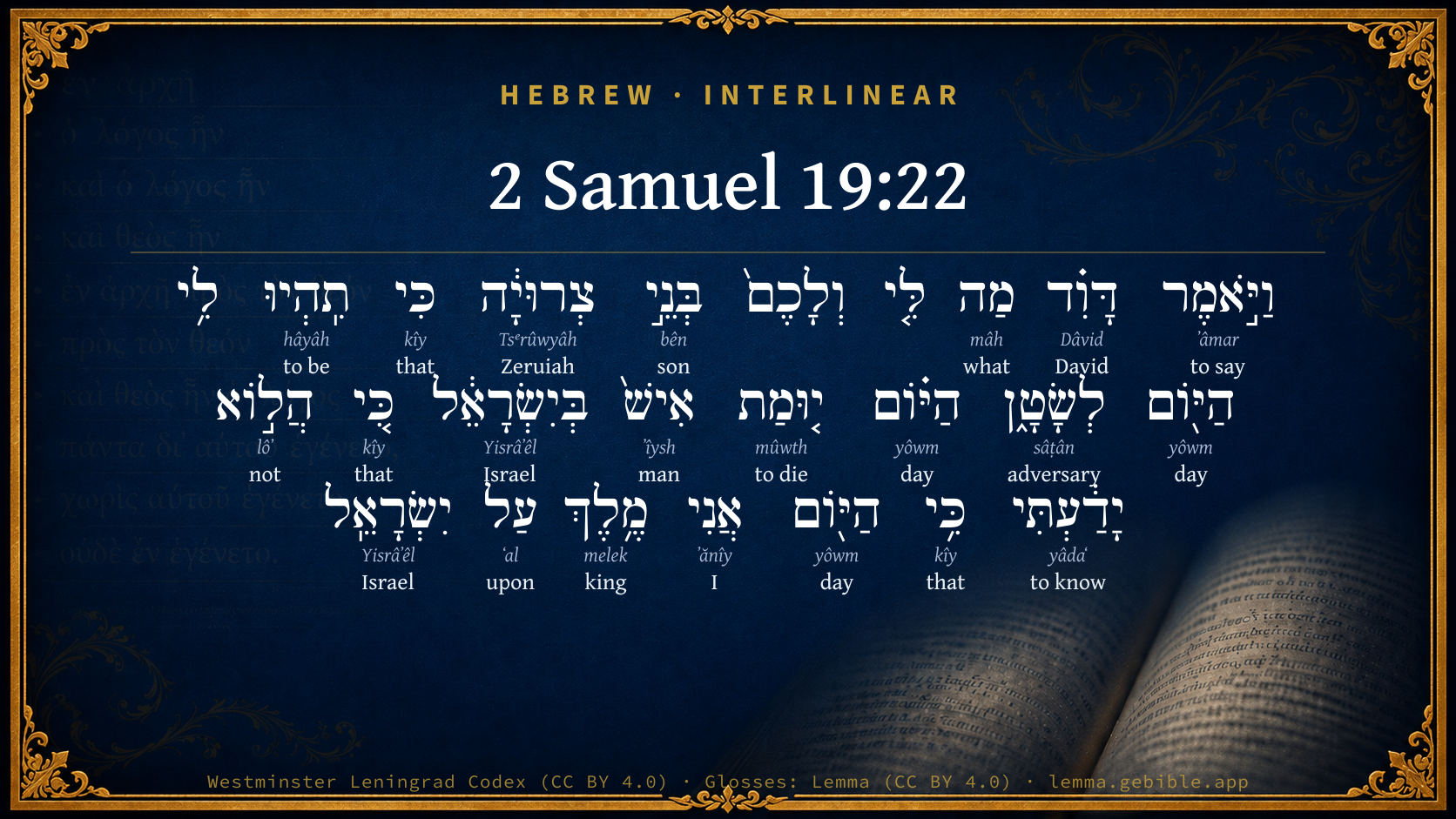
Hebrew (Westminster Leningrad Codex) 2 Samuel 19:22 appears in the Hebrew Old Testament. The text above is from the Westminster Leningrad Codex. Each word links to its Strong’s number, a concise gloss, and parsing drawn from the Open Scriptures Hebrew Bible morphology. Click any word for its full Brown-Driver-Briggs (BDB) entry.
Download image
Cite this verse

2 Samuel 19:22 (World English Bible). Public Domain. Lemma interlinear Bible study tool, https://lemma.gebible.app/v/2-samuel/19/22.

Show BibTeX & RIS
BibTeX
RIS
English Translation
David said, What have I to do with you, you sons of Zeruiah, that you should this day be adversaries to me? shall there any man be put to death this day in Israel? for don't I know that I am this day king over Israel?
World English Bible · Public Domain
Download a study sheet

One document with this verse’s original text, its word-by-word gloss line, the meaning frame, cross-references with their text, attributed commentary, and full source and license credits — printable, and it pastes into notes with its structure intact.

This verse Autodidact and up

Study sheet (.html) Plain text (.txt)

A passage Seminary Student

Up to 50 verses in one chapter. A passage sheet keeps up to 6 commentary sources and 12 cross-references per verse, in the order this page ranks them, and says so on the sheet whenever that leaves anything out. Ask for a single verse and you get the Autodidact verse sheet above.

Everything on this page stays free to read, with no account — the sheet is a download of what is already on screen, not access to it.

Want to remove ads? Support Godless Engineer
Compare translations 3

The same verse in 3 English versions, stacked beneath the original-language interlinear above. Click any original word for its lexicon entry.

Each is an independent rendering of the whole verse — the interlinear is not word-aligned to these translations.

Highlighted words mark where these versions differ — a whole-verse word diff, not a word-by-word alignment.

  • World English Bible Public Domain
    David said, What have I to do with you, you sons of Zeruiah, that you should this day be adversaries to me? shall there any man be put to death this day in Israel? for don't I know that I am this day king over Israel?
  • King James Version Public Domain
    And David said, What have I to do with you, ye sons of Zeruiah, that ye should this day be adversaries unto me? shall there any man be put to death this day in Israel? for do not I know that I am this day king over Israel?
  • unfoldingWord Literal Text CC BY-SA 4.0
    And David said, “What to me and to you, sons of Zeruiah, that you have become an adversary to me today? Shall a man be killed in Israel today? For do I not know that I king over Israel today?”

unfoldingWord Literal Text — © unfoldingWord, licensed CC BY-SA 4.0. Word-aligned USFM3 via Door43 (git.door43.org/unfoldingWord/en_ult).

Versions to compare (up to 4)

3 of 4 selected

Show all 18 translations

Every available English version of this verse, each an independent rendering of the whole verse.

  • World English Bible Public Domain
    David said, What have I to do with you, you sons of Zeruiah, that you should this day be adversaries to me? shall there any man be put to death this day in Israel? for don't I know that I am this day king over Israel?
  • Berean Standard Bible Public Domain
    And David replied, “Sons of Zeruiah, what have I to do with you, that you should be my adversaries today? Should any man be put to death in Israel today? Am I not indeed aware that today I am king over Israel?”
  • Majority Standard Bible Public Domain
    And David replied, “Sons of Zeruiah, what have I to do with you, that you should be my adversaries today? Should any man be put to death in Israel today? Am I not indeed aware that today I am king over Israel?”
  • King James Version Public Domain
    And David said, What have I to do with you, ye sons of Zeruiah, that ye should this day be adversaries unto me? shall there any man be put to death this day in Israel? for do not I know that I am this day king over Israel?
  • American Standard Version (1901) Public Domain
    And David said, What have I to do with you, ye sons of Zeruiah, that ye should this day be adversaries unto me? shall there any man be put to death this day in Israel? for do not I know that I am this day king over Israel?
  • Revised Version (1885) Public Domain
    And David said, What have I to do with you, ye sons of Zeruiah, that ye should this day be adversaries unto me? shall there any man be put to death this day in Israel? for do not I know that I am this day king over Israel?
  • Geneva Bible (1599) Public Domain
    And Dauid saide, What haue I to do with you, ye sonnes of Zeruiah, that this day ye should be aduersaries vnto me? shall there any man die this day in Israel? for doe not I know that I am this day King ouer Israel?
  • Douay-Rheims (1899) Public Domain
    And David said: What have I to do with you, ye sons of Sarvia? why are you a satan this day to me? shall there any man be killed this day in Israel? do not I know that this day I am made king over Israel?
  • Young's Literal Translation Public Domain
    And David saith, `What -- to me and to you, O sons of Zeruiah, that ye are to me to-day for an adversary? to-day is any man put to death in Israel? for have I not known that to-day I `am' king over Israel?'
  • Literal Standard Version CC BY-SA 4.0
    And David says, “And what do I [have to do] with you, O sons of Zeruiah, that today you are for an adversary to me? Is any man put to death in Israel today? For have I not known that today I [am] king over Israel?”
  • Unlocked Literal Bible CC BY-SA 4.0
    Then David said, “What have I to do with you, you sons of Zeruiah, that you should today be adversaries to me? Will any man be put to death today in Israel? For do I not know that today I am king over Israel?”
  • unfoldingWord Literal Text CC BY-SA 4.0
    And David said, “What to me and to you, sons of Zeruiah, that you have become an adversary to me today? Shall a man be killed in Israel today? For do I not know that I king over Israel today?”
  • Darby Bible Public Domain
    And David said, What have I to do with you, ye sons of Zeruiah, that ye should this day be adversaries to me? Should there any man be put to death this day in Israel? for do not I know that I am this day king over Israel?
  • World Messianic Bible Public Domain
    David said, “What have I to do with you, you sons of Zeruiah, that you should be adversaries to me today? Shall any man be put to death today in Israel? For don’t I know that I am king over Israel today?”
  • Webster's Bible Public Domain
    And David said, What have I to do with you, ye sons of Zeruiah, that ye should this day be adversaries to me? shall there any man be put to death this day in Israel? for do not I know that I am this day king over Israel?
  • Free Bible Version CC BY-SA 4.0
    But David replied, “What's that got to do with you, you sons of Zeruiah? Do you want to be my enemies today? Is this a day to execute anybody in Israel? Aren't I certain that today I'm the king of Israel once more?”
  • Bible in Basic English Public Domain
    And David said, What have I to do with you, you sons of Zeruiah, that you put yourselves against me today? is it right for any man in Israel to be put to death today? for I am certain today that I am king in Israel.
  • JPS Tanakh (1917) Public Domain
    (19-23) And David said: 'What have I to do with you, ye sons of Zeruiah, that ye should this day be adversaries unto me? shall there any man be put to death this day in Israel? for do not I know that I am this day king over Israel?'

Literal Standard Version (2020), Covenant Press — licensed CC BY-SA 4.0. Text via the HelloAO Bible API (eBible.org). Unlocked Literal Bible (unfoldingWord) — licensed CC BY-SA 4.0. Text via the HelloAO Bible API (eBible.org). unfoldingWord Literal Text — © unfoldingWord, licensed CC BY-SA 4.0. Word-aligned USFM3 via Door43 (git.door43.org/unfoldingWord/en_ult). Free Bible Version, Dr. Jonathan Gallagher — licensed CC BY-SA 4.0. Text via the HelloAO Bible API (eBible.org).

Word by word

More ways to search: Search by grammar → Find every occurrence → Compare this word →

Practice this passage: Drill this verse → Learn its vocabulary →

צְרוּיָ֔ה
Tsᵉrûwyâh
H6870
“Zeruiah”
Noun, Proper
Part of Speech
Noun
Type
Proper
Full BDB Definition

Origin: pass part from the same as H6875

TWOT: None

Zeruiah = "balsam" - sister of David and mother of the 3 leading heroes of David's army - Abishai, Joab, and Asahel
  1. וַיֹּ֣אמֶר ʼâmar H559 “and · to say” Conjunction + Verb, Qal, Sequential Imperfect, 3rd Person, Masculine, Singular
  2. דָּוִ֗ד Dâvid H1732 “David” Noun, Proper
  3. מַה mâh H4100 “what” Particle, Interrogative
  4. בְּנֵ֣י bên H1121 “sons of” Noun, Common, Masculine, Plural, Construct
  5. כִּי kîy H3588 “that” Conjunction
  6. תִֽהְיוּ hâyâh H1961 “to be” Verb, Qal, Imperfect, 2nd Person, Masculine, Plural
  7. הַיּ֖וֹם yôwm H3117 “the · day” Particle, Definite Article + Noun, Common, Masculine, Singular, Absolute
  8. לְשָׂטָ֑ן sâṭân H7854 “to/for · adversary” Preposition + Noun, Common, Masculine, Singular, Absolute
  9. הַיּ֗וֹם yôwm H3117 “the · day” Particle, Definite Article + Noun, Common, Masculine, Singular, Absolute
  10. י֤וּמַת mûwth H4191 “to die” Verb, Hophal, Imperfect, 3rd Person, Masculine, Singular
  11. אִישׁ֙ ʼîysh H376 “man” Noun, Common, Masculine, Singular, Absolute
  12. בְּיִשְׂרָאֵ֔ל Yisrâʼêl H3478 “in/at · Israel” Preposition + Noun, Proper
  13. כִּ֚י kîy H3588 “that” Conjunction
  14. הֲל֣וֹא lôʼ H3808 “not” Particle, Interrogative + Particle, Negative
  15. יָדַ֔עְתִּי yâdaʻ H3045 “to know” Verb, Qal, Perfect, 1st Person, Common, Singular
  16. כִּ֥י kîy H3588 “that” Conjunction
  17. הַיּ֖וֹם yôwm H3117 “the · day” Particle, Definite Article + Noun, Common, Masculine, Singular, Absolute
  18. אֲנִי ʼănîy H589 “I” Pronoun, Personal, 1st Person, Common, Singular
  19. מֶ֥לֶךְ melek H4428 “king” Noun, Common, Masculine, Singular, Absolute
  20. עַל ʻal H5921 “upon” Preposition
  21. יִשְׂרָאֵֽל Yisrâʼêl H3478 “Israel” Noun, Proper

About this verse

These counts appear in no published source. They are computed here, from the morphology-tagged text and Lemma’s own curated glosses. What Lemma adds →

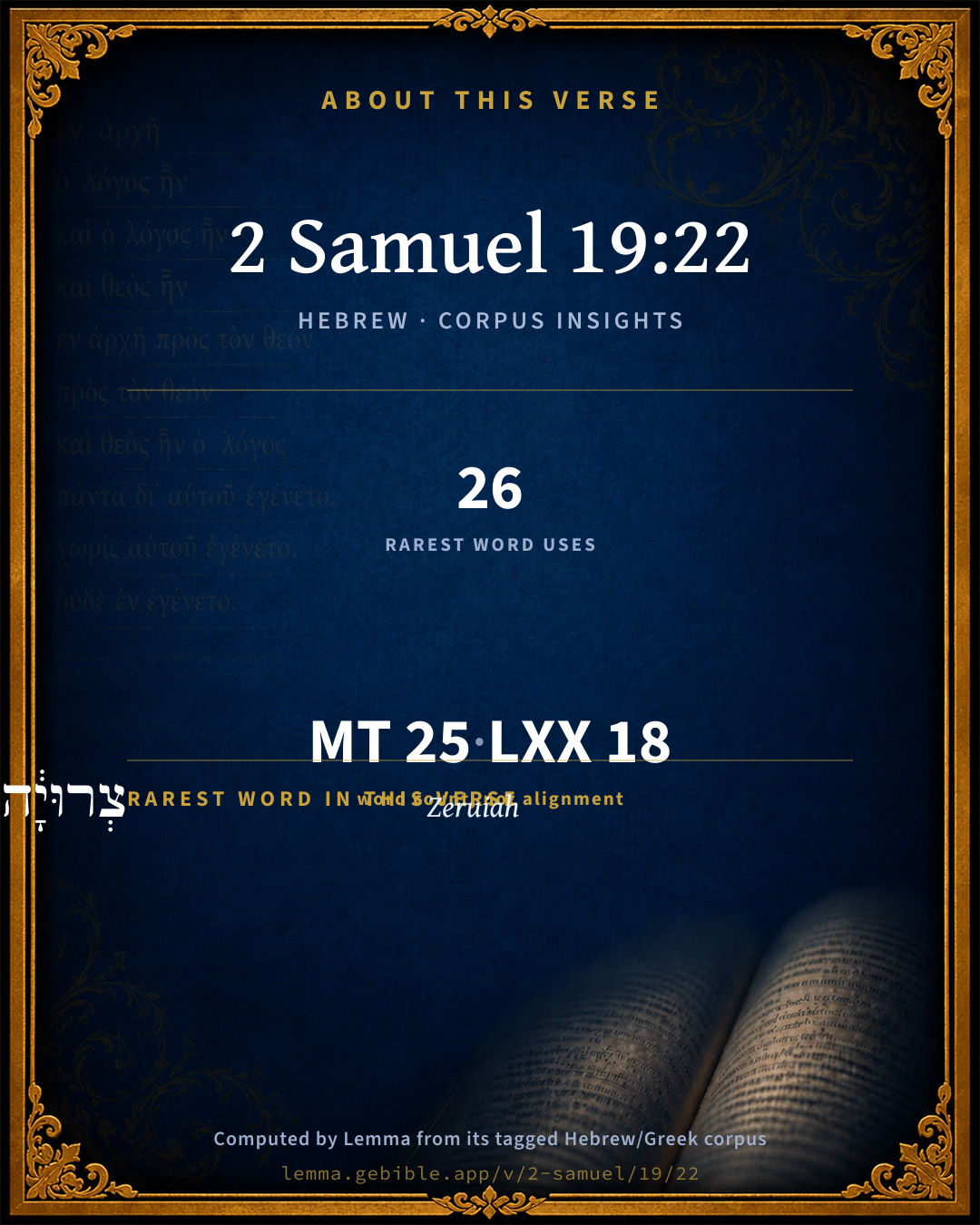
25
words
17
distinct lemmas
Historical
section

Shared distinctive vocabulary

צְרוּיָ֔ה Zeruiah H6870 occurs in 25 verses of the Hebrew Bible. Also found in:

Grammatical profile

  • 4 verbs
  • 11 nouns
  • 1 pronoun
  • 4 prepositions
  • 3 conjunctions
  • 2 particles

Verb forms

  • וַיֹּ֣אמֶר Qal · Sequential Imperfect
  • תִֽהְיוּ Qal · Imperfect
  • י֤וּמַת Hophal · Imperfect
  • יָדַ֔עְתִּי Qal · Perfect

Repetition

Words recur within this verse — often emphatic in Hebrew:

  • הַיּ֖וֹם day H3117 ×3
  • בְּיִשְׂרָאֵ֔ל Israel H3478 ×2
  • כִּי that H3588 ×3

Hebrew & Septuagint length

In English translation the verse runs 46 words from the Hebrew and 47 from the Septuagint (LXX English) — closely comparable.

A rough comparison of the two English renderings, which tokenize alike — not a word-level alignment.

Word counts can differ between the Hebrew and the Greek without any difference in meaning — e.g. the Hebrew direct-object marker אֵת has no separate Greek word, and Greek often adds the article ὁ.

In the original languages it is 25 Hebrew tokens and 18 Greek tokens — but the two are counted differently (Hebrew bundles its prefixes and suffixes into one token; the Greek is in lemma form), so that isn’t a like-for-like length.

Cross-references

7

Topical passages linked to 2 Samuel 19:22 in the Treasury of Scripture Knowledge — connected by theme and wording, ordered by reader-vote popularity; previews shown in the World English Bible.

  • 1 Samuel 11:13 Saul said, There shall not a man be put to death this day; for today Yahweh has worked deliverance in Israel.
  • 2 Samuel 16:10 The king said, What have I to do with you, you sons of Zeruiah? Because he curses, and because Yahweh has said to him, Curse David; who then shall say, Why have you done so?
  • 2 Samuel 3:39 I am this day weak, though anointed king; and these men the sons of Zeruiah are too hard for me. May Yahweh reward the evil-doer according to his wickedness."
  • 1 Samuel 26:8 Then said Abishai to David, God has delivered up your enemy into your hand this day: now therefore please let me strike him with the spear to the earth at one stroke, and I will not strike him the second time.
  • Isaiah 16:5 A throne shall be established in loving kindness; and one shall sit thereon in truth, in the tent of David, judging, and seeking justice, and swift to do righteousness.
  • Matthew 8:29 Behold, they cried out, saying, "What do we have to do with you, Jesus, Son of God? Have you come here to torment us before the time?"
  • Luke 9:54–56 When his disciples, James and John, saw this, they said, "Lord, do you want us to command fire to come down from the sky, and destroy them, just as Elijah did?"

Cross-references courtesy of OpenBible.info (CC BY 4.0).

Hebrew and Greek witnesses Masoretic Hebrew ↔ Greek Septuagint

The same verse in the two great witnesses to the Old Testament, shown verse-for-verse.

These are two independent witnesses, not word-aligned to each other, and the Septuagint is shown in lemma (dictionary) form.

Hebrew 2 Samuel 19:22 Masoretic · Westminster Leningrad Codex

וַיֹּ֣אמֶר דָּוִ֗ד מַה לִּ֤י וְלָכֶם֙ בְּנֵ֣י צְרוּיָ֔ה כִּי תִֽהְיוּ לִ֥י הַיּ֖וֹם לְשָׂטָ֑ן הַיּ֗וֹם י֤וּמַת אִישׁ֙ בְּיִשְׂרָאֵ֔ל כִּ֚י הֲל֣וֹא יָדַ֔עְתִּי כִּ֥י הַיּ֖וֹם אֲנִי מֶ֥לֶךְ עַל יִשְׂרָאֵֽל

David said, What have I to do with you, you sons of Zeruiah, that you should this day be adversaries to me? shall there any man be put to death this day in Israel? for don't I know that I am this day king over Israel?

World English Bible · Public Domain

Greek LXX 2 Samuel 19:22 Septuagint · lemma form

καί ἀποκρίνω αβεσσα υἱός σαρουιας καί εἶπον μή ἀντί οὗτος οὐ θανατόω σεμεϊ ὅτι καταἀράομαι ὁ χριστός κύριος

And David said, What have I to do with you, you⌃ sons of Saruia, that you⌃ as it were lie in wait against me this day? today no man in Israel shall be put to death, for I know not if I this day reign over Israel.

LXX2012 (modern English Septuagint) · Public Domain

Hebrew: Westminster Leningrad Codex (CC BY 4.0). Greek: Septuagint (public domain); English from LXX2012 (modern English Septuagint) (Public Domain). How the Septuagint differs from the Hebrew →

Targum (Aramaic paraphrase)

1

The Targum is the ancient Jewish Aramaic paraphrase of the Hebrew Scriptures — an interpretive translation, not the Hebrew text itself. Onkelos (literal) and Pseudo-Jonathan (expansive) render the Torah, and Jonathan the Prophets. Coverage is partial: where no permissively-licensed English translation exists for a verse, only the Aramaic is shown. This is verse-level text, not a word-by-word alignment to the Hebrew.

  1. Targum Jonathan Prophets (Joshua–Malachi)
    וַאֲתֵיב אֲבִישַׁי בַּר צְרוּיָה וַאֲמַר הַחֲלַף דָא לָא יִתְקְטֵל שִׁמְעִי אֲרֵי לַט יַת מְשִׁיחָא דַיָי:

    (no public-domain English translation for this verse)

    Targum Jonathan — Aramaic: “Mikraot Gedolot” (public domain). English: “Sefaria Community Translation” (CC0 1.0 (public-domain dedication)); “London "Chaldee Paraphrase," 1871” (public domain). Text via Sefaria.

Commentary

Notes on 2 Samuel 19:22 from classic Christian and Jewish commentators (each source and its license shown beneath its notes). The classic Christian expositions comment on the surrounding passage and are grouped to its opening verse, so a note may address several verses; the Jewish commentaries on the Tanakh (Rashi and others) are per-verse, so they appear only where the commentator wrote on this verse.

Lemma curates 59 commentaries, every one of them public domain or Creative Commons licensed, each selected and text-cleaned for this edition rather than reprinted as found. About our sources →

Trapp's Complete Commentary

John Trapp

2Sa 19:22 And David said, What have I to do with you, ye sons of Zeruiah, that ye should this day be adversaries unto me? shall there any man be put to death this day in Israel? for do not I know that I [am] this day king over Israel?

Ver. 22. Shall there any man be put to death this day?] Which is, as it were, a day of my new election and inauguration into the kingdom, and should therefore be auspicated not with bloodshed, but with an act of oblivion.

That I am this day king over Israel?] And so not only may exercise my kingly prerogative in pardoning whom I please, but must in prudence show my readiness so to do: that it may be said of me, as afterwards it was of Julius Caesar, Nihil oblivisci solet praeter iniurias, He is of that happy memory that he never forgetteth anything but injuries.

John Trapp, A Commentary or Exposition upon All the Books of the Old and New Testament (1647–1656) — public domain. Text from a community e-Sword module.

The Biblical Illustrator

Joseph S. Exell

2Sa_19:22

For do not I know that I am this day king over Israel.

Conscious kingship

What wonderful applications this doctrine admits ell It touches life at every point; it is full of lessons to men in all stages of life and in all degrees of influence.

I. Know the great man by his goodness. Know real power, not by its tyranny, but by its kindness. David was given to this kind of expression of his greatness. Once he cut off Sauls skirt and spared the fool; he could have cut off Sauls head. It is better not to use all your power. Always have a great reserve of strength. Never deal your deadliest blow until you are wholly driven to it. You will win more victories by forgiveness than by vengeance, by retaliation, by so-called self-defence.

II. Apply this to the matter of personal character and the defence of personal reputation. Some men are always defending themselves. They had better let it alone. Some little natures are always taking revenge. They will say, Mark: he shall account for this; I have made a note before his name in my diary; he shall hear of this some other day. Oh, shame! That is not the spirit of Christ, the spirit of kingship, the spirit of divinest royalty; that is littleness, yea the veriest meanness.

III. Apply this to pretended rulers. In proportion as a man is only a pretended ruler in anything, in business, in the Church, in Parliament, anywhere--in proportion as he is only a pretence he will be full of vengeance. Cut off their heads! is his policy: make short work of them: we must have a spirited policy; there must be no dillydallying here. Foolish talk; foolish heart! We are not to judge things by stones that are thrown, by dust that is poured upon the wind, by the shouting and crying of poor natures: we must remember that Gods eternity moves slowly but surely, and all his mills grind exceedingly small. Dearly beloved, avenge not yourselves: do not take yourselves into your own keeping, but rather give place unto wrath: for it is written--written in nature, written in every star, written in history, written in life--Vengeance is mine. Vengeance can only belong to one court. All other vengeance is minor, trivial, partial, unjust.

II. Apply this to the christian argument. How slow it is sometimes to human seeming; how indifferent almost to its own issue! It looks calmly upon all the little fray of words, and says, For do not I know that I can save men, bless men, help men, as no other power or force upon earth can do? Why should I follow all these people that are trying to pull my letters to pieces? Why should I take vengeance upon them? The Christian argument often takes no notice of the metaphysical strife, the angry contest, the loud dispute; it does not come down to avenge itself; it says, I am the most beneficent power in human thought, I can therefore afford to wait, and be quiet, and be calm, and not a single life will I take if I can possibly help it.

V. See how wondrously all this fits the character of Christ. In Christ there is nothing vindictive, nothing clamorous, nothing precipitant. When the people would take him by force and make him king he vanished out of their sight. This was the difficulty he had to contend with in his life--refusing so long to declare himself. This might do for a refrain to the music of Christs words--Do not I know that I am the Saviour of the world? Do not I know that I am this day King? Haste thee, smite thine enemies, crush all opposition, shine out of the heavens, out-dazzle the glory of summer noonday, and by that ineffable blaze declare thyself to be King! He says, No; that is not the way; that would be foolish, precipitant, impetuous, irrational: we must move with the currents of life: I have not come to institute a reformation, but to work out a regeneration. Why do the heathen rage? Because they are the heathen. Why do the people imagine a vain thing? Because they are the people, without regulation, discipline, lofty control, spiritual inspiration. Why is the Lord quiet upon His throne? Because He is upon it, and it is His. In one of two ways Jesus Christ is to be King over us all: He is to be King either with our consent, or against it. Choose ye this day. Or you must know that He is the King of kings and Lord of lords; and if you will not accept the sovereignty of His love you must accept the sovereignty of His fear. Now is the accepted time, now is the day of salvation. (J. Parker, D. D.)

The Biblical Illustrator, edited by Joseph S. Exell (c. 1880s–1900s) — public domain. Text from a community e-Sword module.

Ellicott's Commentary for English Readers

(22) Adversaries.—The word in the original here is Satan.

A Bible Commentary for English Readers, edited by Charles John Ellicott (1878–1897) — public domain. Text from a community e-Sword module.

The Cambridge Bible for Schools and Colleges

gen. ed. J. J. S. Perowne

22. adversaries] Opposing my true interests. The Heb. word is satan. Cp. Mat_16:23.

that I am this day king] The rejoicing of the day which saw him restored to his kingdom must not be marred by any bloodshed. Cp. 1Sa_11:13.

The Cambridge Bible for Schools and Colleges (gen. ed. J. J. S. Perowne; Cambridge University Press, 1878–1918) — public domain. Text from a community e-Sword module.

John Gill's Exposition

And David said, what have I to do with you, ye sons of Zeruiah?.... See Gill on Sa2 16:10,

that ye should this day be adversaries unto me? or a Satan unto me, as the word is, by advising him to do what would be prejudicial to his interest; see Mat 16:22; as to use severity at such a time as this would have been; for had he immediately ordered Shimei to be put to death, though he deserved it, who was the first man that came to ask pardon, the Israelites in general, or all however concerned in the rebellion, would have concluded they must share the same fate, and so would not have submitted, but have raised a new rebellion against him; and some think Joab and Abishai had this in view, that they might keep their posts in the army:

shall there any man be put to death this day in Israel? there shall not: the glory of this day shall not be sullied by the death of any; nor the joy of it be turned into sorrow in any family in Israel, as would, if any was put to death for what had passed during the rebellion:

for do not I know that I am this day king over Israel? and can and will do as I please; as he had been driven from his throne and palace, and was now invited back again, and upon his return, it was as if he was made king anew, and afresh inaugurated into his office; and therefore no blood should be split on that day on which he was restored to his kingdom.

John Gill's Exposition of the Whole Bible (1746–1763) — public domain (CC PDM 1.0). Text via the HelloAO Bible API.

Haydock's Catholic Bible Commentary

Sons. He refers to the preceding opposition of Joab, whom Abisai was beginning to imitate. (Haydock) --- Satan; adversary, Matthew xvi. 23. --- This day. Formerly, no one was to be put to death on days of rejoicing, and the prisoners were liberated when the king ascended the throne. A malefactor continued for a long time to be set free on the day of the passover, Matthew xxvii. 15. (Calmet) --- The Romans would never punish any one with death, on the days "whenever (Augustus) entered the city." (Suetonius lvii.) --- David considers this memorable day as a new epoch of his sovereignty, and will not suffer it to be rendered sorrowful. See 1 Kings xi. 13. (Haydock) --- The punishment of Semei might have had the most pernicious consequences, as the rest of Israel would have feared a similar treatment. (Menochius) --- (Salien, the year of the world 3010.)

George Leo Haydock (1774–1849), Haydock's Catholic Family Bible and Commentary, 1859 edition — public domain. Excludes Psalms (Douay-Rheims chapter numbering differs from Protestant) and Deuterocanonical books (Catholic canon only).

Matthew Poole's English Annotations

What have I to do with you? I do not ask, neither will I take, your advice in this matter.

Ye sons of Zeruiah; implying that Joab’s hand was in this contrivance, or that he suspected it.

That ye should this day be adversaries unto me, i.e. that you put me upon things unfit for me to do, and contrary to my present interest; for it was David’s interest at this time to appease the people, and reconcile them to him, and not now to give them any new distaste by acts of severity; for this would make others jealous, that David will not forgive them neither, but would watch an opportunity to be revenged on them. You pretend friendship herein, and would have me take it for an effect of your zeal for my service; but in truth you give me such counsel as my enemies would wish me to follow, that thereby I might awaken the fears and jealousies of my people which are now asleep, and cast them into a second rebellion: which either Joab and Abishai really designed by this advice, that so Joab might recover his place again, and be made necessary for the king’s service; or David suspected that they did so.

Do not I know that I am this day king over Israel? is not my kingdom, which for my sins was in a manner wholly lost, just now restored and assured to me? And when God hath been so merciful to me in forgiving my sin, shall I now show myself revengeful to Shimei? Shall I sully the public joy and glory of this day with an act of such severity? or shall I alienate the hearts of my people from me, now when they are returning to me?

Matthew Poole's English Annotations on the Holy Bible (1683–1685) — public domain. Text from a community e-Sword/MySword module.

Whedon's Commentary on the Bible

Daniel D. Whedon

22. Shall any man be put to death this day — His feelings were like those of Saul after his first great victory. Compare 1Sa_11:13.

Daniel D. Whedon (gen. ed.), Commentary on the Old and New Testaments (1874–1909) — public domain. Text from a community e-Sword module.

The Pulpit Commentary

Ye sons of Zeruiah adversaries unto me; literally, that ye be to me for a Satan; rendered "adversary" in Num_22:22, but by Ewald in this place "tempter." It probably means "one who would do me harm." Though David speaks of the sons of Zeruiah in the plural, (as in 2Sa_16:10) there is no reason to suppose that Joab shared in Abishai"s impetuosity. Indifferent as he was to the shedding of blood, he was too prudent and politic to put the people out of temper by an execution on the day of David"s return. In Israel... over Israel. There is much force in this repetition. A short time before Israel had been for Absalom, but now, by Shimei"s submission, and that of the large body of Benjamites with him, David felt that once again he was king over the whole people.

The Pulpit Commentary (1880–1919), ed. H.D.M. Spence-Jones & Joseph S. Exell — public domain. Text from a community e-Sword module.

John Wesley's Explanatory Notes

Adversaries - That is, that you put me upon things unfit for me to do, and contrary to my interest; for it was David's interest at this time to appease the people, and reconcile them to him, and not to give them any new distaste by acts of severity: for this would make others jealous, that he would watch an opportunity to be revenged on them. King - Is not my kingdom, which was in a manner wholly lost, just now restored and assured to me? And when God hath been so merciful to me in forgiving my sin, shall I shew myself revengeful to Shemei? Shall I sully the publick joy and glory of this day, with an act of such severity? Or, shall I alienate the hearts of my people from me, now they are returning to me?

John Wesley, Explanatory Notes Upon the Whole Bible (1754–1765) — public domain. Text via the GEBible commentary corpus.

Lesson kit

Teaching starters — assembled from the data on this page, not authored interpretation. Every prompt links to the verse data it draws on. Edit before teaching.

2 Samuel, in the Historical, opens this verse with 25 words (17 distinct Hebrew lemmas). Its most distinctive word is Tsᵉrûwyâh (“Zeruiah”). A historical commentator’s framing appears above. Read the whole chapter for the surrounding context.

Discussion questions

  1. The word Tsᵉrûwyâh carries the sense “Zeruiah.” How does it shape the verse?
  2. How does 1 Samuel 26:6, which shares the word «Zeruiah», read alongside this verse?
  3. What does the repetition of “day” (3× in this one verse) do in this verse?
  4. These translations render this verse differently; the difference is in the English rendering, not the original. What questions does that raise?
  5. «וַיֹּ֣אמֶר» is a Qal Sequential Imperfect verb. How does that grammatical form shape the action described?
  6. Compare how Trapp's Complete Commentary and The Biblical Illustrator read this verse. Where do they agree or differ?

Things to notice

Reading settings

Reading text

Shown beneath each verse's original-language words.

Old Testament
Old Testament edition

Read the OT as the Masoretic Hebrew (MT) or the Greek Septuagint (LXX).

English shown for the Greek Septuagint (in the Hebrew ↔ Greek comparison).

Comparing translations? Open the Compare panel on any verse page to stack up to four side by side.