Romans 16:27

Greek (Tischendorf 8th ed.) Romans 16:27 appears in the Greek New Testament. The text above is from the Tischendorf 8th edition. Each word links to its Strong’s number and a concise gloss. Click any word for its full Thayer’s Greek Lexicon entry.
Download image
Cite this verse

Romans 16:27. Public Domain. Lemma interlinear Bible study tool, https://lemma.gebible.app/v/romans/16/27.

Show BibTeX & RIS
BibTeX
RIS
Download a study sheet

One document with this verse’s original text, its word-by-word gloss line, the meaning frame, cross-references with their text, attributed commentary, and full source and license credits — printable, and it pastes into notes with its structure intact.

This verse Autodidact and up

Study sheet (.html) Plain text (.txt)

A passage Seminary Student

Up to 50 verses in one chapter. A passage sheet keeps up to 6 commentary sources and 12 cross-references per verse, in the order this page ranks them, and says so on the sheet whenever that leaves anything out. Ask for a single verse and you get the Autodidact verse sheet above.

Everything on this page stays free to read, with no account — the sheet is a download of what is already on screen, not access to it.

Want to remove ads? Support Godless Engineer
Compare translations 3

The same verse in 3 English versions, stacked beneath the original-language interlinear above. Click any original word for its lexicon entry.

Each is an independent rendering of the whole verse — the interlinear is not word-aligned to these translations.

Highlighted words mark where these versions differ — a whole-verse word diff, not a word-by-word alignment.

  • World English Bible Public Domain

    (No text available for this verse in this version)

  • King James Version Public Domain
    To God only wise, be glory through Jesus Christ for ever. Amen.
  • unfoldingWord Literal Text CC BY-SA 4.0
    to the only wise God, through Jesus Christ, to whom the glory to eternity. Amen.

unfoldingWord Literal Text — © unfoldingWord, licensed CC BY-SA 4.0. Word-aligned USFM3 via Door43 (git.door43.org/unfoldingWord/en_ult).

Versions to compare (up to 4)

3 of 4 selected

Show all 16 translations

Every available English version of this verse, each an independent rendering of the whole verse.

  • Berean Standard Bible Public Domain
    to the only wise God be glory forever through Jesus Christ! Amen.
  • Majority Standard Bible Public Domain
    to the only wise God be glory forever through Jesus Christ! Amen.
  • King James Version Public Domain
    To God only wise, be glory through Jesus Christ for ever. Amen.
  • American Standard Version (1901) Public Domain
    to the only wise God, through Jesus Christ, to whom be the glory for ever. Amen.
  • Revised Version (1885) Public Domain
    to the only wise God, through Jesus Christ, to whom be the glory for ever. Amen.
  • Geneva Bible (1599) Public Domain
    To God, I say, only wise, be praise through Iesus Christ for euer. Amen. Written to the Romans from Corinthus, and sent by Phebe, seruaunt of the Church which is at Cenchrea.
  • Douay-Rheims (1899) Public Domain
    To God the only wise, through Jesus Christ, to whom be honour and glory for ever and ever. Amen.
  • Young's Literal Translation Public Domain
    to the only wise God, through Jesus Christ, to him `be' glory to the ages. Amen.
  • Literal Standard Version CC BY-SA 4.0
    to the only wise God, through Jesus Christ, to Him [be] glory for all ages. Amen.
  • Unlocked Literal Bible CC BY-SA 4.0
    To the only wise God, through Jesus Christ, be glory forever. Amen.
  • unfoldingWord Literal Text CC BY-SA 4.0
    to the only wise God, through Jesus Christ, to whom the glory to eternity. Amen.
  • Darby Bible Public Domain
    [the] only wise God, through Jesus Christ, to whom be glory for ever. Amen.
  • Webster's Bible Public Domain
    To God the only wise, be glory through Jesus Christ for ever. Amen.
  • Free Bible Version CC BY-SA 4.0
    To the one and only wise God, Through Jesus Christ— To him be glory for ever. Amen.
  • Bible in Basic English Public Domain
    To the only wise God, through Jesus Christ, be the glory for ever. So be it.
  • Tyndale New Testament (1534) Public Domain
    To the same God which alone is wyse be prayse thorowe Iesus Christ for ever. Amen. ‘To the Romayns. Sent from Chorinthum by Phebe she that was the minister vnto the congregacion at Chenchrea.’

Literal Standard Version (2020), Covenant Press — licensed CC BY-SA 4.0. Text via the HelloAO Bible API (eBible.org). Unlocked Literal Bible (unfoldingWord) — licensed CC BY-SA 4.0. Text via the HelloAO Bible API (eBible.org). unfoldingWord Literal Text — © unfoldingWord, licensed CC BY-SA 4.0. Word-aligned USFM3 via Door43 (git.door43.org/unfoldingWord/en_ult). Free Bible Version, Dr. Jonathan Gallagher — licensed CC BY-SA 4.0. Text via the HelloAO Bible API (eBible.org).

Word by word

More ways to search: Search by grammar → Find every occurrence → Compare this word →

Practice this passage: Drill this verse → Learn its vocabulary →

σοφῷ
sophós
G4680
“wise”
Adjective, Dative, Singular, Masculine
Part of Speech
Adjective
Case
Dative
Number
Singular
Gender
Masculine
Full Thayer's Definition

Origin: akin to saphes (clear)

TDNT: 14:45,1

1. wise a. skilled, expert: of artificers b. wise, skilled in letters, cultivated, learned 1. of the Greek philosophers and orators 2. of Jewish theologians 3. of Christian teachers c. forming the best plans and using the best means for their execution
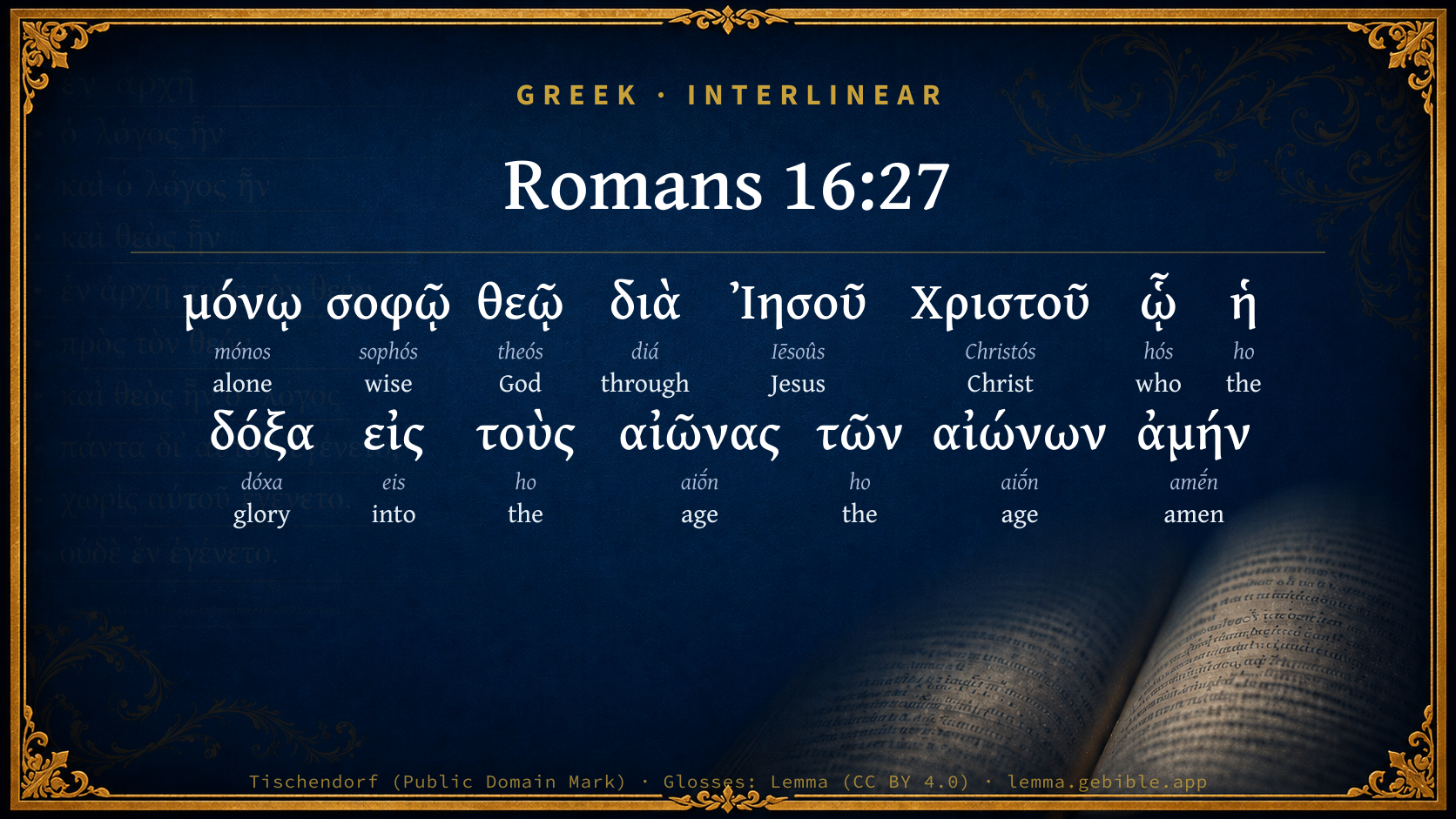
  1. μόνῳ mónos G3441 “alone” Adjective, Dative, Singular, Masculine
  2. θεῷ theós G2316 “God” Noun, Dative, Singular, Masculine
  3. διὰ diá G1223 “through” Preposition
  4. Ἰησοῦ Iēsoûs G2424 “Jesus” Noun, Genitive, Singular, Masculine
  5. Χριστοῦ Christós G5547 “Christ” Noun, Genitive, Singular, Masculine
  6. ᾧ hós G3739 “who” Relative pronoun, Dative, Singular, Masculine
  7. ἡ ho G3588 “the” Article, Nominative, Singular, Feminine
  8. δόξα dóxa G1391 “glory” Noun, Nominative, Singular, Feminine
  9. εἰς eis G1519 “into” Preposition
  10. τοὺς ho G3588 “the” Article, Accusative, Plural, Masculine
  11. αἰῶνας aiṓn G165 “age” Noun, Accusative, Plural, Masculine
  12. τῶν ho G3588 “the” Article, Genitive, Plural, Masculine
  13. αἰώνων aiṓn G165 “age” Noun, Genitive, Plural, Masculine
  14. ἀμήν amḗn G281 “amen” Hebrew transliteration

About this verse

These counts appear in no published source. They are computed here, from the morphology-tagged text and Lemma’s own curated glosses. What Lemma adds →

15
words
12
distinct lemmas
Pauline Epistles
section

Notable vocabulary

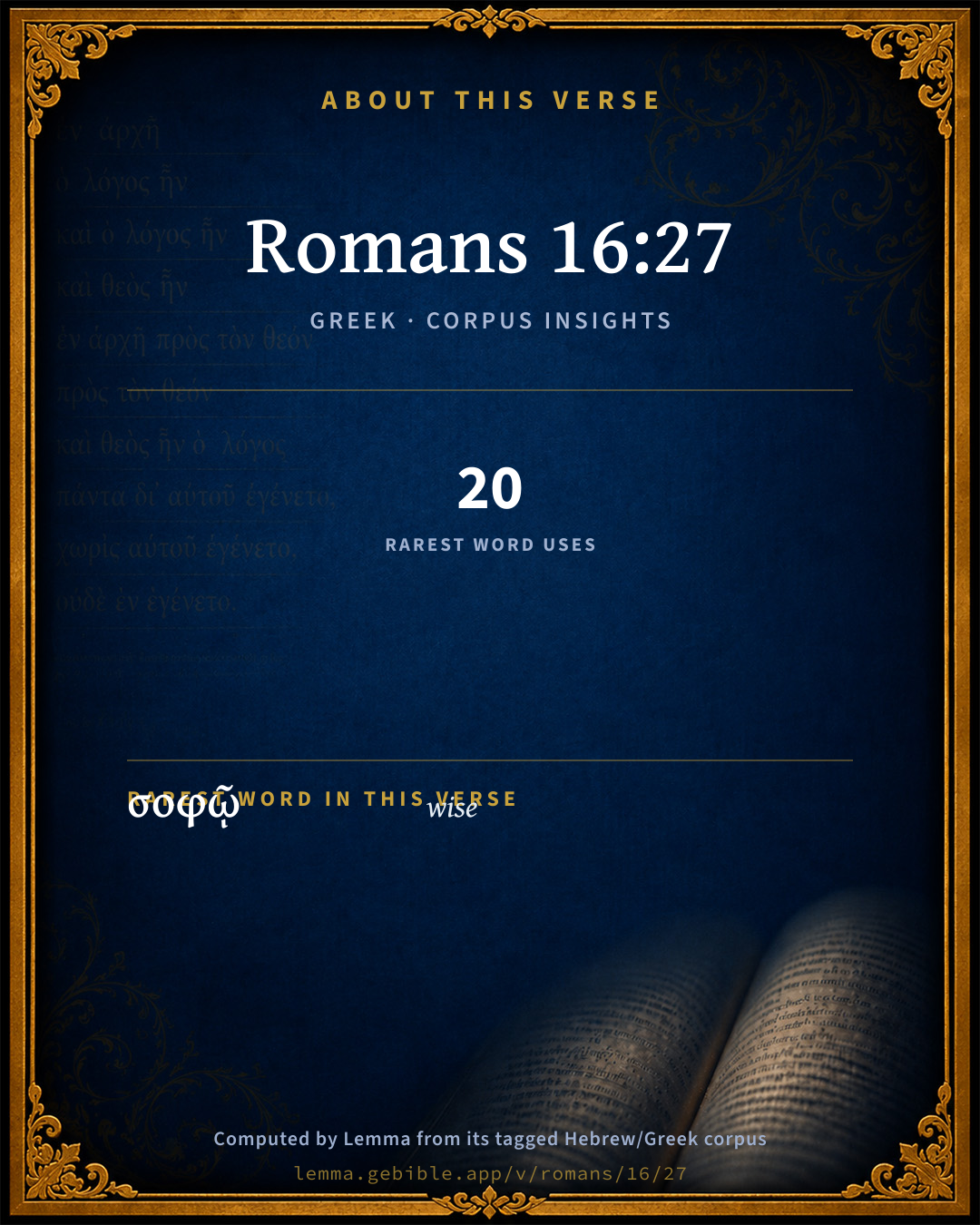
The rarest word here is σοφῷ wise G4680 — appearing just 20 times in the whole Greek New Testament.

Shared distinctive vocabulary

σοφῷ wise G4680 occurs in 19 verses of the Greek New Testament. Also found in:

Repetition

Words recur within this verse:

  • αἰῶνας age G165 ×2
  • ἡ the G3588 ×3

Cross-references

23

Topical passages linked to Romans 16:27 in the Treasury of Scripture Knowledge — connected by theme and wording, ordered by reader-vote popularity; previews shown in the World English Bible.

  • Romans 11:36 For of him, and through him, and to him, are all things. To him be the glory for ever! Amen.
  • 1 Timothy 1:17 Now to the King eternal, immortal, invisible, to God who alone is wise, be honor and glory forever and ever. Amen.
  • Revelation 7:10–12 They cried with a loud voice, saying, "Salvation be to our God, who sits on the throne, and to the Lamb!"
  • Romans 11:33–34 Oh the depth of the riches both of the wisdom and the knowledge of God! How unsearchable are his judgments, and his ways past tracing out!
  • Revelation 19:1–6 After these things I heard something like a loud voice of a great multitude in heaven, saying, "Hallelujah! Salvation, power, and glory belong to our God:
  • 1 Peter 2:5 You also, as living stones, are built up as a spiritual house, to be a holy priesthood, to offer up spiritual sacrifices, acceptable to God through Jesus Christ.
  • Revelation 1:5–6 and from Jesus Christ, the faithful witness, the firstborn of the dead, and the ruler of the kings of the earth. To him who loves us, and washed us from our sins by his blood;
  • Revelation 5:9–14 They sang a new song, saying, "You are worthy to take the book, And to open its seals: For you were killed, And bought us for God with your blood, Out of every tribe, language, people, and nation,
  • Psalms 147:5 Great is our Lord, and mighty in power. His understanding is infinite.
  • Galatians 1:4–5 who gave himself for our sins, that he might deliver us out of this present evil age, according to the will of our God and Father--
  • Ephesians 1:7–8 in whom we have our redemption through his blood, the forgiveness of our trespasses, according to the riches of his grace,
  • Ephesians 3:10 to the intent that now through the assembly the manifold wisdom of God might be made known to the principalities and the powers in the heavenly places,
  • Ephesians 3:20–21 Now to him who is able to do exceedingly abundantly above all that we ask or think, according to the power that works in us,
  • Philippians 4:20 Now to our God and Father be the glory forever and ever! Amen.
  • Colossians 2:2–3 that their hearts may be comforted, they being knit together in love, and gaining all riches of the full assurance of understanding, that they may know the mystery of God, both of the Father and of Christ,
  • 1 Timothy 6:16 who alone has immortality, dwelling in unapproachable light; whom no man has seen, nor can see: to whom be honor and eternal power. Amen.
  • 2 Timothy 4:18 And the Lord will deliver me from every evil work, and will preserve me for his heavenly Kingdom; to whom be the glory forever and ever. Amen.
  • Hebrews 13:15 Through him, then, let us offer up a sacrifice of praise to God continually, that is, the fruit of lips which make confession to his name.
  • Hebrews 13:21 make you complete in every good work to do his will, working in you that which is well pleasing in his sight, through Jesus Christ, to whom be the glory forever and ever. Amen.
  • 1 Peter 5:10–11 But may the God of all grace, who called you to his eternal glory by Christ Jesus, after you have suffered a little while, perfect, establish, strengthen, and settle you.
  • 2 Peter 3:18 But grow in the grace and knowledge of our Lord and Savior Jesus Christ. To him be the glory both now and forever. Amen.
  • Jude 1:25 to God our Savior, who alone is wise, be glory and majesty, dominion and power, both now and forever. Amen.
  • Revelation 4:9–11 When the living creatures give glory, honor, and thanks to him who sits on the throne, to him who lives forever and ever,

Cross-references courtesy of OpenBible.info (CC BY 4.0).

Commentary

Notes on Romans 16:27 from classic Christian and Jewish commentators (each source and its license shown beneath its notes). The classic Christian expositions comment on the surrounding passage and are grouped to its opening verse, so a note may address several verses; the Jewish commentaries on the Tanakh (Rashi and others) are per-verse, so they appear only where the commentator wrote on this verse.

Lemma curates 59 commentaries, every one of them public domain or Creative Commons licensed, each selected and text-cleaned for this edition rather than reprinted as found. About our sources →

Bengel's Gnomon

Johann Albrecht Bengel

Rom 16:27. Σοφῷ) to the wise) The wisdom of God is glorified by means of the Gospel in the Church, Eph 3:10; who is of power [able] Rom 16:25, and to the wise [both predicated of God], are joined together in this passage, as 1Co 1:24, where Christ is said to be the power of God and the wisdom of God.—ᾧ, to whom) is put for αὐτῷ, to Him. So ὧν, ch. Rom 3:14; comp. 2Ti 3:11; Act 26:7; 2Co 4:6, note, LXX., Isa 5:28. There would be a hiatus in the sentence without a pronoun.[174]—Ἀμήν, amen) and let every believing reader say, Amen.[175]

[174] ACD(Λ) Hilary and Vulg. read ᾦ. B the oldest MS. omits it. Lachm. suggests we should adopt this omission and read with the Vulg. no τε between διὰ and γραφῶν and γνωρισθέντι, ‘cognito,’ for γνωρισθεντος. “To the only-wise God who is made known through Jesus Christ.” Else he conjectures that if we retain τε, ᾧ, and γνωρισθέντος, we must read χάρις after Θεῷ, “To the only-wise God be thanks through Jesus Christ, to whom be glory,” etc.—ED.

[175] Bengel, J. A. (1860). Vol. 3: Gnomon of the New Testament (M. E. Bengel & J. C. F. Steudel, Ed.) (J. Bryce, Trans.) (117–198). Edinburgh: T&T Clark.

Bengel's Gnomon of the New Testament — English translation (T&T Clark, Edinburgh, 1860) — public domain. Text from a community e-Sword module.

Meyer's Critical & Exegetical Commentary

Heinrich August Wilhelm Meyer

Rom_16:27. Μόνῳ σοφῷ Θεῷ διὰ Ἰησοῦ Χ.] to be closely connected (without a comma after Θεῷ): to the through Jesus Christ only wise God, i.e. to the God who through Christ has shown Himself as the alone wise, so wise, that in comparison with Him this predicate can be applied to no other being (comp. Luk_18:19; Joh_17:3; 1Ti_6:15-16; 1Ti_1:17; 2Ma_1:25), the absolutely wise. Comp. Plato, Phaedr. p. 278 D; Diog. Laert. i. 12; Philo, de migr. Abr. I. p. 457. 4. The connection: to the alone wise God be the glory through Christ (Pesch., Chrysostom, Luther, Beza, Calvin, Estius, Grotius, Morus, van Hengel, and several others), is inadmissible because of ᾧ, which indeed is omitted by Beza and Grotius after the Complut. edition, but is critically so certified (it is wanting merely in B) that it can only appear to have been omitted with a view to relieve the construction; although Rückert also sees himself forced to omit it, and Ewald (comp. Märcker, p. 8), while retaining the ᾧ, so translates as if it ran ᾧ διὰ Ἰ. Χ. ἡ δόξα. Thus, too, Hofmann connects the words, seeking through the dative μόνῳ σοφῷ Θεῷ to bring them into government with ὀφείλομεν, Rom_15:1 (see on Rom_16:25-27). Instances of such a prefixing of parts of sentences having an emphasis before the relative are found, indeed, in the Greek writers (Schaefer, App. ad Dem. IV. p. 462; Stallbaum, ad Plat. Phaedr. pp. 238 A, 363 A; comp. on Act_1:2); yet in the N. T. we have no passage of this kind (wrongly Hofmann adduces 1Pe_4:11, Heb_13:21, as bearing on this); and it would not be easy to perceive any special reason why Paul should have so uniquely laid stress on διὰ Ἰ. Χ.

The description of God, begun on the side of His power in Rom_16:25, passes over at the conclusion of the doxology into the emphasizing of His wisdom, to which the representation of the gospel as ἀποκάλυψις μυστηρίου … γνωρισθέντος involuntarily led him in a very natural process of thought; for so long as the mystery was covered by silence, the wisdom of God in its highest potency was not yet brought to light,a result which took place by the very means of that ἀποκάλυψις. Comp. Rom_11:32-34. This at the same time applies against Reiche, who believes μόνῳ σοφῷ to be unsuitable here and to be taken from Jud_1:25 var. (the spurious addition σοφῷ, Jud_1:25, as also in 1Ti_1:17, has manifestly flowed from our passage).

διὰ Ἰησοῦ Χριστοῦ] i.e. through the appearance and the whole work of Jesus Christ. Thereby God caused Himself to be practically recognised as the alone wise. Comp. Rom_11:33 ff.; Eph_3:8 ff. Similarly, in Jud_1:25, διὰ Ἰησοῦ Χριστοῦ κ.τ.λ. is connected, not with the following δόξα, but with the preceding σωτῆρι ἡμῶν. Too narrowly, Fritzsche limits διὰ Ἰ. Χ., in accordance with Col_2:3 (but see in loc.), to the contents of His teaching. It is precisely the facts which bring to light the wisdom of the divine measures in the execution of the plan of redemption through Christ,the death and the resurrection and exaltation of Jesus (Rom_4:24-25, Rom_8:34, et al.),that form the sum and substance of the conception of our διὰ Ἰησοῦ Χριστοῦ.

ᾧ] In the lively pressure of the great intermediate thoughts connected with the mention of the gospel, Rom_16:24-25, the syntactic connection has escaped the apostle. Not taking note that τῷ δὲ δυναμένῳ and the resumptive μόνῳ σοφῷ Θεῷ are still without their government, he adds, as though they had already received it at the beginning of the over-full sentence (through χάρις δὲ τῷ δυναμένῳ κ.τ.λ. or the like), the expressionstill remaining dueof the praise itself by means of the (critically certain) relative, so that now the above datives are left to stand as anacoluthic. Comp. Act_24:5-6, and the remark thereon. See also Winer, p. 528 [E. T. p. 710]; Buttmann, neut. Gr. p. 252. Others, indeed, think that Paul allowed himself to be induced by the intermediate thoughts to turn from the doxology to God at first designed, and to direct the tribute of praise to Christ instead, the Mediator and Revealer of the wisdom of God, so as thereby mediately to praise God Himself. See especially Philippi, also Reithmayr, Baumgarten-Crusius, and Tholuck (doubtfully). Such doxologies as if to God, are found addressed to Christ doubtless in Heb_13:21, 2Ti_4:18, Rev_1:6, and later in Clement et al., but in the really apostolical writings nowhere at all (see on Rom_9:5); and that Paul here still, even after the intermediate observations, retained the idea of praising God, so that ᾧ must accordingly be referred not to Christ, but to God, is quite clearly proved by the resumptive μόνῳ σοφῷ Θεῷ. For a formally quite similar anacoluthon[56] in the doxology, see Martyr. Polyc. 20: τῷ δυναμένῳ πάντας ἡμᾶς εἰσαγαγεῖν ἐν τῇ αὐτοῦ χάριτι κ. δωρεᾷ εἰς τὴν αἰώνιον αὐτοῦ βασιλείαν διὰ τοῦ παιδὸς αὐτοῦ μονογενοῦς Ἰησοῦ Χριστοῦ, ᾧ ἡ δόξα, τιμὴ, κράτος, μεγαλωσύνη εἰς αἰῶνας.

ἡ δόξα] sc. εἴη, not ἘΣΤΊ, according to 1Pe_4:11 (Hofmann), where the connection is different and ἜΣΤΙΝ must be written (Lachm.), and its emphasis is to be noted. The article designates the befitting honour, as in Rom_11:36.

[56] For the suggestion that in this passage from the Martyr. Polyc. τῷ δυναμ. is dependent on the preceding ἐκλογάς (Hofmann), is simply a violent and very unsuitably devised evasion. Dressel has the unbiassed and correct punctuation.

Meyer — Critical and Exegetical Commentary on the New Testament — English translation by Peter Christie, edited by Frederick Crombie (T&T Clark, 1880) — public domain. Text from a community e-Sword module.

Expositor's Greek Testament

ed. W. Robertson Nicoll

Rom 16:27 . μόνῳ σοφῷ θεῷ : this description of God suits all that has just been said about His great purpose in human history, and the hiding and revealing of it in due time. The true text in 1Ti 1:17 has no σοφῷ . The absence of the article here indicates that it is in virtue of having this character that God is able to stablish the Romans according to Paul’s Gospel. ᾧ ἡ δόξα : it is impossible to be sure of the reading here. If ᾧ be omitted, there is no grammatical difficulty whatever: glory is ascribed to God through Jesus Christ, through Whom the eternal purpose of the world’s redemption has in God’s wisdom been wrought out. But its omission is almost certainly a correction made for simplification’s sake. If it be retained, to whom does it refer? (1) Some say, to Jesus Christ; and this is grammatically the obvious way to take it. But it seems inconsistent with the fact that in τῷ δὲ δυναμένῳ and μόνῳ σοφῷ θεῷ Paul wishes unequivocally to ascribe the glory to God. And though it saves the grammar of the last clause, it sacrifices that of the whole sentence. Hence (2) it seems necessary to refer it to God, and we may suppose, with Sanday and Headlam, that the structure of the sentence being lost amid the heavily-loaded clauses of the doxology, the writer concludes with a well-known formula of praise, ᾦ ἡ δόξα κ . τ . λ . (Gal 1:15 , 2Ti 4:18 , Heb 13:21 ). This might be indicated by putting a dash after Ἰησοῦ Χριστοῦ . The thread is lost, and the writer appends his solemn conclusion as best he can.

The Expositor's Greek Testament, edited by W. Robertson Nicoll (1897–1910) — public domain. Text from a community e-Sword module.

Cambridge Greek Testament for Schools and Colleges

27. μόνῳ. Cf. Rom 3:30 where the ‘singleness’ of GOD is the basis of the universality of the Gospel, as here. See note ad loc[340] For μόνος cf. Joh 5:44; Joh 17:3; 1Ti 1:17; 1Ti 6:15 (in a similar connexion); Jud 1:25.

[340] ad loc. ad locum

σοφῷ. Cf. Rom 11:33: specially of the wisdom which orders in detail the age-long and world-wide purpose. Cf. 1Co 1:21-30; 1Co 2:7; Eph 3:10; Col 2:3.

θεῷ. To GOD as GOD, sole and supreme Creator and Dispenser of all His wondrous dealings with men.

διὰ Ἰ. Χρ. As through Him GOD has manifested Himself to men, so through Him returns the due acknowledgment from man to GOD; cf. Rom 1:8, Rom 7:25.

ἡ δόξα κ.τ.λ. Cf. Rom 11:36.

NOTE ON THE TEXT

2. Rom 16:27. ᾧ om. B. 33. 72, Pesh., Orig.-lat., ins. rel. exc. αὐτῷ P. 31, 54.

The strongest argument for retaining ᾧ is the difficulty of the reading, and the consequent unlikelihood of its invention. But this principle must not be pressed to the adoption of an all but impossible reading. With ᾧ we can only explain on the assumption of a very awkward anacoluthon. Zahn and Weiss defend this by referring to the strong emotion, with which this passage is written. But even so this is not a natural anacoluthon; there is no parenthesis or interruption of thought; the sentence is regularly and strongly constructed up to Χριστοῦ, and throughout it is obvious that it is to end with ἡ δόξα; after the participial clauses, the dative has come, picking up τῷ δυναμένῳ and resuming the whole thought (μόνῳ σοφῷ); then διὰ Ἰης. Χρ. again makes us expect ἡ δόξα, and cannot be connected with anything that has gone before: no amount of emotion could justify the insertion of ᾧ here, between the words that are crying for ἡ δόξα, and ἡ δόξα itself. It is a sheer though early blunder due to the frequent occurrence of the combination ᾧ ἡ δόξα. There is a closely similar case in Mart. Polycarp. xx. 2 (qu. by Weiss but with the wrong reading), τῷ δὲ δυναμένῳ πάντας ὑμᾶς εἰσαγαγεῖν ἐν τῇ αὐτοῦ χάριτι καὶ δωρεᾷ εἰς τὴν αἰώνιον αὐτοῦ βασιλείαν διὰ τοῦ παιδὸς αὐτοῦ τοῦ μονογενοῦς Ἰησοῦ Χριστοῦ δόξα, τιμή, κράτος, μεγαλοσύνη εἰς τοὺς αἰῶνας. Here ᾧ ἡ are inserted by two MSS before δόξα (Lightfoot, Ap. Fathers II. § ii. p. 983). Further, Jud 1:24-25, clearly modelled on this passage, supports the omission of ᾧ; and even in Jude א* am. and apparently aeth. insert ᾧ before δόξα.

Cambridge Greek Testament for Schools and Colleges (Cambridge University Press, 1896; 21 vols, various authors incl. Carr, Maclear, Plummer, Farrar, Lumby, Moule, M. R. James, Simcox) — public domain. Text from a community e-Sword module.

Godet's Commentaries

Frédéric Louis Godet

Vv. 27. The dative τῷ δυναμένῳ, to Him that is able, in Rom 16:25, has not yet found the verb on which it depends. It is evidently this same dative which, after the long developments contained in Rom 16:25-26, reappears in the words: to God only wise. The idea of God’s power in Rom 16:25 was naturally connected with that of stablishing; and so the idea of the divine wisdom is joined here with the notion of the divine plan and its accomplishment, expounded in Rom 16:25-26. But on what does this dative of Rom 16:27, as well as that of Rom 16:25 which it takes up again, depend? Some answer: on the proposition following: “To Him is (or be) the glory!” But why in this case introduce the relative pronoun ᾧ, to whom? Why not say simply αὐτῷ, to Him? (Eph 4:20-21). To make this construction admissible, all that would be necessary would be to reject this pronoun, as is done by the Vatic. and some Mnn. But these authorities are insufficient. And the reason of the omission is so easy to understand! Must it then be held, as Meyer and many others do, that we have here, exactly in the last sentence of the Epistle, an inaccuracy? It is supposed that Paul, carried away by the great thoughts expressed in Rom 16:25-26, forgot the dative with which he had begun the sentence in Rom 16:25, and continues as if the preceding proposition were finished. But this remote dative, which Paul is thought to have forgotten, is evidently reproduced in this one: to God only wise! He has it therefore still present to his mind. Tholuck, Philippi, and others refer the relative pronoun ᾧ, to whom, not to God, but to Jesus Christ; they hold that, according to the apostle’s intention, the doxology was originally meant to apply to God, the author of the plan of salvation, but that Paul, on reaching the close of the period, applied it to Christ, who executes the plan: “To God powerful...and wise [be glory], by Jesus Christ, to whom be glory forever.” This explanation would certainly be more tolerable than Meyer’s. But we doubt whether the apostle’s real meaning is thereby obtained. In fact, when he began his period with the words: To Him that is of power to stablish you, his intention was certainly not to terminate with this idea: To Him be glory! We glorify Him who has done the work; but as concerning Him who is able to do it, we look to Him to do it; we ask His succor; we express our confidence in Him and in His strength. Such was the inward direction of the apostle’s heart when he began Rom 16:25 by saying: “To Him that is of power”..., exactly as when he closed his discourse to the elders of Ephesus, Act 20:32, by saying: “And now I commend you to God and to the word of His grace, to Him that is of power (τῷ δυναμένῳ) to build you up and give you the inheritance”...The idea understood, on which the dative of Rom 16:25 depends, is therefore that of commendation and confidence: “My eye, in closing, turns to Him who is able, and from whom I expect everything.” This impulse God ward, in which he desires his readers to join him, is so lively within his soul that he does not even feel the need of expressing it; he includes it in this reduplicated dative τῷ δυναμένῳ and μόνῳ σοφῷ Θεῷ). And hence the proposition may be regarded as complete, and as terminating without any real inaccuracy in the doxological formula which closes the period and the whole Epistle: “whose is the glory”...The full form would be: “I look with you all to Him who can stablish you...to God only wise, through Jesus Christ whose is [or be] the glory!”

The clause: through Jesus Christ, is connected by Meyer with the word wise: “to God whose wisdom is manifested in Jesus Christ, in His person and work.” But the expression: only wise through Christ, would not signify: who has shown himself wise through Christ, but: who is really wise through Christ. And that is an idea which Paul could not enunciate. The words: through Jesus Christ, must therefore be referred to the understood thought which forms the basis of the whole preceding sentence: “I look to God, I wait on Him, for all that concerns you, through Jesus Christ.” It is through Jesus Christ that the apostle sends up his supplication, as it is through Jesus Christ that there will come down on the Romans the help of God only strong and only wise.

If it is so, the relative pronoun to whom refers rather to Jesus Christ than to God. But it must be added that in his view the author and executor of the plan of salvation are so closely united, that it is difficult in this final homage to separate God to whom He looks, from Jesus Christ in whose name he looks. In the passage Rom 1:7, the two substantives: God and Jesus Christ, are placed under the government of one and the same preposition; they may therefore be embraced here in one and the same pronoun.

The verb to be understood in the last proposition would certainly be ἔστω, let it be, if Paul had used the word δόξα, glory, without article. But with the article (“the glory”) the verb ἐστί, is, must be preferred: “whose is the glory.” It belongs to Him wholly throughout all eternity. For He has done everything in that work of salvation just expounded in the writing now closed.

Frédéric Louis Godet — Commentaries on Luke, John, Romans, and 1 Corinthians — English translation (T&T Clark, Edinburgh, 1870s–1890s) — public domain. Text from a community e-Sword module.

Hodge's Commentary on Romans, Ephesians & First Corinthians

Charles Hodge

Rom_16:25, Rom_16:27

These verses contain the concluding doxology. Now to him that is of power to establish you according to my gospel and the preaching of Jesus Christ, according to the revelation of the mystery, etc. As the apostle interweaves with his doxology a description and eulogium of the gospel, he renders the sentence so long and complicated that the regular grammatical construction is broken. There is nothing to govern the words (tῷ δυναμένῳ) to him that is of power. The words, be glory for ever, (which are repeated at the end in connection with ᾧ) are, therefore, most probably to be supplied. To him that is able to establish you, i.e. to render you firm and constant, to keep you from falling. According to my gospel. The word (κατά) according to, may be variously explained. It may be rendered, establish you in my gospel; but this the proper meaning of the words will hardly allow; or, agreeably to my gospel; in such a manner as the gospel requires; or, through, i.e. by means of my gospel. The second interpretation is perhaps the best. And the preaching of Jesus Christ. This may mean either Christs preaching, or the preaching concerning Christ; either interpretation gives a good sense, the gospel being, both a proclamation by Christ, and concerning Christ. The apostle dwells upon this idea, and is led into a description and commendation of the gospel. According to the revelation of the mystery. These words may be considered as coordinate with the preceding clause; the sense then is, Who is able to establish you agreeably to (or through) my gospel, agreeably to (through) the revelation of the mystery, etc. It is, however, more common to consider this clause as subordinate and descriptive. The gospel is a revelation of the mystery which had been hid for ages. The word mystery, according to the common scriptural sense of the term, does not mean something obscure or incomprehensible, but simply something previously unknown and undiscoverable by human reason, and which, if known at all, must be known by a revelation from God. In this sense the gospel is called a mystery, or the wisdom of God in a mystery, that is, a hidden wisdom, which the wise of this world could not discover, but which God has revealed by his Spirit, 1Co_2:7-10; 1Co_4:1; Eph_6:19; Col_1:25-27; Col_2:2, etc. In the same sense any particular doctrine, as the calling of the Gentiles, Eph_3:4-6; the restoration of the Jews, Rom_11:25; the change of the bodies of living believers at the last day, 1Co_15:51; is called a mystery, because a matter of divine revelation. According to this passage, Paul speaks of the gospel as something which had been kept secret since the world began; (χρόνοις αἰωνίοις,) i.e. hidden from eternity in the divine mind. It is not a system of human philosophy, or the result of human investigation, but it is a revelation of the purpose of God. Paul often presents the idea that the plan of redemption was formed from eternity, and is such as no eye could discover, and no heart conceive, 1Co_2:7-9; Col_1:26.

Rom_16:27

To the only wise God be glory through Jesus Christ for ever, Amen. There is an ambiguity in the original which is not retained in our version. To the only wise God, through Jesus Christ, to whom be glory for ever. The construction adopted by our translators is perhaps the one most generally approved. To him that is able to establish you, to the only wise God, through Jesus Christ, be glory. In this case the relative, ᾦ, to whom, in Rom_16:27, is pleonastic. Others explain the passage thus, To the only wise God, made known through Jesus Christ, to whom (i.e., Christ) be glory for ever. The simplest construction is, To the only wise God, through Jesus Christ, to him, I say, be glory for ever. As Paul often calls the gospel the wisdom of God, in contrast with the wisdom of men, he here, when speaking of the plan of redemption as the product of the divine mind, and intended for all nations, addresses his praises to its author as the only wise God, as that Being whose wisdom is so wonderfully displayed in the gospel and in all his other works, that he alone can be considered truly wise.

Remarks

1. It is the duty of Christians to receive kindly their brethren, and to aid them in every way within their power, and to do this from religious motives and in a religious manner, as becometh saints, Rom_16:1, Rom_16:2.

2. The social relations in which Christians stand to each other as relatives, countrymen, friends, should not be allowed to give character to their feelings and conduct to the exclusion of the more important relation which they bear to Christ. It is as friends, helpers, fellow-laborers in the Lord, that they are to be recognized; they are to be received in the Lord; our common connection with Christ is ever to be born in mind, and made to modify all our feelings and conduct, Rom_16:3-12.

3. From the beginning females have taken an active and important part in the promotion of the gospel. They seem, more than others, to have contributed to Christ of their substance. They were his most faithful attendants, last at the cross, and first at the sepulchre. Phebe was a servant of the church, a succorer of Paul, and of many others; Tryphena, Typhosa, and Persis, labored much in the Lord Rom_16:1, Rom_16:2, Rom_16:3, Rom_16:6, Rom_16:12.

4. It does not follow, because a custom prevailed in the early churches, and received the sanction of the apostles, that we are obliged to follow it. These customs often arose out of local circumstances and previous habits, or were merely conventional modes of expressing certain feelings, and were never intended to be made universally obligatory. As it was common in the East, (and is so, to a great extent, at present, not only there, but on the continent of Europe,) to express affection by the kiss of peace, Paul exhorts the Roman Christians to salute one another with a holy kiss; i.e., to manifest their Christian love to each other, according to the mode to which they were accustomed. The exercise and manifestation of the feeling but not the mode of its expression, are obligatory on us. This is but one example; there are many other things connected with the manner of conducting public worship, and with the administration of baptism and the Lords Supper, common in the apostolic churches, which have gone out of use. Christianity is a living principle, and was never intended to be confined to one unvarying set of forms, Rom_16:16.

5. It is the duty of Christians to be constantly watchful over the peace and purity of the church, and not to allow those who cause divisions and scandals, by departing from the true doctrines, to pursue their course unnoticed. With all such we should break off every connection which either sanctions their opinions and conduct, or gives them facilities for effecting evil, Rom_16:17.

6. False teachers have ever abounded in the church. All the apostles were called upon earnestly to oppose them. Witness the epistles of Paul, John, Peter, and James. No one of the apostolical epistles is silent on this subject. Good men may indeed hold erroneous doctrines; but the false teachers, the promoters of heresy and divisions, as a class, are characterized by Paul as not influenced by a desire to serve Christ, but as selfish in their aims, and plausible, flattering, and deceitful in their conduct, Rom_16:18.

7. Christians should unite the harmlessness of the dove with the wisdom of the serpent. They should be careful neither to cause divisions or scandals themselves, nor allow others to deceive and beguile them into evil, Rom_16:19.

8. However much the church may be distracted and troubled, error, and its advocates cannot finally prevail. Satan is a conquered enemy with a lengthened chain; God will ultimately bruise him under the feet of his people, Rom_16:20.

9. The stability which the church and every Christian should maintain, is a steadfastness, not in forms or matters of human authority, but in the gospel and the preaching of Jesus Christ. God alone is able thus to make his people stand; and, therefore, we should look to him, and depend upon him for our own preservation and the preservation of the church; and ascribe to him, and not to ourselves, all glory and thanks, Rom_16:25, Rom_16:27.

10. The gospel is a mystery, i.e. a system of truth beyond the power of the human mind to discover, which God has revealed for our faith and obedience. It was formed from eternity in the divine mind, revealed by the prophets and apostles, and the preaching of Jesus Christ; and is, by the command of God, to be made known to all nations, Rom_16:25, Rom_16:26.

11. God alone is wise. He charges his angels with folly; and the wisdom of men is foolishness with him. To God, therefore, the profoundest reverence and the most implicit submission are due. Men should not presume to call in question what he has revealed, or consider themselves competent to sit in judgment on the truth of his declarations or the wisdom of his plans. To God only wise, be glory, through Jesus Christ, for ever. Amen.

Appendix

The subscriptions to this and the other epistles were not added by the sacred writers, but appended by some later and unknown persons. This is evident,

1. Because it cannot be supposed that the apostles would thus formally state (as in this case) what those to whom their letters were addressed must have already known. The Romans had no need to be in formed that this epistle was sent by Phebe, if she actually delivered it to them.

2. They are frequently incorrect, and at times contradict the statements made in the epistles to which they are appended. Thus the subscription to the first Epistle to the Corinthians, states that it was written from Philippi, whereas Paul, Rom_16:8, speaks of himself as being in Ephesus when he was writing.

3. They are either left out entirely by the oldest and best manuscripts and versions, or appear in very different forms. In the present case many MSS. have no subscription at all; others simply, To the Romans; others, To the Romans, written from Corinth; others, Written to the Romans from Corinth, by Phebe, etc.

These subscriptions, therefore, are of no other authority than as evidence of the opinion which prevailed to a certain extent, at an early date, as to the origin of the epistles to which they were attached. Unless confirmed from other sources, they cannot be relied upon.

Charles Hodge — Commentary on Romans (1835), First Corinthians (1857), and Ephesians (1856) — public domain. Text from a community e-Sword module.

Jamieson, Fausset & Brown

Robert Jamieson, A. R. Fausset & David Brown

To God, &c.--"To the only wise God through Jesus Christ, be"--literally, "to whom be"; that is, "to Him, I say, be the glory for ever. Amen." At its outset, this is an ascription of glory to the power that could do all this; at its close it ascribes glory to the wisdom that planned and that presides over the gathering of a redeemed people out of all nations. The apostle adds his devout "Amen," which the reader--if he has followed him with the astonishment and delight of him who pens these words--will fervently echo.

On this concluding section of the Epistle, Note, (1) In the minute and delicate manifestations of Christian feeling, and lively interest in the smallest movements of Christian life, love, and zeal, which are here exemplified, combined with the grasp of thought and elevation of soul which this whole Epistle displays, as indeed all the writings of our apostle, we have the secret of much of that grandeur of character which has made the name of Paul stand on an elevation of its own in the estimation of enlightened Christendom in every age, and of that influence which under God, beyond all the other apostles, he has already exercised, and is yet destined to exert, over the religious thinking and feeling of men. Nor can any approach him in these peculiarities without exercising corresponding influence on all with whom they come in contact (Rom. 16:1-16). (2) "The wisdom of the serpent and the harmlessness of the dove"--in enjoining which our apostle here only echoes the teaching of his Lord (Mat 10:16) --is a combination of properties the rarity of which among Christians is only equalled by its vast importance. In every age of the Church there have been real Christians whose excessive study of the serpent's wisdom has so sadly trenched upon their guileless simplicity, as at times to excite the distressing apprehension that they were no better than wolves in sheep's clothing. Nor is it to be denied, on the other hand, that, either from inaptitude or indisposition to judge with manly discrimination of character and of measures, many eminently simple, spiritual, devoted Christians, have throughout life exercised little or no influence on any section of society around them. Let the apostle's counsel on this head (Rom 16:19) be taken as a study, especially by young Christians, whose character has yet to be formed, and whose permanent sphere in life is but partially fixed; and let them prayerfully set themselves to the combined exercise of both those qualities. So will their Christian character acquire solidity and elevation, and their influence for good be proportionably extended. (3) Christians should cheer their own and each other's hearts, amidst the toils and trials of their protracted warfare, with the assurance that it will have a speedy and glorious end; they should accustom themselves to regard all opposition to the progress and prosperity of Christ's cause--whether in their own souls, in the churches with which they are connected, or in the world at large--as just "Satan" in conflict, as ever, with Christ their Lord; and they should never allow themselves to doubt that "the God of peace" will "shortly" give them the neck of their Enemy, and make them to bruise the Serpent's head (Rom 16:20). (4) As Christians are held up and carried through solely by divine power, working through the glorious Gospel, so to that power, and to the wisdom that brought that Gospel nigh to them, they should ascribe all the glory of their stability now, as they certainly will of their victory at last (Rom 16:25-27). (5) "Has the everlasting God . . . commanded" that the Gospel "mystery," so long kept hid but now fully disclosed, shall be "made known to all nations for the obedience of faith" (Rom 16:26)? Then, what "necessity is laid upon" all the churches and every Christian, to send the Gospel "to every creature!" And we may rest well assured that the prosperity or decline of churches, and of individual Christians, will have not a little to do with their faithfulness or indifference to this imperative duty.

The ancient subscription at the end of this epistle--though of course of no authority--appears to be in this case quite correct.

Next: 1 Corinthians Introduction

Jamieson, Fausset & Brown — Commentary Critical and Explanatory on the Whole Bible (1871) — public domain (CC PDM 1.0). Text via the HelloAO Bible API.

Adam Clarke's Commentary

Verse 27. To God only wise] This comes in with great propriety. He alone who is the fountain of wisdom and knowledge, had all this mystery in himself; and he alone who knew the times, places, persons, and circumstances, could reveal the whole; and he has revealed all in such a way as not only to manifest his unsearchable wisdom, but also his infinite goodness: therefore, to him be glory for his wisdom in devising this most admirable plan; and his goodness in sending Christ Jesus to execute it; to Him, through Christ Jesus, be glory for ever! Because this plan is to last for ever; and is to have no issue but in eternal glory.

Written to the Romans from Corinthus, c.] That this epistle was written from Corinth is almost universally believed. That Phoebe was a deaconess of the Church at Cenchrea, we have seen in the first verse of this chapter and that the epistle might have been sent by her to Rome is possible; but that she should have been the writer of the epistle, as this subscription states, εγραφη δια Φοιβης, is false, for Ro 16:22 shows that Tertius was the writer, though by inserting the words and sent, we represent her rather as the carrier than the writer. This subscription, however, stands on very questionable grounds. It is wanting in almost all the ancient MSS.; and even of those which are more modern, few have it entirely, as in our common editions. It has already been noted that the subscriptions to the sacred books are of little or no authority, all having been added in latter times, and frequently by injudicious hands. The most ancient have simply To the Romans, or the Epistle to the Romans is finished. The word Amen was seldom added by the inspired writers, and here it is wanting in almost all the ancient MSS. As this was a word in frequent use in religious services, pious people would naturally employ it in finishing the reading or copying of this epistle, as they would thereby express their conviction of the truth of its contents, and their desire that the promises contained in it might be fulfilled to them and to the Church at large; and in this sense the word is not only harmless but useful. May the fulness of the Gentiles be brought in, and may all Israel be saved! This is treated of at large in this epistle; and to this prayer let every pious reader say AMEN! Often this word seems to be used as we use the word finis, i.e. the end. See the observations on this word at the end of the Gospel of John.

BEFORE I conclude this work, I shall beg leave to add several important observations, chiefly extracted from Dr. Taylor.

Adam Clarke's Commentary on the Bible (1810–1826) — public domain. Text from a community e-Sword/MySword module.

Ellicott's Commentary for English Readers

(27) To God.—Our English translation has evaded the difficulty of this verse by leaving out two words. The Greek stands literally thus, “To the only wise God, through Jesus Christ, to whom be glory for ever.” “To whom,” if it refers to God, as it is decidedly more probable that it was intended to refer, is ungrammatical. If it is inserted, the words “To him that is able . . . to God, the only wise,” are left without government. This might, indeed, under ordinary circumstances be got over, as such broken constructions are frequent with St. Paul, but it is somewhat different in the last solemn words of an Epistle, and would be especially so if this doxology were composed by itself separately from the rest of the Epistle. There would not then be the usual excuse of haste; and for so short a passage it may be doubted whether the Apostle would even employ an amanuensis. The difficulty is heightened when we ask what is meant by the phrase, “through Jesus Christ.” Separated, as it would then be, from the ascription of glory, and joined to “the only wise God,” it would seem to be impossible to get any really satisfactory sense out of it. “To God, who through Christ has shown Himself as the alone wise,” is maintained, but is surely very forced. Our conclusion then, prior to the evidence, would be that there was a mistake in the reading, and that the words “to whom” had slipped in without warrant. And now we find that a single uncial MS., but that precisely the oldest and best of all the uncials, the Codex Vaticanus, with two cursives, omits these words. The suspicion would indeed naturally arise that they had been left out specially on account of their difficulty. But this is a suspicion from which on the whole, the Vatican MS. is peculiarly free. And, on the other hand, it is just as natural to assume that another common cause of corruption has been at work. Doxologies so frequently begin with the relative, “To whom be glory,” &c., that the copyist would be liable to fall into the phrase, even in places where it was not originally written. The probabilities of corruption may therefore be taken to balance each other, and it will seem, perhaps, on the whole, the most probable solution that the relative has really slipped in at a very early date, and that the English version as it stands is substantially right. There are some exceptions to the rule that “the more difficult reading is to be preferred,” and this is perhaps one.

The subscription in its present form hardly dates back beyond the ninth century. The earliest form of subscription up to the sixth century was simply “To the Romans.”

A Bible Commentary for English Readers, edited by Charles John Ellicott (1878–1897) — public domain. Text from a community e-Sword module.

The Cambridge Bible for Schools and Colleges

gen. ed. J. J. S. Perowne

27. to God only wise] So certainly; though the Gr. equally allows the rendering to the only wise God. But the assertion of His glory as the Only (absolutely) Wise Being is far more in harmony with the height and fulness of the language here, than the assertion that among all Divinities, real or supposed, He only is wise.—The eternal Wisdom is here emphasized because the Gospel is its supreme expression. See especially the profound words of Eph_3:10, and 1Ti_1:17 (with its connexion). Cp. also “Christ … the wisdom of God,” 1Co_1:24.—In Jude 25, the word “wise” is probably to be omitted.

be glory, &c.] The lit. order and rendering of the remaining words is—through Jesus Christ, to whom be the glory for ever. Amen. Here the construction becomes involved by the use of the relative, “to whom;” and this is equally so whether the relative refers to God or to Christ. That it refers to God seems to be proved, (1) by the opening words of Rom_16:25, which lead us to expect, through the whole passage, an ascription of praise to the Father; (2) by the name of Christ occurring in a phrase (see next note) which indicates His mediatorial work, as the Channel through which praise rises to the Father.

through Jesus Christ] Meyer connects these words closely with the phrase “to God only wise,” and explains them to mean that the absolute Wisdom of God acts and is revealed through Jesus Christ. But this, though in itself eternally true, involves a grammatical construction sufficiently peculiar to recommend the more obvious one which takes the words “through Jesus Christ” to refer to the Son of God as our Channel of thanks and praise. Cp. ch. Rom_1:8.—We now explain the abrupt construction (see last note) as if St Paul had fully written, “Now to Him that is of power to stablish you, &c., we give thanks; even to God Only Wise, through Jesus Christ; to whom (i.e. to God) be the glory for ever.”

The construction of this Doxology is remarkable not only in itself, but in the fact that it was evidently left unaltered by St Paul and his friends. No various reading of the least importance occurs throughout it.

for ever. Amen] See on Rom_1:25, and on Rom_11:33, &c. Justly does the great Epistle end with the highest of all thoughts, the Glory of God everlastingly manifested and confessed. Amen, so be it.

The Subscription

Written to the Romans, &c.] Lit. To the Romans [i.e. The Epistle to the Romans] was written from Corinth, by means of Phœbe the servant of the Cenchrean church. This ancient “Subscription” is no doubt true to fact. In this it differs from those appended to 1 Cor., Galat., 1 Tim., which are contradictory to the contents of the respective Epistles; and from those appended to Thess. and Titus, which are difficult to be reconciled with the contents.

These “Subscriptions” (to St Paul’s Epistles) are said to be the work of Euthalius, a Bishop of the fifth century. They thus possess an antiquarian interest, but no historical authority. (See Scrivener’s Introduction to the Criticism of the N. T., ed. 1874, p. 60.)

The Cambridge Bible for Schools and Colleges (gen. ed. J. J. S. Perowne; Cambridge University Press, 1878–1918) — public domain. Text from a community e-Sword module.

Trapp's Complete Commentary

John Trapp

27 To God only wise, be glory through Jesus Christ for ever. Amen. Written to the Romans from Corinthus, and sent by Phebe servant of the church at Cenchrea.

Ver. 27. To God only wise, &c.] So say I for these few notes thus finished. All that I shall now add is this distich, -

" Pars superat coepti, pars est exacta laboris:

Hic teneat nostras anchora iacta rates."

John Trapp, A Commentary or Exposition upon All the Books of the Old and New Testament (1647–1656) — public domain. Text from a community e-Sword module.

Albert Barnes' Notes on the Bible

To God only wise - The apostle here resumes the doxology which had been interrupted by the parenthesis. The attribute of “wisdom” is here brought into view, because it had been particularly displayed in this plan which was now revealed. It evinced, in an eminent degree, the “wisdom” of God. That wisdom was evinced in devising the plan; in adapting it to the renewing of the heart; the justification of the sinner; his preservation, guidance, and sanctification; and in the manner in which the divine attributes had all been seen to harmonize. All this the apostle had illustrated in the previous parts of the Epistle; and now, full of the convictions of this wisdom, he desires that all the praise and honor should be to God. The “tendency” of the plan is to promote his glory. The “obligation” on all who are benefitted by it is to give him praise.

Be glory - Praise; honor.

Through Jesus Christ - By means of the work which Jesus Christ has performed; through him now as mediator and intercessor in the heavens.

The subscription, “written to the Romans,” etc. is evidently added by some other hand, but by whom is unknown. Paul assuredly would not write this to inform the Romans that it was sent by Phebe, whom he had just commended to their kindness. It has been shown, moreover, that no reliance is to be placed on any of the subscriptions to the Epistles. Some of them are known to be false. By whom they were added is unknown. In this case, however, the fact which it states is correct, that it was written from Corinth and sent by Phoebe.

Albert Barnes' Notes on the Bible (1834–1885) — public domain. Text from a community e-Sword/MySword module.

Matthew Poole's English Annotations

The second attribute in the description of God, is his wisdom; he is said to be

wise, and

only wise. See the like, 1Ti 1:17; Jud 1:25. So he is said to be only true, Joh 17:3, and to be the only Potentate, 1Ti 6:15, and only to have immortality, 1Ti 6:16. And this doth not exclude the wisdom of the Son, and of the Holy Spirit, but the wisdom of the creatures. He is said to be only wise, because none is as wise as he, and all the wisdom of others is from him; the wisdom of men and angels is but a ray from his light. Again, he is said to be only wise, because he is originally wise; his wisdom is of himself; yea, his wisdom is himself.

Be glory through Jesus Christ for ever: here he ascribes eternal glory to God. You had the same before, Rom 11:36. Only here is added, through Jesus Christ, to show that our praise and thanksgiving is accepted of God through him: see Rom 1:7; Eph 3:20,21.

Amen: this word is six times before used in this Epistle; Rom 1:25; Rom 9:5; 11:36; 15:33; 16:20,24. It is a Hebrew word, but retained in all languages. It cannot be translated without losing much of its weight. It may be taken three ways:

1. As a name, and so it is a name of Christ, Rev 3:14.

2. As an adverb: so it is used in the beginning of speech, and signifies verily; or in the end of speech, and so it notes assent. Therefore it was used of old by the Jews, not only at prayer, but at all the sermons and expositions of their rabbins, to testify that they assented and agreed to all that they taught: see 1Co 14:16.

3. As a verb; and so it is as much as: So be it, having the nature of a prayer: hence Jeremiah said Amen to the prophecy of Hananiah, though false, concerning the sudden return from the Babylonish captivity, to show how earnestly he desired it might be so, Jer 28:6.

Written to the Romans from Corinthus, (and sent) by Phebe servant of the church at Cenchrea.

This was not added by the apostle Paul, nor by Tertius his amanuensis, but by a later and unknown hand; yet there is nothing in the Epistle itself, nor in any ancient or modern writer, that may induce us to question the verity thereof.

Matthew Poole's English Annotations on the Holy Bible (1683–1685) — public domain. Text from a community e-Sword/MySword module.

Whedon's Commentary on the Bible

Daniel D. Whedon

27. Glory—Our translators smoothly glide over one Greek word, consisting, indeed, of a single letter, which is a thorn to all close commentators. Before be glory comes ω, to whom, giving us not only to God, through Jesus Christ, but also to whom be glory. No critical genius has ever furnished any better method than to consider to whom to be equivalent to to him, which is then pleonastic, but not ungraceful or unPauline. To God only wise… through Jesus Christ… to him be glory forever.

Very ingenious, in fact too purely ingenious, is Lange’s method. Let amen be a noun, (as in 2Co_1:20,) and then we have,

To God only wise—through Jesus Christ, to whom be glory—be an amen forever; the amen being, as it were, the response of an eternal liturgy from God’s Church into the only wise God. A sublime thought, expressing a most sublime reality! What heart does not respond with a prayer to be allowed its share in that eternal AMEN!

Daniel D. Whedon (gen. ed.), Commentary on the Old and New Testaments (1874–1909) — public domain. Text from a community e-Sword module.

The Pulpit Commentary

To God only wise, through Jesus Christ, be glory for ever. Amen. The great preponderance of ancient authorities, including all uncials but B, have "to God only wise." But the intended sense is not affected by the insertion, the ascription of glory being still to the only wise God, and not to Jesus Christ. Otherwise there would be no sequence to tw dunamenw and monw sofw Yew . "In the lively pressure of the great intermediate thoughts connected with the mention of the gospel, vers. 25, 26, the syntactic connection has escaped the apostle" (Meyer).

The Pulpit Commentary (1880–1919), ed. H.D.M. Spence-Jones & Joseph S. Exell — public domain. Text from a community e-Sword module.

John Wesley's Explanatory Notes

To the only wise God - Whose manifold wisdom is known in the church through the gospel, Eph. iii, 10. "To him who is able," and, to the wise God," are joined, as 1 Cor. i, 24, where Christ is styled "the wisdom of God," and "the power of God." To him be glory through Christ Jesus forever - And let every believer say, Amen!

John Wesley, Explanatory Notes Upon the Whole Bible (1754–1765) — public domain. Text via the GEBible commentary corpus.

Godbey's Commentary on the New Testament

William B. Godbey

27. “To God alone wise, through Jesus Christ, to whom be glory unto ages of ages; amen.” In this beautiful and prolix benediction pronounced on the Roman saints, we have the phrase “eternal God.” The Greek word is aioonas, which occurs frequently in the New Testament. It is from aei “always,” and the participle oon, from the verb eimi “to be.” Hence it literally means being or existing always. Here you see it applies to God Himself, defining the duration of His existence (Heb 9:14). It is applied to the Holy Ghost, defining the duration of His existence, who is none other than very and eternal God (Heb 9:12). It is applied to the redemption we have in Christ, defining its duration (Mat 25:46).

The same word defines the duration of the life of the saints in glory. In the same verse the same word is used to define the duration of the punishment of the wicked. In v.41 it is used by our Savior to define the duration of the fire into which the wicked will be cast. Hence you see the lying nonsense of the dogmatism that would take eternal punishment out of the Bible; since the very identical word which tells how long the wicked will be punished in the fires of hell describes the duration of both the life and redemption enjoyed by the saints in glory; the same word also describing the duration of God Himself. Hence the only way to get rid of the teaching of eternal hell-fire is to throw away the Bible. In the last clause of this benediction, “to God only wise, through Jesus Christ to whom be glory unto ages of ages; amen,” I have eis tous aioonas toon aioonoon. That powerful Greek adjunct consisting of two nouns in the plural number, literally translated “into ages of ages or unto eternities of eternities,” here defines the duration of God’s glory. It repeatedly occurs in the Scriptures, defining the existence of God. This very same powerful adjunct tells how long the torment of the wicked in hell will continue to ascend up; vide Rev 14:11; Rev 19:3.

William B. Godbey, Commentary on the New Testament (1896–1900) — public domain. Text from a community e-Sword module.

McGarvey & Pendleton's Commentaries

J. W. McGarvey

to the only wise God, through Jesus Christ, to whom be the glory for ever. Amen . [Owing to difference in Greek and English construction, the long sentence beginning with Rom_16:25 is grammatically incomplete as rendered in English. If, however, the "to whom" of the last phrase be changed to read "to him," the sense is complete and plain. "To him that is able. . . to him be the glory." The whole passage, then, is an ascription of praise, with reasons for it injected in the form of a parenthesis. It is an implied prayer for the safety of the Roman church expressed in the form of a burst of confident praise to him in whom that safety lay. Of this benediction Gifford thus writes: "Comparing it with the introduction in chapter 1, we find in both the same fundamental thoughts of the Epistle: 'the power of God unto salvation' ( Rom_1:16 ), the gospel entrusted to Paul for the Gentiles ( Rom_1:5 ), the testimony of the prophets ( Rom_1:2 ), the 'obedience of the faith' ( Rom_1:5 ), the acceptance of all nations ( Rom_1:5 ; Rom_1:14-16 )--all these thoughts are here gathered up into one harmonious burst of 'wonder, love and praise.'" Thus the conclusion of the Epistle swings back to the beginning, so that the whole instruction assumes the form of the circle, symbol of its divine perfection, its unending authority.]

J. W. McGarvey (with Philip Y. Pendleton), Commentaries on the New Testament (The Fourfold Gospel, 1914; Acts; and the epistles) — public domain. Text from a community e-Sword/MySword module.

The People's New Testament

B. W. Johnson

27. To God only wise. The source of all wisdom.

B. W. Johnson's The People's New Testament with Notes (1889–1891) — public domain. Electronic text from the Christian Classics Ethereal Library (CCEL) ThML edition.

unfoldingWord translationNotes

Door43 World Missions Community

To the only wise God ... be glory forever. Amen

Here "through Jesus Christ" refers to what Jesus did. To give "glory" means to praise God. AT: "Because of what Jesus Christ has done for us, we will praise forever the one who alone is God and who alone is wise. Amen" (See: Assumed Knowledge and Implicit Information)

translationWords

wise

Jesus

glory

eternity

amen

unfoldingWord translationNotes — © Distant Shores Media and the Door43 World Missions Community, licensed CC BY-SA 4.0. Source: git.door43.org/Door43/en_tn.

Alford’s Greek Testament

Henry Alford

27.] διὰ Ἰης. χρ. must by the requirements of the construction be applied to μόνῳ σοφῷ θεῷ, and not (as Aug. [and E. V.]) to δόξα, from which it is separated by the relative ᾧ. The quantity of intervening matter, especially the datives μόνῳ σοφῷ θεῷ, prevent it from being referred (as Œc., Theophyl.) to στηρίξαι. It must then be rendered to the only wise God through Jesus Christ, i.e. Him who is revealed to us by Christ as such.

On the construction of ᾧ see above. It cannot without great harshness be referred to Christ, seeing that the words μόνῳ σοφῷ θεῷ resume the chief subject of the sentence, and to them the relative must apply.

Henry Alford, The Greek Testament (1849–1861) — public domain. Text from a community e-Sword module.

International Critical Commentary

27. ᾧ ἡ δόξα κ.τ.λ. The reading here is very difficult.

International Critical Commentary — older volumes (1896–1929), various authors — public domain. Text from a community e-Sword module.

Vincent's Word Studies in the New Testament

Marvin R. Vincent

To whom. God, who, through Christ, appears as "the only wise."

Marvin R. Vincent, Word Studies in the New Testament (1887–1900) — public domain. Text from a community e-Sword/MySword module.

Lesson kit

Teaching starters — assembled from the data on this page, not authored interpretation. Every prompt links to the verse data it draws on. Edit before teaching.

Romans, in the Pauline Epistles, opens this verse with 15 words (12 distinct Greek lemmas). Its most distinctive word is sophós (“wise”). A historical commentator’s framing appears above. Read the whole chapter for the surrounding context.

Discussion questions

  1. How does “wise” (sophós) shape what this verse is saying?
  2. Matthew 11:25 shares the word «wise» with this verse. How do the two illuminate each other?
  3. “age” occurs 2× in this one verse. What is the effect of the repetition?
  4. These translations render this verse differently. What is at stake in choosing one wording over another?
  5. Reading how Bengel's Gnomon and Meyer's Critical & Exegetical Commentary read this verse, where do the two commentators agree and where do they part?

Things to notice

Reading settings

Reading text

Shown beneath each verse's original-language words.

Old Testament
Old Testament edition

Read the OT as the Masoretic Hebrew (MT) or the Greek Septuagint (LXX).

English shown for the Greek Septuagint (in the Hebrew ↔ Greek comparison).

Comparing translations? Open the Compare panel on any verse page to stack up to four side by side.