1 Corinthians 6:15

Greek (Tischendorf 8th ed.) 1 Corinthians 6:15 appears in the Greek New Testament. The text above is from the Tischendorf 8th edition. Each word links to its Strong’s number and a concise gloss. Click any word for its full Thayer’s Greek Lexicon entry.
Download image
Cite this verse

1 Corinthians 6:15 (World English Bible). Public Domain. Lemma interlinear Bible study tool, https://lemma.gebible.app/v/1-corinthians/6/15.

Show BibTeX & RIS
BibTeX
RIS
English Translation
Don't you know that your bodies are members of Christ? Shall I then take the members of Christ, and make them members of a prostitute? May it never be!
World English Bible · Public Domain
Download a study sheet

One document with this verse’s original text, its word-by-word gloss line, the meaning frame, cross-references with their text, attributed commentary, and full source and license credits — printable, and it pastes into notes with its structure intact.

This verse Autodidact and up

Study sheet (.html) Plain text (.txt)

A passage Seminary Student

Up to 50 verses in one chapter. A passage sheet keeps up to 6 commentary sources and 12 cross-references per verse, in the order this page ranks them, and says so on the sheet whenever that leaves anything out. Ask for a single verse and you get the Autodidact verse sheet above.

Everything on this page stays free to read, with no account — the sheet is a download of what is already on screen, not access to it.

Want to remove ads? Support Godless Engineer
Compare translations 3

The same verse in 3 English versions, stacked beneath the original-language interlinear above. Click any original word for its lexicon entry.

Each is an independent rendering of the whole verse — the interlinear is not word-aligned to these translations.

Highlighted words mark where these versions differ — a whole-verse word diff, not a word-by-word alignment.

  • World English Bible Public Domain
    Don't you know that your bodies are members of Christ? Shall I then take the members of Christ, and make them members of a prostitute? May it never be!
  • King James Version Public Domain
    Know ye not that your bodies are the members of Christ? shall I then take the members of Christ, and make them the members of an harlot? God forbid.
  • unfoldingWord Literal Text CC BY-SA 4.0
    Do you not know that your bodies are members of Christ? Therefore, having taken away the members of Christ, should I make members of a prostitute? May it never be!

unfoldingWord Literal Text — © unfoldingWord, licensed CC BY-SA 4.0. Word-aligned USFM3 via Door43 (git.door43.org/unfoldingWord/en_ult).

Versions to compare (up to 4)

3 of 4 selected

Show all 19 translations

Every available English version of this verse, each an independent rendering of the whole verse.

  • World English Bible Public Domain
    Don't you know that your bodies are members of Christ? Shall I then take the members of Christ, and make them members of a prostitute? May it never be!
  • Berean Standard Bible Public Domain
    Do you not know that your bodies are members of Christ? Shall I then take the members of Christ and unite them with a prostitute? Never!
  • Majority Standard Bible Public Domain
    Do you not know that your bodies are members of Christ? Shall I then take the members of Christ and unite them with a prostitute? Never!
  • King James Version Public Domain
    Know ye not that your bodies are the members of Christ? shall I then take the members of Christ, and make them the members of an harlot? God forbid.
  • American Standard Version (1901) Public Domain
    Know ye not that your bodies are members of Christ? shall I then take away the members of Christ, and make them members of a harlot? God forbid.
  • Revised Version (1885) Public Domain
    Know ye not that your bodies are members of Christ? shall I then take away the members of Christ, and make them members of a harlot? God forbid.
  • Geneva Bible (1599) Public Domain
    Knowe yee not, that your bodies are the members of Christ? shall I then take the members of Christ, and make them the members of an harlot? God forbid.
  • Douay-Rheims (1899) Public Domain
    Know you not that your bodies are the members of Christ? Shall I then take the members of Christ, and make them the members of an harlot? God forbid.
  • Young's Literal Translation Public Domain
    Have ye not known that your bodies are members of Christ? having taken, then, the members of the Christ, shall I make `them' members of an harlot? let it be not!
  • Literal Standard Version CC BY-SA 4.0
    Have you not known that your bodies are members of Christ? Having taken, then, the members of the Christ, will I make [them] members of a prostitute? Let it not be!
  • Unlocked Literal Bible CC BY-SA 4.0
    Do you not know that your bodies are members of Christ? Shall I then take away the members of Christ and join them to a prostitute? May it not be!
  • unfoldingWord Literal Text CC BY-SA 4.0
    Do you not know that your bodies are members of Christ? Therefore, having taken away the members of Christ, should I make members of a prostitute? May it never be!
  • Darby Bible Public Domain
    Do ye not know that your bodies are members of Christ? Shall I then, taking the members of the Christ, make [them] members of a harlot? Far be the thought.
  • World Messianic Bible Public Domain
    Don’t you know that your bodies are members of Messiah? Shall I then take the members of Messiah and make them members of a prostitute? May it never be!
  • Webster's Bible Public Domain
    Know ye not, that your bodies are the members of Christ? shall I then take the members of Christ, and make them the members of a harlot? By no means.
  • Free Bible Version CC BY-SA 4.0
    Don't you know your bodies are parts of Christ's body? Should I take the parts of Christ's body and join them to a prostitute? Absolutely not!
  • Bible in Basic English Public Domain
    Do you not see that your bodies are part of the body of Christ? how then may I take what is a part of the body of Christ and make it a part of the body of a loose woman? such a thing may not be.
  • Text-Critical English NT CC BY 4.0
    Do you not know that your bodies are members of Christ? Shall I then take the members of Christ and make them members of a prostitute? Certainly not!
  • Tyndale New Testament (1534) Public Domain
    Ether remember ye not that youre bodyes are the members of Christ? Shall I now take the members of Christ and make them the members of an harlot? God forbyd.

Literal Standard Version (2020), Covenant Press — licensed CC BY-SA 4.0. Text via the HelloAO Bible API (eBible.org). Unlocked Literal Bible (unfoldingWord) — licensed CC BY-SA 4.0. Text via the HelloAO Bible API (eBible.org). unfoldingWord Literal Text — © unfoldingWord, licensed CC BY-SA 4.0. Word-aligned USFM3 via Door43 (git.door43.org/unfoldingWord/en_ult). Free Bible Version, Dr. Jonathan Gallagher — licensed CC BY-SA 4.0. Text via the HelloAO Bible API (eBible.org).

Word by word

More ways to search: Search by grammar → Find every occurrence → Compare this word →

Practice this passage: Drill this verse → Learn its vocabulary →

πόρνης
pórnē
G4204
“prostitute”
Noun, Genitive, Singular, Feminine
Part of Speech
Noun
Case
Genitive
Number
Singular
Gender
Feminine
Full Thayer's Definition

Origin: from G4205

TDNT: 15:39,9

1. a woman who sells her body for sexual uses a. a prostitute, a harlot, one who yields herself to defilement for the sake of gain b. any woman indulging in unlawful sexual intercourse, whether for gain or for lust 2. metaph. an idolatress a. of "Babylon" i.e. Rome, the chief seat of idolatry
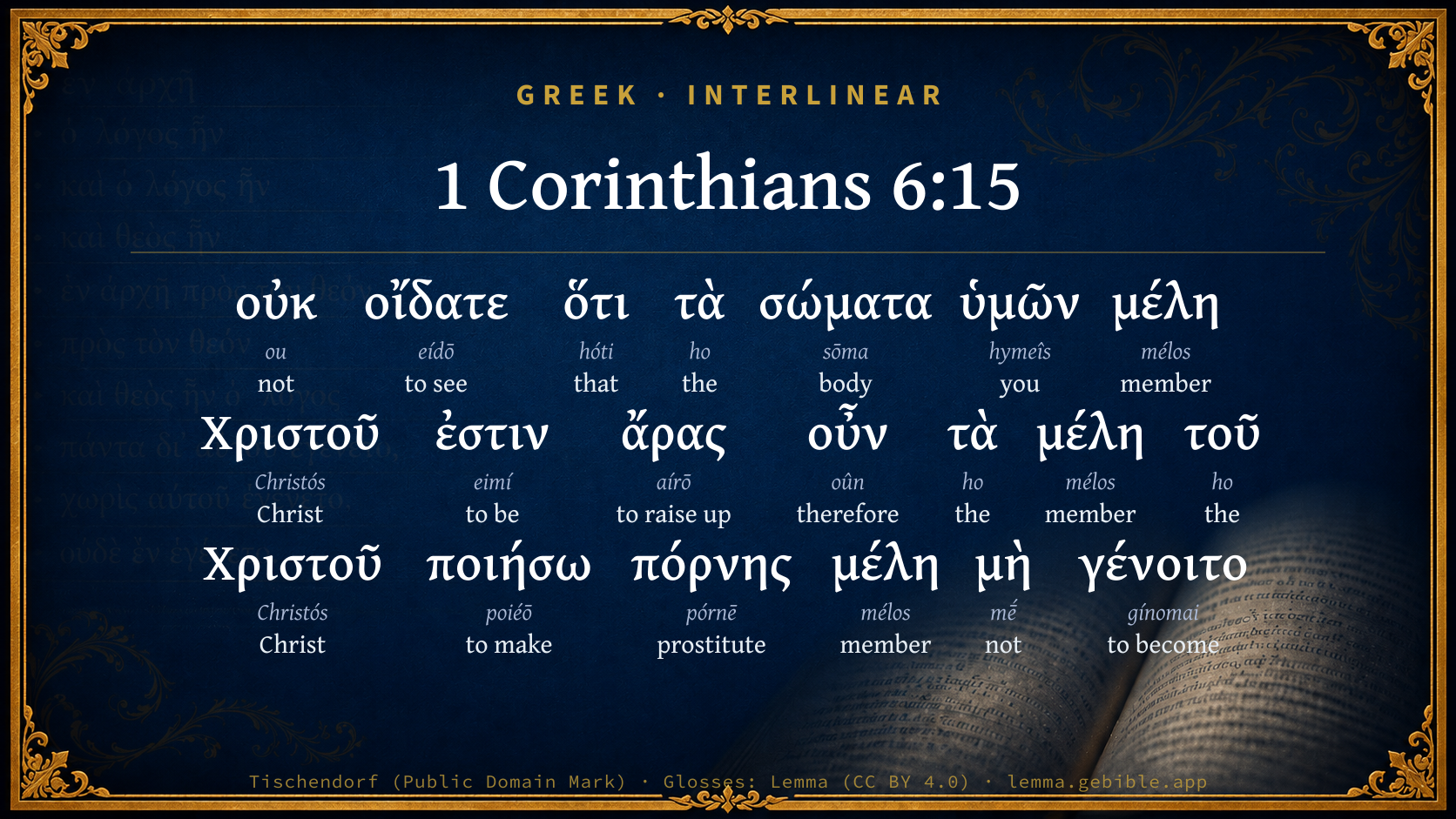
  1. οὐκ ou G3756 “not” Particle, Negative
  2. οἴδατε eídō G1492 “to see” Verb, Perfect, Active, Indicative, 2nd person, Plural
  3. ὅτι hóti G3754 “that” Conjunction
  4. τὰ ho G3588 “the” Article, Nominative, Plural, Neuter
  5. σώματα sōma G4983 “body” Noun, Nominative, Plural, Neuter
  6. ὑμῶν hymeîs G5210 “you” Personal pronoun, 2nd person, Genitive, Plural
  7. μέλη mélos G3196 “member” Noun, Nominative, Plural, Neuter
  8. Χριστοῦ Christós G5547 “Christ” Noun, Genitive, Singular, Masculine
  9. ἐστιν eimí G1510 “to be” Verb, Present, Active, Indicative, 3rd person, Singular
  10. ἄρας aírō G142 “to raise up” Verb, Aorist, Active, Participle, Nominative, Singular, Masculine
  11. οὖν oûn G3767 “therefore” Conjunction
  12. τὰ ho G3588 “the” Article, Accusative, Plural, Neuter
  13. μέλη mélos G3196 “member” Noun, Accusative, Plural, Neuter
  14. τοῦ ho G3588 “the” Article, Genitive, Singular, Masculine
  15. Χριστοῦ Christós G5547 “Christ” Noun, Genitive, Singular, Masculine
  16. ποιήσω poiéō G4160 “to make” Verb, Aorist, Active, Subjunctive, 1st person, Singular
  17. μέλη mélos G3196 “member” Noun, Accusative, Plural, Neuter
  18. μὴ mḗ G3361 “not” Particle, Negative
  19. γένοιτο gínomai G1096 “to become” Verb, Aorist, Middle deponent, Optative, 3rd person, Singular

About this verse

These counts appear in no published source. They are computed here, from the morphology-tagged text and Lemma’s own curated glosses. What Lemma adds →

20
words
15
distinct lemmas
Pauline Epistles
section

Notable vocabulary

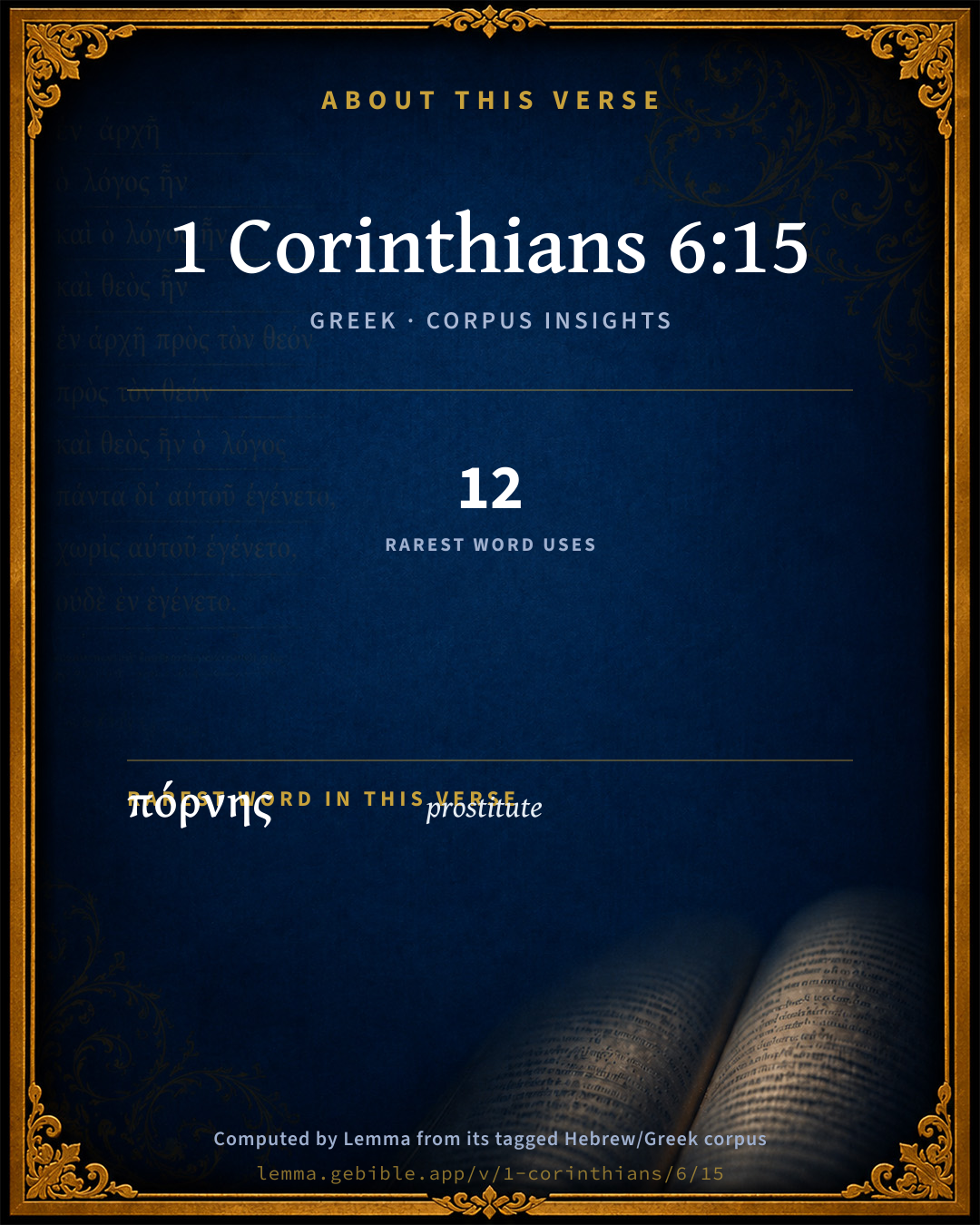
The rarest word here is πόρνης prostitute G4204 — appearing just 12 times in the whole Greek New Testament.

Shared distinctive vocabulary

πόρνης prostitute G4204 occurs in 12 verses of the Greek New Testament. Also found in:

Repetition

Words recur within this verse:

  • μέλη member G3196 ×3
  • Χριστοῦ Christ G5547 ×2
  • τὰ the G3588 ×3

Cross-references

22

Topical passages linked to 1 Corinthians 6:15 in the Treasury of Scripture Knowledge — connected by theme and wording, ordered by reader-vote popularity; previews shown in the World English Bible.

  • Ephesians 5:30 because we are members of his body, of his flesh and bones.
  • Romans 12:5 so we, who are many, are one body in Christ, and individually members one of another.
  • Ephesians 4:15–16 but speaking truth in love, we may grow up in all things into him, who is the head, Christ;
  • Colossians 2:19 and not holding firmly to the Head, from whom all the body, being supplied and knit together through the joints and ligaments, grows with God's growth.
  • 1 Corinthians 12:27 Now you are the body of Christ, and members individually.
  • Ephesians 4:12 for the perfecting of the saints, to the work of serving, to the building up of the body of Christ;
  • 1 Corinthians 6:19 Or don't you know that your body is a temple of the Holy Spirit which is in you, which you have from God? You are not your own,
  • 1 Corinthians 11:3 But I would have you know that the head of every man is Christ, and the head of the woman is the man, and the head of Christ is God.
  • Luke 20:16 He will come and destroy these farmers, and will give the vineyard to others." When they heard it, they said, "May it never be!"
  • Galatians 6:14 But far be it from me to boast, except in the cross of our Lord Jesus Christ, through which the world has been crucified to me, and I to the world.
  • Ephesians 5:23 For the husband is the head of the wife, and Christ also is the head of the assembly, being himself the savior of the body.
  • Romans 3:3–4 For what if some were without faith? Will their lack of faith nullify the faithfulness of God?
  • Romans 7:13 Did then that which is good become death to me? May it never be! But sin, that it might be shown to be sin, by working death to me through that which is good; that through the commandment sin might become exceeding sinful.
  • 1 Corinthians 6:13 "Foods for the belly, and the belly for foods," but God will bring to nothing both it and them. But the body is not for sexual immorality, but for the Lord; and the Lord for the body.
  • Galatians 2:17 But if, while we sought to be justified in Christ, we ourselves also were found sinners, is Christ a servant of sin? Certainly not!
  • Galatians 3:21 Is the law then against the promises of God? Certainly not! For if there had been a law given which could make alive, most assuredly righteousness would have been of the law.
  • Ephesians 1:22–23 He put all things in subjection under his feet, and gave him to be head over all things for the assembly,
  • Genesis 44:17 He said, "Far be it from me that I should do so. The man in whose hand the cup is found, he will be my bondservant; but as for you, go up in peace to your father."
  • Romans 3:31 Do we then nullify the law through faith? May it never be! No, we establish the law.
  • Romans 6:2 May it never be! We who died to sin, how could we live in it any longer?
  • Romans 6:15 What then? Shall we sin, because we are not under law, but under grace? May it never be!
  • Romans 7:7 What shall we say then? Is the law sin? May it never be! However, I wouldn't have known sin, except through the law. For I wouldn't have known coveting, unless the law had said, "You shall not covet."

Cross-references courtesy of OpenBible.info (CC BY 4.0).

Commentary

Notes on 1 Corinthians 6:15 from classic Christian and Jewish commentators (each source and its license shown beneath its notes). The classic Christian expositions comment on the surrounding passage and are grouped to its opening verse, so a note may address several verses; the Jewish commentaries on the Tanakh (Rashi and others) are per-verse, so they appear only where the commentator wrote on this verse.

Lemma curates 59 commentaries, every one of them public domain or Creative Commons licensed, each selected and text-cleaned for this edition rather than reprinted as found. About our sources →

Joseph Benson's Commentary

1Co 6:15-18. Know ye not that your bodies are the members of Christ — Mystically united to him, as well as your souls, if you are his true disciples, as you profess to be. Shall I then take the members of Christ — My body, which is united to him, with its members; and make them the members of a harlot — United to her, and used to gratify her sinful inclinations? Know ye not — Need I inform you; that he who is joined to a harlot is one body with her? But he that is joined unto the Lord — By faith and love; is one spirit with him. And shall he make himself one flesh with a harlot? Flee fornication — All unlawful commerce with women, with speed, with abhorrence, with all your might. Every sin that a man doeth — Every other sin, except gluttony and drunkenness, or every other sin that a man commits against his neighbour; is without the body — Terminates in an object out of himself, and does not so immediately pollute his body, though it does his soul. But he that committeth fornication — Or any kind of lewdness; sinneth against his own body — Pollutes, dishonours, and degrades it to a level with brute beasts; and perhaps infects and enfeebles, wastes and consumes it, which these vices have a manifest tendency to do. Inasmuch as the person who is addicted to gluttony and drunkenness sins against his own body, as well as a fornicator, and debilitates it by introducing into it many painful and deadly diseases: in this prohibition of fornication, those vices likewise are comprehended, being indeed the ordinary concomitants of it. And the way to flee whoredom, is to banish out of the mind all lascivious imaginations, and to avoid carefully the objects and occasions of committing that vice, and to maintain habitual temperance in the use of meat and drink.

Joseph Benson's Commentary on the Old and New Testaments (1811–1818) — public domain. Text from a community e-Sword module.

The Pulpit Commentary

Members of Christ. We find the same metaphor in 1Co_12:12, 1Co_12:27; Eph_5:30. The Church is often alluded to as "the body of Christ". (Eph_1:23; Col_1:18 Col_2:19, etc.) Elsewhere the union between Christ and Christians is described by the metaphor of a tree and its branches; a building and the stones of which it is composed. (Eph_2:21, Eph_2:22) God forbid. An admirable idiom to express the real force of the original, which means, "May it never be!" (for the rationale of the Greek phrase, I may refer to my "Brief Greek Syntax," p. 135). It occurs in Rom_3:4, Rom_3:6, 31 6:15 7:7, 13 9:14 11:1, 11; Gal_2:17 Gal_3:21. The formula, which involves the indignant rejection of some false conclusion, is characteristic of the second group of St. Paul"s Epistles, but especially (as will be seen) of the Epistle to the Romans.

The Pulpit Commentary (1880–1919), ed. H.D.M. Spence-Jones & Joseph S. Exell — public domain. Text from a community e-Sword module.

Tyndale Open Study Notes

Tyndale Open Resources

6:15-17 To be a Christian is to be spiritually joined to Christ in both life and death (cp. Rom 6:3-11). As a result, believers’ bodies have become parts of Christ (cp. 1 Cor 12:12-28; Rom 12:4-5). This spiritual union (cp. John 14:20; 17:21-23) means that they are not free to violate their bodies by physical union with a prostitute.

Tyndale Open Study Notes — © Tyndale Open Resources, licensed CC BY-SA 4.0. Text via the HelloAO Bible API.

Bengel's Gnomon

Johann Albrecht Bengel

1Co 6:15. Σώματα, bodies) whether regard is had to the whole or the parts.—ἄρας οὖν τὰ μέλη τοῦ Χριστοῦ ποιήσω πόρνης μέλη;) Some copies have ἄρα for ἄρας;[52] Paul often says ἌΡΑ ΟὖΝ, but in such places where the conclusion is subjoined, after a somewhat long discourse. ἌΡΑς is more suitable to this place, and they have it, whose testimony is of highest value, among whom is Irenæu[53]: and there is the utmost ἘΝΆΡΓΕΙΑ, graphic power, in this participle, depicting as it were the baseness of the thing: taking away, spontaneously alienating the members of Christ, shall I make them the members of a harlot? So the participle φέρων is often redundant, of which I have spoken, on Chrysost. de Sacerdot. p. 394, at the passage, ΦΈΡΩΝ ἙΑΥΤῸΝ ΚΑΤΕΚΡΉΜΝΙΣΕ, he took and threw himself down.—ποιήσω, shall I make?) For they cannot be at the same time the members of a harlot and of Christ.

[52] So ABCD (Λ), Orig. 1, 520c: ‘tollens’ in f. Vulg. Iren. Lucif.: ‘auferens’ in Cypr.: “an tollens” in g. Ἢ ἄρα is read by G.—ED.

[53] renæus (of Lyons, in Gaul: born about 130 A.D., and died about the end of the second century). The Editio Renati Massueti, Parisinæ, a. 1710.

Bengel's Gnomon of the New Testament — English translation (T&T Clark, Edinburgh, 1860) — public domain. Text from a community e-Sword module.

Meyer's Critical & Exegetical Commentary

Heinrich August Wilhelm Meyer

1Co_6:15-17. That fornication is not an indifferent thing like the use of meats, but anti-Christian, Paul has already proved in 1Co_6:13-14, namely, from this, that the body belongs to Christ and is destined by God to be raised up again. How deserving of abhorrence fornication is on that account, he now brings home to the mind of his readers in a striking and concrete way. The immorality of fornication is certainly taken for granted in 1Co_6:15 f., yet not in such a manner as to make Paul guilty of a petitio principii (Baur in the theol. Jahrb. 1852, p. 538 f.), but on the ground of the proof of this immorality already given in 1Co_6:13-14 In 1Co_6:15 f. the apostle does not seek to prove it over again, but to teach the Corinthians to abhor the sin.

οὐκ οἴδατε κ.τ.λ[982]] He here takes up once more, and exhibits with greater fulness, the thought in 1Co_6:13, ΤῸ ΣῶΜΑ Τῷ ΚΥΡΊῼ, as the basis for the following warning: ἌΡΑς ΟὖΝ Κ.Τ.Λ[983]

μέλη Χριστοῦ] Inasmuch, that is to say, as Christ, as the Head of the Christian world, stands to it in the closest and most inward fellowship of organic life (see especially Eph_4:16), and forms, as it were, one moral Person with it; the bodies of the individual believers, who in fact belong to the Lord, and He to them for this world and that which is to come (1Co_6:13 f.), may be conceived as Christs members, just as from the same point of view the whole church of Christ is His collective organ, His body (Rom_12:5; Eph_1:23; Col_1:18; Col_2:19; 1Co_12:13, al[984]).

ἄρας] Shall I then take away, take off, the members of Christ, and, etc. Billroth sees in ἄρας simply minuteness of description, indicative of deliberation, as in לקח. But this is to confound it with λαβών. The Vulgate renders rightly: tollens; Luk_6:29; Luk_11:22; Joh_11:48; Plato, Pol. ix. p. 578 E, Tim. p. 76 B; Sophocles, Trach. 796; 1Ma_8:18. What is depicted is daring misappropriation. The plural τὰ μέλη denotes the category, for the matter non quanta sit numero, sed qualis genere sit, spectatur, Reisig, Conjec. in Aristoph. p. 58. Since the Christians body is among the members of Christ, the ΠΟΡΝΕΎΕΙΝ is a deed whereby a man takes away the members of Christ from Him whose property they are, and makes them a harlots members.

ΠΟΙΉΣΩ] future: Shall this case occur with me? shall I degrade myself to this? so far forget myself? Rückert and Osiander hold that it is the aorist subjunctive: should I, etc. (see Herm. a[985] Viger. p. 742). It is impossible to decide the point.

[982] .τ.λ. καὶ τὰ λοιπά.

[983] .τ.λ. καὶ τὰ λοιπά.

[984] l. and others; and other passages; and other editions.

[985] d refers to the note of the commentator or editor named on the particular passage.

Meyer — Critical and Exegetical Commentary on the New Testament — English translation by Peter Christie, edited by Frederick Crombie (T&T Clark, 1880) — public domain. Text from a community e-Sword module.

Expositor's Greek Testament

ed. W. Robertson Nicoll

1Co 6:15-17 unfold in its repulsiveness, by vivid concrete presentment, the opposition between the two claimants for bodily service already contrasted: the rival of Christ is ἡ πόρνη ! “Or (if what I have said is not sufficient) do you not know that your bodies are Christ’s limbs? Should I then take away the limbs of Christ and make them a harlot’s limbs? Far be it!” Αἴρω is to remove, carry off , as in 1Co 5:2 (see parls.), Vg [974] tollens , implying “a voluntary and determined act” (Ed [975] ); for the introductory aor [976] ptp [977] , see Bn [978] , §§ 132, 138. ποιήσω , either (deliberative) aor [979] sbj [980] or fut [981] ind [982] “Am I to make, etc.?” or, “Am I going to make?” The former idiom suits an act of choice ; this question the tempted Cor [983] Christian must put to himself: cf. the interrog. form of Rom 6:1 ; Rom 6:15 (- ωμεν ).

[974] Latin Vulgate Translation.

[975] T. C. Edwards’ Commentary on the First Ep. to the Corinthians . 2

[976] aorist tense.

[977] participle

[978] E. Burton’s Syntax of the Moods and Tenses in the N.T. (1894).

[979] aorist tense.

[980] subjunctive mood.

[981] future tense.

[982] indicative mood.

[983] Corinth, Corinthian or Corinthians.

What is true of Christian men individually, that they are μέλη Χριστοῦ and parts of the σῶμα Χριστοῦ , is true specifically of the physical frame of each; similarly in 1Co 6:19 f. Paul applies to the Christian man’s body the glorious truth stated respecting the Christian society in 1Co 3:16 f. In the Hellenic view, the body was the perishing envelope of the man; in the Scriptural view, it is the abiding vehicle of his spirit. To devote the body to a harlot, one must first withdraw it from Christ’s possession: to do that , and for such a purpose the bare statement shows the infamy of the proposal. The Biblical formula of deprecation, μὴ γένοιτο , is frequent also in Epictetus; cf. Odyssey , vii., 316, μὴ τοῦτο φίλον Διῒ πατρὶ γένοιτο .

The Expositor's Greek Testament, edited by W. Robertson Nicoll (1897–1910) — public domain. Text from a community e-Sword module.

Hodge's Commentary on Romans, Ephesians & First Corinthians

Charles Hodge

1Co_6:15, 1Co_6:16

Know ye not that your bodies are the members of Christ? shall I then take the members of Christ, and make (them) the members of an harlot? God forbid. What! know ye not that he which is joined to an harlot is one body? for two, saith he, shall be one flesh.

The design of these verses is to establish two points. First, that the relation between our bodies and Christ is of the intimate and vital character which had just been stated. And second, that the sin in question was inconsistent with that relation, and incompatible with it.

Know ye not that your bodies are the members of Christ? This is a conceded and familiar point of Christian doctrine, one with which they were supposed to be acquainted; and which proved all that the Apostle had said of the relation between the body and Christ. Our bodies are the members of Christ, because they belong to him, being included in the redemption effected by his blood; and also because they are so united to him as to be partakers of his life. It is one of the prominent doctrines of the Bible that the union between Christ and his people includes a community of life; and it is clearly taught that this life pertains to the body as well as to the soul, Rom_8:6-11; Eph_2:6, Eph_2:7; Eph_5:30. This is the truth which the Apostle recalls to the minds of the Corinthians and makes it the ground of his indignant condemnation of the sin of which he is speaking. That fornication is incompatible with the relation of the bodies of believers to Christ, arises out of the peculiar nature of that sin. The parties to it become partakers of a common life. Whether we can understand this or not, it is the doctrine of the Bible. Therefore as we cannot be partakers of the life of Christ, and of the life of Belial, so neither can our bodies be the members of Christ, and at the same time have a common life with one who is a sinner, in the scriptural sense of that phrase.

Charles Hodge — Commentary on Romans (1835), First Corinthians (1857), and Ephesians (1856) — public domain. Text from a community e-Sword module.

Geneva Bible (1599)

Geneva Bible translators

A declaration of the former argument by contraries, and the applying of it.

Geneva Bible (1599) marginal notes — public domain. Text via Bolls.life.

Jamieson, Fausset & Brown

Robert Jamieson, A. R. Fausset & David Brown

Resuming the thought in Co1 6:13, "the body is for the Lord" (Co1 12:27; Eph 4:12, Eph 4:15-16; Eph 5:30).

shall I then--such being the case.

take--spontaneously alienating them from Christ. For they cannot be at the same time "the members of an harlot," and "of Christ" [BENGEL]. It is a fact no less certain than mysterious, that moral and spiritual ruin is caused by such sins; which human wisdom (when untaught by revelation) held to be actions as blameless as eating and drinking [CONYBEARE and HOWSON].

Jamieson, Fausset & Brown — Commentary Critical and Explanatory on the Whole Bible (1871) — public domain (CC PDM 1.0). Text via the HelloAO Bible API.

Adam Clarke's Commentary

Verse 15. Know ye not that your bodies are the members of Christ?] Because he has taken your nature upon him, and thus, as believers in him, ye are the members of Christ.

Shall I then take, &c.] Shall we, who profess to be members of his body, of his flesh, and of his bones, connect ourselves with harlots, and thus dishonour and pollute the bodies which are members of Christ? God forbid! These passages admit of a more literal interpretation. This, if given at all, I must give in a strange language.

Membra humana, ad generationem pertinentia, vocantur Membra Christi, quia mysterium conjunctionis Christi et Ecclesiae per conjunctionem maris et faeminae indigitatur, Eph 5:32. In Vet. Test. idem valebat de membro masculino, guippe quod circumcisione, tanquam signo faederis, honoratum est. Vide Schoettgen, Hor. Hebr.

Adam Clarke's Commentary on the Bible (1810–1826) — public domain. Text from a community e-Sword/MySword module.

John Calvin's Commentaries

15. Know ye not that our bodies are the members, etc. Here we have an explanation, or, if you prefer it, an amplification of the foregoing statement. For that expression, the body is for the Lord, might, owing to its brevity, be somewhat obscure. Hence he says, as if with the view of explaining it, that Christ is joined with us and we with him in such a way, that we become one body with him. Accordingly, if I have connection with an harlot, I tear Christ in pieces, so far as it is in my power to do so; for it is impossible for me to draw Him into fellowship with such pollution. Now as that must be held in abhorrence, he makes use of the expression which he is accustomed to employ in reference to things that are absurd — God forbid Observe, that the spiritual connection which we have with Christ belongs not merely to the soul, but also to the body, so that we are flesh of his flesh, etc (Ephesians 5:30.) Otherwise the hope of a resurrection were weak, if our connection were not of that nature — full and complete.

John Calvin's Commentaries (1540-1563) — public domain. Text from the Calvin Translation Society English edition (1840s-50s) via the Christian Classics Ethereal Library (ccel.org). Calvin's coverage is partial (roughly two-thirds of the Bible); uncommented books and verses are honest gaps, never fabricated. The 19th-century editor's footnotes and remarks are omitted so the notes are faithfully Calvin's own voice.

Ellicott's Commentary for English Readers

(15) Shall I then . . .?—Having shown the great dignity which attaches to our bodies as immortal members of Christ, the Apostle asks with indignant emphasis, “Shall I take them out from that high and holy membership, and make them members of an harlot?” The double act of taking them away from their glorious union with Christ, and joining them to a base body, is implied in the Greek.

A Bible Commentary for English Readers, edited by Charles John Ellicott (1878–1897) — public domain. Text from a community e-Sword module.

The Cambridge Bible for Schools and Colleges

gen. ed. J. J. S. Perowne

15. Know ye not that your bodies are the members of Christ?] This solemn truth, that by our calling as Christians we are so closely united to Christ as to be ‘members of His Body, of His Flesh and of His Bones’ (Eph_5:30) is employed here to remind us of the restrictions placed upon our Christian liberty. Our body is Christ’s, nay it is, in a sense, a part of Christ Himself. It may not be used in violation of the laws imposed upon it from the beginning by God. Nor may it be used to the detriment of others, who equally, with ourselves, belong to Christ. And the sin here reproved leads to all kinds of misery and wretchedness, and that because (1Co_6:18) it is a violation of the eternal law of God impressed upon the human body.

The Cambridge Bible for Schools and Colleges (gen. ed. J. J. S. Perowne; Cambridge University Press, 1878–1918) — public domain. Text from a community e-Sword module.

John Gill's Exposition

Know ye not that your bodies are the members, of Christ,.... The whole persons of God's elect were chosen in Christ, and given to him, and made one with him, their bodies as well as their souls; and both are redeemed by him, and, in union with him, are members of his body, of his flesh, and of his bones:

shall I then take the members of Christ, and make them the members of an harlot? God forbid. Signifying, that it is a most absurd, indecent, abominable, and detestable thing, that the bodies of the saints, which are the members of Christ, should be joined in carnal copulation with an harlot.

John Gill's Exposition of the Whole Bible (1746–1763) — public domain (CC PDM 1.0). Text via the HelloAO Bible API.

Trapp's Complete Commentary

John Trapp

15 Know ye not that your bodies are the members of Christ? shall I then take the members of Christ, and make them the members of an harlot? God forbid.

Ver. 15. Shall I then take] Scipio, when a harlot was offered him, said, Vellem, si non essem imperator, I would, if I were not a general. Say thou, if I were not a Christian.

And make them the members of a harlot] A saint cannot indeed be made the member of a harlot (saith a reverend man), because not κολλωμενος, glued or knit to any sin. Though a member of Christ and sin may fall one upon another, and touch each other; yet they are of a mouldering nature, and will not cleave together. Water and oil violently shaken together may seem to mingle, but will not continue so long; there is no coalition, because they are of diverse natures; the one remaineth water still, and the other oil.

John Trapp, A Commentary or Exposition upon All the Books of the Old and New Testament (1647–1656) — public domain. Text from a community e-Sword module.

Albert Barnes' Notes on the Bible

Know ye not ... - This is the third argument against licentiousness. It is, that we as Christians are united to Christ (compare the notes at Joh 15:1 ff); and that it is abominable to take the members of Christ and subject them to pollution and sin. Christ was pure - wholly pure. We are professedly united to him. We are bound therefore to be pure, as he was. Shall that which is a part, as it were, of the pure and holy Saviour, be prostituted to impure and unholy embraces?

God forbid! - See the note at Rom 3:4. This expresses the deep abhorrence of the apostle at the thought. It needed not argument to show it. The whole world revolted at the idea; and language could scarcely express the abomination of the very thought.

Know ye not ... - This is designed to confirm and strengthen what he had just said.

He which is joined - Who is attached to; or who is connected with.

Is one body - That is, is to he regarded as one; is closely and intimately united. Similar expressions occur in Classic writers. See Grotius and Bloomfield.

For two, saith he ... - This Paul illustrates by a reference to the formation of the marriage connection in Ger. Rom 2:14. He cannot be understood as affirming that that passage had original reference to illicit connections; but be uses it for purposes of illustration. God had declared that the man and his wife became one; in a similar sense in unlawful connections the parties became one.

Albert Barnes' Notes on the Bible (1834–1885) — public domain. Text from a community e-Sword/MySword module.

Matthew Poole's English Annotations

Christ is united to the person of the believer, and he is the Head of the church, which is his mystical body; so that the bodies of believers are in a sense the members of Christ, and should be used by us as the members of Christ, which we should not rend from him: but he that doth commit fornication, rends his body from Christ, and maketh it

the member of an harlot; for as the man and wife are one flesh by Divine ordination, Gen 2:24, so the fornicater and the harlot are one flesh by an impure conjunction.

Matthew Poole's English Annotations on the Holy Bible (1683–1685) — public domain. Text from a community e-Sword/MySword module.

Whedon's Commentary on the Bible

Daniel D. Whedon

15. The nature of this last blessed correlation he will now declare.

Know ye not—As you seem, by your easy dealing with the fornicator, not to know. Members of the mystical body of Christ—A oneness foreshadowed in the Church below, but to be gloriously disclosed in the Church of the resurrection.

Members of a harlot—Under this awful conception (explained in next verse) St. Paul opens to his Corinthians the intense opposition of Christianity to the characteristic vice of their city.

Daniel D. Whedon (gen. ed.), Commentary on the Old and New Testaments (1874–1909) — public domain. Text from a community e-Sword module.

Scofield Reference Notes

C. I. Scofield

shall I

Paul does not invoke the authority of the seventh commandment, but appeals to the believer’s sacredness as a member of Christ.

The Scofield Reference Bible (1917 edition), notes by C. I. Scofield — public domain. Text from a community e-Sword module.

Kretzmann's Popular Commentary

Paul E. Kretzmann

An earnest warning against immorality:

v. 15. Know ye not that your bodies are the members of Christ? Shall I, then, take the members of Christ and make them the members of an harlot? God forbid!

v. 16. What? Know ye not that he which is joined to an harlot is one body? For two, saith He, shall be one flesh.

v. 17. But he that is joined unto the Lord is one spirit.

v. 18. Flee fornication. Every sin that a man doeth is without the body; but he that committeth fornication sinneth against his own body.

v. 19. What? Know ye not that your body is the temple of the Holy Ghost which is in you, which ye have of God, and ye are not your own?

v. 20. For ye are bought with a price; therefore glorify God in your body and in your spirit, which are God’s.

The apostle speaks in holy zeal, with righteous indignation, without reservation, bringing the truth in its hideous nakedness. His aim is to bring to the distinct consciousness of his readers the abominable character of the vice which flaunted its banners so shamelessly in their city; he unfolds it in all its repulsiveness, by vivid concrete presentment: Do you not know that our bodies are members of Christ? Should I, then, take away the members of Christ and make them a harlot’s members? By no means. Christ is the Head of the Church, and every believer by faith becomes a member of this one Head; he is one of the organs of that great body and is intended to function only in the interest of the Lord. Should, then, any one so far forget the dignity which is due to Christ and to His service as to make his body a harlot’s member and thus become unfaithful to his calling and unfaithful to his Lord? The very suggestion fills the apostle with horror; for how could one choose a harlot in preference to Christ? How could one alienate his affections from their proper owner and center them in such an unhallowed connection?

For fear that the Corinthians may not yet have understood him or might deliberately misconstrue his words, St. Paul amplifies still more: Or do you not know that he who joins himself to the harlot is one body with her? For, says God, the two will be one flesh, Gen 2:24. This blessing of God was intended to sanctify the legitimate intercourse of marriage. But he that breaks the ordinance of God and seeks the gratification of mere lust outside of the marriage-bond, becomes one body with one that is not his wife. But the word of the Lord stands: Carnal intercourse means unity of the bodies. Sexual union constitutes a permanent bond between the guilty parties, for the word of the Lord holds of every such union, whether lawful or unlawful, honorably true or shamefully. No presentation could portray the sin of fornication more exactly in its hideous repulsiveness than that which is here used by the apostle.

Once more he emphasizes the contrast: But he that cleaves to the Lord is one spirit with Him. A wonderful, real, lasting, and blessed union is that which the believer enters into in and by regeneration. For the act of faith establishes a bond of intimate communion with Christ, it makes the believer one in spirit with his Savior in love, not only on account of the gracious imputation of His righteousness, but also by the indwelling of His Spirit in the heart, Joh 14:20; Joh 15:4; Joh 17:23; Eph 3:17. No wonder this fact urges the apostle to repeat his urgent admonition: Flee fornication. In the case of this sin it would be foolish to stand and attempt to give battle, for here "the strongest oath is straw against the fire in the blood. " As in the case of Joseph, courageous flight is the only solution of the difficulty, Pro 6:28. And let no one deceive himself with the excuse that he is harming no one by his indulgence in this sin: Every sin which a person commits is outside of the body, but he that commits fornication sins against his own body. The sins against all the other commandments of the Decalogue have their aim outside of the body; if they involve the organs of the body, as in the case of intemperance, they affect and injure only the transient, perishable organs of the body, and require for their commission some means that are taken from without and are in themselves foreign to the body. But the sins against the Sixth Commandment involve violation of self, of the inmost mental desires and physical abilities; the entire body is contaminated and dishonored, not only in one sex, but in both, for the Christian religion knows no double standard.

To make the Corinthian Christians feel the weight of his argument, the apostle refers them to the well-known dignity which the bodies of the believers as such possess: Or do you not know that your body is a temple of the Holy Ghost in you, whom you have from God, and that you are not your own, your own masters? "What are all the other gifts altogether," says Luther, "besides this gift, that the Spirit of God Himself, the eternal God, comes down into our hearts, yea, into our bodies, and lives in us, governs, leads, and conducts us!" Although Paul is addressing the entire congregation, he yet speaks of the body in the singular, in order to bring out once more the fact that they are all one in Christ Jesus. Each one for himself and all of them together are the temple of the Holy Ghost, who has deigned to make them His abode, to take up His dwelling-place in their hearts and in their bodies. And therefore they are no longer masters of their own bodies, to perform their own lusts and desires. According to the heathen idea, prostitution was a consecration of the body; according to the Christian idea, it is the filthiest desecration of the body. The Christians may no longer use their bodies for the gratification of their sinful passions, but are bound to employ them in doing the holy will of God. And to this end St. Paul concludes with a powerful appeal: For bought you were at a price; then glorify God in your body! We Christians were bought, delivered, redeemed, from the power of sin and the devil, not with corruptible things, as silver and gold. The price of our redemption rather was of a nature to make us stand in adoring astonishment and praise in all eternity: with the precious blood of Christ, as of a Lamb without blemish and without spot, 1Pe 1:18-19. Through this redemption we have become Christ’s very own and are to serve Him in everlasting righteousness, innocence, and blessedness. That is the inference of the apostle: Glorify God in your body; let all the acts of all your organs and members be undertaken with the object of increasing His honor and glory, let your body be a temple wherein each man serves as a priest to the most high God in all chastity and decency.

Summary.The apostle rebukes the Corinthian Christians for going to law with their brethren before the Gentile courts; he warns them against various sins, but especially against fornication, since their bodies are the temple of the Holy Ghost.

Paul E. Kretzmann, Popular Commentary of the Bible (1921–1924) — public domain. Text from a community e-Sword module.

Burkitt's Expository Notes on the New Testament

William Burkitt

A third argument here follows: "Our bodies are the members of Christ, as well as our souls; that is, the union is made between Christ and us, consisting of soul and body both.

Now, shall we dispose of our bodies, the members of Christ, to so base an use? Shall our bodies, which are joined to Christ, ever condescend to so base a conjunction, as that of being joined to an harlot? God forbid that such an indignity be done by us."

William Burkitt's Expository Notes on the New Testament (1700–1703) — public domain. Text from a community e-Sword module.

McGarvey & Pendleton's Commentaries

J. W. McGarvey

Know ye not that your bodies are members of Christ? [parts of his body ( 1Co_12:27 ; Eph_5:30 ); branches of the Vine-- Joh_15:5 ] shall I then take away the members of Christ, and make them members of a harlot? God forbid . [Literally, let it never be; a phrase often used by Paul when indignantly rejecting a false conclusion.]

J. W. McGarvey (with Philip Y. Pendleton), Commentaries on the New Testament (The Fourfold Gospel, 1914; Acts; and the epistles) — public domain. Text from a community e-Sword/MySword module.

The People's New Testament

B. W. Johnson

15. Know ye not that your bodies are members of Christ? This is a doctrine emphasized by Paul. Our bodies are a part of Christ's mystical body, the Lord's holy temple, designed for the indwelling of the Spirit. How sacrilegious to take a member of Christ's body and degrade it to fornication, or to any act of licentiousness! It is a duty which a Christian owes to Christ to keep his body pure. As the arm or finger has the life of the body until cut off, so we have the life of Christ until we sever ourselves from him by sinful acts.

B. W. Johnson's The People's New Testament with Notes (1889–1891) — public domain. Electronic text from the Christian Classics Ethereal Library (CCEL) ThML edition.

Cambridge Greek Testament for Schools and Colleges

15. οὐκ οἴδατε. A fresh argument. Not only will our bodies be raised up hereafter, but they are the members of Christ now. This solemn truth, that by our calling as Christians we are so closely united to Christ as to be ‘members of His Body, of His Flesh and of His Bones’ (Eph 5:30 if the reading be correct) is employed here to remind us of the restrictions placed upon our Christian liberty. Our body is Christ’s, nay it is, in a sense, a part of Christ Himself. It may not be used in violation of the laws imposed upon it from the beginning by God. Nor may it be used to the detriment of others, who equally, with ourselves, belong to Christ. And the sin here reproved leads to all kinds of misery and wretchedness, and that because (1Co 6:18) it is a violation of the eternal law of God impressed upon the human body.

ἄρας οὖν. The deliberateness of the act is here pointed out, as well as the violence it does to our Christian calling.

Cambridge Greek Testament for Schools and Colleges (Cambridge University Press, 1896; 21 vols, various authors incl. Carr, Maclear, Plummer, Farrar, Lumby, Moule, M. R. James, Simcox) — public domain. Text from a community e-Sword module.

Alford’s Greek Testament

Henry Alford

15.] Resumption of τὸ σῶμα τῷ κυρίῳ κ. ὁ κύριος τῷ σώματι. The two are so intimately connected, that the Lord is a mystical Body, of which our bodies, parts of ourselves in our perfect organization, are members. This Christian axiom is introduced as before (reff.) by οὐκ οἴδατε ὅτι.

Having then (οὖν, ‘concesso,’ that my body is a member = my members are members of Christ) alienated ([or, taken away] ἄρας is not merely pleonastic, ‘Shall I take … and make them.…’ as E. V. This is shewn by its position first in the sentence) the members of Christ (i.e. my own members) shall I make them an harlot’s members? The expression πόρνης μέλη is put as coarsely and startlingly as possible, with the emphasis on πόρνης.

ποιήσω may also be the aor. subj., ‘must I, have I any right to, make them?’ But μὴ γένοιτο answers better to the future.

Henry Alford, The Greek Testament (1849–1861) — public domain. Text from a community e-Sword module.

International Critical Commentary

15. οὐκ οἴδατε κ.τ.λ. He presses home the principle that ‘the body is for the Lord.’ By virtue of that principle every Christian, and every one of his members, is a member of Christ. The higher heathen view was that man’s body is in common with the brutes, τὸ σῶμα κοινὸν πρὸς τὰ ζῶα, and only his reason and intelligence in common with the gods (Epict. Dissert. 1. iii. 1); but the Christian view is τὸ σῶμα μέλος τοῦ Χριστοῦ.*. Epictetus speaks of both God and gods, and in popular language calls God ‘Zeus.’ In this chapter he speaks of God as the father of men and gods; but, at the best, he falls far short of Christian Theism. The Christian view, which first appears here, is developed in another connexion in 12 and in Rom_12. See also Eph 4:15, Eph 4:16, Eph 4:5:30.

ἄρας οὖν. The AV. misses a point in translating, ‘Shall I then take the members of Christ?’ The RV. has, ‘Shall I then take away the members of Christ?’ Αἴρειν is not simply, ‘to take,’ which is λαμβάνειν, but either ‘to take up,’ ‘raise’ (Act 27:17), or ‘to take away’ (v. 2; Eph 4:31; Col 2:14; and nowhere else in Paul). The. verb is very common in Gospels and Acts; elsewhere rare in N.T. The Apostle assumes that union with a harlot, unlike union with a lawful wife, robs Christ of members which belong to Him. Union with Christ attaches to our body through the spirit (v. 17), and sin is apostasy from the spiritual union with Christ. This is true of all sin, but πορνεία is a peculiarly direct blow at the principle τὸ σῶμα τῷ Κυρίῳ. Quantum flagitium est, corpus nostrum a sacra illa conjunctione abreptum ad res Christo indignas transferri (Calv.). As Augustine remarks (De Civ. Dei xxi. 25), “they cannot be at once the members of Christ and the members of a harlot.”

ποιήσω. It is impossible and unimportant to decide whether ποιήσω is deliberative subjunctive (‘Am I to take away … and make?’) or future indicative (‘Shall I take away?’ etc.). The two aorists would mark two aspects, simultaneous in effect, of one and the same act. But the future harmonizes better with μὴ γένοιτο AV., RV., Alford, Edwards, Ellicott, B. Weiss prefer the future.

μὴ γένοιτο. Like οὐκ οἴδατε, this expression of strong dissent is frequent in this group of the Pauline Epistles (Romans, ten times; Galatians, twice; and here). Elsewhere in N.T., Luk 20:16. It is rare in LXX, and never stands as an independent sentence: Gen 44:7, Gen 44:17; Jos 22:29, Jos 22:24:16; 1Ki_20:[21] 3. It is one of several translations of the same Hebrew, another of which is ἵλεως (1Ch 11:19; 2Sa 20:20; Mat 16:22). Neither μὴ γένοιτο nor ἕλεως is confined to Jewish and Christian writings: the former is frequent in Arrian, the latter is found in inscriptions. In Hom. Od. vii. 316 we have μὴ τοῦτο φίλον Διὶ πατρὶ γένοιτο, of detaining Ulysses against his wish. Cf. Di meliora. Here it expresses horror.

After τὰ σώματα there is the common confusion between ὑμῶν (א3 B C D E F G K L P, Latt.) and ἡμῶν (א* A). ἆρα (P and a few cursives) or ἢ ἆρα (F G) cannot be regarded as more probable than ἄρας (א A B C D E, etc.); yet Baljon adopts it: ἄρας has much force, not only in marking the grievous wrong done to Christ, but also in showing the voluntary, and even deliberate, character of the act.

International Critical Commentary — older volumes (1896–1929), various authors — public domain. Text from a community e-Sword module.

Vincent's Word Studies in the New Testament

Marvin R. Vincent

Members of Christ. The body is not only for the Lord (ver. 13), adapted for Him : it is also united with Him. See Eph 4:16.

Members of a harlot. The union of man and woman, whether lawful or unlawful, confers a double personality. Fornication effects this result in an immoral way.

Marvin R. Vincent, Word Studies in the New Testament (1887–1900) — public domain. Text from a community e-Sword/MySword module.

Godet's Commentaries

Frédéric Louis Godet

Vv. 15. “Know ye not that your bodies are the members of Christ? Shall I then take the members of Christ, and make them the members of an harlot? Let it not be so!”

Paul had just said that the body is not for fornication, but for the Lord. In the first proposition of this verse he justifies the for the Lord, to deduce from it as a conclusion in the second the not for fornication. Baur and Scherer see here a petitio principii, inasmuch as the term harlot already implies the guiltiness of fornication, which is precisely the point to be proved. But the apostle is not treating the question from the standpoint of rational morality; he starts from Christian premises: Know ye not...? Now the relation between Christ and the believer, implied in faith, gives him logically the right to reason as he does.

As the Church in its totality is the body of Christ, that is to say, the organism which He animates with His Spirit, and by which He carries out His wishes on the earth, so every Christian is a member of this body, and consequently an organ of Christ Himself. By means of the Spirit of Christ which dwells in his spirit, and by means of his spirit which directs his soul and thereby his body, this body becomes as it were the body of Christ, the executor of His thought; hence the practical conclusion: This organ of Christ must not be taken from Him to be given to a harlot. Therein is a double crime: on the one hand, a revolt, an odious abduction (ἄρας); on the other, an act of ignoble self-debasement and the acceptance of a shameful dependence. And hence the apostle’s cry of indignation: Let it not be so!

Ποιήσω, perhaps the deliberative subjunctive aorist: “Shall I choose to make...?” or simply the future indicative: “Shall I make?” The second meaning is better: one does not deliberate in regard to such an act. — But do not the expressions, “members of Christ” and “members of an harlot,” contain something of exaggeration? This is what the light - minded Corinthians might ask, and it is to this objection that 1Co 6:16-17 give answer.

Frédéric Louis Godet — Commentaries on Luke, John, Romans, and 1 Corinthians — English translation (T&T Clark, Edinburgh, 1870s–1890s) — public domain. Text from a community e-Sword module.

Lesson kit

Teaching starters — assembled from the data on this page, not authored interpretation. Every prompt links to the verse data it draws on. Edit before teaching.

1 Corinthians, in the Pauline Epistles, opens this verse with 20 words (15 distinct Greek lemmas). Its most distinctive word is pórnē (“prostitute”). A historical commentator’s framing appears above. Read the whole chapter for the surrounding context.

Discussion questions

  1. The word pórnē carries the sense “prostitute.” How does it shape the verse?
  2. How does Matthew 21:31, which shares the word «prostitute», read alongside this verse?
  3. What does the repetition of “member” (3× in this one verse) do in this verse?
  4. These translations render this verse differently; the difference is in the English rendering, not the original. What questions does that raise?
  5. Compare how Joseph Benson's Commentary and The Pulpit Commentary read this verse. Where do they agree or differ?

Things to notice

Reading settings

Reading text

Shown beneath each verse's original-language words.

Old Testament
Old Testament edition

Read the OT as the Masoretic Hebrew (MT) or the Greek Septuagint (LXX).

English shown for the Greek Septuagint (in the Hebrew ↔ Greek comparison).

Comparing translations? Open the Compare panel on any verse page to stack up to four side by side.