
1 Corinthians 7:22

Greek (Tischendorf 8th ed.) 1 Corinthians 7:22 appears in the Greek New Testament. The text above is from the Tischendorf 8th edition. Each word links to its Strong’s number and a concise gloss. Click any word for its full Thayer’s Greek Lexicon entry.
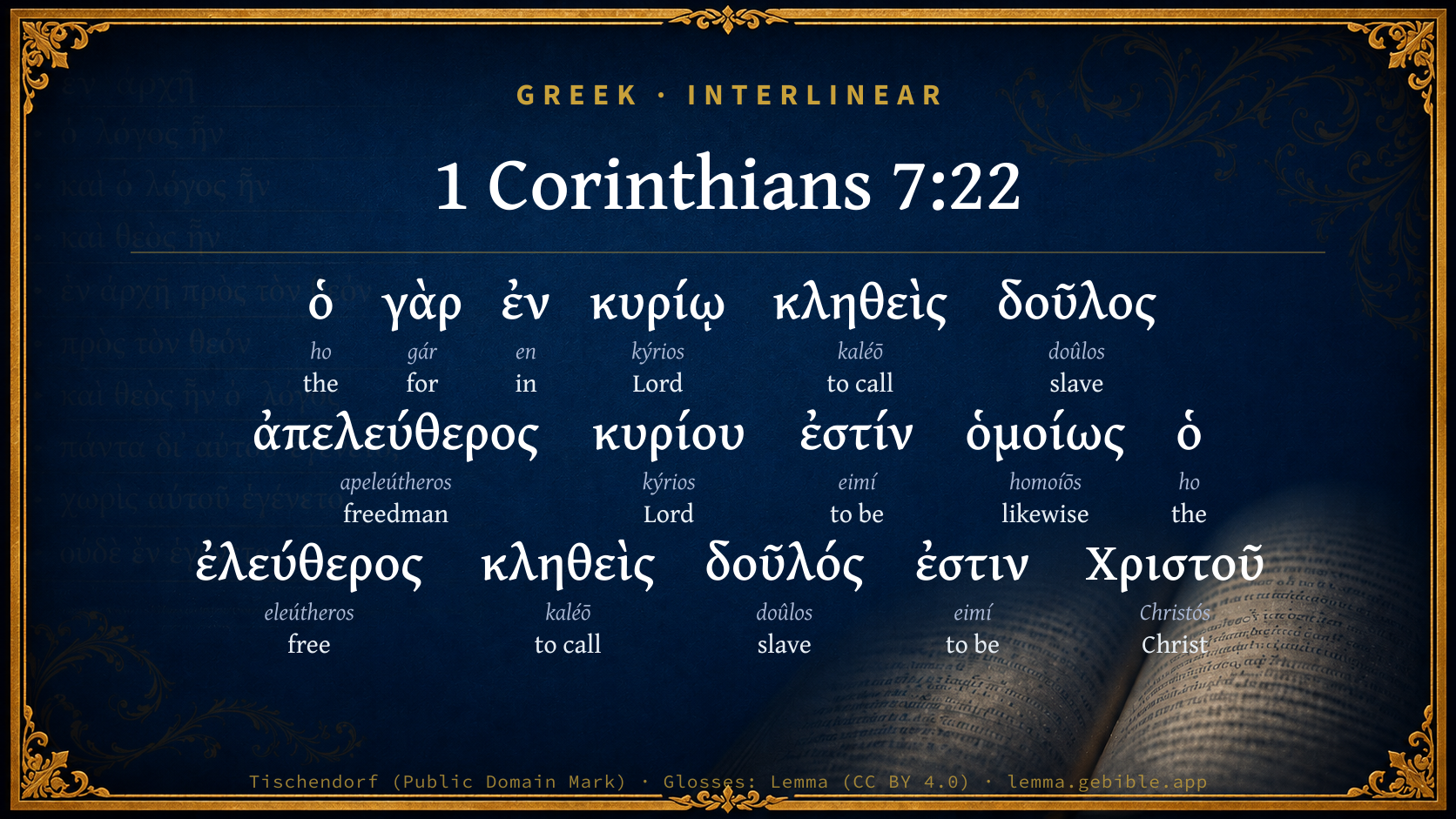
Download image
Cite this verse

1 Corinthians 7:22 (World English Bible). Public Domain. Lemma interlinear Bible study tool, https://lemma.gebible.app/v/1-corinthians/7/22.

Show BibTeX & RIS
BibTeX
RIS
English Translation
For he who was called in the Lord being a bondservant is the Lord's free man. Likewise he who was called being free is Christ's bondservant.
World English Bible · Public Domain
Highlights
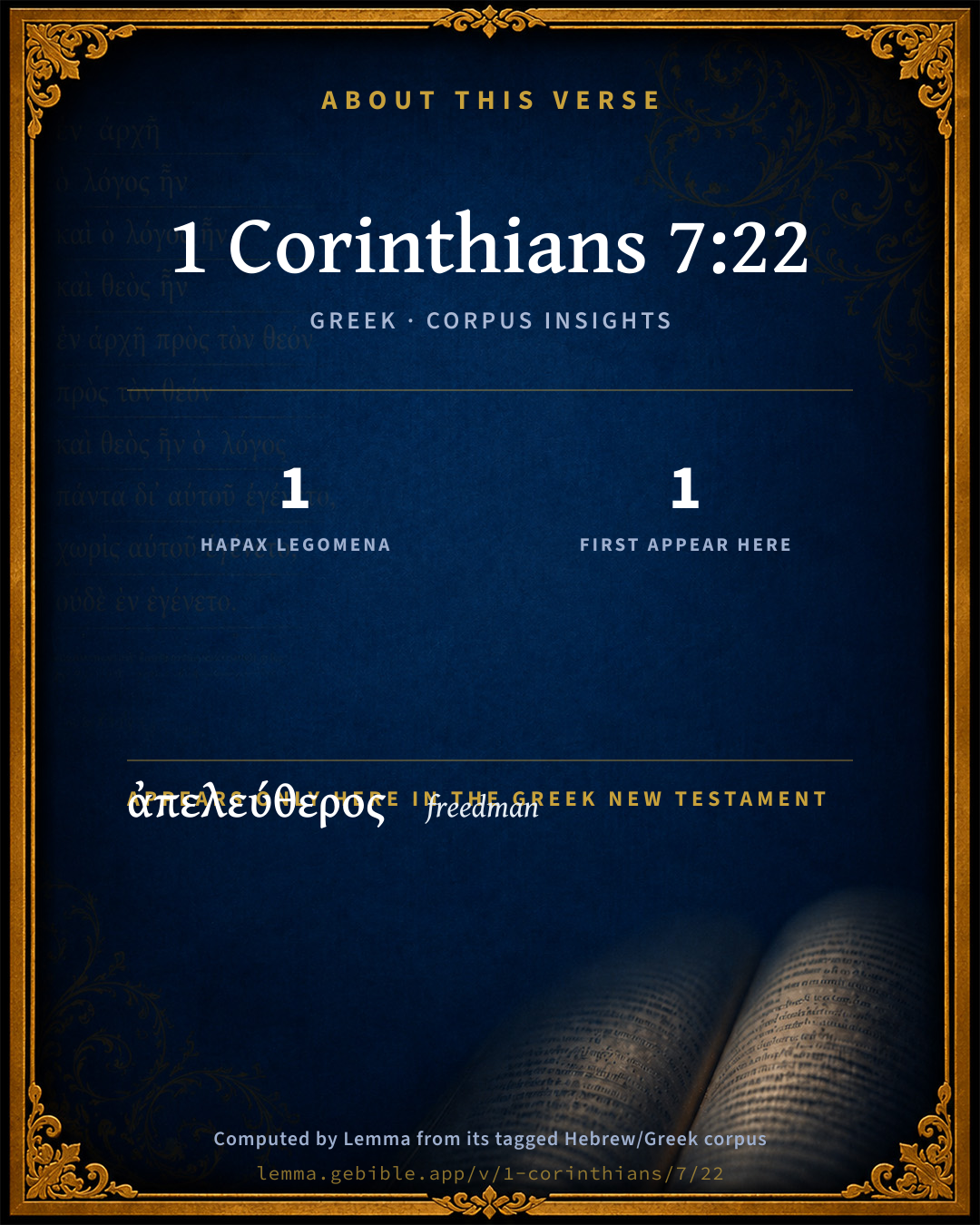
  • 1 hapax legomenon — only here in the Greek New Testament
  • 1 first appearance in the Greek New Testament
Full analysis ↓
Download a study sheet

One document with this verse’s original text, its word-by-word gloss line, the meaning frame, cross-references with their text, attributed commentary, and full source and license credits — printable, and it pastes into notes with its structure intact.

This verse Autodidact and up

Study sheet (.html) Plain text (.txt)

A passage Seminary Student

Up to 50 verses in one chapter. A passage sheet keeps up to 6 commentary sources and 12 cross-references per verse, in the order this page ranks them, and says so on the sheet whenever that leaves anything out. Ask for a single verse and you get the Autodidact verse sheet above.

Everything on this page stays free to read, with no account — the sheet is a download of what is already on screen, not access to it.

Want to remove ads? Support Godless Engineer
Compare translations 3

The same verse in 3 English versions, stacked beneath the original-language interlinear above. Click any original word for its lexicon entry.

Each is an independent rendering of the whole verse — the interlinear is not word-aligned to these translations.

Highlighted words mark where these versions differ — a whole-verse word diff, not a word-by-word alignment.

  • World English Bible Public Domain
    For he who was called in the Lord being a bondservant is the Lord's free man. Likewise he who was called being free is Christ's bondservant.
  • King James Version Public Domain
    For he that is called in the Lord, being a servant, is the Lord's freeman: likewise also he that is called, being free, is Christ's servant.
  • unfoldingWord Literal Text CC BY-SA 4.0
    For the one having been called in the Lord a slave is a freedman of the Lord. Likewise, the one having been called as a freeman is a slave of Christ.

unfoldingWord Literal Text — © unfoldingWord, licensed CC BY-SA 4.0. Word-aligned USFM3 via Door43 (git.door43.org/unfoldingWord/en_ult).

Versions to compare (up to 4)

3 of 4 selected

Show all 19 translations

Every available English version of this verse, each an independent rendering of the whole verse.

  • World English Bible Public Domain
    For he who was called in the Lord being a bondservant is the Lord's free man. Likewise he who was called being free is Christ's bondservant.
  • Berean Standard Bible Public Domain
    For he who was a slave when he was called by the Lord is the Lord’s freedman. Conversely, he who was a free man when he was called is Christ’s slave.
  • Majority Standard Bible Public Domain
    For he who was a slave when he was called by the Lord is the Lord’s freedman. Conversely, he who was a free man when he was called is Christ’s slave.
  • King James Version Public Domain
    For he that is called in the Lord, being a servant, is the Lord's freeman: likewise also he that is called, being free, is Christ's servant.
  • American Standard Version (1901) Public Domain
    For he that was called in the Lord being a bondservant, is the Lord's freedman: likewise he that was called being free, is Christ's bondservant.
  • Revised Version (1885) Public Domain
    For he that was called in the Lord, being a bondservant, is the Lord’s freedman: likewise he that was called, being free, is Christ’s bondservant.
  • Geneva Bible (1599) Public Domain
    For he that is called in the Lord, being. a seruant, is the Lords freeman: likewise also he that is called being free, is Christes seruant.
  • Douay-Rheims (1899) Public Domain
    For he that is called in the Lord, being a bondman, is the freeman of the Lord. Likewise he that is called, being free, is the bondman of Christ.
  • Young's Literal Translation Public Domain
    for he who `is' in the Lord -- having been called a servant -- is the Lord's freedman: in like manner also he the freeman, having been called, is servant of Christ:
  • Literal Standard Version CC BY-SA 4.0
    for he who [is] in the LORD—having been called a servant—is the LORD’s freedman: in like manner also he the freeman, having been called, is servant of Christ:
  • Unlocked Literal Bible CC BY-SA 4.0
    For someone who is called by the Lord as a slave is the Lord's freeman. Likewise, the one who was free when he was called to believe is Christ's slave.
  • unfoldingWord Literal Text CC BY-SA 4.0
    For the one having been called in the Lord a slave is a freedman of the Lord. Likewise, the one having been called as a freeman is a slave of Christ.
  • Darby Bible Public Domain
    For the bondman that is called in [the] Lord is the Lord's freedman; in like manner [also] the freeman being called is Christ's bondman.
  • World Messianic Bible Public Domain
    For he who was called in the Lord being a bondservant is the Lord’s free man. Likewise he who was called being free is Messiah’s bondservant.
  • Webster's Bible Public Domain
    For he that is called in the Lord, being a servant, is the Lord's free-man: likewise also he that is called, being free, is Christ's servant.
  • Free Bible Version CC BY-SA 4.0
    If you were a slave when the Lord called you, you are now free, working for the Lord. In the same way if you were called when you were free, you are now Christ's slave!
  • Bible in Basic English Public Domain
    For he who was a servant when he became a Christian is the Lord's free man; and he who was free when he became a Christian is the Lord's servant.
  • Text-Critical English NT CC BY 4.0
    For he who was called in the Lord as a slave is the Lord's freedman. In the same way, he who was called as a free man is Christ's slave.
  • Tyndale New Testament (1534) Public Domain
    For he that is called in the lorde beynge a servaunt is the lordes freman. Lykwyse he that is called beynge fre is Christes servaut.

Literal Standard Version (2020), Covenant Press — licensed CC BY-SA 4.0. Text via the HelloAO Bible API (eBible.org). Unlocked Literal Bible (unfoldingWord) — licensed CC BY-SA 4.0. Text via the HelloAO Bible API (eBible.org). unfoldingWord Literal Text — © unfoldingWord, licensed CC BY-SA 4.0. Word-aligned USFM3 via Door43 (git.door43.org/unfoldingWord/en_ult). Free Bible Version, Dr. Jonathan Gallagher — licensed CC BY-SA 4.0. Text via the HelloAO Bible API (eBible.org).

Word by word

More ways to search: Search by grammar → Find every occurrence → Compare this word →

Practice this passage: Drill this verse → Learn its vocabulary →

ἀπελεύθερος
apeleútheros
G558
“freedman”
Noun, Nominative, Singular, Masculine
Part of Speech
Noun
Case
Nominative
Number
Singular
Gender
Masculine
Full Thayer's Definition

Origin: from G575 and G1658

TDNT: 10:07,2

1. a slave that has been released from servitude, a freeman
  1. ὁ ho G3588 “the” Article, Nominative, Singular, Masculine
  2. γὰρ gár G1063 “for” Conjunction
  3. ἐν en G1722 “in” Preposition
  4. κυρίῳ kýrios G2962 “Lord” Noun, Dative, Singular, Masculine
  5. κληθεὶς kaléō G2564 “to call” Verb, Aorist, Passive, Participle, Nominative, Singular, Masculine
  6. δοῦλος doûlos G1401 “slave” Noun, Nominative, Singular, Masculine
  7. κυρίου kýrios G2962 “Lord” Noun, Genitive, Singular, Masculine
  8. ἐστίν eimí G1510 “to be” Verb, Present, Active, Indicative, 3rd person, Singular
  9. ὁμοίως homoíōs G3668 “likewise” Adverb
  10. ὁ ho G3588 “the” Article, Nominative, Singular, Masculine
  11. ἐλεύθερος eleútheros G1658 “free” Adjective, Nominative, Singular, Masculine
  12. κληθεὶς kaléō G2564 “to call” Verb, Aorist, Passive, Participle, Nominative, Singular, Masculine
  13. δοῦλός doûlos G1401 “slave” Noun, Nominative, Singular, Masculine
  14. ἐστιν eimí G1510 “to be” Verb, Present, Active, Indicative, 3rd person, Singular
  15. Χριστοῦ Christós G5547 “Christ” Noun, Genitive, Singular, Masculine

About this verse

These counts appear in no published source. They are computed here, from the morphology-tagged text and Lemma’s own curated glosses. What Lemma adds →

16
words
11
distinct lemmas
Pauline Epistles
section

Notable vocabulary

1 hapax legomenon — a word that appears only here in the entire Greek New Testament:

  • ἀπελεύθερος freedman G558

First appearance in Scripture

This word makes its first canonical appearance in the Greek New Testament here:

  • ἀπελεύθερος freedman G558

Shared distinctive vocabulary

ἐλεύθερος free G1658 occurs in 23 verses of the Greek New Testament. Also found in:
Repetition

Words recur within this verse:

  • κυρίῳ Lord G2962 ×2
  • κληθεὶς to call G2564 ×2
  • δοῦλος slave G1401 ×2
  • ἐστίν to be G1510 ×2
  • ὁ the G3588 ×2

Cross-references

16

Topical passages linked to 1 Corinthians 7:22 in the Treasury of Scripture Knowledge — connected by theme and wording, ordered by reader-vote popularity; previews shown in the World English Bible.

  • 1 Peter 2:16 as free, and not using your freedom for a cloak of wickedness, but as bondservants of God.
  • Philemon 1:16 no longer as a slave, but more than a slave, a beloved brother, especially to me, but how much rather to you, both in the flesh and in the Lord.
  • Colossians 3:22–24 Servants, obey in all things those who are your masters according to the flesh, not just when they are looking, as men-pleasers, but in singleness of heart, fearing God.
  • Romans 6:18–22 Being made free from sin, you became bondservants of righteousness.
  • Galatians 5:1 Stand firm therefore in the liberty by which Christ has made us free, and don't be entangled again with a yoke of bondage.
  • Galatians 5:13 For you, brothers, were called for freedom. Only don't use your freedom for gain to the flesh, but through love be servants to one another.
  • Psalms 116:16 Yahweh, truly I am your servant. I am your servant, the son of your handmaid. You have freed me from my chains.
  • 2 Peter 1:1 Simon Peter, a servant and apostle of Jesus Christ, to those who have obtained a like precious faith with us in the righteousness of our God and Savior, Jesus Christ:
  • Luke 1:74–75 To grant to us that we, being delivered out of the hand of our enemies, should serve him without fear,
  • John 8:32–36 You will know the truth, and the truth will make you free."
  • Romans 1:1 Paul, a servant of Jesus Christ, called to be an apostle, set apart for the Gospel of God,
  • 1 Corinthians 9:19 For though I was free from all, I brought myself under bondage to all, that I might gain the more.
  • Galatians 1:10 For am I now seeking the favor of men, or of God? Or am I striving to please men? For if I were still pleasing men, I wouldn't be a servant of Christ.
  • Ephesians 6:5–6 Servants, be obedient to those who according to the flesh are your masters, with fear and trembling, in singleness of your heart, as to Christ;
  • Colossians 4:12 Epaphras, who is one of you, a servant of Christ, salutes you, always striving for you in his prayers, that you may stand perfect and complete in all the will of God.
  • Jude 1:1 Jude, a servant of Jesus Christ, and brother of James, to those who are called, sanctified by God the Father, and kept for Jesus Christ:

Cross-references courtesy of OpenBible.info (CC BY 4.0).

Commentary

Notes on 1 Corinthians 7:22 from classic Christian and Jewish commentators (each source and its license shown beneath its notes). The classic Christian expositions comment on the surrounding passage and are grouped to its opening verse, so a note may address several verses; the Jewish commentaries on the Tanakh (Rashi and others) are per-verse, so they appear only where the commentator wrote on this verse.

Lemma curates 59 commentaries, every one of them public domain or Creative Commons licensed, each selected and text-cleaned for this edition rather than reprinted as found. About our sources →

MacLaren's Expositions of Holy Scripture

Alexander MacLaren

1 Corinthians

SLAVES AND FREE

1Co 7:22.

This remarkable saying occurs in a remarkable connection, and is used for a remarkable purpose. The Apostle has been laying down the principle, that the effect of true Christianity is greatly to diminish the importance of outward circumstance. And on that principle he bases an advice, dead in the teeth of all the maxims recognised by worldly prudence. He says, in effect, ‘Mind very little about getting on and getting up. Do God’s will wherever you are, and let the rest take care of itself.’ Now, the world says, ‘Struggle, wriggle, fight, do anything to better yourself.’ Paul says, ‘You will better yourself by getting nearer God, and if you secure that-art thou a slave? care not for it; if thou mayest be free, use it rather; art thou bound to a wife? seek not to be loosed; art thou loosed? seek not to be bound; art thou circumcised? seek not to be uncircumcised; art thou a Gentile? seek not to become in outward form a Jew.’ Never mind about externals: the main thing is our relation to Jesus Christ, because in that there is what will be compensation for all the disadvantages of any disadvantageous circumstances, and in that there is what will take the gilt off the gingerbread of any superficial and fleeting good, and will bring a deep-seated and permanent blessing.

Now, I am not going to deal in this sermon with that general principle, nor even to be drawn aside to speak of the tone in which the Apostle here treats the great abomination of slavery, and the singular advice that he gives to its victims; though the consideration of the tone of Christianity to that master-evil of the old world might yield a great many thoughts very relevant to pressing questions of to-day. But my one object is to fix upon the combination which he here brings out in regard to the essence of the Christian life; how that in itself it contains both members of the antithesis, servitude and freedom; so that the Christian man who is free externally is Christ’s slave, and the Christian man who is outwardly in bondage is emancipated by his union with Jesus Christ.

There are two thoughts here, the application in diverse directions of the same central idea-viz. the slavery of Christ’s free men, and the freedom of Christ’s slaves. And I deal briefly with these two now.

I. First, then, note how, according to the one-half of the antithesis, Christ’s freed men are slaves.

Now, the way in which the New Testament deals with that awful wickedness of a man held in bondage by a man is extremely remarkable. It might seem as if such a hideous piece of immorality were altogether incapable of yielding any lessons of good. But the Apostles have no hesitation whatever in taking slavery as a clear picture of the relation in which all Christian people stand to Jesus Christ their Lord. He is the owner and we are the slaves. For you must remember that the word most inadequately rendered here, ‘servant’ does not mean a hired man who has, of his own volition, given himself for a time to do specific work and get wages for it; but it means ‘a bond-slave,’ a chattel owned by another. All the ugly associations which gather round the word are transported bodily into the Christian region, and there, instead of being hideous, take on a shape of beauty, and become expressions of the deepest and most blessed truths, in reference to Christian men’s dependence upon, and submission to, and place in the household and the heart of, Jesus Christ, their Owner.

And what is the centre idea that lies in this metaphor, if you like to call it so? It is this: absolute authority, which has for its correlative-for the thing in us that answers to it-unconditional submission. Jesus Christ has the perfect right to command each of us, and we are bound to bow ourselves, unreluctant, unmurmuring, unhesitating, with complete submission at His feet. His authority, and our submission, go far, far deeper than the most despotic sway of the most tyrannous master, or than the most abject submission of the most downtrodden slave. For no man can coerce another man’s will, and no man can require more, or can ever get more, than that outward obedience which may be rendered with the most sullen and fixed rebellion of a hating heart and an obstinate will. But Jesus Christ demands that if we call ourselves Christians we shall bring, not our members only as instruments to Him, in outward surrender and service, but that we shall yield ourselves, with our capacities of willing and desiring, utterly, absolutely, constantly to Him.

The founder of the Jesuits laid it down as a rule for his Order that each member of it was to be at the master’s disposal like a corpse, or a staff in the hand of a blind man. That was horrible. But the absolute putting of myself at the disposal of another’s will, which is expressed so tyrannously in Loyola’s demand, is the simple duty of every Christian, and as long as we have recalcitrating wills, which recoil at anything which Christ commands or appoints, and perk up their own inclinations in the face of His solemn commandment, or that shrink from doing and suffering whatsoever He imposes and enjoins, we have still to learn what it means to be Christ’s disciples.

Dear brethren, absolute submission is not all that makes a disciple, but, depend upon it, there is no discipleship worth calling by the name without it. So I come to each of you with His message to you:-Down on your faces before Him! Bow your obstinate will, surrender yourselves and accept Him as absolute, dominant Lord over your whole being! Are you Christians after that pattern? Being freemen, are you Christ’s slaves?

It does not matter what sort of work the owner sets his household of slaves to do. One man is picked out to be his pipe-bearer, or his shoe-cleaner; and, if the master is a sovereign, another one is sent off, perhaps, to be governor of a province, or one of his council. They are all slaves; and the service that each does is equally important.

‘All service ranks the same with God:

There is no last nor first.’

What does it matter what you and I are set to do? Nothing. And, so, why need we struggle and wear our hearts out to get into conspicuous places, or to do work that shall bring some revenue of praise said glory to ourselves? ‘Play well thy part; there all the honour lies,’ the world can say. Serve Christ in anything, and all His servants are alike in His sight.

The slave-owner had absolute power of life and death over his dependants. He could split up families; he could sell away dear ones; he could part husband and wife, parent and child. The slave was his, and he could do what he liked with his own, according to the cruel logic of ancient law. And Jesus Christ, the Lord of the household, the Lord of providence, can say to this one, ‘Go!’ and he goes into the mists and the shadows of death. And He can say to those who are most closely united, ‘Loose your hands! I have need of one of you yonder. I have need of the other one here.’ And if we are wise, if we are His servants in any real deep sense, we shall not kick against the appointments of His supreme, autocratic, and yet most loving Providence, but be content to leave the arbitrament of life and death, of love united or of love parted, in His hands, and say, ‘Whether we live we are the Lord’s, or whether we die we are the Lord’s; living or dying we are His.’

The slave-owner owned all that the slave owned. He gave him a little cottage, with some humble sticks of furniture in it; and a bit of ground on which to grow his vegetables for his family. But he to whom the owner of the vegetables and the stools belonged owned them too. And if we are Christ’s servants, our banker’s book is Christ’s, and our purse is Christ’s, and our investments are Christ’s; and our mills, and our warehouses, and our shops and our businesses are His. We are not His slaves, if we arrogate to ourselves the right of doing what we like with His possessions.

And, then, still further, there comes into our Apostle’s picture here yet another point of resemblance between slaves and the disciples of Jesus. For the hideous abominations of the slave-market are transferred to the Christian relation, and defecated and cleansed of all their abominations and cruelty thereby. For what immediately follows my text is, ‘Ye are bought with a price.’ Jesus Christ has won us for Himself. There is only one price that can buy a heart, and that is a heart. There is only one way of getting a man to be mine, and that is by giving myself to be his. So we come to the very vital, palpitating centre of all Christianity when we say, ‘He gave Himself for us, that He might acquire to Himself a people for His possession.’ Thus His purchase of His slave, when we remember that it is the buying of a man in his inmost personality, changes all that might seem harsh in the requirement of absolute submission into the most gracious and blessed privilege. For when I am won by another, because that other has given him or her whole self to me, then the language of love is submission, and the conformity of the two wills is the delight of each loving will. Whoever has truly been wooed into relationship with Jesus, by reflection upon the love with which Jesus grapples him to His heart, finds that there is nothing so blessed as to yield one’s self utterly and for ever to His service.

The one bright point in the hideous institution of slavery was, that it bound the master to provide for the slave, and though that was degrading to the inferior, it made his life a careless, child-like, merry life, even amidst the many cruelties and abominations of the system. But what was a good, dashed with a great deal of evil, in that relation of man to man, comes to be a pure blessing and good in our relation to Him. If I am Christ’s slave, it is His business to take care of His own property, and I do not need to trouble myself much about it. If I am His slave, He will be quite sure to find me in food and necessaries enough to get His tale of work out of me; and I may cast all my care upon Him, for He careth for me. So, brethren, absolute submission and the devolution of all anxiety on the Master are what is laid upon us, if we are Christ’s slaves.

II. Then there is the other side, about which I must say, secondly, a word or two; and that is, the freedom of Christ’s slaves.

As the text puts it, ‘He that is called, being a servant, is the Lord’s freedman.’ A freedman was one who was emancipated, and who therefore stood in a relation of gratitude to his emancipator and patron. So in the very word ‘freedman’ there is contained the idea of submission to Him who has struck off the fetters.

But, apart from that, let me just remind you, in a sentence or two, that whilst there are many other ways by which men have sought, and have partially attained, deliverance from the many fetters and bondages that attach to our earthly life, the one perfect way by which a man can be truly, in the deepest sense of the word and in his inmost being, a free man is by faith in Jesus Christ.

I do not for a moment forget how wisdom and truth, and noble aims and high purposes, and culture of various kinds have, in lower degrees and partially, emancipated men from self and flesh and sin and the world, and all the other fetters that bind us. But sure I am that the process is never so completely and so assuredly effected as by the simple way of absolute submission to Jesus Christ, taking Him for the supreme and unconditional Arbiter and Sovereign of a life.

If we do that, brethren, if we really yield ourselves to Him, in heart and will, in life and conduct, submitting our understanding to His infallible Word, and our wills to His authority, regulating our conduct by His perfect pattern, and in all things seeking to serve Him and to realise His presence, then be sure of this, that we shall be set free from the one real bondage, and that is the bondage of our own wicked selves. There is no such tyranny as mob tyranny; and there is no such slavery as to be ruled by the mob of our own passions and lusts and inclinations and other meannesses that yelp and clamour within us, and seek to get hold of us and to sway. There is only one way by which the brute domination of the lower part of our nature can be surely and thoroughly put down, and that is by turning to Jesus Christ and saying to Him, ‘Lord! do Thou rule this anarchic kingdom within me, for I cannot govern it myself. Do Thou guide and direct and subdue.’ You can only govern yourself and be free from the compulsion of your own evil nature when you surrender the control to the Master, and say ever, ‘Speak, Lord! for Thy slave hears. Here am I, send me.’

And that is the only way by which a man can be delivered from the bondage of dependence upon outward things. I said at the beginning of these remarks that my text occurred in the course of a discussion in which the Apostle was illustrating the tendency of true Christian faith to set man free from, and to make him largely independent of, the varieties in external circumstances. Christian faith does so, because it brings into a life a sufficient compensation for all losses, limitations, and sorrows, and a good which is the reality of which all earthly goods are but shadows. So the slave may be free in Christ, and the poor man may be rich in Him, and the sad man may be joyful, and the joyful man may be delivered from excess of gladness, and the rich man be kept from the temptations and sins of wealth, and the free man be taught to surrender his liberty to the Lord who makes him free. Thus, if we have the all-sufficient compensation which there is in Jesus Christ, the satisfaction for all our needs and desires, we do not need to trouble ourselves so much as we sometimes do about these changing things round about us. Let them come, let them go; let the darkness veil the light, and the light illuminate the darkness; let summer and winter alternate; let tribulation and prosperity succeed each other; we have a source of blessedness unaffected by these. Ice may skin the surface of the lake, but deep beneath, the water is at the same temperature in winter and in summer. Storms may sweep the face of the deep, but in the abyss there is calm which is not stagnation. So he that cleaves to Christ is delivered from the slavery that binds men to the details and accidents of outward life.

And if we are the servants of Christ, we shall be set free, in the measure in which we are His, from the slavery which daily becomes more oppressive as the means of communication become more complete, the slavery to popular opinion and to men round us. Dare to be singular; take your beliefs at first hand from the Master. Never mind what fellow-slaves say. It is His smile or frown that is of importance. ‘Ye are bought with a price; be not servants of men.’

And so, brethren, ‘choose you this day whom ye will serve.’ You are not made to be independent. You must serve some thing or person. Recognise the narrow limitations within which your choice lies, and the issues which depend upon it. It is not whether you will serve Christ or whether you will be free. It is whether you will serve Christ or your own worst self, the world, men, and I was going to add, the flesh and the devil. Make your choice. He has bought you. You belong to Him by His death. Yield yourselves to Him, it is the only way of breaking your chains. He that doeth sin is the servant of sin. ‘If the Son make you free, ye shall be free indeed,’ and not only free; for the King’s slaves are princes and nobles, and ‘all things are yours, and ye are Christ’s.’ They who say to Him ‘O Lord! truly I am Thy servant,’ receive from Him the rank of kings and priests to God, and shall reign with Him for ever.

Alexander MacLaren, Expositions of Holy Scripture (1904–1910) — public domain. Text from a community e-Sword module.

Bengel's Gnomon

Johann Albrecht Bengel

1Co 7:22. Ἀπελεύθερος, freedman) Ἐλεύθερος, one free, and who also was never a slave; ἀπελεύθερος, a freedman, who had been a slave.—Κυρίου, of the Lord) Christ, which presently after occurs.—ὁ ἐλεὺθερος κληθεὶς, he that being free is called) At the beginning of the verse the word called is put before a servant; here free is placed before the word called, for the sake of emphasis, that he may be also included, who, in consequence of his calling, obtains the power of acquiring freedom. Comp. on the arrangement of the words, Gal 4:25, note.

Bengel's Gnomon of the New Testament — English translation (T&T Clark, Edinburgh, 1860) — public domain. Text from a community e-Sword module.

Meyer's Critical & Exegetical Commentary

Heinrich August Wilhelm Meyer

1Co_7:22. For the converted slave is Christs freedman; in like manner, too (ὁμοίως καί introduces the precise reversal of relations which here also takes place), the freeman who becomes a Christian is the slave of Christ. That moral freedom (comp Joh_8:36) and this moral slavery are of course essentially identical (Rom_6:16 ff.; Eph_6:6; Col_3:24); but Paul grounds here his admonition in 1Co_7:21 by showing that the matter may be looked at from a twofold point of view: the Christian slave should recognise his relation to Christ as that of an ἀπελεύθερος Χριστοῦ,[1181] and the freemans relation as that of a δοῦλος Χριστοῦ. This will serve in his case this end, not by any means (as Hofmann illogically inserts into the text, despite the ΜΈΝΕΙΝ again required in 1Co_7:24) that he should count it unnecessary to remain in the position of a slave,[1182] but, on the contrary, that he should abide contentedly in his station without coveting after freedom.

Ὁ ἘΝ ΚΥΡΊῼ ΚΛ. ΔΟῦΛ.] the slave who is called in the Lord, i.e. who has received the Christian calling. That is to say, this κλῆσις has not taken place, as any other might, out of Christ, but in Him, as being the distinctive element in which it has its specific character. The ἐν Κυρίῳ, which might have been understood of itself, is expressly added here, because it was meant to be an emphatic correlate to the Κυρίου which follows. It is wholly foreign to the argument to imagine a contrast here with the earthly master (Hofmann), as in Eph_6:5; Col_3:22; Col_4:1.

ἀπελεύθερος with the genitive is not used here in the common sense of libertus alicujus, some ones manumitted slave, for the master hitherto had been sin or Satan (see on 1Co_6:20); but simply a freedman belonging to Christ (comp ΚΛΗΤΟῚ ἸΗΣΟῦ Χ., Rom_1:6), after Christ, namely, has set him free from the service of another (comp Ignatius, ad Romans 4). This was self-evident to the consciousness of the reader.

[1181] So that εἰ σῶμα δοῦλον, ἀλλʼ ὁ νοῦς ἐλεύθερος, Soph. Fragm. 677, Dindorf.

[1182] Paul is, in fact, guarding by this grand utterance of his against all unjust contempt for the condition of outward slavery,a feeling which vanishes in the light of Christianity side by side with all unjust estimation of the worth of mere outward freedom.

Meyer — Critical and Exegetical Commentary on the New Testament — English translation by Peter Christie, edited by Frederick Crombie (T&T Clark, 1880) — public domain. Text from a community e-Sword module.

Expositor's Greek Testament

ed. W. Robertson Nicoll

1Co 7:22 . The two sentences, balanced by ὁμοίως ( cf. 1Co 7:3 f.), do not precisely match: ὁ ἐν Κυρίῳ κληθεὶς δοῦλος is “the slave that was called in the Lord” ( i.e. , under Christ’s authority), but ὁ ἐλεύθερος κληθεὶς is rather “the freeman, in that he was called”; his call has made the latter Christ’s slave, while the former, though a slave , is the Lord’s freedman. ἀπελεύθερος , libertus (the prp [1102] implying severance as in ἀπολύτρωσις , 1Co 1:30 ) freedman of a Lord ; “Christ buys us from our old master, sin, and then sets us free; but a service is still due from the libertus to the patronus ” (Lt [1103] ); cf. Rom 6:17 f.; also ἔννομος Χριστοῦ , 1Co 9:21 , with the same gen [1104] of possession. Ignatius makes a touching allusion to this passage, ad Romans , 4 : “I am till the present time a slave; but if I suffer I shall be Jesus Christ’s freeman, and I shall rise up [in the resurrection] free!”

[1102] preposition.

[1103] J. B. Lightfoot’s (posthumous) Notes on Epp. of St. Paul (1895).

[1104] genitive case.

The Expositor's Greek Testament, edited by W. Robertson Nicoll (1897–1910) — public domain. Text from a community e-Sword module.

Godet's Commentaries

Frédéric Louis Godet

Vv. 22, 23. “For he that was called in the Lord being a slave, is the Lord’s freedman; likewise he that was called being free is Christ’s slave. 23. Ye were bought with a price: become not the slaves of men!”

According to most commentators, 1Co 7:22 is intended to justify the counsel to prefer servitude. Edwards: “A reason why the Christian slave should continue a slave rather than accept liberty.” The reasoning in itself would be admissible: “The slave being spiritually free, and the free believer morally a slave, the contrast is neutralized; why make a change of state?”

But this verse may quite as well justify the counsel of 1Co 7:21, as we have understood it; not in the sense that the first proposition of 1Co 7:22 would justify the first counsel of 1Co 7:21, and the second proposition the second. For in this case the second proposition would not answer the purpose, for the Christian slave called to liberty is not in the position of the free Christian who becomes the slave of Christ. It must be borne in mind that the second part of 1Co 7:21 was a restriction arising in connection with the first, a sort of parenthesis; after which Paul returns to the general idea. We must therefore disentangle the thought common to the two propositions of 1Co 7:22, and apply it to the passage as a whole: If in Christ slaves become free, and the free slaves, then neither slavery nor liberty is to be dreaded for the believer! Slavery will not take away from him his inward liberty, for he is Christ’s freedman; and liberty will not plunge him into licence, for he has become Christ’s slave. The consequence is, that the Christian slave may either remain a slave, or become free, without harm. For, in the latter case, he enters the class of the free who become the Lord’s slaves.

The expression ἐν κυρίῳ κληθείς does not signify: called to communion with the Lord, but: called by a call addressed in the Lord.

The gen. κυρίου here is at once that of cause and of possession. The sentence of emancipation was pronounced by the Lord; by it He delivered this spiritual slave from the power and condemnation of sin; thenceforth this freedman belongs to Him as His servant.

Frédéric Louis Godet — Commentaries on Luke, John, Romans, and 1 Corinthians — English translation (T&T Clark, Edinburgh, 1870s–1890s) — public domain. Text from a community e-Sword module.

Hodge's Commentary on Romans, Ephesians & First Corinthians

Charles Hodge

1Co_7:22

For he that is called in the Lord, (being) a servant, is the Lords freeman: likewise also he that is called, (being) free, is Christs servant.

The connection is with the first, not with the last clause of 1Co_7:21. Care not for your bondage, for, etc. He that is called in the Lord; or, as the words stand, The slave called in the Lord. That is, the converted slave. Is the Lords freeman, i.e. is one whom the Lord has redeemed. The possession of that liberty with which Christ makes his people free, is so great a blessing, that all other things, even the condition of slavery, are comparatively of no account. Paul, in Rom_8:18-23 says that the afflictions of this life are not worthy to be compared with the glorious liberty of the sons of God, towards which the whole creation, now subject to vanity, looks with longing expectation. A man need care little about his external condition in this world, who is freed from the bondage of Satan, the curse of the law, the dominion of sin, and who is made a child and heir of God; that is, who is conformed to the image of his Son, and made a partaker of his exaltation and kingdom. Likewise also he that is called, being free, is the Lords servant (i.e. slave, δοῦλος). The distinction between master and slave is obliterated. To be the Lords freeman, and to be the Lords slave, are the same thing. The Lords freeman is one whom the Lord has redeemed from Satan, and made his own; and the Lords slave is also one whom Christ has purchased for himself. So that master and slave stand on the same level before Christ. Comp. Eph_6:9.

Charles Hodge — Commentary on Romans (1835), First Corinthians (1857), and Ephesians (1856) — public domain. Text from a community e-Sword module.

Geneva Bible (1599)

Geneva Bible translators

He that is in state of a servant, and is called to be a Christian.

Geneva Bible (1599) marginal notes — public domain. Text via Bolls.life.

Jamieson, Fausset & Brown

Robert Jamieson, A. R. Fausset & David Brown

the Lord's freeman-- (Plm 1:16) --rather, "freedman." Though a slave externally, spiritually made free by the Lord: from sin, Joh 8:36; from the law, Rom 8:2; from "circumcision," Co1 7:19; Gal 5:1.

Christ's servant-- (Co1 9:21). Love makes Christ's service perfect freedom (Mat 11:29-30; Gal 5:13; Pe1 2:16).

Jamieson, Fausset & Brown — Commentary Critical and Explanatory on the Whole Bible (1871) — public domain (CC PDM 1.0). Text via the HelloAO Bible API.

Adam Clarke's Commentary

Verse 22. For he that is called] The man who, being a slave, is converted to the Christian faith, is the Lord's freeman; his condition as a slave does not vitiate any of the privileges to which he is entitled as a Christian: on the other hand, all free men, who receive the grace of Christ, must consider themselves the slaves of the Lord, i.e. his real property, to be employed and disposed of according to his godly wisdom, who, notwithstanding their state of subjection, will find the service of their Master to be perfect freedom.

Adam Clarke's Commentary on the Bible (1810–1826) — public domain. Text from a community e-Sword/MySword module.

John Calvin's Commentaries

22. For he that is called in the Lord, being a servant To be called in the Lord, being a servant, is to be chosen out of the rank of servants, and made a partaker of the grace of Christ. Now this statement is designed to furnish consolation to servants, and, at the same time, to beat down the haughtiness of those that are free-born. As servants feel their situation irksome, in respect of their being mean and despicable, it is of importance that the bitterness of servitude be alleviated by some consolation. Those, on the other hand, that are free, need to be restrained, in order that they may not be unduly elated on account of their more honorable condition, and be lifted up with pride. The Apostle does both; for he teaches, that as the liberty of the spirit is greatly preferable to the liberty of the flesh, servants ought to feel the unpleasantness of their condition the more tolerable, when they take into view that inestimable gift with which they have been endowed; and, on the other hand, that those who are free ought not to be puffed up, inasmuch as their condition in the principal respect is not superior to that of servants. We must not, however, infer from this, that those that are free are made inferior to servants, or that political order is subverted. The Apostle saw what suited both. Those that were free required (as I have said) to be restrained, that they might not in a wanton manner triumph over servants. To servants, on the other hand, some consolation required to be administered, that they might not be disheartened. Now these things tend rather to confirm political order, while he teaches that the inconvenience of the flesh is compensated by a spiritual benefit.

John Calvin's Commentaries (1540-1563) — public domain. Text from the Calvin Translation Society English edition (1840s-50s) via the Christian Classics Ethereal Library (ccel.org). Calvin's coverage is partial (roughly two-thirds of the Bible); uncommented books and verses are honest gaps, never fabricated. The 19th-century editor's footnotes and remarks are omitted so the notes are faithfully Calvin's own voice.

Ellicott's Commentary for English Readers

(22) For he that is called in the Lord, being a servant, . . .—Better, For he that was converted as a slave is Christ’s freedman; and, similarly, the one who was converted as a freeman is Christ’s slave. Therefore, no one need trouble himself as to his mere earthly servitude or freedom. If he be a slave, let him be cheered by remembering that he is a freedman belonging to Christ; and if he be a freeman, let him not despise the state of the one in servitude, realising that he himself is Christ’s slave. A “freedman,” as distinct from a “freeman,” was one who had been in bondage but was now free.

A Bible Commentary for English Readers, edited by Charles John Ellicott (1878–1897) — public domain. Text from a community e-Sword module.

The Cambridge Bible for Schools and Colleges

gen. ed. J. J. S. Perowne

22. the Lord’s freeman] Rather, freedman, the Latin libertus. So Beza, Calvin and the Vulgate, and the margin of our version. The English translators generally seem to have missed this point.

Christ’s servant] For this expression, cf. Eph_6:6; Jas_1:1; 2Pe_1:1; Judges 1.

The Cambridge Bible for Schools and Colleges (gen. ed. J. J. S. Perowne; Cambridge University Press, 1878–1918) — public domain. Text from a community e-Sword module.

John Gill's Exposition

For he that is called in the Lord,.... Which is to be understood, not of any civil calling, or of calling to an office; or of the outward call by the ministry of the word only; but of an internal, special, powerful, evangelical, and saving call by the grace of God; which is of persons out of darkness into light, out of bondage into liberty, from their sinful companions to the company and society of Christ and his people, from off themselves and their own righteousness, to the grace and righteousness of Christ, and out of the world unto a kingdom and glory. And this may be said to be, in the Lord; either because it is by him, he is the efficient cause of it, his grace the moving cause, and his glory the end; or because it is in consequence of being in him, united to him, persons are first in the Lord, and then called by him; or because they are called into fellowship and communion with him; the whole is true, and make up the sense of the text; for he that is effectually called by grace, is called by the Lord, and by virtue of being chosen in him, and in union to him, and to partake of all the blessings of grace and glory that are with him. And such an one,

being a servant; in a natural and civil sense when called, in a spiritual sense

is the Lord's freeman; he is free from sin, not from the being, but from the servitude, guilt, and damning power of it: he is free from Satan, not from his temptations and insults, but from his dominion and captivity; he is ransomed from him, by the redemption of Christ, and is turned from his power in conversion; he has not that influence over him he before had; and he is so safe and secure from him, that he can never be destroyed by him, and in a short time Satan will be bruised under his feet: he is free from the law, the observance of the ceremonial law, and all its numerous burdensome rites; and from the moral law, not from obedience to it, as in the hands of Christ, but from the bondage, curse, and condemnation of it, as ministered by Moses: he is free of the company of saints, of the church of God below, and of heaven, the city God has built and prepared for his; he is free to the use of all things indifferent, provided it is done in faith, the peace of weak brethren secured, and the glory of God preserved; he is free to all the privileges and immunities of the house of God, and to the throne of grace, come when he will; and therefore though a servant, in another sense he is a very happy man; he is free indeed, and can never be disenfranchanised, or arrested, or cast into prison; the various privileges he is free unto and enjoys, show him to be a happy man; and the effects following on his freedom prove it, as peace with God, the presence of Christ, joy in the Holy Ghost, fellowship with saints, and a well grounded hope of glory; he is not only called to the liberty of grace, which he enjoys, but will be delivered into the glorious liberty of the children of God; and therefore has no reason to be uneasy with his civil servitude: on the other hand,

likewise he that is called being free; he that is called by the grace of God, with an holy and effectual calling, being a freeman, his own master, and it may be the master of others in a civil sense, he, in a spiritual one,

is Christ's servant: he is bought by Christ with his money, with the price of his blood; and therefore he has a right unto him, and a claim to his service; and he becomes a voluntary servant to him, through the power of his grace upon him; and though he serves his Lord Christ without mercenary views, freely, readily, and cheerfully, from a principle of love and gratitude, he shall not fail of a reward of grace; he shall be honoured of God, approved of men, and shall receive the reward of the inheritance: Christian liberty, and the service of Christ, are not at all inconsistent; nor should we entertain any other notions of liberty, but what are consistent with serving the Lord; whatever liberty contradicts, that is no true liberty; though it may have the face of it, it is no other than bondage.

John Gill's Exposition of the Whole Bible (1746–1763) — public domain (CC PDM 1.0). Text via the HelloAO Bible API.

Trapp's Complete Commentary

John Trapp

22 For he that is called in the Lord, being a servant, is the Lord’s freeman: likewise also he that is called, being free, is Christ’s servant.

Ver. 22. For he that is called] See a parallel place to this, Jas 1:9-10. Our preferment in Christ should make us hold up our heads, but not too high, And be cheerful, but not also scornful. Laeti simus in Domino, sed caveamus a recidivo. Bern.

John Trapp, A Commentary or Exposition upon All the Books of the Old and New Testament (1647–1656) — public domain. Text from a community e-Sword module.

Albert Barnes' Notes on the Bible

For he that is called in the Lord - He that is called by the Lord; he that becomes a Christian.

Being a servant - A slave when he is converted.

Is the Lord’s freeman - Margin, “Made free” (ἀπελεύθερος apeleutheros). Is manumitted, made free, endowed with liberty by the Lord. This is designed evidently to comfort the heart of the slave, and to make him contented with his condition; and it is a most delicate, happy, and tender argument. The sense is this. “You are blessed with freedom from the bondage of sin by the Lord. You were formerly a slave to sin, but now you are liberated. that bondage was far more grievous, and far more to be lamented than the bondage of the body. But from that long, grievous, and oppressive servitude you are now free. Your condition, even though you are a slave, is far better than it was before; nay, you are now the true freeman, the freeman of the Lord. Your spirit is free; while those who are not slaves, and perhaps your own masters, are even now under a more severe and odious bondage than yours. You should rejoice, therefore, in deliverance from the greater evil, and be glad that in the eye of God you are regarded as his freeman, and endowed by him with more valuable freedom than it would be to be delivered from the bondage under which you are now placed. Freedom from sin is the highest blessing that can be conferred upon people; and if that is yours, you should little regard your external circumstances in this life. You will soon be admitted to the eternal liberty of the saints in glory, and will forget all your toils and privations in this world.”

Is Christ’s servant - Is the “slave” (δοῦλος doulos) of Christ; is bound to obey law, and to submit himself, as you are, to the authority of another. This too is designed to promote contentment with his lot, by the consideration that all are bound to obey law; that there is no such thing as absolute independence; and that, since law is to be obeyed, it is not degradation and ignominy to submit to those which God has imposed on us by His providence in an humble sphere of life. Whether a freeman or a slave, we are bound to yield obedience to law, and everywhere must obey the laws of God. It is not, therefore, degradation to submit to his laws in a state of servitude, though these laws come to us through an earthly master. In this respect, the slave and the freeman are on a level, as both are required to submit to the laws of Christ; and, even if freedom could be obtained, there is no such thing as absolute independence. This is a very beautiful, delicate and happy argument, and perhaps no consideration could be urged that would be more adapted to produce contentment.

Albert Barnes' Notes on the Bible (1834–1885) — public domain. Text from a community e-Sword/MySword module.

Matthew Poole's English Annotations

For the state of a servant to men no way prejudiceth a man as to his spiritual liberty; a servant and a free-man, considered with reference to Christ, are both one; a servant may be as near the kingdom of heaven as a free-man; and let a man be in never so good a state of civil liberty, yet, if he be a Christian, he is still a servant of Christ, and bound in all things to obey him. As to the new man, there is neither bond nor free, but Christ is all and in all.

Matthew Poole's English Annotations on the Holy Bible (1683–1685) — public domain. Text from a community e-Sword/MySword module.

Whedon's Commentary on the Bible

Daniel D. Whedon

22. For—Assigning, now, a reason for the precept just given for both contentment in necessary slavery and use of means for emancipation. The slave is the Lord’s freeman, and, therefore, can be content. The freeman is Christ’s servant, and should, therefore, choose to be not the slave of man.

Daniel D. Whedon (gen. ed.), Commentary on the Old and New Testaments (1874–1909) — public domain. Text from a community e-Sword module.

The Pulpit Commentary

Is the Lord"s freeman; rather, freedman. Clearly the entire bearing of this verse favours the view which we have taken of the previous verse. Christ"s servant. The sharp antithesis of this verse was often present to the mind of the early Christians. They knew that the bondage of Satan was so crushing that mere earthly bondage was, in comparison, as nothing; and that the liberty wherewith Christ has made us free, though it might seem to take the form of service, was the sole perfect freedom. The freedmen of sin are the most hopeless slaves; the servants of God alone are free. (see Rom_6:22; 2Ti_2:26; 1Pe_2:16)

Vers. 22-24.

Personal Christianity for the bond and the free.

he that is called in the Lord, being a servant, is the Lord"s freeman: likewise also he that is called, being free, is Christ"s servant. Ye are bought with a price; be not ye the servants of men. Brethren, let every man, wherein he is called, therein abide with God." Although the remarks in our previous sketch include these three verses, there is sufficient meaning in them to justify, if not to require, a separate notice. Understanding, as before intimated, the expression, "called in the Lord," and again, "abide with God," to mean personal Christianity, the verses include three general truths.

I That personal Christianity may be possessed BY THOSE IS SLAVERY AS WELL AS BY THOSE IS FREEDOM. "For he that is called in the Lord, being a servant a slave, is the Lord"s freeman." Slavery under the Greek and Roman governments was an established institution. In Corinth slaves abounded. Many of these had been converted by the gospel, and were in connection with the Corinthian Church. Naturally enough, some would desire their emancipation, and the more so as Christianity gave them a sublime sense of their manhood. Paul"s advice is not to be too anxious on the subject of their enfranchisement, but rather to be anxious to "abide" in their "calling," their religion. Christianity is for man as man, not for him as rich or poor, erudite or rude, bond or free, but for him as a man; it comes to him as outward nature comes to him, with equal freeness and fitness for all. The physical, civil, or ecclesiastical condition of a man, therefore, in this life is no excuse for his not becoming a Christian: though bound in chains, his soul is free free to think, to resolve, to worship, and it is with the soul that Christianity has to do. Hence religion in slavery is not an uncommon fact. Slaves were members of many of the first Churches, and religion reigned amongst a large number of those who were held in bondage in the Southern States of America.

II That the possession of personal Christianity, whether by the bond or the free, INVESTS MAN WITH THE HIGHEST LIBERTY. He is the "Lord"s freeman," whoever he is; the Lord has emancipated his soul, however firmly manacled his bodily limbs. All the inner chains that bound his soul, to mere earthly influence, fleshly pleasures, and sinful pursuits, are snapped asunder, and he revels in the liberty wherewith "Christ makes his people free." What freedom like this freedom from the dominion and consequences of moral wrong? This is the "glorious liberty of the children of God.

He is the freeman whom the truth makes free, And all are slaves besides.

III That the possession of the highest liberty LESSENS NO MAN"S MIGHTY OBLIGATION TO SERVE CHRIST. "Ye are bought with a price; be not ye the servants of men." All creatures are the property of the Creator. No creature owns itself. The highest angel has nothing in him that he can call his own. Man is not merely the property of God on the ground of creatureship, but on the ground of Christ"s interposition. "Ye are not your own: ye are bought with a price: therefore glorify God in your body, and in your spirit, which are God"s." This being the case, however free and independent of men, you must ever be the servant of Christ; serve him heartily, faithfully, loyally, and forever. His service is perfect freedom, his service is heaven.

CONCLUSION. See how Christianity is to work out necessary reformations for the world, not by force but by influence, not from without but from within, by working from the centre to the circumference. "There are," says F. W. Robertson, "two mistakes which are often made upon this subject: one is the error of supposing that outward institutions are unnecessary for the formation Of character, and the other that of supposing that they are all that is required to form the human soul. If we rightly understand the duty of a Christian man, it is this to make his brethren free inwardly and outwardly: first inwardly, so that they may become masters of themselves, rulers of their passions, having the power of self rule and self control; and then outwardly, so that there may be every power and opportunity of developing the inward life; in the language of the prophet, "to break the rod of oppression, and let the oppressed go free.

Who are the free? They who have scorn"d the tyrant and his rod, And bow"d in worship unto none but God; They who have made the conqueror"s glory dim, Unchain"d in soul though manacled in limb,

Unwarp"d by prejudice, unawed by wrong, Friends to the weak, and fearless of the strong; They who could change not with the changing hour, The self same man in peril and in power;

True to the law of right, as warmly prone To grant another"s as maintain their own; Foes of oppression wheresoe"er it be; These are the proudly free.

Vers. 22, 23.

Freedom and bondage.

To the mind of the apostle spiritual and immortal relations seemed so vast and momentous that they dwarfed those relations which are earthly and temporary. It may appear to some readers of this passage of the Epistle as if Paul did not attach enough importance to the conditions of life in which Christians may find themselves. But the fact is that the friendship of Christ and the hopes of eternity were so real and precious to him that all beside seemed insignificant; whilst the uncertainty attaching to the period of the present dispensation was so present to his mind that he could not concern himself very feelingly with what might so soon forever pass away.

I THE BONDMAN"S FREEDOM. It is well known how very large a proportion of the Roman empire were slaves, and how pitiable was the condition of the whole class, how wretched and hopeless the condition of a large portion of the class. We cannot wonder that the gospel of Jesus Christ found so cordial and grateful a welcome from the bondmen in many cities of the empire. In many instances Christianity actually ameliorated the let of the slave; in many more it enabled the unfortunate to bear their trials with patience, and to look beyond them to the glorious liberty of the children of God. The Epistle to Philemon gives us an insight into the relations between a Christian master and a Christian slave. What was the secret of the change which began so auspiciously, and which has proceeded so surely and so beneficially with the lapse of centuries? That Christianity had from the first a tendency to put an end to such inequality, none can doubt. But deeper than the social movement was a spiritual energy which displayed itself in the individual life. Liberty of spirit compensated the yoke of bondage. The humblest slave cherished the assurance that he was the Lord"s freeman. This honourable distinction, the privileges and immunities it brought, the hopes it inspired, made the heart contented and the life tranquil and bright. The same process may take place in cases very different, yet allied. There are in every state of society those whose position is lowly and whose earthly prospects are cheerless, who may nevertheless enjoy the conviction that the Lord, the Son, has made them free, so that they are free indeed, in the enjoyment of a spiritual liberty and all its privileges and anticipations.

II THE FREEMAN"S BONDAGE. The passage contains a twofold paradox: it presents us with a slave enfranchised, and with a freeman in bonds. If the poor slave was encouraged not to allow his chains to tie him in spirit to the earth, the freeman was reminded that, "called in the Lord," he was captive to a Divine will and consecrated to a Divine service.

1. The cause and explanation of this servitude. The Christian is reminded that he is "bought with a price." Brought into a new bondage by the purchase of a Saviour"s blood, he is no more his own. Thus Christ and his sufferings are represented as the source of the new obligations which the ransomed have contracted.

2. The negative side of the change thus effected. It is a grand and stirring appeal of the apostle: "Be not ye the servants of men." Alas! what multitudes subject themselves to a base thraldom, in accepting the chains of human slavery, whilst they disdain the easy yoke of the Redeemer! But it is the prerogative of the Christian to be superior alike to human judgment and to human authority.

3. The positive side. He is "Christ"s servant" who is called in the Lord, although free in a civil sense. From Paul"s own biography we are able to form a judgment as to the value which he set on Roman citizenship. But his highest honour was to subject and devote his powers to his Saviour. So far from there being any degradation, any ignominy in such service, it is most honourable, most illustrious. Yet it must be something more than a name; it involves the bringing, not of the life only, but of every thought, "into captivity to the obedience of Jesus Christ. T.

The Pulpit Commentary (1880–1919), ed. H.D.M. Spence-Jones & Joseph S. Exell — public domain. Text from a community e-Sword module.

John Wesley's Explanatory Notes

Is the Lord's freeman - Is free in this respect. The Greek word implies one that was a slave, but now is free. Is the bondman of Christ - Not free in this respect; not at liberty to do his own will.

John Wesley, Explanatory Notes Upon the Whole Bible (1754–1765) — public domain. Text via the GEBible commentary corpus.

McGarvey & Pendleton's Commentaries

J. W. McGarvey

For he that was called in the Lord being a bondservant, is the Lord's freedman: likewise he that was called being free, is Christ's bondservant .

J. W. McGarvey (with Philip Y. Pendleton), Commentaries on the New Testament (The Fourfold Gospel, 1914; Acts; and the epistles) — public domain. Text from a community e-Sword/MySword module.

The People's New Testament

B. W. Johnson

22. For he that is called … being a servant. The eternal equality of the servant and freeman in Christ is shown. The “servant” is Christ's freedman, since Christ has freed him from sin; the freeman, when converted, is Christ's servant.

B. W. Johnson's The People's New Testament with Notes (1889–1891) — public domain. Electronic text from the Christian Classics Ethereal Library (CCEL) ThML edition.

Cambridge Greek Testament for Schools and Colleges

22. ἀπελεύθερος. Not freeman, with most of the English translators, but with Vulg., Calvin, Beza and the R.V. freedman. Cf. Soph. Fragm. 677 εἰ σῶμα δοῦλον, ἀλλ’ ὁ νοῦς ἐλεύθερος. It is the glory of the religion of the Cross that it conquers the world by submitting to it. Neander, Church History, Sec. 1, A remarks on the astonishment which must have been felt when the slave, without rebelling against the condition in which he found himself, discharged all its duties with greater fidelity than before, and yet shewed an elevation of soul utterly unusual in men in his position. But the indirect influence of Christianity (see note on 1Co 7:17) has introduced a tone of feeling which has struck at the root of slavery and, in Christian society at least, put an end to it.

δοῦλός ἐστιν Χριστοῦ. Cf. Eph 6:6; Jas 1:1; 2Pe 1:1; Jud 1:1.

Cambridge Greek Testament for Schools and Colleges (Cambridge University Press, 1896; 21 vols, various authors incl. Carr, Maclear, Plummer, Farrar, Lumby, Moule, M. R. James, Simcox) — public domain. Text from a community e-Sword module.

Alford’s Greek Testament

Henry Alford

22.] Ground of the above precept. For the slave who was called in the Lord (not, as E. V. and De Wette, ‘He who is called in the Lord, being a slave,’ which would be δοῦλος κληθείς, see above, δοῦλος ἐκλῆθης:

ἐν κυρίῳ, as the element in which what is about to be stated takes place) is the Lord’s freedman (“ἀπελεύθερος with genit. is not here in the ordinary sense of ‘libertus alicujus,’ ‘any one’s manumitted slave:’ for the former master was sin or the devil, see on ch. 6:20;—but only a freedman belonging to Christ, viz. freed by Christ from the service of another. This the reader would understand as a matter of course.” Meyer): similarly he that was called being free (not here, κληθεὶς ἐλεύθερος, see above) is the slave of Christ. Christ’s service is perfect freedom, and the Christian’s freedom is the service of Christ. But here the Apostle takes, in each case, one member of this double antithesis from the outer world, one from the spiritual. The (actual) slave is (spiritually) free: the (actually) free is a (spiritual) slave. So that the two are so mingled, in the Lord, that the slave need not trouble himself about his slavery, nor seek for this world’s freedom, seeing he has a more glorious freedom in Christ, and seeing also that his brethren who seem to be free in this world are in fact Christ’s servants, as he is a servant. It will be plain that the reason given in this verse is quite inconsistent with the prevalent modern rendering of ver. 21.

Henry Alford, The Greek Testament (1849–1861) — public domain. Text from a community e-Sword module.

Vincent's Word Studies in the New Testament

Marvin R. Vincent

Freeman [απελευθερος] . Rev., correctly, freedman; the preposition ajp' from implying previous bondage.

Marvin R. Vincent, Word Studies in the New Testament (1887–1900) — public domain. Text from a community e-Sword/MySword module.

Lesson kit

Teaching starters — assembled from the data on this page, not authored interpretation. Every prompt links to the verse data it draws on. Edit before teaching.

1 Corinthians, in the Pauline Epistles, opens this verse with 16 words (11 distinct Greek lemmas). Its most distinctive word is apeleútheros (“freedman”). A historical commentator’s framing appears above. Read the whole chapter for the surrounding context.

Discussion questions

  1. What does “freedman” (apeleútheros) contribute to the verse as a whole?
  2. This verse holds 1 word here found nowhere else in the Greek New Testament. What might the rare word draw attention to?
  3. The word “freedman” first appears here in Scripture. What is being introduced at this debut?
  4. Matthew 17:26 shares the word «free» with this verse. How do the two illuminate each other?
  5. “Lord” occurs 2× in this one verse. What is the effect of the repetition?
  6. These translations render this verse differently. What is at stake in choosing one wording over another?
  7. Reading how MacLaren's Expositions of Holy Scripture and Bengel's Gnomon read this verse, where do the two commentators agree and where do they part?

Things to notice

  • 1 word in this verse appears nowhere else in the Greek New Testament.
  • 1 word makes its first canonical appearance in Scripture here.
  • These translations choose different wording for 16 words in this verse.
  • “Lord” occurs 2× in this single verse.
  • 11 distinct Greek lemmas span 16 words in this verse.

Reading settings

Reading text

Shown beneath each verse's original-language words.

Old Testament
Old Testament edition

Read the OT as the Masoretic Hebrew (MT) or the Greek Septuagint (LXX).

English shown for the Greek Septuagint (in the Hebrew ↔ Greek comparison).

Comparing translations? Open the Compare panel on any verse page to stack up to four side by side.