1 Corinthians 1:7

Greek (Tischendorf 8th ed.) 1 Corinthians 1:7 appears in the Greek New Testament. The text above is from the Tischendorf 8th edition. Each word links to its Strong’s number and a concise gloss. Click any word for its full Thayer’s Greek Lexicon entry.
Download image
Cite this verse

1 Corinthians 1:7 (World English Bible). Public Domain. Lemma interlinear Bible study tool, https://lemma.gebible.app/v/1-corinthians/1/7.

Show BibTeX & RIS
BibTeX
RIS
English Translation
so that you come behind in no gift; waiting for the revelation of our Lord Jesus Christ;
World English Bible · Public Domain
Download a study sheet

One document with this verse’s original text, its word-by-word gloss line, the meaning frame, cross-references with their text, attributed commentary, and full source and license credits — printable, and it pastes into notes with its structure intact.

This verse Autodidact and up

Study sheet (.html) Plain text (.txt)

A passage Seminary Student

Up to 50 verses in one chapter. A passage sheet keeps up to 6 commentary sources and 12 cross-references per verse, in the order this page ranks them, and says so on the sheet whenever that leaves anything out. Ask for a single verse and you get the Autodidact verse sheet above.

Everything on this page stays free to read, with no account — the sheet is a download of what is already on screen, not access to it.

Want to remove ads? Support Godless Engineer
Compare translations 3

The same verse in 3 English versions, stacked beneath the original-language interlinear above. Click any original word for its lexicon entry.

Each is an independent rendering of the whole verse — the interlinear is not word-aligned to these translations.

Highlighted words mark where these versions differ — a whole-verse word diff, not a word-by-word alignment.

  • World English Bible Public Domain
    so that you come behind in no gift; waiting for the revelation of our Lord Jesus Christ;
  • King James Version Public Domain
    So that ye come behind in no gift; waiting for the coming of our Lord Jesus Christ:
  • unfoldingWord Literal Text CC BY-SA 4.0
    so that you do not lack in any gift, eagerly waiting for the revelation of our Lord Jesus Christ,

unfoldingWord Literal Text — © unfoldingWord, licensed CC BY-SA 4.0. Word-aligned USFM3 via Door43 (git.door43.org/unfoldingWord/en_ult).

Versions to compare (up to 4)

3 of 4 selected

Show all 19 translations

Every available English version of this verse, each an independent rendering of the whole verse.

  • World English Bible Public Domain
    so that you come behind in no gift; waiting for the revelation of our Lord Jesus Christ;
  • Berean Standard Bible Public Domain
    Therefore you do not lack any spiritual gift as you eagerly await the revelation of our Lord Jesus Christ.
  • Majority Standard Bible Public Domain
    Therefore you do not lack any spiritual gift as you eagerly await the revelation of our Lord Jesus Christ.
  • King James Version Public Domain
    So that ye come behind in no gift; waiting for the coming of our Lord Jesus Christ:
  • American Standard Version (1901) Public Domain
    so that ye come behind in no gift; waiting for the revelation of our Lord Jesus Christ;
  • Revised Version (1885) Public Domain
    so that ye come behind in no gift; waiting for the revelation of our Lord Jesus Christ;
  • Geneva Bible (1599) Public Domain
    So that ye are not destitute of any gift: wayting for the appearing of our Lord Iesus Christ.
  • Douay-Rheims (1899) Public Domain
    So that nothing is wanting to you in any grace, waiting for the manifestation of our Lord Jesus Christ.
  • Young's Literal Translation Public Domain
    so that ye are not behind in any gift, waiting for the revelation of our Lord Jesus Christ,
  • Literal Standard Version CC BY-SA 4.0
    so that you are not behind in any gift, waiting for the revelation of our Lord Jesus Christ,
  • Unlocked Literal Bible CC BY-SA 4.0
    Therefore you lack no spiritual gift as you eagerly wait for the revelation of our Lord Jesus Christ.
  • unfoldingWord Literal Text CC BY-SA 4.0
    so that you do not lack in any gift, eagerly waiting for the revelation of our Lord Jesus Christ,
  • Darby Bible Public Domain
    so that ye come short in no gift, awaiting the revelation of our Lord Jesus Christ;
  • World Messianic Bible Public Domain
    so that you come behind in no gift, waiting for the revelation of our Lord Yeshua the Messiah,
  • Webster's Bible Public Domain
    So that ye come behind in no gift; waiting for the coming of our Lord Jesus Christ:
  • Free Bible Version CC BY-SA 4.0
    so that you're not missing any spiritual gift as you wait for the coming of our Lord Jesus Christ.
  • Bible in Basic English Public Domain
    So that having every grace you are living in the hope of the revelation of our Lord Jesus Christ;
  • Text-Critical English NT CC BY 4.0
    so that you are not lacking in any gift as you eagerly await the revelation of our Lord Jesus Christ.
  • Tyndale New Testament (1534) Public Domain
    so that ye are behynde in no gyft and wayte for the apperynge of oure lorde Iesus Christ

Literal Standard Version (2020), Covenant Press — licensed CC BY-SA 4.0. Text via the HelloAO Bible API (eBible.org). Unlocked Literal Bible (unfoldingWord) — licensed CC BY-SA 4.0. Text via the HelloAO Bible API (eBible.org). unfoldingWord Literal Text — © unfoldingWord, licensed CC BY-SA 4.0. Word-aligned USFM3 via Door43 (git.door43.org/unfoldingWord/en_ult). Free Bible Version, Dr. Jonathan Gallagher — licensed CC BY-SA 4.0. Text via the HelloAO Bible API (eBible.org).

Word by word

More ways to search: Search by grammar → Find every occurrence → Compare this word →

Practice this passage: Drill this verse → Learn its vocabulary →

ἀπεκδεχομένους
apekdéchomai
G553
“waiting for”
Verb, Present, Middle or Passive deponent, Participle, Accusative, Plural, Masculine
Part of Speech
Verb
Tense
Present
Voice
Middle or Passive deponent
Mood
Participle
Case
Accusative
Number
Plural
Gender
Masculine
Full Thayer's Definition

Origin: from G575 and G1551

TDNT: 02:56,1

1. assiduously and patiently waiting for
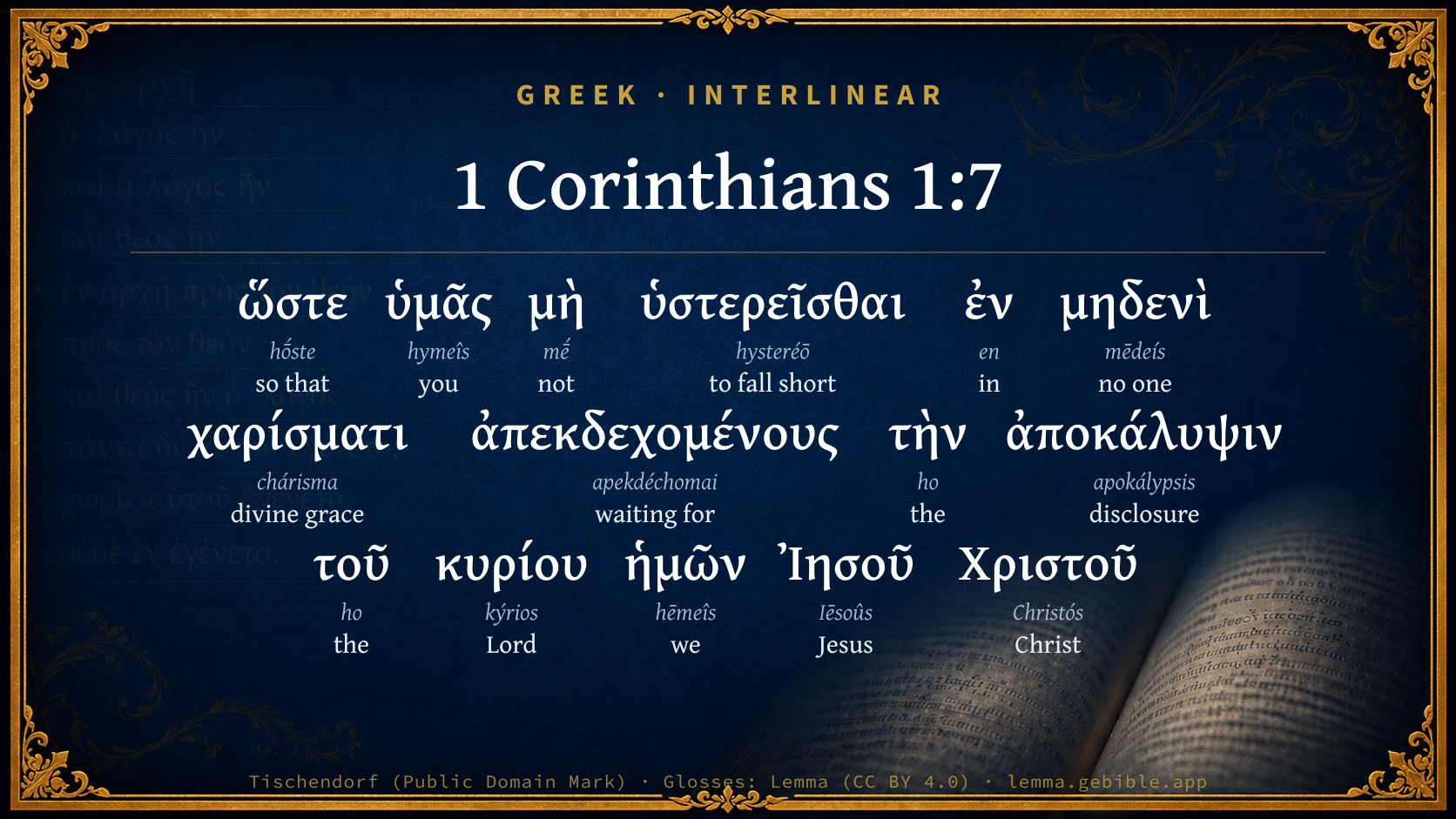
  1. ὥστε hṓste G5620 “so that” Conjunction
  2. ὑμᾶς hymeîs G5210 “you” Personal pronoun, 2nd person, Accusative, Plural
  3. μὴ mḗ G3361 “not” Particle, Negative
  4. ὑστερεῖσθαι hysteréō G5302 “to fall short” Verb, Present, Passive, Infinitive
  5. ἐν en G1722 “in” Preposition
  6. μηδενὶ mēdeís G3367 “no one” Adjective, Dative, Singular, Neuter, Negative
  7. χαρίσματι chárisma G5486 “divine grace” Noun, Dative, Singular, Neuter
  8. τὴν ho G3588 “the” Article, Accusative, Singular, Feminine
  9. ἀποκάλυψιν apokálypsis G602 “disclosure” Noun, Accusative, Singular, Feminine
  10. τοῦ ho G3588 “the” Article, Genitive, Singular, Masculine
  11. κυρίου kýrios G2962 “Lord” Noun, Genitive, Singular, Masculine
  12. ἡμῶν hēmeîs G2249 “we” Personal pronoun, 1st person, Genitive, Plural
  13. Ἰησοῦ Iēsoûs G2424 “Jesus” Noun, Genitive, Singular, Masculine
  14. Χριστοῦ Christós G5547 “Christ” Noun, Genitive, Singular, Masculine

About this verse

These counts appear in no published source. They are computed here, from the morphology-tagged text and Lemma’s own curated glosses. What Lemma adds →

15
words
14
distinct lemmas
Pauline Epistles
section

Notable vocabulary

The rarest word here is ἀπεκδεχομένους waiting for G553 — appearing just 8 times in the whole Greek New Testament.

Shared distinctive vocabulary

ἀπεκδεχομένους waiting for G553 occurs in 8 verses of the Greek New Testament. Also found in:

Repetition

A word recurs within this verse:

Cross-references

23

Topical passages linked to 1 Corinthians 1:7 in the Treasury of Scripture Knowledge — connected by theme and wording, ordered by reader-vote popularity; previews shown in the World English Bible.

  • Philippians 3:20 For our citizenship is in heaven, from where we also wait for a Savior, the Lord Jesus Christ;
  • 2 Peter 3:12 looking for and earnestly desiring the coming of the day of God, by reason of which the heavens being on fire will be dissolved, and the elements will melt with fervent heat?
  • Hebrews 9:28 so Christ also, having been once offered to bear the sins of many, will appear a second time, without sin, to those who are eagerly waiting for him for salvation.
  • 1 John 3:2 Beloved, now we are children of God, and it is not yet revealed what we will be. But we know that, when he is revealed, we will be like him; for we will see him just as he is.
  • Luke 17:30 It will be the same way in the day that the Son of Man is revealed.
  • Romans 8:19 For the creation waits with eager expectation for the children of God to be revealed.
  • Titus 2:13 looking for the blessed hope and appearing of the glory of our great God and Savior, Jesus Christ;
  • 1 Peter 4:13 But because you are partakers of Christ's sufferings, rejoice; that at the revelation of his glory also you may rejoice with exceeding joy.
  • Jude 1:21 Keep yourselves in the love of God, looking for the mercy of our Lord Jesus Christ to eternal life.
  • Hebrews 10:36–37 For you need endurance so that, having done the will of God, you may receive the promise.
  • James 5:7–8 Be patient therefore, brothers, until the coming of the Lord. Behold, the farmer waits for the precious fruit of the earth, being patient over it, until it receives the early and late rain.
  • 1 Peter 1:13 Therefore, prepare your minds for action, be sober and set your hope fully on the grace that will be brought to you at the revelation of Jesus Christ--
  • 1 Peter 5:4 When the chief Shepherd is revealed, you will receive the crown of glory that doesn't fade away.
  • Genesis 49:18 I have waited for your salvation, Yahweh.
  • Matthew 25:1 "Then the Kingdom of Heaven will be like ten virgins, who took their lamps, and went out to meet the bridegroom.
  • Luke 12:36 Be like men watching for their lord, when he returns from the marriage feast; that, when he comes and knocks, they may immediately open to him.
  • 2 Corinthians 12:13 For what is there in which you were made inferior to the rest of the assemblies, unless it is that I myself was not a burden to you? Forgive me this wrong.
  • Colossians 3:4 When Christ, our life, is revealed, then you will also be revealed with him in glory.
  • 1 Thessalonians 1:10 and to wait for his Son from heaven, whom he raised from the dead-- Jesus, who delivers us from the wrath to come.
  • 2 Thessalonians 1:7 and to give relief to you that are afflicted with us, when the Lord Jesus is revealed from heaven with his mighty angels in flaming fire,
  • 1 Timothy 6:14–15 that you keep the commandment without spot, blameless, until the appearing of our Lord Jesus Christ;
  • 2 Timothy 4:8 From now on, there is stored up for me the crown of righteousness, which the Lord, the righteous judge, will give to me on that day; and not to me only, but also to all those who have loved his appearing.
  • 1 Corinthians 4:5 Therefore judge nothing before the time, until the Lord comes, who will both bring to light the hidden things of darkness, and reveal the counsels of the hearts. Then each man will get his praise from God.

Cross-references courtesy of OpenBible.info (CC BY 4.0).

Commentary

Notes on 1 Corinthians 1:7 from classic Christian and Jewish commentators (each source and its license shown beneath its notes). The classic Christian expositions comment on the surrounding passage and are grouped to its opening verse, so a note may address several verses; the Jewish commentaries on the Tanakh (Rashi and others) are per-verse, so they appear only where the commentator wrote on this verse.

Lemma curates 59 commentaries, every one of them public domain or Creative Commons licensed, each selected and text-cleaned for this edition rather than reprinted as found. About our sources →

The Cambridge Bible for Schools and Colleges

gen. ed. J. J. S. Perowne

7. come behind] should rather be translated fall short. No comparison with other Churches seems to have been intended.

the coming of our Lord Jesus Christ] The word in the original and in the margin of the English version is revelation. But this is not always equivalent to coming. The ‘revelation of Jesus Christ’ unquestionably means (1) the Last Day in such passages as 2Th_1:7 and 1Pe_1:7, and the same is the case with St Luk_17:30. But on the other hand, in passages such as 2Co_12:1; Gal_1:12; Gal_1:16; Gal_2:2, it means (2) the fuller revelation of the mysteries of God’s kingdom; while in Rev_1:1, it signifies (3) the unfolding of things to come. The second of these three meanings would seem most appropriate here. The testimony of Christ, confirmed originally by the inward witness of the Spirit, receives additional confirmation by the gradual unfolding of things Divine, until the believer, fully grounded in the faith, stands without reproach before Christ at His coming.

The Cambridge Bible for Schools and Colleges (gen. ed. J. J. S. Perowne; Cambridge University Press, 1878–1918) — public domain. Text from a community e-Sword module.

The Biblical Illustrator

Joseph S. Exell

1Co_1:7-8

So that ye come behind in no gift.

Gift

This word plays a large part in this Epistle. As the form of the Greek indicates, it denotes in general every concrete product in which grace is embodied. The various powers, which so often in St. Pauls writings bear the name of χάρισματα, are certainly the effects of the supernatural life due to faith in Christ; but they fit in, notwithstanding, to pre-existing natural aptitudes in individuals and peoples. The Holy Spirit does not substitute Himself for the human soul; He sanctifies it and consecrates its innate talents to the service of the work of salvation. By this new direction He purifies them and exalts them, and enables them to reach their perfect development. This was what had taken place at Corinth, and it was thus especially that the apostolic testimony had been divinely confirmed in the Church. We see how Paul still carefully avoids (as in 1Co_1:5) speaking of the moral fruits of the gospel, for this was the very respect in which there was a grave deficiency at Corinth. (Prof. Godet.)

Gifts and graces

Gifts show what a man has; graces, what he is.

Gifts and prayer

In mining operations, the full and empty carriages or vessels being connected together, those which have been emptied are from time to time raised up the ascent by the descending of those that have been filled. In this way let the descent of Gods mercies and the gifts bestowed out of His fulness raise your empty vessels to receive again and again from His inexhaustible treasury all that you need. (R. Bickersteth.)

Waiting for the coming of our Lord Jesus Christ.

Waiting for the coming of the Lord

I. The object of expectation to all true believers. The coming of our Lord Jesus Christ. It should rather have been rendered, the discovery or manifestation of our Lord Jesus Christ. The primary idea is that of stripping off a garment, rolling away a curtain, or removing a screen; and under whichever of these aspects we contemplate the image depicted by the apostle, it will come home with equal power to our own consciousness of frailty, our own liability to death. Practically, that moment will be to us the manifestation of Christ as Judge, which shall strip off this garment of mortality, roll away the dark curtain of the grave, and remove the screen which divides us from the invisible world. The believer does not, like one conscious of unacknowledged and unrepented sin, start back from judgment with apprehension and alarm. It is not a Judge who will be manifested to his spiritual view, arrayed in lightnings and attended by ministers of wrath--it is not such a Judge, but our Lord Jesus Christ: yea, he can even say, with all the confiding appropriation of the Apostle Paul, Christ Jesus, my Lord, the excellency of whose knowledge is life eternal, and in whom I desire to be found, not having mine own righteousness, which is of the law, but that which is through the faith of Christ, the righteousness which is of God by faith.

II. The mode of so preparing for the coming or manifestation of Christ Jesus, that it shall be, not the apprehension of impending evil, but the expectancy of certain and enduring good. The apostle speaks of God confirming these Corinthians unto the end. Confirming them, you will ask, in what? The reference is to the fourth verse, in which St. Paul speaks, first, of the producing cause, in which alone preparation had commenced or could commence, even the grace which had been given through Jesus Christ; and afterwards of the effect which had been produced thereby--that they were enriched in all utterance and in all knowledge; in which utterance, being the declaration of a good confession--and in which knowledge, being that which is to life eternal--he desires that through the same grace, and by the same power, they may he confirmed.

III. The consequence of being thus prepared by grace and confirmed of God unto the end: viz., that we shall be found blameless in the day of Jesus Christ. This word blameless is strictly a forensic term, applicable to the trial of the soul in the high court of heaven, and by God, the Judge of all. Whatever may be the discoveries of the last day, or to whomsoever made, of one thing we are certain, beyond all fear of a contingency, there is no condemnation to them that are in Christ Jesus. (T. Dale, M. A.)

Waiting

1. We are all doing this in one way or another. Some watchful and faithful at our post, in the midst of a wicked world, like the sentry who died on guard in sinful Pompeii; some in slothful forgetfulness, like the foolish virgins; others in abject fear, like condemned criminals who wait the coming of the executioner; many, I trust, with patience, and hope, and peace.

2. Waiting is very hard work, far harder than doing. Waiting too for uncertainties, and better times which may never come; hoping against hope, with that hope deferred which maketh the heart sick, is one of the hardest of the tasks which we have to do. Waiting for the Lord Jesus Christ is also hard work, because of the sin which is in us and around us, but it is not hopeless or doubtful. In due time we shall reap if we faint not.

3. How may we best wait for this?

4. Though we are waiting for the coming of the Lord Jesus, He is in a sense always with us.

5. We must wait for our Lords coming with our armour girded on and in the front of the battle. (H. J. W. Buxton, M. A.)

The coming of Christ

When we expect any one we turn our eyes that way, as the wife looks towards the sea when she expects her husbands return. Surely, then, if we look for Christ to come we shall keep our eyes heavenward, and our minds occupied with the country from which He cometh.

Christs second coming

We are not afraid to go alone on a journey to a strange place when we are sure that a friend will meet us at the end of the journey. The husband in a distant city telegraphs to his wife to come to him, and he will be at the station to receive her.

Faith and preparation as to the second coming of Christ

The coming of Christ literally refers to His appearing at the last day, but in its substantial meaning, and as to all its practical effects, it may be considered as equivalent to our death, because there not only is our future condition determined, but we enter into that scene in which His award shall fix us when He pronounces our final sentence. Let us, then, consider what is implied in the Christians waiting for the coming of our Lord Jesus Christ.

I. A firm conviction that Christ will come. In any other state of mind the term waiting would be inapplicable. And, indeed, the second coming of Christ forms a part of the deliberate and cherished creed of every true disciple. It is not a mere speculation indulged in because it is agreeable; a conjecture suggested by appearances, and adhered to as being probable and useful; the result of a process of reasoning, liable to errors and doubts; it is a point of settled belief, which the Christian maintains because it is founded on the testimony of Him who is equally omniscient and true. It is the subject of a Divine prediction, of a Divine promise, of a Divine assurance; and therefore we cannot withhold our full assent to it without impeaching the absolute perfection of that absolutely perfect Being by whom it has been attested. And remember that it is not set down merely as one of a multitude of events which will happen, but as a constituent portion of that scheme which the Son of God undertook to execute as the Redeemer of sinful men. Christ was once offered to bear the sins of many, and unto them who look for Him Christ will appear the second time, without sin, unto salvation.

II. That this event is the subject of habitual thought and contemplation. How, indeed, can it be otherwise, seeing it is so true and so important in His regard? Were it a merely probable circumstance, a fact of little interest, or nothing more than a dry abstract truth, the mind of the Christian could not entertain it with much cordiality, or look forward to the period of its being realised with any intensity of feeling. But how differently must he be affected towards it, when he considers its indubitable certainty--the touching concerns which it involves--the various attractions which it presents in its every aspect--and the bearing which it has on all that he now is, and all that he is to be for ever!

III. A diligent and faithful preparation for it. Unless we had this preparation, we could not with any propriety be said to wait for Christs coming, because, if unprepared for His coming, it would be an event to be feared and deprecated. Christ will come for two purposes: to reward His people and to punish His enemies. But if we are among the number of His enemies, then, when He comes, we must suffer the condemnation which He has threatened against all those who have refused or neglected to become what He required them to be. Those who wait for His coming, and are prepared for that event, are--

1. Believers. Relying on Christ in the exercise of a true faith, we may wait for His coming, because His merit, appropriated by that faith, has cancelled our guilt, the prevalence of which would have made His coming terrible, and has obtained for us a title to the celestial kingdom, which we never could have entered through any doings or deservings of our own.

2. Saints--holy persons. When Christ comes it is to conduct His people to their reward. But how can He take us into His Fathers house, if our principles and dispositions and habits are all in irreconcilable hostility to the exercises and enjoyments of that blessed abode? Nothing that defileth can enter into the New Jerusalem.

IV. A decided and ardent desire for it. The feeling is dictated by all our present experience, and by all our future prospects. There are evils from which that event alone can emancipate us, and there are enjoyments to which that event alone can introduce us. And if it be a right thing to wish for deliverance from the one, and for the attainment of the other, then it is right to wish for the second advent of Christ, because that is identified with both advantages.

1. Here you are subject to disease--to its pain, and its languishing, and its mortal issue. But when your Saviour comes He will put upon you the crown of life, and you shall neither sicken, nor suffer, nor die any more.

2. Here your reputation may be wounded from ignorance, envy, prejudice, or malevolence. But when your Saviour comes He will place you among those whom God hath justified, and whom no man can condemn--in whose society calumny cannot reach you, and reproach cannot hurt you.

3. Here you may have to struggle with the numerous ills and hardships of poverty. But when your Saviour comes you shall have no wants which He will not supply with inexhaustible abundance.

4. Here your cherished friends may betray you when you are most confiding, and those who were dear to you as your own soul may be torn from your embrace by the relentless hand of death. But when your Saviour comes He will wind up this scene of trial, and will take you where ingratitude and treachery and dissolution shall be unknown.

5. Here you have the plague of sin to trouble and torment you. But when your Saviour comes He will place you where you shall be beyond the reach of temptation, and beyond the fear and the capacity of transgressing.

6. Here your eye and your heart are often pained by the sight of abounding iniquity. But when your Saviour comes He will conduct you into a region as pure as it is happy.

7. Here your best services and highest attainments are mixed with much imperfection and weakness. But when your Saviour comes He will make you perfect, even as your Father in heaven is perfect.

8. Here all your enjoyments, however exquisite, multiplied, and prolonged, are but mingled at the best, and soon over. But when your Saviour comes He will impart to you a happiness immortal as the souls that are to enjoy it--as the uncreated source from which it is to flow.

9. Here it is a trial to your patience that the Cross of Christ should be such a rock of offence, and that He who bore its agony and its shame should be despised and rejected of men. But when your Saviour comes His enemies will be destroyed, the numberless trophies of His humiliation and His blood will be assembled to honour Him, and all the hosts of heaven will unite with all the redeemed from the earth, to ascribe to Him the blessing, and dominion, which He had so richly won.

V. The exercise of patience and resignation. Submission to the Divine arrangements is a necessary part of the Christian character, and particularly in this regard. You should wait for Christs second coming with patience, because--

1. The period of that coming is fixed by Gods appointment. It is a part of the plan which He has formed for your salvation. It originates in the same mercy which prompted Him to give up His Son to suffering and to death for you. And does not every view of the Divine perfections constrain you to acquiesce in all that has been fixed as to the second coming, as well as in all that took place with regard to the first coming of Christ?

2. It is conducive to your own improvement and advantage. The present is a scene of preparation for the future. Every temptation that you successfully resist; every obligation that you faithfully fulfil; every trial to which you patiently submit; every step that you advance in the career of godliness and virtue; every victory that you achieve over the devil, the world, and the flesh, by that faith and patience which characterisc the saints of God upon earth, will put a loftier note in your song of praise, and add another gem to your crown of righteousness and glory in heaven. Seeing, then, that your continual stay here is conducive to your everlasting benefit, let not your souls be cast down, and let not their desires for deliverance overstep the limits of devout resignation to the will of Him who has arranged your lot in this world with a view to your destiny beyond it, and whose redeeming mercy will lead Him to make all things work together for your good.

3. It is for the advantage of your brethren and fellow men. This was one of Pauls motives, when amidst his longings to depart and to be with Christ, he was still contented to remain where the great Head of the Church had ordained him to labour. Nevertheless, said he, to abide in the flesh is more needful for you. (A. Thomson, D. D.)

The uncertainty of Christs coming

This blending of light and obscurity--

I. Leaves us in a state more suitable and more profitable than either absolute ignorance or perfect knowledge.

1. It awakens feelings which the former would fail to excite, and which--

2. The latter would quench as they arose.

II. It is specially adapted to keep alive expectation, by bringing emphatically before us the perpetual possibility of an immediate manifestation. It keeps us in a state of--

1. Lively hope;

2. Watchfulness;

3. Humility;

4. Fidelity;

5. Earnest inquiry after truth;

6. Reverence and dread. (W. A. Butler, M. A.)

The revelation of Jesus Christ

This revelation would do two things--

I. Confirm them unto the end (1Co_1:8). All is well that ends well. The end of the Christian will confirm the wisdom of his choosing such an end. Hence the end of a thing is better than the beginning. The world calls him a fool; the day of Christ will confirm his wisdom. The world calls him ignoble; the day of Christ will confirm his pretensions to greatness and glory. The world calls him poor; the day of Christ will confirm his claims to an inheritance incorruptible, &c. We are now confirming the testimony of Christ, and proving Him true (1Co_1:6). In that day Christ will confirm our testimony, and prove us true. It will be the manifestation of the sons of God.

II. Make them blameless. Then all imperfections will end. Sins damp mists will no longer rise to obscure the moral heavens. Lessons:

1. Encouragement to the faithful worker.

2. Confidence. Do circumstances look discouraging in your labours of love? Do long-looked-for wants tarry? Do the desired clouds refuse to break in blessings on the parched heart? Have faith. The blessing will come, though it tarry, for God is faithful, &c. (1Co_1:9). He will keep His promises, &c.

3. Stimulus. The coming of the Lord Jesus Christ will be a revelation of unrecognised or undeveloped gifts. Therefore come behind in no gift, &c. When that day dawns, the grand confirmation service will be held--confirming the good and the bad alike. (The Study.)

Who shall also confirm you unto the end.

The Christians strength

The writings of St. Paul contain frequent assurances to the converts of the continuance and increase of Gods blessing and the grace of Christ, and of strength to support them under their trials, to carry them through their difficulties, and to make them more than conquerors through Him who loved them (Rom_8:37; Php_1:6; Rom_8:31-32; Rom_8:38-39; 1Co_1:4, &c.). In what sense, and with what necessary restrictions, are such promises as these always to be understood? It is manifest, both from the reason of things and from Holy Writ, that some spiritual blessings are so entirely the work of God, that, when considered in themselves, it is impossible that man can contribute to them, or bear any part in their completion. Thus, forgiveness of sins; adoption into Gods family; a resurrection from the dead; and the gift of eternal life; though they suppose due preparations in man, repentance, faith, hope, charity, fixed purposes of obedience, and patient continuance in well-doing are in themselves the absolute gifts of God, simple in their nature, and, as far as we can perceive, admitting of no addition nor decrease. But there are other blessings or endowments, implying increase and variety, in the advancement of which man must bear his part, and work with God. Such are those graces which qualify the human soul for pardon, and peace, and everlasting glory; which are the rudiments or first principles of the heavenly character. For these set out, for the most part, from small and often imperceptible beginnings, and are strengthened and ripened into habits by exercise and godly discipline. When, therefore, St. Paul assures the converts that God will confirm them unto the end, that they may be blameless in the day of our Lord Jesus Christ, he does not comfort them with an assurance of support, divorced from all conditions and contingencies; nor does he lead us to believe that there are any particular persons whom God will at all events endow with an unfailing perseverance. Since, therefore, faith is spoken of in Scripture sometimes as Gods gift, sometimes as mans duty, it is manifest that the gift and the duty mutually imply each other. On the one hand, our faith can neither begin nor continue, nor be perfected, without Gods grace and blessing. On the other hand, we have no ground for supposing that He will confirm our faith until the end, unless we endeavour to hold fast our own faith, to improve it by acts of piety and obedience, and to abound in it more and more. Man is, of himself, strongly inclined to evil: he has a sinful nature stirring within him: his passions are continually provoking him to transgress the restraints of conscience and reason, and the laws revealed to him by his God. God, therefore, who well knows his indisposition to bear up against the power of corruption, mercifully promises to take him in hand, to discipline his imagination and affections (Eze_36:26; Deu_30:6). But though God thus promises to circumcise the hearts of His people, and to subdue them to His own purposes, in other passages of Holy Writ He calls upon them to circumcise their own hearts, and to master and mortify themselves (Deu_10:16, Jer_4:4; Eph_4:22; Col_3:5-6). But in order to complete the Christian character, man stands in need of continual improvement in righteousness and true holiness, the daily renewal of his mind, and confirmed habits of piety and obedience. But since, when unassisted, he has no power in himself to help himself, and is, at the best, a mere beginner in the trade of virtue, God has graciously promised to renew and to supply him with spiritual sufficiency (Eze_11:19-20; Eze_36:26-27). Yet these promises of grace and spiritual succour are accompanied with earnest exhortations to the performance of our duty, and pressing calls upon us to do that for ourselves which God has, in some sort, engaged to do for us (Eze_18:31; Eph_4:23-24). Hence it follows that Gods promises of help to perfect our inner man, require diligence and exertion on our part; that our prayers for renewal will bring no blessing with them, if we do not endeavour to renew the spirit of our own minds; and that it is worse than idle to presume that God will not leave nor forsake us, if we shrink from our duty, and leave and forsake ourselves (Eph_5:1; Col_3:14-15). I shall lay down a few practical lessons which the consideration of this subject naturally suggests.

1. You should make it your business to study the whole of Gods Word, and, as far as you are able, to compare and combine its contents; and you must not accustom yourselves to dwell on the particular parts of it to the exclusion of other portions which require an equal degree of consideration and deference.

2. You will learn from those statements of the scriptural doctrine which have been laid before you, the folly and presumption of relying on Gods goodness, and the grace and promises of Christ, without the exercise, on your own part, of religious labour and spiritual industry.

3. Whatever measure of religious industry you may exert, whatever progress you may make in the improvement of your souls and the reformation of your hearts and habits, still remember that you owe everything to God; that you are yourselves inclined to evil, and that it is your bounden duty to refer back all holy desires, good counsels, and just works to the Author and Giver of all goodness. (Bp. Bethel.)

Confirming grace

I. What does it include?--Confirmation.

1. In faith, holiness, love.

2. Unto the end.

II. How is it effected?

1. By Christ.

2. Through the means of grace.

III. Why is it so necessary?

1. That ye may be blameless.

2. In the day of Christ. (J. Lyth, D. D.)

Firm to the end

Steadfastness is one of the most important characteristics of a Christian. What are love, self-denial, patience, and faith without it? It is not the best regiment which makes the most headlong charge, but which can stand firm. The Spartans were forbidden by their laws to flee. In the Pass of Thermopylae stands a monument to Leonidas and his followers, bearing this inscription--Go, stranger, and tell at Lacedaemon that we died here in obedience to our laws. What we want, as soldiers of Christ, is not so much zeal, or enthusiasm, or outward profession, as firmness to the end, steadfastness to die, if need be, for the laws of our God. We find plenty of zealous professors, but after a time the fire dies out into dead ashes; they have no staying power. Note--

I. Some of the dangers of the Church now.

1. The restless spirit of the age. This is the result of various causes.

(1) The spread of education. Men are taught to cultivate their heads at the price of their hearts.

(2) The growth of cheap literature. The fact is, some of us in these days are getting too clever. We have got a few drops of learning, and we fancy that we can pour the whole ocean of knowledge into our poor little bottle. True education makes us humble, because it shows us our ignorance. What are the doubters and the unbelievers going to give you in exchange for what they rob you of? They can take away the Saviour, and only leave you your sins. They may scoff you out of believing in the resurrection. But can they laugh you out of believing in death?

2. A constant desire for something new, and, if possible, sensational. And, above all, these people want a religion made easy. They have no objection to being saved provided that the process is quick and cheap. They turn away from the thought of self-denial, &c.; they must be made good all at once. Beware of this mushroom religion; the best fruit is not that which ripens most quickly, and the best Christian certainly does not come to maturity all in a moment. The Persian fable tells us how a gourd wound itself round a lofty palm-tree, and in a few weeks climbed to its very top. The gourd asked the palm-tree its age, and the tree answered, An hundred years. Then the gourd answered boastingly that it had grown as tall as the palm in fewer days than the tree could count years. True, answered the palm-tree, every summer has a gourd climbed round me, as proud as thou art, and as short-lived as thou wilt be.

3. This is a specially busy age. Every walk of life is crowded, and competition is most keen. Now there is great danger in all this to a mans spiritual life, if he has not God with him in his work. He will become selfish and unscrupulous.

II. The means by which Christ will confirm you unto the end. (H. J. W. Buxton, M. A.)

Blameless in the day of … Christ.--

Unimpeached

So as to be unimpeached in the day of our Lord; for when the saints stand before the tribunal of Christ, they will not indeed be found to have been free from sin in their earthly life, but having persevered in the faith and in good works will find themselves under the wing and shelter of Gods righteousness, safe from all impeachment. Unimpeached of whom? Probably of the accuser of the brethren, the adversary Satan. But being found holy in Christ and blameless to God, who shall then lay an impeachment against Gods elect? It is God that justifieth (Col_1:22-23). (Canon Evans.)

Eternal blamelessness

I. Judicial. The word used here is the judicial one. A Christian is one against whom there is not only no condemnation, but no accusation. He is a sinner, yet no man, nor angel, nor devil, may accuse him, or mention his guilt to God.

II. Priestly. I might call it sacrificial. The word used in such places as Eph_1:4 is the same as that in 1Pe_1:19, the Lamb without blemish, and without spot. This unblemishedness has special reference to our fitness for worship and service.

III. Personal (Php_2:15; 1Th_3:13). We are forgiven and delivered from wrath that we may be personally holy; holy in heart and life; saved from sin, conformed to Christ. Holiness is to be everywhere in and about the man. If, then, you call yourself a Christian, consider how much is expected from you. Consider--

1. Your names. They are saint, Christian, redeemed from among men, follower of the Lamb. Do not these call you to blamelessness?

2. Your designations. You are the lights of the world, the salt of the earth; pilgrims, strangers, virgins, cross-bearers, kings and priests; a temple, a habitation of God.

3. Your calling. You are called to glory, honour, and immortality.

4. Your hopes.

5. Your companionships. They are all heavenly and pure. Old friendships are severed, and new ones formed. If you are Christians, then, be consistent. Be Christians out and out; Christians every hour, in every part, and in every matter. Beware of half-hearted discipleship. (H. Bonar, D. D.)

The Biblical Illustrator, edited by Joseph S. Exell (c. 1880s–1900s) — public domain. Text from a community e-Sword module.

The Pulpit Commentary

So that ye come behind in no gift. The "gifts" are here the charismata, graces, such as powers of healing, etc., which were the result of the outpouring of the Spirit. The sequel shows that they were rather outward than inward; they were splendid endowments rather than spiritual fruits. Yet even these were not wholly wanting, as we see from 2Co_8:7. The Greek may also mean "causing you not to be conscious of inferiority." Waiting; expecting, not fearing it, This was the constant attitude of the early Christians. (Rom_8:19-25; Php_3:20; Heb_9:20; 1Th_1:10; Col_3:4; Tit_2:13) Love for Christ"s manifestation was a Christian characteristic. (2Ti_4:8) The revelation. Three words are used to express the second advent: apokalypsis (as here and in; 2Th_1:7 1Pe_1:7, 1Pe_1:13) parousia (as in Mat_24:3, Mat_24:27, 1Th_2:19; Jam_5:7, Jam_5:8, etc.) and epiphaneia, in the pastoral Epistles (1Ti_6:14; 2Ti_1:10 2Ti_4:1-8; Tit_2:13) St. Paul, however, only uses parousia six times in 1 and 2 Thessalonians, and once in 1Co_15:23. All Christians alike expected the return of Christ very soon, and possibly in their own lifetime (1Th_1:9, 1Th_1:10, etc.; 1Co_15:51; Jam_5:8, 9 1Pe_4:7; 1Jn_2:18; Rev_22:20, etc.) Their expectation was founded on the great eschatological discourse of our Lord, (Mat_24:29, Mat_24:30, Mat_24:34) and on his express promise that that generation should not pass away before his predictions were fulfilled. They were fulfilled in the fall of Jerusalem and the close of the old dispensation, though they await a stilt more universal fulfilment.

HOMILIES BY D. FRASER

The patience of hope.

for the revelation of our Lord Jesus Christ." Old Testament worthies waited for the advent of Messiah and the consolation of Israel. New Testament saints wait for the second coming of the Lord, the completion of the Church in holiness, and its entrance into his glory at his appearing. They already possess Christ by faith. He answers for them in order to their justification, and he dwells in them in order to their sanctification. They love him as their Saviour unseen, and therefore they long to see him as he is. Men who are afraid of judgment hope for acquittal; men who are weary and worn hope for rest; men whose earthly course has been disappointing hope for a better world; but none of these wishes or expectations come up to the blessed hope which is distinctively Christian. We look for the Saviour. We wait for the apocalypse of our Lord.

I THE GROUND ON WHICH WE CHERISH THIS EXPECTATION. It is simply the word of promise. In parables, and in plain statements also, Jesus Christ assured his disciples that he would return in an unexpected hour. At his ascension the heavenly messengers, "men in white apparel," said explicitly to the "men of Galilee" that "this Jesus" would return from heaven. Accordingly the apostles infused this hope into the early Church; all the Epistles refer to it; and the last book of the Bible closes with a repetition of the Lord"s promise: "Behold, I come quickly;" and the response of the Church: "Even so, come, Lord Jesus!" We do not entertain any question of probability. For Christians the matter rests on a sure word of prophecy and promise, pledging the truth of the Son of God. If any persons are capable of believing that the Son of God spoke at random or kindled by his words expectations that are never to be fulfilled, we cannot prove to them that Christ will come again. But all who reverence him as One in whose mouth no guile was ever found, are bound to believe that he will be revealed in his glory; and all who love him will look for his appearing.

II REASONS FOR OUR WAITING FOR THE LORD.

1. "We see not yet all things put under him," and we long to do so. Promises of universal sovereignty and honour made to Christ in the Psalms

2. wait for fulfilment. Prayers of many generations made "for him" as well as through him, wait for the answer. Therefore the Church, believing the promises and continuing the prayers, above all, loving him to whom such things are promised and the ardour of such prayers is devoted, cannot but wait for the Lord as night watchers wait for the morning. Ever since the Ascension, Christ has had, by appointment of the Father "all authority in heaven and earth." The glory in heaven is hidden from us, but all may see that since the day of his ascension his Name has been rising continually above all other names known to mankind, and has so extended the area of its fame and influence that it is beyond question the mightiest name upon earth. Still Christ has many enemies. They are not yet made "his foot stool." And many of those who are called Christians are at heart indifferent to his cause, disobedient to his Word, apathetic about his kingdom and glory. Then the tribes and nations of the earth do not to any appreciable extent, even in Christendom, acknowledge or serve the Lord Jesus; and there are vast populations that have scarcely heard his Name. Even in our own country, one is struck with the avoidance of any express mention of him who is Lord of all, as Lord over us. In public documents, expressive of the national mind and will, there may be reference to "Almighty God," and to a superintending Providence cold phrases of theism; but there is an apparent reluctance to name the Lord Jesus Christ, and to own submission to his Word. This is grievous to those who love him and know that he is the sole sufficient Healer of mankind. They take their part zealously in all movements to check injustice, to stay the foetid streams of vice, to relieve misery, and to spread virtue and peace; but they lament that Christ is so little sought and honoured in the efforts of philanthropy, and they often cry to him in their struggle, "Lord, how long? When wilt thou return from the far country? When wilt thou take thy great power, and reign?

1. We have such correspondence now with the unseen Saviour as makes us long for his bright presence. It is not fair or reasonable to put the revelation of Christ to us now by the Holy Spirit against the personal revelation to his saints at his second coming, and to ask which of them is the more to be desired. Each is to be desired in its season, and the first whets the longing for the second. If I have had pleasant and profitable correspondence for years with one whom I have not seen, but who is known to me by his wisdom and kindness; if he has done me more good than all the men whom I have seen, taught me, helped me, and stamped the impression of himself on my mind and heart; do I not long to see him face to face, and eagerly wait for a day when I may be nearer to him who has become indispensable to me, the very life of my life? Surely it is so between Christians and Christ.

2. They have heard his words, received his Spirit, had much correspondence with him in prayer and the Lord"s Supper, got much help from him in time of need. Though unseen, he has been far more to them than all the teachers and friends whom they have seen; and for that very reason they long to behold him. Their hearts can never be quite satisfied till they see the Lord.

3. We are weary of ourselves and ashamed of our faults, and therefore long to be perfected at his coming. It is true that the life of faith has deep wells of comfort, and Christians ought to be happy. It is also true that the abiding Spirit of Christ is able to keep his servants from sin, and to sustain them in a course of holy obedience. But it is useless to dispute the fact that we are all imperfect in character and faulty in service. We fall short of our best aims, blunder in our well doing, spoil much good by faults of temper and even of manner, and are unprofitable servants. The best Christians, in whom perhaps we see no blemish, see in themselves sin and imperfection to the last. Now, we make no excuse for fault m inconsistency. We maintain that honest servants of Jesus Christ will aim daily and prayerfully at amendment, and endeavour to walk more closely with God. Still, there will always be some defect till the servants see their Lord. It is his coming that will give the signal for the perfecting of his people, and their complete transformation into his likeness. Such is the doctrine often taught by the Apostle Paul: "Unreprovable in the day of our Lord Jesus Christ" (ver. 8); "Unblamable in holiness before our God and Father at the coming of our Lord Jesus with all his saints"; (1Th_3:13) "Without blame at the coming of our Lord Jesus Christ". (1Th_5:23) There may here be added the prospect of the Lord"s kind approval of diligent though imperfect service rendered to him, for which he will award a kingly recompense. But we do not much dwell on this, because the thought of getting anything from the King is not so dear to those who love him as the expectation of being made like him, purified as he is pure. Therefore the intense longing of the saints for the revelation of our Lord Jesus.

(1) Watch and be sober. Extravagance of mind, glorying in the flesh, indulgence of inordinate desire, are not becoming in men who wait for the Lord. Be temperate in all things.

(2) Watch and pray. Ask God to help your infirmities, and to deliver you from the spirit of slumber. Your lamps will not go out so long as you pray; for then you have a continual supply of oil.

(3) Watch and work. The Lord followed up the parable of the waiting virgins with that of the trading servants. Blessed is the faithful and wise servant whom the Lord, when he comes, shall find doing the work assigned to him. The Master bids us not "prepare for death," as so many put it, but prepare to render account of our service to him at his return. Alas for the wicked and slothful servants in that day! F.

Vers. 7-9.

Christ coming, and Christ here.

The early Church conceived that the Lord Jesus Christ would return, in some material manifestation, during their age. Inquire how far this idea rested on the view they held of Messiah as an earthly Deliverer and Patriot King. Their question, after our Lord"s resurrection, "Wilt thou at this time restore again the kingdom to Israel?" indicated a bias and preoccupation of mind which even their Lord"s ascension did. not correct; and possibly this lingering misconception helped to form the idea of Christ"s speedy second coming. It may be further shown that our Lord"s assurances about his coming again might have been taken literally, though he so carefully sought to impress the spiritual hearing of his promises, and their fulfilment, mainly in the abiding and indwelling of the Holy Ghost. With the conception of this speedy coming of Christ in their minds, the apostles regard the proper attitude of the Christian and the Church as being one of "waiting." Such waiting becomes a virtual "preparing;" it involves a care to have and hold all things ready, and this is a good sign of the faithful and diligent servant. "The attitude of expectation is thought of as the highest that can be attained here by the Christian. It implies a patient, humble spirit, one that is waiting for, one that is looking forward to, something nobler and better." The moral influence of a high and noble expectation may be pointed out. "Where your treasure is, there will your heart be also;" and it is certain that to fitness for it your life and conduct will be moulded. In these verses we find a double thought associated with the Lord"s second coming.

I PAUL"S THOUGHT OF CHRIST"S COMING TO REWARD. As he has been writing of "gifts" and their use in the Church, he must have in mind Christ"s gracious reward of his faithful ones. Reward is proper from one occupying the position of Master. Rewards may be given for work that is far short of perfection, Rewards may be bestowed when no absolute claims can be made for them. Divine rewards can only be gifts of grace. The moral ends to be served by granting rewards are such as God may seek by such means. So it is rational and right that we should still watch, work, and use our gifts, in the full expectation of gracious recognition and reward in due season. Qualify, however, the expectation, by showing that the New Testament strives to impress on us that Divine and future rewards must be spiritual, not material; we are to have crowns, but they are crowns of life, righteousness, and, glory.

II PAUL"S THOUGHT OF CHRIST"S PRESENCE TO CONFIRM. Too much attention to Christ"s coming would lighten the conviction of his real, though spiritual, presence now with the individual and with the Church. That presence Paul conceives as the confirmation, the imspiration, and the security of Christ"s servants. In it they have their only, but their all sufficient, guarantee that, amid. frailties, temptations, and perils, they shall hold out unto the end, attaining unto the coming of the Lord. Either of these thoughts of Christ may prove misleading if it stands alone. Each tempers and qualifies the other. Both together keep us wisely looking down on our work, beside us at our helper, and on to our reward. The thought of "reward makes us wonder how the Divine One will ever be able to testify to our "blamelessness and unreprovableness." Illustrate by David"s appeal to his "integrity." We may be genuine and sincere. A standard of consistency may be pressed on us as Church members; but nothing less than the standard of absolute purity must be pressed, on us as one clay to stand in the presence of the glorified Christ. R.T.

The Pulpit Commentary (1880–1919), ed. H.D.M. Spence-Jones & Joseph S. Exell — public domain. Text from a community e-Sword module.

Scofield Reference Notes

C. I. Scofield

coming

Three words are used in connection with the return of the Lord:

(1) Parousia, "personal presence," also used by Paul of the "coming" of Stephanas 1Co 16:17 of Titus 2Co 7:6; 2Co 7:7 and of his own "coming" to Philippi Php 1:26. The word means simply personal presence, and is used of the return of the Lord as that event relates to the blessing of the saints; 1Co 15:23; 1Th 4:14; 1Th 4:17 and to the destruction of the man of sin 2Th 2:8.

(2) Apokalupsis, "unveiling," "revelation." The use of this word emphasizes the visibility of the Lord’s return. It is used of the Lord 2Th 1:7; 1Pe 1:7; 1Pe 1:13; 1Pe 4:13 of the sons of God in connection with the Lord’s return Rom 8:19 and of the man of sin 2Th 2:3; 2Th 2:6; 2Th 2:8 and always implies visibility.

(3) Epiphaneia, "appearing," trans. "brightness" 2Th 2:8 A.V.; "manifestation," R.V.), and means simply an appearing. It is used of both advents.; 2Ti 1:10; 2Th 2:8; 1Ti 6:14; 2Ti 4:1; 2Ti 4:8; Tit 2:13.

coming (Greek - revelation, unveiling).

The Scofield Reference Bible (1917 edition), notes by C. I. Scofield — public domain. Text from a community e-Sword module.

Tyndale Open Study Notes

Tyndale Open Resources

1:7 every spiritual gift: See 12:8-10, 28.

Tyndale Open Study Notes — © Tyndale Open Resources, licensed CC BY-SA 4.0. Text via the HelloAO Bible API.

Bengel's Gnomon

Johann Albrecht Bengel

1Co 1:7. Ὥστε ὑμᾶς μὴ ὑστερεῖσθαι, So that ye are not behind) This clause depends on ye are enriched by antithesis.—ἀπεκδεχομένους, expecting, [waiting for]) The character of the true or false Christian is either to expect or dread the revelation of Christ. [Leaving to others their MEMENTO MORI, do thou urge this joyful expectation.—V. g.].

Bengel's Gnomon of the New Testament — English translation (T&T Clark, Edinburgh, 1860) — public domain. Text from a community e-Sword module.

Meyer's Critical & Exegetical Commentary

Heinrich August Wilhelm Meyer

1Co_1:7. Result of τὸ μαρτ. τ. Χ. ἐβεβ. ἐν ὑμῖν, consequently parallel to ἐν παντὶ ἐπλουτ. ἐν αὐτᾷ. The negative expression μὴ ὑστερεῖσθαι ἐν is conceived quite after the analogy of the positive πλουτίζ. ἐν (see on 1Co_1:5), so that ἐν denotes that, in which one is behind (defectively constituted). Hence: so that ye in no gift of grace are behind (i.e. less rich than other churches). Comp Plat. Pol. vi. p. 484 D: μηδʼ ἐν ἄλλῳ μηδενὶ μέρει ἀρετῆς ὑστηροῦντας. Sir_51:24. The sense would be different, if the words were μηδενὸς χαρίσματος (so that no gift of grace is lacking to you). See Rom_3:22; Luk_22:35; Joh_2:3. Ruhnk. a[124] Tim. p. 51. Lobeck, a[125] Phryn. p. 237; a[126] Soph. Aj. 782. Χάρισμα is here to be taken (with Calvin and others, including Rosenmüller, Pott, de Wette, Maier) in the wider sense of the spiritual blessings of Christianity generally, in so far as believers are made partakers of them by the divine grace through the πνεῦμα ἅγιον (Rom_1:11; 1Co_7:7); not, with most of the older expositors, as well as Billroth, Rückert, Olshausen, Hofmann, in the narrower sense of the extraordinary gifts (chap. 12 ff.). The proof of this is, first, that the immediately following ἀπεκδεχομ. κ.τ.λ[127] makes the ΜῊ ὙΣΤΕΡΕῖΣΘΑΙ ἘΝ ΜΗΔΕΝῚ ΧΑΡΊΣΜΑΤΙ appear as an ethical endowment; second, that the significant retrospective reference of the ἀνεγκλήτους in 1Co_1:8 does not suit the ΧΑΡΊΣΜΑΤΑ in the narrower sense, but does suit all the more strikingly the moral character of the Christian gifts of the Spirit in general. The form of expression in the singular here stands as little in the way of this view (in opposition to Hofmann) as at Rom_1:11, and is, in fact, necessitated by the negative form of the discourse. Rückert, indeed, objects: that Paul could not at all mean here those purely moral blessings, seeing that the Corinthians did not possess them. The apostle, however, is not speaking of every individual, but of the church taken as a whole (comp already Chrysostom and Theophylact); and, moreover, expresses himself with much caution in a negative way, so that he only needs to answer for the presence of a sufficienter praeditum esse to stand comparison with other churches.

ἀπεκδεχομ. Κ.Τ.Λ[129]] is a significant accompanying definition to what has gone before: as persons, who are not in any wise afraid of the revelation of Christ (1Pe_1:7; Col_3:3 f.) and wish it away, but who are waiting for it. This waiting and that afflux of grace stand in a mutual relation of action and reaction. Bengel says rightly: Character Christiani veri vel falsi, revelationem Christi vel expectare vel horrere. The fact that there were among the Corinthians deniers of the resurrection (and consequently of the Parousia in its full idea)which, we may add, might naturally enough cause this hope to become all the more vividly prominent in the case of the restdoes not take away from the truth of the words, which hold good of the church a potiori. Just as little can they (contrary to the winning tone of the whole preamble) have it as their design to terrify with the thought of the day of judgment (Chrysostom), or to censure the doubters (Grotius, Rückert), or even to make ironical reference to the fancied perfection of the Corinthians (Mosheim). The participial clause, which needed neither ὡς nor the article, is not merely a temporal definitionconsequently for the time of the waiting (Hofmann)any more than at Tit_2:13; Rom_8:23; Jud_1:21.

ἀπεκδ.] denotes the persevering expectation. See on Rom_8:19; Fritzsche in Fritzschior. Opusc. p. 150 ff. The word does not indicate the element of longing (de Wette). See Rom_8:25; 1Pe_3:20. For the subject-matter, comp Php_3:20; Tit_2:13; 2Ti_4:8; Luk_12:36.

[124] d refers to the note of the commentator or editor named on the particular passage.

[125] d refers to the note of the commentator or editor named on the particular passage.

[126] d refers to the note of the commentator or editor named on the particular passage.

[127] .τ.λ. καὶ τὰ λοιπά.

[129] .τ.λ. καὶ τὰ λοιπά.

Meyer — Critical and Exegetical Commentary on the New Testament — English translation by Peter Christie, edited by Frederick Crombie (T&T Clark, 1880) — public domain. Text from a community e-Sword module.

Expositor's Greek Testament

ed. W. Robertson Nicoll

1Co 1:7 describes the result of the firm establishment of the Gospel: ὥστε ὑμᾶς μὴ ὑστερεῖσθαι κ . τ . λ . ( ὥστε with inf [87] of contemplated result: see Bn [88] §§ 369 ff.), “causing you not to feel behindhand in any gift of grace”; the mid [89] ὑστερεῖσθαι implies subjective reflexion , the consciousness of inferiority (Ev [90] ): similarly in Rom 3:23 , “ find themselves short of the glory of God” (Sanday and Headl.); and in Luk 15:14 , “he began to feel his destitution ”. The pr [91] inf [92] and ptp [93] of the vbs. bear no ref [94] to the time of writing; their time is given by the governing ἐβεβαιώθη : the strong assurance with which the Cor [95] embraced the Gospel was followed by a shower of spiritual energies, of which they had a lively sense. A χάρισμα (see parls.) is χάρις in some concrete result (see Cr [96] s. v. ), a specific endowment of ( God’s ) grace , whether the fundamental charism, embracing all others, of salvation in Christ (Rom 5:16 ), or, e.g. , the special and individual charism of continence (1Co 7:7 ). No church excelled the Cor [97] in the variety of its endowments and the satisfaction felt in them. Chaps. 12 14 enumerate and discuss the chief Cor [98] χαρίσματα , setting ἀγάπη in their midst; ethical qualities are included under this term, 1Co 1:8 f. ἀπεκδεχομένους τ . ἀποκάλυψιν κ . τ . λ . “while you eagerly awaited ( or eagerly awaiting, as you did) the coming of our Lord Jesus Christ”. The vb [99] is one of P.’s characteristic intensive compounds (see parls.). The anarthrous pr [100] ptp [101] implies a continuous state conditioning that of the foregoing clause: the unstinted plenty of Divine gifts continued while the recipients fixed their thought upon the day of Christ; 1Co 15:12 ; 1Co 15:33 f. show that this expectation had been in many instances relaxed. Rom 8 and Col 3 (also 1Jn 2:28 to 1Jn 3:3 ) illustrate the bearing of faith in the παρουσία on Christian character; cf. Mat 25 , Luk 12:32 ff., etc. It is an ἀποκάλυψις , an “ unveiling ” of Christ that the Cor [102] looked for; since although they are “in Christ,” still he is hidden (Col 3:3 f.); His presence is a mystery (Col 1:27 , Eph 5:32 ). “ Παρουσία denotes the fact of Christ’s (future) presence, ἑπιφάνεια its visibility” and splendour, “ ἀποκάλυψις its inner meaning” (Ed [103] ); φανέρωσις (it might be added: Col 3:4 ) its open display. The Cor [104] were richly blessed with present good, while expecting a good far exceeding it: “a tacit warning against fancied satisfaction in the present” (Gd [105] : cf. 1Co 4:8 ).

[87] infinitive mood.

[88] E. Burton’s Syntax of the Moods and Tenses in the N.T. (1894).

[89] middle voice.

[90] T. S. Evans in Speaker’s Commentary .

[91] present tense.

[92] infinitive mood.

[93] participle

[94] reference.

[95] Corinth, Corinthian or Corinthians.

[96] Cremer’s Biblico-Theological Lexicon of N.T. Greek (Eng. Trans.).

[97] Corinth, Corinthian or Corinthians.

[98] Corinth, Corinthian or Corinthians.

[99] verb

[100] present tense.

[101] participle

[102] Corinth, Corinthian or Corinthians.

[103] T. C. Edwards’ Commentary on the First Ep. to the Corinthians . 2

[104] Corinth, Corinthian or Corinthians.

[105] F. Godet’s Commentaire sur la prem. Ép. aux Corinthiens (Eng. Trans.).

The Expositor's Greek Testament, edited by W. Robertson Nicoll (1897–1910) — public domain. Text from a community e-Sword module.

Cambridge Greek Testament for Schools and Colleges

7. ὑστερεῖσθαι. Are lacking. Cf. ἐπλουτίσθητε above. No comparison with other churches is hinted at. The middle voice here seems to decide this point.

χαρίσματι. See ch. 1Co 7:7, 1Co 12:4, note. The special gifts of the Spirit are intended. The Apostle’s drift in 1Co 1:4-7 is as follows: ‘I thank God for the evident signs of His favour in you, for you have in every way been enriched by Him. For our testimony concerning Christ was established among you by certain unequivocal results: so that every special gift of His Spirit was vouchsafed to you, and you were as men who waited for the further revelation of His power.’

ἀπεκδεχομένους. Not merely awaiting, but awaiting from some one, looking out for, as we say. In this case the thing waited for comes from God.

ἀποκάλυψιν. Unveiling. The margin of the English version has revelation. But this is not always equivalent to the coming of the A.V. The ‘revelation of Jesus Christ’ unquestionably means (1) the Last Day in such passages as 2Th 1:7 and 1Pe 1:7. In Luk 17:30 it refers to that anticipation of the Last Day, the destruction of Jerusalem. But on the other hand, in passages such as 2Co 12:1; Gal 1:12; Gal 1:16; Gal 2:2, it means (2) the fuller revelation of the mysteries of God’s kingdom; while in Rev 1:1 it signifies (3) the unfolding of things to come. The second of these three meanings would seem most appropriate here. The testimony of Christ, confirmed originally by the inward witness of the Spirit, receives additional confirmation by the gradual unveiling of Christ, until the believer, fully grounded in the faith, stands without reproach before Him at His coming. See next verse.

Cambridge Greek Testament for Schools and Colleges (Cambridge University Press, 1896; 21 vols, various authors incl. Carr, Maclear, Plummer, Farrar, Lumby, Moule, M. R. James, Simcox) — public domain. Text from a community e-Sword module.

International Critical Commentary

7. ὥστε ὑμᾶς μὴ ὑστερεῖσθαι. With the infin., ὥστε points to a contemplated result; with the indic., to the result as a fact (2Co 5:16; Gal 2:13). What follows, then, is a statement of what was to be looked for in the Corinthians as the effect of the grace (v. 4) of God given to them in Christ; and there was evidently much in their spiritual condition which corresponded to this (11:2; Act 18:10).

ὑστερεῖσθαι. ‘Feel yourselves inferior’; middle, as in 12:24. The active or passive is more suitable for expressing the bare fact (2Co 11:5), or physical want (2Co 11:9; Php 4:12); while the middle, more passive than the active and more active than the passive, is applicable to persons rather than things, and to feelings rather than to external facts. The prodigal began to realize his state of want (ὑστερεῖσθαι, Luk 15:14), while the young questioner appealed to an external standard (τί ἔτι ὑστερῶ; Mat 19:20).

χαρίσματι. Cf. Rom 1:11, where it is in context with στηριχθῆναι, as here with βεβαιωθῆναι. Philo uses the word of divine gifts (De alleg. leg. iii. 24), and in N.T., excepting 1Pe 4:10, it is peculiar to Paul. It is used by him (1) of God’s gift of salvation through Christ, Rom 5:15, Rom 5:6:23; (2) of any special grace or mercy, 7:7; 2Co 1:11; and (3) of special equipments or miraculous gifts, as that of healing, 12:9; cf. 12:4; Rom 12:6. Here it is by no means to be restricted to (3), but includes (2), for the immediate context, especially v. 8, dwells on gifts flowing from a state of grace.

ἀπεκδεχομένους. As in Rom 8:19. For the sense cf. Col 3:3 f.; 1Pe 1:7; 1Jn 3:2, 1Jn 3:3; and see Μαρὰν ἀθά, 16:22. In this reference, of waiting for the Advent, the word is always used of faithful Christians (Gal 5:5; Php 3:20; Heb 9:28)* Character Christiani veri vel falsi revelationem Christi vel expectare vel horrere (Beng.).

ἀποκάλυψιν. See Rom 8:19; 1Pe 1:13. Quite needlessly, Michelsen suspects the verse of being a gloss.

International Critical Commentary — older volumes (1896–1929), various authors — public domain. Text from a community e-Sword module.

Godet's Commentaries

Frédéric Louis Godet

Vv. 7. “So that ye come behind in no gift, waiting for the revelation of our Lord Jesus Christ.”

In the explanation of the preceding verse, which we have rejected, the ὥστε, so that, is made to refer to the verb ἐβεβαιώθη of 1Co 1:6: “Your faith was confirmed in such a way, that in consequence no gift was lacking to you...” But in the sense of 1Co 1:6, which we have adopted, this verse being rather an observation thrown in by the way, it is natural to refer the ὥστε to the ἐπλουτίσθητε of 1Co 1:5, which gives a simpler and clearer meaning: “Ye were so enriched, that in point of gifts ye lacked nothing.” There is indeed an evident contrast between the two ideas of being enriched and lacking.

The word ὑστερεῖσθται, to lack, denotes a deficiency either relatively to the normal level which a Church should attain (1Co 16:17; Col 1:24; 1Th 3:10), or comparatively to other Churches more richly endowed (2Co 11:5; 2Co 12:11). The first of these two meanings is evidently the more suitable here. The Corinthians realize, in respect of gifts, χαρίσματα, all that can be desired for a Church on the earth. The ἐν μηδενί corresponds to the ἐν παντί of 1Co 1:5.

The word χάρισμα, gift, will play a large part in this Epistle. As the form of the Greek term indicates, it denotes in general every concrete product in which grace is embodied. Several commentators (Calvin, de Wette, Meyer) apply the word here to the blessings of salvation in general, as in Rom 1:11; but the evident relation to 1Co 1:5 (comp. the reference of ὑστερεῖσθαι to πλουτισθῆναι, and that of μηδενί to παντί) leads us to give a more definite sense to the word χάρισμα. According to the two expressions, knowledge and utterance, it must be applied here to the new spiritual powers with which the Spirit had endowed the members of the Church at Corinth. These various powers, which so often in Paul’s writings bear the name of χαρίσματα, gifts of grace, are certainly the effects of the supernatural life due to faith in Christ; but they fit in notwithstanding to pre-existing natural aptitudes in individuals and peoples. The Holy Spirit does not substitute Himself for the human soul; He sanctifies it and consecrates its innate talents to the service of the work of salvation. By this new direction, He purifies and exalts them, and enables them to reach their perfect development. This was what had taken place at Corinth, and it was thus especially that the apostolic testimony had been divinely confirmed in this Church. We see how Paul still carefully avoids (as in 1Co 1:5) speaking of the moral fruits of the gospel, for this was the very respect in which there was a deficiency, and a grave deficiency, at Corinth.

The following words, waiting for the revelation..., have been very variously understood. Grotius and Rückert have seen in them an indirect reproof to those of the members of the Church who, according to chap. 15, denied the resurrection. But the apostle speaks of waiting for the Lord’s return, and not of faith in the resurrection. Chrysostom supposes that he wishes to alarm them by thus glancing at the approach of the judgment; but this would not be very suitable to a thanksgiving. Calvin, Hofmann, Meyer suppose, on the contrary, that he wishes to encourage them: “Ye can go to meet the Lord’s advent with confidence, for ye possess all the graces that suffice for that time;” or, as Meyer says: “The blessings which ye have received fit you to see the Lord come without fear.” But would the apostle thus reassure people whom he saw filled with the most presumptuous self-satisfaction, and given over to a deceitful security? Comp. 1Co 4:6-8, 1Co 10:1-22. Reuss supposes that Paul wishes to lead them to put to good account the spiritual aids which they now enjoy. But Paul would have declared this intention more clearly. Mosheim seems to me to have come nearer the true sense, when he finds irony here: “Ye lack nothing, waiting however the great revelation!” Without going the length of finding a sarcasm which would be out of place here, I think that there is really in this appendix, “waiting the revelation...,” the purpose of bringing this too self-satisfied Church to a more modest estimate. Rich as they are, they ought not to forget that as yet it is only a waiting state: they lack nothing...waiting for the moment which will give them everything. As is said, indeed (1Co 13:11), all our present gifts of utterance and knowledge have still the character of the imperfect state of childhood, in comparison with that which the perfect state will bring about. There was a tendency among the Corinthians to anticipate this latter state; they already imagined that they were swimming in the full enjoyment of the perfected kingdom of God (1Co 4:8). The apostle reminds them that real knowledge is yet to come; and this no doubt is the reason why he here uses the term, the revelation of Jesus Christ, to denote His advent. He means thereby less to characterize His visible presence (παρουσία), than the full revelation both of Him and of all things in Him, which will accompany that time. In that light what will become of your knowledge, your present prophesyings and ecstasies? Comp. 2Th 1:7; 1Pe 1:7, where the use of this term is also occasioned by the context.

The term ἀπεκδέχεσθαι, compounded of the three words, ἀπό, far from (here, from far), ἐκ, from the hands of, and δέχεσθαι, to receive, admirably depicts the attitude of waiting.

After expressing his gratitude for what God has already done for his readers, the apostle, as in Eph 1:17 seq., and Php 1:6 seq., adds the hope that God will yet accomplish in them all that is lacking, that they may be able to stand in that great day; such is the idea of the two following verses.

Frédéric Louis Godet — Commentaries on Luke, John, Romans, and 1 Corinthians — English translation (T&T Clark, Edinburgh, 1870s–1890s) — public domain. Text from a community e-Sword module.

Hodge's Commentary on Romans, Ephesians & First Corinthians

Charles Hodge

1Co_1:7

So that ye come behind in no gift; waiting for the coming of our Lord Jesus Christ

Such was their strength of faith that the gifts of the Spirit were bestowed upon them as abundantly as upon any other church. This connection of faith with the divine blessing is often presented in Scripture. Our Lord said to the father who sought his aid in behalf of his demoniac child, If thou canst believe, all things are possible to him that believeth, Mar_9:23. And on another occasion, According to thy faith be it unto thee, Mat_9:29. In his own country, it is said, he did not many mighty works because of their unbelief, Mat_13:58. The Holy Ghost, therefore, confers on men his gifts in proportion to their faith. The word (χάρισμα) gift, is used both for the ordinary and extraordinary gifts of the Spirit; most frequently for the latter. Here it includes both classes. The Corinthians had not only the inward gifts of repentance, faith and knowledge, but also those of miracles, of healing, of speaking with tongues, of prophecy, in rich abundance. No church was superior to them in these respects. The extraordinary gifts, however, seem to be principally intended. Pauls commendation has reference to their wisdom, knowledge and miraculous gifts, rather than to their spiritual graces. Much as he found to censure in their state and conduct, he freely acknowledged their flourishing condition in many points of view.

Waiting the coming of our Lord Jesus Christ. Waiting (ἀπεκδεχομένοὐ), patiently expecting, comp. 1Pe_3:20 or expecting with desire, i.e. longing for. Comp. Rom_8:19, Rom_8:20, Rom_8:23. The object of this patient and earnest expectation of believers is the coming (ἀποκάλυψιν) i.e. the revelation of our Lord Jesus Christ. The second advent of Christ, so clearly predicted by himself and by his apostles, connected as it is with the promise of the resurrection of his people and the consummation of his kingdom, was the object of longing expectation to all the early Christians. So great is the glory connected with that event that Paul, in Rom_8:18-23 not only represents all present afflictions as trifling in comparison, but describes the whole creation as looking forward to it with earnest expectation. Comp. Phi_3:20. Tit_2:13. So general was this expectation that Christians were characterized as those who love his appearing, 2Ti_4:8 and as those who wait for him, Heb_9:28. Why is it that this longing for the coming of Christ is awakened in the hearts of his people? The apostle answers this question by saying that the first fruits of the Spirit enjoyed by believers in this life are an earnest, that is, a foretaste and pledge, of those blessings which they are to receive in their fullness at the second advent. The Spirit, therefore, awakens desire for that event. See Rom_8:23. Eph_1:14. The same truth is here implied. The Corinthians had received largely the gifts of the Spirit: the consequence was they waited with patience and desire for the revelation of Christ, when they should enter on that inheritance of which those gifts are the foretaste and pledge. If the second coming of Christ is to Christians of the present day less an object of desire than it was to their brethren during the apostolic age, it must be because they think the Lord is slack concerning his promise, and forget that with him a thousand years is as one day.

Charles Hodge — Commentary on Romans (1835), First Corinthians (1857), and Ephesians (1856) — public domain. Text from a community e-Sword module.

Geneva Bible (1599)

Geneva Bible translators

He speaketh of the last coming of Christ.

He saith by the way, that there is no cause why they should please themselves so much in those gifts which they had received, seeing that those were nothing in comparison of them which are to be looked for.

Geneva Bible (1599) marginal notes — public domain. Text via Bolls.life.

Jamieson, Fausset & Brown

Robert Jamieson, A. R. Fausset & David Brown

ye come behind--are inferior to other Christians elsewhere [GROTIUS].

in no gift--not that all had all gifts, but different persons among them had different gifts (Co1 12:4, &c.).

waiting for . . . coming of . . . Christ--The crowning proof of their "coming behind in no gift." Faith, hope, and love, are all exercised herein (compare Ti2 4:8; Tit 2:13). "Leaving to others their MEMENTO MORI (remember death), do thou earnestly cherish this joyous expectation of the Lord's coming" [BENGEL]. The Greek verb implies, "to expect constantly, not only for a certain time, but even to the end till the expected event happens" (Rom 8:19, [TITTMANN, Greek Synonyms of the New Testament]).

Jamieson, Fausset & Brown — Commentary Critical and Explanatory on the Whole Bible (1871) — public domain (CC PDM 1.0). Text via the HelloAO Bible API.

Adam Clarke's Commentary

Verse 7. So that ye come behind in no gift] Every gift and grace of God's Spirit was possessed by the members of that Church, some having their gifts after this manner, others after that.

Waiting for the coming of our Lord] It is difficult to say whether the apostle means the final judgment, or our Lord's coming to destroy Jerusalem, and make an end of the Jewish polity. - See 1Th 3:13. As he does not explain himself particularly, he must refer to a subject with which they were well acquainted. As the Jews in general continued to contradict and blaspheme, it is no wonder if the apostle should be directed to point out to the believing Gentiles that the judgments of God were speedily to fall upon this rebellious people, and scatter them over the face of the earth; which shortly afterwards took place.

Adam Clarke's Commentary on the Bible (1810–1826) — public domain. Text from a community e-Sword/MySword module.

John Calvin's Commentaries

7. So that ye come behind in no gift ̔Υστερεισθαι means to be in want of what you would otherwise stand in need of. He means, therefore, that the Corinthians abound in all the gifts of God, so as not to be in want of anything, as if he had said, “The Lord has not merely honored you with the light of the gospel, but has eminently endowed you with all those graces that may be of service to the saints for helping them forward in the way of salvation.” For he gives the name of gifts (χαρίσματα) to those spiritual graces that are, as it were, means of salvation to the saints. But it is objected, on the other hand, that the saints are never in such abundance as not to feel in want of graces to some extent, so that they must always of necessity be “hungering and thirsting” (Matthew 5:6.) For where is the man that does not come far short of perfection? I answer, “As they are sufficiently endowed with needful gifts, and are never in such destitution but that the Lord seasonably relieves their need; Paul on this ground ascribes to them such wealth.” For the same reason he adds: waiting for the manifestation, meaning, that he does not ascribe to them such abundance as to leave nothing to be desired; but merely as much as will suffice, until they shall have arrived at perfection. The participle waiting I understand in this sense, “In the meantime while you are waiting.” Thus the meaning will be, “So that ye are in want of no gift in the meantime while you are waiting for the day of perfected revelation, by which Christ our wisdom (1 Corinthians 1:30) will be fully manifested.”

John Calvin's Commentaries (1540-1563) — public domain. Text from the Calvin Translation Society English edition (1840s-50s) via the Christian Classics Ethereal Library (ccel.org). Calvin's coverage is partial (roughly two-thirds of the Bible); uncommented books and verses are honest gaps, never fabricated. The 19th-century editor's footnotes and remarks are omitted so the notes are faithfully Calvin's own voice.

Ellicott's Commentary for English Readers

(7) So that ye come.—Not exactly as in the English, “so that ye come behind” (or, are wanting) “in no gift,” but “the result being that ye come behind others in no gift.” You have as fully as any others those spiritual gifts which sustain you and enable you to wait for the revelation (i.e., the second visible appearance, which the early Church expected would soon occur) of our Lord Jesus Christ, not with fear, or with impatience, but with a calm trustfulness (Luk_17:30; Tit_2:13).

A Bible Commentary for English Readers, edited by Charles John Ellicott (1878–1897) — public domain. Text from a community e-Sword module.

Trapp's Complete Commentary

John Trapp

7 So that ye come behind in no gift; waiting for the coming of our Lord Jesus Christ:

Ver. 7. So that ye come behind, &c.] Yet were babes and carnal, 1Co 3:2-3, and fell short in many graces. We must distinguish between gifts and graces, and covet these rather than those, 1Co 13:1.

John Trapp, A Commentary or Exposition upon All the Books of the Old and New Testament (1647–1656) — public domain. Text from a community e-Sword module.

Albert Barnes' Notes on the Bible

So that - God has so abundantly endowed you with his favors.

Ye come behind - ὑστερεῖσθαι hustereisthai. You are not missing, or deficient. The word is usually applied to destitution, want, or poverty; and the declaration here is synonymous with what he had said, 1Co 1:5, that they abounded in everything.

In no gift - In no favor, or gracious endowment. The word used here χάρισμα charisma, does not refer necessarily to extraordinary and miraculous endowments, but includes also all the kindnesses of God toward them in producing peace of mind, constancy, humility, etc. And the apostle meant evidently to say that they possessed, in rich abundance, all those endowments which were bestowed on Christians.

Waiting for - Expecting, or looking for this coming with glad and anxious desire. This was, certainly, one of the endowments to which he referred, to wit, that they had grace given them earnestly to desire, and to wait for the second appearing of the Lord Jesus. An earnest wish to see him, and a confident expectation and firm belief that he will return, is an evidence of a high state of piety. It demands strong faith, and it will do much to elevate the feelings above the world, and to keep the mind in a state of peace.

The coming ... - Greek The revelation - τὴν ἀποκάλυψιν tēn apokalupsin - the manifestation of the Son of God. That is, waiting for his return to judge the world, and for his approbation of his people on that Day. The earnest expectation of the Lord Jesus became one of the marks of early Christian piety. This return was promised by the Saviour to his anxious disciples, when he was about to leave them; Joh 14:3. The promise was renewed when he ascended to heaven; Act 1:11. It became the settled hope and expectation of Christians that he would return; Tit 2:13; 2Pe 3:12; Heb 9:28. And with the earnest prayer that be would quickly come, John closes the volume of inspiration; Rev 22:20-21.

Albert Barnes' Notes on the Bible (1834–1885) — public domain. Text from a community e-Sword/MySword module.

Matthew Poole's English Annotations

Not that every one of them was filled with all the gifts of the blessed Spirit; but one excelled in one gift, another excelled in another, as the apostle expounds himself, 1Co 12:7,8; neither doth the apostle assert them perfect in their gifts, but saith that they came behind-hand, or were defective, in no gift; but were all waiting for the second coming of the Lord Jesus Christ to judgment, of which he mindeth them, to encourage them to go on as they had began.

Matthew Poole's English Annotations on the Holy Bible (1683–1685) — public domain. Text from a community e-Sword/MySword module.

Whedon's Commentary on the Bible

Daniel D. Whedon

7. Come behind—Such was the vivid Greek temperament of the Corinthian Church, and such the operations of the Spirit within it, that they equalled any Church in charismatic manifestations. This was the bright side of their case. The shadier side was, the fact that this was no demonstration of their preeminent piety; and even in the use of their gifts there was such a mixture of human with divine, that they needed the guidance of apostolic wisdom.

Gifts—Grace, χαρις, is sanctifying; gifts, charisms, are edifying as manifestations of divine power.

Coming—Note on 2Th_2:2.

Daniel D. Whedon (gen. ed.), Commentary on the Old and New Testaments (1874–1909) — public domain. Text from a community e-Sword module.

John Wesley's Explanatory Notes

Waiting - With earnest desire. For the glorious Revelation of our Lord Jesus Christ - A sure mark of a true or false Christian, to long for, or dread, this Revelation.

John Wesley, Explanatory Notes Upon the Whole Bible (1754–1765) — public domain. Text via the GEBible commentary corpus.

McGarvey & Pendleton's Commentaries

J. W. McGarvey

so that [causing that] ye come behind [other churches] in no gift [or miracle-working power of the Spirit]; waiting for the revelation of our Lord Jesus Christ [Christ taught all his followers to be constantly ready for his coming, and the Corinthians were conforming to this rule];

J. W. McGarvey (with Philip Y. Pendleton), Commentaries on the New Testament (The Fourfold Gospel, 1914; Acts; and the epistles) — public domain. Text from a community e-Sword/MySword module.

The People's New Testament

B. W. Johnson

7. So that ye come behind in no gift. They were “enriched” by the grace of God, so that they were not inferior to other Christians in privileges. Waiting for the coming. They, like other Christians, were eagerly waiting for the return of the Lord to the earth.

B. W. Johnson's The People's New Testament with Notes (1889–1891) — public domain. Electronic text from the Christian Classics Ethereal Library (CCEL) ThML edition.

unfoldingWord translationNotes

Door43 World Missions Community

Therefore

"Because what I have just said is true"

you lack no spiritual gift

This can be stated in positive form. AT: "you have every spiritual gift" (See: Litotes)

the revelation of our Lord Jesus Christ

Possible meanings are 1) "the time when God will reveal the Lord Jesus Christ" or 2) "the time when our Lord Jesus Christ will reveal himself."

you will be blameless

There will be no reason for God to condemn you.

God is faithful

"God will do everything he has said he will do"

his Son

This is an important title for Jesus, the Son of God. (See: Translating Son and Father)

translationWords

spirit

gift

reveal

blameless

day of the Lord

faithful

call

fellowship

unfoldingWord translationNotes — © Distant Shores Media and the Door43 World Missions Community, licensed CC BY-SA 4.0. Source: git.door43.org/Door43/en_tn.

Alford’s Greek Testament

Henry Alford

7.] So that ye are behind (others) in no gift of grace;—not, lack no gift of grace, which would be genitive. χάρισμα here has its widest sense, of that which is the effect of χάρις,—not meaning ‘spiritual gifts’ in the narrower sense, as in ch. 12:4. This is plain from the whole strain of the passage, which dwells not on outward gifts, but on the inward graces of the Christian life.

ἀπεκδεχ.] which is the greatest proof of maturity and richness of the spiritual life; implying the coexistence and co-operation of faith, whereby they believed the promise of Christ,—hope, whereby they looked on to its fulfilment,—and love, whereby that anticipation was lit up with earnest desire;—compare πᾶσιν τοῖς ἠγαπηκόσιν τὴν ἐπιφάνειαν αὐτοῦ, 2Ti 4:8.

ἀπεκδ. κ.τ.λ., is taken by Chrys.,—who understands χαρίσματα of miraculous powers,—as implying that besides them they needed patience to wait till the coming of Christ; and by Calv.,—“ideo addit expectantes revelationem, quo significat, non talem se affluentiam illis affingere in qua nihil desideretur; sed tantum quæ sufficiet usquedum ad perfectionem perventum fuerit.” But I much prefer taking ἀπεκδεχομένους as parallel with and giving the result of μὴ ὑστ. κ.τ.λ.

Henry Alford, The Greek Testament (1849–1861) — public domain. Text from a community e-Sword module.

Vincent's Word Studies in the New Testament

Marvin R. Vincent

Come behind [υστερεισθαι] . See on Luk 14:14, and compare Rom 3:23. Contrast with were enriched.

Gift [χαρισματι] . See on Rom 1:11. Its prevailing sense in this epistle is that of special spiritual endowments, such as tongues, prophecy, etc. Here of spiritual blessings generally.

Waiting [απεκδεχομενους] . See on Rom 8:19. Denoting assiduous waiting. Dr. Thayer compares the phrase wait it out [εκ] .

Revelation [αποκαλυψιν] . See on Rev 1:1.

Marvin R. Vincent, Word Studies in the New Testament (1887–1900) — public domain. Text from a community e-Sword/MySword module.

Lesson kit

Teaching starters — assembled from the data on this page, not authored interpretation. Every prompt links to the verse data it draws on. Edit before teaching.

1 Corinthians, in the Pauline Epistles, opens this verse with 15 words (14 distinct Greek lemmas). Its most distinctive word is apekdéchomai (“waiting for”). A historical commentator’s framing appears above. Read the whole chapter for the surrounding context.

Discussion questions

  1. The word apekdéchomai carries the sense “waiting for.” How does it shape the verse?
  2. How does Romans 8:19, which shares the word «waiting for», read alongside this verse?
  3. What does the repetition of “the” (2× in this one verse) do in this verse?
  4. The translations on this page render this verse differently — a whole-verse word diff, not a word-by-word alignment. What might account for the different wordings?
  5. Compare how The Cambridge Bible for Schools and Colleges and The Biblical Illustrator read this verse. Where do they agree or differ?

Things to notice

Reading settings

Reading text

Shown beneath each verse's original-language words.

Old Testament
Old Testament edition

Read the OT as the Masoretic Hebrew (MT) or the Greek Septuagint (LXX).

English shown for the Greek Septuagint (in the Hebrew ↔ Greek comparison).

Comparing translations? Open the Compare panel on any verse page to stack up to four side by side.