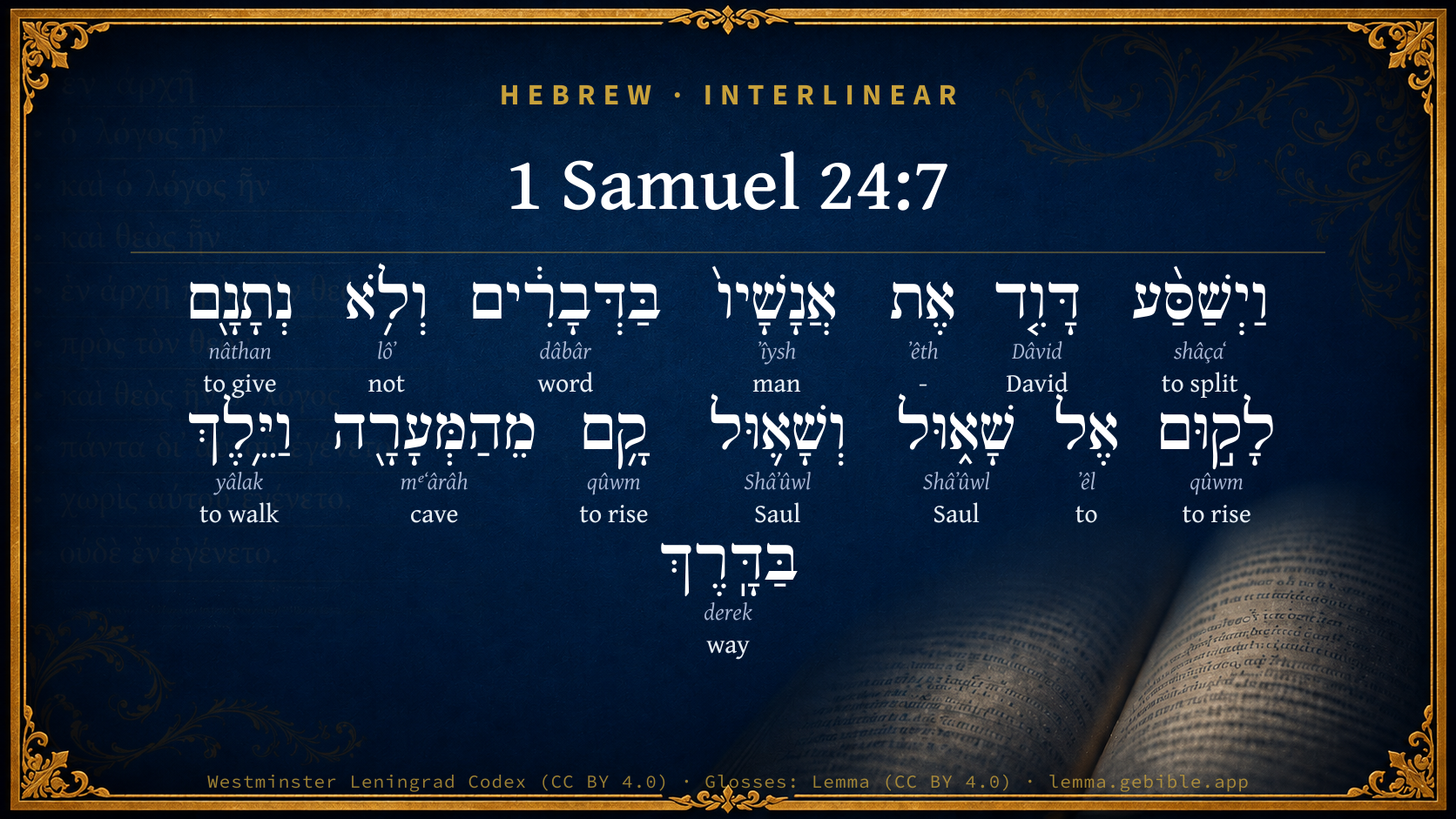
1 Samuel 24:7

Hebrew (Westminster Leningrad Codex) 1 Samuel 24:7 appears in the Hebrew Old Testament. The text above is from the Westminster Leningrad Codex. Each word links to its Strong’s number, a concise gloss, and parsing drawn from the Open Scriptures Hebrew Bible morphology. Click any word for its full Brown-Driver-Briggs (BDB) entry.
Download image
Cite this verse

1 Samuel 24:7 (World English Bible). Public Domain. Lemma interlinear Bible study tool, https://lemma.gebible.app/v/1-samuel/24/7.

Show BibTeX & RIS
BibTeX
RIS
English Translation
So David checked his men with these words, and didn't allow them to rise against Saul. Saul rose up out of the cave, and went on his way.
World English Bible · Public Domain
Download a study sheet

One document with this verse’s original text, its word-by-word gloss line, the meaning frame, cross-references with their text, attributed commentary, and full source and license credits — printable, and it pastes into notes with its structure intact.

This verse Autodidact and up

Study sheet (.html) Plain text (.txt)

A passage Seminary Student

Up to 50 verses in one chapter. A passage sheet keeps up to 6 commentary sources and 12 cross-references per verse, in the order this page ranks them, and says so on the sheet whenever that leaves anything out. Ask for a single verse and you get the Autodidact verse sheet above.

Everything on this page stays free to read, with no account — the sheet is a download of what is already on screen, not access to it.

Want to remove ads? Support Godless Engineer
Compare translations 3

The same verse in 3 English versions, stacked beneath the original-language interlinear above. Click any original word for its lexicon entry.

Each is an independent rendering of the whole verse — the interlinear is not word-aligned to these translations.

Highlighted words mark where these versions differ — a whole-verse word diff, not a word-by-word alignment.

  • World English Bible Public Domain
    So David checked his men with these words, and didn't allow them to rise against Saul. Saul rose up out of the cave, and went on his way.
  • King James Version Public Domain
    So David stayed his servants with these words, and suffered them not to rise against Saul. But Saul rose up out of the cave, and went on his way.
  • unfoldingWord Literal Text CC BY-SA 4.0
    And David dispersed his men with words and did not allow them to arise against Saul. And Saul arose from the cave and went in the way.

unfoldingWord Literal Text — © unfoldingWord, licensed CC BY-SA 4.0. Word-aligned USFM3 via Door43 (git.door43.org/unfoldingWord/en_ult).

Versions to compare (up to 4)

3 of 4 selected

Show all 18 translations

Every available English version of this verse, each an independent rendering of the whole verse.

  • World English Bible Public Domain
    So David checked his men with these words, and didn't allow them to rise against Saul. Saul rose up out of the cave, and went on his way.
  • Berean Standard Bible Public Domain
    With these words David restrained his men, and he did not let them rise up against Saul. Then Saul left the cave and went on his way.
  • Majority Standard Bible Public Domain
    With these words David restrained his men, and he did not let them rise up against Saul. Then Saul left the cave and went on his way.
  • King James Version Public Domain
    So David stayed his servants with these words, and suffered them not to rise against Saul. But Saul rose up out of the cave, and went on his way.
  • American Standard Version (1901) Public Domain
    So David checked his men with these words, and suffered them not to rise against Saul. And Saul rose up out of the cave, and went on his way.
  • Revised Version (1885) Public Domain
    So David checked his men with these words, and suffered them not to rise against Saul. And Saul rose up out of the cave, and went on his way.
  • Geneva Bible (1599) Public Domain
    And he said vnto his men, The Lord keepe mee from doing that thing vnto my master the Lords Anoynted, to lay mine hand vpon him: for he is the Anoynted of the Lord.
  • Douay-Rheims (1899) Public Domain
    And he said to his men: The Lord be merciful unto me, that I may do no such thing to my master the Lord's anointed, as to lay my hand upon him, because he is the Lord's anointed.
  • Young's Literal Translation Public Domain
    And David subdueth his men by words, and hath not permitted them to rise against Saul; and Saul hath risen from the cave, and goeth on the way;
  • Literal Standard Version CC BY-SA 4.0
    And David subdues his men by words, and has not permitted them to rise against Saul; and Saul has risen from the cave, and goes on the way;
  • Unlocked Literal Bible CC BY-SA 4.0
    So David rebuked his men with these words, and did not permit them to attack Saul. Saul stood up, left the cave, and went on his way.
  • unfoldingWord Literal Text CC BY-SA 4.0
    And David dispersed his men with words and did not allow them to arise against Saul. And Saul arose from the cave and went in the way.
  • Darby Bible Public Domain
    And David checked his men with these words, and suffered them not to rise against Saul. And Saul rose up out of the cave, and went on [his] way.
  • World Messianic Bible Public Domain
    So David checked his men with these words, and didn’t allow them to rise against Saul. Saul rose up out of the cave, and went on his way.
  • Webster's Bible Public Domain
    \\24:6\\And he said to his men, The LORD forbid that I should do this thing to my master, the LORD'S anointed, to stretch forth my hand against him, seeing he is the anointed of the LORD.
  • Free Bible Version CC BY-SA 4.0
    He reprimanded his men and didn't allow them to attack Saul. Saul stood up and went on his way.
  • Bible in Basic English Public Domain
    And David said to his men, Before the Lord, never let it be said that my hand was lifted up against my lord, the man of the Lord's selection, for the Lord's holy oil has been put on him.
  • JPS Tanakh (1917) Public Domain
    (24-8) So David checked his men with these words, and suffered them not to rise against Saul. And Saul rose up out of the cave, and went on his way.

Literal Standard Version (2020), Covenant Press — licensed CC BY-SA 4.0. Text via the HelloAO Bible API (eBible.org). Unlocked Literal Bible (unfoldingWord) — licensed CC BY-SA 4.0. Text via the HelloAO Bible API (eBible.org). unfoldingWord Literal Text — © unfoldingWord, licensed CC BY-SA 4.0. Word-aligned USFM3 via Door43 (git.door43.org/unfoldingWord/en_ult). Free Bible Version, Dr. Jonathan Gallagher — licensed CC BY-SA 4.0. Text via the HelloAO Bible API (eBible.org).

Word by word

More ways to search: Search by grammar → Find every occurrence → Compare this word →

Practice this passage: Drill this verse → Learn its vocabulary →

וַיְשַׁסַּ֨ע
shâçaʻ
H8156
“and · to split”
Conjunction + Verb, Piel, Sequential Imperfect, 3rd Person, Masculine, Singular
Part of Speech
Conjunction + Verb
Stem
Piel
Form
Sequential Imperfect
Person
3rd Person
Gender
Masculine
Number
Singular
Full BDB Definition

Origin: a primitive root

TWOT: 2427

to divide, cleave, part, split - (Qal) cleaving, cleft (participle) - (Piel) to tear in two, cleave in two
  1. דָּוִ֤ד Dâvid H1732 “David” Noun, Proper
  2. אֶת ʼêth H853 “-” Particle, Direct Object
  3. אֲנָשָׁיו֙ ʼîysh H376 “men · his” Noun, Common, Masculine, Plural, Construct + Suffix, Personal, 3rd Person, Masculine, Singular
  4. בַּדְּבָרִ֔ים dâbâr H1697 “in/at the · words” Preposition, Determined + Noun, Common, Masculine, Plural, Absolute
  5. וְלֹ֥א lôʼ H3808 “and · not” Conjunction + Particle, Negative
  6. נְתָנָ֖ם nâthan H5414 “to give · them” Verb, Qal, Perfect, 3rd Person, Masculine, Singular + Suffix, Personal, 3rd Person, Masculine, Plural
  7. לָק֣וּם qûwm H6965 “to rise” Preposition + Verb, Qal, Infinitive Construct
  8. אֶל ʼêl H413 “to” Preposition
  9. שָׁא֑וּל Shâʼûwl H7586 “Saul” Noun, Proper
  10. וְשָׁא֛וּל Shâʼûwl H7586 “and · Saul” Conjunction + Noun, Proper
  11. קָ֥ם qûwm H6965 “to rise” Verb, Qal, Perfect, 3rd Person, Masculine, Singular
  12. מֵהַמְּעָרָ֖ה mᵉʻârâh H4631 “from · the · cave” Preposition + Particle, Definite Article + Noun, Common, Feminine, Singular, Absolute
  13. וַיֵּ֥לֶךְ yâlak H3212 “and · to walk” Conjunction + Verb, Qal, Sequential Imperfect, 3rd Person, Masculine, Singular
  14. בַּדָּֽרֶךְ derek H1870 “in/at the · way” Preposition, Determined + Noun, Common, Both, Singular, Absolute

About this verse

These counts appear in no published source. They are computed here, from the morphology-tagged text and Lemma’s own curated glosses. What Lemma adds →

15
words
13
distinct lemmas
Historical
section

Notable vocabulary

The rarest word here is וַיְשַׁסַּ֨ע to split H8156 — appearing just 9 times in the whole Hebrew Bible.

Shared distinctive vocabulary

וַיְשַׁסַּ֨ע to split H8156 occurs in 8 verses of the Hebrew Bible. Also found in:

Grammatical profile

  • 5 verbs
  • 7 nouns
  • 1 preposition
  • 2 particles

Verb forms

  • וַיְשַׁסַּ֨ע Piel · Sequential Imperfect
  • נְתָנָ֖ם Qal · Perfect
  • לָק֣וּם Qal · Infinitive Construct
  • קָ֥ם Qal · Perfect
  • וַיֵּ֥לֶךְ Qal · Sequential Imperfect

Repetition

Words recur within this verse — often emphatic in Hebrew:

  • לָק֣וּם to rise H6965 ×2
  • שָׁא֑וּל Saul H7586 ×2

Hebrew & Septuagint length

In English translation the verse runs 28 words from the Hebrew and 39 from the Septuagint (LXX English) — closely comparable.

A rough comparison of the two English renderings, which tokenize alike — not a word-level alignment.

Word counts can differ between the Hebrew and the Greek without any difference in meaning — e.g. the Hebrew direct-object marker אֵת has no separate Greek word, and Greek often adds the article ὁ.

Cross-references

4

Topical passages linked to 1 Samuel 24:7 in the Treasury of Scripture Knowledge — connected by theme and wording, ordered by reader-vote popularity; previews shown in the World English Bible.

  • Psalms 7:4 If I have rewarded evil to him who was at peace with me (Yes, I have delivered him who without cause was my adversary),
  • Matthew 5:44 But I tell you, love your enemies, bless those who curse you, do good to those who hate you, and pray for those who mistreat you and persecute you,
  • 1 Samuel 25:33 and blessed be your discretion, and blessed be you, that have kept me this day from blood guiltiness, and from avenging myself with my own hand.
  • Romans 12:17–21 Repay no one evil for evil. Respect what is honorable in the sight of all men.

Cross-references courtesy of OpenBible.info (CC BY 4.0).

Hebrew and Greek witnesses Masoretic Hebrew ↔ Greek Septuagint

The same verse in the two great witnesses to the Old Testament, shown verse-for-verse.

These are two independent witnesses, not word-aligned to each other, and the Septuagint is shown in lemma (dictionary) form.

Hebrew 1 Samuel 24:7 Masoretic · Westminster Leningrad Codex

וַיְשַׁסַּ֨ע דָּוִ֤ד אֶת אֲנָשָׁיו֙ בַּדְּבָרִ֔ים וְלֹ֥א נְתָנָ֖ם לָק֣וּם אֶל שָׁא֑וּל וְשָׁא֛וּל קָ֥ם מֵהַמְּעָרָ֖ה וַיֵּ֥לֶךְ בַּדָּֽרֶךְ

So David checked his men with these words, and didn't allow them to rise against Saul. Saul rose up out of the cave, and went on his way.

World English Bible · Public Domain

Greek LXX 1 Samuel 24:7 Septuagint · lemma form

καί εἶπον δαυίδ πρός ὁ ἀνήρ αὐτός μηδαμῶς ἐγώ παρά κύριος εἰ ποιέω ὁ ῥῆμα οὗτος ὁ κύριος ἐγώ ὁ χριστός κύριος ἐπιφέρω χείρ ἐγώ ἐπί αὐτός ὅτι χριστός κύριος εἰμί οὗτος

And David said to his men, The Lord forbid it me, that I should do this thing to my lord the anointed of the Lord, to lift my hand against him; for he is the anointed of the Lord.

LXX2012 (modern English Septuagint) · Public Domain

Hebrew: Westminster Leningrad Codex (CC BY 4.0). Greek: Septuagint (public domain); English from LXX2012 (modern English Septuagint) (Public Domain). How the Septuagint differs from the Hebrew →

Targum (Aramaic paraphrase)

1

The Targum is the ancient Jewish Aramaic paraphrase of the Hebrew Scriptures — an interpretive translation, not the Hebrew text itself. Onkelos (literal) and Pseudo-Jonathan (expansive) render the Torah, and Jonathan the Prophets. Coverage is partial: where no permissively-licensed English translation exists for a verse, only the Aramaic is shown. This is verse-level text, not a word-by-word alignment to the Hebrew.

  1. Targum Jonathan Prophets (Joshua–Malachi)
    וַאֲמַר לְגַבְרוֹהִי חָס לִי מִן קֳדָם יְיָ אִם אַעְבֵּיד יַת פִּתְגָמָא הָדֵין לְרִבּוֹנִי לִמְשִׁיחָא דַייָ לְאוֹשָׁטָא יְדִי בֵּיהּ אֲרֵי מְשִׁיחָא דַייָ הוּא:

    (no public-domain English translation for this verse)

    Targum Jonathan — Aramaic: “Mikraot Gedolot” (public domain). English: “Sefaria Community Translation” (CC0 1.0 (public-domain dedication)); “London "Chaldee Paraphrase," 1871” (public domain). Text via Sefaria.

Commentary

Notes on 1 Samuel 24:7 from classic Christian and Jewish commentators (each source and its license shown beneath its notes). The classic Christian expositions comment on the surrounding passage and are grouped to its opening verse, so a note may address several verses; the Jewish commentaries on the Tanakh (Rashi and others) are per-verse, so they appear only where the commentator wrote on this verse.

Lemma curates 59 commentaries, every one of them public domain or Creative Commons licensed, each selected and text-cleaned for this edition rather than reprinted as found. About our sources →

Trapp's Complete Commentary

John Trapp

1Sa 24:7 So David stayed his servants with these words, and suffered them not to rise against Saul. But Saul rose up out of the cave, and went on [his] way.

Ver. 7. So David stayed his servants.] Dispescuit, diffidit: He staved them off, when they rose from both sides of the cave to lay violent hands upon Saul; and this was a greater victory, saith Chrysostom, than that he once got over Goliath, because now he overcame himself, and manfully repressed his unruly soldiers with a word in season.

But Saul rose up out of the cave.] Little thinking how near he had been to a mischief, and how easily he might have died before his time; {Ecc 7:17} that is, than when it had been better for him to have done anything than have died. See Ecc 9:12.

John Trapp, A Commentary or Exposition upon All the Books of the Old and New Testament (1647–1656) — public domain. Text from a community e-Sword module.

Joseph Benson's Commentary

1Sa 24:7-8. And suffered them not to rise against Saul — He not only would not do this ill thing himself, but he would not suffer those about him to do it. Thus did he render good for evil to him, from whom he had received evil for good; and was herein both a type of Christ, who saved his persecutors, and an example to all Christians, not to be overcome of evil, but to overcome evil with good. David also went out of the cave, and cried after Saul — A bold attempt this, to adventure to come into the presence of such an enraged enemy. But his innocence, and confidence in God, imboldened him, especially having so strong an evidence to give of his integrity.

Joseph Benson's Commentary on the Old and New Testaments (1811–1818) — public domain. Text from a community e-Sword module.

Adam Clarke's Commentary

Verse 7. Suffered them not to rise against Saul.] As he could restrain them, it was his duty to do so; had he connived at their killing him, David would have been the murderer. In praying for the king we call God the only Ruler of princes, for this simple reason, that their authority is the highest among men, and next to that of God himself; hence he alone is above them. We find this sentiment well expressed by an elegant poet: -

Regum timendorum in proprios greges,

Reges in ipsos imperium est Jovis.

HORACE, Odar. lib. iii., Od. i., ver. 5.

Kings are supreme over their own subjects;

Jove is supreme over kings themselves.

Adam Clarke's Commentary on the Bible (1810–1826) — public domain. Text from a community e-Sword/MySword module.

The Cambridge Bible for Schools and Colleges

gen. ed. J. J. S. Perowne

7. stayed] Lit. tore, or lashed: a strong expression. Vulg. “confregit viros suos sermonibus.”

The Cambridge Bible for Schools and Colleges (gen. ed. J. J. S. Perowne; Cambridge University Press, 1878–1918) — public domain. Text from a community e-Sword module.

John Gill's Exposition

So David stayed his servants with these words,.... Or pacified them, as the Targum, and made them quiet and easy in that he had not slain him, and reconciled their minds to his conduct, and restrained them from laying hands on him, by observing to them, that he was the anointed of the Lord:

and suffered them not to rise against Saul; to take away his life; he not only argued with them, but laid his commands on them that they should not slay him:

but Saul rose up out of the cave, and went on his way; he rose from his sleep, and went out of the cave unhurt, and proceeded on in the way he came to the sheepcotes, and which led on further, Sa1 24:3.

John Gill's Exposition of the Whole Bible (1746–1763) — public domain (CC PDM 1.0). Text via the HelloAO Bible API.

Haydock's Catholic Bible Commentary

Anointed. He was chosen by God, and to be judge by him. (Calmet) --- Reges in ipsos imperium est Jovis. (Horace) --- David was not to mount the throne, till Saul was removed, by God’s ordinance. (Worthington)

George Leo Haydock (1774–1849), Haydock's Catholic Family Bible and Commentary, 1859 edition — public domain. Excludes Psalms (Douay-Rheims chapter numbering differs from Protestant) and Deuterocanonical books (Catholic canon only).

Matthew Poole's English Annotations

Stayed his servants, Heb. cut, or clave, or divided, or cut them off. The word notes both the eagerness and violence of David’s men in prosecuting their desire, and David’s resoluteness in opposing them, as it were, by force; wherein he shows great piety, and generosity, and loyalty to Saul.

Matthew Poole's English Annotations on the Holy Bible (1683–1685) — public domain. Text from a community e-Sword/MySword module.

Whedon's Commentary on the Bible

Daniel D. Whedon

7. David stayed his servants — Literally, He split them. Vulgate: confregit; he broke them to pieces. The idea is, that by his words he completely nonplussed them, so as to check their furious desire to make an end of Saul.

Daniel D. Whedon (gen. ed.), Commentary on the Old and New Testaments (1874–1909) — public domain. Text from a community e-Sword module.

Rashi

Rabbi Shlomo Yitzchaki (Rashi)

He said to his men, "[Adonoy] forbid." These two verses are not written in sequence; but since he began to speak regarding the cutting of the robe, he finished everything concerning it, and he said that he even regretted cutting the robe. Afterwards, he returns to the first subject, and says that regarding his men's comments, "Behold, concerning this day, etc." He replied to them, 'May Adonoy forbid that, etc.'

Rashi on the Tanakh — English translations: “The Judaica Press complete Tanach with Rashi, translated by A. J. Rosenberg” (CC BY 4.0); “Pentateuch with Rashi's commentary by M. Rosenbaum and A.M. Silbermann, 1929-1934” (public domain); “The Metsudah Tanach series, Lakewood, N.J” (CC BY 4.0); and “The Book of Joshua, Metsudah Publications, 1997” (CC BY 4.0). Text via Sefaria.

Lesson kit

Teaching starters — assembled from the data on this page, not authored interpretation. Every prompt links to the verse data it draws on. Edit before teaching.

1 Samuel, in the Historical, opens this verse with 15 words (13 distinct Hebrew lemmas). Its most distinctive word is shâçaʻ (“to split”). A historical commentator’s framing appears above. Read the whole chapter for the surrounding context.

Discussion questions

  1. The word shâçaʻ carries the sense “to split.” How does it shape the verse?
  2. How does Leviticus 1:17, which shares the word «to split», read alongside this verse?
  3. What does the repetition of “to rise” (2× in this one verse) do in this verse?
  4. These translations render this verse differently; the difference is in the English rendering, not the original. What questions does that raise?
  5. «וַיְשַׁסַּ֨ע» is a Piel Sequential Imperfect verb. How does that grammatical form shape the action described?
  6. Compare how Trapp's Complete Commentary and Joseph Benson's Commentary read this verse. Where do they agree or differ?

Things to notice

Reading settings

Reading text

Shown beneath each verse's original-language words.

Old Testament
Old Testament edition

Read the OT as the Masoretic Hebrew (MT) or the Greek Septuagint (LXX).

English shown for the Greek Septuagint (in the Hebrew ↔ Greek comparison).

Comparing translations? Open the Compare panel on any verse page to stack up to four side by side.