Romans 6:9

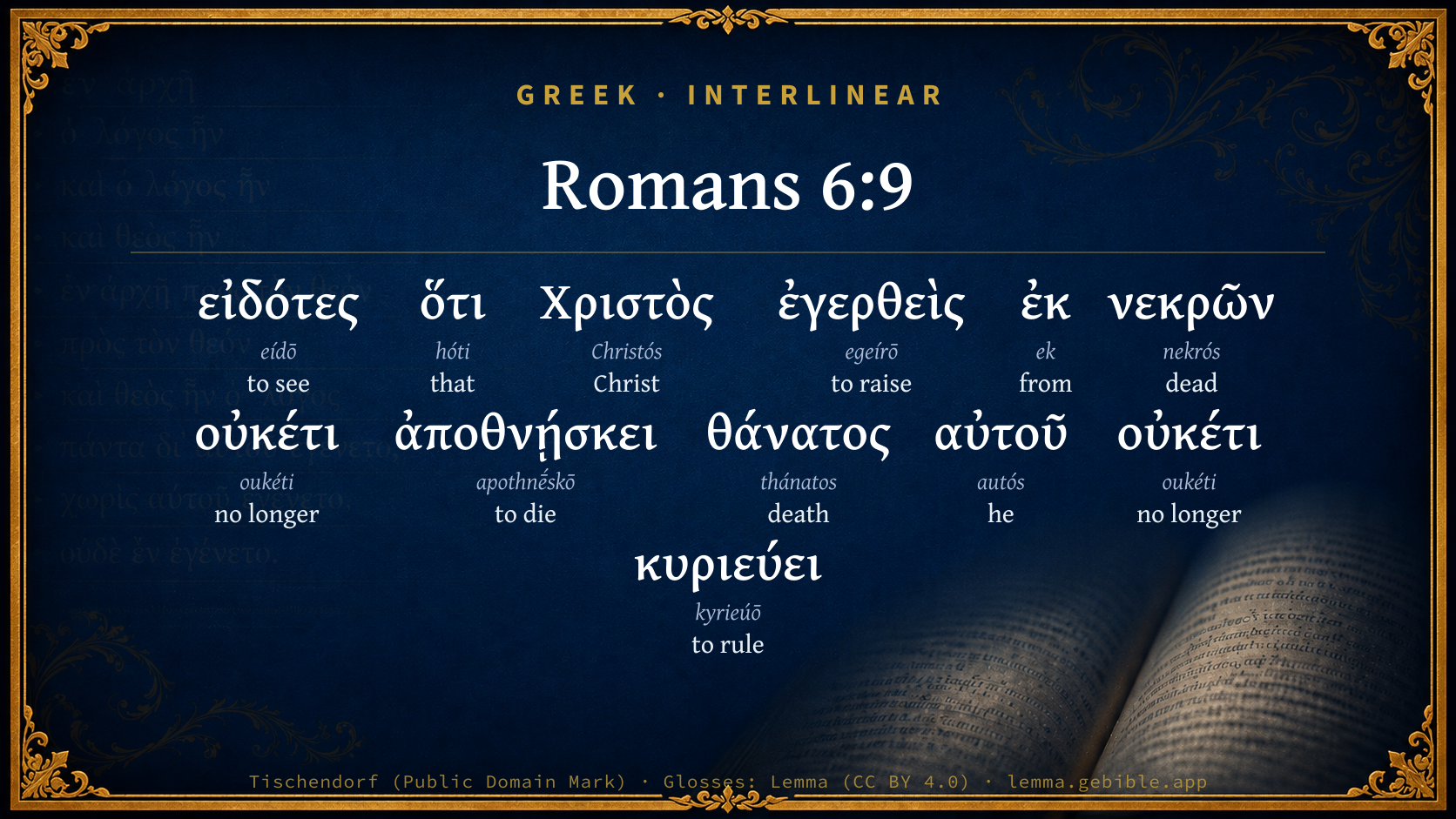
Greek (Tischendorf 8th ed.) Romans 6:9 appears in the Greek New Testament. The text above is from the Tischendorf 8th edition. Each word links to its Strong’s number and a concise gloss. Click any word for its full Thayer’s Greek Lexicon entry.
Download image
Cite this verse

Romans 6:9 (World English Bible). Public Domain. Lemma interlinear Bible study tool, https://lemma.gebible.app/v/romans/6/9.

Show BibTeX & RIS
BibTeX
RIS
English Translation
knowing that Christ, being raised from the dead, dies no more. Death no more has dominion over him!
World English Bible · Public Domain
Download a study sheet

One document with this verse’s original text, its word-by-word gloss line, the meaning frame, cross-references with their text, attributed commentary, and full source and license credits — printable, and it pastes into notes with its structure intact.

This verse Autodidact and up

Study sheet (.html) Plain text (.txt)

A passage Seminary Student

Up to 50 verses in one chapter. A passage sheet keeps up to 6 commentary sources and 12 cross-references per verse, in the order this page ranks them, and says so on the sheet whenever that leaves anything out. Ask for a single verse and you get the Autodidact verse sheet above.

Everything on this page stays free to read, with no account — the sheet is a download of what is already on screen, not access to it.

Want to remove ads? Support Godless Engineer
Compare translations 3

The same verse in 3 English versions, stacked beneath the original-language interlinear above. Click any original word for its lexicon entry.

Each is an independent rendering of the whole verse — the interlinear is not word-aligned to these translations.

Highlighted words mark where these versions differ — a whole-verse word diff, not a word-by-word alignment.

  • World English Bible Public Domain
    knowing that Christ, being raised from the dead, dies no more. Death no more has dominion over him!
  • King James Version Public Domain
    Knowing that Christ being raised from the dead dieth no more; death hath no more dominion over him.
  • unfoldingWord Literal Text CC BY-SA 4.0
    knowing that Christ, having been raised from dead ones, no longer dies; death no longer is lord over him.

unfoldingWord Literal Text — © unfoldingWord, licensed CC BY-SA 4.0. Word-aligned USFM3 via Door43 (git.door43.org/unfoldingWord/en_ult).

Versions to compare (up to 4)

3 of 4 selected

Show all 19 translations

Every available English version of this verse, each an independent rendering of the whole verse.

  • World English Bible Public Domain
    knowing that Christ, being raised from the dead, dies no more. Death no more has dominion over him!
  • Berean Standard Bible Public Domain
    For we know that since Christ was raised from the dead, He cannot die again; death no longer has dominion over Him.
  • Majority Standard Bible Public Domain
    For we know that since Christ was raised from the dead, He cannot die again; death no longer has dominion over Him.
  • King James Version Public Domain
    Knowing that Christ being raised from the dead dieth no more; death hath no more dominion over him.
  • American Standard Version (1901) Public Domain
    knowing that Christ being raised from the dead dieth no more; death no more hath dominion over him.
  • Revised Version (1885) Public Domain
    knowing that Christ being raised from the dead dieth no more; death no more hath dominion over him.
  • Geneva Bible (1599) Public Domain
    Knowing that Christ being raised from the dead, dieth no more: death hath no more dominion ouer him.
  • Douay-Rheims (1899) Public Domain
    Knowing that Christ rising again from the dead, dieth now no more, death shall no more have dominion over him.
  • Young's Literal Translation Public Domain
    knowing that Christ, having been raised up out of the dead, doth no more die, death over him hath no more lordship;
  • Literal Standard Version CC BY-SA 4.0
    knowing that Christ, having been raised up out of the dead, dies no more; death has no more lordship over Him;
  • Unlocked Literal Bible CC BY-SA 4.0
    We know that since Christ has been raised from the dead he cannot die again; death no longer has authority over him.
  • unfoldingWord Literal Text CC BY-SA 4.0
    knowing that Christ, having been raised from dead ones, no longer dies; death no longer is lord over him.
  • Darby Bible Public Domain
    knowing that Christ having been raised up from among [the] dead dies no more: death has dominion over him no more.
  • World Messianic Bible Public Domain
    knowing that Messiah, being raised from the dead, dies no more. Death no longer has dominion over him!
  • Webster's Bible Public Domain
    Knowing that Christ, being raised from the dead, dieth no more; death hath no more dominion over him.
  • Free Bible Version CC BY-SA 4.0
    for we know that because Christ has been raised from the dead he won't ever die, because death has no longer any power over him.
  • Bible in Basic English Public Domain
    Having knowledge that because Christ has come back from the dead, he will never again go down to the dead; death has no more power over him.
  • Text-Critical English NT CC BY 4.0
    For we know that Christ, having been raised from the dead, dies no more; death no longer has dominion over him.
  • Tyndale New Testament (1534) Public Domain
    remembringe that Christ once raysed from deeth dyeth no more. Deeth hath no moare power over him.

Literal Standard Version (2020), Covenant Press — licensed CC BY-SA 4.0. Text via the HelloAO Bible API (eBible.org). Unlocked Literal Bible (unfoldingWord) — licensed CC BY-SA 4.0. Text via the HelloAO Bible API (eBible.org). unfoldingWord Literal Text — © unfoldingWord, licensed CC BY-SA 4.0. Word-aligned USFM3 via Door43 (git.door43.org/unfoldingWord/en_ult). Free Bible Version, Dr. Jonathan Gallagher — licensed CC BY-SA 4.0. Text via the HelloAO Bible API (eBible.org).

Word by word

More ways to search: Search by grammar → Find every occurrence → Compare this word →

Practice this passage: Drill this verse → Learn its vocabulary →

κυριεύει
kyrieúō
G2961
“to rule”
Verb, Present, Active, Indicative, 3rd person, Singular
Part of Speech
Verb
Tense
Present
Voice
Active
Mood
Indicative
Person
3rd person
Number
Singular
Full Thayer's Definition

Origin: from G2962

TDNT: 21:17,5

1. to be lord of, to rule, have dominion over 2. of things and forces a. to exercise influence upon, to have power over
  1. εἰδότες eídō G1492 “to see” Verb, Perfect, Active, Participle, Nominative, Plural, Masculine
  2. ὅτι hóti G3754 “that” Conjunction
  3. Χριστὸς Christós G5547 “Christ” Noun, Nominative, Singular, Masculine
  4. ἐγερθεὶς egeírō G1453 “to raise” Verb, Aorist, Passive, Participle, Nominative, Singular, Masculine
  5. ἐκ ek G1537 “from” Preposition
  6. νεκρῶν nekrós G3498 “dead” Adjective, Genitive, Plural, Masculine
  7. οὐκέτι oukéti G3765 “no longer” Adverb, Negative
  8. ἀποθνῄσκει apothnḗskō G599 “to die” Verb, Present, Active, Indicative, 3rd person, Singular
  9. θάνατος thánatos G2288 “death” Noun, Nominative, Singular, Masculine
  10. αὐτοῦ autós G846 “he” Personal pronoun, Genitive, Singular, Masculine
  11. οὐκέτι oukéti G3765 “no longer” Adverb, Negative

About this verse

These counts appear in no published source. They are computed here, from the morphology-tagged text and Lemma’s own curated glosses. What Lemma adds →

12
words
11
distinct lemmas
Pauline Epistles
section

Notable vocabulary

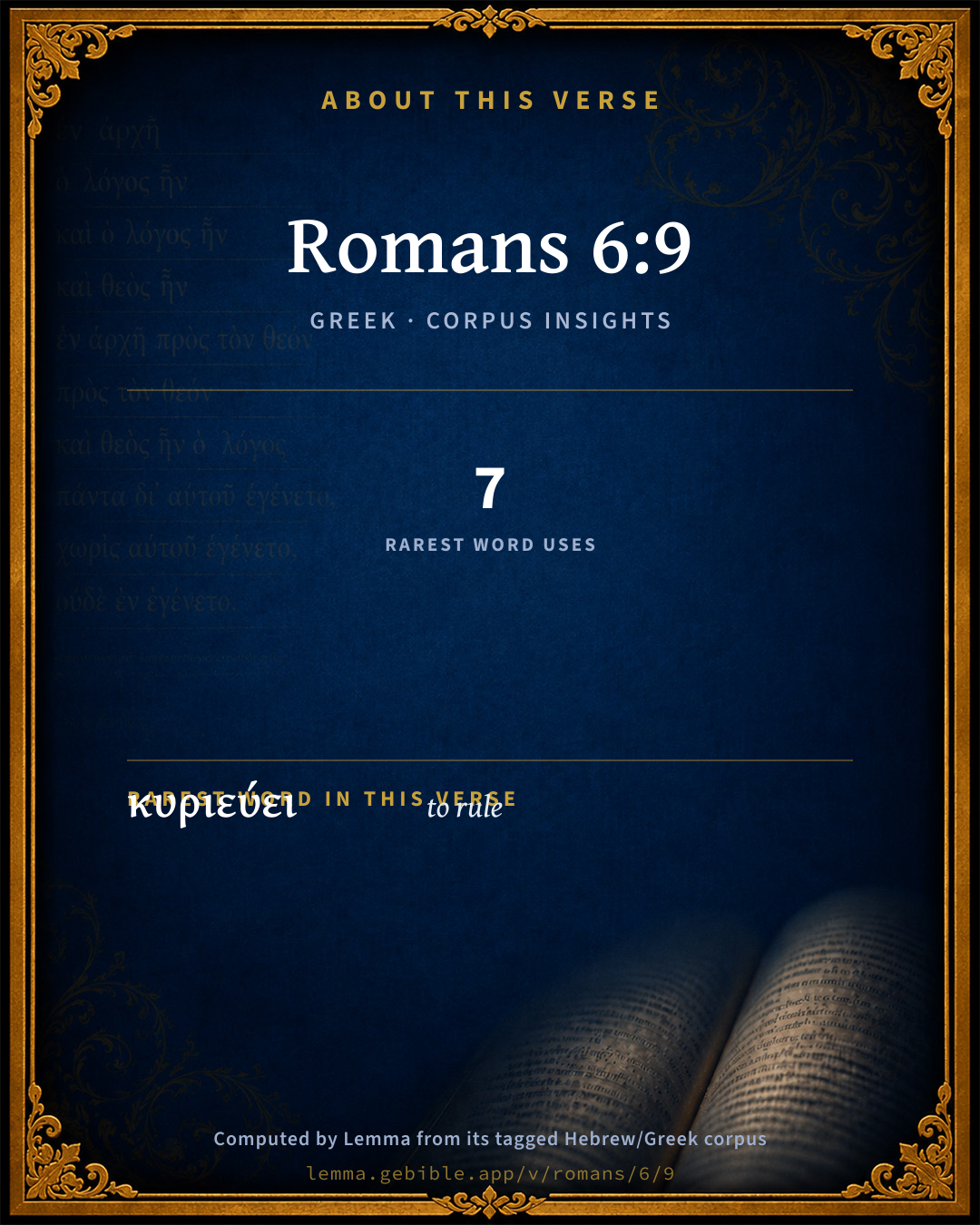
The rarest word here is κυριεύει to rule G2961 — appearing just 7 times in the whole Greek New Testament.

Shared distinctive vocabulary

κυριεύει to rule G2961 occurs in 7 verses of the Greek New Testament. Also found in:

Repetition

A word recurs within this verse:

  • οὐκέτι no longer G3765 ×2

Cross-references

9

Topical passages linked to Romans 6:9 in the Treasury of Scripture Knowledge — connected by theme and wording, ordered by reader-vote popularity; previews shown in the World English Bible.

  • Romans 6:14 For sin will not have dominion over you. For you are not under law, but under grace.
  • Revelation 1:18 and the Living one. I was dead, and behold, I am alive forevermore. Amen. I have the keys of Death and of Hades.
  • Acts 2:24–28 whom God raised up, having freed him from the agony of death, because it was not possible that he should be held by it.
  • Hebrews 10:12–13 but he, when he had offered one sacrifice for sins for ever, sat down on the right hand of God;
  • Psalms 16:9–11 Therefore my heart is glad, and my tongue rejoices. My body shall also dwell in safety.
  • Hebrews 2:14–15 Since then the children have shared in flesh and blood, he also himself in like manner partook of the same, that through death he might bring to nothing him who had the power of death, that is, the devil,
  • Romans 5:14 Nevertheless death reigned from Adam until Moses, even over those whose sins weren't like Adam's disobedience, who is a foreshadowing of him who was to come.
  • Hebrews 7:25 Therefore he is also able to save to the uttermost those who draw near to God through him, seeing he ever lives to make intercession for them.
  • Hebrews 7:16 who has been made, not after the law of a fleshly commandment, but after the power of an endless life:

Cross-references courtesy of OpenBible.info (CC BY 4.0).

Commentary

Notes on Romans 6:9 from classic Christian and Jewish commentators (each source and its license shown beneath its notes). The classic Christian expositions comment on the surrounding passage and are grouped to its opening verse, so a note may address several verses; the Jewish commentaries on the Tanakh (Rashi and others) are per-verse, so they appear only where the commentator wrote on this verse.

Lemma curates 59 commentaries, every one of them public domain or Creative Commons licensed, each selected and text-cleaned for this edition rather than reprinted as found. About our sources →

Bengel's Gnomon

Johann Albrecht Bengel

Rom 6:9. Εἰδότες, knowing) This word depends on, we believe.—θάνατος, death) without the article, any kind of death.—οὖκ ἔτι, no more) Death never had dominion over Christ, but yet it had assailed Him, Act 2:24; and if it had held Him, it might have been said to have had dominion over Him; which God forbid. Paul was unwilling to say here, βασιλεύει, reigneth.

Bengel's Gnomon of the New Testament — English translation (T&T Clark, Edinburgh, 1860) — public domain. Text from a community e-Sword module.

Expositor's Greek Testament

ed. W. Robertson Nicoll

Rom 6:9 . εἰδότες … οὐκέτι ἀποθνήσκει : The new life with Christ will be the same which Christ Himself lives, a life inaccessible to death. The post-resurrection life of Jesus was not His old life over again; in that life death had dominion over Him, because He made Himself one with us in all the consequences of sin; but now the dominion of death has expired. The principle of Rom 6:7 can be applied to Christ also: He has died, and the powers which in the old relations had claims upon Him death, e.g. have such claims no more.

The Expositor's Greek Testament, edited by W. Robertson Nicoll (1897–1910) — public domain. Text from a community e-Sword module.

Godet's Commentaries

Frédéric Louis Godet

Vv. 9. This faith, this firm expectation of the believer who is dead with Him, is not a vain imagination. It rests on a positive fact, the resurrection of Christ Himself: εἰδότες, knowing that. This participle justifies the we believe of Rom 6:8. We believe that our spiritual resurrection will come about, because we know that His resurrection has taken place, and that irrevocably. Now the latter gives us assurance of the former. But faithful to his original subject, the apostle, instead of developing the idea of the new life of Jesus, confines himself to expressing this consequence: that He dieth no more. It is easy to see the logical relation between this purely negative turn of expression, and the question put in Rom 6:2: “How shall we who are dead to sin live any longer therein?” There is no return backward for the risen Jesus; how should there be one for us, from the time that we share His life as the Risen One? No doubt, his death alone would not have rendered His return to an earthly life impossible; but His entrance upon a celestial life absolutely excludes such a retrograde step. Thus mere communion with His death would not suffice to furnish an unhesitating answer to the question of Rom 6:2, while participation in His new life settles it once and forever.

The last words of Rom 6:9 form an independent proposition. This break in the construction throws the idea more into relief. The time having passed when death was permitted to stretch its sceptre over him, He is freed from its power forever.

Frédéric Louis Godet — Commentaries on Luke, John, Romans, and 1 Corinthians — English translation (T&T Clark, Edinburgh, 1870s–1890s) — public domain. Text from a community e-Sword module.

Hodge's Commentary on Romans, Ephesians & First Corinthians

Charles Hodge

Rom_6:9

Knowing that Christ, being raised from the dead, dieth no more. Knowing εἰδότες is either equal to καὶ οἴδαμεν, and we know, thus introducing a new idea, or it is causal, because we know. The latter is to be preferred. We are sure we shall be partakers of the life of Christ, because we know that he lives. Were he not a living Savior, if his life were not perpetual, he could not be the source of life to his people in all ages. The perpetuity of Christs life, therefore, is presented,

1. As the ground of assurance of the perpetuity of the life of believes. We shall partake of the life of Christ, i.e. of the spiritual and eternal blessings of redemption, because he ever lives to make intercession for us, and to grant us those supplies of grace which we need; see Rom_5:10; Joh_14:19; 1Co_15:22, etc. As death has no more dominion over him, there is no ground of apprehension that our supplies of life will be cut off. This verse, therefore, is introduced as the ground of the declaration, we shall live with him, at the close of Rom_6:8.

2. The perpetuity of the life of Christ is one of the points in which our life is to be conformed to his. Christ dieth no more, death hath no more dominion over him. This repetition is for the sake of emphasis. Christs subjection to death was voluntary. It was not from a necessity of nature, nor from any obligation to justice. He laid down his life of himself. He voluntarily submitted to death for our sakes, and was the master of death even in dying; and therefore he is, so to speak, in no danger of ever being subject to its power. The object of his voluntary submission to death having been accomplished, he lives for evermore. This is more fully expressed in the following verse.

Charles Hodge — Commentary on Romans (1835), First Corinthians (1857), and Ephesians (1856) — public domain. Text from a community e-Sword module.

Jamieson, Fausset & Brown

Robert Jamieson, A. R. Fausset & David Brown

Christ being raised from the dead dieth no more; death hath no more dominion over him--Though Christ's death was in the most absolute sense a voluntary act (Joh 10:17-18; Act 2:24), that voluntary surrender gave death such rightful "dominion over Him" as dissolved its dominion over us. But this once past, "death hath," even in that sense, "dominion over Him no more."

Jamieson, Fausset & Brown — Commentary Critical and Explanatory on the Whole Bible (1871) — public domain (CC PDM 1.0). Text via the HelloAO Bible API.

Adam Clarke's Commentary

Verse 9. Christ being raised from the dead dieth no more] So we, believing in Christ Jesus, and having a death unto sin, and a life unto righteousness, should sin no more. If we be risen indeed with Christ, we should seek the things above, and set our affections on things above, and not on the earth. The man who walks in humble, loving obedience, to an indwelling Christ, sin has no more dominion over his soul than death has over the immortal and glorified body of his Redeemer.

Adam Clarke's Commentary on the Bible (1810–1826) — public domain. Text from a community e-Sword/MySword module.

John Calvin's Commentaries

9. Death no more rules over him, etc. He seems to imply that death once ruled over Christ; and indeed when he gave himself up to death for us, he in a manner surrendered and subjected himself to its power; it was however in such a way that it was impossible that he should be kept bound by its pangs, so as to succumb to or to be swallowed up by them. He, therefore, by submitting to its dominion, as it were, for a moment, destroyed it for ever. Yet, to speak more simply, the dominion of death is to be referred to the state of death voluntarily undergone, which the resurrection terminated. The meaning is, that Christ, who now vivifies the faithful by his Spirit, or breathes his own life into them by his secret power from heaven, was freed from the dominion of death when he arose, that by virtue of the same dominion he might render free all his people.

John Calvin's Commentaries (1540-1563) — public domain. Text from the Calvin Translation Society English edition (1840s-50s) via the Christian Classics Ethereal Library (ccel.org). Calvin's coverage is partial (roughly two-thirds of the Bible); uncommented books and verses are honest gaps, never fabricated. The 19th-century editor's footnotes and remarks are omitted so the notes are faithfully Calvin's own voice.

Ellicott's Commentary for English Readers

(9) Dieth no more.—The eternal subsistence of the life of Christ is a guarantee for the permanence and reality of our own life, so far as it is dependent on His. If it were possible that the life of Christ should fail, the whole fabric that the believer’s faith builds upon it would fall to the ground.

A Bible Commentary for English Readers, edited by Charles John Ellicott (1878–1897) — public domain. Text from a community e-Sword module.

The Cambridge Bible for Schools and Colleges

gen. ed. J. J. S. Perowne

9. knowing] As an admitted foundation-truth. Christian faith is always viewed as grounded upon knowledge, upon fact.

dieth no more] His life is continuous and endless; such then also is that of those to whom He is the Second Adam; who therefore “shall live with Him.” Through this whole context the parallel of Adam and Christ needs to be borne in mind.

death hath no more dominion over him] “Him” is emphatic.—The Second Adam, as Representative and Substitute, submitted to the “dominion,” or mastery, of death as the appointed penalty of sin. But by that very act He exhausted death’s claim on Himself and His brethren; He “cancelled death.” (2Ti_1:10.)

The Cambridge Bible for Schools and Colleges (gen. ed. J. J. S. Perowne; Cambridge University Press, 1878–1918) — public domain. Text from a community e-Sword module.

John Gill's Exposition

Knowing that Christ being raised from the dead,.... That Christ is risen from the dead, is a certain fact, well attested, thoroughly known, and firmly believed; the prophets prophesied of it, Christ himself foretold it, angels affirmed it, and the apostles were witnesses of it, as is also the Holy Ghost: and it is as certain, that he

dieth no more; he is raised to an immortal life, and will live for evermore; there is no need of his dying again, his death having been a full atonement and expiation of all the sins and transgressions of his people:

death hath no more dominion over him: it once had dominion over him; it held him under its power for a time, according to the divine determination, and by his own consent: but it was not possible he should be holden of it longer; both on account of the dignity of his person, as the Son of God, and the virtue and efficacy of his sacrifice, as the surety of his people, having put away sin for ever by it. He is the holy man the Jews (u) speak of,

"who is the mystery of the name Jehovah, and in him there is no sin, neither shall death have the dominion over him.''

(u) Tikkune Zohar, fol. 112. p. 1. apud Rittangel. de verit. Relig. Christ. p. 68.

John Gill's Exposition of the Whole Bible (1746–1763) — public domain (CC PDM 1.0). Text via the HelloAO Bible API.

Trapp's Complete Commentary

John Trapp

9 Knowing that Christ being raised from the dead dieth no more; death hath no more dominion over him.

Ver. 9. Death hath no more, &c.] Christ, being the life essential, swallowed up death in victory, as the fire swalloweth up the fuel, and as Moses’ serpent swallowed up the sorcerers’ serpents.

John Trapp, A Commentary or Exposition upon All the Books of the Old and New Testament (1647–1656) — public domain. Text from a community e-Sword module.

Matthew Poole's English Annotations

q.d. Of this you know you have an example or copy in Christ himself; he so rose again, as never more to come under the power of death.

Matthew Poole's English Annotations on the Holy Bible (1683–1685) — public domain. Text from a community e-Sword/MySword module.

The Pulpit Commentary

Knowing that Christ being raised from the dead dieth no more; death hath no more dominion over him. When it is implied here that death had once dominion over him, it is not, of course, meant that he was in his own Divide nature subject to death, or that. "it was possible that he should be holden of it." All that is implied is that he had made himself subject to it by taking on him our nature, and voluntarily submitted to it, once for all, as representing us. (cf. Joh_10:17 Act_2:24)

The Pulpit Commentary (1880–1919), ed. H.D.M. Spence-Jones & Joseph S. Exell — public domain. Text from a community e-Sword module.

Burkitt's Expository Notes on the New Testament

William Burkitt

Here the apostle declares both the death which Christ once died, and the life which he now liveth.

Observe, 1. The death which Christ died; he died unto sin once, that is, either,

1. He died for sin once, namely, to expiate the guilt of sin, and to make atonements for sinners; or else,

2. He died unto sin; that is, to destroy, conquer, and subdue sin in the hearts and lives of his children and people, by the aids and assistances of his Holy Spirit.

Observe, 2. The life which Christ now lives after his resurrection; he liveth unto God, and dieth no more.

Here note, 1. The perpetuity and immortality of his life; he dieth no more. Christ has done his work, in taking away the guilt and power of sin: let us look to it, that we do ours.

Note, 2. The perfection and blessedness of his life. He liveth unto God, or liveth forever with God; by which the Son hath with the Father; he is one with him, and lives forever in the enjoyment of him.

Learn hence, That the due consideration of Christ’s resurrection from the dead, will mightily promote the spiritual life in us.

This it doth these three ways:

1. As evidences the truth and verity of the Christian religion, that Christ is no impostor or deceiver. In the judgment of the world, Christ died as a malefactor; but God justified him, acquitted and freed him from the imputation by raising him from the dead.

2. Christ’s resurrection shews the perfection of his sacrifice and satisfaction, that nothing more is needful to take away sin; when the surety is let out of prison, the debtor may be assured that his debt is paid.

3. Christ’s arising is a pledge and assurance of our resurrection, and so promotes holiness in us, by obliging us to live as the candidates of heaven, as the children of the resurrection, as becomes the heirs of such glorious hopes.

William Burkitt's Expository Notes on the New Testament (1700–1703) — public domain. Text from a community e-Sword module.

Godbey's Commentary on the New Testament

William B. Godbey

9. “Knowing that Christ being raised from the dead dieth no more: death hath no more dominion over him.” We are here portrayed, by the inspired apostle, going with Christ to Calvary and there being nailed to the cross and crucified with Him. None but disciples of Christ go to heaven. If you would be His disciple you must follow Him in the great salient facts of His personal experience. You must follow Him to the manger and be born of the Spirit in utter obscurity and contempt of the world. You must follow Him to the Jordan and receive the Holy Ghost descending on you and filling you. You must follow Him as He climbs Mount Calvary, and there be nailed to the cross, bleed and die as He did. You must also follow Him in His glorious resurrection, transfiguration and triumphant ascension. After Christ had died He had the perfect and eternal victory over death. All the powers of the Roman Empire could never have killed Him again. Just so this wonderful experience of entire sanctification, crucifying the old man and burying him deep into the atonement, sinking him away into the “sea of forgetfulness,” never to be heard of again, thus “destroying the body of sin,” makes us just as free from sin as Christ was from physical death after He had consummated His work and exhausted all of His resources, so far as He was concerned, becoming powerless as a fleeting shadow.

William B. Godbey, Commentary on the New Testament (1896–1900) — public domain. Text from a community e-Sword module.

McGarvey & Pendleton's Commentaries

J. W. McGarvey

knowing that Christ being raised from the dead dieth no more; death no more hath dominion over him .

J. W. McGarvey (with Philip Y. Pendleton), Commentaries on the New Testament (The Fourfold Gospel, 1914; Acts; and the epistles) — public domain. Text from a community e-Sword/MySword module.

The People's New Testament

B. W. Johnson

9. This is certain because, Christ being raised from the dead, dieth no more. He now lives eternally, and we who are in him, having shared his death, must share his eternal life.

B. W. Johnson's The People's New Testament with Notes (1889–1891) — public domain. Electronic text from the Christian Classics Ethereal Library (CCEL) ThML edition.

Cambridge Greek Testament for Schools and Colleges

9. εἰδότες ὅτι, ‘appeal to an elementary Christian belief,’ Hort, 1Pe 1:18; cf. Rom 6:3; 2Co 4:14; 2Co 5:6. A stronger form is οὐκ οἴδατε ὅτι, Rom 6:16, 1Co 3:16 alibi

Χριστὸς κ.τ.λ. The antithetic and rhythmical balance of these clauses suggests a well-known and well-used formula. Cf. above Rom 6:8. It is possible that we have here, too, a fragment of a hymn or confession; cf. 2Ti 2:8. N. the rhythmical character stops at θεῷ.

οὐκέτι ἀποθνήσκει = never again dies: iterative, cf. Moulton, p. 114.

θάνατος α. κ.τ.λ. His resurrection was a triumph over the sovereignty of death (cf. Rom 5:14; 1Co 15:57) and has changed the meaning of death.

Cambridge Greek Testament for Schools and Colleges (Cambridge University Press, 1896; 21 vols, various authors incl. Carr, Maclear, Plummer, Farrar, Lumby, Moule, M. R. James, Simcox) — public domain. Text from a community e-Sword module.

Alford’s Greek Testament

Henry Alford

9.] This and the following verse explain what sort of a life with Christ is meant, by what we know of the Resurrection-life of Christ himself. The only difficulty here is in οὐκ ἔτι κυριεύει, as implying that Death had dominion over Christ, which we know it had not: see Joh 10:17, Joh 10:18; Joh 2:19; Act 2:24. But this vanishes, when we remember that our Lord, by submitting to Death, virtually, and in the act of death, surrendered Himself into the power of Death. Death could not hold Him, and had no power over Him further than by his own sufferance: but power over Him it had, inasmuch as He died.

Henry Alford, The Greek Testament (1849–1861) — public domain. Text from a community e-Sword module.

International Critical Commentary

9. If the Resurrection opened up eternity to Christ it will do so also to the Christian.

κυριεύει. Still the idea of master and slave or vassal. Death loses its dominium over Christ altogether. That which gave Death its hold upon Him was sin, the human sin with which He was brought in contact by His Incarnation. The connexion was severed once for all by Death, which set Him free for ever.

International Critical Commentary — older volumes (1896–1929), various authors — public domain. Text from a community e-Sword module.

Lesson kit

Teaching starters — assembled from the data on this page, not authored interpretation. Every prompt links to the verse data it draws on. Edit before teaching.

Romans, in the Pauline Epistles, opens this verse with 12 words (11 distinct Greek lemmas). Its most distinctive word is kyrieúō (“to rule”). A historical commentator’s framing appears above. Read the whole chapter for the surrounding context.

Discussion questions

  1. What does “to rule” (kyrieúō) contribute to the verse as a whole?
  2. How does Luke 22:25, which shares the word «to rule», read alongside this verse?
  3. What does the repetition of “no longer” (2× in this one verse) do in this verse?
  4. The translations on this page render this verse differently — a whole-verse word diff, not a word-by-word alignment. What might account for the different wordings?
  5. Compare how Bengel's Gnomon and Expositor's Greek Testament read this verse. Where do they agree or differ?

Things to notice

  • These translations choose different wording for 11 words in this verse.
  • “no longer” occurs 2× in this single verse.
  • 11 distinct Greek lemmas span 12 words in this verse.

Reading settings

Reading text

Shown beneath each verse's original-language words.

Old Testament
Old Testament edition

Read the OT as the Masoretic Hebrew (MT) or the Greek Septuagint (LXX).

English shown for the Greek Septuagint (in the Hebrew ↔ Greek comparison).

Comparing translations? Open the Compare panel on any verse page to stack up to four side by side.