Luke 20:41

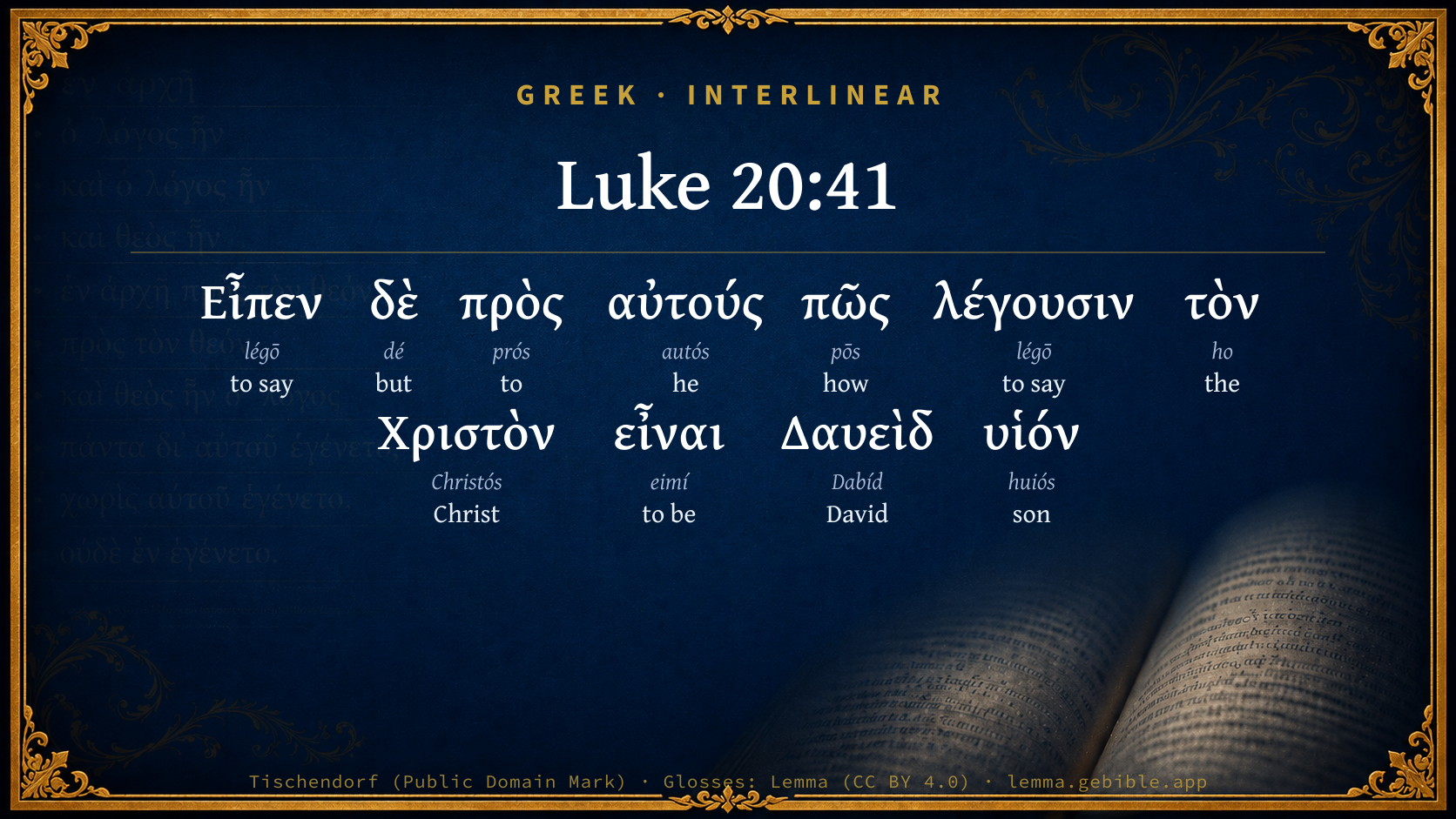
Greek (Tischendorf 8th ed.) Luke 20:41 appears in the Greek New Testament. The text above is from the Tischendorf 8th edition. Each word links to its Strong’s number and a concise gloss. Click any word for its full Thayer’s Greek Lexicon entry.
Download image
Cite this verse

Luke 20:41 (World English Bible). Public Domain. Lemma interlinear Bible study tool, https://lemma.gebible.app/v/luke/20/41.

Show BibTeX & RIS
BibTeX
RIS
English Translation
He said to them, "Why do they say that the Christ is David's son?
World English Bible · Public Domain
Download a study sheet

One document with this verse’s original text, its word-by-word gloss line, the meaning frame, cross-references with their text, attributed commentary, and full source and license credits — printable, and it pastes into notes with its structure intact.

This verse Autodidact and up

Study sheet (.html) Plain text (.txt)

A passage Seminary Student

Up to 50 verses in one chapter. A passage sheet keeps up to 6 commentary sources and 12 cross-references per verse, in the order this page ranks them, and says so on the sheet whenever that leaves anything out. Ask for a single verse and you get the Autodidact verse sheet above.

Everything on this page stays free to read, with no account — the sheet is a download of what is already on screen, not access to it.

Want to remove ads? Support Godless Engineer
Compare translations 3

The same verse in 3 English versions, stacked beneath the original-language interlinear above. Click any original word for its lexicon entry.

Each is an independent rendering of the whole verse — the interlinear is not word-aligned to these translations.

Highlighted words mark where these versions differ — a whole-verse word diff, not a word-by-word alignment.

  • World English Bible Public Domain
    He said to them, "Why do they say that the Christ is David's son?
  • King James Version Public Domain
    And he said unto them, How say they that Christ is David's son?
  • unfoldingWord Literal Text CC BY-SA 4.0
    Then he said to them, “How do they say that the Christ is the son of David?

unfoldingWord Literal Text — © unfoldingWord, licensed CC BY-SA 4.0. Word-aligned USFM3 via Door43 (git.door43.org/unfoldingWord/en_ult).

Versions to compare (up to 4)

3 of 4 selected

Show all 19 translations

Every available English version of this verse, each an independent rendering of the whole verse.

  • World English Bible Public Domain
    He said to them, "Why do they say that the Christ is David's son?
  • Berean Standard Bible Public Domain
    Then Jesus declared, “How can it be said that the Christ is the Son of David?
  • Majority Standard Bible Public Domain
    Then Jesus declared, “How can it be said that the Christ is the Son of David?
  • King James Version Public Domain
    And he said unto them, How say they that Christ is David's son?
  • American Standard Version (1901) Public Domain
    And he said unto them, How say they that the Christ is David's son?
  • Revised Version (1885) Public Domain
    And he said unto them, How say they that the Christ is David’s son?
  • Geneva Bible (1599) Public Domain
    Then sayd he vnto them, Howe say they that Christ is Dauids sonne?
  • Douay-Rheims (1899) Public Domain
    But he said to them: How say they that Christ is the son of David?
  • Young's Literal Translation Public Domain
    And he said unto them, `How do they say the Christ to be son of David,
  • Literal Standard Version CC BY-SA 4.0
    And He said to them, “How do they say the Christ is [the] son of David,
  • Unlocked Literal Bible CC BY-SA 4.0
    Jesus said to them, “How do they say that the Christ is David's son?
  • unfoldingWord Literal Text CC BY-SA 4.0
    Then he said to them, “How do they say that the Christ is the son of David?
  • Darby Bible Public Domain
    And he said to them, How do they say that the Christ is David's son,
  • World Messianic Bible Public Domain
    He said to them, “Why do they say that the Messiah is David’s son?
  • Webster's Bible Public Domain
    And he said to them, How say they that Christ is David's son?
  • Free Bible Version CC BY-SA 4.0
    Then Jesus asked them, “Why is it said that Christ is the son of David?
  • Bible in Basic English Public Domain
    And he said to them, Why do they say that the Christ is the son of David?
  • Text-Critical English NT CC BY 4.0
    Then Jesus said to them, “How can it be said that the Christ is the Son of David?
  • Tyndale New Testament (1534) Public Domain
    Then sayde he vnto them: how saye they that Christ is Davids sonne?

Literal Standard Version (2020), Covenant Press — licensed CC BY-SA 4.0. Text via the HelloAO Bible API (eBible.org). Unlocked Literal Bible (unfoldingWord) — licensed CC BY-SA 4.0. Text via the HelloAO Bible API (eBible.org). unfoldingWord Literal Text — © unfoldingWord, licensed CC BY-SA 4.0. Word-aligned USFM3 via Door43 (git.door43.org/unfoldingWord/en_ult). Free Bible Version, Dr. Jonathan Gallagher — licensed CC BY-SA 4.0. Text via the HelloAO Bible API (eBible.org).

Word by word

More ways to search: Search by grammar → Find every occurrence → Compare this word →

Practice this passage: Drill this verse → Learn its vocabulary →

About this verse

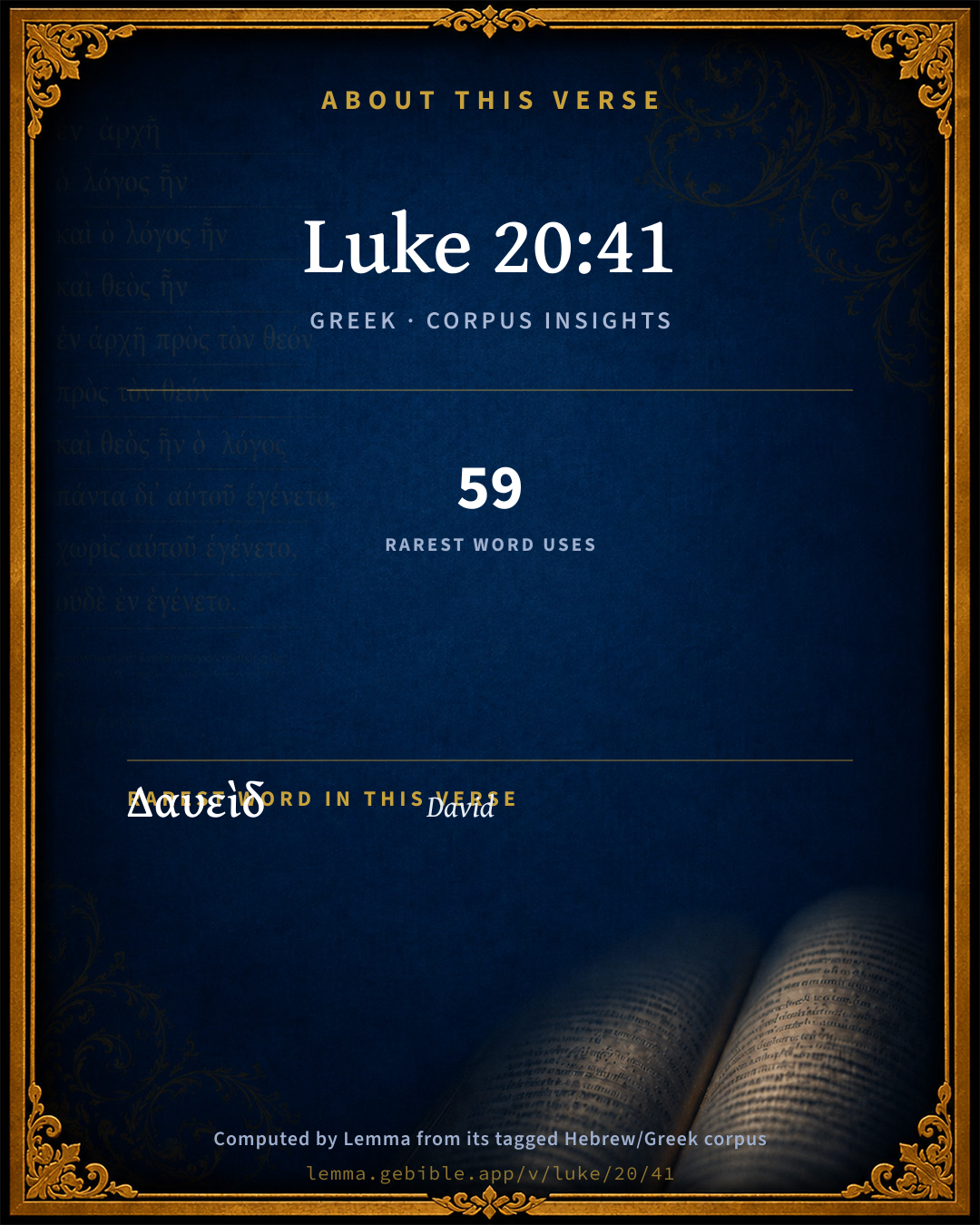
These counts appear in no published source. They are computed here, from the morphology-tagged text and Lemma’s own curated glosses. What Lemma adds →

11
words
10
distinct lemmas
Gospels
section

Shared distinctive vocabulary

Δαυεὶδ David G1138 occurs in 54 verses of the Greek New Testament. Also found in:

Repetition

A word recurs within this verse:

  • Εἶπεν to say G3004 ×2

Cross-references

13

Topical passages linked to Luke 20:41 in the Treasury of Scripture Knowledge — connected by theme and wording, ordered by reader-vote popularity; previews shown in the World English Bible.

  • Mark 12:35–37 Jesus responded, as he taught in the temple, "How is it that the scribes say that the Christ is the son of David?
  • Matthew 1:1 The book of the generation of Jesus Christ, the son of David, the son of Abraham.
  • Matthew 22:41–45 Now while the Pharisees were gathered together, Jesus asked them a question,
  • Isaiah 9:6–7 For to us a child is born, to us a son is given; and the government shall be on his shoulder: and his name shall be called Wonderful, Counselor, Mighty God, Everlasting Father, Prince of Peace.
  • Isaiah 11:1–2 There shall come forth a shoot out of the stock of Jesse, and a branch out of his roots shall bear fruit.
  • Jeremiah 23:5–6 Behold, the days come, says Yahweh, that I will raise to David a righteous Branch, and he shall reign as king and deal wisely, and shall execute justice and righteousness in the land.
  • Jeremiah 33:15–16 In those days, and at that time, will I cause a Branch of righteousness to grow up to David; and he shall execute justice and righteousness in the land.
  • Luke 18:38–39 He cried out, "Jesus, you son of David, have mercy on me!"
  • John 7:42 Hasn't the Scripture said that the Christ comes of the seed of David, and from Bethlehem, the village where David was?"
  • Acts 2:30 Therefore, being a prophet, and knowing that God had sworn with an oath to him that of the fruit of his body, according to the flesh, he would raise up the Christ to sit on his throne,
  • Romans 1:3–4 concerning his Son, who was born of the seed of David according to the flesh,
  • Jeremiah 33:21 then may also my covenant be broken with David my servant, that he shall not have a son to reign on his throne; and with the Levites the priests, my ministers.
  • Revelation 22:16 I, Jesus, have sent my angel to testify these things to you for the assemblies. I am the root and the offspring of David; the Bright and Morning Star."

Cross-references courtesy of OpenBible.info (CC BY 4.0).

Commentary

Notes on Luke 20:41 from classic Christian and Jewish commentators (each source and its license shown beneath its notes). The classic Christian expositions comment on the surrounding passage and are grouped to its opening verse, so a note may address several verses; the Jewish commentaries on the Tanakh (Rashi and others) are per-verse, so they appear only where the commentator wrote on this verse.

Lemma curates 59 commentaries, every one of them public domain or Creative Commons licensed, each selected and text-cleaned for this edition rather than reprinted as found. About our sources →

Jamieson, Fausset & Brown

Robert Jamieson, A. R. Fausset & David Brown

CHRIST BAFFLES THE PHARISEES BY A QUESTION ABOUT DAVID AND MESSIAH, AND DENOUNCES THE SCRIBES. (Luk 20:41-47)

said, &c.--"What think ye of Christ [the promised and expected Messiah]? Whose son is He [to be]? They say unto Him, The son of David. He saith unto them, How then doth David in spirit [by the Holy Ghost, Mar 12:36] call Him Lord?" (Mat 22:42-43). The difficulty can only be solved by the higher and lower--the divine and human natures of our Lord (Mat 1:23). Mark the testimony here given to the inspiration of the Old Testament (compare Luk 24:44).

Jamieson, Fausset & Brown — Commentary Critical and Explanatory on the Whole Bible (1871) — public domain (CC PDM 1.0). Text via the HelloAO Bible API.

The Biblical Illustrator

Joseph S. Exell

Luk_20:41-44

How say they that Christ is Davids son?

--

David, Christs ancestor

How say they that Christ is Davids son? Reading Davids history, we might exclaim, How, indeed! Son of David, Son of God: is not this like son of sin, son of grace? But if in the ancestor sin abounded, in the descendant grace much more abounded; and wisdom will inquire whether there is any relation between the superabounding grace and the abounding sin. We may think of Christ as a spiritual David, and we may think of David as a natural Christ, in this way: we may suppose a nature like Christs, but without what we know He possessed--a governing, harmonizing spirit of holiness. Imagine that. Imagine one whose natural endowments resembled Christs, but without the presiding spirit of holiness; then, we say, you would have another variety of Davids life--one more distinguished by nobleness, but one marked and saddened with many an act of dishonour. On the other hand, if you suppose David to become perfectly spiritual, to have that presiding holiness which Christ had; amongst all the ancient saints, there would have been none so like the Lord Jesus Christ, though still less than He. And thus it is that we have in David the nature of Christ, but without the Divine harmonic regulation; and we have in Christ the nature of David, but not now with the fleshly irregularities, not sullied by blots, not made the shame as well as in part the glory of Israel, but utterly free from evil. Christ is, then, considered as Davids descendant, the inheritor of his sensibilities, which shine in our Lord with completest lustre. He is also the inheritor of his contests; and our Lord overcomes with unvaried and complete victory those temptations which assaulted His ancestor. And by being at once the possessor of his sensibilities and the inheritor of his contests, He becomes the expiation of his sins. You will often find in the history of families that troubles accumulate, and as it were ripen, until they are laid upon some one individual; that on this individual rests the burden of evil which has been slowly accumulating. Now, you may have a case in which it seems that the burden of evil so rests that the man is borne down, crushed, and destroyed; and here you say, through the wickedness of his House, this, the last descendant, is utterly shaken and ruined. But you may also have a successful fight; the burden is on the back, but the strength is in the man. This is at once the most burdened and most powerful individual sprung from the race. It is he who, grappling with the evil in its fullest strength, shall retrieve the fortunes of the family. There are historic cases which illustrate that principle. In every family history evil goes on worsening, or good goes on strengthening; and we may have instances of men borne down by the evil, and other instances of men oppressed very greatly and yet triumphing, and so retrieving honour and fortune. Now our Lord Jesus Christ was a spiritual David; He shares--possesses, indeed, to the full--Davids sensibilities; He engages in the moral contests in which David so often failed; and He becomes the expiation of Davids sins--that is to say, He utterly annuls that power of sin so manifest and hateful in David, and brings in a strength of holiness which, as gradually diffused in the breasts of men, shall cause the instrument that else would be discordant to be a harp of joy--shall refine from earthly alloys that sacred metal which, as Gods gold, he will work up into the ornaments and harps of heaven. (T. T. Lynch.)

The Biblical Illustrator, edited by Joseph S. Exell (c. 1880s–1900s) — public domain. Text from a community e-Sword module.

Joseph Benson's Commentary

Luk 20:41-47. How say they that Christ is David’s son, &c. — For an elucidation of these verses, see on Mat 22:41-46; Mat 23:5-7; Mat 23:14; and Mar 12:35-40. David therefore calleth him Lord: how is he then his son — “This implies both the existence of David in a future state, and the authority of the Messiah over that invisible world into which that prince was removed by death. Else, how great a monarch soever the Messiah might have been, he could not have been properly called David’s Lord; any more than Julius Cesar could have been called the lord of Romulus, because he reigned in Rome seven hundred years after his death, and vastly extended the bounds of that empire which Romulus founded. Munster’s note on this text shows, in a very forcible manner, the wretched expedients of some modern Jews to evade the force of that interpretation of the one hundred and tenth Psalm, which refers it to the Messiah.” — Doddridge.

Joseph Benson's Commentary on the Old and New Testaments (1811–1818) — public domain. Text from a community e-Sword module.

The Preacher's Complete Homiletical Commentary

Joseph S. Exell (gen. ed.)

CRITICAL NOTES

Luk_20:41. To them.—I.e., to the scribes. Christ.—Rather, “the Christ” (R.V.). David’s son.—Cf. Joh_7:42.

Luk_20:42. David himself.—Psa_110:1. David was popularly supposed to be the author of the psalm. Even if he were not, the point on which Christ lays stress—viz., that in it Divine honours are paid to the Messiah, who was to come of David’s line, would be unaffected. Christ is not discussing the authorship of the psalm and affirming that it was written by David, but drawing the attention of the scribes to a statement in Scripture which was inconsistent with their belief that the Messiah would be a mere man. The Lord, etc.—I.e. “Jehovah said unto my Lord.”

Luk_20:43. Thy footstool.—R.V. “the footstool of thy feet.” The same tautology is in the original; but it is doubtful whether it was worth while to coin an awkward English phrase by such a literal translation.

Luk_20:44. How is He, then, his son?—The solution is given in Rom_1:3-4; Christ was the Son of David according to the flesh, and yet the eternal, pre-existent Son of God.

Luk_20:45. Then in the audience.—Rather, “and in the hearing” (R.V.).

Luk_20:46. Long robes.—Either an official dress or an exaggerated obedience to the law concerning dress (Num_15:38-40). Chief rooms.—Rather, “chief seats” (R.V.).

Luk_20:47. Devour widows’ houses.—Cf. 2Ti_3:6. For a show.—Rather “for a pretence” (R.V.). Damnation.—Rather, “condemnation” (R.V.).

MAIN HOMILETICS OF THE PARAGRAPH.—Luk_20:41-47

A Warning against False Guides.—The attempts to check our Lord’s activity, to betray Him into the expression of an opinion which might have been used against Him, and to cast ridicule upon His teaching, having failed, His adversaries withdrew from the contest. But He was not satisfied with having maintained His ground against them: He now carried the war into His enemies’ quarters.

I. He exposed the incompetency of the scribes and Pharisees as teachers (Luk_20:41-44).—They prided themselves on their skill in expounding and interpreting the Word of God, and He drew their attention to one of the most famous of the Messianic prophecies in the Old Testament, and asked them to solve the difficulty which, according to their principles of interpretation, it contained. Their dead monotheism had blinded them to the intimations given in Scripture of the Divine dignity of the Messiah, and consequently they could return no answer to the question, “How could David apply the term ‘Lord’ to one who was to be descended from him?” Yet the question was not asked merely in order to show that the Word of God contained passages which they could not explain. It was also calculated to stir them up to profounder reflection upon a truth which they had not fairly faced, and to remove one of their principal grounds of objection to the claims He made. For frequently in the course of His ministry they had protested against His assumption of Divine attributes and prerogatives. Their obstinate silence, however, when confronted with the fact that Divine dignity was ascribed in Scripture to the Messiah, clearly proved that deeply rooted prejudices filled their minds, and that, therefore, they were incapacitated for acting as teachers of spiritual truths.

II. He upbraids them with the moral corruption of their lives (Luk_20:45-47).—He judged it necessary to set the people on their guard against those whose religion was only a cloak for the worst vices, and who took advantage of the reverence which the simple-minded naturally have for all who wear the garb of piety, to deceive and defraud them. Hypocrisy, pride, and covetousness, are the three charges He makes against them. They affect a piety of the most exaggerated type, in order to conceal the real depravity of their characters. They are consumed with a desire to secure the applause of their fellows, instead of being any help or blessing to them. And, worst of all, they plunder the property of those whom they delude with their religious professions. The picture thus drawn reminds us of the ecclesiastical abuses in the worst time of the Middle Ages; but traces, at any rate, of the same vices will still be found. People are still so easily deluded by a profession of piety that it is a wonder that hypocrites are not even more numerous than they are. Popularity and notoriety are still too often sought after by ministers of religion; and silly women are still so inclined to run after those who profess an exaggerated piety that one cannot be surprised at seeing hypocrites and impostors occasionally flourishing at their expense.

SUGGESTIVE COMMENTS ON Luk_20:41-47

Luk_20:41-44. Christ’s First and His last Visit to The Temple.—Immeasurable is the contrast between the first and the last visit of our Lord to the Temple. The less may we leave unnoticed that the boy Jesus, who, once, by his questions, threw the teachers in Israel into astonishment, and by His answers often made them suddenly dumb, and the Messiah, who often, on the final day, both with questions and with answers, nobly maintains the field, exhibit really one and the same character. The Divine Sonship then presaged is now distinctly known.—Van Oosterzee.

Deeper Truths Unveiled.—Our Lord’s question does not, by the passage referred to, solve any difficulty, but rather throws out a difficulty which might arrest the attention of a scribe desirous to know the truth, such as would lead him to see there was something far higher and more mysterious about the Messiah than he supposed. Our Lord’s words were a clue by which faith might apprehend the secret nature of the kingdom. To reason they proved nothing; but to faith they opened lofty views of the Divine economy in the gospel, as far surpassing anything which reason could have inferred, or imagination could conceive, as heaven is above earth.—Williams.

The Present and The Future.

I. Surrounded by enemies, victorious over enemies—those whom He has now confuted to be suppressed, if still impenitent, by His almighty power.

II. Enthroned in the hearts of a few disciples, but to be exalted to God’s right hand, and have all authority in heaven and earth.

The Divine Nature of Christ.

I. Revealed to David.

II. Concealed from scribes and Pharisees.

III. Brought to light by Christ Himself.

IV. Accepted by His disciples.

Cf. Rev_22:16—Christ the offspring of David and yet the root from which David sprang; and Joh_8:58—the Son of Abraham, and yet before Abraham; also Rom_1:3—born of the race of David, “according to the flesh.”

Mysteries Revealed to Faith and Love.—Scripture contains mysteries which can never be solved by the wise and understanding, but which are revealed to those who love and obey Christ, and to them alone.

Luk_20:45-47.

I. Imposition practised upon society in general.

II. Usurpation of places of honour in synagogues.

III. Self-seeking ambition in social life.

IV. Making religion and philanthropy a cloak for the grossest frauds.

Luk_20:45. “In the audience of all the people.”—The minds of scribes and Pharisees were hardened against Christ: the hearts of the people were receptive of His word. To them, therefore, He addresses a word of warning against blind devotion to unworthy leaders.

Luk_20:46. “Beware of the scribes.”—Christ dwells upon the external guise of these self-appointed guides and rulers, as an indication of their inward character: “by their fruits ye shall know them.”

Luk_20:47. “Devour widows’ houses.”—I.e., either extort large sums of money from them, under some religious pretext, or take advantage of their position as directors of consciences to enjoy sumptuous feasts in the houses of their victims.

Cf. 2Ti_3:6. “Pretenders to holiness practise most upon women, who are less apt than men to see through their hypocrisy, and are easily inclined to love them on the ground of religion” (Chrysostom).

The Preacher's Complete Homiletical Commentary (gen. ed. Joseph S. Exell; Funk & Wagnalls, c. 1892) — public domain (pre-1929). A full-Bible homiletical/sermon-outline anthology covering 65 of 66 books (2 John is absent from the source module). Text from a community e-Sword module.

Lange's Commentary on the Holy Scriptures

4. Direct Controversy with the Pharisees on the part of Jesus (Luk_20:41-47)

(Parallel to Mat_22:41-46; Mat_23:14; Mar_12:35-40.)

41, 42And he said unto them, How say they that [the] Christ is David’s son? And [yet] David himself saith in the book of Psalms, The Lord said unto my Lord, Sit thou on my right hand, 43Till I make thine enemies thy footstool [lit., Till I place thine enemies as a footstool in thy feet]. 44David therefore calleth him Lord, how is he then [and how is he] his son? 45Then in the audience of all the people [while all the people were listening] he said unto his disciples,19 46Beware of the scribes, which desire [or, like] to walk in long robes, and love greetings in the markets, and the highest seats in the synagogues, and the chief rooms [places] at feasts; 47Which devour widows’ houses, and for a shew make long prayers: the same shall receive greater damnation [condemnation].

EXEGETICAL AND CRITICAL

Luk_20:41. And He said unto them.—The conflict between our Lord and His antagonists has here visibly reached a turning-point. Long enough has He answered their question; now He on His part takes the initiative, in order that the continued silence which He also maintained might not wear the guise of perplexity. From Matthew we perceive that the question was addressed to the collective body of the Pharisees here present (Mat_22:46): from Mark (Mar_12:35), that He therewith answers de facto, all their former invectives against Him; from Luke (comp. Luk_20:45), that our Lord handles the point in question with the greatest possible publicity. First did He put the enemy to flight: now He also on His part passes on the pursuit.

How say they.—Not in the sense of “How is it possible that they so speak?” but, “In what sense is this name given to the Messiah?” There is a distinction between the question which, Mat_16:13, is addressed to the disciples and that which is here addressed to the Pharisees. There our Lord inquires after their view as to His own person; here He speaks in general, entirely objectively, respecting the Christ, the object of their expectation. Luke, who gives the account with the utmost possible condensation, passes over the answer, “David’s Son,” in order to let the second question: καὶ αὐτός, &c., follow immediately upon the first.

Luk_20:42. And yet David himself saith.—That the Messiah was to be David’s Son was, it is true, not the universal (comp. Joh_7:27), but yet the most current, conception. It would be an entire perversion, however, of our Saviour’s intention in making the citation from David, to suppose (Weisse, Evang. Gesch. i. p. 168) that He wished thereby to controvert the conception in itself as an ungrounded or indifferent one, and to point to the truth that the Christ was rather to be called David’s Lord. No: He proceeds the rather with His enemies e concessis: the Messiah is David’s Son, an homage which we know that He often received without gainsaying. But now He proposes to them for solution the enigma, how David could yet speak of his Son at the same time as his Lord. To a generally acknowledged truth He attaches the conception of a higher, almost forgotten one.

In the Book of Psalms.—We seek in vain also in Luke for the very pregnant hint found in Matthew and Mark, that David spoke ἐν πνεύματι. Yet even according to his statement the Lord designates the 110th Psalm as a Messianic and Davidic one. In reference to the last point, critical investigation need not, it is true, be bound by this form of the citation, since our Saviour was evidently here not concerned with rendering critical judgment; but, on the other hand, a considerate criticism will certainly only venture upon sure grounds to deny the Davidic originality of this Psalm. But as respects the first point, we willingly acknowledge that it requires more courage than we possess in order, after so decided a declaration, to dispute the Messianic import of this psalm, which, moreover, is sufficiently established by Stier, Hoffman, Hengstenberg, and others. The question of the conception which the poet himself connected with the Scheblimini, does not lie within the sphere of our investigation; but that the poet in the element of the Spirit has greeted the Messiah as his Lord, can only be disputed by such expositors as, like those of the Jews, would place their authority above that of our Lord.

Luk_20:44. How is He his Son?—The question, how David in his Son—that is, one standing below himself—could at the same time honor his Lord, and therewith one who stood above him, is for us Christians scarcely a question any longer, since we have been initiated into the secret of the Divine nature of the Messiah. To the Jews, on the other hand, who expected a Messiah endowed with heavenly gifts and energies, and that as an earthly king, who was to be in a Theocratic and not in a metaphysical sense God’s Son, the matter was not so evident. It appears that the dead monotheism to which they surrendered themselves, especially after the exile, closed the eyes of most to the pregnant intimations which even in the Old Testament were here and there given respecting the supernatural descent and Divine dignity of the Messiah. The Lord will therefore show them that their whole Christology is imperfect and contradicts itself, so long as this integral element is wanting to it. He brings them to silence by pointing them to a sanctuary whose key they had lost. He wishes to stir them up to profounder reflection upon the truth which they had either never yet understood or had looked upon as blasphemy against God, and greeted with stones. In this way He will cure them once for all of their carnal expectations, and show them that He is in no wise minded to direct Himself according to their egoistic wishes. Even to-day the Jews are not in condition to answer satisfactorily the enigma proposed to them by the Great Master. Comp. the Ebionitic conception of the Messiah as θιλὸς ά̓νθρωπος, and the Christological confession which the Jew Trypho, in Justin Martyr, has given.

Luk_20:45. While all the people were listening.—Matthew (Luk_22:46) and Mark (Luk_12:37) communicate especially the impression which this last question of our Lord made; Luke visibly hurries on and communicates only a little of the extended warning which our Lord before leaving the temple uttered in reference to the Pharisees and scribes. Comp. Mat_23:1-36. In the little that he mentions of it he faithfully follows Mark, while he himself has already (Luk_11:37-54), preserved many a terrific “Woe to you” of the Lord in another connection. Respecting the historical accuracy of this arrangement see above (on Luk_17:20-37). Yet even from his compendious account (Luk_20:41-47), there appears so much as this: that our Lord, after He had proposed that question to the Pharisees upon which they are not even to this day clear, turns forever away from them, in order to address Himself to the more receptive people, and to warn them yet once again before His departure, against the blind leaders of the blind. Luke mentions particularly in addition (Luk_20:45) that our Lord addressed these warnings to His disciples (not exclusively the apostles, but a wider circle of His followers), yet coram populo.

Luk_20:46. Beware of the scribes.—The scribes, as the worst corrupters of the people among all the Pharisees, are here particularly brought forward and drawn from life; yet not according to their inward character, but according to their external guise. The Lord depicts their behavior: 1. In social life—the self-complacency with which they go about, ἐν στολαῖς, by which we have especially to understand the wide Tallith reaching down even to the feet; the value which they lay upon being universally greeted in the market, as well as upon extended titles; 2. in the Synagogues, where they lay claim to the πρωτοκαθεδρίας, which are allotted according to office and law; 3. in the house, where they transfer the controversy of rank for the place of honor from the Synagogue to the feast, and seek to dispute with others the first place; 4. in the sphere of philanthropy, where they devour widows’ houses while they pretend to advance their interests. Thus are hypocrisy, pride, and covetousness the three chief traits of which their portrait is composed. The last reproach “has reference primarily to the parasitism of the saints, who in long exercises of devotion sought to acquire influence with wealthy women and widows. The susceptibility of the weaker sex has been ever an object of the attention of devout friends of the world, and has never yet lost anything of its attractive power.”

Luk_20:47. Greater damnation.—This expression also appears to be an indirect proof that our Saviour on this occasion brought up more than only this little against the corrupters of the nation. It lay, however, in the character of the Hellenistic, Pauline Gospel of Luke, that He speaks with less particularity and detail than Matthew of the terrific judgment with which our Lord, on leaving the temple, shakes the dust from His feet. Here also holds good what has been observed of Mark: “For young Gentile Christians the great sermon of denunciation would have been in part unintelligible and in part too strong a food.”

DOCTRINAL AND ETHICAL

1. The last question which our Lord proposes to His enemies, is on His part the first step to an irrevocable farewell. He closes therewith for these His work as Teacher, by proposing to them yet once again to be pondered the great problem of His Theanthropic personality; what He will now hereafter address to them will no more be uttered to instruct them as Prophet, but in order to answer them as High-Priest and King.

2. The last question with which Jesus parts from His enemies affords the convincing proof that for true Christianity everything depends on a correct judgment of His glorious person. If conceptions of faith (Glaubensbegriffe) were really a matter of quite subordinate importance, and the assertion of rationalism were well founded—namely, that not the person but the doctrine and example of our Lord are the chief concern, He would scarcely have given Himself the trouble of encouraging the Pharisees to an investigation which in this case would have concerned a dry, exegetical, and abstract dogmatical question.

3. On this occasion it plainly appears that our Lord finds direct Messianic prophecies even in the book of Psalms; that He conceives David as with his vision into the future taken up into a region of the Spirit; that to Him the prophetic Scripture, as an inspired, was also a perfectly infallible, Scripture. So long as one regards the Old Testament with His eyes, neither the Nomistic over-valuation nor the Gnostic contempt for the first and largest half of the Scripture has a satisfactory prospect of finding great acceptance in His church.

4. There is no book in which our Lord in His last week has so lived as in the book of Psalms; an intimation which should not be neglected, particularly by suffering and striving Christians.

5. There exists a palpable similarity between the image which our Lord has here sketched of the Pharisees and scribes, and Clericalism, especially that of the middle ages. Altogether spontaneously, one in reading the expression, Luk_20:47, thinks of the presents which the church and the monkish orders knew how to get for themselves, of the traffic in masses for the dead, of the unhappy influence of the confessional. The value also which they laid upon sumptuous garments and places, of honor, the predilection for circumstantial titles, and the system of reciprocal deification and homage has all revived in many a form, and even to-day has not yet died out. But it would betray a very short-sighted view, if one knew how to find the traces of these perversions nowhere else than merely within the jurisdiction of Rome.

6. Severe, yet not too severe, is the tone where with our Lord prepares Himself to leave the sanctuary. Perhaps we may even rather wonder that He has not said more, than that He has not said less. Nor may it be overlooked that He does not attack the persons of His enemies in themselves, but their principles, whose working was so utterly ruinous; that He by no means denies the existence of individuals of a better mind among the scribes, but directs His eye principally to the spirit ruling among them; that the salt of His speech must here often more than elsewhere bite, if it was as yet even in any measure to stay the corruption. And may we not add that our Lord felt even for Himself the necessity of holding up to Himself the whole wickedness of His enemies once more in an overwhelming picture (Matthew 23); that He might be able to rise up with so much the more power and dignity, and take of the temple a leave which was to Him so indescribably melancholy?

7. Immeasurable is the contrast between the first and the last visit of our Lord to the temple. The less may we leave unnoticed that the boy Jesus, who once by His questions threw the teachers in Israel into astonishment, and by His answers often made them suddenly dumb, and the Messiah, who often on the final day, both with questions and with answers, nobly maintains the field, exhibit really one and the same character. The Divine Sonship then presaged is now distinctly known.

HOMILETICAL AND PRACTICAL

Even on the last day of His sojourn in the temple our Lord, as once at the wedding in Cana, has kept the best wine until the last.—The mystery of the Divinely human dignity of our Lord: 1. Revealed to David; 2. concealed from the Pharisees; 3. confirmed by Jesus; 4. brought for us to light.—The apparent discrepancies in the Scripture can be resolved for us only by Jesus Himself.—Sit Thou at My right hand: 1. The power of this word; 2. the right of this word; 3. the fruit of this word.—The devil in the garment of a scribe.—The holy duty of calling evil by its true name. Comp. Isa_5:20.—Esse quam videri.—How hypocrisy poisons: 1. Social; 2. married; 3. church, life.—The danger of a spiritless formalism in the ministers of religion.—Hypocrisy the sin which is always punished the hardest.

Starke:—Let him whom the people like to hear take note of the opportunity to do good.—Quesnel:—Proud, ambitious, avaricious teachers are more dangerous than the greatest sinners among the people.—Hedinger:—Pride a sign of hypocrisy, believe it certainly; if an angel came and were proud, believe he were a devil, Psa_131:1.—Widows can very easily be talked over and misled: they should therefore take good heed to themselves; but woe to him that misleads them. 2Ti_3:6.—Brentius:—It is an abomination above all abominations to deceive people and deprive them of their property under the guise of godliness.

Heubner:—Jesus here proposes no school-question, but the highest, weightiest question in life.—It is a serious duty to become clear as to the person of Jesus.—Christ is Lord absolutely of the whole human race, even David’s Lord; His Lordship is the highest and most blessed one; Christocracy would be the best constitution for us.—Arndt, Prediglen über das Leben Jesu, iv. p. Luke 251:—The weightiest article of faith in the Gospel. The Pharisees, with their ‘David’s Son’, yet only expressed in substance that Jesus was a man like all other men, only of royal race. It was only the half, not the whole truth. Even as our contemporaries, who also will let Christ pass for a remarkably gifted and virtuous character, and yet for a man such as they and all are. If Jesus had been really only that and nothing higher, He would have had to praise the answer of the Pharisees, and to say something like this: Ye are right; and I see that ye are very much at home in Moses and in the prophets. But our Lord is in nowise content with the answer; He demands, when the discourse is about the Messiah, a deeper penetration into the declarations of the Scripture, and into the character of His person. Must He, therefore, if God already calls Him Lord, even before He was born, not be infinitely more than David’s Son—than a mere man?—Palmer:—There is, according to this inquiry, only one truth for our faith; for a living faith in God, in a providence, immortality, &c., is impossible without a knowledge of Christ.—Fuchs:—What think ye of Christ? In that name there is implied that He is: 1. The greatest Prophet; 2. the true High-Priest; 3. the eternal King.—Otto:—Christ, David’s Lord and Son.—Moll:—What think ye of Christ, whose Son is He? 1. A question of life, which stands in the centre of all moral problems; 2. a question of conscience, which lays hold of the personal life in its deepest root; 3. a question of faith, which finds its solution only upon the soil of revelation.

Footnotes:

[19]Luk_20:45.—Πρὸς αὐτούς, to which Tischendorf gives the preference, [also Alford,] has not other authorities for it than Q. [As an ecclesiastical lection begins here, Alford explains the Recepta as having arisen very early from the wish to specify αὐτούς. But it is strange that only a single authority should have retained the true reading.—C. C. S.]

Lange's Commentary on the Holy Scriptures (Critical, Doctrinal, and Homiletical), ed. John Peter Lange, English translation edited by Philip Schaff (1864–1880) — public domain. Text from a community e-Sword module.

Godbey's Commentary on the New Testament

William B. Godbey

CHRIST THE SON OF DAVID

Mar 12:35-37; Luk 20:41-44; Mat 22:41-46. “And the Pharisees being assembled, Jesus asked them, saying, What do you think concerning the Christ? Whose Son is He? They say to Him, The Son of David. He says to them, How does David in the Spirit call Him Lord, saying, ‘The Lord said unto my Lord, Sit Thou on My fight hand, until I make Thy enemies Thy footstool? [Psa 110:1.] If therefore David calls Him Lord, how is He his Son? And no one answered Him a word, neither did any one from that day dare to ask Him anything.” Whereas on many occasions hitherto our Lord so dumfounded all of His critics as to silence all batteries, now we have really reached the finale of all their quizzical assaults against Him, vainly hoping to capture some remark dropped from His lips. Any other man in all the ages would doubtless have suffered more or less embarrassment, and probably entanglement, if thus beset from day to day by capricious, hostile critics, all combined, their wits under heaviest contribution, to entangle Him if possible. Amid all He is perfectly tranquil, and proves utterly imperturbable, by all the powers of earth and hell, throughout all the vicissitudes of His ministry, arrest, arraignment, and suffering. We see here they readily respond that Christ is the Son of David; but why he calls Him Lord, none of them can answer. This is plain and simple, setting forth in this terse manner His humanity and Divinity, the former being the Son of David, and the latter his Lord.

William B. Godbey, Commentary on the New Testament (1896–1900) — public domain. Text from a community e-Sword module.

Tyndale Open Study Notes

Tyndale Open Resources

20:41-44 Having silenced his opponents, Jesus took the offensive in challenging the religious leaders’ concept of the Messiah.

20:41 The Old Testament predicted that the Messiah would be a descendant of David (see study note on 18:38).

Tyndale Open Study Notes — © Tyndale Open Resources, licensed CC BY-SA 4.0. Text via the HelloAO Bible API.

Meyer's Critical & Exegetical Commentary

Heinrich August Wilhelm Meyer

Luk_20:41-44. See on Mat_22:41-46; Mar_12:35-37. εἶπε δὲ πρὸς αὐτ.] to the scribes, Luk_20:39 f., and indeed (otherwise Matthew and Mark) immediately after what is before related. Without reason, Grotius says: De illis, as Luk_20:19.

Meyer — Critical and Exegetical Commentary on the New Testament — English translation by Peter Christie, edited by Frederick Crombie (T&T Clark, 1880) — public domain. Text from a community e-Sword module.

Expositor's Greek Testament

ed. W. Robertson Nicoll

Luk 20:41-44 . The counter question (Mat 22:41-46 , Mar 12:35-37 ). Lk., who had given something similar at an earlier stage (Luk 10:25-37 ), omits the question of the scribe concerning the great commandment, which comes in at this point in Mt. (Mat 22:34-40 ) and Mk. (Mar 12:28-34 ), retaining only its conclusion (in Mk.), which he appends to the previous narrative (Luk 20:40 ).

Luk 20:41 . πρὸς αὐτούς , to them, i.e. , the representatives of the scribes mentioned in Luk 20:39 . In Mt. the Pharisees are addressed, in Mk. the audience is the people, and the question is about the scribes as interpreters. πῶς λέγουσι , how do they say? (not λέγετε ). The controversial character of the question is not made clear in Lk.

The Expositor's Greek Testament, edited by W. Robertson Nicoll (1897–1910) — public domain. Text from a community e-Sword module.

Godet's Commentaries

Frédéric Louis Godet

6. The Question of Jesus: Luk 20:41-44.

Vers. 41-44. Matthew and Mark place here the question of a scribe on the great commandment of the law. This question was suggested to the man, as we see from Mar 12:28, by the admiration which filled him at the answers which he had just heard. According to Matthew, he wished yet again to put the wisdom of Jesus to the proof (πειράζων αὐτόν, Mat 22:35). Either Luke did not know this narrative, or he omitted it because he had related one entirely similar, Luk 10:25 et seq.

At the close of this spiritual tournament, Jesus in His turn throws down a challenge to His adversaries. Was it to give them difficulty for difficulty, entanglement for entanglement? No; the similar question which He had put to them, Luk 20:4, has proved to us that Jesus was acting in a wholly different spirit. What, then, was His intention? He had just announced His death, and pointed out the authors of it (parable of the husbandmen). Now, He was not ignorant what the charge would be which they would use against Him. He would be condemned as a blasphemer, and that for having called Himself the Son of God (Joh 5:18; Joh 10:33; Mat 26:65). And as He was not ignorant that before such a tribunal it would be impossible for Him to plead His cause in peace, He demonstrates beforehand, in presence of the whole people, and by the Old Testament, the divinity of the Messiah, thus sweeping away from the Old Testament standpoint itself the accusation of blasphemy which was to form the pretext for His condemnation. The three Syn. have preserved, with slight differences, this remarkable saying, which, with Luk 10:21-22 and some other passages, forms the bond of union between the teaching of Jesus in those Gospels, and all that is affirmed of His person in that of John. If it is true that Jesus applied to Himself the title of David’s Lord, with which this king addressed the Messiah in Psalms 110, the consciousness of His divinity is implied in this title as certainly as in any declaration whatever of the fourth Gospel.

According to Luke, it is to the scribes, according to Matthew (Mat 22:41), to the Pharisees, that the following question is addressed. Mark names no one. The three narratives differ likewise slightly in the form of the question: “How say they?” (Luke); “How say the scribes?” (Mark.) In Matthew, Jesus declares to the Pharisees at the same time the doctrine of the Davidic sonship of the Messiah,—very natural diversities if they arise from a tradition which had taken various forms, but inexplicable if they are intentional, as they must be, supposing the use of one and the same written source. The Alex. read: “For he himself...;” that is to say: “there is room to put this question; for...” The Byz.: “And (nevertheless) he himself hath said...” Luke says: in the book of Psalms; Matthew: by the Spirit; Mark: by the Holy Spirit.

The non-Messianic explanations of Psalms 110 are the masterpiece of rationalistic arbitrariness. They begin by giving to וד לְדָתִהךֵ meaning: “addressed to David,” instead of: “composed by David,” contrary to the uniform sense of the לauctoris in the titles of the Psalms, and that to make David the subject of the Psalm, which would be impossible if he were its author (Ewald). And as this interpretation turns out to be untenable, for David never was a priest (Luk 20:4: “Thou art a priest for ever”), they transfer the composition of the Psalm to the age of the Maccabees, and suppose it addressed by some author or other to Jonathan, the brother of Judas Maccabeus, of the priestly race. This person, who never even bore the title of king, is the man whom an unknown flatterer is supposed, according to Hitzig, to celebrate as seated at Jehovah’s right hand! It is impossible to cast a glance at the contents of the Psalm without recognising its directly Messianic bearing: 1. A Lord of David; 2. Raised to Jehovah’s throne, that is to say, to participation in omnipotence; 3. Setting out from Zion on the conquest of the world, overthrowing the kings of the earth (Luk 20:4), judging the nations (Luk 20:5), and that by means of an army of priests clothed in their sacerdotal garments (Luk 20:3); 4. Himself at once a priest and a king, like Melchisedec before Him. The law, by placing the kingly power in the tribe of Judah, and the priesthood in that of Levi, had raised an insurmountable barrier between those two offices. This separation David must often have felt with pain. Uzziah attempted to do away with it; but he was immediately visited with punishment. It was reserved for the Messiah alone, at the close of the theocracy, to reproduce the sublime type of the King-Priest, presented at the date of its origin in the person of Melchisedec. Comp. on the future reunion of those two offices in the Messiah, the wonderful prophecy of Zec 6:9-15. Psalms 110, besides its evidently prophetic bearing, possesses otherwise all the characteristics of David’s compositions: a conciseness which is forcible and obscure; brilliancy and freshness in the images; grandeur and richness of intuition. It was from the words: Sit Thou at my right hand, that Jesus took His answer to the adjuration of the high priest in the judgment-scene (Mat 26:64): “Henceforth shall ye see the Son of man sitting on the right hand of power.” With what a look of severity, turned upon His adversaries at the very moment when He quoted this Psalm before all the people, must He have accompanied this declaration of Jehovah to the Messiah: “until I make Thine enemies Thy footstool.”

To answer satisfactorily the question of Luk 20:44, put by Jesus, it was absolutely necessary to introduce the idea of the divinity of the Messiah, which is the soul of the entire Old Testament. Isaiah called the Son born to us: Wonderful, mighty God (Isa 9:5). Micah had distinguished His historic birth at Bethlehem, and His pre-historic birth from everlasting (Luk 20:2). Malachi had called the Messiah, “Adonai coming to His temple” (Luk 3:1). There was in the whole of the Old Testament, from the patriarchal theophanies down to the latest prophetic visions, a constant current toward the incarnation as the goal of all those revelations. The appearance of the Messiah presents itself more and more clearly to the view of the prophets as the perfect theophany, the final coming of Jehovah. No doubt, since the exile, exclusive zeal for monotheism had diverted Jewish theology from this normal direction. This is the fact which Jesus sets before its representatives in that so profound argument of His, Joh 10:34-38. It was exactly in this way that Rabbinical monotheism had become petrified and transformed into a dead theism. Jesus has taken up the broken thread of the living theology of the prophets. Such is the explanation of His present question. To resolve it, the scribes would have required to plunge again into the fresh current of the ancient theocratic aspirations: The descendant promised to David (2Sa 7:16) will be nothing less than Adonai coming to His temple (Mal 3:1); to His human birth at Bethlehem there corresponds His eternal origin in God (Mic 5:2): such only is the reconciliation of the two titles son and Lord of David given to the person of the Messiah.

The meaning and appropriateness of Jesus’ question appear to us equally manifest. It has been sought, however, to explain it otherwise.

1. Some think that Jesus argues, from the fact that Messiah is to be David’s Lord, to prove that He cannot be his descendant. For it is incongruous, say they, that an ancestor should call his descendant his Lord. According to this meaning, it must be admitted that Jesus Himself knew very well that He did not descend from David, although among the people they ignorantly gave Him the title son of David, because they took Him for the Messiah. The Christians, it is said, yielded at a later period to the popular Jewish instinct; and to satisfy it invented the two genealogies which seem to establish the Davidic descent of Jesus (Schenkel). But, (a) In this case, Jesus would have acted, as Keim observes, in a manner extremely imprudent, by Himself raising a question which more than any other might have prejudiced His standing with the people. “The character son of David could not be wanting to Him who thus publicly made it a subject of discussion” (Keim). (b) It would not only be the forgers, the authors of the two genealogical documents preserved by Matthew and Luke, who had admitted and propagated this late error; it would also mean the author of the Apocalypse (Luk 22:16: “I am the root and offspring of David”). St. Paul himself would be guilty,—he who should least of all have been inclined to make such a concession to the Judaizing party (Rom 1:3: “of the seed of David according to the flesh;” 2Ti 2:8: “of the seed of David”). The whole Church must thus have connived at this falsehood, or given in to this error, and that despite of the express protestation of Jesus Himself in our passage, and without any attempt on the part of our Lord’s adversaries to show up the error or falsehood of this assertion! (c) The argument thus understood would prove far too much; the rationalists themselves should beware of ascribing to Jesus so gross a want of logic as it would imply. If it was dishonouring to David to call any one whatsoever of his descendants his Lord, why would it be less so for him to give this title to that descendant of Abraham who should be the Messiah? Was not the family of David the noblest, the most illustrious of Israelitish families? The reasoning of Jesus would logically end in proving that the Messiah could not be an Israelite, or even a man! (d) Jesus would thus have put Himself in contradiction to the whole Old Testament, which represented the Christ as being born of the family of David (2 Samuel 7; Psa 132:17; Isa 9:5-6). (e) Luke would also be in contradiction with himself, for he expressly makes Jesus descend from David (Luk 1:32; Luk 1:69). (f) How, finally, could Jesus have contented Himself with protesting so indirectly against this attribute son of David ascribed to Him by the multitude, if He had known that He did not possess it?

2. According to M. Colani also, Jesus means that the Messiah is not the son of David, but in this purely moral sense, that He is not the heir of his temporal power; that His kingdom is of a higher nature than David’s earthly kingdom. But, (a) It is wholly opposed to the simple and rational meaning of the term son of David, not to refer it to sonship properly so called, but to make it signify, a temporal king like David. (b) It would be necessary to admit that the evangelist did not himself understand the meaning of this saying, or that he contradicts himself,—he who puts into the mouth of the angel the declaration, Luk 1:32: “The Lord shall give unto Him the throne of His father David” (comp. Luk 1:69).

3. Keim admits the natural meaning of the term Son. He places the notion of spiritual kingship not in this term, but in that of David’s Lord. “The physical descent of Jesus from David is of no moment; His kingdom is not a repetition of David’s. From the bosom of the heavenly glory to which He is raised, He bestows spiritual blessings on men. None, therefore, should take offence at His present poverty.” But, (a) If that is the whole problem, the problem vanishes; for there is not the least difficulty in admitting that a descendant may be raised to a height surpassing that of his ancestor. There is no serious difficulty, if the term Lord does not include the notion of a sonship superior to that which is implied in the title son of David. (b) So thoroughly is this our Lord’s view, that in Mark the question put by Him stands thus: “David calls Him his Lord; how, then, is He his son?” In Keim’s sense, Jesus should have said: “David calls Him his son; how, then, is He his Lord?” In the form of Matthew (the Gospel to which Keim uniformly gives the preference, and to which alone he ascribes any real value), the true point of the question is still more clearly put: “Whose son is He?” The problem is evidently, therefore, the Davidic sonship of Jesus, as an undeniable fact, and yet apparently contradictory to another sonship implied in the term David’s Lord. Finally, (c) If it was merely the spiritual nature of His kingdom which Jesus meant to teach, as Colani and Keim allege in their two different interpretations, there were many simpler and clearer ways of doing so, than the ambiguous and complicated method which on their supposition He must have employed here. The question put by Jesus would be nothing but a play of wit, unworthy of Himself and of the solemnity of the occasion.

4. According to Volkmar, this whole piece is a pure invention of Mark, the primitive evangelist, who, by putting this question in the mouth of Jesus, skilfully answered this Rabbinical objection: Jesus did not present Himself to the world either as David’s descendant or as His glorious successor; consequently He cannot be the Messiah, for the O. T. makes Messiah the son of David. Mark answered by the mouth of Jesus: No; it is impossible that the O. T. could have meant to make Messiah the son of David, for according to Psalms 110 the Messiah was to be his Lord. But, (a) It would follow therefrom, as Volkmar acknowledges, that in the time of Jesus none had regarded Him as the descendant of David. Now the acclamations of the multitude on the day of Palms, the address of the woman of Canaan, that of Bartimeus, and all the other like passages, prove, on the contrary, that the Davidic sonship of Jesus was a generally admitted fact. (b) How was it that the scribes never protested against the Messianic pretensions of Jesus, especially on the occasion of His trial before the Sanhedrim, if His attribute son of David had not been a notorious fact? (c) The Davidic descent of the family of Jesus was so well known, that the emperor Domitian summoned the nephews of Jesus, the sons of Jude His brother, to Rome, under the designation of sons of David. (d) St. Paul, in the year 59, positively teaches the Davidic descent of Jesus (Rom 1:3). And Mark, the Pauline (according to Volkmar), denied to Jesus this same sonship in 73 (the date, according to Volkmar, of Mark’s composition), by a reasoning ad hoc! Still more, Luke himself, that Pauline of the purest water, reproduces Mark’s express denial, without troubling himself about the positive teaching of Paul! Volkmar attempts to elude the force of this argument by maintaining that Paul’s saying in the Epistle to the Romans is only a concession made by him to the Judeo-Christian party! To the objection taken from the genealogy of Jesus (Luk 3:23 et seq.), Volkmar audaciously replies that Luke mentions it only to set it aside (“um sie zu illudiren”). And yet this same Luke, as we have seen, expressly asserts this sonship (Luk 1:32; Luk 1:69). (e) Let us add a last discovery of Volkmar’s: Matthew found it useful, in the interest of the Judeo-Christian party, to accept in spite of Mark the idea of the Davidic descent of Jesus as he found it contained in Luke (in that genealogical document which Luke had quoted only to set aside)! Only, to glorify Jesus the more, he substituted at his own hand, for the obscure branch of Nathan (Luke’s genealogy), the royal and much more glorious line of Solomon (Matthew’s).

Thus our sacred writers manipulate history to suit their interest or caprice! Instead of the artless simplicity which moves us in their writings, we find in them device opposed to device, and falsehood to falsehood! Be it ours to stand aloof from such saturnalia of criticism!

Our interpretation, the only natural one in the context, is confirmed: (1) By those expressions in the Apocalypse: the root and offspring of David,—expressions which correspond to those of Lord and son of this king; (2) by Paul’s twofold declaration, “made of the seed of David according to the flesh [David’s son], and declared to be the Son of God with power since His resurrection, according to the spirit of holiness [David’s Lord];” (3) by the silence of Jesus at the time of His condemnation. This question, put in the presence of all the people to the conscience of His judges, had answered beforehand the accusation of blasphemy raised against Him. Such was the practical end which Jesus had in view, when with this question He closed this decisive passage of arms.

Frédéric Louis Godet — Commentaries on Luke, John, Romans, and 1 Corinthians — English translation (T&T Clark, Edinburgh, 1870s–1890s) — public domain. Text from a community e-Sword module.

Geneva Bible (1599)

Geneva Bible translators

Christ is so the son of David according to the flesh, that he is also his Lord (because he is the everlasting son of God) according to the spirit.

Geneva Bible (1599) marginal notes — public domain. Text via Bolls.life.

Adam Clarke's Commentary

Verse 41. How say they] See the note on Mt 22:42-46.

Adam Clarke's Commentary on the Bible (1810–1826) — public domain. Text from a community e-Sword/MySword module.

Ellicott's Commentary for English Readers

(41, 42) How say they that Christ is David’s son?—Better, that the Christ. See Notes on Mat_22:41-46; Mar_12:35-37. The implied subject of the verb is clearly, as in St. Mark, “the scribes.” St. Luke agrees with St. Mark in not giving the preliminary question, “What think ye of Christ? . . ,” which we find in St. Matthew.

A Bible Commentary for English Readers, edited by Charles John Ellicott (1878–1897) — public domain. Text from a community e-Sword module.

The Cambridge Bible for Schools and Colleges

gen. ed. J. J. S. Perowne

41-47. The Scribes, Sadducees, and Pharisees reduced to a Confession of Ignorance.

41. How say they that Christ is Davids son?] Rather, the Christ. See Joh_7:42; Psa_132:11; Jer_23:5; Mic_5:2.

The Cambridge Bible for Schools and Colleges (gen. ed. J. J. S. Perowne; Cambridge University Press, 1878–1918) — public domain. Text from a community e-Sword module.

John Gill's Exposition

Which devour widows' houses,.... As the characters of them, in the preceding verse, expose their pride, this shows their avarice; they were very voracious and cruel; they did not spare widows, but devoured their substance:

and for a show make long prayers; to cover their wickedness, pretending great devotion and religion;

the same shall receive greater damnation: than openly profane sinners; doing such wickedness under a cloak of religion, will aggravate their condemnation; See Gill on Mat 23:14.

Next: Luke Chapter 21

John Gill's Exposition of the Whole Bible (1746–1763) — public domain (CC PDM 1.0). Text via the HelloAO Bible API.

Trapp's Complete Commentary

John Trapp

40 And after that they durst not ask him any question at all.

41 And he said unto them, How say they that Christ is David’s son?

Ver. 41. See Mat 22:42; Mar 12:35.

John Trapp, A Commentary or Exposition upon All the Books of the Old and New Testament (1647–1656) — public domain. Text from a community e-Sword module.

Matthew Poole's English Annotations

The answer had been easy if the scribes and Pharisees, who (Matthew saith) were there also, had owned Christ to be the Son of God. But this they did not own, and so, as Mat 22:46 tells us,

No man was able to answer him a word, neither durst any man from that day forth ask him any more questions. Thus Christ nonplussed all his adversaries.

Matthew Poole's English Annotations on the Holy Bible (1683–1685) — public domain. Text from a community e-Sword/MySword module.

The Pulpit Commentary

Vers. 41-44. The question rejecting Christs being David"s Son.

And he said unto them, How say they that Christ is David"s Son? St. Matthew gives us more details of what went before the following saying of Jesus in which he asserts the Divinity of Messiah. Jesus asked the Pharisees, "What think ye of Christ? whose Son is he? They say unto him, The Son of David. He saith unto them, How then doth David in spirit call him Lord, saying, The Lord said unto my Lord," etc.? (Mat_22:42-44) This is one of the most remarkable sayings of our Lord reported by the synoptists; in it he distinctly claims for himself Divinity, partieipation in omnipotence. Unmistakably, lately, under the thinnest veil of parable, Jesus had told the people that he was Messiah For instance, his words in the parable of the "wicked husbandmen;" in the parable of "the pounds;" in his late acts in the temple driving out the sellers and buyers, allowing the children in the temple to welcome him with Messianic salutation, receiving as Messiah the welcome of the Passover pilgrims and others on Palm Sunday as he entered Jerusalem. In his later parables, too, he had with startling clearness predicted his approaching violent death. Now, Jesus was aware that the capital charge which would be brought against him would be blasphemy, that he had called himself, not only the Messiah, but Divine, the Son of God. (Joh_5:18 Joh_10:33 Mat_26:65) He was desirous, then, before the end came, to show from an acknowledged Messianic psalm that if he was Messiah and unquestionably a large proportion of the people received him as such he was also Divine. The words of the psalm (Ps 110) indisputably show this, viz. that the coming Messiah was Divine. This, he pointed out to them, was the old faith, the doctrine taught in their own inspired Scriptures. But this was not the doctrine of the Jews in the time of our Lord. They, like the Ebionites in early Christian days, expected for their Messiah a mere "beloved Man. " It is most noticeable that the Messianic claim of Jesus, although not, of course, conceded by the scribes, was never protested against by them. That would have been glaringly unpopular. So many of the people, we know, were persuaded of the truth of these pretensions; Jesus had evidently the greatest difficulty to stay the people"s enthusiasm in his favour. What the scribes persistently repelled, and in the end condemned him for, was his assertion of Divinity. In this passage he shows from their own Scriptures that whoever was Messiah must be Divine. He spoke over and over again as Messiah; he acted with the power and in the authority of Messiah; he allowed himself on several public occasions to be saluted as such: who would venture, then, to question that he was fully conscious of his Divinity? This conclusion is drawn, not from St. John, but exclusively from the recitals of the three synoptists.

The Pulpit Commentary (1880–1919), ed. H.D.M. Spence-Jones & Joseph S. Exell — public domain. Text from a community e-Sword module.

John Wesley's Explanatory Notes

Matt. xxii, 41; Mark xii, 35.

John Wesley, Explanatory Notes Upon the Whole Bible (1754–1765) — public domain. Text via the GEBible commentary corpus.

McGarvey & Pendleton's Commentaries

J. W. McGarvey

J. W. McGarvey's The Fourfold Gospel [CIX. D. Jesus' Question].

CIX. JEWISH RULERS SEEK TO ENSNARE JESUS. (Court of the Temple. Tuesday, April 4, A. D. 30.) Subdivision D. JESUS' QUESTION WHICH NONE COULD ANSWER. aMATT. XXII. 41-46; bMARK XII. 35-37; cLUKE XX. 41-44.

a41 Now while the Pharisees were gathered together, bas he taught in the temple, aJesus asked them a question [They had questioned him seeking to expose his lack of wisdom, but the question of Jesus was devoid of retaliation. It was asked to teach a most important lesson], b35 And Jesus answered and said, a42 saying, cunto them, aWhat think ye of the Christ? whose son is he? They say unto him, The son of David. [The answer was true, but it was not all the truth as the Scriptures themselves showed. And this additional truth was what the opposers of Jesus needed to learn.] 43 He saith unto them, bHow say cthey bthe scribes that the Christ is the son of David? cDavid's son? aHow then doth David in the Spirit call him Lord, c42 For David himself saith bsaid in the Holy Spirit, cin the book of Psalms, asaying, bThe Lord said unto my Lord, Sit thou on my right hand, Till I make thine enemies the footstool of thy feet. aTill I make thine enemies underneath thy feet? 45 If b37 David himself therefore athen calleth him Lord, how band whence is he his son? [The quotation is from Psa_110:1. The context here shows that the rabbis of that day accepted this Psalm as written by David and as Messianic in meaning. Since then the Jews have denied that the Psalm is Messianic, and that it was written by David; some saying that Abraham, and others that Hezekiah, wrote it. This Psalm speaks of the Messiah as the Lord of David, and other Scriptures call him David's son. So also the Scriptures describe Christ as conquering yet suffering, as divine yet human, as dying yet living, as judged yet judging, etc. The Jewish rulers seem able to grasp only one side of the character of Christ as revealed either in his life or in the Scriptures, and hence they [605] stumbled.] a46 And no one was able to answer him a word, neither durst any man from that day forth ask him any more questions. bAnd the common people heard him gladly. [By all their questioning, the Jews had not been able to weaken public confidence in Christ.]

[FFG 605-606]

J. W. McGarvey (with Philip Y. Pendleton), Commentaries on the New Testament (The Fourfold Gospel, 1914; Acts; and the epistles) — public domain. Text from a community e-Sword/MySword module.

The People's New Testament

B. W. Johnson

41–44. How say they that Christ is David's son? See notes on Matt. 22:41–46. Compare Mark 12:35–37.

B. W. Johnson's The People's New Testament with Notes (1889–1891) — public domain. Electronic text from the Christian Classics Ethereal Library (CCEL) ThML edition.

unfoldingWord translationNotes

Door43 World Missions Community

General Information:

Jesus asks the scribes a question.

How do they say ... son?

"Why do they say ... son?" Jesus uses a question to make the scribes think about who the Messiah is. AT: "Let's think about them saying ... son." or "I will talk about them saying ... son" (See: Rhetorical Question)

they say

The prophets, the religious rulers, and the Jewish people in general knew that the Messiah was the son of David. AT: "everyone says" or "people say" (See: Assumed Knowledge and Implicit Information)

David's son

"King David's descendant." The word "son" is used here to refer to a descendant. In this case it refers to the one who would reign over God's kingdom. (See: Synecdoche)

The Lord said to my Lord

This is a quotation from the book of Psalms which says "Yahweh said to my Lord." But the Jews stopped saying "Yahweh" and often said "Lord" instead. AT: "The Lord God said to my Lord" or "God said to my Lord"

my Lord

David was referring to the Christ as "my Lord."

Sit at my right hand

To sit at the "right hand of God" is a symbolic action of receiving great honor and authority from God. AT: "Sit in the place of honor beside me" (See: Symbolic Action)

until I make your enemies your footstool

The Messiah's enemies are spoken of as if they were furniture on which he would rest his feet. This was an image of submission. AT: "until I make your enemies like a footstool for you" or "until I conquer your enemies for you" (See: Metaphor)

David therefore calls the Christ 'Lord'

In the culture of that time, a father was more respected than a son. David's us of the title 'Lord' for the Christ implies that he was greater than David. (See: Assumed Knowledge and Implicit Information)

so how is he David's son?

"so how can the Christ be David's son?" This can be a statement. AT: "this shows that the Christ is not merely David's descendant" (See: Rhetorical Question)

translationWords

Christ

David

son

psalm

lord

right hand

adversary

footstool

unfoldingWord translationNotes — © Distant Shores Media and the Door43 World Missions Community, licensed CC BY-SA 4.0. Source: git.door43.org/Door43/en_tn.

Bengel's Gnomon

Johann Albrecht Bengel

[41. Πῶς λέγουσι, how (in what sense) say they) viz. Commentators, Doctors.—V. g.]

Bengel's Gnomon of the New Testament — English translation (T&T Clark, Edinburgh, 1860) — public domain. Text from a community e-Sword module.

Cambridge Greek Testament for Schools and Colleges

41–47. THE SCRIBES, SADDUCEES, AND PHARISEES REDUCED TO A CONFESSION OF IGNORANCE

41. τὸν Χριστόν. ‘The Christ.’ See Joh 7:42; Psa 132:11; Jer 23:5; Mic 5:2.

Cambridge Greek Testament for Schools and Colleges (Cambridge University Press, 1896; 21 vols, various authors incl. Carr, Maclear, Plummer, Farrar, Lumby, Moule, M. R. James, Simcox) — public domain. Text from a community e-Sword module.

Alford’s Greek Testament

Henry Alford

41-44.] Question respecting Christ and David. Mat 22:41-46: Mar 12:35-37, where see notes. Luke omits the question of the lawyer, which occurred immediately on the gathering together of the Pharisees after the last incident. This question of our Lord seems to have followed close on that, which (and not that in vv. 27 ff. here) was their last to Him, Mar 12:34.

41.] πρὸς αὐτούς, i.e. the Scribes. The same thing is signified by πῶς λέγουσιν οἱ γρ. in Mark. In Matt. the question is addressed to the Pharisees. I mention these things as marks of the independence of the accounts. The underlying fact is, the Lord addressed the Pharisees and Scribes on a view which they (the Scribes, the Pharisees agreeing) entertained about the Messiah. Hence the three accounts diverge.

Henry Alford, The Greek Testament (1849–1861) — public domain. Text from a community e-Sword module.

International Critical Commentary

41-44. Jesus in turn asks a Question about David and the Messiah. Mat 22:41-46; Mar 12:35-37, where see Gould. It is yet another opportunity of instructing them, not of vanquishing and humiliating them, that is sought. The approbation recorded in ver. 39 (comp. Mar 12:32) gave signs that some of His opponents were open to conviction, and might even now recognize the Christ.

41. πρὸς αὐτούς. The scribes who had expressed admiration are perhaps chiefly meant. In any case, “unto them” and not “in reference to them” is the meaning.

Πῶς λέγουσιν. Mk. gives οἱ γραμματεῖς as the subject of λέγουσιν, which does not imply that the scribes had gone away. “With what right do teachers say?” This is the usual doctrine; but do people consider what it involves in reference to other statements?

International Critical Commentary — older volumes (1896–1929), various authors — public domain. Text from a community e-Sword module.

Lesson kit

Teaching starters — assembled from the data on this page, not authored interpretation. Every prompt links to the verse data it draws on. Edit before teaching.

Luke, in the Gospels, opens this verse with 11 words (10 distinct Greek lemmas). Its most distinctive word is Dabíd (“David”). A historical commentator’s framing appears above. Read the whole chapter for the surrounding context.

Discussion questions

  1. How does “David” (Dabíd) shape what this verse is saying?
  2. Matthew 1:1 shares the word «David» with this verse. How do the two illuminate each other?
  3. “to say” occurs 2× in this one verse. What is the effect of the repetition?
  4. The translations on this page render this verse differently — a whole-verse word diff, not a word-by-word alignment. What might account for the different wordings?
  5. Reading how Jamieson, Fausset & Brown and The Biblical Illustrator read this verse, where do the two commentators agree and where do they part?

Things to notice

  • These translations choose different wording for 5 words in this verse.
  • “to say” occurs 2× in this single verse.
  • 10 distinct Greek lemmas span 11 words in this verse.

Reading settings

Reading text

Shown beneath each verse's original-language words.

Old Testament
Old Testament edition

Read the OT as the Masoretic Hebrew (MT) or the Greek Septuagint (LXX).

English shown for the Greek Septuagint (in the Hebrew ↔ Greek comparison).

Comparing translations? Open the Compare panel on any verse page to stack up to four side by side.