Romans 10:17

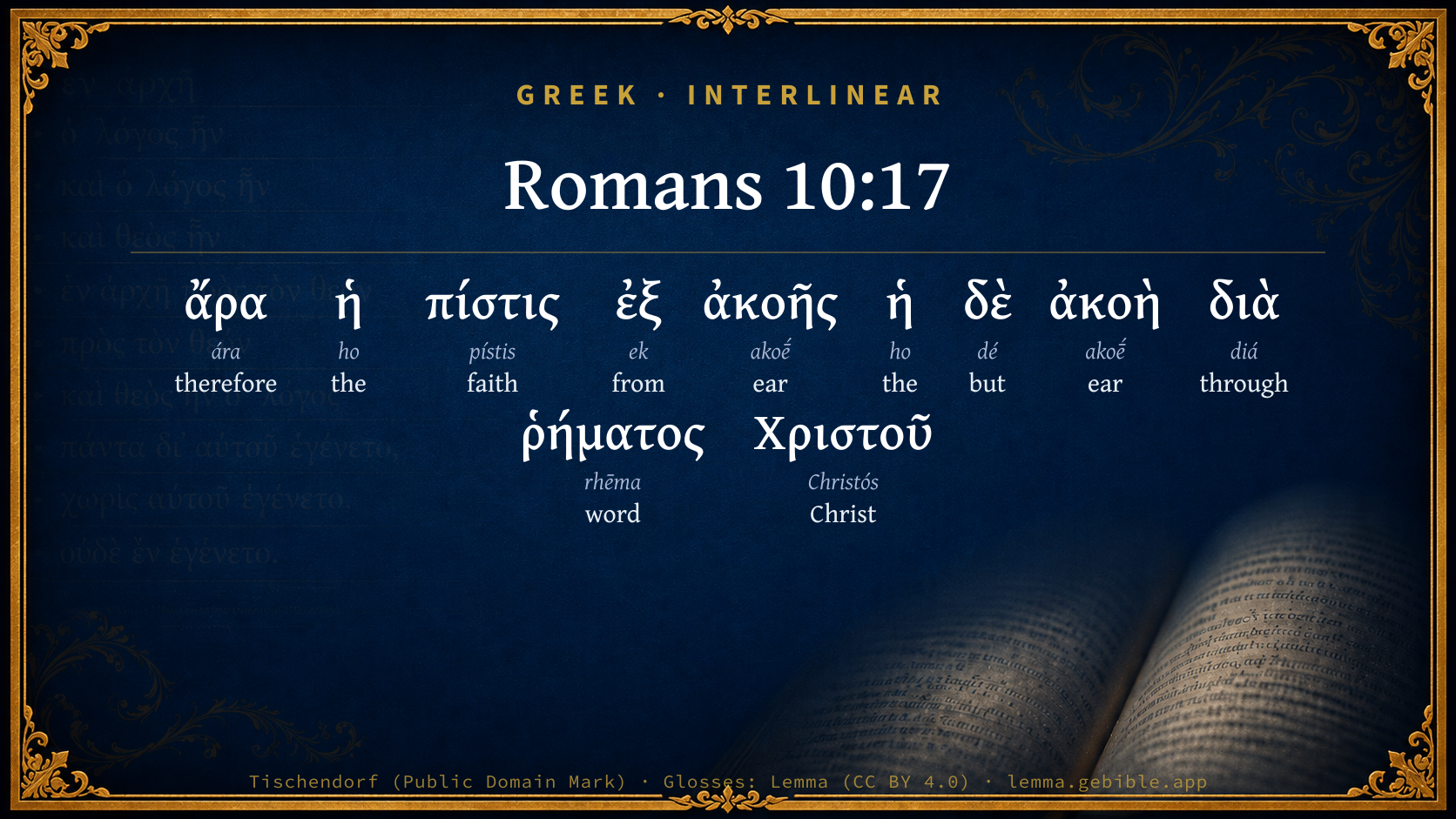
Greek (Tischendorf 8th ed.) Romans 10:17 appears in the Greek New Testament. The text above is from the Tischendorf 8th edition. Each word links to its Strong’s number and a concise gloss. Click any word for its full Thayer’s Greek Lexicon entry.
Download image
Cite this verse

Romans 10:17 (World English Bible). Public Domain. Lemma interlinear Bible study tool, https://lemma.gebible.app/v/romans/10/17.

Show BibTeX & RIS
BibTeX
RIS
English Translation
So faith comes by hearing, and hearing by the word of God.
World English Bible · Public Domain
Download a study sheet

One document with this verse’s original text, its word-by-word gloss line, the meaning frame, cross-references with their text, attributed commentary, and full source and license credits — printable, and it pastes into notes with its structure intact.

This verse Autodidact and up

Study sheet (.html) Plain text (.txt)

A passage Seminary Student

Up to 50 verses in one chapter. A passage sheet keeps up to 6 commentary sources and 12 cross-references per verse, in the order this page ranks them, and says so on the sheet whenever that leaves anything out. Ask for a single verse and you get the Autodidact verse sheet above.

Everything on this page stays free to read, with no account — the sheet is a download of what is already on screen, not access to it.

Want to remove ads? Support Godless Engineer
Compare translations 3

The same verse in 3 English versions, stacked beneath the original-language interlinear above. Click any original word for its lexicon entry.

Each is an independent rendering of the whole verse — the interlinear is not word-aligned to these translations.

Highlighted words mark where these versions differ — a whole-verse word diff, not a word-by-word alignment.

  • World English Bible Public Domain
    So faith comes by hearing, and hearing by the word of God.
  • King James Version Public Domain
    So then faith cometh by hearing, and hearing by the word of God.
  • unfoldingWord Literal Text CC BY-SA 4.0
    So this faith by hearing, and this hearing through the word of Christ.

unfoldingWord Literal Text — © unfoldingWord, licensed CC BY-SA 4.0. Word-aligned USFM3 via Door43 (git.door43.org/unfoldingWord/en_ult).

Versions to compare (up to 4)

3 of 4 selected

Show all 19 translations

Every available English version of this verse, each an independent rendering of the whole verse.

  • World English Bible Public Domain
    So faith comes by hearing, and hearing by the word of God.
  • Berean Standard Bible Public Domain
    Consequently, faith comes by hearing, and hearing by the word of Christ.
  • Majority Standard Bible Public Domain
    Consequently, faith comes by hearing, and hearing by the word of God.
  • King James Version Public Domain
    So then faith cometh by hearing, and hearing by the word of God.
  • American Standard Version (1901) Public Domain
    So belief `cometh' of hearing, and hearing by the word of Christ.
  • Revised Version (1885) Public Domain
    So belief cometh of hearing, and hearing by the word of Christ.
  • Geneva Bible (1599) Public Domain
    Then faith is by hearing, and hearing by the worde of God.
  • Douay-Rheims (1899) Public Domain
    Faith then cometh by hearing; and hearing by the word of Christ.
  • Young's Literal Translation Public Domain
    so then the faith `is' by a report, and the report through a saying of God,
  • Literal Standard Version CC BY-SA 4.0
    So then faith [is] by a report, and the report through a saying of God,
  • Unlocked Literal Bible CC BY-SA 4.0
    So faith comes from hearing, and hearing by the word of Christ.
  • unfoldingWord Literal Text CC BY-SA 4.0
    So this faith by hearing, and this hearing through the word of Christ.
  • Darby Bible Public Domain
    So faith then [is] by a report, but the report by God's word.
  • World Messianic Bible Public Domain
    So faith comes by hearing, and hearing by the word of God.
  • Webster's Bible Public Domain
    So then, faith cometh by hearing, and hearing by the word of God.
  • Free Bible Version CC BY-SA 4.0
    Trusting in God comes from hearing—hearing the message of Christ.
  • Bible in Basic English Public Domain
    So faith comes by hearing, and hearing by the word of Christ.
  • Text-Critical English NT CC BY 4.0
    So then, faith comes by hearing, and hearing comes through the word of God.
  • Tyndale New Testament (1534) Public Domain
    So then fayth cometh by hearynge and hearynge cometh by the worde of God.

Literal Standard Version (2020), Covenant Press — licensed CC BY-SA 4.0. Text via the HelloAO Bible API (eBible.org). Unlocked Literal Bible (unfoldingWord) — licensed CC BY-SA 4.0. Text via the HelloAO Bible API (eBible.org). unfoldingWord Literal Text — © unfoldingWord, licensed CC BY-SA 4.0. Word-aligned USFM3 via Door43 (git.door43.org/unfoldingWord/en_ult). Free Bible Version, Dr. Jonathan Gallagher — licensed CC BY-SA 4.0. Text via the HelloAO Bible API (eBible.org).

Word by word

More ways to search: Search by grammar → Find every occurrence → Compare this word →

Practice this passage: Drill this verse → Learn its vocabulary →

About this verse

These counts appear in no published source. They are computed here, from the morphology-tagged text and Lemma’s own curated glosses. What Lemma adds →

11
words
9
distinct lemmas
Pauline Epistles
section

Notable vocabulary

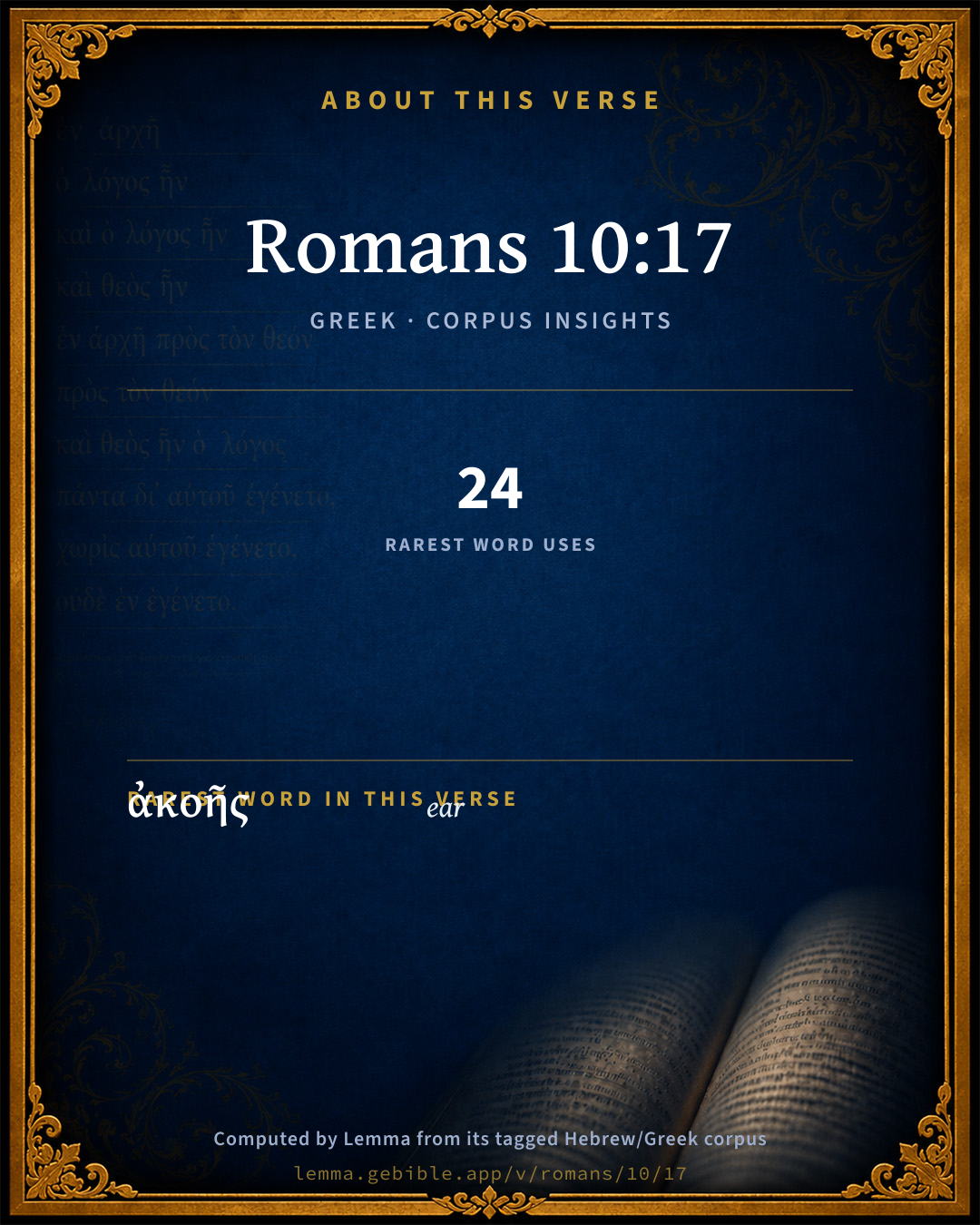
The rarest word here is ἀκοῆς ear G189 — appearing just 24 times in the whole Greek New Testament.

Shared distinctive vocabulary

ἀκοῆς ear G189 occurs in 22 verses of the Greek New Testament. Also found in:

Repetition

Words recur within this verse:

  • ἀκοῆς ear G189 ×2
  • ἡ the G3588 ×2

Cross-references

20

Topical passages linked to Romans 10:17 in the Treasury of Scripture Knowledge — connected by theme and wording, ordered by reader-vote popularity; previews shown in the World English Bible.

  • Galatians 3:2 I just want to learn this from you. Did you receive the Spirit by the works of the law, or by hearing of faith?
  • Galatians 3:5 He therefore who supplies the Spirit to you, and works miracles among you, does he do it by the works of the law, or by hearing of faith?
  • Luke 11:28 But he said, "On the contrary, blessed are those who hear the word of God, and keep it."
  • Colossians 3:16 Let the word of Christ dwell in you richly; in all wisdom teaching and admonishing one another with psalms, hymns, and spiritual songs, singing with grace in your heart to the Lord.
  • 1 Thessalonians 2:13 For this cause we also thank God without ceasing, that, when you received from us the word of the message of God, you accepted it not as the word of men, but, as it is in truth, the word of God, which also works in you who believe.
  • Mark 4:24 He said to them, "Take heed what you hear. With whatever measure you measure, it will be measured to you, and more will be given to you who hear.
  • Luke 8:21 But he answered them, "My mother and my brothers are these who hear the word of God, and do it."
  • Romans 1:16 For I am not ashamed of the Gospel of Christ, for it is the power of God for salvation for everyone who believes; for the Jew first, and also for the Greek.
  • Romans 10:14 How then will they call on him in whom they have not believed? How will they believe in him whom they have not heard? How will they hear without a preacher?
  • Hebrews 4:12–13 For the word of God is living, and active, and sharper than any two-edged sword, and piercing even to the dividing of soul and spirit, of both joints and marrow, and is able to discern the thoughts and intentions of the heart.
  • 1 Corinthians 1:18–24 For the word of the cross is foolishness to those who are dying, but to us who are saved it is the power of God.
  • 2 Thessalonians 2:13–14 But we are bound to always give thanks to God for you, brothers loved by the Lord, because God chose you from the beginning for salvation through sanctification of the Spirit and belief in the truth;
  • Luke 8:11 Now the parable is this: The seed is the word of God.
  • Luke 16:29–31 "But Abraham said to him, 'They have Moses and the prophets. Let them listen to them.'
  • James 1:18–21 Of his own will he brought us forth by the word of truth, that we should be a kind of first fruits of his creatures.
  • 1 Peter 1:23–2:2 having been born again, not of corruptible seed, but of incorruptible, through the word of God, which lives and remains forever.
  • Revelation 1:9 I John, your brother and partner with you in oppression, Kingdom, and perseverance in Christ Jesus, was on the isle that is called Patmos because of God's Word and the testimony of Jesus Christ.
  • 2 Corinthians 2:17 For we are not as so many, peddling the word of God. But as of sincerity, but as of God, in the sight of God, we speak in Christ.
  • Jeremiah 23:28–29 The prophet who has a dream, let him tell a dream; and he who has my word, let him speak my word faithfully. What is the straw to the wheat? says Yahweh.
  • Colossians 1:4–6 having heard of your faith in Christ Jesus, and of the love which you have toward all the saints,

Cross-references courtesy of OpenBible.info (CC BY 4.0).

Where the printed editions differ

1 variant

Places in this verse where the major printed Greek editions disagree on the wording in a way that affects the translation — a comparison of editions, not a manuscript-by-manuscript collation. The editions are the modern critical texts (Nestlé-Aland 28/27, SBL, Westcott-Hort, Tregelles, Tyndale House) and the traditional texts behind the KJV (the Textus Receptus and the Byzantine/Majority text). It is not a claim about which reading is original.

  1. Different wording
    Χριστοῦ.

    “of Christ.”

    In NA28NA27TynSBLWHTreg Not in TRByz

    θεοῦ (theou) 'of God' occurs in traditional manuscripts (TR+Byz) instead of Χριστοῦ. (Christou) 'of Christ.' in older manuscripts (NA28+NA27+Tyn+SBL+WH+Treg)

Textual data: Translators Amalgamated Greek New Testament (STEPBible TAGNT) · CC BY 4.0.

Commentary

Notes on Romans 10:17 from classic Christian and Jewish commentators (each source and its license shown beneath its notes). The classic Christian expositions comment on the surrounding passage and are grouped to its opening verse, so a note may address several verses; the Jewish commentaries on the Tanakh (Rashi and others) are per-verse, so they appear only where the commentator wrote on this verse.

Lemma curates 59 commentaries, every one of them public domain or Creative Commons licensed, each selected and text-cleaned for this edition rather than reprinted as found. About our sources →

Ellicott's Commentary for English Readers

(17) So then faith cometh.—Inference from the prophecy just quoted. Before men can believe, there must be something for them to believe. That something is the word of God, which we preach and they hear. It must be remembered that the word for “report” in Rom_10:16, and for “hearing” in Rom_10:17, is the same, but with a slight difference of meaning. In the first place, both the act of hearer and preacher are involved; in the second place, only the act of the hearer.

By the word of God.—We should read here, without doubt, “by the word of Christ”—i.e., by the gospel first delivered by Christ and propagated by His ministers.

A Bible Commentary for English Readers, edited by Charles John Ellicott (1878–1897) — public domain. Text from a community e-Sword module.

The Biblical Illustrator

Joseph S. Exell

Rom_10:17

So then faith cometh by hearing, and hearing by the Word of God.

How can I obtain faith?

If I am thirsty, how shall I quench my thirst? By a draught of water. But in what way can I obtain water? It is enough to tell me to go to the tap or the fountain. There is no need to explain that the water is supplied by a reservoir, having been first drawn from the river, which received it from the clouds. To the thirsty all you want to say is, Theres the water, drink. A man is hungry, and he asks you, How can I get bread? … . Go to the bakers, you say. If he wants to know how bread is obtained, we can give it to him at another time. And when you are dealing with an anxious person, it will suffice to say, Faith cometh by hearing; further information can be supplied under happier circumstances.

I. The way by which faith comes to men. By hearing.

1. Negatively. It does not come--

(1) By hereditary descent. The heirs of salvation are born, not of blood, nor of the will of the flesh, but of God. That which is born of the flesh is flesh, and nothing more.

(2) By sacraments. Is not faith a concomitant of regeneration? and what is that regeneration worth which leaves a person an unbeliever? Faith cannot be sprinkled upon us, nor can we be immersed in it. It is not to be poured into us from a chalice, nor generated in us by consecrated bread.

(3) By feeling. Till certain men have felt what they have heard described in religious biography they cannot believe. You may get the best feeling from faith, but you will be long before you will find any faith worth having from frames and feelings.

(4) By dreams and visions. The notion is still current that if you dream of seeing Jesus, or if a passage of Scripture strikes you, or if you imagine that you hear a voice speaking to you, you are then a believer. Now, though you should see all the angels in heaven, it would not prove that you would go to heaven, any more than my having seen the Popes bodyguard would be a proof that I shall be made a Cardinal. Moreover, men saw Christ, and yet blasphemed Him.

(5) Through the eloquence, earnestness, or any other good quality of the preacher. If so, being born of the power of the flesh, it will die, and so prove itself unlike the faith which springs from the incorruptible word of God, for that liveth and abideth for ever.

2. Positively: Faith cometh by hearing. Sometimes faith has come into mens minds by hearing--

(1) The simple statement of the gospel. All some have wanted has been merely to be informed of the way of salvation.

(2) Of the suitability of the gospel to the individual case. While some have heard it preached as a gospel for sinners, they have felt that they were certainly among that class.

(3) Of the condescending pity and the melting love of Jesus. When such texts have been preached on This Man receiveth sinners, Come unto Me, all ye that labour, etc., that strain has touched the heart, and led the most hardened to believe in a Saviour so kind to the undeserving.

(4) Of its authority. There are persons who, when they have heard the gospel, have not at first believed it, but if the minister has been led to show that God has set His sanction upon it, they have yielded and given over all further question.

(5) Of the veracity of the sacred writers.

(6) The explanation of the gospel. When the preacher takes up one by one the soul difficulties which keep a man from looking to Christ, and when a man shows that all his help for salvation is laid upon one that is mighty, it has often happened that faith has come through the hearing of such an explanatory word.

(7) The gospel preached with peculiar soul-revealing pointedness. Remember the Samaritan woman.

(8) The experience of those who have tasted the word of life; when the preacher tells how he trusted in Jesus, and found peace; when he is able to point to others who have felt the same, then conviction and faith are wrought in the mind. To set the whole matter clearly: Suppose you are labouring under a very serious disease, and a physician professes to heal you, how would you get faith in him? By hearing. You hear him speak, and you perceive that he understands your case, for he describes exactly all your symptoms. He next describes to you as much of the method of cure as you can comprehend. Then you inquire as to the mans character; you find that he is a skilful practitioner. Moreover, suppose that he does everything gratis, moved only by a kind desire to remove pain and save life. But if, in addition, he shows you his case-book, and bids you read case after case similar to your own in which he has effected perfect cure, and if some of these are your own acquaintances, you will not insult him by saying, I wish I could believe you. In the same way faith in Christ comes.

II. The obstructions which often block up this way.

1. A want of intention. Many persons come to hear, but they have no wish to be led into faith. Like the butterflies which flit from flower to flower, they extract no honey because they come not for such a purpose; while the bees dive into the cups and bells of the flowers, and come up loaded with their luscious food.

2. A want of attention. Sleepy hearers are not likely to be led to faith. Wandering hearts lose the benefit of the truth, and vain minds trifle away the privilege of a gospel ministry.

3. A want of candour. If a man hears with a prejudiced heart he is not likely to be convinced.

4. The want of after meditation. The juryman who is most likely to get at the truth of a given case will be the man who, having heard attentively, takes the notes of the evidence, weighs it, and endeavours to sift out the truth. So when you hear us preach, sift the sermon afterwards, pick holes in it if you like, but do search into the truth, and be not content till you find it. Here is a bag, and I drop into it pound after pound, but I find that the bag is just as empty as before; the reason is, there are holes in it, and the money drops through. Too many hearers are as a bag full of holes, and golden sermons will not bless them because they wilfully forget all.

III. The importance that faith should come to us by this way. If you have been a hearer and faith has not come to you, you are, this moment, in the gall of bitterness and in the bonds of iniquity. The wrath of God abideth on you. (C. H. Spurgeon.)

The faith hearing the word of God

I. What is faith?

1. An historical (Jam_2:19).

2. A dogmatical (Act_8:13; Act_8:33; Luk_4:41).

3. A temporary (Luk_8:13; Joh_5:35).

4. A faith of miracles (Luk_17:6; 1Co_13:2).

5. A saving faith (Rom_10:10; Act_16:31; 1Pe_2:6).

II. What is the worn by the hearing whereof faith comes?

1. Not the word of men.

2. Not of angels (Gal_1:8).

3. But of God.

III. What is meant by hearing this word? Hearing it--

1. Read.

2. Expounded.

3. Preached.

IV. How is faith wrought by the word? Not as by the principal, but only instrumental cause. Thus--

1. The minister commissioned by God speaks it to the ear, sometimes of Gods mercy, sometimes of mans duty (2Ti_4:2).

2. The ears of the hearer take in what the preacher speaks, and convey it to the understanding. But that cannot receive it (1Co_2:14), therefore--

3. The Spirit goes along with the word, and enables the understanding to receive it.

4. The Spirit having done so inclines the heart to embrace it (Php_2:13; Rom_7:15; Heb_4:12).

V. Use of reprehension.

1. To those who think themselves above ordinances.

2. To those who will not come up to them. This doctrine meets, as the angel did Balaam, with a drawn sword--

(1) Such as will not so much as.come to hear.

(2) Such as will come, but not to hear, but out of custom, or to stop the mouth of a brawling conscience.

(3) Such as will come to hear, but will not hear when they are come (Eze_33:31). They come and bring their ears too, but they are either stopped (Psa_58:4-5), dull (Mat_13:15), or itching (2Ti_4:3-4).

(4) Such as will hear when they come, but do not mind or understand what they hear (Eze_33:32; Act_9:7; cf. Act_22:9).

(5) Such as mind what they hear, but will not believe what they mind.

(6) Such as do believe what they mind, but will not resolve to practise what they believe (Eze_33:1-33.).

(7) Such as will resolve to practise what they believe, but will never practise what they resolve (Jam_1:23-24).

VI. Motives. Consider--

1. Whose word it is.

2. What a word it is (Psa_19:7; Rom_1:16; Jam_1:21).

3. What thou mayest get by coming to it; what thou mayest lose by staying from it.

4. The time will come when thou wilt curse thyself for every opportunity lost, or bless God for everyone embraced (Mat_23:39).

VII. Directions.

1. Before hearing--

(1) Consider what thou art going about and whom thou art going before.

(2) Set aside all worldly thoughts, as Abraham his servants, and Nehemiah (13:19, 20), especially sins (Jam_1:21).

(3) If thou wouldst have God pour forth His blessings upon thee in preaching, do thou pour out thy spirit before Him in prayer (Psa_10:17; Psa_65:2).

(a) For the minister (Rom_15:20).

(b) For yourselves, that God would assist the word (Isa_8:11).

(4) Come--

(a) with an appetite (Mat_5:6; Job_29:23).

(b) With large expectations.

(c) With strong resolutions to practise.

2. In hearing. Hear--

(1) Reverently.

(2) Diligently, with hearts as well as ears.

(3) Meekly (Jam_1:21).

(4) With faith (Heb_4:2).

(5) With self-application (Job_5:27).

3. After hearing--

(1) Meditate (1Ti_4:15).

(2) Confer with others.

(3) Square thyself according to it, that thy life may be a comment on the sermon (Jam_1:22; Mat_7:24-25). (Bp. Beveridge.)

The two great instruments appointed for the propagation of the gospel; and thy duty of the Christian public to keep them both in vigorous operation

I. The general lesson of the text.

1. As all is suspended upon God, and as He reigns with as supreme a dominion in the heart of man as in the world around us, all relating to the salvation of the soul is His work. But on the ether hand, it is evident that though it be God alone that worketh, yet He worketh by instruments. None were more impressed than Paul with the pious sentiment that all depends upon God; yet he says Faith cometh by hearing, and hearing by the word of God. If, in that extraordinary age, when the Author of nature broke in upon the constancy of its operations by miracles, one of His own inspired messengers does not overlook the use of instruments, it would ill become us to overlook them.

2. Now observe that the operation of the two instruments laid before us in the text is somewhat different at present from what it was in the days of the apostles. Those were the days of inspiration; and faith came by the hearing of inspired teachers; and hearing came by the Word of God--for the apostles spake only as God put the word into their mouth. But whatever is capable of being spoken is capable of being written also; and it was not long before the Christian teachers committed to writing the doctrine of salvation; and if you read what they wrote with the impression that it is the genuine production of inspired men, you are in circumstances likely for receiving faith. Now, however, there is a change in one of the instruments. Instead of the messenger delivering the message in person, you have the substance of it in a written communication. And now faith comes by reading, and reading by the Word of God.

3. We are not to suppose, however, that reading is substituted for hearing. True you can no longer hear the immediate messengers of heaven; but you can hear the descendants of these messengers. And although you have the inspired documents, heaven still gives a saving influence to the living energy of a human voice.

4. In no age of the Church, indeed, does it appear that the one instrument ever superseded the other. Nehemiah not only read in the book of the law of God distinctly, but gave the sense, and caused the people to understand the reading. And this reading and expounding of the law from the days of Ezra formed a permanent institution among the Jews. We meet with traces of its existence in the New Testament (Act_13:14, etc.; Luk_4:16, etc.). And it has descended, without interruption, through all the ages of Christian worship. The apostles deemed it necessary to leave something more than the written volume of inspiration behind them. They left teachers and overseers; and to this very day, the readings, and the explanations, and the sermons of Christian pastors, are superadded to the silent reading of Christian people; and both are found to be instruments of mighty operation, for the edifying of the body of Christ.

5. Neither instrument is to be dispensed with.

(1) If you have hearing without reading, you lay the Church open to all the corruptions of Popery. You have priests, but you have no Bibles. You take your lesson from the wisdom of man, and throw away from you all the light and benefit of revelation. Keep fast, then, by your Bible. Let not your faith come by hearing alone; but let your hearing be tried by the Word of God. Let it not be said that what you believe is what you have heard merely.

(2) But if you have reading without hearing, you throw away the benefit of a public ministry--an institution sanctioned by the Bible. Though you have no knowledge to receive, you have memories to be refreshed; minds which, however pure, need to be stirred up by way of remembrance.

II. Its application to the evangelisation of the world. The propagation of the gospel is a cause the maintenance of which consists of the providing of Bibles, and the providing of human agents. The latter, by teaching them to read, teaches unlettered people to use one of the instruments of the text; and to the latter belongs the exclusive office of bringing the other instrument to bear upon them--the instrument of hearing. The society whose office it is to provide the former is the Bible Society. The society whose office it is to provide the latter instrument is the Missionary Society. It is the duty of a Christian public to keep both instruments in vigorous operation. Each of these societies has mighty claims upon you. The two go hand in hand. The one ploughs while the other sows; and let no opposition be instituted betwixt their claims on the generosity of the public. (T. Chalmers, D.D.)

Hear and live

A poor man being on his death-bed, asked that the fifty-fifth chapter of Isaiah should be read to him. Though weak and faint, and full of pain, yet when he heard the words, Incline your ear and come unto Me; hear, and your soul shall live, he gathered up his strength to say, What a mercy, sir, that it is not Read, and your soul shall live, for if it had been I could not have been saved, for you know I am no scholar. But, blessed be God, it is Hear, and your soul shall live. I have heard and believed, and trust I shall be saved.

Power to hear, a blessing

It is said that a beautiful countess of one of the Orkney Islands was a deaf mute. One day, when her firstborn child was a few months old, as it was sleeping in its cradle, she softly approached its side, to the terror of the nurse, with a large stone in her hands, and dropped it on the floor, eagerly watching the face of the babe to see the effect of the noise. To the inexpressible joy of the fond mothers heart the child started and awoke, so that she knew it had the sense of hearing. She embraced both child and nurse, and wept tears of gratitude to God that her own sad affliction was not transmitted to her offspring.

The Biblical Illustrator, edited by Joseph S. Exell (c. 1880s–1900s) — public domain. Text from a community e-Sword module.

Bengel's Gnomon

Johann Albrecht Bengel

Rom 10:17.[118] Ἄρα, then) From the complaint of the prophet respecting the unbelief of his hearers, he infers, that the word of God and preaching, the proper source and handle of faith, were not wanting.—ἐξ ἀκοῆς) ἈΚΟῊ, hearing, and hence [the thing heard] speech, word, preaching.

[118] Ἡμῶν, [the report] of us) thy ambassadors, he means.—V. g.

Bengel's Gnomon of the New Testament — English translation (T&T Clark, Edinburgh, 1860) — public domain. Text from a community e-Sword module.

Meyer's Critical & Exegetical Commentary

Heinrich August Wilhelm Meyer

Rom_10:17. Inference from the prophetic passage, with the view of substantially recapitulating what was said in Rom_10:14, and then pursuing the subject in Rom_10:18.

ἀκοή] the same as in Rom_10:16, the announcement, which is heard; comp. on Joh_12:38. From this comes faith; the heard preaching of the gospel brings about in mens minds faith on Christ; but preaching is brought about by Gods behest (Luk_3:2; Mat_4:4; Heb_11:3), set to work by the fact that God commands preachers to their office. Rightly have Beza, Piscator, Semler, Cramer, Fritzsche, Glöckler, Tholuck, Baumgarten-Crusius, so understood ῥῆμα Θεοῦ. For the ordinary interpretation of it, also followed by Hofmann, as the preached word of God, is incorrect for this reason, that according to it ῥῆμα Θεοῦ in point of fact would not be different from ἀκοή; and this ῥῆμα Θεοῦ does not point back to Rom_10:8, but to ἀποσταλῶσι in Rom_10:15, as the remaining contents of the verse show, so that the signification saying obtains textually the more precise definition of its sense as behest. But when ἀκοή has been taken in two different senses in Rom_10:16 and Rom_10:17, so that in Rom_10:16 it signifies the preaching, but in Rom_10:17 the hearing (Rückert, de Wette, Philippi, according to whom the preaching is to be analysed into its two elements, the hearing and the word of God, comp. Tholuck); or when in διὰ ῥήματος Θεοῦ, instead of Gods word, divine revelation has been substituted (Reiche, van Hengel, comp. Olshausen, who explains it as equivalent to διὰ πνεύματος Θεοῦ): these are just makeshifts in order to separate the incorrectly assumed notion of ῬῆΜΑ ΘΕΟῦ from that of ἈΚΟΉ.

How could Paul infer also ἡ δὲ ἀκοὴ διὰ ῥήματος Θεοῦ from Isaiah? Certainly not from the mere address κύριε, but rather from the whole attitude of the prophet towards God, as it is expressed in κύριε … ἡμῶν,an attitude in which the prophet stands as the servant and ambassador of God, so that God thus appears as He on whose saying, i.e. on whose command, the ἀκοή is preached.

Meyer — Critical and Exegetical Commentary on the New Testament — English translation by Peter Christie, edited by Frederick Crombie (T&T Clark, 1880) — public domain. Text from a community e-Sword module.

Expositor's Greek Testament

ed. W. Robertson Nicoll

Rom 10:17 . This verse is really parenthetic: Paul’s logical mind cannot let slip the chance of showing how this quotation confirms the connection of ideas in Rom 10:14 . ἄρα suits a rapid passing inference better than the more deliberate ἄρα οὖν which is much more frequent in Romans. Cf. 1Co 15:18 , 2Co 5:14 , Gal 2:17 . So then faith comes from a message (that which is received by the hearer of the Gospel), and the message διὰ ῥήματος Χριστοῦ through the Word concerning Christ. That which when heard is ἀκοὴ is when spoken ῥῆμα , and it is the condition of faith. The construction in ῥῆμα Χριστοῦ is the same as in τὸ ῥῆμα τῆς πίστεως in Rom 10:8 . The words could not signify Christ’s command.

The Expositor's Greek Testament, edited by W. Robertson Nicoll (1897–1910) — public domain. Text from a community e-Sword module.

Godet's Commentaries

Frédéric Louis Godet

Vv. 17. There was no logical necessity obliging the apostle to return to the two ideas contained in this verse, and already expressed in Rom 10:14. But he takes them up again in passing, as confirmed by the words of Isaiah just quoted, and to give occasion more clearly to the objection about to follow in Rom 10:18. ῎Αρα: so then (precisely as I was saying).

The meaning of ἀκοή, hearing, is not modified in passing from Rom 10:16 to Rom 10:17. It is still the hearing of what is preached as from God; only Paul here distinguishes between the two ideas of hearing and preaching (the word of God), which were blended in the first of these two terms, Rom 10:16, in the passage of Isaiah (in consequence of the complement ἡμῶν, of us [our], prophets and apostles). It is unnecessary, therefore, to apply the expression word of God, as Meyer would, to the command by which God sends the preachers. This meaning has not the slightest support in the words of Isaiah, and it is contrary to the use of the term ῥῆμα, word, in Rom 10:8-9, where it denotes the work of salvation as preached. It must be the same here. ᾿Εκ, of: faith is born of hearing; διά, by: hearing is wrought by the word preached.

The complement of God in the T. R. denotes the author of the word, while the complement of Christ in the Alex. and Greco-Lat. reading would express its subject. The first reading agrees better with the context.

The question is therefore relatively to the unbelief of the Jews: Has this double condition been fulfilled toward them? If not, here would be a circumstance fitted to exculpate them, and to throw back on God the blame of their unbelief and rejection. The apostle does not fail, before closing, to raise this question.

Frédéric Louis Godet — Commentaries on Luke, John, Romans, and 1 Corinthians — English translation (T&T Clark, Edinburgh, 1870s–1890s) — public domain. Text from a community e-Sword module.

Hodge's Commentary on Romans, Ephesians & First Corinthians

Charles Hodge

Rom_10:17

So then faith (cometh) by hearing, and hearing by the word of God. The passage in Isaiah speaks of an ἀκοή, a message, something addressed to the ear. The design of that message was that men should believe. They were required to receive and rest upon it as true. Without it there could be no ground of faith; nothing on which faith could rest. Therefore faith is from hearing. It is receiving the message as true. But this message is by the word or command of God. It is therefore a sure foundation of faith. And as all men are required to believe, the message should be sent to all, and the divine command on which it rests, must include an injunction to make the proclamation universal. Thus the two ideas presented in the context, viz., the necessity of knowledge to faith, and the purpose of God to extend that knowledge to the Gentiles, are both confirmed in this verse. The above is the common interpretation of this passage. It assumes that ῥῆμα Θεοῦ is to be taken in the sense of God, whereas it commonly means the word or message of God. If this sense be retained here, then ἀκοή must mean the act of hearing. Faith cometh by hearing, and hearing supposes something to be heard, a ῥῆμα, or word of God. In Luk_5:5; Heb_11:3, (compare Heb_1:3), ῥῆμα Θεοῦ means Gods (or the Lords) command. There is no necessity, therefore, for giving ἀκοή a different sense here from that which it must have in the preceding verse.

Charles Hodge — Commentary on Romans (1835), First Corinthians (1857), and Ephesians (1856) — public domain. Text from a community e-Sword module.

Geneva Bible (1599)

Geneva Bible translators

A conclusion of the former gradation: we must ascend from faith, to our vocation, as by our vocation we came to the testimony of our election.

By God’s Commandment.

Geneva Bible (1599) marginal notes — public domain. Text via Bolls.life.

Jamieson, Fausset & Brown

Robert Jamieson, A. R. Fausset & David Brown

So then faith cometh by hearing, and hearing by the word of God--"This is another confirmation of the truth that faith supposes the hearing of the Word, and this a commission to preach it."

Jamieson, Fausset & Brown — Commentary Critical and Explanatory on the Whole Bible (1871) — public domain (CC PDM 1.0). Text via the HelloAO Bible API.

Adam Clarke's Commentary

Verse 17. So then faith cometh by hearing] Preaching the Gospel is the ordinary means of salvation; faith in Christ is the result of hearing the word, the doctrine of God preached. Preaching, God sends; if heard attentively, faith will be produced; and if they believe the report, the arm of the Lord will be revealed in their salvation.

Adam Clarke's Commentary on the Bible (1810–1826) — public domain. Text from a community e-Sword/MySword module.

John Calvin's Commentaries

17. Faith then is by hearing, etc. We see by this conclusion what Paul had in view by the gradation which he formed; it was to show, that wherever faith is, God has there already given an evidence of his election; and then, that he, by pouring his blessing on the ministration of the gospel, to illuminate the minds of men by faith, and thereby to lead them to call on his name, had thus testified, that the Gentiles were admitted by him into a participation of the eternal inheritance.

And this is a remarkable passage with regard to the efficacy of preaching; for he testifies, that by it faith is produced. He had indeed before declared, that of itself it is of no avail; but that when it pleases the Lord to work, it becomes the instrument of his power. And indeed the voice of man can by no means penetrate into the soul; and mortal man would be too much exalted, were he said to have the power to regenerate us; the light also of faith is something sublimer than what can be conveyed by man: but all these things are no hindrances, that God should not work effectually through the voice of man, so as to create faith in us through his ministry.

It must be further noticed, that faith is grounded on nothing else but the truth of God; for Paul does not teach us that faith springs from any other kind of doctrine, but he expressly restricts it to the word of God; and this restriction would have been improper if faith could rest on the decrees of men. Away then with all the devices of men when we speak of the certainty of faith. Hence also the Papal conceit respecting implicit faith falls to the ground, because it tears away faith from the word; and more detestable still is that blasphemy, that the truth of the word remains suspended until the authority of the Church establishes it.

John Calvin's Commentaries (1540-1563) — public domain. Text from the Calvin Translation Society English edition (1840s-50s) via the Christian Classics Ethereal Library (ccel.org). Calvin's coverage is partial (roughly two-thirds of the Bible); uncommented books and verses are honest gaps, never fabricated. The 19th-century editor's footnotes and remarks are omitted so the notes are faithfully Calvin's own voice.

The Cambridge Bible for Schools and Colleges

gen. ed. J. J. S. Perowne

17. So then faith, &c.] In this verse, which forms a parenthesis of thought, St Paul uses the quotation just made in a new reference; not now to the fact of unbelief, but to the means of faith. Isaiah’s words imply that the “report” of Messiah’s messengers was the appointed means for the conveyance of faith (“who hath believed?”) in Messiah. But this faith was (see above, Rom_10:11,) for Gentiles as well as Jews. Therefore Gentiles as well as Jews must have the “report” carried to them.

hearing] Same word in Gr. as that rendered report just above. See margin of E. V.

by the word of God] i.e. either “by His order,” or “by (the delivery of) His message;” “by the utterance of truth from and about Him.” The latter is on the whole more likely, both grammatically and by the context, where the necessity of evangelization is the main point.—A various reading, but not decisively supported, is “by the word of Christ.”

The Cambridge Bible for Schools and Colleges (gen. ed. J. J. S. Perowne; Cambridge University Press, 1878–1918) — public domain. Text from a community e-Sword module.

John Gill's Exposition

So then faith comes by hearing,.... That is, by preaching; for the word hearing is used in the same sense as in the preceding verse; and designs the report of the Gospel, or the preaching of the word, which is the means God makes use of, to convey faith into the hearts of his people; for preachers are ministers, or instruments, by whom others believe:

and hearing by the word of God; or "of Christ", as some copies read, and so do the Vulgate Latin and Ethiopic versions; and intends either the holy Scriptures, which have God for their author, and Christ for the subject of them; and which furnish the men of God, or ministers of the Gospel, with proper materials to preach; and so hearing or preaching is by them, or else the command of God or Christ, which more properly signifies; and the sense is, that men preach the Gospel in obedience to the commandment of the everlasting God, and according to the orders, mission, and commission, warrant and authority, of the Lord Jesus Christ: and so these words are the conclusion, and sum of the whole; that as invocation is owing to faith, so faith to hearing, hearing to preaching, preaching to a mission; whence it follows, that it is the original will of God, to send forth his apostles and ministers, to preach the Gospel to the Gentiles, as well as to the Jews; that they hearing might believe, and believing call upon the Lord, and so be saved by him: it is a saying of the Jews, , "hearing depends upon the word" (e).

(e) Zohar in Deut. fol. 110. 3.

John Gill's Exposition of the Whole Bible (1746–1763) — public domain (CC PDM 1.0). Text via the HelloAO Bible API.

Trapp's Complete Commentary

John Trapp

17 So then faith cometh by hearing, and hearing by the word of God.

Ver. 17. By the word of God] That is, by the word of God’s command, sending out preachers gifted for the purpose, and saying to them, "Go preach," &c.

John Trapp, A Commentary or Exposition upon All the Books of the Old and New Testament (1647–1656) — public domain. Text from a community e-Sword module.

Albert Barnes' Notes on the Bible

So then faith cometh ... - This I take to be clearly the language of the objector. As if he had said, by the very quotation which you have made from Isaiah, it appears that a report was necessary. He did not condemn people for not believing what they had not heard; but he complains of those who did not believe a message actually delivered to them. Even by this passage, therefore, it seems that a message was necessary, that faith comes by hearing, and hearing by the divine message. It could not be right, therefore, to condemn those who had not obeyed the gospel because they had not heard it; and hence, not right to make salvation dependent on a condition which was, by the arrangement of God, put beyond their power. The very quotation from Isaiah, therefore, goes to confirm the objection in Rom 10:14;15.

By hearing - Our translation has varied the expression here, which is the same in two places in the Greek: “Isaiah said, Who hath believed our report τῇ ἀκοῇ tē akoē? So then, you must admit that faith comes by that report ἐξ ἀκοῆς ex akoēs, and therefore this report or message is necessary.” When it is said that faith cometh by hearing, it is not meant that all who hear actually believe, for that is not true; but that faith does not exist unless there is a message, or report, to be heard or believed. It cannot come otherwise than by such a message; in other words, unless there is something made known to be believed. And this shows us at once the importance of the message, and the fact that people are converted by the instrumentality of truth, and of truth only.

And hearing - And the report, or the message (η ̔ἀκοὴ hē akoē), is by the Word of God; that is, the message is sent by the command of God. It is his word, sent by his direction, and therefore if withheld by him, those who did not believe could not be blamed. The argument of the objector is, that God could not justly condemn people for not believing the gospel.

Albert Barnes' Notes on the Bible (1834–1885) — public domain. Text from a community e-Sword/MySword module.

Matthew Poole's English Annotations

This is the conclusion of the former gradation, Rom 10:14. He speaketh here of the ordinary means whereby faith is wrought; not confining or limiting the Spirit of God, who worketh, or may work, by extraordinary means, yea, without any means at all. See Poole on "Rom 10:14".

By the word of God; by the command of God: q.d. The gospel could not be lawfully preached to them, for them to hear it, but by God’s command; and therefore the apostles and others, in preaching the gospel to the Gentiles, had good authority for what they did.

Matthew Poole's English Annotations on the Holy Bible (1683–1685) — public domain. Text from a community e-Sword/MySword module.

Whedon's Commentary on the Bible

Daniel D. Whedon

17. So then—Or, therefore. From Isaiah’s words, even if they describe a disbelief of the hearing, yet it follows that hearing is the proper means of faith. He confirms this instance from Isaiah by maintaining that the Gentiles had heard, (18,) and that Israel had known from hearing prophetic warnings, (19-21.)

Daniel D. Whedon (gen. ed.), Commentary on the Old and New Testaments (1874–1909) — public domain. Text from a community e-Sword module.

John Wesley's Explanatory Notes

Faith, indeed, ordinarily cometh by hearing; even by hearing the word of God.

John Wesley, Explanatory Notes Upon the Whole Bible (1754–1765) — public domain. Text via the GEBible commentary corpus.

Burkitt's Expository Notes on the New Testament

William Burkitt

As if the apostle had said, "It is very evident, and these testimonies show, that faith comes by hearing, and hearing by the preaching of the word of God." The grace of faith is wrought by the Spirit in the act of hearing: and the matter heard by which this faith is wrought, is the word of God preached. Persons must hear, that they may believe; and God’s word must be preached, that they may hear. A non-preaching minister then is no minister; he is like a bell without a clapper, or a crier without a voice; he neither answers the design of his commission, nor the end of the gospel’s institution, which was to be the instrumental mean of faith. Faith cometh by hearing.

William Burkitt's Expository Notes on the New Testament (1700–1703) — public domain. Text from a community e-Sword module.

McGarvey & Pendleton's Commentaries

J. W. McGarvey

So [as I said, and, as you see, Isaiah corroborates] belief cometh of [is born of, or grows out of] hearing, and hearing by [by reason of, because of] the word [saying, behest, command. See Luk_5:5 ; Heb_11:3 ; Rom_1:3 ] of Christ . [And so, briefly paraphrasing the apostle's thought, it runs thus: Can God's glorious purpose and inimitable means fail to accomplish the universal glorification of man? Assuredly they can, for Isaiah so predicted. To accomplish universal salvation there must be a universal heed-hearing. But Isaiah complained, "Lord, who hath believed that which we have caused them to hear?" meaning that very few gave a heed-hearing. So we see from Isaiah that it is precisely as I said ( Rom_10:14-15 ); namely, that belief comes of hearing, and hearing is caused by the command or commission of Christ, as is made apparent by the fact that Isaiah reports back to Christ (whom he calls Lord) that men have not heard what Christ sent, or commissioned, him to tell them. How culpable, then, was Israel as foreseen in the visions of Isaiah and as literally seen by the eyes of Paul! A message commanded by Christ the Lord! How could they be excused for not giving it a heed-hearing, an obedience? Only in two ways: first, by showing that they had never heard it; second, by proving that they were misled by their Scriptures so that they could not recognize it as coming from their Lord--and the point where they would assert and attempt to prove the misleading was this very one now mooted; namely, universality, for the Jew regarded the reception of the Gentile as contrary to all that God had ever revealed, or caused to be written down. Therefore the apostle takes these two excuses in order, and exposes their emptiness.]

J. W. McGarvey (with Philip Y. Pendleton), Commentaries on the New Testament (The Fourfold Gospel, 1914; Acts; and the epistles) — public domain. Text from a community e-Sword/MySword module.

The People's New Testament

B. W. Johnson

17. So, then, faith cometh by hearing. Hence the need of preaching. If God by a miracle wrought faith in the heart, he could dispense with the preacher. But the divine arrangement is that it should result from hearing the word of God preached. For an example of the gospel plan, see Acts 18:8.

B. W. Johnson's The People's New Testament with Notes (1889–1891) — public domain. Electronic text from the Christian Classics Ethereal Library (CCEL) ThML edition.

Cambridge Greek Testament for Schools and Colleges

17. ἄρα κ.τ.λ. Then, as now, it was Christ’s word, heard by the prophet and reported, which was the outward condition of faith. N. the underlying thought that Christ spoke through the prophets; cf. 1Pe 1:11.

διὰ ῥ. Χρ. The word is that which the prophet utters, and it is Christ’s word in the prophet. Pope (J. T. S. IV., p. 273 f.) argues for taking ῥ. Χρ. here of the word spoken to the heart of the hearer; but the thought is alien from the context.

Cambridge Greek Testament for Schools and Colleges (Cambridge University Press, 1896; 21 vols, various authors incl. Carr, Maclear, Plummer, Farrar, Lumby, Moule, M. R. James, Simcox) — public domain. Text from a community e-Sword module.

Alford’s Greek Testament

Henry Alford

17.] Faith then (conclusion from ver. 16, τίς ἐπίστ. τῇ ἀκοῇ) is from hearing (the publication of the Gospel produces belief in it), and the hearing (the effect of the publication of the Gospel) is by means of (not, ‘in obedience to,’ but ‘by,’ as its instrument and vehicle) the word of Christ (θεοῦ has probably been a rationalizing correction, to suit better the sense of the prophecy. ῥήματος is used possibly, as De Wette suggests, as a preparation for τὰ ῥήματα αὐτ. in ver. 18).

Henry Alford, The Greek Testament (1849–1861) — public domain. Text from a community e-Sword module.

International Critical Commentary

17. ἄρα ἡ πίστις. ‘Hence may be inferred (in corroboration of what was said above) that the preliminary condition necessary for faith is to have heard, and to have heard implies a message.’ This sentence is to a certain extent parenthetical, merely emphasizing a fact already stated; yet the language leads us on to the excuse for unbelief suggested in the next verse.

διὰ ῥήματος Χριστοῦ: ‘a message about Christ.’ Cf. ver. 8 τὸ ῥῆμα τῆς πίστεως ὃ κηρύσσομεν. St. Paul comes back to the phrase he has used before, and the use of it will remind his readers that this message has been actually sent.

Χριστοῦ is the reading of א B C D E minusc. pauc., Vulg. Sah. Boh. Arm. Aeth. Orig.-Lam 2:2, Ambrstr. Aug.—Θεοῦ of אc A Db c K L P al. pler., Syrr., Clem.-Alex. Chrys. Theodrt.

St. Paul has laid down the conditions which make faith possible, a Gospel and messengers of the Gospel; the language he has used reminds his readers that both these have come. Yet, in spite of this, the Jews have not obeyed. He now suggests two possible excuses.

International Critical Commentary — older volumes (1896–1929), various authors — public domain. Text from a community e-Sword module.

Vincent's Word Studies in the New Testament

Marvin R. Vincent

By hearing [εξ ακοης] . The same word as report, above, and in the same sense, that which is heard.

Word of God [ρηματος θεου] . The best texts read of Christ. Probably not the Gospel, but Christ 's word of command or commission to its preachers; thus taking up except they be sent (ver. 15), and emphasizing the authority of the message. Belief comes through the message, and the message through the command of Christ.

Marvin R. Vincent, Word Studies in the New Testament (1887–1900) — public domain. Text from a community e-Sword/MySword module.

Lesson kit

Teaching starters — assembled from the data on this page, not authored interpretation. Every prompt links to the verse data it draws on. Edit before teaching.

Romans, in the Pauline Epistles, opens this verse with 11 words (9 distinct Greek lemmas). Its most distinctive word is akoḗ (“ear”). A historical commentator’s framing appears above. Read the whole chapter for the surrounding context.

Discussion questions

  1. What does “ear” (akoḗ) contribute to the verse as a whole?
  2. How does Matthew 4:24, which shares the word «ear», read alongside this verse?
  3. What does the repetition of “ear” (2× in this one verse) do in this verse?
  4. The translations on this page render this verse differently — a whole-verse word diff, not a word-by-word alignment. What might account for the different wordings?
  5. Compare how Ellicott's Commentary for English Readers and The Biblical Illustrator read this verse. Where do they agree or differ?

Things to notice

  • These translations choose different wording for 5 words in this verse.
  • “ear” occurs 2× in this single verse.
  • 9 distinct Greek lemmas span 11 words in this verse.

Reading settings

Reading text

Shown beneath each verse's original-language words.

Old Testament
Old Testament edition

Read the OT as the Masoretic Hebrew (MT) or the Greek Septuagint (LXX).

English shown for the Greek Septuagint (in the Hebrew ↔ Greek comparison).

Comparing translations? Open the Compare panel on any verse page to stack up to four side by side.