
Acts 3:20

Greek (Tischendorf 8th ed.) Acts 3:20 appears in the Greek New Testament. The text above is from the Tischendorf 8th edition. Each word links to its Strong’s number and a concise gloss. Click any word for its full Thayer’s Greek Lexicon entry.
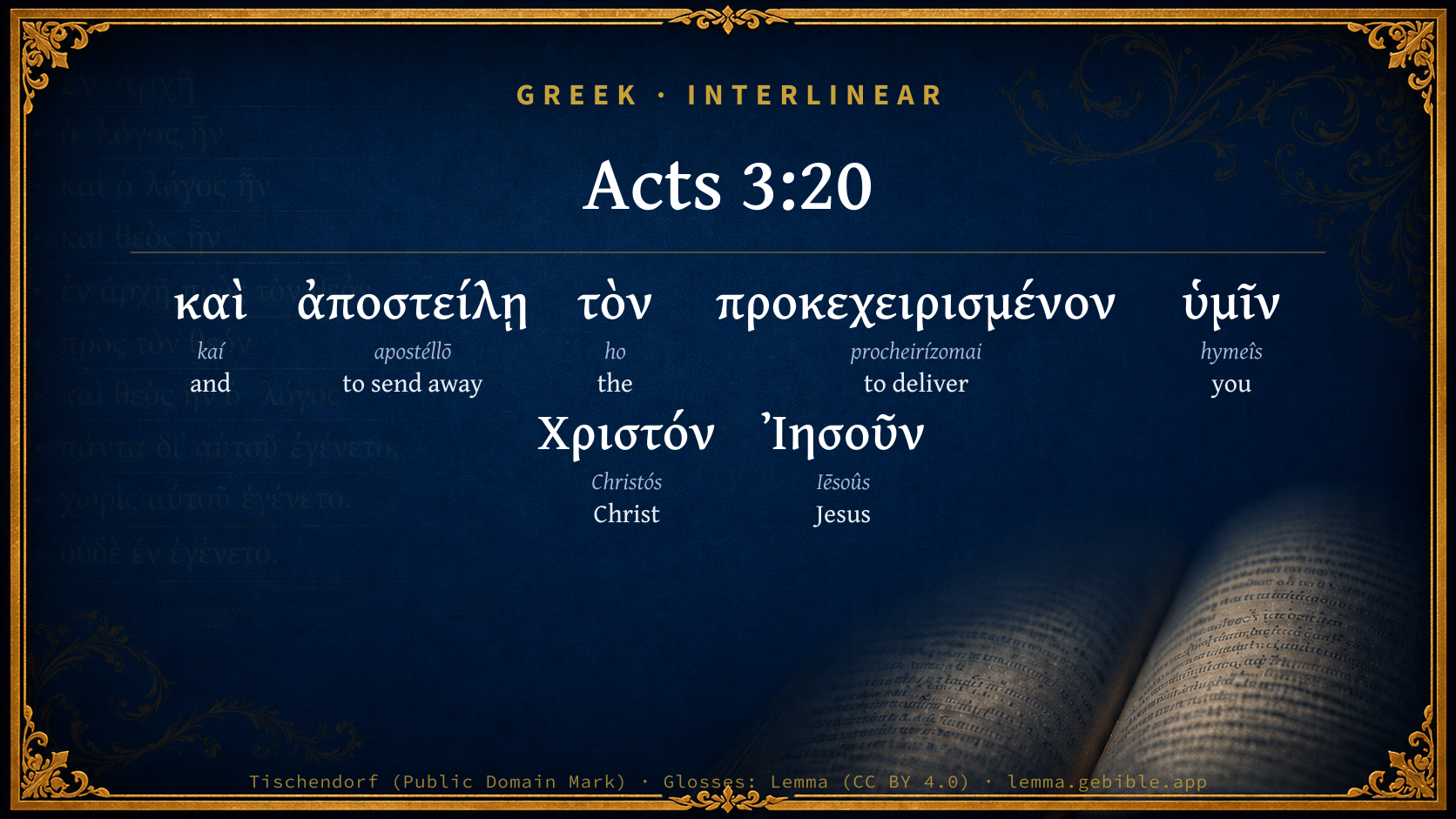
Download image
Cite this verse

Acts 3:20 (World English Bible). Public Domain. Lemma interlinear Bible study tool, https://lemma.gebible.app/v/acts/3/20.

Show BibTeX & RIS
BibTeX
RIS
English Translation
and that he may send Christ Jesus, who was ordained for you before,
World English Bible · Public Domain
Highlights
  • 1 first appearance in the Greek New Testament
Full analysis ↓
Download a study sheet

One document with this verse’s original text, its word-by-word gloss line, the meaning frame, cross-references with their text, attributed commentary, and full source and license credits — printable, and it pastes into notes with its structure intact.

This verse Autodidact and up

Study sheet (.html) Plain text (.txt)

A passage Seminary Student

Up to 50 verses in one chapter. A passage sheet keeps up to 6 commentary sources and 12 cross-references per verse, in the order this page ranks them, and says so on the sheet whenever that leaves anything out. Ask for a single verse and you get the Autodidact verse sheet above.

Everything on this page stays free to read, with no account — the sheet is a download of what is already on screen, not access to it.

Want to remove ads? Support Godless Engineer
Compare translations 3

The same verse in 3 English versions, stacked beneath the original-language interlinear above. Click any original word for its lexicon entry.

Each is an independent rendering of the whole verse — the interlinear is not word-aligned to these translations.

Highlighted words mark where these versions differ — a whole-verse word diff, not a word-by-word alignment.

  • World English Bible Public Domain
    and that he may send Christ Jesus, who was ordained for you before,
  • King James Version Public Domain
    And he shall send Jesus Christ, which before was preached unto you:
  • unfoldingWord Literal Text CC BY-SA 4.0
    so that times of refreshment may come from the face of the Lord and he may send the one appointed for you, Christ Jesus,

unfoldingWord Literal Text — © unfoldingWord, licensed CC BY-SA 4.0. Word-aligned USFM3 via Door43 (git.door43.org/unfoldingWord/en_ult).

Versions to compare (up to 4)

3 of 4 selected

Show all 19 translations

Every available English version of this verse, each an independent rendering of the whole verse.

  • World English Bible Public Domain
    and that he may send Christ Jesus, who was ordained for you before,
  • Berean Standard Bible Public Domain
    that times of refreshing may come from the presence of the Lord, and that He may send Jesus, the Christ, who has been appointed for you.
  • Majority Standard Bible Public Domain
    that times of refreshing may come from the presence of the Lord, and that He may send Jesus, the Christ, who has been appointed for you.
  • King James Version Public Domain
    And he shall send Jesus Christ, which before was preached unto you:
  • American Standard Version (1901) Public Domain
    and that he may send the Christ who hath been appointed for you, `even' Jesus:
  • Revised Version (1885) Public Domain
    and that he may send the Christ who hath been appointed for you, even Jesus:
  • Geneva Bible (1599) Public Domain
    And he shall sende Iesus Christ, which before was preached vnto you,
  • Douay-Rheims (1899) Public Domain
    That when the times of refreshment shall come from the presence of the Lord, and he shall send him who hath been preached unto you, Jesus Christ,
  • Young's Literal Translation Public Domain
    and He may send Jesus Christ who before hath been preached to you,
  • Literal Standard Version CC BY-SA 4.0
    and He may send Jesus Christ who before has been preached to you,
  • Unlocked Literal Bible CC BY-SA 4.0
    and that he may send the Christ who has been appointed for you, Jesus.
  • unfoldingWord Literal Text CC BY-SA 4.0
    so that times of refreshment may come from the face of the Lord and he may send the one appointed for you, Christ Jesus,
  • Darby Bible Public Domain
    and he may send Jesus Christ, who was foreordained for you,
  • World Messianic Bible Public Domain
    and that he may send Messiah Yeshua, who was ordained for you before,
  • Webster's Bible Public Domain
    And he will send Jesus Christ, who before was preached to you:
  • Free Bible Version CC BY-SA 4.0
    and send Jesus, the Messiah appointed for you.
  • Bible in Basic English Public Domain
    And that he may send the Christ who was marked out for you from the first, even Jesus:
  • Text-Critical English NT CC BY 4.0
    and that he may send Jesus, the Christ who has been appointed for you.
  • Tyndale New Testament (1534) Public Domain
    and when God shall sende him which before was preached vnto you that is to wit Iesus Christ

Literal Standard Version (2020), Covenant Press — licensed CC BY-SA 4.0. Text via the HelloAO Bible API (eBible.org). Unlocked Literal Bible (unfoldingWord) — licensed CC BY-SA 4.0. Text via the HelloAO Bible API (eBible.org). unfoldingWord Literal Text — © unfoldingWord, licensed CC BY-SA 4.0. Word-aligned USFM3 via Door43 (git.door43.org/unfoldingWord/en_ult). Free Bible Version, Dr. Jonathan Gallagher — licensed CC BY-SA 4.0. Text via the HelloAO Bible API (eBible.org).

Word by word

More ways to search: Search by grammar → Find every occurrence → Compare this word →

Practice this passage: Drill this verse → Learn its vocabulary →

About this verse

These counts appear in no published source. They are computed here, from the morphology-tagged text and Lemma’s own curated glosses. What Lemma adds →

7
words
7
distinct lemmas
Acts
section

Notable vocabulary

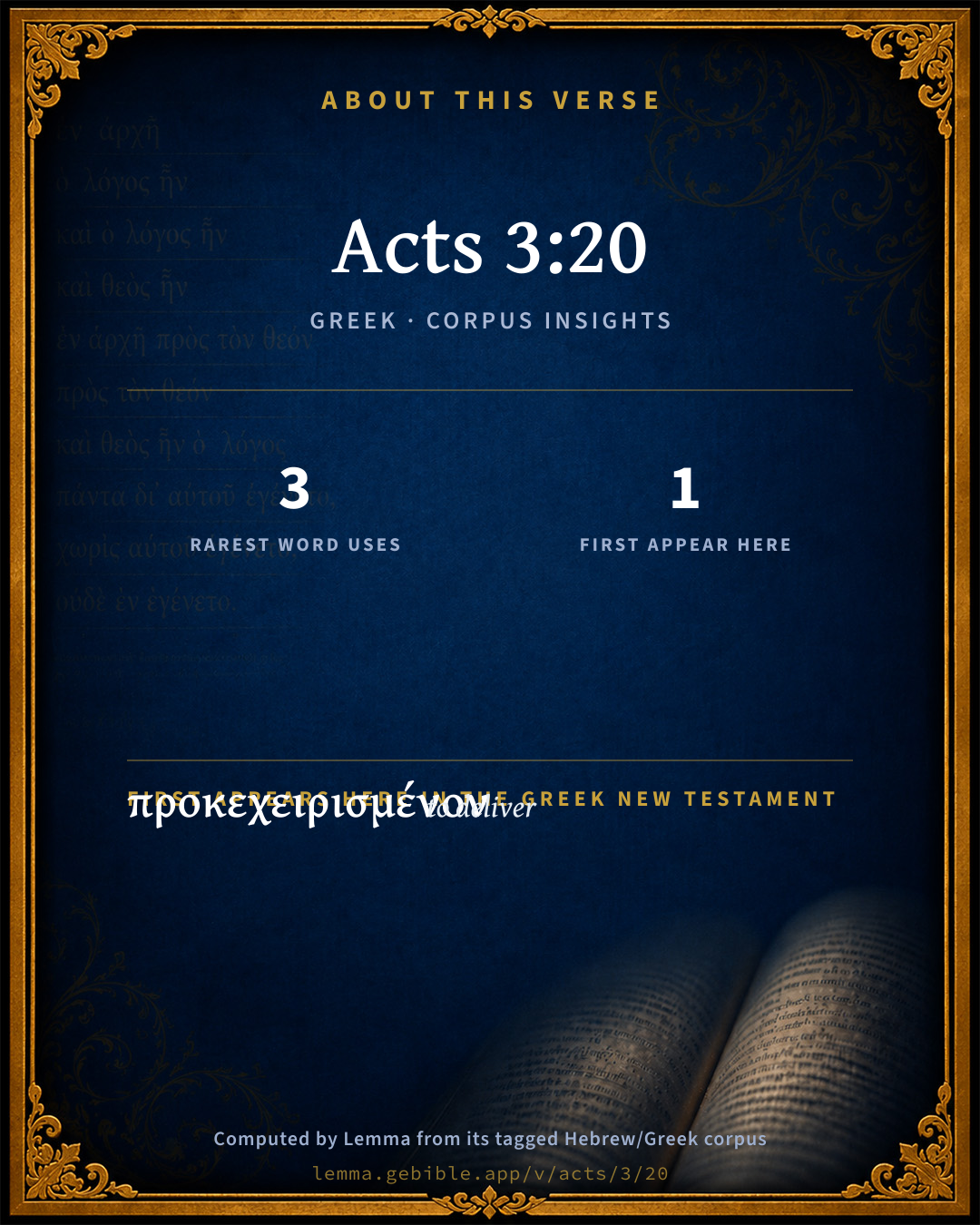
The rarest word here is προκεχειρισμένον to deliver G4400 — appearing just 3 times in the whole Greek New Testament.

First appearance in Scripture

This word makes its first canonical appearance in the Greek New Testament here:

  • προκεχειρισμένον to deliver G4400

Shared distinctive vocabulary

προκεχειρισμένον to deliver G4400 occurs in 3 verses of the Greek New Testament. Also found in:
Cross-references

13

Topical passages linked to Acts 3:20 in the Treasury of Scripture Knowledge — connected by theme and wording, ordered by reader-vote popularity; previews shown in the World English Bible.

  • Luke 19:11 As they heard these things, he went on and told a parable, because he was near Jerusalem, and they supposed that the Kingdom of God would be revealed immediately.
  • 2 Thessalonians 2:2 not to be quickly shaken in your mind, nor yet be troubled, either by spirit, or by word, or by letter as from us, saying that the day of Christ had come.
  • 2 Thessalonians 2:8 Then the lawless one will be revealed, whom the Lord will kill with the breath of his mouth, and bring to nothing by the brightness of his coming;
  • Revelation 1:7 Behold, he is coming with the clouds, and every eye will see him, including those who pierced him. All the tribes of the earth will mourn over him. Even so, Amen.
  • Matthew 24:30–36 and then the sign of the Son of Man will appear in the sky. Then all the tribes of the earth will mourn, and they will see the Son of Man coming on the clouds of the sky with power and great glory.
  • Revelation 19:11–16 I saw the heaven opened, and behold, a white horse, and he who sat on it is called Faithful and True. In righteousness he judges and makes war.
  • Matthew 16:27 For the Son of Man will come in the glory of his Father with his angels, and then he will render to everyone according to his deeds.
  • Matthew 24:3 As he sat on the Mount of Olives, the disciples came to him privately, saying, "Tell us, when will these things be? What is the sign of your coming, and of the end of the age?"
  • Mark 13:26 Then they will see the Son of Man coming in clouds with great power and glory.
  • Mark 13:30–37 Most assuredly I say to you, this generation will not pass away until all these things happen.
  • Luke 21:27 Then they will see the Son of Man coming in a cloud with power and great glory.
  • Acts 17:31 because he has appointed a day in which he will judge the world in righteousness by the man whom he has ordained; of which he has given assurance to all men, in that he has raised him from the dead."
  • Hebrews 9:28 so Christ also, having been once offered to bear the sins of many, will appear a second time, without sin, to those who are eagerly waiting for him for salvation.

Cross-references courtesy of OpenBible.info (CC BY 4.0).

Where the printed editions differ

1 variant

Places in this verse where the major printed Greek editions disagree on the wording in a way that affects the translation — a comparison of editions, not a manuscript-by-manuscript collation. The editions are the modern critical texts (Nestlé-Aland 28/27, SBL, Westcott-Hort, Tregelles, Tyndale House) and the traditional texts behind the KJV (the Textus Receptus and the Byzantine/Majority text). It is not a claim about which reading is original.

  1. Different wording
    προκεχειρισμένον

    “appointed”

    In NA28NA27TynSBLWHTregByz Not in TR

    προκεκηρυγμένον (prokekērugmenon) 'announced' occurs in traditional manuscripts (TR) instead of προκεχειρισμένον (prokecheirismenon) 'appointed' in older manuscripts (NA28+NA27+Tyn+SBL+WH+Treg+Byz)

Textual data: Translators Amalgamated Greek New Testament (STEPBible TAGNT) · CC BY 4.0.

Commentary

Notes on Acts 3:20 from classic Christian and Jewish commentators (each source and its license shown beneath its notes). The classic Christian expositions comment on the surrounding passage and are grouped to its opening verse, so a note may address several verses; the Jewish commentaries on the Tanakh (Rashi and others) are per-verse, so they appear only where the commentator wrote on this verse.

Lemma curates 59 commentaries, every one of them public domain or Creative Commons licensed, each selected and text-cleaned for this edition rather than reprinted as found. About our sources →

The Biblical Illustrator

Joseph S. Exell

Act_3:20

And He shall send Jesus.

The Missionary Christ

A missionary is one sent. Jesus was a missionary when He came to save; He will be a missionary when He comes to judge. These missions have been loosely termed the First and Second Advents as though there were no others. But if the Old Testament theophanies were manifestations of Christ, then Christ came on a pre-incarnate mission. Then, again, He had aa important mission after the Resurrection; and further, we see from the text in conjunction with Act_3:26 and His promise, Lo, I am with you, that He has been engaged in a mission ever since the Ascension. So there are four advents which characterise the successive phases of the mission of the Son of God. The text refers to that in which He is now engaged. Note--

I. The missionary.

1. The name Jesus is generally used of the Saviour in His human capacity; and it is not without the profoundest interest that the Great Ambassador from on high is that same Jesus who assumed our humanity to qualify Himself for a real brotherhood with our race. We have suggested, therefore, in the name sympathy, helpfulness, accessibility, companionship. While we carefully remember His august position on the throne of the universe, let us not forget that that throne is occupied by our Brother, and that therefore we may come boldly to the throne of grace!

2. Christ is the official title which represents our Lord as embodying all that was meant by the anointed personages of the Old Testament. He is the reality of which they were the type--the Messiah.

(1) Christ, then, still discharges His teaching functions, and says many things which He could not say to His ancient disciples--not so much revealing new truth as unfolding fresh developments, exhibiting new aspects, and bringing it home in unlooked-for ways.

(2) Christ is the Priest of His Church. Atonement was only one function. He ever lives to apply the benefits of His sacrifice, to make intercession, to pour forth His ceaseless blessings.

(3) Christ is King to legislate, rule, and lead to victory.

II. The Sender God (Act_3:19). That Jesus was the Sent of God shows--

1. The harmony of the missions of Christ incarnate and Christ glorified. No more frequent thought was in our Lords mind than that He came from God except the cognate thought that He was glad to come. So our text regards Christ as still being sent, and, since the effects of His mission are so blessed (Act_3:26), with the same joy. What dignity and blessedness does this give to those who receive Him! We are amazed at the condescension and love which marked the advent to Bethlehem; but under the same grand auspices does Christ come to our soul, home, church.

2. The relation of Christ.

(1) To the Father.

(a) Subordination. Send.

(b) Equality. God only could do what Christ is sent to do (Act_3:26).

(2) To the Holy Spirit. The times of refreshing are regarded as emphatically the Spirits, but our text shows that they are also Christs. This harmony of operation is seen throughout the New Testament. And what God hath joined together let no man put asunder.

III. The time; Times of refreshing. Christ is always here, but He is not always manifest. But He is supremely manifest during periods of spiritual revival.

1. In the revival of personal religion it is the vivid realisation of Christ that brings refreshment. Our dead, dry, barren times are when Christ is partially or altogether hidden. But when the clouds break the showers fall and the Sun of Righteousness shines forth, and all is glad and fruitful.

2. In the revival of Church life it is Christ brought home to the sinner, magnified by the saint, and honoured in all effort that is the prime cause.

IV. The means. Preached unto you.

1. Christless preaching is never marked by a time of refreshing. There were learned rabbis prophesying in a valley of dry bones; but it was a rude fisherman that was the instrument of bringing them to life. This Peter did by simply preaching Christ. Scholastic philosophers were scattering their ponderous tomes on an age that was not only dark but dead; but it was a rude miners son that awakened Europe into life. This Luther did by simply preaching Christ. Stately essays were read by cultured thinkers in that barren, arid eighteenth century; but untutored evangelists simply held up Christ and times of refreshing came.

2. As a means of revival, therefore, preaching Christ is the chief. Other things are important--architecture, music, visitation, schools, pleasant evenings, etc. But a Church may have all, and yet lack the one thing needful. But the Subject to be preached is a whole Christ: not His tender humanness apart from His sovereign dignity; not His precious promises apart from His atoning sacrifice. Let the whole Christ be preached accompanied by the power of the Holy Ghost, with and through whom He works, and times of refreshing from the presence of the Lord will come. (J. W. Burn.)

The Biblical Illustrator, edited by Joseph S. Exell (c. 1880s–1900s) — public domain. Text from a community e-Sword module.

Bengel's Gnomon

Johann Albrecht Bengel

Act 3:20. Ἀποστέιλη, that He may send) “Sent,” in Act 3:26: and yet the expression here, is not “send back,” or “again,” but simply “send:” comp. Act 1:1, note.—προκεχειρισμένον) Hardly anywhere is the reading προκεκηρυγμένον to be found. Peter does not here preach beforehand Christ, but declares that He is already “prepared.” The same verb occurs, ch. Act 22:14, Act 26:16; Exo 4:13; Jos 3:12. Comp. Luk 2:31. He is prepared, that He may be received by us, (and) that He may be sent by God. Hesychius, προκεχειρισμένον, προβεβλημένον, ἡτοιμασμένον; for so we ought to read, for ἠτιμασμένον.

Bengel's Gnomon of the New Testament — English translation (T&T Clark, Edinburgh, 1860) — public domain. Text from a community e-Sword module.

Meyer's Critical & Exegetical Commentary

Heinrich August Wilhelm Meyer

Act_3:20. The final aim of the preceding exhortation. In order that times of refreshiny may come. Peter conceives that the καιροὶ ἀναψύξεως and the Parousia (καὶ ἀποστείλῃ κ.τ.λ.) will set in, as soon as the Jewish nation is converted to the acknowledgment of Jesus as the Messiah. It required a further revelation to teach him that the Gentiles also were to be convertedand that directly, and not by the way of proselytismto Christ (chap.10).

ὅπως ἄν, with the subjunctive (Act_15:17; Luk_2:35; Rom_3:4; Mat_6:5), denotes the purpose that is to be attained in dependence on a supposition (here: in this event; if ye comply with the summons). See Hartung, Partikell. II. p. 289; Klotz, ad Devar. p. 685 f. This ἄν, consequently, is not equivalent to ἐάν (Vulg.: ut cum venerint), in which case an apodosis which would be wanting is arbitrarily supplied in thought (see Erasmus and, recently, Beelen). Others (Beza, Castalio, Erasmus Schmid, Eckermann, et al.) consider ὅπως as a particle of time = ὅτε: quandocunque venerint. Against this it may be decisively urged, in point of linguistic usage, that in Greek writers (in Herod, and the poets) the temporal ὅπως is joined with the indicative or optative, but does not occur at all in the N. T.; and, in point of fact, the remission of sins takes place not for the first time at the Parousia, but at once on the acceptance of the gospel.

καιροὶ ἀναψύξ.] seasons of refreshing: namely, the Messianic, as is self-evident and is clear from what follows. It is substantially the same as is meant in Luk_2:25 by παράκλησις τοῦ Ἰσραήλ,namely, seasons in which, through the appearance of the Messiah in His kingdom, there shall occur blessed rest and refreshment for the people of God, after the expiration of the troublous seasons of the αἰὼν οὗτος (2Ti_3:1; Gal_1:4; Act_14:22).[145] The αἰῶνες οἱ ἐπερχόμενοι in chap. Act_2:7 are not different from these future καιροί. This explanation is shown to be clearly right by the fact that Peter himself immediately adds, as explanatory of καιροὶ ἀναψύξ.: καὶ ἀποστείλῃ τὸν προκεχειρ. ὑμῖν Ἰησ. Χ., which points to the Parousia. Others rationalizing have, at variance with the text, explained the καιροὶ ἀναψ. either of the time of rest after death (Schulz in the Bibl. Hag. 5. p. 119 ff.), or of deliverance from the yoke of the ceremonial law (Kraft, Obss. sacr. Fasc. IX. p. 271 ff.), or of the putting off of penal judgment on the Jews (Barkey), or of the sparing of the Christians amidst the destruction of the Jews (Grotius, Hammond, Lightfoot), or of the glorious condition of the Christian church before the end of the world (Vitringa). On ἀνάψυξις, comp. LXX. Exo_8:15; Aq. Isa_28:12; Strabo, x. p. 459.

ἀπὸ προσώπου τοῦ κυρίου] The times, which are to appear, are rhetorically represented as something real, which is to be found with God in heaven, and comes thence, from the face of God, to earth. Thus God is designated as αἴτιος of the times of refreshing (Chrysostom).

τὸν προκεχ. ὑμῖν Ἰ. Χ.] Jesus the Messiah destined for you (for your nation). On προχειρίζομαι (Act_22:14, Act_26:16), properly, I take in hand; then, I undertake, I determine, and with the accusative of the person: I, appoint one. Comp. 2Ma_3:7; 2Ma_8:9; Polyb. vi. 58. 3; Plut. Galb. 8; Diod. Sic. xii. 22; Wetstein and Kypke in loc.; Schleusn. Thes. iv. p. 513. Analogous is ὁ τοῦ Θεοῦ ἐκλεκτός, Luk_23:35.

[145] Analogous is the conception of χατάπαυσις and σαββατισμός in the Epistle to the Hebrews. Comp. ἄνεσις 2Th_1:7, and the description given in Rev_21:4 f.

Meyer — Critical and Exegetical Commentary on the New Testament — English translation by Peter Christie, edited by Frederick Crombie (T&T Clark, 1880) — public domain. Text from a community e-Sword module.

Expositor's Greek Testament

ed. W. Robertson Nicoll

Act 3:20 . καὶ ἀποστείλῃ , i.e. , at His Parousia. The construction is still ὅπως ἄν with the verb. ἀποστ . is here used as in Luk 4:18 ; Luk 4:43 , expressing that the person sent is the envoy or representative of the sender ( πέμπω is also used of the mission of our Lord). τὸν προκεκηρυγμένον , T.R., see on Act 3:18 ; but W.H [146] , Blass, Weiss, τὸν προκεχειρισμένον ὑμῖν Χριστόν , Ἰησοῦν : “the Christ who hath been appointed for you, even Jesus”. So R.V. This verb is found with accusative of the person in the sense of choosing, appointing, in Act 22:14 ; Act 26:16 , and nowhere else in the N.T.; cf. Jos 3:12 , 2MMal 3:7 ; 2Ma 8:9 , Exo 6:13 ( cf. its use also in Dem., Polyb., Plut., and instances in Wetstein); Latin eligere, destinare . The expression here refers not only to the fact that Jesus was the appointed Christ, inasmuch as the covenant with Abraham was fulfilled in Him, Act 3:25 , but also to the return of Jesus as the Christ, the Messianic King, at His Parousia, in accordance with the voices of the Prophets. This is more natural than to suppose that the expression means foreordained, i.e. , from eternity, although St. Peter’s words elsewhere may well be considered in connection with the present passage, 1Pe 1:20 .

[146] Westcott and Hort’s The New Testament in Greek: Critical Text and Notes.

The Expositor's Greek Testament, edited by W. Robertson Nicoll (1897–1910) — public domain. Text from a community e-Sword module.

Jamieson, Fausset & Brown

Robert Jamieson, A. R. Fausset & David Brown

he shall send Jesus Christ--The true reading is, "He shall send your predestinated (or foreordained) Messiah, Jesus."

Jamieson, Fausset & Brown — Commentary Critical and Explanatory on the Whole Bible (1871) — public domain (CC PDM 1.0). Text via the HelloAO Bible API.

Adam Clarke's Commentary

Verse 20. Which before was preached unto you] Instead of προκεκηρυγμενον, before preached, ABCDE, fifty-three others, both the Syriac, all the Arabic, the Armenian, Chrysostom, and others, have προκεχειρισμενον, who was before designed, or appointed; and this is without doubt the true reading. Christ crucified was the person whom God had from the beginning appointed or designed for the Jewish people. It was not a triumphant Messiah which they were to expect; but one who was to suffer and die. Jesus was this person; and by believing in him, as thus suffering and dying for their sins, he should be again sent, in the power of his Spirit, to justify and save them.

Adam Clarke's Commentary on the Bible (1810–1826) — public domain. Text from a community e-Sword/MySword module.

John Calvin's Commentaries

20. That when If we follow Erasmus and the old interpreter, this sentence shall be unperfect, which may be made perfect, thus: When the time of refreshing shall come, you may also enjoy this refreshing; when Christ shall come to judge the world, you may find him a redeemer and not a Judge. But because Beza doth fitly translate it, After that they shall come, it is better to retain that which is not so racked; so you resolve it thus: That sins are so forgiven against the day of the last judgment; because, unless we be cited to appear before God’s judgment-seat we are not greatly careful to pacify God. First of all, we must note, that he setteth before them the day of judgment, to the end the former exhortation may take the greater effect. For there is nothing which doth more prick us, than when we are taught that we must once give an account. For so long as our senses are holden and kept in this world, they are drowned, as it were, in a certain drowsiness, that I may so call it. Wherefore the message of the last judgment must sound as a trumpet to cite us to appear before the judgment-seat of God. For then at last being truly awaked, we begin to think of a new life. In like sort, when Paul preached at Athens, God saith, that he doth now will all men to repent; because he hath appointed a day wherein he will judge the world, (Acts 17:30, 31.) The sum is this, that Christ, who is now unto us a Master, when as he teacheth us by the gospel, is appointed of the Father to be a Judge, and shall come in his due time; and that, therefore, we must obey his doctrine betimes, that we may gather the fruit of our faith then.

But some man may object, that Peter speaketh otherwise of the last day. For this doth not serve to make them afraid, when he saith, the time of refreshing. I answer, that there is a double prick, wherewith the faithful are pricked forward when as they are told of the last judgment. For the profit of faith doth not appear in this world, yea rather it seemeth to go well with the despisers of God; but the life of the godly is full of miseries. Therefore our hearts should oftentimes faint and quail, unless we should remember that the day of rest shall come, which shall quench all the heat of our trouble, and make an end of our miseries. The other prick whereof I spoke is this, when as the fearful judgment of God causeth us to shake off delicacy and drowsiness. So Peter mixeth in this place threatenings with promises, partly to the end he may allure the Jews unto Christ, and partly that he may prick them forward with fear. Furthermore, this is a thing much used in the Scripture, as it speaketh either unto the reprobate, or unto the elect, sometimes to make the day of the Lord doleful and fearful, sometimes to make the same pleasant and to be wished for. Peter therefore doth very well, who, whilst that he putteth the Jews in good hope of pardon, doth make the day of Christ pleasant to them, to the end they may desire the same.

And shall send him. He saith expressly that Christ shall be Judge, to the end they may know that the contempt of the gospel shall not be unpunished. For how should not Christ punish the same? In the meanwhile, this doth greatly comfort the faithful, when as they know that it shall be in his hand to give salvation, who doth now promise and offer the same. He addeth, moreover, that he shall come who is now preached unto them. Whereby he taketh away all excuse of ignorance. As if he should say, Christ is preached unto you now before he come to judge the world; to the end that those who will embrace him may receive the fruit of their faith at that day; and to the end that others, who shall refuse him, may be punished for their unbelief. Although the Grecians do read this two ways; for some books have προκεκηρυγμενον, that is, preached before; and other some προκεχειρισμενον, that is, showed, or set before their eyes. But both have one sense, to wit, that Christ is not offered unto them in vain now by the doctrine of the gospel; because he shall be sent the second time by his Father to be a Judge, armed and prepared to render vengeance, unless they embrace him now for their Redeemer.

John Calvin's Commentaries (1540-1563) — public domain. Text from the Calvin Translation Society English edition (1840s-50s) via the Christian Classics Ethereal Library (ccel.org). Calvin's coverage is partial (roughly two-thirds of the Bible); uncommented books and verses are honest gaps, never fabricated. The 19th-century editor's footnotes and remarks are omitted so the notes are faithfully Calvin's own voice.

Ellicott's Commentary for English Readers

(20) And he shall send Jesus Christ.—Better, as before, and that He may send.

Which before was preached unto you.—The better MSS. have, which was fore-appointed, or fore-ordained, for you.

A Bible Commentary for English Readers, edited by Charles John Ellicott (1878–1897) — public domain. Text from a community e-Sword module.

The Cambridge Bible for Schools and Colleges

gen. ed. J. J. S. Perowne

20. and he shall send] The construction is continued from the previous verse. Read, and that he may send.

In the rest of this verse both the order of the words and the reading of the Tex. Rec. is different from that of the best MSS. The sentence should read: the Christ which was appointed for you, even Jesus. Not only is this the more authoritative reading but it agrees with the proofs which St Peter presently cites (Act_3:25), “Ye are the children of the covenant which God made with our fathers.” The Christ, the Messiah, had been appointed and promised unto the Jewish nation, and now the promise of the covenant is fulfilled in Jesus.

The Cambridge Bible for Schools and Colleges (gen. ed. J. J. S. Perowne; Cambridge University Press, 1878–1918) — public domain. Text from a community e-Sword module.

John Gill's Exposition

And he shall send Jesus Christ,.... Or "that he may send Jesus Christ", as the Syriac and Arabic versions render it: not in person, for this regards neither his first, nor his second coming, both which might be terrible to the awakened Jews; the former, because he had been sent, and was come, and was gone again; and therefore might fear there was no hope for them, who had denied him, and crucified him; the latter, because they might conclude he would be sent, and come to take vengeance on them, when they should look upon him whom they had pierced with horror and trembling; but here it regards his being sent, and his coming in the ministration of the word, and by his Spirit, to the comfort of their souls:

which before was preached unto you; in the writings of the Old Testament, in the books of Moses, and of the Prophets, Act 3:22 or, as it is read in the Alexandrian copy, and in other copies, and in the Complutensian edition, and in the Syriac and Arabic versions, who was "predetermined" or "prepared for you"; that is, in the purposes, council, and covenant of God. The Ethiopic version reads, "whom he before anointed"; to be prophet, priest, and King; and from each of these considerations much comfort might be drawn by sensible sinners.

John Gill's Exposition of the Whole Bible (1746–1763) — public domain (CC PDM 1.0). Text via the HelloAO Bible API.

Trapp's Complete Commentary

John Trapp

20 And he shall send Jesus Christ, which before was preached unto you:

Ver. 20. Preached unto you] Or handed to you, or put into your hands, προκεχειρισμενον.

John Trapp, A Commentary or Exposition upon All the Books of the Old and New Testament (1647–1656) — public domain. Text from a community e-Sword module.

Albert Barnes' Notes on the Bible

And he shall send ... - Act 1:1 l. Under this economy of things, he shall send Jesus Christ, that is, the Messiah, to teach people; to redeem them; to save them; to judge the world; to gather his people to himself; and to condemn the wicked. Under this economy they were then. This, therefore, was an argument why they should repent and turn to God, that they might escape in the day of judgment.

Which before was preached ... - Who has been proclaimed as the Messiah. The name “Jesus Christ” is equivalent here to “the Messiah.” The Messiah had been proclaimed to the Jews as about to come. In his time was to be the period of refreshing. He had come; and they were under the economy in which the blessings of the Messiah were to be enjoyed. This does not refer to his personal ministry, or to the preaching of the apostles, but to the fact that the Messiah had been a long time announced to them by the prophets as about to come. All the prophets had preached him as the hope of the nation. It may be remarked, however, that there is here a difference in the manuscripts. A large majority of them read προκεχειρισμενον prokecheirismenon, who was designated or appointed, instead of who was preached. This reading is approved by Griesbach, Knapp, Bengel, etc. It was followed in the ancient Syriac, the Arabic, etc., and is undoubtedly the true reading.

Albert Barnes' Notes on the Bible (1834–1885) — public domain. Text from a community e-Sword/MySword module.

Haydock's Catholic Bible Commentary

The times of refreshment. The time of eternal rest and happiness, &c. --- These words, you may be saved, must be understood, to make the sense complete. (Witham)

George Leo Haydock (1774–1849), Haydock's Catholic Family Bible and Commentary, 1859 edition — public domain. Excludes Psalms (Douay-Rheims chapter numbering differs from Protestant) and Deuterocanonical books (Catholic canon only).

Matthew Poole's English Annotations

To remove all evils and miseries from his people; when that Sun shines all clouds and mists are scattered. This refers especially to Christ’s second coming, which is here promised, to encourage us to do good, and to deter us from doing evil; as also to move us to repentance, and to comfort us when penitent.

Matthew Poole's English Annotations on the Holy Bible (1683–1685) — public domain. Text from a community e-Sword/MySword module.

Whedon's Commentary on the Bible

Daniel D. Whedon

20. And he shall send—In order that he may send.

Before was preached—It is generally agreed now that the true reading here is, which was chosen or appointed. The same Greek word occurs in Act_22:14, “Hath chosen thee, that thou shouldest know his will,” and Act_26:16, “To make (or choose) thee a minister.” The verse should read: And (in order that) he may send the chosen Jesus Messiah unto you. The unto you depends upon send.

Daniel D. Whedon (gen. ed.), Commentary on the Old and New Testaments (1874–1909) — public domain. Text from a community e-Sword module.

The Pulpit Commentary

And that he may send the Christ even Jesus for and he shall send Jesus Christ, A.V.; who hath been appointed (prokeceirismenon, (Act_22:14 Act_26:16) for you for (prokekhrugmenon) which before was preached unto you, A.V. and T.R. Who hath been appointed, etc. Jesus is already designated and appointed and made (Act_2:36) both Lord and Christ, but his glorious presence with his Church is deferred for a time, during which he is in heaven (ver. 21). Tim R.V. is surely very infelicitous here, as if there were several Christs, one of whom was appointed for Israel.

The Pulpit Commentary (1880–1919), ed. H.D.M. Spence-Jones & Joseph S. Exell — public domain. Text from a community e-Sword module.

John Wesley's Explanatory Notes

And he may send - The apostles generally speak of our Lord's second coming, as being just at hand. Who was before appointed - Before the foundation of the world.

John Wesley, Explanatory Notes Upon the Whole Bible (1754–1765) — public domain. Text via the GEBible commentary corpus.

Scofield Reference Notes

C. I. Scofield

And he shall

The appeal here is national to the Jewish people as such, not individuals as in Peter’s first sermon Act 2:38; Act 2:39. There those who were pricked in heart were exhorted to save themselves from (among) the untoward nation; here the whole people is addressed, and the promise to national repentance is national deliverance: "and he shall send Jesus Christ" to bring in the times which the prophets had foretold

(See Scofield "Act 2:14"). The official answer was the imprisonment of the apostles, and the inhibition to preach, so fulfilling Luk 19:14.

The Scofield Reference Bible (1917 edition), notes by C. I. Scofield — public domain. Text from a community e-Sword module.

Burkitt's Expository Notes on the New Testament

William Burkitt

Here St. Peter enforces his exhortation to repentance with a strong motive; namely, the certainty of Christ’s coming to judge the world. God shall send Jesus, this Jesus whom we preach to you, visibly, to justify and glorify all penitentt and pardoned sinners, whom yet the heaven must contain till the restitution of all things; that is, to the end of the world, when the whole creation which now groaneth will be delivered, and man particularly restored to God, to himself, and to a blessed immortality.

Learn hence, That Christ, being ascended into heaven in our human nature, shall abide and continue there until the restitution of all things, and his corporal presence here on earth is not to be expected, until he has put all his enemies under his feet. Now if his body be, and must continue in heaven, surely then it is not in the sacrament, and the Papist’s dream; who ascribe to Christ’s human nature the property of a Godhead; namely, to be in ten thousand places at one and the same time, contrary to the nature of a human body. If the heavens must contain Christ, Christ must be contained in heaven, and then his presence in the sacrament doth not draw him from heaven; his bodily presence is in heaven, his spiritual presence with his people in the sacrament.

William Burkitt's Expository Notes on the New Testament (1700–1703) — public domain. Text from a community e-Sword module.

Godbey's Commentary on the New Testament

William B. Godbey

RETURN OF CHRIST

20. The E. V. erroneously has a semicolon between the 19th and 20th verses. The inspired original, spoken by Peter and written by Luke, has no stop whatever between these verses. Then what will our brethren do who are unwilling to preach the second coming of Christ, as there is not even a comma here, much less a period, on which they may slide out? Inspired Peter preaches the glorious spiritual economy of full salvation and the second coming of Christ in the very same breath. Hence, if you preach the former and leave out the latter, you will certainly grieve the Holy Spirit by breaking one of His sentences in two in the middle without His authority. Good Lord, help us to be true to His Word and not get wise above what is written: “And he may send forth unto you him who has been preached unto you as the Messiah, namely Jesus,”

William B. Godbey, Commentary on the New Testament (1896–1900) — public domain. Text from a community e-Sword module.

McGarvey & Pendleton's Commentaries

J. W. McGarvey

See notes on verse 19

J. W. McGarvey (with Philip Y. Pendleton), Commentaries on the New Testament (The Fourfold Gospel, 1914; Acts; and the epistles) — public domain. Text from a community e-Sword/MySword module.

The People's New Testament

B. W. Johnson

20. And he shall send Jesus Christ. Again we have to turn to the Revision for the meaning. The great hope of the Jews was the Messiah. He had come, been rejected, and had returned to heaven. His return will be prepared for by repentance, and turning to the Lord. The blotting out of sins, the seasons of refreshing, and the return of Christ are all, in some measure, dependent on their repentance and turning. The Christ appointed is even Jesus, the crucified One.

B. W. Johnson's The People's New Testament with Notes (1889–1891) — public domain. Electronic text from the Christian Classics Ethereal Library (CCEL) ThML edition.

Cambridge Greek Testament for Schools and Colleges

20. προκεχειρισμένον is the reading of אABCDEP. The Vulg. favours the Text. recept. in giving ‘qui prædicatus est.’ But that sense is out of harmony with Act 3:25 where the people are called υἱοὶ τῆς διαθήκης. See notes.

20. καὶ ἀποστείλῃ. The construction is continued from ὅπως ἄν in the previous verse. Render, and that He may send.

προκεχειρισμένον, the Christ which was appointed for you, even Jesus. This reading and sense agree with the proof which St Peter presently cites (Act 3:25), ‘Ye are the children of the covenant which God made with our fathers.’ The Christ, the Messiah had been appointed and promised unto the Jewish nation, and now the promise of the covenant is fulfilled in Jesus.

Cambridge Greek Testament for Schools and Colleges (Cambridge University Press, 1896; 21 vols, various authors incl. Carr, Maclear, Plummer, Farrar, Lumby, Moule, M. R. James, Simcox) — public domain. Text from a community e-Sword module.

Alford’s Greek Testament

Henry Alford

20.] ἀποστείλῃ (see above), literally,—not figuratively, by the Spirit:—even if the word send be no where else applied to the second coming of the Lord, there is no reason why it should not be here: the whole ground and standing-point of these two orations of Peter are peculiar, and the very mention of the ‘times of refreshment’ proceeding forth from the presence of the Father would naturally lead to the position here assigned to the Son, as one sent by the Father. See below, on ver. 26. Besides which, the aor. will not allow of the figurative interpretation, confining, as it does, the ‘sending’ to one definite event.

προκεχειρισμένον] before appointed, as apparently in the first ref.: or perhaps προ- merely gives the idea of forth, before the rest, as in the two others, and perhaps even in the first also. ὑμῖν, to you,—as your Messiah. According to the right reading, χριστ. Ἰησοῦν, χριστόν may be connected with τὸν προκεχ. ὑμ., Him who was predestined your Messiah, namely, Jesus.

Henry Alford, The Greek Testament (1849–1861) — public domain. Text from a community e-Sword module.

Vincent's Word Studies in the New Testament

Marvin R. Vincent

Which before was preached [τον προκεκηρυγμενον] . But the best texts read prokeceirismenon, appointed. Compare ch. 22 14. Used by Luke only, ch. Act 22:14; Act 26:16. The verb originally means to take in hand.

Marvin R. Vincent, Word Studies in the New Testament (1887–1900) — public domain. Text from a community e-Sword/MySword module.

Lesson kit

Teaching starters — assembled from the data on this page, not authored interpretation. Every prompt links to the verse data it draws on. Edit before teaching.

Acts, in the Acts, opens this verse with 7 words (7 distinct Greek lemmas). Its most distinctive word is procheirízomai (“to deliver”). A historical commentator’s framing appears above. Read the whole chapter for the surrounding context.

Discussion questions

  1. The word procheirízomai carries the sense “to deliver.” How does it shape the verse?
  2. The word “to deliver” first appears here in Scripture. What is being introduced at this debut?
  3. Acts 22:14 shares the word «to deliver» with this verse. How do the two illuminate each other?
  4. The translations on this page render this verse differently — a whole-verse word diff, not a word-by-word alignment. What might account for the different wordings?
  5. Reading how The Biblical Illustrator and Bengel's Gnomon read this verse, where do the two commentators agree and where do they part?

Things to notice

  • 1 word makes its first canonical appearance in Scripture here.
  • These translations choose different wording for 14 words in this verse.
  • 7 distinct Greek lemmas span 7 words in this verse.

Reading settings

Reading text

Shown beneath each verse's original-language words.

Old Testament
Old Testament edition

Read the OT as the Masoretic Hebrew (MT) or the Greek Septuagint (LXX).

English shown for the Greek Septuagint (in the Hebrew ↔ Greek comparison).

Comparing translations? Open the Compare panel on any verse page to stack up to four side by side.