
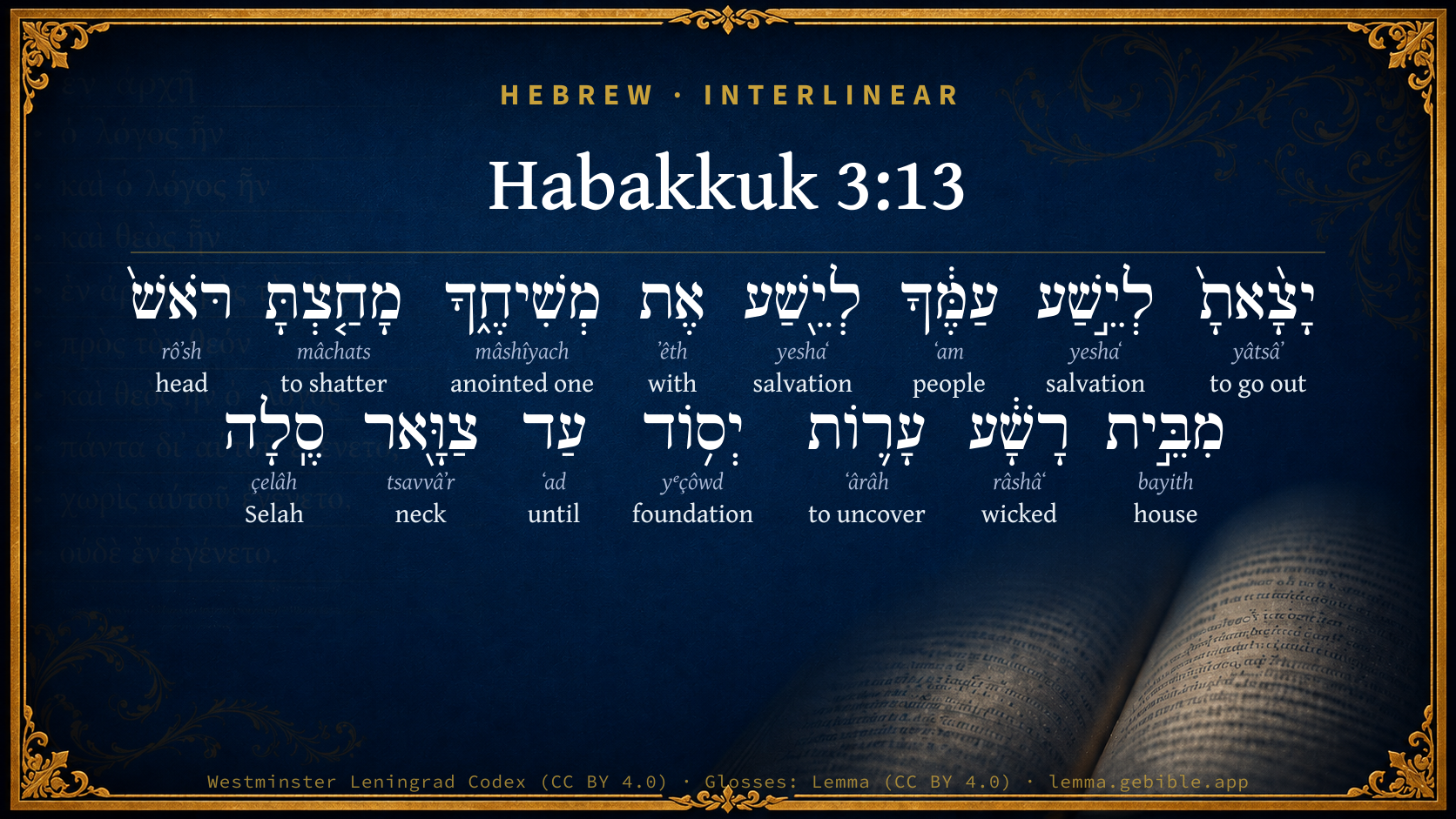
Habakkuk 3:13

Hebrew (Westminster Leningrad Codex) Habakkuk 3:13 appears in the Hebrew Old Testament. The text above is from the Westminster Leningrad Codex. Each word links to its Strong’s number, a concise gloss, and parsing drawn from the Open Scriptures Hebrew Bible morphology. Click any word for its full Brown-Driver-Briggs (BDB) entry.
Download image
Cite this verse

Habakkuk 3:13 (World English Bible). Public Domain. Lemma interlinear Bible study tool, https://lemma.gebible.app/v/habakkuk/3/13.

Show BibTeX & RIS
BibTeX
RIS
English Translation
You went forth for the salvation of your people, For the salvation of your anointed. You crushed the head of the land of wickedness. You stripped them head to foot. Selah.
World English Bible · Public Domain
Download a study sheet

One document with this verse’s original text, its word-by-word gloss line, the meaning frame, cross-references with their text, attributed commentary, and full source and license credits — printable, and it pastes into notes with its structure intact.

This verse Autodidact and up

Study sheet (.html) Plain text (.txt)

A passage Seminary Student

Up to 50 verses in one chapter. A passage sheet keeps up to 6 commentary sources and 12 cross-references per verse, in the order this page ranks them, and says so on the sheet whenever that leaves anything out. Ask for a single verse and you get the Autodidact verse sheet above.

Everything on this page stays free to read, with no account — the sheet is a download of what is already on screen, not access to it.

Want to remove ads? Support Godless Engineer
Compare translations 3

The same verse in 3 English versions, stacked beneath the original-language interlinear above. Click any original word for its lexicon entry.

Each is an independent rendering of the whole verse — the interlinear is not word-aligned to these translations.

Highlighted words mark where these versions differ — a whole-verse word diff, not a word-by-word alignment.

  • World English Bible Public Domain
    You went forth for the salvation of your people, For the salvation of your anointed. You crushed the head of the land of wickedness. You stripped them head to foot. Selah.
  • King James Version Public Domain
    Thou wentest forth for the salvation of thy people, even for salvation with thine anointed; thou woundedst the head out of the house of the wicked, by discovering the foundation unto the neck. Selah.
  • unfoldingWord Literal Text CC BY-SA 4.0
    You went out for the salvation of your people, for the salvation of your anointed one. You struck the head from the house of the wicked, laying bare the foundation to the neck. Selah

unfoldingWord Literal Text — © unfoldingWord, licensed CC BY-SA 4.0. Word-aligned USFM3 via Door43 (git.door43.org/unfoldingWord/en_ult).

Versions to compare (up to 4)

3 of 4 selected

Show all 18 translations

Every available English version of this verse, each an independent rendering of the whole verse.

  • World English Bible Public Domain
    You went forth for the salvation of your people, For the salvation of your anointed. You crushed the head of the land of wickedness. You stripped them head to foot. Selah.
  • Berean Standard Bible Public Domain
    You went forth for the salvation of Your people, to save Your anointed. You crushed the head of the house of the wicked and stripped him from head to toe. Selah
  • Majority Standard Bible Public Domain
    You went forth for the salvation of Your people, to save Your anointed. You crushed the head of the house of the wicked and stripped him from head to toe. Selah
  • King James Version Public Domain
    Thou wentest forth for the salvation of thy people, even for salvation with thine anointed; thou woundedst the head out of the house of the wicked, by discovering the foundation unto the neck. Selah.
  • American Standard Version (1901) Public Domain
    Thou wentest forth for the salvation of thy people, For the salvation of thine anointed; Thou woundest the head out of the house of the wicked man, Laying bare the foundation even unto the neck. Selah.
  • Revised Version (1885) Public Domain
    Thou wentest forth for the salvation of thy people, for the salvation of thine anointed; thou woundedst the head out of the house of the wicked, laying bare the foundation even unto the neck. Selah
  • Geneva Bible (1599) Public Domain
    Thou wentest foorth for the saluation of thy people, euen for saluation with thine Anointed: thou hast wounded the head of the house of the wicked, and discoueredst the foundations vnto the necke, Selah.
  • Douay-Rheims (1899) Public Domain
    Thou wentest forth for the salvation of thy people: for salvation with thy Christ. Thou struckest the head of the house of the wicked: thou hast laid bare his foundation even to the neck.
  • Young's Literal Translation Public Domain
    Thou hast gone forth for the salvation of Thy people, For salvation with Thine anointed, Thou hast smitten the head of the house of the wicked, Laying bare the foundation unto the neck. Pause!
  • Literal Standard Version CC BY-SA 4.0
    You have gone forth for the salvation of Your people, || For salvation with Your Anointed, || You have struck the head of the house of the wicked, || Laying bare the foundation to the neck. Pause!
  • Unlocked Literal Bible CC BY-SA 4.0
    You went out for the salvation of your people, for the salvation of your anointed one. You shatter the head of the house of the wicked to lay bare from the base up to the neck. Selah
  • unfoldingWord Literal Text CC BY-SA 4.0
    You went out for the salvation of your people, for the salvation of your anointed one. You struck the head from the house of the wicked, laying bare the foundation to the neck. Selah
  • Darby Bible Public Domain
    Thou wentest forth for the salvation of thy people, For the salvation of thine anointed; Thou didst smite off the head from the house of the wicked, Laying bare the foundation even to the neck. Selah.
  • World Messianic Bible Public Domain
    You went out for the salvation of your people, for the salvation of your anointed. You crushed the head of the land of wickedness. You stripped them head to foot. Selah.
  • Webster's Bible Public Domain
    Thou wentest forth for the salvation of thy people, even for salvation with thy anointed; thou woundedst the head out of the house of the wicked, by uncovering the foundation to the neck. Selah.
  • Free Bible Version CC BY-SA 4.0
    You came out to save your people, to save your chosen people. You crushed the head of the house of the wicked, stripping him from thick to neck.
  • Bible in Basic English Public Domain
    You went out for the salvation of your people, for the salvation of the one on whom your holy oil was put; wounding the head of the family of the evil-doer, uncovering the base even to the neck. Selah.
  • JPS Tanakh (1917) Public Domain
    Thou art come forth for the deliverance of Thy people, for the deliverance of Thine anointed; Thou woundest the head out of the house of the wicked, uncovering the foundation even unto the neck. Selah

Literal Standard Version (2020), Covenant Press — licensed CC BY-SA 4.0. Text via the HelloAO Bible API (eBible.org). Unlocked Literal Bible (unfoldingWord) — licensed CC BY-SA 4.0. Text via the HelloAO Bible API (eBible.org). unfoldingWord Literal Text — © unfoldingWord, licensed CC BY-SA 4.0. Word-aligned USFM3 via Door43 (git.door43.org/unfoldingWord/en_ult). Free Bible Version, Dr. Jonathan Gallagher — licensed CC BY-SA 4.0. Text via the HelloAO Bible API (eBible.org).

Word by word

More ways to search: Search by grammar → Find every occurrence → Compare this word →

Practice this passage: Drill this verse → Learn its vocabulary →

מָחַ֤צְתָּ
mâchats
H4272
“to shatter”
Verb, Qal, Perfect, 2nd Person, Masculine, Singular
Part of Speech
Verb
Stem
Qal
Form
Perfect
Person
2nd Person
Gender
Masculine
Number
Singular
Full BDB Definition

Origin: a primitive root

TWOT: 1183

to smite through, shatter, wound severely - (Qal) - to shatter - shattering (participle)
  1. יָצָ֨אתָ֙ yâtsâʼ H3318 “to go out” Verb, Qal, Perfect, 2nd Person, Masculine, Singular
  2. לְיֵ֣שַׁע yeshaʻ H3468 “to/for · salvation of” Preposition + Noun, Common, Masculine, Singular, Construct
  3. עַמֶּ֔ךָ ʻam H5971 “people · your” Noun, Common, Masculine, Singular, Construct + Suffix, Personal, 2nd Person, Masculine, Singular
  4. לְיֵ֖שַׁע yeshaʻ H3468 “to/for · salvation” Preposition + Noun, Common, Masculine, Singular, Absolute
  5. אֶת ʼêth H854 “with” Preposition
  6. מְשִׁיחֶ֑ךָ mâshîyach H4899 “anointed one · your” Noun, Common, Masculine, Singular, Construct + Suffix, Personal, 2nd Person, Masculine, Singular
  7. רֹּאשׁ֙ rôʼsh H7218 “head” Noun, Common, Masculine, Singular, Absolute
  8. מִבֵּ֣ית bayith H1004 “from · house of” Preposition + Noun, Common, Masculine, Singular, Construct
  9. רָשָׁ֔ע râshâʻ H7563 “wicked” Adjective, Adjective, Masculine, Singular, Absolute
  10. עָר֛וֹת ʻârâh H6168 “to uncover” Verb, Piel, Infinitive Absolute
  11. יְס֥וֹד yᵉçôwd H3247 “foundation” Noun, Common, Masculine, Singular, Absolute
  12. עַד ʻad H5704 “until” Preposition
  13. צַוָּ֖אר tsavvâʼr H6677 “neck” Noun, Common, Masculine, Singular, Absolute
  14. סֶֽלָה çelâh H5542 “Selah” Particle, Interjection

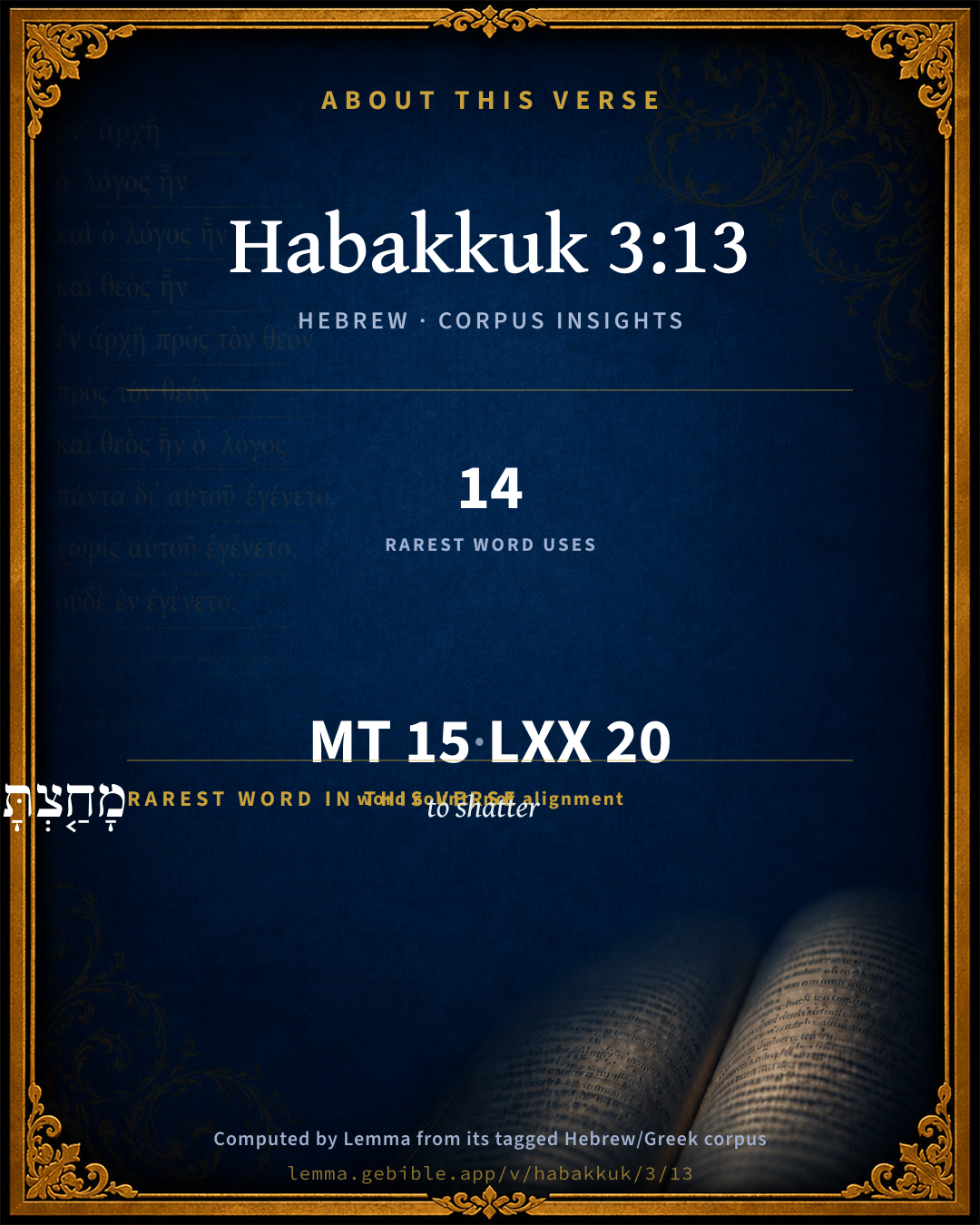
About this verse

These counts appear in no published source. They are computed here, from the morphology-tagged text and Lemma’s own curated glosses. What Lemma adds →

15
words
14
distinct lemmas
Prophets
section

Notable vocabulary

The rarest word here is מָחַ֤צְתָּ to shatter H4272 — appearing just 14 times in the whole Hebrew Bible.

Shared distinctive vocabulary

מָחַ֤צְתָּ to shatter H4272 occurs in 14 verses of the Hebrew Bible. Also found in:

Grammatical profile

  • 3 verbs
  • 8 nouns
  • 1 adjective
  • 2 prepositions
  • 1 particle

Verb forms

  • יָצָ֨אתָ֙ Qal · Perfect
  • מָחַ֤צְתָּ Qal · Perfect
  • עָר֛וֹת Piel · Infinitive Absolute

Repetition

A word recurs within this verse — often emphatic in Hebrew:

  • לְיֵ֣שַׁע salvation H3468 ×2

Hebrew & Septuagint length

In English translation the verse runs 31 words from the Hebrew and 30 from the Septuagint (LXX English) — closely comparable.

A rough comparison of the two English renderings, which tokenize alike — not a word-level alignment.

Word counts can differ between the Hebrew and the Greek without any difference in meaning — e.g. the Hebrew direct-object marker אֵת has no separate Greek word, and Greek often adds the article ὁ.

In the original languages it is 15 Hebrew tokens and 20 Greek tokens — but the two are counted differently (Hebrew bundles its prefixes and suffixes into one token; the Greek is in lemma form), so that isn’t a like-for-like length.

Cross-references

20

Topical passages linked to Habakkuk 3:13 in the Treasury of Scripture Knowledge — connected by theme and wording, ordered by reader-vote popularity; previews shown in the World English Bible.

  • Psalms 110:6 He will judge among the nations. He will heap up dead bodies. He will crush the ruler of the whole earth.
  • Psalms 105:15 "Don't touch my anointed ones! Do my prophets no harm!"
  • Exodus 14:13–14 Moses said to the people, "Don't be afraid. Stand still, and see the salvation of Yahweh, which he will work for you today: for the Egyptians whom you have seen today, you shall never see them again.
  • Exodus 15:1–2 Then Moses and the children of Israel sang this song to Yahweh, and said, "I will sing to Yahweh, for he has triumphed gloriously: The horse and his rider he has thrown into the sea.
  • Joshua 10:11 It happened, as they fled from before Israel, while they were at the descent of Beth Horon, that Yahweh cast down great stones from the sky on them to Azekah, and they died: they were more who died with the hailstones than they whom the children of Israel killed with the sword.
  • Joshua 10:24 It happened, when they brought forth those kings to Joshua, that Joshua called for all the men of Israel, and said to the chiefs of the men of war who went with him, Come near, put your feet on the necks of these kings. They came near, and put their feet on the necks of them.
  • Joshua 10:42 All these kings and their land did Joshua take at one time, because Yahweh, the God of Israel, fought for Israel.
  • Joshua 11:8 Yahweh delivered them into the hand of Israel, and they struck them, and chased them to great Sidon, and to Misrephoth Maim, and to the valley of Mizpeh eastward; and they struck them, until they left them none remaining.
  • Joshua 11:12 All the cities of those kings, and all the kings of them, did Joshua take, and he struck them with the edge of the sword, and utterly destroyed them; as Moses the servant of Yahweh commanded.
  • Psalms 20:6 Now I know that Yahweh saves his anointed. He will answer him from his holy heaven, With the saving strength of his right hand.
  • Psalms 28:8 Yahweh is their strength. He is a stronghold of salvation to his anointed.
  • Psalms 68:19–23 Blessed be the Lord, who daily bears our burdens, Even the God who is our salvation. Selah.
  • Exodus 12:29–30 It happened at midnight, that Yahweh struck all the firstborn in the land of Egypt, from the firstborn of Pharaoh who sat on his throne to the firstborn of the captive who was in the dungeon; and all the firstborn of cattle.
  • Psalms 18:37–45 I will pursue my enemies, and overtake them. Neither will I turn again until they are consumed.
  • Psalms 68:7 God, when you went forth before your people, When you marched through the wilderness... Selah.
  • Psalms 74:13–14 You divided the sea by your strength. You broke the heads of the sea monsters in the waters.
  • Psalms 77:20 You led your people like a flock, By the hand of Moses and Aaron.
  • Psalms 89:19–21 Then you spoke in vision to your saints, And said, "I have bestowed strength on the warrior. I have exalted a young man from the people.
  • Psalms 99:6 Moses and Aaron were among his priests, Samuel among those who call on his name; They called on Yahweh, and he answered them.
  • Psalms 105:26 He sent Moses, his servant, And Aaron, whom he had chosen.

Cross-references courtesy of OpenBible.info (CC BY 4.0).

Hebrew and Greek witnesses Masoretic Hebrew ↔ Greek Septuagint

The same verse in the two great witnesses to the Old Testament, shown verse-for-verse.

These are two independent witnesses, not word-aligned to each other, and the Septuagint is shown in lemma (dictionary) form.

Hebrew Habakkuk 3:13 Masoretic · Westminster Leningrad Codex

יָצָ֨אתָ֙ לְיֵ֣שַׁע עַמֶּ֔ךָ לְיֵ֖שַׁע אֶת מְשִׁיחֶ֑ךָ מָחַ֤צְתָּ רֹּאשׁ֙ מִבֵּ֣ית רָשָׁ֔ע עָר֛וֹת יְס֥וֹד עַד צַוָּ֖אר סֶֽלָה

You went forth for the salvation of your people, For the salvation of your anointed. You crushed the head of the land of wickedness. You stripped them head to foot. Selah.

World English Bible · Public Domain

Greek LXX Habakkuk 3:13 Septuagint · lemma form

ἐκἔρχομαι εἰς σωτηρία λαός σύ ὁ σώζω ὁ χριστός σύ βάλλω εἰς κεφαλή ἄνομος θάνατος ἐκἀγείρω δεσμός ἕως τράχηλος διάψαλμα

You went forth for the salvation of your people, to save your anointed: you shall bring death on the heads of transgressors; you have brought bands upon their neck. Pause.

LXX2012 (modern English Septuagint) · Public Domain

On this verse, Adam Clarke's Commentary discusses the Septuagint’s reading. Read the note in Commentary ↓

Hebrew: Westminster Leningrad Codex (CC BY 4.0). Greek: Septuagint (public domain); English from LXX2012 (modern English Septuagint) (Public Domain). How the Septuagint differs from the Hebrew →

Targum (Aramaic paraphrase)

1

The Targum is the ancient Jewish Aramaic paraphrase of the Hebrew Scriptures — an interpretive translation, not the Hebrew text itself. Onkelos (literal) and Pseudo-Jonathan (expansive) render the Torah, and Jonathan the Prophets. Coverage is partial: where no permissively-licensed English translation exists for a verse, only the Aramaic is shown. This is verse-level text, not a word-by-word alignment to the Hebrew.

  1. Targum Jonathan Prophets (Joshua–Malachi)
    אִתְגְלֵיתָא לְמִפְרַק יַת עַמָךְ לְמִפְרַק יַת מְשִׁיחָךְ שֵׁיצֵיתָא מִן קֳדָמֵיהוֹן מַלְכַיָא וְשִׁלְטוֹנַיָא מִבָּתֵּיהוֹן תָּרֵיכְתְּ חַיָבָא וּתְבַרְתָּא חֵילֵיהוֹן רִגְלֵי עַמָךְ עַל צַוְרֵי סָנְאֵיהוֹן מֵימְרָךְ קַיָם לְעַלְמִין:

    (no public-domain English translation for this verse)

    Targum Jonathan — Aramaic: “Mikraot Gedolot” (public domain). English: “Sefaria Community Translation” (CC0 1.0 (public-domain dedication)); “London "Chaldee Paraphrase," 1871” (public domain). Text via Sefaria.

Commentary

Notes on Habakkuk 3:13 from classic Christian and Jewish commentators (each source and its license shown beneath its notes). The classic Christian expositions comment on the surrounding passage and are grouped to its opening verse, so a note may address several verses; the Jewish commentaries on the Tanakh (Rashi and others) are per-verse, so they appear only where the commentator wrote on this verse.

Lemma curates 59 commentaries, every one of them public domain or Creative Commons licensed, each selected and text-cleaned for this edition rather than reprinted as found. About our sources →

Trapp's Complete Commentary

John Trapp

Hab 3:13 Thou wentest forth for the salvation of thy people, [even] for salvation with thine anointed; thou woundedst the head out of the house of the wicked, by discovering the foundation unto the neck. Selah.

Ver. 13. Thou wentest forth for the salvation of thy people] q.d. Thou wast Generalissimo grand general in our expeditions, in the days of the judges, who therefore were so successful. How could they be otherwise, when God came with them into the field? If Queen Elizabeth could take for her motto, Cui adhaereo, praeest, He to whom I adhere prevaileth, how much more may Almighty God say as much?

Even for salvation with thine anointed] i.e. With David, 1Sa 16:12-13; 2Sa 5:3; 2Sa 5:17; 2Sa 19:22; 2Sa 22:51; Psa 20:7; a lively type of Christ, that Messiah the prince, the mystery of which promised Saviour the ancient Jewish doctors confessed to be contained in this text. It is not altogether unlikely that the prophet might intend here to point at Jesus Christ, when he saith, for salvation (Jeshang, whence Jesus) for thine anointed, or thy Christ. There are those who read the words in the future tense, thus: Thou shalt go forth for the salvation of thy people, sc. when Messiah, the great Sospitator, preserver cometh: thou shalt wound the head of the wicked, sc. of the devil, Rom 16:20. Thou shalt make naked the foundation of his kingdom, unto the neck. Selah: thou shalt utterly destroy sin, death, and hell. A remarkable mercy indeed, a mystery of greatest concernment, and most worthy to be considered. Gualther carries the sense this way; and yet addeth, that if any please to refer the words to the history of the Old Testament, they must be understood as those tyrants that persecuted the true Church, and whom God, for Christ’s sake, subdued and subverted, together with their kingdoms.

John Trapp, A Commentary or Exposition upon All the Books of the Old and New Testament (1647–1656) — public domain. Text from a community e-Sword module.

Joseph Benson's Commentary

Hab 3:13-15. Thou wentest forth for the salvation of thy people — For their deliverance and protection; even for salvation with thine anointed — With those appointed and qualified to be leaders and rulers of thy people; such as Moses, Joshua, Samuel, and David. Thou woundedst the head out of the house of the wicked — That is, the heads, or confederate princes, of the Canaanites, Jos 10:3; Jos 11:1; by discovering the foundation unto the neck — Or, as Green renders it, Thou rasedst the foundations even to the rock. Thou didst strike through with his staves, &c. —

Waterland reads, Thou didst strike through the head of his warriors among his tribes: and Houbigant, Thou, with thy sceptre, didst strike through the head of his princes. Thou didst discomfit all the petty kings of the several clans carrying on the war against Joshua. They came out as a whirlwind to scatter me — The prophet here assumes the person of the Israelitish people, and therefore says, They came out to scatter me. Armies are sometimes spoken of as whirlwinds: see Zec 9:14. Their rejoicing was as to devour the poor secretly — Or, in secret, that is, to devour those who were weak and defenceless, and should keep themselves in secret for fear. So the enemies of the Israelites, who came out as a whirlwind to scatter them, thought that they were not able to oppose them, but would hide themselves through fear; and they therefore exulted, as if they were marching to certain victory. Thou didst walk through the sea with thy horses — This seems to be a highly figurative expression, to signify God’s dividing the waters of the Red sea and the river Jordan, and making them to stand on a heap, while the Israelites went through with as much safety as if they had rode on horses.

Joseph Benson's Commentary on the Old and New Testaments (1811–1818) — public domain. Text from a community e-Sword module.

Geneva Bible (1599)

Geneva Bible translators

Signifying, that there is no salvation, but by Christ.

From the top to the toe thou hast destroyed the enemies.

Geneva Bible (1599) marginal notes — public domain. Text via Bolls.life.

Jamieson, Fausset & Brown

Robert Jamieson, A. R. Fausset & David Brown

with thine anointed--with Messiah; of whom Moses, Joshua, and David, God's anointed leaders of Israel, were the types (Psa 89:19-20, Psa 89:38). God from the beginning delivered His people in person, or by the hand of a Mediator (Isa 63:11). Thus Habakkuk confirms believers in the hope of their deliverance, as well because God is always the same, as also because the same anointed Mediator is ready now to fulfil God's will and interpose for Israel, as of old [CALVIN]. MAURER translates to suit the parallelism, "for salvation to Thine anointed," namely, Israel's king in the abstract, answering to the "people" in the former clause (compare Psa 28:8; Lam 4:20). Or Israel is meant, the anointed, that is, consecrated people of Jehovah (Psa 105:15).

woundedst the head out of the house of the wicked--probably an allusion to Psa 68:21. Each head person sprung from and belonging to the house of Israel's wicked foes; such as Jabin, whose city Hazor was "the head of all the kingdoms" of Canaan (Jos 11:10; compare Jdg 4:2-3, Jdg 4:13).

discovering the foundation--Thou destroyedst high and low. As "the head of the house" means the prince, so the "foundation" means the general host of the enemy.

unto the neck--image from a flood reaching to the neck (Isa 8:8; Isa 30:28). So God, by His wrath overflowing on the foe, caused their princes' necks to be trodden under foot by Israel's leaders (Jos 10:24; Jos 11:8, Jos 11:12).

Jamieson, Fausset & Brown — Commentary Critical and Explanatory on the Whole Bible (1871) — public domain (CC PDM 1.0). Text via the HelloAO Bible API.

Adam Clarke's Commentary

Verse 13. Thou wentest forth for the salvation of thy people] Their deliverance would not have been effected but through thy interference.

For salvation with thine anointed] That is, with Joshua, whom God had anointed, or solemnly appointed to fill the place of Moses, and lead the people into the promised land. If we read, with the common text, משיחך meshichecha, "thy anointed," the singular number, Joshua is undoubtedly meant, who was God's instrument to put the people in possession of Canaan: but if, with several MSS. and some copies of the Septuagint, we read משיחיך meshicheycha, "thy anointed ones," the Israelites must be intended. They are frequently called God's anointed, or God's saints. The sense is very far-fetched when applied to Jesus Christ.

Thou woundedst the head out of the house of the wicked] This alludes to the slaying of the first-born through all the land of Egypt. These were the heads of the houses or families.

By discovering the foundation unto the neck.] The general meaning of this clause is sufficiently plain: the government of these lands should be utterly subverted; the very foundations of it should be razed. But what means unto the neck, עד צואר ad tsavvar? Several critics read עד צור ad tsur, "Unto the ROCK," that on which the house is founded: and this very intelligible reading is obtained by the omission of a single letter, א aleph, from the word צוער, This conjecture has been adopted by Newcome, though unsupported either by MS. or version. But is the conjecture necessary? I think not: read the verse as it ought to be read, and all will be plain. "Thou hast wounded the head even unto the neck, in the house of the wicked, by laying bare the foundation." The whole head, neck, and all are cut off. There was no hope left to the Egyptians, because the first-born of every family was cut off, so that the very foundation was laid bare, no first-born being left to continue the heirship of families.

Adam Clarke's Commentary on the Bible (1810–1826) — public domain. Text from a community e-Sword/MySword module.

John Calvin's Commentaries

The Prophet applies again to the present state of the people what he had before recorded—that God went forth with his Christ for the salvation of his people. Some consider that there is understood a particle of comparison, and repeat the verb twice, “As thou didst then go forth for the deliverance of thy people, so now wilt thou go forth for the deliverance of thy people with thy Christ.” But this repetition is strained. I therefore take the words of the Prophet simply as they are—that God went forth for the deliverance of his people. But when God’s people are spoken of, their gratuitous adoption must ever be remembered. How was it that the children of Abraham became the peculiar people of God? Did this proceed from any worthiness? Did it come to them naturally? None of these things can be alleged. Though then they differed in nothing from other nations, yet God was pleased to choose them to be a people to himself. By the title, the people of God, is therefore intimated their adoption. Now this adoption was not temporary or momentary, but was to continue to the end. Hence it was easy for the faithful to draw this conclusion—that they were to hope from God the same help as what he had formerly granted to the fathers.

Thou wentest forth, he says, for the salvation, for the salvation of thy people. He repeats the word salvation, and not without reason; for he wished to call attention to this point, as when he had said before—that God had not in vain manifested, by so many miracles, his power, as though he were angry with the sea and with rivers, but had respect to the preservation of his people. Since then the salvation of the Church has ever been the design of God in working miracles, why should the faithful be now cast down, when for a time they were oppressed by adversities? for God ever remains the same: and why should they despond, especially since that ancient deliverance, and also those many deliverances, of which he had hitherto spoken, are so many evidences of his everlasting covenant. These indeed ought to be connected with the word of God; that is, with that promise, according to which he had received the children of Abraham into favor for the purpose of protecting them to the end. “For salvation, for salvation,” says the Prophet, and that of his elect people.

He adds, with thy Christ. This clause still more confirms what Habakkuk had in view—that God had been from the beginning the deliverer of his people in the person of the Mediator. When God, therefore, delivered his people from the hand of Pharaoh, when he made a way for them to pass through the Red Sea, when he redeemed them by doing wonders, when he subdued before them the most powerful nations, when he changed the laws of nature in their behalf—all these things he did through the Mediator. For God could never have been propitious either to Abraham himself or to his posterity, had it not been for the intervention of a Mediator. Since then it has ever been the office of the Mediator to preserve in safety the Church of God, the Prophet takes it now for granted, that Christ was now manifested in much clearer light than formerly; for David was his lively image, as well as his successors. God then gave a living representation of his Christ when he erected a kingdom in the person of David; and he promised that this kingdom should endure as long as the sun and moon should shine in the heavens. Since, then, there were in the time of Habakkuk clearer prophecies than in past times respecting the eternity of this kingdom, ought not the people to have taken courage, and to have known of a certainty that God would be their Deliverer, when Christ should come? We now then apprehend the meaning of the Prophet. But I cannot now go farther; I shall defer the subject until tomorrow.

John Calvin's Commentaries (1540-1563) — public domain. Text from the Calvin Translation Society English edition (1840s-50s) via the Christian Classics Ethereal Library (ccel.org). Calvin's coverage is partial (roughly two-thirds of the Bible); uncommented books and verses are honest gaps, never fabricated. The 19th-century editor's footnotes and remarks are omitted so the notes are faithfully Calvin's own voice.

Ellicott's Commentary for English Readers

(13) Thou wentest.—Here the verbs, though past, are best rendered by the English present.

Even for salvation . . .—Better, even for the salvation of Thine anointed—scil., Thy chosen people, as also, perhaps, in Psa_105:15. The rendering of the Authorised Version has the support of Aquila and the Quinta. It is a possible rendering, but few impartial Hebraists will deny that the other is preferable. In the last half of the verse two figures are blended—those of a house and a human body. Literally, it runs, Thou crushest the head of the house of the wicked (comp. Psa_110:6), laying bare the foundation even to the neck. The obvious meaning is that the house or race of the Chaldæans is to be destroyed, “root and branch.”

A Bible Commentary for English Readers, edited by Charles John Ellicott (1878–1897) — public domain. Text from a community e-Sword module.

The Cambridge Bible for Schools and Colleges

gen. ed. J. J. S. Perowne

13. Thou wentest forth] Thou art come forth.

for salvation with thine anointed] for the salvation (deliverance) of thine anointed. The term “anointed” was used properly of the king (1Sa_24:6), or of the priest (1Sa_2:35), but in later times it was employed more generally, e.g. of the Patriarchs (Psa_105:15), of Cyrus (Isa_45:1), and here it appears to designate the people, according to the parallelism with the preceding clause. Comp. Psa_89:38; Psa_89:51. In Isa_55:3-5 the promises made to David are represented as being inherited by the people.

Thou woundedst the head] thou hast shattered, or as R.V. marg. thou hast smitten off the head from the house.

By discovering the foundation] laying bare the foundation. The “wicked” is the heathen foe of Israel; if the Theophany of the Exodus be described he is either the nation of the Egyptians or Pharaoh. This foe is compared to a house the top of which is smitten away from it, so that it falls to pieces and the foundation is laid bare. Comp. Amo_9:1, “Smite the chapiters that the thresholds may shake, and break them to pieces on the head of all of them.”

unto the neck] The phrase to discover or lay bare the foundations means to destroy utterly and throw down the structure raised upon the foundations so that these appear (Mic_1:6). Hence in Psa_137:7 it is said, “Lay bare even unto the foundation.” This suggests that “lay bare” was used in the general sense of destroy, rase (as A.V.). In the present passage the “head” was said to be shattered away from the house, and in this clause it is added that the house from foundation to “neck,” i.e. up to the shattered head, was rased. Possibly “rase unto the neck” was a proverbial expression, meaning to rase utterly. Baethgen (Psalmen, p. 414) proposes to read rock (a somewhat similar word) for “neck”—the foundation unto the rock. This circumstantiality is rather trivial; and the proposed reading rests on a misconception of the meaning of the phrase “lay bare the foundation.’

The Cambridge Bible for Schools and Colleges (gen. ed. J. J. S. Perowne; Cambridge University Press, 1878–1918) — public domain. Text from a community e-Sword module.

John Gill's Exposition

Thou wentest forth for the salvation of that people, even for salvation with thine anointed,.... Or, "thy Messiah"; which Kimchi and Ben Melech interpret of Messiah the son of David; and read and give the sense of the words thus,

"as thou wentest forth for the salvation of thy people, by bringing them into the land of Canaan, so do thou go forth for salvation with thy Messiah.''

God of old went forth in his power and providence for the salvation of his people, whom he chose above all people to be his special and peculiar people; making use of Moses and Aaron in bringing them out of Egypt, and leading them through the wilderness, and of Joshua to introduce them, and settle them in the land of Canaan; who were all types of Christ in the salvation of the chosen people. Joshua particularly was a type of Jesus; they agree in their name, which signifies a Saviour the salvation of God, or God the salvation; and in their character, office, and usefulness to the people of God, Jesus is the Lord's "anointed"; anointed with the Holy Ghost, the oil of gladness, above his fellows, which he received without measure; anointed to the office of Prophet, Priest, and King; and from whom his people receive the unction, and are denominated Christians, or anointed ones: and the "people" of God, for whose salvation he went forth with him, are not all mankind, who are not all saved; nor the people of the Jews only, or all of them; but a peculiar people, out of Jews and Gentiles, loved with a special love; chosen to salvation, secured in the covenant of grace, and given to Christ as his portion and people, and so saved by him, Mat 1:21. The "salvation" of them is a spiritual one, a salvation from all their sins; from the power and dominion, pollution and guilt, the damning power of them, and at last from the very being of them; as well as from Satan, the law, death, hell, and wrath to come: it is perfect and complete, and endures for ever. Jehovah the Father "went forth" with Christ his Son for this salvation, in his purposes and decrees concerning it; in his council and covenant relating to it; in the mission of him into this world to effect it; and by helping and assisting him in it, as man and Mediator. The words may be rendered, "thou wentest forth"; or, "thou goest forth"; thou wilt do so; and mayest thou do so, "to save thy people, to save thy anointed" (t); and so respect not the salvation of Israel by Moses or Joshua; nor the spiritual and eternal salvation of God's elect by the Messiah; but the salvation of the Lord's people from mystical Babylon, from the oppression and tyranny of antichrist, and from all his false doctrines, superstition, and idolatry, and ruin by them; and particularly the salvation of the two witnesses, the two olive trees, the two anointed ones that stand before the Lord of the whole earth; the singular being put for the plural, "anointed" for "anointed ones"; and so the Alexandrian copy of the Septuagint version, and the Arabic version, render it, "thy Christs", or "thy anointed ones"; now this will be done when the Lord shall go forth in his power and providence, and quicken and raise their dead bodies, when they have lain three days and a half, and shall cause them to ascend to heaven in the sight of their enemies; see Zac 4:14,

thou woundedst the head out of the house of the wicked; not the princes of the families of the land of Canaan, as some; nor the first born of Pharaoh's family in Egypt, or him and his host at the Red sea, as, others; nor Goliath of Gath, smitten by David, as Burkius; nor Satan and his principalities and powers by Christ on the cross; but antichrist the man of sin, that wicked and lawless one, who is at the bead of a wicked house or family, the antichristian party; who received a wound at the Reformation; and ere long the kings of the earth will hate the whore, eat her flesh, and burn her with fire; and Christ, will utterly consume and destroy this wicked one with the breath of his mouth, and the brightness of his coming, Rev 13:3 see Psa 110:6. Kimchi and Ben Melech interpret this of the head of the army of wicked Gog, the king of Magog, taking it to belong to future time; and so some render all those phrases, "thou wilt go forth, thou wilt wound" (u), &c.:

by discovering the foundation unto the neck; or "razing the foundation", as in Psa 137:7. There seems to be a double metaphor in the words, expressing the utter ruin and destruction of antichrist and his party; who, being compared to a building, will be demolished, and razed to the very foundation; that will be dug up, and laid bare, and no trace of an edifice to be seen any more; and, being compared to a human body, will be plunged into such distresses and calamities, as to be as it were up to the neck in them, from whence there is no escape and deliverance. Some understand this of the princes of this head, or of his friends, and those of his family that are nearest to him, as the neck is to the head; or of the whole body of the people under him, of which he will be deprived; and so be as a head without a body, and who cannot long survive them.

Selah is added as a mark of attention, something of moment and importance being observed.

(t) "ad salutem populi tui, ad servandum unctum tuum", De Dieu. (u) "egredieris"; so some in Vatablus. "transfiges"; so some in Drusius.

John Gill's Exposition of the Whole Bible (1746–1763) — public domain (CC PDM 1.0). Text via the HelloAO Bible API.

Albert Barnes' Notes on the Bible

Thou wentest forth - Even a Jew says of this place, Kimchi: “The past is here used for the future; and this is frequent in the language of prophecy; for prophecy, although it be future, yet since it is, as it were, firmly fixed, they use the past concerning it.” The prophet speaks again in the past, perhaps to fix the mind on that signal going-forth, when God destroyed Pharaoh, the first enemy who essayed to destroy the chosen line. This stands at the head of all those dispensations, in which God put or shall put forth His might to save His people or destroy their enemies. All is with Him one everlasting purpose; the last were, as it were, embodied in the first: were it not for the last, the first would not have been. Prophecy, in speaking of the first, has in mind all the rest, and chiefly the chiefest and the end of all, the full salvation of His people through Jesus Christ our Lord. “Thou wentest forth,” i. e. Rup.: “Thou, the Unseen God, gavest signs which may be seen of Thy Presence or coming to men.” “Thou wentest forth,” not by change of place, for Thou art not bounded; Thou art without change; but by showing Thy power, and doing something anew openly.

For the salvation of thy people even for salvation with Thine anointed - The English Version is doubtless right. So Aquila, although a Jew rendered, and the 5th Version. The 6th, a Christian, translated, “Thou wentest forth to save Thy people through Jesus, Thy Christ.” So also the Vulgate and other old Jewish authorities. Rachmon (in Martini Pug. Fid. f. 534.). notes “that the word (את 'êth) means “with,” as in Gen 37:2; Gen 39:2.” For although it might he used to mark the object only after a verbal noun, it is not likely that the construction would have been changed, unless the meaning were different. If (את 'êth) had been only the sign of the object there was no occasion for inserting it at all, and it would probably have been avoided, as only making the sentence ambiguous, in that it may more obviously be taken in the sense adopted by Aquila and the Vulgate and the English version.

The Septuagint and two early heretics who disbelieved the divinity of our Lord (Theodotion and Symmachus) render “to save Thy Christs.” Moreover, the Septuagint is wrong in that the “anointed” is never used of the people, but of single persons only, who were shadows of the Christ. “Thine anointed” is understood of one individual - “the king of Judah,” by A. E. “Saul and David,” by Rashi; “Moses,” by Abarb.; “Hezekiah” by Tanchum; but “Messiah Ben David,” by Kimchi Sal. b. Mel. God, from the first, helped His people through single persons - Moses, Joshua, each of the Judges - accustoming them to receive deliverance by one, and to gather together all their hopes in One. To Moses He said, Exo 3:12 : “I will be with thee,” and to Joshua, Jos 1:5 : “As I was with Moses, so I will be with thee,” and to Cyrus, Isa 45:2 : “I will go before thee,” preparing His people to receive that nearer Presence with His Christ, of which our Lord says: “Believest thou not, that I am in the Father, and the Father in Me? The Father that Dwelleth in Me, He doeth the works” Joh 14:10 Rup.: “The Son of God, God Invisible, became Man, visible; and with Him, so going forth, the Holy Spirit went forth ‘to the salvation of His people,’ so as to give a visible sign of His Coming. For upon His Christ Himself, Him who was anointed with the Holy Spirit Act 10:38. ‘He descended in a bodily Shape, as a Dove.’ So He ‘went forth to the Salvation of His people,’ i. e., to save His people with His Christ, our Saviour;” and again, on the Day of Pentecost, when that other Comforter came, “whom,” He said, I” will send unto you from the Father,” and in whose Presence His own promise was fulfilled, “Lo, I am with you always, even unto the end of the world.” His Presence was manifested both in the remission of sins, and the parting of graces among all, and in the Heb 2:4. “signs and wonders, and divers miracles, and gifts of the Holy Ghost,” wherewith “God bare witness to the apostles,” when, Mar 16:20, “they went forth, the Lord working with them, and confirming the word with signs following.” A going forth to judgment, at the end of the world, is foretold in the like image of warfare (Rev 17:14; Rev 19:11 ff).

Thou woundedst (crushedst) the head out of the house of the wicked - One wicked stands over against One anointed, as in Isaiah Isa 11:4. “He shall smite the earth with the rod of His mouth, and with the breath of His lips shall He slay the wicked;” and David speaks of one “He shall smite the head over a great land” Psa 110:6; and Paul speaks of “that wicked, whom the Lord shall consume with the spirit of His mouth, and shall destroy with the brightness of His coming” 1Th 4:8 Him He shall destroy at once from above and below; overthrowing his kingdom from the foundation. From above, his head was crushed in pieces; from below, the house was razed from its very foundations. So Amos said, Amo 9:1, “The Lord said, Smite the capital, and the lintel (threshold ) strike, and wound them in the head, all of them;” and with a different image Amo 2:9. “I destroyed his fruit from above, and his roots from beneath.” First, the head is struck off, crushed; then the house from the foundations to its neck; then as it were the headless walls. The image of the neck may be the rather used to recall, that as the house of God is built of living stones, so the kingdom of the evil one is made of living dead, who shall never cease to exist in an undying death. The bruising of Satan, the head or prince of this evil world, is the deliverance of the world. His head was bruised, when, by the Death of our Lord, “the Prince of this world was cast out;” he is “crushed out of the house of the wicked, whenever he, the strong man,” is bound and cast out, and “the soul of the sinner which had been his abode, becomes the house of God, and righteousness dwelleth there and walketh in her.”

Rup.: “Thou didst not leave any error or vice in the world unshaken, either what was concealed, like the foundation of a house; or that which was open, as the neck of the body is open;” to the neck, where the destruction from above ceased, so that nothing remained unsmitten. Rup.: “For they being, by the fiery tongues which Thou shewedst without, made fervent and strong, wise and eloquent, ceased not, until they made known to all, what folly was this world’s wisdom, what sacrilege its sacred worship.” Dion.: “His secret counsels He laid bare, as the apostle says 2Co 2:11; 1Co 12:10. We are not ignorant of his devices; and, to another is given the discerning of spirits.”

Albert Barnes' Notes on the Bible (1834–1885) — public domain. Text from a community e-Sword/MySword module.

Haydock's Catholic Bible Commentary

Christ. This may well be explained of the incarnation. God was touched at the miseries of his people, and rescued them by Moses. (Calmet) --- Theodotion and Symmachus, "Ebionite, half Christians," give a Jewish interpretation, "to save thy Christ." Aquila, though a Jew, and the 5th edition agree with us; but the 6th edition best explains the mystery, "through Jesus, thy Christ." (St. Jerome) --- Head, &c. Such was Pharao heretofore; such shall antichrist be hereafter. (Challoner) --- It may also be understood of Nabuchodonosor and of all persecutors. (Haydock) --- Cyrus cut off Baltassar; Christ will destroy antichrist, (2 Thessalonians ii.; Menochius) the head of the wicked congregation, Isaias xi. 4. (Worthington) --- Neck, or root. Pharao’s eldest son perished, Exodus xiv. 17. (Calmet)

George Leo Haydock (1774–1849), Haydock's Catholic Family Bible and Commentary, 1859 edition — public domain. Excludes Psalms (Douay-Rheims chapter numbering differs from Protestant) and Deuterocanonical books (Catholic canon only).

Matthew Poole's English Annotations

Thou wentest forth: pursuant of his metaphor, the prophet speaks of God as marching on before his people; or it may refer to the ark, a token of God’s presence before the people.

For the salvation; to complete the salvation begun in bringing them out of Egypt, and carrying them through the wilderness, and to be finished in settling them in Canaan.

Of the people; thy chosen people, the tribes of thine inheritance.

Even for salvation: it is repeated for confirmation, and to affect us with the greatness of the mercy.

With thine anointed; or, for thine anointed, i.e. all Israel; or under the conduct of thine anointed, Joshua, type of the Messiah, by whose hand all these great things were done.

Thou woundedst the head; gavest a deadly wound to the princes and kings of Canaan, enemies to Israel, who were cut off, and their families utterly destroyed.

Out of the house; royal palaces, or ancient dwellings, and settled habitations; of which slaughter of Canaanitish kings, see Psa 136:17-20.

Of the wicked; the courts of these kings were houses of greatest wickednesses, for which they were destroyed.

By discovering the foundation unto the neck: razing the foundations of their power, and destroying all from foot to head.

Selah: all which is to be heeded, and well minded.

Matthew Poole's English Annotations on the Holy Bible (1683–1685) — public domain. Text from a community e-Sword/MySword module.

The Pulpit Commentary

Thou wentest forth. The prophet specifies the end which these manifestations were designed to effect. God is said to "go forth" when he intervenes for the aid of his people, as Jud_1:5:4; 2Sa_5:24; Isa_42:13. For salvation with thine anointed; In salutem cum Christo tuo (Vulgate) tou swsai ton criston sou (touv sou, Alex., Sin.), "to save thine anointed" (Septuagint). If the signification of the word "with" (eth) be pressed, the passage is taken to mean that, as God manifested himself in old time for the salvation of his people with his chosen "Christ," Moses; so he will hereafter reveal his power for the destruction of the Chaldeans with his chosen "Christ," Cyrus. But this is too definite, and cannot be shown to be intended. The "anointed one," again, is not the nation of Israel, for the term is always applied to a single individual and never to the people collectively; so here it is the theocratic king who is meant first, the representative of David; and secondly, the Messiah. God reveals himself for the salvation of his people in union with the work especially of his anointed Son, Christ. This is how the passage is taken by Eusebius ("Dem. Evang.," 4:16), Eijv swthrian laon sou sun Cristw sou. It must be confessed, however, that most modern commentaters translate, "for the salvation of thy anointed," taking the last expression (contrary to all usage) to mean the Israelites, as being a kingdom and nation of priests. (Exo_19:6) In this case the present clause is merely a repetition of the preceding one.

Thou woundedst the head out of the house of the wicked; thou dashest in pieces the head. As in the following clause the metaphor of a house is plainly employed, "the head" must be taken for the gable or topmost ridge. "The house of the wicked" is an allegorical description of the Chaldaic dominion and its king; and the prophet declares that God will smite with destruction both the ungodly monarch and the kingdom that opposes itself. Some commentators see here an allusion to the primeval sentence: (Gen_3:15) others to the destruction of the Egyptians" firstborn; others to the incident of Jael and Sisera. (Jud_1:5:26) If the prophet"s language was influenced by any of these matters, his view and his oracle are concerned with the mighty future. The LXX has, "Thou wilt east death upon the heads of the evil." By discovering (literally, making naked) the foundations unto the neck. "By" is better omitted. Keil supposes that "the neck" is the central part of the house, looking from the gable downwards; though why this should be so called is not apparent; and the wording of the original, "the foundations even to the neck," compels us to connect the two words together, and will not allow us to interpret "the neck" of some higher part of the building. The general meaning is plain the metaphorical house is destroyed from summit to base, the destruction beginning at the gable is carried on to the very foundations According to this view, "the neck" should mean the very lowest basis of the walls. Henderson (after Capellus and others) suggests that we should read "rock," a word derived from the same root. Septuagint, jExhgeirav desmoulou, "Thou didst raise chains unto the neck." It is possible that the mention of "the head," just above, has led the prophet to use the term "neck" in order to express the utter destruction of the whole body. Selah. Another solemn pause ensues.

The Pulpit Commentary (1880–1919), ed. H.D.M. Spence-Jones & Joseph S. Exell — public domain. Text from a community e-Sword module.

John Wesley's Explanatory Notes

With thine anointed - Under the conduct of thine anointed, Joshua, the type of the Messiah. Thou woundest - Gavest a deadly wound to the kings of Canaan. The house of the wicked - The courts of these kings were houses of the vilest wickedness. By discovering - Destroying all from head to foot.

John Wesley, Explanatory Notes Upon the Whole Bible (1754–1765) — public domain. Text via the GEBible commentary corpus.

unfoldingWord translationNotes

Door43 World Missions Community

General Information:

Habakkuk continues to describe his vision of Yahweh. The last sentence in this verse is difficult to translate. Read each of the translationNotes on that sentence below to see different ways to translate it.

You went out for the salvation of your people

The word "salvation" can be translated with a verb. AT: "You went out to save your people" (See: Abstract Nouns)

your anointed one

"the one whom you have anointed." Here this phrase refers to one whom Yahweh has chosen. Possible meanings are 1) "the people you have chosen" or "the nation you have chosen" or 2) "the king you have chosen."

You shatter the head of the house of the wicked to lay bare from the base up to the neck

Possible meanings are 1) killing the leader and destroying the people is spoken of as if someone were destroying a house. Here the leader is the head, that is, the roof of the house; and "base" and "neck" represent other parts of the house. AT: "You destroy the roof of the wicked house and demolish the rest of the building" or "You kill the leader of the wicked nation and completely destroy the nation" or 2) Killing the leader and removing honor and power from the people is spoken of as if someone were shattering a person's head and stripping off all of his clothes. Here the leader is the "head," and "house" represents the people who are the body. AT: "The wicked people and their leader are like a man whose head you crush and whose body you strip naked from foot to neck" or "You kill the leader of the wicked people and completely remove all of the people's power" (See: Metonymy and Metaphor)

translationWords

save

anoint

house

evil

unfoldingWord translationNotes — © Distant Shores Media and the Door43 World Missions Community, licensed CC BY-SA 4.0. Source: git.door43.org/Door43/en_tn.

Rashi

Rabbi Shlomo Yitzchaki (Rashi)

to rescue Your anointed Saul and David.

uncovering it from the foundation The walls of their enemies.

to the neck The height of the walls and the towers.

Rashi on the Tanakh — English translations: “The Judaica Press complete Tanach with Rashi, translated by A. J. Rosenberg” (CC BY 4.0); “Pentateuch with Rashi's commentary by M. Rosenbaum and A.M. Silbermann, 1929-1934” (public domain); “The Metsudah Tanach series, Lakewood, N.J” (CC BY 4.0); and “The Book of Joshua, Metsudah Publications, 1997” (CC BY 4.0). Text via Sefaria.

Lesson kit

Teaching starters — assembled from the data on this page, not authored interpretation. Every prompt links to the verse data it draws on. Edit before teaching.

Habakkuk, in the Prophets, opens this verse with 15 words (14 distinct Hebrew lemmas). Its most distinctive word is mâchats (“to shatter”). A historical commentator’s framing appears above. Read the whole chapter for the surrounding context.

Discussion questions

  1. What does “to shatter” (mâchats) contribute to the verse as a whole?
  2. How does Numbers 24:8, which shares the word «to shatter», read alongside this verse?
  3. What does the repetition of “salvation” (2× in this one verse) do in this verse?
  4. These translations render this verse differently. What is at stake in choosing one wording over another?
  5. «יָצָ֨אתָ֙» is a Qal Perfect verb. How does that grammatical form shape the action described?
  6. Compare how Trapp's Complete Commentary and Joseph Benson's Commentary read this verse. Where do they agree or differ?

Things to notice

Reading settings

Reading text

Shown beneath each verse's original-language words.

Old Testament
Old Testament edition

Read the OT as the Masoretic Hebrew (MT) or the Greek Septuagint (LXX).

English shown for the Greek Septuagint (in the Hebrew ↔ Greek comparison).

Comparing translations? Open the Compare panel on any verse page to stack up to four side by side.