Romans 15:29

Greek (Tischendorf 8th ed.) Romans 15:29 appears in the Greek New Testament. The text above is from the Tischendorf 8th edition. Each word links to its Strong’s number and a concise gloss. Click any word for its full Thayer’s Greek Lexicon entry.
Download image
Cite this verse

Romans 15:29 (World English Bible). Public Domain. Lemma interlinear Bible study tool, https://lemma.gebible.app/v/romans/15/29.

Show BibTeX & RIS
BibTeX
RIS
English Translation
I know that, when I come to you, I will come in the fullness of the blessing of the Gospel of Christ.
World English Bible · Public Domain
Highlights
  • 1 first appearance in the Greek New Testament
Full analysis ↓
Download a study sheet

One document with this verse’s original text, its word-by-word gloss line, the meaning frame, cross-references with their text, attributed commentary, and full source and license credits — printable, and it pastes into notes with its structure intact.

This verse Autodidact and up

Study sheet (.html) Plain text (.txt)

A passage Seminary Student

Up to 50 verses in one chapter. A passage sheet keeps up to 6 commentary sources and 12 cross-references per verse, in the order this page ranks them, and says so on the sheet whenever that leaves anything out. Ask for a single verse and you get the Autodidact verse sheet above.

Everything on this page stays free to read, with no account — the sheet is a download of what is already on screen, not access to it.

Want to remove ads? Support Godless Engineer
Compare translations 3

The same verse in 3 English versions, stacked beneath the original-language interlinear above. Click any original word for its lexicon entry.

Each is an independent rendering of the whole verse — the interlinear is not word-aligned to these translations.

Highlighted words mark where these versions differ — a whole-verse word diff, not a word-by-word alignment.

  • World English Bible Public Domain
    I know that, when I come to you, I will come in the fullness of the blessing of the Gospel of Christ.
  • King James Version Public Domain
    And I am sure that, when I come unto you, I shall come in the fulness of the blessing of the gospel of Christ.
  • unfoldingWord Literal Text CC BY-SA 4.0
    But I know that coming to you, I will come in the fullness of the blessing of Christ.

unfoldingWord Literal Text — © unfoldingWord, licensed CC BY-SA 4.0. Word-aligned USFM3 via Door43 (git.door43.org/unfoldingWord/en_ult).

Versions to compare (up to 4)

3 of 4 selected

Show all 19 translations

Every available English version of this verse, each an independent rendering of the whole verse.

  • World English Bible Public Domain
    I know that, when I come to you, I will come in the fullness of the blessing of the Gospel of Christ.
  • Berean Standard Bible Public Domain
    I know that when I come to you, I will come in the fullness of the blessing of Christ.
  • Majority Standard Bible Public Domain
    I know that when I come to you, I will come in the fullness of the blessing of the gospel of Christ.
  • King James Version Public Domain
    And I am sure that, when I come unto you, I shall come in the fulness of the blessing of the gospel of Christ.
  • American Standard Version (1901) Public Domain
    And I know that, when I come unto you, I shall come in the fulness of the blessing of Christ.
  • Revised Version (1885) Public Domain
    And I know that, when I come unto you, I shall come in the fulness of the blessing of Christ.
  • Geneva Bible (1599) Public Domain
    And I knowe when I come, that I shall come to you with abundance of the blessing of the Gospel of Christ.
  • Douay-Rheims (1899) Public Domain
    And I know, that when I come to you, I shall come in the abundance of the blessing of the gospel of Christ.
  • Young's Literal Translation Public Domain
    and I have known that coming unto you -- in the fulness of the blessing of the good news of Christ I shall come.
  • Literal Standard Version CC BY-SA 4.0
    and I have known that coming to you—in the fullness of the blessing of the good news of Christ I will come.
  • Unlocked Literal Bible CC BY-SA 4.0
    I know that when I come to you I will come in the fullness of the blessing of Christ.
  • unfoldingWord Literal Text CC BY-SA 4.0
    But I know that coming to you, I will come in the fullness of the blessing of Christ.
  • Darby Bible Public Domain
    But I know that, coming to you, I shall come in [the] fulness of [the] blessing of Christ.
  • World Messianic Bible Public Domain
    I know that when I come to you, I will come in the fullness of the blessing of the Good News of Messiah.
  • Webster's Bible Public Domain
    And I am sure that when I come to you, I shall come in the fullness of the blessing of the gospel of Christ.
  • Free Bible Version CC BY-SA 4.0
    I know that when I come, Christ will give us his full blessing.
  • Bible in Basic English Public Domain
    And I am certain that when I come, I will be full of the blessing of Christ.
  • Text-Critical English NT CC BY 4.0
    And I know that when I come to you, I will come in the fullness of the blessing of the gospel of Christ.
  • Tyndale New Testament (1534) Public Domain
    And I am sure when I come that I shall come with aboundaunce of the blessinge of the gospell of Christ.

Literal Standard Version (2020), Covenant Press — licensed CC BY-SA 4.0. Text via the HelloAO Bible API (eBible.org). Unlocked Literal Bible (unfoldingWord) — licensed CC BY-SA 4.0. Text via the HelloAO Bible API (eBible.org). unfoldingWord Literal Text — © unfoldingWord, licensed CC BY-SA 4.0. Word-aligned USFM3 via Door43 (git.door43.org/unfoldingWord/en_ult). Free Bible Version, Dr. Jonathan Gallagher — licensed CC BY-SA 4.0. Text via the HelloAO Bible API (eBible.org).

Word by word

More ways to search: Search by grammar → Find every occurrence → Compare this word →

Practice this passage: Drill this verse → Learn its vocabulary →

εὐλογίας
eulogía
G2129
“praise”
Noun, Genitive, Singular, Feminine
Part of Speech
Noun
Case
Genitive
Number
Singular
Gender
Feminine
Full Thayer's Definition

Origin: from the same as G2127

TDNT: 14:34,3

1. praise, laudation, panegyric: of Christ or God 2. fine discourse, polished language a. in a bad sense, language artfully adapted to captivate the hearer: fair speaking, fine speeches 3. an invocation of blessing, benediction 4. consecration 5. a (concrete) blessing, benefit
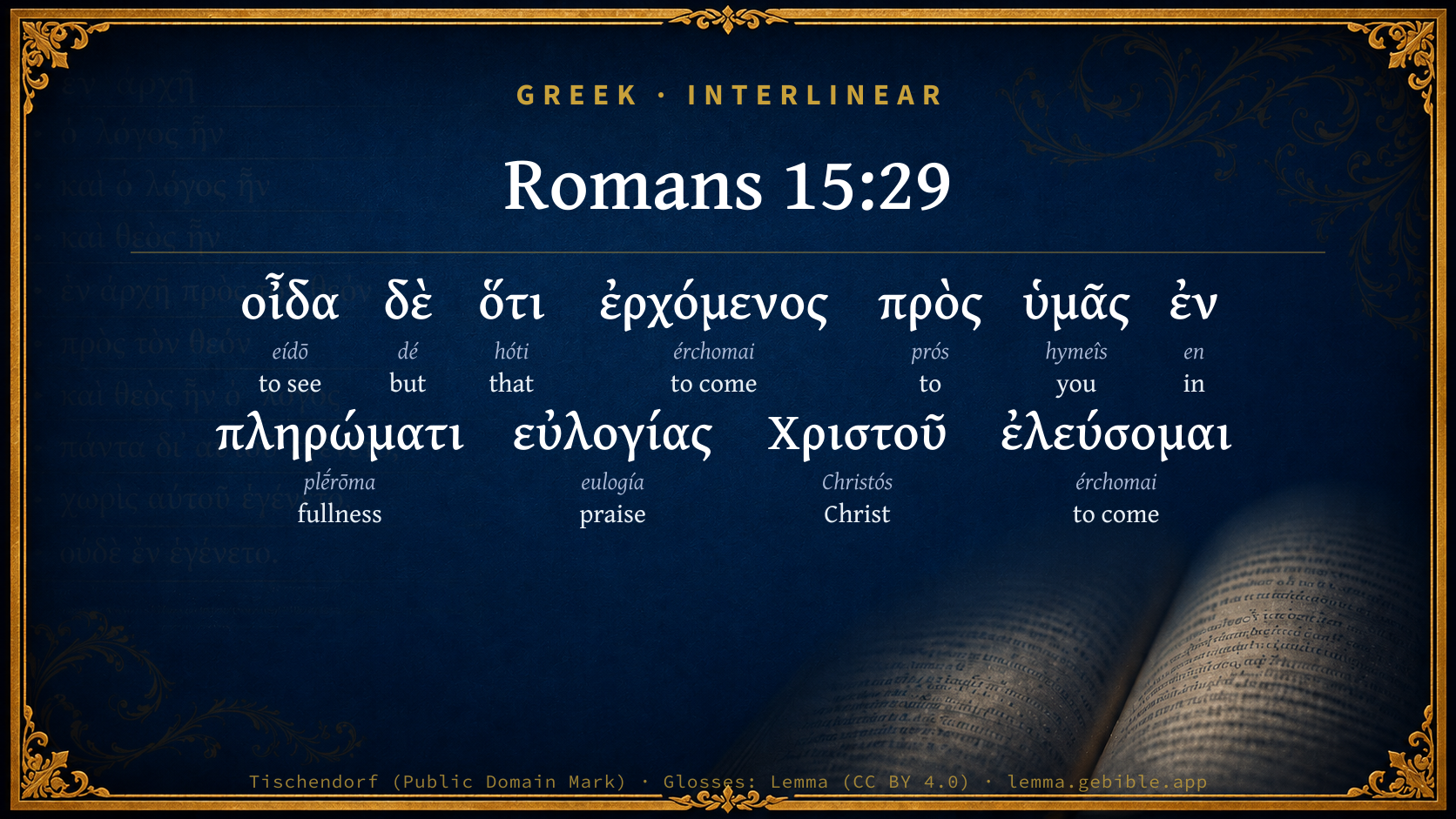
  1. οἶδα eídō G1492 “to see” Verb, Perfect, Active, Indicative, 1st person, Singular
  2. δὲ dé G1161 “but” Conjunction
  3. ὅτι hóti G3754 “that” Conjunction
  4. ἐρχόμενος érchomai G2064 “to come” Verb, Present, Middle or Passive deponent, Participle, Nominative, Singular, Masculine
  5. πρὸς prós G4314 “to” Preposition
  6. ὑμᾶς hymeîs G5210 “you” Personal pronoun, 2nd person, Accusative, Plural
  7. ἐν en G1722 “in” Preposition
  8. πληρώματι plḗrōma G4138 “fullness” Noun, Dative, Singular, Neuter
  9. Χριστοῦ Christós G5547 “Christ” Noun, Genitive, Singular, Masculine
  10. ἐλεύσομαι érchomai G2064 “to come” Verb, Future, Middle deponent, Indicative, 1st person, Singular

About this verse

These counts appear in no published source. They are computed here, from the morphology-tagged text and Lemma’s own curated glosses. What Lemma adds →

11
words
10
distinct lemmas
Pauline Epistles
section

Notable vocabulary

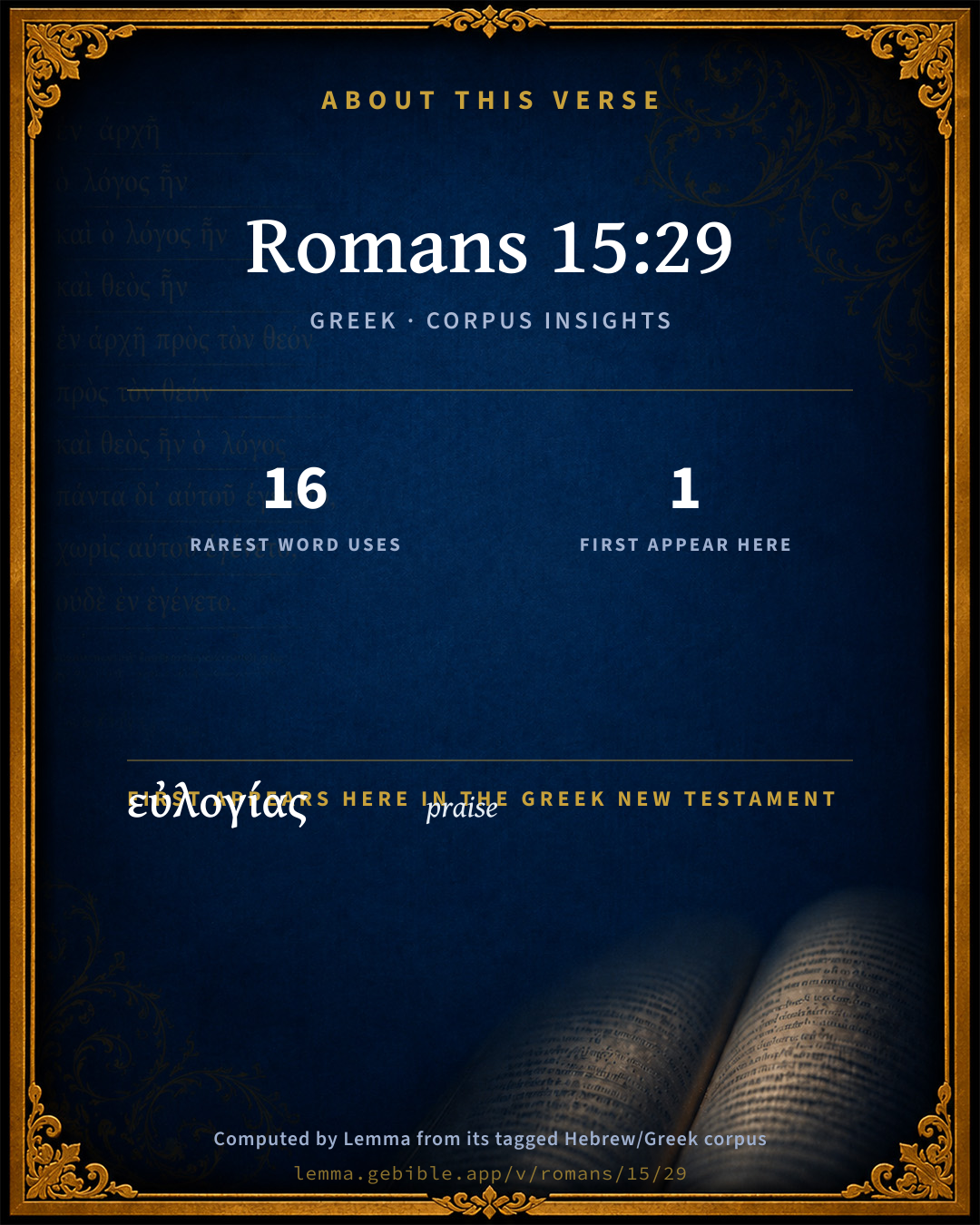
The rarest word here is εὐλογίας praise G2129 — appearing just 16 times in the whole Greek New Testament.

First appearance in Scripture

This word makes its first canonical appearance in the Greek New Testament here:

  • εὐλογίας praise G2129

Shared distinctive vocabulary

εὐλογίας praise G2129 occurs in 14 verses of the Greek New Testament. Also found in:

Repetition

A word recurs within this verse:

  • ἐρχόμενος to come G2064 ×2

Cross-references

7

Topical passages linked to Romans 15:29 in the Treasury of Scripture Knowledge — connected by theme and wording, ordered by reader-vote popularity; previews shown in the World English Bible.

  • Romans 1:10–12 requesting, if by any means now at last I may be prospered by the will of God to come to you.
  • Ephesians 4:13 until we all attain to the unity of the faith, and of the knowledge of the Son of God, to a full grown man, to the measure of the stature of the fullness of Christ;
  • Psalms 16:11 You will show me the path of life. In your presence is fullness of joy. In your right hand there are pleasures forevermore.
  • Ephesians 1:3 Blessed be the God and Father of our Lord Jesus Christ, who has blessed us with every spiritual blessing in the heavenly places in Christ;
  • Ephesians 3:19 and to know Christ's love which surpasses knowledge, that you may be filled with all the fullness of God.
  • Ezekiel 34:26 I will make them and the places round about my hill a blessing; and I will cause the shower to come down in its season; there shall be showers of blessing.
  • Ephesians 3:8 To me, the very least of all saints, was this grace given, to preach to the Gentiles the unsearchable riches of Christ,

Cross-references courtesy of OpenBible.info (CC BY 4.0).

Where the printed editions differ

1 variant

Places in this verse where the major printed Greek editions disagree on the wording in a way that affects the translation — a comparison of editions, not a manuscript-by-manuscript collation. The editions are the modern critical texts (Nestlé-Aland 28/27, SBL, Westcott-Hort, Tregelles, Tyndale House) and the traditional texts behind the KJV (the Textus Receptus and the Byzantine/Majority text). It is not a claim about which reading is original.

  1. Extra text
    τοῦ εὐαγγελίου

    “of the gospel”

    In TRByz Not in NA28NA27TynSBLWHTreg

    τοῦ εὐαγγελίου (tou euangeliou) 'of the gospel' is only in traditional manuscripts (TR+Byz)

Textual data: Translators Amalgamated Greek New Testament (STEPBible TAGNT) · CC BY 4.0.

Commentary

Notes on Romans 15:29 from classic Christian and Jewish commentators (each source and its license shown beneath its notes). The classic Christian expositions comment on the surrounding passage and are grouped to its opening verse, so a note may address several verses; the Jewish commentaries on the Tanakh (Rashi and others) are per-verse, so they appear only where the commentator wrote on this verse.

Lemma curates 59 commentaries, every one of them public domain or Creative Commons licensed, each selected and text-cleaned for this edition rather than reprinted as found. About our sources →

The Biblical Illustrator

Joseph S. Exell

Rom_15:29

And I am sure that, when I come unto you, I shall come in the fulness of the blessing of the gospel of Christ.

The fulness of the blessing of the gospel of Christ

Separation is one of the evil fruits of sin. God loves union. When He created Adam He bound together the whole family of man in one common link. Hence it is one great end of the gospel to restore this union, which was one leading subject in the Saviours intercessory prayer (Joh_17:1-26.). Christianity imparts to us the love of one common God and Saviour, and infuses into all one common spirit. St. Paul had imbibed largely of this spirit. He knew what it was to feel communion of spirit even in the absence of all personal knowledge. Such was the case with regard to the Church at Rome (Rom_1:8; Rom_15:22; Rom_15:29). Note--

I. The subject of the apostles confidence. To carry the glad tidings of salvation to those who are altogether ignorant of them--this might seem to be one sense in which the minister of Christ might be said to come in the fulness of the blessing of the gospel of Christ. Nor, perhaps, is this application wholly to be excluded. If he chiefly refers here to his ministry within the Church, he yet might include the blessing of adding to its numbers from without. And certainly the conversion of sinners must be one great blessing for which we are to look as the end of our work. Yet it is of the ministry to the saints that Paul more expressly speaks. Hence, observe that this expectation will be realised--

1. If Christ should become more precious to the flock. To you that believe He is precious. All you want is treasured up in Him. We come, then, in the fulness of the blessing of the gospel of Christ, if the fruit of our ministry be to make Him to dwell in our thoughts and hearts--if it be to set Him always before us in all things, and to do all things in His name.

2. If the Holy Ghost in all His operations should be more honoured by us. We are placed under the dispensation of the Spirit. He is our teacher, sanctifier, preserver; and our progress must be in proportion as we are taught by and made submissive to Him. If we live in the Spirit, let us also walk in the Spirit; and then we shall come in the fulness, etc.

3. If the ordinances of the Church, as such, should be more valued by us, Jesus Christ, as the head of His Church, has provided for its edification. It is by submitting to His ways, and not walking in our own, that we may hope to be built up in holy things. If we come to them not as mere forms, but as filled with the Spirit of the living God, then shall we have just cause to adopt the language of the text.

4. If Christ shall be more magnified by us. This will be in proportion as we are transformed into the image of Christ, and are able to manifest His holy character. To have the mind that was in Christ, to make Him the centre around which we move, is included in the fulness of the blessing of the gospel of Christ.

II. The grounds on which he rests his confidence.

1. Not any power or wisdom in himself. These weapons he knew well are too weak to be employed in so great a warfare.

2. Something personal, however, might have had to do with it--e.g.,

(1) His own conviction of the great truths which he ministered. He could say, I know whom I have believed, etc. Now, this must unquestionably tend to engender confidence as to the success of the ministry, when we can speak of those things which we know of a truth in our own souls.

(2) His consciousness of sincerity, and purity of intention (2Co_2:17; 2Co_4:7). It inspires confidence to feel that it is at no partial exhibition of Gods truth we aim; no favourite doctrine, no select portions, but the whole of Gods revealed counsel so far as He teaches it to us.

3. These, however, after all, may be termed rather auxiliaries of the apostles confidence than its foundation; the foundation of it is doubtless to be found primarily, in the promised blessing of God, and the presence of Christ in all His ordinances. Paul may plant, and Apollos water, but God giveth the increase. (W. Dodsworth, A. M.)

The fulness of the blessing of the gospel of Christ

I. The nature of these blessings--

1. Spiritual.

2. Undeserved.

3. Blessings of peace.

II. Their abunbance in their--

1. Variety.

2. Supply.

3. Sufficiency for all, in this life and the next.

III. Their free dispensation.

1. To saints.

2. To sinners. (J. Lyth, D.D.)

The fulness of gospel blessing

That was a privileged man who could say this. Did he do so in the confidence of apostolic power, in the strength of some special Divine mission? I think not. There are many who carry with them their own atmosphere, radiators of holiness, overflowing with affection and full of heaven, whom you cannot be near and not feel that a virtue goes out of them; their very presence is a benediction. And those are the same men who are lowly enough to confess the power, not their own, but Christs. But who are they? Those who live so near to God that they are always breathing in the Divine; and such was Paul. Observe these words in their series and their climax.

I. Christ. And in His holy anointing is all which you can ever want for time or for eternity. A ransom paid, a life hidden, a friend at the throne, a brother at the side; all love, and all loveliness.

II. The gospel. For you, poor miserable sinner, He died. He has loved you with an everlasting love,--between you and heaven, between you and God, there is no barrier.

III. The blessing of the gospel of Christ.

1. You are at peace. You know it in your hearts deep secret places that you are safe.

2. You shall serve Him, see Him, be like Him, enjoy Him for ever,

3. And your forgiveness shall become your holiness. He is in you, and you in Him, by living union. Therefore as He is, so shall you be in this world.

4. You shall be blessed and be a blessing.

IV. The fulness of the blessing of the gospel of Christ. It is all done. No fact in history more sure, more complete. The heavens are not complete; the angels are not perfect. But His work and His people are. An eternity of happiness--of usefulness, and of God. Conclusion:

1. Do not be afraid of a full, free gospel. It will neither make you presumptuous nor indolent. Nothing humbles like being loved. And how shall a man conquer his sins, and do good works, if he have not a motive? What motive is strong enough but the love of God?

2. Therefore, let me take care to preach, and you to receive, a full gospel. Not half fear and half hope; not half self and half Christ; not a partial pardon; not a change which is to come; not a possible heaven.

3. Now, when we meet, we are to come together with this blessing. Woe to me if I do not so preach as to bring this fulness of the blessing to you! And woe to you if you do not so pray as to bring it to me! Very great is my privilege to preach it, and very large will be your loss, if, from prejudice, or fear, or unbelief, or Satans wiles, or mens false teaching, you refuse it, or add to it conditions which God has never placed--or abate one iota from it.

4. And to one another you are to be a blessing. When you go to a man, and try to speak faithfully to him, when you are teaching your child, when you engage in some work of mercy, or in each days common converse, or recognise the promise. (J. Vaughan, M.A.)

The fulness of the blessing

A doctor may come with healing or with failure, because his remedies are fallible. A statesman may come with progress or retrogression, because his measures are only fallible; but a servant of Christ comes with nothing but blessing. Indeed, the house of God is the one place on earth where blessing abounds always. The home may be miserable; business disappointing; the Senate House the scene of turmoil; but in the house of God there broods unruffled peace. Blessedness is the watermark of Christianity, and just as you know a five-pound note by the watermarks upon it, so you will know the message, as to whether it is Divine, by this: it makes men blessed. Its morality is the high road to blessedness. The life of its Founder is the blessed life. His death leads to mans reconciliation with God. His resurrection tells us that mans last enemy is destroyed. Its message is well called a gospel.

I. It is a certain blessing.

1. Because the messenger is sent of God. God can make all things sure; not man, but God. Paul had often said to God, O Lord, let me preach the gospel at Rome, and God at length heard his prayers; but what a strange answer it was! But all through life he had been led to see that the God who had called him to that work of the ministry would also show him when and where he was to carry on the ministry. Now that--

(1) Helps the hearer. There is a communication from heaven; it comes through the man--very imperfect, but the trappings of the messenger must never make us forget his Divine message.

(2) It helps the speaker. He is taken away from man; he breaks through the ensnaring influences of the sense, and he sees nothing, feels nothing but God and the souls of men.

2. When the people are prepared to receive the message. There is a vital difference between a prepared and an unprepared people. You may have the best seed in the world, but unless you choose carefully the best soil you will not get the best fruit. There is a mysterious power of self-choosing in every one, which enables men to resist all appeals. Vain, then, are all our reasonings and pleadings. They are showers on a rock, sunlight on a barren desert.

II. A full blessing. There is--

1. The fulness of giving that comes from the Divine love to us. To all things else there is a limit, and it is very difficult for us to rise to the conception of a Being whose power is illimitable. We see suggestions of it in the sky, the rolling prairie, and the immense sea. Now, the same God rules in grace as in Nature; and in His dealings with the spirits of men we may expect He will exercise the same largeness. And we are not disappointed. Indeed, the greatness of the gospel baffles many. They measure the Infinite Reason, love, and plans by the littleness of their own; and when they find themselves confronted by the incarnation, deity, atonement, and resurrection of Christ, they find the greatness and the glory too much for their faith. But so it should not be with us. It is said that the Highlanders who dwell among the rocky fastnesses get a strength and heroism which do not come out of the plain. It is so in spiritual things. Here the air is keen. The mountain solitudes of truth are trodden by few; but when once we have stood on those glorious heights we know God as we have never known Him before. But just as in the mountain regions there will be here and there a little chalet where the sun rests in quiet and cheering warmth, so the truth of God subdivides itself, and rests on every converted heart.

2. The fulness of the human reception. On the Divine side there is love given to us; on the human side there is faith receiving Gods gifts. Not the hearer only of the Word. Oh, how often we stop here! We think that a ministry is successful when numbers of attentive hearers are drawn to hear the word; and this is so far a great gain. But pews may be full, and yet hearts may be empty. What we must pray for is not that these seats may be full only, but our souls also. The whole question of our having a full blessing or of having half or none hangs upon our faith. It is not faith in our minister, in one another, in this building, and in these outward services. These, no doubt, are all helpful gifts, but our great need is a full faith in Christ. (S. Pearson, M. A.)

The fulness of the gospel

I. In what it consists. In--

1. A full Christ for empty sinners.

2. A full salvation for lost sinners.

3. A full assurance for doubting sinners.

4. A full restoration for fallen sinners.

5. A full comfort for sorrowful sinners.

6. Fulness of food for hungry sinners.

7. Fulness of love, joy, hope, peace for all.

II. What we are to do with it.

1. Believe it.

2. Receive it.

3. Enjoy it.

4. Live it.

5. Impart it.

6. Die with it in our hearts and on our tongues. (Bp. Villiers.)

The blessings of the gospel

I. The gospel originates from a source of supreme elevation.

1. Men form their opinions of existing systems by referring to the character of their founders. The absence, e.g., of dignity and worth in the founders of systems, is always converted into an argument against the principles they have propounded; and vice versa. This mode of reasoning is, of course, liable to abuse, but if it be applied aright to the gospel and its Founder, it will be discovered as possessing every claim on reverence, admiration, and love. To Christ the gospel is indebted for its existence; and hence in the text the association of His name. Christ unfolded its promises and principles, established its laws, performed its confirmatory miracles, bestowed its efficacy, and constituted those arrangements by which it was to be propagated in the world.

2. There are truths with regard to Him which render Him a character of matchless elevation.

(1) He was without sin.

(2) His human nature was invested with an especial appointment from God the Father.

(3) He was essentially and eternally Divine.

(4) Besides these dignifying truths with regard to Christ, there are His resurrection, ascension, and session as the triumphant Mediator at the right hand of the Majesty on high. Wonder, then, at the amazing dignity which the gospel receives in consequence of its association with such a Being, and measure the imperious claim which the gospel possesses on the reverence, faith, and obedience of mankind.

II. The gospel is fraught with abundant blessings to the world. The very term gospel verifies this proposition, Note--

1. The nature of the blessings which the gospel is able to impart. When we speak of these we seem as though we stood at the entrance of a beauteous garden, within whose limits we cannot stir a step without plucking flowers, and beholding fruits on the trees of life, whose leaves are for the healing of the nations. The gospel imparts to man

(l) A knowledge of God and of all spiritual truth (Rom_16:25; 2Co_4:6; 2Ti_1:9-10). The communication of this knowledge is essential to all real dignity, to all moral worth, and to the introduction of man into that state where we shall know even as also we are known.

(2) A deliverance from the guilt and the power of sin (Rom_3:23-26; Eph_2:12-17). Will anyone compare the difference between a state of condemnation and of justification, of pollution, and of holiness, and not at once perceive that here are given blessings so vast that no intellect can compute them, and no fancy conceive them?

(3) Abundant consolation and support amidst all sorrow (2Co_4:8-9; 2Co_4:17-18).

2. The extent to which these blessings are to be diffused. A great portion of the value of the blessing depends upon its extent. Now, if the gospel had possessed but a restricted constitution, so as by implication to pass a sentence of outlawry on any portion of the human family, there would be a vast subtraction from its value. But its expansiveness was indicated in prophecy, by Christs parables, instructions, and example, and by those series of commissions which He gave to His apostles. Its operations truly have been as yet imperfect, yet there is to arrive an era when the gospel shall become the property of our race. The knowledge of the Lord shall cover the earth, etc. And so replete shall be the then weight of blessing, when the groanings of creation shall have been hushed, when its travailing shall have been terminated, and when peace and liberty and joy shall have become the charter of our free and emancipated race, that then shall be totally verified the title of the gospel, the fulness of the blessings of the gospel of Christ.

III. The ministry is the appointed instrument for conveying the blessings of the gospel to mankind. The apostle is speaking as one engaged in the exercise of the ministry of the Word. It must be clear that there is here a connection instituted between the ministry and the efficacy of the gospel (Rom_10:13-17; 2Co_5:18-20). There is a solemn call on us--

1. To acquire a perfect knowledge of its contents, and freely and faithfully to declare it to our fellow-men.

2. To honour the ministry by giving earnest heed to the things which you hear, remembering that he that despiseth us despiseth not man, but God.

In conclusion, let me remind you--

1. Of the awful danger that will be incurred on your part by the rejection of the gospel.

2. Of your duty to assist in its propagation. (J. Parsons.)

The Biblical Illustrator, edited by Joseph S. Exell (c. 1880s–1900s) — public domain. Text from a community e-Sword module.

Bengel's Gnomon

Johann Albrecht Bengel

Rom 15:29. Πληρώματι, in the fulness) comp. Rom 15:19. There is a real parallelism in the fulness of the Gospel, both intensive and extensive.[162]—εὐλογίας, of the blessing) which is conspicuous [such fulness of blessing as it is conspicuously seen to possess] both at Jerusalem and Rome.—τοῦ εὐαγγελίου) Some have omitted this word: The cause of the omission is easy to be perceived, viz. from the recurrence of τοῦ.[163]

[162] That is, the internal fulness, and the expansive capabilities of the Gospel externally, have a real correspondence.—ED.

[163] Either S. R. D. Foertschius in Progr. to this passage, or S. R. D. Ernesti in his review of the Program, affirms, that Bengel was satisfied with the omission of this word, see Bibl. th. T. V. p. 474, but this is a mistake. The margin of both editions (where the sign δ had marked an omission instead of a reading less certain) may be compared, s. pl., also the German Version which expresses the words des Evangelii without a parenthesis.—(E. B.)

The τοῦ alluded to by Beng. as recurring refers to Rec. Text τοῦ εὐαγγελίου τοῦ, which reading is supported by both Syr. Versions and Vulg. (later MSS.) But ABCD(Λ)G Cod. Amiat. (the oldest MS.) of Vulg. Memph. fg Versions omit the three words.—ED.

Bengel's Gnomon of the New Testament — English translation (T&T Clark, Edinburgh, 1860) — public domain. Text from a community e-Sword module.

Meyer's Critical & Exegetical Commentary

Heinrich August Wilhelm Meyer

Rom_15:29. Paul is convinced that his advent to the Romans will not be without rich blessing from Christ; he will bring with him a fulness (copia, see on Eph_3:19) of Christs blessing. On the matter itself, comp. Rom_1:11.

ἐν is to be explained: furnished with. See Bernhardy, p. 209, and on 1Co_4:21. Quite contrary to the words, Chrysostom. Oecumenius, Calvin, and others: Scio me … vos inventurum repletos omnibus donis spiritualibus, Estius.

ἐρχόμενος with the same verb ἐλεύσομαι; see Kühner, ii. 2, p. 656, and ad Xen. Mem. v. 2. 21. Comp. on 1Co_2:1; Php_2:2.

Meyer — Critical and Exegetical Commentary on the New Testament — English translation by Peter Christie, edited by Frederick Crombie (T&T Clark, 1880) — public domain. Text from a community e-Sword module.

Expositor's Greek Testament

ed. W. Robertson Nicoll

Rom 15:29 . For ἐρχόμενος … ἐλεύσομαι cf. 1Co 2:1 . ἐν πληρώματι εὐλογίας Χριστοῦ . Paul’s desire was to impart to the Romans χάρισμά τι πνευματικόν (Rom 1:2 ), and he is sure it will be satisfied to the full. When he comes he will bring blessing from Christ to which nothing will be lacking. On πλήρωμα see Rom 11:12 .

The Expositor's Greek Testament, edited by W. Robertson Nicoll (1897–1910) — public domain. Text from a community e-Sword module.

Hodge's Commentary on Romans, Ephesians & First Corinthians

Charles Hodge

Rom_15:29

And I am sure that when I come unto you, I shall come in the fullness of the blessing of the gospel‹81› of Christ. The fullness of the blessing, means the abundant blessing. Paul was persuaded that God, who had so richly crowned his labors in other places, would cause his visit to Rome to be attended by those abundant blessings which the gospel of Christ is adapted to produce. He had, in Rom_1:11, expressed his desire to visit the Roman Christians, that he might impart unto them some spiritual gift, to the end that they might be established.

Charles Hodge — Commentary on Romans (1835), First Corinthians (1857), and Ephesians (1856) — public domain. Text from a community e-Sword module.

Geneva Bible (1599)

Geneva Bible translators

He promiseth them through the blessing of God, not to come empty unto them: and requiring of them the duty of prayers, he showeth what thing we ought chiefly to rest upon in all difficulties and adversities.

Geneva Bible (1599) marginal notes — public domain. Text via Bolls.life.

Jamieson, Fausset & Brown

Robert Jamieson, A. R. Fausset & David Brown

And I am sure--"I know"

that . . . I shall come in the fulness of the blessing of Christ--Such, beyond all doubts, is the true reading, the words "of the gospel" being in hardly any manuscripts of antiquity and authority. Nor was the apostle mistaken in this confidence, though his visit to Rome was in very different circumstances from what he expected. See Acts 28:16-31.

Jamieson, Fausset & Brown — Commentary Critical and Explanatory on the Whole Bible (1871) — public domain (CC PDM 1.0). Text via the HelloAO Bible API.

Adam Clarke's Commentary

Verse 29. In the fulness of the blessing of the Gospel of Christ.] The words του ευαγγελιου του, of the Gospel, are wanting in almost every MS. of importance. Griesbach has left them out of the text. There is no doubt they should be omitted. The fulness of the blessing of Christ is really more than the fulness of the blessing of the Gospel of Christ. He hoped to come to them not only with the blessing of the Gospel, but endued with the gifts and graces of the Lord Jesus himself; which he was now a constant instrument, in the hand of God, to dispense among those who were converted to the Christian faith.

Adam Clarke's Commentary on the Bible (1810–1826) — public domain. Text from a community e-Sword/MySword module.

John Calvin's Commentaries

29. And I know, that when I come, etc. These words may be explained in two ways: the first meaning is, — that he should find a plentiful fruit from the gospel at Rome; for the blessing of the gospel is, when it fructifies by good works: but to confine this to alms, as some do, is not what I approve. The second is, that in order to render his coming to them more an object of desire, he says, that he hopes that it would not be unfruitful, but that it would make a great accession to the gospel; and this he calls fullness of blessing, which signifies a full blessing; by which expression he means great success and increase. But this blessing depended partly on his ministry and partly on their faith. Hence he promises, that his coming to them would not be in vain, as he would not disappoint them of the grace given to him, but would bestow it with the same alacrity with which their minds were prepared to receive the gospel.

The former exposition has been most commonly received, and seems also to me the best; that is, that he hoped that at his coming he would find what he especially wished, even that the gospel flourished among them and prevailed with evident success, — that they were excelling in holiness and in all other virtues. For the reason he gives for his desire is, that he hoped for no common joy in seeing them, as he expected to see them abounding in all the spiritual riches of the gospel.

John Calvin's Commentaries (1540-1563) — public domain. Text from the Calvin Translation Society English edition (1840s-50s) via the Christian Classics Ethereal Library (ccel.org). Calvin's coverage is partial (roughly two-thirds of the Bible); uncommented books and verses are honest gaps, never fabricated. The 19th-century editor's footnotes and remarks are omitted so the notes are faithfully Calvin's own voice.

Ellicott's Commentary for English Readers

(29) I shall come in the fulness.—I shall bring with me, come furnished with, the fulness of the blessing of Christ. The words “of the gospel” should be omitted. By “the fulness of the blessing of Christ” the Apostle means the full or abundant measure of those spiritual blessings which he, as the Minister and Apostle of Christ, was commissioned to impart to them.

A Bible Commentary for English Readers, edited by Charles John Ellicott (1878–1897) — public domain. Text from a community e-Sword module.

The Cambridge Bible for Schools and Colleges

gen. ed. J. J. S. Perowne

29. And I am sure] Lit. But, or now, I know.—This “knowledge” was abundantly justified by the event.

in the fulness of the blessing of the Gospel of Christ] The words “of the Gospel” must be omitted.—He is sure that he will come attended by the “fulness,” the full range and variety, of “Christ’s benediction;” which would so rest on the visit as to make it in every way happy and helpful both to the Romans and the Apostle.

The Cambridge Bible for Schools and Colleges (gen. ed. J. J. S. Perowne; Cambridge University Press, 1878–1918) — public domain. Text from a community e-Sword module.

John Gill's Exposition

And I am sure when I come to you,.... He intended to go to Spain; he was not sure he should reach thither; but he was positive in it he should come to Rome. It had been much and long upon his mind; and under an impress of the Spirit of God upon him, he had signified some time before this, that after he had been at Jerusalem, he "must see, Rome also", Act 19:21, and it was afterwards more expressly told him by the Lord, that as he had testified of him at Jerusalem, he should bear witness at Rome also, Act 23:11, and therefore he was fully assured he should come to Rome, and was as confident of the manner of his coming thither.

I shall come in, or "with"

the fulness of the blessing of the Gospel of Christ; with the Gospel, the good news of salvation by Christ; and which must make him a welcome person to every sensible soul wherever he came; to this he was chosen, separated, and called; for this he was abundantly qualified; this was committed to his trust, and which he carried with him wherever he went: and he was not ashamed of it, and was ready to preach it even at Rome also. With "the Gospel of Christ"; not his own, or another's, or any man's, but Christ's, which he had by the revelation of Christ; of which Christ is the sum and substance, and which Christ himself preached; "with the blessing of the Gospel of Christ". Some by "blessing" understand a liberal contribution, which he trusted he should make at Rome, for the poor saints at Jerusalem; believing that their hearts would be opened, under the preaching of the Gospel, to give freely to them, and that this would be a blessing that would attend it: but rather he means, either the blessed gifts he had, qualifying him for preaching the Gospel, with which he should come and deliver it among them, and which would attend it with success; such as boldness of spirit, freedom of speech, enlarged knowledge, mighty signs and wonders, and the demonstration of the Spirit, and of power: or the blessed effects it would have on them, in establishing them in the present truths; in further enlightening and instructing their minds; in edifying, quickening, and comforting them; and in nourishing up with the words of faith and sound doctrine, unto eternal life: or the blessings of grace exhibited and set forth in the Gospel; such as justification and forgiveness of sins, peace and reconciliation, salvation and eternal life. Nay, he believed he should come in, or with the "fulness" of all this; meaning, either that he believed he should find them full of the Gospel, and the fruits of it; or rather that he should come full fraught with it, and fully preach it to them, and keep back thing that would be profitable. There is a fulness in the Gospel; it is full of the deep things of God, which the Spirit searches and reveals, Co1 2:10; it is full of the doctrines of grace and truth, which Christ himself is said to be full of, Joh 1:14, it is full of exceeding great and precious promises transcribed from Christ, and out of the covenant of grace; and it is full of a variety of food, of milk for babes, Heb 5:13, and meat for strong persons, Heb 5:14. The Alexandrian copy, and some others, read only, "with the fulness of the blessing of Christ"; and so the Ethiopic version.

John Gill's Exposition of the Whole Bible (1746–1763) — public domain (CC PDM 1.0). Text via the HelloAO Bible API.

Trapp's Complete Commentary

John Trapp

29 And I am sure that, when I come unto you, I shall come in the fulness of the blessing of the gospel of Christ.

Ver. 29. In the fulness of the blessing] Christ may use one of less grace to do more good than one of more (for there are diversities of operations, as well as of gifts, 1Co 12:6), but usually he delights to honour those of most sincerity, with most success, 1Co 15:10.

John Trapp, A Commentary or Exposition upon All the Books of the Old and New Testament (1647–1656) — public domain. Text from a community e-Sword module.

Albert Barnes' Notes on the Bible

I am sure - Greek, I know; expressing the fullest confidence, a confidence that was greatly confirmed by the success of his labors elsewhere.

In the fulness of the blessings ... - This is a Hebrew mode of expression, where one noun performs the purpose of an adjective, and means “with a full or abundant blessing.” This confidence he, expressed in other language in Rom 1:11-12; see the notes.

Of the gospel of Christ - Which the gospel of Christ is suited to impart. Thus, every minister of the gospel should wish to go. This should be his everburning desire in preaching. Paul went to Rome; but he went in bonds; Acts 27; 28. But though he went in this manner, he was permitted there to preach the gospel for at least two years, nor can we doubt that his ministry was attended with the anticipated success; Act 28:30-31. God may disappoint us in regard to the “mode” in which we purpose to do good; but if we really desire it, he will enable us to do it in “his own way.” It “may” be better to preach the gospel in “bonds” than at liberty; it “is” better to do it even in a prison, than not at all. Bunyan wrote the Pilgrim’s Progress to amuse his heavy hours during a twelve years’ cruel imprisonment. If he had been at liberty, he probably would not have written it at all. The great desire of his heart was accomplished, but a “prison” was the place in which to do it. Paul preached; but preached in chains.

Albert Barnes' Notes on the Bible (1834–1885) — public domain. Text from a community e-Sword/MySword module.

Haydock's Catholic Bible Commentary

I know, by the Spirit of God revealing it to me, that God will give a blessing to my labours, when I come to you. That I may be delivered from the unbelievers in Judea, from the unbelieving Jews, foreseeing the persecution he should there meet with. That I may be refreshed with you, have comfort by finding peace and union among you. (Witham)

George Leo Haydock (1774–1849), Haydock's Catholic Family Bible and Commentary, 1859 edition — public domain. Excludes Psalms (Douay-Rheims chapter numbering differs from Protestant) and Deuterocanonical books (Catholic canon only).

Matthew Poole's English Annotations

i.e. As some expound it, I shall find you furnished with all spiritual and gospel blessings: this sense agrees with Rom 15:14. But others rather think, that he speaks of what he should bring with him, and not of what he should find there: therefore it may better be expounded by Rom 1:11,12. He assures himself he should impart unto them much knowledge, grace, and comfort; that he should enrich and fill them with all

the blessings of the gospel of Christ.

Matthew Poole's English Annotations on the Holy Bible (1683–1685) — public domain. Text from a community e-Sword/MySword module.

Whedon's Commentary on the Bible

Daniel D. Whedon

29. Fulness of the blessing of Christ—Best reading omits of the Gospel.

(See note on Rom_1:11.)

Daniel D. Whedon (gen. ed.), Commentary on the Old and New Testaments (1874–1909) — public domain. Text from a community e-Sword module.

Godbey's Commentary on the New Testament

William B. Godbey

PAUL’S TESTIMONY TO SANCTIFICATION

29. “I know that coming unto you I will come in the fullness of the blessing of Christ,” not, as in E. V., the “fullness of the blessing of the gospel of Christ,” “gospel” in this sentence being an interpolation; but the true reading is, “I will come unto you in the fullness of the blessing of Christ,” which is none other than entire sanctification, so clearly and positively here attested by the beloved apostle. It is the glorious privilege of all God’s children to enjoy this “fullness of the blessing of Christ,” which is none other than complete expurgation of all sin, actual and original, and the infilling of the Holy Spirit. The next three verses is an appeal to the Roman saints that God may give him journeying mercies and deliver him from the unbelieving Jews, and permit him to enjoy a glorious spiritual refreshing with His faithful children in the world’s metropolis.

William B. Godbey, Commentary on the New Testament (1896–1900) — public domain. Text from a community e-Sword module.

McGarvey & Pendleton's Commentaries

J. W. McGarvey

And I know that, when I come unto you, I shall come in the fulness of the blessing of Christ : [Paul had no doubt about the favorable conditions in the Roman church, nor about his kindly reception by the Christians at Rome. He felt that they would so receive him that he would be able to greatly enrich them in instruction and in all other spiritual blessings. "Beyond these blessings," says Lard, "he had nothing to bestow, nor they anything to ask." Far other were his presentiments as to Jerusalem, as he immediately shows us. For a like expectation of an evil reception, see 2Co_1:23 ; 2Co_12:14 ; 2Co_12:20-21 ; 2Co_13:1-2 ]

J. W. McGarvey (with Philip Y. Pendleton), Commentaries on the New Testament (The Fourfold Gospel, 1914; Acts; and the epistles) — public domain. Text from a community e-Sword/MySword module.

The People's New Testament

B. W. Johnson

29. I am sure that, when I come. He assures them that his coming will be full of blessing to them in Christ. Godet says, with force, “Would a forger of this epistle, in the second century, have drawn a picture of the future so opposite to the way in which things really came to pass?” These allusions to his future movements are positive proof that this was written before Paul was a prisoner.

B. W. Johnson's The People's New Testament with Notes (1889–1891) — public domain. Electronic text from the Christian Classics Ethereal Library (CCEL) ThML edition.

Cambridge Greek Testament for Schools and Colleges

29. ἐν πληρώματι εὐλογίας Χριστοῦ = bringing with me Christ’s blessing in its full completeness. He feels no doubt (οἶδα) that, if he succeeds in reaching Rome, that is, in getting safe through his mission to Jerusalem, he will have been successful too in the great aim of that mission, that is, in producing a signal manifestation of the union of Jew and Gentile and securing a full acknowledgement of it. This he regards as a complete execution of Christ’s blessing—i.e. GOD’s blessing offered in Christ to all mankind (cf. Gal 3:9; Gal 3:14; Eph 1:3) and, if he comes to them at all, it will be with this supreme achievement. See also Act 20:24; infra Rom 15:31 and Hort R. and E., p. 42.

ἐν πλ. This use of ἐν is to be compared with ἐν ῥάβδῳ ἢ ἐν ἀγάπῃ (1Co 4:21), ἐν μαχαίρᾳ. Papp. = using or wearing, or furnished with; “haec exempla ad vestitum pertinent, significantia qua veste quis indutus, deinde quibus rebus ornatus et instructus sit,” Kuhring Prepos. Graec.; cf. Deissmann, B. S., p. 115.

Cambridge Greek Testament for Schools and Colleges (Cambridge University Press, 1896; 21 vols, various authors incl. Carr, Maclear, Plummer, Farrar, Lumby, Moule, M. R. James, Simcox) — public domain. Text from a community e-Sword module.

Alford’s Greek Testament

Henry Alford

29.] The fulness of the blessing of Christ imports that richness of apostolic grace which he was persuaded he should impart to them. So he calls his presence in the churches a χάρις, 2Co 1:15. See also ch. 1:11.

Henry Alford, The Greek Testament (1849–1861) — public domain. Text from a community e-Sword module.

International Critical Commentary

29. πληρώματι: see on 11:12. St. Paul feels confident that his visit to Rome will result in a special gift of Christ’s blessing. He will confer on the Church a χάρισμα πνευματικόν, and will in his turn be comforted by the mutual faith which will be exhibited. Cf. 1:11, 12.

It has been pointed out how strongly these words make for the authenticity and early date of this chapter. No one could possibly write in this manner at a later date, knowing the circumstances under which St. Paul actually did visit Rome. See also ver. 32 ἵνα ἐν χαρᾷ ἐλθὼν πρὸς ὑμᾶς διὰ θελήματος Θεοῦ συναναπαύσωμαι ὑμῖν.

The TR. reads with אc L &c., Vulg.-clem. Syrr. Arm., Chrys. Theodrt. εὐλογίας τοῦ εὐαγγελίου τοῦ Χρ. The words τοῦ εὐ. τοῦ should be omitted on decisive authority.

International Critical Commentary — older volumes (1896–1929), various authors — public domain. Text from a community e-Sword module.

Vincent's Word Studies in the New Testament

Marvin R. Vincent

Gospel. Omit, and read blessing of Christ.

Marvin R. Vincent, Word Studies in the New Testament (1887–1900) — public domain. Text from a community e-Sword/MySword module.

Lesson kit

Teaching starters — assembled from the data on this page, not authored interpretation. Every prompt links to the verse data it draws on. Edit before teaching.

Romans, in the Pauline Epistles, opens this verse with 11 words (10 distinct Greek lemmas). Its most distinctive word is eulogía (“praise”). A historical commentator’s framing appears above. Read the whole chapter for the surrounding context.

Discussion questions

  1. What does “praise” (eulogía) contribute to the verse as a whole?
  2. This is the first place “praise” appears in Scripture (first appears here). What does its debut here establish?
  3. How does Romans 16:18, which shares the word «praise», read alongside this verse?
  4. What does the repetition of “to come” (2× in this one verse) do in this verse?
  5. These translations render this verse differently. What is at stake in choosing one wording over another?
  6. Compare how The Biblical Illustrator and Bengel's Gnomon read this verse. Where do they agree or differ?

Things to notice

  • 1 word makes its first canonical appearance in Scripture here.
  • These translations choose different wording for 10 words in this verse.
  • “to come” occurs 2× in this single verse.
  • 10 distinct Greek lemmas span 11 words in this verse.

Reading settings

Reading text

Shown beneath each verse's original-language words.

Old Testament
Old Testament edition

Read the OT as the Masoretic Hebrew (MT) or the Greek Septuagint (LXX).

English shown for the Greek Septuagint (in the Hebrew ↔ Greek comparison).

Comparing translations? Open the Compare panel on any verse page to stack up to four side by side.