1 Corinthians 15:17

Greek (Tischendorf 8th ed.) 1 Corinthians 15:17 appears in the Greek New Testament. The text above is from the Tischendorf 8th edition. Each word links to its Strong’s number and a concise gloss. Click any word for its full Thayer’s Greek Lexicon entry.
Download image
Cite this verse

1 Corinthians 15:17 (World English Bible). Public Domain. Lemma interlinear Bible study tool, https://lemma.gebible.app/v/1-corinthians/15/17.

Show BibTeX & RIS
BibTeX
RIS
English Translation
If Christ has not been raised, your faith is vain; you are still in your sins.
World English Bible · Public Domain
Download a study sheet

One document with this verse’s original text, its word-by-word gloss line, the meaning frame, cross-references with their text, attributed commentary, and full source and license credits — printable, and it pastes into notes with its structure intact.

This verse Autodidact and up

Study sheet (.html) Plain text (.txt)

A passage Seminary Student

Up to 50 verses in one chapter. A passage sheet keeps up to 6 commentary sources and 12 cross-references per verse, in the order this page ranks them, and says so on the sheet whenever that leaves anything out. Ask for a single verse and you get the Autodidact verse sheet above.

Everything on this page stays free to read, with no account — the sheet is a download of what is already on screen, not access to it.

Want to remove ads? Support Godless Engineer
Compare translations 3

The same verse in 3 English versions, stacked beneath the original-language interlinear above. Click any original word for its lexicon entry.

Each is an independent rendering of the whole verse — the interlinear is not word-aligned to these translations.

Highlighted words mark where these versions differ — a whole-verse word diff, not a word-by-word alignment.

  • World English Bible Public Domain
    If Christ has not been raised, your faith is vain; you are still in your sins.
  • King James Version Public Domain
    And if Christ be not raised, your faith is vain; ye are yet in your sins.
  • unfoldingWord Literal Text CC BY-SA 4.0
    but if Christ has not been raised, your faith in vain; you are still in your sins.

unfoldingWord Literal Text — © unfoldingWord, licensed CC BY-SA 4.0. Word-aligned USFM3 via Door43 (git.door43.org/unfoldingWord/en_ult).

Versions to compare (up to 4)

3 of 4 selected

Show all 19 translations

Every available English version of this verse, each an independent rendering of the whole verse.

  • World English Bible Public Domain
    If Christ has not been raised, your faith is vain; you are still in your sins.
  • Berean Standard Bible Public Domain
    And if Christ has not been raised, your faith is futile; you are still in your sins.
  • Majority Standard Bible Public Domain
    And if Christ has not been raised, your faith is futile; you are still in your sins.
  • King James Version Public Domain
    And if Christ be not raised, your faith is vain; ye are yet in your sins.
  • American Standard Version (1901) Public Domain
    and if Christ hath not been raised, your faith is vain; ye are yet in your sins.
  • Revised Version (1885) Public Domain
    and if Christ hath not been raised, your faith is vain; ye are yet in your sins.
  • Geneva Bible (1599) Public Domain
    And if Christ be not raised, your faith is vaine: ye are yet in your sinnes.
  • Douay-Rheims (1899) Public Domain
    And if Christ be not risen again, your faith is vain, for you are yet in your sins.
  • Young's Literal Translation Public Domain
    and if Christ hath not risen, vain is your faith, ye are yet in your sins;
  • Literal Standard Version CC BY-SA 4.0
    and if Christ has not risen, your faith is vain, you are yet in your sins;
  • Unlocked Literal Bible CC BY-SA 4.0
    and if Christ has not been raised, your faith is in vain and you are still in your sins.
  • unfoldingWord Literal Text CC BY-SA 4.0
    but if Christ has not been raised, your faith in vain; you are still in your sins.
  • Darby Bible Public Domain
    but if Christ be not raised, your faith [is] vain; ye are yet in your sins.
  • World Messianic Bible Public Domain
    If Messiah has not been raised, your faith is vain; you are still in your sins.
  • Webster's Bible Public Domain
    And if Christ is not raised, your faith is vain; ye are yet in your sins.
  • Free Bible Version CC BY-SA 4.0
    and if Christ hasn't been raised, then your trust in God is useless, and you are still in your sins.
  • Bible in Basic English Public Domain
    And if that is so, your faith is of no effect; you are still in your sins.
  • Text-Critical English NT CC BY 4.0
    And if Christ has not been raised, your faith is futile; you are still in your sins.
  • Tyndale New Testament (1534) Public Domain
    If it beso that Christ rose not then is youre fayth in vayne and yet are ye in youre synnes.

Literal Standard Version (2020), Covenant Press — licensed CC BY-SA 4.0. Text via the HelloAO Bible API (eBible.org). Unlocked Literal Bible (unfoldingWord) — licensed CC BY-SA 4.0. Text via the HelloAO Bible API (eBible.org). unfoldingWord Literal Text — © unfoldingWord, licensed CC BY-SA 4.0. Word-aligned USFM3 via Door43 (git.door43.org/unfoldingWord/en_ult). Free Bible Version, Dr. Jonathan Gallagher — licensed CC BY-SA 4.0. Text via the HelloAO Bible API (eBible.org).

Word by word

More ways to search: Search by grammar → Find every occurrence → Compare this word →

Practice this passage: Drill this verse → Learn its vocabulary →

ματαία
mátaios
G3152
“vain”
Adjective, Nominative, Singular, Feminine
Part of Speech
Adjective
Case
Nominative
Number
Singular
Gender
Feminine
Full Thayer's Definition

Origin: from the base of G3155

TDNT: 12:39,6

1. devoid of force, truth, success, result 2. useless, of no purpose
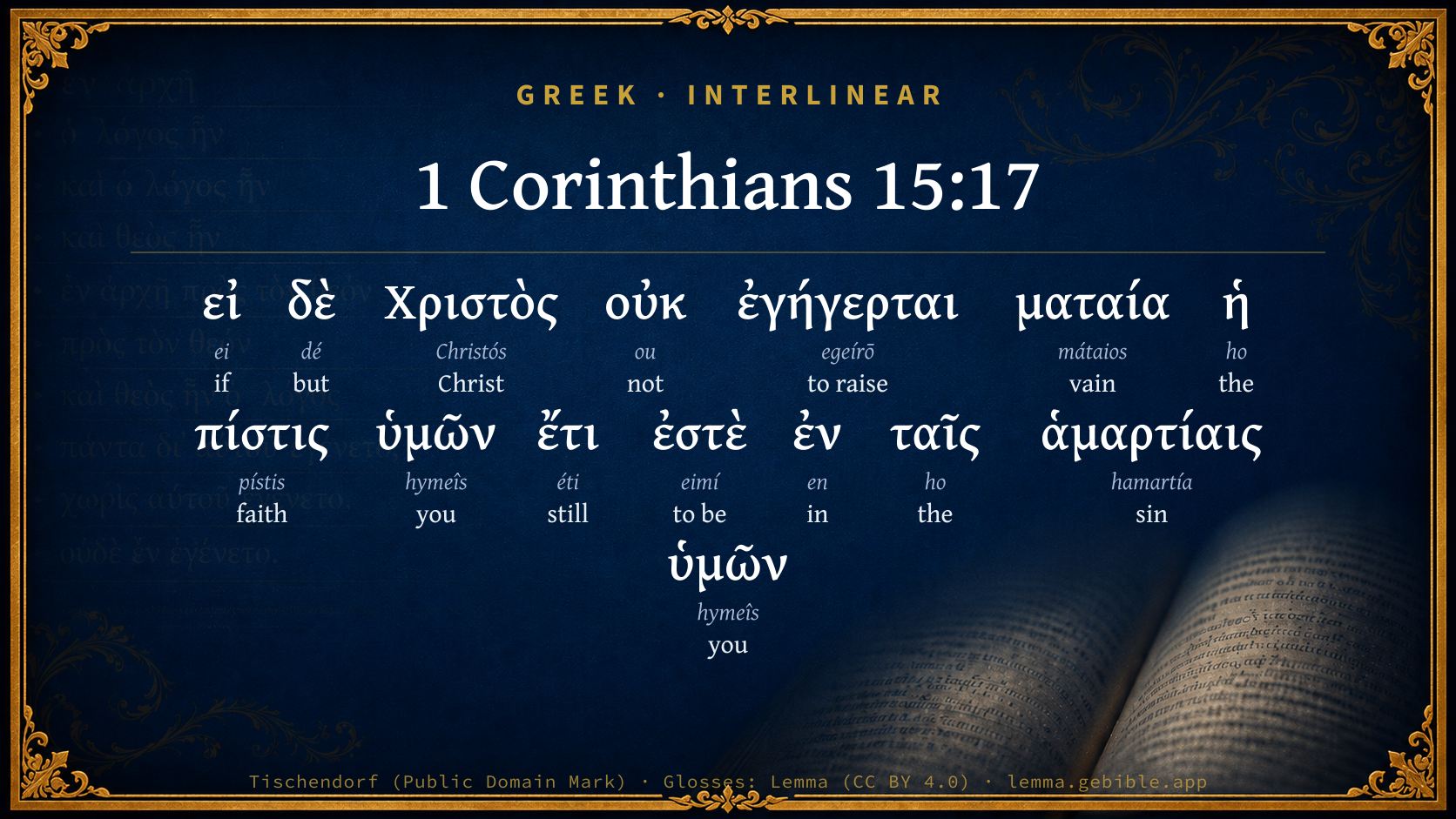
  1. εἰ ei G1487 “if” Conditional
  2. δὲ dé G1161 “but” Conjunction
  3. Χριστὸς Christós G5547 “Christ” Noun, Nominative, Singular, Masculine
  4. οὐκ ou G3756 “not” Particle, Negative
  5. ἐγήγερται egeírō G1453 “to raise” Verb, Perfect, Passive, Indicative, 3rd person, Singular
  6. ἡ ho G3588 “the” Article, Nominative, Singular, Feminine
  7. πίστις pístis G4102 “faith” Noun, Nominative, Singular, Feminine
  8. ὑμῶν hymeîs G5210 “you” Personal pronoun, 2nd person, Genitive, Plural
  9. ἔτι éti G2089 “still” Adverb
  10. ἐστὲ eimí G1510 “to be” Verb, Present, Active, Indicative, 2nd person, Plural
  11. ἐν en G1722 “in” Preposition
  12. ταῖς ho G3588 “the” Article, Dative, Plural, Feminine
  13. ἁμαρτίαις hamartía G266 “sin” Noun, Dative, Plural, Feminine
  14. ὑμῶν hymeîs G5210 “you” Personal pronoun, 2nd person, Genitive, Plural

About this verse

These counts appear in no published source. They are computed here, from the morphology-tagged text and Lemma’s own curated glosses. What Lemma adds →

15
words
13
distinct lemmas
Pauline Epistles
section

Notable vocabulary

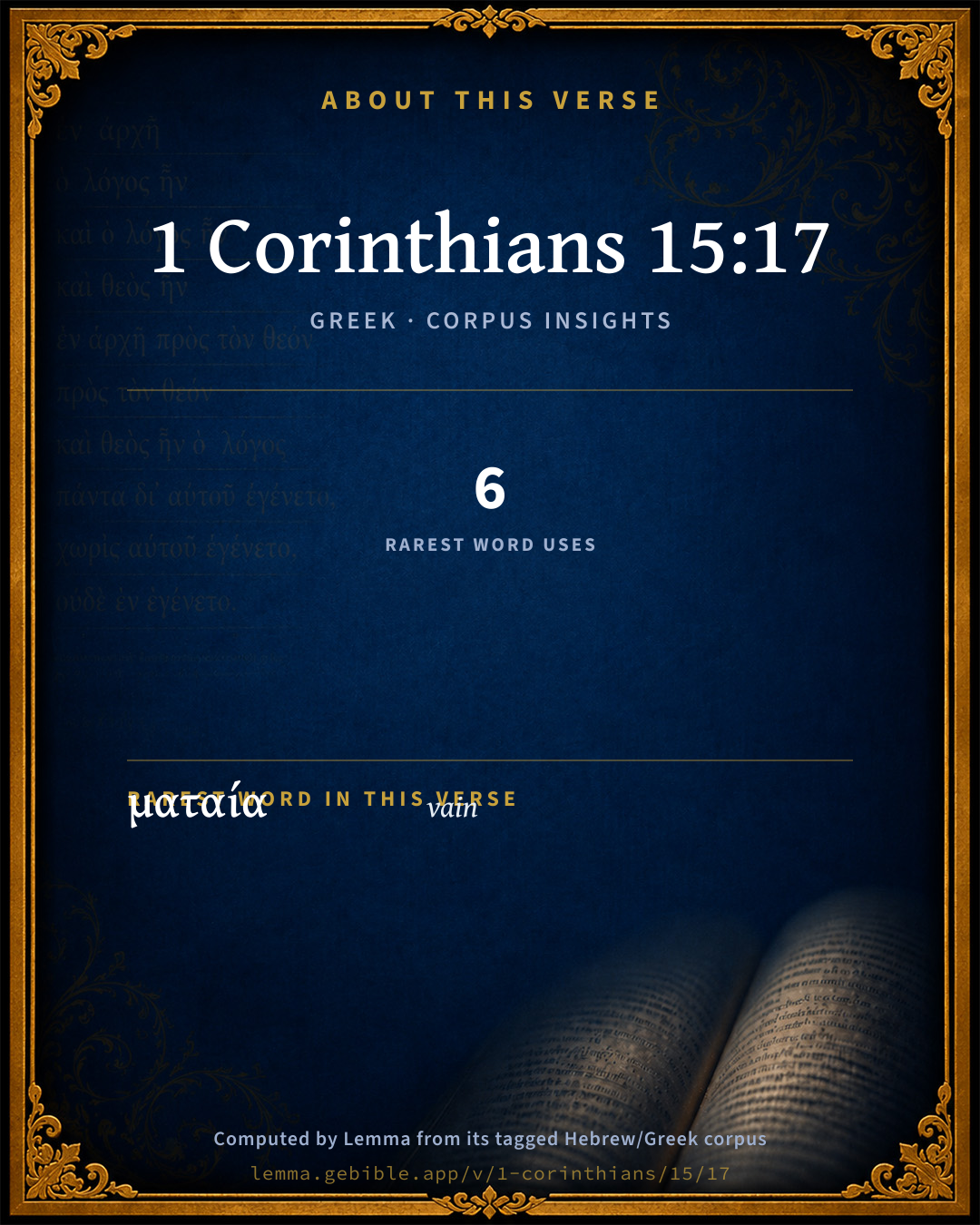
The rarest word here is ματαία vain G3152 — appearing just 6 times in the whole Greek New Testament.

Shared distinctive vocabulary

ματαία vain G3152 occurs in 6 verses of the Greek New Testament. Also found in:

Repetition

Words recur within this verse:

Cross-references

14

Topical passages linked to 1 Corinthians 15:17 in the Treasury of Scripture Knowledge — connected by theme and wording, ordered by reader-vote popularity; previews shown in the World English Bible.

  • Romans 4:25 who was delivered up for our trespasses, and was raised for our justification.
  • 1 Peter 1:3 Blessed be the God and Father of our Lord Jesus Christ, who according to his great mercy became our father again to a living hope through the resurrection of Jesus Christ from the dead,
  • 1 Corinthians 15:14 If Christ has not been raised, then our preaching is in vain, and your faith also is in vain.
  • 1 Peter 1:21 who through him are believers in God, who raised him from the dead, and gave him glory; so that your faith and hope might be in God.
  • Romans 8:33–34 Who could bring a charge against God's chosen ones? It is God who justifies.
  • Romans 5:10 For if, while we were enemies, we were reconciled to God through the death of his Son, much more, being reconciled, we will be saved by his life.
  • Acts 5:31 God exalted him with his right hand to be a Prince and a Savior, to give repentance to Israel, and remission of sins.
  • 1 Corinthians 15:2 by which also you are saved, if you hold firmly the word which I preached to you--unless you believed in vain.
  • Hebrews 10:4–12 For it is impossible that the blood of bulls and goats should take away sins.
  • John 8:21–24 Jesus said therefore again to them, "I am going away, and you will seek me, and you will die in your sins. Where I go, you can't come."
  • Acts 13:38–39 Be it known to you therefore, brothers, that through this man is proclaimed to you remission of sins,
  • Hebrews 9:22–28 According to the law, nearly everything is cleansed with blood, and apart from shedding of blood there is no remission.
  • Ezekiel 33:10 You, son of man, tell the house of Israel: Thus you speak, saying, Our transgressions and our sins are on us, and we pine away in them; how then can we live?
  • Hebrews 7:23–28 Many, indeed, have been made priests, because they are hindered from continuing by death.

Cross-references courtesy of OpenBible.info (CC BY 4.0).

Commentary

Notes on 1 Corinthians 15:17 from classic Christian and Jewish commentators (each source and its license shown beneath its notes). The classic Christian expositions comment on the surrounding passage and are grouped to its opening verse, so a note may address several verses; the Jewish commentaries on the Tanakh (Rashi and others) are per-verse, so they appear only where the commentator wrote on this verse.

Lemma curates 59 commentaries, every one of them public domain or Creative Commons licensed, each selected and text-cleaned for this edition rather than reprinted as found. About our sources →

Bengel's Gnomon

Johann Albrecht Bengel

1Co 15:17. Ἁμαρτίαις, in your sins), even those of blind heathenism; 1Co 15:34, [deprived of the hope of life eternal.—V. g.]

Bengel's Gnomon of the New Testament — English translation (T&T Clark, Edinburgh, 1860) — public domain. Text from a community e-Sword module.

Meyer's Critical & Exegetical Commentary

Heinrich August Wilhelm Meyer

1Co_15:17-18. Solemnly now also the other conclusion from the οὐδὲ Χριστὸς ἐγήγ., already expressed in 1Co_15:14, is once more exhibited, but in such a way that its tragical form stands out still more awfully (ματαία and ἔτι ἐστὲ ἐν τ. ἁμ. ὑμ.), and has a new startling feature added to it by reference to the lot of the departe.

ματαία] vain, fruitless, put first with emphasis, as ἔτι is afterwards. Comp. 1Co_15:14. The meaning of the word may be the same as κενή in 1Co_15:14 (comp. μάταιος λόγος, Plato, Legg. ii. p. 654 E; Herod. iii. 56; μάταιος δοξοσοφία, Plato, Soph. p. 231 B; μάταιος εὐχή, Eur. Iph. T. 628, and the like, Isa_59:4; Eccles. 31:5; Act_14:15; 1Co_3:20), to which Hofmann, too, ultimately comes in substance, explaining the πίστις ματαία of their having comforted themselves groundlessly with that which has no truth. But what follows shows that resultlessness, the missing of the aim, is denoted here (comp. Tit_3:9; Plato, Tim. p. 40 D, Legg. v. p. 735 B; Polyb. vi. 25. 6; 4Ma_6:10). This, namely, has its character brought out in an awful manner by ἔτι ἐστὲ ἐν τ. ἁμ. ὑμ.: then ye are still in your sinsi.e. then ye are not yet set free from your (pre-Christian) sins, not yet delivered from the obligation of their guilt. For if Christ is not risen, then also the reconciliation with God and justification have not taken place; without His resurrection His death would not be a redemptive death.[39] Rom_4:25, and see on 1Co_15:14. Regarding the expression, comp. 3 Esdr. 8:76; Thuc. i. 78. See also Joh_8:21; Joh_8:24; Joh_9:41.

ἄρα καὶ οἱ κοιμηθ. κ.τ.λ.] a new consequence of ΕἸ ΔῈ Χ. ΟὐΚ ἘΓΉΓ., but further inferred by ἌΡΑ from the immediately preceding ἜΤΙ ἘΣΤῈ ἘΝ ΤΑῖς ἉΜΑΡΤ. ὙΜ.: then those also who have fallen asleep are accordingly (since they, too, can have obtained no propitiation), et.

οἱ κοιμηθ.] Observe the aorist: who fell asleep, which expresses the death of the individuals as it took place at different times. It is otherwise at 1Co_15:20; comp. 1Th_4:14 f.

ἐν Χριστῷ] for they died[40] so, that they during their dying were not out of Christ, but through faith in Him were in living fellowship with Him. Comp. 1Th_4:16; Rev_14:13. We are neither, with Grotius (comp. as early interpreters as Chrysostom and Theodoret), to think simply of the martyrs (ἐν = propter), nor, with Calovius, widening the historical meaning on dogmatic grounds, to include the believers of the Old Testament (even Adam), for both are without support in the context; but to think of the Christians deceased.

ἀπώλοντο] they are destroyed, because in their death they have become liable to the state of punishment in Hades (see on Luk_16:23), seeing that they have, in fact, died without expiation of their sins. That this does not mean: they have become annihilated (Menochius, Bengel, Heydenreich, and others), is clear from ἔτι ἐστὲ ἐν τ. ἁμ. ὑμ., of which, in respect of the dead, the ἈΠΏΛΕΙΑ in Hades is the consequence.

[39] Comp. Weiss, bibl. Theol. p. 329.

[40] Κοιμᾶσθαι is the habitually used New Testament euphemism for dying (comp. vv. 6, 11, 30), and in no way justifies the unscriptural assumption of a sleep of the soul, in which Paul is held to have believed. See against this, Delitzsch, Psychol. p. 419 ff. In the euphemistic character of that expression, however, which classic writers also have (Jacobs, ad Del. epigr. viii. 2), lies the reason why he never uses it of the death of Christ. This was recognised as early as by Photius, who aptly remarks, Quaest. Amphiloch 187: ἐπὶ μὲν οὖν τοῦ Χριστοῦ θάνατον καλεῖ, ἵνα τὸ πάθος πιστώσηται· ἐπὶ δὲ ἡμῶν κοίμησιν, ἵνα τὴν ὀδύνην παραμυθήσηται. Ἔνθα μὲν γὰρ παρεχώρησεν ἡ ἀνάστασις, ὀαῤῥῶν καλεῖ θάνατον· ἔνθα δὲ ἐν ἐλπίσιν ἔτι μένει, κοίμησιν καλεῖ κ.τ.λ.

Meyer — Critical and Exegetical Commentary on the New Testament — English translation by Peter Christie, edited by Frederick Crombie (T&T Clark, 1880) — public domain. Text from a community e-Sword module.

Expositor's Greek Testament

ed. W. Robertson Nicoll

1Co 15:17-18 unfold this latter consequence in a form parl [2326] to the former: εἰ δὲ … ἄρα (1Co 15:14 ). For ματαία (syn [2327] with ἀργή , Jas 2:20 ; with ἀνωφελεῖς , Tit 3:9 ), see note on κενόν (1Co 15:14 ); a faith is “frustrate,” “null and void,” “which does not save from sin ; now “Christ died for our sins” (1Co 15:3 ), but His resurrection makes His death valid, publishing it to men as accepted by God and availing for redemption (Rom 4:25 ; Rom 8:33 f., 1Co 10:9 ; Luk 24:46 f.; Act 13:32-38 observe the γνωστὸν οὖν ἔστω ); it is hereby that “God gives the victory”over both sin and death (1Co 15:57 ). ln Christ’s resurrection is the seal of our justification, and the spring of our sanctification (Rom 6:4-11 ); both are wanting, if He is still in the grave. The absence of both is implied in being “yet in your sins” unforgiven, unrenewed. Now this is contrary to experience (1Co 1:30 , 1Co 6:11 ); the Cor [2328] readers know themselves to be saved men, as Paul and the App. know themselves to be honest men (1Co 15:15 ). P. leaves the inference, which observes the strict method of the modus tollens , to the consciousness of his readers (cf. 1Co 15:20 ): “We are true witnesses, you are redeemed believers; on both accounts it is certain that Christ has risen, and therefore that there is a resurrection of the dead”. A further miserable consequence of the negative dogma emerges from the last: ἄρα καὶ οἱ κοιμηθέντες … ἀπώλοντο . “Then also those that were laid to sleep in Christ perished!” perished (ptp [2329] and vb [2330] both aor [2331] ) when we laid them to rest, and with the “perishing” which befalls those “yet in their sins” ( cf. 1Co 1:18 , 1Co 8:11 , Rom 2:12 ; Rom 6:23 , etc.; also Joh 8:21 ; Joh 8:24 ). They were “put to sleep in Christ ” ( cf. 1Th 4:14 ), as the sense of His presence and the promises of His gospel turned their death into sleep (Joh 11:2 , etc.). The ματαιότης of being lulled to sleep when falling into utter ruin! They thought “the sting of death” drawn (1Co 15:56 ), and lay down to rest untroubled: cruelly deceived! For the unclassical position of ἄρα , see Wr [2332] , p. 699.

[2326] parallel.

[2327] synonym, synonymous.

[2328] Corinth, Corinthian or Corinthians.

[2329] participle

[2330] verb

[2331] aorist tense.

[2332] Winer-Moulton’s Grammar of N.T. Greek (8th ed., 1877).

The Expositor's Greek Testament, edited by W. Robertson Nicoll (1897–1910) — public domain. Text from a community e-Sword module.

Hodge's Commentary on Romans, Ephesians & First Corinthians

Charles Hodge

1Co_15:17

And if Christ be not raised, your faith (is) vain; ye are yet in your sins.

This is the third consequence of the denial of Christs resurrection. In 1Co_15:14 it was said, your faith is κενή, empty; here it is said to be ματαία, fruitless. In what sense the following clause explains; ye are yet in your sins, i.e. under the condemnation of sin. Comp. Joh_8:21, Ye shall die in your sins. As Christs resurrection is necessary to our justification, Rom_4:25, if he did not rise, we are not justified. To teach, therefore, that there is no resurrection, is to teach that there is no atonement and no pardon. Errorists seldom see the consequences of the false doctrines which they embrace. Many allow themselves to entertain doubts as to this very doctrine of the resurrection of the body who would be shocked at the thought of rejecting the doctrine of atonement. Yet Paul teaches that the denial of the one involves the denial of the other.

Charles Hodge — Commentary on Romans (1835), First Corinthians (1857), and Ephesians (1856) — public domain. Text from a community e-Sword module.

Geneva Bible (1599)

Geneva Bible translators

First, seeing death is the punishment of sin, in vain should we believe that our sins were forgiven us, if they remain: but they do remain, if Christ rose not from death.

They are yet in their sins, which are not sanctified, nor have obtained remission of their sins.

Geneva Bible (1599) marginal notes — public domain. Text via Bolls.life.

Jamieson, Fausset & Brown

Robert Jamieson, A. R. Fausset & David Brown

vain--Ye are, by the very fact (supposing the case to be as the skeptics maintained), frustrated of all which "your faith" appropriates: Ye are still under the everlasting condemnation of your sins (even in the disembodied state which is here referred to), from which Christ's resurrection is our justification (Rom 4:25): "saved by his life" (Rom 5:10).

Jamieson, Fausset & Brown — Commentary Critical and Explanatory on the Whole Bible (1871) — public domain (CC PDM 1.0). Text via the HelloAO Bible API.

Adam Clarke's Commentary

Verse 17. Ye are yet in your sins.] If Christ has not risen from the dead, there is no proof that he has not been justly put to death. If he were a malefactor, God would not work a miracle to raise him from the dead. If he has not been raised from the dead, there is a presumption that he has been put to death justly; and, if so, consequently he has made no atonement; and ye are yet in your sins-under the power, guilt, and condemnation of them. All this reasoning of the apostle goes to prove that at Corinth, even among those false teachers, the innocency of our Lord was allowed, and the reality of his resurrection not questioned.

Adam Clarke's Commentary on the Bible (1810–1826) — public domain. Text from a community e-Sword/MySword module.

The Cambridge Bible for Schools and Colleges

gen. ed. J. J. S. Perowne

17. your faith is vain; ye are yet in your sins] Christ came, not only to make reconciliation for sin, but to free us from it. Cf. Rom_6:11-23; Rom_8:2. And this He did by proclaiming a Life. He first conquered sin Himself. Then He offered the acceptable Sacrifice of His pure and unpolluted life to God in the place of our corrupt and sinful lives. And then, having at once vindicated the righteousness of God’s law and fulfilled it, He arose from the dead. Having thus led sin and death captive, He redeemed us from the power of both by imparting His own Life to all who would enter into covenant with Him. Thus the Resurrection of Christ was the triumph of humanity (see 1Co_15:21) over sin and death; the reversal of the sentence, ‘the soul that sinneth, it shall die.’ Had He not risen from the dead, humanity had not triumphed, the sentence had not been reversed, man had not been delivered from the yoke of sin, and therefore those who had ‘fallen asleep’ could never wake again. “None of these things would have taken place, had He not emerged victor from the conflict by rising again.” Calvin.

The Cambridge Bible for Schools and Colleges (gen. ed. J. J. S. Perowne; Cambridge University Press, 1878–1918) — public domain. Text from a community e-Sword module.

John Gill's Exposition

Then they also which are fallen asleep in Christ,.... That is, who are dead, and have died in Christ: death is often represented by a sleep, and that more than once in this chapter; and doubtless with a view to the resurrection, which will be an awaking out of it, since it will not be perpetual: some understand this of such only who were fallen asleep, or died martyrs for the sake of Christ and his Gospel; as Stephen, James the brother of John, and others; but rather it designs all such as die in Christ, in union with him, whether in the lively exercise of faith, or not; of whom it must be said, if Christ is not risen, that they

are perished: soul and body; for if there is no reason to believe the resurrection of the dead, there is no reason to believe the immortality of the soul, or a future state, but rather that the soul perishes with the body, and that there is no existence after death: though should it be insisted on that the soul survives, and shall live without the body to all eternity, it must be in a state of misery, if Christ is not risen, because it must be in its sins; and neither sanctified nor justified, and consequently cannot be glorified, so that the whole may be said to be perished; the body perishes in the grave, the soul in hell; but God forbid that this should be said of those, who have either died for Christ, or in him: can it be that any that are in Christ, that are united to him, one body and spirit with him, should ever perish? or those that are asleep in him be lost? no, those that sleep in Jesus, will God bring with him at the last day, who shall be for ever with him, and for ever happy.

John Gill's Exposition of the Whole Bible (1746–1763) — public domain (CC PDM 1.0). Text via the HelloAO Bible API.

Trapp's Complete Commentary

John Trapp

17 And if Christ be not raised, your faith is vain; ye are yet in your sins.

Ver. 17. Ye are yet in your sins] Rom 4:25. If he had not been let out of prison, our debt had remained upon us. But God sent his angel to roll away the stone, as the judge sends an officer to fetch one out of prison, and to release him. And this is the strength of our Saviour’s reason, Joh 16:10. The Spirit shall convince the world of righteousness (that I am Jehovah their righteousness), because I go to the Father, which I could not have done, unless you were acquitted of all your sins.

John Trapp, A Commentary or Exposition upon All the Books of the Old and New Testament (1647–1656) — public domain. Text from a community e-Sword module.

Albert Barnes' Notes on the Bible

Your faith is vain, - 1Co 15:14. The meaning of this passage here is, that their faith was vain, “because,” if Christ was not raised up, they were yet unpardoned sinners. The pardon of sin was connected with the belief of the resurrection of the Lord Jesus, and, if he was not raised, they were still in a state of sin.

Ye are yet in your sins - Your sins are yet unpardoned. They can be forgiven only by faith in him, and by the efficacy of his blood. But if he was not raised, he was an impostor; and, of course, all your hopes of pardon by him, and through him, must be vain. The argument in this verse consists in an appeal to their Christian experience and their hopes. It may be thus expressed:

(1) You have reason to believe that your sins are forgiven. You cherish that belief on evidence that is satisfactory to you. But if Christ is not raised, that cannot be true. He was an impostor, and sins cannot be forgiven by him. As you are not, and cannot be prepared to admit that your sins are not forgiven, you cannot admit a doctrine which involves that.

(2) You have evidence that you are not under the dominion of sin. You have repented of it; have forsaken it; and are leading a holy life. You know that, and cannot be induced to doubt this fact. But all that is to be traced to the doctrine that the Lord Jesus rose from the dead. It is only by believing that, and the doctrines which are connected with it, that the power of sin in the heart has been destroyed. And as you “cannot” doubt that under the influence of “that truth” you have been enabled to break off from your sins, so you cannot admit a doctrine which would involve it as a consequence that you are yet under the condemnation and the dominion of sin. You must believe, therefore, that the Lord Jesus rose; and that, if he rose, others will also. This argument is good also now, just so far as there is evidence that, through the belief of a risen Saviour, the dominion of sin has been broken; and every Christian is, therefore, in an important sense, a witness of the resurrection of the Lord Jesus, a living proof that a system which can work so great changes, and produce such evidence that sins are forgiven as are furnished in the conversion of sinners, must be from God; and, of course, that the work of the Lord Jesus was accepted, and that he was raised up from the dead.

Albert Barnes' Notes on the Bible (1834–1885) — public domain. Text from a community e-Sword/MySword module.

Matthew Poole's English Annotations

That is, ye are yet in your estate of nature, under the guilt and condemning power of your sins, which are not yet pardoned to you; for no sins are remitted, but upon believing in the Lord Jesus Christ, which none can do, if Christ be not risen from the dead; for by that he was declared to be the Son of God with power, Rom 1:4; his death declared him to be truly man, it was his resurrection that manifested him to be truly God, God over all blessed for ever, and so the proper object of people’s faith.

Matthew Poole's English Annotations on the Holy Bible (1683–1685) — public domain. Text from a community e-Sword/MySword module.

Whedon's Commentary on the Bible

Daniel D. Whedon

17. In your sins—If Christ is still dead, and Christianity is nothing, we are in a pagan or Jewish condition. We have no deliverance from sin; neither by Christ, nor from the expiations that Judaism or paganism professes to offer. Both these systems had their sense of sin, and their sacrifices and lustrations for it. But if Christ rose not, ye Christians, wholly without expiation, are yet in your sins.

Daniel D. Whedon (gen. ed.), Commentary on the Old and New Testaments (1874–1909) — public domain. Text from a community e-Sword module.

The Pulpit Commentary

Vain; rather, frustrate. The word used (mataia) is different from the word used (kene) in ver 14. Ye are yet in your sins. Because a dead Redeemer could be no Redeemer. Christ"s resurrection is the pledge of his Divine power. He was "raised for our justification". (Rom_4:25) It is only "as a Prince and Saviour" that "God hath exalted him to give repentance and forgiveness of sins" (Act_5:31; Rom_5:10)

A vain faith.

It often happens that men accept certain notions without realizing what they involve. So it seems to have been with those Corinthian Christians who lent too willing an ear to the false teachers who denied the resurrection of the dead. The apostle was justified in pointing out to such that their surrender of this great doctrine and revelation involved virtually the denial of the resurrection of Christ, and that this involved the denial of some of their most cherished beliefs and hopes. What the Lord Christ was to them he was because he was the risen and triumphant Saviour. To take away their faith in such a Saviour was to render their faith vain.

I FAITH IN CHRIST"S DEITY LARGELY RESTS UPON THE FACT OF HIS RESURRECTION.

1. If Jesus had not risen from the dead, his own recorded predictions would have been falsifed. On several occasions he had foretold that his violent death should be followed on the third day by his resurrection. Had this not taken place, his word would have been discredited, and all confidence in his Deity would naturally have been destroyed.

2. If Jesus had not risen from the dead, he would have been proved inferior to death. The argument of the apostle was a very powerful and effective argument that, being not only David"s Son, but David"s Lord, it was not possible that he should be holden by death, that his body should see corruption. But had he remained in the grave, a very different impression concerning his nature would necessarily have been produced upon the minds of his disciples, and the world could never have been convinced of his Messiahship and divinity.

II FAITH IN CHRIST AS A SAVIOUR RESTS UPON THE FACT OF HIS RESURRECTION.

1. This appears in the customary publication of the gospel by the inspired apostles. They preached that Jesus was "raised to be a Prince and a Saviour, to give repentance unto Israel, and remission of sins.

2. The resurrection of Christ is a token of the acceptance by the Father of that redemptive work of Christ whereby forgiveness is secured to those who believe. And it is the condition of the exercise of those mediatorial functions which are still discharged in the court of heaven, the presence of God.

3. The resurrection is a spiritual power in the hearts of those who believe it, a power of newness of mind, of holiness, of life immortal. They who die with Christ unto sin, and are crucified with him unto the world, risen with Christ, live in his heavenly and resurrection life.

III FAITH IN CHRIST AS THE FIRSTFRUITS OF THE GENERAL RESURRECTION RESTS UPON HIS RISING FROM THE TOMB. There is observable a marvellous contrast between the hopelessness of the heathen and the confidence of Christians in the prospect of death. To those who believe the gospel, the victory of Immanuel over death and the grave is the pledge of the final triumph of the good, is their consolation when they are bereaved of their Christian kindred and associates, is their confidence and inspiration in the prospect of their own departure to be with Christ. T.

The Pulpit Commentary (1880–1919), ed. H.D.M. Spence-Jones & Joseph S. Exell — public domain. Text from a community e-Sword module.

John Wesley's Explanatory Notes

Ye are still in your sins - That is, under the guilt of them. So that there needed something more than reformation, (which was plainly wrought,) in order to their being delivered from the guilt of sin even that atonement, the sufficiency of which God attested by raising our great Surety from the grave.

John Wesley, Explanatory Notes Upon the Whole Bible (1754–1765) — public domain. Text via the GEBible commentary corpus.

Scofield Reference Notes

C. I. Scofield

sins

Sin. (See Scofield "Rom 3:23").

The Scofield Reference Bible (1917 edition), notes by C. I. Scofield — public domain. Text from a community e-Sword module.

Godbey's Commentary on the New Testament

William B. Godbey

17. “If Christ is not risen, your faith is vain, and you are still in your sins.

William B. Godbey, Commentary on the New Testament (1896–1900) — public domain. Text from a community e-Sword module.

McGarvey & Pendleton's Commentaries

J. W. McGarvey

and if Christ hath not been raised, your faith is vain; ye are yet in your sins . [unjustified-- Rom_4:25 ]

J. W. McGarvey (with Philip Y. Pendleton), Commentaries on the New Testament (The Fourfold Gospel, 1914; Acts; and the epistles) — public domain. Text from a community e-Sword/MySword module.

The People's New Testament

B. W. Johnson

17. If Christ be not raised, your faith is vain. In that case he is not the Savior. He is a dead man, who could not even save himself. Such a one has no power to pardon sins, and ye are yet in your sins.

B. W. Johnson's The People's New Testament with Notes (1889–1891) — public domain. Electronic text from the Christian Classics Ethereal Library (CCEL) ThML edition.

Cambridge Greek Testament for Schools and Colleges

17. ματαία. This word is in all probability synonymous with κενή above, 1Co 15:14. But Meyer would distinguish between them. The former with him means without result, the latter without reality.

ἔτι ἐστὲ ἐν ταῖς ἁμαρτίαις ὑμῶν. Christ came, not only to make reconciliation for sin, but to free us from it. Cf. Rom 6:11-23; Rom 8:2. And this He did by proclaiming a Life. He first conquered sin Himself. Then He offered the acceptable Sacrifice of His pure and unpolluted life to God in the place of our corrupt and sinful lives. And then, having at once vindicated the righteousness of God’s law and fulfilled it, He arose from the dead. When He had thus led sin and death captive, He redeemed us from the power of both by imparting His own Life to all who would enter into covenant with Him. Thus the Resurrection of Christ was the triumph of humanity (see 1Co 15:21) over sin and death; the reversal of the sentence, ‘the soul that sinneth, it shall die.’ Had He not risen from the dead, humanity had not triumphed, the sentence had not been reversed, man had not been delivered from the yoke of sin, and therefore those who had ‘fallen asleep’ could never wake again. ‘None of these things would have taken place, had He not emerged victor from the conflict by rising again.’ Calvin.

Cambridge Greek Testament for Schools and Colleges (Cambridge University Press, 1896; 21 vols, various authors incl. Carr, Maclear, Plummer, Farrar, Lumby, Moule, M. R. James, Simcox) — public domain. Text from a community e-Sword module.

Alford’s Greek Testament

Henry Alford

17. ματαία] from μάτην, and thus more directly pointing at the frustration of all on which faith relies as accomplished,—e.g. the removal of the guilt and power of sin;—and of all to which hope looks forward, e.g. bliss after death for those who die in Christ. This is so, because Christ’s Resurrection accomplished our justification (Rom 4:25), and, through justification, our future bliss, even in the disembodied state (for that seems here to be treated of).

Henry Alford, The Greek Testament (1849–1861) — public domain. Text from a community e-Sword module.

International Critical Commentary

17. A solemn repetition and enlargement of v. 14, showing more clearly what the loss to the Corinthians would be if this theory were true. Both AV. and RV. render κενή in v. 14 and ματαία here ‘vain,’ and sometimes there is little difference between the two words: but here there is; κενή is ‘wanting in reality,’ ματαία ‘wanting in result,’ ‘fruitless,’ ‘futile’ (Tit 3:9; 4 Macc. 16:7). In class. Grk. μάταιος is of two terminations (Jas 1:26); but here and 1Pe 1:18 the fem. occurs, as often in LXX.

ἓτι ἐστὲ ἐν ταῖς ἁμαρτίαις ὑμῶν. This may mean one of two things. If Christ has not been raised for our justification (Rom 4:25), His death is made a nullity, for there is no redemptive power in it. It does not save us from the guilt and penalty of sin; for how can a dead Christ save others from death, which is the penalty of sin? And how can He secure for others a life beyond the grave which He Himself does not possess? Comp. Rom 6:1-11; Php 3:10; Col 3:1. Or, the words may be an appeal to their personal experience. If Christ had not risen, they would still be living in their original heathen wickedness, for baseless credulity could never have delivered them. It was faith in a living Christ that had done that. Therefore Christ has been raised. This is a more telling argument than the other, because it is based on what the Corinthians could not help knowing. They were as sure that they were not continuing their old heathen life as the Apostles were that they were not lying witnesses. But the former is closer to the context, and to St Paul’s doctrinal purpose.

International Critical Commentary — older volumes (1896–1929), various authors — public domain. Text from a community e-Sword module.

Vincent's Word Studies in the New Testament

Marvin R. Vincent

Vain [ματαια] . A different word, signifying fruitless. The difference is between reality and result.

Marvin R. Vincent, Word Studies in the New Testament (1887–1900) — public domain. Text from a community e-Sword/MySword module.

Godet's Commentaries

Frédéric Louis Godet

Vv. 17, 18. “Now, if Christ be not raised, your faith is vain; ye are yet in your sins. 18. Then they also which are fallen asleep in Christ are perished.”

Once deny Christ’s resurrection, and there is no more salvation in Him.

The word ματαία denotes, as often, the vanity of the thing from the standpoint of its effects, its uselessness. Such is the difference between it and the κενή, vain, of 1Co 15:14. Faith in the resurrection, not taking hold of a real fact (κενή), cannot procure for the believer the salvation he expects (ματαία). It is completely to mistake the meaning of this saying, to follow Heinrici and several others, in applying the expression: to be yet in one’s sins, to the moral bondage of sin. The apostle certainly does not mean: “If Christ be not really risen, you will not be able to conquer your evil inclinations.” Nothing in this Epistle has prepared us for such an idea. It is of the state of condemnation arising from unpardoned sins that he wishes to speak, as is clearly shown by the following verse. The idea is this: Condemnation can only be taken away by the expiatory death of Christ, and expiation would never have taken place if the victim who accomplished it had not been restored to life. As long as the security is not let out of prison, it must be concluded that the debt is not paid. If then Christ did not leave the prison of death, our justification was not obtained by His death; and we are still, we believers, as much as others, condemned. Bonnet rightly says: “No one can understand the doctrine of Scripture regarding the resurrection, unless he has clearly present to his mind the intimate and indissoluble relation there is between sin and death.” Christ dead without resurrection would be a condemned, not a justified, Christ. How could He justify others?

Hence there follows immediately the disastrous consequence drawn in 1Co 15:18 : the perdition of those who have been seen to die peacefully in the faith of Christ.

Frédéric Louis Godet — Commentaries on Luke, John, Romans, and 1 Corinthians — English translation (T&T Clark, Edinburgh, 1870s–1890s) — public domain. Text from a community e-Sword module.

Lesson kit

Teaching starters — assembled from the data on this page, not authored interpretation. Every prompt links to the verse data it draws on. Edit before teaching.

1 Corinthians, in the Pauline Epistles, opens this verse with 15 words (13 distinct Greek lemmas). Its most distinctive word is mátaios (“vain”). A historical commentator’s framing appears above. Read the whole chapter for the surrounding context.

Discussion questions

  1. The word mátaios carries the sense “vain.” How does it shape the verse?
  2. How does Acts 14:15, which shares the word «vain», read alongside this verse?
  3. What does the repetition of “the” (2× in this one verse) do in this verse?
  4. The translations on this page render this verse differently — a whole-verse word diff, not a word-by-word alignment. What might account for the different wordings?
  5. Compare how Bengel's Gnomon and Meyer's Critical & Exegetical Commentary read this verse. Where do they agree or differ?

Things to notice

Reading settings

Reading text

Shown beneath each verse's original-language words.

Old Testament
Old Testament edition

Read the OT as the Masoretic Hebrew (MT) or the Greek Septuagint (LXX).

English shown for the Greek Septuagint (in the Hebrew ↔ Greek comparison).

Comparing translations? Open the Compare panel on any verse page to stack up to four side by side.