Romans 3:24

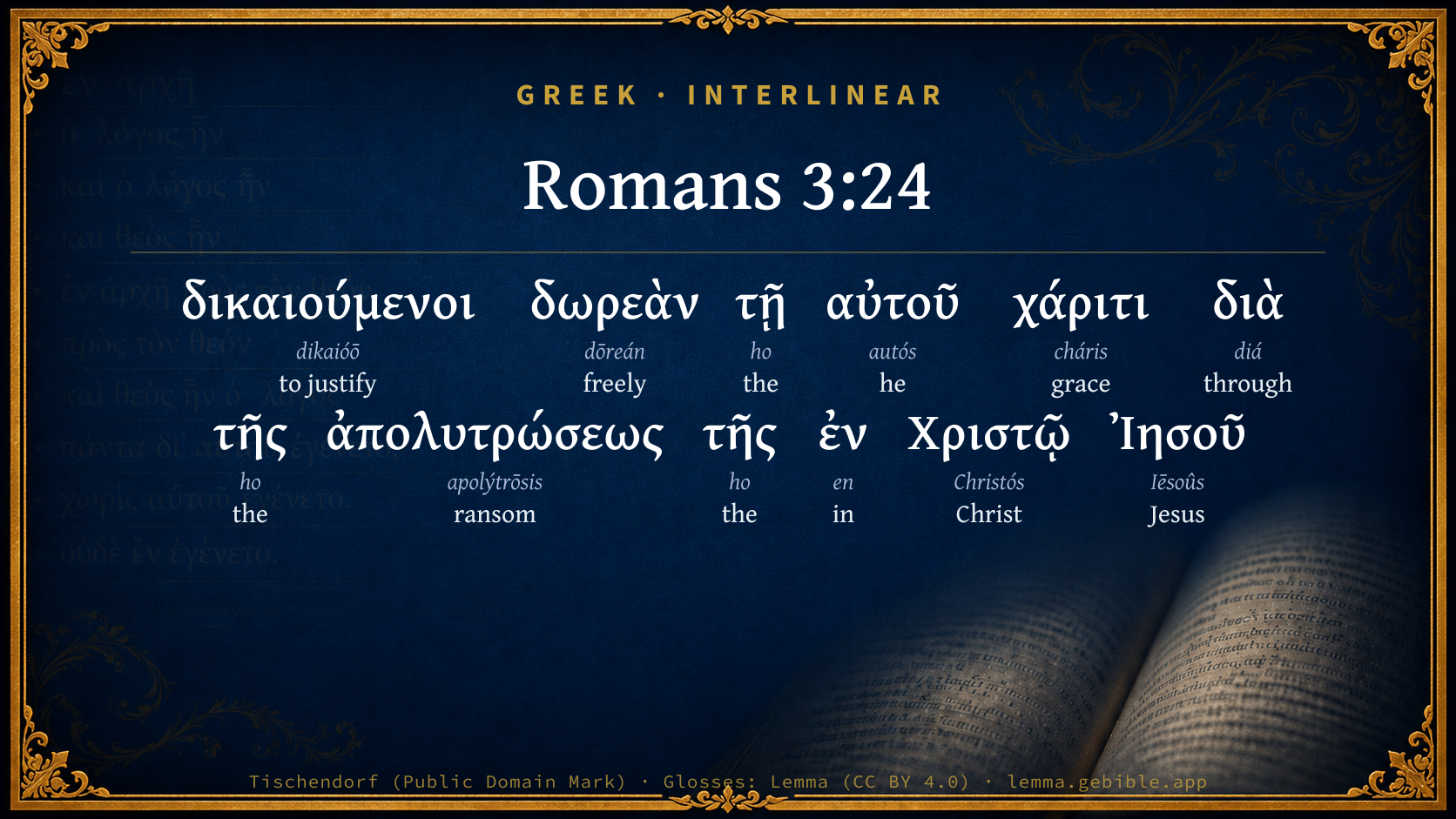
Greek (Tischendorf 8th ed.) Romans 3:24 appears in the Greek New Testament. The text above is from the Tischendorf 8th edition. Each word links to its Strong’s number and a concise gloss. Click any word for its full Thayer’s Greek Lexicon entry.
Download image
Cite this verse

Romans 3:24 (World English Bible). Public Domain. Lemma interlinear Bible study tool, https://lemma.gebible.app/v/romans/3/24.

Show BibTeX & RIS
BibTeX
RIS
English Translation
being justified freely by his grace through the redemption that is in Christ Jesus;
World English Bible · Public Domain
Download a study sheet

One document with this verse’s original text, its word-by-word gloss line, the meaning frame, cross-references with their text, attributed commentary, and full source and license credits — printable, and it pastes into notes with its structure intact.

This verse Autodidact and up

Study sheet (.html) Plain text (.txt)

A passage Seminary Student

Up to 50 verses in one chapter. A passage sheet keeps up to 6 commentary sources and 12 cross-references per verse, in the order this page ranks them, and says so on the sheet whenever that leaves anything out. Ask for a single verse and you get the Autodidact verse sheet above.

Everything on this page stays free to read, with no account — the sheet is a download of what is already on screen, not access to it.

Want to remove ads? Support Godless Engineer
Compare translations 3

The same verse in 3 English versions, stacked beneath the original-language interlinear above. Click any original word for its lexicon entry.

Each is an independent rendering of the whole verse — the interlinear is not word-aligned to these translations.

Highlighted words mark where these versions differ — a whole-verse word diff, not a word-by-word alignment.

  • World English Bible Public Domain
    being justified freely by his grace through the redemption that is in Christ Jesus;
  • King James Version Public Domain
    Being justified freely by his grace through the redemption that is in Christ Jesus:
  • unfoldingWord Literal Text CC BY-SA 4.0
    being justified freely by his grace through the redemption that in Christ Jesus;

unfoldingWord Literal Text — © unfoldingWord, licensed CC BY-SA 4.0. Word-aligned USFM3 via Door43 (git.door43.org/unfoldingWord/en_ult).

Versions to compare (up to 4)

3 of 4 selected

Show all 19 translations

Every available English version of this verse, each an independent rendering of the whole verse.

  • World English Bible Public Domain
    being justified freely by his grace through the redemption that is in Christ Jesus;
  • Berean Standard Bible Public Domain
    and are justified freely by His grace through the redemption that is in Christ Jesus.
  • Majority Standard Bible Public Domain
    and are justified freely by His grace through the redemption that is in Christ Jesus.
  • King James Version Public Domain
    Being justified freely by his grace through the redemption that is in Christ Jesus:
  • American Standard Version (1901) Public Domain
    being justified freely by his grace through the redemption that is in Christ Jesus:
  • Revised Version (1885) Public Domain
    being justified freely by his grace through the redemption that is in Christ Jesus:
  • Geneva Bible (1599) Public Domain
    And are iustified freely by his grace, through the redemption that is in Christ Iesus,
  • Douay-Rheims (1899) Public Domain
    Being justified freely by his grace, through the redemption, that is in Christ Jesus,
  • Young's Literal Translation Public Domain
    being declared righteous freely by His grace through the redemption that `is' in Christ Jesus,
  • Literal Standard Version CC BY-SA 4.0
    being declared righteous freely by His grace through the redemption that [is] in Christ Jesus,
  • Unlocked Literal Bible CC BY-SA 4.0
    and they are freely justified by his grace through the redemption that is in Christ Jesus.
  • unfoldingWord Literal Text CC BY-SA 4.0
    being justified freely by his grace through the redemption that in Christ Jesus;
  • Darby Bible Public Domain
    being justified freely by his grace through the redemption which [is] in Christ Jesus;
  • World Messianic Bible Public Domain
    being justified freely by his grace through the redemption that is in Messiah Yeshua,
  • Webster's Bible Public Domain
    Being justified freely by his grace, through the redemption that is in Jesus Christ:
  • Free Bible Version CC BY-SA 4.0
    Yet through the free gift of his grace, God makes us right through Christ Jesus who sets us free.
  • Bible in Basic English Public Domain
    And they may have righteousness put to their credit, freely, by his grace, through the salvation which is in Christ Jesus:
  • Text-Critical English NT CC BY 4.0
    being freely justified by his grace through the redemption that is in Christ Jesus,
  • Tyndale New Testament (1534) Public Domain
    but are iustified frely by his grace through the redempcion that is in Christ Iesu

Literal Standard Version (2020), Covenant Press — licensed CC BY-SA 4.0. Text via the HelloAO Bible API (eBible.org). Unlocked Literal Bible (unfoldingWord) — licensed CC BY-SA 4.0. Text via the HelloAO Bible API (eBible.org). unfoldingWord Literal Text — © unfoldingWord, licensed CC BY-SA 4.0. Word-aligned USFM3 via Door43 (git.door43.org/unfoldingWord/en_ult). Free Bible Version, Dr. Jonathan Gallagher — licensed CC BY-SA 4.0. Text via the HelloAO Bible API (eBible.org).

Word by word

More ways to search: Search by grammar → Find every occurrence → Compare this word →

Practice this passage: Drill this verse → Learn its vocabulary →

About this verse

These counts appear in no published source. They are computed here, from the morphology-tagged text and Lemma’s own curated glosses. What Lemma adds →

12
words
10
distinct lemmas
Pauline Epistles
section

Notable vocabulary

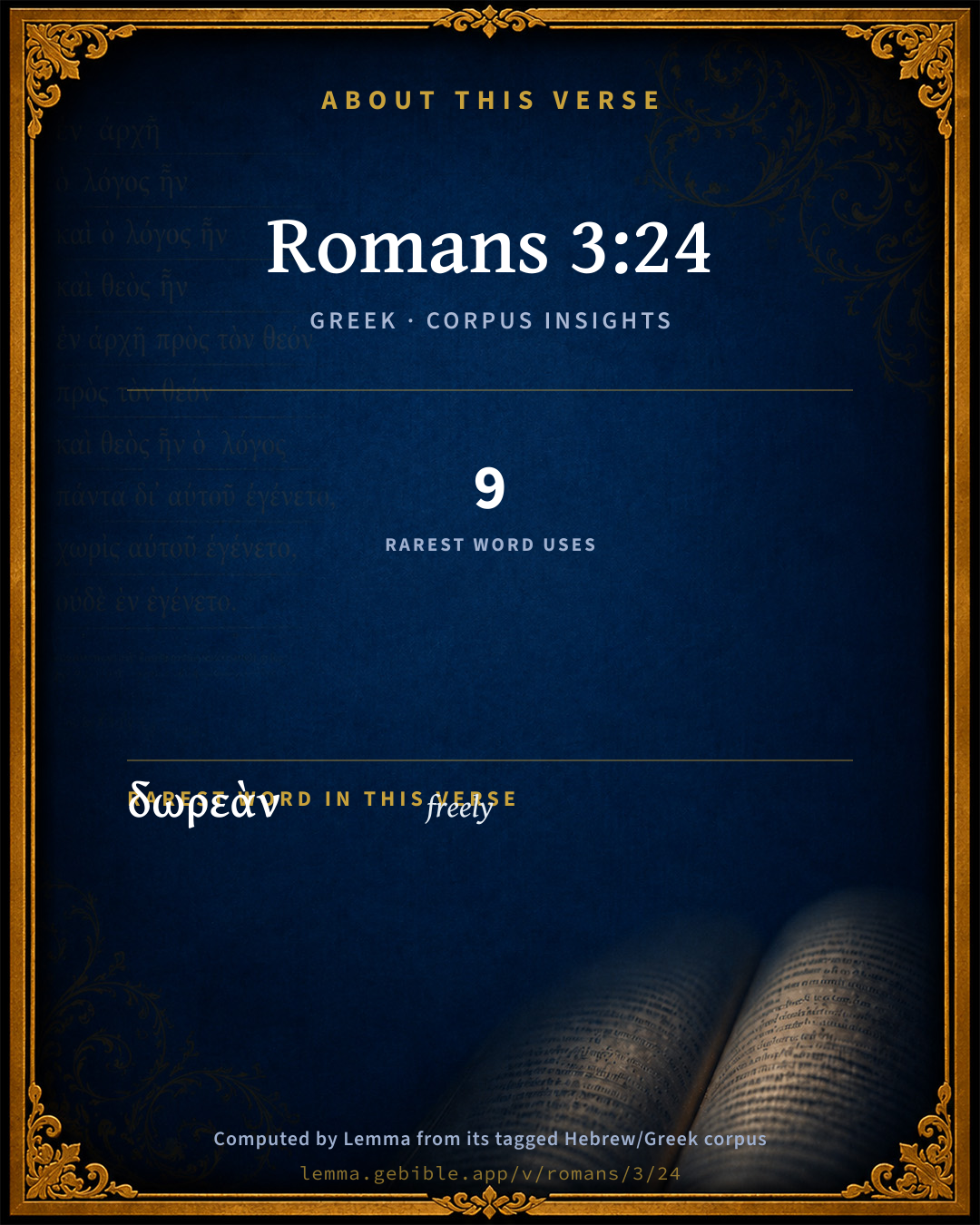
The rarest word here is δωρεὰν freely G1432 — appearing just 9 times in the whole Greek New Testament.

Shared distinctive vocabulary

δωρεὰν freely G1432 occurs in 8 verses of the Greek New Testament. Also found in:

Repetition

A word recurs within this verse:

Cross-references

17

Topical passages linked to Romans 3:24 in the Treasury of Scripture Knowledge — connected by theme and wording, ordered by reader-vote popularity; previews shown in the World English Bible.

  • 1 Peter 1:18–19 knowing that you were redeemed, not with corruptible things, with silver or gold, from the useless way of life handed down from your fathers,
  • Titus 3:5–7 not by works of righteousness, which we did ourselves, but according to his mercy, he saved us, through the washing of regeneration and renewing by the Holy Spirit,
  • Colossians 1:14 in whom we have our redemption, the forgiveness of our sins;
  • Ephesians 1:6–7 to the praise of the glory of his grace, by which he freely bestowed favor on us in the Beloved,
  • Romans 5:9 Much more then, being now justified by his blood, we will be saved from God's wrath through him.
  • Romans 4:16 For this cause it is of faith, that it may be according to grace, to the end that the promise may be sure to all the seed, not to that only which is of the law, but to that also which is of the faith of Abraham, who is the father of us all.
  • Titus 2:14 who gave himself for us, that he might redeem us from all iniquity, and purify for himself a people for his own possession, zealous for good works.
  • 1 Corinthians 1:30 But of him, you are in Christ Jesus, who was made to us wisdom from God, and righteousness and sanctification, and redemption:
  • Matthew 20:28 even as the Son of Man came not to be served, but to serve, and to give his life as a ransom for many."
  • Ephesians 2:7–10 that in the ages to come he might show the exceeding riches of his grace in kindness toward us in Christ Jesus;
  • Romans 5:16–19 The gift is not as through one who sinned: for the judgment came by one to condemnation, but the free gift came of many trespasses to justification.
  • 1 Corinthians 6:11 Such were some of you, but you were washed. But you were sanctified. But you were justified in the name of the Lord Jesus, and in the Spirit of our God.
  • 1 Timothy 2:6 who gave himself as a ransom for all; the testimony in its own times;
  • Revelation 5:9 They sang a new song, saying, "You are worthy to take the book, And to open its seals: For you were killed, And bought us for God with your blood, Out of every tribe, language, people, and nation,
  • Hebrews 9:2–15 For there was a tabernacle prepared. In the first part were the lampstand, the table, and the show bread; which is called the Holy Place.
  • Isaiah 53:11 He shall see of the travail of his soul, [and] shall be satisfied: by the knowledge of himself shall my righteous servant justify many; and he shall bear their iniquities.
  • Revelation 7:14 I told him, "My lord, you know." He said to me, "These are those who came out of the great tribulation. They washed their robes, and made them white in the Lamb's blood.

Cross-references courtesy of OpenBible.info (CC BY 4.0).

Commentary

Notes on Romans 3:24 from classic Christian and Jewish commentators (each source and its license shown beneath its notes). The classic Christian expositions comment on the surrounding passage and are grouped to its opening verse, so a note may address several verses; the Jewish commentaries on the Tanakh (Rashi and others) are per-verse, so they appear only where the commentator wrote on this verse.

Lemma curates 59 commentaries, every one of them public domain or Creative Commons licensed, each selected and text-cleaned for this edition rather than reprinted as found. About our sources →

Albert Barnes' Notes on the Bible

Being justified - Being treated as if righteous; that is, being regarded and treated as if they had kept the Law. The apostle has shown that they could not be so regarded and treated by any merit of their own, or by personal obedience to the Law. He now affirms that if they were so treated, it must be by mere favor, and as a matter not of right, but of gift. This is the essence of the gospel. And to show this, and the way in which it is done, is the main design of this Epistle. The expression here is to be understood as referring to all who are justified; Rom 3:22. The righteousness of God by faith in Jesus Christ, is “upon all who believe,” who are all “justified freely by his grace.”

Freely - δωρεὰν dōrean. This word stands opposed to what is purchased, or which is obtained by labor, or which is a matter of claim. It is a free, undeserved gift, not merited by our obedience to the Law, and not that to which we have any claim. The apostle uses the word here in reference to those who are justified. To them it is a mere undeserved gift, It does not mean that it has been obtained, however, without any price or merit from anyone, for the Lord Jesus has purchased it with his own blood, and to him it becomes a matter of justice that those who were given to him should be justified, 1Co 6:20; 1Co 7:23; 2Pe 2:1; 1Pe 2:9. (Greek). Act 20:28; Isa 53:11. We have no offering to bring, and no claim. To us, therefore, it is entirely a matter of gift.

By his grace - By his favor; by his mere undeserved mercy; see the note at Rom 1:7.

Through the redemption - διὰ τῆς ἀπολυτρώσεως dia tēs apolutrōseōs. The word used here occurs only 10 times in the New Testament, Luk 21:28; Rom 3:24; Rom 8:23; 1Co 1:30; Eph 1:7, Eph 1:14; Eph 4:30; Col 1:14; Heb 9:15; Heb 11:35. Its root (λύτρον lutron) properly denotes the price which is paid for a prisoner of war; the ransom, or stipulated purchase-money, which being paid, the captive is set free. The word used here is then employed to denote liberation from bondage, captivity, or evil of any kind, usually keeping up the idea of a price, or a ransom paid, in consequence of which the delivery is effected. It is sometimes used in a large sense, to denote simple deliverance by any means, without reference to a price paid, as in Luk 21:28; Rom 8:23; Eph 1:14. That this is not the sense here, however, is apparent. For the apostle in the next verse proceeds to specify the price which has been paid, or the means by which this redemption has been effected. The word here denotes that deliverance from sin, and from the evil consequences of sin, which has been effected by the offering of Jesus Christ as a propitiation; Rom 3:25.

That is in Christ Jesus - Or, that has been effected by Christ Jesus; that of which he is the author and procurer; compare Joh 3:16.

Albert Barnes' Notes on the Bible (1834–1885) — public domain. Text from a community e-Sword/MySword module.

The Biblical Illustrator

Joseph S. Exell

Rom_3:24

Being Justified freely by His grace.

Justification

I. Its mode--freely. It is not a matter of wages, it is a free gift.

II. Its origin--His grace. Gods free good will inclining Him to sinful man to bestow on him a favour. There is no blind necessity here. We are face to face with a generous inspiration of Divine love.

III. The means. The deliverance wrought in Jesus Christ. (Prof. Godet.)

Justification

I. The benefit spoken of--Justification. In this there is--

1. The forgiveness of sins. The remission of sins.

2. A restoration to Gods favour.

3. A treatment of the pardoned and accepted person as righteous.

II. Its original spring, or first moving cause, and the free grace of God (Rom_11:6).

1. By Gods grace, which excludes all merit.

2. Freely, which excludes all conceit.

III. Its meritorious or procuring cause. The redemption that is in Jesus Christ.

IV. The ordination of God about it. He hath set Christ forth to be a propitiation. The word set forth signifies that--

1. God hath purposed in Himself that Christ should be a propitiation for sin (Eph_1:9; 1Pe_1:18-20).

2. God has exhibited and proposed Christ to us to be a propitiation.

(1) He set Him forth beforehand, in the promises, types, and prophecies (Rom_3:21; Joh_5:46; Act_10:43).

(2) And when the fulness of time was come, God actually exhibited Him in the flesh (Gal_4:4-5).

(3) Then the great decree broke forth, and the promised Saviour came to take away sin by the sacrifice of Himself.

(4) He is now set forth as a propitiation in the clear discoveries which are made of Him in the gospel (1Pe_1:20; Rom_3:21; Gal_3:1).

(5) And this is proposed to our faith for the remission of our sins and acceptance with God (Rom_1:17).

3. God has preferred Christ as a propitiation to all things else. The sacrifices under the law could not possibly take away sin. God did not take any pleasure in them for that purpose; but in Christ His soul is well pleased, and His offering is of a sweet-smelling savour to God (Eph_5:2).

V. The way in which we are made partakers of this benefit--through faith in His blood. Conclusion:

1. This gives us a lively view of the great evil of sin and the exceeding riches of Gods grace.

2. Here is no room for any to encourage themselves with hopes of pardon and acceptance with God while they go on in sin.

3. Here is a blessed ground of relief for poor convinced sinners who are discouraged with fears, as if there could be no pardon for their sins.

4. Here are the richest consolations and the highest obligations to those who have obtained this blessing. (J. Guyse, D. D.)

Of justification

I. What it is to justify a sinner. Justification is a law term taken from courts of judicature, wherein a person is accused, tried, and, after trial, absolved. Thus it is opposed to accusation and condemnation (chap. 8:33, 34; Deu_25:1). And so it is declared to be a sin to justify the wicked (Pro_17:15), not to make them righteous but to pronounce them righteous. Hence it follows that justification--

1. Is not a real but a relative change of the sinners state.

2. Is an act done and passed in an instant in the court of heaven, as soon as the sinner believes in Christ, and not a work carried on by degrees.

II. The parts of justification.

1. That we may the more clearly take up this matter, we must view the process of a sinners justification.

(1) God Himself sits Judge in this process. He gave the law; and as He is the Lawgiver so He is the Judge. And He only can justify authoritatively and irreversibly. For--

(a) He only is the Lawgiver, and He only has power to save or to destroy, and therefore the judgment must be left to Him (Jam_4:12).

(b) Against Him the crime is committed, and He only can pardon it.

(2) The sinner is cited to answer before Gods judgment seat by the messengers of God, the ministers of the gospel (Mal_3:1). Every sermon is a summons put into the sinners hand to answer for his sin. But, alas! sinners are so secure that they slight the summons and will not appear. Some keep themselves out of the messengers way; some never read the summons; others tear it in pieces, or affront the messengers (Mat_22:6). And so they act till Death bring them under his black rod before the tribunal in another world, where there is no access to justification.

(3) The Judge sends out other messengers who apprehend the sinner to carry him before the judgment seat. And these are, the spirit of bondage and an awakened conscience (Joh_16:8-9; Pro_20:27; Jer_2:27). They apprehended Paul, and left him not till he appeared and submitted himself. But some when caught are unruly prisoners, and strive against the Spirit and their own consciences (Act_7:51); they go no farther with them than they are dragged. They get the mastery at length, and get away to their own ruin; like Cain, Saul, Felix, etc.

(4) When at length the prisoner, in chains of guilt, is brought to the bar (Act_16:29-30), what fear and sorrow seize him while he sees a just Judge on the throne, a strict law laid before him, and a guilty conscience within!

(5) Then the indictment is read, and the sinner is speechless (Rom_3:10-19). And sentence is demanded agreeable to the law (Gal_3:10).

(6) Then the sinner must plead guilty or not. If he were innocent he might plead not guilty, and thereupon he would be justified. But this plea is not for us. For--

(a) It is utterly false (Rom_3:10; Ecc_7:20; Jam_3:2).

(b) Falsehood can never bear out before Gods judgment seat. There is no want of evidence. Conscience is as a thousand witnesses, and the Judge is omniscient. The sinner then must needs plead guilty.

(7) The sinner being convicted is put to it to plead, why the sentence should not pass against him. Shall he plead mercy for mere mercys sake? Justice interposes that the Judge of all the earth must do right. The truth of God interposes that the word already gone out must be accomplished--That without shedding of blood there is no remission. Whither shall the sinner turn now? Both saints and angels are helpless. So--

(8) The despised Mediator, the Advocate at this court, who takes the desperate causes of sinners in hand, offers Himself now, with His perfect righteousness, and all His salvation. The sinner by faith lays hold on Him, renounces all other claims, and betakes himself to His alone merits and suretyship. Now has the sinner a plea that will infallibly bring him off. He pleads, he is guilty indeed; yet he must not die, for Christ has died for him. The laws demands were just, but they are all answered already.

(9) Hereupon the judge sustaining the plea passes the sentence of justification on the sinner, according to the everlasting agreement (Isa_53:11), who is now set beyond the reach of condemnation (chap. 8:1).

2. This great benefit consists of--

(1) The pardon of sin (Act_13:38-39). Here I shall show--

(a) What pardon is. It is not the taking away the nature of sin; God justifies the stoner, but will never justify his sin. Nor is it the removing of the intrinsic demerit of sin; it still deserves condemnation. Nor is it a simple delay of the punishment; a reprieve is no pardon. There are four things in sin:--Its power, which is broken in regeneration (Rom_6:14); its blot and stain, which is taken away in sanctification (1Co_6:11); its indwelling, which is removed in glorification (Heb_12:23); its guilt. Now pardon is the taking away of guilt, the dreadful obligation to punishment. Pardon cuts the knot whereby guilt ties sin and wrath together, cancels the bond obliging the sinner to pay his debt, and puts him out of the laws reach.

(b) Its properties--full (Mic_7:19; Col_2:13); free; irrevocable (Rom_11:29).

(c) Its names discovering its nature. It is a blotting out of sin (Isa_43:25), an allusion to a creditor who, when he discharges a debt, scores it out of his count book; a not imputing of sin (Psa_32:2), a metaphor from merchants, who, when a rich friend undertakes for one of their poor debtors, charge their accounts no more upon him; a taking of the burden of sin from off the sinner (Psa_32:1; Hos_14:2); a washing of him (1Co_6:11; Psa_51:2; Isa_1:18; 1Jn_1:7); a dismissing or remission of sin (Mat_6:12; Rom_3:25), as the scapegoat bore away the iniquities of the people; the dispelling of a thick cloud (Isa_44:22), which pardon, like the shining sun, breaks through and dissolves, or, like a mighty wind, scatters; a casting of sin behind the Lords back.(Isa_38:17); a casting it into the depth of the sea (Mic_7:19); a covering of sin (Psa_32:1); a not remembering of sin (Jer_31:34).

(2) The acceptation of the person as righteous in the sight of God (2Co_5:2 l; Rom_4:6; Rom_5:19). There is a two-fold acceptation which must be carefully distinguished. First, of a mans works as righteous (Gal_3:12). Works in a full conformity to the law are thus accepted. But since Gods judgment is according to truth, He cannot account things to be what really they are not; it is evident that even a believers works are not righteous in the eye of the law. So that this acceptation has no place in our justification. Secondly, of a mans person as righteous (Eph_1:6). This may be done, and is done, to the believer. This is an unspeakable benefit; for thereby--

(a) The bar in the way of abounding mercy is taken away, so that the rivers of compassion may flow towards him (Rom_5:1, etc.; Job_33:24, etc.)

(b) He is adjudged to eternal life (2Th_1:6-7; Act_26:18).

(c) The accusations of Satan and the clamours of evil conscience are hereby to be stilled (Rom_8:33-34). (T. Boston, D. D.)

Justification: a change of state accompanied by a change of character

There may amongst men be a change of state without any change of character. A prisoner may be dismissed from the bar, acquitted of the charge; or he may be convicted, but pardoned; but he may go with all the principles of wickedness as strong as ever within him. His condition is changed, but not his character. But it is never so in Gods dealings with men. In every case in which there is justification, sanctification accompanies it. Wherever there is the change of state there is the change of character. (R. Wardlaw, D. D.)

Justification by grace

I. The redemption that is in or by Christ Jesus. When a prisoner has been made a slave by some barbarous power, a ransom price must be paid. Now, we being, by the fall of Adam, virtually guilty, Justice claimed us as his bond slaves forever unless we could pay a ransom. But we were bankrupt debtors; an execution was put into our house; all we had was sold, and we could by no means find a ransom; it was just then that Christ paid the ransom price that we might be delivered from the curse of the law and go free. Note--

1. The multitude He has redeemed, a multitude that no man can number.

2. This ransom was all paid, and all paid at once. The sacrifice of Calvary was not a part payment. The whole of the demands of the law were paid down there and then. So priceless was the ransom one might have thought that Christ should pay it by installments. Kings ransoms have sometimes run through years. But our Saviour once for all gave Himself a sacrifice, leaving nothing for Him or us to do.

3. When Christ paid all this ransom He did it all Himself! Simon, the Cyrenian, might bear the cross, but not be nailed to it. Two thieves were with Him there; not righteous men, lest any should have said that their death helped the Saviour. He trod the wine press alone.

4. It was accepted. There have been prices offered which never were accepted, and therefore the slave did not go free. But this was accepted, and the proof of that is--

(1) His resurrection.

(2) His ascension into heaven.

II. The effect of the ransom being justified freely by His grace.

1. What is the meaning of justification? There is no such thing on earth for mortal man, except in one way--i.e., he must be found not guilty. If you find him guilty, you cannot justify him. The Queen may pardon him, but she cannot justify him. It remained for the ransom of Christ to effect that which is an impossibility to earthly tribunals. Now see the way whereby God justifies a sinner. A prisoner has been tried and condemned to death. But suppose that some second party could be introduced who could become that man, he, the righteous man, putting the rebel in his place, and making the rebel a righteous man. We cannot do that in our courts. If I should be committed for a years imprisonment instead of some wretch who was condemned yesterday, I might take his punishment, but not his guilt. Now, what flesh and blood cannot do, that Jesus by His redemption did. The way whereby God saves a sinner is not by passing over the penalty, but the putting of another person in the rebels place. The rebel must die. Christ says, I will be his substitute. God consents to it. No earthly monarch could have power to consent to such a change. But the God of heaven had a right to do as He pleased.

2. Some of the characteristics of this justification.

(1) As soon as a repenting sinner is justified, remember, he is justified for all his sins. The moment he believes in Christ, his pardon at once he receives, and his sins are no longer his; they are laid upon the shoulders of Christ, and they are gone.

(2) But what is more, he becomes righteous; for in the moment when Christ takes his sins he takes Christs righteousness.

(3) This is irreversible. If Christ has once paid the debt, the debt is paid, and it will never be asked for again; if you are pardoned, you are pardoned once forever.

III. The manner of giving this justification.

1. Freely, because there is no price to be paid for it; By His grace, because it is not of our deservings. If you bring in any of your deservings, or anything to pay for it, He will not give it. Rowland Hill at a fair noticed the chapmen selling their wares by auction; so he said, I am going to hold an auction too, to sell wine and milk, without money and without price. My friends over there find a great difficulty to get you up to their price; my difficulty is to bring you down to mine. So it is with men. If I could preach justification to be bought, or to be had by walking a hundred miles, or by some torture, who would not seek it? But when it is offered freely men turn away. But may I not say, Lord, justify me because I am not so bad as others; or because I go to church twice a day; or because I mean to be better? No; it is by His grace. You insult God by bringing your counterfeit coin to pay for His treasures. What poor ideas men have of the value of Christs gospel if they think they can buy it! A rich man, when he was dying, thought he could buy a place in heaven by building a row of almshouses. A good man said, How much are you going to leave? Twenty thousand pounds. Said he, That would not buy enough for your foot to stand on in heaven; for the streets are made of gold there, and therefore of what value can your gold be, it would be accounted nothing of, when the very streets are paved with it?

2. But how is it to be got? By faith. There is a story told of a captain of a man-of-war whose little boy ran up the mast till at last he got on to the main truck. Then the difficulty was that he was not tall enough to get down from this main truck, reach the mast, and so descend. He was clinging to the main truck with all his might, but in a little time he would fall down on the deck a mangled corpse. The captain shouted, Boy, the next time the ship lurches, throw yourself into the sea. The poor boy looked down on the sea; it was a long way; he could not bear the idea of throwing himself in. So he clung to the main truck, though there was no doubt that he must soon let go and perish. The father, pointing a gun at him, said, If you dont throw yourself into the sea, Ill shoot you! Over went the boy splash into the sea, and out went brawny arms after him, and brought him on deck. Now we, like the boy, are in a position of extraordinary danger. Unfortunately, we have some good works like that main truck, and we cling to them. Christ knows that unless we give them up, we shall be dashed to pieces. He therefore says, Sinner, let go thine own trust, and drop into the sea of My love. We look down, and say, Can I be saved by trusting in God? He looks as if He were angry with me, and I could not trust Him. Ah, will not mercys tender cry persuade you?--He that believeth shall be saved. Must the weapon of destruction be pointed directly at you? Must you hear the dreadful threat--He that believeth not shall be damned? You must let go or perish! That is faith when the sinner lets go his hold, drops down, and so is saved; and the very thing which looks as if it would destroy him is the means of his being saved. (C. H. Spurgeon.)

The mode and means of pardon

I. Justification.

1. Negatively is not declaring just--

(1) By proof that sins so called were no sins; they are as abominable as ever.

(2) By proof that sins in the accusation were never committed; all are proved and confirmed.

(3) By proof that such sins do not involve the sinner in guilt and condemnation; wrath is revealed against them to the uttermost.

2. Positively. It is a declaring just, while pardoning, by proof that the necessities arising in the case, for the maintenance of law and exhibition of justice, are satisfactorily met by other means than the culprits punishment. Pardon is not slovenly and careless mercy, and it does not come through the hushing up or cloaking under of the sinners sin.

II. Is a freely gracious act and gift.

1. It is not purchased by the offender.

2. It is not procured by any means that recompense the Pardoner.

3. It is not constrained in Him by any interested motive; He has no peril from the guilty or gain from the pardoned.

4. It is not begrudged, delayed, sold, or bartered.

III. Comes through Christs redemption, or paying of a price.

1. Not to conciliate Satan or sin.

2. Not to conciliate God in His manner of feeling towards us.

3. Not to give to the Pardoner an equivalent in value for the pardon.

4. But paying down His own life, as that which the Kingly Judge required, ere as a Kingly Father He could permit His willing mercy to flow--a payment which has all the effect, and something of the nature, of a ransom price paid for a lawful captive.

IV. The redemption is effected by the setting forth of Christ a propitiation (Rom_3:25). Christ is set forth--

1. In His Divinity, as all in all, and all-sufficient.

2. In His humanity, as one with us in nature, sympathy, and devotion to us.

3. In His spotless purity and innocence, as owing nothing to justice, and having a precious life to give.

4. In His propitiatory work, as being sacrificed, as accepted of God, as exalted where the redemption in Him affects all the Divine counsels and administrations. His propitiation does not appease any ill-will or thirst for vengeance in God, for none existed; it meets those requirements that justice dictated. Thus God is not made propitious in His feelings; but being already propitious in Himself, He can now be propitious in His Kingly actions.

V. This propitiation is effectual towards and upon us, through faith in Christs blood.

1. That blood is the central thing in the propitiatory work; for the blood is the life, and in it that life was poured forth which was accepted in the place of our forfeited life.

2. That shed blood is the basis of the promise of pardon.

3. Faith that it has been shed, shed for me, and that it does acceptably propitiate, brings to me the pardon for which it provides.

VI. The express purpose of the propitiation is the declaration of Gods righteousness.

1. To show while He pardons that He was in earnest in His condemnation of sin and sentence of death, and that He has unexceptionable grounds for pardoning sin.

2. To make such exhibition of His justice that sin may not seem to be encouraged or winked at.

3. To justify His seeming leniency in the long suffering and pardon shown towards sinners in the past, before Christ. To declare in all time present and to come, that while He justifies He is just. (W. Griffiths.)

Through the redemption that is in Christ Jesus.

Redemption

By an image, forceful, because true, Holy Scripture speaks of us as slaves of sin, sold under it, slaves of corruption. We were not under its power only, but under its curse. From that guilt and power of sin we were redeemed, ransomed, purchased; and the ransom which was paid was the Precious Blood of Christ. It has been said, Scripture is silent, to whom the ransom was paid, and for what. Scripture says for what, the forgiveness of sins. In whom, i.e., in Jesus, we have redemption through His Blood, the remission of our sins, according to the riches of His grace. It says, from what. For it says, Christ purchased us out of the curse of the law. It says to whom when it says, ye were redeemed by the precious blood of Christ as of a Lamb without blemish and without spot. For sacrifice was offered to God alone. (E. B. Pusey, D. D.)

Redemption: setting free

On payment, or by payment of a price. It combines the ideas of liberation and price.

1. In some cases the context suggests the liberation of captives on payment of a ransom. But hero the next verse reminds us that the word was frequently used for those on whom the Mosaic law had a claim, but whom it released for a price or a substitute. E.g., God claimed the firstborn, but waved His claim on payment of five shekels apiece (Exo_13:13; Num_18:15). The word may also be studied in Lev_27:27-33; Num_3:46-51. Like most words which denote a combination of ideas, it is sometimes used where only one of the ideas is present, viz., liberation (Exo_6:6; Exo_15:13, etc.) But in the case of those whom the Mosaic law claimed, liberation was effected only by payment of a price. We therefore inquire whether it is so in this case. The words which follow, and the teaching of Paul and of the entire New Testament, give a decisive answer. We are constantly taught that salvation is by purchase; and that the blood and life of Christ are our ransom (1Co_6:20; Gal_3:13; 1Ti_2:6; Mat_20:28; Rev_5:9).

2. Again, the idea of a price is that of exchange. The price takes the place of what is bought. Therefore, that Christs life is our ransom is explained and confirmed by the passages which teach that He died in our stead (2Co_5:21; Gal_3:13). Pauls words therefore imply that in Christ there is a setting free brought about by someone or something taking our place. By this means believers are justified. (Prof. J. A. Beet.)

The cost of redemption

Yonder ermine, hung so carelessly over the proud beautys shoulder, cost terrible battles with polar ice and hurricane. All choicest things are reckoned the dearest. So is it, too, in heavens inventories. The universe of God has never witnessed aught to be reckoned in comparison with the redemption of a guilty world. That mighty ransom no such contemptible things as silver and gold could procure. Only by one price could the Church of God be redeemed from hell, and that the precious blood of the Lamb--the Lamb without blemish or spot--the Lamb slain from the foundation of the world. (T. L. Cuyler.)

Redemption: glory of

I can conceive that to the mind of God, looking upon a single soul, and unrolling it as it shall be disclosed through the cycles of eternity, there may come, in the far perspective, such a thought of the magnitude of a single soul, as that in the view of God that soul shall outweigh in importance the sum total of the governments and populations of the globe at any particular period of time. I can understand that God may sound a soul to a depth greater than earth ever had a measure to penetrate, and find reasons enough of sympathy to over-measure all the temporal and earthly interests of mankind. And I can conceive that God should assume to Himself the right to execute His government of love by suffering for a single soul in such a way as quite to set aside the ordinary courses of the secular and human idea of justice. This is to my mind the redemptive idea. I do not believe it is a play between an abstract system of law and a right of mercy. I think that nowhere in the world is there so much law as in redemption, or so much justice as in love. (H. W. Beecher.)

Redemption: gratitude for

Is there anything that is comparable with the love and gratitude of the soul that feels himself redeemed from death and destruction? With almost an agony of love, such an one clings to his deliverer. There be those that cling to the minister of Christ who, as an instrument and representative of the Master, has been the means of opening their eyes, and bringing them out of darkness into light. And there is nothing more natural or more noble than this instinctive desire of one that has been saved from ruin to be ever present with his benefactor. And when a soul is brought back from destruction, how natural it is that it should wish, and that it should pray, that it might be with Him by whom it has been rescued! (H. W. Beecher.)

The Biblical Illustrator, edited by Joseph S. Exell (c. 1880s–1900s) — public domain. Text from a community e-Sword module.

Scofield Reference Notes

C. I. Scofield

Redemption

Redemption, "to deliver by paying a price." The N.T. doctrine. The N.T. records the fulfilment of the O.T. types and prophecies of redemption through the sacrifice of Christ. The completed truth is set forth in the three words which are translated redemption

(1) agorazo, "to purchase in the market." The underlying thought is of a slave-market. The subjects of redemption are "sold under sin" Rom 7:14 but are, moreover, under sentence of death; Eze 18:4,; Joh 3:18; Joh 3:19; Rom 3:19; Gal 3:10, and the purchase price is the blood of the Redeemer who dies in their stead; Gal 3:13; 2Co 5:21; Mat 20:28,; Mar 10:45; 1Ti 2:6; 1Pe 1:18.

(2) exagorazo, "to buy out of the market." The redeemed are never again to be exposed to sale;

(3) lutroo, "to loose," "to set free by paying a price" Joh 8:32; Gal 4:4; Gal 4:5; Gal 4:31; Gal 5:13; Rom 8:21. Redemption is by sacrifice and by power (See Scofield "Exo 14:30") Christ paid the price, the Holy Spirit makes deliverance actual in experience Rom 8:2.

(See Scofield "Isa 59:20"). See Scofield "Rom 1:16".

grace Grace (in salvation), Rom 4:4-16; Rom 3:24. (See Scofield "Joh 1:17").

The Scofield Reference Bible (1917 edition), notes by C. I. Scofield — public domain. Text from a community e-Sword module.

Tyndale Open Study Notes

Tyndale Open Resources

3:24 God, in his grace: God makes us right in his sight, not because he has to, but because he has freely chosen to give us his favor through Christ Jesus. Because we are helpless slaves of sin (3:9), our righteous status before God can never be earned (see 4:4-5). • through Christ Jesus when he freed us from the penalty for our sins (literally through the redemption that is in Christ Jesus): In Paul’s day, redemption referred to the price paid to free a slave. God paid our redemption price with the blood of his own Son to rescue us from our slavery to sin (see 3:9). This language was used in the Old Testament to refer to the Exodus, the first redemption of God’s people from bondage (see 2 Sam 7:23). God promised that he would again redeem his people (Hos 13:14; Mic 4:10).

Tyndale Open Study Notes — © Tyndale Open Resources, licensed CC BY-SA 4.0. Text via the HelloAO Bible API.

Bengel's Gnomon

Johann Albrecht Bengel

Rom 3:24. Δικαιούμενοι, Those who are justified) Suddenly, a more pleasant scene is thus spread before us.—τῇ αὐτο͂υ χάριτι) by His own grace, not inherent in us, but has it were inclining of its own accord towards us; which is evident from the conjugate verbs χαρίζομαι and χαριτόω. Melancthon, instead of grace, often uses the expression favour and mercy. His own is emphatic. Comp. the following verse.—ἀπολυτρώσεως)—ἀπολύτρωσις, redemption from sin and misery. Atonement [expiation] or propitiation (ἱλασμὸς) and ἀπολύτρωσις, redemption, are fundamentally one single benefit and no more, namely, the restoration of the lost sinner. This is an exceedingly commensurate and pure idea, and adequately corresponds to the name JESUS. Redemption has regard to enemies (and on this point the positive theology of Koenig distinctly treats in the passage where he discusses Redemption), and reconciliation refers to God; and here, again, there is a difference between the words ἱλασμὸς and καταλλαγὴ. Ἱλασμὸς, propitiation takes away the offence against God: καταλλαγὴ may be viewed from two sides; it removes (α) God’s indignation against us, 2Co 5:19; (β) and our alienation from God, 2Co 5:20.—ἐν Χριστῷ Ἰησο͂ν, in Christ Jesus) It is not without good reason that the name Christ is sometimes put before Jesus. According to the Old Testament [From Old Testament point of view], progress is made from the knowledge of Christ to the knowledge of Jesus; in the experience of present faith [From the New Testament point of view, the progress is] from the knowledge of Jesus to the knowledge of Christ. Comp. 1Ti 1:15, notes.

Bengel's Gnomon of the New Testament — English translation (T&T Clark, Edinburgh, 1860) — public domain. Text from a community e-Sword module.

Meyer's Critical & Exegetical Commentary

Heinrich August Wilhelm Meyer

Rom_3:24. Δικαιούμενοι] does not stand for the finite tense (as even Rückert and Reiche, following Erasmus, Calvin and Melancthon, think); nor is, with Ewald, Rom_3:23 to be treated as a parenthesis, so that the discourse from the accusative in Rom_3:22 should now resolve itself more freely into the nominative, which would be unnecessarily harsh. But the participle introduces the accompanying relation, which here comes into view with the ὑστεροῦνται τῆς δόξης τ. θεοῦ, namely, that of the mode of their δικαίωσις: so that, in that state of destitution, they receive justification in the way of gift. Bengel aptly remarks: repente sic panditur scena amoenior. The participle is not even to be resolved into καὶ δικαιοῦνται (Peschito, Luther, Fritzsche), but the relation of becoming justified is to be left in the dependence on the want of the δόξα Θεοῦ, in which it is conceived and expressed. Against the Osiandrian misinterpretations in their old and new forms see Melancthon, Enarr. on Rom_3:21; Kahnis, Dogm. I. p. 599 ff.; and also Philippi, Glaubenslehre, IV. 2, p. 247 ff.

δωρεάν] gratuitously (comp v. 17, and on the adverb in this sense Polyb. xviii. 17, 7; 1Ma_10:33; Mat_10:8; 2Th_3:8; 2Co_11:7) they are placed in the relation of righteousness, so that this is not anyhow the result of their own performance; comp Eph_2:8; Tit_3:5.

Τῇ ΑὐΤΟῦ ΧΆΡ. ΔΙᾺ Τῆς ἈΠΟΛ. Τῆς ἘΝ Χ. Ἰ.] in virtue of His grace through the redemption that is in Christ Jesus. This redemption is that which forms the medium of the justification of man taking place gratuitously through the grace of God. By the position of the words τῇ αὐτοῦ χάριτι, the divine grace, is, in harmony with the notion of ΔΏΡΕΑΝ, emphasised precisely as the divine, opposed to all human co-operation; comp Eph_2:8. In ἈΠΟΛΎΤΡΩΣΙς (comp Plut. Pomp. 24, Dem. 159, 15) the special idea of ransoming (comp on Eph_1:7; 1Co_6:20; Gal_3:13) is not to be changed into the general one of the Messianic liberation (Rom_8:23; Luk_21:28; Eph_1:14; Eph_4:30; and see Ritschl in the Jahrb. f. d. Theol. 1863, p. 512); for the λύτρον or ἈΝΤΊΛΥΤΡΟΝ (Mat_20:28; 1Ti_2:6) which Christ rendered, to procure for all believers remission of guilt and the ΔΙΚΑΙΟΣΎΝΗ ΘΕΟῦ, was His blood, which was the atoning sacrificial blood, and so as equivalent accomplished the forgiveness of sins, i.e. the essence of the ἀπολύτρωσις. See Rom_3:25; Eph_1:7; Col_1:14; Heb_9:15; comp on Mat_20:28; 1Co_6:20; Gal_3:13; 2Co_5:21. Liberation from the sin-principle (from its dominion) is not the essence of the ἀπολύτρωσις itself (Lipsius, Rechtfertigungsl. p. 147 f.), but its consequence through the Spirit, if it is appropriated in faith (Rom_8:2). Every mode of conception, which refers redemption and the forgiveness of sins not to a real atonement through the death of Christ, but subjectively to the dying and reviving with Him guaranteed and produced by that death (Schleiermacher, Nitzsch, Hofmann, and others, with various modifications), is opposed to the N. T.a mixing up of justification and sanctification. Comp on Rom_3:26; also Ernesti, Ethik d. Ap. P. p. 27 f.

ἐν Χ. Ἰησοῦ] i.e. contained and resting in Him, in His person that has appeared as the Messiah (hence the Χριστῷ is placed first). To what extent, is shown in Rom_3:25.

Observe further that justification, the causa efficiens of which is the divine grace (Τῇ ΑὐΤΟῦ ΧΑΡΊΤΙ), is here represented as obtained by means of the ἈΠΟΛΎΤΡΩΣΙς, but in Rom_3:22 as obtained by means of faith, namely, in the one case objectively and in the other subjectively (comp Rom_3:25). But even in Rom_3:22 the objective element was indicated in ΠΊΣΤ. ἸΗΣΟῦ ΧΡΙΣΤΟῦ, and in Rom_3:24 f. both elements are more particularly explained.

Meyer — Critical and Exegetical Commentary on the New Testament — English translation by Peter Christie, edited by Frederick Crombie (T&T Clark, 1880) — public domain. Text from a community e-Sword module.

Expositor's Greek Testament

ed. W. Robertson Nicoll

Rom 3:24 . δικαιούμενοι : grammatically, the word is intractable. If we force a connection with what immediately precedes, we may say with Lipsius that just as Paul has proved the universality of grace through the universality of sin, so here, conversely, he proves the universal absence of merit in men by showing that they are justified freely by God’s grace. Westcott and Hort’s punctuation (comma after τοῦ θεοῦ ) favours this connection, but it is forced and fanciful. In sense δικαιούμενοι refers to πάντας τοὺς πιστεύοντας , and the use of the nominative to resume the main idea after an interruption like that of Rom 3:23 is rather characteristic than otherwise of the Apostle. δωρεὰν is used in a similar connection in Gal 2:21 . It signifies “for nothing”. Justification, we are told here, costs the sinner nothing; in Galatians we are told that if it comes through law, then Christ died “for nothing”. Christ is all in it (1Co 1:30 ): hence its absolute freeness. τῇ αὐτοῦ χάριτι repeats the same thing: as δωρεὰν signifies that we contribute nothing, τῇ αὐτοῦ χάριτι signifies that the whole charge is freely supplied by God. αὐτοῦ in this position has a certain emphasis. διὰ τῆς ἀπολυτρώσεως τῆς ἐν Χ . Ἰ . The justification of the sinful, or the coming to them of that righteousness of God which is manifested in the Gospel, takes effect through the redemption that is in Christ Jesus. Perhaps “liberation” would be a fairer word than “redemption” to translate ἀπολύτρωσις . In Eph 1:7 , Col 1:14 , Heb 9:15 , it is equal to forgiveness. Ἀπολύτρωσις itself is rare; in the LXX there is but one instance, Dan 4:29 , in which ὁ χρόνος μου τῆς ἀπολυτρώσεως signifies the time of Nebuchadnezzar’s recovery from his madness. There is here no suggestion of price or cost. Neither is there in the common use of the verb λυτροῦσθαι , which in LXX represents גָּאַל and פָּדָה , the words employed to describe God’s liberation of Israel from Egypt (Isa 43:3 does not count). On the other hand, the classical examples favour the idea that a reference to the cost of liberation is involved in the word. Thus Jos., Ant. , xii. 2, 3: πλειόνων δὲ ἢ τετρακοσίων ταλάντων τὰ τῆς ἀπολυτρώσεως γενήσεσθαι φαμένων κ . τ . λ .; and Philo, Quod omnis probus liber , § 17 (of a Spartan boy taken prisoner in war) ἀπογνοὺς ἀπολύτρωσιν ἄσμενος ἑαυτὸν διεχρήσατο , where it is at least most natural to translate “having given up hope of being held to ransom”. In the N.T., too, the cost of man’s liberation is often emphasised: 1Co 6:20 ; 1Co 7:23 , 1Pe 1:18 f., and that especially where the cognate words λύτρον and ἀντίλυτρον are employed: Mar 10:45 , 1Ti 2:6 . The idea of liberation as the end in view may often have prevailed over that of the particular means employed, but that some means and especially some cost, toil or sacrifice were involved, was always understood. It is implied in the use of the word here that justification is a liberation; the man who receives the righteousness of God is set free by it from some condition of bondage or peril. From what? The answer is to be sought in the connection of Rom 1:17 and Rom 1:18 : he is set free from a condition in which he was exposed to the wrath of God revealed from heaven against sin. In Eph 1:7 , Col 1:14 , ἀπολύτρωσις is plainly defined as remission of sins: in Eph 1:14 , Rom 8:23 , 1Co 1:30 , it is eschatological.

The Expositor's Greek Testament, edited by W. Robertson Nicoll (1897–1910) — public domain. Text from a community e-Sword module.

Godet's Commentaries

Frédéric Louis Godet

Vv. 24. “Being justified as a pure gift by His grace through the redemption that is in Christ Jesus.”

The participle δικαιούμενοι, being justified, takes us by surprise. Why give this idea, which is the principal one in the context, a subordinate place, by using a participle to express it? To explain this unexpected form, it must be remembered that the idea of justification had already been solemnly introduced, Rom 3:21-22. Rom 3:23 had afterward explained it by the fact of the fall; and now it can reappear as a simple corollary from this great fact. We might paraphrase: “being consequently justified, as we have just declared, freely”...The present participle (δικαιούμενοι) refers to every moment in the history of mankind when a sinner comes to believe. There is no need therefore to add, as Ostervald and others do, a new conjunction: “and that they are justified.” Neither is it necessary to take this participle, with Beza and Morison, as the demonstration of the fact of sin, Rom 3:23. It is impossible that the essential idea of the whole passage should be given in proof of a secondary idea. The most erroneous explanation seems to us to be that of Oltramare, who here begins a wholly new period, the principal verb of which must be sought in Rom 3:27 : “Since we are justified freely...is there here, then, any cause for boasting?” The most important passage in the whole Epistle, Rom 3:24-26, would thus be degraded to the rank of a simple incident. And, moreover, the asyndeton between Rom 3:23-24 would be without the slightest justification.

This notion: being justified, is qualified in three directions: those of the mode, the origin, and the means. The mode is expressed by the adverb δωρεάν, gratuitously. It is not a matter of wages, it is a free gift.

The origin of this gift is: His grace, God’s free goodwill inclining him to sinful man to bestow on him a favor. There is no blind necessity here; we are face to face with a generous inspiration of divine love. The means is the deliverance wrought in Jesus Christ. The Greek term ἀπολύτρωσις denotes etymologically, a deliverance obtained by way of purchase (λύτρον, ransom). No doubt the New Testament writers often use it in the general sense of deliverance, apart from all reference to a price paid; so Rom 8:23; Luk 21:28; 1Co 1:30. But in these passages, as Morison observes, the matter in question is only one of the particular consequences of the fundamental deliverance obtained by Christ. The idea of the latter is usually connected with that of the ransom paid to obtain it; comp. Mat 20:28, where it is said that Jesus gives his life a ransom (λύτρον), in the room and stead (ἀντί) of many; 1Ti 2:6, where the term signifying ransom forms one word with the preposition ἀντί, in the place of (ἀντίλυτρον); 1Pe 1:18: “Ye were ransomed as by the precious blood of the Lamb, without spot.” This notion of purchase, in speaking of the work of Christ, appears also in 1Co 6:20; 1Co 7:23; Gal 3:13. It is obvious that this figure was most familiar to the apostle’s mind; it is impossible to get rid of it in the present passage.

The title Christ is placed before the name Jesus, the main subject here being his mediatorial office (see on Rom 1:1).

After thus giving the general idea of the work, the apostle expounds it more in detail by defining exactly the ideas he has just stated. That of divine grace reappears in the words: whom he had set forth beforehand, Rom 3:25; that of deliverance, in the words: to be a propitiation through faith; that of Christ Jesus, in the words: in His blood; and, finally, the principal term: being justified, in the last words of Rom 3:26 : the justifier of him who believeth in Jesus. This conclusion thus brings us back to the starting-point of the passage.

Frédéric Louis Godet — Commentaries on Luke, John, Romans, and 1 Corinthians — English translation (T&T Clark, Edinburgh, 1870s–1890s) — public domain. Text from a community e-Sword module.

Hodge's Commentary on Romans, Ephesians & First Corinthians

Charles Hodge

Rom_3:24

Being justified freely by his grace, through the redemption that is in Christ Jesus. The apostle continues his exhibition of the method of salvation by using the participle being justified, instead of the verb we are justified, agreeably to a mode of construction not unusual in the Greek, though much more frequent in the Hebrew. Δικαιούμενοι therefore depends on ὑστεροῦνται, all come short of the favor of God, being justified freely. That is, since justification is gratuitous, the subjects of it are in themselves unworthy; they do not merit Gods favor. Justification is as to us δωρεάν, a matter of gift; on the part of God it is an act of grace; we are justified τῇ αὐτοῦ χάριτι, by his grace. The act, so far as we are concerned, is altogether gratuitous. We have not the slightest degree of merit to offer as the ground of our acceptance. This is the third characteristic of the method of justification which is by the righteousness of God. Though it is so entirely gratuitous as regards the sinner, yet it is in a way perfectly consistent with the justice of God. It is through the redemption that is in Christ Jesus, that is, of which he is the author.

The word ἀπολύτρωσις, redemption, has two senses in the New Testament.

1. It means properly a deliverance effected by the payment of a ransom. This is its primary etymological meaning.

2. It means deliverance simply, without any reference to the mode of its accomplishment, whether by power or wisdom. Luk_21:28, The day of redemption (i.e. of deliverance) draweth nigh; Heb_9:15, and perhaps Rom_8:23; compare Isa_1:2, Is my hand shortened at all, that it cannot redeem? etc. When applied to the work of Christ, as affecting our deliverance from the punishment of sin, it is always taken in its proper sense, deliverance effected by the payment of a ransom. This is evident,

1. Because in no case where it is thus used, is anything said of the precepts, doctrines, or power of Christ, as the means by which the deliverance is effected; but uniformly his sufferings are mentioned as the ground of deliverance. Eph_1:7, In whom we have redemption through his blood; Heb_9:15, By means of death, for the redemption of transgressions, Col_1:14.

2. In this passage the nature of this redemption is explained by the following verse: it is not by truth, nor the exhibition of excellence, but through Christ as a propitiatory sacrifice, through faith in his blood.

3. Equivalent expressions fix the meaning of the term beyond doubt. 1Ti_2:6, Who gave himself as a ransom for all; Mat_20:28, The Son of man came to give his life as a ransom for many; 1Pe_1:18, Ye were not redeemed with corruptible things, such as silver and gold, but with the precious blood of Christ, etc.

Accordingly Christ is presented as a Redeemer, not in the character of a teacher or witness, but of a priest, a sacrifice, a propitiation, etc. That from which we are redeemed is the wrath of God; the price of our redemption is the blood of Christ. That is in Christ Jesus. This may mean by him, ἐν having its instrumental force, as in Act_17:31, (ἐν ἀνδρὶ ῷ,) by the man. As this use of the preposition with names of persons is infrequent, others retain its usual force, in. Compare Eph_1:7, In whom (ἐν ῷ) we have redemption, etc.; and Col_1:14. We are justified by means (διά) of the redemption which we have in virtue of union to Christ.

Charles Hodge — Commentary on Romans (1835), First Corinthians (1857), and Ephesians (1856) — public domain. Text from a community e-Sword module.

Geneva Bible (1599)

Geneva Bible translators

Of his free gift, and mere liberality.

Therefore this righteousness touching us, is altogether freely given, for it standeth upon those things which we have not done ourselves, but such as Christ hath suffered for our sakes, to deliver us from sin.

Geneva Bible (1599) marginal notes — public domain. Text via Bolls.life.

Jamieson, Fausset & Brown

Robert Jamieson, A. R. Fausset & David Brown

justified freely--without anything done on our part to deserve.

by his grace--His free love.

through the redemption that is in Christ Jesus--a most important clause; teaching us that though justification is quite gratuitous, it is not a mere fiat of the divine will, but based on a "Redemption," that is, "the payment of a Ransom," in Christ's death. That this is the sense of the word "redemption," when applied to Christ's death, will appear clear to any impartial student of the passages where it occurs.

Jamieson, Fausset & Brown — Commentary Critical and Explanatory on the Whole Bible (1871) — public domain (CC PDM 1.0). Text via the HelloAO Bible API.

Adam Clarke's Commentary

Verse 24. Being justified freely by his grace] So far from being able to attain the glory of God by their obedience, they are all guilty: and, to be saved, must be freely pardoned by God's grace; which is shown to them who believe, through the redemption, απολυτρωσεως, the ransom price, which is in the sacrifice of Christ Jesus. The original is compounded of απο, from, and λυτροω, I redeem, and properly means the price laid down for the redemption of a captive. Comprehendit haec Christi απολυτρωσις, quicquid is docuit, fecit et passus est, eo consilio, ut homines malis liberati, praecipue peccato, malorum fonte immunes, veram felicitatem adipiscerentur.-Rosenmuller. This redemption of Christ comprehends whatsoever he taught, did, or suffered, in order to free men from evil; especially to free them from sin, the source of evils; that they might attain true felicity. And that it here means the liberation purchased by the blood-shedding of Christ, is evident from Eph 1:7: We have REDEMPTION, απολυτρωσιν δια του αιματος αυτου, THROUGH HIS BLOOD, the forgiveness of sins, according to the riches of his grace. See also Col 1:14, where the same words are found.

λυτρα according to Suidas, is μισθος, η τα παρεχομενα υπερ ελευθεριας, επι τω λυτρωσασθαι βαρβαρων δουλειας. A reward; or the price given to be redeemed from the slavery of the barbarians. Schleusner, under the word απολυτρωσις, says, Negari quidem non potest, hanc vocem proprie notare redemptionem ejus, qui captivus detinetur, sive bello, sive alio captus sit modo, quae fit per pretti solutionem; quo sensu verbum απολυτροω legitur haud raro in Scripp. Graecis. No man certainly can deny that this word properly means the redemption of a captive, (whether he may have been taken in war or in any other way,) which is procured by the payment of a price. That the word also means any deliverance, even where no price is paid down, nobody will dispute; but that it means redemption by a price laid down, and the redemption of the soul by the price of the death of Christ, the above scriptures sufficiently prove.

Adam Clarke's Commentary on the Bible (1810–1826) — public domain. Text from a community e-Sword/MySword module.

John Calvin's Commentaries

24. Being justified freely, etc. A participle is here put for a verb according to the usage of the Greek language. The meaning is, — that since there remains nothing for men, as to themselves, but to perish, being smitten by the just judgment of God, they are to be justified freely through his mercy; for Christ comes to the aid of this misery, and communicates himself to believers, so that they find in him alone all those things in which they are wanting. There is, perhaps, no passage in the whole Scripture which illustrates in a more striking manner the efficacy of his righteousness; for it shows that God’s mercy is the efficient cause, that Christ with his blood is the meritorious cause, that the formal or the instumental cause is faith in the word, and that moreover, the final cause is the glory of the divine justice and goodness.

With regard to the efficient cause, he says, that we are justified freely, and further, by his grace; and he thus repeats the word to show that the whole is from God, and nothing from us. It might have been enough to oppose grace to merits; but lest we should imagine a half kind of grace, he affirms more strongly what he means by a repetition, and claims for God’s mercy alone the whole glory of our righteousness, which the sophists divide into parts and mutilate, that they may not be constrained to confess their own poverty. — Through the redemption, etc. This is the material, — Christ by his obedience satisfied the Father’s justice, (judicium — judgment,) and by undertaking our cause he liberated us from the tyranny of death, by which we were held captive; as on account of the sacrifice which he offered is our guilt removed. Here again is fully confuted the gloss of those who make righteousness a quality; for if we are counted righteous before God, because we are redeemed by a price, we certainly derive from another what is not in us. And Paul immediately explains more clearly what this redemption is, and what is its object, which is to reconcile us to God; for he calls Christ a propitiation, (or, if we prefer an allusion to an ancient type,) a propitiatory. But what he means is, that we are not otherwise just than through Christ propitiating the Father for us. But it is necessary for us to examine the words.

John Calvin's Commentaries (1540-1563) — public domain. Text from the Calvin Translation Society English edition (1840s-50s) via the Christian Classics Ethereal Library (ccel.org). Calvin's coverage is partial (roughly two-thirds of the Bible); uncommented books and verses are honest gaps, never fabricated. The 19th-century editor's footnotes and remarks are omitted so the notes are faithfully Calvin's own voice.

Ellicott's Commentary for English Readers

(24) Being justified.—We should more naturally say, “but now are justified.” The construction in the Greek is peculiar, and may be accounted for in one of two ways. Either the phrase “being justified” may be taken as corresponding to “all them that believe” in Rom_3:22, the change of case being an irregularity suggested by the form of the sentence immediately preceding; or the construction may be considered to be regular, and the participle “being justified” would then be dependent upon the last finite verb: “they come short of the glory of God, and in that very state of destitution are justified.”

Freely.—Gratuitously, without exertion or merit on their part. (Comp. Mat_10:8; Rev_21:6; Rev_22:17.)

By his grace.—By His own grace. The means by which justification is wrought out is the death and atonement of Christ; its ulterior cause is the grace of God, or free readmission into His favour, which He accords to man.

Redemption.—Literally, ransoming. The notion of ransom contains in itself the triple idea of a bondage, a deliverance, and the payment of an equivalent as the means of that deliverance. The bondage is the state of sin and of guilt, with the expectation of punishment; the deliverance is the removal of this state, and the opening out, in its stead, of a prospect of eternal happiness and glory; the equivalent paid by Christ is the shedding of His own blood. This last is the pivot upon which the whole idea of redemption turned. It is therefore clear that the redemption of the sinner is an act wrought objectively, and, in the first instance, independently of any change of condition in him, though such a change is involved in the appropriation of the efficacy of that act to himself. It cannot be explained as a purely subjective process wrought in the sinner through the influence of Christ’s death. The idea of dying and reviving with Christ, though a distinct aspect of the atonement, cannot be made to cover the whole of it. There is implied, not only a change in the recipient of the atonement, but also a change wrought without his co-operation in the relations between God and man. There is, if it may be so said, in the death of Christ something which determines the will of God, as well as something which acts upon the will of man. And the particular influence which is brought to bear upon the counsels of God is represented under the figure of a ransom or payment of an equivalent. This element is too essentially a part of the metaphor, and is too clearly established by other parallel metaphors, to be explained away; though what the terms “propitiation” and “equivalent” can mean, as applied to God, we do not know, and it perhaps does not become us too curiously to inquire.

The doctrine of the atonement thus stated is not peculiar to St. Paul, and did not originate with him. It is found also in the Synoptic Gospels, Mat_20:28 ( = Mar_10:45), “The Son of Man came to give His life a ransom for many,” and in Heb_9:15, “And for this cause He is the Mediator of the New Testament, that by means of death, for the redemption (ransoming) of the transgressions that were under the first testament, they which are called might receive the promise of eternal inheritance.” (Comp. 1Jn_2:2; 1Pe_1:18-19; 1Pe_2:24, et al.)

A Bible Commentary for English Readers, edited by Charles John Ellicott (1878–1897) — public domain. Text from a community e-Sword module.

The Cambridge Bible for Schools and Colleges

gen. ed. J. J. S. Perowne

24. being justified] A present tense; indicating a constant procedure, in the case of successive individuals.

freely] Lit. gratis, gift-wise. Same word as Joh_15:25 (“without a cause,” E. V.); 2Co_11:7; Gal_2:21 (“in vain,” E. V.; i.e., “without equivalent result”); 2Th_3:8 (“for nought”); Rev_21:6; Rev_22:17.

The word here expresses with all the force possible the entire absence of human merit in the matter of justification.

grace] The loving favour of God, uncaused by anything external to Himself. For explanatory phrases specially to the point here, see Rom_5:15; Rom_5:17, Rom_6:14-15; Eph_2:8-9.

through the redemption] The Divine Grace, because Divine and therefore holy, acts only in the channel of the Work of Christ.—“Redemption:”—this word, and the corresponding Gr., specially denote “deliverance as the result of ransom.” There are cases where its reference is less special, e.g. Heb_11:35. But the context here makes its strict meaning exactly appropriate; the sacrifice, the blood, of the Saviour is the ransom of the soul. See for a similar context the following passages, where the same Gr. word, or one closely cognate, occurs: Mat_20:28; Eph_1:7; Col_1:14; Tit_2:14; Heb_9:15; 1Pe_1:18. See below on Rom_8:23 for another reference of the word.

in Christ Jesus] It resides in Him, as the immediate procuring cause; for He “became unto us Redemption,” 1Co_1:30. To Him man must look for it; in Him he must find it.

The Cambridge Bible for Schools and Colleges (gen. ed. J. J. S. Perowne; Cambridge University Press, 1878–1918) — public domain. Text from a community e-Sword module.

John Gill's Exposition

Therefore we conclude,.... This is the conclusion from the premises, the sum total of the whole account:

that a man is justified by faith without the deeds of the law. The subject of justification is, "man", not in opposition to angels; nor does it design the Jew against the Gentile, though some have so thought; but the apostle names neither Jew nor Gentile, but "man", to show that Christ's righteousness is unto all, and every man, that believes, be he who he will; and is to be understood indefinitely, that every man that is justified is justified by faith. The means is "by faith", not habitually or actually considered; that is, either as an habit and principle infused into us, or as an act performed by us; but either organically, as it is a means of receiving Christ's righteousness; or objectively, as it denotes Christ the object of it: and all this is done "without works", of any sort; not by a faith which is without works, for such a faith is dead, and of no avail; but by faith without works joined to it, in the affair of justification; or by the righteousness of Christ imputed by God the Father, without any consideration of them, and received by faith, and relied upon by the believer, without any regard unto them.

John Gill's Exposition of the Whole Bible (1746–1763) — public domain (CC PDM 1.0). Text via the HelloAO Bible API.

Trapp's Complete Commentary

John Trapp

24 Being justified freely by his grace through the redemption that is in Christ Jesus:

Ver. 24. Being justified freely] Because the apostle’s word δωρεα is expounded by Varinus to be χαριτος αλλαγη, therefore Thammerus will needs conclude from this text that God by justifying us, doth but pay for our pains, give us what we have earned. Caelum gratis non accipiam, saith Vega. Opera bona sunt caeli mercatura, saith another. Heaven is the purchase of good works.

By the redemption] i.e. By faith applying this redemption, wrapping herself in the golden fleece of that Lamb of God.

John Trapp, A Commentary or Exposition upon All the Books of the Old and New Testament (1647–1656) — public domain. Text from a community e-Sword module.

Matthew Poole's English Annotations

Being justified freely by his grace; i.e. Being in this case, they can by no means be acquitted and freed from the accusation and condemnation of the law, but in the way and manner that follows. He mentions the great moving cause of justification first, (which doth comprehend also the principal efficient), that it is without any cause or merit in us; and by the free favour of God to undeserving, ill-deserving creatures, Eph 1:6,7; 2:8; Tit 3:7.

Through the redemption that is in Christ Jesus: the meritorious cause is expressed by a metaphor taken from military proceedings, where captives taken in war, and under the power of another, are redeemed upon a valuable price laid down: see Mat 20:28; Mar 10:45; 1Ti 2:6; Heb 9:12.

Matthew Poole's English Annotations on the Holy Bible (1683–1685) — public domain. Text from a community e-Sword/MySword module.

Whedon's Commentary on the Bible

Daniel D. Whedon

24. Being justified—If at all justified.

Freely—Gratuitously. For though the justification is conditioned upon faith, yet the faith is no compensation to God for it. Faith being the self-surrender above described has indeed a sort of merit. It has the merit of being a right and not a wrong thing, as unfaith is. It is a compliance with the divine command. It is intrinsically an excellent thing or act, the very best thing indeed possible in the case. It has the merit, too, of suitableness or congruity, being the soul’s putting itself into the proper position of accepting and receiving the blessed gift. The very fact that God selects faith as a condition, implies its excellence and fitness as a condition; otherwise God might just as well make blasphemy or murder a condition of salvation. Yet this implies not that there is in this faith any compensation to God, any merit adequate to the gift of eternal life, any thing that (apart from God’s promises) places him under obligation to confer wages or reward. A millionaire may bestow a fortune on a beggar simply on the condition of his coming, kneeling down, and stretching forth his hand to take it. There would thereby be no merit on the beggar’s part. There might be great demerit in his refusing, and turning his back and calling his benefactor a liar; but there would be no merit in his performing the condition and obtaining the grace. So the receptive faith by which the sinner yields to God’s mercy, though it be a condition, may have no merit.

From all this the reader may clearly see what a blunder it is to suppose that non-merited salvation must imply that the salvation is forced, or fixed, or fastened upon us without power of resistance on our part. Grace is grace without being irresistible, and without being divinely “secured not to be resisted.” The placing any value on man’s service, and therefor conferring pardon, happiness, and heaven, is of God’s free, spontaneous, unbought bounty.

Redemption—The word signifies a ransoming, being derived from the word λυτρον, a ransom. (Note Mat_20:28.) Dr. Hodge’s note on this word is very admirable: “The word translated redemption has two senses in the New Testament. 1. It means properly ‘a deliverance effected by the payment of a ransom.’ This is its primary etymological meaning. 2. It means deliverance simply, without any reference to the means of its accomplishment, whether by power or wisdom—Luk_21:28 : ‘The day of redemption (that is, of deliverance) draweth nigh;’

Heb_11:25, (and perhaps Rom_8:23; compare Isa_50:2 :) ‘Is my hand shortened at all, that it cannot redeem?’ etc. When applied to the work of Christ, as effecting our deliverance from the punishment of sin, it is always taken in its proper sense, deliverance effected by the payment of a ransom. This is evident, (1,) Because in no case where it is thus used is anything said of the precepts, doctrines, or power of Christ as the means by which the deliverance is effected, but uniformly his sufferings are mentioned as the ground of deliverance: ‘In whom we have redemption in his blood;’ Eph_1:7; ‘By the means of death, for the redemption of the transgressions,’ Heb_9:15; Col_1:14. (2.) In this passage the nature of this redemption is explained by the following verse; it is not by truth, nor the exhibition of excellence, but through Christ ‘as a propitiatory sacrifice, through faith in his blood.’ (3.) Equivalent expressions fix the meaning of the term without doubt; 1Ti_2:6 : ‘Who gave himself a ransom for all;’ Mat_20:28 : ‘The Son of man came to give his life as a ransom for many;’ 1Pe_1:18 : ‘Ye were not redeemed with corruptible things, such as silver and gold, but with the precious blood of Christ;’ etc., etc. Accordingly, Christ is presented as a Redeemer, not in the character of a teacher or witness, but of a priest, a sacrifice, a propitiation,” etc., etc.

Daniel D. Whedon (gen. ed.), Commentary on the Old and New Testaments (1874–1909) — public domain. Text from a community e-Sword module.

The Pulpit Commentary

Vers. 24-26. Being justified freely by his grace through the redemption that is in Christ Jesus: whom God set forth to be a propitiation through faith in his blood. Dikaioumenoi agrees with pantev in ver. 23. "Repente sic panditur scena amaenior" (Bengel). Dwrean and th autou cariti are opposed to the impossible theory of justification by law. And, as all sinned, so all are so justified potentially, the redemption being for all; cf. especially Rom_5:18. But potential justification only is implied; for the condition for appropriation is further intimated by dia thv pistewv following. The means whereby it becomes objectively possible is "the redemption that is in Christ Jesus." Here, as throughout St. Paul"s Epistles, and in the New Testament generally, the doctrine of atonement being required for man"s justification is undoubtedly taught, Christ being viewed as not only manifesting God"s righteousness in his life, and reconciling believers through his influence on themselves, but as effecting such reconciliation by an atoning sacrifice. The word itself (apolutrwsiv) here used may indeed sometimes denote deliverance only; (cf. Rom_8:23 Luk_21:28 Eph_1:14 Eph_4:30 Heb_11:35) but certainly, when used of the redemption of man by Christ, it implies atonement by the payment of a ransom (lutron or antilutron); cf. Eph_1:7 1Co_6:20 Gal_3:13 1Ti_2:6 Rev_5:9 Mat_20:28; the ransom paid being said to be himself, or (as in Mat_20:28) his life; Thtron anti pollwn . It does not follow that all conceptions of schools of theology as to how the atonement was efficacious for its purpose are correct or adequate. It must, from the very nature of the subject, remain to us a mystery. It may be enough for us to believe that whatever need the human conscience has ever felt of atonement for sin, whatever human want was expressed by world-wide rites of sacrifice, whatever especially was signified by the blood required for atonement in the Mosaic ritual, all this is met and fulfilled for us in Christ"s offering of himself, and that in him and through him we may now "come boldly to the throne of grace," having need of no other Proeyeto in ver. 25 ("set forth," Authorized Version), may bear here its most usual classical sense of exhibiting to view ("ante omniam oculos possuit," Bengel); i.e. in the historical manifestation of the Redeemer. It may, however, mean "decreed," or "purposed". (cf. Rom_1:13 Eph_1:9) The word ilasthrion seems best taken as a neuter adjective used substantively, there being no instance of its application in the masculine to a person. Its ordinary use in the LXX (as also Heb_9:5) is to designate the lid of the ark (i.e. the mercy-seat), the noun epiyema (which is added Exo_25:17 Exo_37:6) being supposed to be always understood, though the usual designation is simply to ilasthrion . Hence most commentators, including the Greek Fathers generally, understood ilasthrion in this sense here, Christ being regarded as the antitype of the mercy-seat, as being the medium of atonement and approach to God. The main objection to this view is that it involves an awkward confusion of metaphors, it being difficult to regard him who was at once the Victim whose blood was offered, and the High Priest who offered his own blood, at the mercy-seat, as being also the Mercy-seat itself. (Thus, however, Theodoret explains: "The mercy-seat of old was itself bloodless, being without life, but it received the sprinkling of the blood of the sacrifice. But the Lord Christ and God is at once Mercy-seat, High Priest, and Lamb.") The difficulty is avoided if we take the word here in the sense of propitiatory offering, which in itself it will bear, a noun, such as yuma , being supposed to be (cf. RAPC 4Ma 17:22; Josephus, "Ant.," 16. c. 7; Dio Chrys., "Orat.," 11:1). Whatever its exact meaning, it evidently denotes a true fulfilment in Christ of the atonement for sin undoubtedly signified by the type; as does further en tw autou aimati , which follows. For a distinct enunciation of the significance of bleed under the ancient ritual, as reserved for and expressing atonement, see especially Lev_17:11. The meaning of the whole sacrificial ritual is there expressed as being that the life of man being forfeit to Divine justice, blood, representing life, must be offered instead of his life for atonement. Hence, in pursuance of this idea, the frequent references in the New Testament to Hebrews physical blood-shedding of Christ. (cf. Heb_9:22, "Without shedding of blood there is no remission It is not, however, implied that the material blood of Christ, shed on the cross, in itself cleanses the soul from sin, but only that it signifies to us the fulfilment in him of the type of an atoning sacrifice. As to the construction of ver. 25, it is a question whether en tw autou aimati is to be taken in connection with dia thv pistewv , meaning "through faith in his blood", (an unusual expression, though grammatically correct, cf. Eph_1:15) or with ilasthrion . The emphatic position of autou , such as apparently to signify "in his own blood," favours the latter connection. (cf. Heb_9:12-25, where the offering of Christ is distinguished from those of the Law in being dia tou adiou aimatov , not en aimati allotriw) Thus the meaning will be that he was set forth (or purposed) as an ilasthrion , available for us through faith, and consisting in the offering of himself in, the shedding of his own blood. For showing of his righteousness because of the passing over of the sins done aforetime in the forbearance of God, in order to the showing of his righteousness in the time that now is, so that he may be righteous, and justifying (the word is dikaiounta , corresponding with dikaiwsunhn and dikaiwn preceding) him that is of faith in Jesus. This translation differs materially from that of the Authorized Version, which is evidently erroneous, especially in the rendering of dia thresin by "for the remission." Our translators, in a way very unusual with them, seem to have missed the drift of the passage, and so been led to give the above untenable rendering in order to suit their view of it. It is to be observed that two purposes of the setting forth (or purposing) of Christ Jesus as ilasthrion are here declared, both denoted by the word endeixin , which is repeated, being governed in the first clause of the sentence by eiv , and in the second by prov . Some say that the preposition is changed with no intended difference of meaning. But it is not St. Paul"s way to use his prepositions carelessly. Eiv in the first clause may be taken to denote the immediate purpose of the propitiation, and prov in the second to have its proper significance of aim or direction, denoting a further intention and result, consequent on the first. The first purpose, denoted by eiv , was the vindication of God"s righteousness with regard to the ages past, in that he had so long passed over, or left unvisited, the sins of mankind. The propitiation of Christ. at length set forth (or, as may be expressed by proeyeto , all along purposed), showed that he had not been indifferent to these sins, though in his forbearance he had passed them over. Cf. Act_17:30, Tounouv thv agnoiav uperidwv ; also Heb_9:15, where the death of Christ, as the Mediator of the new covenant, is said to have been "for the redemption of the transgressions that were under the first covenant," the meaning and efficacy of the "death" being thus regarded, in the first place, as retrospective. (cf. also Heb_9:26) But then there was a further grand purpose, expressed by the pro of the second clause that of providing a way of present justification for believers now, without derogation of the Divine righteousness. Such appears to be the meaning of this passage.

The Pulpit Commentary (1880–1919), ed. H.D.M. Spence-Jones & Joseph S. Exell — public domain. Text from a community e-Sword module.

John Wesley's Explanatory Notes

And are justified - Pardoned and accepted. Freely - Without any merit of their own. By his grace - Not their own righteousness or works. Through the redemption - The price Christ has paid. Freely by his grace - One of these expressions might have served to convey the apostle's meaning; but he doubles his assertion, in order to give us the fullest conviction of the truth, and to impress us with a sense of its peculiar importance. It is not possible to find words that should more absolutely exclude all consideration of our own works and obedience, or more emphatically ascribe the whole of our justification to free, unmerited goodness.

John Wesley, Explanatory Notes Upon the Whole Bible (1754–1765) — public domain. Text via the GEBible commentary corpus.

Burkitt's Expository Notes on the New Testament

William Burkitt

Observe here, 1. A glorious privilege vouchsafed to believers, which the scriptures call justification, whereby they are judicially acquitted and discharged from the guilt and punishment of all their sins, and accounted righteous before God.

Observe, 2. The efficient cause of our justification. It is God that justifies: Who can forgive the crime, but the person against whom we have done the wrong?

Observe, 3. The moving or impulsive cause, namely, the free grace of God: Being justified freely by his grace.

Observe, 4. The meritorious cause, the blood-shedding and death of Christ; through redemption that is in Jesus Christ.

Observe, 5. The final cause; to declare his righteousness, not his clemency and mercy only, but his justice and righteousness, especially that attribute which disposes and inclines him to punish sin and sinners.

Observe, 6. The instrumental cause of justification, faith: Whom God hath set forth to be a propitiation, through faith in his blood &c. Some of the papists, especially Cagetan and a Lapide, do call faith causa aplicans in our justification: Verily, an unapplied Christ justifies none, being saved, he must be justified, that is, discharged of, absolved from, the guilt of all sin, upon the account of a complete satisfaction given to divine justice for sin.

Learn, 2. That not all and every sinner, but only repenting and believing sinners are justified by God.

Learn, 3. That when the Lord justifies a believing sinner, he doth it freely; being justified freely by his grace. It is an act of mere grace; there is nothing in the creature that can merit or deserve it: then it would be debt, and not grace.

Learn, 4. That God’s free grace and Christ’s full satisfaction were consistent, and both concurring in the believer’s justification; we are justified freely by God’s grace; yet, though the redemption that is in Christ Jesus: Him God having set forth to be a propitiation.

The word propitiation is an illusion to the mercy seat, which covered the ark wherein the law was; this typified Christ, who fully covers our sins, the transgressions of the law, out of God’s sight.

When therefore the apostle saith, that God hath set forth Christ to be a mercy seat to us, through faith in his blood; we have reason to believe the blood of Christ, as our sin offering, doth make an atonement for us, and renders God propitious to us.

Learn, 5. That Almighty God, in the justification of a believing sinner, is not only gracious and merciful, but just and righteous, in the most exalted degree: To declare his righteousness for the remission of sin.

Where note, That the design and end of God in exacting satisfaction from Christ, was to declare his righteousness in the remission of sin; but the apostle would have us take notice, that our justification is an act of justice as well as mercy, and that God, as he is a just God, cannot condemn the believer, since Christ has satisfied for his sins.

Oh blessed be God! that pardon of sin is built upon that very attribute, the justice of God, which is so affrighting and dreadful to the offending sinner. This attribute, which seemed to be the main bar against remmission, is now become the very ground and reason why God remits.

Hence saith St. John, God is faithful and just to forgive us our sins: Faithful with respect to his own promise, and just with respect to his Son’s satisfaction.

Who then can lay anything to the charge of God’s elect, when justice itself doth justify them?

Behold here the sweet harmony of the divine attributes in justifying and pardoning the believer! One attribute is not robbed to pay another; neither is one attribute raised upon the ruit of another; but justice and mercy both triumph. And well might the justice of God triumph, for never was it thus honoured before, to have such a person as the Son of God stand honoured before, to have such a person as the Son of God stand at its bar, and such a sum as the Son’s blood paid down at once, by way of satisfaction, to its due demands.

Oh glorious and all wise contrivance! whereby God made sufficient provision for the reparation of his honour, for the vindication of his holiness, and for the manifestation of his truth and faithfulness, and for the present consolation, and eternal salvation of all repenting and believing sinners, to the end of the world.

William Burkitt's Expository Notes on the New Testament (1700–1703) — public domain. Text from a community e-Sword module.

Godbey's Commentary on the New Testament

William B. Godbey

24. “Being freely justified by his grace through the redemption that is in Christ Jesus.” If the people could have been saved through legal obedience and good works, the Son of God might have stayed in heaven, enjoying forever the throne of his glory. Counterfeit religion, girdling the globe and deluding the people with the vain hallucination that they can be saved by priestly absolutions, church loyalty and legal obedience, hurls daily into the face of God the most abominable of all insults by actually treating with contempt the dying love and precious blood of His Son.

William B. Godbey, Commentary on the New Testament (1896–1900) — public domain. Text from a community e-Sword module.

McGarvey & Pendleton's Commentaries

J. W. McGarvey

being justified freely by his grace through the redemption that is in Christ Jesus [The apostle adds four additional details, viz.: 1. This, justification is conditional, being obtained through faith in Jesus Christ. 2. It is bestowed upon Jew and Gentile without distinction, for both classes, having failed to attain that perfection of righteousness and character which is the glory of God, are equally condemned without it. 3. It is a free gift, bestowed by God's grace or favor. 4. It was obtained as a redemption by the giving of Jesus Christ as a ransom ( 1Co_6:20 ). The last detail is further elaborated in what follows]:

J. W. McGarvey (with Philip Y. Pendleton), Commentaries on the New Testament (The Fourfold Gospel, 1914; Acts; and the epistles) — public domain. Text from a community e-Sword/MySword module.

The People's New Testament

B. W. Johnson

24. Being justified freely by his grace. All who believe upon Jesus Christ have their sins thus blotted out, being freely, as a divine gift, justified (that is, counted just, or sinless) by grace, through the redemption that is in Christ Jesus. Christ redeems the sinner who puts his trust in him. His blood pays the debt that the sinner owes to justice. Since Christ, the sinless One, has suffered for sin, God will accept his suffering for the debt of those who love and trust in him.

B. W. Johnson's The People's New Testament with Notes (1889–1891) — public domain. Electronic text from the Christian Classics Ethereal Library (CCEL) ThML edition.

Cambridge Greek Testament for Schools and Colleges

24. δικαιούμενοι δωρεὰν κ.τ.λ., ‘being declared righteous (so far as they are so declared) by a free act of GOD.’ The participle adds a third element to the description of the universal state, and returns to the thought of Rom 3:22, εἰς πάντας τ. π., introducing the further specification of the means of ‘justification.’ δωρεάν is the emphatic word and is therefore expanded by τῇ α. χάριτι, |[110] χωρὶς νόμου, Rom 3:21.

[110] | parallel to

τῇ αὐ. χ. The free grace of GOD is the source of justification; πἱστις, the human condition; ἡ ἀπολ. the means: αὐτοῦ is emphatic—by His gift, not by their desert.

διὰ τῆς ἀπολυτρώσεως. Cf. Heb 9:15; Westcott, ib[111] p. 295. The scriptural idea of ἀπολύτρωσις is redemption from an alien yoke: orig. of Egypt, then of any yoke other than that of GOD; here the yoke of sin. The word implies the cost of redemption to him that brings it about; and does not involve (as used) a price paid to the alien master. The whole class of words is specially characteristic of S. Paul, in accordance with the essentially historical and experimental character of his religious position. The point here is, then, that man is delivered from that general state of sin by the free act of GOD working through Jesus Christ, and requiring only trust on the part of man for its realisation.

[111] ib. ibidem

τῆς ἐν Χρ. Ἰ. ἐν Χρ. Ἰ. and ἐν Χρ. always relate to the glorified Christ, not to the historic Jesus, S. H.

Cambridge Greek Testament for Schools and Colleges (Cambridge University Press, 1896; 21 vols, various authors incl. Carr, Maclear, Plummer, Farrar, Lumby, Moule, M. R. James, Simcox) — public domain. Text from a community e-Sword module.

Alford’s Greek Testament

Henry Alford

24.] δικαιούμενοι agrees with πάντες, without any ellipsis; nor need it be resolved into καὶ δικαιοῦνται: the participial sentence is subordinated to the great general statement of the insufficiency of all to attain to the glory of God. It is not necessary, in the interpretation, that the subjects of πάντες and δικαιούμενοι should be in matter of fact strictly commensurate:—‘all have sinned—all are (must be, if justified) justified freely, &c.’

δωρεάν] see reff.: here ‘without merit or desert as arising from earnings of our own;’ ‘gratis.’

τῇ αὐτοῦ χάριτι] by His grace, i.e. ‘His free undeserved Love,’ as the working cause (De W.).

διὰ τῆς ἀπολ. κ.τ.λ.] By means of the propitiatory redemption which is in (has been brought about by, and is now in the Person of) Christ Jesus.

ἀπολύτρωσις, redemption by a λύτρον, propitiation,—and, as expressed by the preposition ἀπο, redemption from some state of danger or misery: here,—redemption from the guilt of sin by the propitiatory sacrifice of Christ’s death, see reff. and Mat 20:28. In Eph 1:7 this ἀπολύτρωσις is is defined to = ἡ ἄφεσις τῶν παραπτωμάτων.

Henry Alford, The Greek Testament (1849–1861) — public domain. Text from a community e-Sword module.

International Critical Commentary

24. δικαιούμενοι. The construction and connexion of this word are difficult, and perhaps not to be determined with certainty. (i) Many leading scholars (De W. Mey. Lips. Lid. Win. Gr. § xlv. 6 b) make δικαιούμενοι mark a detail in, or assign a proof of, the condition described by ὑστεροῦνται. In this case there would be a slight stress on δωρεάν: men are far from God’s glory, because the state of righteousness has to be given them; they do nothing for it. But this is rather far-fetched. No such proof or further description of ὑστεροῦνται is needed. It had already been proved by the actual condition of Jews as well as Gentiles; and to prove it by the gratuitousness of the justification would be an inversion of the logical order. (ii) ὑστεροῦνται δικαιούμενοι is taken as = ὑστεροῦνται καὶ δικαιοῦνται (Fri.) or = ὑστερούμενοι δικαιοῦνται (Tholuck). But this is dubious Greek. (iii) δικαιούμενοι is not taken with what precedes, but is made to begin a new clause. In that case there is an anacoluthon, and we must supply some such phrase as πῶς καυχώμεθα; (Oltr.). But that would be harsh, and a connecting particle seems wanted. (iv) Easier and more natural than any of these expedients seems to be, with Va. and Ewald, to make οὐ γάρ … ὑστεροῦνται practically a parenthesis, and to take the nom. δικαιούμενοι ‘as suggested by πάντες in ver. 23, but in sense referring rather to τοὺς πιστεύοντας in ver. 22.’ No doubt such a construction would be irregular, but it may be questioned whether it is too irregular for St. Paul. The Apostle frequently gives a new turn to a sentence under the influence of some expression which is really subordinate to the main idea. Perhaps as near a parallel as any would be 2Co 8:18, 2Co 8:19 συνεπέμψαμεν δὲ τὸν ἀδελφὸν … οὗ ὁ ἔπαινος ἐν τῷ εὐαγγελίῳ … οὐ μόνον δέ, ἀλλὰ καὶ χειροτονηθείς (as if ὃς ἐπαινεῖται had preceded).

δωρεὰν τῇ αὐτοῦ χάριτι. Each of these phrases strengthens the other in a very emphatic way, the position of αὐτοῦ further laying stress on the fact that this manifestation of free favour on the part of God is unprompted by any other external cause than the one which is mentioned (διὰ τῆς ἀπολυτρώσεως).

ἀπολυτρώσεως. It is contended, esp. by Oltramare, (i) that λυτρόω and ἀπολυτρόω in classical Greek = not ‘to pay a ransom,’ but ‘to take a ransom,’ ‘to put to ransom,’ or ‘release on ransom,’ as a conqueror releases his prisoners (the only example given of ἀπολύτρωσις is Plut. Pomp. 24 πολέων αἰχμαλώτων ἀπολυτρώσεις, where the word has this sense of ‘putting to ransom’); (ii) that in LXX λυτροῦσθαι is frequently used of the Deliverance from Egypt, the Exodus, in which there is no question of ransom (so Exo 6:6, Exo 6:15:13; Deu 7:8; Deu 9:26; Deu 13:5, &c.: cf. also ἀπολυτρώσει Exo 21:8, of the ‘release’ of a slave by her master). The subst. ἀπολύτρωσις occurs only in one place, Dan 4:30 [29 or 32], LXX ὁ χρόνος μου τῆς ἀπολυτρώσεως ἦλθε of Nebuchadnezzar`s recovery from his madness. Hence it is inferred (cf. also Westcott, ב p. 296, and Ritschl, Rechtfert. u. Versöhn. ii. 220 ff.) that here and in similar passages ἀπολύτρωσις denotes ‘deliverance’ simply without any idea of ‘ransom.’ There is no doubt that this part of the metaphor might be dropped. But in view of the clear resolution of the expression in Mar 10:45 (Mat 20:28) δοῦναι τὴν ψυχὴν αὐτοῦ λύτρον ἀντὶ πολλῶν, and in 1Ti 2:6 ὁ δοὺς ἑαυτὸν ἀντίλυτρον ὑπὲρ πάντων, and in view also of the many passages in which Christians are said to be ‘bought,’ or ‘bought with a price’ (1Co 6:20, 1Co 6:7:23; Gal 3:13; 2Pe 2:1; Rev 5:9: cf. Act 20:28; 1Pe 1:18, 1Pe 1:19), we can hardly resist the conclusion that the idea of the λύτρον retains its full force, that it is identical with the τιμή, and that both are ways of describing the Death of Christ. The emphasis is on the cost of man’s redemption. We need not press the metaphor yet a step further by asking (as the ancients did) to whom the ransom or price was paid. It was required by that ultimate necessity which has made the whole course of things what it has been; but this necessity is far beyond our powers to grasp or gauge.

τῆς ἐν Χριστῷ Ἰησοῦ. We owe to Haussleiter (Der Glaube Jesu Christi, p. 116) the interesting observation that wherever the phrase ἐν Χριστῷ or ἐν Χριστῷ Ἰησοῦ occurs there is no single instance of the variants ἐν Ἰησοῦ or ἐν Ἰησοῦ Χριστῷ. This is significant, because in other combinations the variants are frequent. It is also what we should expect, because ἐν Χριστῷ and ἐν Χριστῷ Ἰης. always relate to the glorified Christ, not to the historic Jesus.

International Critical Commentary — older volumes (1896–1929), various authors — public domain. Text from a community e-Sword module.

Vincent's Word Studies in the New Testament

Marvin R. Vincent

Being justified. The fact that they are justified in this extraordinary way shows that they must have sinned.

Freely [δωρεαν] . Gratuitously. Compare Mt 10:8; Joh 14:25; 2Co 11:7; Rev 21:6.

Grace [χαριτι] . See on Luk 1:30.

Redemption [απολυτρωσεως] . From ajpolutrow to redeem by paying the lutron price. Mostly in Paul. See Luk 21:28; Heb 9:15; Heb 11:35. The distinction must be carefully maintained between this word and lutron ransom. The Vulgate, by translating both redemptio, confounds the work of Christ with its result. Christ 's death is nowhere styled lutrwsiv redemption. His death is the lutron ransom, figuratively, not literally, in the sense of a compensation; the medium of the redemption, answering to the fact that Christ gave Himself for us.

Marvin R. Vincent, Word Studies in the New Testament (1887–1900) — public domain. Text from a community e-Sword/MySword module.

Lesson kit

Teaching starters — assembled from the data on this page, not authored interpretation. Every prompt links to the verse data it draws on. Edit before teaching.

Romans, in the Pauline Epistles, opens this verse with 12 words (10 distinct Greek lemmas). Its most distinctive word is dōreán (“freely”). A historical commentator’s framing appears above. Read the whole chapter for the surrounding context.

Discussion questions

  1. How does “freely” (dōreán) shape what this verse is saying?
  2. How does Matthew 10:8, which shares the word «freely», read alongside this verse?
  3. What does the repetition of “the” (3× in this one verse) do in this verse?
  4. Compare how Albert Barnes' Notes on the Bible and The Biblical Illustrator read this verse. Where do they agree or differ?

Things to notice

Reading settings

Reading text

Shown beneath each verse's original-language words.

Old Testament
Old Testament edition

Read the OT as the Masoretic Hebrew (MT) or the Greek Septuagint (LXX).

English shown for the Greek Septuagint (in the Hebrew ↔ Greek comparison).

Comparing translations? Open the Compare panel on any verse page to stack up to four side by side.