
1 Samuel 26:11

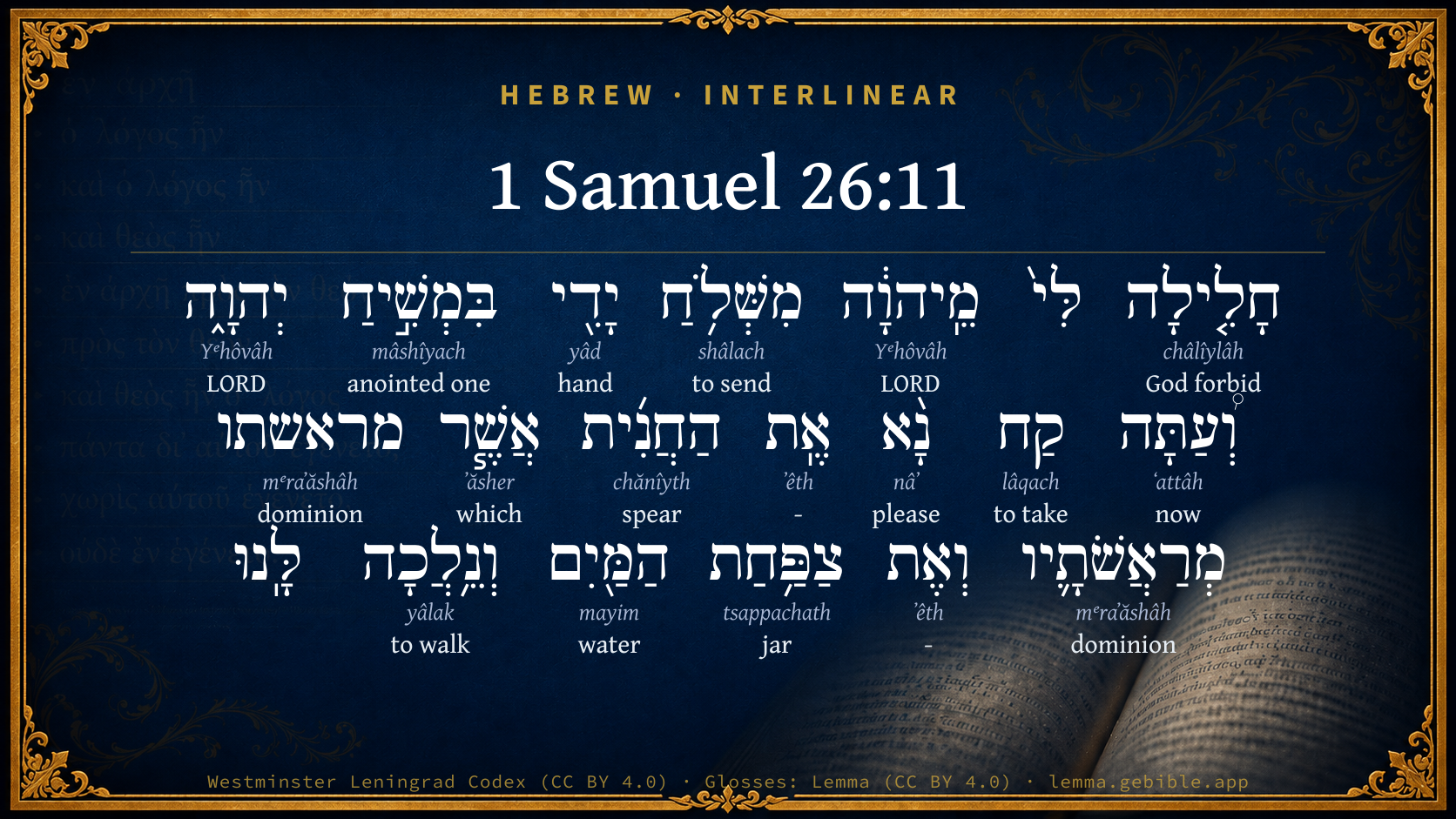
Hebrew (Westminster Leningrad Codex) 1 Samuel 26:11 appears in the Hebrew Old Testament. The text above is from the Westminster Leningrad Codex. Each word links to its Strong’s number, a concise gloss, and parsing drawn from the Open Scriptures Hebrew Bible morphology. Click any word for its full Brown-Driver-Briggs (BDB) entry.
Download image
Cite this verse

1 Samuel 26:11 (World English Bible). Public Domain. Lemma interlinear Bible study tool, https://lemma.gebible.app/v/1-samuel/26/11.

Show BibTeX & RIS
BibTeX
RIS
English Translation
Yahweh forbid that I should put forth my hand against Yahweh's anointed: but now please take the spear that is at his head, and the jar of water, and let us go.
World English Bible · Public Domain
Highlights
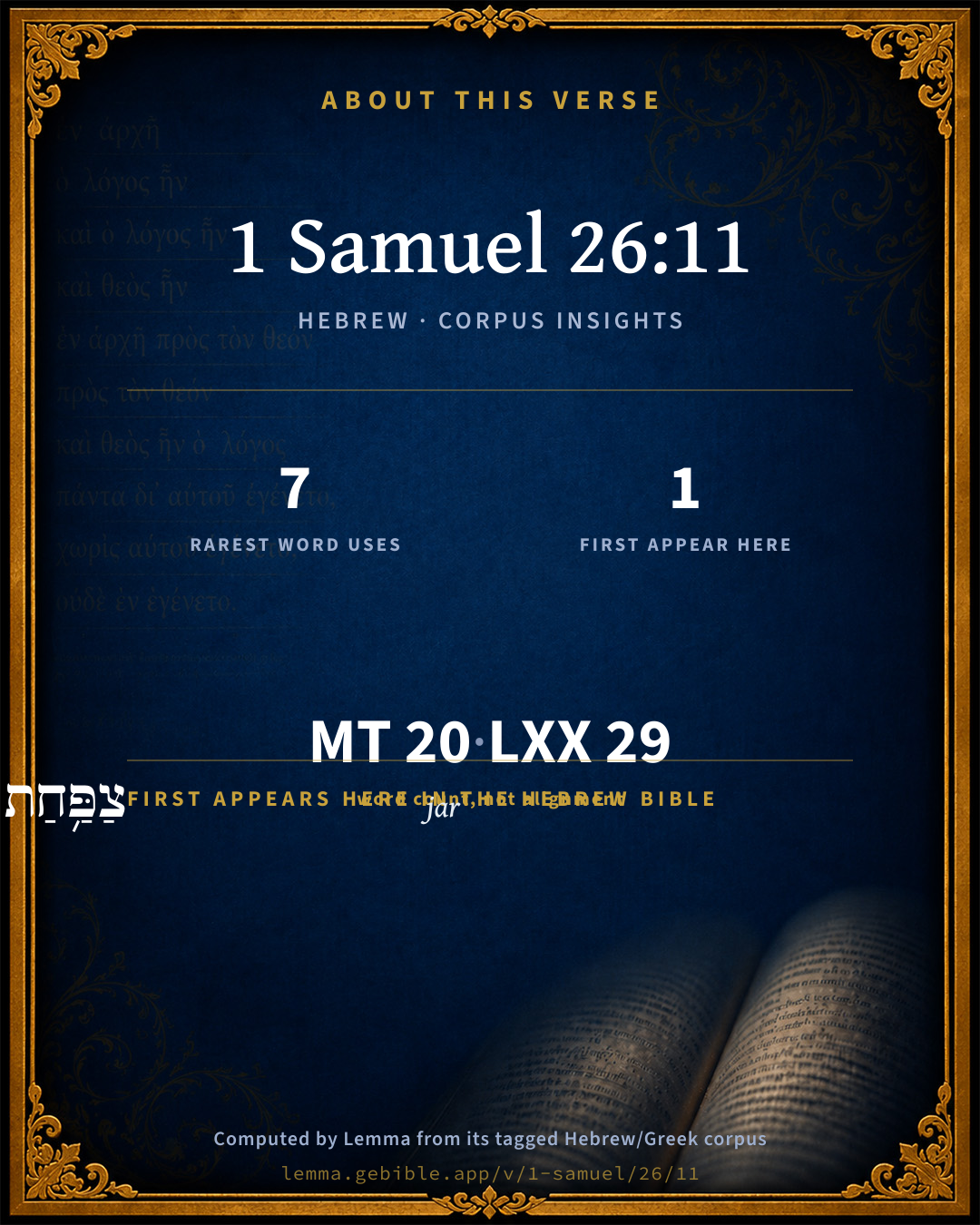
  • 1 first appearance in the Hebrew Bible
Full analysis ↓
Download a study sheet

One document with this verse’s original text, its word-by-word gloss line, the meaning frame, cross-references with their text, attributed commentary, and full source and license credits — printable, and it pastes into notes with its structure intact.

This verse Autodidact and up

Study sheet (.html) Plain text (.txt)

A passage Seminary Student

Up to 50 verses in one chapter. A passage sheet keeps up to 6 commentary sources and 12 cross-references per verse, in the order this page ranks them, and says so on the sheet whenever that leaves anything out. Ask for a single verse and you get the Autodidact verse sheet above.

Everything on this page stays free to read, with no account — the sheet is a download of what is already on screen, not access to it.

Want to remove ads? Support Godless Engineer
Compare translations 3

The same verse in 3 English versions, stacked beneath the original-language interlinear above. Click any original word for its lexicon entry.

Each is an independent rendering of the whole verse — the interlinear is not word-aligned to these translations.

Highlighted words mark where these versions differ — a whole-verse word diff, not a word-by-word alignment.

  • World English Bible Public Domain
    Yahweh forbid that I should put forth my hand against Yahweh's anointed: but now please take the spear that is at his head, and the jar of water, and let us go.
  • King James Version Public Domain
    The LORD forbid that I should stretch forth mine hand against the LORD's anointed: but, I pray thee, take thou now the spear that is at his bolster, and the cruse of water, and let us go.
  • unfoldingWord Literal Text CC BY-SA 4.0
    profane to me from Yahweh to stretch out my hand against the anointed one of Yahweh! And now, please take the spear that by his head and the jug of water, and let us go for ourselves.”

unfoldingWord Literal Text — © unfoldingWord, licensed CC BY-SA 4.0. Word-aligned USFM3 via Door43 (git.door43.org/unfoldingWord/en_ult).

Versions to compare (up to 4)

3 of 4 selected

Show all 18 translations

Every available English version of this verse, each an independent rendering of the whole verse.

  • World English Bible Public Domain
    Yahweh forbid that I should put forth my hand against Yahweh's anointed: but now please take the spear that is at his head, and the jar of water, and let us go.
  • Berean Standard Bible Public Domain
    But the LORD forbid that I should stretch out my hand against the LORD’s anointed. Instead, take the spear and water jug by his head, and let us go.”
  • Majority Standard Bible Public Domain
    But the LORD forbid that I should extend my hand against the LORD’s anointed. Instead, take the spear and water jug by his head, and let us go.”
  • King James Version Public Domain
    The LORD forbid that I should stretch forth mine hand against the LORD's anointed: but, I pray thee, take thou now the spear that is at his bolster, and the cruse of water, and let us go.
  • American Standard Version (1901) Public Domain
    Jehovah forbid that I should put forth my hand against Jehovah's anointed: but now take, I pray thee, the spear that is at his head, and the cruse of water, and let us go.
  • Revised Version (1885) Public Domain
    The LORD forbid that I should put forth mine hand against the LORD’S anointed: but now take, I pray thee, the spear that is at his head, and the cruse of water, and let us go.
  • Geneva Bible (1599) Public Domain
    The Lord keepe mee from laying mine hand vpon the Lordes anointed: but, I pray thee, take now the speare that is at his head, and the pot of water, and let vs goe hence.
  • Douay-Rheims (1899) Public Domain
    The Lord be merciful unto me, that I extend not my hand upon the Lord's anointed. But now take the spear, which is at his head, and the cup of water, and let us go.
  • Young's Literal Translation Public Domain
    far be it from me, by Jehovah, from putting forth my hand against the anointed of Jehovah; and, now, take, I pray thee, the spear which `is' at his pillow, and the cruse of water, and we go away.'
  • Literal Standard Version CC BY-SA 4.0
    far be it from me, by YHWH, from putting forth my hand against the anointed of YHWH; and now, please take the spear which [is] by his pillow, and the jug of water, and we go away.”
  • Unlocked Literal Bible CC BY-SA 4.0
    May Yahweh forbid that I should extend my hand against his anointed one; but now, I beg you, take the spear that is at his head and the jar of water, and let us go.”
  • unfoldingWord Literal Text CC BY-SA 4.0
    profane to me from Yahweh to stretch out my hand against the anointed one of Yahweh! And now, please take the spear that by his head and the jug of water, and let us go for ourselves.”
  • Darby Bible Public Domain
    Jehovah forbid that I should stretch forth my hand against Jehovah's anointed! But now take, I pray thee, the spear that is at his head, and the cruse of water, and let us go.
  • World Messianic Bible Public Domain
    The LORD forbid that I should stretch out my hand against the LORD’s anointed; but now please take the spear that is at his head and the jar of water, and let’s go.”
  • Webster's Bible Public Domain
    The LORD forbid that I should stretch forth my hand against the LORD'S anointed: but, I pray thee, take thou now the spear that is at his bolster, and the cruse of water, and let us go.
  • Free Bible Version CC BY-SA 4.0
    May the Lord prevent me from attacking the Lord's anointed one. Just pick up the spear and water jug beside his head, and let's go.”
  • Bible in Basic English Public Domain
    Never will my hand be stretched out against the man marked with the holy oil; but take the spear which is by his head and the vessel of water, and let us go.
  • JPS Tanakh (1917) Public Domain
    The LORD forbid it me, that I should put forth my hand against the LORD'S anointed; but now take, I pray thee, the spear that is at his head, and the cruse of water and let us go.'

Literal Standard Version (2020), Covenant Press — licensed CC BY-SA 4.0. Text via the HelloAO Bible API (eBible.org). Unlocked Literal Bible (unfoldingWord) — licensed CC BY-SA 4.0. Text via the HelloAO Bible API (eBible.org). unfoldingWord Literal Text — © unfoldingWord, licensed CC BY-SA 4.0. Word-aligned USFM3 via Door43 (git.door43.org/unfoldingWord/en_ult). Free Bible Version, Dr. Jonathan Gallagher — licensed CC BY-SA 4.0. Text via the HelloAO Bible API (eBible.org).

Word by word

More ways to search: Search by grammar → Find every occurrence → Compare this word →

Practice this passage: Drill this verse → Learn its vocabulary →

צַפַּ֥חַת
tsappachath
H6835
“jar of”
Noun, Common, Feminine, Singular, Construct
Part of Speech
Noun
Type
Common
Gender
Feminine
Number
Singular
State
Construct
Full BDB Definition

Origin: from an unused root meaning to expand

TWOT: 1952a

jar, jug (for liquids)
  1. חָלִ֤ילָה châlîylâh H2486 “God forbid · toward” Particle, Interjection + Suffix, Demonstrative
  2. מֵֽיהוָ֔ה Yᵉhôvâh H3068 “from · LORD” Preposition + Noun, Proper
  3. מִשְּׁלֹ֥חַ shâlach H7971 “from · to send” Preposition + Verb, Qal, Infinitive Construct
  4. יָדִ֖י yâd H3027 “hand · my” Noun, Common, Both, Singular, Construct + Suffix, Personal, 1st Person, Common, Singular
  5. בִּמְשִׁ֣יחַ mâshîyach H4899 “in/at · anointed one of” Preposition + Noun, Common, Masculine, Singular, Construct
  6. יְהוָ֑ה Yᵉhôvâh H3068 “LORD” Noun, Proper
  7. וְ֠עַתָּה ʻattâh H6258 “and · now” Conjunction + Adverb
  8. קַח lâqach H3947 “take” Verb, Qal, Imperative, 2nd Person, Masculine, Singular
  9. נָ֨א nâʼ H4994 “please” Particle, Exhortation
  10. אֶֽת ʼêth H853 “-” Particle, Direct Object
  11. הַחֲנִ֜ית chănîyth H2595 “the · spear” Particle, Definite Article + Noun, Common, Feminine, Singular, Absolute
  12. אֲשֶׁ֧ר ʼăsher H834 “which” Particle, Relative
  13. מראשתו mᵉraʼăshâh H4763 “head place · his” Noun, Common, Feminine, Plural, Construct + Suffix, Personal, 3rd Person, Masculine, Singular
  14. מְרַאֲשֹׁתָ֛יו mᵉraʼăshâh H4763 “head place · his” Noun, Common, Feminine, Plural, Construct + Suffix, Personal, 3rd Person, Masculine, Singular
  15. וְאֶת ʼêth H853 “and · -” Conjunction + Particle, Direct Object
  16. הַמַּ֖יִם mayim H4325 “the · water(s)” Particle, Definite Article + Noun, Common, Masculine, Plural, Absolute
  17. וְנֵ֥לֲכָה yâlak H3212 “and · to walk” Conjunction + Verb, Qal, Imperfect, 1st Person, Common, Plural

About this verse

These counts appear in no published source. They are computed here, from the morphology-tagged text and Lemma’s own curated glosses. What Lemma adds →

20
words
15
distinct lemmas
Historical
section

Notable vocabulary

The rarest word here is צַפַּ֥חַת jar H6835 — appearing just 7 times in the whole Hebrew Bible.

First appearance in Scripture

This word makes its first canonical appearance in the Hebrew Bible here:

  • צַפַּ֥חַת jar H6835

Shared distinctive vocabulary

צַפַּ֥חַת jar H6835 occurs in 7 verses of the Hebrew Bible. Also found in:

Grammatical profile

  • 3 verbs
  • 9 nouns
  • 2 prepositions
  • 1 adverb
  • 5 particles

Verb forms

  • מִשְּׁלֹ֥חַ Qal · Infinitive Construct
  • קַח Qal · Imperative
  • וְנֵ֥לֲכָה Qal · Imperfect

Repetition

Words recur within this verse — often emphatic in Hebrew:

  • מֵֽיהוָ֔ה LORD H3068 ×2
  • מראשתו dominion H4763 ×2

Hebrew & Septuagint length

In English translation the verse runs 32 words from the Hebrew and 39 from the Septuagint (LXX English) — closely comparable.

A rough comparison of the two English renderings, which tokenize alike — not a word-level alignment.

Word counts can differ between the Hebrew and the Greek without any difference in meaning — e.g. the Hebrew direct-object marker אֵת has no separate Greek word, and Greek often adds the article ὁ.

In the original languages it is 20 Hebrew tokens and 29 Greek tokens — but the two are counted differently (Hebrew bundles its prefixes and suffixes into one token; the Greek is in lemma form), so that isn’t a like-for-like length.

Cross-references

4

Topical passages linked to 1 Samuel 26:11 in the Treasury of Scripture Knowledge — connected by theme and wording, ordered by reader-vote popularity; previews shown in the World English Bible.

  • 1 Samuel 24:6 He said to his men, Yahweh forbid that I should do this thing to my lord, Yahweh's anointed, to put forth my hand against him, seeing he is Yahweh's anointed.
  • 1 Samuel 24:12 Yahweh judge between me and you, and Yahweh avenge me of you; but my hand shall not be on you.
  • 2 Samuel 1:14 David said to him, How were you not afraid to put forth your hand to destroy Yahweh's anointed?
  • 2 Samuel 1:16 David said to him, Your blood be on your head; for your mouth has testified against you, saying, I have slain Yahweh's anointed.

Cross-references courtesy of OpenBible.info (CC BY 4.0).

Hebrew and Greek witnesses Masoretic Hebrew ↔ Greek Septuagint

The same verse in the two great witnesses to the Old Testament, shown verse-for-verse.

These are two independent witnesses, not word-aligned to each other, and the Septuagint is shown in lemma (dictionary) form.

Hebrew 1 Samuel 26:11 Masoretic · Westminster Leningrad Codex

חָלִ֤ילָה לִּי֙ מֵֽיהוָ֔ה מִשְּׁלֹ֥חַ יָדִ֖י בִּמְשִׁ֣יחַ יְהוָ֑ה וְ֠עַתָּה קַח נָ֨א אֶֽת הַחֲנִ֜ית אֲשֶׁ֧ר מראשתו מְרַאֲשֹׁתָ֛יו וְאֶת צַפַּ֥חַת הַמַּ֖יִם וְנֵ֥לֲכָה לָּֽנוּ

Yahweh forbid that I should put forth my hand against Yahweh's anointed: but now please take the spear that is at his head, and the jar of water, and let us go.

World English Bible · Public Domain

Greek LXX 1 Samuel 26:11 Septuagint · lemma form

μηδαμῶς ἐγώ παρά κύριος ἐπιφέρω χείρ ἐγώ ἐπί χριστός κύριος καί νῦν λαμβάνω δή ὁ δόρυ ἀπό πρός κεφαλή αὐτός καί ὁ φακός ὁ ὕδωρ καί ἀποἔρχομαι κατά ἑαυτοῦ

The Lord forbid it me that I should lift up my hand against the anointed of the Lord: and now take, I pray you, the spear from his bolster, and the pitcher of water, and let us return home.

LXX2012 (modern English Septuagint) · Public Domain

Hebrew: Westminster Leningrad Codex (CC BY 4.0). Greek: Septuagint (public domain); English from LXX2012 (modern English Septuagint) (Public Domain). How the Septuagint differs from the Hebrew →

Targum (Aramaic paraphrase)

1

The Targum is the ancient Jewish Aramaic paraphrase of the Hebrew Scriptures — an interpretive translation, not the Hebrew text itself. Onkelos (literal) and Pseudo-Jonathan (expansive) render the Torah, and Jonathan the Prophets. Coverage is partial: where no permissively-licensed English translation exists for a verse, only the Aramaic is shown. This is verse-level text, not a word-by-word alignment to the Hebrew.

  1. Targum Jonathan Prophets (Joshua–Malachi)
    חָס לִי מִן קֳדָם יְיָ מִלְאוֹשָׁטָא יְדִי בִּמְשִׁיחָא דַייָ וּכְעַן סַב יַת מוּרְנִיתָא דִי אִיסָדוֹהִי וְיַת מָנָא דְמַיָא וְנֵיזִיל לָנָא:

    (no public-domain English translation for this verse)

    Targum Jonathan — Aramaic: “Mikraot Gedolot” (public domain). English: “Sefaria Community Translation” (CC0 1.0 (public-domain dedication)); “London "Chaldee Paraphrase," 1871” (public domain). Text via Sefaria.

Commentary

Notes on 1 Samuel 26:11 from classic Christian and Jewish commentators (each source and its license shown beneath its notes). The classic Christian expositions comment on the surrounding passage and are grouped to its opening verse, so a note may address several verses; the Jewish commentaries on the Tanakh (Rashi and others) are per-verse, so they appear only where the commentator wrote on this verse.

Lemma curates 59 commentaries, every one of them public domain or Creative Commons licensed, each selected and text-cleaned for this edition rather than reprinted as found. About our sources →

Trapp's Complete Commentary

John Trapp

1Sa 26:11 The LORD forbid that I should stretch forth mine hand against the LORD’S anointed: but, I pray thee, take thou now the spear that [is] at his bolster, and the cruse of water, and let us go.

Ver. 11. And the cruse of water.] Clepsydram, the hour glass, as some render it; others understand it of a bottle of rose-water standing there to refresh him. But probably it was a cruse of common water to be used either for drink or for washing. Iudaei etiam in lecto purgantur, saith Clement of Alexandia. {a} The Jews wash by night many times. The Turks also are much in this ceremony.

{a} Strom., lib. iv. cap. 7.

John Trapp, A Commentary or Exposition upon All the Books of the Old and New Testament (1647–1656) — public domain. Text from a community e-Sword module.

Jamieson, Fausset & Brown

Robert Jamieson, A. R. Fausset & David Brown

the spear that is at his bolster, and the cruse of water--The Oriental spear had, and still has, a spike at the lower extremity, intended for the purpose of sticking the spear into the ground when the warrior is at rest. This common custom of Arab sheiks was also the practice of the Hebrew chiefs.

at his bolster--literally, "at his head"; perhaps, Saul as a sovereign had the distinguished luxury of a bolster carried for him. A "cruse of water" is usually, in warm climates, kept near a person's couch, as a drink in the night time is found very refreshing. Saul's cruse would probably be of superior materials, or more richly ornamented than common ones, and therefore by its size or form be easily distinguished.

Jamieson, Fausset & Brown — Commentary Critical and Explanatory on the Whole Bible (1871) — public domain (CC PDM 1.0). Text via the HelloAO Bible API.

Ellicott's Commentary for English Readers

(11) The spear.—The spear was Saul’s especial sign of royalty. “This taking away of the spear from Saul’s head as he slept was an omen of the transfer of his royalty to David.”—Bishop Patrick, quoted by Wordsworth.

And the cruse of water.—“A very ancient usage explains why the cruse of water is here brought into such special prominence. According to this custom, some high dignitary always had in keeping a costly ewer for the king’s necessary ablutions, and it was specially his duty to take it with him, and present it to the king during campaigns or other journeys, so that its disappearance would involve almost as great a disgrace to the king as the loss of his sceptre” (Ewald, in reference to Psa_60:8, states his belief that this custom existed in the time of David).—Ewald, History of Israel, “David,” ii. 3 (Note). The same scholar also writes that “there are many other instances of similar stories, in which the future conqueror and founder of a new dynasty is represented as having received at first some symbol of royalty from his predecessors by accident, as it were, or in sport. Thus Alexander at first takes the royal divining cup from Dârâ as if in sport: a story which in the Shâhnâmeh no longer appears in its original light; and in nothing was the belief in omens so strong as in the high affairs of state.”—“David,” ii. 3 (Note).

A Bible Commentary for English Readers, edited by Charles John Ellicott (1878–1897) — public domain. Text from a community e-Sword module.

The Cambridge Bible for Schools and Colleges

gen. ed. J. J. S. Perowne

11. cruse] A small cup or jar. The word is found in Icelandic, Danish, and other languages, and is probably akin to crock and crucible.

The Cambridge Bible for Schools and Colleges (gen. ed. J. J. S. Perowne; Cambridge University Press, 1878–1918) — public domain. Text from a community e-Sword module.

John Gill's Exposition

The Lord forbid that I should stretch forth mine hand against the Lord's anointed,.... Or suffer any about him to do it; he speaks of it with the utmost detestation and abhorrence:

but, I pray thee, take thou now the spear that is at his bolster; not to smite him with, as he desired, but to carry off, and was no other than his sceptre; See Gill on Sa1 20:33,

and the cruse of water; which stood in the same place, as appears by Sa1 26:12. Some take this to be a pot to make water in; others an hourglass, to know the time of night, in which not sand, but water, flowed for that purpose: but rather this was for his refreshment should he be hot and thirsty in the night, or to purify him from any nocturnal pollution that might happen; for, according to Clemens of Alexandria (m), it was a custom of the Jews often to purify themselves in bed: though Fortunatus Scacchus (n) thinks Saul had this pot or cup for a religious use; which he had with him, and with it gave thanks to God, the author of all good, whenever he sat down to a meal; such as the golden cup Philip king of Macedon always had under his pillow when he slept (o):

and let us go; and do nothing more; which would be sufficient to convince they had been there, and to show what was in their power to do, had they been so inclined.

(m) Stromat. l. 4. p. 531. (n) Elaeochrism. Myrothec. l. I. c. 44. col. 224. (o) Plin. Nat. Hist. l. 33. c. 3.

John Gill's Exposition of the Whole Bible (1746–1763) — public domain (CC PDM 1.0). Text via the HelloAO Bible API.

Matthew Poole's English Annotations

Take thou now the spear, which will show where we have been, and what we could have done.

The cruse of water might be put there, either to wash himself, in case of any accidental pollution, which oft happened in the night; or to refresh him, and quench his thirst in that hot climate and season; or for divers other uses.

Matthew Poole's English Annotations on the Holy Bible (1683–1685) — public domain. Text from a community e-Sword/MySword module.

Whedon's Commentary on the Bible

Daniel D. Whedon

11. The cruse of water — Of which the king might drink if he awoke thirsty. “The cruse of water at Saul’s head.” adds Thomson, “is in exact accordance with the customs of the people at this day. No one ventures to travel over these deserts without his cruse of water, and it is very common to place one at the bolster, so that the owner can reach it during the night.”

Daniel D. Whedon (gen. ed.), Commentary on the Old and New Testaments (1874–1909) — public domain. Text from a community e-Sword module.

John Wesley's Explanatory Notes

Take the spear - Which will shew where we have been, and what we could have done.

John Wesley, Explanatory Notes Upon the Whole Bible (1754–1765) — public domain. Text via the GEBible commentary corpus.

unfoldingWord translationNotes

Door43 World Missions Community

extend my hand against

The hand is a metonym for the harm a hand can do. AT: "do anything to harm" (See: Metonymy)

let us go

David includes Abishai, so the word "us" here is inclusive. (See: Inclusive "We")

a deep sleep from Yahweh had fallen on them

Yahweh had caused them to sleep deeply.

translationWords

Yahweh

hand

anoint

spear

David

Saul (OT)

asleep

unfoldingWord translationNotes — © Distant Shores Media and the Door43 World Missions Community, licensed CC BY-SA 4.0. Source: git.door43.org/Door43/en_tn.

Rashi

Rabbi Shlomo Yitzchaki (Rashi)

Flask. Jug.

Rashi on the Tanakh — English translations: “The Judaica Press complete Tanach with Rashi, translated by A. J. Rosenberg” (CC BY 4.0); “Pentateuch with Rashi's commentary by M. Rosenbaum and A.M. Silbermann, 1929-1934” (public domain); “The Metsudah Tanach series, Lakewood, N.J” (CC BY 4.0); and “The Book of Joshua, Metsudah Publications, 1997” (CC BY 4.0). Text via Sefaria.

Lesson kit

Teaching starters — assembled from the data on this page, not authored interpretation. Every prompt links to the verse data it draws on. Edit before teaching.

1 Samuel, in the Historical, opens this verse with 20 words (15 distinct Hebrew lemmas). Its most distinctive word is tsappachath (“jar”). A historical commentator’s framing appears above. Read the whole chapter for the surrounding context.

Discussion questions

  1. The word tsappachath carries the sense “jar.” How does it shape the verse?
  2. The word “jar” first appears here in Scripture. What is being introduced at this debut?
  3. 1 Samuel 26:12 shares the word «jar» with this verse. How do the two illuminate each other?
  4. “LORD” occurs 2× in this one verse. What is the effect of the repetition?
  5. These translations render this verse differently; the difference is in the English rendering, not the original. What questions does that raise?
  6. The verb «מִשְּׁלֹ֥חַ» is Qal Infinitive Construct. How does its form color the action?
  7. Reading how Trapp's Complete Commentary and Jamieson, Fausset & Brown read this verse, where do the two commentators agree and where do they part?

Things to notice

Reading settings

Reading text

Shown beneath each verse's original-language words.

Old Testament
Old Testament edition

Read the OT as the Masoretic Hebrew (MT) or the Greek Septuagint (LXX).

English shown for the Greek Septuagint (in the Hebrew ↔ Greek comparison).

Comparing translations? Open the Compare panel on any verse page to stack up to four side by side.