
Luke 22:66

Greek (Tischendorf 8th ed.) Luke 22:66 appears in the Greek New Testament. The text above is from the Tischendorf 8th edition. Each word links to its Strong’s number and a concise gloss. Click any word for its full Thayer’s Greek Lexicon entry.
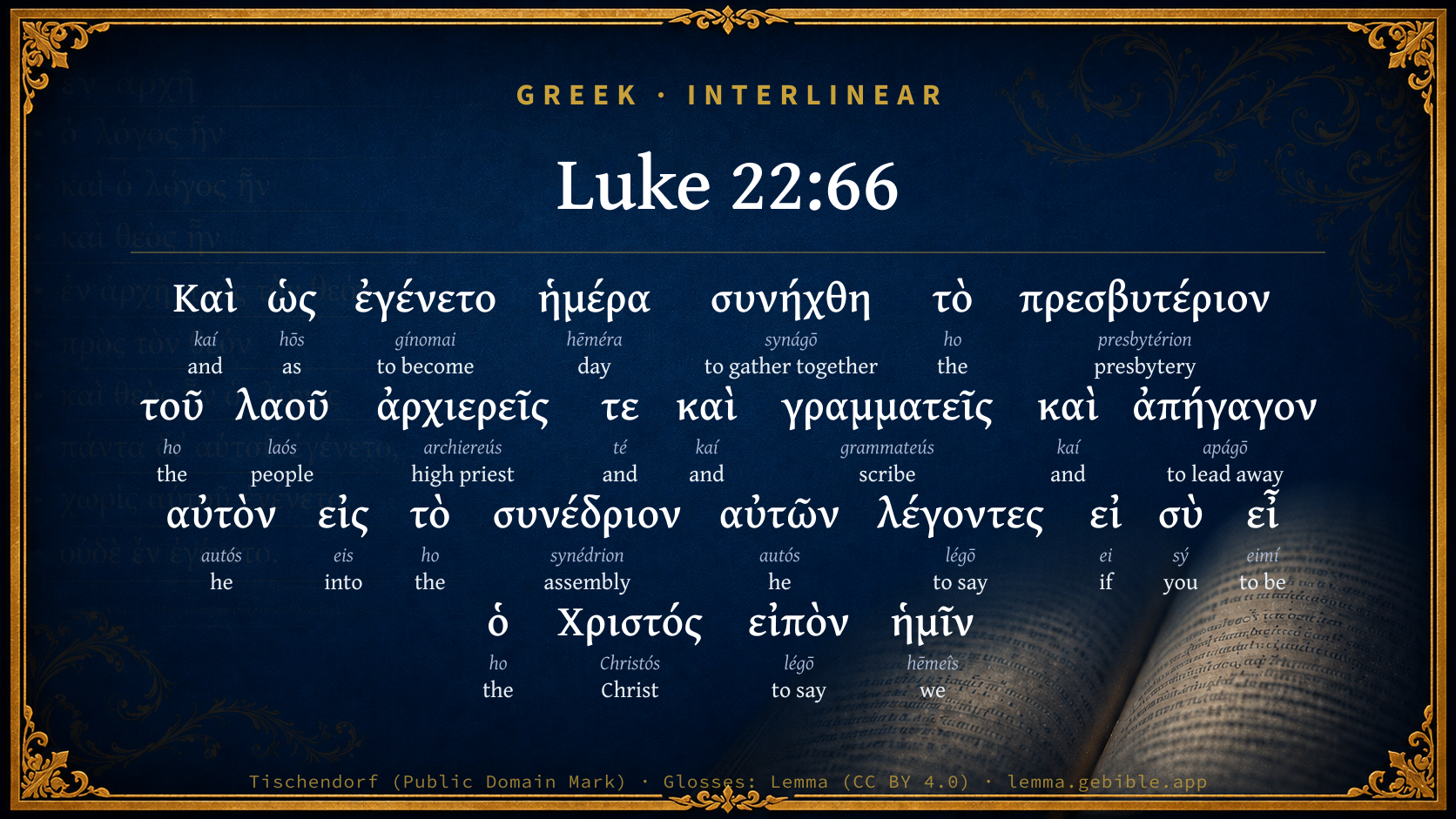
Download image
Cite this verse

Luke 22:66 (World English Bible). Public Domain. Lemma interlinear Bible study tool, https://lemma.gebible.app/v/luke/22/66.

Show BibTeX & RIS
BibTeX
RIS
English Translation
As soon as it was day, the assembly of the elders of the people was gathered together, both chief priests and scribes, and they led him away into their council, saying,
World English Bible · Public Domain
Highlights
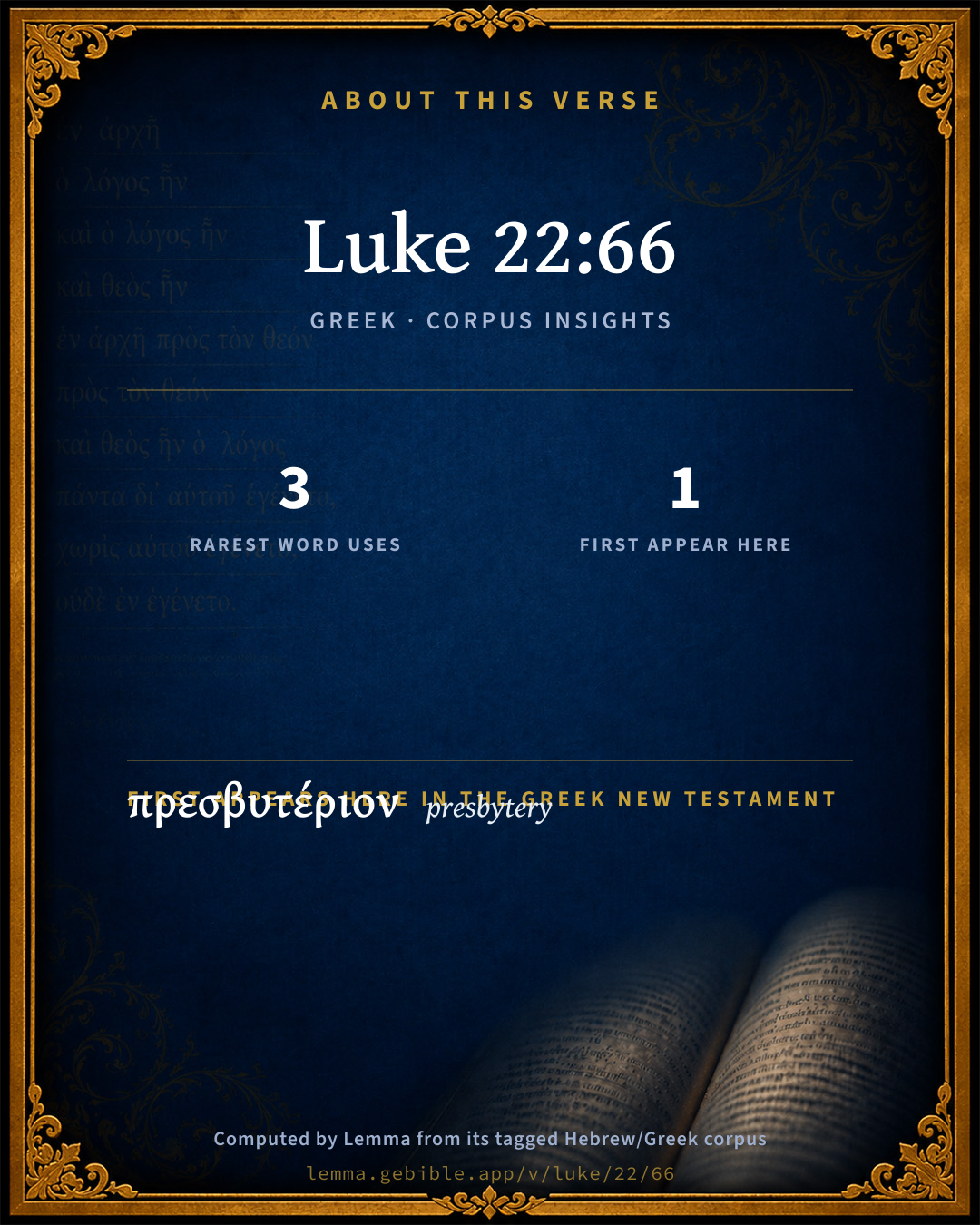
  • 1 first appearance in the Greek New Testament
Full analysis ↓
Download a study sheet

One document with this verse’s original text, its word-by-word gloss line, the meaning frame, cross-references with their text, attributed commentary, and full source and license credits — printable, and it pastes into notes with its structure intact.

This verse Autodidact and up

Study sheet (.html) Plain text (.txt)

A passage Seminary Student

Up to 50 verses in one chapter. A passage sheet keeps up to 6 commentary sources and 12 cross-references per verse, in the order this page ranks them, and says so on the sheet whenever that leaves anything out. Ask for a single verse and you get the Autodidact verse sheet above.

Everything on this page stays free to read, with no account — the sheet is a download of what is already on screen, not access to it.

Want to remove ads? Support Godless Engineer
Compare translations 3

The same verse in 3 English versions, stacked beneath the original-language interlinear above. Click any original word for its lexicon entry.

Each is an independent rendering of the whole verse — the interlinear is not word-aligned to these translations.

Highlighted words mark where these versions differ — a whole-verse word diff, not a word-by-word alignment.

  • World English Bible Public Domain
    As soon as it was day, the assembly of the elders of the people was gathered together, both chief priests and scribes, and they led him away into their council, saying,
  • King James Version Public Domain
    And as soon as it was day, the elders of the people and the chief priests and the scribes came together, and led him into their council, saying,
  • unfoldingWord Literal Text CC BY-SA 4.0
    And when it became day, the elders of the people gathered together, both chief priests and scribes, and they led him into their Sanhedrin,

unfoldingWord Literal Text — © unfoldingWord, licensed CC BY-SA 4.0. Word-aligned USFM3 via Door43 (git.door43.org/unfoldingWord/en_ult).

Versions to compare (up to 4)

3 of 4 selected

Show all 19 translations

Every available English version of this verse, each an independent rendering of the whole verse.

  • World English Bible Public Domain
    As soon as it was day, the assembly of the elders of the people was gathered together, both chief priests and scribes, and they led him away into their council, saying,
  • Berean Standard Bible Public Domain
    At daybreak the council of the elders of the people, both the chief priests and scribes, met together. They led Jesus into their Sanhedrin and said,
  • Majority Standard Bible Public Domain
    At daybreak the council of the elders of the people, both the chief priests and scribes, met together. They led Jesus into their Sanhedrin and said,
  • King James Version Public Domain
    And as soon as it was day, the elders of the people and the chief priests and the scribes came together, and led him into their council, saying,
  • American Standard Version (1901) Public Domain
    And as soon as it was day, the assembly of the elders of the people was gathered together, both chief priests and scribes; and they led him away into their council, saying,
  • Revised Version (1885) Public Domain
    And as soon as it was day, the assembly of the elders of the people was gathered together, both chief priests and scribes; and they led him away into their council, saying,
  • Geneva Bible (1599) Public Domain
    And assoone as it was day, the Elders of the people, and the hie Priests and the Scribes came together, and led him into their councill,
  • Douay-Rheims (1899) Public Domain
    And as soon as it was day, the ancients of the people, and the chief priests and scribes, cane together; and they brought him into their council, saying: If thou be the Christ, tell us.
  • Young's Literal Translation Public Domain
    And when it became day there was gathered together the eldership of the people, chief priests also, and scribes, and they led him up to their own sanhedrim,
  • Literal Standard Version CC BY-SA 4.0
    And when it became day there was gathered together the eldership of the people, chief priests also, and scribes, and they led Him up to their own Sanhedrin,
  • Unlocked Literal Bible CC BY-SA 4.0
    As soon as it was day, the elders of the people gathered together, both chief priests and scribes. They led him into the council
  • unfoldingWord Literal Text CC BY-SA 4.0
    And when it became day, the elders of the people gathered together, both chief priests and scribes, and they led him into their Sanhedrin,
  • Darby Bible Public Domain
    And when it was day, the elderhood of the people, both [the] chief priests and scribes, were gathered together, and led him into their council, saying,
  • World Messianic Bible Public Domain
    As soon as it was day, the assembly of the elders of the people were gathered together, both chief priests and scribes, and they led him away into their council, saying,
  • Webster's Bible Public Domain
    And as soon as it was day, the elders of the people, and the chief priests, and the scribes came together, and led him into their council,
  • Free Bible Version CC BY-SA 4.0
    Early in the morning the council of elders gathered together with the chief priests and religious teachers. Jesus was led before the council.
  • Bible in Basic English Public Domain
    And when it was day, the rulers of the people came together, with the chief priests and the scribes, and they took him before their Sanhedrin, saying,
  • Text-Critical English NT CC BY 4.0
    When daybreak came, the elders of the people gathered together, both chief priests and scribes, and they led Jesus up to their Sanhedrin and said,
  • Tyndale New Testament (1534) Public Domain
    And assone as it was daye the elders of the people and the hye prestes and scribes came to gedder and ledde him into their counsell sayinge:

Literal Standard Version (2020), Covenant Press — licensed CC BY-SA 4.0. Text via the HelloAO Bible API (eBible.org). Unlocked Literal Bible (unfoldingWord) — licensed CC BY-SA 4.0. Text via the HelloAO Bible API (eBible.org). unfoldingWord Literal Text — © unfoldingWord, licensed CC BY-SA 4.0. Word-aligned USFM3 via Door43 (git.door43.org/unfoldingWord/en_ult). Free Bible Version, Dr. Jonathan Gallagher — licensed CC BY-SA 4.0. Text via the HelloAO Bible API (eBible.org).

Word by word

More ways to search: Search by grammar → Find every occurrence → Compare this word →

Practice this passage: Drill this verse → Learn its vocabulary →

πρεσβυτέριον
presbytérion
G4244
“presbytery”
Noun, Nominative, Singular, Neuter
Part of Speech
Noun
Case
Nominative
Number
Singular
Gender
Neuter
Full Thayer's Definition

Origin: from a presumed derivative of G4245

TDNT: 16:51,9

1. body of elders, presbytery, senate, council a. of the Jewish elders b. of the elders of any body (assembly) of Christians
  1. Καὶ kaí G2532 “and” Conjunction
  2. ὡς hōs G5613 “as” Adverb
  3. ἐγένετο gínomai G1096 “to become” Verb, Aorist, Middle deponent, Indicative, 3rd person, Singular
  4. ἡμέρα hēméra G2250 “day” Noun, Nominative, Singular, Feminine
  5. συνήχθη synágō G4863 “to gather together” Verb, Aorist, Passive, Indicative, 3rd person, Singular
  6. τὸ ho G3588 “the” Article, Nominative, Singular, Neuter
  7. τοῦ ho G3588 “the” Article, Genitive, Singular, Masculine
  8. λαοῦ laós G2992 “people” Noun, Genitive, Singular, Masculine
  9. ἀρχιερεῖς archiereús G749 “high priest” Noun, Nominative, Plural, Masculine
  10. τε té G5037 “and” Particle
  11. καὶ kaí G2532 “and” Conjunction
  12. γραμματεῖς grammateús G1122 “scribe” Noun, Nominative, Plural, Masculine
  13. καὶ kaí G2532 “and” Conjunction
  14. ἀπήγαγον apágō G520 “to lead away” Verb, Aorist, Active, Indicative, 3rd person, Plural
  15. αὐτὸν autós G846 “he” Personal pronoun, Accusative, Singular, Masculine
  16. εἰς eis G1519 “into” Preposition
  17. τὸ ho G3588 “the” Article, Accusative, Singular, Neuter
  18. συνέδριον synédrion G4892 “assembly” Noun, Accusative, Singular, Neuter
  19. αὐτῶν autós G846 “he” Personal pronoun, Genitive, Plural, Masculine
  20. λέγοντες légō G3004 “to say” Verb, Present, Active, Participle, Nominative, Plural, Masculine
  21. εἰ ei G1487 “if” Conditional
  22. σὺ sý G4771 “you” Personal pronoun, 2nd person, Nominative, Singular
  23. εἶ eimí G1510 “to be” Verb, Present, Active, Indicative, 2nd person, Singular
  24. ὁ ho G3588 “the” Article, Nominative, Singular, Masculine
  25. Χριστός Christós G5547 “Christ” Noun, Nominative, Singular, Masculine
  26. εἰπὸν légō G3004 “to say” Verb, Aorist, Active, Imperative, 2nd person, Singular
  27. ἡμῖν hēmeîs G2249 “we” Personal pronoun, 1st person, Dative, Plural

About this verse

These counts appear in no published source. They are computed here, from the morphology-tagged text and Lemma’s own curated glosses. What Lemma adds →

28
words
21
distinct lemmas
Gospels
section

Notable vocabulary

The rarest word here is πρεσβυτέριον presbytery G4244 — appearing just 3 times in the whole Greek New Testament.

First appearance in Scripture

This word makes its first canonical appearance in the Greek New Testament here:

  • πρεσβυτέριον presbytery G4244

Shared distinctive vocabulary

πρεσβυτέριον presbytery G4244 occurs in 3 verses of the Greek New Testament. Also found in:
Repetition

Words recur within this verse:

  • λέγοντες to say G3004 ×2
  • τὸ the G3588 ×4
  • Καὶ and G2532 ×3
  • αὐτὸν he G846 ×2

Cross-references

7

Topical passages linked to Luke 22:66 in the Treasury of Scripture Knowledge — connected by theme and wording, ordered by reader-vote popularity; previews shown in the World English Bible.

  • Matthew 27:1 Now when morning had come, all the chief priests and the elders of the people took counsel against Jesus to put him to death:
  • Mark 15:1 Immediately in the morning the chief priests, with the elders and scribes, and the whole council, held a consultation, and bound Jesus, and carried him away, and delivered him up to Pilate.
  • Acts 22:5 As also the high priest and all the council of the elders testify, from whom also I received letters to the brothers, and traveled to Damascus to bring them also who were there to Jerusalem in bonds to be punished.
  • Matthew 5:22 But I tell you, that everyone who is angry with his brother without a cause shall be in danger of the judgment; and whoever shall say to his brother, 'Raca!' shall be in danger of the council; and whoever shall say, 'You fool!' shall be in danger of the fire of Gehenna.
  • Acts 4:25–28 who by the mouth of your servant, David, said, 'Why do the nations rage, And the peoples plot a vain thing?
  • John 18:28 They led Jesus therefore from Caiaphas into the Praetorium. It was early, and they themselves didn't enter into the Praetorium, that they might not be defiled, but might eat the Passover.
  • Psalms 2:1–3 Why do the nations rage, And the peoples plot a vain thing?

Cross-references courtesy of OpenBible.info (CC BY 4.0).

Commentary

Notes on Luke 22:66 from classic Christian and Jewish commentators (each source and its license shown beneath its notes). The classic Christian expositions comment on the surrounding passage and are grouped to its opening verse, so a note may address several verses; the Jewish commentaries on the Tanakh (Rashi and others) are per-verse, so they appear only where the commentator wrote on this verse.

Lemma curates 59 commentaries, every one of them public domain or Creative Commons licensed, each selected and text-cleaned for this edition rather than reprinted as found. About our sources →

Joseph Benson's Commentary

Luk 22:66-71. And as soon as it was day, the elders of the people, and the chief-priests, &c., came together — When the band of soldiers arrived at the high-priest’s with Jesus, they found many of the chief-priests, and the scribes, and the elders assembled there. (Mar 14:53.) Some persons of distinction, however, may have been absent, whose coming the rest would wait for. Wherefore, although the soldiers brought Jesus to the high- priest’s a while after midnight, his trial did not begin till about three in the morning: the intermediate time being spent in procuring witnesses, in sending for the absent members, in gathering the clerks and officers of the court, and in fitting up an apartment for the trial. For, that Jesus was tried by the council, not in the temple, as many suppose, but in the high-priest’s palace, is evident from Joh 18:28, where we are expressly told, that they led Jesus from Caiaphas’s house to the pretorium. Saying, Art thou the Christ? tell us — Dost thou give up the pretensions thou hast formerly made, or dost thou maintain them? If thou art indeed the Messiah, tell us plainly, and it will bring matters to a short issue. It seems, these wretches hoped to gain a great advantage against Jesus either way; if he confessed it, they would condemn him on that confession; and if he denied it, they would expose him on that denial, as afraid to maintain the pretensions he had made. And he said, If I tell you — That I am the Christ, and give you the most convincing proofs of it, you are resolved that you will not believe. And if I ask you — What you have to object against the proofs I produce; you will not answer me — Here he seems to refer to their silence, when he put a question to them which would have led them to his own authority, Luk 20:5-7. Nor let me go — If I be not the Christ, you ought to answer the arguments by which I prove that I am; if I be, you ought to let me go; but you will do neither: you will only overbear me with renewed violence. Hereafter shall the Son of man sit, &c. — The day will come, when ye shall see the Son of man, who now stands in this despised and lowly form at your tribunal, exalted to all the dignity and glory which that high title imports; sitting on the right hand of the power of God — And coming with irresistible strength to take vengeance on the proudest of his enemies. See on Mat 26:59-64; and Mar 14:53-65. Then said they all, Art thou then the Son of God? — A number of them cried out together, feigning great astonishment at the blasphemy, as they were pleased to call it, of his answer, and desiring him to repeat it, lest they might have mistaken him, asked, Art thou then the Son of God? — Both these, the Son of God, and the Son of man, were known titles of the Messiah, the one taken from his divine, and the other from his human, nature. And he said unto them, Ye say that I am — This, according to the Jewish manner of speaking, was a plain and strong affirmation of the thing expressed. When the high-priest heard our Lord’s second reply, he solemnly rent his clothes, crying out, that he had spoken blasphemy; and, appealing to the council, he said, What need we any further witness? (Luk 22:71.) And they said, What need we, &c. — The council replied, As you have justly observed, what need have we of witnesses now, seeing we ourselves have heard in what manner he hath blasphemed? And being asked what punishment he deserved, they answered, that he deserved death. Mat 26:26; Mat 26:66.

Joseph Benson's Commentary on the Old and New Testaments (1811–1818) — public domain. Text from a community e-Sword module.

Tyndale Open Study Notes

Tyndale Open Resources

22:66 At daybreak: It was Friday morning (see study note on 22:34). • all the elders of the people assembled: The Jewish high council (Greek Sanhedrin) was originally made up of the Jerusalem nobility, both civil leaders and priests, with the high priest as its head. In Jesus’ time, the Sadducees still controlled the Sanhedrin (Acts 5:17), though leading Pharisees had also gained a prominent place on the council (Acts 23:7).

Tyndale Open Study Notes — © Tyndale Open Resources, licensed CC BY-SA 4.0. Text via the HelloAO Bible API.

Meyer's Critical & Exegetical Commentary

Heinrich August Wilhelm Meyer

Luk_22:66-67. According to Luke, the Sanhedrim now first comes together after daybreak, and Jesus is led in for trial. Where it assembled Luke does not say, and there is nothing therefore opposed to our finding in this place the leading away from the court of Annas (see on Luk_22:54) into the house of Caiaphas (Joh_18:24). The trial itself, as to its matter, is plainly the same which Matthewalthough immediately after the bringing in of Jesusmakes to be held in the house of Caiaphas. See Mat_26:59 ff. Luke relates the matter and proceedings in a merely summary and imperfect manner.

τὸ πρεσβυτέριον κ.τ.λ.] the elders of the people, (the) chief priests, and scribes. These are the three constituent elements of the Sanhedrim. Comp. Luk_9:22, Luk_20:1. On πρεσβυτέριον, denoting the elders as a corporation, comp. Act_22:5. By the non-repetition of the article the three parts are bound into a unity, in respect of which the difference of the gender and number is no difficulty (comp. Plato, Pol. vi. p. 501 D: τοῦ ὄντος τε καὶ ἀληθείας ἐραστάς; Soph. Oed. C. 850: πατρίδα τε τὴν σὴν καὶ φίλους), especially in respect of the collective nature of πρεσβυτέριον. See in general, Krüger, § 58. 2. 1; Winer, p. 115 f. [E. T. 157 f.].

ἀνήγαγον] The subject is the assembled members of the Sanhedrim who had caused Him to be brought up. ἀνα indicates a locality situated higher, as contrasted with the court of Annas, in which locality the Sanhedrim were met.

εἰς τὸ συνέδρ. ἑαυτῶν] into their own concessus, into their own council gathering, in order now themselves to proceed further with Him. Comp. the use of συνέδριον of the Amphictyonic council, also of the Roman and the Carthaginian Senate (Polyb. xl. 6. 6, i. 11. 1, 31. 8).

Luk_22:67. εἰ σὺ κ.τ.λ.] may mean: If thou art the Messiah, tell us (Vulgate, Luther, and most commentators), or: Tell us whether thou art the Messiah (Castalio, Bornemann, Ewald, and others), or: Is it the case that thou art the Messiah? Tell us (Erasmus). The first is the simplest, and corresponds to the purpose of framing the question so as to elicit an affirmative answer.

Meyer — Critical and Exegetical Commentary on the New Testament — English translation by Peter Christie, edited by Frederick Crombie (T&T Clark, 1880) — public domain. Text from a community e-Sword module.

Expositor's Greek Testament

ed. W. Robertson Nicoll

Luk 22:66-71 . Morning trial , the proceedings of which, as reported by Lk., correspond to those of the night meeting reported by Mt. and Mk. (Mat 26:59-66 , Mar 14:55-64 ), only much abridged. No mention of the attempt to get, through witnesses, matter for an accusation, or of the testimony concerning the word about destroying the temple. The Messiah question is alone noticed. Perhaps Lk. omitted the former because of their futility, though they were important as revealing the animus of the judges.

Luk 22:66 . εἰς τὸ συνέδριον , to the council chamber, in which the Sanhedrim met. λέγοντες , introducing the proceedings, in a very generalising way. Cf. the graphic account of the high priest rising up to interrogate Jesus, after the first attempt to incriminate Him had failed, in parallels (Mat 26:62 f., Mar 14:60 f.).

The Expositor's Greek Testament, edited by W. Robertson Nicoll (1897–1910) — public domain. Text from a community e-Sword module.

Godet's Commentaries

Frédéric Louis Godet

(3.) Luk 22:66-71. The Morning Sitting.

It is impossible to determine to what extent the Sanhedrim required to repeat in their morning sitting what had passed in the night one. But we are justified in allowing that some details of the one were applied to the other by tradition and by our evangelists. There was nothing in itself blasphemous in one calling himself the Christ. This claim, even if it was false, was not an outrage on the honour of God. If the assertions of Jesus regarding His person appeared in the judgment of the Jews to be blasphemy, it was because in His mouth the title Son of God always signified something else and something more than that of Messiah, and because the latter was in His lips only a corollary from the former. In proportion to the care with which Jesus in His ministry had avoided making His Messiahship the subject of His public declarations, He had pointedly designated Himself as the Son of God. Hence, in the sitting described by Matthew and Mark, the high priest, when putting to Him the question: “Art thou the Christ?” takes care to add: “the Son of God?” well knowing that the first assertion cannot be the foundation of a capital charge, unless it be again completed and explained as it had always been in the teaching of Jesus by the second. The question of Luk 22:67, in Luke, was simply, on the part of the high priest, the introduction to the examination (comp. Luk 22:70). But Jesus, wishing to hasten a decision which He knew to be already taken, boldly and spontaneously passes in His answer beyond the strict contents of the question, and declares Himself not only the Messiah, but at the same time the Son of man sharing the divine glory. The particle εἰ (Luk 22:67) may be taken interrogatively: “Art thou the Christ? Tell us so in that case.” But it is more natural to make it directly dependent on εἶπε: “Tell us if thou art...”

De Wette has criticised the answer here ascribed to Jesus (Luk 22:67-68). The second alternative: If I ask you, appears to him out of place in the mouth of an accused person. It is not so. Here is the position, as brought out by the answer of Jesus: “I cannot address you either as judges whom I am seeking to convince, for you are already determined to put no faith in my declarations, nor as disciples whom I am endeavouring to instruct, for you would not enter into a fair discussion with me.” Had he not questioned them once and again previously on the origin of John’s baptism, and on the meaning of Psalms 110? And they had steadily maintained a prudent silence! Jesus foresees the same result, if He should now enter into discussion with them.

The last words: ἢ ἀπολύσητε, nor let me go, are perplexing, because, while grammatically connected with the second alternative, they refer in sense to both. Either, with the Alex., they must be rejected, or they must be taken as a climax: “Nor far less still will ye let me go.”

Ver. 69. Jesus Himself thus furnishes the Jews with the hold which they seek. The name Son of man, which He uses as most directly connected with that of Christ (Luk 22:67), is qualified by a description implying that He who bears this title participates in the divine state.

Thereby the trial became singularly shortened. There was no occasion searchingly to examine the right of Jesus to the title of Christ. The claim to divine glory contained in this assertion of Jesus is immediately formulated by the tribunal in the title Son of God. It only remains to have the blasphemy articulately stated by the culprit Himself. Hence the collective question, Luk 22:70.

The form: ye say that I am, thou sayest it, is not used in Greek; but it is frequently used in Rabbinical language. By such an answer the party accepts, as His own affirmation, the whole contents of the question put to Him.

So far, therefore, from this question proving, as is persistently affirmed, that the name Son of God is equivalent in the view of the Jews, or in that of Jesus, to the name Christ, the evident progress from the question of Luk 22:67 to that of Luk 22:70, brought about by the decided answer of Jesus, Luk 22:69, clearly proves the difference between the two terms. As to the difference between the night sitting and that of the morning, it was not considerable. In the second, the steps were only more summary, and led more quickly to the end. All that was necessary was to ratify officially what had been done during the night. As Keim says, “the Sanhedrim had not to discuss; they had merely to approve and confirm the decision come to overnight.”

In the opinion of those who allege that Jesus was crucified on the afternoon of the 15th, and not of the 14th, the arrest of Jesus, and the three judicial sessions which followed, took place in the night between the 14th and 15th, and so on the sabbatic holy day. Is that admissible? Langen remarks that on the 15th Nisan food might be prepared, which was forbidden on a Sabbath (Exo 12:16). But there is no proof that this exception extended to other acts of ordinary life (arrests, judgments, punishments, etc.). He seeks, further, to prove that what was forbidden on a sabbatic day was not to pronounce a sentence, but merely to write and execute it. Now, he says, there is no proof that the sentence of Jesus was written; and it was Roman soldiers, not subject to the law, by whom it was executed. These replies are ingenious; but after all, the objection taken from the general sabbatic character of the 15th Nisan remains in all its force.

Frédéric Louis Godet — Commentaries on Luke, John, Romans, and 1 Corinthians — English translation (T&T Clark, Edinburgh, 1870s–1890s) — public domain. Text from a community e-Sword module.

Geneva Bible (1599)

Geneva Bible translators

Christ is wrongfully condemned of blasphemy before the high Priest’s judgment seat, that we might be quit before God from the blasphemy which we deserved.

Geneva Bible (1599) marginal notes — public domain. Text via Bolls.life.

Ellicott's Commentary for English Readers

(66-71) And as soon as it was day.—See Notes on Mat_27:11-14; Mar_15:2-5. The special mention of the hour, though agreeing with what is implied in the other Gospels, is peculiar to St. Luke.

The elders of the people.—Literally, the presbytery of the people. St. Luke uses here, and in Act_22:5, the collective singular noun, instead of the masculine plural. St. Paul uses it of the assembly of the elders of the Church, in 1Ti_4:14.

A Bible Commentary for English Readers, edited by Charles John Ellicott (1878–1897) — public domain. Text from a community e-Sword module.

The Cambridge Bible for Schools and Colleges

gen. ed. J. J. S. Perowne

66-71. The third Jewish Trial.

66. as soon as it was day] The Oral Law decided that the Sanhedrin could only meet by daylight.

elders of the people] Literally, “the presbytery of the people,” as in Act_22:5.

elders...chief priests...scribes] See Mar_15:1. The three constituent parts of the Sanhedrin, 1Ma_14:28. The Sanhedrin was the successor of the Great Synagogue, which ended with Simon the Just. Where they met is uncertain. It was either in the Paved Hall, or ‘Hall of Squares’ (Lisehath haggazzith); or in the Beth Midrash (Temple Synagogue), a chamber which abutted on the “middle wall of partition” (Chet), or in the Chanujoth ‘shops’ or ‘booths’ founded by the house of Hanan to sell doves, &c. for the temple.

their council] Synedrion, from which the word Sanhedrin (mistakenly spelt Sanhedrim) is derived. The word is first found on the occasion when they summoned before them Hyrcanus II., son of Alexander Jannaeus. It gloried in being a mild tribunal, but was now an extremely degenerate body, and unworthy of its earlier traditions (Jos. Antt. xiii. 10, § 6; B. J. ii. 8, § 14). The Jewish authorities had lost the power of inflicting death; they could only pass sentence of excommunication, and hand over to the secular arm.

The Cambridge Bible for Schools and Colleges (gen. ed. J. J. S. Perowne; Cambridge University Press, 1878–1918) — public domain. Text from a community e-Sword module.

John Gill's Exposition

Hereafter shall the son of man,.... Meaning himself, who was truly man, and then in a low and mean form, and thought by the Jews to be a mere man; though this character was known by them to belong to the Messiah, especially what follows; as that he should

sit on the right hand of the power of God: as he did after his resurrection, and ascension, and which was manifest by the destruction of their nation, city, and temple; See Gill on Mat 27:64.

John Gill's Exposition of the Whole Bible (1746–1763) — public domain (CC PDM 1.0). Text via the HelloAO Bible API.

Trapp's Complete Commentary

John Trapp

66 And as soon as it was day, the elders of the people and the chief priests and the scribes came together, and led him into their council, saying,

Ver. 66. See Mat 27:1.

John Trapp, A Commentary or Exposition upon All the Books of the Old and New Testament (1647–1656) — public domain. Text from a community e-Sword module.

Matthew Poole's English Annotations

Our blessed Lord before his death passed two trials or examinations. The one before the Jewish sanhedrim, whose proper province it was to try such as were accused as false prophets, or blasphemers. This was a kind of ecclesiastical court. The high priest was the chief judge in it, and we are told that they used to sit in his palace. The other was before Pilate, the Roman governor of Judea at that time; he principally took cognizance of criminal things, such especially as concerned the peace of the country, considered as a part of the Roman empire. These verses give an account only of the former. Blasphemy was the crime they charged upon him. We cannot from any one evangelist have a full account of either of them.

See Poole on "Mat 26:57" and following verses to Mat 26:68, when have fully considered what all the evangelists say.

Matthew Poole's English Annotations on the Holy Bible (1683–1685) — public domain. Text from a community e-Sword/MySword module.

The Pulpit Commentary

Vers. 66-71. The third trial before the Sanhedrin.

And as soon as it was day. The Sanhedrin as a council could only meet by day; all the preliminaries had been settled and the course of procedure fully arranged when the legal time for the meeting of the state council arrived. The elders of the people and the chief priests and the scribes earns together, and led him into their council. These were the three constitutional parts of the Sanhedrin. The name of the famous Sanhedrin, curiously enough, is a Greek, not a Hebrew or Aramaic word, being derived from sunedrion , an assembly. We first come on the word, says Dr. Farrar, when this state council summoned before them Hyrcanus II, son of Alexander Jannaeus. In the time of our Lord, the Roman government had taken from them the power of carrying out capital sentences; hence their bringing Jesus before Pilate. There is a remarkable tradition that the council left their proper place of assembly, Gazith, and sat in another chamber (forty years before the destruction of the temple). Now, it was forbidden to condemn to death except in Gazith (see "Avoda Zara," pp. 61, etc.). Dr. Westcott quotes from Derenbourg ("Essai sur l"Histoire et la Geographie de Palestine"), who suggests the probability of the night sitting of Anrias and Caiaphas and the members of the Sanhedrin favorable to their policy (the second trial) being held at "the Booths of the Sons of Hanan" (Annas), These booths, or shops, were under two cedars on the Mount of Olives (Jerusalem Talmud, "Taanith," 4:8). There were four of these booths, which were for the sale of objects legally pure. In one of these pigeons were sold for the sacrifices of all Israel. Derenbourg conjectures that these booths on the Mount of Olives were part of the famous Booths of the Sons of Hanan (Annas), to which the Sanhedrin retired when it left the chamber Gazith.

The Pulpit Commentary (1880–1919), ed. H.D.M. Spence-Jones & Joseph S. Exell — public domain. Text from a community e-Sword module.

John Wesley's Explanatory Notes

Matt. xxvi, 63; Mark xiv, 61.

John Wesley, Explanatory Notes Upon the Whole Bible (1754–1765) — public domain. Text via the GEBible commentary corpus.

Scofield Reference Notes

C. I. Scofield

And as soon

For order of events on the day of the crucifixion, (See Scofield "Mat 26:57").

The Scofield Reference Bible (1917 edition), notes by C. I. Scofield — public domain. Text from a community e-Sword module.

Kretzmann's Popular Commentary

Paul E. Kretzmann

Summary of the trial:

v. 66. And as soon as it was day, the elders of the people and the chief priests and the scribes came together, and led Him into their council, saying,

v. 67. Art Thou the Christ! Tell us. And He said unto them, If I tell you, ye will not believe;

v. 68. and if I also ask you, ye will not answer Me, nor let Me go.

v. 69. Hereafter shall the Son of Man sit on the right hand of the power of God.

v. 70. Then said they all, Art Thou, then, the Son of God? And He said unto them, Ye say that I am.

v. 71. And they said, What need we any further witness? For we ourselves have heard of His own mouth.

See Mat 26:59-66; Mar 14:55-64. Luke gives a summary of both the night meeting at the palace of the high priest and of the morning meeting, in which the sentence of the night was repeated and confirmed. As soon as it was morning, the entire Sanhedrin convened in the Hall of Polished Stones. It was necessary that the sentence of death be taken into consideration once more, and that the travesty upon justice be made not quite so apparent. The demand of the members of the Sanhedrin was short and insolent. He should tell them whether He really were the Christ, the promised Messiah. Jesus gently reminded them of the fact that their entire trial was a farce and a mockery, for they neither believed His words nor answered His questions. One word, however, He told them with great solemnity, namely, that He, the. Son of Man, would be sitting at the right hand of the power of God. When these His judges see Him again, their roles will be exchanged. Then He will be the Judge, and the enemies of Christ will shrink back in terror when they are haled before the throne of His judgment. Then they will call upon the mountains to fall upon them, and upon the hills to cover them. And when they all, following the example of the high priest, demanded a short statement whether He were the Son of God, He gave the majestic answer: You say it; for I am. With this statement Bounding in their ears, the unjust condemnation of the council was in reality the most perfect vindication of the innocence and holiness of Jesus. The reason, then, why the Jews wanted Jesus to die was because He was the Son of God and as such had told them the truth, had rebuked their evil works, and exposed their hypocrisy. But we Christians thank our dear Lord Jesus Christ for having permitted this sentence to be pronounced upon Him, and for testifying to this fact to the very last, confirming it with a solemn oath, that He is the Son of the most blessed God. Now we know that we are reconciled to God by the death of His Son. The blood of Jesus Christ, the Son of God, cleanest us from all sin.

Summary.While Judas offers to betray his Master, Jesus has Peter and John prepare the Passover meal in a designated house, eats the supper with His disciples, institutes the Holy Eucharist, teaches a lesson in humility, warns Peter against overconfidence in self, suffers the agony of Gethsemane, is betrayed to the Jews by the kiss of Judas, and in the court of the Sanhedrin is condemned to death, while Peter denies Him three times.

Paul E. Kretzmann, Popular Commentary of the Bible (1921–1924) — public domain. Text from a community e-Sword module.

Burkitt's Expository Notes on the New Testament

William Burkitt

Observe here, 1. Christ was judged and tried before a court that had no authority to judge or try him, verse 66. They let him into their council. This was their great Sanhedrin, or ecclesiastical court, which, according to its first constitution, was to consist of seventy grave, honorable, and learned men, who were to judge impartially for God, according to Num 11:16 But this, alas, consisted of a malicious pack of Scribes and Pharisees, men full of malice and revenge, and over these Caiaphas now presided; an head fit for such a body: but though there was, at our Saviour’s trial, a face of a court amongst them, yet their power was much abridged by the Romans, so that they could not hear nor determine, neither judge nor condemn, in capital matters.

Observe next, the indictment of blasphemy is brought in against him; What need we any further witness? We have heard his blasphemy. Abominable wickedness! It is not in the power of the greeatest and unspotted innocency to protect from slander and false accusation.

Observe farther, the great meekness of our Saviour under all these ill suggestions, and false accusations: as a lamb before the shearer, so is he dumb, and opened not his mouth.

Learn thence, that to bear the revilings, contradictions, and false accusations of men, with a silent and submissive spirit, is an excellent and Christ-like temper. Though a trial for his innocent life, was now managed most maliciously and illegally against him, yet, when he was reviled, he reviled not again: when he suffered, he threatened not. Oh may the same meek and humble mind be in us, which was also in Christ Jesus, who, instead of reviling his accusers, prayed for his murderers, and offered up his blood to God on the behalf of them that shed it! Lord Jesus, help us to set up thy instructive example continually before us, and to be daily correcting and reforming of our lives, by that blessed pattern. Amen.

William Burkitt's Expository Notes on the New Testament (1700–1703) — public domain. Text from a community e-Sword module.

McGarvey & Pendleton's Commentaries

J. W. McGarvey

J. W. McGarvey's The Fourfold Gospel [CXXVIII. Third Stage of Jewish Trial].

CXXVIII. THIRD STAGE OF JEWISH TRIAL. JESUS FORMALLY CONDEMNED BY THE SANHEDRIN AND LED TO PILATE. (Jerusalem. Friday after dawn.) aMATT. XXVII. 1, 2; bMARK XV. 1; cLUKE XXII. 66-23:1; dJOHN XVIII. 28.

a1 Now when morning was come, c66 And as soon as it was day, bstraightway cthe assembly of the [702] elders of the people was gathered together, both chief priests and scribes; and they led him away into their council, aall the chief priests and bwith the elders aof the people band scribes, and the whole council, held a consultation, and atook counsel against Jesus to put him to death [Since blasphemy was by no means a criminal offense among the Romans, the Sanhedrin consulted together and sought for some charge of which the Romans would take notice. As we follow their course it will become evident to us that they found no new ground of accusation against Jesus, and, failing to do so, they decided to make use of our Lord's claim to be the Christ by so perverting it as to make him seem to assert an intention to rebel against the authority of Rome]: csaying, 67 If thou art the Christ, tell us. But he said unto them, If I tell you, ye will not believe [as experience had already proven-- Joh_8:59, Joh_10:31]: 68 and if I ask i you, ye will not answer. [Thus Jesus protests against the violence and injustice of his trial. His judges were asking him whether he was the Christ without any intention of investigating the truth of his claim, but merely for the purpose of condemning him by unwarrantedly assuming that he was not the Christ. They therefore asked in an unlawful spirit as well as in an unlawful manner. Jesus had a good right to ask them questions tending to confirm his Christhood by the Scripture, but had he done so they would not have answered-- Mat_22:41-45. Jesus appeals to them to try the question as to who he was, but they insist on confining the inquiry as to who he claimed to be, assuming that the claim was false.] 69 But from henceforth shall the Son of man be seated at the right hand of the power of God. [See p. 698.] 70 And they all said, Art thou then the Son of God? And he said unto them, Ye say that I am. [The Hebrew mode of expression, equivalent to "Ye say it, because I am."] 71 And they said, What further need have we of witness? for we ourselves have heard from his own mouth. [Thus they unconsciously admit their lack of evidence against Jesus.] [703] 1 And the whole company of them rose up, a2 and they bound bJesus, and carried aled him away, d28 They lead Jesus therefore from Caiaphas into the Praetorium: cand brought him before Pilate. band delivered him up to Pilate. athe governor. dand it was early; [The Sanhedrin could try and could condemn, but could not put to death without the concurring sentence of the Roman governor. To obtain this sentence, they now lead Jesus before Pilate in the early dawn, having made good use of their time.]

[FFG 702-704]

J. W. McGarvey (with Philip Y. Pendleton), Commentaries on the New Testament (The Fourfold Gospel, 1914; Acts; and the epistles) — public domain. Text from a community e-Sword/MySword module.

The People's New Testament

B. W. Johnson

66. As soon as it was day. The Lord had already been examined by Annas, and tried and condemned before Caiaphas in the night. To make it legal a meeting had to be held after daylight. See notes on Matt. 26:57–68. The assembly of the elders. The Sanhedrim. Led him into their council. Before the formal meeting of the body. This is the second time Jesus was before it and the second condemnation.

B. W. Johnson's The People's New Testament with Notes (1889–1891) — public domain. Electronic text from the Christian Classics Ethereal Library (CCEL) ThML edition.

unfoldingWord translationNotes

Door43 World Missions Community

General Information:

It is now the next day and Jesus is brought before the council.

As soon as it was day

"At dawn the next morning"

They led him into the council

Possible meanings are 1) "The elders had Jesus brought into the council" or 2) "The guards led Jesus into the council of the elders." Some languages may avoid saying who led him by using the pronoun "they" or by using a passive verb: "Jesus was led into the council" (See: Active or Passive)

council and said

A new sentence can be started here. AT: "council. The elders said to Jesus"

If you are the Christ, tell us

"Tell us if you are the Christ"

If I tell you ... if I ask you

Jesus is saying that whether he speaks or asks them to speak, they will not respond correctly. These two phrases together show that Jesus did not believe that the council was really looking for the truth.

If I tell you, you will not believe

This is the first of two hypothetical statements by Jesus. It was a way for Jesus to respond without giving them a reason to say that he was guilty of blasphemy. Your language may have a way of indicating that the action has not actually happened. (See: Hypothetical Situations)

if I ask you, you will not answer

This is the second hypothetical statement. It was a way for Jesus to rebuke them without giving them a reason to convict him. Your language may have a way of indicating that the action has not actually happened. (See: Hypothetical Situations)

translationWords

elder

chief priests

scribe

council

Christ

believe

unfoldingWord translationNotes — © Distant Shores Media and the Door43 World Missions Community, licensed CC BY-SA 4.0. Source: git.door43.org/Door43/en_tn.

Cambridge Greek Testament for Schools and Colleges

66–71. THE THIRD JEWISH TRIAL

66. ὡς ἐγένετο ἡμέρα. The Oral Law decided that the Sanhedrin could only meet by daylight. Sanhedrin 9. 1.

τὸ πρεσβυτέριον. Literally, “the presbytery of the people,” as in Act 22:5.

πρεσβυτέριον … ἀρχιερεῖς … γραμματεῖς. See Mar 15:1. The three constituent parts of the Sanhedrin, 1Ma 14:28. The Sanhedrin was the successor of the Great Synagogue, which ended with Simon the Just. Where they met is uncertain. It was either in the Paved Hall, or ‘Hall of Squares’ (Lischath haggazzith); or in the Beth Midrash (Temple Synagogue), a chamber which abutted on the “middle wall of partition” (Chêl), or in the Chanujoth ‘shops’ or ‘booths’ founded by the house of Hanan to sell doves, &c. for the temple.

ἀπήγαγον. Some MSS. read ἀνήγαγον, which would mean ‘led Him up.’

συνέδριον. From which the word Sanhedrin (mistakenly spelt Sanhedrim) is derived. Polybius uses the word of the Amphictyonic Council, the Roman Senate, &c.; but it is first applied to the Jewish Presbytery on the occasion when they summoned before them Hyrcanus II., son of Alexander Jannaeus. It gloried in being a mild tribunal, but was now an extremely degenerate body, and unworthy of its earlier traditions (Jos. Antt. XIII. 10, § 6; B. J. II. 8, § 14). The Jewish authorities had lost the power of inflicting death; they could only pass sentence of excommunication, and hand over to the secular arm.

εἰ σὺ εἶ ὁ Χριστός. The object of the Sanhedrin was somewhat different from that of the Priests in the house of Caiaphas. They had only succeeded in establishing (by a most illegal personal appeal) a charge of constructive blasphemy. But ‘blasphemy’ was not a charge on which a Roman could pronounce capital sentence. Hence, in order to get Christ crucified, they needed a charge of treason, which might be constructed out of His claim to be the Messiah.

Cambridge Greek Testament for Schools and Colleges (Cambridge University Press, 1896; 21 vols, various authors incl. Carr, Maclear, Plummer, Farrar, Lumby, Moule, M. R. James, Simcox) — public domain. Text from a community e-Sword module.

Alford’s Greek Testament

Henry Alford

66-71.] Hearing before the council. (Probably) Mat 27:1.Mar 14:1Mar 14:1. It seems probable that Luke here gives us an account of a second and formal judgment held in the morning. The similarity of the things said at the two hearings may be accounted for by remembering that they were both more or less formal processes in legal courts, one the precognition, the other, the decision, at which the things said before would be likely to be nearly repeated.

66. ὡς ἐγ. ἡμ.] Some trace of a meeting of the Sanhedrim after daylight I believe our Evangelist to have found, see Mat 27:1—and to have therefore related as then happening, the following account of what really took place at the former meeting.

λέγοντες—but first took place the μαρτυρία referred to in ver. 71; and the person who said this was the high-priest, and with an adjuration, Matt. ver. 63. The ordinary rendering is the most natural and correct: If thou art (not if thou be) the Christ, tell us. The others, ‘Tell us whether thou be the Christ;’ and, ‘Art thou the Christ? tell us’ (see the question in ver. 49), are forced and unusual.

Henry Alford, The Greek Testament (1849–1861) — public domain. Text from a community e-Sword module.

International Critical Commentary

66-71. The Third Jewish Trial. The Sanhedrin could hold no valid meeting before daybreak, and what had been irregularly done in the night had to be formally transacted after dawn.1 Comp. Mat 27:1; Mar 15:1. But Lk. is quite independent; whereas Mt. and Mk. have much in common.

66. ὡς ἐγένετο ἡμέρα . All three note the early hour: εὐθὺς πρωί (Mk.), πρωίας δὲ γενομένης (Mt.). The expression ἡμέρα γίνεται is characteristic of Lk. Comp. 4:42, 6:13; Act 12:18, Act 12:16:35, Act 12:23:12, 27:29, 33, 39.

τὸ πρεσβυτέριον τοῦ λαοῦ, ἀρχιερεῖς τε καὶ γραμματεῖς. The meaning is that the three component parts of the Sanhedrin met, and that Jesus was brought before the whole assembly. Mt. and Mk. also give the parts as well as the whole; but the place of meeting is not given by any. That portions of what is recorded of one examination should resemble portions of what is recorded of another is natural. Before Annas, Caiaphas, and the Sanhedrin the same questions would be asked. At this last and only valid trial everything of importance would have to be repeated. It is probable that τὸ συνέδριον αὐτῶν is here used in a technical sense for the Great Council or Sanhedrin. Comp. Act 4:15, Act 4:5:21, Act 4:27, Act 4:34, 41, Act 4:6:12, Act 4:15, Act 4:22:30, Act 4:23:1, Act 4:6, Act 4:15, Act 4:20, Act 4:28, Act 4:24:20. See Herzog, art. Synedrium; Keim, Jes. of Naz. 6. pp. 63-72; Edersh. L. & T. 2. pp. 553-557; Hist. of. J. N. ch. 5.; Farrar, L. of C. II Excurs. 13.; and above all Schurer, J. P. in T. of J. C. II. 1. pp. 163-195, where the literature of the subject is given.

Note the τε καί, which neither Mt. nor Mk. has. In the Gospel Lk. never has τε without καί following: 2:16, 12:45, 21:11, etc.

International Critical Commentary — older volumes (1896–1929), various authors — public domain. Text from a community e-Sword module.

Vincent's Word Studies in the New Testament

Marvin R. Vincent

The elders [πρεσβυτεριον] . More correctly, the assembly of the elders. So Rev. ===Luk23

CHAPTER XXIII

1 - 5. Compare Mt 27:1, 2; 11, 14; Mr 14:1 - 5.

Marvin R. Vincent, Word Studies in the New Testament (1887–1900) — public domain. Text from a community e-Sword/MySword module.

Lesson kit

Teaching starters — assembled from the data on this page, not authored interpretation. Every prompt links to the verse data it draws on. Edit before teaching.

Luke, in the Gospels, opens this verse with 28 words (21 distinct Greek lemmas). Its most distinctive word is presbytérion (“presbytery”). A historical commentator’s framing appears above. Read the whole chapter for the surrounding context.

Discussion questions

  1. The word presbytérion carries the sense “presbytery.” How does it shape the verse?
  2. This is the first place “presbytery” appears in Scripture (first appears here). What does its debut here establish?
  3. How does Acts 22:5, which shares the word «presbytery», read alongside this verse?
  4. What does the repetition of “to say” (2× in this one verse) do in this verse?
  5. The translations on this page render this verse differently — a whole-verse word diff, not a word-by-word alignment. What might account for the different wordings?
  6. Compare how Joseph Benson's Commentary and Tyndale Open Study Notes read this verse. Where do they agree or differ?

Things to notice

  • 1 word makes its first canonical appearance in Scripture here.
  • These translations choose different wording for 11 words in this verse.
  • “to say” occurs 2× in this single verse.
  • 21 distinct Greek lemmas span 28 words in this verse.

Reading settings

Reading text

Shown beneath each verse's original-language words.

Old Testament
Old Testament edition

Read the OT as the Masoretic Hebrew (MT) or the Greek Septuagint (LXX).

English shown for the Greek Septuagint (in the Hebrew ↔ Greek comparison).

Comparing translations? Open the Compare panel on any verse page to stack up to four side by side.