Acts 4:33

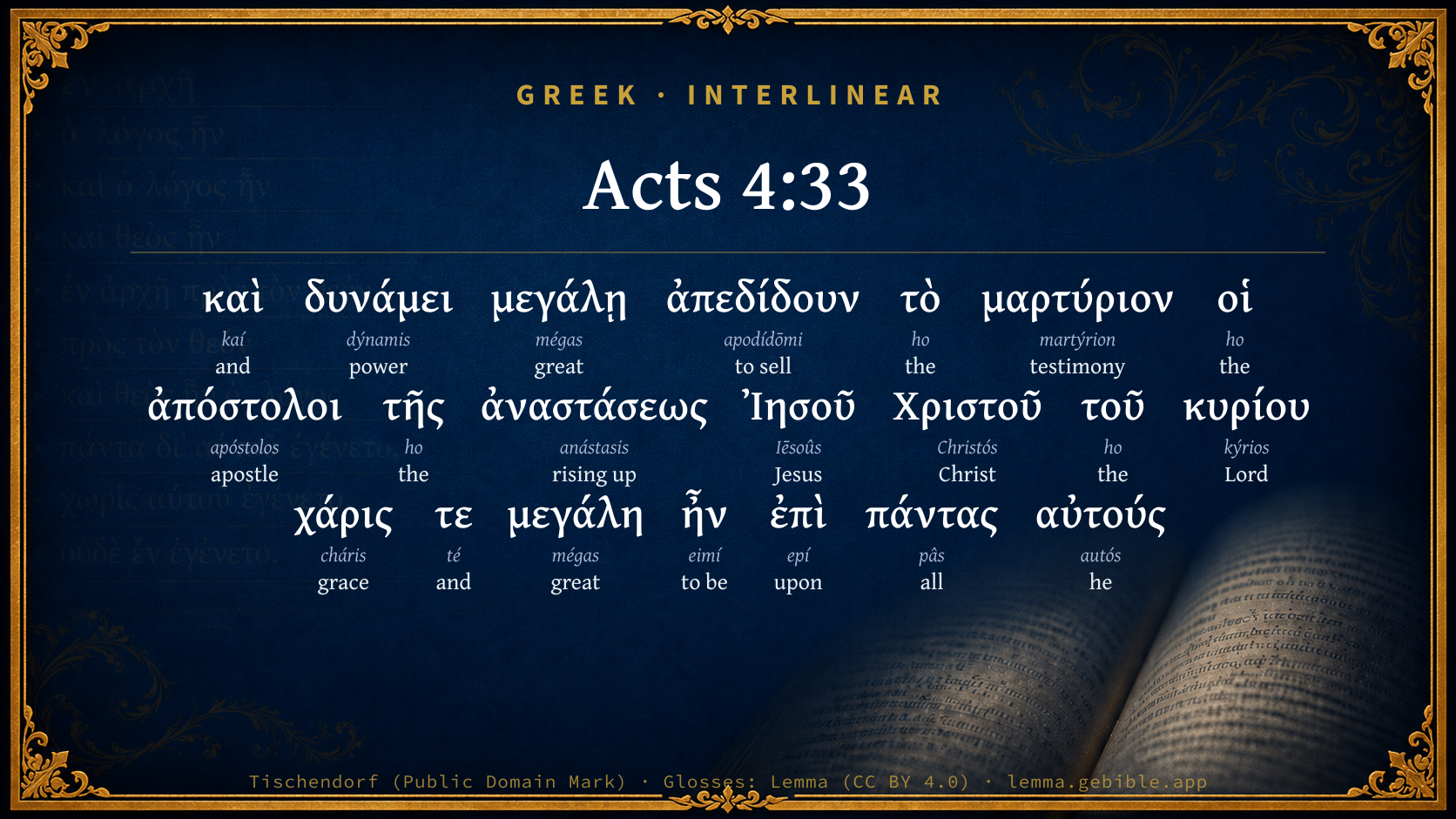
Greek (Tischendorf 8th ed.) Acts 4:33 appears in the Greek New Testament. The text above is from the Tischendorf 8th edition. Each word links to its Strong’s number and a concise gloss. Click any word for its full Thayer’s Greek Lexicon entry.
Download image
Cite this verse

Acts 4:33 (World English Bible). Public Domain. Lemma interlinear Bible study tool, https://lemma.gebible.app/v/acts/4/33.

Show BibTeX & RIS
BibTeX
RIS
English Translation
With great power, the apostles gave their testimony of the resurrection of the Lord Jesus. Great grace was on them all.
World English Bible · Public Domain
Download a study sheet

One document with this verse’s original text, its word-by-word gloss line, the meaning frame, cross-references with their text, attributed commentary, and full source and license credits — printable, and it pastes into notes with its structure intact.

This verse Autodidact and up

Study sheet (.html) Plain text (.txt)

A passage Seminary Student

Up to 50 verses in one chapter. A passage sheet keeps up to 6 commentary sources and 12 cross-references per verse, in the order this page ranks them, and says so on the sheet whenever that leaves anything out. Ask for a single verse and you get the Autodidact verse sheet above.

Everything on this page stays free to read, with no account — the sheet is a download of what is already on screen, not access to it.

Want to remove ads? Support Godless Engineer
Compare translations 3

The same verse in 3 English versions, stacked beneath the original-language interlinear above. Click any original word for its lexicon entry.

Each is an independent rendering of the whole verse — the interlinear is not word-aligned to these translations.

Highlighted words mark where these versions differ — a whole-verse word diff, not a word-by-word alignment.

  • World English Bible Public Domain
    With great power, the apostles gave their testimony of the resurrection of the Lord Jesus. Great grace was on them all.
  • King James Version Public Domain
    And with great power gave the apostles witness of the resurrection of the Lord Jesus: and great grace was upon them all.
  • unfoldingWord Literal Text CC BY-SA 4.0
    And with great power the apostles were proclaiming the testimony of the resurrection of the Lord Jesus, and great grace was upon them all.

unfoldingWord Literal Text — © unfoldingWord, licensed CC BY-SA 4.0. Word-aligned USFM3 via Door43 (git.door43.org/unfoldingWord/en_ult).

Versions to compare (up to 4)

3 of 4 selected

Show all 19 translations

Every available English version of this verse, each an independent rendering of the whole verse.

  • World English Bible Public Domain
    With great power, the apostles gave their testimony of the resurrection of the Lord Jesus. Great grace was on them all.
  • Berean Standard Bible Public Domain
    With great power the apostles continued to give their testimony about the resurrection of the Lord Jesus. And abundant grace was upon them all.
  • Majority Standard Bible Public Domain
    With great power the apostles continued to give their testimony about the resurrection of the Lord Jesus. And abundant grace was upon them all.
  • King James Version Public Domain
    And with great power gave the apostles witness of the resurrection of the Lord Jesus: and great grace was upon them all.
  • American Standard Version (1901) Public Domain
    And with great power gave the apostles their witness of the resurrection of the Lord Jesus: and great grace was upon them all.
  • Revised Version (1885) Public Domain
    And with great power gave the apostles their witness of the resurrection of the Lord Jesus: and great grace was upon them all.
  • Geneva Bible (1599) Public Domain
    And with great power gaue the Apostles witnes of the resurrection of the Lord Iesus: and great grace was vpon them all.
  • Douay-Rheims (1899) Public Domain
    And with great power did the apostles give testimony of the resurrection of Jesus Christ our Lord; and great grace was in them all.
  • Young's Literal Translation Public Domain
    And with great power were the apostles giving the testimony to the rising again of the Lord Jesus, great grace also was on them all,
  • Literal Standard Version CC BY-SA 4.0
    And with great power the apostles were giving the testimony to the resurrection of the Lord Jesus, great grace was also on them all,
  • Unlocked Literal Bible CC BY-SA 4.0
    With great power the apostles were proclaiming their testimony about the resurrection of the Lord Jesus, and great grace was upon them all.
  • unfoldingWord Literal Text CC BY-SA 4.0
    And with great power the apostles were proclaiming the testimony of the resurrection of the Lord Jesus, and great grace was upon them all.
  • Darby Bible Public Domain
    and with great power did the apostles give witness of the resurrection of the Lord Jesus, and great grace was upon them all.
  • World Messianic Bible Public Domain
    With great power, the emissaries gave their testimony of the resurrection of the Lord Yeshua. Great grace was on them all.
  • Webster's Bible Public Domain
    And with great power the apostles gave testimony of the resurrection of the Lord Jesus: and great grace was upon them all.
  • Free Bible Version CC BY-SA 4.0
    The apostles gave their testimony regarding the resurrection of the Lord Jesus with tremendous power, and God greatly blessed them all.
  • Bible in Basic English Public Domain
    And with great power the Apostles gave witness of the coming back of the Lord Jesus from the dead; and grace was on them all.
  • Text-Critical English NT CC BY 4.0
    With great power the apostles were giving testimony to the resurrection of the Lord Jesus, and great grace was upon them all.
  • Tyndale New Testament (1534) Public Domain
    And with greate power gave the Apostles witnes of the resurreccion of the Lorde Iesu. And greate grace was with them all.

Literal Standard Version (2020), Covenant Press — licensed CC BY-SA 4.0. Text via the HelloAO Bible API (eBible.org). Unlocked Literal Bible (unfoldingWord) — licensed CC BY-SA 4.0. Text via the HelloAO Bible API (eBible.org). unfoldingWord Literal Text — © unfoldingWord, licensed CC BY-SA 4.0. Word-aligned USFM3 via Door43 (git.door43.org/unfoldingWord/en_ult). Free Bible Version, Dr. Jonathan Gallagher — licensed CC BY-SA 4.0. Text via the HelloAO Bible API (eBible.org).

Word by word

More ways to search: Search by grammar → Find every occurrence → Compare this word →

Practice this passage: Drill this verse → Learn its vocabulary →

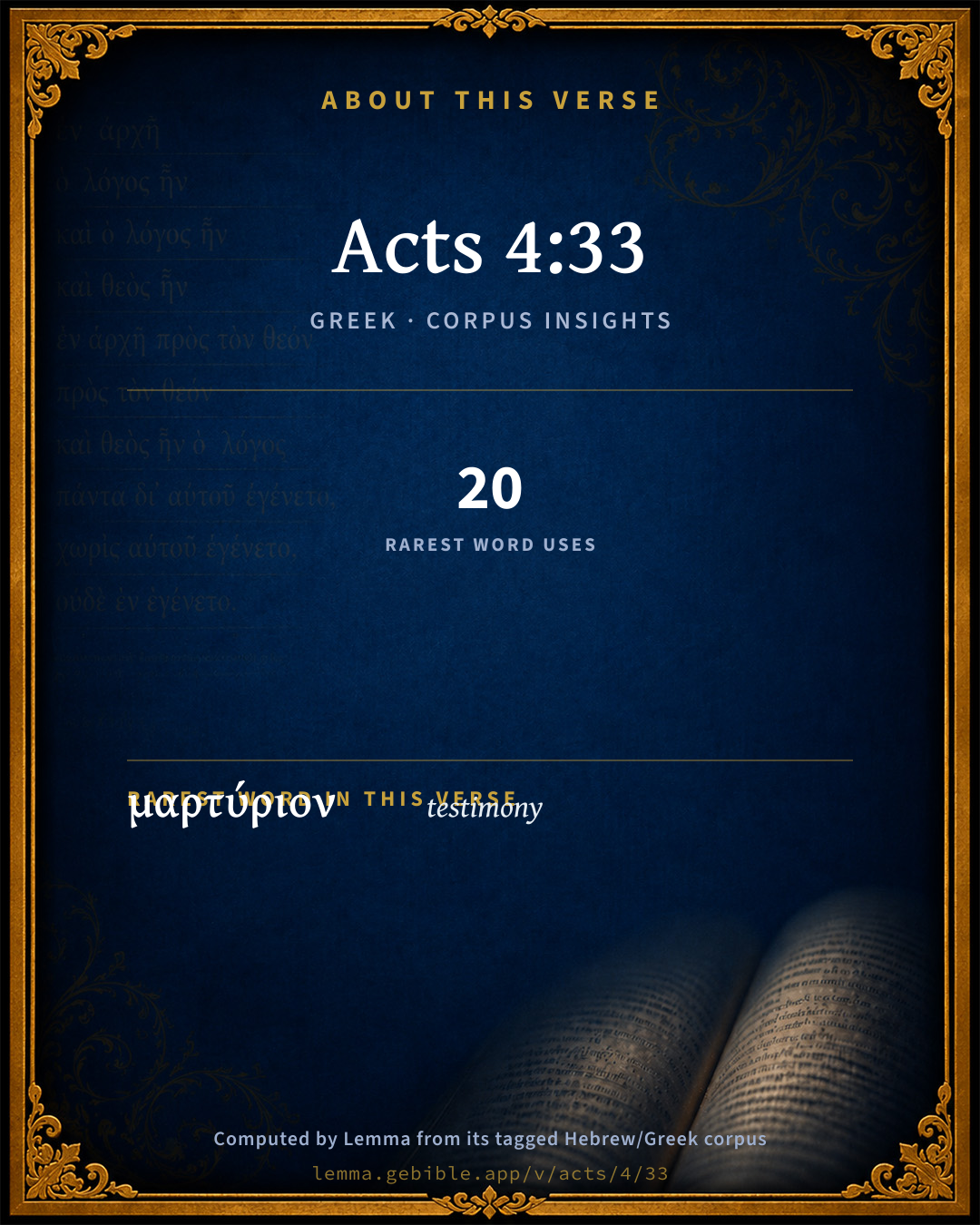
μαρτύριον
martýrion
G3142
“testimony”
Noun, Accusative, Singular, Neuter
Part of Speech
Noun
Case
Accusative
Number
Singular
Gender
Neuter
Full Thayer's Definition

Origin: from a presumed derivative of G3144

TDNT: 11:54,6

1. testimony
  1. καὶ kaí G2532 “and” Conjunction
  2. δυνάμει dýnamis G1411 “power” Noun, Dative, Singular, Feminine
  3. μεγάλῃ mégas G3173 “great” Adjective, Dative, Singular, Feminine
  4. ἀπεδίδουν apodídōmi G591 “to sell” Verb, Imperfect, Active, Indicative, 3rd person, Plural
  5. τὸ ho G3588 “the” Article, Accusative, Singular, Neuter
  6. οἱ ho G3588 “the” Article, Nominative, Plural, Masculine
  7. ἀπόστολοι apóstolos G652 “apostle” Noun, Nominative, Plural, Masculine
  8. τῆς ho G3588 “the” Article, Genitive, Singular, Feminine
  9. ἀναστάσεως anástasis G386 “rising up” Noun, Genitive, Singular, Feminine
  10. Ἰησοῦ Iēsoûs G2424 “Jesus” Noun, Genitive, Singular, Masculine
  11. Χριστοῦ Christós G5547 “Christ” Noun, Genitive, Singular, Masculine
  12. τοῦ ho G3588 “the” Article, Genitive, Singular, Masculine
  13. κυρίου kýrios G2962 “Lord” Noun, Genitive, Singular, Masculine
  14. χάρις cháris G5485 “grace” Noun, Nominative, Singular, Feminine
  15. τε té G5037 “and” Particle
  16. μεγάλη mégas G3173 “great” Adjective, Nominative, Singular, Feminine
  17. ἦν eimí G1510 “to be” Verb, Imperfect, Active, Indicative, 3rd person, Singular
  18. ἐπὶ epí G1909 “upon” Preposition
  19. πάντας pâs G3956 “all” Adjective, Accusative, Plural, Masculine
  20. αὐτούς autós G846 “he” Personal pronoun, Accusative, Plural, Masculine

About this verse

These counts appear in no published source. They are computed here, from the morphology-tagged text and Lemma’s own curated glosses. What Lemma adds →

21
words
17
distinct lemmas
Acts
section

Notable vocabulary

The rarest word here is μαρτύριον testimony G3142 — appearing just 20 times in the whole Greek New Testament.

Shared distinctive vocabulary

μαρτύριον testimony G3142 occurs in 20 verses of the Greek New Testament. Also found in:

Repetition

Words recur within this verse:

  • μεγάλῃ great G3173 ×2
  • τὸ the G3588 ×4

Cross-references

14

Topical passages linked to Acts 4:33 in the Treasury of Scripture Knowledge — connected by theme and wording, ordered by reader-vote popularity; previews shown in the World English Bible.

  • John 1:16 From his fullness we all received grace upon grace.
  • Acts 1:22 beginning from the baptism of John, to the day that he was received up from us, of these one must become a witness with us of his resurrection."
  • Acts 1:8 But you will receive power when the Holy Spirit has come upon you. You will be witnesses to me in Jerusalem, in all Judea and Samaria, and to the uttermost parts of the earth."
  • Mark 16:20 They went out, and preached everywhere, the Lord working with them, and confirming the word by the signs that followed. Amen.
  • Acts 4:30 while you stretch out your hand to heal; and that signs and wonders may be done through the name of your holy Servant Jesus."
  • Luke 2:52 And Jesus increased in wisdom and stature, and in favor with God and men.
  • 1 Thessalonians 1:5 and that our Gospel came to you not in word only, but also in power, and in the Holy Spirit, and with much assurance. You know what kind of men we showed ourselves to be among you for your sake.
  • Romans 15:18–19 For I will not dare to speak of any things except those which Christ worked through me, for the obedience of the Gentiles, by word and deed,
  • Hebrews 2:4 God also bearing witness with them, both by signs and wonders, and by various works of power, and by gifts of the Holy Spirit, according to his own will?
  • Luke 24:48–49 You are witnesses of these things.
  • Acts 2:32–33 This Jesus God raised up, to which we all are witnesses.
  • Acts 2:47 praising God, and having favor with all the people. The Lord added to the assembly day by day those who were being saved.
  • Acts 3:15–16 and killed the Prince of life, whom God raised from the dead, to which we are witnesses.
  • Acts 5:12–16 By the hands of the apostles many signs and wonders were done among the people. They were all with one accord in Solomon's porch.

Cross-references courtesy of OpenBible.info (CC BY 4.0).

Commentary

Notes on Acts 4:33 from classic Christian and Jewish commentators (each source and its license shown beneath its notes). The classic Christian expositions comment on the surrounding passage and are grouped to its opening verse, so a note may address several verses; the Jewish commentaries on the Tanakh (Rashi and others) are per-verse, so they appear only where the commentator wrote on this verse.

Lemma curates 59 commentaries, every one of them public domain or Creative Commons licensed, each selected and text-cleaned for this edition rather than reprinted as found. About our sources →

The Biblical Illustrator

Joseph S. Exell

Act_4:33

With great power gave the apostles witness of the resurrection of the Lord Jesus.

The power of the Apostolic testimony to the resurrection

In what did this great power consist?

I. In the great number of witnesses. Here were more than were necessary for the fabrication of a cheat, and too many to keep it long a secret (1Co_15:5-6).

II. In the well-known character of the apostles. They were poor, timid and friendless; and, therefore, unlikely to devise, and unable to execute, a scheme for imposing a falsehood of this nature upon the world. Above all, they were proverbial for integrity in principle and conduct. Such qualities would render any evidence respectable. Will it be said that their simplicity exposed them to delusion? There were among them Peter, sufficiently acute, and Thomas sufficiently scrupulous. Will it be said that, as followers of Christ; they were interested in the success of this story. Alas! in what way could the story advance the interest of any of them, if Jesus was not risen? It would have been much more natural, as well as reasonable, for them, as indeed they did after the crucifixion, to have shrunk from the public view.

III. In that there was among them consistence, boldness, and correspondent behaviour.

1. They were perfectly consistent. Numerous as were the testifiers, there were no divisions, contradictions, or separate interests: and if there were some little variations in their narratives, respecting minute matters, these are reconcilable, and tend rather to confirm their accounts, by evidencing that there had been no combination.

2. They were undaunted. Though before, mortified with disappointment, and shaking with terror, they shunned even the light, they now openly and eagerly proclaimed that He who had been crucified, was risen from the dead.

3. There was also correspondent behaviour. They exhibited that life which the resurrection necessarily enforced. They were animated with that joy which it was calculated to inspire. They manifested that anxiety and diligence to maintain and propagate the religion of their Lord which it could not fail to produce.

IV. In that they brought to their support the types and prophecies of the word of God. The argument was of wonderful power with those Jews who had cherished the revelations which the Most High had vouchsafed to them; and it is of astonishing import, of irresistible force to every man, who considers soberly the wonderful, the supernatural, the connected, the singularly significant nature, of the Jewish economy.

V. In that it left His adversaries destitute of any satisfactory or reasonable replication. Much it behoved the rulers of the Jews to prove to the people, who were many of them struck with the miracles of Christ, that they had not crucified the Lord of Glory. In their care to secure the sepulchre, they betrayed their anxiety to do so. And, blessed Lord, could they have produced Thy sacred body after the third day, with what triumph would it have been exhibited! But there was no such refutation of the resurrection.

VI. In that it was accompanied with the confirmation and blessing of God, and produced great and extensive conviction. The establishment and rapid progress of a religion, whose Author was crucified, and its propagators twelve of the most despised men; of a religion so opposed to the strongest propensities of nature, so different from anything to which man had been accustomed, and so destructive to ancient, venerated, and congenial systems; and this, too, by means so simple, and seemingly inadequate to the object, is of itself a demonstration of the wisdom and power with which its witnesses unto the people spake. (Bp. Dehon.)

Preaching the resurrection of Jesus

Notice--

I. The great fact to which they gave testimony.

1. This fact was of essential importance in the Christian scheme. All the great events of our Lords history are of vast importance, both in themselves or in their relation to each other. What would the death of Christ have availed if He had not also risen?

2. The apostles were witnesses of it. Hence they were prepared everywhere to vindicate the doctrine of the Resurrection.

II. The character of their testimony. Power may refer to--

1. The miracle they wrought.

2. The unction, the energy, the extraordinary influence of their ministry.

3. Their marvellous success.

III. The abundant grace with which they were endowed. Great grace. Application:

1. Let us learn to give great prominence to the fundamental doctrines and facts of Christianity.

2. Let us remember that the success of our labours depends not only on what is preached, but very greatly on how it is preached.

3. Let us all, and always, mind to have great grace--the grace of humility, of patience, of charity, of faith--if we would have great success. (W. Antliff, D. D.)

The resurrection of Christ historic

1. The resurrection of Christ is the most important event in all history. It expresses in itself the whole gospel of God to man. When a new apostle was elected it was that he might be a witness to it.

(1) This fact is the demonstration of all the other vital things in the gospel that went before it. By it Jesus was declared to be the Son of God with power. By it God publicly owned Him in the face of earth and heaven, and testified to all things vital in His life and mission, to the sinlessness of His character, to the Divine truth of His teaching, and to the sufficiency of His atonement.

(2) It is also the pledge and promise of all that is yet to come. It opens the gate of a future life; it is the pattern and the assurance of our own resurrection; the Church arose again in Christ, and each individual member of it has power and privilege to say, Because He lives, I shall live also!

2. With truth therefore, this fact is put in the Scriptures, and in derived systems of theological thought, as the key-stone of the arch of Christianity. Take it away, and the whole system crumbles to pieces. Our preaching is vain; your faith is vain; we are yet in our sins; we have no more hope in Christ for this life, or for any other.

3. Such a fact, from its very importance, requires the very strongest confirmation, and, being a fact of history, confirmation of a strictly historical kind.

I. The fact itself.

1. It is a fact quite capable of proof. There is no difficulty in imagining it to have occurred. There are no invincible laws against it. There are no natural principles or instincts of the human mind which reject it. All that can be averred is that it is not in the line of our experiences.

2. What is sufficient evidence? All human laws assume that the testimony of two witnesses, when that testimony is unchallenged and when it is confirmed by collateral evidence, is enough. This is not to say that any two men would be believed in anything they might choose to say. They must be honest men worthy of belief, and must be able to show that they had adequate opportunity for ascertaining or observing the thing to which they give testimony, and that they were the dupes of no illusion, and that they were in full possession of their faculties. Then, the human mind is so constituted that it must receive their testimony. If it were not so; human society would be no longer possible; no important ease could be decided in any court of law; in fact, no law could be administered at all.

II. The witnesses.

1. How many are they? The first to see the risen Lord was Mary; then her companions, the other women, shared the privilege with her. Then John and Peter saw Him. Later in the day He met the two disciples on the way to Emmaus. In the evening He appeared to the brethren as they sat at meat; and again, a week later, to them in presence of Thomas. He came to the apostolic company by the lake; on the mountain more than five hundred brethren at once saw Him. It is probable that six or seven hundred people, at least, saw Christ after He was risen. True, we have not a separate testimony in writing from every one who saw Him. Writing in those days was not an easy matter. We have the testimony of the four Evangelists and of James, Peter, and Paul--to what? Not only to what they themselves saw and heard, but to the fact that a great many others saw and heard with them; and there is no denial from any of these. Here, e.g., is a letter which Paul writes to the Corinthians, which he must have known would not be kept a secret; and he asserts in it that Christ was seen after His resurrection by more than five hundred men, most of whom, he says, were then alive; and yet there is no contradiction. Corinth was full of objectors, and some of them would have been nothing loth to undermine his authority. The casual observation, Some have fallen asleep, indicates that he knew many of the persons referred to, and that, had it been necessary, he could have given further details respecting them.

2. Are they honest men? Let any one read the Gospels and see. True, and honest, and simple-hearted are they, if ever such men were in the world.

3. As to their soundness of mind. Where is there any sign of weakness or of hallucination in these Gospels, or in the Epistles, from first to last? They seem almost too calm. It is impossible to conceive evidence more perfectly given. They were the subjects of profound emotion; but they knew that the world could have no interest in the state of their feelings, and that what they had to do was to tell faithfully and truly the great facts which had excited such feelings.

4. As to their opportunities for ascertaining the truth. They saw their risen Lord many times and in many places. They heard Him speak; they talked with Him; they touched Him; they saw Him eat; they felt His breath; they saw Him ascend to heaven.

5. But had they not something to gain by this history? Yes; they gained disrepute, persecution, spoiling of goods, as the price of their faithfulness. They gained bonds and martyrdom. If they did not believe it, their course of action makes them the greatest madmen the world has ever seen.

6. Their testimony was received undoubtingly by men of their own generation. It has been said that eighteen centuries is a long time across which to verify important historic truth. But it was grasped and held by those to whom it was near, who could judge of its truth as we judge of the occurrences of our own time, and who could not be deceived. Remember the wonderful effects this belief produced then; and now Christendom, with all the light and love and tenderness it contains, is the fruit of the faith that there is a risen Christ. Conclusion: Eighty years before the resurrection Caesar landed on the coast of Kent. Who thinks of doubting that? I suppose, if eternal salvation depended on believing it, there is not a sane Englishman alive who would fail of heaven; and yet the actual historic proof of this is far less complete, cogent, convincing, than the proof that Christ died and rose and revived, that He might be Lord both of the dead and of the living. Men believe without any doubt or difficulty in the Sabine farm of Horace, where his friends quaffed the Falernian wine. We believe that Virgil died on a journey, and that he lies buried, at his own request, at the second milestone from Naples on the Puteolan way. We believe in the plough of Cincinnatus, and in the poison-cup of Socrates; but all kinds of conscientious scruples and honest doubts, which must be treated with great tenderness and delicacy, arise in some minds when they are asked to believe in the resurrection and ascension of the Lord Jesus Christ. We feel inclined to say of such, everything in its own place. We would not break any bruised reed, or quench any smoking flax; but if any one will not take the trouble to examine the evidence for the resurrection, and yet will complain that he is unable to believe it, sympathy with such a person may be unfaithfulness to truth, and a slight even upon rationality, because he asks for comfort while rejecting light. Let men be honest and earnest in this great matter. (A. Raleigh, D. D.)

The gospel of the resurrection

Let us consider some of the reasons why the apostles attached such importance to the resurrection. It proved:

I. That Christ was still living and had returned to His Church. His death had struck them with confusion and dismay, and their first feeling was one of profound loss. The resurrection was the return of their beloved Master. So we do not worship a dead Christ. He is not a memory but a presence.

II. That Christ had not failed in His work. This was once their impression (Luk_24:21). But after the resurrection all was changed. Here was--

1. Triumph over death.

2. The proof that God had accepted the great sacrifice.

3. The evidence that what seemed a hindrance was the very means by which the Saviour effected His work of redemption.

III. That Christ was more than man. It was a triumphant refutation of Jewish error. They had mocked at His claims (Luk_23:35). Here was the vindication of them. Accordingly the apostles pressed this fact with great persistency (Act_3:15). He could be no mere man that could break the bars of the grave.

IV. The supernatural character of Christianity. If this is granted it is vain to cavil at lesser miracles. Admit this, and all anti-Christian objection crumbles to dust.

V. That it is possible for man to be raised from the dead (1Co_15:20). (W. F. Adeney, M. A.)

Great grace was upon them all.--

Manifestations of Divine grace

Grace sometimes denotes the full and undeserved compassion which our Heavenly Father manifests to a lost world. At other times, the term is employed to describe the subduing and sanctifying effects of this marvellous love. In the text it is to be understood as referring to both. Great grace was manifest--

I. In their earnest and united prayers. They held frequent communion with the God of all grace. This practice was habitual (Act_1:14). On any unusual occasion of trial, prayer was their first and last resort (Act_4:31; Act_12:5; Act_21:5). If great grace is to rest upon believers in our time, it will be when they realise the cheering promise of their Lord (Mat_18:20). No matter how small, or how great the number, nor from what quarter, nor the place of assembly, He--the Prophet, Priest, and King of His Church--will be present to bless.

II. In their steadfast devotion to scripture doctrine. Indifference to Divine truth is always the sign that the spark of grace in the heart is near extinction. The first-fruits of the day of Pentecost, instead of dividing themselves up into rival factions, to suit their individual caprice, continued steadfast in the apostles doctrine (Act_2:42).

III. In their love one to another (verse 32). When a company of Christians in Numidia had been taken prisoners by barbarians, and the churches to which (hey belonged were unable to pay their ransom, they sent to the Church in Carthage. Bishop Cyprian no sooner heard of this than he set himself at work, and never relaxed his efforts until he had collected the necessary sum. This substantial token of brotherly kindness was not more gratifying than the letter of Christian sympathy and tenderness which accompanied it. In cases like these, wrote the bishop, who would not feel sorrow, and who would not look upon a brothers sufferings as his own? As the apostle says, When one member suffers, all the members suffer with it (1Co_12:26). Therefore, we must consider the captivity of our brethren as our own captivity. We must see Christ in our captive brethren, and redeem Him from captivity who redeemed us from death.

IV. In the holy joy and peace in believing with which they triumphed in every place.

V. In the spirit and deportment with which they recommended their religion to the world (Act_2:47). A Christian young man was asked what had led him to turn aside from his wild and thoughtless career to become a follower of Jesus. Was it a sermon or a book that had improved him? He answered very emphatically, No. Had any one spoken to him specially on the subject of religion? No. It was a Christian man, who boarded at the same house with me. Did he ever talk to you about your soul? No, never, till I sought an interview with him; but there was a sweetness in his disposition, a heavenly-mindedness about him, that made me feel that he had a source of comfort and peace, to which I was a stranger. His whole life was a sermon. I sought an interview with him. He pointed me to Jesus Christ, prayed with me and counselled me. In this, and in all such cases, religion is preached most eloquently to the world. About twenty years ago, a Christian woman of London was asked to take charge of a Bible-class of three young women. Although the work was a very humble one, she shrank from its responsibilities, and, with many misgivings, consented to the trial. The first months experience was so encouraging that she consented to go on with the work, and the class constantly increased in numbers. From fifty, it soon grew to eighty, and a larger room was provided. In the course of a few years the Bible-class became five hundred strong; and now, at the age of sixty-nine, the faithful teacher (Mrs. Bartlett) has fallen asleep in Jesus. She was not a woman of marked ability, but simply one who gave up her whole self to the service of the Lord. This was the secret of her success. She knew the members of her large class, and called them by their names. She visited them at their homes, and wrote letters to the absent ones. For each, and for all of them, she prayed unceasingly. Her pupils are scattered over the whole earth, and many of them are telling to others the good tidings she brought to them. (J. N. Norton, D. D.)

Happy state of the primitive Church

We shall now seek an illustration of the text, by inquiring wherein such eminent grace appeared in these primitive believers.

1. Great grace appeared in their earnest and united supplications.

2. If appeared in their steadfast adherence to the apostles doctrine.

3. In a constant adherence to the worship and service of God.

4. In their great love to one another.

5. These primitive Christians were full of holy joy and peace in believing, and they triumphed in every place.

6. Their spirit and deportment were such as recommended their religion to the word (Act_2:47).

They abounded in those Christian graces which are lovely even in the eyes of men in general. (Theological Sketch-Book.)

The Biblical Illustrator, edited by Joseph S. Exell (c. 1880s–1900s) — public domain. Text from a community e-Sword module.

Bengel's Gnomon

Johann Albrecht Bengel

Act 4:33. Ἀπεδίδουν, the apostles gave or rendered[37]) Being assured of the truth themselves, they tried to assure others of it.—οἱ ἀπόστολοι, the apostles) The giving testimony was peculiarly their province; for they had seen the facts. To them also was given an extraordinary measure of the Spirit: ch. Act 5:12.—χάρις, grace) The grace of GOD and the favour of the people.

[37] The ἀπὸ implies, that they gave testimony as a thing that was due, as of a thing which, having received themselves, they gave in turn to others.—E. and T.

Bengel's Gnomon of the New Testament — English translation (T&T Clark, Edinburgh, 1860) — public domain. Text from a community e-Sword module.

Meyer's Critical & Exegetical Commentary

Heinrich August Wilhelm Meyer

Act_4:33. And with this unity of love in the bosom of the church, how effective was the testimony of the apostles, and the divine grace, which was imparted to all the members of the church!

τῆς ἀναστ. τ. κυρ. Ἰησοῦ] This was continually the foundation of the whole apostolic preaching; comp. on Act_1:22. They bore their witness to the resurrection of Christ, as a thing to which they were in duty bound. Hence the compound verb ἀπεδίδουν, which (see Wyttenbach, Bibl. crit. III. 2, p. 56 ff.) καθάπερ ἐγχειρισθέντας αὐτούς τι δείκνυσι καὶ ὡς περὶ ὀφλήματος λέγει αὐτό, Oecumenius. Comp. 4Ma_6:32; Dem. 234. 5. Observe, moreover, that here, where from Act_4:32 onwards the internal condition of the church is described, the apostolic preaching within the church is denoted.

The χάρις μεγάλη is usually understood (according to Act_2:47) of the favour of the people. Incorrectly, as οὐδὲ γὰρ ἐνδεής κ.τ.λ., Act_4:34, would contain no logical assignation of a reason for this. It is the divine grace, which showed itself in them in a remarkable degree (1Co_15:10). So, correctly, Beza, Wetstein, de Wette, Baumgarten, Hackett.

ἦν ἐπὶ πάντ. αὐτ.] upon them all: of the direction in which the presence of grace was active. Comp. Luk_2:40.

Meyer — Critical and Exegetical Commentary on the New Testament — English translation by Peter Christie, edited by Frederick Crombie (T&T Clark, 1880) — public domain. Text from a community e-Sword module.

Expositor's Greek Testament

ed. W. Robertson Nicoll

Act 4:33 . ἀπεδίδουν τὸ μαρτύριον , “gave the Apostles their witness,” R.V. See Act 4:12 . τὸ μαρτ ., prop., “res quæ testimonio est,” but sometimes in N.T. pro μαρτυρία (Blass). ἀπεδ ., however, implies paying or rendering what is due; it suggests that there is a claim in response to which something is given (Westcott on Heb 13:11 ); cf. Mat 12:36 , Luk 12:59 ; Luk 16:2 ; Luk 20:25 , Rom 13:7 , 1Co 7:3 , etc. This was its first and strict significance in classical Greek, cf. also its use in LXX, frequently. The Apostles therefore bear their witness as a duty to which they were pledged, cf. Act 1:8 ; Act 1:22 , Act 4:20 ; καὶ ὡς περὶ ὀφλήματος λέγει αὐτό , Oecum. δυνάμει μεγάλῃ : the words may include miraculous powers, as well as stedfast witness. But the τε must not, as Weiss maintains, be so taken as to indicate that χάρις μεγάλη was the result, as in Act 2:47 . For if we regard χάρις as referring to the favour of the people (as in the former narrative in ii.), the γάρ in Act 4:34 seems to point to the love and liberality of the Christians as its cause. But many commentators prefer to take χάρις as in Act 6:8 (and as in Luk 2:40 , Hilgenfeld), of the grace of God, since here as there it is used absolutely, and Act 4:34 would thus be a proof of the efficacy of this grace, cf. 2Co 9:14 χάρις , as Bengel maintains, may include grace, favour with God and man, as in our Lord Himself, Gratia Dei et favor populi .

The Expositor's Greek Testament, edited by W. Robertson Nicoll (1897–1910) — public domain. Text from a community e-Sword module.

Jamieson, Fausset & Brown

Robert Jamieson, A. R. Fausset & David Brown

with great power--effect on men's minds.

great grace was upon them all--The grace of God copiously rested on the whole community.

Jamieson, Fausset & Brown — Commentary Critical and Explanatory on the Whole Bible (1871) — public domain (CC PDM 1.0). Text via the HelloAO Bible API.

Adam Clarke's Commentary

Verse 33. With great power gave the apostles witness] This power they received from the Holy Spirit, who enabled them, μεγαλη δυναμει, with striking miracles, to give proof of the resurrection of the Lord Jesus; for this is the point that was particularly to be proved: that he was slain and buried, all knew; that he rose again from the dead, many knew; but it was necessary to give such proofs as should convince and confound all. This preaching and these miracles demonstrated this Divine truth: Jesus died for your sins-he rose again for your justification; behold what God works in confirmation of these glorious truths; believe therefore in the Lord Jesus, and ye shall not perish, but have everlasting life.

Great grace was upon them all.] They all received much of the favour or grace of God; and they had much favour with all who feared God. In both these ways this clause may be understood; for χαρις means favour, whether that be evidenced by benevolence or beneficence, or by both. The favour of God is the benevolence of God; but his benevolence is never exerted without the exertions of his beneficence. Hence the grace or favour of God always implies a blessing or gift from the hand of his mercy and power. The favour or benevolence of men may exist without beneficence, because it may not be in their power to communicate any gift or benefit, though they are disposed to do it; or, 2dly. the persons who enjoy their favour may not stand in need of any of their kind acts; but it is not so with God: his good will is ever accompanied by his good work; and every soul that is an object of his benevolence stands in the utmost need of the acts of his beneficence. Hence, as he loved the world, he gave his Son a ransom for all. All needed his help; and, because they all needed it, therefore all had it. And truly we may say of the whole human race, for whom the Son of God tasted death, that great grace was upon all; for ALL have been purchased by his sacrificial death. This by the way.

Adam Clarke's Commentary on the Bible (1810–1826) — public domain. Text from a community e-Sword/MySword module.

John Calvin's Commentaries

33. And with great power. This third member appertaineth to doctrine. For Luke doth signify that the zeal which the apostles had to preach the gospel was so far from being diminished, that they were rather endowed with new power. Whereas he doth only name the resurrection of Christ, it is synecdoche; for this part is put for the whole gospel. But Luke maketh mention of the resurrection alone, because it is, as it were, the furnishing or fulfilling of the gospel; and, secondly, because they had endured a sore combat for the same, and the Sadducees were sore grieved at it, who aid then bear the chief swinge, [sway.]

And great grace was He signifieth that this served not a little to the spreading abroad of doctrine, in that, by helping the poor so bountifully, they found favor at the hands of strangers. For he saith that they were beloved, because they were beneficial. Therefore, there is a showing of a reason in these words, No man amongst them did lack. Although we need not doubt of this, but that their honesty, and temperance, and modesty, and patience, and other virtues, did provoke many to bear them good-will. He declareth afterward, after what sort they had their goods common, which he had touched before, to wit, that the rich men sold their lands and houses, that they might relieve the poverty of the poor,

John Calvin's Commentaries (1540-1563) — public domain. Text from the Calvin Translation Society English edition (1840s-50s) via the Christian Classics Ethereal Library (ccel.org). Calvin's coverage is partial (roughly two-thirds of the Bible); uncommented books and verses are honest gaps, never fabricated. The 19th-century editor's footnotes and remarks are omitted so the notes are faithfully Calvin's own voice.

Ellicott's Commentary for English Readers

(33) With great power gave the apostles witness.—The Greek verb implies the idea of paying or rendering what was due, as in Mat_22:11. They were doing that which they were bound to do.

Great grace was upon them.—The words may stand parallel with Luk_2:40 as meaning that the grace of God was bestowed upon the disciples in full measure, or with Act_2:47 as stating that the favour of the people towards them still continued. There are no sufficient data for deciding the question, and it must be left open. The English versions all give “grace,” as if accepting the highest meaning, as do most commentators.

A Bible Commentary for English Readers, edited by Charles John Ellicott (1878–1897) — public domain. Text from a community e-Sword module.

The Cambridge Bible for Schools and Colleges

gen. ed. J. J. S. Perowne

33. And with great power gave the apostles witness] [Better, their witness.] The Greek verb implies a great deal more than our English gave. It is the word so constantly used for paying a debt (Mat_18:25; Luk_7:42), or rendering an account (Mat_12:36; Heb_13:17). So that there is implied in it the sense of obligation under which the Apostles felt themselves to lie of declaring “the things which they saw and heard” (Act_4:20).

and great grace was upon them all] i.e. like their Master, while experiencing the favour of God, they were also finding favour with men. Cp. Act_5:13.

The Cambridge Bible for Schools and Colleges (gen. ed. J. J. S. Perowne; Cambridge University Press, 1878–1918) — public domain. Text from a community e-Sword module.

John Gill's Exposition

And with great power,.... Either in a very powerful way, with great fervency of spirit, and ardour of mind, and uncommon zeal; or with great efficacy on the souls of men; or with many miracles, and powerful operations in healing the sick, casting out devils, &c.

gave the apostles witness of the resurrection of the Lord Jesus; which they were chosen to be witnesses, and were eyewitnesses of; and which is a fundamental article of the Gospel, and was what the Sadducees were particularly disturbed at, and on account of which they forbade them to preach any more in Christ's name.

And great grace was upon them all; not only upon the apostles and ministers, but upon the whole church: and which may be understood either of the large gifts of the Spirit of God, which were poured out upon them, and plentifully bestowed on them; or of the gracious protection of God over them, preserving them from the rage and malice of men; or of that grace and favour which they had among thee people in common; or of that charity, liberality and beneficence, which were among them, which sense is confirmed by what follows; though it may be all these senses may be taken in.

John Gill's Exposition of the Whole Bible (1746–1763) — public domain (CC PDM 1.0). Text via the HelloAO Bible API.

Trapp's Complete Commentary

John Trapp

33 And with great power gave the apostles witness of the resurrection of the Lord Jesus: and great grace was upon them all.

Ver. 33. Great grace was upon them all] Dropped down, as it were, upon them from heaven. God it is that fashioneth men’s opinions, and maketh them think well of us. He gave Solomon honour as well as wisdom. And of him it was, that whatsoever David did, pleased the people. Paul goes to God for acceptance of his service, which yet was the bringing of alms. And such are usually very welcome.

John Trapp, A Commentary or Exposition upon All the Books of the Old and New Testament (1647–1656) — public domain. Text from a community e-Sword module.

Albert Barnes' Notes on the Bible

And with great power - See Act 1:8. The word “power” here denotes “efficacy,” and means that they had “ability” given them to bear witness of the resurrection of the Saviour. it refers, therefore, I rather to their preaching than to their miracles.

Gave the apostles witness - The apostles bore testimony to.

The resurrection of the Lord Jesus - This was the main point to be established. If it proved that the Lord Jesus came to life again after having been put to death, it established all that he taught, and was a demonstration that he was sent from God. They exerted, therefore, all their powers to prove this, and their success was such as might have been expected. Multitudes were converted to the Christian faith.

And great grace ... - The word “grace” means “favor.” See the notes on Joh 1:16. The expression here may mean either that the favor of God was remarkably shown to them, or that they had great favor in the sight of the people. It does not refer, as the expression now does commonly, to the internal blessings of religion on a man’s own soul, to their personal advancement in the Christian graces, but to the favor or success that attended their preaching. The meaning probably is, that the “favor” of the “people” toward them was great, or that great success attended their ministry among them. Thus, the same word grace (Greek) is used in Act 2:47. If this is its meaning, then here is an instance of the power of the testimony of the resurrection of the Lord Jesus to impress the minds of people. But this is not all, nor probably is it the main idea. It is that their union, their benevolence their liberality in supplying the needs of the needy, was a means of opening the hearts of the people, and of winning them to the Saviour. If we wish to incline others to our opinions, nothing is better adapted to it than to show them kindness, and even to minister to their temporal needs.

Benevolence toward them softens the heart, and inclines them to listen to us. It disarms their prejudices, and disposes them to the exercise of the mild and amiable feelings of religion. Hence, our Saviour was engaged in healing the diseases and supplying the needs of the people. He drew around him the poor, the needy, and the diseased, and supplied their necessities, and thus prepared them to receive his message of truth. Thus, God is love, and is constantly doing good, that his goodness may lead people to repentance, Rom 2:4. And hence, no persons have better opportunities to spread the true sentiments of religion, or are clothed with higher responsibilites, than those who have it in their power to do good, or than those who are habitually engaged in bestowing favors. Thus, physicians have access to the hearts of people which other persons have not. Thus, parents have an easy access to the minds of children. for they are constantly doing them good. And thus Sunday-school teachers, whose whole work is a work of benevolence, have direct and most efficient access to the hearts of the children committed to their care.

Albert Barnes' Notes on the Bible (1834–1885) — public domain. Text from a community e-Sword/MySword module.

Haydock's Catholic Bible Commentary

And great grace was in them all. All of them were present, were replenished with extraordinary graces of charity, zeal, &c. (Witham)

George Leo Haydock (1774–1849), Haydock's Catholic Family Bible and Commentary, 1859 edition — public domain. Excludes Psalms (Douay-Rheims chapter numbering differs from Protestant) and Deuterocanonical books (Catholic canon only).

Matthew Poole's English Annotations

With great power; by sundry miracles which they wrought, as also by their boldness with which they spake; it being no small wonder to see and hear such illiterate men testifying the truths of the gospel amidst so many learned rabbins.

The resurrection was the greatest point in controversy, which being granted, all things concerning Christ and the gospel could not be denied; and therefore here it is especially mentioned.

Great grace; favour and acceptation; men could not but think well of their doctrine and ways, whom they saw so innocent and holy, meek and good; especially God’s grace was manifest in their words and actions.

Matthew Poole's English Annotations on the Holy Bible (1683–1685) — public domain. Text from a community e-Sword/MySword module.

Whedon's Commentary on the Bible

Daniel D. Whedon

33. With great power—Natural and bestowed by the Spirit.

Resurrection—They had seen the risen Jesus, and they had mighty power in testifying to that fact as the fundamental point in the history of the Lord.

Daniel D. Whedon (gen. ed.), Commentary on the Old and New Testaments (1874–1909) — public domain. Text from a community e-Sword module.

The Pulpit Commentary

Their witness for witness, A.V. (torion). Their witness. It was one of their chief functions as apostles to bear witness to the resurrection of the Lord Jesus. (see Act_1:22, note) Great grace, etc. Some understand this of the singular favor with which the people regarded them. But it is better to take it of the grace of God which abounded towards them in spiritual gifts and abundant unction and rich blessing, crowning their labors with success.

Great grace.

This expression may refer to the measure of Divine favor resting upon the early disciples; or to the favor which they found among men, who could not fail to see and admire the spirit of "self-sacrifice" which was exhibited by what they were doing. We dwell on the former of these references. More grace, fresh grace, greater grace, rested on them after the imprisonment and deliverance of their leaders. We are to understand that the holy fervor manifested by them at this time was not accounted for by such things as the incoming of wealthy members or the multiplying of their numbers, but by the increase and enlargement of the grace" that rested on them. "Great grace "is ever the one secret of great spiritual power. Looking at the incidents connected with the text, we observe

I THIS WAS NOT THE FIRST BESTOWMENT OF GRACE. Recall the scene of the Pentecost. Show in what sense that may be spoken of as the first coming of the Spirit. Explain why that coming was attended with outward signs, and why the presence of the Spirit is not now manifest in such miraculous gifts. The "grace" in us may be as great may be greater though the attendant signs and expressions differ. Show what are the first signs of" grace" working in us. Signs in thought, feeling, conduct, and relations. Illustrate by what is said of Saul of Tarsus: "Behold, he prayeth.

II THAT FIRST GIFT OF THE SPIRIT WAS WELL RECEIVED AND USED. This may be illustrated in the earnestness and zeal of the apostles, as well as in the active, devoted, and zealous life of those converted under the apostolic teachings.

III BECAUSE WELL RECEIVED AND USED, MORE GRACE WAS GIVEN. The further grace enabled them to suffer nobly and well; to testify for Christ even before governors and kings, and to pray together and live together and work together, in loving union and mutual forbearance, and charity. And so we come to apprehend afresh God"s great and ever-working law, expressed in the familiar words, "To him that hath shall more be given;" "We are not straitened in God;" "Then shall ye know, if ye follow on to know the Lord," etc. God"s grace is indeed "free," sovereignly free, but he has been pleased to set it under conditions; and one of the chief conditions is that we shall have used wisely and well the grace already received. To those who are faithful in using grace the promise applies, He giveth more grace." Then, if we feel the need of and long for "great grace," let us see that we deal rightly in response to the leadings and movings of the grace we have. Empty the vessel in service for others, and God will be sure to refill it. Trim the lamp, and let its light shine brightly all around, and God will be sure to replenish it with abundance of fresh oil. R.T.

The Pulpit Commentary (1880–1919), ed. H.D.M. Spence-Jones & Joseph S. Exell — public domain. Text from a community e-Sword module.

John Wesley's Explanatory Notes

And great grace - A large measure of the inward power of the Holy Ghost, was upon them all - Directing all their thoughts, words, and actions.

John Wesley, Explanatory Notes Upon the Whole Bible (1754–1765) — public domain. Text via the GEBible commentary corpus.

Godbey's Commentary on the New Testament

William B. Godbey

BARNABAS

33-37. Here we have another allusion to the community of goods, practiced by the Apostolic church, necessitated by the suddenness and improvidence of the Pentecostal revival, and inspired by the hostility of their environments and the vivid anticipation of the Lord’s speedy return. Barnabas, which is but a cognomen, a Syriac word, meaning son of consolation, while his real name was Joseph, though a Levite, was a farmer off in the beautiful isle of Cyprus, in the Mediterranean Sea. He was a bright young man of liberal education, a friend and acquaintance of Saul, the celebrated Tarsian, doubtless having been his school-mate in the Greek colleges in the city of Tarsus, the Capital of Cilicia, a border-land of Asia, near his home in Cyprus. This bright and promising young Levite is an honored delegate of a Cyprian synagogue, sent to represent them in the great annual camp-meeting at Jerusalem, denominated Pentecost, without the vaguest dream of the heavenly cyclone destined to catch him in its inextricable whorls. Now that he is wonderfully converted to the Christhood of Jesus, I trow, having formerly known the God of Israel, he is a most joyful recipient of the Pentecostal baptism. Therefore he sells out his Cyprian farm, with all its appurtenances, brings the money and tumbles down every penny at the apostles’ feet, simultaneously importuning, “Will you not take Barnabas also?” Behold the contrast between primitive Christianity and the present age! I am constantly accosted by brothers and sisters in the kingdom of God, testifying to a call to preach and a burning enthusiasm to start at once if they only “had the money.” Behold the contrast! In the Apostolic age, the first thing they did after receiving a call was to sell out all they had and turn over every cent to the church, giving themselves, too. The monetary difficulties arise from the misapprehension that they actually need it in their humble efforts to glorify God in the salvation of souls. The apostles and their evangelistic comrades all walked everywhere they went, trusting the Lord to feed them like He feeds the birds. Therefore they needed no money except such as the Lord would supply in their peregrinations, as they had no fares to pay. Consequently, in order to disencumber themselves of all temporal care, that they might be perfectly free to go preaching, like Barnabas, they sold out everything they had, turning the proceeds over to the apostles. We would enjoy much better health, live longer and be more useful if we would let the railroads alone and all walk, as in the Apostolic age. We need multiplied thousands of walking itinerants, full of faith and the Holy Ghost, to preach the gospel from house to house, pursuant to the primitive economy.

William B. Godbey, Commentary on the New Testament (1896–1900) — public domain. Text from a community e-Sword module.

McGarvey & Pendleton's Commentaries

J. W. McGarvey

See notes on verse 32

J. W. McGarvey (with Philip Y. Pendleton), Commentaries on the New Testament (The Fourfold Gospel, 1914; Acts; and the epistles) — public domain. Text from a community e-Sword/MySword module.

Cambridge Greek Testament for Schools and Colleges

33. δυνάμει μεγάλῃ (the order of the Vulg.) with אABD and several cursives.

33. ἀπεδίδουν τὸ μαρτύριον, they gave their witness. The article should have its force. See above on Act 4:12. The verb is also much stronger than the usual verb ‘to give.’ It is used for ‘paying a debt’ (Mat 18:29; Luk 7:42) and for ‘rendering an account’ (Mat 12:36; Heb 13:17): so that there is implied in it the sense of obligation under which the Apostles so constantly declare themselves placed (cf. above, Act 4:20).

χάρις τε μεγάλη, and great grace (or favour). Like their Master, while experiencing the favour of God, they were also finding favour with men. Cf. Act 5:13.

Cambridge Greek Testament for Schools and Colleges (Cambridge University Press, 1896; 21 vols, various authors incl. Carr, Maclear, Plummer, Farrar, Lumby, Moule, M. R. James, Simcox) — public domain. Text from a community e-Sword module.

Alford’s Greek Testament

Henry Alford

33.] The Apostles were the specially appointed witnesses of the Resurrection, ch. 1:22: and this their testimony they gave with power, i.e. with a special gift of the Holy Spirit to enforce and illustrate, to persuade and dispute on, those facts of which their own experience (see ver. 20) informed them. That the Spirit did not inspire them with unbroken uniformity in matters of fact, our present Gospels, the remnants to us of this very testimony, sufficiently witness. Nor was this necessary: each man reported what he had heard and seen;—and it was in the manner of delivering this report that the great power of the Spirit was shewn. See, on the whole subject, Prolegg. Vol. I. i. § iii. 5 ff.

χάρις, better grace, i.e. from God, than favour, i.e. from the people, which would hardly be so absolutely designated.

Henry Alford, The Greek Testament (1849–1861) — public domain. Text from a community e-Sword module.

Vincent's Word Studies in the New Testament

Marvin R. Vincent

Gave [απεδιδουν] . Lit., gave back [απο] ; as something which they were in duty bound to give.

Marvin R. Vincent, Word Studies in the New Testament (1887–1900) — public domain. Text from a community e-Sword/MySword module.

Lesson kit

Teaching starters — assembled from the data on this page, not authored interpretation. Every prompt links to the verse data it draws on. Edit before teaching.

Acts, in the Acts, opens this verse with 21 words (17 distinct Greek lemmas). Its most distinctive word is martýrion (“testimony”). A historical commentator’s framing appears above. Read the whole chapter for the surrounding context.

Discussion questions

  1. What does “testimony” (martýrion) contribute to the verse as a whole?
  2. How does Matthew 8:4, which shares the word «testimony», read alongside this verse?
  3. What does the repetition of “great” (2× in this one verse) do in this verse?
  4. These translations render this verse differently; the difference is in the English rendering, not the original. What questions does that raise?
  5. Compare how The Biblical Illustrator and Bengel's Gnomon read this verse. Where do they agree or differ?

Things to notice

  • These translations choose different wording for 5 words in this verse.
  • “great” occurs 2× in this single verse.
  • 17 distinct Greek lemmas span 21 words in this verse.

Reading settings

Reading text

Shown beneath each verse's original-language words.

Old Testament
Old Testament edition

Read the OT as the Masoretic Hebrew (MT) or the Greek Septuagint (LXX).

English shown for the Greek Septuagint (in the Hebrew ↔ Greek comparison).

Comparing translations? Open the Compare panel on any verse page to stack up to four side by side.