Romans 10:7

Greek (Tischendorf 8th ed.) Romans 10:7 appears in the Greek New Testament. The text above is from the Tischendorf 8th edition. Each word links to its Strong’s number and a concise gloss. Click any word for its full Thayer’s Greek Lexicon entry.
Download image
Cite this verse

Romans 10:7 (World English Bible). Public Domain. Lemma interlinear Bible study tool, https://lemma.gebible.app/v/romans/10/7.

Show BibTeX & RIS
BibTeX
RIS
English Translation
or, 'Who will descend into the abyss?' (that is, to bring Christ up from the dead.)"
World English Bible · Public Domain
Download a study sheet

One document with this verse’s original text, its word-by-word gloss line, the meaning frame, cross-references with their text, attributed commentary, and full source and license credits — printable, and it pastes into notes with its structure intact.

This verse Autodidact and up

Study sheet (.html) Plain text (.txt)

A passage Seminary Student

Up to 50 verses in one chapter. A passage sheet keeps up to 6 commentary sources and 12 cross-references per verse, in the order this page ranks them, and says so on the sheet whenever that leaves anything out. Ask for a single verse and you get the Autodidact verse sheet above.

Everything on this page stays free to read, with no account — the sheet is a download of what is already on screen, not access to it.

Want to remove ads? Support Godless Engineer
Compare translations 3

The same verse in 3 English versions, stacked beneath the original-language interlinear above. Click any original word for its lexicon entry.

Each is an independent rendering of the whole verse — the interlinear is not word-aligned to these translations.

Highlighted words mark where these versions differ — a whole-verse word diff, not a word-by-word alignment.

  • World English Bible Public Domain
    or, 'Who will descend into the abyss?' (that is, to bring Christ up from the dead.)"
  • King James Version Public Domain
    Or, Who shall descend into the deep? (that is, to bring up Christ again from the dead.)
  • unfoldingWord Literal Text CC BY-SA 4.0
    or, “Who will descend into the abyss?” (that is, to bring Christ up from dead ones).

unfoldingWord Literal Text — © unfoldingWord, licensed CC BY-SA 4.0. Word-aligned USFM3 via Door43 (git.door43.org/unfoldingWord/en_ult).

Versions to compare (up to 4)

3 of 4 selected

Show all 19 translations

Every available English version of this verse, each an independent rendering of the whole verse.

  • World English Bible Public Domain
    or, 'Who will descend into the abyss?' (that is, to bring Christ up from the dead.)"
  • Berean Standard Bible Public Domain
    or, ‘Who will descend into the Abyss?’ (that is, to bring Christ up from the dead).”
  • Majority Standard Bible Public Domain
    or, ‘Who will descend into the Abyss?’ (that is, to bring Christ up from the dead).”
  • King James Version Public Domain
    Or, Who shall descend into the deep? (that is, to bring up Christ again from the dead.)
  • American Standard Version (1901) Public Domain
    or, Who shall descend into the abyss? (That is, to bring Christ up from the dead.)
  • Revised Version (1885) Public Domain
    or, Who shall descend into the abyss? (that is, to bring Christ up from the dead.)
  • Geneva Bible (1599) Public Domain
    Or, Who shall descend into the deepe? (that is to bring Christ againe from the dead)
  • Douay-Rheims (1899) Public Domain
    Or who shall descend into the deep? that is, to bring up Christ again from the dead.
  • Young's Literal Translation Public Domain
    or, `Who shall go down to the abyss,' that is, Christ out of the dead to bring up.
  • Literal Standard Version CC BY-SA 4.0
    or, “Who will go down to the abyss?” (that is, to bring up Christ out of the dead).
  • Unlocked Literal Bible CC BY-SA 4.0
    and do not say, 'Who will descend into the abyss?'” (that is, to bring Christ up from the dead).
  • unfoldingWord Literal Text CC BY-SA 4.0
    or, “Who will descend into the abyss?” (that is, to bring Christ up from dead ones).
  • Darby Bible Public Domain
    or, Who shall descend into the abyss? that is, to bring up Christ from among [the] dead.
  • World Messianic Bible Public Domain
    or, ‘Who will descend into the abyss?’ (that is, to bring Messiah up from the dead.)”
  • Webster's Bible Public Domain
    Or, Who shall descend into the deep? (that is, to bring Christ again from the dead.)
  • Free Bible Version CC BY-SA 4.0
    or “‘who'll go to the place of the dead?’ (asking to bring Christ back from the dead).”
  • Bible in Basic English Public Domain
    Or, Who will go down into the deep? (that is, to make Christ come again from the dead:)
  • Text-Critical English NT CC BY 4.0
    “or, ‘Who will go down into the abyss?’ ” (that is, to bring Christ up from the dead).
  • Tyndale New Testament (1534) Public Domain
    Other who shall descende into the depe? (that is nothinge els but to fetch vp Christ from deeth)

Literal Standard Version (2020), Covenant Press — licensed CC BY-SA 4.0. Text via the HelloAO Bible API (eBible.org). Unlocked Literal Bible (unfoldingWord) — licensed CC BY-SA 4.0. Text via the HelloAO Bible API (eBible.org). unfoldingWord Literal Text — © unfoldingWord, licensed CC BY-SA 4.0. Word-aligned USFM3 via Door43 (git.door43.org/unfoldingWord/en_ult). Free Bible Version, Dr. Jonathan Gallagher — licensed CC BY-SA 4.0. Text via the HelloAO Bible API (eBible.org).

Word by word

More ways to search: Search by grammar → Find every occurrence → Compare this word →

Practice this passage: Drill this verse → Learn its vocabulary →

ἄβυσσον
ábyssos
G12
“abyss”
Noun, Accusative, Singular, Feminine
Part of Speech
Noun
Case
Accusative
Number
Singular
Gender
Feminine
Full Thayer's Definition

Origin: from G1 (as a negative particle) and a variation of G1037

TDNT: 01:09,2

1. bottomless 2. unbounded 3. the abyss a. the pit b. the immeasurable depth c. of Orcus, a very deep gulf or chasm in the lowest parts of the earth used as the common receptacle of the dead and especially as the abode of demons
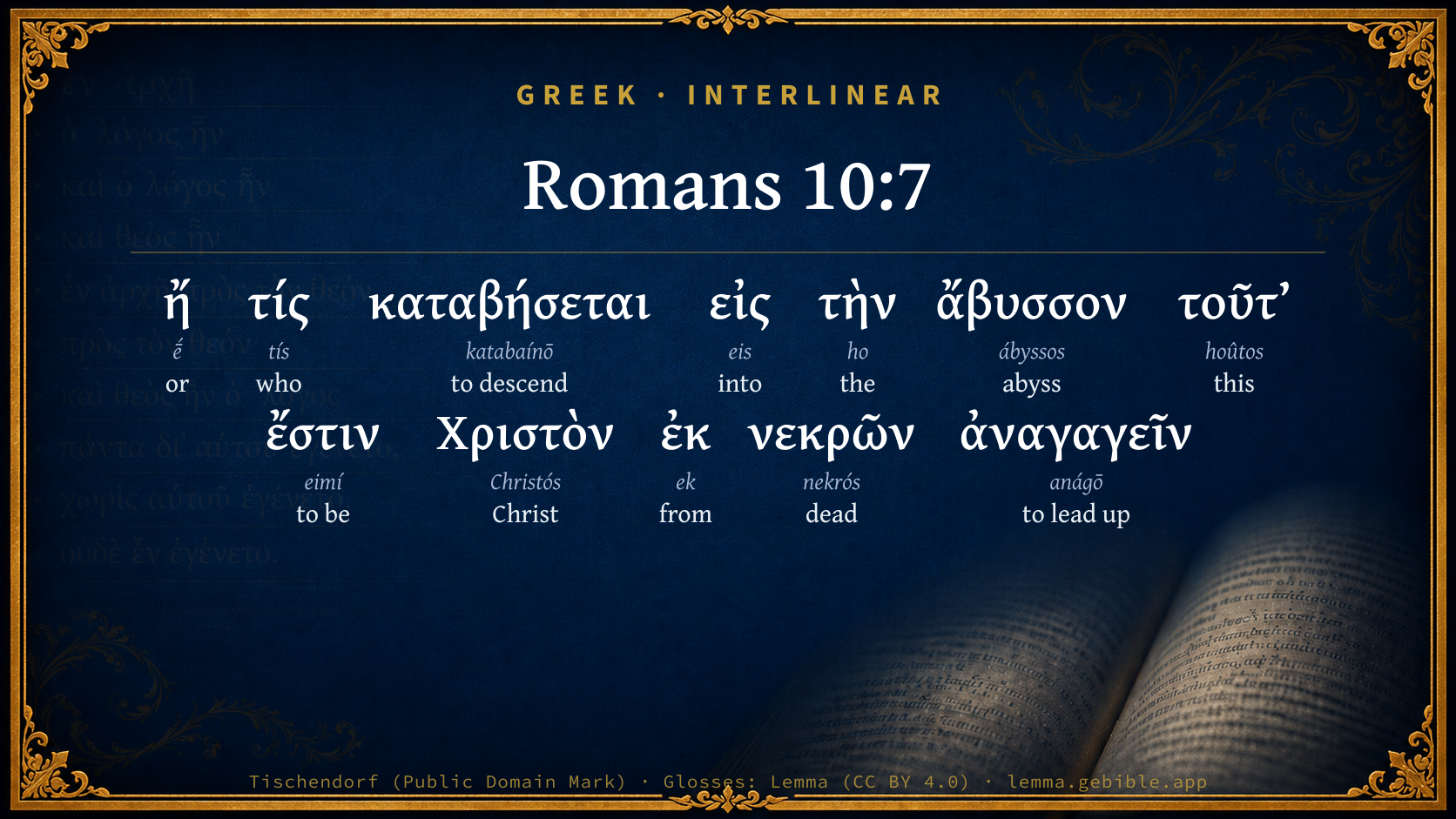
  1. ἤ ḗ G2228 “or” Particle
  2. τίς tís G5101 “who” Interrogative pronoun, Nominative, Singular, Masculine
  3. καταβήσεται katabaínō G2597 “to descend” Verb, Future, Middle deponent, Indicative, 3rd person, Singular
  4. εἰς eis G1519 “into” Preposition
  5. τὴν ho G3588 “the” Article, Accusative, Singular, Feminine
  6. τοῦτ’ hoûtos G3778 “this” Demonstrative pronoun, Nominative, Singular, Neuter
  7. ἔστιν eimí G1510 “to be” Verb, Present, Active, Indicative, 3rd person, Singular
  8. Χριστὸν Christós G5547 “Christ” Noun, Accusative, Singular, Masculine
  9. ἐκ ek G1537 “from” Preposition
  10. νεκρῶν nekrós G3498 “dead” Adjective, Genitive, Plural, Masculine
  11. ἀναγαγεῖν anágō G321 “to lead up” Verb, Aorist, Active, Infinitive

About this verse

These counts appear in no published source. They are computed here, from the morphology-tagged text and Lemma’s own curated glosses. What Lemma adds →

12
words
12
distinct lemmas
Pauline Epistles
section

Notable vocabulary

The rarest word here is ἄβυσσον abyss G12 — appearing just 9 times in the whole Greek New Testament.

Shared distinctive vocabulary

ἄβυσσον abyss G12 occurs in 9 verses of the Greek New Testament. Also found in:

Cross-references

3

Topical passages linked to Romans 10:7 in the Treasury of Scripture Knowledge — connected by theme and wording, ordered by reader-vote popularity; previews shown in the World English Bible.

  • Hebrews 13:20 Now may the God of peace, who brought again from the dead the great shepherd of the sheep with the blood of an eternal covenant, our Lord Jesus,
  • Revelation 1:18 and the Living one. I was dead, and behold, I am alive forevermore. Amen. I have the keys of Death and of Hades.
  • Romans 4:25 who was delivered up for our trespasses, and was raised for our justification.

Cross-references courtesy of OpenBible.info (CC BY 4.0).

Commentary

Notes on Romans 10:7 from classic Christian and Jewish commentators (each source and its license shown beneath its notes). The classic Christian expositions comment on the surrounding passage and are grouped to its opening verse, so a note may address several verses; the Jewish commentaries on the Tanakh (Rashi and others) are per-verse, so they appear only where the commentator wrote on this verse.

Lemma curates 59 commentaries, every one of them public domain or Creative Commons licensed, each selected and text-cleaned for this edition rather than reprinted as found. About our sources →

Bengel's Gnomon

Johann Albrecht Bengel

Rom 10:7. Τοῦτ ἔστι), that is. That is construed with to say, as substantive and adjective. Moreover, they are again reproved for perverseness, who say, who shall descend into the deep? for they speak just as if the word concerning the resurrection of Christ from the dead were not nigh at hand, and the heart of the believer acknowledges, that He has risen, in the same Rom 10:9: and they who wish to fetch salvation from the depths of the earth, wish to bring Christ (since there is no salvation without Him) from the deep, which He left once for all at His resurrection; but as the latter cannot happen, so neither can the former. Therefore the believer, so far as this is concerned, regards not either heaven or the deep, since he has the thing which he desires, as near to him, as he is to himself. But unbelief is always fluctuating; it is always wishing, and knows not what it wishes; it is always seeking, and finds nothing. Hence it looks down at the deep with giddiness, nor can it look up to the heaven with joy.—Χριστὸν, Christ) The unbeliever does not fetch Christ in His own name, that is in the name of Christ [in His peculiar attributes as anointed Saviour] either from heaven or from the deep: but the righteousness by faith, speaking here, suggests to the ignorant unbeliever to call upon the name of Christ, as much as to say, that which thou art seeking, O unbeliever [O unbelief], whilst thou art moving heaven and the deep, and art taking refuge in heaven or the deep, (as we find in Virgil, I will move hell[116] [Acheronta movebo], know that it can neither be thought of by me, nor be found by thee, without [outside of] Christ, Rom 10:4. The expression is hypothetical. That, which cannot be done,—to fetch righteousness from afar [opposed to, is nigh thee], from heaven or out of the deep; Paul sets this aside: and so leaves one only refuge, the word of Christ, which is very near.

[116] Aen. 7:312.

Bengel's Gnomon of the New Testament — English translation (T&T Clark, Edinburgh, 1860) — public domain. Text from a community e-Sword module.

Hodge's Commentary on Romans, Ephesians & First Corinthians

Charles Hodge

Rom_10:6, Rom_10:7

But the righteousness which is of faith speaketh on this wise, Say not, etc. Moses says one thing; the righteousness of faith says another thing. The same kind of personification occurs in Gal_3:23, Gal_3:25. The phrase righteousness of faith, or as it is here, which is of faith, admits of different interpretations, if we limit ourselves to the mere force of the words. Righteousness of faith, may mean that righteousness which consists in faith; or, which flows from faith, (i.e., that inward excellence which faith produces); or, the righteousness which is received by faith. This last is the only interpretation consistent with the context, or with the analogy of Scripture. The righteousness which consists in faith, or which flows from faith, is our own righteousness. It is as true and properly our own as any righteousness of works on which Pharisees relied. Besides, it is the whole doctrine of the apostle and of the gospel, that it is Christs righteousness, his obedience, blood, or death, which is the ground of our acceptance with God, and which it receives and rests upon.

It is clearly implied in that verse that the attainment of justification, by a method which prescribed perfect obedience, is for sinful men impossible. It is the object of this and the succeeding verses, to declare that the gospel requires no such impossibilities; it neither requires us to scale the heavens, nor to fathom the great abyss; it demands only cordial faith and open profession. In expressing these ideas the apostle skillfully avails himself of the language of Moses, Deu_30:10-14. It is clear that the expressions used by the ancient lawgiver were a familiar mode of saying that a thing could not be done. The passage referred to is the following, For this commandment which I command thee this day, it is not hidden from thee, neither is it far off. It is not in heaven, that thou shouldest say, Who shall go up for us to heaven, and bring it unto us, that we may hear it, and do it? Neither is it beyond the sea, that thou shouldest say, Who shall go over the sea for us, and bring it unto us, that we may hear it and do it? But the word is very nigh unto thee, in thy mouth and in thy heart, that thou mayest do it. The obvious import of this passage is, that the knowledge of the will of God had been made perfectly accessible, no one was required to do what was impossible; neither to ascend to heaven, nor to pass the boundless sea, in order to attain it; it was neither hidden, nor afar off, but obvious and at hand. Without directly citing this passage, Paul uses nearly the same language to express the same idea. The expressions here used seem to have become proverbial among the Jews. To be high, or afar off, was to be unattainable; Psa_139:6; Pro_24:7. To ascend to heaven, or to go down to hell, was to do what was impossible, Amo_9:2; Psa_139:8, Psa_139:9. As the sea was to the ancients impassable, it is easy to understand how the question, Who can pass over the sea? was tantamount to Who can ascend up into heaven? Among the later Jews the same mode of expressions not unfrequently occur. Bava Mezia, f. 94, 1. Si quis dixerit mulieri, si adscenderis in firmamentum, aut descenderis in abyssum, eris mihi desponsata, haec conditio frustranea est. Wetstein.

Instead of using the expression, Who shall go over the sea for us? Paul uses the equivalent phrase, Who shall descend into the deep? as more pertinent to his object. The word (ἄβυσσον) rendered deep, is the same which elsewhere is rendered abyss, and properly means, without bottom, bottomless, and therefore, is often applied to the sea as fathomless, Gen_1:2; Gen_7:11, (in the Septuagint), and also to the great cavern beneath the earth, which, in the figurative language of the Scriptures, is spoken of as the abode of the dead, and which is often opposed to heaven. Job_28:14, The abyss says it is not in me; compare the enumeration of things in heaven, things in earth, and things under the earth, in Phi_2:10, and elsewhere; see also Gen_49:25, God shall bless thee with the blessings of heaven above, blessings of the abyss which lieth under. In the New Testament, with the exception of this passage, it is always used for the abode of fallen spirits and lost souls, Luk_8:31; Rev_17:8; Rev_20:1, and frequently in that book, where it is appropriately rendered the bottomless pit. The expression is, therefore, equivalent to that which is commonly rendered hell in our version. Psa_139:8, If I make my bed in hell. Amo_9:2, Though they dig into hell, and was no doubt chosen by the apostle, as more suitable to the reference to the resurrection of Christ, with which he meant to connect it, than the expression used by Moses in the same general sense, Who shall pass over the sea?

Paul connects each of the questions, virtually borrowed from the Old Testament, with a comment designed to apply them more directly to the point which he had in view. Say not, who shall ascend into heaven? that is, to bring Christ down, etc. The precise intent of these comments, however, may be differently understood.

1. The words that is, may be taken as equivalent to namely, or to wit, and the apostles comment be connected, as an explanatory substitute, with the questions, Say not who shall ascend into heaven? to wit, to bring Christ down; or who shall descend into the deep? to bring him up again from the dead. The sense would then be, The plan of salvation by faith does not require us to do what cannot be done, and which is now unnecessary; it does not require us to provide a Savior, to bring him from heaven, or to raise him from the dead; a Savior has been provided, and we are now only required to believe, etc.

2. The words that is, may be taken as equivalent to the fuller expression, that is to say, To ask who shall ascend into heaven? is as much as to ask, Who shall bring Christ down from above? And to ask, Who shall descend into the deep? is as much as to ask, who shall bring Christ again from the dead?

The comments of the apostle may, therefore, be regarded as a reproof of the want of faith implied in such questions, and the passage may be thus understood, Do not reject the gospel. Say not in thy heart that no one can ascend to heaven, as the gospel says Christ has done: and no man can descend into the abyss and thence return, as is said of Christ. The incarnation of the Son of God, and his ascension to heaven, are not impossibilities, which would justify unbelief. The doctrines of the gospel are plain and simple.

Instead of regarding the apostle as intending to state generally the nature of the method of justification by faith, many suppose that it is his object to encourage and support a desponding and anxious inquirer. Do not despairingly inquire who shall point out the way of life? No one, either from heaven or from the deep, will come to teach me the way. Speak not thus, for Christ has come from heaven, and arisen from the dead for your salvation and no other Savior is required.‹58› But this view does not seem to harmonize with the spirit of the context.

It has been questioned whether Paul meant, in this passage, merely to allude to the language of Moses in Deu_30:10-14, or whether he is to be understood as quoting it in such a manner as to imply that the ancient prophet was describing the method of justification by faith. This latter view is taken by Calvin, De Brais, and many others. They suppose that in the passage quoted from Lev_18:5, Moses describes the legal method of justification, but that here he has reference to salvation by faith. This is, no doubt, possible. For in Deu_30:10, etc., the context shows that the passage may be understood of the whole system of instruction given by Moses; a system which included in it, under its various types and prophecies, an exhibition of the true method of salvation. Moses, therefore, might say with regard to his own law, that it set before the people the way of eternal life, that they had now no need to inquire who should procure this knowledge for them from a distance, for it was near them, even in their hearts and in their mouths. But, on the other hand, it is very clear that this interpretation is by no means necessary. Paul does not say, Moses describes the righteousness which is of faith in this wise, as immediately above he had said of the righteousness which is of the law. There is nothing in the language of the apostle to require us to understand him as quoting Moses in proof of his own doctrine. It is, indeed, more in accordance with the spirit of the passage, to consider him as merely expressing his own ideas in scriptural language, as in Rom_10:19 of this chapter, and frequently elsewhere. Moses teaches us that the legal method of justification requires perfect obedience; but the righteousness which is by faith, requires no such impossibility, it demands only cordial faith and open profession. The modern interpreters who understand the apostle as quoting the language of Moses to prove the true nature of the gospel, differ among themselves. Meyer and most other advocates of this view of the context, assume that Paul departs entirely from the historical meaning of the original text, and gives it a sense foreign to the intention of the sacred writer. Others, as Olshausen, suppose him to give its true spiritual sense. The passage in Deuteronomy is, in this view, strictly Messianic. It describes, in contrast with the inexorable demand of obedience made by the law, the spiritual power of the future dispensation. All this, however, requires unnecessary violence done both to the passage in Deuteronomy and to the language of the apostle. In this very chapter, Rom_10:18, we have another clear example of Pauls mode of expressing his own ideas in the language of the Scriptures. This is done without hesitation by every preacher of the gospel. The apostle, therefore, is not to be understood as saying, Moses describes the righteousness of the law in one way, and the righteousness of faith in another way; but he contrasts what Moses says of the law with what the gospel says.

According to the interpretation given above, it is assumed the design of this passage is to present the simplicity and suitableness of the gospel method of salvation, which requires only faith and confession, in opposition to the strict demands of the law, which it is as impossible for us to satisfy as it is to scale the heavens. According to the other view, mentioned above, the design of the apostle was to rebuke the unbelief of the Jews. They were not to regard the resurrection and ascension of Christ as impossible. But the whole context shows that the purpose of the apostle is to contrast the legal and the gospel method of salvation to show that the one is impracticable, the other easy. By works of the law no flesh living can he justified; whereas, whosoever simply calls on the name of the Lord shall be saved.

Charles Hodge — Commentary on Romans (1835), First Corinthians (1857), and Ephesians (1856) — public domain. Text from a community e-Sword module.

Jamieson, Fausset & Brown

Robert Jamieson, A. R. Fausset & David Brown

Or, Who shall descend, &c.--another case of impossibility, suggested by Pro 30:4, and perhaps also Amo 9:2 --probably proverbial expressions of impossibility (compare Psa 139:7-10; Pro 24:7, &c.).

Jamieson, Fausset & Brown — Commentary Critical and Explanatory on the Whole Bible (1871) — public domain (CC PDM 1.0). Text via the HelloAO Bible API.

Ellicott's Commentary for English Readers

(7) Into the deep.—In the original, beyond the sea. The word which St. Paul uses is found in the LXX. for “the sea,” but here means the abyss of Hades.

A Bible Commentary for English Readers, edited by Charles John Ellicott (1878–1897) — public domain. Text from a community e-Sword module.

The Cambridge Bible for Schools and Colleges

gen. ed. J. J. S. Perowne

7. Who shall descend, &c.] The Heb. has “Who shall go over (or on) the sea?”; the LXX., “to the other side of the sea?” St Paul takes the sea, as surely Moses took it, to be the antithesis of “heaven”—the “great deep;” and thus the idea is of exploring depth rather than breadth. The Jerusalem Targum on Deuteronomy has a remarkable paraphrase: “Neither is the law beyond the great sea, that thou shouldest say, O that we had one like Jonah the prophet, to descend into the depths of the sea, and bring it to us!” (Etheridge’s Translation.) To Moses, sky and sea were suggestive of heights and depths of supernatural mystery. St Paul finds in this use of them the latent truth of the special Height of Christ’s pre-existent majesty and the special Depth of His entrance at death into the world of souls; and so sees here an inspired declaration that this His Descent and Ascent were so “finished” as to make the means of salvation a prepared and present reality to the believing soul, which is asked (thanks to Divine mercy) not to elaborate, but to accept, the “righteousness of God” in the Incarnate and Risen Christ.

The Cambridge Bible for Schools and Colleges (gen. ed. J. J. S. Perowne; Cambridge University Press, 1878–1918) — public domain. Text from a community e-Sword module.

Trapp's Complete Commentary

John Trapp

7 Or, Who shall descend into the deep? (that is, to bring up Christ again from the dead.)

Ver. 7. Into the deep] Those deeps of the earth, Psa 71:20.

John Trapp, A Commentary or Exposition upon All the Books of the Old and New Testament (1647–1656) — public domain. Text from a community e-Sword module.

Albert Barnes' Notes on the Bible

Or who shall descend into the deep? - These words are also a part of the address of Moses, Deu 30:13. But it is not literally quoted. The Hebrew is, “Neither is it beyond the sea, that thou shouldst say, Who shall go over the sea for us, etc.” The words of the quotation are changed, but not the sense; and it is to be remembered that Paul is not professing to quote the words of Moses, but to “express the language of faith;” and this he does mainly by words which Moses had used, which also expressed his meaning. The words as used by Moses refer to what is remote, and therefore difficult to be obtained. To cross the sea in the early times of navigation involved the highest difficulty, danger, and toil. The sea which was in view was doubtless the Mediterranean, but the crossing of that was an enterprise of the greatest difficulty, and the regions beyond that were regarded as being at a vast distance.

Hence, it is spoken of as being the widest object with which they were acquainted, and the fairest illustration of infinity, Job 11:9. In the same sense Paul uses the word “deep,” ἄβυσσον abusson - “the abyss.” This word is applied to anything the depth or bottom of which is not known. It is applied to the ocean (in the Septuagint), Job 41:31, “He maketh the deep to boil as a pot.” Isa 44:27, “that saith to the deep, Be dry, etc.” Gen 7:11; Gen 8:2; to a broad place Job 36:16; and to the abyss before the world was formed, Gen 1:2. In the New Testament it is not applied to the ocean, unless in the passage Luk 8:31 (see the note on that place), but to the abode of departed spirits; and particularly to the dark, deep, and bottomless pit, where the wicked are to dwell forever. Rev 9:1-2, “and to him was given the key of the bottomless pit. And he opened the bottomless pit;” Greek, “The pit of the abyss.”

Rev 11:7; Rev 17:8; Rev 20:1, Rev 20:3. In these places the word means the deep, awful regions of the nether world. The word stands opposed to heaven; as deep as that is high; as dark as that is light; while the one is as vast as the other. In the place before us it is opposed to heaven; and to descend there to bring up one, is supposed to be as impossible as to ascend to heaven to bring one down. Paul does not affirm that Christ descended to those regions; but he says that there is no such difficulty in religion as if one were required to descend into those profound regions to call back a departed spirit. That work was in fact done, when Jesus was recalled from the dead, and now the work of salvation is easy. The word “abyss” here, therefore, corresponds to Hades, or the dark regions of departed spirits.

That is, to bring up Christ ... - Justification by faith had no such difficult and impossible work to perform as would be an attempt for man to raise the dead. That would be impossible; but the work of religion is easy. “Christ, the ground of hope, is not by our efforts to be brought down from heaven to save us, for that is done; nor by our efforts to be raised from the dead, for that is done; and what remains for us, that is to believe, is easy, and is near us.” This is the meaning of the whole passage.

Albert Barnes' Notes on the Bible (1834–1885) — public domain. Text from a community e-Sword/MySword module.

Matthew Poole's English Annotations

Who shall descend into the deep? By the deep, here, understand hell: see Luk 8:31; Rev 9:1; 20:1,3. q. d. Do not inquire distrustfully, and despairingly, whether thou shalt go to hell, or who shall go thither, to see, and bring thee word, if such as thou are there.

That is, to bring up Christ again from the dead; this were in effect to frustrate and make void the death of Christ; it is as much as to say, he never died for us, or he must come again, and suffer, and shed his blood for the remission of our sins. He died to deliver us from death and damnation; he endured the wrath of God, that we may escape it. The sense of the whole is this, That the doctrine of justification by faith, doth not propose such difficult and impossible terms, as the doctrine of justification by works. The righteousness of the law, that speaks terror, and puts us into a continual fear of hell, and despair of heaven; but the righteousness of faith, that speaks comfort, and forbids all amazing fear and troubles about our salvation or damnation.

Matthew Poole's English Annotations on the Holy Bible (1683–1685) — public domain. Text from a community e-Sword/MySword module.

Whedon's Commentary on the Bible

Daniel D. Whedon

7. Into the deep—In the Hebrew and the Septuagint the phrase is to beyond sea. And as to the ancients the sea was conceived as unbounded, so this phrase would mean to a limitless distance. The apostle’s word is abyss, which was conceived as a bottomless deep. Where its place, is not distinctly said; but as earth to the ancient conception was the limitless plane of sublunary existence, (as being antithetic to heaven,) it would, verbally, be in the depths of earth. When our conceptions are purified by astronomy, however, the abyss, hell, is no longer necessarily located in our earth. In substituting the bottomless abyss for the limitless ocean, the apostle simply adapts the phrase to his present purpose; which is, to use the term abyss as hades, or the state of the dead, into which Christ descended after his crucifixion. (See notes on Luk_16:23.)

Daniel D. Whedon (gen. ed.), Commentary on the Old and New Testaments (1874–1909) — public domain. Text from a community e-Sword module.

Godbey's Commentary on the New Testament

William B. Godbey

7. “Or, Who shall descend into the abyss? (that is, to bring Christ up from the dead.)

William B. Godbey, Commentary on the New Testament (1896–1900) — public domain. Text from a community e-Sword module.

McGarvey & Pendleton's Commentaries

J. W. McGarvey

or, Who shall descend into the abyss? [Hades, the abode of the dead-- Luk_8:31 ; Rev_17:8 ; Rev_20:1 ; Psa_139:8 ] (that is, to bring Christ up from the dead.)

J. W. McGarvey (with Philip Y. Pendleton), Commentaries on the New Testament (The Fourfold Gospel, 1914; Acts; and the epistles) — public domain. Text from a community e-Sword/MySword module.

The People's New Testament

B. W. Johnson

7. Or who shall descend into the abyss? Another stumbling block with the Jews was the death and burial of Christ. When Jesus died on the cross, they held it to be proof that he was not the Christ. They still were wont to demand that they should see the Risen Christ with their own eyes, or that he be produced from the realms of the dead. To have met the demands of the Jews would have been sight rather than faith.

B. W. Johnson's The People's New Testament with Notes (1889–1891) — public domain. Electronic text from the Christian Classics Ethereal Library (CCEL) ThML edition.

Cambridge Greek Testament for Schools and Colleges

7. τὴν ἄβυσσον for πέραν τῆς θαλάσσης, Deut. l.c[202] = ᾅδης of Psa 138:8, LXX[203]; Swete on Rev 9:1.

[202] l.c. locus citatus

[203] LXX. the Septuagint Version of the Old Testament

Cambridge Greek Testament for Schools and Colleges (Cambridge University Press, 1896; 21 vols, various authors incl. Carr, Maclear, Plummer, Farrar, Lumby, Moule, M. R. James, Simcox) — public domain. Text from a community e-Sword module.

International Critical Commentary

7. ἤ, Τίς καταβήσεται … ἀναγαγεῖν: ‘nor is it necessary to search the depth, since Christ is risen from the dead.’ St. Paul substitutes τίς καταβήσεται εἰς τὴν ἄβυσσον for the more ordinary τίς διαπεράσει ἡμῖν εἰς τὸ πέραν τῆς θαλάσσης, both because it makes a more suitable contrast to the first part of the sentence, and because it harmonizes better with the figurative meaning he wishes to draw from it. ἄβυσσος in the O. T. meant originally the ‘deep sea,’ ‘the great deep’ or ‘the depths of the sea,’ Psa 106(107):26 ἀναβαίνουσιν ἕως τῶν οὐρανῶν, καὶ καταβαίνουσιν ἕως τῶν ἀβύσσων, and the deep places of the earth, Psa_70(71):20 καὶ ἐκ τῶν ἀβύσσων τῆς γῆς πάλιν ἀνήγαγές με, and so had come to mean Tartarus or the Lower World; τὸν δὲ τάρταρον τῆς ἀβύσσου Job 41:23, where the reference to τάρταρος is due to the LXX; cf. Eur. Phoen. 1632 (1605) ταρτάρου ἄβυσσα χάσματα. Elsewhere in the N. T. it is so used of the abode of demons (Luk 8:31) and the place of torment (Rev 9:1). This double association of the word made it suitable for St. Paul’s purpose; it kept up the antithesis of the original, and it also enabled him to apply the passage figuratively to the Resurrection of Christ after His human soul had gone down into Hades.

On the descensus ad inferos, which is here referred to in indefinite and untechnical language, cf. Act 2:27; 1Pe 3:19; 1Pe 4:6; and Lft. on Ign. Magn. ix; see also Swete, Apost.-creed, p. 57 ff.

International Critical Commentary — older volumes (1896–1929), various authors — public domain. Text from a community e-Sword module.

Vincent's Word Studies in the New Testament

Marvin R. Vincent

Descend into the deep. Rev., abyss. Septuagint, Who shall pass through to beyond the sea ? See on Luk 8:31. Paul changes the phrase in order to adapt it to the descent of Christ into Hades. The two ideas may be reconciled in the fact that the Jew conceived the sea as the abyss of waters on which the earth rested. Compare Exo 20:4. Thus the ideas beyond the sea and beneath the earth coincide in designating the realm of the dead. Compare Homer's picture of the region of the dead beyond the Ocean - stream :

" As soon as thou shalt cross.

Oceanus, and come to the low shore And groves of Proserpine, the lofty groups Of poplars, and the willows that let fall Their withered fruit, moor thou thy galley there In the deep eddies of Oceanus, And pass to Pluto's comfortless abode. "" Odyssey," 10. 508 - 513.

" Our bark Reached the far confines of Oceanus.

There lies the land and there the people dwell Of the Cimmerians, in eternal cloud And darkness. "" Odyssey," 11. 13 - 15.

To bring up. There is no need. He is already risen.

Marvin R. Vincent, Word Studies in the New Testament (1887–1900) — public domain. Text from a community e-Sword/MySword module.

Lesson kit

Teaching starters — assembled from the data on this page, not authored interpretation. Every prompt links to the verse data it draws on. Edit before teaching.

Romans, in the Pauline Epistles, opens this verse with 12 words (12 distinct Greek lemmas). Its most distinctive word is ábyssos (“abyss”). A historical commentator’s framing appears above. Read the whole chapter for the surrounding context.

Discussion questions

  1. How does “abyss” (ábyssos) shape what this verse is saying?
  2. Luke 8:31 shares the word «abyss» with this verse. How do the two illuminate each other?
  3. These translations render this verse differently; the difference is in the English rendering, not the original. What questions does that raise?
  4. Reading how Bengel's Gnomon and Hodge's Commentary on Romans, Ephesians & First Corinthians read this verse, where do the two commentators agree and where do they part?

Things to notice

Reading settings

Reading text

Shown beneath each verse's original-language words.

Old Testament
Old Testament edition

Read the OT as the Masoretic Hebrew (MT) or the Greek Septuagint (LXX).

English shown for the Greek Septuagint (in the Hebrew ↔ Greek comparison).

Comparing translations? Open the Compare panel on any verse page to stack up to four side by side.