1 Corinthians 4:10

Greek (Tischendorf 8th ed.) 1 Corinthians 4:10 appears in the Greek New Testament. The text above is from the Tischendorf 8th edition. Each word links to its Strong’s number and a concise gloss. Click any word for its full Thayer’s Greek Lexicon entry.
Download image
Cite this verse

1 Corinthians 4:10 (World English Bible). Public Domain. Lemma interlinear Bible study tool, https://lemma.gebible.app/v/1-corinthians/4/10.

Show BibTeX & RIS
BibTeX
RIS
English Translation
We are fools for Christ's sake, but you are wise in Christ. We are weak, but you are strong. You have honor, but we have dishonor.
World English Bible · Public Domain
Download a study sheet

One document with this verse’s original text, its word-by-word gloss line, the meaning frame, cross-references with their text, attributed commentary, and full source and license credits — printable, and it pastes into notes with its structure intact.

This verse Autodidact and up

Study sheet (.html) Plain text (.txt)

A passage Seminary Student

Up to 50 verses in one chapter. A passage sheet keeps up to 6 commentary sources and 12 cross-references per verse, in the order this page ranks them, and says so on the sheet whenever that leaves anything out. Ask for a single verse and you get the Autodidact verse sheet above.

Everything on this page stays free to read, with no account — the sheet is a download of what is already on screen, not access to it.

Want to remove ads? Support Godless Engineer
Compare translations 3

The same verse in 3 English versions, stacked beneath the original-language interlinear above. Click any original word for its lexicon entry.

Each is an independent rendering of the whole verse — the interlinear is not word-aligned to these translations.

Highlighted words mark where these versions differ — a whole-verse word diff, not a word-by-word alignment.

  • World English Bible Public Domain
    We are fools for Christ's sake, but you are wise in Christ. We are weak, but you are strong. You have honor, but we have dishonor.
  • King James Version Public Domain
    We are fools for Christ's sake, but ye are wise in Christ; we are weak, but ye are strong; ye are honourable, but we are despised.
  • unfoldingWord Literal Text CC BY-SA 4.0
    We fools for Christ’s sake, but you wise in Christ. We weak, but you strong. You honored, but we dishonored.

unfoldingWord Literal Text — © unfoldingWord, licensed CC BY-SA 4.0. Word-aligned USFM3 via Door43 (git.door43.org/unfoldingWord/en_ult).

Versions to compare (up to 4)

3 of 4 selected

Show all 19 translations

Every available English version of this verse, each an independent rendering of the whole verse.

  • World English Bible Public Domain
    We are fools for Christ's sake, but you are wise in Christ. We are weak, but you are strong. You have honor, but we have dishonor.
  • Berean Standard Bible Public Domain
    We are fools for Christ, but you are wise in Christ. We are weak, but you are strong. You are honored, but we are dishonored.
  • Majority Standard Bible Public Domain
    We are fools for Christ, but you are wise in Christ. We are weak, but you are strong. You are honored, but we are dishonored.
  • King James Version Public Domain
    We are fools for Christ's sake, but ye are wise in Christ; we are weak, but ye are strong; ye are honourable, but we are despised.
  • American Standard Version (1901) Public Domain
    We are fools for Christ's sake, but ye are wise in Christ; we are weak, but ye are strong; ye have glory, but we have dishonor.
  • Revised Version (1885) Public Domain
    We are fools for Christ’s sake, but ye are wise in Christ; we are weak, but ye are strong; ye have glory, but we have dishonour.
  • Geneva Bible (1599) Public Domain
    We are fooles for Christes sake, and ye are wise in Christ: we are weake, and ye are strong: ye are honourable, and we are despised.
  • Douay-Rheims (1899) Public Domain
    We are fools for Christ's sake, but you are wise in Christ; we are weak, but you are strong; you are honourable, but we without honour.
  • Young's Literal Translation Public Domain
    we `are' fools because of Christ, and ye wise in Christ; we `are' ailing, and ye strong; ye glorious, and we dishonoured;
  • Literal Standard Version CC BY-SA 4.0
    we [are] fools because of Christ, and you wise in Christ; we [are] ailing, and you strong; you glorious, and we dishonored;
  • Unlocked Literal Bible CC BY-SA 4.0
    We are fools for Christ's sake, but you are wise in Christ. We are weak, but you are strong. You are held in honor, but we are held in dishonor.
  • unfoldingWord Literal Text CC BY-SA 4.0
    We fools for Christ’s sake, but you wise in Christ. We weak, but you strong. You honored, but we dishonored.
  • Darby Bible Public Domain
    *We* [are] fools for Christ's sake, but *ye* prudent in Christ: *we* weak, but *ye* strong: *ye* glorious, but *we* in dishonour.
  • World Messianic Bible Public Domain
    We are fools for Messiah’s sake, but you are wise in Messiah. We are weak, but you are strong. You have honor, but we have dishonor.
  • Webster's Bible Public Domain
    We are fools for Christ's sake, but ye are wise in Christ; we are weak, but ye are strong; ye are honorable, but we are despised.
  • Free Bible Version CC BY-SA 4.0
    We're Christ's fools, but you are so wise in Christ! We're the weak ones, but you are so strong! You have the glory, but we are despised!
  • Bible in Basic English Public Domain
    We are made to seem foolish for Christ, but you are wise in Christ; we are feeble, but you are strong; you have glory, but we have shame.
  • Text-Critical English NT CC BY 4.0
    We are fools for the sake of Christ, but you are wise in Christ. We are weak, but you are strong. You are esteemed, but we are dishonored.
  • Tyndale New Testament (1534) Public Domain
    We are foles for Christes sake and ye are wyse thorow Christ. We are weake and ye are stroge. Ye are honorable and we are despised.

Literal Standard Version (2020), Covenant Press — licensed CC BY-SA 4.0. Text via the HelloAO Bible API (eBible.org). Unlocked Literal Bible (unfoldingWord) — licensed CC BY-SA 4.0. Text via the HelloAO Bible API (eBible.org). unfoldingWord Literal Text — © unfoldingWord, licensed CC BY-SA 4.0. Word-aligned USFM3 via Door43 (git.door43.org/unfoldingWord/en_ult). Free Bible Version, Dr. Jonathan Gallagher — licensed CC BY-SA 4.0. Text via the HelloAO Bible API (eBible.org).

Word by word

More ways to search: Search by grammar → Find every occurrence → Compare this word →

Practice this passage: Drill this verse → Learn its vocabulary →

ἔνδοξοι
éndoxos
G1741
“glorious”
Adjective, Nominative, Plural, Masculine
Part of Speech
Adjective
Case
Nominative
Number
Plural
Gender
Masculine
Full Thayer's Definition

Origin: from G1722 and G1391

TDNT: 06:14,2

1. held in good or in great esteem, of high repute a. illustrious, honourable, esteemed b. notable, glorious c. splendid 1. of clothing 2. fig., free from sins
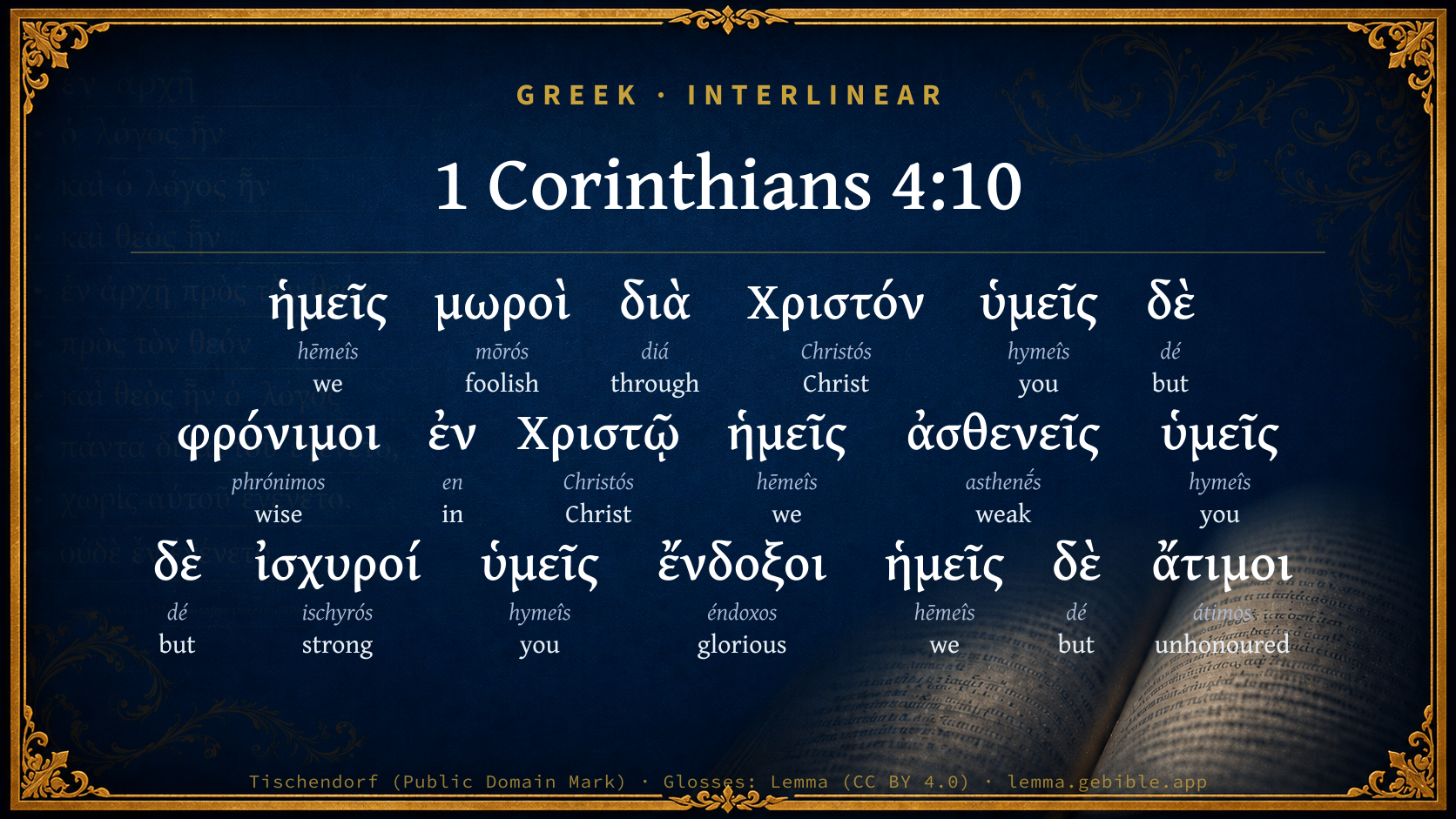
  1. ἡμεῖς hēmeîs G2249 “we” Personal pronoun, 1st person, Nominative, Plural
  2. μωροὶ mōrós G3474 “foolish” Adjective, Nominative, Plural, Masculine
  3. διὰ diá G1223 “through” Preposition
  4. Χριστόν Christós G5547 “Christ” Noun, Accusative, Singular, Masculine
  5. ὑμεῖς hymeîs G5210 “you” Personal pronoun, 2nd person, Nominative, Plural
  6. δὲ dé G1161 “but” Conjunction
  7. φρόνιμοι phrónimos G5429 “wise” Adjective, Nominative, Plural, Masculine
  8. ἐν en G1722 “in” Preposition
  9. Χριστῷ Christós G5547 “Christ” Noun, Dative, Singular, Masculine
  10. ἡμεῖς hēmeîs G2249 “we” Personal pronoun, 1st person, Nominative, Plural
  11. ἀσθενεῖς asthenḗs G772 “weak” Adjective, Nominative, Plural, Masculine
  12. ὑμεῖς hymeîs G5210 “you” Personal pronoun, 2nd person, Nominative, Plural
  13. δὲ dé G1161 “but” Conjunction
  14. ἰσχυροί ischyrós G2478 “strong” Adjective, Nominative, Plural, Masculine
  15. ὑμεῖς hymeîs G5210 “you” Personal pronoun, 2nd person, Nominative, Plural
  16. ἡμεῖς hēmeîs G2249 “we” Personal pronoun, 1st person, Nominative, Plural
  17. δὲ dé G1161 “but” Conjunction
  18. ἄτιμοι átimos G820 “unhonoured” Adjective, Nominative, Plural, Masculine

About this verse

These counts appear in no published source. They are computed here, from the morphology-tagged text and Lemma’s own curated glosses. What Lemma adds →

19
words
12
distinct lemmas
Pauline Epistles
section

Notable vocabulary

The rarest word here is ἔνδοξοι glorious G1741 — appearing just 4 times in the whole Greek New Testament.

Shared distinctive vocabulary

ἔνδοξοι glorious G1741 occurs in 4 verses of the Greek New Testament. Also found in:

Repetition

Words recur within this verse:

  • Χριστόν Christ G5547 ×2
  • ἡμεῖς we G2249 ×3
  • ὑμεῖς you G5210 ×3
  • δὲ but G1161 ×3

Cross-references

33

Topical passages linked to 1 Corinthians 4:10 in the Treasury of Scripture Knowledge — connected by theme and wording, ordered by reader-vote popularity; previews shown in the World English Bible.

  • 1 Corinthians 2:3 I was with you in weakness, in fear, and in much trembling.
  • Acts 17:18 Some of the Epicurean and Stoic philosophers also were conversing with him. Some said, "What does this babbler want to say?" Others said, "He seems to be advocating foreign deities," because he preached Jesus and the resurrection.
  • Acts 26:24 As he thus made his defense, Festus said with a loud voice, "Paul, you are crazy! Your great learning is driving you insane!"
  • 1 Corinthians 3:18 Let no one deceive himself. If anyone thinks that he is wise among you in this world, let him become a fool, that he may become wise.
  • 2 Corinthians 13:9 For we rejoice when we are weak and you are strong. And this we also pray for, even your perfecting.
  • 2 Corinthians 11:19 For you bear with the foolish gladly, being wise.
  • 1 Peter 4:14 If you are insulted for the name of Christ, blessed are you; because the Spirit of glory and of God rests on you. On their part he is blasphemed, but on your part he is glorified.
  • Proverbs 11:12 One who despises his neighbor is void of wisdom, But a man of understanding holds his peace.
  • Hosea 9:7 The days of visitation have come. The days of reckoning have come. Israel will consider the prophet to be a fool, And the man who is inspired to be insane, Because of the abundance of your sins, And because your hostility is great.
  • 2 Kings 9:11 Then Jehu came forth to the servants of his lord: and one said to him, Is all well? why came this mad fellow to you? He said to them, You know the man and what his talk was.
  • Isaiah 53:3 He was despised, and rejected by men; a man of suffering, and acquainted with disease: and as one from whom men hide their face he was despised; and we didn't respect him.
  • Jeremiah 8:8–9 How do you say, We are wise, and the law of Yahweh is with us? But, behold, the false pen of the scribes has worked falsely.
  • Luke 6:22 Blessed are you when men shall hate you, and when they shall exclude and mock you, and throw out your name as evil, for the Son of Man's sake.
  • Luke 18:9 He spoke also this parable to certain people who were convinced of their own righteousness, and who despised all others.
  • 2 Corinthians 13:3–4 seeing that you seek a proof of Christ who speaks in me; who toward you is not weak, but is powerful in you.
  • Matthew 5:11 "Blessed are you when people reproach you, persecute you, and say all kinds of evil against you falsely, for my sake.
  • Matthew 10:22–25 You will be hated by all men for my name's sake, but he who endures to the end will be saved.
  • Matthew 24:9 Then they will deliver you up to oppression, and will kill you. You will be hated by all of the nations for my name's sake.
  • Luke 10:16 Whoever listens to you listens to me, and whoever rejects you rejects me. Whoever rejects me rejects him who sent me."
  • Acts 9:16 For I will show him how many things he must suffer for my name's sake."
  • Acts 17:32 Now when they heard of the resurrection of the dead, some mocked; but others said, "We want to hear you again concerning this."
  • 1 Corinthians 1:1–3 Paul, called to be an apostle of Jesus Christ through the will of God, and our brother Sosthenes,
  • 1 Corinthians 1:18–20 For the word of the cross is foolishness to those who are dying, but to us who are saved it is the power of God.
  • 1 Corinthians 1:26–28 For you see your calling, brothers, that not many are wise according to the flesh, not many mighty, and not many noble;
  • 1 Corinthians 2:14 Now the natural man doesn't receive the things of God's Spirit, for they are foolishness to him, and he can't know them, because they are spiritually discerned.
  • 1 Corinthians 3:2 I fed you with milk, not with meat; for you weren't yet ready. Indeed, not even now are you ready,
  • 1 Corinthians 4:8 You are already filled. You have already become rich. You have come to reign without us. Yes, and I wish that you did reign, that we also might reign with you.
  • 1 Corinthians 10:12 Therefore let him who thinks he stands be careful that he doesn't fall.
  • 1 Corinthians 10:14–15 Therefore, my beloved, flee from idolatry.
  • 2 Corinthians 10:10 For, "His letters," they say, "are weighty and strong, but his bodily presence is weak, and his speech is despised."
  • 2 Corinthians 12:9–10 He has said to me, "My grace is sufficient for you, for my power is made perfect in weakness." Most gladly therefore I will rather glory in my weaknesses, that the power of Christ may rest on me.
  • 1 Thessalonians 4:8 Therefore he who rejects doesn't reject man, but God, who has also given his Holy Spirit to you.
  • 2 Corinthians 11:29 Who is weak, and I am not weak? Who is caused to stumble, and I don't burn with indignation?

Cross-references courtesy of OpenBible.info (CC BY 4.0).

Commentary

Notes on 1 Corinthians 4:10 from classic Christian and Jewish commentators (each source and its license shown beneath its notes). The classic Christian expositions comment on the surrounding passage and are grouped to its opening verse, so a note may address several verses; the Jewish commentaries on the Tanakh (Rashi and others) are per-verse, so they appear only where the commentator wrote on this verse.

Lemma curates 59 commentaries, every one of them public domain or Creative Commons licensed, each selected and text-cleaned for this edition rather than reprinted as found. About our sources →

The Biblical Illustrator

Joseph S. Exell

1Co_4:10-14

We are fools for Christs sake, but ye are wise in Christ.

The folly of Paul

The better to serve Christ, Paul refrained from making acquirement of knowledge his chief aim. And many others have renounced a path which might have led to literary eminence in order to devote their entire energies to evangelical work. Again, by abstaining from teaching mere human learning and by preaching a gospel which in the eyes of men was folly, Paul became, and felt himself to be, in their view, a foolish man. In other words, because of his loyalty to Christ he passed among men as one destitute of wisdom (cf. 1Co_2:2)

. (Prof. Beet.)

Paul and the Corinthians: a contrast

The contrast between the two situations enunciated in 1Co_4:8; 1Co_9:1-27 is expressed here in three antitheses, which are, as it were, so many blows for the proud Corinthians. The text is addressed especially to the principal men of the Church, but at the same time to all its members who share in the pretensions of these proud party leaders. And--

I. As to teaching. The apostles had to face the reputation of foolishness which the gospel brings on them, while at Corinth there is found a way of preaching Christ so as to procure a name for wisdom, the reputation of profound philosophers and men of most reliable judgment. As a Rabbi Paul might have become as eminent a savant as Gamaliel; for Christ he consented to pass as a fool. The Corinthians knew better how to manage: they make the teaching even of the gospel a means of gaining celebrity for their lofty wisdom.

II. As to conduct. They came before their public with the feeling of their strength: there is in them neither hesitation nor timidity. The apostles do not know these grand lordly airs. Witness 1Co_2:1-5.

III. As to the welcome received from the world. The Corinthians are honoured, feted, regarded as the ornament of cultivated circles; there is a rivalry to do them honour. The apostles are scarcely judged worthy of attention; nay, rather reviled and calumniated. In this last contrast the apostle reverses the order of the two terms, and puts the apostles in the second place. This is by way of transition to one or two traits of detail in the apostolic life he is about to draw. Indeed despised is the theme of the following verses. (Prof. Godet.)

Pauls treatment of self conceited teachers

The Corinthian teachers were puffed up with conceit. Paul treats them here with--

I. An ironic appeal (1Co_2:10). Ye have glory, but we have dishonour; we know nothing, you know everything; we are timid and feeble, but ye are strong and fearless; you are thought a deal of, but we are despised. How would our little penny-a-liners feel if such a man as Carlyle were to speak in this way? If they had any sense remaining, they would quiver into nothingness. How much more would those small pretentious teachers feel this stroke of satire from the grand apostle!

II. A personal history.

1. Here he refers to--

(1) His privations (1Co_2:11)--without nourishment, clothing, and the shelter of a home.

(2) His labours (1Co_2:12).

(3) His persecutions (1Co_2:13).

(4) The spirit in which he endured the sufferings (1Co_2:12).

2. Why did he state all this? Not for the sake of parade, but for the sake of bringing these proud teachers to their senses. They could not fail to feel that he was a pre-eminent minister of Christ; notwithstanding this, in the world he was treated with cruelty and contempt. What, then, had they to be proud of as ministers? (D. Thomas, D. D.)

Even unto this present hour we both hunger and thirst.--

True religion

I. What it costs.

1. Sacrifice.

2. Shame.

3. Suffering.

4. Toil.

II. What it secures.

1. Companionship with the best of men.

2. The approbation of God.

3. A certain and glorious reward. (J. Lyth, D. D.)

And labour, working with our own hands.--

Honest labour

1. Is no disgrace.

2. Is a sign of true independence.

3. Is acceptable to God. (J. Lyth, D. D.)

Mammal labour gentlemanly

When Bishop Patteson went among the South Sea Islanders they were surprised to see that he was ready to put his hand to anything. He would do a piece of carpentering, wash up things after meals, and teach the little blacks to wash and dress themselves. Other white men wanted to put all the work on the negroes; so in order to mark the difference, they called the bishop a gentleman-gentleman, and the others pig-gentlemen. Jesus Christ, the first true gentleman that ever breathed, was when on earth called the Carpenter, and if one of His chief apostles, St. Paul, worked with his hands as a tent-maker, manual labour ought never to be thought derogatory to the dignity of a gentleman.

A honourable occupation

There are three vitally important choices to be made by young men, about which a few plain hints may be pertinent and useful. The first one is his occupation. He who does not bring up his son for a trade brings up a boy for the devil, is an ancient Jewish provers. In America, too, many of the native-born youths eschew a mechanical trade as vulgar, and go scouring about for some easier situation. If Benjamin Franklin, the printer, and Roger Sherman, the shoemaker, were alive now, they would tell their young countrymen what a foolish mistake many of them are making. So would Vice-President Wilson and Governor Banks, who said that he graduated from an institution which had a factory-bell on the roof and a water-wheel at the bottom. In selecting your occupation, endeavour first to find out what the Creator made you for. Consult your natural bent and talent. If you have a talent for trade, then you may venture into a counting-room or store. If you have a native skill in chemistry, and are made for a doctor, then study medicine. If your mathematical capacity fit you for it, you may be an engineer. No one ever fails in life who understands his forte, and few ever succeeded in life who did not understand it. Seek for a useful, productive calling, and steer clear of a career of speculation as you would a gambling den or a glass of gin. Dont be ashamed to begin at the bottom and work up. Remember that every occupation is honourable in which you can serve God and your fellow-men, and keep a clean conscience. (T. L. Cuyler.)

Being reviled we bless.--

Apostolic meekness

Observe--

I. What the true Christian must expect.

1. Reproach.

2. Persecution.

3. Calumny.

4. Contempt.

II. Why he must expect it. Because of--

1. The experience of others.

2. The unaltered spirit of the world.

III. How he ought to bear it.

1. Meekly.

2. Patiently.

3. Christianly. (J. Lyth, D. D.)

The triumph of the true Christian

He triumphs--

I. Over the hatred of the world. Which is--

1. Unchangeable.

2. Bitter.

3. Variously manifested.

II. By--

1. Faith.

2. Hope.

3. Love. (J. Lyth, D. D.)

The Biblical Illustrator, edited by Joseph S. Exell (c. 1880s–1900s) — public domain. Text from a community e-Sword module.

Joseph Benson's Commentary

1Co 4:10-13. We are fools — In the account of the world, for Christ’s sake — Because we expose ourselves to so many dangers and sufferings for his cause: or because we preach the plain truths of the gospel, and affirm such high things of one who was crucified as a malefactor. But ye are wise in Christ — Though ye are Christians, ye think yourselves wise; and ye have found means to make the world think so too: or, you think you have found out a way at once of securing the blessings of the gospel, and escaping its inconveniences and persecutions. We are weak — In presence, in infirmities, and in sufferings: but ye are strong — Just in opposite circumstances. Ye are honourable — Adorned with extraordinary gifts, in which you are ready to glory, and some of you appear in circumstances of external distinction; but we are despised — Treated with contempt wherever we come. Or the apostle may be considered in this verse as repeating ironically the things which his enemies in Corinth said of him, and as attributing to them, in the same spirit of irony, the contrary qualities. Even unto this present hour — Not only at our first entrance upon our office, when all the world was set against Christianity, but still, though many thousands are converted; we both hunger and thirst, &c. — Are destitute of necessary food and apparel, and exposed to wants of all sorts. Who can imagine a more glorious triumph of the truth than that which is gained in these circumstances? When Paul, with an impediment in his speech, and a person rather contemptible than graceful, appeared in a mean, perhaps tattered dress, before persons of the highest distinction, and yet commanded such attention, and made such deep impressions upon them! Being reviled, we bless, suffer it, entreat — We do not return revilings, persecution, defamation; nothing but blessing, We are made as the filth of the world, and the off-scouring of all things — Such were those poor wretches among the heathen, who were taken from the dregs of the people to be offered as expiatory sacrifices to the infernal gods. They were loaded with curses, affronts, and injuries, all the way they went to the altars. And when the ashes of those unhappy men were thrown into the sea, those very names were given them in the ceremony.

Joseph Benson's Commentary on the Old and New Testaments (1811–1818) — public domain. Text from a community e-Sword module.

Bengel's Gnomon

Johann Albrecht Bengel

1Co 4:10. Μωροὶ, fools) 1Co 1:21.—διὰ Χριστὸν—ἐν Χριστῳ, for Christ’s sake—in Christ) These words must be repeated in the two following clauses. Without any violation of the truth, different things may be predicated of one subject; or of different subjects, who are regarded as standing on the same footing; for example, of Paul and the Corinthians; according to the different point of view in which they are regarded, and which the words, for the sake of, and, in, here express; for the sake of is applied to slaves; in, to partners.—ἔνδοξοι) men in the highest estimation; but ἄτιμοι, applies to persons, who are deprived of even ordinary esteem.—ἡμεῖς δὲ, but we) Here the first person takes the second place, and so it goes on in the following verse.

Bengel's Gnomon of the New Testament — English translation (T&T Clark, Edinburgh, 1860) — public domain. Text from a community e-Sword module.

Meyer's Critical & Exegetical Commentary

Heinrich August Wilhelm Meyer

1Co_4:10. What very different sort of people ye are from us!

μωροὶ διὰ Χ.] for, because we concern ourselves about nothing else save Christ the crucified, are bent on knowing Him only, and on having nothing to do with the worlds wisdom (comp 1Co_2:2), we are foolish, weak-minded men, for Christs sake. Comp 1Co_1:18; 1Co_1:25.

φρόνιμοι ἐν Χ.] wise men are ye in your connection with Christ, sagacious, enlightened Christians! Observe, that Paul could not write again διὰ Χ.; the Christian pseudo-wisdom had other motives. The nature of the irony, plena aculeis (Calvin), with which he scourges the worldly state of things at Corinth, does not allow us to supply anything else here but ἐσμέν and ἐστέ.

ἀσθενεῖς] weak and powerless. For in trembling and humility they came forward, making little of human agency, trusting for all success to the simple word of Christ. Ye, on the contrary, are ἰσχυροί, men of power, able to take up an imposing attitude and to carry through great things. Comp 1Co_2:3; 2Co_13:2 ff; 2Co_10:10. By an arbitrary limitation, Chrysostom, Theophylact, Grotius, and Estius refer ἀσθ. to their sufferings: Quia multa mala patimur, nec resistimus quod est infirmitatis, and ἰσχ.: Mala, si qua occurrunt, facile repellitis, Estius.

ἔνδοξοι] celebrated, highly honoured personages; ἄτιμοι: unhonoured, despised, Mat_13:57; Hom. Il. i. 516; Plato, Legg. 6. p. 774 B, Euthyd. p. 281 C.

In the last clause the first person is the subject of the sarcastic antithesis, because Paul means now to speak at more length regarding the apostles.

Meyer — Critical and Exegetical Commentary on the New Testament — English translation by Peter Christie, edited by Frederick Crombie (T&T Clark, 1880) — public domain. Text from a community e-Sword module.

Expositor's Greek Testament

ed. W. Robertson Nicoll

1Co 4:10 represents the contrasted case of the App. and the Cor [726] Christians, as they appear in the estimate of the two parties. “We” are μωροί , ἀσθενεῖς , ἄτιμοι ( cf. 1Co 1:18-27 , 1Co 3:18 , and notes; with 1Co 2:3 , for ἀσθ .); “you,” φρόνιμοι , ἰσχυροί , ἔνδοξοι the last adj [727] in heightened contrast to ἄτιμοι ; not merely honoured ( ἔντιμοι , Phi 2:29 ), but glorious P. reflects on the relatively “splendid” (Luk 7:25 ) worldly condition of the Cor [728] as compared with his own. μωροὶ διὰ Χριστόν , “fools because of Christ” ( cf. Mat 5:11 ) who makes us so, sends us with a “foolish” message (1Co 1:23 ). Distinguish διά (1Co 9:23 , 2Co 4:11 , etc.) from ὑπὲρ Χριστοῦ , which means “on Christ’s behalf,” as representing Him (2Co 5:20 , etc.). The Ap. does not call the Cor [729] σοφοί (see 1Co 3:18 ), but, with a fine discrimination, φρόνιμοι ἐν Χριστῷ ( prudentes in Christo ); he appeals to them as such in 1Co 10:15 , 2Co 11:19 the epithet was one they affected; writing at Cor [730] , he is perhaps thinking of them in Rom 11:25 ; Rom 12:16 . The φρόνιμος is the man of sense no fanatic, rushing to extremes and affronting the world needlessly: this Church is on dangerously good terms with the world (1Co 8:10 , 1Co 10:14-33 , cf. 2Co 6:14 to 2Co 7:1 ); see Introd. , pp. 731 f.; “Christum et prudentiam carnis miscere vellent” (Cv [731] ). They deem themselves “strong” in contrast with the “feeble in faith” (Rom 14:1 ), with whom P. associates himself (1Co 9:22 , etc.), able to “use the world” (1Co 7:31 ) and not hampered by weak-minded scruples (1Co 6:12 , 1Co 10:23 ; 1Co 10:8 ; see note on 1Co 3:22 ). In the third clause P. reverses the order of prons. ( you … we ), returning to the description of his own mode of life. The ἀγενής (1Co 1:28 ) is without the birth qualifying for public respect, the ἄτιμος (see parls.) is one actually deprived of respect in cl [732] Gr [733] , disfranchised.

[726] Corinth, Corinthian or Corinthians.

[727] adjective.

[728] Corinth, Corinthian or Corinthians.

[729] Corinth, Corinthian or Corinthians.

[730] Corinth, Corinthian or Corinthians.

[731] Calvin’s In Nov. Testamentum Commentarii .

[732] classical.

[733] Greek, or Grotius’ Annotationes in N.T.

The Expositor's Greek Testament, edited by W. Robertson Nicoll (1897–1910) — public domain. Text from a community e-Sword module.

Godet's Commentaries

Frédéric Louis Godet

Vv. 10. “We are fools for Christ’s sake, ye are wise in Christ; we weak, ye strong; ye honourable, we despised.”

The contrast between the two situations enunciated in 1Co 4:8-9 is expressed in 1Co 4:10 in three antitheses, which are, as it were, so many blows for the proud Corinthians. These words are addressed especially to the principal men of the Church, but at the same time to all its members who share in the pretensions of these proud party leaders. And, first, as to teaching, the apostles had to face the reputation of foolishness which the gospel brings on them, while at Corinth there is found a way of preaching Christ so as to procure a name for wisdom, the reputation of profound philosophers and of men of most reliable judgment (φρόνιμος).

Διά, on account of (for Christ’s sake). As a Rabbin he might have become as eminent a savant as Hillel, as celebrated as Gamaliel; for Christ he has consented to pass as a fool. The Corinthians know better how to manage; they make the teaching even of the gospel (ἐν Χριστῷ, in Christ) a means of gaining celebrity for their lofty wisdom.

The second contrast relates to conduct in general. They come before their public with the feeling of their strength; there is in them neither hesitation nor timidity. The apostles do not know these grand lordly airs. Witness the picture, chap. 1Co 2:1-5, where Paul describes his state of trembling at Corinth. Finally, the third antithesis relates to the welcome received from the world by the one and the other. The Corinthians are honoured, fêted, regarded as the ornament of cultivated circles; there is a rivalry to do them honour. The apostles are scarcely judged worthy of attention; nay, rather reviled and calumniated. In this last contrast the apostle reverses the order of the two terms, and puts the apostles in the second place. This is by way of transition to one or two traits of detail in the apostolic life which he is about to draw. Indeed the word ἄτιμοι, despised, is the theme of the following verses.

Frédéric Louis Godet — Commentaries on Luke, John, Romans, and 1 Corinthians — English translation (T&T Clark, Edinburgh, 1870s–1890s) — public domain. Text from a community e-Sword module.

Hodge's Commentary on Romans, Ephesians & First Corinthians

Charles Hodge

1Co_4:10

We (are) fools for Christs sake, but ye (are) wise in Christ; we (are) weak, but ye (are) strong; ye (are) honorable, but we (are) despised.

In amplification of what he had just said, he contrasts, in this and the following verses, his situation with theirs. There are two things included in these contrasts. The opinion which the Corinthians entertained, and that which was entertained by others. We are fools on account of Christ; our devotion to the cause of Christ is such that you and others regard us as fools; ye are wise in Christ; your union with Christ is such that you regard yourselves and are regarded by others as wise. We are weak, we feel ourselves to be so, and are so considered; ye are strong, you so regard yourselves, and are so regarded. You are honored, you are objects of respect, we of contempt. All this doubtless has special, though not exclusive, reference to the false teachers, whose state in Corinth he contrasts with his own.

Charles Hodge — Commentary on Romans (1835), First Corinthians (1857), and Ephesians (1856) — public domain. Text from a community e-Sword module.

Jamieson, Fausset & Brown

Robert Jamieson, A. R. Fausset & David Brown

Irony. How much your lot (supposing it real) is to be envied, and ours to be pitied.

fools-- (Co1 1:21; Co1 3:18; compare Act 17:18; Act 26:24).

for Christ's sake . . . in Christ--Our connection with Christ only entails on us the lowest ignominy, "ON ACCOUNT OF," or, "FOR THE SAKE OF" Him, as "fools"; yours gives you full fellowship IN Him as "wise" (that is, supposing you really are all you seem, Co1 3:18).

we . . . weak . . . ye . . . strong-- (Co1 2:3; Co2 13:9).

we . . . despised-- (Co2 10:10) because of our "weakness," and our not using worldly philosophy and rhetoric, on account of which ye Corinthians and your teachers are (seemingly) so "honorable." Contrast with "despised" the "ye (Galatians) despised not my temptation . . . in my flesh" (Gal 4:14).

Jamieson, Fausset & Brown — Commentary Critical and Explanatory on the Whole Bible (1871) — public domain (CC PDM 1.0). Text via the HelloAO Bible API.

Adam Clarke's Commentary

Verse 10. We are fools for Christ's sake] Here he still carries on the allusion to the public spectacles among the Romans, where they were accustomed to hiss, hoot, mock, and variously insult the poor victims. To this Philo alludes, in his embassy to Caius, speaking of the treatment which the Jews received at Rome: ὡσπερ γαρ εν θεατρῳ κλωσμοσυριττοντων, καταμωκωμενων, αμετραχλευαζοντων· "For, as if exhibited upon a theatre, we are hissed, most outrageously hooted, and insulted beyond all bounds." Thus, says the apostle, we are fools on Christ's account; we walk in a conformity to his will, and we bear his cross: and did we walk according to the course of this world, or according to the man-pleasing conduct of some among you, we should have no such cross to bear.

Ye are wise in Christ] Surely all these expressions are meant ironically; the apostles were neither fools, nor weak, nor contemptible; nor were the Corinthians, morally speaking, wise, and strong, and honourable. Change the persons, and then the epithets will perfectly apply.

Adam Clarke's Commentary on the Bible (1810–1826) — public domain. Text from a community e-Sword/MySword module.

John Calvin's Commentaries

10. We are fools for Christ’s sake This contrast is throughout ironical, and exceedingly pointed, it being unseemly and absurd that the Corinthians should be in every respect happy and honorable, according to the flesh, while in the meantime they beheld their master and father afflicted with the lowest ignominy, and with miseries of every kind. For those who are of opinion that Paul abases himself in this manner, in order that he may in earnestness ascribe to the Corinthians those things which he acknowledges himself to be in want of, may without any difficulty be refuted from the little clause that he afterwards subjoins. In speaking, therefore, of the Corinthians as wise in Christ, and strong, and honorable, he makes a concession ironically, as though he had said — “You desire, along with the gospel, to retain commendation for wisdom, whereas I have not been able to preach Christ otherwise than by becoming a fool in this world. Now when I have willingly, on your account, submitted to be a fool, or to be reckoned such, consider whether it be reasonable that you should wish to be esteemed wise. How in these things consort — that I who have been your master, am a fool for Christ’s sake, and you, on the other hand, remain wise!” In this way, being wise in Christ is not taken here in a good sense, for he derides the Corinthians for wishing to mix up together Christ and the wisdom of the flesh, inasmuch as this were to endeavor to unite things directly contrary.

The case is the same as to the subsequent clauses — “You are strong says he, and honorable, that is, you glory in the riches and resources of the world, you cannot endure the ignominy of the cross. In the meantime, is it reasonable that I should be on your account mean and contemptible, and exposed to many infirmities? Now the complaint carries with it so much the more reproach on this account, that even among themselves he was weak and contemptible. (2 Corinthians 10:10.) In fine, he derides their vanity in this respect, that, reversing the order of things, those who were sons and followers were desirous to be esteemed honorable and noble, while their father was in obscurity, and was exposed also to all the reproaches of the world.

John Calvin's Commentaries (1540-1563) — public domain. Text from the Calvin Translation Society English edition (1840s-50s) via the Christian Classics Ethereal Library (ccel.org). Calvin's coverage is partial (roughly two-thirds of the Bible); uncommented books and verses are honest gaps, never fabricated. The 19th-century editor's footnotes and remarks are omitted so the notes are faithfully Calvin's own voice.

Ellicott's Commentary for English Readers

(10) We are fools.—This verse is charged with irony. Our connection with Christ, as His Apostles and preachers, may make us fools; you are, on the contrary, “wise Christians; we are weak Christians, ye strong; ye are glorified, made leaders of factions and churches, we are despised.”

A Bible Commentary for English Readers, edited by Charles John Ellicott (1878–1897) — public domain. Text from a community e-Sword module.

The Cambridge Bible for Schools and Colleges

gen. ed. J. J. S. Perowne

10. We are fools for Christ’s sake] Rather, on account of Christ, i.e. on account of His doctrine, which was looked upon as folly (ch. 1Co_1:23; 1Co_2:14).

ye are wise in Christ] Prudent, Wiclif; prudentes, Vulgate. It is scarcely necessary to explain that this language is ironical. They were unquestionably ‘prudent’ in this, that they spared themselves the labours and anxieties in which St Paul was so ‘abundant’ (2Co_11:23).

The Cambridge Bible for Schools and Colleges (gen. ed. J. J. S. Perowne; Cambridge University Press, 1878–1918) — public domain. Text from a community e-Sword module.

John Gill's Exposition

We are fools for Christ's sake,.... They were so in the esteem of men, for their close attach merit to a crucified Christ; and for preaching the doctrine of salvation by him; and for enduring so much reproach, affliction, and persecution, for his sake and the Gospel's:

but ye are wise in Christ. This is ironically said; for his meaning is not that they were truly wise in Christ, in the knowledge and faith of him, in preaching his Gospel, or professing his name; but they were so in their own eyes, and made use of much worldly wisdom and carnal policy in their profession of religion. Their ministers took care to preach, and they to profess Christ, in such a manner as to retain the favour of the world, and to escape reproach and persecution.

We are weak; in your account; our bodily presence is weak, and speech contemptible; we are men of mean capacities and abilities; nor are we able to express ourselves in that strong and masculine way, with those masterly strokes of eloquence and oratory your ministers do; or we are pressed down with infirmities, and afflictions, and persecutions.

But ye are strong; your ministers are men of great parts, strong voice, masculine language, and powerful oratory; and you abound in outward prosperity, and are free from persecution for the cross of Christ.

Ye are honourable; high in the favour and esteem of men for your wisdom and learning, your riches and wealth, power and grandeur.

But we are despised; are in dishonour and disgrace, for the mean appearance we make, the Gospel we preach, and the cross we bear.

John Gill's Exposition of the Whole Bible (1746–1763) — public domain (CC PDM 1.0). Text via the HelloAO Bible API.

Trapp's Complete Commentary

John Trapp

10 We are fools for Christ’s sake, but ye are wise in Christ; we are weak, but ye are strong; ye are honourable, but we are despised.

Ver. 10. We are fools, &c.] Not to the world only, but in your account too. For these Corinthians undervalued and depressed Paul under their silly shallow headed verbalists, not worthy to carry his books after him for sound and substantial learning.

John Trapp, A Commentary or Exposition upon All the Books of the Old and New Testament (1647–1656) — public domain. Text from a community e-Sword module.

Albert Barnes' Notes on the Bible

We are fools - This is evidently ironical. “We are doubtless foolish people, but ye are wise in Christ. We, Paul, Apollos, and Barnabas, have no claims to the character of wise men - we are to be regarded as fools, unworthy of confidence, and unfit to instruct; but you are full of wisdom.”

For Christ’s sake - διὰ Χριστὸν dia Christon. On account of Christ; or in reference to his cause, or in regard to the doctrines of the Christian religion.

But ye are wise in Christ - The phrase “in Christ,” does not differ in signification materially from the one above; “for Christ’s sake.” This is wholly ironical, and is exceedingly pungent. “You, Corinthians, boast of your wisdom and prudence. You are to be esteemed very wise. You are unwilling to submit to be esteemed fools. You are proud of your attainments. We, in the meantime, who are apostles, and who have founded your church, are to be regarded as fools, and as unworthy of public confidence and esteem.” The whole design of this irony is to show the folly of their boasted wisdom. That they only should be wise and prudent, and the apostles fools, was in the highest degree absurd; and this absurdity the apostle puts in a strong light by his irony.

We are weak - We are timid and feeble, but you are daring, bold and fearless. This is irony. The very reverse was probably true. Paul was bold, daring, fearless in declaring the truth, whatever opposition it might encounter; and probably many of them were timid and time-serving, and endeavoring to avoid persecution, and to accommodate themselves to the prejudices and opinions of those who were wise in their own sight; the prejudices and opinions of the world.

Ye are honourable - Deserving of honor and obtaining it. Still ironical. You are to be esteemed as worthy of praise.

We are despised - ἄτιμοι atimoi. Not only actually contemned, but worthy to be so. This was irony also. And the design was to show them how foolish was their self-confidence and self-flattery, and their attempt to exalt themselves.

Albert Barnes' Notes on the Bible (1834–1885) — public domain. Text from a community e-Sword/MySword module.

Matthew Poole's English Annotations

We are accounted fools for Christ’s sake by the wise men of the world, and we are willing to be so accounted; but you think yourselves wise, and yet in Christ.

We are weak in the opinion of men, we suffer evil, and do not resist; but ye account yourselves, and are by the world accounted, strong: ye are accounted noble and honourable, but we are despised and contemptible.

Matthew Poole's English Annotations on the Holy Bible (1683–1685) — public domain. Text from a community e-Sword/MySword module.

Whedon's Commentary on the Bible

Daniel D. Whedon

10. Wise… strong… honourable—These were the epithets with which the proud element of the Church puffed themselves and each other up.

Fools… weak… depised—Such were the epithets the apostles were obliged to encounter in their missions through the world.

Daniel D. Whedon (gen. ed.), Commentary on the Old and New Testaments (1874–1909) — public domain. Text from a community e-Sword module.

The Pulpit Commentary

We are fools for Christ"s sake. The irony is softened by the intervening sentences, and as regards the apostles there is no irony. St. Paul was called "a seed pecker" (spermologos) by the Epicureans and Stoics at Athens, and Festus in full court called him "mad." Ye are wise in Christ. He could not say as before, "for Christ"s sake;" for even though he is using the language of irony, "the pseudo wisdom of the Corinthians had other motives." We are weak. The consciousness of physical and personal weakness weighed heavily on the mind of St. Paul in moments of depression. (2Co_10:10 2Co_13:4) Ye are honourable, but we are despised; literally, ye are glorious, but we are dishonoured. The word "dishonoured" also means "disfranchised.

Vers. 10-14.

Paul"s treatment of self. conceited teachers.

are fools for Christ"s sake, but ye are wise in Christ; we are weak, but ye are strong; ye are honourable, but we are despised. Even unto this present hour we both hunger, and thirst, and are naked, and are buffeted, and have no certain dwelling place; and labour, working with our own hands: being reviled, we bless; being persecuted, we suffer it; being defamed, we entreat: we are made as the filth of the world, and are the offscouring of all things unto this day. I write not these things to shame you, but as my beloved sons I warn you." Paul is still thinking of those teachers of the Corinthian Church who were "puffed up," inflated with conceit. He treats them here with

I AN IRONIC APPEAL. "We are fools for Christ"s sake, but ye are wise in Christ; we are weak, but ye are strong; ye are honourable, but we are despised;" or, "ye have glory, but we have dishonour." "W are fools," we know nothing, "but ye are wise," you know everything; "we are weak," timid, and feeble, "but ye are strong" and fearless. "ye are extolled, but "we are despised," the "offscouring of all things." All this is sarcasm again, well deserved, and well directed. How would our little penny-a-liners feel if such a man as Thomas Carlyle were to stand before them and speak in this way? If they had any sense remaining, they would quiver into nothingness. How much more would those small pretentious teachers in the Corinthian Church feel this stroke of satire dealt out to them by the great apostle to the Gentiles!

II A PERSONAL HISTORY. Here he refers to his privations: "Even unto this present hour we both hunger, and thirst, and are naked, and are buffeted, and have no certain dwelling place without nourishment, without clothing, without the shelter of a home. Here he refers to his labours: "And labour, working with our own hands." Here he refers to his persecutions: "We are made as the filth of the world, and are the offscouring of all things." Then he refers to the spirit in which he endured the sufferings: "Being reviled, we bless; being persecuted, we suffer it; being defamed, we entreat." Now, why did he state all this? Not for the sake of parading his great trials and toils, but for the sake of bringing these proud teachers to their senses. They could not fail to acknowledge that he was an apostle a pre-eminent minister of Christ; notwithstanding this, in the world he was treated with cruelty and contempt, he was poor and despised. What, then, had they to be proud of as ministers?

CONCLUSION. From this subject it is natural to ask Who in the present age engaged in the Christian ministry are most likely to be of apostolic succession? Those who are "full," and "rich," and royal, and "wise," and "strong," who pride themselves in all these things; whom the people favour and flatter? or those who, like the Apostle Paul, in the discharge of their ministry, endure privations, persecutions, and all in the magnanimous spirit of self abnegation and generous forgiveness of enemies? Call no man a successor of the apostle who has not the apostolic character. To call a man a successor of the apostle who has not the apostolic character manfully noble, Christly loyal, and withal self sacrificing is a mischievous imposture.

The Pulpit Commentary (1880–1919), ed. H.D.M. Spence-Jones & Joseph S. Exell — public domain. Text from a community e-Sword module.

John Wesley's Explanatory Notes

We are fools, in the account of the world, for Christ's sake, but ye are wise in Christ - Though ye are Christians, ye think yourselves wise; and ye have found means to make the world think you so too. We are weak - In presence, in infirmities, in sufferings. But ye are strong - In just opposite circumstances.

John Wesley, Explanatory Notes Upon the Whole Bible (1754–1765) — public domain. Text via the GEBible commentary corpus.

Godbey's Commentary on the New Testament

William B. Godbey

10. This verse continues the bold irony by which he castigates their spiritual pride by contrast with apostolical humility.

William B. Godbey, Commentary on the New Testament (1896–1900) — public domain. Text from a community e-Sword module.

McGarvey & Pendleton's Commentaries

J. W. McGarvey

We are fools for Christ's sake, but ye are wise in Christ; we are weak, but ye are strong; ye have glory, but we have dishonor . [In this verse Paul resumes his satire, contrasting the vain imaginations of the Corinthians with the real condition of the apostles, himself in particular.]

J. W. McGarvey (with Philip Y. Pendleton), Commentaries on the New Testament (The Fourfold Gospel, 1914; Acts; and the epistles) — public domain. Text from a community e-Sword/MySword module.

The People's New Testament

B. W. Johnson

10–13. We are fools for Christ's sake. The sad worldly lot of the apostles is set forth. For Christ's sake they chose a path of sorrow that made the world call them fools. Ye are wise in Christ. Think you are wise in your religious speculations. We are weak. See 2:3. Ye are strong. In your own conceits.

B. W. Johnson's The People's New Testament with Notes (1889–1891) — public domain. Electronic text from the Christian Classics Ethereal Library (CCEL) ThML edition.

unfoldingWord translationNotes

Door43 World Missions Community

We are fools ... in dishonor

Paul uses irony to shame the Corinthians so they will think about what he is saying. (See: Irony)

You are held in honor

"People treat you Corinthians as though you are important people"

we are held in dishonor

"people shame us apostles"

Up to this present hour

"Until now" or "Up to now"

we are brutally beaten

This refers to hitting with the hand, not with whips or clubs. This can be stated in active form. AT: "people beat us" (See: Active or Passive)

we are homeless

Paul means that they had places to stay, but they had to move around from place to place. They had no fixed home.

translationWords

fool

Christ

wise

honor

dishonor

unfoldingWord translationNotes — © Distant Shores Media and the Door43 World Missions Community, licensed CC BY-SA 4.0. Source: git.door43.org/Door43/en_tn.

Cambridge Greek Testament for Schools and Colleges

10. μωροὶ διὰ Χριστόν. Fools on account of Christ, in reference to the labours and sufferings they underwent in His cause, but which it were folly to have undergone, if the Corinthian theory of the Christian life were correct, which placed the reward of the Christian in the things of this present world. See 1Co 4:8 and ch. 1Co 2:14, 1Co 3:3.

φρόνιμοι. Prudent, Wiclif; prudentes, Vulgate. It is scarcely necessary to explain that this language is ironical. They were unquestionably ‘prudent’ in this, that they spared themselves the labours and anxieties in which St Paul was so ‘abundant’ (2Co 11:23).

Cambridge Greek Testament for Schools and Colleges (Cambridge University Press, 1896; 21 vols, various authors incl. Carr, Maclear, Plummer, Farrar, Lumby, Moule, M. R. James, Simcox) — public domain. Text from a community e-Sword module.

Alford’s Greek Testament

Henry Alford

10.] Again, the bitterest irony: ‘how different our lot from yours! How are you to be envied—we, to be pitied!’

There is a distinction in διὰ χριστόν and ἐν χριστῷ—q. d. We are foolish for Christ’s sake (on account of Christ,—our connexion with Him does nothing but reduce us to be fools), whereas you are φρόνιμοι ἐν χριστῷ, have entered into full participation of Him, and grown up to be wise, subtle Christians.

ἀσθενεῖς—ἰσχυροί are both to be understood generally: the ἀσθένεια is not here that of persecution, but that of ch. 2:3: the strength is the high bearing of the Corinthians.

Ye are in honour (in glorious repute, party leaders and party men, highly honoured and looked up to), whereas we are despised (without honour). Then ἄτιμοι leads him to enlarge on the disgrace and contempt which the Apostle met with at the hands of the world.

Henry Alford, The Greek Testament (1849–1861) — public domain. Text from a community e-Sword module.

International Critical Commentary

10. ἡμεῖς μωροὶ … ὑμεῖς δὲ φρόνιμοι. Est increpatio cum ironia (Herv.). The three antitheses refer respectively to teaching, demeanour, and worldly position. The Apostles were ‘fools on account of Christ’ (2Co 4:2; Php 3:7), because it was owing to their preaching Christ that the world regarded them as crazy (1:23; Act 26:24). The Corinthians were ‘wise in Christ,’ because they maintained that as Christians they had great powers of discernment and possessed the true wisdom; διά in servos, ἐν in consortes convenit (Beng.): ταῦτα λέγων εἰρωνικῶς προέτρεπεν αὐτοὺς γενέσθαι φρονίμους ἐν Χριστῷ (Orig.). Cf. 10:15.

ὑμεῖς ἔνδοξοι, ἡμεῖς δὲ ἄτιμοι. The order is here inverted, not merely to avoid monotony, but in order to append to ἡμεῖς ἄτιμοι the clauses which expand it. Chiasmus is common in these Epistles (3:17, 8:13, 13:2; 2Co 4:3, 2Co 6:8, 2Co 9:6, 2Co 10:12, etc.). Ἔνδοξος is one of the 103 words which are found only in Paul and Luke in N.T. (Hawkins, Hort. Syn. p. 191).

International Critical Commentary — older volumes (1896–1929), various authors — public domain. Text from a community e-Sword module.

Vincent's Word Studies in the New Testament

Marvin R. Vincent

For Christ 's sake - in Christ [δια χριστον - εν χριστω] . We apostles are fools in the world 's eyes on account of [δια] Christ, because we know and preach nothing but Christ : You are wise in Christ, as Christians, making your Christianity a means to your worldly greatness - union with Christ the basis of worldly wisdom. "Wise men are ye in your connection with Christ ! Sagacious, enlightened Christians !" (Meyer). Honorable [ενδοξοι] . With a suggestion of display and splendor. Right honorable are ye!

Marvin R. Vincent, Word Studies in the New Testament (1887–1900) — public domain. Text from a community e-Sword/MySword module.

Lesson kit

Teaching starters — assembled from the data on this page, not authored interpretation. Every prompt links to the verse data it draws on. Edit before teaching.

1 Corinthians, in the Pauline Epistles, opens this verse with 19 words (12 distinct Greek lemmas). Its most distinctive word is éndoxos (“glorious”). A historical commentator’s framing appears above. Read the whole chapter for the surrounding context.

Discussion questions

  1. What does “glorious” (éndoxos) contribute to the verse as a whole?
  2. Luke 7:25 shares the word «glorious» with this verse. How do the two illuminate each other?
  3. “Christ” occurs 2× in this one verse. What is the effect of the repetition?
  4. The translations on this page render this verse differently — a whole-verse word diff, not a word-by-word alignment. What might account for the different wordings?
  5. Reading how The Biblical Illustrator and Joseph Benson's Commentary read this verse, where do the two commentators agree and where do they part?

Things to notice

Reading settings

Reading text

Shown beneath each verse's original-language words.

Old Testament
Old Testament edition

Read the OT as the Masoretic Hebrew (MT) or the Greek Septuagint (LXX).

English shown for the Greek Septuagint (in the Hebrew ↔ Greek comparison).

Comparing translations? Open the Compare panel on any verse page to stack up to four side by side.