Acts 11:17

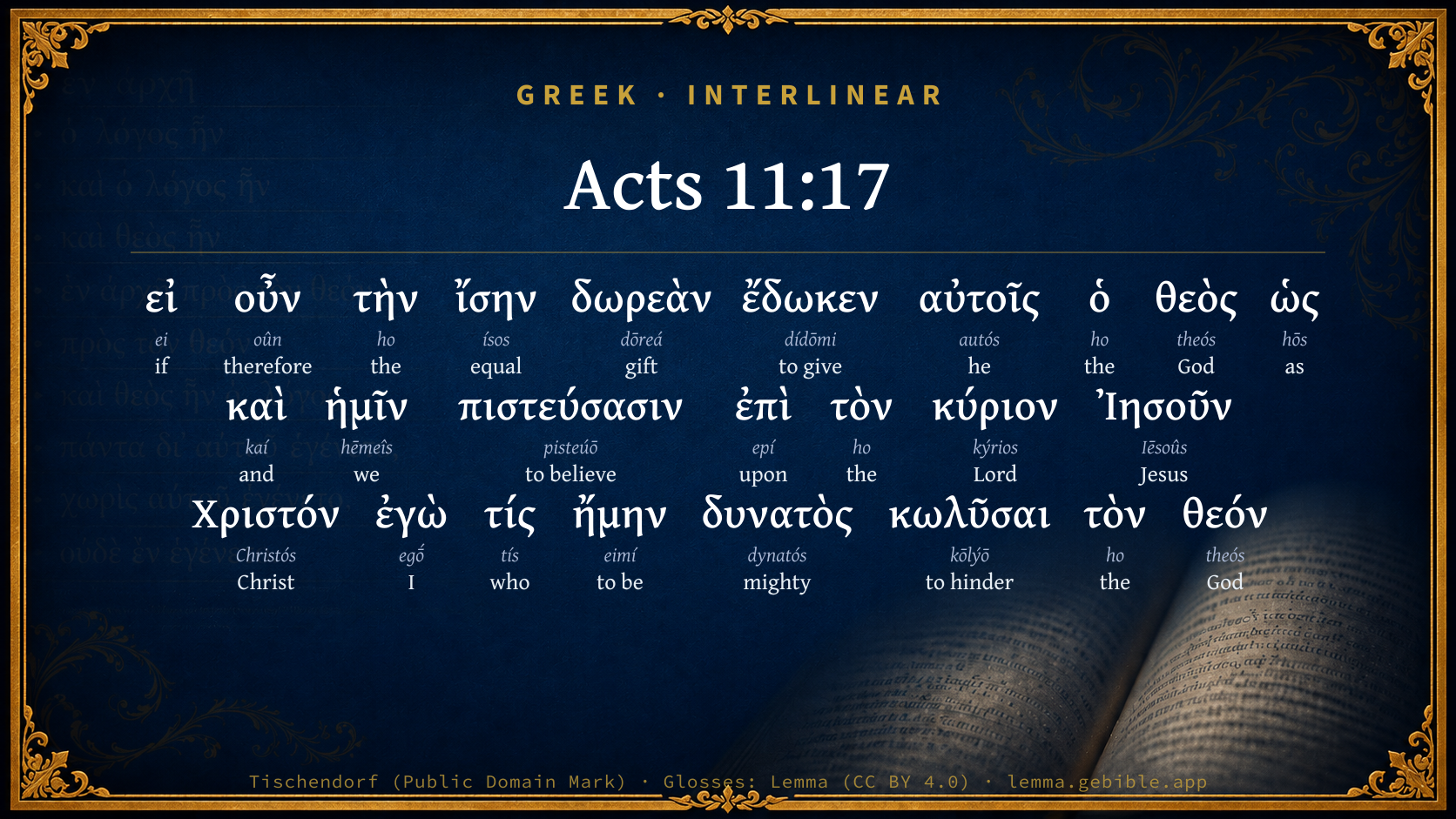
Greek (Tischendorf 8th ed.) Acts 11:17 appears in the Greek New Testament. The text above is from the Tischendorf 8th edition. Each word links to its Strong’s number and a concise gloss. Click any word for its full Thayer’s Greek Lexicon entry.
Download image
Cite this verse

Acts 11:17 (World English Bible). Public Domain. Lemma interlinear Bible study tool, https://lemma.gebible.app/v/acts/11/17.

Show BibTeX & RIS
BibTeX
RIS
English Translation
If then God gave to them the same gift as us, when we believed in the Lord Jesus Christ, who was I, that I could withstand God?"
World English Bible · Public Domain
Download a study sheet

One document with this verse’s original text, its word-by-word gloss line, the meaning frame, cross-references with their text, attributed commentary, and full source and license credits — printable, and it pastes into notes with its structure intact.

This verse Autodidact and up

Study sheet (.html) Plain text (.txt)

A passage Seminary Student

Up to 50 verses in one chapter. A passage sheet keeps up to 6 commentary sources and 12 cross-references per verse, in the order this page ranks them, and says so on the sheet whenever that leaves anything out. Ask for a single verse and you get the Autodidact verse sheet above.

Everything on this page stays free to read, with no account — the sheet is a download of what is already on screen, not access to it.

Want to remove ads? Support Godless Engineer
Compare translations 3

The same verse in 3 English versions, stacked beneath the original-language interlinear above. Click any original word for its lexicon entry.

Each is an independent rendering of the whole verse — the interlinear is not word-aligned to these translations.

Highlighted words mark where these versions differ — a whole-verse word diff, not a word-by-word alignment.

  • World English Bible Public Domain
    If then God gave to them the same gift as us, when we believed in the Lord Jesus Christ, who was I, that I could withstand God?"
  • King James Version Public Domain
    Forasmuch then as God gave them the like gift as he did unto us, who believed on the Lord Jesus Christ; what was I, that I could withstand God?
  • unfoldingWord Literal Text CC BY-SA 4.0
    If, therefore, God gave to them the same gift as also to us having believed on the Lord Jesus Christ, I, who was I able to hinder God?”

unfoldingWord Literal Text — © unfoldingWord, licensed CC BY-SA 4.0. Word-aligned USFM3 via Door43 (git.door43.org/unfoldingWord/en_ult).

Versions to compare (up to 4)

3 of 4 selected

Show all 19 translations

Every available English version of this verse, each an independent rendering of the whole verse.

  • World English Bible Public Domain
    If then God gave to them the same gift as us, when we believed in the Lord Jesus Christ, who was I, that I could withstand God?"
  • Berean Standard Bible Public Domain
    So if God gave them the same gift He gave us who believed in the Lord Jesus Christ, who was I to hinder the work of God?”
  • Majority Standard Bible Public Domain
    So if God gave them the same gift He gave us who believed in the Lord Jesus Christ, who was I to hinder the work of God?”
  • King James Version Public Domain
    Forasmuch then as God gave them the like gift as he did unto us, who believed on the Lord Jesus Christ; what was I, that I could withstand God?
  • American Standard Version (1901) Public Domain
    If then God gave unto them the like gift as `he did' also unto us, when we believed on the Lord Jesus Christ, who was I, that I could withstand God?
  • Revised Version (1885) Public Domain
    If then God gave unto them the like gift as he did also unto us, when we believed on the Lord Jesus Christ, who was I, that I could withstand God?
  • Geneva Bible (1599) Public Domain
    For as much then as God gaue them a like gift, as he did vnto vs, when we beleeued in the Lord Iesus Christ, who was I, that I coulde let God?
  • Douay-Rheims (1899) Public Domain
    If then God gave them the same grace, as to us also who believed in the Lord Jesus Christ; who was I, that could withstand God?
  • Young's Literal Translation Public Domain
    if then the equal gift God did give to them as also to us, having believed upon the Lord Jesus Christ, I -- how was I able to withstand God?'
  • Literal Standard Version CC BY-SA 4.0
    if then God gave to them the equal gift as also to us, having believed on the Lord Jesus Christ, I—how was I able to withstand God?”
  • Unlocked Literal Bible CC BY-SA 4.0
    Then if God gave to them the same gift as he gave to us when we believed on the Lord Jesus Christ, who was I, that I could oppose God?”
  • unfoldingWord Literal Text CC BY-SA 4.0
    If, therefore, God gave to them the same gift as also to us having believed on the Lord Jesus Christ, I, who was I able to hinder God?”
  • Darby Bible Public Domain
    If then God has given them the same gift as also to us when we had believed on the Lord Jesus Christ, who indeed was *I* to be able to forbid God?
  • World Messianic Bible Public Domain
    If then God gave to them the same gift as us when we believed in the Lord Yeshua the Messiah, who was I, that I could withstand God?”
  • Webster's Bible Public Domain
    Forasmuch then as God gave them the like gift as he did to us, who believed on the Lord Jesus Christ, what was I that I could withstand God?
  • Free Bible Version CC BY-SA 4.0
    Since God gave them the same gift as he gave us when we trusted in the Lord Jesus Christ, what power did I have to oppose God?”
  • Bible in Basic English Public Domain
    If then God gave them, when they had faith in the Lord Jesus Christ, the same as he gave to us, who was I to go against God?
  • Text-Critical English NT CC BY 4.0
    If then God gave them the same gift that he gave us when we believed in the Lord Jesus Christ, how could I stand in God's way?”
  • Tyndale New Testament (1534) Public Domain
    For as moche then as God gave the lyke gyftes as he dyd vnto vs when we beleved on the Lorde Iesus Christ: what was I that I shuld have with stonde God?

Literal Standard Version (2020), Covenant Press — licensed CC BY-SA 4.0. Text via the HelloAO Bible API (eBible.org). Unlocked Literal Bible (unfoldingWord) — licensed CC BY-SA 4.0. Text via the HelloAO Bible API (eBible.org). unfoldingWord Literal Text — © unfoldingWord, licensed CC BY-SA 4.0. Word-aligned USFM3 via Door43 (git.door43.org/unfoldingWord/en_ult). Free Bible Version, Dr. Jonathan Gallagher — licensed CC BY-SA 4.0. Text via the HelloAO Bible API (eBible.org).

Word by word

More ways to search: Search by grammar → Find every occurrence → Compare this word →

Practice this passage: Drill this verse → Learn its vocabulary →

ἴσην
ísos
G2470
“equal”
Adjective, Accusative, Singular, Feminine
Part of Speech
Adjective
Case
Accusative
Number
Singular
Gender
Feminine
Full Thayer's Definition

Origin: probably from G1492 (through the idea of seeming)

TDNT: 08:43,4

1. equal, in quantity or quality
  1. εἰ ei G1487 “if” Conditional
  2. οὖν oûn G3767 “therefore” Conjunction
  3. τὴν ho G3588 “the” Article, Accusative, Singular, Feminine
  4. δωρεὰν dōreá G1431 “gift” Noun, Accusative, Singular, Feminine
  5. ἔδωκεν dídōmi G1325 “to give” Verb, Aorist, Active, Indicative, 3rd person, Singular
  6. αὐτοῖς autós G846 “he” Personal pronoun, Dative, Plural, Masculine
  7. ὁ ho G3588 “the” Article, Nominative, Singular, Masculine
  8. θεὸς theós G2316 “God” Noun, Nominative, Singular, Masculine
  9. ὡς hōs G5613 “as” Adverb
  10. καὶ kaí G2532 “and” Conjunction
  11. ἡμῖν hēmeîs G2249 “we” Personal pronoun, 1st person, Dative, Plural
  12. πιστεύσασιν pisteúō G4100 “to believe” Verb, Aorist, Active, Participle, Dative, Plural, Masculine
  13. ἐπὶ epí G1909 “upon” Preposition
  14. τὸν ho G3588 “the” Article, Accusative, Singular, Masculine
  15. κύριον kýrios G2962 “Lord” Noun, Accusative, Singular, Masculine
  16. Ἰησοῦν Iēsoûs G2424 “Jesus” Noun, Accusative, Singular, Masculine
  17. Χριστόν Christós G5547 “Christ” Noun, Accusative, Singular, Masculine
  18. ἐγὼ egṓ G1473 “I” Personal pronoun, 1st person, Nominative, Singular
  19. τίς tís G5101 “who” Interrogative pronoun, Nominative, Singular, Masculine
  20. ἤμην eimí G1510 “to be” Verb, Imperfect, Middle, Indicative, 1st person, Singular
  21. δυνατὸς dynatós G1415 “mighty” Adjective, Nominative, Singular, Masculine
  22. κωλῦσαι kōlýō G2967 “to hinder” Verb, Aorist, Active, Infinitive
  23. τὸν ho G3588 “the” Article, Accusative, Singular, Masculine
  24. θεόν theós G2316 “God” Noun, Accusative, Singular, Masculine

About this verse

These counts appear in no published source. They are computed here, from the morphology-tagged text and Lemma’s own curated glosses. What Lemma adds →

25
words
21
distinct lemmas
Acts
section

Notable vocabulary

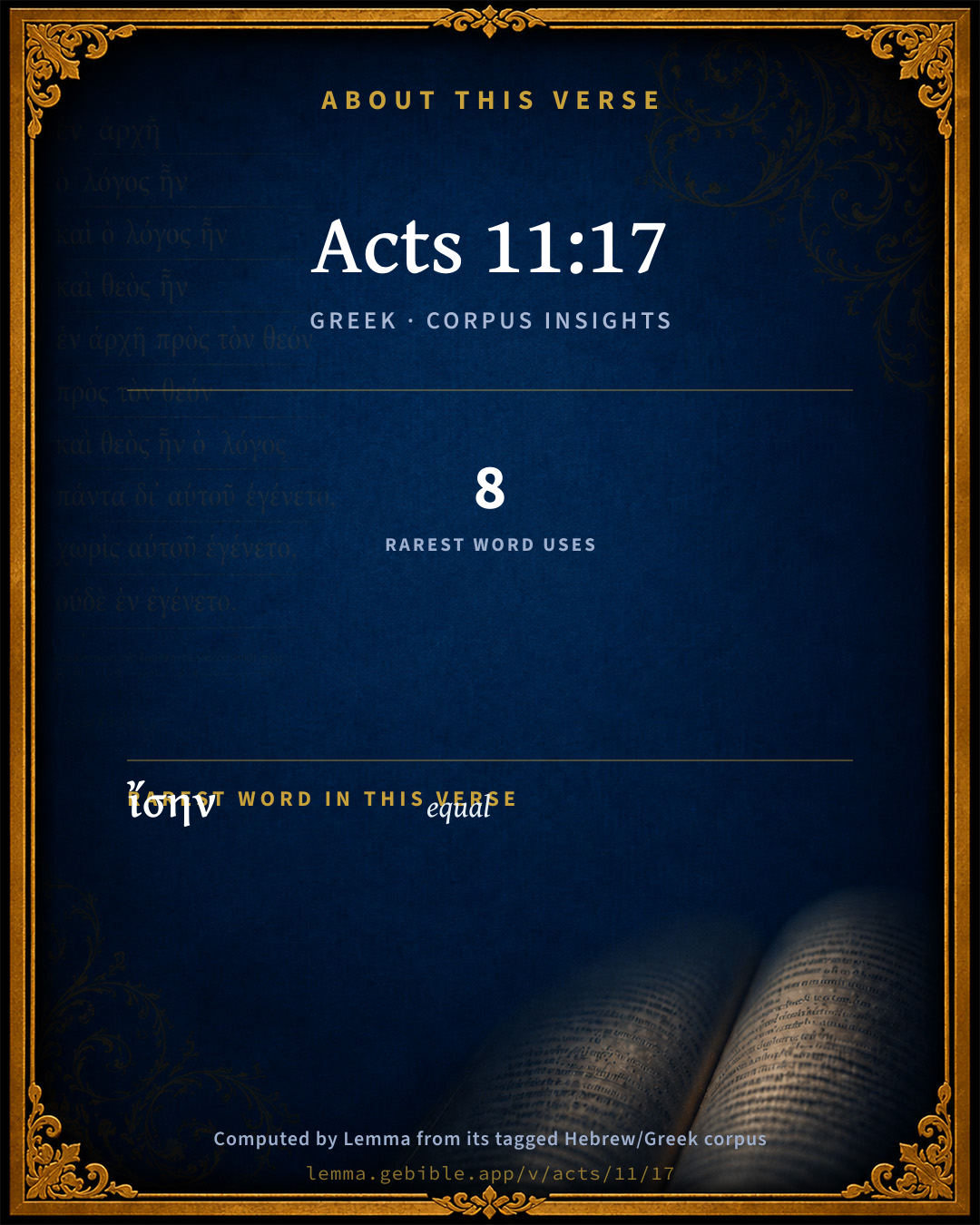
The rarest word here is ἴσην equal G2470 — appearing just 8 times in the whole Greek New Testament.

Shared distinctive vocabulary

ἴσην equal G2470 occurs in 8 verses of the Greek New Testament. Also found in:

Repetition

Words recur within this verse:

Cross-references

14

Topical passages linked to Acts 11:17 in the Treasury of Scripture Knowledge — connected by theme and wording, ordered by reader-vote popularity; previews shown in the World English Bible.

  • Acts 10:47 "Can any man forbid the water, that these who have received the Holy Spirit as well as we should not be baptized?"
  • Romans 9:20–26 But indeed, O man, who are you to reply against God? Will the thing formed ask him who formed it, "Why did you make me like this?"
  • Job 33:13 Why do you strive against him, Because he doesn't give account of any of his matters?
  • Daniel 4:35 All the inhabitants of the earth are reputed as nothing; and he does according to his will in the army of heaven, and among the inhabitants of the earth; and none can stay his hand, or tell him, What do you?
  • Acts 15:8–9 God, who knows the heart, testified about them, giving them the Holy Spirit, just like he did to us.
  • Romans 9:15–16 For he said to Moses, "I will have mercy on whom I have mercy, and I will have compassion on whom I have compassion."
  • Romans 11:34–36 "For who has known the mind of the Lord? Or who has been his counselor?"
  • Job 9:12–14 Behold, he snatches away; who can hinder him? Who will ask him, 'What are you doing?'
  • Job 40:2 "Shall he who argues contend with the Almighty? He who argues with God, let him answer it."
  • Job 40:8–9 Will you even annul my judgment? Will you condemn me, that you may be justified?
  • Matthew 20:14–15 Take that which is yours, and go your way. It is my desire to give to this last just as much as to you.
  • Acts 5:39 But if it is of God, you will not be able to overthrow it, and you would be found even to be fighting against God!"
  • Acts 10:45 They of the circumcision who believed were amazed, as many as came with Peter, because the gift of the Holy Spirit was also poured out on the Gentiles.
  • Acts 11:15 As I began to speak, the Holy Spirit fell on them, even as on us at the beginning.

Cross-references courtesy of OpenBible.info (CC BY 4.0).

Commentary

Notes on Acts 11:17 from classic Christian and Jewish commentators (each source and its license shown beneath its notes). The classic Christian expositions comment on the surrounding passage and are grouped to its opening verse, so a note may address several verses; the Jewish commentaries on the Tanakh (Rashi and others) are per-verse, so they appear only where the commentator wrote on this verse.

Lemma curates 59 commentaries, every one of them public domain or Creative Commons licensed, each selected and text-cleaned for this edition rather than reprinted as found. About our sources →

Bengel's Gnomon

Johann Albrecht Bengel

Act 11:17. Τὴν ἴσην, the like) So 2Pe 1:1. They are alike blessed, who have received the Holy Spirit immediately (without the mediation of ordinances) or mediately.—ἡμῖν, πιστεύσασιν, unto us who believed, i.e. when we believed) It was not, saith he, because we had circumcision, but because we had faith, that the Holy Spirit was given to us.—ἐγὼ, I) I, a mere instrument. The brethren had asked only concerning his having taken food with the Gentiles: Peter gives them also a satisfactory account concerning his having conferred baptism on them; and establishes the certainty that he had acted rightly, not only from the Divine command, but also from the event, which had been crowned by the Divine blessing.

Bengel's Gnomon of the New Testament — English translation (T&T Clark, Edinburgh, 1860) — public domain. Text from a community e-Sword module.

Expositor's Greek Testament

ed. W. Robertson Nicoll

Act 11:17 . πιστεύσασιν , see R.V., best to take participle as referring both to αὐτοῖς and to ἡμῖν ; in each case the Holy Spirit was bestowed, and in each case as a result of the preceding belief, not as a result of circumcision, or of uncircumcision; sometimes referred to ἡμῖν , so Bengel, Nösgen, Wendt, sometimes to αὐτοῖς , so Weiss, Blass. τίς ἤμην δ ., cf. Exo 3:11 , 2Ki 8:13 , Blass, Gram. , p. 173; in reality two questions: Who was I? Was I able to withstand God? Winer-Moulton, lxvi., 5. ἐγὼ , emphatic, “merum organon,” Bengel.

The Expositor's Greek Testament, edited by W. Robertson Nicoll (1897–1910) — public domain. Text from a community e-Sword module.

Adam Clarke's Commentary

Verse 17. God gave them the like gift, c.] Viz. the Holy Spirit, and its various gifts and graces, in the same way and in the same measure in which he gave them to us Jews. What was I, that I could withstand God? It was not I who called them to salvation: it was God and the thing is proved to be from God alone, for none other could dispense the Holy Spirit.

Adam Clarke's Commentary on the Bible (1810–1826) — public domain. Text from a community e-Sword/MySword module.

John Calvin's Commentaries

17. Who was I? Now do we see to what end Peter made that narration; to wit, that he might declare that God was the author and governor of all the whole matter; therefore, the state of the question consisteth in [turneth upon] the authority of God, whether meat be not of more weight than men’s counsels. Peter affirmeth that he did nothing but that which was rightly and orderly done, because he obeyed God; he showeth that he preached the doctrine of the gospel, neither amiss, neither rashly, where Christ bestowed the graces of his Spirit. The approbation of our doctrine, and also our deeds, must be brought to this rule so often as men call us to an account; for whosoever stayeth himself upon the commandment of God, he hath defense enough. If men be not content, there is no cause why he should pass for their judgments any more. And hereby we gather that the faithful ministers of God’s word may in such sort give an account of their doctrine, that they may no whit impair the credit and certainty thereof; to wit, if they show that it was given them by God: but if they shall deal with unjust men, who will not be enforced with the reverence of God to yield, let us let them alone with their obstinacy, appealing unto the day of the Lord.

And we must also note, that we do not only resist God by striving against him, but also by lingering, if we do not that which our calling requireth, and which is proper to it. For Peter saith that he cannot deny baptism and brotherly fellowship to the Gentiles, but that he should be [without being] an enemy to God. But he should have essayed nothing which was manifestly contrary to the grace of God. That is true indeed; but he which doth not receive those whom God offereth, and shutteth the gate which God openeth, he hindereth the work of God so much as in him lieth; as we say at this day, that those men make war against God who are set against the baptizing of infants; because they most cruelly exclude those out of the Church whom God hath adopted into the Church, and they deprive those of the outward sign whom God vouchsafeth to call his children. Like unto this is that kind of resisting, in that many dissemblers, who, whilst they be magistrates, ought to assist, according to their office, the martyrs of Christ, go about to stop their mouths, and to take from them their liberty. For because they hate the truth, they would have it suppressed.

John Calvin's Commentaries (1540-1563) — public domain. Text from the Calvin Translation Society English edition (1840s-50s) via the Christian Classics Ethereal Library (ccel.org). Calvin's coverage is partial (roughly two-thirds of the Bible); uncommented books and verses are honest gaps, never fabricated. The 19th-century editor's footnotes and remarks are omitted so the notes are faithfully Calvin's own voice.

Ellicott's Commentary for English Readers

(17) Forasmuch then . . .—More accurately, If then.

Unto us, who believed on the Lord Jesus Christ.—The Greek construction gives a somewhat different meaning: If then God gave to them an equal gift as to us, upon their believing . . . That condition was sufficient in their case for the greater gifts, and their admissibility to baptism and to general fellowship followed naturally as a thing of course.

What was I, that I could withstand God?—The Greek gives a complex question, Who was I? Able to withstand God?—i.e., How was I, being such a one as I am, able to withstand?

A Bible Commentary for English Readers, edited by Charles John Ellicott (1878–1897) — public domain. Text from a community e-Sword module.

The Cambridge Bible for Schools and Colleges

gen. ed. J. J. S. Perowne

17. who believed] The words refer alike to “them” and to “us,” and so the two cases are made parallel, as in Act_11:15. For just as in the case of Peter and the Apostles, their faith was existing before the gift of the Spirit, so in Cornelius and in his companions there existed a degree of faith, or there could have been no sincere prayer offered by them.

The Cambridge Bible for Schools and Colleges (gen. ed. J. J. S. Perowne; Cambridge University Press, 1878–1918) — public domain. Text from a community e-Sword module.

John Gill's Exposition

When they heard these things,.... Peter's vision at Joppa, and Cornelius's at Caesarea, and the wonderful pouring forth of the Spirit upon these Gentiles under Peter's sermon:

they held their peace; and ceased contending and disputing with Peter, or blaming him for his conduct; for otherwise they were not silent, but made use of their tongues:

and glorified God; praised his name, adored his rich grace, and gave him the glory of all the wonderful things related to them:

saying, then hath God also to the Gentiles granted repentance unto life. The phrase "unto life", is left out in the Ethiopic version, which only reads, "God hath also given to the Gentiles that they should repent"; but it ought not to be omitted, being in the Greek copies in general, and of considerable moment, rightly understood; the Arabic version directs to a wrong sense of it, "perhaps God hath given also to the Gentiles repentance, that they may live by it"; the word "perhaps", is very wrongly put instead of "then", which affirms that God had given them repentance, whereas this makes a doubt of it; and upon a supposition of it, the version ascribes too much to it; for it is not by repentance that men live spiritually, but by faith in Christ Jesus; nor do they obtain eternal life by it, but by Christ; though true repentance is an evidence of spiritual life, and it begins with it, for as soon as ever God quickens a sinner, he shows him the evil of sin, and gives him repentance for it: "repentance" here designs the grace of evangelical repentance, which is attended with faith in Christ, as it was in these Gentiles, and with views of pardon in Christ, and which springs from the love of God, and this is "unto life"; is a repentance from dead works, and is attended with a life of faith, and issues in eternal life: and it is also a "grant" from God; it is not in the power of man's free will, who though he may have time and means, yet if he has not grace given him to repent, he never will; his heart is hard and obdurate, and no means will do without an almighty power; not the most severe judgments, nor the greatest mercies, nor the most powerful ministry; it is a pure gift of God's free grace, and a blessing of the covenant of grace: and this being given to Gentiles, shows that the covenant of grace belongs to them, as well as to the Jews; and discovers a false opinion of the Jews, that the Gentiles should not be saved; and answers the design of the Gospel being sent among them, whereby the doctrines both of repentance and remission are preached unto them; and opens the glorious mystery of the calling of them, and may encourage sinners of the Gentiles to hope for this grace, and apply to Christ for it, who is exalted to give it.

John Gill's Exposition of the Whole Bible (1746–1763) — public domain (CC PDM 1.0). Text via the HelloAO Bible API.

Trapp's Complete Commentary

John Trapp

17 Forasmuch then as God gave them the like gift as he did unto us, who believed on the Lord Jesus Christ; what was I, that I could withstand God?

Ver. 17. What was I that I could withstand God?] Whose power is irresistible, whose will is a law, yea, Voluntas Dei, necessitas rei: and God hath put a secret instinct (as into the bee, the stork, and other creatures to do their kind, so) into all his children to submit to his will, to say Amen to God’s Amen, and to put their fiat let it be done, and placet it is pleasing, to his, Act 21:14.

John Trapp, A Commentary or Exposition upon All the Books of the Old and New Testament (1647–1656) — public domain. Text from a community e-Sword module.

Albert Barnes' Notes on the Bible

What was I - What power or right had I to oppose the manifest will of God that the Gentiles should be received into the Christian church.

Withstand God - Oppose or resist God. He had indicated his will; he had showed his intention to save the Gentiles; and the prejudices of Peter were all overcome. One of the best means of destroying prejudice and false opinions is a powerful revival of religion. More erroneous doctrines and unholy feelings are overcome in such scenes than in all the bigoted and fierce contentions that have ever taken place. If people wish to root error out of the church, they should strive by all means to promote everywhere revivals of pure and undefiled religion. The Holy Spirit more easily and effectually silences false doctrine, and destroys heresy, than all the denunciations of fierce theologians; all the alarms of heated zealots for orthodoxy; and all the anathemas which professed love for the purity of the church ever utters from the icebergs on which such champions usually seek their repose and their home.

Albert Barnes' Notes on the Bible (1834–1885) — public domain. Text from a community e-Sword/MySword module.

Matthew Poole's English Annotations

The apostle’s argument is cogent: They who have the grace signified by baptism, ought to have the seal of that grace; but the Gentiles had the grace signified by baptism. Or, they who have the inward baptism, may not be denied the outward. As he that hath a right to an inheritance, cannot without injustice be denied the writings and seals thereunto belonging. To deny baptism unto any unto whom it doth belong, is to

withstand God, and to keep back the token of God’s love from such unto whom it is sent.

Matthew Poole's English Annotations on the Holy Bible (1683–1685) — public domain. Text from a community e-Sword/MySword module.

Whedon's Commentary on the Bible

Daniel D. Whedon

17. I could withstand God?—By this question, in the first person, Peter involves the disputants in the predicament of withstanding God, and by that they are for the time being silenced. (See note on Rom_9:20.)

Daniel D. Whedon (gen. ed.), Commentary on the Old and New Testaments (1874–1909) — public domain. Text from a community e-Sword module.

The Pulpit Commentary

If for forasmuch as, A.V.; unto them for them, A.V.; did also for did, A.V.; when we for who, A.V.; who for what, A.V. The saying, Who was I, that I could withstand (kwlusai)? corresponds to Act_10:47, "Can any man forbid (kwlusai) water?"

The Pulpit Commentary (1880–1919), ed. H.D.M. Spence-Jones & Joseph S. Exell — public domain. Text from a community e-Sword module.

John Wesley's Explanatory Notes

To us, when we believed - The sense is, because we believed, not because we were circumcised, was the Holy Ghost given to us. What was I - A mere instrument in God's hand. They had inquired only concerning his eating with the Gentiles. He satisfies them likewise concerning his baptizing them, and shows that he had done right in going to Cornelius, not only by the command of God, but also by the event, the descent of the Holy Ghost. And who are we that we should withstand God? Particularly by laying down rules of Christian communion which exclude any whom he has admitted into the Church of the first born, from worshipping God together. O that all Church governors would consider how bold an usurpation this is on the authority of the supreme Lord of the Church! O that the sin of thus withstanding God may not be laid to the charge of those, who perhaps with a good intention, but in an over fondness for their own forms, have done it, and are continually doing it.

John Wesley, Explanatory Notes Upon the Whole Bible (1754–1765) — public domain. Text via the GEBible commentary corpus.

Godbey's Commentary on the New Testament

William B. Godbey

17. “If therefore God gave unto them the like gift as even unto us. . .” This declaration of Peter, with many other parallels, settles the question beyond the possibility of cavil that the Gentiles at the house of Cornelius received precisely what the apostles did on the day of Pentecost. They were Gentiles, representative of the whole Gentile world down to the end of time. Hence you see that the above mentioned heresy flatly contradicts Peter and the Holy Ghost. It is a subtle trick of the devil to keep people from receiving the baptism of the Holy Ghost, so he will get them.

William B. Godbey, Commentary on the New Testament (1896–1900) — public domain. Text from a community e-Sword module.

McGarvey & Pendleton's Commentaries

J. W. McGarvey

See notes one verse 4

J. W. McGarvey (with Philip Y. Pendleton), Commentaries on the New Testament (The Fourfold Gospel, 1914; Acts; and the epistles) — public domain. Text from a community e-Sword/MySword module.

unfoldingWord translationNotes

Door43 World Missions Community

Connecting Statement:

Peter finishes his speech (which he began in Acts 11:4) to the Jews about his vision and about what had happened at the house of Cornelius.

General Information:

The word "them" refers to Cornelius and his Gentile guests and household. Peter does not call them Gentiles in his account to the Jewish believers at Jerusalem.

General Information:

The word "they" refers to the Jewish believers to whom Peter spoke. The word "us" includes all of the Jewish believers. (See: Inclusive "We")

Then if God gave to them ... who was I, that I could oppose God?

Peter uses this question to emphasize that he was only obeying God. AT: "Since God gave to them ... I decided that I could not oppose God!" (See: Rhetorical Question)

the same gift

Peter refers to the gift of the Holy Spirit.

they said nothing in response

"they did not argue with Peter"

God has given repentance for life to the Gentiles also

"God has given repentance that leads to life to the Gentiles also." Here "life" refers to eternal life. The abstract nouns "repentance" and "life" can be translated as the verbs "repent" and "live." AT: "God has allowed the Gentiles also to repent and live eternally" (See: Abstract Nouns)

translationWords

gift

believe

lord

Jesus

praise

repent

life

Gentile

unfoldingWord translationNotes — © Distant Shores Media and the Door43 World Missions Community, licensed CC BY-SA 4.0. Source: git.door43.org/Door43/en_tn.

Cambridge Greek Testament for Schools and Colleges

17. πιστεύσασιν, who believed. The participle refers alike to the preceding αὐτοῖς and ἡμῖν, and thus the two cases are made parallel exactly as in the narrative of Act 11:15. For just as in the case of Peter and the Apostles, their faith was existing before the gift of the Spirit, so in Cornelius and in his companions there existed a degree of faith, or there could have been no sincere prayer offered by them.

ἐγὼ τίς ἤμην δυνατὸς κωλῦσαι τὸν θεόν; who was I that I could withstand God? There are in reality two questions here merged into one. Who was I? Was I able to withstand …? So also Luk 19:15 τίς τί διεπραγματεύσατο = who had traded, and what he had made thereby.

Cambridge Greek Testament for Schools and Colleges (Cambridge University Press, 1896; 21 vols, various authors incl. Carr, Maclear, Plummer, Farrar, Lumby, Moule, M. R. James, Simcox) — public domain. Text from a community e-Sword module.

Alford’s Greek Testament

Henry Alford

17.] πιστεύσασιν belongs to both αὐτοῖς and ἡμῖν; setting forth the strict analogy between the cases, and the community of the faith to both.

[δέ (omitted in some mss., the transcribers perhaps not being aware of the construction) brings out the contrast after εἰ οὖν, as frequently after ἐπεί, e.g. Od. ξ. 178, τὸν ἐπεὶ θρέψαν θεοί, ἔρνεϊ ἶσον … τοῦ δέ τις ἀθανάτων βλάψε φρένας ἔνδον ἐΐσας: Herod. iii. 68, εἰ μὴ αὐτὴ Σμέρδιν.… γινώσκεις, σὺ δὲ παρὰ Ἀτόσσης πύθου. See more examples in Hartung, Partikellehre, i. p. 184.]

τίς ἤμην δυν.] A junction of two questions: (1) Who was I that I should.…, as ref. Exod.,—and (2) Was I able to.… We have a similar instance in τίς τί ἄρῃ, Mar 15:24. See Winer, edn. 6, § 66. 5. 3.

Henry Alford, The Greek Testament (1849–1861) — public domain. Text from a community e-Sword module.

Vincent's Word Studies in the New Testament

Marvin R. Vincent

Forasmuch as [ει] . Better, as Rev., if.

The like [ισην] . Lit., equal; making them, equally with us, recipients of the Holy Spirit.

Marvin R. Vincent, Word Studies in the New Testament (1887–1900) — public domain. Text from a community e-Sword/MySword module.

Lesson kit

Teaching starters — assembled from the data on this page, not authored interpretation. Every prompt links to the verse data it draws on. Edit before teaching.

Acts, in the Acts, opens this verse with 25 words (21 distinct Greek lemmas). Its most distinctive word is ísos (“equal”). A historical commentator’s framing appears above. Read the whole chapter for the surrounding context.

Discussion questions

  1. How does “equal” (ísos) shape what this verse is saying?
  2. How does Matthew 20:12, which shares the word «equal», read alongside this verse?
  3. What does the repetition of “God” (2× in this one verse) do in this verse?
  4. These translations render this verse differently; the difference is in the English rendering, not the original. What questions does that raise?
  5. Compare how Bengel's Gnomon and Expositor's Greek Testament read this verse. Where do they agree or differ?

Things to notice

Reading settings

Reading text

Shown beneath each verse's original-language words.

Old Testament
Old Testament edition

Read the OT as the Masoretic Hebrew (MT) or the Greek Septuagint (LXX).

English shown for the Greek Septuagint (in the Hebrew ↔ Greek comparison).

Comparing translations? Open the Compare panel on any verse page to stack up to four side by side.