
1 Samuel 2:35

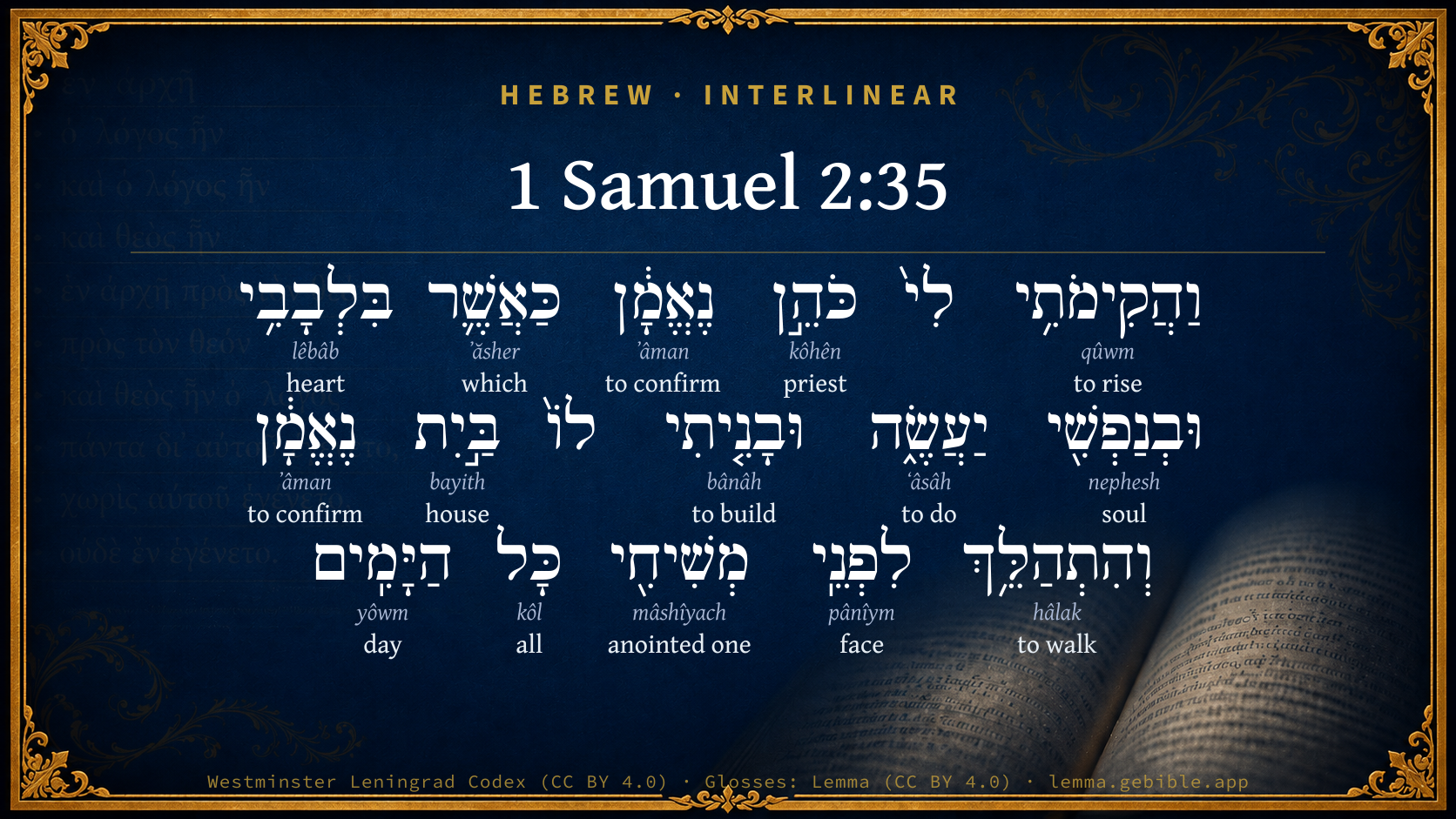
Hebrew (Westminster Leningrad Codex) 1 Samuel 2:35 appears in the Hebrew Old Testament. The text above is from the Westminster Leningrad Codex. Each word links to its Strong’s number, a concise gloss, and parsing drawn from the Open Scriptures Hebrew Bible morphology. Click any word for its full Brown-Driver-Briggs (BDB) entry.
Download image
Cite this verse

1 Samuel 2:35 (World English Bible). Public Domain. Lemma interlinear Bible study tool, https://lemma.gebible.app/v/1-samuel/2/35.

Show BibTeX & RIS
BibTeX
RIS
English Translation
I will raise me up a faithful priest, that shall do according to that which is in my heart and in my mind: and I will build him a sure house; and he shall walk before my anointed forever.
World English Bible · Public Domain
Download a study sheet

One document with this verse’s original text, its word-by-word gloss line, the meaning frame, cross-references with their text, attributed commentary, and full source and license credits — printable, and it pastes into notes with its structure intact.

This verse Autodidact and up

Study sheet (.html) Plain text (.txt)

A passage Seminary Student

Up to 50 verses in one chapter. A passage sheet keeps up to 6 commentary sources and 12 cross-references per verse, in the order this page ranks them, and says so on the sheet whenever that leaves anything out. Ask for a single verse and you get the Autodidact verse sheet above.

Everything on this page stays free to read, with no account — the sheet is a download of what is already on screen, not access to it.

Want to remove ads? Support Godless Engineer
Compare translations 3

The same verse in 3 English versions, stacked beneath the original-language interlinear above. Click any original word for its lexicon entry.

Each is an independent rendering of the whole verse — the interlinear is not word-aligned to these translations.

Highlighted words mark where these versions differ — a whole-verse word diff, not a word-by-word alignment.

  • World English Bible Public Domain
    I will raise me up a faithful priest, that shall do according to that which is in my heart and in my mind: and I will build him a sure house; and he shall walk before my anointed forever.
  • King James Version Public Domain
    And I will raise me up a faithful priest, that shall do according to that which is in mine heart and in my mind: and I will build him a sure house; and he shall walk before mine anointed for ever.
  • unfoldingWord Literal Text CC BY-SA 4.0
    And I will raise up for myself a faithful priest. He will do just as in my heart and in my soul. And I will build for him an established house, and he will walk about to the face of my anointed all of the days.

unfoldingWord Literal Text — © unfoldingWord, licensed CC BY-SA 4.0. Word-aligned USFM3 via Door43 (git.door43.org/unfoldingWord/en_ult).

Versions to compare (up to 4)

3 of 4 selected

Show all 18 translations

Every available English version of this verse, each an independent rendering of the whole verse.

  • World English Bible Public Domain
    I will raise me up a faithful priest, that shall do according to that which is in my heart and in my mind: and I will build him a sure house; and he shall walk before my anointed forever.
  • Berean Standard Bible Public Domain
    Then I will raise up for Myself a faithful priest. He will do whatever is in My heart and mind. And I will build for him an enduring house, and he will walk before My anointed one for all time.
  • Majority Standard Bible Public Domain
    Then I will raise up for Myself a faithful priest. He will do whatever is in My heart and mind. And I will build for him an enduring house, and he will walk before My anointed one for all time.
  • King James Version Public Domain
    And I will raise me up a faithful priest, that shall do according to that which is in mine heart and in my mind: and I will build him a sure house; and he shall walk before mine anointed for ever.
  • American Standard Version (1901) Public Domain
    And I will raise me up a faithful priest, that shall do according to that which is in my heart and in my mind: and I will build him a sure house; and he shall walk before mine anointed for ever.
  • Revised Version (1885) Public Domain
    And I will raise me up a faithful priest, that shall do according to that which is in mine heart and in my mind: and I will build him a sure house; and he shall walk before mine anointed for ever.
  • Geneva Bible (1599) Public Domain
    And I will stirre me vp a faithfull Priest, that shall do according to mine heart and according to my minde: and I wil build him a sure house, and he shall walke before mine Anointed for euer.
  • Douay-Rheims (1899) Public Domain
    And I will raise me up a faithful priest, who shall do according to my heart, and my soul, and I will build him a faithful house, and he shall walk all days before my anointed.
  • Young's Literal Translation Public Domain
    and I have raised up for Me a stedfast priest; as in My heart and in My soul he doth do; and I have built for him a stedfast house, and he hath walked up and down before Mine anointed all the days;
  • Literal Standard Version CC BY-SA 4.0
    and I have raised up a steadfast priest for Myself; he does as in My heart and in My soul; and I have built a steadfast house for him, and he has walked up and down before My anointed all the days;
  • Unlocked Literal Bible CC BY-SA 4.0
    I will raise up for myself a faithful priest who will do what is in my heart and in my soul. I will build him a sure house; and he will walk before my anointed king forever.
  • unfoldingWord Literal Text CC BY-SA 4.0
    And I will raise up for myself a faithful priest. He will do just as in my heart and in my soul. And I will build for him an established house, and he will walk about to the face of my anointed all of the days.
  • Darby Bible Public Domain
    And I will raise up for myself a faithful priest, [who] shall do according to what is in my heart and in my mind; and I will build him a sure house; and he shall walk before mine anointed continually.
  • World Messianic Bible Public Domain
    I will raise up a faithful priest for myself who will do according to that which is in my heart and in my mind. I will build him a sure house. He will walk before my anointed forever.
  • Webster's Bible Public Domain
    And I will raise me up a faithful priest, that shall do according to that which is in my heart and in my mind: and I will build him a sure house; and he shall walk before my Anointed for ever.
  • Free Bible Version CC BY-SA 4.0
    I will choose for myself a trustworthy priest who will do what I really want, what I have in mind. I will make sure he and his descendants are trustworthy and they will always serve my anointed one.
  • Bible in Basic English Public Domain
    And I will make a true priest for myself, one who will do what is in my heart and in my mind: and I will make for him a family which will not come to an end; and his place will be before my holy one for ever.
  • JPS Tanakh (1917) Public Domain
    And I will raise Me up a faithful priest, that shall do according to that which is in My heart and in My mind; and I will build him a sure house; and he shall walk before Mine anointed for ever.

Literal Standard Version (2020), Covenant Press — licensed CC BY-SA 4.0. Text via the HelloAO Bible API (eBible.org). Unlocked Literal Bible (unfoldingWord) — licensed CC BY-SA 4.0. Text via the HelloAO Bible API (eBible.org). unfoldingWord Literal Text — © unfoldingWord, licensed CC BY-SA 4.0. Word-aligned USFM3 via Door43 (git.door43.org/unfoldingWord/en_ult). Free Bible Version, Dr. Jonathan Gallagher — licensed CC BY-SA 4.0. Text via the HelloAO Bible API (eBible.org).

Word by word

More ways to search: Search by grammar → Find every occurrence → Compare this word →

Practice this passage: Drill this verse → Learn its vocabulary →

מְשִׁיחִ֖י
mâshîyach
H4899
“anointed one · my”
Noun, Common, Masculine, Singular, Construct + Suffix, Personal, 1st Person, Common, Singular
Part of Speech
Noun
Type
Common
Gender
Masculine
Number
Singular
State
Construct
Full BDB Definition

Origin: from H4886

TWOT: 1255c

anointed, anointed one - of the Messiah, Messianic prince - of the king of Israel - of the high priest of Israel - of Cyrus - of the patriarchs as anointed kings
  1. וַהֲקִימֹתִ֥י qûwm H6965 “and · to rise” Conjunction + Verb, Hiphil, Sequential Perfect, 1st Person, Common, Singular
  2. כֹּהֵ֣ן kôhên H3548 “priest” Noun, Common, Masculine, Singular, Absolute
  3. נֶאֱמָ֔ן ʼâman H539 “confirming” Verb, Niphal, Participle Active, Masculine, Singular, Absolute
  4. כַּאֲשֶׁ֛ר ʼăsher H834 “like/as · which” Preposition + Particle, Relative
  5. בִּלְבָבִ֥י lêbâb H3824 “in/at · heart · my” Preposition + Noun, Common, Masculine, Singular, Construct + Suffix, Personal, 1st Person, Common, Singular
  6. וּבְנַפְשִׁ֖י nephesh H5315 “and · in/at · soul · my” Conjunction + Preposition + Noun, Common, Both, Singular, Construct + Suffix, Personal, 1st Person, Common, Singular
  7. יַעֲשֶׂ֑ה ʻâsâh H6213 “to do” Verb, Qal, Imperfect, 3rd Person, Masculine, Singular
  8. וּבָנִ֤יתִי bânâh H1129 “and · to build” Conjunction + Verb, Qal, Sequential Perfect, 1st Person, Common, Singular
  9. בַּ֣יִת bayith H1004 “house” Noun, Common, Masculine, Singular, Absolute
  10. נֶאֱמָ֔ן ʼâman H539 “confirming” Verb, Niphal, Participle Active, Masculine, Singular, Absolute
  11. וְהִתְהַלֵּ֥ךְ hâlak H1980 “and · to walk” Conjunction + Verb, Hithpael, Sequential Perfect, 3rd Person, Masculine, Singular
  12. לִפְנֵֽי pânîym H6440 “to/for · face(s) of” Preposition + Noun, Common, Both, Plural, Construct
  13. כָּל kôl H3605 “all of” Noun, Common, Masculine, Singular, Construct
  14. הַיָּמִֽים yôwm H3117 “the · days” Particle, Definite Article + Noun, Common, Masculine, Plural, Absolute

About this verse

These counts appear in no published source. They are computed here, from the morphology-tagged text and Lemma’s own curated glosses. What Lemma adds →

17
words
14
distinct lemmas
Historical
section

Shared distinctive vocabulary

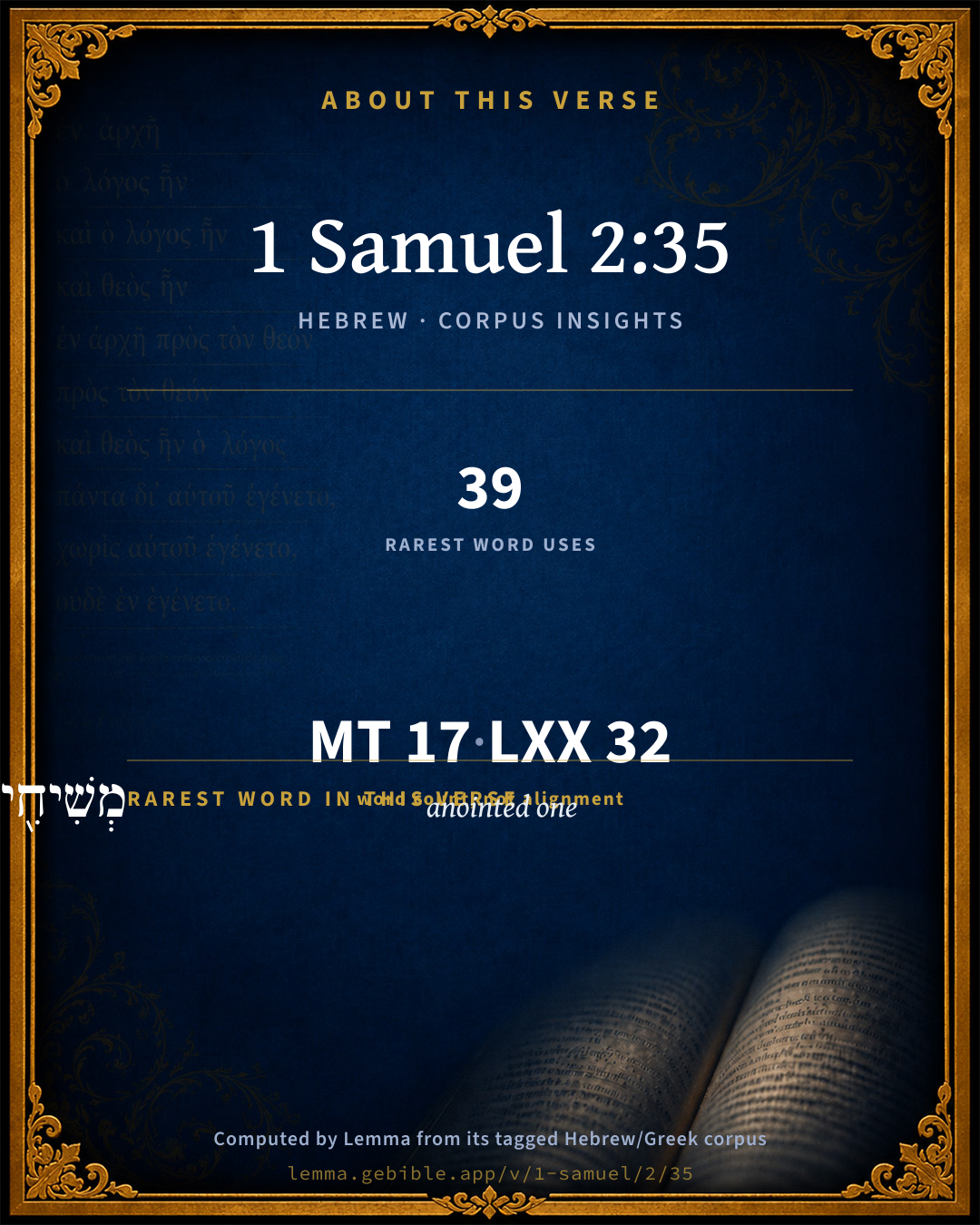
מְשִׁיחִ֖י anointed one H4899 occurs in 38 verses of the Hebrew Bible. Also found in:

Grammatical profile

  • 6 verbs
  • 8 nouns
  • 2 prepositions
  • 1 particle

Verb forms

  • וַהֲקִימֹתִ֥י Hiphil · Sequential Perfect
  • נֶאֱמָ֔ן Niphal · Participle Active
  • יַעֲשֶׂ֑ה Qal · Imperfect
  • וּבָנִ֤יתִי Qal · Sequential Perfect
  • נֶאֱמָ֔ן Niphal · Participle Active
  • וְהִתְהַלֵּ֥ךְ Hithpael · Sequential Perfect

Repetition

A word recurs within this verse — often emphatic in Hebrew:

  • נֶאֱמָ֔ן to confirm H539 ×2

Hebrew & Septuagint length

In English translation the verse runs 39 words from the Hebrew and 40 from the Septuagint (LXX English) — closely comparable.

A rough comparison of the two English renderings, which tokenize alike — not a word-level alignment.

Word counts can differ between the Hebrew and the Greek without any difference in meaning — e.g. the Hebrew direct-object marker אֵת has no separate Greek word, and Greek often adds the article ὁ.

In the original languages it is 17 Hebrew tokens and 32 Greek tokens — but the two are counted differently (Hebrew bundles its prefixes and suffixes into one token; the Greek is in lemma form), so that isn’t a like-for-like length.

Cross-references

19

Topical passages linked to 1 Samuel 2:35 in the Treasury of Scripture Knowledge — connected by theme and wording, ordered by reader-vote popularity; previews shown in the World English Bible.

  • 2 Samuel 7:27 For you, Yahweh of Hosts, the God of Israel, have revealed to your servant, saying, I will build you a house: therefore has your servant found in his heart to pray this prayer to you.
  • 2 Samuel 7:11 and [as] from the day that I commanded judges to be over my people Israel; and I will cause you to rest from all your enemies. Moreover Yahweh tells you that Yahweh will make you a house.
  • 1 Kings 11:38 It shall be, if you will listen to all that I command you, and will walk in my ways, and do that which is right in my eyes, to keep my statutes and my commandments, as David my servant did; that I will be with you, and will build you a sure house, as I built for David, and will give Israel to you.
  • 1 Samuel 25:28 Please forgive the trespass of your handmaid: for Yahweh will certainly make my lord a sure house, because my lord fights the battles of Yahweh; and evil shall not be found in you all your days.
  • Psalms 18:50 He gives great deliverance to his king, And shows loving kindness to his anointed, To David and to his seed, forevermore.
  • Hebrews 7:26–28 For such a high priest was fitting for us: holy, guiltless, undefiled, separated from sinners, and made higher than the heavens;
  • 1 Samuel 12:3 Here I am: witness against me before Yahweh, and before his anointed: whose ox have I taken? or whose donkey have I taken? or whom have I defrauded? whom have I oppressed? or of whose hand have I taken a ransom to blind my eyes therewith? and I will restore it you.
  • 1 Samuel 16:13 Then Samuel took the horn of oil, and anointed him in the midst of his brothers: and the Spirit of Yahweh came mightily on David from that day forward. So Samuel rose up, and went to Ramah.
  • 1 Kings 1:8 But Zadok the priest, and Benaiah the son of Jehoiada, and Nathan the prophet, and Shimei, and Rei, and the mighty men who belonged to David, were not with Adonijah.
  • 1 Kings 1:45 and Zadok the priest and Nathan the prophet have anointed him king in Gihon; and they are come up from there rejoicing, so that the city rang again. This is the noise that you have heard.
  • 1 Kings 2:35 The king put Benaiah the son of Jehoiada in his room over the host; and Zadok the priest did the king put in the room of Abiathar.
  • 1 Chronicles 6:8–15 and Ahitub became the father of Zadok, and Zadok became the father of Ahimaaz,
  • 1 Chronicles 29:22 and ate and drink before Yahweh on that day with great gladness. They made Solomon the son of David king the second time, and anointed him to Yahweh to be prince, and Zadok to be priest.
  • Nehemiah 12:10–11 Jeshua became the father of Joiakim, and Joiakim became the father of Eliashib, and Eliashib became the father of Joiada,
  • Hebrews 2:17 Therefore he was obligated in all things to be made like his brothers, that he might become a merciful and faithful high priest in things pertaining to God, to make atonement for the sins of the people.
  • Numbers 25:13 and it shall be to him, and to his seed after him, the covenant of an everlasting priesthood; because he was jealous for his God, and made atonement for the children of Israel.
  • Psalms 2:2 The kings of the earth take a stand, And the rulers take counsel together, Against Yahweh, and against his anointed, saying,
  • Ezekiel 34:23 I will set up one shepherd over them, and he shall feed them, even my servant David; he shall feed them, and he shall be their shepherd.
  • Ezekiel 44:15–16 But the priests the Levites, the sons of Zadok, who kept the charge of my sanctuary when the children of Israel went astray from me, they shall come near to me to minister to me; and they shall stand before me to offer to me the fat and the blood, says the Lord Yahweh:

Cross-references courtesy of OpenBible.info (CC BY 4.0).

Hebrew and Greek witnesses Masoretic Hebrew ↔ Greek Septuagint

The same verse in the two great witnesses to the Old Testament, shown verse-for-verse.

These are two independent witnesses, not word-aligned to each other, and the Septuagint is shown in lemma (dictionary) form.

Hebrew 1 Samuel 2:35 Masoretic · Westminster Leningrad Codex

וַהֲקִימֹתִ֥י לִי֙ כֹּהֵ֣ן נֶאֱמָ֔ן כַּאֲשֶׁ֛ר בִּלְבָבִ֥י וּבְנַפְשִׁ֖י יַעֲשֶׂ֑ה וּבָנִ֤יתִי לוֹ֙ בַּ֣יִת נֶאֱמָ֔ן וְהִתְהַלֵּ֥ךְ לִפְנֵֽי מְשִׁיחִ֖י כָּל הַיָּמִֽים

I will raise me up a faithful priest, that shall do according to that which is in my heart and in my mind: and I will build him a sure house; and he shall walk before my anointed forever.

World English Bible · Public Domain

Greek LXX 1 Samuel 2:35 Septuagint · lemma form

καί ἀναἵστημι ἐμαυτοῦ ἱερεύς πιστός ὅς πᾶς ὁ ἐν ὁ καρδία ἐγώ καί ὁ ἐν ὁ ψυχή ἐγώ ποιέω καί οἰκοδομέω αὐτός οἶκος πιστός καί διαἔρχομαι ἐνώπιον χριστός ἐγώ πᾶς ὁ ἡμέρα

And I will raise up to myself a faithful priest, who shall do all that is in my heart and in my soul; and I will build him a sure house, and he shall walk before my Christ for ever.

LXX2012 (modern English Septuagint) · Public Domain

On this verse, Adam Clarke's Commentary discusses the Septuagint’s reading. Read the note in Commentary ↓

Hebrew: Westminster Leningrad Codex (CC BY 4.0). Greek: Septuagint (public domain); English from LXX2012 (modern English Septuagint) (Public Domain). How the Septuagint differs from the Hebrew →

Targum (Aramaic paraphrase)

1

The Targum is the ancient Jewish Aramaic paraphrase of the Hebrew Scriptures — an interpretive translation, not the Hebrew text itself. Onkelos (literal) and Pseudo-Jonathan (expansive) render the Torah, and Jonathan the Prophets. Coverage is partial: where no permissively-licensed English translation exists for a verse, only the Aramaic is shown. This is verse-level text, not a word-by-word alignment to the Hebrew.

  1. Targum Jonathan Prophets (Joshua–Malachi)
    וַאֲקֵים קֳדָמַי כָּהֵין מְהֵימָן דִכְמֵימְרִי וְכִרְעוּתִי יַעְבֵּד וַאֲקֵים לֵיהּ מַלְכוּ קַיָמָא וִישַׁמֵשׁ קֳדָם מְשִׁיחִי כָּל יוֹמַיָא:

    (no public-domain English translation for this verse)

    Targum Jonathan — Aramaic: “Mikraot Gedolot” (public domain). English: “Sefaria Community Translation” (CC0 1.0 (public-domain dedication)); “London "Chaldee Paraphrase," 1871” (public domain). Text via Sefaria.

Commentary

Notes on 1 Samuel 2:35 from classic Christian and Jewish commentators (each source and its license shown beneath its notes). The classic Christian expositions comment on the surrounding passage and are grouped to its opening verse, so a note may address several verses; the Jewish commentaries on the Tanakh (Rashi and others) are per-verse, so they appear only where the commentator wrote on this verse.

Lemma curates 59 commentaries, every one of them public domain or Creative Commons licensed, each selected and text-cleaned for this edition rather than reprinted as found. About our sources →

Trapp's Complete Commentary

John Trapp

1Sa 2:35 And I will raise me up a faithful priest, [that] shall do according to [that] which [is] in mine heart and in my mind: and I will build him a sure house; and he shall walk before mine anointed for ever.

Ver. 35. And I will build him a sure house,] i.e., Bless him with children, and settle the office firm upon them.

John Trapp, A Commentary or Exposition upon All the Books of the Old and New Testament (1647–1656) — public domain. Text from a community e-Sword module.

Albert Barnes' Notes on the Bible

Zadok is meant rather than Samuel. The High Priesthood continued in the direct descendants of Zadok as long as the monarchy lasted (see 1Ch 6:8-15).

Mine anointed - in its first sense obviously means the kings of Israel and Judah Psa 89:20; Zec 4:14. But doubtless the use of the term MESSIAH (Χριστὸς Christos) here and in 1Sa 2:10, is significant, and points to the Lord’s Christ, in whom the royal and priestly offices are united (Zec 6:11-15 : see the marginal references). In this connection the substitution of the priesthood after the order of Melchisedec for the Levitical may be foreshadowed under 1Sa 2:35 (see Heb. 7).

Albert Barnes' Notes on the Bible (1834–1885) — public domain. Text from a community e-Sword/MySword module.

The Biblical Illustrator

Joseph S. Exell

1Sa_2:35

And I will raise me up a faithful priest.

Rejection and election

I. The principle of Divine rejection is always the same.

1. There is nothing arbitrary in Gods dealings with men.

(1) They seem so to us--

(2) Only because we are ignorant of many of the facts with which He is acquainted.

(3) If we know the whole, we should see how entirely all His doings are referable to His eternal love and wisdom.

(4) We must never therefore justify Gods dealings by mere appeals to His power, to His right to do as He pleases, as though His pleasure could ever be at variance with the dictates of infinite love and perfect wisdom.

2. The real cause of rejection is always found in the enmity against God in the natural man. And this enmity shows itself in self-will. Them that honour Me I will honour, and they that despite Me shall be lightly esteemed (1Sa_2:30).

(1) So it was in Saul: Hath the Lord as much pleasure in burnt offerings and in sacrifices as in obeying the voice of the Lord?

(2) So in the sons of Eli. They did not love Gods will or way.

(3) The most awful example in Judas.

II. God will not have His work neglected on account of our unfaithfulness. I will raise up a faithful priest (1Sa_2:35). In the Old Testament, Samuel came into the place of Elis family. In the New Testament, Matthias came into the place of Judas. Note here, in conclusion, two separate lessons.

1. To those who refuse Gods work. They will be rejected, but the work will not be left undone.

2. To those who offer themselves to that work in sincerity and devotion. What is their course?

(1) Fidelity: a faithful priest.

(2) Sympathy with the purposes of God: Do according to that which is in mine heart.

(3) The protection and blessing of God: I will build him a sure house.

(4) Endurance: He shall walk before mine anointed forever. (W. R. Clark, M. A.)

He shall walk before Mine anointed forever.--

Holiness becometh Gods Minister

As precious liquors are best kept in clean vessels, so is the mystery of faith in a pure conscience. Who, indeed, would knowingly pour a choice wine into a tainted cask? It would be no instance of his wisdom if he did so. When we hear of men living in sin and yet claiming to be the ministers of God, we are disgusted with their pretences, but we are not deceived by their professions. In the same manner, we care little for those who are orthodox Christians in creed if it is clear that they are heterodox in life. He who believes the truth should himself be true. How can we expect others to receive our religion if it leaves us foul, false, malicious, and selfish? We sicken at the sight of a dirty dish, and refuse even good meat when it is placed thereon. So pure and holy is the doctrine of the cross that he who hears it aright will have his ear cleansed, he who believes it will have his heart purged, and he who preaches it should have his tongue purified. (C. H. Spurgeon.)

.

The Biblical Illustrator, edited by Joseph S. Exell (c. 1880s–1900s) — public domain. Text from a community e-Sword module.

Joseph Benson's Commentary

1Sa 2:35. I will raise me up a faithful priest — Of another line, as is necessarily implied by the total removal of that office from Eli’s line. The person designed is Zadok, one eminent for his faithfulness to God, and to the king, who, when Abiathar, the last of Eli’s line, was deposed by Solomon, was made high-priest in his stead. Build a sure house — That is, give him a numerous posterity, and confirm unto him and his children that sure covenant of an everlasting priesthood made to Phinehas, of Eleazar’s line, Num 25:13, and interrupted for a little while by Eli, of the line of Ithamar. The high-priesthood continued in his line till the captivity of Babylon, as appears from Eze 40:16; and a long time after it, as Josephus shows, lib. 4. cap. 4. He shall walk before mine Anointed — That is, Zadok and his descendants shall perform the office of high-priest before that king whom God shall anoint, and before his successors. The high- priest is said to walk before God’s anointed, chiefly because he wore the breast-plate of judgment, which he was to consult, not in common cases, but for the king, in the affairs of state. For ever — A learned writer justly observes, that though this, according to the history, was intended of, and may properly be applied to Zadok, yet in the highest sense it belongs to none but our Lord Jesus Christ, who offered himself to the Father for us, and is our great High-Priest for ever; who in all things did his Father’s will, and for whom God will build a sure house, build it on a rock, so that the gates of hell cannot prevail against it. For he is the main scope and design not only of the New but of the Old Testament, which, in all types and ceremonies, represented him; and the high-priest especially was an eminent type of him, represented by his person, acted in his name and stead, and did mediately what John the Baptist did immediately, namely, go before the face of the Lord Christ; and when Christ came, that officer and the office he sustained were to cease.

Joseph Benson's Commentary on the Old and New Testaments (1811–1818) — public domain. Text from a community e-Sword module.

Whedon's Commentary on the Bible

Daniel D. Whedon

35. I will raise me up a faithful priest — By this “faithful priest” some have understood Samuel, and others Zadok, while a few argue that both of them may be intended. Samuel, indeed, succeeded Eli as judge of Israel, and during his lifetime the Aaronic priesthood seems to have fallen into neglect; but it is certain that neither he nor his descendants were established in the priesthood, so that it cannot be said that God “built him a sure house.” Therefore it is better to understand Zadok to be this faithful priest. As a part of this prophecy received its fulfilment in the thrusting out of Abiathar, so this verse was fulfilled in the consecration of Zadok. 1Ki_2:35; 1Ch_29:22. Zadok was a descendant of Aaron through Eleazar, (1Ch_24:3,) and therefore God’s promise to Aaron was not made void by the impiety of Eli’s sons, for in Zadok, Eleazar’s posterity were established forever. Compare Num_25:11-13. It is also well worthy of notice that in the temple of Ezekiel’s vision, which symbolizes the spiritual Church of the then future, the sons of Zadok are named as priests. Eze_40:46; Eze_43:19; Eze_44:15; Eze_48:11.

He shall walk before mine anointed for ever — Before David, Solomon, and the later kings of Judah, until the passing away of the Hebrew monarchy before the Messianic kingdom, in which Christ himself is prophet, priest, and king.

Daniel D. Whedon (gen. ed.), Commentary on the Old and New Testaments (1874–1909) — public domain. Text from a community e-Sword module.

Tyndale Open Study Notes

Tyndale Open Resources

2:35 a faithful priest: Zadok and his descendants later replaced Eli’s family in the priesthood (1 Kgs 2:26-27, 35).

Tyndale Open Study Notes — © Tyndale Open Resources, licensed CC BY-SA 4.0. Text via the HelloAO Bible API.

Geneva Bible (1599)

Geneva Bible translators

Meaning Zadok, who succeeded Abiathar, and was the figure of Christ.

Geneva Bible (1599) marginal notes — public domain. Text via Bolls.life.

Adam Clarke's Commentary

Verse 35. A faithful priest] This seems to have been spoken of Zadok, who was anointed high priest in the room of Abiathar, the last descendant of the house of Eli; see 1Kg 2:26; 1Kg 2:27. Abiathar was removed because he had joined with Adonijah, who had got himself proclaimed king; see 1Kg 1:7.

I will build him a sure house] I will continue the priesthood in his family.

He shall walk before mine Anointed] He shall minister before Solomon, and the kings which shall reign in the land. The Targum says, "He shall walk קדם משיחי kodam Meshichi, before my MESSIAH," and the Septuagint expresses it, ενωπιον Χριστου μον, "before my CHRIST; " for, in their proper and more extended sense, these things are supposed to belong to our great High Priest and the Christian system: but the word may refer to the Israelitish people. See Clarke on Heb 9:26.

Adam Clarke's Commentary on the Bible (1810–1826) — public domain. Text from a community e-Sword/MySword module.

Ellicott's Commentary for English Readers

(35) A faithful priest.—Who here is alluded to by this “faithful priest,” of whom such a noble life was predicted, and to whom such a glorious promise as that “he should walk before mine anointed for ever,” was made? Many of the conditions are fairly fulfilled by Samuel, to whom naturally our thoughts at once turn. He occupies a foremost place in the long Jewish story, and immediately succeeded Eli in most of his important functions as the acknowledged chief of the religious and political life in Israel. He was also eminently and consistently faithful to his master and God during his whole life. Samuel, though a Levite, was not of the sons of Aaron; yet he seems, even in Eli’s days, to have ministered as a priest before the Lord, the circumstances of his early connection with the sanctuary being exceptional. After Eli’s death, when the regular exercise of the Levitical ritual and priesthood was suspended by the separation of the ark from the tabernacle, Samuel evidently occupied a priestly position, and we find him for a long period standing as mediator between Jehovah and His people, in sacrifice, prayer, and intercession, in the performance of which high offices his duty, after the solemn anointing of Saul as king, was to walk before the anointed of the Lord (Saul), while (to use the words of Von Gerlach, quoted by Erdmann), the Aaronic priesthood fell for a long time into such disrepute that it had to beg for honour and support from him (1Sa_2:36), and became dependent on the new order of things instituted by Samuel. (See Excursus C at the end of this Book.)

The prediction “I will build him a sure house” is satisfied in the strong house and numerous posterity given to Samuel by God. His grandson Heman was “the king’s seer in the words of God,” and was placed by King David over the choir in the house of God. This eminent personage, Heman, had fourteen sons and three daughters (1Ch_6:33; 1Ch_25:4-5).

Samuel also fulfilled the prophecy “He shall walk before mine anointed for ever” in his close and intimate relation with King Saul, who we find, even after the faithful prophet’s death—although the later acts of Saul had alienated the prophet from his sovereign—summoning the spirit of Samuel as the only one who was able to counsel and strengthen him (1Sa_28:15).

Of the other interpretations, that of Rashi and Abarbanel, and many of the moderns, which supposes the reference to be Zadok, of the house of Eleazar, who, in the reign of Solomon, superseded Abiathar, of the house of Ithamar (the ancestor of Eli), alone fairly satisfies most of the different predictions, but we are met with this insurmountable difficulty at the outset—Can we assume that the comparatively unknown Zadok, after the lapse of so many years, was pointed out by the magnificent promises contained in the words of the “man of God” to Eli? The words of the “man of God” surely indicate a far greater one than any high priest of the time of Solomon. In the golden days of this magnificent king, the high priest, overshadowed by the splendour and power of the sovereign, was a very subordinate figure indeed in Israel; but the subject of this prophecy was one evidently destined to hold no secondary and inferior position.

Some commentators, with a singular confusion of ideas, see a reference to Christ in the “faithful priest,” forgetting that this “faithful priest” who was to arise in Eli’s place was to walk before the Lord’s Christ, or Anointed One.

On the whole, the reference to Samuel is the most satisfactory, and seems in all points—without in any way unfairly pressing the historical references—to fulfil that portion of the prediction of the “man of God” to Eli respecting the one chosen to replace him in his position of judge and guide of Israel.

A Bible Commentary for English Readers, edited by Charles John Ellicott (1878–1897) — public domain. Text from a community e-Sword module.

The Cambridge Bible for Schools and Colleges

gen. ed. J. J. S. Perowne

35. This verse forms no part of the sign, but is to be connected with 1Sa_2:33.

a faithful priest] The prophecy is commonly supposed to have been fulfilled in Zadok, whose descendants retained the High-priesthood till the end of the monarchy (1Ch_6:8-15). But that Samuel is meant seems clear on the following grounds.

(a) The faithful priest is obviously contrasted with the unfaithful sons of Eli. This points to Samuel not Zadok. The account of his call is given immediately in ch. 3 and it concludes by saying (1Sa_2:20), “all Israel knew that Samuel was established to be a prophet of the Lord,” a connecting link with the present passage, for it is the same Heb. word which is rendered “faithful,” “sure,” and “established.” This is followed by the death of Hophni and Phinehas (ch. 4).

(b) The “sure house” which is promised does not necessarily imply succession to the priesthood. But if it had originally done so, might not the privilege have been forfeited by the sin of Samuel’s sons (ch. 1Sa_8:3), as in the case of the exactly similar promise to Jeroboam (1Ki_11:38)? That Samuel’s descendants flourished is clear, for his grandson Heman (1Ch_6:33) was David’s chief musician, and father of fourteen sons and three daughters (1Ch_25:1; 1Ch_25:4-5).

(c) “He shall walk before mine anointed (not, for ever, but) all the days of his life” (cp. 1Sa_1:22). This is most naturally referred to Samuel, who was God’s instrument for establishing the kingdom, and occupied a unique position as the authorised adviser of Saul.

(d) But it will be said, Samuel was no priest, only a prophet-judge. True he was not a priest by descent, and is nowhere expressly so called. But the expression I will raise up’ (used so commonly of the judges) implies an extraordinary office. And during his lifetime Samuel filled the place of High-priest. The prerogative of the line of Aaron was in abeyance for a time, as a punishment for the corruption of Eli’s sons. Ahitub the son of Phinehas never appears in the history. Ahiah is not mentioned till after Saul’s first rejection in Samuel’s extreme old age (1Sa_14:3). Samuel exercised priestly functions by intercession (1Sa_7:9), by offering sacrifice (1Sa_7:9-10), by benediction (1Sa_9:12-13), by anointing Saul and David (1Sa_10:1, 1Sa_16:13, cp. 1Ki_1:34). He may be compared with Moses who though not strictly a priest was sometimes regarded as such (Psa_99:6).

mine anointed] See notes on 1Sa_2:10, 1Sa_10:1, 1Sa_12:3.

The Cambridge Bible for Schools and Colleges (gen. ed. J. J. S. Perowne; Cambridge University Press, 1878–1918) — public domain. Text from a community e-Sword module.

John Gill's Exposition

And it shall come to pass, that everyone that is left in thine house,.... That is not cut off by death, the few remains of Eli's posterity in succeeding times, after the high priesthood was removed out of his family into another; so that they were reduced at best to common priests, and these, as it should seem, degraded from that office for their maladministration of it, or scandalous lives:

shall come and crouch to him for a piece of silver and a morsel of bread; which Grotius interprets of their coming to God, and bowing themselves before him, and praying to him for the smallest piece of money to cast into the treasury, and for a morsel of bread to be accepted as an offering, instead of a bullock, sheep, lamb, or even a bird, which they were not able to bring; but the meaning is, that such should be the low estate of Eli's family, when another, even Zadok, was made high priest, that they should come and humble themselves before him, as the Targum expresses it, beseeching him to give them a piece of silver, even the smallest piece, that is, as the word signifies, a "gerah" or "meah", about a penny or three halfpence of our money, the twentieth part of a shekel, Eze 45:12 and a piece of bread, not a whole loaf, but a slice of it, to such extremity would they be brought:

and shall say, put me, I pray thee, into one of the priests' offices, that I may eat a piece of bread; or into one of the wards of the priests; their custodies or courses, as the Targum; with which the Jewish commentators generally agree, and of which there were twenty four; see Ch1 24:4, and there are some traces of them in the New Testament, see Luk 1:5, but these were regular priests, who were in those courses, and had a sufficient maintenance for them, and had not barely a piece of bread to live on, or just enough to keep them from starving, as the phrase denotes; wherefore this must be understood, as before hinted, of priests degraded from their office, on some account or another, and reduced to poverty and want; and therefore, that they might be kept from starving, would solicit the high priest in those days, and beg that he would put them in some inferior post under the priests, to do the meanest offices for them, slay the sacrifices for them, wash their pots, open and shut up doors, and the like, that so they might have a living, though a poor one; and this may reasonably be thought to be the case of Eli's posterity, in process of time, after Abiathar was deposed from the high priest's office, and was ordered to go and live upon his fields and farm at Anathoth, Kg1 2:26 with which compare Eze 44:10. This, as Ben Gersom observes, was a fit punishment, and a righteous retaliation on Eli's posterity, that they should be brought to crouch to others, and be glad of a morsel of bread, who had behaved so imperiously towards the Lord's people, and had taken away their flesh from them by force; and, not content with their allowance, took the best pieces of the sacrifices, to make themselves fat with them.

Next: 1 Samuel Chapter 3

John Gill's Exposition of the Whole Bible (1746–1763) — public domain (CC PDM 1.0). Text via the HelloAO Bible API.

Haydock's Catholic Bible Commentary

Faithful often denotes what shall continue a long time, Isaias xxxiii. 16., and lv. 3. (Calmet) --- But in the conduct of Sadoc, we find nothing reprehensible. (Menochius) --- This faithful priest pointed out the Christian priesthood, as the sequel shews. (Calmet) --- All days. He shall perform his office. (Haydock) --- Anointed, king Solomon. (Menochius) --- The priests of the new law ought always to have Christ in view. (Calmet)

George Leo Haydock (1774–1849), Haydock's Catholic Family Bible and Commentary, 1859 edition — public domain. Excludes Psalms (Douay-Rheims chapter numbering differs from Protestant) and Deuterocanonical books (Catholic canon only).

Matthew Poole's English Annotations

A faithful priest, to wit, of another line, as is necessarily implied by one total removal of that office from Eli’s line, before threatened. The person designed is Zadok, one eminent for his faithfulness to God and to the king, who, when Abiathar, the last of Eli’s line, was deposed by Solomon, was made high priest in his stead, 1Ki 2:27,35; 1Ch 29:22.

That shall do according to that which is in mine heart; and shall not dishonour or disobey me to gratify his sons, as thou hast done.

I will build him a sure house, i.e. give him a numerous posterity, as that phrase is used, Exo 1:21; 2Sa 7:11; 1Ki 11:38, and confirm that sure covenant of an everlasting priesthood made to Phinehas, of Eleazar’s line, Num 25:13, and interrupted for a little while by Eli, and his, of the line of Ithamar, unto him and his children for ever. And this was manifestly verified until the Babylonish captivity, Eze 44:15; and there is no reason to doubt of its continuance in the same line till Christ came.

He shall walk, i.e. minister as high priest.

Before mine anointed; either, first, Before king Solomon, who was anointed king, 1Ki 1:39, and before the succeeding kings, who are commonly called anointed, or the Lord’s anointed, as 1Sa 12:3,5; 24:6,10; Psa 89:38,51; La 4:20. Or rather, secondly, Before Jesus Christ; first, Because this title of Anointed, or Christ, or Messias, (both which words signify only the Anointed,) is most frequently and eminently ascribed to Christ, both in the Old and New Testament, and therefore it is most reasonable to understand it of him, when there is nothing in the text or context which determines it to any other. Secondly, Christ is the main scope and design, not only of the New, but of the Old Testament, which in all its types and ceremonies represented Christ; and particularly, the high priest was an eminent type of Christ, and did represent his person, and act in his name and stead, and did mediately what John Baptist did immediately, go before the face of the Lord Christ; and when Christ did come, that office and officer was to cease. Thirdly, The high priest is seldom or never said to walk or minister before the kings of Israel or Judah, but constantly before the Lord, and consequently before Christ, who as he was God blessed for ever, Rom 9:5, was present with, and the Builder and Governor of, the ancient church of Israel, as is manifest from Act 7:35; 1Co 10:4; Heb 3:3-6, and many other places; and their temple is particularly called his temple, Mal 3:1, because all the temple worship was performed in his presence, and had a special respect unto him, and therefore the high priest is most properly said to walk before him.

Matthew Poole's English Annotations on the Holy Bible (1683–1685) — public domain. Text from a community e-Sword/MySword module.

The Pulpit Commentary

I will raise me up a faithful priest. This prophecy is explained in three several ways, of Samuel, of Zadok, and of Christ. St. Augustine, who considers the whole passage at length in his "De Civ. Dei," 17:5, argues that it cannot be reasonably said that a change in the priesthood foretold with so great circumstance was fulfilled in Samuel. But while we grant that it was an essential characteristic of Jewish prophecy to be ever larger than the immediate fulfilment, yet its primary meaning must never be slurred over, as if it were a question of slight importance. By the largeness of its terms, the grandeur of the hopes it inspired, and the incompleteness of their immediate accomplishment, the Jews were taught to look ever onward, and so became a Messianic people. Granting then that Christ and his Church are the object and end of this and of all prophecy, the question narrows itself to this In whom was this prediction of a faithful priest primarily fulfilled? We answer, Not in Zadok, but in Samuel. Zadok was a commonplace personage, of whom little or nothing is said after the time that he joined David with a powerful contingent. (1Ch_12:28) Samuel is the one person in Jewish history who approaches the high rank of Moses, Israel"s founder. (Jer_15:1) The argument that he was a Levite, and not a priest, takes too narrow and technical a view of the matter; for the essence of the priesthood lies not in the offering of sacrifice, but in mediation. Sacrifice is but an accident, being the appointed method by which the priest was to mediate between God and man. As a matter of fact, Samuel often did discharge priestly functions (1Sa_7:9, 17 13:8, where we find Saul reproved for invading Samuel"s office; 16:2), and it is a point to be kept in mind that the regular priests disappear from Jewish history for about fifty years after the slaughter of themselves, their wives, and families at Shiloh; for it is not until Saul"s time that Ahiah, the great-grandson of Eli, appears, as once again ministering at the altar. (1Sa_14:3) The calamity that overtook the nation at the end of Eli"s reign was so terrible that all ordinary ministrations seem to have been in abeyance. We are even expressly told that after the recovery of the ark it was placed in the house of Abinadab at Kirjath-jearim in Judaea, and that for twenty years his son Eleazar, though a Levite only, ministered there before it by no regular consecration, but by the appointment of the men of that town. During this time, though Ahitub, Ahiah"s father, was probably high priest nominally, yet nothing is said of him, and all the higher functions of the office were exercised by Samuel. Instead of the Urim and Thummim, he as prophet was the direct representative of the theocratic king. Subsequently this great duty was once again discharged by Abiathar as priest, and then a mighty change was made, and the prophets with the living voice of inspiration took the place of the priest with the ephod. For this is a far more important matter than even the fact that Samuel performed the higher functions of the priesthood. With him a new order of things began. Prophecy, from being spasmodic and irregular, became an established institution, and took its place side by side with the priesthood in preparing for Christ"s advent, and in forming the Jewish nation to be the evangelisers of the world. The prediction of this organic change followed the rule of all prophecy in taking its verbal form and expression from what was then existent. Just as the gospel dispensation is always described under figures taken from the Jewish Church and commonwealth, so Samuel, as the founder of the prophetic schools, and of the new order of things which resulted from them, is described to Eli under terms taken from his priestly office. He was a "faithful priest," and much more, just as our Lord was a "prophet like unto Moses", (Deu_18:15) and a "King set upon the holy hill of Zion", (Psa_2:6) but in a far higher sense than any would have supposed at the time when these prophecies were spoken.

As regards the specific terms of the prophecy, "the building of a sure house" (1Sa_25:28; 2Sa_7:11; 1Ki_2:34 1Ki_11:38; Isa_32:18) is a metaphor expressive of assured prosperity. The mass of the Israelites dwelt in tents (2Sa_11:11 2Sa_20:1, etc.; 1Ki_12:16) and to have a fixed and permanent dwelling was a mark of greatness. From such passages as 1Ki_2:24 1Ki_11:38, it is plain that the idea of founding a family is not contained in the expression. As a matter of fact, Samuel"s family was prosperous, and his grandson Heman had high rank in David"s court and numerous issue. (1Ch_25:5) Probably too the men of Ramah, who with the men of the Levite town of Gaba made up a total of 621 persons, (Neh_7:30) represented the descendants of Samuel at the return from Babylon. Nevertheless, the contrast is between the migratory, life in tents and the ease and security of a solid and firm abode, and the terms of the promise are abundantly fulfilled in Samuel"s personal greatness.

In the promise, "he shall walk before mine anointed forever," there is the same outlook upon the office of king, as if already in existence, which we observed in Hannah"s hymn. (1Sa_2:10) Apparently the expectation that Jehovah was about to anoint, i.e. consecrate, for them some one to represent him in civil matters and war, as the high priest represented him in things spiritual, had taken possession of the minds of the people. It had been clearly promised them, and regulations for the office; (Deu_17:14-20) and it was to be Samuel"s office to fulfil this wish, and all his life through he held a post of high dignity in the kingdom.

But the promise has also a definite meaning as regards the prophets, in whom Samuel lived on. For St. Augnstine"s error was in taking Samuel simply in his personal relations, whereas he is the representative of the whole prophetic order. (Act_3:24) They were his successors in his work, and continued to be the recognised mediators to declare to king and people the will of Jehovah, who was the supreme authority in both Church and state; and in political matters they were the appointed check upon the otherwise absolute power of the kings, with whose appointment their own formal organisation exactly coincided. From Samuel"s time prophet and king walked together till the waiting period began which immediately preceded the nativity of Christ.

HOMILIES BY B. DALE Ver. 35.

A faithful priest.

In the strictest sense Christ alone is now a Priest. In himself assuming the office, he has forever abolished it in others. Hence none are called priests in the New Testament, except in the modified sense in which all who believe in him are so called (1Pe_2:9; Rev_1:6) But taking the expression as equivalent to "a faithful ministry," consisting of men appointed by Christ to a special service for him (Mal_2:6, Mal_2:7; Act_6:4; Eph_4:11; Col_1:7; 2Ti_2:2) and faithfully fulfilling the purpose of their appointment, it leads us to notice

I WHENCE IT IS DERIVED. "I will raise up.

1. He alone can do it. From him come natural gifts and, still more, spiritual graces, eminent faith and patience, humility, courage, meekness, tender compassion "on the ignorant and on them that are out of the way," etc.

2. He has promised and made provision for it. (Jer_3:15) "I willbuild him a sure (enduring) house." "The death of Christ hath a great influence unto this gift of the ministry. It is a branch that grew out of the grave of Christ; let it be esteemed as lightly as men please, had not Christ died for it we had not had a ministry in the world" (Owen, vol. 9. p. 441). He "will be inquired of for it. If Churches would have "good ministers of Jesus Christ," they must seek them from God. (Mat_9:38)

II WHEREIN IT APPEARS. "Shall do according to that which is in my heart and in my mind.

1. Supreme regard to his will as the rule of character and labour.

2. Clear insight into his mind in relation to the special requirements of the time, place, and circumstances.

3. Practical, earnest, and constant devotion to it in all things, the least as well as the greatest. Even as "Christ himself." "I have given you an example.

III WHEREBY IT IS HONOURED. "And he shall walk before mine anointed forever.

1. Enjoyment of the King"s favour. (Pro_16:15)

2. Employment in the King"s service; in continued, honourable, beneficent, and increasing cooperation with him.

3. Participation in the King"s glory forever. "Be thou faithful," etc. (Rev_2:10) "To him that overcometh will I grant to sit with me in my throne". D. (Rev_3:21)

The Pulpit Commentary (1880–1919), ed. H.D.M. Spence-Jones & Joseph S. Exell — public domain. Text from a community e-Sword module.

John Wesley's Explanatory Notes

Raise a priest - Of another line, as it necessarily implied by the total removal of that office from Eli's line. The person designed is Zadok, one eminent for his faithfulness to God, and to the king, who, when Abiather, the last of Eli's line, was deposed by Solomon, was made high-priest in his stead. Build,&c. - That is, give him a numerous posterity, and confirm that sure covenant of an everlasting priesthood made to Phinehas, of Eleazar's line, Num. xxv, 13, and interrupted for a little while by Eli, of the line of Ithamar, unto him and his children forever. Anointed - Before Jesus Christ, who is the main scope and design, not only of the New, but of the Old Testament, which in all its types and ceremonies represented him; and particularly, the high-priest was an eminent type of Christ, and represented his person, and acted in his name and stead, and did mediately, what John Baptist did immediately, go before the face of the Lord Christ; and when Christ came, that office and officer was to cease. The high-priest is seldom or never said to walk or minister before the kings of Israel or Judah, but constantly before the Lord, and consequently, before Christ, who, as he was God blessed forever, Rom. ix, 5, was present with, and the builder and governor of the ancient church of Israel, and therefore the high-priest is most properly said to walk before him.

John Wesley, Explanatory Notes Upon the Whole Bible (1754–1765) — public domain. Text via the GEBible commentary corpus.

Rashi

Rabbi Shlomo Yitzchaki (Rashi)

A faithful kohein. Tzadok.

Rashi on the Tanakh — English translations: “The Judaica Press complete Tanach with Rashi, translated by A. J. Rosenberg” (CC BY 4.0); “Pentateuch with Rashi's commentary by M. Rosenbaum and A.M. Silbermann, 1929-1934” (public domain); “The Metsudah Tanach series, Lakewood, N.J” (CC BY 4.0); and “The Book of Joshua, Metsudah Publications, 1997” (CC BY 4.0). Text via Sefaria.

Lesson kit

Teaching starters — assembled from the data on this page, not authored interpretation. Every prompt links to the verse data it draws on. Edit before teaching.

1 Samuel, in the Historical, opens this verse with 17 words (14 distinct Hebrew lemmas). Its most distinctive word is mâshîyach (“anointed one”). A historical commentator’s framing appears above. Read the whole chapter for the surrounding context.

Discussion questions

  1. The word mâshîyach carries the sense “anointed one.” How does it shape the verse?
  2. Leviticus 4:3 shares the word «anointed one» with this verse. How do the two illuminate each other?
  3. “to confirm” occurs 2× in this one verse. What is the effect of the repetition?
  4. These translations render this verse differently. What is at stake in choosing one wording over another?
  5. The verb «וַהֲקִימֹתִ֥י» is Hiphil Sequential Perfect. How does its form color the action?
  6. Reading how Trapp's Complete Commentary and Albert Barnes' Notes on the Bible read this verse, where do the two commentators agree and where do they part?

Things to notice

Reading settings

Reading text

Shown beneath each verse's original-language words.

Old Testament
Old Testament edition

Read the OT as the Masoretic Hebrew (MT) or the Greek Septuagint (LXX).

English shown for the Greek Septuagint (in the Hebrew ↔ Greek comparison).

Comparing translations? Open the Compare panel on any verse page to stack up to four side by side.