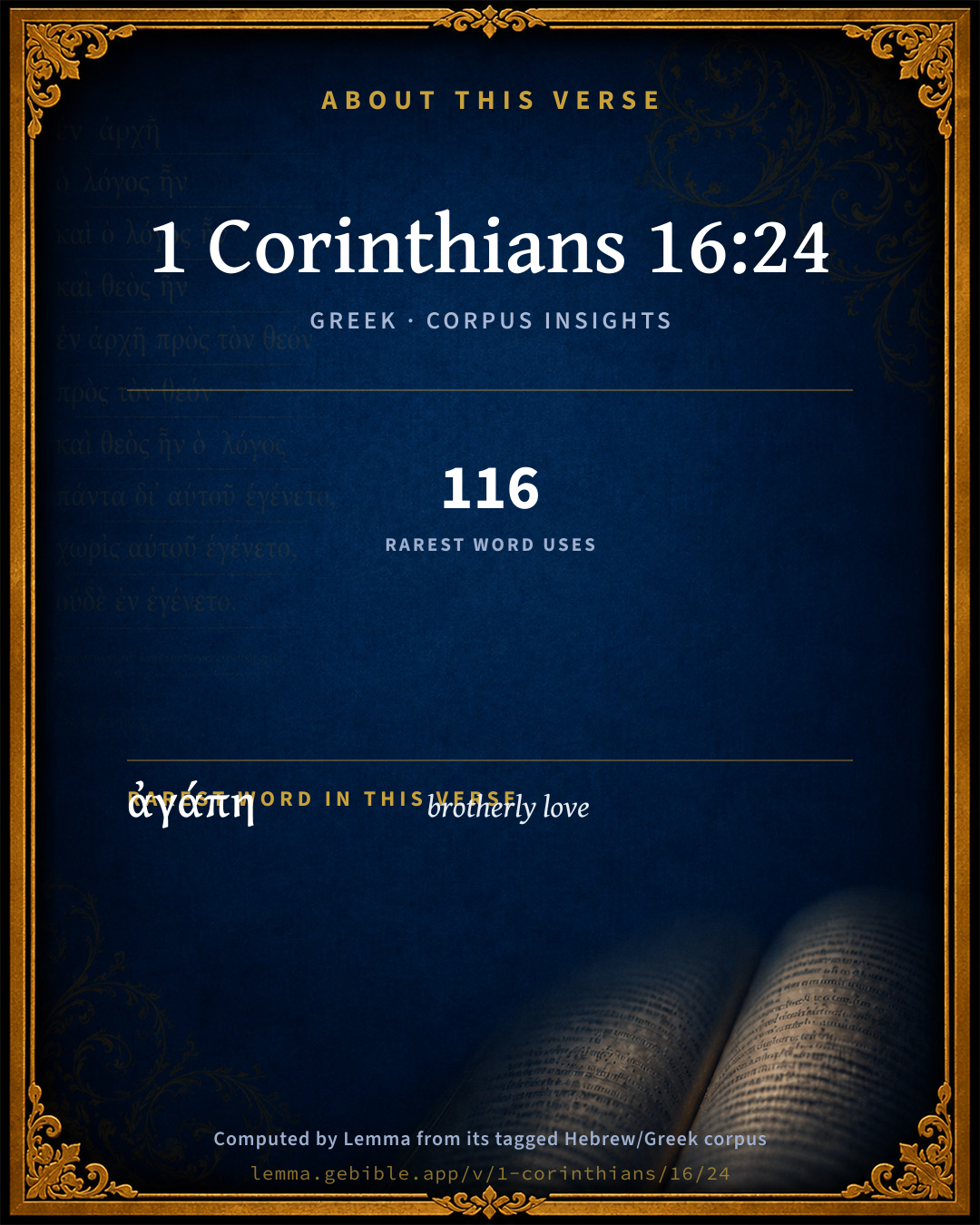
1 Corinthians 16:24

Greek (Tischendorf 8th ed.) 1 Corinthians 16:24 appears in the Greek New Testament. The text above is from the Tischendorf 8th edition. Each word links to its Strong’s number and a concise gloss. Click any word for its full Thayer’s Greek Lexicon entry.
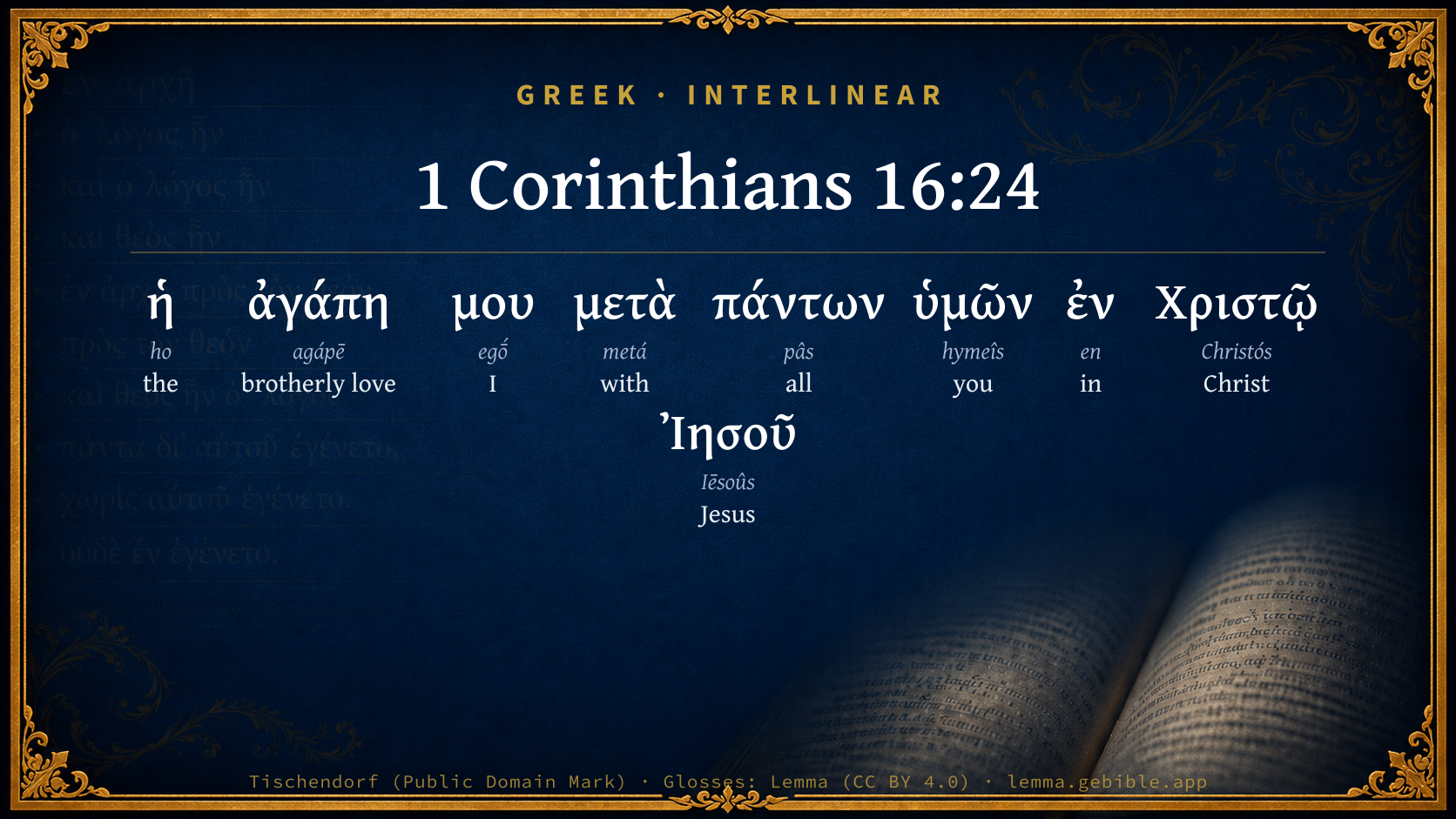
Download image
Cite this verse

1 Corinthians 16:24 (World English Bible). Public Domain. Lemma interlinear Bible study tool, https://lemma.gebible.app/v/1-corinthians/16/24.

Show BibTeX & RIS
BibTeX
RIS
English Translation
My love to all of you in Christ Jesus. Amen.
World English Bible · Public Domain
Download a study sheet

One document with this verse’s original text, its word-by-word gloss line, the meaning frame, cross-references with their text, attributed commentary, and full source and license credits — printable, and it pastes into notes with its structure intact.

This verse Autodidact and up

Study sheet (.html) Plain text (.txt)

A passage Seminary Student

Up to 50 verses in one chapter. A passage sheet keeps up to 6 commentary sources and 12 cross-references per verse, in the order this page ranks them, and says so on the sheet whenever that leaves anything out. Ask for a single verse and you get the Autodidact verse sheet above.

Everything on this page stays free to read, with no account — the sheet is a download of what is already on screen, not access to it.

Want to remove ads? Support Godless Engineer
Compare translations 3

The same verse in 3 English versions, stacked beneath the original-language interlinear above. Click any original word for its lexicon entry.

Each is an independent rendering of the whole verse — the interlinear is not word-aligned to these translations.

Highlighted words mark where these versions differ — a whole-verse word diff, not a word-by-word alignment.

  • World English Bible Public Domain
    My love to all of you in Christ Jesus. Amen.
  • King James Version Public Domain
    My love be with you all in Christ Jesus. Amen.
  • unfoldingWord Literal Text CC BY-SA 4.0
    My love with you all in Christ Jesus. Amen.

unfoldingWord Literal Text — © unfoldingWord, licensed CC BY-SA 4.0. Word-aligned USFM3 via Door43 (git.door43.org/unfoldingWord/en_ult).

Versions to compare (up to 4)

3 of 4 selected

Show all 19 translations

Every available English version of this verse, each an independent rendering of the whole verse.

  • World English Bible Public Domain
    My love to all of you in Christ Jesus. Amen.
  • Berean Standard Bible Public Domain
    My love be with all of you in Christ Jesus. Amen.
  • Majority Standard Bible Public Domain
    My love be with all of you in Christ Jesus. Amen.
  • King James Version Public Domain
    My love be with you all in Christ Jesus. Amen.
  • American Standard Version (1901) Public Domain
    My love be with you all in Christ Jesus. Amen.
  • Revised Version (1885) Public Domain
    My love be with you all in Christ Jesus. Amen.
  • Geneva Bible (1599) Public Domain
    My loue be with you all in Christ Iesus, Amen. The first Epistle to the Corinthians, written from Philippi, and sent by Stephanas, and Fortunatus, and Achaicus, and Timotheus.
  • Douay-Rheims (1899) Public Domain
    My charity be with you all in Christ Jesus. Amen.
  • Young's Literal Translation Public Domain
    my love `is' with you all in Christ Jesus. Amen.
  • Literal Standard Version CC BY-SA 4.0
    my love [is] with you all in Christ Jesus! Amen.
  • Unlocked Literal Bible CC BY-SA 4.0
    My love be with you all in Christ Jesus.
  • unfoldingWord Literal Text CC BY-SA 4.0
    My love with you all in Christ Jesus. Amen.
  • Darby Bible Public Domain
    My love [be] with you all in Christ Jesus. Amen.
  • World Messianic Bible Public Domain
    My love to all of you in Messiah Yeshua. Amen.
  • Webster's Bible Public Domain
    My love be with you all in Christ Jesus. Amen.
  • Free Bible Version CC BY-SA 4.0
    My love to all of you in Christ Jesus. Amen.
  • Bible in Basic English Public Domain
    My love be with you all in Christ Jesus. So be it.
  • Text-Critical English NT CC BY 4.0
    My love be with you all in Christ Jesus. Amen.
  • Tyndale New Testament (1534) Public Domain
    My love be with you all in Christ Iesu. Amen. ‘The epistle vnto the Corinthyans sent from Philippos by Stephana and Fortunatus and Acaichus and Timotheus.’

Literal Standard Version (2020), Covenant Press — licensed CC BY-SA 4.0. Text via the HelloAO Bible API (eBible.org). Unlocked Literal Bible (unfoldingWord) — licensed CC BY-SA 4.0. Text via the HelloAO Bible API (eBible.org). unfoldingWord Literal Text — © unfoldingWord, licensed CC BY-SA 4.0. Word-aligned USFM3 via Door43 (git.door43.org/unfoldingWord/en_ult). Free Bible Version, Dr. Jonathan Gallagher — licensed CC BY-SA 4.0. Text via the HelloAO Bible API (eBible.org).

Word by word

More ways to search: Search by grammar → Find every occurrence → Compare this word →

Practice this passage: Drill this verse → Learn its vocabulary →

About this verse

These counts appear in no published source. They are computed here, from the morphology-tagged text and Lemma’s own curated glosses. What Lemma adds →

9
words
9
distinct lemmas
Pauline Epistles
section

Cross-references

9

Topical passages linked to 1 Corinthians 16:24 in the Treasury of Scripture Knowledge — connected by theme and wording, ordered by reader-vote popularity; previews shown in the World English Bible.

  • Matthew 6:13 Bring us not into temptation, but deliver us from the evil one. For yours is the Kingdom, the power, and the glory forever. Amen.'
  • 1 Corinthians 14:16 Otherwise if you bless with the spirit, how will he who fills the place of the unlearned say the "Amen" at your giving of thanks, seeing he doesn't know what you say?
  • 2 Corinthians 12:15 I will most gladly spend and be spent for your souls. If I love you more abundantly, am I loved the less?
  • Revelation 3:19 As many as I love, I reprove and chasten. Be zealous therefore, and repent.
  • Matthew 28:20 teaching them to observe all things that I commanded you. Behold, I am with you always, even to the end of the age." Amen.
  • 1 Corinthians 4:14–15 I don't write these things to shame you, but to admonish you as my beloved children.
  • 1 Corinthians 16:14 Let all that you do be done in love.
  • 2 Corinthians 11:11 Why? Because I don't love you? God knows.
  • Philippians 1:8 For God is my witness, how I long after all of you in the tender mercies of Christ Jesus.

Cross-references courtesy of OpenBible.info (CC BY 4.0).

Where the printed editions differ

2 variants

Places in this verse where the major printed Greek editions disagree on the wording in a way that affects the translation — a comparison of editions, not a manuscript-by-manuscript collation. The editions are the modern critical texts (Nestlé-Aland 28/27, SBL, Westcott-Hort, Tregelles, Tyndale House) and the traditional texts behind the KJV (the Textus Receptus and the Byzantine/Majority text). It is not a claim about which reading is original.

  1. Extra text
    ἀμήν

    “Amen”

    In TynTRByz Not in NA28NA27SBLWHTreg
  2. Extra text
    πρός Κορινθίους πρώτη ἐγράφη ἀπό Φιλίππων διά Στεφανᾶ καί φουρτουνάτου καί Ἀχαϊκοῦ καί Τιμοθέου.¶

    “to Corinthians first it was written from Philippi through of Stephanas and Fortunatus and Achaicus and Timothy.”

    In TR Not in NA28NA27TynSBLWHTregByz

    ἀμήν πρός Κορινθίους πρώτη ἐγράφη ἀπό Φιλίππων διά Στεφανᾶ καί φουρτουνάτου καί Ἀχαϊκοῦ καί Τιμοθέου.¶ (amēn pros Korinthious prōtē egraphē apo Philippōn dia Stephana kai phourtounatou kai Achaikou kai Timotheou) 'Amen to Corinthians first it was written from Philippi through of Stephanas and Fortunatus and Achaicus and Timothy.' is only in traditional manuscripts (TR)

Textual data: Translators Amalgamated Greek New Testament (STEPBible TAGNT) · CC BY 4.0.

Commentary

Notes on 1 Corinthians 16:24 from classic Christian and Jewish commentators (each source and its license shown beneath its notes). The classic Christian expositions comment on the surrounding passage and are grouped to its opening verse, so a note may address several verses; the Jewish commentaries on the Tanakh (Rashi and others) are per-verse, so they appear only where the commentator wrote on this verse.

Lemma curates 59 commentaries, every one of them public domain or Creative Commons licensed, each selected and text-cleaned for this edition rather than reprinted as found. About our sources →

The Biblical Illustrator

Joseph S. Exell

1Co_16:24

My love be with you all.

Pauls love to the Corinthians was

I. Sincere. Witness the Epistle.

1. Its faithful dealing.

2. Wise counsels.

3. Earnest admonitions.

4. Sublime lessons.

5. Patient and loving spirit.

II. Comprehensive--including all, even those who had offended.

III. Christian in its source, nature, operation, and effect. (J. Lyth, D.D.)

The Biblical Illustrator, edited by Joseph S. Exell (c. 1880s–1900s) — public domain. Text from a community e-Sword module.

Bengel's Gnomon

Johann Albrecht Bengel

1Co 16:24. Ἡ ἀγάπη χμου μετὰ πάντων ὑμῶν ἐν Χριστῷ Ιἠσοῦ, My love be with you all in Christ Jesus) The Apostle embraces in Christ Jesus with love, which had been divinely kindled, not only those who had said they were of Paul, but all the Corinthians. In the Alexandrian copy alone, μου is omitted; but this little word evidently agrees with the beginning and end of this epistle.[159] There was afterwards added, ἐγράφη ἀπὸ Φιλίππων, it was written from Philippi. But it was written at Ephesus, as 1Co 16:8 proves; perhaps, however, it was sent from Philippi, 1Co 16:5, because the deputies of the Corinthians had accompanied Paul thither. At least, Aquila and Priscilla, who are spoken of at 1Co 16:19, were at Ephesus (Act 18:19); thence there was a road to Corinth above Philippi. I do not refuse a more convenient way of reconciling these two statements; comp. Ord. Temp., p. 282, lin. 4 and 9, and the end of the page 281.[160]

[159] Μου is read in BCD (Λ) Gfg Vulg. But A omits it.—ED.

[160] Bengel, J. A. (1860). Vol. 3: Gnomon of the New Testament (M. E. Bengel & J. C. F. Steudel, Ed.) (J. Bryce, Trans.) (291–348). Edinburgh: T&T Clark.

Bengel's Gnomon of the New Testament — English translation (T&T Clark, Edinburgh, 1860) — public domain. Text from a community e-Sword module.

Hodge's Commentary on Romans, Ephesians & First Corinthians

Charles Hodge

1Co_16:24

My love (be) with you all in Christ Jesus. Amen.

My love in Christ is my Christian love. Paul in conclusion assures them all, all the believers in Corinth, even those whom he had been called upon to reprove, of his sincere love.

Charles Hodge — Commentary on Romans (1835), First Corinthians (1857), and Ephesians (1856) — public domain. Text from a community e-Sword module.

Jamieson, Fausset & Brown

Robert Jamieson, A. R. Fausset & David Brown

My love, &c.--After having administered some severe rebukes, he closes with expressions of "love": his very rebukes were prompted by love, and therefore are altogether in harmony with the profession of love here made: it was love in Christ Jesus, and therefore embraced "all" who loved Him.

The subscription represents the Epistle as written from Philippi. Co1 16:8 shows it was written at Ephesus. BENGEL conjectures that perhaps, however, it was sent from Philippi (Co1 16:5), because the deputies of the Corinthians had accompanied Paul thither. From Ephesus there was a road to Corinth above Philippi.

Next: 2 Corinthians Introduction

Jamieson, Fausset & Brown — Commentary Critical and Explanatory on the Whole Bible (1871) — public domain (CC PDM 1.0). Text via the HelloAO Bible API.

Adam Clarke's Commentary

Verse 24. My love be with you all in Christ Jesus.] It appears exceedingly strange that the apostle should say, My love be with you; as he said, The grace of our Lord Jesus Christ be with you. We can easily conceive what the latter means: the grace of Christ is an active, powerful, saving principle; it is essential to the existence of the Christian Church that this grace should be ever with it: and without this grace no individual can be saved. But what could the love of the apostle do with them? Has it any meaning? I confess I can see none, unless it be intended to say, I love you; or, I continue to love you. The pronoun μου, my, is wanting in the Codex Alexandrinus, and in 73, an excellent MS. in the Vatican, written about the eleventh century. This will help us to a better sense, for it either says, May love prevail among you! or supplying the word θεου GOD, as in 2Co 13:14, The love of God be with you! This gives a sound sense; for the love of God is as much a principle of light, life, and salvation, as the grace of Christ. And probably ΜΟΥ, my, is a corruption for ΘΕΟΥ, of GOD. And this is the more likely, because he uses this very form in the conclusion of his second epistle to this Church, as we have seen above. I conclude, therefore, that the reading of the two MSS. above is the true reading; or else that μου is a corruption for θεου, and that the verse should be read thus: The love of GOD be with you all, in (or by) Christ Jesus.

Amen.] So be it: but this word is wanting in most MSS. of repute, and certainly was not written by the apostle.

1. THE subscription to this epistle in our common English Bibles, and in the common editions of the Greek text, is palpably absurd. That it was not written from Philippi, but from Ephesus, see the notes on 1Co 16:5; 1Co 16:8; 1Co 16:10; 1Co 16:19; and that it could not be written by Silvanus, and Fortunatus, and Achaicus, and Timotheus," needs no proof. But this subscription is wanting in all the best MSS. and versions, either in whole or in part. In some it is simply said, The first to the Corinthians; in others, The first to the Corinthians is finished; written from Ephesus-from Asia-from Ephesus of Asia-from Philippi of Macedonia-from Philippi of Macedonia, and sent by the hands of Timothy; so the SYRIAC. Written from Ephesus, by Stephanas and Fortunatus; COPTIC. Written from Philippi by Stephanas, and Fortunatus, and Achaicus; SLAVONIC. Written, c., by Paul and Sosthenes. Written from the city of Philippi, and sent by Stephanas, and Fortunatus, and Achaicus, and Timotheus ARABIC. There are other variations, which need not be set down. Those only appear to be correct that state the epistle to have been sent from Ephesus, of which there can be no reasonable doubt.

2. In closing my observations on this epistle, I feel it necessary once more to call the reader's attention to the many difficulties contained in it as an excuse for any thing he may find handled in an unsatisfactory manner. Perhaps it will be of little consequence for him to know that this epistle has cost me more labour and difficulty than any portion of the same quantity which I have yet passed over either in the Old or New Testament.

3. It has been already noticed that the Church at Corinth had written to the apostle for advice, direction, and information on a variety of points; and that this epistle is, in the main, an answer to the epistle from Corinth. Had we that epistle, all difficulty would vanish in this; but, as the apostle only refers to their questions by mere catch words from their letter, it is impossible to know, in all cases, what the questions contained. To them the answers would be clear, because they knew on what they had consulted him; to us the answers must be, as they really are in some cases, necessarily obscure, because we know not the whole bearing and circumstances of the questions. Indeed the epistle contains more local matter, and more matter of private application, than any other in the New Testament; and there is in it, on the whole, less matter for general use than in most other parts of the sacred writings. Yet it is both very curious and useful; it gives insight into several customs, and not a few forms of speech, and matters relative to the discipline of the primitive Church, which we can find nowhere else: and it reads a very awful lesson to those who disturb the peace of society, make schisms in the Church of Christ, and endeavour to set up one preacher at the expense of another.

4. It shows us also how many improper things may, in a state of ignorance or Christian infancy, be consistent with a sincere belief in the Gospel of Christ, and a conscientious and zealous attachment to it.

5. In different parts of the epistle we find the apostle speaking very highly of the knowledge of this Church; and its various gifts and endowments. How then can we say that its blemishes arose from ignorance? I answer, that certainly only a few of the people at Corinth could possess those eminent spiritual qualifications; because the things that are attributed to this Church in other places are utterly inconsistent with that state of grace for which the apostle, in other places, appears to give them credit. The solution of the difficulty is this: There were in the Church at Corinth many highly gifted and very gracious people; there were also there many more, who, though they might have been partakers of some extraordinary gifts, had very little of that religion which the apostle describes in the thirteenth chapter of this epistle.

6. Besides, we must not suppose that eminent endowments necessarily imply gracious dispositions. A man may have much light and little love; he may be very wise in secular matters, and know but little of himself, and less of his God. There is as truly a learned ignorance, as there is a refined and useful learning. One of our old writers said, "Knowledge that is not applying, is only like a candle which a man holds to light himself to hell." The Corinthians abounded in knowledge, and science, and eloquence, and various extraordinary gifts; but in many cases, distinctly enough marked in this epistle, they were grossly ignorant of the genius and design of the Gospel. Many, since their time, have put words and observances in place of the weightier matters of the LAW, and the spirit of the GOSPEL. The apostle has taken great pains to correct these abuses among the Corinthians, and to insist on that great, unchangeable, and eternal truth, that love to God and man, filling the heart, hallowing the passions, regulating the affections, and producing universal benevolence and beneficence, is the fulfilling of all law; and that all professions, knowledge, gifts, c., without this, are absolutely useless. And did this epistle contain no more than what is found in the 13th chapter, yet that would be an unparalleled monument of the apostle's deep acquaintance with God and an invaluable record of the sum and substance of the Gospel, left by God's mercy to the Church, as a touchstone for the trial of creeds, confessions of faith, and ritual observances, to the end of the world.

7. I have often had occasion to note that the whole epistle refers so much to Jewish affairs, customs, forms of speech, ceremonies, c., that it necessarily supposes the people to have been well acquainted with them: from this I infer that a great majority of the Christian Church at Corinth was composed of converted JEWS and it is likely that this was the case in all the Churches of Asia Minor and Greece. Many Gentiles were undoubtedly brought to the knowledge of the truth; but the chief converts were from among the Hellenistic Jews. In many respects Jewish phraseology prevails more in this epistle than even in that to the Romans. Without attention to this it would be impossible to make any consistent sense out of the 15th chapter, where the apostle treats so largely on the doctrine of the resurrection, as almost every form and turn of expression is JEWISH; and we must know what ideas they attached to such words and forms of speech, in order to enter into the spirit of the apostle's meaning. His ignorance of this caused a late eminent writer and philosopher to charge the apostle with "inconsistent reasoning." Had he understood the apostle's language, he would not have said so; and as he did not understand it, he should have said nothing. A man may be qualified to make great and useful discoveries in the doctrine of gases or factitious airs, who may be ill qualified to elucidate the meaning of the Holy Spirit.

8. Before I finish my concluding observations on this epistle, I must beg leave to call the reader's attention once more to the concluding words of the apostle: If any man love not the Lord Jesus Christ, let him be anathema, maran-atha. These words have been as often misunderstood, and perhaps as dangerously applied, as another passage in this epistle, He that eateth and drinketh unworthily, eateth and drinketh damnation to himself, c. Though I am ready to grant that the bad Christian, i.e. the man who professes Christianity, and yet lives under the power of sin, is in a very dangerous state and that he who, while he credits Christianity, is undecided as to the public part he should take in its profession and practice, is putting his eternal interests to the most awful hazard; yet I must also grant that the meaning generally put on the words in question is not correct. The words apply to the gainsaying and blasphemous Jews; to those who were calling Christ anathema, or accursed; and cannot be applied to any person who respects his name, or confides in him for his salvation; much less do they apply to him who finds through the yet prevalence of evil in his heart, and the power of temptation, that he has little, and, to his own apprehension, no love to the Lord Jesus. The anathema of the apostle is denounced against him only who gives the anathema to Christ: of this, not one of my readers is capable. It is the duty of all to love him with an undivided heart: if any be not yet able to do it, let him not be discouraged: if the Lord cometh to execute judgment on him who calleth Jesus accursed, he cometh also to fulfil the desire of them who fear him; to make them partake of the Divine nature, and so cleanse their hearts by the inspiration of his Holy Spirit, that they shall perfectly love him, and worthily magnify his name.

Adam Clarke's Commentary on the Bible (1810–1826) — public domain. Text from a community e-Sword/MySword module.

Ellicott's Commentary for English Readers

(24) My love be with you all.—Like a river which, after rushing, foaming over many a rock and through many a gorge, at last emerges into a broad calm amid sunlit meadows, so this Epistle, after chapters of trenchant logic and fervid rebuke, closes in peaceful words of tenderness and love.

[In reference to the erroneous subscription which follows this Epistle in our English version, see Notes on 1Co_16:5; 1Co_16:8; 1Co_16:10.

For the date of this Epistle, see Introduction.]

A Bible Commentary for English Readers, edited by Charles John Ellicott (1878–1897) — public domain. Text from a community e-Sword module.

The Cambridge Bible for Schools and Colleges

gen. ed. J. J. S. Perowne

24. My love be with you all in Christ Jesus. Amen] See note on ch. 1Co_4:17. This affectionate commendation of the Corinthians to the favour of Christ, coupled with the assurance of his own unchanging affection, must have sounded very striking in the ears of a community accustomed to Gentile modes of thought. Compare the curt and cold ‘Farewell’ at the end of Claudius Lysias’ letter in Act_23:30. Much of the beauty and significance of this conclusion is lost to us by over-familiarity. It is worthy of note that the Epistle begins and ends with Jesus Christ See note on ch. 1Co_1:10.

The Cambridge Bible for Schools and Colleges (gen. ed. J. J. S. Perowne; Cambridge University Press, 1878–1918) — public domain. Text from a community e-Sword module.

Trapp's Complete Commentary

John Trapp

23 The grace of our Lord Jesus Christ be with you.

24 My love be with you all in Christ Jesus. Amen. The first epistle to the Corinthians was written from Philippi by Stephanas and Fortunatus and Achaicus and Timotheus.>>

Ver. 24. My love, &c.] Though I have sharply rebuked you, &c., Tit 1:13.

John Trapp, A Commentary or Exposition upon All the Books of the Old and New Testament (1647–1656) — public domain. Text from a community e-Sword module.

Albert Barnes' Notes on the Bible

In Christ Jesus - Through Christ Jesus; or in connection with your love to him; that is, as Christians. This is an expression of tender regard to them as Christian brethren; of his love for the church; and his earnest desire for their welfare. It is in accordance with the usual manner in which he closes his epistles; and it is especially tender, affectionate, and beautiful here, when we consider the manner in which he had been treated by many of the Corinthians; and as following the solemn declaration in 1Co 16:22. Paul loved them; loved them intensely, and was ever ready to express his affectionate regard for them all, and his earnest desire for their salvation.

The subscription to the Epistle, “The first epistle to the Corinthians,” etc., was evidently written by some other hand than that of Paul, and has no claim to be regarded as inspired. Probably these subscriptions were added a considerable time after the Epistles were first written; and in some instances evidently by some person who was not well informed on the subject; see the note at the end of the Epistle to the Romans. In this instance, the subscription is evidently in its main statement false. The Epistle bears internal marks that it was written from Ephesus, though there is every probability that it was sent by three of the persons who are mentioned here. It is absurd, however, to suppose that Timothy was concerned in bearing the Epistle to them, since it is evident that when it was written he was already on a visit to the churches, and on his way to Corinth; see the notes on 1Co 16:10-11; 1Co 4:17. There is not the slightest internal evidence that it was written from Philippi; but everything in the Epistle concurs in the supposition that it was sent from Ephesus. See the introduction to that Epistle. There is, however, a considerable variety among the manuscripts in regard to the subscription; and they are evidently none of them of any authority, and as these subscriptions generally mislead the reader of the Bible, it would have been better had they been omitted.

Albert Barnes' Notes on the Bible (1834–1885) — public domain. Text from a community e-Sword/MySword module.

Haydock's Catholic Bible Commentary

Happy, thrice happy the pastor, whose life, labours, zeal, and the testimony of his own conscience, embolden him to say with St. Paul, that he loves the flock of Jesus Christ, that he only loves them for Jesus Christ, and in Jesus Christ, by virtue of the Holy Spirit.

George Leo Haydock (1774–1849), Haydock's Catholic Family Bible and Commentary, 1859 edition — public domain. Excludes Psalms (Douay-Rheims chapter numbering differs from Protestant) and Deuterocanonical books (Catholic canon only).

Matthew Poole's English Annotations

As I love you, so I desire to be again beloved of you in Christ sincerely. Or, I love you all in Christ, and for Christ’s sake; or, I wish that my love may abide in and with you.

The first (epistle) to the Corinthians was written from Philippi by Stephanas, and Fortunatus, and Achaicus, and Timotheus.

These words are no part of Scripture; and (as was said before) it is much more probable, that this Epistle was written from Ephesus than from Philippi, though it might be sent by these, or some of these, men named.

Matthew Poole's English Annotations on the Holy Bible (1683–1685) — public domain. Text from a community e-Sword/MySword module.

Whedon's Commentary on the Bible

Daniel D. Whedon

24. My love—Notwithstanding my rebukes.

With… all—Notwithstanding your schisms and partisanships against me.

In Christ Jesus—Who is the unity of us all in spite of the factions that divide you, and the distance that separates us.

Amen—A Hebrew word, now adopted through the New Testament Greek into all the languages of Christendom. Its original Hebrew meaning was firm; hence, faithful, true; and hence, as a responsive or closing formula, so is it, or so be it. Our Lord’s commencing formula, verily, verily, was in the Greek, amen, amen. Our Lord himself, in Rev_3:14, is called the Amen, the faithful and true Witness. How important the response amen was held to be by the rabbins appears from our note to 1Co_14:16. The apostle doubtless himself affixed this word to the epistle, and we doubt not that when this epistle was read in the Corinthian Church, the people silenced the murmurs of the factious leaders by re-echoing to the amen of their beloved founder-apostle a response, (in the words of Jerome,) “like the voice of the falling waters or the rolling thunders.” Hence, when the gentle Timothy addressed them in Paul’s great name, so clear was the unanimity, in spite of some few recusants, that Titus was able to report to Paul at Philippi that the Corinthian Church was “Amen, faithful and true.”

Dear reader, when the Lord cometh to the final analysis and judgment of the world, may our record on the page of the Divine Memory declare that we, too, have been “faithful and true.” Such, in closing this book, amid weakness and tears, is our humble prayer. Amen and Amen.

Daniel D. Whedon (gen. ed.), Commentary on the Old and New Testaments (1874–1909) — public domain. Text from a community e-Sword module.

The Pulpit Commentary

My love be with you all in Christ Jesus. Added as a last proof that, if he has written in severity, he has also written in love. Amen. Perhaps genuine, though omitted by B, F, G.

The superscription to the Epistle, rightly omitted in the Revised Version, does not possess the smallest authority, and is absolutely erroneous. It contains two positive misstatements, which show with what utter carelessness these superscriptions were written in the later manuscripts. The Epistle was not written from Philippi (a mere mistaken inference from, 1Co_16:5) but from Ephesus, (1Co_16:8) and was not conveyed by Timotheus.

The Pulpit Commentary (1880–1919), ed. H.D.M. Spence-Jones & Joseph S. Exell — public domain. Text from a community e-Sword module.

Godbey's Commentary on the New Testament

William B. Godbey

24. “My Divine love be with you all in Christ Jesus.”

William B. Godbey, Commentary on the New Testament (1896–1900) — public domain. Text from a community e-Sword module.

McGarvey & Pendleton's Commentaries

J. W. McGarvey

My love be with you all in Christ Jesus. Amen . [The apostle closes with this thought, lest any should misconstrue his letter. Though it contained severe rebukes, it was dictated by love, and not by hatred.]

J. W. McGarvey (with Philip Y. Pendleton), Commentaries on the New Testament (The Fourfold Gospel, 1914; Acts; and the epistles) — public domain. Text from a community e-Sword/MySword module.

Cambridge Greek Testament for Schools and Colleges

24. Rec. adds ἀμήν at end with אACDE Vulg. Peshito. Text BF.

Cambridge Greek Testament for Schools and Colleges (Cambridge University Press, 1896; 21 vols, various authors incl. Carr, Maclear, Plummer, Farrar, Lumby, Moule, M. R. James, Simcox) — public domain. Text from a community e-Sword module.

Alford’s Greek Testament

Henry Alford

24. ἡ ἀγ. μου] Because the Epistle had contained so much that was of a severe character, he concludes it with an expression of affection; so Chrys.: μετὰ τοσαύτην κατηγορίαν οὐκ ἀποστρέθεται, ἀλλὰ καὶ φιλεῖ καὶ περιλαμβάνει πόῤῥωθεν αὐτοὺς ὄντας. Hom. xliv. p. 411.

ἐν χρ. Ἰησ.] τουτέστιν, οὐδὲν ἀνθρώπινον ἢ σαρκικὸν ἡ ἀγάπη μου ἔχει, ἀλλὰ πνευματική ἐστι καὶ ἐν χριστῷ. Theophyl.

Henry Alford, The Greek Testament (1849–1861) — public domain. Text from a community e-Sword module.

International Critical Commentary

24. To make his farewell words still more tender, he adda to the Apostolic Benediction a message of personal affection. The verb to be suplied is probably the same in both cases, εἲη, ‘be,’ as in AV. and RV.; εἲη must be understood in v. 23, and is more probably than ἐστί in v. 24. He sends his love in the form of a blessing to help them to correct what he has blames, and to prove to them that, as regards his attitude towards them ἡ ἀγάπη οὐδέποτε πίπτελ. It embraces all of them, even the most faulty, for it is ἐν Χριστῷ Ἰησοῦ, the ‘bond of perfectness’ and the ‘bond of peace,’* He would not have said πάντων, of ἐστί were understoood, for some offenders were too flagrant to be at present included; but as a wish, an aspiration and a prayer, his message may embrace all. And, being ‘in Christ Jesus,’ it has nothing of the partiality or fickleness of human affection. It is, as Chrysostom says, πνευματική τις. διὸ καὶ σφόδρα γνησία.

The final ἀμήν (א A C D K L P, Versions) is as usual, a liturgical, addition: B F M 17 and some Latt. omit. The ἀμήν at the end of galatians, romans, and Jude is genuine; that at the end of 2 Peter is possibly genuine. See Introduction, § ‘Text’.

As already pointed out on v.5, the note in K L and some Latin texts, stating that the letter was weitten from Philippi, is based on a misapprehesion. P and some other texts say correctly that it was written ‘from Ephesus’ or “from Asia,’ while א B* C D* F 17 make no statement about the place of writing.

* Calvin remarks that Christians, who know that they have God for their debtor, ought to feel the blessedness of giving, when even a heathen poet (Mart. 5:42) could write, Quas dederis solas semper habebis opes: and Primasius says that by giving a little at a time they will not feel oppressed, and so can be the cheerful givers who are beloved by God. Compare καὶ συνήγαγον ἀργύριον καθὰ ἑκάστου ἠδύνατο ἡ χείρ (Bar. 1:6).

† It illustrates the caprice of the AV. that in v. 1 λογία is rendered ‘collection,’ and in v. 2 ‘gathering.’ Tyndale and the Genevan have ‘gathering’ in both places, while the Rhemish has ‘collection’ in both. Contrast the ὅταν in 2, 3, 5 with the ἐάν in 10.

K K (Ninth century). Codex S. Synod. xcviii. Lacks 1:1-6:13 ταύτην καί: 8:7 τινὲς δὲ—8:11 ἀπέθανεν.

L L (Ninth century). Codex Angelicus; At Rome.

M M (Ninth century). Harl. 5913 * at the British Museum. Contains 15:52 σαλπίσει to the end of 16. The MS. also contains fragments of 2 Corinthians and (in some leaves now at Hamburg) of Hebrews.

A A (Fifth century.) The Codex Alexandrinus; now at the British Museum.

B B (Fourth century.) The Vatican MS.

C C (Fifth century). The Codex Ephraem, a Palimpsest; now at Paris. Lacks 7:18 ἐν ἀκροβυστίᾳ-9:6 τοῦ μὴ ἐργάζεσθαι: 13:8 παύσονται-14:40 ἀλλὰ ἕτερα.

D D (Sixth century.) Codex Clarmontanus; now at Paris. A Graeco-Latin MS. 14:13 διο͂ ὁ λαλῶν-22 σημεῖον ἐστίν is supplied by a later but ancient hand. Many subsequent hands (sixth to ninth centuries) have corrected the MS. (See Gregory, Prolegomena , pp. 418-422).

E E (Ninth century). At Petrograd. A copy of D, and unimportant

F F (Late ninth century). Codex Augiensis (from Reichenau); now at Trin. Coll. Cambr. Probably a copy of G in any case, secondary to G, from which it very rarely varies (see Gregory, p. 429).

G G (Late ninth century). Codex Boernerianus; at Dresden. Interlined with the Latin (in minluscules). Lacks 1Co 3:8-16, 1Co 6:7-14 (F).

P P (Ninth century). Porfirianus Chiovensis. A palimpsest acquired in the East by Porphyrius Bishop of Kiew. Lacks 7:15 ὑμᾶς ὁ θεός-17 περιπάτει: 12:23 τοῦ σώματος-13:5 οὐ λογί-: 14:23 τὸ λαλεῖν μή. A good type of text in St Paul’s Epistles.

אԠא (Fourth century.) The Sinaitic MS., now at St Petersburg, the only MS. containing the whole N.T.

I I2 (Fifth century). Codex Muralti vi. At St Petersburg.Contains 15:53 ταῦτο-16:9.

* In Galatians, St Paul uses the later Graecized political form Ἰεροσόλυμα of the actual city (1:17, 18, 2:1), and the ancient theocratic Hebrew form Ἰερουσαλήμ of the typical city (4:25, 26; comp. Heb 12:22; Rev 3:12; Rev 21:2, Rev 21:10). But here and Rom 15:19, Rom 15:25, Rom 15:26, Rom 15:31 he uses Ἰερουσαλήμ of the actual city, “lovingly and reverently,” as of the mother Church and the home of suffering saints. See Deissmann, Bible Studies, p. 316.

‡ Papyri seem to show that οὒͅς ἐὰν δοκιμάσητε was a phrase in common use. On commendatory letters see Deissmann, Light, p. 158.

* It has been found in a letter written a leaden tabler from Athens about B.C. 400 (Deissmann, New Light on the N.T., p. 56).

67 67. (Act 66, Apoc. 34. Eleventh century.) At Vienna. The marginal corrections (67**) embody very early readings, akin to those of M (supra). See Westcott and Hort, Introd.§ 212.

† With this use of πάροδος compare 2Sa 12:4, ἧλθε πάροδος τῷ ἀνδρὶ τῷ πλουσίῳ, ‘there came a visit to the rich man’; and Wisd. 2:5, where life is called σκιᾶς πάροδος, the ‘passing of a shadow.’ In Gen 38:14, ὲν παρόδῳ seems to mean ‘on a by-way’ or ‘by the wayside’ (see Skinner ad loc.). The word occurs nowhere else in N.T.

* Lightfoot, Bibical Essays, p. 276; Zahn, Introd. to N.T., 1. p. 344.

*

But see Lightfoot, On Revision, p. 118, who quotes Ign. Ephes. 20, Rom_1, Smyr. 1; where, however, the context shows that the Divine will is meant, and where some texts have τοῦ Θεοῦ expressed.

It is quite clear that St Paul did not regard Apollos as the leader of the Apollos party, any more than he regarded Peter as leader of the Cephas party, or himself as leader of the Paul party. But it is possible that Apollos had some reason, which the Apostle does not care to mention, for not wishing to return to Corinth then. Origen speaks of him as being ἐπίσκοπος at Corinth.

* The AV. has the same weak rendering; ‘with charity,’ following Beza’s cum charitate.

* The AV. is not an improvement on earlier versions, with ‘They have addicted themselves.’ The Genevan is better, with ‘They have given themselves’; and Tyndale still better, with ‘They have appoyned them selves’, For the kind of διακονία see Rom 15:25, Rom 15:31; 2Co 8:4, 2Co 8:9:1; Heb 6:10; also Hort, Christian Ecclesia, pp. 206 f.

* In κοπιᾶν we perhaps have one of St Paul’s athletic metaphors. It seems to refer to laborious training for a contest; Php 2:16; Col 1:29; 1Ti 4:10; [Clem. Rom.] 2:7, οἰ πολλὰ κοπιάσαντες καὶ καλῶς ἀγωνισάμενοι, where see Lightfoot; also on Ign. Polyc. 6, συγκοπιᾶτε ἀλλήλοις συναθλεῖτε συντρέχετε.

† The names of Corinthian Christians that are known to us are mostly of Roman or servile origin: see on 1:14; also Hastings, DB. Art. ‘Achaicus’.

* In the papyri, ἀσπἀζεσθαι is frequently used in salutations at the close of letters; e.g. ἀσπἀζου Ἑπαγαθδν καὶ τοὺς φιλοῦντας ἡμᾶς πρὸς ἀληθίαν. See Milligan on 1Th 5:26; Deissmann, Bible Studies, p. 257.

47 47. Bodleian. Roe 16. (Eleventh century.)

17 17. (Ev. 33, Act_13. Ninth century.) At Paris (Nat. Gr. 14). See Westcott and Hort., Introd. §§ 211, 212.

* In none of the Epistles which have come down to us does he call himself Saul. Possibly, if he had to write to Jews, he would do so (9:20), See Deissmann, Bible Studies, pp. 316 f.; Ramsay, St Paul, pp. 81 f.; Schiller. Szinessy, Expositor, 3rd series, 4. p. 324. See also on 15:9.

* Chrysostom renders it, Ὁ Κύριος ἡμῶν ἧλθε, and interprets it of the Incarnation: “as if the Apostle said, The common Lord and Ruler of all condescended to come down so low, and you remain unchanged and persist in sinning”. The thought of the Incarnation incites to virtue and extinguishes the desire to sin. The Didache has the expression in the invitation to the Holy Communion; εί τις ἃγιός ἐστιν, ἐρχέσθω. εί τισοὐκ ἔστι, μετανοείτὠ μαραναθά Ἀμήν.. (10:6). See Schaff’s note, p. 198; also Field, Otium Norvic. iii. p. 110; Deissmann, Light, pp. 305, 354.

* See Deissmann, Die neutestamentliche formel “in Christo Jesus”; also Sanday and Headlam on Rom 6:11, pp. 160, 161.

International Critical Commentary — older volumes (1896–1929), various authors — public domain. Text from a community e-Sword module.

Lesson kit

Teaching starters — assembled from the data on this page, not authored interpretation. Every prompt links to the verse data it draws on. Edit before teaching.

1 Corinthians, in the Pauline Epistles, opens this verse with 9 words (9 distinct Greek lemmas). Its most distinctive word is agápē (“brotherly love”). A historical commentator’s framing appears above. Read the whole chapter for the surrounding context.

Discussion questions

  1. How does “brotherly love” (agápē) shape what this verse is saying?
  2. Matthew 6:13 shares this passage’s theme. How do the two illuminate each other?
  3. Reading how The Biblical Illustrator and Bengel's Gnomon read this verse, where do the two commentators agree and where do they part?

Reading settings

Reading text

Shown beneath each verse's original-language words.

Old Testament
Old Testament edition

Read the OT as the Masoretic Hebrew (MT) or the Greek Septuagint (LXX).

English shown for the Greek Septuagint (in the Hebrew ↔ Greek comparison).

Comparing translations? Open the Compare panel on any verse page to stack up to four side by side.