
Matthew 2:4

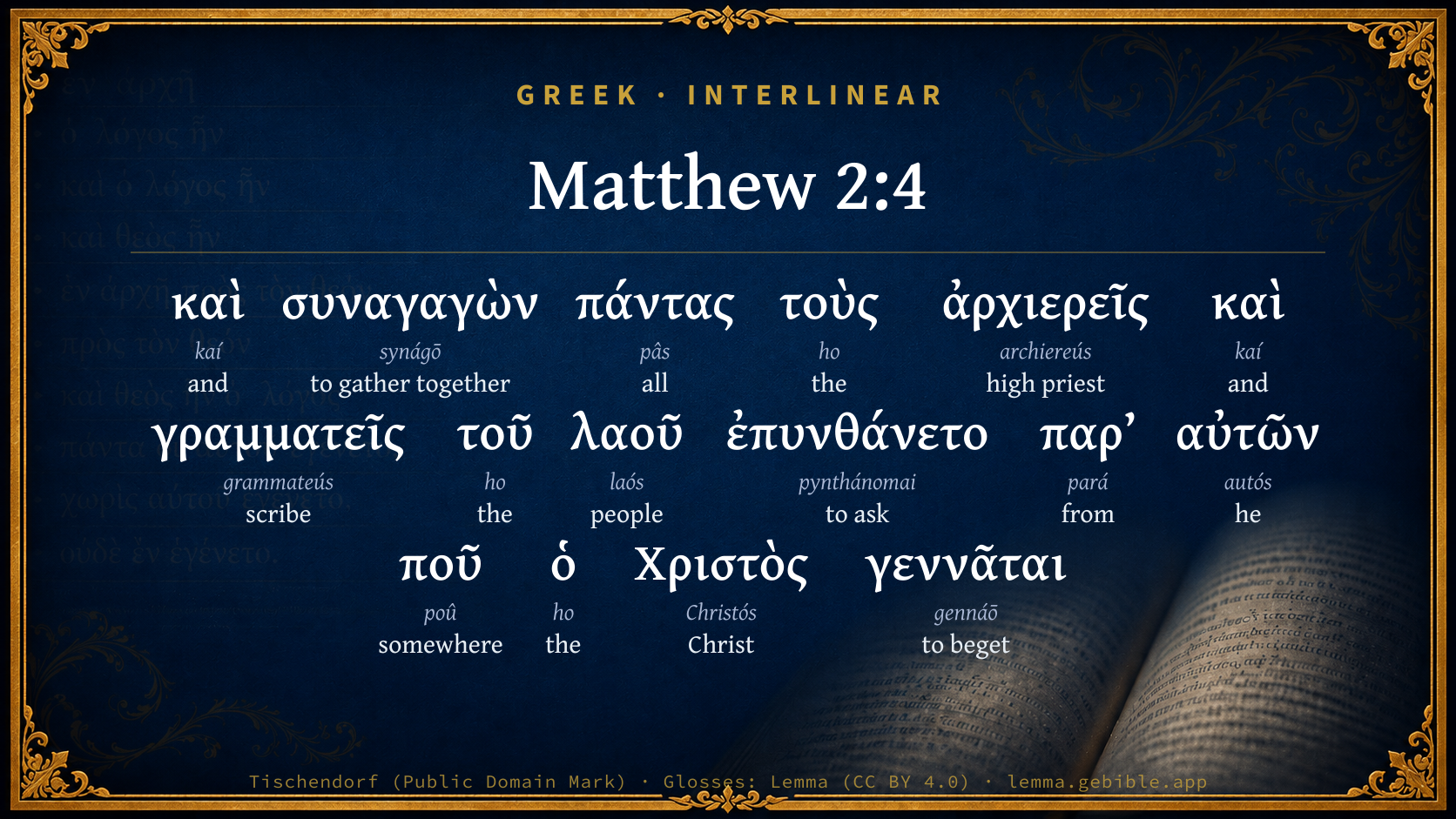
Greek (Tischendorf 8th ed.) Matthew 2:4 appears in the Greek New Testament. The text above is from the Tischendorf 8th edition. Each word links to its Strong’s number and a concise gloss. Click any word for its full Thayer’s Greek Lexicon entry.
Download image
Cite this verse

Matthew 2:4 (World English Bible). Public Domain. Lemma interlinear Bible study tool, https://lemma.gebible.app/v/matthew/2/4.

Show BibTeX & RIS
BibTeX
RIS
English Translation
Gathering together all the chief priests and scribes of the people, he asked them where the Christ would be born.
World English Bible · Public Domain
Highlights
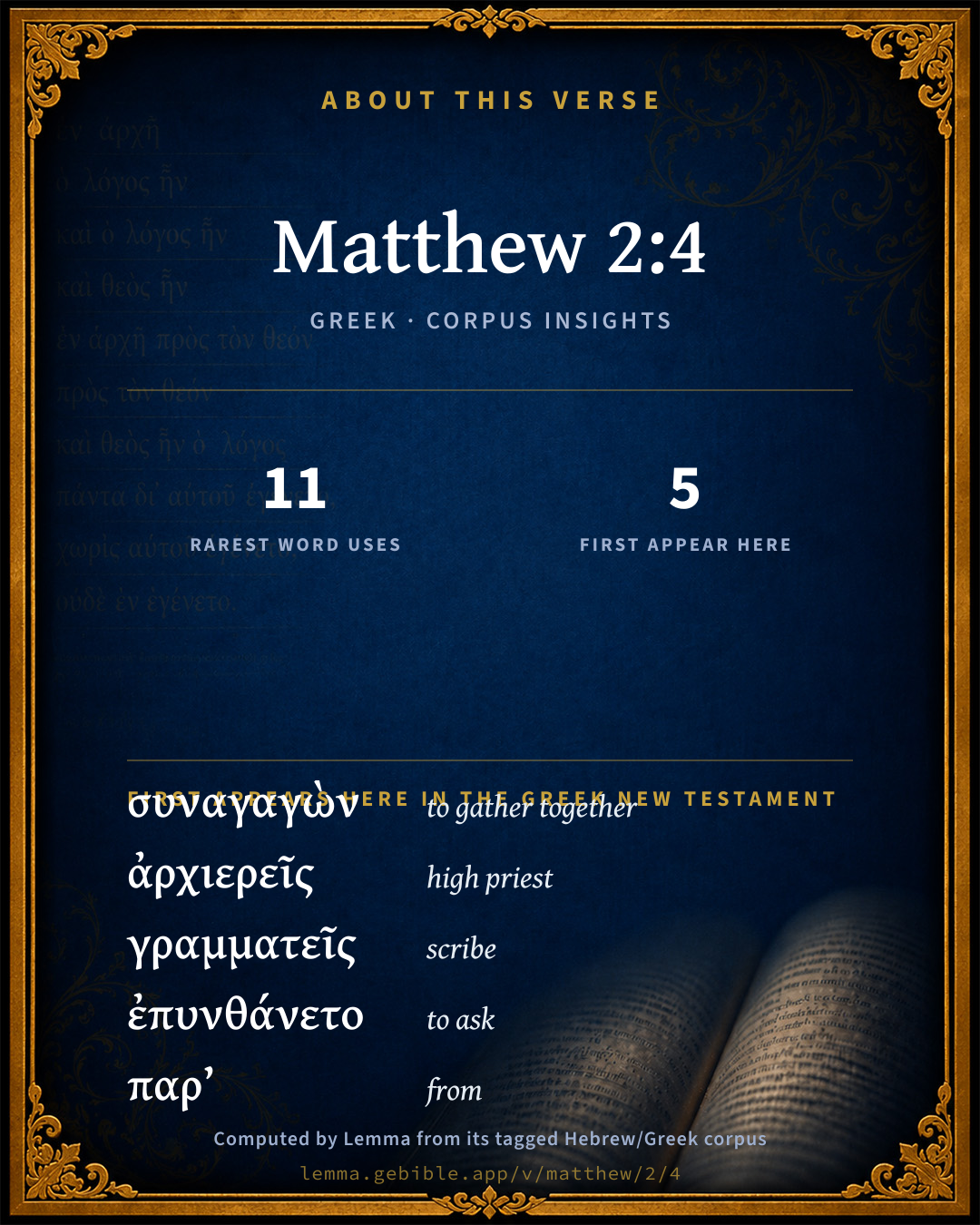
  • 5 first appearances in the Greek New Testament
Full analysis ↓
Download a study sheet

One document with this verse’s original text, its word-by-word gloss line, the meaning frame, cross-references with their text, attributed commentary, and full source and license credits — printable, and it pastes into notes with its structure intact.

This verse Autodidact and up

Study sheet (.html) Plain text (.txt)

A passage Seminary Student

Up to 50 verses in one chapter. A passage sheet keeps up to 6 commentary sources and 12 cross-references per verse, in the order this page ranks them, and says so on the sheet whenever that leaves anything out. Ask for a single verse and you get the Autodidact verse sheet above.

Everything on this page stays free to read, with no account — the sheet is a download of what is already on screen, not access to it.

Want to remove ads? Support Godless Engineer
Compare translations 3

The same verse in 3 English versions, stacked beneath the original-language interlinear above. Click any original word for its lexicon entry.

Each is an independent rendering of the whole verse — the interlinear is not word-aligned to these translations.

Highlighted words mark where these versions differ — a whole-verse word diff, not a word-by-word alignment.

  • World English Bible Public Domain
    Gathering together all the chief priests and scribes of the people, he asked them where the Christ would be born.
  • King James Version Public Domain
    And when he had gathered all the chief priests and scribes of the people together, he demanded of them where Christ should be born.
  • unfoldingWord Literal Text CC BY-SA 4.0
    And having brought together all the chief priests and scribes of the people, he inquired from them, “Where is the Christ being born?”

unfoldingWord Literal Text — © unfoldingWord, licensed CC BY-SA 4.0. Word-aligned USFM3 via Door43 (git.door43.org/unfoldingWord/en_ult).

Versions to compare (up to 4)

3 of 4 selected

Show all 19 translations

Every available English version of this verse, each an independent rendering of the whole verse.

  • World English Bible Public Domain
    Gathering together all the chief priests and scribes of the people, he asked them where the Christ would be born.
  • Berean Standard Bible Public Domain
    And when he had assembled all the chief priests and scribes of the people, he asked them where the Christ was to be born.
  • Majority Standard Bible Public Domain
    And when he had assembled all the chief priests and scribes of the people, he asked them where the Christ was to be born.
  • King James Version Public Domain
    And when he had gathered all the chief priests and scribes of the people together, he demanded of them where Christ should be born.
  • American Standard Version (1901) Public Domain
    And gathering together all the chief priests and scribes of the people, he inquired of them where the Christ should be born.
  • Revised Version (1885) Public Domain
    And gathering together all the chief priests and scribes of the people, he inquired of them where the Christ should be born.
  • Geneva Bible (1599) Public Domain
    And gathering together all the chiefe Priestes and Scribes of the people, hee asked of them, where Christ should be borne.
  • Douay-Rheims (1899) Public Domain
    And assembling together all the chief priests and the scribes of the people, he inquired of them where Christ should be born.
  • Young's Literal Translation Public Domain
    and having gathered all the chief priests and scribes of the people, he was inquiring from them where the Christ is born.
  • Literal Standard Version CC BY-SA 4.0
    and having gathered all the chief priests and scribes of the people, he was inquiring from them where the Christ is born.
  • Unlocked Literal Bible CC BY-SA 4.0
    Herod brought together all the chief priests and scribes of the people, and he asked them, “Where is the Christ to be born?”
  • unfoldingWord Literal Text CC BY-SA 4.0
    And having brought together all the chief priests and scribes of the people, he inquired from them, “Where is the Christ being born?”
  • Darby Bible Public Domain
    and, assembling all the chief priests and scribes of the people, he inquired of them where the Christ should be born.
  • World Messianic Bible Public Domain
    Gathering together all the chief priests and scribes of the people, he asked them where the Messiah would be born.
  • Webster's Bible Public Domain
    And when he had assembled all the chief priests and scribes of the people, he inquired of them where Christ should be born.
  • Free Bible Version CC BY-SA 4.0
    Herod summoned all the chief priests and religious teachers of the people, and asked them where the Messiah was supposed to be born.
  • Bible in Basic English Public Domain
    And he got together all the chief priests and scribes of the people, questioning them as to where the birth-place of the Christ would be.
  • Text-Critical English NT CC BY 4.0
    So he assembled all the chief priests and scribes of the people, and inquired of them where the Christ was to be born.
  • Tyndale New Testament (1534) Public Domain
    and he gathered all the chefe Prestes and Scribes of the people and axed of them where Christ shulde be borne.

Literal Standard Version (2020), Covenant Press — licensed CC BY-SA 4.0. Text via the HelloAO Bible API (eBible.org). Unlocked Literal Bible (unfoldingWord) — licensed CC BY-SA 4.0. Text via the HelloAO Bible API (eBible.org). unfoldingWord Literal Text — © unfoldingWord, licensed CC BY-SA 4.0. Word-aligned USFM3 via Door43 (git.door43.org/unfoldingWord/en_ult). Free Bible Version, Dr. Jonathan Gallagher — licensed CC BY-SA 4.0. Text via the HelloAO Bible API (eBible.org).

Word by word

More ways to search: Search by grammar → Find every occurrence → Compare this word →

Practice this passage: Drill this verse → Learn its vocabulary →

ἐπυνθάνετο
pynthánomai
G4441
“to ask”
Verb, Imperfect, Middle or Passive deponent, Indicative, 3rd person, Singular
Part of Speech
Verb
Tense
Imperfect
Voice
Middle or Passive deponent
Mood
Indicative
Person
3rd person
Number
Singular
Full Thayer's Definition

Origin: middle voice prolonged from a primary putho (which occurs only as an alternate in certain tenses)

TDNT: None

1. to enquire, ask 2. to ascertain, by enquiry
  1. καὶ kaí G2532 “and” Conjunction
  2. συναγαγὼν synágō G4863 “to gather together” Verb, Aorist, Active, Participle, Nominative, Singular, Masculine
  3. πάντας pâs G3956 “all” Adjective, Accusative, Plural, Masculine
  4. τοὺς ho G3588 “the” Article, Accusative, Plural, Masculine
  5. ἀρχιερεῖς archiereús G749 “high priest” Noun, Accusative, Plural, Masculine
  6. καὶ kaí G2532 “and” Conjunction
  7. γραμματεῖς grammateús G1122 “scribe” Noun, Accusative, Plural, Masculine
  8. τοῦ ho G3588 “the” Article, Genitive, Singular, Masculine
  9. λαοῦ laós G2992 “people” Noun, Genitive, Singular, Masculine
  10. παρ’ pará G3844 “from” Preposition
  11. αὐτῶν autós G846 “he” Personal pronoun, Genitive, Plural, Masculine
  12. ποῦ poû G4226 “somewhere” Particle, Interrogative
  13. ὁ ho G3588 “the” Article, Nominative, Singular, Masculine
  14. Χριστὸς Christós G5547 “Christ” Noun, Nominative, Singular, Masculine
  15. γεννᾶται gennáō G1080 “to beget” Verb, Present, Passive, Subjunctive, 3rd person, Singular

About this verse

These counts appear in no published source. They are computed here, from the morphology-tagged text and Lemma’s own curated glosses. What Lemma adds →

16
words
13
distinct lemmas
Gospels
section

Notable vocabulary

The rarest word here is ἐπυνθάνετο to ask G4441 — appearing just 11 times in the whole Greek New Testament.

First appearance in Scripture

These words make their first canonical appearance in the Greek New Testament here:

  • συναγαγὼν to gather together G4863
  • ἀρχιερεῖς high priest G749
  • γραμματεῖς scribe G1122
  • ἐπυνθάνετο to ask G4441
  • παρ’ from G3844

Shared distinctive vocabulary

ἐπυνθάνετο to ask G4441 occurs in 11 verses of the Greek New Testament. Also found in:
Repetition

Words recur within this verse:

Cross-references

28

Topical passages linked to Matthew 2:4 in the Treasury of Scripture Knowledge — connected by theme and wording, ordered by reader-vote popularity; previews shown in the World English Bible.

  • Matthew 7:29 for he taught them with authority, and not like the scribes.
  • Matthew 21:23 When he had come into the temple, the chief priests and the elders of the people came to him as he was teaching, and said, "By what authority do you do these things? Who gave you this authority?"
  • Acts 6:12 They stirred up the people, the elders, and the scribes, and came against him and seized him, and brought him in to the council,
  • Acts 23:9 A great clamor arose, and some of the scribes of the Pharisees part stood up, and contended, saying, "We find no evil in this man. But if a spirit or angel has spoken to him, let's not fight against God!"
  • Jeremiah 8:8 How do you say, We are wise, and the law of Yahweh is with us? But, behold, the false pen of the scribes has worked falsely.
  • Luke 20:19 The chief priests and the scribes sought to lay hands on Him that very hour, but they feared the people--for they knew He had spoken this parable against them.
  • Luke 23:10 The chief priests and the scribes stood, vehemently accusing him.
  • John 3:10 Jesus answered him, "Are you the teacher of Israel, and don't understand these things?
  • John 7:32 The Pharisees heard the multitude murmuring these things concerning him, and the chief priests and the Pharisees sent officers to arrest him.
  • John 8:3 The scribes and the Pharisees brought a woman taken in adultery. Having set her in the midst,
  • John 18:3 Judas then, having taken a detachment of soldiers and officers from the chief priests and the Pharisees, came there with lanterns, torches, and weapons.
  • Acts 4:5 It happened in the morning, that their rulers, elders, and scribes were gathered together in Jerusalem.
  • 1 Chronicles 24:4–19 There were more chief men found of the sons of Eleazar than of the sons of Ithamar; and [thus] were they divided: of the sons of Eleazar there were sixteen, heads of fathers' houses; and of the sons of Ithamar, according to their fathers' houses, eight.
  • 2 Chronicles 34:13 Also they were over the bearers of burdens, and set forward all who did the work in every manner of service: and of the Levites there were scribes, and officers, and porters.
  • 2 Chronicles 34:15 Hilkiah answered Shaphan the scribe, I have found the book of the law in the house of Yahweh. Hilkiah delivered the book to Shaphan.
  • 2 Chronicles 36:14 Moreover all the chiefs of the priests, and the people, trespassed very greatly after all the abominations of the nations; and they polluted the house of Yahweh which he had made holy in Jerusalem.
  • Ezra 7:6 this Ezra went up from Babylon: and he was a ready scribe in the law of Moses, which Yahweh, the God of Israel, had given; and the king granted him all his request, according to the hand of Yahweh his God on him.
  • Ezra 7:11–12 Now this is the copy of the letter that the king Artaxerxes gave to Ezra the priest, the scribe, even the scribe of the words of the commandments of Yahweh, and of his statutes to Israel:
  • Ezra 10:5 Then arose Ezra, and made the chiefs of the priests, the Levites, and all Israel, to swear that they would do according to this word. So they swore.
  • Nehemiah 12:7 Sallu, Amok, Hilkiah, Jedaiah. These were the chiefs of the priests and of their brothers in the days of Jeshua.
  • Psalms 2:2 The kings of the earth take a stand, And the rulers take counsel together, Against Yahweh, and against his anointed, saying,
  • Malachi 2:7 For the priest's lips should keep knowledge, and they should seek the law at his mouth; for he is the messenger of Yahweh of Hosts.
  • Matthew 13:52 He said to them, "Therefore, every scribe who has been made a disciple in the Kingdom of Heaven is like a man who is a householder, who brings out of his treasure new and old things."
  • Matthew 21:15 But when the chief priests and the scribes saw the wonderful things that he did, and the children who were crying in the temple and saying, "Hosanna to the son of David!" they were indignant,
  • Matthew 26:3 Then the chief priests, the scribes, and the elders of the people were gathered together in the court of the high priest, who was called Caiaphas.
  • Matthew 26:47 While he was still speaking, behold, Judas, one of the twelve, came, and with him a great multitude with swords and clubs, from the chief priest and elders of the people.
  • Matthew 27:1 Now when morning had come, all the chief priests and the elders of the people took counsel against Jesus to put him to death:
  • Mark 8:31 He began to teach them that the Son of Man must suffer many things, and be rejected by the elders, the chief priests, and the scribes, and be killed, and after three days rise again.

Cross-references courtesy of OpenBible.info (CC BY 4.0).

Commentary

Notes on Matthew 2:4 from classic Christian and Jewish commentators (each source and its license shown beneath its notes). The classic Christian expositions comment on the surrounding passage and are grouped to its opening verse, so a note may address several verses; the Jewish commentaries on the Tanakh (Rashi and others) are per-verse, so they appear only where the commentator wrote on this verse.

Lemma curates 59 commentaries, every one of them public domain or Creative Commons licensed, each selected and text-cleaned for this edition rather than reprinted as found. About our sources →

The Biblical Illustrator

Joseph S. Exell

Mat_2:4

Priests and scribes.

Near in privilege, far from piety

Some that are best acquainted with the gospel are practical strangers to it. They are like one who should pore over a map, mastering its geography; marking each sea, lake, river; understanding the position of every range of mountains; learning the names of all the localities indicated, but never visiting them. A living author, describing his journey to the falls of Niagara, says: I met with a gentleman who told me that he had walked from Boston, a distance of seven hundred miles, to see Niagara. When within seven miles, he heard what he thought might be the roar of the torrent, and asked a man who was at work on the road if this was so. The man replied that he didnt know; it might be, but he had never been there himself. Yet he had lived within sound of it all his life! Wonderful stupidity, this! Who does not reprobate such folly? Nevertheless, it is nothing-absolutely nothing-compared with the direr folly which may be witnessed any day that we choose to look around us. Numbers are within sound of the river of the water of life without an actual, personal experience of its benefit. (Rev. T. R. Stevenson.)

Like in this to those who built the ark for Noah, providing others with a refuge, themselves perished in the flood; or like to the stones by the road that show the miles, but themselves are not able to move. (Augustine.)

The Biblical Illustrator, edited by Joseph S. Exell (c. 1880s–1900s) — public domain. Text from a community e-Sword module.

Joseph Benson's Commentary

Mat 2:4. And when he had gathered all the chief priests — This expression must be intended to comprehend not only the high priest for the time being, and his deputy, with those who had formerly borne that office, but also the heads of the twenty-four courses, as well as any other persons of peculiar eminence in the priesthood, in which sense Josephus uses the word, Antiq. lib. 20. cap. 8. (al. 6,) § 8, p. 973. The scribes of the people — It would seem, from Ezr 7:11-12; 1Ch 24:6; 2Ch 34:13, that they were of the tribe of Levi only, and so were either priests or Levites. As their office was to transcribe and prepare fair copies of the law of Moses, and other parts of the Old Testament, (a very necessary work before printing was invented,) they became, of course, well acquainted with the Scriptures, and were ordinarily employed in explaining them to the people: whence the chief of them were called doctors of the law. They, or at least some of them, together with the chief priests and elders, constituted the sanhedrim, or great council of the nation. But in this place, when no public business was to be done, but only the predictions of the ancient prophets were to be searched into by those who were thought to excel others in the knowledge of them, it does not appear that any fixed and legal council was summoned; but only that an extraordinary meeting of learned men was called by the king, that they might judge of the question of the wise men. He demanded of them where Christ, i.e, the promised Messiah, was to be born. The wise men had said nothing about Christ, or the Messiah, but only about a king, or, the king of the Jews. But Herod presently conceived that this king of the Jews that was born must be the Messiah promised Psalms 2.; Daniel 9.; and therefore desired to know of them the place of his birth, according to their received traditions, and sense of the prophecies of Scripture. But it is to be well observed, that we must understand Herod as inquiring, not concerning an event considered by him as already come to pass, but concerning a matter yet future and uncertain. For although he understood from the wise men that the birth of the Messiah had even now taken place, yet he concealed his knowledge of this, and his whole design, from the Jews. It is easy to observe how strongly all this story implies that a general expectation of the Messiah now prevailed: and it is plain Herod, in a sense, both believed the Jewish Scriptures, and that the birth of the Messiah was foretold in them. And yet, which discovered the height of madness, as well as of impiety and cruelty, he was contriving to destroy him! to destroy him whose birth, and reign, and glory, God in his word, he believed, had infallibly foretold!

Joseph Benson's Commentary on the Old and New Testaments (1811–1818) — public domain. Text from a community e-Sword module.

Tyndale Open Study Notes

Tyndale Open Resources

2:4 The leading priests had political and religious clout and ministered predominantly in the Temple (see 21:23). Herod gathered the teachers of religious law because they were trained to know Old Testament prophecies and were often influential Pharisees.

Tyndale Open Study Notes — © Tyndale Open Resources, licensed CC BY-SA 4.0. Text via the HelloAO Bible API.

Bengel's Gnomon

Johann Albrecht Bengel

Mat 2:4. Πάντας, all) i.e., all who were in Jerusalem at that time.—ἀρχιερεῖς, chief priests) The writers of the New Testament seldom speak of ἰερεῖς, priests, but generally of ἀρχιερεῖς, chief priests. This word had distinct significations in the singular and plural number: the singular ὁ Ἀρχιερεὺς signifies the High Priest; the plural ἀρχιερεῖς, either with or without the definite article, signified those priests who were more nearly related to the High Priest, and had from that circumstance greater influence than the rest.—See Act 4:6.—γραμματεῖς τοῦ λαοῦ, scribes of the people) With the LXX. γραμματεὺς (scribe) corresponds to the Hebrew שטר;[80] in which sense ΤΟῪς ΓΡΑΜΜΑΤΕῖς ΤΟῦ ΛΑΟῦ (the scribes of the people), occurs in 1Ma 5:42, cf. also Deu 20:5. They render also ספר[81] by γραμματεὺς. And that signification suits also the present passage, where a Theological Reply is spoken of. The scribes of the people are spoken of in contradistinction to the chiefs of the priests: and were private men or doctors, well versed in the Scriptures; cf. note on ch. Mat 22:35.—ἐπυνθάνετο, inquired. He ought to have done so before.—ΠΟῦ Ὁ ΧΡΙΣΤῸς ΓΕΝΝᾶΤΑΙ, where Christ is born) He makes the question of the Magi his own. The present tense of the verb γεννᾶται (is born), accords with the general expectation of the coming of the Messiah, which prevailed at that time.

[80] i.e. ש̈טֵר a scribe (LXX. γραμματεὺς, γραμματοεισαγωγεύς); hence from the art of writing having been especially used forensically, a magistrate, prefect of the people: specially ש̈טְרִים is used of the prefects of the people of Israel in Egypt, Exo 5:6-19, and in the desert, Num 11:16 (used of the seventy elders), Deu 20:9 etc., etc.; magistrates in the towns of Palestine, Deu 16:18, etc., etc.; used of the superior magistrates, Pro 6:7.—Gesenius.—(I. B.)

[81] i.e. ס̇פר a scribe, Psa 45:2, Ezr 9:2-3; specially (a) the king’s scribe; 2Sa 8:17; 2Sa 20:25; 2Ki 12:17; 2Ki 19:2; 2Ki 22:3-4; (b) a military scribe who has the charge of keeping the muster-rolls, Jer 37:15; Jer 52:25; 2Ki 25:19; (c) in the later books a person skilled in the sacred writings, γραμματεύς, 1Ch 27:32; Ezr 7:6, etc., etc.; orסָפִרִ 1) a scribe, a royal scribe accompanying a satrap or governor of a province, Ezr 4:8-9; Ezr 4:17; Ezr 4:23; (2) γραμματεύς—one skilled in the sacred books, Ezr 7:12; Ezr 7:21.—Ibid.—(I. B.)

Bengel's Gnomon of the New Testament — English translation (T&T Clark, Edinburgh, 1860) — public domain. Text from a community e-Sword module.

Meyer's Critical & Exegetical Commentary

Heinrich August Wilhelm Meyer

Mat_2:4. Πάντας … λαοῦ] is regarded, after Grotius, by Fritzsche, Arnoldi, Lange, not as an assembly of the Sanhedrin (so commonly), but an extraordinary convocation of all the high priests and learned men. This explanation, in which, moreover, πάντας is not to be taken literally, is the correct one. Indeed, οἱ ἀρχιερεῖς καὶ γραμματεῖς, even without adding the third element of the Sanhedrin, the πρεσβύτεροι, may denote the Sanhedrin (Mat_20:18, Mat_21:15; while, on the other hand, elsewhere, as in Mat_26:47, Mat_27:1, the γραμματεῖς are not mentioned along with them). But here πάντας is decisive, which would designedly draw attention to a full sitting of the high council, and therefore would have made it necessary not to omit an entire class of the members, but to mention in full all the three classes, as in Mat_16:21, Mat_27:41; τοῦ λαοῦ also stands opposed to the common interpretation, as the latter, in designating the Sanhedrin in Matthew, serves only to denote the πρεσβύτεροι more precisely (Mat_21:23, Mat_26:3; Mat_26:47, Mat_27:1). Herod summoned together all the theologians of the nation, because he wanted a theological answer; τοῦ λαοῦ belongs to both words; observe the non-repetition of the article after καί.

ἀρχιερεῖς] certainly comprises partly the actual ruling high priest (ὁ ἀρχιερεύς, כֹּהֵן הַנָּרוֹל, Lev_15:10), partly those who had formerly held this high official post, which very often changed hands under the Herods. See Schürer, Stud. u. Krit. 1872, p. 593 ff. That the presidents of the twenty-four classes of priests are also to be understood (Bleek, Ewald), is nowhere certainly attested, and has against it the designation of the office itself, ἀρχιερεῖς. Both reasons, moreover, are in opposition to our including, with Wieseler, the priestly nobles, or, with Schürer, the members of the at that time privileged high-priestly families (Joseph. Bell. iv. 3. 6), which is not justified by Act_4:6, and cannot be proved by a few individual names mentioned in Josephus, whose relation to the high-priesthood is otherwise unknown (Schürer, p. 638 f.). The last high priests who ruled before the death of Herod were Matthias (5 B.C.), and Jozarus, who soon after followed him (Joseph. Antt. xvii. 4. 2, xvii. 6. 4).

γραμματεῖς] corresponds to the Hebr. מוֹפְרִיםthat is, first, writers, then learned men (Ezr_7:6; Ezr_7:11; Neh_8:1; Gesenius, Thes. II. p. 966). This was the name specially of the expositors of the divine law, who, as Jewish canonists and learned councillors, belonged chiefly to the sect of the Pharisees, and in part to the Sanhedrin, and were held in great respect. See Lightfoot on the passage, and on Mat_23:13; Leyrer in Herzogs Encykl. XIII. p. 731 ff.

γεννᾶται] not in the sense of the future, but purely present: where is the Messiah born? The theologians were to tell what they knew concerning the birthplace of the Messiah. By this question Herod leaves it quite undetermined whether the birth had already taken place, or was still to come.

Meyer — Critical and Exegetical Commentary on the New Testament — English translation by Peter Christie, edited by Frederick Crombie (T&T Clark, 1880) — public domain. Text from a community e-Sword module.

Expositor's Greek Testament

ed. W. Robertson Nicoll

Mat 2:4 . Herod’s measures . καὶ συναγαγὼν … τοῦ λαοῦ . Was this a meeting of the Sanhedrim? Not likely, as the elders are not mentioned, who are elsewhere named as the representatives of the people, vide Mat 26:3 , “the chief priests, scribes and elders of the people”. Here we read only of the chief priests and scribes of the people. The article is not repeated before γραμματεῖς , the two classes being joined together as the theological experts of the people. Herod called together the leading men among the priests and scribes to consult them as to the birth-place of Messiah. Holtzmann (H. C.), assuring that a meeting of the Sanhedrim is meant, uses the fact as an argument against the historicity of the narrative. The Herod of history slew the Sanhedrists wholesale, and did his best to lull to sleep Messianic hopes. It is only the Herod of Christian legend that convenes the Sanhedrim, and makes anxious inquiries about Messiah’s birth-place. But the past policy of the king and his present action, as reported by the evangelist, hang together. He discouraged Messianic hopes, and, now that they have revived in spite of him, he must deal with them, and his first step is to consult the experts in as quiet a way as possible, to ascertain the whereabouts of the new-born child ἐπυνθάνετο , etc.: it is not a historical question he submits to the experts as to where the Christ has been born, or shall be, but a theological one: where, according to the accepted tradition, is His birth-place? Hence γεννᾶται , present tense.

The Expositor's Greek Testament, edited by W. Robertson Nicoll (1897–1910) — public domain. Text from a community e-Sword module.

Geneva Bible (1599)

Geneva Bible translators

The chief priests, that is, such as were of Aaron’s family, which were divided into four and twenty orders, 1 Chron. 14:5 and 2 Chron. 36:14.

They that expound the Law to the people, for the Hebrews take this word of another, which signifieth as much as to expound and declare.

Geneva Bible (1599) marginal notes — public domain. Text via Bolls.life.

Jamieson, Fausset & Brown

Robert Jamieson, A. R. Fausset & David Brown

And when he had gathered all the chief priests and scribes of the people together--The class of the "chief priests" included the high priest for the time being, together with all who had previously filled this office; for though the then head of the Aaronic family was the only rightful high priest, the Romans removed them at pleasure, to make way for creatures of their own. In this class probably were included also the heads of the four and twenty courses of the priests. The "scribes" were at first merely transcribers of the law and synagogue readers; afterwards interpreters of the law, both civil and religious, and so both lawyers and divines. The first of these classes, a proportion of the second, and "the elders"--that is, as LIGHTFOOT thinks, "those elders of the laity that were not of the Levitical tribe"--constituted the supreme council of the nation, called the Sanhedrim, the members of which, at their full complement, numbered seventy-two. That this was the council which Herod now convened is most probable, from the solemnity of the occasion; for though the elders are not mentioned, we find a similar omission where all three were certainly meant (compare Mat 26:59; Mat 27:1). As MEYER says, it was all the theologians of the nation whom Herod convened, because it was a theological response that he wanted.

he demanded of them--as the authorized interpreters of Scripture.

where Christ--the Messiah.

should be born--according to prophecy.

Jamieson, Fausset & Brown — Commentary Critical and Explanatory on the Whole Bible (1871) — public domain (CC PDM 1.0). Text via the HelloAO Bible API.

Adam Clarke's Commentary

Verse 4. The chief priests] Not only the high priest for the time being, called כהן הראש cohen ha-rosh, 2Kg 25:18, and his deputy, called כהן משנה cohen mishneh, with those who had formerly borne the high priest's office; but also, the chiefs or heads of the twenty four sacerdotal families, which David distributed into so many courses, 1Ch 24. These latter are styled סרי הכהנים sarey ha-cohanim, chief of the priests, 2Ch 36:14; Ezr 8:24; and ראשי הכהנים roshey ha-cohanim, heads of the priests, Ne 12:7. Josephus calls them by the same name as the writers of the New Testament. In his Life, sect. 8, he mentions πολλους - των αρχιερεων, MANY of the chief priests. The word is used in the singular in this last sense, for a chief of the priests, Ac 19:14.

Scribes] The word γραμματευς, in the Septuagint, is used for a political officer, whose business it was to assist kings and civil magistrates, and to keep an account in writing of public acts and occurrences. Such an officer is called in Hebrew ספר המלך seper hamelech, ὁ γραμματευς του βασιλεως, the king's scribe, or secretary. See LXX. 2Kg 12:10.

The word is often used by the LXX. for a man of learning, especially for one skilled in the Mosaic law: and, in the same sense, it is used by the New Testament writers. γραμματευς is therefore to be understood as always implying a man of letters, or learning, capable of instructing the people. The derivation of the names proves this to be the genuine meaning of the word γραμμα: a letter, or character, in writing: or γραμματα, letters, learning, erudition, and especially that gained from books. The Hebrew ספר or סופר sopher, from saphar, to tell, count, cypher, signifies both a book, volume, roll, c., and a notary, recorder, or historian and always signifies a man of learning. We often term such a person a man of letters.

The word is used Ac 19:35, for a civil magistrate at Ephesus, probably such a one as we would term recorder. It appears that Herod at this time gathered the whole Sanhedrin, in order to get the fullest information on a subject by which all his jealous fears had been alarmed.

Adam Clarke's Commentary on the Bible (1810–1826) — public domain. Text from a community e-Sword/MySword module.

Ellicott's Commentary for English Readers

(4) The chief priests and scribes.—The chief priests were probably the heads of the twenty-four courses into which the sons of Aaron were divided (2Ch_23:8; Luk_1:5), but the term may have included those who had, though only for a time, held the office of high priest. The “scribes” were the interpreters of the Law, casuists and collectors of the traditions of the Elders, for the most part Pharisees. The meeting thus convened was not necessarily a formal meeting of the Sanhedrim or Great Council, and may have been only as a Committee of Notables called together for a special purpose. With a characteristic subtlety, as if trying to gauge the strength of their Messianic hopes, Herod acts as if he himself shared them, and asks where the Christ, the expected Messiah, the “anointed” of the Lord (Psa_2:2; Psa_45:7; Psa_89:20) was to be born.

A Bible Commentary for English Readers, edited by Charles John Ellicott (1878–1897) — public domain. Text from a community e-Sword module.

The Cambridge Bible for Schools and Colleges

gen. ed. J. J. S. Perowne

4. gathered all the chief priests and scribes of the people together] i. e. summoned a meeting of the Sanhedrin, a body often indicated in this way. Others contend that this was an irregular meeting of all the chief priests and learned men.

The chief priests were those who had served the office of high priest, and also the heads of the courses into which the priests were divided. Scribes were those who transcribed or copied the law and who expounded it. They are called lawyers in St Luke’s gospel.

where Christ should be born] Lit. where the Christ or Messiah is born. Where do your sacred writings represent him to be born? For a similar use of the indicative cp. Joh_7:52.

The Cambridge Bible for Schools and Colleges (gen. ed. J. J. S. Perowne; Cambridge University Press, 1878–1918) — public domain. Text from a community e-Sword module.

John Gill's Exposition

And when he had gathered all the chief priests,.... Here we have an account of Herod's conduct at this juncture; he calls a council, assembles the sanhedrim, gathers together the more learned persons in the city to consult with them upon this matter,

the chief priests, all of which he gathered together, and which seem to be many; and were not only the then present high priest and his substitutes, but all the principal persons of the priesthood, who were chosen from the rest, into the great sanhedrim, or council: and by

the scribes of the people are meant a sort of letter learned men, whose business it was to keep and write out copies of the law, and other things, for "the people"; they were the fathers of the traditions, and interpreters of the law to them; and therefore are called "the scribes of the people": as well also, because they were chosen from among the people, from any other tribe, and not from the tribe of Levi, from whom the priests were; so that one seems to design the "clergy", and the other the laity, in this assembly. The Septuagint render "the officers of the people", by this same word the scribes, and scribes of the people, in Num 11:16 Jos 1:10. The learned Dr. Lightfoot (x) conjectures, that the persons of note, who were present at this time, were Hillell the president of the council, Shammai the vice president, the sons of Betira, Judah and Joshua, Bava ben Buta, Jonathan ben Uzziel, the Chaldee paraphrast, and Simeon the son of Hillell.

He demanded of them, or asked them with authority, as the chief captain did, Act 21:33 "where Christ", , the Christ, the Messiah

should be born? that is, where was the place of his birth as fixed in their prophecies, where, accordingly, they believed and expected he would be born. Herod's pretence, no doubt, in putting this question was, that he might be able to satisfy the wise men of the East about this matter; though the true reason within himself was, that he might know where this new born king was, in order to destroy him.

(x) Vol. II. p. 111.

John Gill's Exposition of the Whole Bible (1746–1763) — public domain (CC PDM 1.0). Text via the HelloAO Bible API.

Trapp's Complete Commentary

John Trapp

4 And when he had gathered all the chief priests and scribes of the people together, he demanded of them where Christ should be born.

Ver. 4. And when he had gathered all the chief priests] The true picture of Popish councils, who propound grave questions as this was, Where Christ should be born? and pretend to worship Christ, but intend to worry him: the Council of Trent was carried, against the simplicity of Christ, with such infinite guile and craft, as that themselves will even smile in the twiumphs of their own wits (when they hear it but mentioned) as at a master stratagem. It passed in France in manner of a proverb, That the modern council had more authority than that of the apostles, because their own pleasure was a sufficient ground for the decrees, without admitting the Holy Ghost. (Hist. of Council of Trent.)

John Trapp, A Commentary or Exposition upon All the Books of the Old and New Testament (1647–1656) — public domain. Text from a community e-Sword module.

Albert Barnes' Notes on the Bible

The chief priests - By the chief priests here are meant not only the high priest and his deputy, but. also the heads or chiefs of the 24 classes into which David had divided the sacerdotal families, 1Ch 23:6; 24; 2Ch 8:14; Ezr 8:24.

Scribes - By the scribes, in the New Testament, are meant learned men; men skilled in the law, or the lawyers of the nation. They kept the records of the Courts of justice, the registers of the synagogues, wrote articles of contract and sale, bills of divorce, etc. They were also called lawyers, Mat 22:35, and doctor’s of the law, Luk 5:17. They were called scribes. from the fact of their writing the public records. They were not, however, a religious sect, but might be either Pharisees or Sadducees. By the chief priests and scribes here mentioned is denoted the Sanhedrin or great council of the nation. This was composed of 72 men, who had the charge of the civil and religious affairs of the Jews. On this occasion Herod, in alarm, called them together, professedly to make inquiry respecting the birth of the Messiah.

Demanded of them - Inquired, or asked of them. As they were the learned men of the nation, and as it was their business to study and explain the Old Testament, they were presumed to know what the prophecies had declared on that point. His object was to ascertain from prophecy where he was born, that he might put him to death, and thus calm the anxieties of his own mind. He seems not to have had any doubt about the time when he would be born. He was satisfied that the time had come.

Albert Barnes' Notes on the Bible (1834–1885) — public domain. Text from a community e-Sword/MySword module.

Matthew Poole's English Annotations

In this perplexity the king Herod calleth a synod or convocation, which was made up of the chief priests and scribes; the single question which he propounds to them was to resolve him

where Christ should be born. It is most likely this was an extraordinary convention of such of these persons as the king thought fit, who were best skilled in the law, and other revelations of holy writ, not any orderly meeting of the sanhedrim; for the question propounded to them was of mere ecclesiastical concern, and to be resolved from the prophecies and writings of the Old Testament. The stating of the question to them, not where the King of the Jews, but where Christ should be born, makes it manifest, that although (that we read of) the wise men said nothing of Christ, yet Herod presently conceived that this King of the Jews, that was born, must be the Messiah prophesied of Psa 2:1-12 and in Dan 9:1-27; he therefore desired to know of them the place in which, according to their received tradition, and sense of the prophecies of holy writ, the Messiah whom they expected (that is, Christ) should be born.

Matthew Poole's English Annotations on the Holy Bible (1683–1685) — public domain. Text from a community e-Sword/MySword module.

Whedon's Commentary on the Bible

Daniel D. Whedon

4. All the chief priests and scribes — The deep alarm of Herod is manifested by the greatness of the convocation he calls. The chief priest was properly but one; but the title is extended to include his deputy and the heads of the twenty-four courses. Scribes — The word scribe signifies a writer, and was originally used to designate one of the class in the tribe of Levi who performed the office of secretary, recorder, roll-keeper, or transcriber. Seraiah was scribe or secretary to King David. 2Sa_8:17. Elihoreph and Ahiah were secretaries to King Solomon. 1Ki_4:3. Under Uzziah, king of Judah, Jeil, the scribe, kept the muster-roll of the army. 2Ch_26:11. So Ezra was a ready scribe in the law of Moses. Ezr_7:6.

The scribes of the New Testament belonged to the class of which Ezra was the model. They were transcribers of the text of the Mosaic law, and students and doctors of its principles. They were the same as the lawyers.

A select number of these scribes, as well as of the Pharisees, was associated with the high priests to constitute the Sanhedrim, or supreme legislative body of the Jewish nation.

Where Christ should be born — By Christ here is meant not a proper name, but a title — the Christ or the Messiah. See note on Mat_1:1. It is a profound, theological question, therefore, which King Herod puts to his spiritual advisers: Where, according to the prophecies of the Old Testament, is the Messiah to be born? In the answer then given by this illustrious body, we have the decision of the Jewish nation on this point. Hence Tacitus, the celebrated Pagan historian, says: “With the masses the opinion was prevalent that it was predicted IN THE BOOKS OF THE PRIESTS, that the East should at that time grow strong.” Which Suetonius, another Pagan Roman, confirms and makes even more pointed: “Through all the East there prevailed an ancient and constant opinion that it was contained in the fates that at that time those arising from Judea should become masters of human things.”

These testimonies prove, 1. That the expectations of an arising prodigy from Judea were then prevailing through the East. 2. That these expectations were founded on prophecy in the sacred books. 3. That the time for his coming was believed to be nigh at hand, the prophetic period being about accomplished. Finally, Herod, through his great Sanhedrim, has immediate access to these very sacred books which predict the very village where the Christ was to be born; just where our Jesus was born, in Bethlehem of Judea.

As a singular illustration of this whole subject, we quote the following: “So vivid was their (the Chinese’s) expectation of the Messiah — ‘the Great Saint who,’ as Confucius says, ‘was to appear in the West’ — so fully sensible were they not only of the place of his birth, but of the TIME of his coming, that about sixty years after the birth of our Saviour they sent their envoys to hail the expected Redeemer. These envoys encountered on their way the missionaries of Boodhism coming from India — the latter announcing an incarnate God were taken to be the disciples of the true Christ, and were presented as such to their countrymen by the deluded ambassadors. Thus was this religion introduced into China.” (Schlegel’s Philosophy of History, 1:176.)

Daniel D. Whedon (gen. ed.), Commentary on the Old and New Testaments (1874–1909) — public domain. Text from a community e-Sword module.

The Pulpit Commentary

And when he had gathered... together (kai sunagagwn). The Revised Version, and gathering together, suggests that there was no delay. All the chief priests and scribes of the people (pantav tou grammateiv tou laou). In the absence of the article before grammateiv we must take the words, "of the people," as belonging to both terms. The addition helped to bring out the evangelist"s thought that the representatives of the chosen people (1Pe_2:10) were fully informed of the coming of Christ. The chief priests (cf. also Mat_16:21, note) represented the ecclesiastical and Sadducean part, the scribes the more literary and probably the Pharisaic part, of the nation. The width of the term "all," and the double classification, seem to point to this not being a meeting of the Sanhedrin as such. Herod called an informal and perhaps the more comprehensive meeting of those who could assist him. He demanded of them; Revised Version, in quired, for "demand" is, in modern English, too strong for epunyaneto . The tyrant could be courteous when it served his purpose. Does the imperfect mark his putting the question to one after another? (cf. Act_1:6; and contrast Joh_4:52) Where Christ (the Christ, Revised Version) should be born (gennatai). In ver. 2 ( o tecyeiv) the stress lay on his birth as an accomplished fact. Here on his birth as connected with his origin The present is chosen, not the future, because Herod is stating a theological question without reference to time. Observe, in Herod"s inquiry and subsequent action, the combination of superstition and irreligion. He was willing to accept the witness of stars and of prophecies, but not willing to allow himself to be morally influenced by it. His attempt to kill this Child was the expression of a desire to destroy the Jewish nationality so far as this was severed from himself, and perhaps with it to uproot at the same time a fundamental part of the Jewish religion.

The Pulpit Commentary (1880–1919), ed. H.D.M. Spence-Jones & Joseph S. Exell — public domain. Text from a community e-Sword module.

John Wesley's Explanatory Notes

The chief priests - That is, not only the high priest and his deputy, with those who formerly had born that office: but also the chief man in each of those twenty-four courses, into which the body of priests were divided, 1 Chron. xxiv, 6-19. The scribes were those whose peculiar business it was to explain the Scriptures to the people. They were the public preachers, or expounders of the law of Moses. Whence the chief of them were called doctors of the law.

John Wesley, Explanatory Notes Upon the Whole Bible (1754–1765) — public domain. Text via the GEBible commentary corpus.

Scofield Reference Notes

C. I. Scofield

Scribes

(Greek - "ἀπόλλυμι" = "writer") Heb. "spherim," "to write," "set in order," "count." The scribes were so called because it was their office to make copies of the Scriptures; to classify and teach the precepts of oral law (See Scofield "Mat 3:7") and to keep careful count of every letter in the O.T. writings. Such an office was necessary in a religion of law and precept, and was an O.T. function 2Sa 8:17; 2Sa 20:25; 1Ki 4:3; Jer 8:8; Jer 36:10; Jer 36:12; Jer 36:26. To this legitimate work the scribes added a record of rabbinical decisions on questions of ritual (Halachoth); the new code resulting from those decisions (Mishna); the Hebrew sacred legends (Gemara, forming with the Mishna the Talmud); commentaries on the O.T. (Midrashim); reasonings upon these (Hagada); and finally, mystical interpretations which found in Scripture meanings other than the grammatical, lexical, and obvious ones (the Kabbala); not unlike the allegorical method of Origen, or the modern Protestant "spiritualizing" interpretation. In our Lord’s time, to receive this mass of writing superposed upon the Scriptures was to be orthodox; to return to the Scriptures themselves was heterodoxy--our Lord’s most serious offence.

The Scofield Reference Bible (1917 edition), notes by C. I. Scofield — public domain. Text from a community e-Sword module.

Kretzmann's Popular Commentary

Paul E. Kretzmann

Herod’s measures to meet the emergency:

v. 4. And when he had gathered all the chief priests and scribes of the people together, he demanded of them where Christ should be born.

Not the entire Sanhedrin, or Great Council of the Jewish people,—for that included also the elders, many of whom Herod had put to death,—but the chief priests, the present incumbent of the office as well as former high priests; and the scribes, who were also political officers, assisting the civil magistrates in the role of confidential secretaries and statisticians. All of these were men of letters. Here again was a political move planned to strengthen Herod’s tottering prestige: to be summoned to a secret meeting might be thought a rare distinction by the Jewish leaders. And Herod, accustomed as he was to commanding, in this instance was very careful about couching his request in polite, though urgent, terms. The question he submitted was a theological one: Where, according to the transmitted records, according to the accepted tradition, is the birthplace of the Christ?

The answer of the Jewish theologians savors of a hidden satisfaction:

v. 5. And they said unto him, In Bethlehem of Judea; for thus it is written by the prophet,

v. 6a. And thou Bethlehem, in the land of Judah, art not the least among the princes of Judah.

Their opinion was given without hesitation; it reflected the current opinion and agreed with Talmudic tradition. In their Scriptural proof they do not quote the Old Testament passage literally, but combine the words of the prophet, Mic 5:2, with 2Sa 5:2. Incidentally, their answer was shaped by some interpretation due to rabbinical teaching. "Art not thou the least?" the text inquires. Bethlehem may be little in size and influence, especially as compared with its metropolitan neighbor, but it is by no means the least in dignity and distinction. It may have been considered small and insignificant among the thousands of Judah, the cities that could boast a population of a thousand or more families, but it still had the best-founded claim for excellence among the princes of Judah. Here is indisputable evidence:

v. 6. For out of thee shall come a Governor, that shall rule My people Israel.

Out of the despised village One should come forth, should regard it as His native town, who would combine the qualities of a Ruler with those of a tender, loving Friend and watchful Guardian. He whose birth was to distinguish Bethlehem-Judah, would be a Prince and Leader, who would make the shepherd’s sleepless devotion for those entrusted to him His life’s object.

Herod was convinced that the information he received was reliable. He resolved, therefore, to remove a possible rival by a speedy and thorough, though cruel method. But he must have more information:

v. 7. Then Herod, when he had privily called the wise men, enquired of them diligently what time the star appeared.

It was a secret conference, just fitting in with his political trickery. Had he made his inquiries in a public reception, his own courtiers might have become suspicious, but the unsuspecting visitors could be coaxed to talk freely in a private interview and would not become alarmed. The exact time of the star’s first appearance was what Herod wanted, assuming probably that the birth of the child had occurred at the same time. All of which was an especially loathsome form of hypocrisy, an affectation of a kind interest in all that related to the Child in whose destinies the very stars seemed involved.

Paul E. Kretzmann, Popular Commentary of the Bible (1921–1924) — public domain. Text from a community e-Sword module.

Burkitt's Expository Notes on the New Testament

William Burkitt

Herod being in great perplexity, convened a council of the chief priests and scribes, and demands of them the place where Christ, the promised Messiah was to be born. They readily reply, out of the prophet Micah, Mic 5:2. that Bethlehem was the place; this was the city of David’s birth, and of Christ’s the son of David. Bethlehem signifies the house of bread, and was so called from its fertility and fruitfulness, and as some think with reference to Christ, the true bread of life, born there. Bethlehem was a mean and contemptible place in itself, but being honoured with Christ’s presence, how great is it!

Learn thence, that the presence of Christ dignifies and exalts a place, how mean soever in itself. Bethlehem, though a little city in itself, yet is not the least among the cities of Judah, because Christ is born there.

William Burkitt's Expository Notes on the New Testament (1700–1703) — public domain. Text from a community e-Sword module.

The People's New Testament

B. W. Johnson

4. And when he had gathered all the chief priests and scribes together. Literally, “high priests.” The high priests, and perhaps the heads of the twenty-four courses of priests, are included. See 1 Chron. 24:1–19. The “scribes” were the successors of Ezra, the official copyists of the Scripture, who naturally became its expounders, and were the theologians of the time of Christ. The priests, as the head of the Jewish religion, and the scribes, as the chief expounders of the Scriptures, were the proper persons to answer Herod's question. Where Christ should be born. This demand concedes: 1. That the Jews expected a Messiah; 2. That the Scriptures had foretold his coming; 3. That the very place of his birth had been pointed out.

B. W. Johnson's The People's New Testament with Notes (1889–1891) — public domain. Electronic text from the Christian Classics Ethereal Library (CCEL) ThML edition.

unfoldingWord translationNotes

Door43 World Missions Community

General Information:

In verse 6, the chief priests and scribes of the people quote the prophet Micah to show that the Christ would be born in Bethlehem.

In Bethlehem of Judea

"In the town of Bethlehem in the province of Judea"

this is what was written by the prophet

This can be stated in active form. AT: "this is what the prophet wrote long ago" (See: Active or Passive)

you, Bethlehem, ... are not the least among the leaders of Judah

Micah was speaking to the people of Bethlehem as if they were with him but they were not. Also, "are not the least" can be translated with a positive phrase. AT: "you, people of Bethlehem, ... your town is among the most important towns in Judah" (See: Apostrophe and Litotes)

who will shepherd my people Israel

Micah speaks of this ruler as a shepherd. This means he will lead and care for the people. AT: "who will lead my people Israel as a shepherd leads his sheep" (See: Metaphor)

translationWords

Herod the Great

chief priests

scribe

Christ

Bethlehem

Judea

prophet

shepherd

Israel

unfoldingWord translationNotes — © Distant Shores Media and the Door43 World Missions Community, licensed CC BY-SA 4.0. Source: git.door43.org/Door43/en_tn.

Cambridge Greek Testament for Schools and Colleges

4. πάντας τοὺς ἀρχιερεῖς καὶ γραμματεῖς τοῦ λαοῦ, i.e. summoned a meeting of the Sanhedrin. But from the omission of τοὺς πρεσβυτέρους, who are generally included in the designation of the Sanhedrin it is contended by some that this was an irregular meeting of the chief priests and learned men. With this view it is difficult to explain πάντας.

For an account of the Sanhedrin see note ch. Mat 26:3, for γραμματεῖς see notes on ch. Mat 7:29, and for ἀρχιερεῖς, note ch. Mat 21:15.

ποῦ ὁ Χριστὸς γεννᾶται. Lit. ‘where the Christ or Messiah is born.’ Where do your sacred writings represent him to be born? For this use of the pres. indic. cp. ἐκ τῆς Γαλ. προφ. οὐκ ἐγείρεται, Joh 7:52.

Cambridge Greek Testament for Schools and Colleges (Cambridge University Press, 1896; 21 vols, various authors incl. Carr, Maclear, Plummer, Farrar, Lumby, Moule, M. R. James, Simcox) — public domain. Text from a community e-Sword module.

Alford’s Greek Testament

Henry Alford

4. συναγαγών] i.e. says Lightfoot, he assembled the Sanhedrim. For the Sanhedrim consisting of seventy-one members, and comprising Priests, Levites, and Israelites (Maimonides), under the term ἀρχιερεῖς are contained the two first of these, and under γραμ. τ. λαοῦ the third.

ἀρχ. are most likely the High Priest and those of his race,—any who had served the office,—and perhaps also the presidents of the twenty-four courses (1Ch 24:6).

γρ. consisted of the teachers and interpreters of the Divine law, the νομικοί and νομοδιδάσκαλοι of St. Luke. But the πρεσβύτεροι τοῦ λαοῦ are usually mentioned with these two classes as making up the Sanhedrim. See ch. 16:21; 26:3, 59. Possibly on this occasion the ἀρχ. and γρ. only were summoned, the question being one of Scripture learning. “ἀρχιερεῖς,” says Bp. Wordsworth, “is a word suggestive of the confusion now introduced into the nomination to the office of High Priest, when the true High Priest came from heaven to ‘purify the sons of Levi’ (Mal 3:3).” Instead of one High Priest for life, there were many, made and unmade in rapid succession. As Spanheim says, Dub. Evan. ii. 37, “ἀρχιερωσύνη confusa, Christo exhibito. Summum sacerdotium pessime habitum, Herodis et Romanorum licentia.”

γεννᾶται] The present tense is often used indefinitely of subjects of prophecy, e.g. ὁ ἐρχόμενος, ch. 11:3: Heb 10:37; ἔρχεται, in an expression exactly parallel to this, Joh 7:42.

Henry Alford, The Greek Testament (1849–1861) — public domain. Text from a community e-Sword module.

International Critical Commentary

4. And gathering together all the chief priests and scribes of the people, he tried to learn from them where the Messiah is being born.] πυνθάνεσθαι only here in this Gospel.

(P)

4. But, on the other hand, the fact that the conception of supernatural birth was widespread in the ancient world, and had already been used in pre-Christian speculation on the person of the Messiah, is not in itself an argument against the historical accuracy of the tradition that the Messiah was born in a supernatural manner. If that were so, we should be reduced to the unphilosophic position that the Jewish anticipation of a Messiah could never be fulfilled in any of its developments, because the supposed realisation of these anticipations would always be regarded with suspicion on the ground that anticipation and fulfilment were too closely in agreement. On these lines the only possible Messiah would be one who contradicted in every respect the ideas which previous generations had formed of Him.

The truth, no doubt, is that the idea of supernatural birth was one of the many grooves in the mould in which the conception of the Messianic King had been shaped, and that the fulfilment did not prove the anticipation to have been altogether false.

International Critical Commentary — older volumes (1896–1929), various authors — public domain. Text from a community e-Sword module.

Vincent's Word Studies in the New Testament

Marvin R. Vincent

All the chief priests. We should expect only one chief priest to be mentioned; but the office had become a lucrative one, and frequently changed hands. A rabbit is quoted as saying that the first temple, which stood about four hundred and ten years, had only eighteen high - priests from first to last; while the second temple, which stood four hundred and twenty years, had more than three hundred high - priests. The reference here is not to a meeting of the Sanhedrim, since the elders, who are not mentioned, belonged to this; but to an extraordinary convocation of all the high - priests and learned men. Besides the high - priest in actual office, there might be others who had been this predecessors, and who continued to bear the name, and in part the dignity. It may possibly have included the heads of the twenty - four courses of priests.

Marvin R. Vincent, Word Studies in the New Testament (1887–1900) — public domain. Text from a community e-Sword/MySword module.

Lesson kit

Teaching starters — assembled from the data on this page, not authored interpretation. Every prompt links to the verse data it draws on. Edit before teaching.

Matthew, in the Gospels, opens this verse with 16 words (13 distinct Greek lemmas). Its most distinctive word is pynthánomai (“to ask”). A historical commentator’s framing appears above. Read the whole chapter for the surrounding context.

Discussion questions

  1. The word pynthánomai carries the sense “to ask.” How does it shape the verse?
  2. 5 words here appear for the first time in Scripture. What is being introduced at this debut?
  3. Luke 15:26 shares the word «to ask» with this verse. How do the two illuminate each other?
  4. “the” occurs 3× in this one verse. What is the effect of the repetition?
  5. These translations render this verse differently. What is at stake in choosing one wording over another?
  6. Reading how The Biblical Illustrator and Joseph Benson's Commentary read this verse, where do the two commentators agree and where do they part?

Things to notice

  • 5 words make their first canonical appearance in Scripture here.
  • These translations choose different wording for 12 words in this verse.
  • “the” occurs 3× in this single verse.
  • 13 distinct Greek lemmas span 16 words in this verse.

Reading settings

Reading text

Shown beneath each verse's original-language words.

Old Testament
Old Testament edition

Read the OT as the Masoretic Hebrew (MT) or the Greek Septuagint (LXX).

English shown for the Greek Septuagint (in the Hebrew ↔ Greek comparison).

Comparing translations? Open the Compare panel on any verse page to stack up to four side by side.