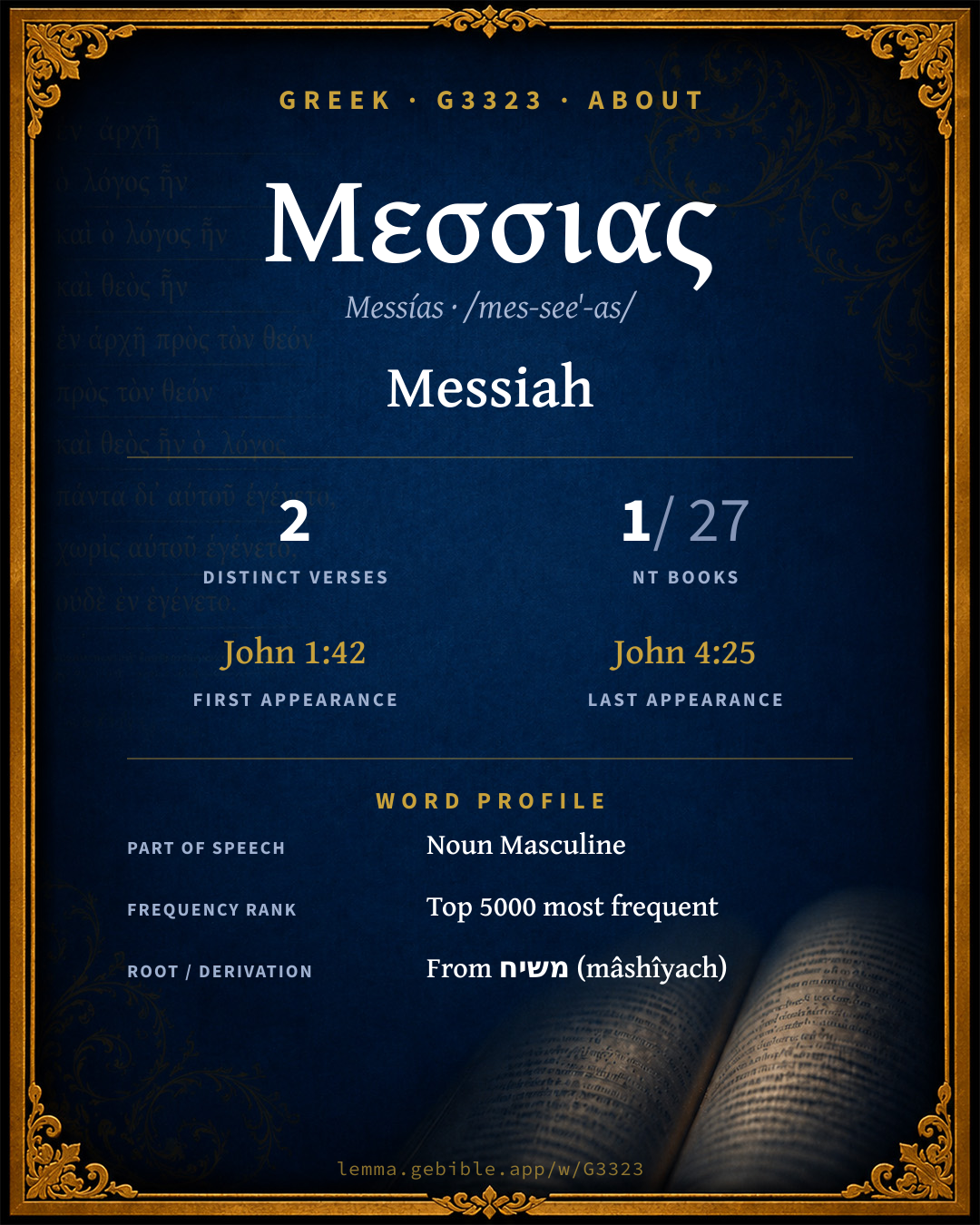
Μεσσίας
Messiah
Thayer's lists 3 entries for ‘Messiah’ fuller range ↓
Full lexicon entry — Thayer's Greek Lexicon
From Thayer's Greek Lexicon
Where this word appears
See every Accusative-case word in the Greek New Testament →
Grammar key — what these labels mean
Part of speech
- Noun
- A naming word — a person, place, thing, or idea.
Case
- Accusative
- The case of the direct object and of extent.
- Nominative
- The case of the subject (and the predicate nominative).
Gender
- Masculine
- Grammatically masculine.
Number
- Singular
- One.
Grammatical forms
- Noun, Accusative, Singular, Masculine 1 time (50%)
- Noun, Nominative, Singular, Masculine 1 time (50%)
Parsed forms decoded from the imported morphology (Robinson–Tischendorf, public domain), counted across 2 parsed occurrences — not distinct verses.
Every verse where G3323 appears — 2 distinct verses across 1 book. Click any verse to open its interlinear word-by-word view. Verse text shown in the World English Bible for context — . Each verse’s Greek form is shown with its reference; the English is not keyword-highlighted, since the data carries no word-level English alignment. Use “Compare translations” on any verse to read it across multiple English versions. This concordance covers the Greek New Testament; Septuagint (Greek Old Testament) occurrences of this word are not indexed here.
John 2 verses
- John 1:42 Μεσσίαν n acc sg masc He brought him to Jesus. Jesus looked at him, and said, "You are Simon the son of Jonah. You shall be called Cephas" (which is by interpretation, Peter).
- John 4:25 Μεσσίας n nom sg masc The woman said to him, "I know that Messiah comes," (he who is called Christ). "When he has come, he will declare to us all things."
About this entry
At a glance — auto-summarized from this page’s data, not written by a person. Every figure links to its source below. This summary describes the numbers; it doesn’t interpret them.
Μεσσιας — transliterated Messías — is a Greek name carrying the sense “Messiah.” With only 2 verses it sits in the long tail of Greek New Testament vocabulary. Its uses cluster heavily in John (100% of all occurrences). Debuting at John 1:42, it then recurs through the corpus. See 2-verse concordance and the renderings breakdown below.
Gloss history
Strong's 1890 vs modern scholarship
About this word
Strong's G3323 catalogs a Greek word from the Greek New Testament.
These counts are not copied from any lexicon or concordance. They are computed here, from the morphology-tagged Greek New Testament. What Lemma adds →
- 2
- distinct verses
- The word appears in 2 distinct verses.
- 1 / 27
- NT books
- The word appears in 1 of 27 New Testament books.
- #2,678
- by frequency
- Top 5000 most frequent Greek words (rank 2,678 of 5,347 Greek words by occurrence).
View all 2 occurrences in the concordance →
Most concentrated in
- John 2 verses 100%
By section of the New Testament
By traditional corpus
Conventional, traditional groupings — biblical authorship is debated, so this is a traditional corpus grouping, not an authorship claim. Some books belong to more than one corpus (Luke is in both the Gospels and the Lukan corpus, and so on), so these shares overlap and need not total 100%. Each figure is a share of the word’s 2 distinct verses.
- Gospels 2 verses · 100%
- Johannine 2 verses · 100%
How translations render this word
Counts come from each version’s own published word-to-Strong’s tagging or interlinear alignment — an approximate guide to how each version renders this word, not a word-level alignment the data otherwise carries. Because each total is that version’s own tagged count, the per-version totals vary from one another and need not match the appearance or distinct-verse counts above. These counts may also differ from a printed concordance because Lemma counts each distinctly tagged rendering and does not collapse phrase taggings into a single head-word total. This is a fixed set of word-tagged versions (KJV, ASV, BSB, ULT) and does not change with the reading translation you choose elsewhere. Each version’s license is shown beside its name below (and on Sources).
- King James Version: Messias 2×
- American Standard Version: Messiah 2×
- Berean Standard Bible: Messiah 2×
- unfoldingWord Literal Text: Messiah 2×
King James Version Public Domain
Renders G3323 across 2 tagged occurrences — most commonly:
American Standard Version Public Domain
Renders G3323 across 2 tagged occurrences — most commonly:
Berean Standard Bible Public Domain
Renders G3323 across 2 tagged occurrences — most commonly:
unfoldingWord Literal Text CC BY-SA 4.0
Renders G3323 across 2 tagged occurrences — most commonly:
Senses in Thayer's
The 3 senses Thayer's distinguishes for this word, in lexicon order (not ranked by frequency or importance). The full entry — with sub-senses — is in the Lexicon Entry tab.
- Messias = "anointed"
- the Greek form of Messiah
- a name of Christ
Word origin
Derived from משיח (mâshîyach) (H4899) — anointed one.
Of hebrew origin [ H4899 ]; the messias (that is Mashiach ) or christ : - messias.
— Strong’s Exhaustive Concordance (1890), public domain.
Forms in the corpus
The 2 distinct written forms G3323 takes in the Greek New Testament, most frequent first — each parse links to that case’s occurrences in the concordance.
| Form | Parsing | Example | Uses |
|---|---|---|---|
| Μεσσίαν Messían | Noun, Accusative, Singular, Masculine | John 1:42 | 1 |
| Μεσσίας Messías | Noun, Nominative, Singular, Masculine | John 4:25 | 1 |
Bible dictionary
Public-domain dictionary articles matched to this entry by name (Messiah). A biblical name can be shared by more than one person or place, so an article may treat several.
Easton's Bible Dictionary · M. G. Easton, 1897
(Heb. mashiah), in all the thirty-nine instances of its occurring in the Old Testament, is rendered by the LXX. "Christos." It means anointed. Thus priests (Ex. 28:41; 40:15; Num. 3:3), prophets (1 Kings 19:16), and kings (1 Sam. 9:16; 16:3; 2 Sam. 12:7) were anointed with oil, and so consecrated to their respective offices. The great Messiah is anointed "above his fellows" (Ps. 45:7); i.e., he embraces in himself all the three offices. The Greek form "Messias" is only twice used in the New Testament, in John 1:41 and 4:25 (R.V., "Messiah"), and in the Old Testament the word Messiah, as the rendering of the Hebrew, occurs only twice (Dan 9:25, 26; R.V., "the anointed one").
The first great promise (Gen. 3:15) contains in it the germ of all the prophecies recorded in the Old Testament regarding the coming of the Messiah and the great work he was to accomplish on earth. The prophecies became more definite and fuller as the ages rolled on; the light shone more and more unto the perfect day. Different periods of prophetic revelation have been pointed out, (1) the patriarchal; (2) the Mosaic; (3) the period of David; (4) the period of prophetism, i.e., of those prophets whose works form a part of the Old Testament canon. The expectations of the Jews were thus kept alive from generation to generation, till the "fulness of the times," when Messiah came, "made of a woman, made under the law, to redeem them that were under the law." In him all these ancient prophecies have their fulfilment. Jesus of Nazareth is the Messiah, the great Deliverer who was to come. (Comp. Matt. 26:54; Mark 9:12; Luke 18:31; 22:37; John 5:39; Acts 2; 16:31; 26:22, 23.)
Smith's Bible Dictionary · William Smith, 1863
(anointed). This word (Mashiach) answers to the word Christ (Christos) in the New Testament, and is applicable in its first sense to any one anointed with the holy oil. The kings of Israel were called anointed, from the mode of their consecration. (1 Samuel 2:10,35; 12:3,5) etc. This word also refers to the expected Prince of the chosen people who was to complete God's purposes for them and to redeem them, and of whose coming the prophets of the old covenant in all time spoke. He was the Messiah, the Anointed, i.e. consecrated as the king and prophet by God's appointment. The word is twice used in the New Testament of Jesus. (John 1:41; 4:25) Authorized Version "Messias." The earliest gleam of the gospel is found in the account of the fall. (Genesis 3:15) the blessings in store for the children of Shem are remarkable indicated int he words of Noah. (Genesis 9:26) Next follows the promise to Abraham. (Genesis 12:2,3) A great step is made in (Genesis 49:10) This is the first case in which the promises distinctly centre in one person. The next passage usually quoted is the prophecy of Balaam. (Numbers 24:17-19) The prophecy of Moses, (18:18) claims attention. Passages in the Psalms are numerous which are applied to the Messiah in the New Testament; such as Psal 2,16,22,40,110. The advance in clearness in this period is great. The name of Anointed, i.e. King, comes in, and the Messiah is to come of the Lineage of David. He is described in his exaltation, with his great kingdom that shall be spiritual rather than temporal. Psal 2,21,40,110. In other places he is seen in suffering and humiliation. Psal 16,22,40. Later on the prophets show the Messiah as a king and ruler of David's house, who should come to reform and restore the Jewish nation and purify the Church, as in Isai 11,40-66 The blessings of the restoration, however, will not be confined to Jews; the heathen are made to share them fully. (Isaiah 2:66) The passage of (Micah 5:2) (comp. Matt 2:6) left no doubt in the mind of the Sanhedrin as to the birthplace of the Messiah. The lineage of David is again alluded to in (Zechariah 12:1-14) The coming of the Forerunner and of the Anointed is clearly revealed in (Malachi 3:1; 4:5,6) The Pharisees and those of the Jews who expected Messiah at all looked for a temporal prince only. The apostles themselves were infected with this opinion till after the resurrection. (Matthew 20:20,21; Luke 24:21; Acts 1:6) Gleams of a purer faith appear in (Luke 2:30; 23:42; John 4:25)
Hitchcock's Bible Names Dictionary · Roswell D. Hitchcock, 1869
anointed
Classic public-domain reference works; full attribution on Sources.