1 Corinthians 1:9

Greek (Tischendorf 8th ed.) 1 Corinthians 1:9 appears in the Greek New Testament. The text above is from the Tischendorf 8th edition. Each word links to its Strong’s number and a concise gloss. Click any word for its full Thayer’s Greek Lexicon entry.
Download image
Cite this verse

1 Corinthians 1:9 (World English Bible). Public Domain. Lemma interlinear Bible study tool, https://lemma.gebible.app/v/1-corinthians/1/9.

Show BibTeX & RIS
BibTeX
RIS
English Translation
God is faithful, through whom you were called into the fellowship of his Son, Jesus Christ, our Lord.
World English Bible · Public Domain
Download a study sheet

One document with this verse’s original text, its word-by-word gloss line, the meaning frame, cross-references with their text, attributed commentary, and full source and license credits — printable, and it pastes into notes with its structure intact.

This verse Autodidact and up

Study sheet (.html) Plain text (.txt)

A passage Seminary Student

Up to 50 verses in one chapter. A passage sheet keeps up to 6 commentary sources and 12 cross-references per verse, in the order this page ranks them, and says so on the sheet whenever that leaves anything out. Ask for a single verse and you get the Autodidact verse sheet above.

Everything on this page stays free to read, with no account — the sheet is a download of what is already on screen, not access to it.

Want to remove ads? Support Godless Engineer
Compare translations 3

The same verse in 3 English versions, stacked beneath the original-language interlinear above. Click any original word for its lexicon entry.

Each is an independent rendering of the whole verse — the interlinear is not word-aligned to these translations.

Highlighted words mark where these versions differ — a whole-verse word diff, not a word-by-word alignment.

  • World English Bible Public Domain
    God is faithful, through whom you were called into the fellowship of his Son, Jesus Christ, our Lord.
  • King James Version Public Domain
    God is faithful, by whom ye were called unto the fellowship of his Son Jesus Christ our Lord.
  • unfoldingWord Literal Text CC BY-SA 4.0
    God faithful, by whom you were called into the fellowship of his Son, Jesus Christ our Lord.

unfoldingWord Literal Text — © unfoldingWord, licensed CC BY-SA 4.0. Word-aligned USFM3 via Door43 (git.door43.org/unfoldingWord/en_ult).

Versions to compare (up to 4)

3 of 4 selected

Show all 19 translations

Every available English version of this verse, each an independent rendering of the whole verse.

  • World English Bible Public Domain
    God is faithful, through whom you were called into the fellowship of his Son, Jesus Christ, our Lord.
  • Berean Standard Bible Public Domain
    God, who has called you into fellowship with His Son Jesus Christ our Lord, is faithful.
  • Majority Standard Bible Public Domain
    God, who has called you into fellowship with His Son Jesus Christ our Lord, is faithful.
  • King James Version Public Domain
    God is faithful, by whom ye were called unto the fellowship of his Son Jesus Christ our Lord.
  • American Standard Version (1901) Public Domain
    God is faithful, through whom ye were called into the fellowship of his Son Jesus Christ our Lord.
  • Revised Version (1885) Public Domain
    God is faithful, through whom ye were called into the fellowship of his Son Jesus Christ our Lord.
  • Geneva Bible (1599) Public Domain
    God is faithfull, by whom ye are called vnto the fellowship of his Sonne Iesus Christ our Lord.
  • Douay-Rheims (1899) Public Domain
    God is faithful: by whom you are called unto the fellowship of his Son Jesus Christ our Lord.
  • Young's Literal Translation Public Domain
    faithful `is' God, through whom ye were called to the fellowship of His Son Jesus Christ our Lord.
  • Literal Standard Version CC BY-SA 4.0
    faithful [is] God, through whom you were called into the fellowship of His Son Jesus Christ our Lord.
  • Unlocked Literal Bible CC BY-SA 4.0
    God is faithful, who called you into the fellowship of his Son, Jesus Christ our Lord.
  • unfoldingWord Literal Text CC BY-SA 4.0
    God faithful, by whom you were called into the fellowship of his Son, Jesus Christ our Lord.
  • Darby Bible Public Domain
    God [is] faithful, by whom ye have been called into [the] fellowship of his Son Jesus Christ our Lord.
  • World Messianic Bible Public Domain
    God is faithful, through whom you were called into the fellowship of his Son, Yeshua the Messiah our Lord.
  • Webster's Bible Public Domain
    God is faithful, by whom ye were called to the fellowship of his Son Jesus Christ our Lord.
  • Free Bible Version CC BY-SA 4.0
    God is trustworthy who called you to share together in fellowship with his son Jesus Christ our Lord.
  • Bible in Basic English Public Domain
    God is true, through whom you have been given a part with his Son, Jesus Christ our Lord.
  • Text-Critical English NT CC BY 4.0
    God is faithful, by whom you were called into the fellowship of his Son, Jesus Christ our Lord.
  • Tyndale New Testament (1534) Public Domain
    For god is faythfull by whom ye are called vnto the fellishyppe of his sonne Iesus Christe oure lorde.

Literal Standard Version (2020), Covenant Press — licensed CC BY-SA 4.0. Text via the HelloAO Bible API (eBible.org). Unlocked Literal Bible (unfoldingWord) — licensed CC BY-SA 4.0. Text via the HelloAO Bible API (eBible.org). unfoldingWord Literal Text — © unfoldingWord, licensed CC BY-SA 4.0. Word-aligned USFM3 via Door43 (git.door43.org/unfoldingWord/en_ult). Free Bible Version, Dr. Jonathan Gallagher — licensed CC BY-SA 4.0. Text via the HelloAO Bible API (eBible.org).

Word by word

More ways to search: Search by grammar → Find every occurrence → Compare this word →

Practice this passage: Drill this verse → Learn its vocabulary →

κοινωνίαν
koinōnía
G2842
“fellowship”
Noun, Accusative, Singular, Feminine
Part of Speech
Noun
Case
Accusative
Number
Singular
Gender
Feminine
Full Thayer's Definition

Origin: from G2844

TDNT: 16:17,4

1. fellowship, association, community, communion, joint participation, intercourse a. the share which one has in anything, participation b. intercourse, fellowship, intimacy 1. the right hand as a sign and pledge of fellowship (in fulfilling the apostolic office) c. a gift jointly contributed, a collection, a contribution, as exhibiting an embodiment and proof of fellowship
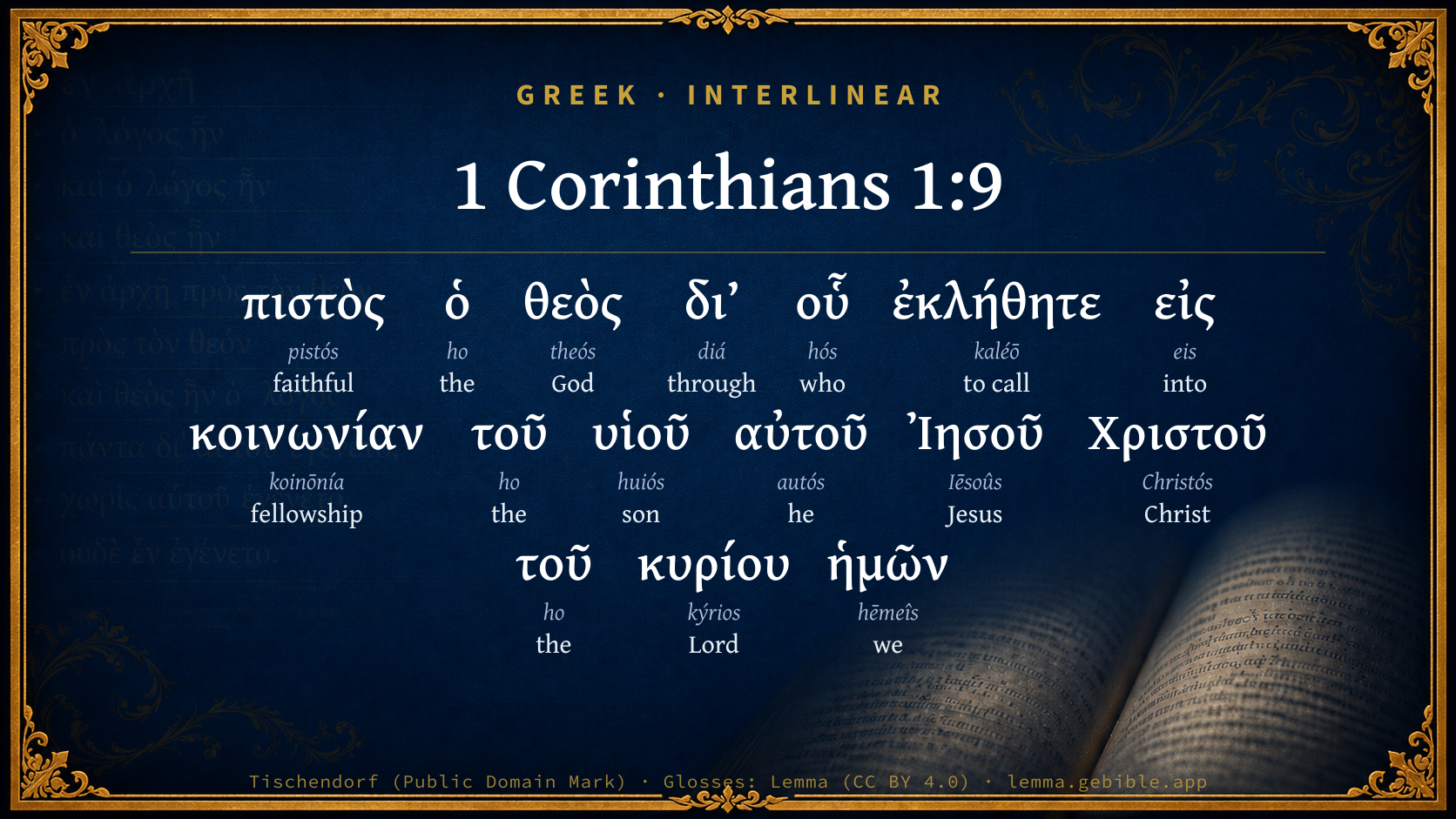
  1. πιστὸς pistós G4103 “faithful” Adjective, Nominative, Singular, Masculine
  2. ὁ ho G3588 “the” Article, Nominative, Singular, Masculine
  3. θεὸς theós G2316 “God” Noun, Nominative, Singular, Masculine
  4. δι’ diá G1223 “through” Preposition
  5. οὗ hós G3739 “who” Relative pronoun, Genitive, Singular, Masculine
  6. ἐκλήθητε kaléō G2564 “to call” Verb, Aorist, Passive, Indicative, 2nd person, Plural
  7. εἰς eis G1519 “into” Preposition
  8. τοῦ ho G3588 “the” Article, Genitive, Singular, Masculine
  9. υἱοῦ huiós G5207 “son” Noun, Genitive, Singular, Masculine
  10. αὐτοῦ autós G846 “he” Personal pronoun, Genitive, Singular, Masculine
  11. Ἰησοῦ Iēsoûs G2424 “Jesus” Noun, Genitive, Singular, Masculine
  12. Χριστοῦ Christós G5547 “Christ” Noun, Genitive, Singular, Masculine
  13. τοῦ ho G3588 “the” Article, Genitive, Singular, Masculine
  14. κυρίου kýrios G2962 “Lord” Noun, Genitive, Singular, Masculine
  15. ἡμῶν hēmeîs G2249 “we” Personal pronoun, 1st person, Genitive, Plural

About this verse

These counts appear in no published source. They are computed here, from the morphology-tagged text and Lemma’s own curated glosses. What Lemma adds →

16
words
14
distinct lemmas
Pauline Epistles
section

Notable vocabulary

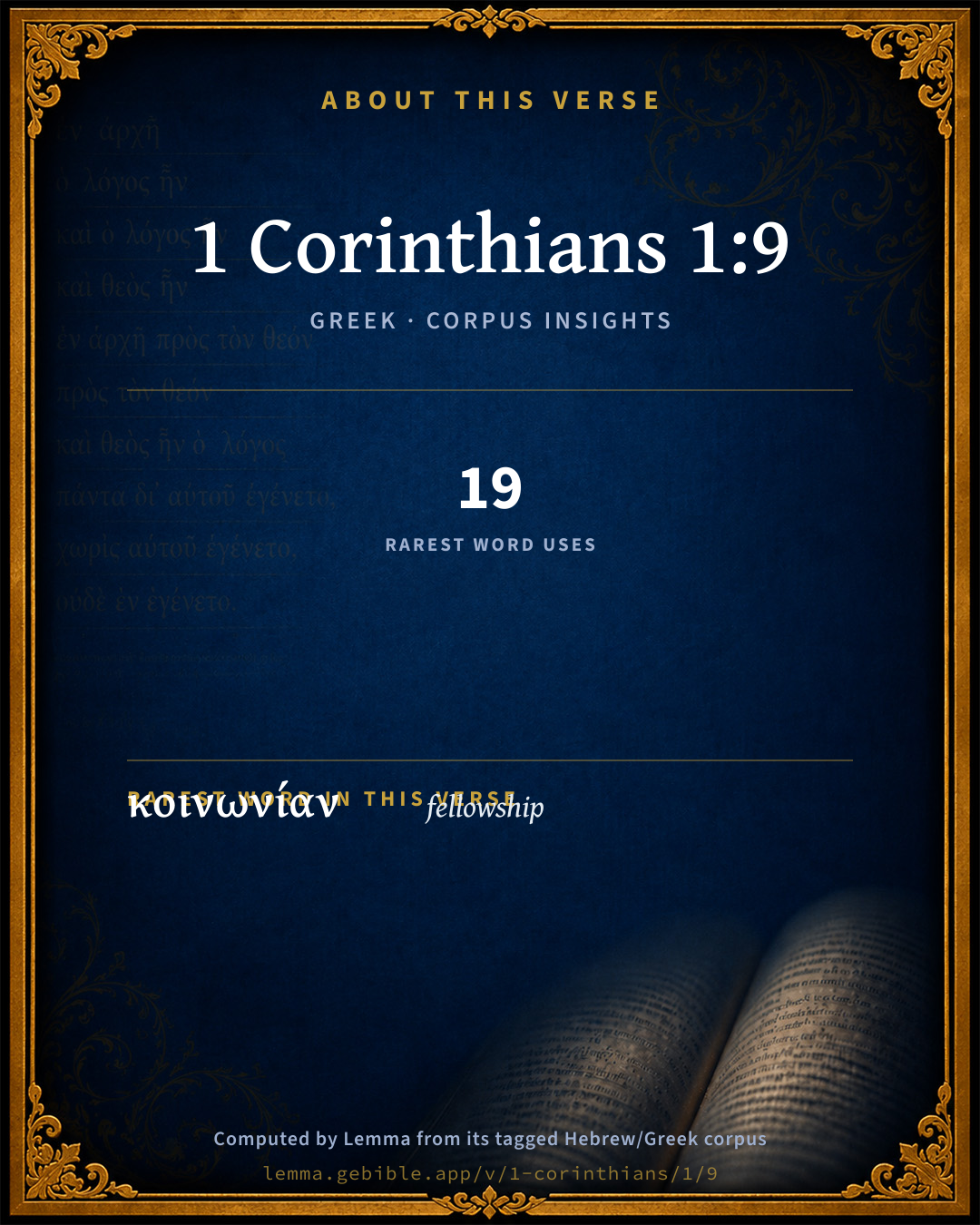
The rarest word here is κοινωνίαν fellowship G2842 — appearing just 19 times in the whole Greek New Testament.

Shared distinctive vocabulary

κοινωνίαν fellowship G2842 occurs in 17 verses of the Greek New Testament. Also found in:

Repetition

A word recurs within this verse:

Cross-references

42

Topical passages linked to 1 Corinthians 1:9 in the Treasury of Scripture Knowledge — connected by theme and wording, ordered by reader-vote popularity; previews shown in the World English Bible.

  • 2 Thessalonians 3:3 But the Lord is faithful, who will establish you, and guard you from the evil one.
  • Hebrews 10:23 let us hold fast the confession of our hope unyieldingly. For he who promised is faithful.
  • Deuteronomy 7:9 Know therefore that Yahweh your God, he is God, the faithful God, who keeps covenant and loving kindness with them who love him and keep his commandments to a thousand generations,
  • 1 John 1:3 that which we have seen and heard we declare to you, that you also may have fellowship with us. Yes, and our fellowship is with the Father, and with his Son, Jesus Christ.
  • 1 Corinthians 10:13 No temptation has taken you except what is common to man. God is faithful, who will not allow you to be tempted above what you are able, but will with the temptation also make the way of escape, that you may be able to endure it.
  • Deuteronomy 32:4 The Rock, his work is perfect; For all his ways are justice: A God of faithfulness and without iniquity, Just and right is he.
  • Romans 8:28 We know that all things work together for good for those who love God, to those who are called according to his purpose.
  • Isaiah 49:7 Thus says Yahweh, the Redeemer of Israel, [and] his Holy One, to him whom man despises, to him whom the nation abhors, to a servant of rulers: Kings shall see and arise; princes, and they shall worship; because of Yahweh who is faithful, [even] the Holy One of Israel, who has chosen you.
  • Psalms 100:5 For Yahweh is good. His loving kindness endures forever, His faithfulness to all generations.
  • 1 John 1:7 But if we walk in the light, as he is in the light, we have fellowship with one another, and the blood of Jesus Christ, his Son, cleanses us from all sin.
  • Revelation 19:11 I saw the heaven opened, and behold, a white horse, and he who sat on it is called Faithful and True. In righteousness he judges and makes war.
  • Numbers 23:19 God is not a man, that he should lie, Neither the son of man, that he should repent: Has he said, and will he not do it? Or has he spoken, and will he not make it good?
  • 2 Corinthians 1:18 But as God is faithful, our word toward you was not "Yes and no."
  • 1 Peter 5:10 But may the God of all grace, who called you to his eternal glory by Christ Jesus, after you have suffered a little while, perfect, establish, strengthen, and settle you.
  • 1 Thessalonians 5:23–24 May the God of peace himself sanctify you completely. May your whole spirit, soul, and body be preserved blameless at the coming of our Lord Jesus Christ.
  • Isaiah 25:1 Yahweh, you are my God; I will exalt you, I will praise your name; for you have done wonderful things, [even] counsels of old, in faithfulness [and] truth.
  • John 15:4–5 Remain in me, and I in you. As the branch can't bear fruit by itself, unless it remains in the vine, so neither can you, unless you remain in me.
  • Romans 9:24 us, whom he also called, not from the Jews only, but also from the Gentiles?
  • Hebrews 11:11 By faith, even Sarah herself received power to conceive, and she bore a child when she was past age, since she counted him faithful who had promised.
  • 1 John 4:13 By this we know that we remain in him and he in us, because he has given us of his Spirit.
  • Psalms 89:33–35 But I will not completely take my loving kindness from him, Nor allow my faithfulness to fail.
  • Isaiah 11:5 Righteousness shall be the belt of his waist, and faithfulness the belt of his loins.
  • Lamentations 3:22–23 [It is of] Yahweh's loving kindnesses that we are not consumed, because his compassion doesn't fail.
  • Galatians 2:20 I have been crucified with Christ, and it is no longer I that live, but Christ living in me. That life which I now live in the flesh, I live by faith in the Son of God, who loved me, and gave himself up for me.
  • John 17:21 that they may all be one; even as you, Father, are in me, and I in you, that they also may be one in us; that the world may believe that you sent me.
  • Romans 8:30 Whom he predestined, those he also called. Whom he called, those he also justified. Whom he justified, those he also glorified.
  • 2 Thessalonians 2:14 to which he called you through our Gospel, for the obtaining of the glory of our Lord Jesus Christ.
  • Hebrews 3:14 For we have become partakers of Christ, if we hold fast the beginning of our confidence firm to the end:
  • Ephesians 2:20–22 being built on the foundation of the apostles and prophets, Christ Jesus himself being the chief cornerstone;
  • Ephesians 3:6 that the Gentiles are fellow heirs, and fellow members of the body, and fellow partakers of his promise in Christ Jesus through the Gospel,
  • Titus 1:2 in hope of eternal life, which God, who can't lie, promised before eternal times;
  • Matthew 24:35 Heaven and earth will pass away, but my words will not pass away.
  • 2 Timothy 1:9 who saved us and called us with a holy calling, not according to our works, but according to his own purpose and grace, which was given to us in Christ Jesus before times eternal,
  • Hebrews 6:18 that by two immutable things, in which it is impossible for God to lie, we may have a strong encouragement, who have fled for refuge to take hold of the hope set before us.
  • 1 Corinthians 10:16 The cup of blessing which we bless, isn't it a communion of the blood of Christ? The bread which we break, isn't it a communion of the body of Christ?
  • Galatians 1:15 But when it was the good pleasure of God, who separated me from my mother's womb, and called me through his grace,
  • 1 Corinthians 1:30 But of him, you are in Christ Jesus, who was made to us wisdom from God, and righteousness and sanctification, and redemption:
  • Hebrews 2:17 Therefore he was obligated in all things to be made like his brothers, that he might become a merciful and faithful high priest in things pertaining to God, to make atonement for the sins of the people.
  • Hebrews 3:1 Therefore, holy brothers, partakers of a heavenly calling, consider the Apostle and High Priest of our confession, Jesus;
  • 1 Thessalonians 2:12 to the end that you should walk worthily of God, who calls you into his own Kingdom and glory.
  • Romans 11:17 But if some of the branches were broken off, and you, being a wild olive, were grafted in among them, and became partaker with them of the root and of the richness of the olive tree;
  • Colossians 1:24 Now I rejoice in my sufferings for your sake, and fill up on my part that which is lacking of the afflictions of Christ in my flesh for his body's sake, which is the assembly;

Cross-references courtesy of OpenBible.info (CC BY 4.0).

Commentary

Notes on 1 Corinthians 1:9 from classic Christian and Jewish commentators (each source and its license shown beneath its notes). The classic Christian expositions comment on the surrounding passage and are grouped to its opening verse, so a note may address several verses; the Jewish commentaries on the Tanakh (Rashi and others) are per-verse, so they appear only where the commentator wrote on this verse.

Lemma curates 59 commentaries, every one of them public domain or Creative Commons licensed, each selected and text-cleaned for this edition rather than reprinted as found. About our sources →

The Biblical Illustrator

Joseph S. Exell

1Co_1:9

God is faithful, by whom ye were called unto the fellowship of His Son.

The faithfulness of God

On this eternal, self-existent fidelity we can repose with safety.

I. It is well that we have something sure, for talk as we will of the fidelity of man and woman, there is much to say also of their infidelity.

1. Who can say--in friendship, in love--what a week, a month, a year may not bring forth? In the very strength of human affection lies its frailty. And it is in hours when this is realised, when we seem to toss upon a shifting sea in sailing over human love, that we turn to the everlasting firmness of Gods fidelity.

2. But even more than in others do we recognise this faithlessness in ourselves. How often are we only faithful because we are ashamed to be otherwise, and how often have we betrayed that which was given us to keep? We look into our own hearts and know how slight and fluttering, how changeable we have often been, how we even enjoyed our change. What wonder, then, if we turn from the weakness of our own fidelity to seek a centre for it and a power of it in the unalterable strength of the faithfulness of God, and cry, Faithful Master of fidelity, enter into my life and make it all fidelity.

II. What answer does God give us to that? Not that we should at first expect. We have fled from man to God, God sends us back to man. If a man find not fidelity in his brother whom he hath seen, how can he find fidelity in God whom he hath not seen? We have been looking on the unfaithfulness we have found in man. Nothing can be worse for us. He bids us search for faithfulness, and we shall find it.

1. In the hearts of those that love us. And the moment our whole position is thus changed, and we look on a new side of facts, we remember all the uncomplaining patience of long love that mother and father, wife and sister, have bestowed on us. We recollect that there are friends who have never failed us, to doubt whom would be a crime.

2. With this new light we look within our own hearts, and we are conscious that we have been true to many. Surprised, we ask ourselves, What is this faithfulness in the midst of unfaithfulness, this stability in human nature that accompanies instability? Oh! it is what we searched for, it is what we fled away from man to find. It is the fidelity of God Himself that moves and lives within His children. The kingdom of God is among you.

III. Having learnt that lesson, we learn from it--

1. To love and honour men much more. We are not so ready to impute unfaithfulness, and we are kinder and more gracious, and being so, we find that men and women are more faithful to us, for we have lost the evil and unpleasant qualities which made people tire of our love. By believing in faithfulness we make it grow. Then our power of creating faithfulness has a reflex action on our own faithfulness. That which we cause to grow in others, grows by that very effort in ourselves.

2. An ideal of Gods fidelity. The beauty of human fidelity forces us to aspire to a more beautiful fidelity, the real leads us onwards to the ideal.

IV. Still an ideal remains always somewhat in the vague. But to our wonderful comfort the fidelity of God is realised in humanity, in Christ, the image of God in man. He who hath seen Me hath seen the Father. He who hath seen the human faithfulness of Christ hath seen the Divine faithfulness of God.

1. His faithfulness was faithfulness to duty. At twelve years of age it was clearly conceived. Wist ye not that I must be about My Fathers business? For eighteen years He brooded on His duty, and at thirty it was accepted, and never let go. The imperative of His later saying, I must work the works of Him that sent Me while it is day, was said with the same fervour as it had been said by the joyful enthusiasm of the boy; and when the supreme hour of life came He could say, It is finished. What? tits Fathers business!

2. That is the outward aspect of Christs faithfulness to duty; its inner aspect was Eternal Truth. He had a few clear, dominant conceptions on which His whole life was built. To these ideas--such as the universal Fatherhood of God, the union of the Divine and human, the existence of a spiritual kingdom, and the necessity of man being a believer in these things, and being made at one with God through Him--Christs whole inner life was faithful. He could say, with absolute truthfulness, feeling that His whole inner life had been faithful to them throughout: To this end was I born, and for this cause came I into the world, that I should hear witness unto the Truth. This was Christs fidelity, the image of Gods.

V. But what duty can God be said to have to which He is faithful? There can be no duty imposed on Him from without, else there were another greater than Himself. But there can be an imperative within His own nature which is to Him that which duty was to Christ and to us.

1. With regard to us, that duty is the duty of a Father to His children. By that imperative of Fatherhood He can never cease to care for us, watch over us, educate us, and finally perfect us.

2. That is the outward form. But the central idea of which it is the form, and to which in His own inner life He is for ever faithful, is this: I am the eternal spiritual All. I give Myself forth in all that thinks, and loves, and acts, and is. That being such, it is inconceivable that He should ever be unfaithful to His thought, for that thought is His own realisation of Himself, and were He unfaithful to it, God were unfaithful to God, which is absurd. To this idea, then, and to all the duties it brings with it, God is absolutely faithful; He cannot be otherwise. I am, He says, because I am. Conclusion: That is our security. We have arrived at the conception of it through Christ, through our own humanity taken up into and filled with divinity. And once we have grasped it, it transfigures life and gives us a rock to stand on amid the shifting sands of our own feeling, amid the wavering of human faithfulness. The foundation of God standeth sure. (Stopford A. Brooke, M. A.)

The faithfulness of God

I. Results from, or stands connected with, all His other perfections.

1. His power (Psa_146:6). This enables Him, without the possibility of failure, to accomplish all His promises and threatenings. Honest men may be prevented keeping their word by unexpected difficulties; but the designs of the Almighty cannot be frustrated (Mat_19:26; Gen_18:14; Rom_4:20-21; 2Ti_1:12).

2. His holiness; without it, indeed, He could not be holy (Psa_92:15; Tit_1:2; Heb_6:18; Num_23:19). Well might the Psalmist say, God hath spoken in His holiness: I will rejoice (Psa_60:6), for the holiness of God is a pledge of His faithfulness.

3. His unchangeableness. Angels have changed, and become devils; man is changed, and become a rebel; but God changes not (Mal_3:6). Men frequently change their minds, sometimes from good to evil, at other times from evil to good; their second thoughts are best: but Gods thoughts can neither be improved nor depraved (Jam_1:17). The promises and vows of men (like Jephthahs and Herods) are sometimes unlawful or incautiously made, so that there may be more honour in the breach than in the observance of them. Not so the engagements of Heaven (Job_23:13-14).

4. His wisdom. Among men, the non-performance of promises is frequently occasioned by circumstances which human prudence could not foresee; and therefore good men should not make promises hastily, and never without reference to St. Jamess caution (Jam_4:15). But no provisions are necessary when God makes a promise. No difficulties, no disappointments, can occur to Him; His instruments are always at hand, and shall all subserve His holy designs.

5. His mercy, love, and goodness (Psa_138:2). His love inclines Him to make the promise, and His veracity induces Him to fulfil it.

II. Our confidence in it is confirmed by the following facts.

1. The promises are made in and to Christ, as the Head of His Church; and faithfulness to Him, as well as to us, insures their fulfilment (2Co_1:20; Tit_1:2; Eph_1:6).

2. God has confirmed His promise by an oath (Gen_22:16; Heb_6:13; Heb_6:17-18).

3. The experience of the people of God in all ages.

(1) The first promise (Gen_3:15) has bees fulfilled (1Jn_3:8; Gal_4:5). Remember that there is nothing like distance of time in the mind of God between the promise and the fulfilment (2Pe_3:8), and hence some events are spoken of in the prophets as present, or even as past, which are yet to come.

(2) Was the universal flood threatened, and Noah with his family to be secured? The event corresponded with the threatening, though one hundred and twenty years intervened.

(3) Was Abraham, when one hundred, and childless, to have a vast posterity? Every Jew we see is a witness that the promise has been fulfilled.

(4) So with the deliverance of Israel, &c. Conclusion:

1. Learn the unreasonableness and sinfulness of unbelief (1Jn_5:10).

2. Let God be honoured in His faithfulness by a suitable confidence in it.

3. Let us, in our humble measure, try to imitate God in this His glorious attribute (Eph_5:1). (G. Burder.)

Faithful is He that calleth you

Consider--

I. How God deals with you, in so calling you as to unite you to His Son. Faithfully throughout. He is faithful--

1. In discovering to you your case.

2. In commending to you His Son.

3. In presenting Christ to you, in free gift, as yours.

4. In not repenting of His call.

II. The end of this calling. You are united to His Son, and to such an effect as to have all things in common.

1. Common interests. The interests which Christ has as--

(1) Gods ally, are identical with those of the Father.

(2) His Son, are identical with ours.

2. A common character.

3. A common history. With respect to--

(1) A birth.

(2) A baptism.

(3) A work.

(4) A cross.

(5) A crown. (R. Candlish, D. D.)

The special call and the unfailing result

I. Your calling.

1. Its Divine origin. The text says, God called you--does not your experience prove the same? We thought that we had had no other call than that which came through our Bibles, good books, &c. But did we not read the same books years before? but they never touched a chord in our hearts; therefore we conclude that that time it must have been the finger of God. We had been called scores of times before, but we always turned a deaf ear. But when this particular call came, we threw down our sword and said, Great God, I yield!

2. Its graciousness. What was there in you to suggest a motive why God should call you? Some of you were drunkards, profane, injurious. John Bradford, when he saw a cartful of men going off to Tyburn to be hanged, said, There goes John Bradford but for the grace of God. A good Scotchman called to see Rowland Hill, and without saying a word, sat still for some five minutes, looking into his face. At last Rowland asked him what engaged his attention. Said he, I was looking at the lines of your face. Well, what do you make out of em? Why, said he, that if the grace of God hadnt been in you, you would have been the biggest rascal living.

3. The privileges it brings.

(1) Pardon.

(2) Righteousness.

(3) Sonship.

(4) Heaven.

II. To what end did God call you? That you might have fellowship with Christ. Now the word koinonia is not to be interpreted here as a society, but as the result of society; i.e., fellowship lies in mutual and identical interests. A man and his wife have fellowship with each other, in that which is common to both and enjoyed in communion accordingly. Now when we were called to Christ we became one with Him, so that everything Christ had became ours. This was the act of faith. Now we have fellowship to Christ.

1. In His loves. He loves saints, sinners, the world, and pants to see it transformed into the garden of the Lord. What He loves we love, and what He hates we abhor.

2. In His desires. He desires to see multitudes saved, the glory of God, that the saints may be with Him where He is--we desire the same.

3. In His sufferings. We do not die a bloody death; yet many have done so, and there are millions ready to do so. But when He is reproached we have learned to bear His reproach too. Some few drops of His cup we drink, and it has been given to some more than to others to fill up that which is behind of the afflictions of Christ for His bodys sake, which is the Church.

4. In His joys. Is He happy? We are happy to think Christ is happy.

5. In His riches. If He has riches in pardoning, supporting, instructing, illuminating, sanctifying, preserving, or perfecting Christians, they are all ours. Is His blood precious, His righteousness complete, His merits sweet? They are mine. Has He power in intercession, has He wisdom, righteousness--has He anything? It is mine.

6. In His glory. There is not a crown He wears but we have part of it; nay, there is not a gem that sparkles in His crowns but it sparkles for us as well as for Him. For us the golden streets, the chariot, the crowding angels; the shout of Hallelujah! for Thou wast slain, &c., the second advent with all its splendours, universal reign of Christ, the day of judgment.

III. All this leads us to perceive our security. Saints must be saved--

1. Because God has called them. The gifts and culling of God are without repentance, Because--

2. God has called them into fellowship with Christ, and that fellowship, if God be faithful, must be complete. You have shared His sufferings, His faithfulness secures the rest. (C. H. Spurgeon.)

The fellowship of Gods Son

1. The apostle writes as a peacemaker. Party strife had weakened spiritual life, and a weakened spiritual life had been fruitful in other evils. St. Paul would remedy all evil and restore harmony. He finds his potent spell in the Name which is above every name, and recalls Corinthian Christians to the consideration of the common Saviour, and their one hope which is by Him and in Him. Christ Jesus is all to each and to every one of them. Thus it is that throughout these opening verses this name occurs again and again.

2. Divine fellowship is often spoken of in the Scriptures. In the New Testament it is naturally most familiar, for there God has come nearest to man, and therefore man may come nigh unto Him. This is the gospel message that, made nigh by the blood of Christ there is, for all, boldness to enter into the holiest. No one cometh unto the Father but by Me. Between God and men there is but the one Mediator. Fellowship with God must needs be first of all the fellowship of His Son Jesus Christ.

3. But what is this high privilege? Ordinarily the term suggests the interchange of sympathy and thought, or association in acts of Christian worship and participation in common joys and sorrows. The word itself has a meaning which, in its application to ordinary affairs, is very definite and clear. The sons of Zebedee are twice spoken of as partners of Simon. Without any violence, therefore, we may read: The partnership of His Son Jesus Christ our Lord (cf. Heb_3:14)

. In this busy life, partnerships are common; but never in human commerce did men look upon one like this. Suppose a firm utterly and hopelessly ruined. A wealthy man asks to be admitted as partner. As honest men, the bankrupts must needs protest that the offerer knows not what he is doing. Then comes the reply that all is known, that wealth is available more than sufficient to meet all the need, and that practical wisdom also whereby the ruin may be reconstructed on a safe and enduring basis. Yet this, and more than all this, is in the gospel. A ruined race may scan the present, or peer as they will into the dark future. Sin hath wrought shame and death. Yet now, in the midst of the utter wreck, there stands One who offers much, as He offers life--who giveth all, as He gives Himself. This is true for each and for all, without respect of persons, and without limitation of gift.

4. What has this communion brought to the Saviour Himself? The answer is soon given. He took upon Himself our nature, the likeness of sinful flesh. He shared to the utmost its weakness, weariness, pain, and death. One burden He shared not; for Himself hath borne it all. By Himself He purged our sins. Beyond this He had nothing. Joy became His, the joy that was set before Him, that of presenting faultless before the presence of His glory the redeemed sons of men. Glory has been given to Him, but it is the glory of power over all flesh, that He should give eternal life. And these things He hath received of the Father, and not from mankind.

5. But let us turn to the other side, the relation of man to this fellowship. In the commercial world, partnerships are not all alike. Modern society, under the pressure of altered circumstances, has invented the contrivance of limited liability. But in olden times when any man entered a firm he took in with him all that he possessed. Thenceforth none of the things which he had could, in presence of the common need, be called his own. From such a partnership the young ruler recoiled: Sell that thou hast, &c. Into such a partnership the early Christians gladly entered, for they had all things common. Into such a partnership are we called--one of unlimited liability. Entire consecration is the first requirement. Ye are not your own. Whether ye eat, or drink, or whatsoever ye do, do all to the glory of God. Christ will have all, or nothing. On this essential condition, the partnership is open to every man. He came to call sinners to repentance, and, when sinners come, they are accepted just as they are. No man may bring less than his all to the fellowship of Christ; but no man can bring more. So the trembling servant comes with his burden of conscious liability. His all is a debt of ten thousand talents; but the Saviour admits him to the partnership. The poor wasteful and wasted wanderer comes, with rags and shame as his only contribution, but he meets with no denial. Penitent, needy soul! Lay thy gift thyself, whatever thou hast been, whatever thou art--lay it all upon the altar. It is His will, it is His command; therefore, for once, obey. The gift is accepted, for He hath promised. For God is faithful, by whom thou hast been called unto this fellowship.

6. Once admitted, all things are yours. In earthly partnerships, though there may be unlimited liability, there is only a limited supply. It cannot be that every partner shall have power to draw as he may upon the common resources. The banking account is strictly guarded; and the available funds are doled out to each and to all, not according to need, but according to legal claim. For sinful men, all this is blessedly otherwise. The treasury of grace is the fulness of God. There is enough for all, enough for each, enough for evermore! But all He hath for mine I claim.

7. If, now, we would learn something of the wealth which we share with and in Christ Jesus, we may read His own words (Joh_17:22-23). The glory of Christ is the possession of His people. That glory consists in what He is, and what He has; the riches of life and the gifts of love. (G. W. Olver, B. A.)

Fellowship with Christ

I. Our distinctive position as Christians is that we have fellowship with Gods Son. Men are often marked out from others by the particular fraternity, corporation, or firm to which they belong. We as Christians are members of the firm of the Son of God; for the word here means co-partnership.

1. The grounds of this fellowship are--

(1) The Divine acceptance of Christs work.

(2) The consequent Divine grant to Christ of all the power and gifts of salvation for the benefit of all who should become co-partners with Himself.

2. Its terms or conditions--entire self-surrender. Faith receives Christ as He is presented in the gospel, i.e., in all His relations. To Christ as a Saviour trust is reliance, as a Teacher trust is teachableness, as a Ruler it is obedience, as a Leader following, as a King homage, as a Man sympathy, as God worship. Let there be no mistake here. Many put their trust in Christ as a Saviour, but not as a King; as man, not as God. They will take all He has to give, but give nothing in return, or if anything their money, but Hot themselves. But Christ seeks not yours, but you. He requires not large capital, knowledge, skill, art, &c., although He will receive them when offered; what He does require is your whole affection and unlimited trust.

3. Its prospects. Our position is that of partners--in spiritual life, brotherhood and service; but not on equal terms. We take nothing into the concern but weakness and poverty. Without Him we can do nothing, but with Him we shall jointly realise Gods ideal of humanity. Military or commercial companies have often proposed to themselves the conquest of the world; this society has the same object, and will achieve it, only in a nobler sense.

II. God has called us into the fellowship of His Son. In the invitations of the gospel God is calling men to become co-partners with Christ; but mere invitation does not come up to the full meaning of the term, and our hearts must say what that full meaning is. The heart makes God the author of its whole salvation. By the grace of God I am what I am. That grace makes all the difference between a stranger to and a partner with Christ.

III. Everything must depend on the faithfulness of God. This fellowship from first to last is His creation; on Him it depends to render it a failure or a success.

1. Therefore our confidence rests immediately on God. In worldly affairs men usually contemplate success through natural laws and material properties. Farmers trust to the virtues of the seed, &c., merchants to the winds and waves, warriors to the spirit of their troops; but even in such cases a devout spirit will recognise the presence of God in all secondary causes, and make Him at least the basis of its hope. But in this great co-partnership we have no interventions to distract our faith. We go right to God at once.

2. We rest upon the most Godlike thing in God--His faithfulness, which supports the universe. Our fellowship with Christ is thus placed beyond the possibility of failure in God. No storm can shatter our bark, no blight destroy our harvests, for God is faithful. And what a stimulus to endeavour we have in this! Because God is so faithful to me I will be faithful to Him. Consequently the fellowship of Christ becomes to us the one permanent interest in this uncertain world. There is no possibility of bankruptcy; we cannot be outbidden or undersold; for ours is the capital of Gods unsearchable Fiches. His name is pledged to every acceptance in which cur safety is involved, and so long as His throne shall stand our safety and glory is assured. (Prof. J. M. Charlton.)

The Divine call, and its design

I. The call comprehends all the purposes, decrees, providences, and means of salvation.

II. The design of this call of God is, that all who obey it may for ever have fellowship or communion with His Son our Saviour, Communion signifies joint participation in anything, good or bad. Here all is good. God calls the believer--

1. To communion with His Son, in His miraculous formation in the womb. The Spirit creates believers anew in Christ Jesus unto good works.

2. In His purity from sin. The Spirit keeps our new nature from sin.

3. In growth in grace. The Spirit brings unto the measure of the stature of the fulness of Christ.

4. In fitness for every duty. The Spirit anointed Him, and He anoints the believer.

5. In working miracles. The Spirit enables the believer to conquer Satan, sin, the world, death, and hell.

6. In comfort. The Spirit comforted Him, and He comforts real believers.

7. In death.

8. In the state of the dead. The Spirit preserved His holy body that it saw no corruption. The Spirit will keep the bodies of believers still united to Christ, till the resurrection.

9. In the resurrection. The Spirit raised Him up; and the same Spirit will raise up the believer.

10. In glory. The Spirit glorified our Lord; and He will also glorify the true believer. (Jas. Kidd, D. D.)

Sonship and fellowship

Let us consider his fellowship or partnership with Christ in the following aspects:--

I. Partnership with Him in what He was. He was crucified, He died, was buried, rose again. In all these we have part.

II. Partnership with him in what he is. He has not only risen, but He has ascended. We share His present dignity; for we are said to be seated with Him in heavenly places, and are treated by God as such. We share His offices; we are prophets, priests, and kings; heirs of God and joint-heirs of Christ Jesus.

III. Partnership with Him in what He shall be. Much of His glory is yet in reserve; for now we see not yet all things put under Him. (H. Bonar, D. D.)

The Biblical Illustrator, edited by Joseph S. Exell (c. 1880s–1900s) — public domain. Text from a community e-Sword module.

The Pulpit Commentary

God is faithful. He will not leave his promises unfulfilled or his work unfinished. (1Co_10:13; 2Th_3:3; Heb_10:23; Rom_8:28-30) Through whom. By whom, as the moving cause and agent in your salvation. Ye were called. The calling was a pledge of the final blessing. (Rom_8:30) Into the fellowship of his Son. Union (koinonia, communion) with Christ is the sole means of spiritual life. (Joh_15:4; Gal_2:20) Through the Son we also have fellowship with the Father. (1Jn_1:3) The perfect sincerity of the apostle is observable in this thanksgiving. He speaks of the Church in general in terms of gratitude and hopefulness, and dwells on its rich spiritual endowments; but he has not a word of praise for any moral advance such as that which he so lovingly recognized in the Thessalonians and Philippians.

The fellowship of his Son.

Social ties are inevitable either for good or for evil; some are made for us and others are made by us. All religions have made use of the social tendency, the social necessity, which distinguish human nature. Christianity adapts itself to the highest form of the tendency. The Divine Christ has made himself the Associate, the Friend, the Brother of mankind.

I THE FELLOWSHIP OF FAITH IN CHRIST"S REDEMPTION. The work of Christ was perfect in itself, but its benefits are only to be enjoyed through spiritual association and affinity with Christ. Union of heart and soul with Christ is the condition of true salvation. Christians are built on Christ as the foundation, grafted into Christ as into the vine, joined to Christ as to the body, partakers of Christ as of spiritual bread, friends with Christ as by a congenial attachment.

II THE FELLOWSHIP OF SPIRIT WITH CHRIST"S CHARACTER. The frequent expression, "in Christ," shows what was the view of the Lord himself and of his apostles concerning the identification of the people of Jesus with their Lord. It is their aspiration to be like him, to have the mind which was in him. They are followers, disciples, imitators, representatives of him whose name they bear. Sympathizing with Christ"s obedience and submission to the Father, they are practically and powerfully and beneficially affected by this sympathy.

III THE FELLOWSHIP OF THE ACTIVE LIFE WITH THE WORK OF CHRIST. Christians recognize their Master"s devotion to the highest interests of men, his unwearied efforts, his unflinching sacrifice. In communion with him they make their life one of service, of consecration. In motive the Christian life is service to Christ; in result it is service to man. How many a life has been rescued by the cross from selfishness and from sin, and made a life of devoted and successful benevolence!

IV THE FELLOWSHIP OF HEART AND OF ACTION WITH CHRIST"S PEOPLE. Union with the Head is the basis of communion with the members; yet by this last the former is fostered and perfected. Congeniality and sympathy of disposition and aim, worship and ordinances in common, mutual aid, conjoined endeavours and testimony, these are the results, and, at the same time, the means of communion with Christ.

V FELLOWSHIP PROSPECTIVELY IN CHRIST"S INHERITANCE. The Lord ever encouraged his disciples, who shared his humiliation, with the prospect that they should share his exaltation. It was his promise, "Because I live, ye shall live also;" it was his prayer, "Where I am, there may also my people be." Fellowship with such a Being cannot be for a season, it must be imperishable. To be "ever with the Lord" is the bright and joyous expectation of all who honour and who love his appearing. This shall be the crown of communion. Then in the fullest sense shall his disciples and friends be truly "partakers of Christ. T.

The faithfulness of God.

To be faithful is to be true to what one has promised or engaged to do. God has come into relation with the universe and the creatures he has made. He has revealed himself to us in various ways, declaring his will, and hence we can speak of his faithfulness. As the unchanging One, ever consistent with himself, he is true to all he has spoken. In all the departments of his working this great principle may be traced.

I THE FAITHFULNESS OF GOD IS EXEMPLIFIED IN NATURE. What we call "the laws of nature" are not mere blind forces, beyond which we cannot see; they are simply the modes of the Almighty"s working, the impress of his will upon creation. On what does the fixity of these laws rest but just the faithfulness of God? The movements of the heavenly bodies, the succession of the seasons, the production of like effects by like causes, these have been uniform since the present course of things began. Uponthis uniformity all human activity depends. The husbandman sows his seed, relying on the laws of growth. The sailor launches his vessel, believing that the waters will bear it up, and that the breeze will fill his sails. The chemist mixes his materials, knowing that they will combine according to the laws of chemical affinity. To the materialist these are ultimate facts, of which he has no explanation to offer; to the Christian they are so many evidences of the truth that God is faithful.

II THE FAITHFULNESS OF GOD IS EXEMPLIFIED IN THE MORAL GOVERNMENT OF THE WORLD. On what principles does that government rest? Are the ten words of Sinai still in force as the statute book of the world? Is that old announcement as true today as when it was uttered by the prophet? (Isa_3:10, Isa_3:11) "Say ye to the righteous, that it shall be well with him; woe unto the wicked, it shall be ill with him." Good and evil seem to us inextricably confused in this world. Bad men frequently get the best of life, while good men as often go to the wall. Is God faithful? Amid all apparent anomalies there is enough to show that he is on the side of righteousness, and that all his laws are working for that end. But we must not forget that he does not promise to strike the balance between good and evil in this life. Things are meanwhile in process, and the full result can be judged of only hereafter.

When the mists have rolled away from this world"s ongoings, and everything is seen in its naked reality, the faithfulness of God will stand out in clear relief.

III THE FAITHFULNESS OF GOD IS EXEMPLIFIED IN THE SPHERE OF RACE. Here it shines with conspicuous lustre. All round the circle you may trace it; but a few illustrations will suffice. God is faithful:

1. In regard to his promises. They are "precious and exceeding great", (2Pe_1:4) because "he is faithful that promised". (Heb_10:23) Not one of them shall fail of fulfilment. The great promise contained in the protevangel (Gen_3:15) took long centuries to reach its development, bat the fulness of the time came at last, and the seed of the woman blossomed into the Christ. Similarly, every promise of God shall be fulfilled in its season. What Joshua said to Israel may be said to us when we have entered on the promised inheritance: "Ye know in all your hearts and in all your souls, that not one thing hath failed of all the good things which the Lord your God spake concerning you". (Jos_23:14)

1. In regard to the pardon of sin. "If we confess our sins, he is faithful and righteous to forgive us our sins, and to cleanse us from all unrighteousness". (1Jn_1:9) A frank and full confession will always bring forgiveness, because God has pledged himself to this. What an encouragement to keep nothing back from him! His faithfulness and righteousness demand the pardon of the penitent child.

2. In regard to temptation. "God is faithful, who will not suffer you to be tempted above that ye are able," etc. (1Co_10:13; comp. 2Th_3:3) There is no promise to exempt believers from trial. Temptation will surely come to us, as it came to our Saviour; and in that hour our security does not lie in our own watchfulness or strength, but in the faithfulness of God. True to his word, true to the obligation implied in our effectual calling, he will always "deliver us from the evil.

3. In regard to perfect holiness. It is introduced in this connection here (vers. 8, 9) and in 1Th_5:23, 1Th_5:24, "And the God of peace himself sanctify you wholly Faithful is he that calleth you, who will also do it." Having called us, he will complete the work thus begun. The faithfulness of God is the pledge that we shall at last be "holy as he is holy.

APPLY.

1. To Christians, as a ground of comfort. His faithfulness will carry you through every valley of death shade, and bring you home at last.

2. To the ungodly, as a ground of warning. God is faithful to his threatenings as well as his promises. B.

Sacred partnership.

were called into the fellowship of his Son Jesus Christ our Lord.

I WHAT IS MEANT BY THIS FELLOWSHIP? It is something more than discipleship or even friendship. It is partnership. It is a form of the word which is used when the sons of Zebedee are described as "partners with Simon," and when the early Christians at Jerusalem are said to have "had all things common." St. Paul held that heathen worshippers of demons were sharers with the demons made common cause with them; and that, on the other hand, the worshippers of God in Christ were sharers with Christ, and made common cause with him, having a common interest in the "day of grace," and destined to a common inheritance in the day of glory. He was theirs, and they were his. It was a partnership which God"s purpose had contemplated from of old, which his Spirit had constituted, and which his faithfulness was pledged to maintain and defend. Fail not to observe the fulness of the designation Son Jesus Christ our Lord." Christians are made sons of God by adoption, and, "if children, then heirs, heirs of God, and co-heirs with Christ." But the inheritance is not yet. This is the day of service, perhaps of suffering. Therefore let us consider the fellowship with the Father of which the Son Jesus Christ was conscious in the time of his service and sorrow on the earth; for the holy calling is into the fellowship of the Son. In the Gospel according to St. John it is shown that our Saviour had not only an unbroken communion of heart and purpose with the Father in heaven, but also a conscious participation with the Father. All things that the Father has were his. No practical line of division could be drawn between the Father"s will and his will, the Father"s works and his works. As in eternal essence, so also in operation, he and the Father were one. The Father was always with him. He spoke words which he had heard with his Father. He did works which were the Father"s works, which indeed the Father dwelling in him performed. He received and kept men whom the Father had given to him out of the world. The very hatred which he encountered was the hatred of the world to the Father; and the glory for which he looked was glory with the Father above the reach of human scorn. Now, it is into participation with the Son as thus participating with the Father that Christians are admitted by adoption, in so far as it is possible for the human to share with the Divine. Made one with Christ through faith, they also have communion with him in the sense of having a common cause and interest with him. His Father is their Father, and his God their God. The same Spirit that rested on him is imparted to them. The same works that he did, they do also. The adversaries that they encounter hated him before they hated them. The path which he trod. is the path for them also. His cause is their concern; and their cause is his concern. Nay, the very love with which the Father loved the Son is in and on them also; and their hope of glory is the hope to be with him and. behold his glory. Thus the fellowship means more than friendship. It is participation with Christ. His disciples are in his work, waiting to enter into his rest; in his battle, looking to share his victory; and, if need be, co-suffering with him, long to be also co-glorified.

II HOW IS THIS FELLOWSHIP CONSTITUTED? By the gracious call of God. The apostle spoke of the transfer of the Corinthian Christians from their old and sinful fellowships to a new and sacred one, proceeding on the true ideal and heavenly calling, of the Church, notwithstanding actual defects and faults which he saw and. reproved in the particular Christian community there, and in some of its individual members. Heathen society was in his view a region of darkness; Christian society a region of light. The one was a temple of idols; the other a temple of God. The one was the fellowship of Belial; the other the fellowship of Christ. The transition from the one to the other was by compliance with a call of God, which was a public call to all men in the mouths of preachers of the gospel, an effectual call of the Holy Spirit in all who believed and obeyed.

III HOW IS THE FELLOWSHIP MANIFESTED, AND SO THE CALLING MADE SURE?

1. In resolutely breaking away from evil associations. Read in the Book of Proverbs how "the wicked join hand in hand," and young persons are ruined by casting in their lot with sinners who entice them. Read in this Epistle the homely saying that "bad company corrupts good manners." And depend on it that it is as needful as ever to shun the society of evil doers and scoffers. The tendency of the time is to obliterate sharp distinctions on moral grounds, to suggest pleasant compromises, and get rid of all that is difficult or stern in the obligations of Christian consistency. But those who really obey the call of God in Christ Jesus have no choice but to follow the direction of his Word, cost what it may, and therefore must decline

2. intimacy with such as make light of that Word, and must not be conformed to this world, but transformed by the renewing of their minds.

3. In adherence to those who retain and obey the doctrine once for all delivered to the saints. No other conditions should be required. To confine fellowship to those of our own party and of our own way of thinking all round indicates sectarian zeal or self complacency rather than brotherly love, The Corinthians broke into parties and set up rival names. In their assemblies, and even at the Eucharistic Supper, individuals courted observation and scrambled for precedence over others. It was sadly inconsistent with the fact that God had called them to the fellowship of his Son. It is well to be warned in this matter, so as to have patience one with another, avoid party spirit, and cherish regard for all who, having the doctrine and Spirit of Jesus Christ, are and. must be in the holy fellowship.

4. In exhibiting the disposition and mind of Christ. They who have a new life in union and communion with Christ must feel, speak, and act accordingly, putting away evil passions and all deceit, and putting on a meek, compassionate, and honest heart. In the third chapter of the Epistle to the Colossians St. Paul beautifully expounds this holy obligation, and imparts these two pregnant counsels: "Let the peace of Christ rule arbitrate in your hearts;" "Let the Word of Christ dwell in you richly in all wisdom. F.

The Pulpit Commentary (1880–1919), ed. H.D.M. Spence-Jones & Joseph S. Exell — public domain. Text from a community e-Sword module.

Tyndale Open Study Notes

Tyndale Open Resources

1:9 God . . . is faithful: See 10:13; Deut 7:9; 1 Thes 5:24. • he has invited you: God has chosen them and brought them into partnership with his Son (cp. Rom 8:28-39).

Tyndale Open Study Notes — © Tyndale Open Resources, licensed CC BY-SA 4.0. Text via the HelloAO Bible API.

Bengel's Gnomon

Johann Albrecht Bengel

1Co 1:9. Πιστὸς, faithful) God is said to be faithful, because He performs, what He has promised, and what believers promise to themselves from His goodness.—ἐκλήθητε, ye were called) Calling is a pledge of other benefits, [to which the end, 1Co 1:8, will correspond.—V. g.]—Rom 8:30; [1Th 5:24]; 1Pe 5:10.

Bengel's Gnomon of the New Testament — English translation (T&T Clark, Edinburgh, 1860) — public domain. Text from a community e-Sword module.

Meyer's Critical & Exegetical Commentary

Heinrich August Wilhelm Meyer

1Co_1:9. Ground of this confident hope. Comp 1Co_10:13; 1Th_5:24; 2Th_3:3; Php_1:6; Rom_11:29. Were the ΒΕΒΑΊΩΣΙς on the part of Christ (1Co_1:8) not to take place, the divine call to the ΚΟΙΝΩΝΊΑ ΤΟῦ ΥἹΟῦ ΑὐΤΟῦ would remain without effect, which would not be compatible with the faithfulness of God, from whom the call comes, and who, by His calling, gives pledge to us of eternal salvation (Rom_8:30).

Rückert finds in διʼ οὗ, because God Himself is the caller, a veritable misuse of the preposition; and others, as Beza and Rosenmüller, explain it without ceremony by ὙΦʼ ΟὟ, which D* F G in fact read. But Paul is thinking here in a popular way of the call as mediated through God. It is true, of course, that God is the causa principalis, but the mediating agency is also Gods, ἐξ οὗ καὶ διʼ οὗ τὰ πάντα (Rom_11:36); hence both modes of representation may occur, and ΔΙΆ may be used as well as ὙΠΌ, wherever the context does not make it of importance to have a definite designation of the primary cause as such. Comp Gal_1:1; Plat. Symp. p. 186 E, Pol. ii. p. 379 E. Fritzsche, a[152] Rom. I. p. 15; Bernhardy, p. 235 f.

The ΚΟΙΝΩΝΊΑ ΤΟῦ ΥἹΟῦ ΑὐΤΟῦ is the fellowship with the Son of God (genitive, as in 2Co_11:13; Php_2:1; 2Pe_1:4), i.e. the having part in the filial relation of Christ, which, however, is not to be understood of the temporal relation of sonship, Gal_3:26 f. (κοινωνίαν γὰρ υἱοῦ τὴν υἱοθεσίαν ἐκάλεσε, Theodoret), nor of ethical fellowship (Grotius, Hofmann, and many others), but, in accordance with the idea of the ΚΑΛΕῖΝ which always refers to the Messianic kingdom, of fellowship of the glory of the Son of God in the eternal Messianic life,[153]a fellowship which will be the glorious completion of the state of υἱοθεσία (Gal_4:7). It is the ΔΌΞΑ ΤῶΝ ΤΈΚΝΩΝ ΤΟῦ ΘΕΟῦ (Rom_8:21), when they shall be ΣΥΓΚΛΗΡΟΝΌΜΟΙ ΤΟῦ ΧΡΙΣΤΟῦ, ΣΎΜΜΟΡΦΟΙ of His image, ΣΥΜΒΑΣΙΛΕΎΟΝΤΕς and ΣΥΝΔΟΞΑΣΘΈΝΤΕς, Rom_8:17; comp 1Co_1:23; 1Co_1:29; 2Th_2:14; Col_3:4; Php_3:20 f.; 1Co_15:48 f.; 2Ti_2:12.

[152] d refers to the note of the commentator or editor named on the particular passage.

[153] Comp. Weiss, biblische Theol. p. 310.

Meyer — Critical and Exegetical Commentary on the New Testament — English translation by Peter Christie, edited by Frederick Crombie (T&T Clark, 1880) — public domain. Text from a community e-Sword module.

Expositor's Greek Testament

ed. W. Robertson Nicoll

1Co 1:9 . The ground of Paul’s hope for the ultimate welfare of the Cor [110] is God’s fidelity . His gifts are bestowed on a wise and settled plan (1Co 1:21 , Rom 8:28 ff; Rom 11:29 ); His word , with it His character, is pledged to the salvation of those who believe in His Son: πιστὸς ὁ Θεὸς διʼ οὗ ἐκλήθητε = πιστὸς ὁ καλῶν of 1Th 5:23 f.; the formula πιστὸς ὁ λόγος of the Past. Epp. is not very different. διʼ οὗ is “through (older Eng., by ) whom you were called”; cf. διὰ θελήματος Θεοῦ (1Co 1:1 , see note), and διʼ οὗ … τὰ πάντα (of God , Rom 11:36 ); similarly in Gal 4:7 : God had manifestly interposed to bring the Cor [111] into the communion of Christ (see, further, 1Co 1:26-28 ); His voice sounded in the ears of the Cor [112] when the Gospel summons reached them ( cf. 1Th 2:13 ). Christ (1Co 1:8 ) and God are both therefore security for the perfecting of their Christian life. God’s accepted call has brought the readers εἰς κοινωνίαν τοῦ υἱοῦ αὐτοῦ Ἰησοῦ Χριστοῦ τοῦ κυρίου ἡμῶν i.e. , not “into a communion (or partnership) with His Son Jesus Christ our Lord” (nowhere else has this noun an objective gen [113] of the person: see parls.), but “into a communion belonging to (and named after) God’s Son,” of which He is founder, centre and sum. In this fellowship the Cor [114] partake “with all those that call on the name of our Lord Jesus Christ” (1Co 1:2 ); κοινωνία denotes collective participation . The κοινωνία τ . υἱοῦ is the same, both in content and constituency, as the κοινωνία τ . πνεύματος (see 1Co 12:13 , 2Co 13:13 , Phi 2:1 , Eph 4:4-6 ). Its content that which the Cor [115] share in is sonship to God , since it is “a communion of His Son,” with Christ for “first-born among many brethren” (Rom 8:29 f.; cf. Heb 2:10-16 ), and consequent heirship to God (Rom 8:17 , Gal 3:26 to Gal 4:7 ). The title “our Lord,” added to “His Son Jesus Christ,” invests the Christian communion with present grandeur and certifies its hope of glory; Christ’s glory lies in His full manifestation as Lord (1Co 15:25 , Phi 2:11 ), and its glorification is wrapped up in His (2Th 1:12 ; 2Th 2:14 ; also 1Th 2:12 ). 1Co 1:9 sustains and crowns the hope expressed in 1Co 1:8 . For κοινωνία , see further the notes on 1Co 10:16 f.

[110] Corinth, Corinthian or Corinthians.

[111] Corinth, Corinthian or Corinthians.

[112] Corinth, Corinthian or Corinthians.

[113] genitive case.

[114] Corinth, Corinthian or Corinthians.

[115] Corinth, Corinthian or Corinthians.

DIVISION I. THE CORINTHIAN PARTIES AND THE GOSPEL MINISTRY, 1Co 1:10 to 1Co 4:21 . Paul could not honestly give thanks for the actual condition of the Cor [116] Church. The reason for this omission at once appears. The Church is rent with factions, which ranged themselves under the names of the leading Christian teachers. On the causes of these divisions see Introduction , Chap. 1 Out of their crude and childish experience (1Co 3:1-4 ) the Cor [117] are constructing prematurely a γνῶσις of their own (1Co 8:1 , see note), a σοφία resembling that “wisdom of the world” which is “foolishness with God” (1Co 1:18 ff., 1Co 1:30 , 1Co 3:18 f., 1Co 4:9 f.); they think themselves already above the mere λόγος τοῦ σταύρου brought by the Ap., wherein, simple as it appeared, there lay the wisdom and the power of God. This conceit had been stimulated, unwittingly on his part, by the preaching of Apollos. Ch. 1Co 3:3-7 shows that it is the Apollonian faction which most exercises Paul’s thoughts at present; the irony of 1Co 1:18-31 and 1Co 4:6-13 is aimed at the partisans of Ap., who exalted his ὑπεροχὴ λόγου κ . σοφίας in disparagement of Paul’s unadorned κήρυγμα τοῦ σταύρου . Mistaking the nature of the Gospel, the Cor [118] mistook the office of its ministers: on the former subject they are corrected in 1Co 1:18 to 1Co 2:5 showing in what sense and why the Gospel is not , and in 1Co 2:6 to 1Co 3:2 showing in what sense and to whom the Gospel is a σοφία ; the latter misconception is rectified in 1Co 3:3 to 1Co 4:21 , where, with express reference to Ap. and P., Christian teachers are shown to be no competing leaders of human schools but “fellow-workmen of God” and “servants of Christ,” co-operative and complementary instruments of His sovereign work in the building of the Church. The four chapters constitute an apologia for the Apostle’s teaching and office, parl [119] to those of 2 Corinthians 10-13 and Galatians 1-3; but the line of defence adopted here is quite distinct. Here Paul pleads against Hellenising lovers of wisdom, there against Judaising lovers of tradition. Both parties stumbled at the cross; both judged of the Ap. κατὰ σάρκα , and fastened upon his defects in visible prestige and presence. The existence of the legalist party at Cor [120] is intimated by the cry, “I am of Cephas,” and by Paul’s words of self-vindication in 1Co 9:1 f.; but this faction had as yet reached no considerable head; it developed rapidly in the interval between 1 and 2 Cor.

[116] Corinth, Corinthian or Corinthians.

[117] Corinth, Corinthian or Corinthians.

[118] Corinth, Corinthian or Corinthians.

[119] parallel.

[120] Corinth, Corinthian or Corinthians.

The Expositor's Greek Testament, edited by W. Robertson Nicoll (1897–1910) — public domain. Text from a community e-Sword module.

Vincent's Word Studies in the New Testament

Marvin R. Vincent

Faithful [πιστος] . Emphatic, and therefore first in the sentence. See on 1Jo 1:9; Rev 1:5; Rev 3:14. Compare 2Ti 2:13.

Ye were called [εκληθητε] . See on Rom 4:17.

Fellowship [κοινωνιαν] . See on 1Jo 1:3; Act 2:42; Luk 5:10.

Marvin R. Vincent, Word Studies in the New Testament (1887–1900) — public domain. Text from a community e-Sword/MySword module.

Hodge's Commentary on Romans, Ephesians & First Corinthians

Charles Hodge

1Co_1:9

God (is) faithful, by whom ye were called unto the fellowship of his Son Jesus Christ our Lord.

God is faithful, one in whom we may confide; one who will fulfill all his promises. The apostles confidence in the steadfastness and final perseverance of believers was founded neither on the strength of their purpose to persevere, nor on any assumption that the principle of religion in their hearts was indestructible, but simply on the fidelity of God. If God has promised to give certain persons to his Son as his inheritance, to deliver them from sin and condemnation and to make them partakers of eternal life, it is certain he will not allow them to perish. This is plain enough, but how did the apostle know that those to whom he wrote were included in the number of those given to Christ, and that the fidelity of God was pledged to their salvation? It was because they were called. Whom he calls, them he also justifies; and whom he justifies them he also glorifies, Rom_8:30. The call intended is the effectual call of the Holy Spirit, by which the soul is renewed and translated from the kingdom of darkness into the kingdom of light. The only evidence of election is therefore vocation, and the only evidence of vocation, is holiness of heart and life, for we are called into the fellowship of his Son Jesus Christ our Lord. Compare again Rom_8:29 where believers are said to be predestinated to be conformed to the image of his Son. To this they are effectually called. They are made like Christ. Fellowship includes union and communion. The original word (κοινωνία) signifies participation, as in 10, 16, participation of the blood of Christ, 2Co_13:13participation of the Holy Ghost. We are called to be partakers of Christ; partakers of his life, as members of his body; and therefore, partakers of his character, of his sufferings here and of his glory hereafter. This last idea is made specially prominent. Believers are called to be partakers of the glory of Christ, Rom_8:17, Rom_8:23; 2Th_2:14. It is because believers are thus partakers of Christ, that the apostle was assured they could never perish. The person with whom believers are thus intimately united, is the Son of God; of the same nature, being the same in substance and equal in power and glory. He is also Jesus, a man; consequently he is both God and man, in two distinct natures, and one person. This incarnate God, the Savior, is the Christ, of whom the Old Testament says and promises so much. He is also our Lord, we belong to him; he is our possessor, our sovereign, our protector. How can they apostatize and perish who stand in this relation to the eternal Son of God?

Charles Hodge — Commentary on Romans (1835), First Corinthians (1857), and Ephesians (1856) — public domain. Text from a community e-Sword module.

Geneva Bible (1599)

Geneva Bible translators

True and constant, who doth not only call us, but giveth us the gift of perseverance also.

Geneva Bible (1599) marginal notes — public domain. Text via Bolls.life.

Jamieson, Fausset & Brown

Robert Jamieson, A. R. Fausset & David Brown

faithful--to His promises (Phi 1:6; Th1 5:24).

called--according to His purpose (Rom 8:28).

unto . . . fellowship of . . . Jesus--to be fellow heirs with Christ (Rom 8:17-28), like Him sons of God and heirs of glory (Rom 8:30; Th2 2:14; Pe1 5:10; Jo1 1:3). CHRYSOSTOM remarks that the name of Christ is oftener mentioned in this than in any other Epistle, the apostle designing thereby to draw them away from their party admiration of particular teachers to Christ alone.

Jamieson, Fausset & Brown — Commentary Critical and Explanatory on the Whole Bible (1871) — public domain (CC PDM 1.0). Text via the HelloAO Bible API.

Adam Clarke's Commentary

Verse 9. God is faithful] The faithfulness of God is a favourite expression among the ancient Jews; and by it they properly understand the integrity of God in preserving whatever is entrusted to him. And they suppose that in this sense the fidelity of man may illustrate the fidelity of God, in reference to which they tell the two following stories. "Rabbi Phineas, the son of Jair, dwelt in a certain city, whither some men came who had two measures of barley, which they desired him to preserve for them. They afterwards forgot their barley and went away. Rabbi Phineas each year sowed the barley, reaped, thrashed, and laid it up in his granary. When seven years had elapsed the men returned, and desired to have the barley with which they had entrusted him. Rabbi Phineas recollected them, and said, 'Come and take your treasure,' i.e. the barley they had left, with all that it had produced for seven years. Thus, from the faithfulness of man ye may know the faithfulness of God."

"Rabbi Simeon, the son of Shetach, bought an ass from some Edomites, at whose neck his disciples saw a diamond hanging; they said unto him, Rabbi, the blessing of the Lord maketh rich, Pr 10:22. But he answered: The ass I have bought, but the diamond I have not bought; therefore he returned the diamond to the Edomites. Thus, from the fidelity of man ye may know the fidelity of God." This was an instance of rare honesty, not to be paralleled among the Jews of the present day, and probably among few Gentiles. Whatever is committed to the keeping of God he will most carefully preserve; for he is faithful.

Unto the fellowship, c.] εις κοινωνιαν, Into the communion or participation of Christ, in the graces of his Spirit and the glories of his future kingdom. God will continue to uphold and save you, if you entrust your bodies and souls to him. But can it be said that God will keep what is either not entrusted to him or, after being entrusted, is taken away?

Adam Clarke's Commentary on the Bible (1810–1826) — public domain. Text from a community e-Sword/MySword module.

John Calvin's Commentaries

9. God is faithful When the Scripture speaks of God as faithful the meaning in many cases is, that in God there is steadfastness and evenness of tenor, so that what he begins he prosecutes to the end, as Paul himself says elsewhere, that the calling of God is without repentance (Romans 11:29.) Hence, in my opinion, the meaning of this passage is, that God is steadfast in what he purposes. This being the case, he consequently does not make sport as to his calling, but will unceasingly take care of his work. From God’s past benefits we ought always to hope well as to the future. Paul, however, has something higher in view, for he argues that the Corinthians cannot be cast off, having been once called by the Lord into Christ’s fellowship. To apprehend fully, however, the force of this argument, let us observe first of all, that every one ought to regard his calling as a token of his election. Farther, although one cannot judge with the same certainty as to another’s election, yet we must always in the judgment of charity conclude that all that are called are called to salvation; I mean efficaciously and fruitfully. Paul, however, directed his discourse to those in whom the word of the Lord had taken root, and in whom some fruits of it had been produced.

Should any one object that many who have once received the word afterwards fall away, I answer that the Spirit alone is to every one a faithful and sure witness of his election, upon which perseverance depends. This, however, did not stand in the way of Paul’s being persuaded, in the judgment of charity, that the calling of the Corinthians would prove firm and immovable, as being persons in whom he saw the tokens of God’s fatherly benevolence. These things, however, do not by any means tend to beget carnal security, to divest us of which the Scriptures frequently remind us of our weakness, but simply to confirm our confidence in the Lord. Now this was needful, in order that their minds might not be disheartened on discovering so many faults, as he comes afterwards to present before their view. The sum of all this may be stated thus, — that it is the part of Christian candor to hope well of all who have entered on the right way of salvation, and are still persevering in that course, notwithstanding that they are at the same time still beset with really distempers. Every one of us, too, from the time of his being illuminated (Hebrews 10:32) by the Spirit of God in the knowledge of Christ, ought to conclude with certainty from this that he has been adopted by the Lord to an inheritance of eternal life. For effectual calling ought to be to believers an evidence of divine adoption; yet in the meantime we must all walk with fear and trembling (Philippians 2:12.) On this point I shall touch again to some extent when we come to the tenth chapter.

Into the fellowship. Instead of this rendering Erasmus translates it into partnership The old interpreter renders it society I have preferred, however, to render it fellowship, as bringing out better the force of the Greek word κοινωνιας For this is the design of the gospel, that Christ may become ours, and that we may be engrafted into his body. Now when the Father gives him to us in possession, he also communicates himself to us in him; and hence arises a participation in every benefit. Paul’s argument, then, is this — “Since you have, by means of the gospel which you have received by faith, been called into the fellowship of Christ, you have no reason to dread the danger of death, having been made partakers of him (Hebrews 3:14) who rose a conqueror over death.” In fine, when the Christian looks to himself he finds only occasion for trembling, or rather for despair; but having been called into the fellowship of Christ, he ought, in so far as assurance of salvation is concerned, to think of himself no otherwise than as a member of Christ, so as to reckon all Christ’s benefits his own. Thus he will obtain an unwavering hope of final perseverance, (as it is called,) if he reckons himself a member of him who is beyond all hazard of falling away.

John Calvin's Commentaries (1540-1563) — public domain. Text from the Calvin Translation Society English edition (1840s-50s) via the Christian Classics Ethereal Library (ccel.org). Calvin's coverage is partial (roughly two-thirds of the Bible); uncommented books and verses are honest gaps, never fabricated. The 19th-century editor's footnotes and remarks are omitted so the notes are faithfully Calvin's own voice.

Ellicott's Commentary for English Readers

(9) God is faithful.—The One who called them “unto the communion of His Son” is faithful, and therefore He will complete His work; no trials and sufferings need make them doubt that all will at last be well. The same confidence is expressed in Php_1:6, and 1Th_5:24.

A Bible Commentary for English Readers, edited by Charles John Ellicott (1878–1897) — public domain. Text from a community e-Sword module.

The Cambridge Bible for Schools and Colleges

gen. ed. J. J. S. Perowne

9. God is faithful] It will not be God’s fault, but our own, if the promises of the last verse are not realized.

the fellowship of his Son Jesus Christ] The important word here rendered fellowship has unfortunately different renderings in our version. Sometimes, as in ch. 1Co_10:16 (where see note), it is rendered communion; and in 2Co_6:14, where it is thus rendered, another word is rendered fellowship. In 2Co_9:13, it is rendered distribution. Its usual signification would appear to be the sharing together, joint participation as common possessors of any thing. But it is impossible to go so far as Cremer in his Lexicon of the N. T. and assert that it never has the active sense of communication, in the face of such passages as Rom_15:26 (where it is rendered distribution); 2Co_9:13. Here it refers to the life which by means of faith is common to the believer and his Lord. Cf. Gal_2:20.

The Cambridge Bible for Schools and Colleges (gen. ed. J. J. S. Perowne; Cambridge University Press, 1878–1918) — public domain. Text from a community e-Sword module.

John Gill's Exposition

God is faithful, by whom ye were called,.... These words contain arguments, assuring the saints of their confirmation in grace, and of their being preserved blameless to the day of Christ, taken from the faithfulness of God, who is always true to his promises: whatever he has said, he will do it; he will never suffer his faithfulness to fail; and since he has made so many promises concerning the establishment of his people, and their perseverance to grace, they may assure themselves of them; and also from his having called them by his grace, for whom he effectually calls by his grace, he glorifies; and particularly from his having called them

into the fellowship of his Son Jesus Christ our Lord; to partake of his grace, and to be heirs of glory with him; to enjoy communion with him in private and public exercises of religion, which is an evidence of being in him, and of union to him; for it is not merely into the fellowship of his saints or churches, but into the fellowship of his Son they are said to be called; and such are members of Christ, of his body, of his flesh, and of his bone; and shall never be lost and perish, but shall be confirmed to the end; be preserved in him blameless, and presented to him faultless, and have everlasting life.

John Gill's Exposition of the Whole Bible (1746–1763) — public domain (CC PDM 1.0). Text via the HelloAO Bible API.

Trapp's Complete Commentary

John Trapp

9 God is faithful, by whom ye were called unto the fellowship of his Son Jesus Christ our Lord.

Ver. 9. Unto the fellowship] Union being the ground of communion: so that all is in him is for us. I give my goods to the saints, saith David, in the person of Christ.

John Trapp, A Commentary or Exposition upon All the Books of the Old and New Testament (1647–1656) — public domain. Text from a community e-Sword module.

Albert Barnes' Notes on the Bible

God is faithful - That is, God is true, and constant, and will adhere to his promises. He will not deceive. He will not promise, and then fail to perform; he will not commence anything which he will not perfect and finish. The object of Paul in introducing the idea of the faithfulness of God here, is to show the reason for believing that the Christians at Corinth would be kept unto everlasting life. The evidence that they will persevere depends on the fidelity of God; and the argument of the apostle is, that as they had been called by Him into the fellowship of his Son, his faithfulness of character would render it certain that they would be kept to eternal life. The same idea he has presented in Phi 1:6, “Being confident of this very thing, that he which hath begun a good work in you, will also perform it until the day of Jesus Christ.”

Ye were called - The word “called” here does not refer merely to “an invitation” or an “offer of life,” but to the effectual influence which had been put forth; which had inclined them to embrace the gospel note at Rom 8:30; note at Rom 9:12; see Mar 2:17; Luk 5:32; Gal 1:6; Gal 5:8, Gal 5:13; Eph 1:4; Col 3:15. In this sense the word often occurs in the Scriptures, and is designed to denote a power, or influence that goes forth “with” the external invitation, and that makes it effectual. That power is the agency of the Holy Spirit.

Unto the fellowship of his Son - To participate with his Son Jesus Christ; to be partakers with him; see the notes at Joh 15:1-8. Christians participate with Christ:

(1) In his feelings and views; Rom 8:9.

(2) In his trials and sufferings, being subjected to temptations and trials similar to his; 1Pe 4:13, “But rejoice, inasmuch as ye are partakers of Christ’s sufferings;” Col 1:24; Phi 3:10.

(3) In his heirship to the inheritance and glory which awaits him; Rom 8:17, “And if children, then heirs, heirs of God and joint heirs with Christ;” 1Pe 1:4.

(4) In his triumph in the resurrection and future glory; Mat 19:28, “Ye which have followed me, in the regeneration when the Son of man shall sit on the throne of his glory, ye also shall sit upon twelve thrones, judging the twelve tribes of Israel;” Joh 14:19, “Because I live, ye shall live also;” Rev 3:21, “To him that overcometh will I grant to sit with me in my throne, even as I also overcame, and am set down with my Father in his throne.”

(Immediately on our union to Christ, we have fellowship with him, in all the blessings of his purchase. This communion or fellowship with him is the necessary result of our union to him. On the saint’s union to Christ, see the supplementary note at Rom 8:10.)

From all this, the argument of the apostle is, that as they partake with Christ in these high privileges, and hopes, and promises, they will be kept by a faithful God unto eternal life. God is faithful to his Son; and will be faithful to all who are united to him. The argument for the perseverance of the saints is, therefore, sure.

Albert Barnes' Notes on the Bible (1834–1885) — public domain. Text from a community e-Sword/MySword module.

Matthew Poole's English Annotations

God is faithful: faithfulness is the same with veracity or truth to a man’s word, which renders a person fit to be credited. It is a great attribute of God, 1Co 10:13; 1Th 5:24. This implieth promises of God for the perseverance of believers, of which there are many to be found in holy writ. But these promises concern not all, but such only whom God hath chosen out of the world, calling them to a communion with Christ, which necessarily supposeth union with him. So as here is another argument to confirm them that God would keep them to the end, so as they should be blameless in the day of Christ; because God had called them into that state of grace wherein they were, and would not leave his work in them imperfect; he had called them unto the fellowship of Jesus Christ; see 1Jo 1:3; into a state of friendship with Christ, and into a state of union with him, into such a state as he would daily by his Spirit be communicating the blessed influences of his grace unto them.

Matthew Poole's English Annotations on the Holy Bible (1683–1685) — public domain. Text from a community e-Sword/MySword module.

Whedon's Commentary on the Bible

Daniel D. Whedon

9. God is faithful—If you fail, it will be from no want of faithfulness in God. Note above on 1Co_1:1. Fellowship of his Son.—Not a fellowship with Christ, but a common sharing, with all Christians, of Christ. So 1Co_10:16, fellowship, or common participation or communion of his blood and of his body. And with this earnest symbol of Christian union, Paul prepares for the contrast of disunion which follows.

Daniel D. Whedon (gen. ed.), Commentary on the Old and New Testaments (1874–1909) — public domain. Text from a community e-Sword module.

John Wesley's Explanatory Notes

God is faithful - To all his promises; and therefore "to him that hath shall be given." By whom ye are called - A pledge of his willingness to save you unto the uttermost.

John Wesley, Explanatory Notes Upon the Whole Bible (1754–1765) — public domain. Text via the GEBible commentary corpus.

Godbey's Commentary on the New Testament

William B. Godbey

9. Here we are assured of God’s faithfulness who has called us “into the fellowship of his Son.” This word “fellowship” (koinoonia) really means the co-partnership of husband and wife in their matrimonial alliance. Hence it involves at once the beautiful and profound problem of the Bridehood.

William B. Godbey, Commentary on the New Testament (1896–1900) — public domain. Text from a community e-Sword module.

McGarvey & Pendleton's Commentaries

J. W. McGarvey

God is faithful, through whom ye were called into the fellowship of his Son Jesus Christ our Lord . [The faithfulness of God insured that it would be no fault of his if the Corinthians failed to attain fellowship with Jesus; i. e., a close intimacy with him in the present, and an association with him in glory in the future. In these nine verses with which the apostle opens his Epistle he follows his usual course of putting his commendation before his reproof. But the quality of his commendation should be carefully noted. He praises them for their spiritual endowments, and not for their private virtues. There is no commendation for moral advance, as is accorded to the Thessalonians and Philippians. Moreover, he deftly concludes by noting how God had brought them into fellowship and union with Christ, that this unifying act of God might stand in sharp contrast with the schisms and factions into which they had divided themselves, and for which he is just now going to reprove them.]

J. W. McGarvey (with Philip Y. Pendleton), Commentaries on the New Testament (The Fourfold Gospel, 1914; Acts; and the epistles) — public domain. Text from a community e-Sword/MySword module.

The People's New Testament

B. W. Johnson

9. God is faithful. Hence he will faithfully discharge his part of the covenant. His promises may be relied upon. The fact that he had called the saints to fellowship with his Son, is proof that their salvation will be completed.

B. W. Johnson's The People's New Testament with Notes (1889–1891) — public domain. Electronic text from the Christian Classics Ethereal Library (CCEL) ThML edition.

Cambridge Greek Testament for Schools and Colleges

9. πιστός. God is faithful, i.e. to be depended upon. He will not fail on His part, if we are but true to ourselves and to Him.

δι’ οὗ. This use of διὰ in reference to the causa principalis is unusual. See Winer, Gr. Gram. Pt III. § 47.

κοινωνίαν. The important word here rendered fellowship in A.V. has unfortunately different renderings in that Version. Sometimes, as in ch. 1Co 10:16 (where see note), it is rendered communion; and in 2Co 6:14, where it is thus rendered, another word is rendered fellowship. In 2Co 9:13, it is rendered distribution. Its usual signification would appear to be the sharing together, joint participation as common possessors of anything. But it is impossible to go so far as Cremer in his Lexicon of the N. T. and assert that it never has the active sense of communication, in the face of such passages as Rom 15:26 (where it is rendered contribution); 2Co 9:13. Here it refers to the life which by means of faith is common to the believer and his Lord. Cf. Gal 2:20.

Cambridge Greek Testament for Schools and Colleges (Cambridge University Press, 1896; 21 vols, various authors incl. Carr, Maclear, Plummer, Farrar, Lumby, Moule, M. R. James, Simcox) — public domain. Text from a community e-Sword module.

Alford’s Greek Testament

Henry Alford

9.] See ref. 1 Thess.; also Php 1:6. The κοιν. τοῦ υἱ. αὐτ., as Meyer well remarks, is the δόξα τῶν τέκνων τοῦ θεοῦ, Rom 8:21; for they will be συγκληρονόμοι τοῦ χριστοῦ, and συνδοξασθέντες with Him,—see Rom 8:17, Rom 8:23; 2Th 2:14. The mention of κοινωνία may perhaps have been intended to prepare the way, as was before done in ver. 2, for the reproof which is coming.

Chrys. remarks respecting vv. 1-9, σὺ δὲ σκόπει πῶς αὐτοὺς τῷ ὀνόματι ἀεὶ τοῦ χριστοῦ προσηλοῖ. καὶ ἀνθρώπου μὲν οὐδενός, οὔτε ἀποστόλου οὔτε διδασκάλου, συνεχῶς δὲ αὐτοῦ τοῦ ποθουμένου μέμνηται, καθάπερ ἀπὸ μέθης τινὸς τοὺς καρηβαροῦντας ἀπενεγκεῖν παρασκευάζων. οὐδαμοῦ γὰρ ἐν ἑτέρᾳ ἐπιστολῇ οὕτω συνεχῶς κεῖται τὸ ὄνομα τοῦ χριστοῦ· ἐνταῦθα μέντοι ἐν ὀλίγοις στίχοις πολλάκις, καὶ διὰ τούτου σχεδὸν τὸ πᾶν ὑφαίνει προοίμιον. Hom. ii. p. 10.

Henry Alford, The Greek Testament (1849–1861) — public domain. Text from a community e-Sword module.

International Critical Commentary

9. The confident hope expressed in v. 8 rests upon the faithfulness of God (10:13; 1Th 5:24; Rom 8:30; Php 1:6) who had been the agent, as well as the source, of their call. With διʼ οὗ cf. Heb 2:10, and also ἐξ αὐτοῦ καὶ διʼ αὐτοῦ καὶ εἰς αὐτὸν τὰ πάντα, Rom 11:36. Διά with genitive can be applied either to Christ or to the Father,* but ἐξ οὗ would not be applied by St Paul to Christ. “Wherever God the Father and Christ are mentioned together, origination is ascribed to the Father and mediation to Christ” (Lightfoot, who refers especially to 8:6). By St Paul, as by St John (6:44), the calling is specifically ascribed to the Father.

εἰς κοινωνίαν. This fellowship (Rom 8:17; Php 3:10 f.) exists now and extends to eternity: it is effected by and in the Spirit (Rom 8:9 f.); hence κοινωνία (τοῦ) πνεύματος (2Co 13:13; Php 2:1). Vocati estis in societatem non modo apostolorum vel angelorum, sed etiam Filii ejus J. C. Domini nostri (Herv.). The genitive τοῦ υἱοῦ is objective, and “the κοινωνία τοῦ υἱοῦ αὐτοῦ is co-extensive with the βασιλεία τοῦ Θεοῦ” (Lightcoot).

D*F G (not d f g) have ὑφʼ οὖ instead of διʼ οὖ.

After this preamble, in which the true keynote of St Paul’s feeling towards his Corinthian readers is once for all struck, he goes on at once to the main matters of censure, arising, not from their letter to him (7:1), but from what he has heard from other sources. In the preamble we have to notice the solemn impression which is made by the frequent repetition of ‘Christ Jesus’ or ‘our Lord Jesus Christ.’ Only once (v. 5) have we αὐτός instead of the Name. And in the beginning of the next section the Apostle repeats the full title once more, as if he could not repeat it too often (Bachmann).

1:10-6:20. URGENT MATTERS FOR CENSURE

1:10-4:21. THE DISSENSIONS (Σχίσματα)

International Critical Commentary — older volumes (1896–1929), various authors — public domain. Text from a community e-Sword module.

Godet's Commentaries

Frédéric Louis Godet

Vv. 9. The asyndeton between the preceding verse and this arises from the fact that the latter is only the emphasized reaffirmation, in another form, of the same idea: the faithfulness of God, as the pledge of the confirmation of believers in their attachment to the gospel. The assurance here expressed by the apostle is doubtless not a certainty of a mathematical order; for the entire close of chap. 9 and the first half of chap. 10 are intended to show the Corinthians that they may, through lack of watchfulness and obedience, make shipwreck of the Divine work in them; the certainty in question is of a moral nature, implying the acquiescence of the human will. As the ye were called assumes the free acceptance of faith, so continuance in the state of salvation supposes perseverance in that acceptance. But the apostle sets forth here only the Divine factor, because it is that which contains the solid assurance of this hope.

The words, by whom ye were called, sum up the work already accomplished at Corinth by Paul’s ministry; comp. Php 1:6. We need not with Meyer apply the phrase, the fellowship of His Son Jesus Christ, to the state of glory in the heavenly kingdom. The term κοινωνία, fellowship, implies something inward and present. Paul means to speak of the participation of believers in the life of Christ, of their close union to His person even here below. The form, Jesus Christ our Lord, recurs so to speak in every phrase of this preface; it reappears again in the following verse. It is obvious that it is the thought which is filling the apostle’s mind; for he is about to enumerate the human names which they dare at Corinth to put side by side with that of this one Lord.

This thanksgiving has therefore, like the foregoing address, a character very peculiarly appropriate to the state of the Church. While frankly commending the graces which had been bestowed on them, the apostle gives them clearly to understand what they lack and what they must yet seek, to be ready to receive their Lord. He now passes to the treatment of the various subjects of which he has to speak with them.

Frédéric Louis Godet — Commentaries on Luke, John, Romans, and 1 Corinthians — English translation (T&T Clark, Edinburgh, 1870s–1890s) — public domain. Text from a community e-Sword module.

Lesson kit

Teaching starters — assembled from the data on this page, not authored interpretation. Every prompt links to the verse data it draws on. Edit before teaching.

1 Corinthians, in the Pauline Epistles, opens this verse with 16 words (14 distinct Greek lemmas). Its most distinctive word is koinōnía (“fellowship”). A historical commentator’s framing appears above. Read the whole chapter for the surrounding context.

Discussion questions

  1. What does “fellowship” (koinōnía) contribute to the verse as a whole?
  2. How does Acts 2:42, which shares the word «fellowship», read alongside this verse?
  3. What does the repetition of “the” (3× in this one verse) do in this verse?
  4. These translations render this verse differently. What is at stake in choosing one wording over another?
  5. Compare how The Biblical Illustrator and The Pulpit Commentary read this verse. Where do they agree or differ?

Things to notice

Reading settings

Reading text

Shown beneath each verse's original-language words.

Old Testament
Old Testament edition

Read the OT as the Masoretic Hebrew (MT) or the Greek Septuagint (LXX).

English shown for the Greek Septuagint (in the Hebrew ↔ Greek comparison).

Comparing translations? Open the Compare panel on any verse page to stack up to four side by side.