
1 Samuel 26:16

Hebrew (Westminster Leningrad Codex) 1 Samuel 26:16 appears in the Hebrew Old Testament. The text above is from the Westminster Leningrad Codex. Each word links to its Strong’s number, a concise gloss, and parsing drawn from the Open Scriptures Hebrew Bible morphology. Click any word for its full Brown-Driver-Briggs (BDB) entry.
Download image
Cite this verse

1 Samuel 26:16 (World English Bible). Public Domain. Lemma interlinear Bible study tool, https://lemma.gebible.app/v/1-samuel/26/16.

Show BibTeX & RIS
BibTeX
RIS
English Translation
This thing isn't good that you have done. As Yahweh lives, you are worthy to die, because you have not kept watch over your lord, Yahweh's anointed. Now see where the king's spear is, and the jar of water that was at his head.
World English Bible · Public Domain
Download a study sheet

One document with this verse’s original text, its word-by-word gloss line, the meaning frame, cross-references with their text, attributed commentary, and full source and license credits — printable, and it pastes into notes with its structure intact.

This verse Autodidact and up

Study sheet (.html) Plain text (.txt)

A passage Seminary Student

Up to 50 verses in one chapter. A passage sheet keeps up to 6 commentary sources and 12 cross-references per verse, in the order this page ranks them, and says so on the sheet whenever that leaves anything out. Ask for a single verse and you get the Autodidact verse sheet above.

Everything on this page stays free to read, with no account — the sheet is a download of what is already on screen, not access to it.

Want to remove ads? Support Godless Engineer
Compare translations 3

The same verse in 3 English versions, stacked beneath the original-language interlinear above. Click any original word for its lexicon entry.

Each is an independent rendering of the whole verse — the interlinear is not word-aligned to these translations.

Highlighted words mark where these versions differ — a whole-verse word diff, not a word-by-word alignment.

  • World English Bible Public Domain
    This thing isn't good that you have done. As Yahweh lives, you are worthy to die, because you have not kept watch over your lord, Yahweh's anointed. Now see where the king's spear is, and the jar of water that was at his head.
  • King James Version Public Domain
    This thing is not good that thou hast done. As the LORD liveth, ye are worthy to die, because ye have not kept your master, the LORD's anointed. And now see where the king's spear is, and the cruse of water that was at his bolster.
  • unfoldingWord Literal Text CC BY-SA 4.0
    This thing that you have done not good. The life of Yahweh, that you sons of death who did not watch over your master, over the anointed one of Yahweh. And now, see, where the spear of the king and the jug of water that by his head?”

unfoldingWord Literal Text — © unfoldingWord, licensed CC BY-SA 4.0. Word-aligned USFM3 via Door43 (git.door43.org/unfoldingWord/en_ult).

Versions to compare (up to 4)

3 of 4 selected

Show all 18 translations

Every available English version of this verse, each an independent rendering of the whole verse.

  • World English Bible Public Domain
    This thing isn't good that you have done. As Yahweh lives, you are worthy to die, because you have not kept watch over your lord, Yahweh's anointed. Now see where the king's spear is, and the jar of water that was at his head.
  • Berean Standard Bible Public Domain
    This thing you have done is not good. As surely as the LORD lives, all of you deserve to die, since you did not protect your lord, the LORD’s anointed. Now look around. Where are the king’s spear and water jug that were by his head?”
  • Majority Standard Bible Public Domain
    This thing you have done is not good. As surely as the LORD lives, all of you deserve to die, since you did not protect your lord, the LORD’s anointed. Now look around. Where are the king’s spear and water jug that were by his head?”
  • King James Version Public Domain
    This thing is not good that thou hast done. As the LORD liveth, ye are worthy to die, because ye have not kept your master, the LORD's anointed. And now see where the king's spear is, and the cruse of water that was at his bolster.
  • American Standard Version (1901) Public Domain
    This thing is not good that thou hast done. As Jehovah liveth, ye are worthy to die, because ye have not kept watch over your lord, Jehovah's anointed. And now see where the king's spear is, and the cruse of water that was at his head.
  • Revised Version (1885) Public Domain
    This thing is not good that thou hast done. As the LORD liveth, ye are worthy to die, because ye have not kept watch over your lord, the LORD’S anointed. And now, see, where the king’s spear is, and the cruse of water that was at his head.
  • Geneva Bible (1599) Public Domain
    This is not well done of thee: as the Lord liueth, ye are worthy to dye, because ye haue not kept your master the Lordes Anointed: and now see where the Kings speare is, and the pot of water that was at his head.
  • Douay-Rheims (1899) Public Domain
    This thing is not good, that thou hast done: as the Lord liveth, you are the sons of death, who have not kept your master, the Lord's anointed. And now where is the king's spear, and the cup of water, which was at his head?
  • Young's Literal Translation Public Domain
    Not good is this thing which thou hast done; Jehovah liveth, but ye `are' sons of death, in that ye have not watched over your lord, over the anointed of Jehovah; and now, see where the king's spear `is', and the cruse of water which `is' at his bolster.'
  • Literal Standard Version CC BY-SA 4.0
    This thing which you have done is not good; YHWH lives, but you [are] sons of death, in that you have not watched over your lord, over the anointed of YHWH; and now, see where the king’s spear [is], and the jug of water which [is] by his pillow.”
  • Unlocked Literal Bible CC BY-SA 4.0
    This thing you have done is not good. As Yahweh lives, you deserve to die because you have not kept watch over your master, Yahweh's anointed one. Now see where the king's spear is and the jar of water that was near his head!”
  • unfoldingWord Literal Text CC BY-SA 4.0
    This thing that you have done not good. The life of Yahweh, that you sons of death who did not watch over your master, over the anointed one of Yahweh. And now, see, where the spear of the king and the jug of water that by his head?”
  • Darby Bible Public Domain
    This thing is not good which thou hast done. As Jehovah liveth, ye are worthy to die, because ye have not guarded your master, Jehovah's anointed. And now see where the king's spear is, and the cruse of water that was at his head.
  • World Messianic Bible Public Domain
    This thing isn’t good that you have done. As the LORD lives, you are worthy to die, because you have not kept watch over your lord, the LORD’s anointed. Now see where the king’s spear is, and the jar of water that was at his head.”
  • Webster's Bible Public Domain
    This thing is not good that thou hast done. As the LORD liveth, ye are worthy to die, because ye have not kept your master the LORD'S anointed. And now see where the king's spear is, and the cruse of water that was at his bolster.
  • Free Bible Version CC BY-SA 4.0
    You haven't done well at all. As the Lord lives, you all deserve to die, because you did not protect your master, the Lord's anointed. Take a look around. Where are the king's spear and water jug that were beside his head?”
  • Bible in Basic English Public Domain
    What you have done is not good. By the living Lord, death is the right fate for you, because you have not kept watch over your lord, the man on whom the Lord has put the holy oil. Now see, where is the king's spear, and the vessel of water which was by his head?
  • JPS Tanakh (1917) Public Domain
    This thing is not good that thou hast done. As the LORD liveth, ye deserve to die, because ye have not kept watch over your lord, the LORD'S anointed. And now, see, where the king's spear is, and the cruse of water that was at his head.'

Literal Standard Version (2020), Covenant Press — licensed CC BY-SA 4.0. Text via the HelloAO Bible API (eBible.org). Unlocked Literal Bible (unfoldingWord) — licensed CC BY-SA 4.0. Text via the HelloAO Bible API (eBible.org). unfoldingWord Literal Text — © unfoldingWord, licensed CC BY-SA 4.0. Word-aligned USFM3 via Door43 (git.door43.org/unfoldingWord/en_ult). Free Bible Version, Dr. Jonathan Gallagher — licensed CC BY-SA 4.0. Text via the HelloAO Bible API (eBible.org).

Word by word

More ways to search: Search by grammar → Find every occurrence → Compare this word →

Practice this passage: Drill this verse → Learn its vocabulary →

צַפַּ֥חַת
tsappachath
H6835
“jar of”
Noun, Common, Feminine, Singular, Construct
Part of Speech
Noun
Type
Common
Gender
Feminine
Number
Singular
State
Construct
Full BDB Definition

Origin: from an unused root meaning to expand

TWOT: 1952a

jar, jug (for liquids)
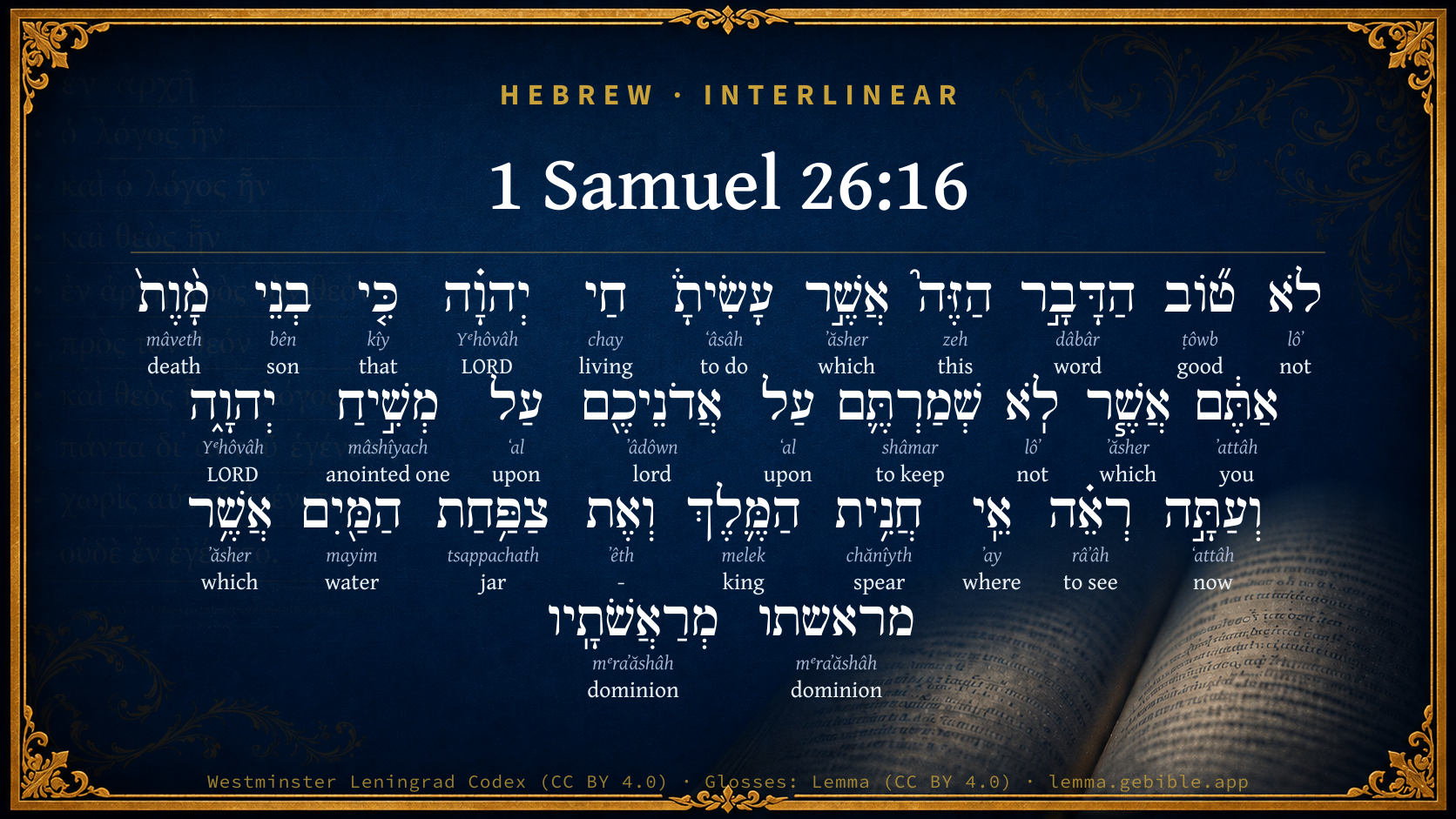
  1. לֹא lôʼ H3808 “not” Particle, Negative
  2. ט֞וֹב ṭôwb H2896 “good” Adjective, Adjective, Masculine, Singular, Absolute
  3. הַדָּבָ֣ר dâbâr H1697 “the · word” Particle, Definite Article + Noun, Common, Masculine, Singular, Absolute
  4. הַזֶּה֮ zeh H2088 “the · this” Particle, Definite Article + Pronoun, Demonstrative, Masculine, Singular
  5. אֲשֶׁ֣ר ʼăsher H834 “which” Particle, Relative
  6. עָשִׂיתָ֒ ʻâsâh H6213 “to do” Verb, Qal, Perfect, 2nd Person, Masculine, Singular
  7. חַי chay H2416 “living” Adjective, Adjective, Masculine, Singular, Absolute
  8. יְהוָ֗ה Yᵉhôvâh H3068 “LORD” Noun, Proper
  9. כִּ֤י kîy H3588 “that” Conjunction
  10. בְנֵי bên H1121 “sons of” Noun, Common, Masculine, Plural, Construct
  11. מָ֨וֶת֙ mâveth H4194 “death” Noun, Common, Masculine, Singular, Absolute
  12. אַתֶּ֔ם ʼattâh H859 “you” Pronoun, Personal, 2nd Person, Masculine, Plural
  13. אֲשֶׁ֧ר ʼăsher H834 “which” Particle, Relative
  14. לֹֽא lôʼ H3808 “not” Particle, Negative
  15. שְׁמַרְתֶּ֛ם shâmar H8104 “to keep” Verb, Qal, Perfect, 2nd Person, Masculine, Plural
  16. עַל ʻal H5921 “upon” Preposition
  17. אֲדֹנֵיכֶ֖ם ʼâdôwn H113 “lords · your” Noun, Common, Masculine, Plural, Construct + Suffix, Personal, 2nd Person, Masculine, Plural
  18. עַל ʻal H5921 “upon” Preposition
  19. מְשִׁ֣יחַ mâshîyach H4899 “anointed one of” Noun, Common, Masculine, Singular, Construct
  20. יְהוָ֑ה Yᵉhôvâh H3068 “LORD” Noun, Proper
  21. וְעַתָּ֣ה ʻattâh H6258 “and · now” Conjunction + Adverb
  22. רְאֵ֗ה râʼâh H7200 “see” Verb, Qal, Imperative, 2nd Person, Masculine, Singular
  23. אֵֽי ʼay H335 “where” Particle, Interrogative
  24. חֲנִ֥ית chănîyth H2595 “spear of” Noun, Common, Feminine, Singular, Construct
  25. הַמֶּ֛לֶךְ melek H4428 “the · king” Particle, Definite Article + Noun, Common, Masculine, Singular, Absolute
  26. וְאֶת ʼêth H853 “and · -” Conjunction + Particle, Direct Object
  27. הַמַּ֖יִם mayim H4325 “the · water(s)” Particle, Definite Article + Noun, Common, Masculine, Plural, Absolute
  28. אֲשֶׁ֥ר ʼăsher H834 “which” Particle, Relative
  29. מראשתו mᵉraʼăshâh H4763 “head place · his” Noun, Common, Feminine, Plural, Construct + Suffix, Personal, 3rd Person, Masculine, Singular
  30. מְרַאֲשֹׁתָֽיו mᵉraʼăshâh H4763 “head place · his” Noun, Common, Feminine, Plural, Construct + Suffix, Personal, 3rd Person, Masculine, Singular

About this verse

These counts appear in no published source. They are computed here, from the morphology-tagged text and Lemma’s own curated glosses. What Lemma adds →

31
words
25
distinct lemmas
Historical
section

Notable vocabulary

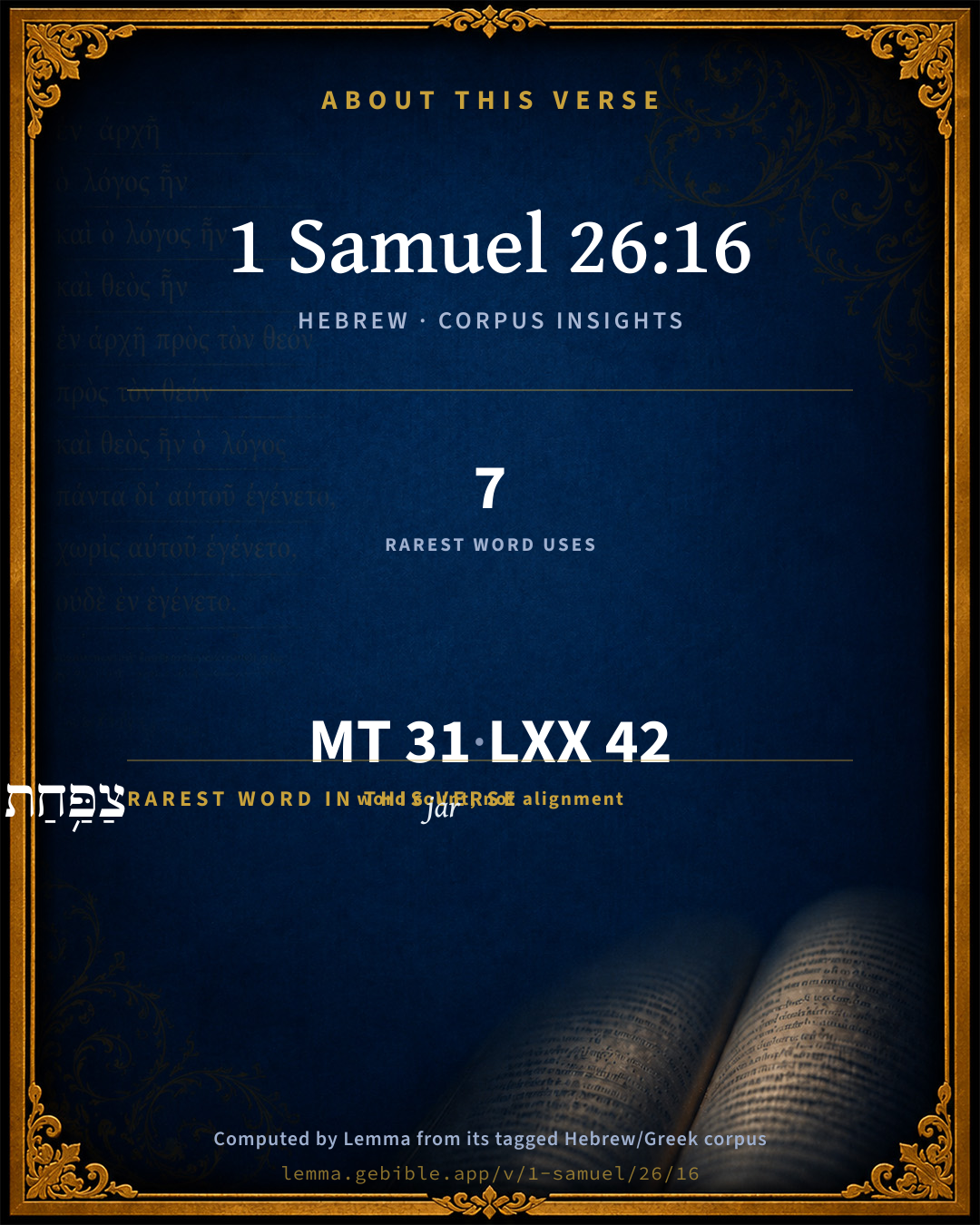
The rarest word here is צַפַּ֥חַת jar H6835 — appearing just 7 times in the whole Hebrew Bible.

Shared distinctive vocabulary

צַפַּ֥חַת jar H6835 occurs in 7 verses of the Hebrew Bible. Also found in:

Grammatical profile

  • 3 verbs
  • 13 nouns
  • 2 adjectives
  • 2 pronouns
  • 2 prepositions
  • 1 conjunction
  • 1 adverb
  • 7 particles

Verb forms

  • עָשִׂיתָ֒ Qal · Perfect
  • שְׁמַרְתֶּ֛ם Qal · Perfect
  • רְאֵ֗ה Qal · Imperative

Repetition

Words recur within this verse — often emphatic in Hebrew:

  • יְהוָ֗ה LORD H3068 ×2
  • עַל upon H5921 ×2
  • מראשתו dominion H4763 ×2
  • אֲשֶׁ֣ר which H834 ×3
  • לֹא not H3808 ×2

Hebrew & Septuagint length

In English translation the verse runs 44 words from the Hebrew and 57 from the Septuagint (LXX English) — closely comparable.

A rough comparison of the two English renderings, which tokenize alike — not a word-level alignment.

Word counts can differ between the Hebrew and the Greek without any difference in meaning — e.g. the Hebrew direct-object marker אֵת has no separate Greek word, and Greek often adds the article ὁ.

In the original languages it is 31 Hebrew tokens and 42 Greek tokens — but the two are counted differently (Hebrew bundles its prefixes and suffixes into one token; the Greek is in lemma form), so that isn’t a like-for-like length.

Cross-references

9

Topical passages linked to 1 Samuel 26:16 in the Treasury of Scripture Knowledge — connected by theme and wording, ordered by reader-vote popularity; previews shown in the World English Bible.

  • 1 Samuel 20:31 For as long as the son of Jesse lives on the earth, you shall not be established, nor your kingdom. Therefore now send and bring him to me, for he shall surely die.
  • 1 Samuel 26:9 David said to Abishai, Don't destroy him; for who can put forth his hand against Yahweh's anointed, and be guiltless?
  • 1 Samuel 26:11 Yahweh forbid that I should put forth my hand against Yahweh's anointed: but now please take the spear that is at his head, and the jar of water, and let us go.
  • 2 Samuel 12:5 David's anger was greatly kindled against the man, and he said to Nathan, "As Yahweh lives, the man who has done this is worthy to die!
  • 2 Samuel 19:28 For all my father's house were but dead men before my lord the king; yet you set your servant among those who ate at your own table. What right therefore have I yet that I should cry any more to the king?
  • Psalms 79:11 Let the sighing of the prisoner come before you. According to the greatness of your power, preserve those who are sentenced to death;
  • Psalms 102:20 To hear the groans of the prisoner; To free those who are condemned to death;
  • Ephesians 2:3 among whom we also all once lived in the lust of our flesh, doing the desires of the flesh and of the mind, and were by nature children of wrath, even as the rest.
  • 1 Samuel 24:6 He said to his men, Yahweh forbid that I should do this thing to my lord, Yahweh's anointed, to put forth my hand against him, seeing he is Yahweh's anointed.

Cross-references courtesy of OpenBible.info (CC BY 4.0).

Hebrew and Greek witnesses Masoretic Hebrew ↔ Greek Septuagint

The same verse in the two great witnesses to the Old Testament, shown verse-for-verse.

These are two independent witnesses, not word-aligned to each other, and the Septuagint is shown in lemma (dictionary) form.

Hebrew 1 Samuel 26:16 Masoretic · Westminster Leningrad Codex

לֹא ט֞וֹב הַדָּבָ֣ר הַזֶּה֮ אֲשֶׁ֣ר עָשִׂיתָ֒ חַי יְהוָ֗ה כִּ֤י בְנֵי מָ֨וֶת֙ אַתֶּ֔ם אֲשֶׁ֧ר לֹֽא שְׁמַרְתֶּ֛ם עַל אֲדֹנֵיכֶ֖ם עַל מְשִׁ֣יחַ יְהוָ֑ה וְעַתָּ֣ה רְאֵ֗ה אֵֽי חֲנִ֥ית הַמֶּ֛לֶךְ וְאֶת צַפַּ֥חַת הַמַּ֖יִם אֲשֶׁ֥ר מראשתו מְרַאֲשֹׁתָֽיו

This thing isn't good that you have done. As Yahweh lives, you are worthy to die, because you have not kept watch over your lord, Yahweh's anointed. Now see where the king's spear is, and the jar of water that was at his head.

World English Bible · Public Domain

Greek LXX 1 Samuel 26:16 Septuagint · lemma form

καί οὐ ἀγαθός ὁ ῥῆμα οὗτος ὅς ποιέω ζάω κύριος ὅτι υἱός θανατώσις σύ ὁ φυλάσσω ὁ βασιλεύς κύριος σύ ὁ χριστός κύριος καί νῦν ὁράω δή ὁ δόρυ ὁ βασιλεύς καί ὁ φακός ὁ ὕδωρ ποῦ εἰμί ὁ πρός κεφαλή αὐτός

And this thing is not good which you have done. As the Lord lives, you⌃ are worthy of death, you⌃ who guard your lord the king, the anointed of the Lord: and now behold, I pray you, the spear of the king, and the cruse of water: where are the articles that should be at his head?

LXX2012 (modern English Septuagint) · Public Domain

Hebrew: Westminster Leningrad Codex (CC BY 4.0). Greek: Septuagint (public domain); English from LXX2012 (modern English Septuagint) (Public Domain). How the Septuagint differs from the Hebrew →

Targum (Aramaic paraphrase)

1

The Targum is the ancient Jewish Aramaic paraphrase of the Hebrew Scriptures — an interpretive translation, not the Hebrew text itself. Onkelos (literal) and Pseudo-Jonathan (expansive) render the Torah, and Jonathan the Prophets. Coverage is partial: where no permissively-licensed English translation exists for a verse, only the Aramaic is shown. This is verse-level text, not a word-by-word alignment to the Hebrew.

  1. Targum Jonathan Prophets (Joshua–Malachi)
    לָא תַקֵין פִּתְגָמָא הָדֵין דִי עֲבַדְתָּא קַיָים הוּא יְיָ אֲרֵי גַבְרִין חַיָבֵי קְטוֹל אַתּוּן דְלָא נְטַרְתּוּן עַל רִבּוֹנְכוֹן עַל מְשִׁיחָא דַייָ וּכְעַן חֲזֵי אָן מוּרְנִיתָא דְמַלְכָּא וְיַת מָנָא דְמַיָא דְאִיסָדוֹהִי:

    (no public-domain English translation for this verse)

    Targum Jonathan — Aramaic: “Mikraot Gedolot” (public domain). English: “Sefaria Community Translation” (CC0 1.0 (public-domain dedication)); “London "Chaldee Paraphrase," 1871” (public domain). Text via Sefaria.

Commentary

Notes on 1 Samuel 26:16 from classic Christian and Jewish commentators (each source and its license shown beneath its notes). The classic Christian expositions comment on the surrounding passage and are grouped to its opening verse, so a note may address several verses; the Jewish commentaries on the Tanakh (Rashi and others) are per-verse, so they appear only where the commentator wrote on this verse.

Lemma curates 59 commentaries, every one of them public domain or Creative Commons licensed, each selected and text-cleaned for this edition rather than reprinted as found. About our sources →

Trapp's Complete Commentary

John Trapp

1Sa 26:16 This thing [is] not good that thou hast done. [As] the LORD liveth, ye [are] worthy to die, because ye have not kept your master, the LORD’S anointed. And now see where the king’s spear [is], and the cruse of water that [was] at his bolster.

Ver. 16. Ye are worthy to die,] sc., Ex iure Gentium, because ye keep no better a watch. Epaminondas walking the round, slew a watchman whom he found sleeping; and defended the fact by saying, Talem reliqui, qualem inveni, I left him no otherwise than I found him.

And now see where the king’s spear is.] Ecce signum, lo here an ocular demonstration of thy blameworthiness, but of mine integrity and innocence.

John Trapp, A Commentary or Exposition upon All the Books of the Old and New Testament (1647–1656) — public domain. Text from a community e-Sword module.

Tyndale Open Study Notes

Tyndale Open Resources

26:16 deserve to die: Death was the punishment for dereliction of duty.

Tyndale Open Study Notes — © Tyndale Open Resources, licensed CC BY-SA 4.0. Text via the HelloAO Bible API.

Geneva Bible (1599)

Geneva Bible translators

Hebrew, sons of death.

Geneva Bible (1599) marginal notes — public domain. Text via Bolls.life.

The Cambridge Bible for Schools and Colleges

gen. ed. J. J. S. Perowne

16. worthy to die] Lit. sons of death. Cp. 1Sa_20:31.

The Cambridge Bible for Schools and Colleges (gen. ed. J. J. S. Perowne; Cambridge University Press, 1878–1918) — public domain. Text from a community e-Sword module.

John Gill's Exposition

This thing is not good that thou hast done,.... Yea, it was very bad, a great fault, and very blameworthy, if he had neglected to set a watch over the king, whose business it was as a general; the words are expressed in a figure called "meiosis", in which less is said than was intended:

as the Lord liveth, ye are worthy to die, because ye have not kept your master, the Lord's anointed; if a watch was set, and these had fallen asleep, and neglected their duty, or had deserted their post; which to do was a capital crime, and deserving of death; wherefore he does not say this of Abner, but of the watch:

and now see where the king's spear is, and the cruse of water that was at his bolster; which he then held up as proofs and evidences of the truth of what be said, that one had been in the camp and had carried off these, and who could as easily have destroyed the king as to have taken these away; and as he came hither with an intent to destroy him, would have done it, had he not been prevented by David; all which likewise plainly proved the negligence of Abner, in not setting a watch about his master, or the negligence of the watch that was set.

John Gill's Exposition of the Whole Bible (1746–1763) — public domain (CC PDM 1.0). Text via the HelloAO Bible API.

Haydock's Catholic Bible Commentary

Death; i.e., you deserve to die. Such negligence was punishable with death, according to the Roman laws; & qui excubias. (Grotius)

George Leo Haydock (1774–1849), Haydock's Catholic Family Bible and Commentary, 1859 edition — public domain. Excludes Psalms (Douay-Rheims chapter numbering differs from Protestant) and Deuterocanonical books (Catholic canon only).

Matthew Poole's English Annotations

This thing is not good, i.e. it is very bad, a great crime. A figure called meiosis, as Pro 18:5; 19:2.

Matthew Poole's English Annotations on the Holy Bible (1683–1685) — public domain. Text from a community e-Sword/MySword module.

Lesson kit

Teaching starters — assembled from the data on this page, not authored interpretation. Every prompt links to the verse data it draws on. Edit before teaching.

1 Samuel, in the Historical, opens this verse with 31 words (25 distinct Hebrew lemmas). Its most distinctive word is tsappachath (“jar”). A historical commentator’s framing appears above. Read the whole chapter for the surrounding context.

Discussion questions

  1. The word tsappachath carries the sense “jar.” How does it shape the verse?
  2. How does 1 Samuel 26:11, which shares the word «jar», read alongside this verse?
  3. What does the repetition of “LORD” (2× in this one verse) do in this verse?
  4. These translations render this verse differently; the difference is in the English rendering, not the original. What questions does that raise?
  5. «עָשִׂיתָ֒» is a Qal Perfect verb. How does that grammatical form shape the action described?
  6. Compare how Trapp's Complete Commentary and Tyndale Open Study Notes read this verse. Where do they agree or differ?

Things to notice

Reading settings

Reading text

Shown beneath each verse's original-language words.

Old Testament
Old Testament edition

Read the OT as the Masoretic Hebrew (MT) or the Greek Septuagint (LXX).

English shown for the Greek Septuagint (in the Hebrew ↔ Greek comparison).

Comparing translations? Open the Compare panel on any verse page to stack up to four side by side.