Acts 9:34

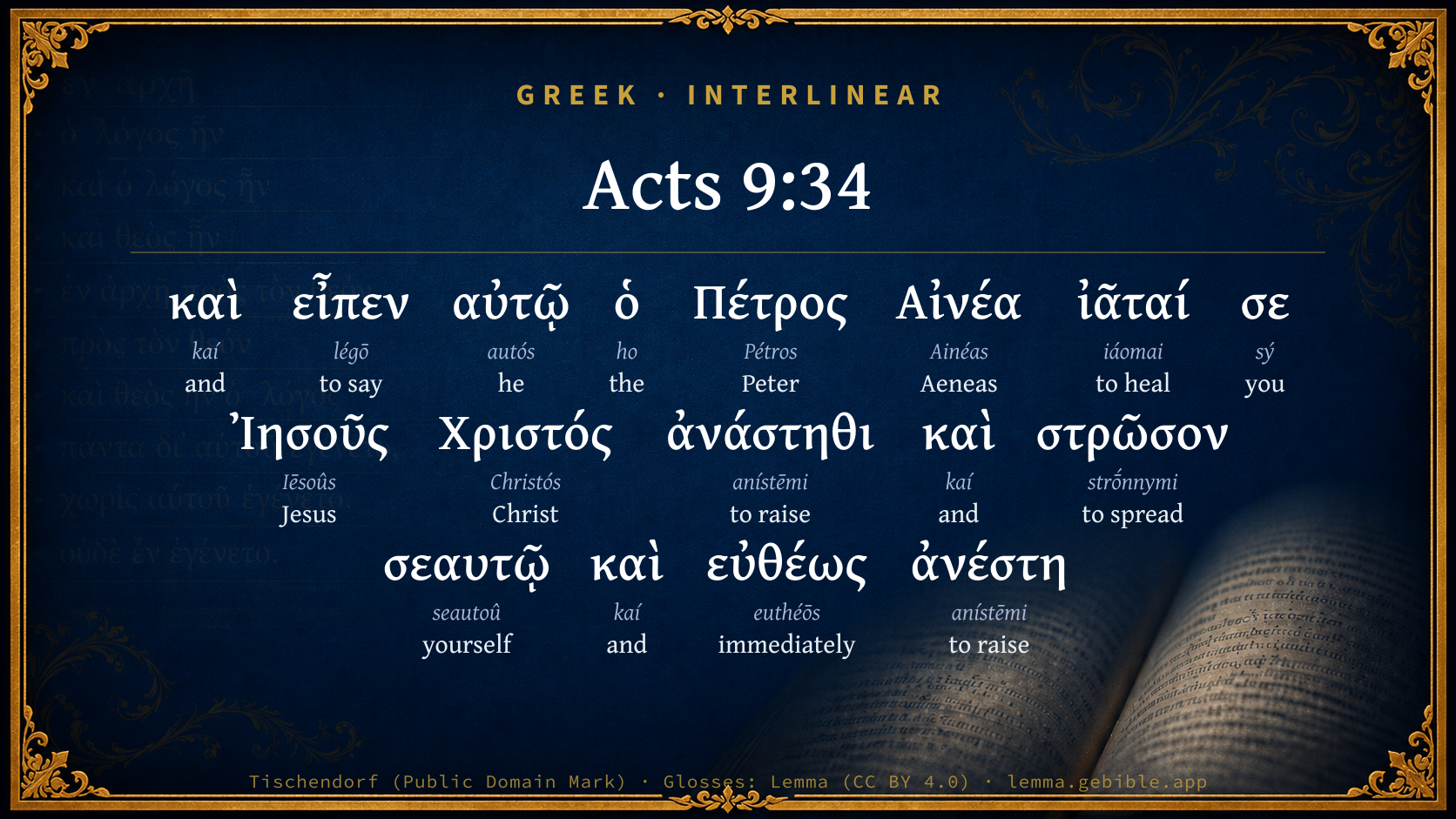
Greek (Tischendorf 8th ed.) Acts 9:34 appears in the Greek New Testament. The text above is from the Tischendorf 8th edition. Each word links to its Strong’s number and a concise gloss. Click any word for its full Thayer’s Greek Lexicon entry.
Download image
Cite this verse

Acts 9:34 (World English Bible). Public Domain. Lemma interlinear Bible study tool, https://lemma.gebible.app/v/acts/9/34.

Show BibTeX & RIS
BibTeX
RIS
English Translation
Peter said to him, "Aeneas, Jesus Christ heals you. Get up and make your bed!" Immediately he arose.
World English Bible · Public Domain
Download a study sheet

One document with this verse’s original text, its word-by-word gloss line, the meaning frame, cross-references with their text, attributed commentary, and full source and license credits — printable, and it pastes into notes with its structure intact.

This verse Autodidact and up

Study sheet (.html) Plain text (.txt)

A passage Seminary Student

Up to 50 verses in one chapter. A passage sheet keeps up to 6 commentary sources and 12 cross-references per verse, in the order this page ranks them, and says so on the sheet whenever that leaves anything out. Ask for a single verse and you get the Autodidact verse sheet above.

Everything on this page stays free to read, with no account — the sheet is a download of what is already on screen, not access to it.

Want to remove ads? Support Godless Engineer
Compare translations 3

The same verse in 3 English versions, stacked beneath the original-language interlinear above. Click any original word for its lexicon entry.

Each is an independent rendering of the whole verse — the interlinear is not word-aligned to these translations.

Highlighted words mark where these versions differ — a whole-verse word diff, not a word-by-word alignment.

  • World English Bible Public Domain
    Peter said to him, "Aeneas, Jesus Christ heals you. Get up and make your bed!" Immediately he arose.
  • King James Version Public Domain
    And Peter said unto him, Aeneas, Jesus Christ maketh thee whole: arise, and make thy bed. And he arose immediately.
  • unfoldingWord Literal Text CC BY-SA 4.0
    And Peter said to him, “Aeneas, Jesus Christ heals you. Arise and make your bed for yourself,” and immediately he arose.

unfoldingWord Literal Text — © unfoldingWord, licensed CC BY-SA 4.0. Word-aligned USFM3 via Door43 (git.door43.org/unfoldingWord/en_ult).

Versions to compare (up to 4)

3 of 4 selected

Show all 19 translations

Every available English version of this verse, each an independent rendering of the whole verse.

  • World English Bible Public Domain
    Peter said to him, "Aeneas, Jesus Christ heals you. Get up and make your bed!" Immediately he arose.
  • Berean Standard Bible Public Domain
    “Aeneas,” Peter said to him, “Jesus Christ heals you! Get up and put away your mat.” Immediately Aeneas got up,
  • Majority Standard Bible Public Domain
    “Aeneas,” Peter said to him, “Jesus Christ heals you! Get up and put away your mat.” Immediately Aeneas got up,
  • King James Version Public Domain
    And Peter said unto him, Aeneas, Jesus Christ maketh thee whole: arise, and make thy bed. And he arose immediately.
  • American Standard Version (1901) Public Domain
    And Peter said unto him, Aeneas, Jesus Christ healeth thee: arise and make thy bed. And straightway he arose.
  • Revised Version (1885) Public Domain
    And Peter said unto him, AEneas, Jesus Christ healeth thee: arise, and make thy bed. And straightway he arose.
  • Geneva Bible (1599) Public Domain
    Then said Peter vnto him, Aeneas, Iesus Christ maketh thee whole: arise and trusse thy couch together. And he arose immediately.
  • Douay-Rheims (1899) Public Domain
    And Peter said to him: Eneas, the Lord Jesus Christ healeth thee: arise, and make thy bed. And immediately he arose.
  • Young's Literal Translation Public Domain
    and Peter said to him, `Aeneas, heal thee doth Jesus the Christ; arise and spread for thyself;' and immediately he rose,
  • Literal Standard Version CC BY-SA 4.0
    and Peter said to him, “Aeneas, Jesus the Christ heals you; arise and spread for yourself”; and immediately he rose,
  • Unlocked Literal Bible CC BY-SA 4.0
    Peter said to him, “Aeneas, Jesus Christ heals you. Get up and make your bed,” and right away he got up.
  • unfoldingWord Literal Text CC BY-SA 4.0
    And Peter said to him, “Aeneas, Jesus Christ heals you. Arise and make your bed for yourself,” and immediately he arose.
  • Darby Bible Public Domain
    And Peter said to him, Aeneas, Jesus, the Christ, heals thee: rise up, and make thy couch for thyself. And straightway he rose up.
  • World Messianic Bible Public Domain
    Peter said to him, “Aeneas, Yeshua the Messiah heals you. Get up and make your bed!” Immediately he arose.
  • Webster's Bible Public Domain
    And Peter said to him, Eneas, Jesus Christ healeth thee: arise, and make thy bed. And he arose immediately.
  • Free Bible Version CC BY-SA 4.0
    Peter told him, “Aeneas, Jesus Christ heals you! Get up and pick up your mat!” Immediately Aeneas got up.
  • Bible in Basic English Public Domain
    And Peter said to him, Aeneas, Jesus Christ makes you well: get up and make your bed. And straight away he got up.
  • Text-Critical English NT CC BY 4.0
    Peter said to him, “Aeneas, Jesus Christ has now healed yoʋ; rise and roll up yoʋr mat.” Immediately he rose,
  • Tyndale New Testament (1534) Public Domain
    Then sayde Peter vnto hym: Eneas Iesus Christ make the whole. Aryse and make thy beed. And he arose immedyatly.

Literal Standard Version (2020), Covenant Press — licensed CC BY-SA 4.0. Text via the HelloAO Bible API (eBible.org). Unlocked Literal Bible (unfoldingWord) — licensed CC BY-SA 4.0. Text via the HelloAO Bible API (eBible.org). unfoldingWord Literal Text — © unfoldingWord, licensed CC BY-SA 4.0. Word-aligned USFM3 via Door43 (git.door43.org/unfoldingWord/en_ult). Free Bible Version, Dr. Jonathan Gallagher — licensed CC BY-SA 4.0. Text via the HelloAO Bible API (eBible.org).

Word by word

More ways to search: Search by grammar → Find every occurrence → Compare this word →

Practice this passage: Drill this verse → Learn its vocabulary →

Αἰνέα
Ainéas
G132
“Aeneas”
Noun, Vocative, Singular, Masculine
Part of Speech
Noun
Case
Vocative
Number
Singular
Gender
Masculine
Full Thayer's Definition

Origin: of uncertain derivation

TDNT: None

Aeneas = "laudable" 1. the name of a paralytic cured by Peter at Lydia
  1. καὶ kaí G2532 “and” Conjunction
  2. εἶπεν légō G3004 “to say” Verb, Aorist, Active, Indicative, 3rd person, Singular
  3. αὐτῷ autós G846 “he” Personal pronoun, Dative, Singular, Masculine
  4. ὁ ho G3588 “the” Article, Nominative, Singular, Masculine
  5. Πέτρος Pétros G4074 “Peter” Noun, Nominative, Singular, Masculine
  6. ἰᾶταί iáomai G2390 “to heal” Verb, Present, Middle or Passive deponent, Indicative, 3rd person, Singular
  7. σε sý G4771 “you” Personal pronoun, 2nd person, Accusative, Singular
  8. Ἰησοῦς Iēsoûs G2424 “Jesus” Noun, Nominative, Singular, Masculine
  9. Χριστός Christós G5547 “Christ” Noun, Nominative, Singular, Masculine
  10. ἀνάστηθι anístēmi G450 “to raise” Verb, Aorist, Active, Imperative, 2nd person, Singular
  11. καὶ kaí G2532 “and” Conjunction
  12. στρῶσον strṓnnymi G4766 “to spread” Verb, Aorist, Active, Imperative, 2nd person, Singular
  13. σεαυτῷ seautoû G4572 “yourself” Reflexive pronoun, 2nd person, Dative, Singular, Masculine
  14. καὶ kaí G2532 “and” Conjunction
  15. εὐθέως euthéōs G2112 “immediately” Adverb
  16. ἀνέστη anístēmi G450 “to raise” Verb, Aorist, Active, Indicative, 3rd person, Singular

About this verse

These counts appear in no published source. They are computed here, from the morphology-tagged text and Lemma’s own curated glosses. What Lemma adds →

17
words
14
distinct lemmas
Acts
section

Notable vocabulary

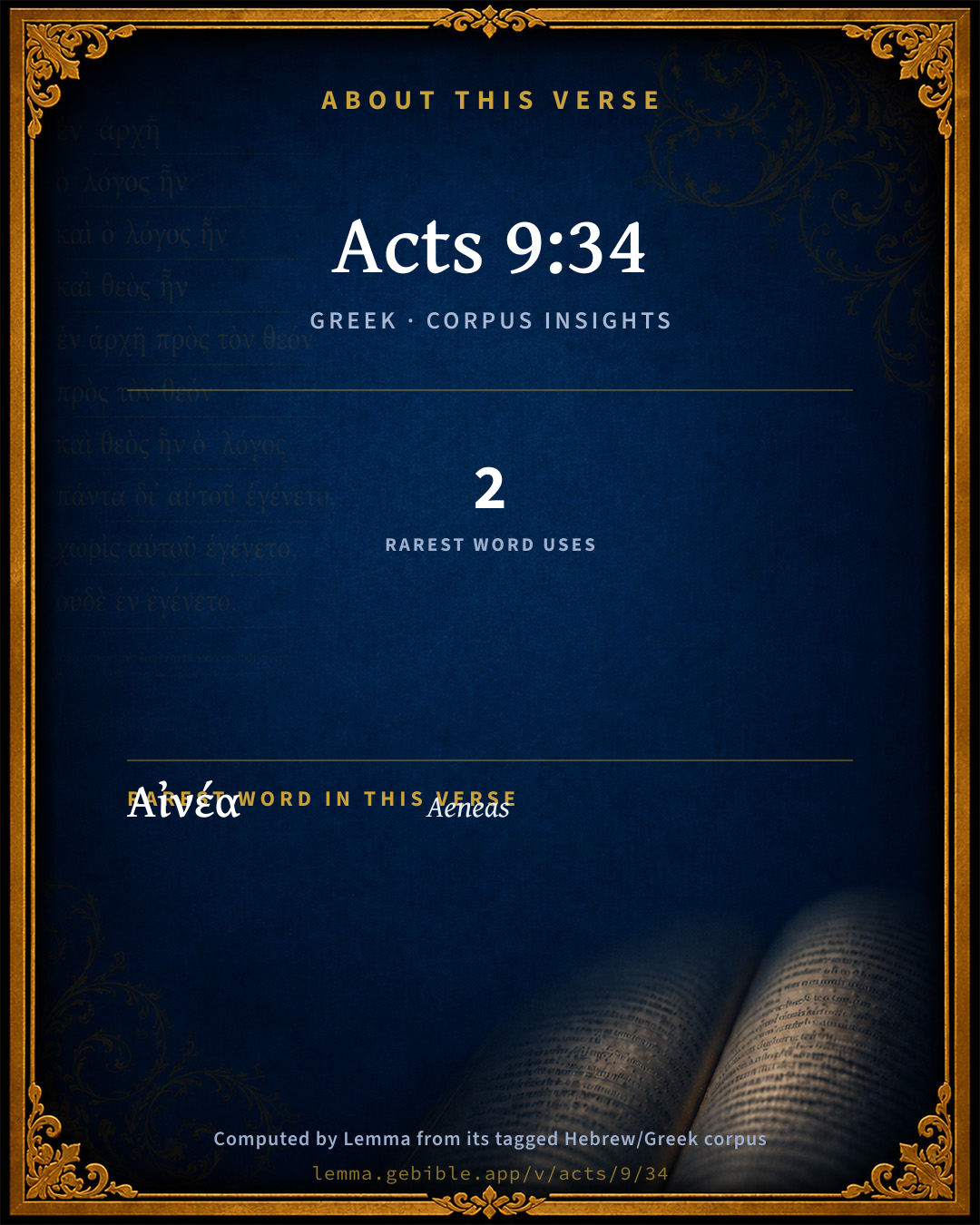
The rarest word here is Αἰνέα Aeneas G132 — appearing just 2 times in the whole Greek New Testament.

Shared distinctive vocabulary

Αἰνέα Aeneas G132 occurs in 2 verses of the Greek New Testament. Also found in:

Repetition

Words recur within this verse:

  • ἀνάστηθι to raise G450 ×2
  • καὶ and G2532 ×3

Cross-references

9

Topical passages linked to Acts 9:34 in the Treasury of Scripture Knowledge — connected by theme and wording, ordered by reader-vote popularity; previews shown in the World English Bible.

  • Matthew 9:6 But that you may know that the Son of Man has authority on earth to forgive sins..." (then he said to the paralytic), "Get up, and take up your mat, and go up to your house."
  • Acts 3:6 But Peter said, "Silver and gold have I none, but what I have, that I give you. In the name of Jesus Christ of Nazareth, get up and walk!"
  • Acts 3:12 When Peter saw it, he responded to the people, "You men of Israel, why do you marvel at this man? Why do you fasten your eyes on us, as though by our own power or godliness we had made him walk?
  • Acts 16:18 She was doing this for many days. But Paul, becoming greatly annoyed, turned and said to the spirit, "I charge you in the name of Jesus Christ to come out of her!" It came out that very hour.
  • Matthew 8:3 Jesus stretched out his hand, and touched him, saying, "I want to. Be made clean." Immediately his leprosy was cleansed.
  • Matthew 9:28–30 When he had come into the house, the blind men came to him. Jesus said to them, "Do you believe that I am able to do this?" They told him, "Yes, Lord."
  • Acts 3:16 By faith in his name has his name made this man strong, whom you see and know. Yes, the faith which is through him has given him this perfect soundness in the presence of you all.
  • Acts 4:10 be it known to you all, and to all the people of Israel, that in the name of Jesus Christ of Nazareth, whom you crucified, whom God raised from the dead, in him does this man stand here before you whole.
  • John 2:11 This beginning of his signs Jesus did in Cana of Galilee, and revealed his glory; and his disciples believed in him.

Cross-references courtesy of OpenBible.info (CC BY 4.0).

Commentary

Notes on Acts 9:34 from classic Christian and Jewish commentators (each source and its license shown beneath its notes). The classic Christian expositions comment on the surrounding passage and are grouped to its opening verse, so a note may address several verses; the Jewish commentaries on the Tanakh (Rashi and others) are per-verse, so they appear only where the commentator wrote on this verse.

Lemma curates 59 commentaries, every one of them public domain or Creative Commons licensed, each selected and text-cleaned for this edition rather than reprinted as found. About our sources →

MacLaren's Expositions of Holy Scripture

Alexander MacLaren

Acts

COPIES OF CHRIST’S MANNER

Act 9:34, Act 9:40.

I have put these two miracles together, not only because they were closely connected in time and place, but because they have a very remarkable and instructive feature in common. They are both evidently moulded upon Christ’s miracles; are distinct imitations of what Peter had seen Him do. And their likenesses to and differences from our Lord’s manner of working are equally noteworthy. It is to the lessons from these two aspects, common to both miracles, that I desire to turn now.

I. First, notice the similarities and the lesson which they teach.

The two cases before us are alike, in that both of them find parallels in our Lord’s miracles. The one is the cure of a paralytic, which pairs off with the well-known story in the Gospels concerning the man that was borne by four, and let down through the roof into Christ’s presence. The other of them, the raising of Dorcas, or Tabitha, of course corresponds with the three resurrections of dead people which are recorded in the Gospels.

And now, note the likenesses. Jesus Christ said to the paralysed man, ‘Arise, take up thy bed.’ Peter says to Aeneas, ‘Arise, and make thy bed.’ The one command was appropriate to the circumstances of a man who was not in his own house, and whose control over his long-disused muscles in obeying Christ’s word was a confirmation to himself of the reality and completeness of his cure. The other was appropriate to a man bedridden in his own house; and it had precisely the same purpose as the analogous injunction from our Lord, ‘Take up thy bed and walk.’ Aeneas was lying at home, and so Peter, remembering how Jesus Christ had demonstrated to others, and affirmed to the man himself, the reality of the miraculous blessing given to him, copies his Master’s method, ‘Aeneas, make thy bed.’ It is an echo and resemblance of the former incident, and is a distinct piece of imitation of it.

And then, if we turn to the other narrative, the intentional moulding of the manner of the miracle, consecrated in the eyes of the loving disciple, because it was Christ’s manner, is still more obvious. When Jesus Christ went into the house of Jairus there was the usual hubbub, the noise of the loud Eastern mourning, and He put them all forth, taking with Him only the father and mother of the damsel, and Peter with James and John. When Peter goes into the upper room, where Tabitha is lying, there are the usual noise of lamentation and the clack of many tongues, extolling the virtues of the dead woman. He remembers how Christ had gone about His miracle, and he, in his turn, ‘put them all forth.’ Mark, who was Peter’s mouthpiece in his Gospel, gives us the very Aramaic words which our Lord employed when He raised the little girl, Talitha, the Aramaic word for ‘a damsel,’ or young girl; cumi, which means in that language ‘arise.’ Is it not singular and beautiful that Peter’s word by the bedside of the dead Dorcas is, with the exception of one letter, absolutely identical? Christ says, Talitha cumi. Peter remembered the formula by which the blessing was conveyed, and he copied it. ‘Tabitha cumi!’ Is it not clear that he is posing after his Master’s attitude; that he is, consciously or unconsciously, doing what he remembered so well had been done in that other upper room, and that the miracles are both of them shaped after the pattern of the miraculous working of Jesus Christ?

Well, now, although we are no miracle-workers, the very same principle which underlay these two works of supernatural power is to be applied to all our work, and to our lives as Christian people. I do not know whether Peter meant to do like Jesus Christ or not; I think rather that he was unconsciously and instinctively dropping into the fashion that to him was so sacred. Love always delights in imitation; and the disciples of a great teacher will unconsciously catch the trick of his intonation, even the awkwardness of his attitudes or the peculiarities of his way of looking at things-only, unfortunately, outsides are a good deal more easily imitated than insides. And many a disciple copies such external trifles, and talks in the tones that have, first of all, brought blessed truths to him, whose resemblance to his teacher goes very little further. The principle that underlies these miracles is just this-get near Jesus Christ, and you will catch His manner. Dwell in fellowship with Him, and whether you are thinking about it or not, there will come some faint resemblance to that Lord into your characters and your way of doing things, so that men will ‘take knowledge of you that you have been with Jesus.’ The poor bit of cloth which has held some precious piece of solid perfume will retain fragrance for many a day afterwards, and will bless the scentless air by giving it forth. The man who keeps close to Christ, and has folded Him in his heart, will, like the poor cloth, give forth a sweetness not his own that will gladden and refresh many nostrils. Live in the light, and you will become light. Keep near Christ, and you will be Christlike. Love Him, and love will do to you what it does to many a wedded pair, and to many kindred hearts: it will transfuse into you something of the characteristics of the object of your love. It is impossible to trust Christ, to obey Christ, to hold communion with Him, and to live beside Him, without becoming like Him. And if such be our inward experience, so will be our outward appearance.

But there may be a specific point given to this lesson in regard to Christian people’s ways of doing their work in the world and helping and blessing other folk. Although, as I say, we have no miraculous power at our disposal, we do not need it in order to manifest Jesus Christ and His way of working in our work. And if we dwell beside Him, then, depend upon it, all the characteristics-far more precious than the accidents of manner, or tone, or attitude in working a miracle-all the characteristics so deeply and blessedly stamped upon His life of self-sacrifice and man-helping devotion will be reproduced in us. Jesus Christ, when He went through the wards of the hospital of the world, was overflowing with quick sympathy for every sorrow that met His eye. If you and I are living near Him, we shall never steel our hearts nor lock up our sensibilities against any suffering that it is within our power to stanch or to alleviate. Jesus Christ never grudged trouble, never thought of Himself, never was impatient of interruption, never repelled importunity, never sent away empty any outstretched hand. And if we live near Him, self-oblivious willingness to spend and be spent will mark our lives, and we shall not consider that we have the right of possession or of sole enjoyment of any of the blessings that are given to us. Jesus Christ, according to the beautiful and significant words of one of the Gospels, ‘healed them that had need of healing.’ Why that singular designation for the people that were standing around Him but to teach us that wide as men’s necessity was His sympathy, and that broad as the sympathy of Christ were the help and healing which He brought? And so, with like width of compassion, with like perfectness of self-oblivion, with equal remoteness from consciousness of superiority or display of condescension, Christian men should go amongst the sorrowful and the sad and the outcast and do their miracles-’greater works’ than those which Christ did, as He Himself has told us-after the manner in which He did His. If they did, the world would be a different place, and the Church would be a different Church, and you would not have people writing in the newspapers to demonstrate that Christianity was ‘played out.’

II. Further, note the differences and the lessons from them.

Take the first of the two miracles. ‘Aeneas, Jesus Christ maketh thee whole: arise, and make thy bed.’ That first clause points to the great difference. Take the second miracle, ‘Jesus Christ put them all forth, and stretched out His hand, and said, Damsel, arise!’ ‘Peter put them all forth, . . . and said, Tabitha, arise!’ but between the putting forth and the miracle he did something which Christ did not do, and he did not do something which Christ did do. ‘He kneeled down and prayed.’ Jesus Christ did not do that. ‘And Jesus put forth His hand, and said, Arise!’ Peter did not do that. But he put forth his hand after the miracle was wrought; not to communicate life, but to help the living woman to get to her feet; and so, both by what he did in his prayer and by what he did not do after Christ’s pattern, the extension of the hand that was the channel of the vitality, he drew a broad distinction between the servant’s copy and the Master’s original.

The lessons from the differences are such as the following.

Christ works miracles by His inherent power; His servants do their works only as His instruments and organs. I need not dwell upon the former thought; but it is the latter at which I wish to look for a moment. The lesson, then, of the difference is that Christian men, in all their work for the Master and for the world, are ever to keep clear before themselves, and to make very obvious to other people, that they are nothing more than channels and instruments. The less the preacher, the teacher, the Christian benefactor of any sort puts himself in the foreground, or in evidence at all, the more likely are his words and works to be successful. If you hear a man, for instance, preaching a sermon, and you see that he is thinking about himself, he may talk with the tongues of men and of angels, but he will do no good to anybody. The first condition of work for the Lord is-hide yourself behind your message, behind your Master, and make it very plain that His is the power, and that you are but a tool in the Workman’s hand.

And then, further, another lesson is, Be very sure of the power that will work in you. What a piece of audacity it was for Peter to go and stand by the paralytic man’s couch and say, ‘Aeneas, Jesus Christ maketh thee whole.’ Yes, audacity; unless he had been in such constant and close touch with his Master that he was sure that his Master was working through him. And is it not beautiful to see how absolutely confident he is that Jesus Christ’s work was not ended when He went up into heaven; but that there, in that little stuffy room, where the man had lain motionless for eight long years, Jesus Christ was present, and working? O brethren, the Christian Church does not half enough believe in the actual presence and operation of Jesus Christ, here and now, in and through all His servants! We are ready enough to believe that He worked when He was in the world long ago, that He is going to work when He comes back to the world, at some far-off future period. But do we believe that He is verily putting forth His power, in no metaphor, but in simple reality, at present and here, and, if we will, through us?

‘Jesus Christ maketh thee whole.’ Be sure that if you keep near Christ, if you will try to mould yourselves after His likeness, if you expect Him to work through you, and do not hinder His work by self-conceit and self-consciousness of any sort, then it will be no presumption, but simple faith which He delights in and will vindicate, if you, too, go and stand by a paralytic and say, ‘Jesus Christ maketh thee whole,’ or go and stand by people dead in trespasses and sins and say, after you have prayed, ‘Arise.’

We are here for the very purpose for which Peter was in Lydda and Joppa-to carry on and copy the healing and the quickening work of Christ, by His present power, and after His blessed example.

Alexander MacLaren, Expositions of Holy Scripture (1904–1910) — public domain. Text from a community e-Sword module.

Bengel's Gnomon

Johann Albrecht Bengel

Act 9:34. Ἰᾶται, maketh thee whole) not merely, may Jesus make thee whole. Comp. Act 9:40, where he prayed first: ch. Act 3:6, Act 14:10. This language establishes the presence and Divine power of Christ.

Bengel's Gnomon of the New Testament — English translation (T&T Clark, Edinburgh, 1860) — public domain. Text from a community e-Sword module.

Expositor's Greek Testament

ed. W. Robertson Nicoll

Act 9:34 . ἰᾶται σε Ἰ .: perhaps a paronomasia , Act 4:30 (see Page, in loco ); present tense, indicating that the healing was immediately effected, Burton, N. T. Moods and Tenses , p. 9; Blass, Gram. , p. 183; verb much more frequent in St. Luke than in the other N.T. writers; in Gospel eleven times, in Acts three times, and one quotation; in St. Matthew three times, and same quotation; in St. John twice, and same quotation; in St. Mark only once; in Epistles three times, but perhaps only figuratively; so in Deu 30:3 , of the diseases of the soul. The term is used by St Luke in a passage where a similar statement is made by St. Matthew and St. Mark, in which they employ another verb, less precise, σώζειν , διασώζειν , and not so strictly medical, cf. Mat 14:36 , Mar 6:56 , Luk 6:19 , Hobart, p. 9. ἴασις : the cognate noun, only in St. Luke, Luk 13:32 , Act 4:32 , and see further also Hobart, pp. 23, 24. Both noun and verb are also frequent in LXX, and cf. Plummer on Luk 5:19 , who points out that ἰᾶσθαι in its active significance is peculiar to St. Luke, except in the quotations from LXX (Mat 13:15 , Joh 12:40 , both figurative), and in Joh 4:47 . στρῶσον σεαυτῷ , cf. Act 22:12 , where, as here, the context must be supplied. The aorist denotes performance without delay now and at once make thy bed for thyself an act which hitherto others have done for thee. καὶ εὐθ , ἀνέστη corresponds to ἀνάστηθι and indicates the completeness of the healing.

The Expositor's Greek Testament, edited by W. Robertson Nicoll (1897–1910) — public domain. Text from a community e-Sword module.

Jamieson, Fausset & Brown

Robert Jamieson, A. R. Fausset & David Brown

And Peter said unto him, Eneas, Jesus Christ maketh thee whole--(See on Act 3:6).

make thy bed--(See on Joh 5:8).

Jamieson, Fausset & Brown — Commentary Critical and Explanatory on the Whole Bible (1871) — public domain (CC PDM 1.0). Text via the HelloAO Bible API.

Adam Clarke's Commentary

Verse 34. Jesus Christ maketh thee whole] Not Peter, for he had no power but what was given him from above. And, as an instrument, any man could heal with this power as well as Peter; but God chose to put honour upon those primitive preachers of his word, that men might see that they were commissioned from heaven.

Arise, and make thy bed.] Give now full proof that Jesus Christ HAS made thee whole, by arising, and by making thy bed. He was at home, and therefore was not commanded, as the paralytic person, to take up his bed; but he was ordered to make it-strew it afresh, that all might see that the cure was perfect.

Adam Clarke's Commentary on the Bible (1810–1826) — public domain. Text from a community e-Sword/MySword module.

John Calvin's Commentaries

34. Jesus Christ maketh thee whole. It is certain that the apostles would never have attempted the doing of miracles, unless they had been first certified of the will of God, whereupon the effect did depend. For they had no such power of the Spirit given them that they could heal whatsoever sick persons they would; but as Christ himself used a measure in his miracles, so he would have his apostles to work no more than he knew were profitable. Therefore Peter did not rashly break out into these words; because he might have set himself to be laughed at, unless he had already known the will of God. It may be that he prayed apart. The Spirit who was the author of all miracles, and which wrought by the hand of Peter, did even then direct his tongue, and did move his heart by a secret inspiration. And in these words Peter showeth plainly that he is only the minister of the miracle, and that it proceedeth from the power of Christ; that he may by this means extol the name of Christ alone.

Make thy bed. These circumstances do amplify the glory of the miracle, in that he doth not only recover strength to rise, but is also able to make his own bed, who could move no member before. To the same end tendeth the continuance of the disease; for a palsy of eight years’ continuance is not easily cured. In like sort is he said to have laid in his bed, that we may know that all his members were lame; for it was a little bed wherein they were wont to rest at noon. Whereas AEneas was so ready to make trial of his members, he thereby declared the obedience of his faith. For although he perceived the strength which was given him, yet he was most of all moved with the efficacy of the words, to rise.

John Calvin's Commentaries (1540-1563) — public domain. Text from the Calvin Translation Society English edition (1840s-50s) via the Christian Classics Ethereal Library (ccel.org). Calvin's coverage is partial (roughly two-thirds of the Bible); uncommented books and verses are honest gaps, never fabricated. The 19th-century editor's footnotes and remarks are omitted so the notes are faithfully Calvin's own voice.

Ellicott's Commentary for English Readers

(34) Jesus Christ maketh thee whole.—Better, Jesus the Christ. We note the same anxiety to disclaim any personal power or holiness as the cause that wrought the supernatural healing as in Act_3:12; Act_4:9-10. In the assonance of the Greek words (Iësus iâtai se) we may, perhaps, trace a desire to impress the thought that the very name of Jesus testified that He was the great Healer. Such a paronomasia has its parallel in the later play upon Christiani and Chrestiani = the good or gracious people (Tertull. Apol. c. 3), perhaps also in St. Peter’s own language that the Lord is not Christos only, but Chrestos = gracious (1Pe_2:3). The command seems to imply a reminiscence of the manner in which our Lord had wrought His work of healing in like cases (Mat_9:6; Joh_5:8).

Make thy bed.—More accurately, make, or, arrange for thyself. He was to do at once for himself what for so many years others had done for him.

A Bible Commentary for English Readers, edited by Charles John Ellicott (1878–1897) — public domain. Text from a community e-Sword module.

The Cambridge Bible for Schools and Colleges

gen. ed. J. J. S. Perowne

34. Jesus Christ maketh thee whole] As in the cure of the cripple at the Temple-gate (Act_3:6), the Apostle makes known that he is but the messenger, and that the healer is Christ. We are not told that Æneas was a disciple, but it may be inferred that he was among “the saints,” and that thus Peter was brought unto him.

The Cambridge Bible for Schools and Colleges (gen. ed. J. J. S. Perowne; Cambridge University Press, 1878–1918) — public domain. Text from a community e-Sword module.

John Gill's Exposition

And all that dwelt at Lydda and Saron,.... Saron, which is here joined to Lydda, is the name of a fruitful country on the borders of the Mediterranean sea, between Joppa and Caesarea, beginning at Lydda. There were two countries in the land of Israel called Saron, as Jerom observes (n); there was one between Mount Tabor, and the lake of Tiberias; and there was another which reached from Caesarea of Palestine, to the town of Joppa; the former was inhabited by the Gadites, and was beyond Jordan, Ch1 5:16 the other was on this side Jordan, near Lydda. And this is what is here meant; and of which the same writer elsewhere says (o), the whole country by Joppa and Lydda is called Saron, in which are large and fruitful fields; and on Isa 65:10 which the Vulgate Latin renders, "and the plains shall be for folds of flocks", he observes, that "Sharon", in the Hebrew text, is put for plains or champaign country; and adds, all the country about Lydda, Joppa, and Jamnia, is fit to feed flocks: and agreeably to this, in Jewish writings, the calves of Sharon (p) are spoken of as the best; and the word is by the commentators of the Misna interpreted (q) by "a plain", or champaign country; for this was not the name of a single town or city, but of a country, bordering on Lydda, and the above mentioned places; in which were several towns and villages, and the inhabitants of those that were nearest Lydda are here designed. It was such a fruitful and delightful country, that the Targum on Sol 2:1 has rendered it by the garden of Eden: it had its name either from "Shur", which signifies to behold afar off, from the fine and large prospect that might be taken on it; or from "Shar", which signifies the navel, because it was a valley or plain surrounded on every side with mountains and hills: it abounded in flowers and fruits; hence mention is made of the rose of Sharon, Sol 2:1 and in vines; hence we frequently read of the wine of Saron (r), and which was so very good, that they mixed two parts of water with one of wine (s). It was a country, the Jews say (t), whose earth was not fit to make bricks of; and therefore houses made of them did not stand long, but needed repairing often in seven years: hence the high priest, on the day of atonement, used to pray for the Saronites, that their houses might not become their graves (u). Now when the inhabitants of this place, as well as of Lydda,

saw him; that is, Aeneas, made whole, who had been ill of a palsy, and had kept his bed eight years, they were so impressed with it, that it issued in their conversion:

and turned to the Lord: they believed in Christ, embraced his Gospel preached by Peter, professed faith in him, and submitted to his ordinances; being turned by powerful efficacious grace, they turned their feet to keep his testimonies.

(n) De locis Hebraicis, fol. 94. M. (o) Comment. in Isa. xxxiii. 9. (p) Misn. Bava Kama, c. 10. sect. 9. (q) Maimon. & Bartenora in Misn. Bava Bathra, c. 6. sect. 2. (r) Misn. Nidda, c. 2. sect. 7. (s) T. Bab Sabbat, fol. 77. 1. (t) Gloss. in T. Bab. Sota, fol. 43. 1. (u) T. Hieros. Sota, fol. 23. 1. Vajikra Rabba, sect. 20. fol. 161. 4.

John Gill's Exposition of the Whole Bible (1746–1763) — public domain (CC PDM 1.0). Text via the HelloAO Bible API.

Trapp's Complete Commentary

John Trapp

34 And Peter said unto him, Æneas, Jesus Christ maketh thee whole: arise, and make thy bed. And he arose immediately.

Ver. 34. And Peter said] After he had prayed for him, likely. It is the prayer of faith that healeth the sick. Thus Epaphroditus was given in as an answer to St Paul’s prayer, and Miconius to Luther’s, after he had been almost spent with a consumption. {a}

{a} Melch. Adam in Vit. Luth.

John Trapp, A Commentary or Exposition upon All the Books of the Old and New Testament (1647–1656) — public domain. Text from a community e-Sword module.

Albert Barnes' Notes on the Bible

Maketh thee whole - Cures thee. Peter claimed no power to do it himself. Compare Act 3:6, Act 3:16; Act 4:10.

Make thy bed - This would show that he was truly healed. Compare Mat 9:6; Mar 2:9, Mar 2:11; Joh 5:11-12.

Albert Barnes' Notes on the Bible (1834–1885) — public domain. Text from a community e-Sword/MySword module.

Matthew Poole's English Annotations

Jesus Christ maketh thee whole: these words are not a prayer, (though they were not spoken without Peter’s lifting up his heart to Christ in prayer), but a promise to this sick man of health and recovery, declaring from whom he should receive it, that he might know whom to acknowledge and thank for it.

Arise, and make thy bed: our Saviour bids the sick of the palsy to arise, and take up his bed, Mar 2:11; and so he commands the impotent man, Joh 5:8. Here St. Peter bids this paralytic to make his bed; which seems more strange, being he was commanded to arise, so that now he should have no need of having his bed made; but it is easily answered, that being it was only intended to show how fully he was cured, the making of his bed did as much prove, both to himself and others, that he was recovered, as any thing else could do.

Matthew Poole's English Annotations on the Holy Bible (1683–1685) — public domain. Text from a community e-Sword/MySword module.

Whedon's Commentary on the Bible

Daniel D. Whedon

34. Eneas—He appears as a characterless man, quite in contrast with the noble maiden whose story next follows.

Jesus Christ maketh—There is a close resemblance between these two miracles and some performed by Jesus. Rightly, for, as these words of Peter show, these very miracles were truly performed by Jesus; Jesus Messiah healeth thee, not Peter; healeth thee in the present tense, and so is doing it at this very instant.

Make thy bed—Arise, spread (couch) for thyself. To show that he was paralytic no longer. (See notes on Mat_9:2-8.)

Daniel D. Whedon (gen. ed.), Commentary on the Old and New Testaments (1874–1909) — public domain. Text from a community e-Sword module.

The Pulpit Commentary

Healeth thee for maketh thee whole, A.V.; straightway he arose for he arose immediately, A.V. Jesus Christ healeth thee. The juxtaposition, ijatai de jIhsouv, looks almost like an intentional play upon the sound. Some of the Fathers who did not know Hebrew derived the name jIhsouv from ijaomai, and the Anglo-Saxon name for the Savior Haelend, the Healer, seems to have the same origin. Arise and make thy bed. Not (says Meyer), "Henceforth make thine own bed," but, as the force of the imperative script requires, maize thy bed now, both as a token of his miraculous cure, and that he might carry it away. (Mar_2:9-12) AEneas is a Greek name, not identical with Aeneas (Aijneiav), but occurring in Thucydides and elsewhere. If it was a Hebrew name, it might be derived from yi, "(whom) the eye spareth." It is uncertain whether Aeneas was a disciple or not.

A bodily absent Christ may be a spiritually present power.

Attention is directed to the remarkable fact that St. Peter spoke to Aeneas as if the Lord Jesus were actually present in the room; and that he was present is proved by the healing which followed upon the invoking of his power: "Jesus Christ maketh thee whole!" The words must have sounded very strangely to those who first heard them. They sound strangely to us. Jesus Christ was not there. No one saw him. No calming look from Jesus quieted the sufferer. No hand of Jesus touched and quickened into life the sickly man. No voice of Jesus spoke the words of healing power, The Jesus of Bethesda, and Nain, and Capernaum, and Bethany was not there. Some might have said, Jesus is dead," and might tell how they saw him die. And if others urged that nevertheless he lived, they might say, "Ah! yes; lives far away in heaven, among the angels." They had seen him go up, and a white cloud sailed across and hid him from view; and since that day no human eye had looked into his face or seen the print of his feet. To many of us one of the gravest difficulties is to reconcile the apparent contradiction Jesus is in the glory; Jesus is here. Jesus sits on the throne; Jesus dwells in the open, trusting heart. And our difficulty is not met by urging that Jesus himself is in the glory, but his influence is here, his power is here, his Spirit is here; for we do not want to know about his influence, but about his personal presence, which carries and assures his influence. What we find it so hard to realize is that the only true being is spiritual being. Christ is a spiritual being; we are spiritual beings; so we can be really together, though the material thing space may seem to be a woeful divider. Two spirits can come together; and if one spirit be weak, dependent, suffering, and the other strong, loving, and glorious, there may be wondrous and gracious intercommunions, and Jesus may make palsied Aeneas whole. The striking thing in our text is the declaration that Jesus was actually there, and there to heal. Then we inquire

I WHAT ARE THE EYES THAT CAN SEE SUCH A PRESENT CHRIST? For it is quite proper to say that both St. Peter and Aeneas saw Jesus there. We so highly value the use of our bodily eyes that we fail to realize our soul-eyes. There are some striking instances in Scripture of the weakness of our bodily vision, and of our power to see what the eye never looks on; e.g. Sodomites wearying themselves to find the door; the prophet"s servant seeing the guardian angels all round the mountains; so Saul saw nothing, and yet everything, when smitten down at Damascus. See also the holden eyes of the disciples on the way to Emmaus. This eye of the spirit, that brings Jesus near, we call faith. It is to the soul what the eye is to the body. It strains through the spiritual atmosphere, and makes real and clear spiritual objects. And the present Christ, so beheld, becomes to us a comfort and a joy unspeakable; telling as a gracious elevator on our whole daily life, sanctifying everything with the conviction, Christ is with me here.

II WHAT IS THE CONDITION WHICH CAN FEEL CHRIST"S PRESENCE? Need and suffering, especially spiritual need and spiritual suffering, are the great quickeners of sensibility. The soul that needeth Christ soon makes the joyous discovery that Christ needeth the soul, and has already come seeking it. Sin-sick souls want the Physician nigh, and it is still the great gospel to men that we may stand before them and open and quicken their spiritual vision as we say, "Look! Jesus Christ maketh thee whole! R.T.

The Pulpit Commentary (1880–1919), ed. H.D.M. Spence-Jones & Joseph S. Exell — public domain. Text from a community e-Sword module.

McGarvey & Pendleton's Commentaries

J. W. McGarvey

See notes on verse 32

J. W. McGarvey (with Philip Y. Pendleton), Commentaries on the New Testament (The Fourfold Gospel, 1914; Acts; and the epistles) — public domain. Text from a community e-Sword/MySword module.

Cambridge Greek Testament for Schools and Colleges

34. ἰᾶταί σε Ἰησοῦς Χριστός, Jesus Christ maketh thee whole. As in the cure of the cripple at the Temple gate (Act 3:6), the Apostle makes known that he is but the messenger, and that the healer is Christ. We are not told that Æneas was a disciple, but it may be inferred that he was among ‘the saints,’ and that thus Peter was brought unto him.

καὶ στρῶσον. The noun τὴν κλίνην, or some equivalent, must be understood after this verb.

Cambridge Greek Testament for Schools and Colleges (Cambridge University Press, 1896; 21 vols, various authors incl. Carr, Maclear, Plummer, Farrar, Lumby, Moule, M. R. James, Simcox) — public domain. Text from a community e-Sword module.

Alford’s Greek Testament

Henry Alford

34. στρῶς. σεαυτ.] Not ‘for the future:’ but ‘immediately,’ as a proof of his soundness.

Henry Alford, The Greek Testament (1849–1861) — public domain. Text from a community e-Sword module.

Vincent's Word Studies in the New Testament

Marvin R. Vincent

Jesus Christ. But note the article : Jesus the Christ; the Anointed; Messiah.

Maketh thee whole [ιαται σε] . Rev., healeth thee. See on Luk 6:19. Make thy bed [στρωσον σεαυτω] Lit., strew for thyself. Not, henceforth, but on the spot, as an evidence of restoration.

Marvin R. Vincent, Word Studies in the New Testament (1887–1900) — public domain. Text from a community e-Sword/MySword module.

Lesson kit

Teaching starters — assembled from the data on this page, not authored interpretation. Every prompt links to the verse data it draws on. Edit before teaching.

Acts, in the Acts, opens this verse with 17 words (14 distinct Greek lemmas). Its most distinctive word is Ainéas (“Aeneas”). A historical commentator’s framing appears above. Read the whole chapter for the surrounding context.

Discussion questions

  1. What does “Aeneas” (Ainéas) contribute to the verse as a whole?
  2. How does Acts 9:33, which shares the word «Aeneas», read alongside this verse?
  3. What does the repetition of “to raise” (2× in this one verse) do in this verse?
  4. These translations render this verse differently; the difference is in the English rendering, not the original. What questions does that raise?
  5. Compare how MacLaren's Expositions of Holy Scripture and Bengel's Gnomon read this verse. Where do they agree or differ?

Things to notice

  • These translations choose different wording for 8 words in this verse.
  • “to raise” occurs 2× in this single verse.
  • 14 distinct Greek lemmas span 17 words in this verse.

Reading settings

Reading text

Shown beneath each verse's original-language words.

Old Testament
Old Testament edition

Read the OT as the Masoretic Hebrew (MT) or the Greek Septuagint (LXX).

English shown for the Greek Septuagint (in the Hebrew ↔ Greek comparison).

Comparing translations? Open the Compare panel on any verse page to stack up to four side by side.