

Romans 5:6
Greek (Tischendorf 8th ed.) Romans 5:6 appears in the Greek New Testament. The text above is from the Tischendorf 8th edition. Each word links to its Strong’s number and a concise gloss. Click any word for its full Thayer’s Greek Lexicon entry.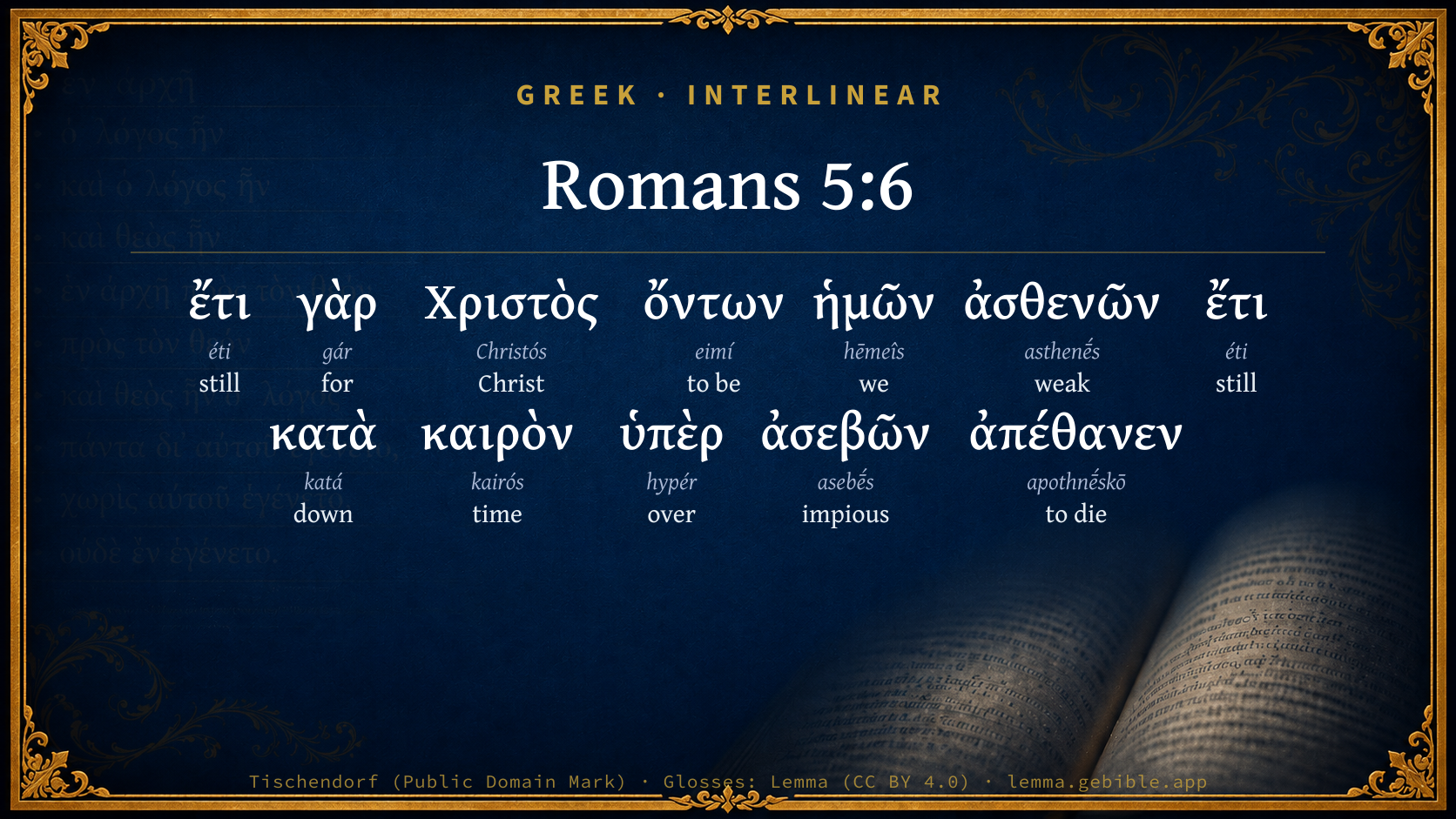
For while we were yet weak, at the right time Christ died for the ungodly.
Download a study sheet
One document with this verse’s original text, its word-by-word gloss line, the meaning frame, cross-references with their text, attributed commentary, and full source and license credits — printable, and it pastes into notes with its structure intact.
This verse Autodidact and up
A passage Seminary Student
Up to 50 verses in one chapter. A passage sheet keeps up to 6 commentary sources and 12 cross-references per verse, in the order this page ranks them, and says so on the sheet whenever that leaves anything out. Ask for a single verse and you get the Autodidact verse sheet above.
Everything on this page stays free to read, with no account — the sheet is a download of what is already on screen, not access to it.
Compare translations 3
The same verse in 3 English versions, stacked beneath the original-language interlinear above. Click any original word for its lexicon entry.
Each is an independent rendering of the whole verse — the interlinear is not word-aligned to these translations.
Highlighted words mark where these versions differ — a whole-verse word diff, not a word-by-word alignment.
-
World English Bible Public Domain
For while we were yet weak, at the right time Christ died for the ungodly.
-
King James Version Public Domain
For when we were yet without strength, in due time Christ died for the ungodly.
-
unfoldingWord Literal Text CC BY-SA 4.0
For we still being weak, yet at the right time Christ died on behalf of ungodly ones.
unfoldingWord Literal Text — © unfoldingWord, licensed CC BY-SA 4.0. Word-aligned USFM3 via Door43 (git.door43.org/unfoldingWord/en_ult).
Show all 19 translations
Every available English version of this verse, each an independent rendering of the whole verse.
-
World English Bible Public Domain
For while we were yet weak, at the right time Christ died for the ungodly.
-
Berean Standard Bible Public Domain
For at just the right time, while we were still powerless, Christ died for the ungodly.
-
Majority Standard Bible Public Domain
For at the right time, while we were still powerless, Christ died for the ungodly.
-
King James Version Public Domain
For when we were yet without strength, in due time Christ died for the ungodly.
-
American Standard Version (1901) Public Domain
For while we were yet weak, in due season Christ died for the ungodly.
-
Revised Version (1885) Public Domain
For while we were yet weak, in due season Christ died for the ungodly.
-
Geneva Bible (1599) Public Domain
For Christ, when we were yet of no strength, at his time died for the vngodly.
-
Douay-Rheims (1899) Public Domain
For why did Christ, when as yet we were weak, according to the time, die for the ungodly?
-
Young's Literal Translation Public Domain
For in our being still ailing, Christ in due time did die for the impious;
-
Literal Standard Version CC BY-SA 4.0
For in our being still ailing, Christ in due time died for the impious;
-
Unlocked Literal Bible CC BY-SA 4.0
For while we were still weak, at the right time Christ died for the ungodly.
-
unfoldingWord Literal Text CC BY-SA 4.0
For we still being weak, yet at the right time Christ died on behalf of ungodly ones.
-
Darby Bible Public Domain
for we being still without strength, in [the] due time Christ has died for [the] ungodly.
-
World Messianic Bible Public Domain
For while we were yet weak, at the right time Messiah died for the ungodly.
-
Webster's Bible Public Domain
For when we were yet without strength, in due time Christ died for the ungodly.
-
Free Bible Version CC BY-SA 4.0
When we were completely helpless, at just the right time Christ died for us ungodly people.
-
Bible in Basic English Public Domain
For when we were still without strength, at the right time Christ gave his life for evil-doers.
-
Text-Critical English NT CC BY 4.0
For when we were still weak, at the right time Christ died for the ungodly.
-
Tyndale New Testament (1534) Public Domain
For when we were yet weake accordynge to the tyme: Christ dyed for vs which were vngodly.
Literal Standard Version (2020), Covenant Press — licensed CC BY-SA 4.0. Text via the HelloAO Bible API (eBible.org). Unlocked Literal Bible (unfoldingWord) — licensed CC BY-SA 4.0. Text via the HelloAO Bible API (eBible.org). unfoldingWord Literal Text — © unfoldingWord, licensed CC BY-SA 4.0. Word-aligned USFM3 via Door43 (git.door43.org/unfoldingWord/en_ult). Free Bible Version, Dr. Jonathan Gallagher — licensed CC BY-SA 4.0. Text via the HelloAO Bible API (eBible.org).
Word by word
More ways to search: Search by grammar → Find every occurrence → Compare this word →
Practice this passage: Drill this verse → Learn its vocabulary →
- Appears 9× in the Greek New Testament
- First appears at Romans 4:5
- Part of Speech
- Adjective
- Case
- Genitive
- Number
- Plural
- Gender
- Masculine
Full Thayer's Definition
- ἔτι éti G2089 “still” Adverb
- γὰρ gár G1063 “for” Conjunction
- Χριστὸς Christós G5547 “Christ” Noun, Nominative, Singular, Masculine
- ὄντων eimí G1510 “to be” Verb, Present, Active, Participle, Genitive, Plural, Masculine
- ἡμῶν hēmeîs G2249 “we” Personal pronoun, 1st person, Genitive, Plural
- ἀσθενῶν asthenḗs G772 “weak” Adjective, Genitive, Plural, Masculine
- ἔτι éti G2089 “still” Adverb
- κατὰ katá G2596 “down” Preposition
- καιρὸν kairós G2540 “time” Noun, Accusative, Singular, Masculine
- ὑπὲρ hypér G5228 “over” Preposition
- ἀσεβῶν asebḗs G765 “impious” Adjective, Genitive, Plural, Masculine
- ἀπέθανεν apothnḗskō G599 “to die” Verb, Aorist, Active, Indicative, 3rd person, Singular
About this verse
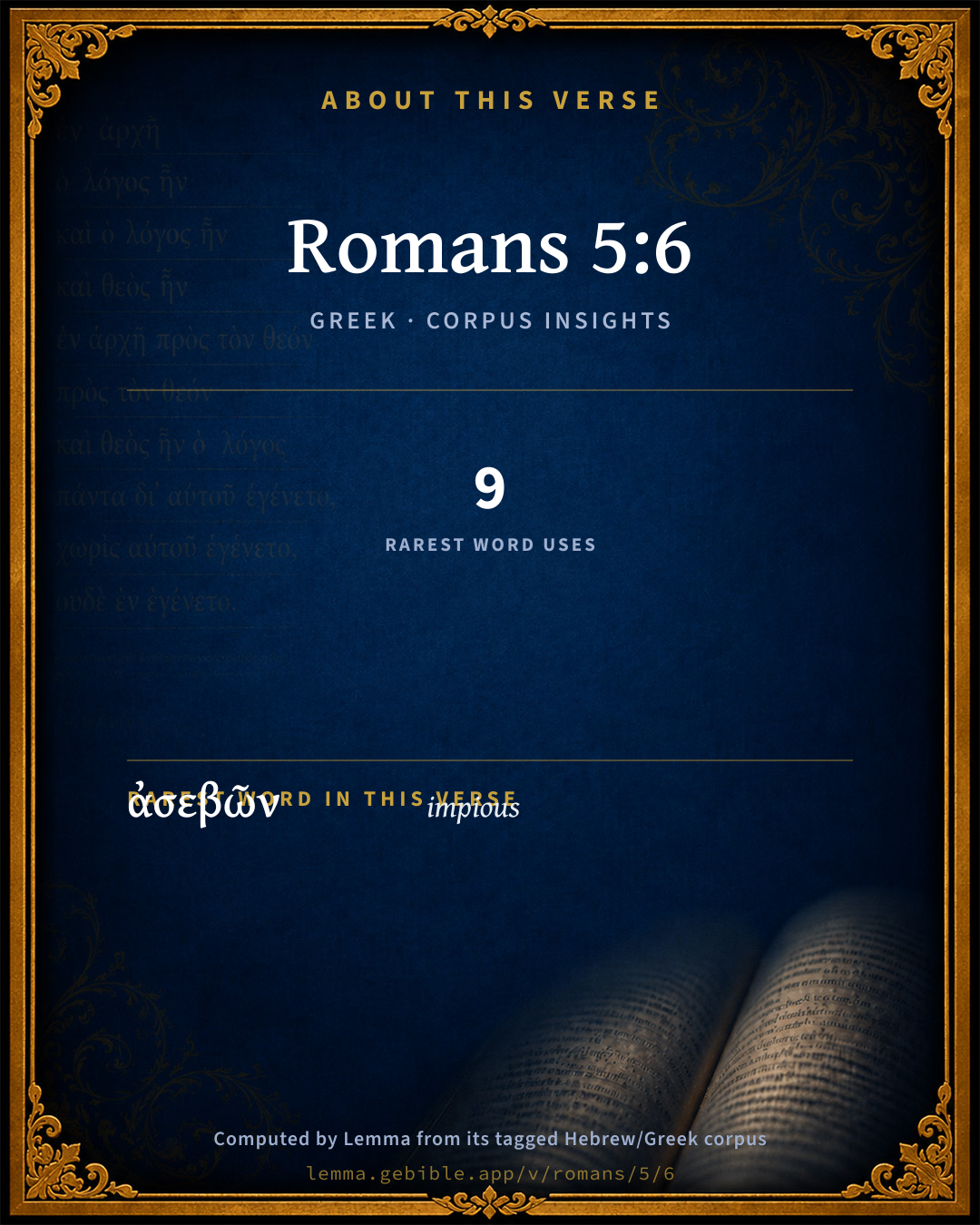
These counts appear in no published source. They are computed here, from the morphology-tagged text and Lemma’s own curated glosses. What Lemma adds →
- 12
- words
- 11
- distinct lemmas
- Pauline Epistles
- section
Cross-references
23Topical passages linked to Romans 5:6 in the Treasury of Scripture Knowledge — connected by theme and wording, ordered by reader-vote popularity; previews shown in the World English Bible.
- Ephesians 2:1–5 You were made alive when you were dead in transgressions and sins,
- Romans 5:8 But God commends his own love toward us, in that while we were yet sinners, Christ died for us.
- Colossians 2:13 You were dead through your trespasses and the uncircumcision of your flesh. He made you alive together with him, having forgiven us all our trespasses,
- Titus 3:3–5 For we were also once foolish, disobedient, deceived, serving various lusts and pleasures, living in malice and envy, hateful, and hating one another.
- Romans 5:10 For if, while we were enemies, we were reconciled to God through the death of his Son, much more, being reconciled, we will be saved by his life.
- Romans 4:25 who was delivered up for our trespasses, and was raised for our justification.
- Titus 2:12 instructing us to the intent that, denying ungodliness and worldly lusts, we would live soberly, righteously, and godly in this present world;
- Romans 4:5 But to him who doesn't work, but believes in him who justifies the ungodly, his faith is accounted for righteousness.
- Galatians 4:4 But when the fullness of the time came, God sent out his Son, born to a woman, born under the law,
- 1 Thessalonians 5:9 For God didn't appoint us to wrath, but to the obtaining of salvation through our Lord Jesus Christ,
- Hebrews 9:26 or else he must have suffered often since the foundation of the world. But now once at the end of the ages, he has been revealed to put away sin by the sacrifice of himself.
- 1 Timothy 1:9 as knowing this, that law is not made for a righteous man, but for the lawless and insubordinate, for the ungodly and sinners, for the unholy and profane, for murderers of fathers and murderers of mothers, for manslayers,
- 1 Peter 1:20 who was foreknown indeed before the foundation of the world, but was revealed at the end of times for your sake,
- Ezekiel 16:4–8 As for your birth, in the day you were born your navel was not cut, neither were you washed in water to cleanse you; you weren't salted at all, nor swaddled at all.
- 2 Peter 2:5–6 and didn't spare the ancient world, but preserved Noah with seven others, a preacher of righteousness, when he brought a flood on the world of the ungodly;
- Jude 1:4 For there are certain men who crept in secretly, even those who were long ago written about for this condemnation: ungodly men, turning the grace of our God into lasciviousness, and denying our only Master, God, and Lord, Jesus Christ.
- Jude 1:15 to execute judgment on all, and to convict all the ungodly of all their works of ungodliness which they have done in an ungodly way, and of all the hard things which ungodly sinners have spoken against him."
- Psalms 1:1 Blessed is the man who doesn't walk in the counsel of the wicked, Nor stand in the way of sinners, Nor sit in the seat of scoffers;
- Daniel 11:15 So the king of the north shall come, and cast up a mound, and take a well-fortified city: and the forces of the south shall not stand, neither his chosen people, neither shall there be any strength to stand.
- Romans 11:26 and so all Israel will be saved. Even as it is written, "There will come out of Zion the Deliverer, And he will turn away ungodliness from Jacob.
- 2 Peter 3:7 But the heavens that now are, and the earth, by the same word have been stored up for fire, being reserved against the day of judgment and destruction of ungodly men.
- Lamentations 1:6 From the daughter of Zion all her majesty is departed: Her princes are become like harts that find no pasture, They are gone without strength before the pursuer.
- Jude 1:18 They said to you that "In the last time there will be mockers, walking after their own ungodly lusts."
Cross-references courtesy of OpenBible.info (CC BY 4.0).
Where the printed editions differ
2 variantsPlaces in this verse where the major printed Greek editions disagree on the wording in a way that affects the translation — a comparison of editions, not a manuscript-by-manuscript collation. The editions are the modern critical texts (Nestlé-Aland 28/27, SBL, Westcott-Hort, Tregelles, Tyndale House) and the traditional texts behind the KJV (the Textus Receptus and the Byzantine/Majority text). It is not a claim about which reading is original.
-
Different wording
ἔτι
“Yet”
In NA28NA27TynSBLTregTRByz Not in WHεἴ (ei) 'if' occurs in a few manuscripts (WH) instead of ἔτι (eti) 'Yet' in older manuscripts (NA28+NA27+Tyn+SBL+Treg+TR+Byz)
-
Extra text
ἔτι
“still”
In NA28NA27TynSBLWHTreg Not in TRByzἔτι (eti) 'still' is only in older manuscripts (NA28+NA27+Tyn+SBL+WH+Treg)
Textual data: Translators Amalgamated Greek New Testament (STEPBible TAGNT) · CC BY 4.0.
Lesson kit
Teaching starters — assembled from the data on this page, not authored interpretation. Every prompt links to the verse data it draws on. Edit before teaching.
Romans, in the Pauline Epistles, opens this verse with 12 words (11 distinct Greek lemmas). Its most distinctive word is asebḗs (“impious”). A historical commentator’s framing appears above. Read the whole chapter for the surrounding context.
Discussion questions
- The word asebḗs carries the sense “impious.” How does it shape the verse?
- How does Romans 4:5, which shares the word «impious», read alongside this verse?
- What does the repetition of “still” (2× in this one verse) do in this verse?
- The translations on this page render this verse differently — a whole-verse word diff, not a word-by-word alignment. What might account for the different wordings?
- Compare how Matthew Henry's Commentary and The Cambridge Bible for Schools and Colleges read this verse. Where do they agree or differ?
Things to notice
- These translations choose different wording for 11 words in this verse.
- “still” occurs 2× in this single verse.
- 11 distinct Greek lemmas span 12 words in this verse.
Commentary
Notes on Romans 5:6 from classic Christian and Jewish commentators (each source and its license shown beneath its notes). The classic Christian expositions comment on the surrounding passage and are grouped to its opening verse, so a note may address several verses; the Jewish commentaries on the Tanakh (Rashi and others) are per-verse, so they appear only where the commentator wrote on this verse.
Lemma curates 59 commentaries, every one of them public domain or Creative Commons licensed, each selected and text-cleaned for this edition rather than reprinted as found. About our sources →
Matthew Henry's Commentary
Matthew Henry's Commentary on the Whole Bible (1708–1710) — public domain (CC PDM 1.0). Text via the HelloAO Bible API.
The Cambridge Bible for Schools and Colleges
gen. ed. J. J. S. Perowne
The Cambridge Bible for Schools and Colleges (gen. ed. J. J. S. Perowne; Cambridge University Press, 1878–1918) — public domain. Text from a community e-Sword module.
Albert Barnes' Notes on the Bible
Albert Barnes' Notes on the Bible (1834–1885) — public domain. Text from a community e-Sword/MySword module.
The Biblical Illustrator
Joseph S. Exell
The Biblical Illustrator, edited by Joseph S. Exell (c. 1880s–1900s) — public domain. Text from a community e-Sword module.
Joseph Benson's Commentary
Joseph Benson's Commentary on the Old and New Testaments (1811–1818) — public domain. Text from a community e-Sword module.
The Preacher's Complete Homiletical Commentary
Joseph S. Exell (gen. ed.)
The Preacher's Complete Homiletical Commentary (gen. ed. Joseph S. Exell; Funk & Wagnalls, c. 1892) — public domain (pre-1929). A full-Bible homiletical/sermon-outline anthology covering 65 of 66 books (2 John is absent from the source module). Text from a community e-Sword module.
Tyndale Open Study Notes
Tyndale Open Resources
Tyndale Open Study Notes — © Tyndale Open Resources, licensed CC BY-SA 4.0. Text via the HelloAO Bible API.
Bengel's Gnomon
Johann Albrecht Bengel
Bengel's Gnomon of the New Testament — English translation (T&T Clark, Edinburgh, 1860) — public domain. Text from a community e-Sword module.
Meyer's Critical & Exegetical Commentary
Heinrich August Wilhelm Meyer
Meyer — Critical and Exegetical Commentary on the New Testament — English translation by Peter Christie, edited by Frederick Crombie (T&T Clark, 1880) — public domain. Text from a community e-Sword module.
Expositor's Greek Testament
ed. W. Robertson Nicoll
The Expositor's Greek Testament, edited by W. Robertson Nicoll (1897–1910) — public domain. Text from a community e-Sword module.
Godet's Commentaries
Frédéric Louis Godet
Frédéric Louis Godet — Commentaries on Luke, John, Romans, and 1 Corinthians — English translation (T&T Clark, Edinburgh, 1870s–1890s) — public domain. Text from a community e-Sword module.
Hodge's Commentary on Romans, Ephesians & First Corinthians
Charles Hodge
Charles Hodge — Commentary on Romans (1835), First Corinthians (1857), and Ephesians (1856) — public domain. Text from a community e-Sword module.
Geneva Bible (1599)
Geneva Bible translators
Geneva Bible (1599) marginal notes — public domain. Text via Bolls.life.
Jamieson, Fausset & Brown
Robert Jamieson, A. R. Fausset & David Brown
Jamieson, Fausset & Brown — Commentary Critical and Explanatory on the Whole Bible (1871) — public domain (CC PDM 1.0). Text via the HelloAO Bible API.
Adam Clarke's Commentary
Adam Clarke's Commentary on the Bible (1810–1826) — public domain. Text from a community e-Sword/MySword module.
John Calvin's Commentaries
John Calvin's Commentaries (1540-1563) — public domain. Text from the Calvin Translation Society English edition (1840s-50s) via the Christian Classics Ethereal Library (ccel.org). Calvin's coverage is partial (roughly two-thirds of the Bible); uncommented books and verses are honest gaps, never fabricated. The 19th-century editor's footnotes and remarks are omitted so the notes are faithfully Calvin's own voice.
Ellicott's Commentary for English Readers
A Bible Commentary for English Readers, edited by Charles John Ellicott (1878–1897) — public domain. Text from a community e-Sword module.
John Gill's Exposition
John Gill's Exposition of the Whole Bible (1746–1763) — public domain (CC PDM 1.0). Text via the HelloAO Bible API.
Trapp's Complete Commentary
John Trapp
John Trapp, A Commentary or Exposition upon All the Books of the Old and New Testament (1647–1656) — public domain. Text from a community e-Sword module.
Haydock's Catholic Bible Commentary
George Leo Haydock (1774–1849), Haydock's Catholic Family Bible and Commentary, 1859 edition — public domain. Excludes Psalms (Douay-Rheims chapter numbering differs from Protestant) and Deuterocanonical books (Catholic canon only).
Matthew Poole's English Annotations
Matthew Poole's English Annotations on the Holy Bible (1683–1685) — public domain. Text from a community e-Sword/MySword module.
Whedon's Commentary on the Bible
Daniel D. Whedon
Daniel D. Whedon (gen. ed.), Commentary on the Old and New Testaments (1874–1909) — public domain. Text from a community e-Sword module.
The Pulpit Commentary
The Pulpit Commentary (1880–1919), ed. H.D.M. Spence-Jones & Joseph S. Exell — public domain. Text from a community e-Sword module.
John Wesley's Explanatory Notes
John Wesley, Explanatory Notes Upon the Whole Bible (1754–1765) — public domain. Text via the GEBible commentary corpus.
Burkitt's Expository Notes on the New Testament
William Burkitt
William Burkitt's Expository Notes on the New Testament (1700–1703) — public domain. Text from a community e-Sword module.
Godbey's Commentary on the New Testament
William B. Godbey
William B. Godbey, Commentary on the New Testament (1896–1900) — public domain. Text from a community e-Sword module.
McGarvey & Pendleton's Commentaries
J. W. McGarvey
J. W. McGarvey (with Philip Y. Pendleton), Commentaries on the New Testament (The Fourfold Gospel, 1914; Acts; and the epistles) — public domain. Text from a community e-Sword/MySword module.
The People's New Testament
B. W. Johnson
B. W. Johnson's The People's New Testament with Notes (1889–1891) — public domain. Electronic text from the Christian Classics Ethereal Library (CCEL) ThML edition.
unfoldingWord translationNotes
Door43 World Missions Community
unfoldingWord translationNotes — © Distant Shores Media and the Door43 World Missions Community, licensed CC BY-SA 4.0. Source: git.door43.org/Door43/en_tn.
Cambridge Greek Testament for Schools and Colleges
Cambridge Greek Testament for Schools and Colleges (Cambridge University Press, 1896; 21 vols, various authors incl. Carr, Maclear, Plummer, Farrar, Lumby, Moule, M. R. James, Simcox) — public domain. Text from a community e-Sword module.
Alford’s Greek Testament
Henry Alford
Henry Alford, The Greek Testament (1849–1861) — public domain. Text from a community e-Sword module.
International Critical Commentary
International Critical Commentary — older volumes (1896–1929), various authors — public domain. Text from a community e-Sword module.
Vincent's Word Studies in the New Testament
Marvin R. Vincent
Marvin R. Vincent, Word Studies in the New Testament (1887–1900) — public domain. Text from a community e-Sword/MySword module.