Hebrews 1:11

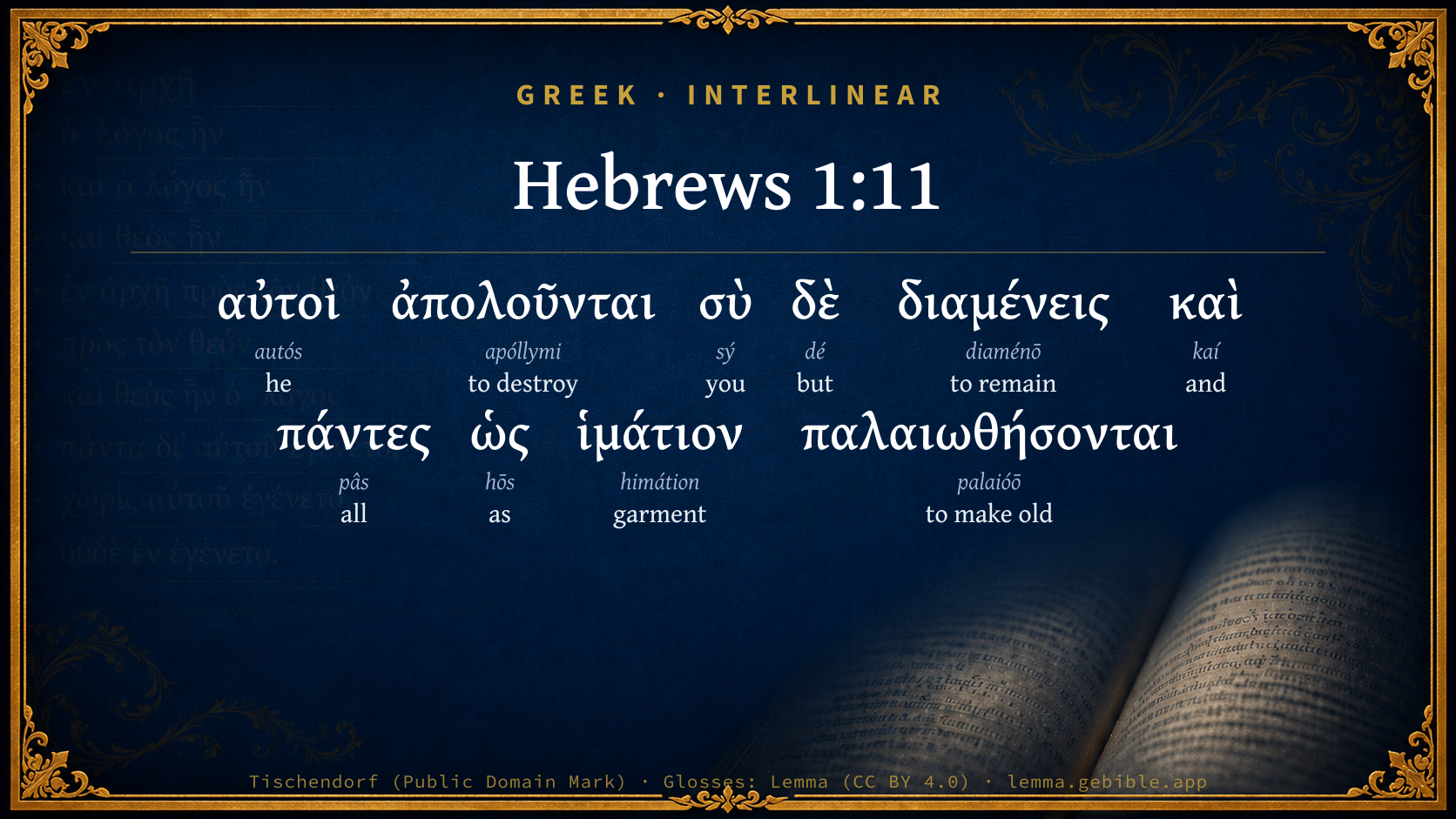
Greek (Tischendorf 8th ed.) Hebrews 1:11 appears in the Greek New Testament. The text above is from the Tischendorf 8th edition. Each word links to its Strong’s number and a concise gloss. Click any word for its full Thayer’s Greek Lexicon entry.
Download image
Cite this verse

Hebrews 1:11 (World English Bible). Public Domain. Lemma interlinear Bible study tool, https://lemma.gebible.app/v/hebrews/1/11.

Show BibTeX & RIS
BibTeX
RIS
English Translation
They will perish, but you continue. They all will grow old like a garment does.
World English Bible · Public Domain
Download a study sheet

One document with this verse’s original text, its word-by-word gloss line, the meaning frame, cross-references with their text, attributed commentary, and full source and license credits — printable, and it pastes into notes with its structure intact.

This verse Autodidact and up

Study sheet (.html) Plain text (.txt)

A passage Seminary Student

Up to 50 verses in one chapter. A passage sheet keeps up to 6 commentary sources and 12 cross-references per verse, in the order this page ranks them, and says so on the sheet whenever that leaves anything out. Ask for a single verse and you get the Autodidact verse sheet above.

Everything on this page stays free to read, with no account — the sheet is a download of what is already on screen, not access to it.

Want to remove ads? Support Godless Engineer
Compare translations 3

The same verse in 3 English versions, stacked beneath the original-language interlinear above. Click any original word for its lexicon entry.

Each is an independent rendering of the whole verse — the interlinear is not word-aligned to these translations.

Highlighted words mark where these versions differ — a whole-verse word diff, not a word-by-word alignment.

  • World English Bible Public Domain
    They will perish, but you continue. They all will grow old like a garment does.
  • King James Version Public Domain
    They shall perish; but thou remainest; and they all shall wax old as doth a garment;
  • unfoldingWord Literal Text CC BY-SA 4.0
    They themselves will perish, but you yourself will continue, and they will all wear out like a garment,

unfoldingWord Literal Text — © unfoldingWord, licensed CC BY-SA 4.0. Word-aligned USFM3 via Door43 (git.door43.org/unfoldingWord/en_ult).

Versions to compare (up to 4)

3 of 4 selected

Show all 19 translations

Every available English version of this verse, each an independent rendering of the whole verse.

  • World English Bible Public Domain
    They will perish, but you continue. They all will grow old like a garment does.
  • Berean Standard Bible Public Domain
    They will perish, but You remain; they will all wear out like a garment.
  • Majority Standard Bible Public Domain
    They will perish, but You remain; they will all wear out like a garment.
  • King James Version Public Domain
    They shall perish; but thou remainest; and they all shall wax old as doth a garment;
  • American Standard Version (1901) Public Domain
    They shall perish; but thou continuest: And they all shall wax old as doth a garment;
  • Revised Version (1885) Public Domain
    They shall perish; but thou continuest: And they all shall wax old as doth a garment;
  • Geneva Bible (1599) Public Domain
    They shall perish, but thou doest remaine: and they all shall waxe olde as doeth a garment.
  • Douay-Rheims (1899) Public Domain
    They shall perish, but thou shalt continue: and they shall all grow old as a garment.
  • Young's Literal Translation Public Domain
    these shall perish, and Thou dost remain, and all, as a garment, shall become old,
  • Literal Standard Version CC BY-SA 4.0
    These will perish, but You remain, || And all will become old as a garment,
  • Unlocked Literal Bible CC BY-SA 4.0
    They will perish, but you will continue. They will all wear out like a piece of clothing.
  • unfoldingWord Literal Text CC BY-SA 4.0
    They themselves will perish, but you yourself will continue, and they will all wear out like a garment,
  • Darby Bible Public Domain
    They shall perish, but *thou* continuest still; and they all shall grow old as a garment,
  • World Messianic Bible Public Domain
    They will perish, but you continue. They all will grow old like a garment does.
  • Webster's Bible Public Domain
    They shall perish; but thou remainest: and they all shall become old as doth a garment;
  • Free Bible Version CC BY-SA 4.0
    They will come to an end, but you will continue. They will wear out like clothes do,
  • Bible in Basic English Public Domain
    They will come to their end; but you are for ever; they will become old as a robe;
  • Text-Critical English NT CC BY 4.0
    They will perish, but yoʋ remain; they will all wear out like a garment.
  • Tyndale New Testament (1534) Public Domain
    They shall perisshe but thou shalt endure. They all shall wexe olde as doth a garment:

Literal Standard Version (2020), Covenant Press — licensed CC BY-SA 4.0. Text via the HelloAO Bible API (eBible.org). Unlocked Literal Bible (unfoldingWord) — licensed CC BY-SA 4.0. Text via the HelloAO Bible API (eBible.org). unfoldingWord Literal Text — © unfoldingWord, licensed CC BY-SA 4.0. Word-aligned USFM3 via Door43 (git.door43.org/unfoldingWord/en_ult). Free Bible Version, Dr. Jonathan Gallagher — licensed CC BY-SA 4.0. Text via the HelloAO Bible API (eBible.org).

Word by word

More ways to search: Search by grammar → Find every occurrence → Compare this word →

Practice this passage: Drill this verse → Learn its vocabulary →

About this verse

These counts appear in no published source. They are computed here, from the morphology-tagged text and Lemma’s own curated glosses. What Lemma adds →

10
words
10
distinct lemmas
General Epistles
section

Notable vocabulary

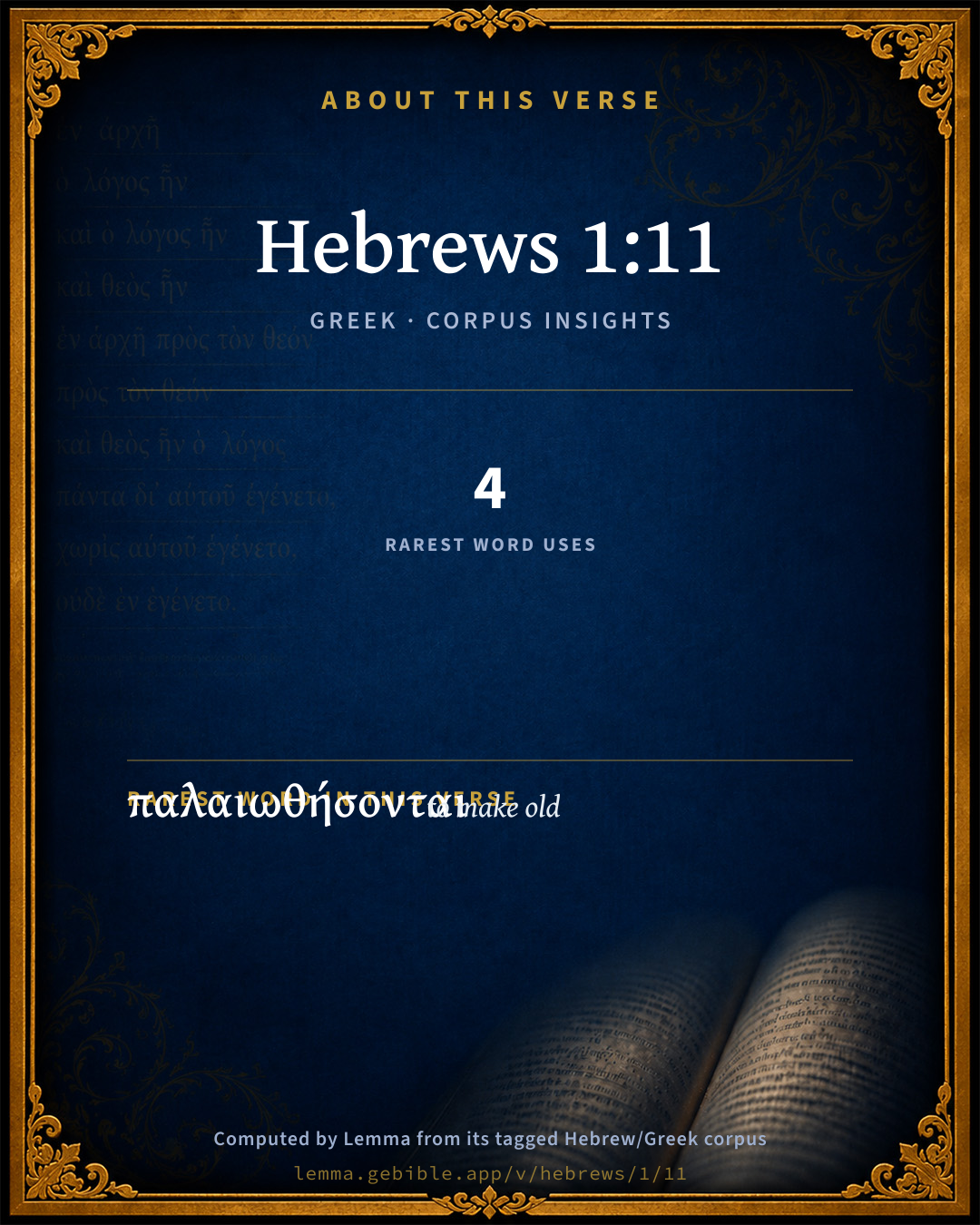
The rarest word here is παλαιωθήσονται to make old G3822 — appearing just 4 times in the whole Greek New Testament.

Shared distinctive vocabulary

παλαιωθήσονται to make old G3822 occurs in 3 verses of the Greek New Testament. Also found in:

Cross-references

20

Topical passages linked to Hebrews 1:11 in the Treasury of Scripture Knowledge — connected by theme and wording, ordered by reader-vote popularity; previews shown in the World English Bible.

  • Isaiah 51:6 Lift up your eyes to the heavens, and look on the earth beneath; for the heavens shall vanish away like smoke, and the earth shall wax old like a garment; and those who dwell therein shall die in like manner: but my salvation shall be forever, and my righteousness shall not be abolished.
  • Mark 13:31 Heaven and earth will pass away, but my words will not pass away.
  • Luke 21:33 Heaven and earth will pass away, but my words will by no means pass away.
  • Matthew 24:35 Heaven and earth will pass away, but my words will not pass away.
  • Isaiah 34:4 All the host of the sky shall be dissolved, and the heavens shall be rolled together as a scroll; and all their host shall fade away, as the leaf fades from off the vine, and as a fading [leaf] from the fig tree.
  • Revelation 21:1 I saw a new heaven and a new earth: for the first heaven and the first earth have passed away, and the sea is no more.
  • Psalms 10:16 Yahweh is King forever and ever! The nations will perish out of his land.
  • Psalms 90:2 Before the mountains were brought forth, Or ever you had formed the earth and the world, Even from everlasting to everlasting, you are God.
  • Isaiah 65:17 For, behold, I create new heavens and a new earth; and the former things shall not be remembered, nor come into mind.
  • Psalms 29:10 Yahweh sat enthroned at the Flood. Yes, Yahweh sits as King forever.
  • Isaiah 41:4 Who has worked and done it, calling the generations from the beginning? I, Yahweh, the first, and with the last, I am he.
  • Isaiah 50:9 Behold, the Lord Yahweh will help me; who is he who shall condemn me? Behold, all they shall wax old as a garment, the moth shall eat them up.
  • Hebrews 12:27 This phrase, "Yet once more," signifies the removing of those things that are shaken, as of things that have been made, that those things which are not shaken may remain.
  • 2 Peter 3:7–10 But the heavens that now are, and the earth, by the same word have been stored up for fire, being reserved against the day of judgment and destruction of ungodly men.
  • Revelation 1:11 saying, "What you see, write in a book and send to the seven assemblies: to Ephesus, Smyrna, Pergamum, Thyatira, Sardis, Philadelphia, and to Laodicea."
  • Revelation 2:8 "To the angel of the assembly in Smyrna write: "The first and the last, who was dead, and has come to life says these things:
  • Revelation 20:11 I saw a great white throne, and him who sat on it, from whose face the earth and the heaven fled away. There was found no place for them.
  • Isaiah 44:6 Thus says Yahweh, the King of Israel, and his Redeemer, Yahweh of Hosts: I am the first, and I am the last; and besides me there is no God.
  • Isaiah 51:8 For the moth shall eat them up like a garment, and the worm shall eat them like wool; but my righteousness shall be forever, and my salvation to all generations.
  • Revelation 1:17–18 When I saw him, I fell at his feet like a dead man. He laid his right hand on me, saying, "Don't be afraid. I am the first and the last,

Cross-references courtesy of OpenBible.info (CC BY 4.0).

Commentary

Notes on Hebrews 1:11 from classic Christian and Jewish commentators (each source and its license shown beneath its notes). The classic Christian expositions comment on the surrounding passage and are grouped to its opening verse, so a note may address several verses; the Jewish commentaries on the Tanakh (Rashi and others) are per-verse, so they appear only where the commentator wrote on this verse.

Lemma curates 59 commentaries, every one of them public domain or Creative Commons licensed, each selected and text-cleaned for this edition rather than reprinted as found. About our sources →

Bengel's Gnomon

Johann Albrecht Bengel

Heb 1:11. Αὐτοὶ, they) the earth and heaven.—ἀπολοῦνται, shall perish) There is the same word at Luk 5:37; Jas 1:11; 1Pe 1:7; 2Pe 3:6.

Bengel's Gnomon of the New Testament — English translation (T&T Clark, Edinburgh, 1860) — public domain. Text from a community e-Sword module.

Meyer's Critical & Exegetical Commentary

Heinrich August Wilhelm Meyer

Heb_1:11. Αὐτοί] refers back not to earth and heaven, Heb_1:10, taken together (Kuinoel, Stuart, Bloomfield, Delitzsch, Kurtz), but, as is evident from the following πάντες, and in particular from ἑλίξεις, Heb_1:12, only to οἱ οὐρανοί.

ἀπολοῦνται] shall perish. Comp. Isa_34:4; Isa_51:6; Isa_65:17; 2Pe_3:13; Rev_20:11; Rev_21:1.

σὺ δὲ διαμένεις] but Thou abidest for evermore (throughout all duration of time, διά). On account of the environment of futures, and because the future is used here in the Hebrew, Bleek, after the example of Luther, Cornelius a Lapide, Peirce, Bengel, Wetstein, alii, accentuates: διαμενεῖς. So also the Vulgate (permanebis). Hardly in the sense of the author. For, since he employed only the LXX., not the Hebrew original, he surely took σὺ δὲ διαμ. as a parallel member to σὺ δὲ ὁ αὐτὸς εἶ, Heb_1:12, consequently also construed the former as a present.

ὡς ἱμάτιον παλαιωθήσονται] will grow old like a garment, which by long use is worn out and laid aside, to be replaced by a new and better one. Comp. Isa_50:9; Isa_51:6; Sir_14:17.

Meyer — Critical and Exegetical Commentary on the New Testament — English translation by Peter Christie, edited by Frederick Crombie (T&T Clark, 1880) — public domain. Text from a community e-Sword module.

Jamieson, Fausset & Brown

Robert Jamieson, A. R. Fausset & David Brown

They--The earth and the heavens in their present state and form "shall perish" (Heb 12:26-27; Pe2 3:13). "Perish" does not mean annihilation; just as it did not mean so in the case of "the world that being overflowed with water, perished" under Noah (Pe2 3:6). The covenant of the possession of the earth was renewed with Noah and his seed on the renovated earth. So it shall be after the perishing by fire (Pe2 3:12-13).

remainest--through (so the Greek) all changes.

as . . . a garment-- (Isa 51:6).

Jamieson, Fausset & Brown — Commentary Critical and Explanatory on the Whole Bible (1871) — public domain (CC PDM 1.0). Text via the HelloAO Bible API.

Adam Clarke's Commentary

Verse 11. They shall perish] Permanently fixed as they seem to be, a time shall come when they shall be dissolved, and afterward new heavens and a new earth be formed, in which righteousness alone shall dwell. See 1Pet 3:10-13.

Shall wax old as doth a garment] As a garment by long using becomes unfit to be longer used, so shall all visible things; they shall wear old, and wear out; and hence the necessity of their being renewed. It is remarkable that our word world is a contraction of wear old; a term by which our ancestors expressed the sentiment contained in this verse. That the word was thus compounded, and that it had this sense in our language, may be proved from the most competent and indisputable witnesses. It was formerly written [Anglo-Saxon] weorold, and [Anglo-Saxon] wereld. This etymology is finely alluded to by our excellent poet, Spencer, when describing the primitive age of innocence, succeeded by the age of depravity: -

"The lion there did with the lambe consort,

And eke the dove sat by the faulcon's side;

Ne each of other feared fraude or tort,

But did in safe security abide,

Withouten perill of the stronger pride:

But when the WORLD woxe old, it woxe warre old,

Whereof it hight, and having shortly tride

The trains of wit, in wickednesse woxe bold,

And dared of all sinnes, the secrets to unfold."

Even the heathen poets are full of such allusions. See Horace, Carm. lib. iii., od. 6; Virgil, AEn. viii., ver. 324.

Thou remainest] Instead of διαμενεις, some good MSS. read διαμενεις, the first, without the circumflex, being the present tense of the indicative mood; the latter, with the circumflex, being the future-thou shalt remain. The difference between these two readings is of little importance.

Adam Clarke's Commentary on the Bible (1810–1826) — public domain. Text from a community e-Sword/MySword module.

Ellicott's Commentary for English Readers

(11) And they all . . .—Both the earth and the heavens: see Isa_34:4, “The heavens shall be rolled together as a scroll;” and Isa_51:6, “The earth shall wax old like a garment.”

A Bible Commentary for English Readers, edited by Charles John Ellicott (1878–1897) — public domain. Text from a community e-Sword module.

The Cambridge Bible for Schools and Colleges

gen. ed. J. J. S. Perowne

11. They shall perish] Isa_34:4, &c.; 2Pe_3:12; Rev_21:1. remainest] The verb means “abidest through all times.”

as doth a garment] A common Scripture metaphor. Isa_50:9, &c.

The Cambridge Bible for Schools and Colleges (gen. ed. J. J. S. Perowne; Cambridge University Press, 1878–1918) — public domain. Text from a community e-Sword module.

John Gill's Exposition

They shall perish,.... That is, the heavens and the earth; not as to the substance of them, but as to the quality of them; the present form and fashion of them shall pass away; the curse will be removed from them, and they will be renewed and purified, but the substance of them will continue; otherwise there would be no place, either for the righteous or the wicked,

But thou remainest; without any change or alteration, neither in his natures, divine or human, as God or man, nor in his office as Mediator; as a priest, he has an unchangeable priesthood, and ever lives to make intercession; as a King, his kingdom is an everlasting one, and of it there will be no end; and as a prophet, he will be the everlasting light, of his people.

They all shall wax old as doth a garment; garments in time wax old, and lose their beauty and usefulness, unless when a miracle is wrought, as in the case of the children of Israel in the wilderness. Now the heavens, and the light thereof, are as a garment and a curtain, Psa 104:2 and these, together with the earth, will in time come to their end of usefulness, in the present form of them; see Isa 51:6.

John Gill's Exposition of the Whole Bible (1746–1763) — public domain (CC PDM 1.0). Text via the HelloAO Bible API.

Trapp's Complete Commentary

John Trapp

11 They shall perish; but thou remainest; and they all shall wax old as doth a garment;

Ver. 11. They shall perish] The visible heavens are defiled with man’s sin, and shall therefore be purged by the last fire, as the vessels that held the sin offering were to pass the fire.

They shall all wax old] {See Trapp on "Rom 8:22"}

John Trapp, A Commentary or Exposition upon All the Books of the Old and New Testament (1647–1656) — public domain. Text from a community e-Sword module.

Albert Barnes' Notes on the Bible

They shall perish - That is, the heavens and the earth. They shall pass away; or they shall be destroyed. Probably no more is meant by the phrase here, than that important changes will take place in them, or than that they will change their form. Still it is not possible to foresee what changes may yet take place in the heavenly bodies, or to say that the present universe may not at some period be destroyed, and be succeeded by another creation still more magnificent. He that created the universe by a word, can destroy it by a word and he that formed the present frame of nature can cause it to be succeeded by another not less wonderful and glorious. The Scriptures seem to hold out the idea that the present frame of the universe shall be destroyed; see 2Pe 3:10-13; Mat 24:35. “But thou remainest.” Thou shalt not die or be destroyed. What a sublime thought! The idea is, that though the heavens and earth should suddenly disappear, or though they should gradually wear out and become extinct, yet there is one infinite being who remains unaffected and unchanged.

Nothing can reach or disturb him. All these changes shall take place under his direction, and by his command; see Rev 20:11. Let us not be alarmed then at any revolution. Let us not fear though we should see the heavens rolled up as a scroll, and the stars falling from their places. God, the Creator and the Redeemer, presides over all. He is unchanged. He ever lives; and though the universe should pass away, it will be only at his bidding, and under his direction. “And they all shall wax old.” Shall “grow” or become old. The word “wax” is an Old Saxon word, meaning to grow, or increase, or become. The heavens here are compared to a garment, meaning that as that grows old and decays, so it will be with the heavens and the earth. The language is evidently figurative; and yet who can tell how much literal truth there may be couched under it? Is it absurd to suppose that that sun which daily sends forth so many countless millions of beams of light over the universe, may in a course of ages become diminished in its splendor, and shine with feeble lustre? Can there be constant exhaustion, a constant burning like that, and yet no tendency to decay at some far distant period? Not unless the material for its splendor shall be supplied from the boundless resources of the Great Source of Light - God; and when he shall choose to withhold it, even that glorious sun must be dimmed of its splendor, and shine with enfeebled beams.

Albert Barnes' Notes on the Bible (1834–1885) — public domain. Text from a community e-Sword/MySword module.

Matthew Poole's English Annotations

They shall perish; the heavens themselves instanced in, as containing the most excellent part of the creation, (such as the Gentile philosophy esteemed incorruptible), are mutable, as by the various changes, not only in the airy part of it, but in the ethereal, doth appear: the glorious lights in it have their spots and rusts, as the sun itself, both increasing and diminishing upon them, and so as to their present, natural frame, are changeable, perishable, and dissolvable, Isa 51:6; Mat 24:35.

But thou remainest; but the Son Jehovah is unchangeable, hath a stedfast being, such as never loseth its state, no term is set for the ending of him. His immutability proves his Deity.

Remainest is an expression of present time, denoting constant abiding. He was before, in, and after all ages immutable, Lam 5:19.

Jesus Christ the same yesterday, and to-day, and for ever, Heb 13:8.

And they all shall wax old as doth a garment: the antiquation of a garment is a metaphor borrowed, to show the corruptibility of the heavens. A garment wears and decayeth with use in tract of time, it changeth its fashion, is another thing as to its matter and form: so will the heavens, as to their form and face, decay, they are gradually coming to an end as to what they are now, 2Pe 3:7,10.

That which decayeth and waxeth old is ready to vanish away, Heb 8:13; so these heavens do.

Matthew Poole's English Annotations on the Holy Bible (1683–1685) — public domain. Text from a community e-Sword/MySword module.

Whedon's Commentary on the Bible

Daniel D. Whedon

11. They shall perish—They shall change from one form or system to another, the old form disappearing. Compare Isa_34:4; Isa_5:6; Isa_6:11; 2Pe_3:12-13; Rev_20:11. Science assumes matter to be indestructible; higher truth holds it to be in itself phenomenal, and indestructible only as it is sustained by underlying divine power.

Thou remainest—The Greek word expressively means, thou art permanent through; that is, through all the changes of phenomena and systems.

Daniel D. Whedon (gen. ed.), Commentary on the Old and New Testaments (1874–1909) — public domain. Text from a community e-Sword module.

Godbey's Commentary on the New Testament

William B. Godbey

11. “These will perish,” i.e. they will cease to exist in their present form; they will undergo revolutions, transformations and renovations. “All these will grow old like a garment.” The earth is rapidly wearing out and washing away into the sea, and losing its pristine fertility, significant of the fact that we are fast approaching the end of the present order of things.

William B. Godbey, Commentary on the New Testament (1896–1900) — public domain. Text from a community e-Sword module.

The People's New Testament

B. W. Johnson

11. They shall perish. All created things shall grow old and pass away.

B. W. Johnson's The People's New Testament with Notes (1889–1891) — public domain. Electronic text from the Christian Classics Ethereal Library (CCEL) ThML edition.

Cambridge Greek Testament for Schools and Colleges

11. αὐτοὶ ἀπολοῦνται. Isa 34:4, &c.; 2Pe 3:12; Rev 21:1.

διαμένεις, “abidest through all times.” This, and not the future διαμενεῖς, is the right reading, for it is parallel to σὺ δὲ ὁ αὐτὸς εἶ. Διαμένειν means to abide through all changes.

ὡσεὶ περιβόλαιον. ὡς ἱμάτιον is a common Scripture metaphor. Isa 50:9, &c.

Cambridge Greek Testament for Schools and Colleges (Cambridge University Press, 1896; 21 vols, various authors incl. Carr, Maclear, Plummer, Farrar, Lumby, Moule, M. R. James, Simcox) — public domain. Text from a community e-Sword module.

Alford’s Greek Testament

Henry Alford

11.] They (seems most naturally to refer to οί οὐρανοί immediately preceding. There is no reason in the Psalm why the pronoun should not represent both antecedents, the heavens and the earth. Here, however, the subsequent context seems to determine the application to be only to the heavens: for to them only can be referred the following image, ὡσεὶ περιβόλαιον ἑλίξεις αὐτούς) shall perish (as far as concerns their present state, cf. ἀλλαγήσονται below. ἐδήλωσε καὶ τῆς κτίσεως τὴν ἐπὶ τὸ κρεῖττον μεταβολὴν ἀπʼ αὐτοῦ γεννησομένην, αὐτοῦ δὲ τὸ ἄναρχον καὶ ἀνώλεθρον. Thdrt. On this change, see the opinions of the Fathers in Suicer, vol. ii. pp. 151-2, 365, and 520 b), but thou remainest (Bleek prefers the fut. διαμενεῖς, see var. readd., on the ground of the verbs being all future in the Heb. text. But perhaps the consideration alleged by Lünemann, that the Writer, using only the LXX, seems to place σὺ δὲ διαμένεις and σὺ δὲ ὁ αὐτὸς εἶ as parallel clauses, is of more weight than the other. De Wette, on the Ps., renders the Hebrew verbs present: Dieselben vergehen, doch du bestehest. διαμένω, as in reff. and Ps. 118:90, ἐθεμελίωσας τὴν γῆν καὶ διαμένει. The preposition gives the sense of endurance through all changes): and they all shall wax old as a garment (see besides reff. Isa 51:6, ἡ δὲ γῆ ὡς ἱμάτιον παλαιωθήσεται: ib. 50:9; and Sir. 14:17, πᾶσα σὰρξ ὡς ἱμάτιον παλαιοῦται), and as a mantle (περιβόλαιον (reff.) is a word of unusual occurrence, found principally in the later classics; but also in Eurip. Herc. Fur. 549, θανάτου περιβόλαιʼ ἀνήμμεθα, and 1269, σαρκὸς περιβόλαια ἡβῶντα. It, as περιβολή, Gen 49:11, signifies any enveloping, enwrapping garment) shalt thou fold them up (the Heb. here and apparently some copies of the LXX have the same verb as below: תַּחֲלִיפֵם וִיַחֲלֹפוּ,—ἀλλάξεις αὐτοὺς καὶ ἀλλαγήσονται,—“thou shalt change them, and they shall be changed.” See also var. readd. here. LXX-A (not F.), with which Bא agree, reads as our text: and there can be little doubt that the Writer of this Epistle followed that text as usual. Grot. thinks ἑλίξεις has come into the Greek text from ref. Isa., ἑλιγήσεται ὁ οὐρανὸς ὡς βιβλίον. See also ref. Rev.), and they shall be changed (viz. as a mantle is folded up to be put away when a fresh one is about to be put on. Bleek quotes, as illustrating the idea, Philo de Profug. § 20, vol. i. p. 562, ἐνδύεται δὲ ὁ μὲν πρεσβύτατος τοῦ ὄντος λόγος ὡς ἐσθῆτα τὸν κόσμον· γῆν γὰρ καὶ ὓδωρ καὶ ἀέρα καὶ πῦρ κ. τὰ ἐκ τούτων ἐπαμπίσχεται): but Thou art the same (Heb. וְאַתָּה הוּא, “and Thou art He:” viz. He, which Thou hast ever been: cf. Isa 46:4 Heb. and E. V. Bleek compares Philo, de Profug. § 11, p. 554: ἥλιος γὰρ οὐκ ἀλλαττόμενος ὁ αὐτός ἐστιν ἀεὶ κ.τ.λ.), and thy years shall not fail (Heb., “Thy years end not,” are never completed: so LXX render the same verb תָּמַם by ἐκλείπειν, Ps. 103:35: 1Ki 16:11:4 Kings 7:13, &c.). The account to be given of Psa 102 seems to be as follows: according to its title it is “a prayer of the afflicted, when he is overwhelmed, and poureth out his complaint before the Lord.” It was probably written during the Babylonian exile (cf. vv. 14, 15) by one who “waited for the consolation of Israel.” That consolation was to be found only in Israel’s covenant God, and the Messiah Israel’s deliverer. And the trust of Israel in this her Deliverer was ever directed to the comfort of her sons under the immediate trouble of the time, be that what it might. As generations went on, more and more was revealed of the Messiah’s office and work, and the hearts of God’s people entered deeper and deeper into the consolation to be derived from the hope of His coming. Here then we have this sorrowing one casting himself on the mercy of the great Deliverer, and extolling His faithfulness and firmness over, and as distinguished from, all the works of His hands. To apply then these words to the Redeemer, is to use them in their sense of strictest propriety. See Delitzsch’s note, where the whole matter is discussed.

Henry Alford, The Greek Testament (1849–1861) — public domain. Text from a community e-Sword module.

Vincent's Word Studies in the New Testament

Marvin R. Vincent

They [αυτοι] . The heavens : not heaven and earth.

Remainest [διαμενεις] . Note the present tense : not shalt remain. Permanency is the characteristic of God in the absolute and eternal present.

Marvin R. Vincent, Word Studies in the New Testament (1887–1900) — public domain. Text from a community e-Sword/MySword module.

Westcott on Hebrews & the Epistles of John

Brooke Foss Westcott

11. αὐτοί] The heavens are taken an representing the whole visible universe.

drodvveras} The idea, as it is afterwards developed (xii. 26 ff), is of change, transfiguration, and not of annihilation: Ia li 6, 16; lxv. 17; Ixvi, 22; 2 Pot. ili. 13; Apoc xx. 11. δημιονργίας guléaro, τὴν μετασχημάτισιν τοῦ κόσμου, ἀλλαγήσονται γὰρ πάντα ἀπὸ τῆς φθορᾶς εἰς ἀφθαρσίαν.

διαμένει] Latt. permanedis (δια- - μενεῖ) The present is more expressive. The compound marks continuance throughout some period or crisis suggested by the context: Luke i

Esech. xxvii. 7. Comp. 1 Cor. xi. 15. Al€as}] Tho substitution of this word for thenatural rendering ἀλλάξεις may have been due to a reference to Is. xxxiv. 4 dAcyjcerat ὁ οὐρανὸς ds βιβλίον. In tho original tho verb is

repeated (35°!) ὈΒῬΠΡΝ.

ὁ avrés] The original is simply ‘Thou art Ie.’ Comp. Is. xli. 4; xliii. 10; xlvi. 4; xviii. 12; Deut. xxxii. 39 (ἐγώ elps).

Sco ch. xiii. 8 note.

(4) 13,14. The superior dignity of the Son as seated in Royal Majesty assured of triumph (‘having made purification...He sat down...’).

Tho comparison of the Son with angels is completed by the development of the idea contained in the fact of the Session of the Son at the right hand of the Father. This idea is conveyed by tho opening words of Ps. cx. and is spread throughout the New Testament: Matt. xxii. 23 ff. and parallels; Acts ii. 34 f. See also c. x. 13; 1 Cor. xv. 25; 1 Pot. iii. 22. The

Psalm (cx.) is quoted again coc. v. 6; vil. 17, 21.

13 But of which of the angels hath

He said at any time

Sit on My right hand,

Until I make Thine enemies the footstool of Thy feet?

uAre they not all ministering spirits sent forth unto service for the sake of them that shall inherit salvation ἢ .

Brooke Foss Westcott (1825–1901), The Epistle to the Hebrews (1889) and The Epistles of St John (1883) — public domain (pre-1929). Text recovered from Internet Archive / Google Books OCR scans. Westcott’s Gospel of John commentary is not included (its OCR lost the chapter running-heads required for reliable verse-keying). Some Greek quoted in the Hebrews volume is imperfectly rendered by the OCR.

Lesson kit

Teaching starters — assembled from the data on this page, not authored interpretation. Every prompt links to the verse data it draws on. Edit before teaching.

Hebrews, in the General Epistles, opens this verse with 10 words (10 distinct Greek lemmas). Its most distinctive word is palaióō (“to make old”). A historical commentator’s framing appears above. Read the whole chapter for the surrounding context.

Discussion questions

  1. What does “to make old” (palaióō) contribute to the verse as a whole?
  2. How does Luke 12:33, which shares the word «to make old», read alongside this verse?
  3. These translations render this verse differently. What is at stake in choosing one wording over another?
  4. Compare how Bengel's Gnomon and Meyer's Critical & Exegetical Commentary read this verse. Where do they agree or differ?

Things to notice

Reading settings

Reading text

Shown beneath each verse's original-language words.

Old Testament
Old Testament edition

Read the OT as the Masoretic Hebrew (MT) or the Greek Septuagint (LXX).

English shown for the Greek Septuagint (in the Hebrew ↔ Greek comparison).

Comparing translations? Open the Compare panel on any verse page to stack up to four side by side.