

Hebrews 12:15
Greek (Tischendorf 8th ed.) Hebrews 12:15 appears in the Greek New Testament. The text above is from the Tischendorf 8th edition. Each word links to its Strong’s number and a concise gloss. Click any word for its full Thayer’s Greek Lexicon entry.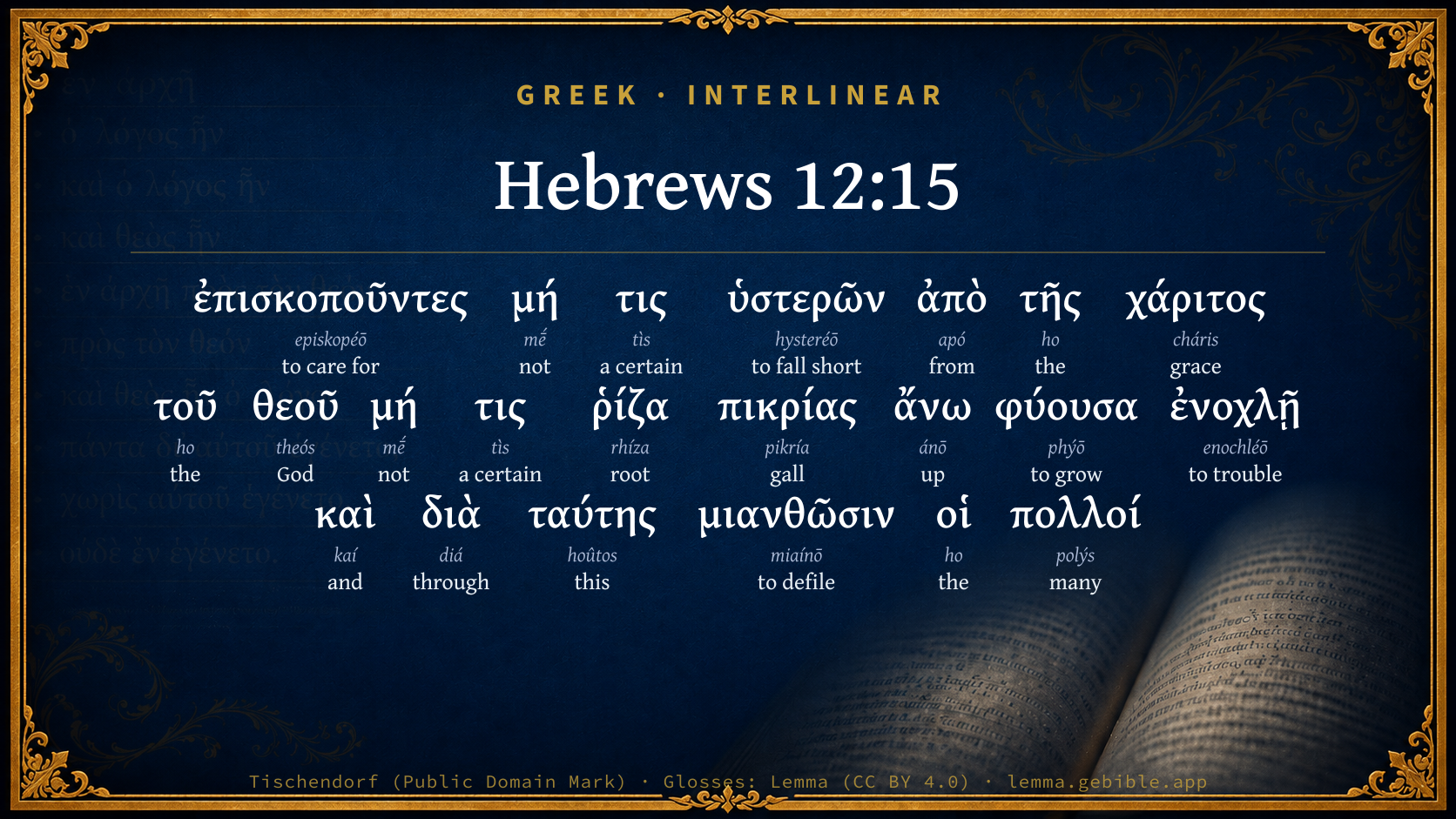
looking carefully lest there be any man who falls short of the grace of God; lest any root of bitterness springing up trouble you, and thereby the many be defiled;
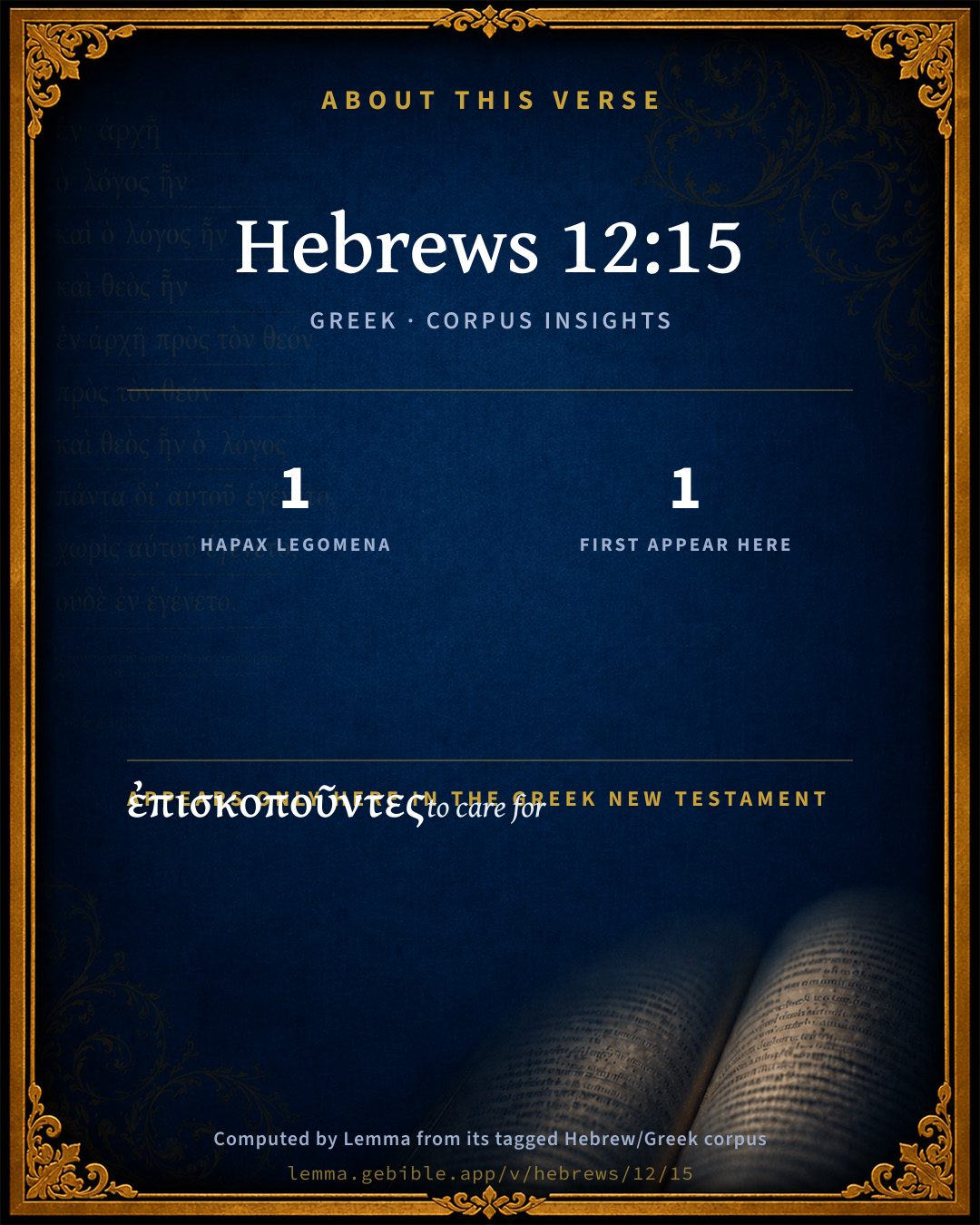
- 1 hapax legomenon — only here in the Greek New Testament
- 1 first appearance in the Greek New Testament
Download a study sheet
One document with this verse’s original text, its word-by-word gloss line, the meaning frame, cross-references with their text, attributed commentary, and full source and license credits — printable, and it pastes into notes with its structure intact.
This verse Autodidact and up
A passage Seminary Student
Up to 50 verses in one chapter. A passage sheet keeps up to 6 commentary sources and 12 cross-references per verse, in the order this page ranks them, and says so on the sheet whenever that leaves anything out. Ask for a single verse and you get the Autodidact verse sheet above.
Everything on this page stays free to read, with no account — the sheet is a download of what is already on screen, not access to it.
Compare translations 3
The same verse in 3 English versions, stacked beneath the original-language interlinear above. Click any original word for its lexicon entry.
Each is an independent rendering of the whole verse — the interlinear is not word-aligned to these translations.
Highlighted words mark where these versions differ — a whole-verse word diff, not a word-by-word alignment.
-
World English Bible Public Domain
looking carefully lest there be any man who falls short of the grace of God; lest any root of bitterness springing up trouble you, and thereby the many be defiled;
-
King James Version Public Domain
Looking diligently lest any man fail of the grace of God; lest any root of bitterness springing up trouble you, and thereby many be defiled;
-
unfoldingWord Literal Text CC BY-SA 4.0
carefully watching that no one is falling short from the grace of God, not any root of bitterness is growing up to cause trouble, and by this many might become defiled,
unfoldingWord Literal Text — © unfoldingWord, licensed CC BY-SA 4.0. Word-aligned USFM3 via Door43 (git.door43.org/unfoldingWord/en_ult).
Show all 19 translations
Every available English version of this verse, each an independent rendering of the whole verse.
-
World English Bible Public Domain
looking carefully lest there be any man who falls short of the grace of God; lest any root of bitterness springing up trouble you, and thereby the many be defiled;
-
Berean Standard Bible Public Domain
See to it that no one falls short of the grace of God, and that no root of bitterness springs up to cause trouble and defile many.
-
Majority Standard Bible Public Domain
See to it that no one falls short of the grace of God, and that no root of bitterness springs up to cause trouble and defile many.
-
King James Version Public Domain
Looking diligently lest any man fail of the grace of God; lest any root of bitterness springing up trouble you, and thereby many be defiled;
-
American Standard Version (1901) Public Domain
looking carefully lest `there be' any man that falleth short of the grace of God; lest any root of bitterness springing up trouble `you', and thereby the many be defiled;
-
Revised Version (1885) Public Domain
looking carefully lest there be any man that falleth short of the grace of God; lest any root of bitterness springing up trouble you, and thereby the many be defiled;
-
Geneva Bible (1599) Public Domain
Take heede, that no man fall away from the grace of God: let no roote of bitternes spring vp and trouble you, lest thereby many be defiled.
-
Douay-Rheims (1899) Public Domain
Looking diligently, lest any man be wanting to the grace of God; lest any root of bitterness springing up do hinder, and by it many be defiled.
-
Young's Literal Translation Public Domain
looking diligently over lest any one be failing of the grace of God, lest any root of bitterness springing up may give trouble, and through this many may be defiled;
-
Literal Standard Version CC BY-SA 4.0
observing lest anyone be failing of the grace of God, lest any root of bitterness springing up may give trouble, and through this many may be defiled;
-
Unlocked Literal Bible CC BY-SA 4.0
Be careful so that no one lacks God's grace, and that no root of bitterness grows up to cause trouble, so that many do not become polluted by it.
-
unfoldingWord Literal Text CC BY-SA 4.0
carefully watching that no one is falling short from the grace of God, not any root of bitterness is growing up to cause trouble, and by this many might become defiled,
-
Darby Bible Public Domain
watching lest [there be] any one who lacks the grace of God; lest any root of bitterness springing up trouble [you], and many be defiled by it;
-
World Messianic Bible Public Domain
looking carefully lest there be any man who falls short of the grace of God, lest any root of bitterness springing up trouble you and many be defiled by it,
-
Webster's Bible Public Domain
Looking diligently, lest any man fail of the grace of God; lest any root of bitterness springing up, trouble you, and by it many be defiled;
-
Free Bible Version CC BY-SA 4.0
Make sure that none of you lack God's grace, in case some cause of bitterness arises to give trouble and end up corrupting many of you.
-
Bible in Basic English Public Domain
Looking with care to see that no man among you in his behaviour comes short of the grace of God; for fear that some bitter root may come up to be a trouble to you, and that some of you may be made unclean by it;
-
Text-Critical English NT CC BY 4.0
Make sure no one falls short of the grace of God and that no root of bitterness springs up and causes trouble, which would result in many becoming defiled.
-
Tyndale New Testament (1534) Public Domain
And looke to that no man be destitute of the grace of God and that no rote of bitternes springe vp and trouble and therby many be defiled:
Literal Standard Version (2020), Covenant Press — licensed CC BY-SA 4.0. Text via the HelloAO Bible API (eBible.org). Unlocked Literal Bible (unfoldingWord) — licensed CC BY-SA 4.0. Text via the HelloAO Bible API (eBible.org). unfoldingWord Literal Text — © unfoldingWord, licensed CC BY-SA 4.0. Word-aligned USFM3 via Door43 (git.door43.org/unfoldingWord/en_ult). Free Bible Version, Dr. Jonathan Gallagher — licensed CC BY-SA 4.0. Text via the HelloAO Bible API (eBible.org).
Word by word
More ways to search: Search by grammar → Find every occurrence → Compare this word →
Practice this passage: Drill this verse → Learn its vocabulary →
- Appears 1× in the Greek New Testament
- First appears here
- Part of Speech
- Verb
- Tense
- Present
- Voice
- Active
- Mood
- Participle
- Case
- Nominative
- Number
- Plural
- Gender
- Masculine
Full Thayer's Definition
- ἐπισκοποῦντες episkopéō G1983 “to care for” Verb, Present, Active, Participle, Nominative, Plural, Masculine
- μή mḗ G3361 “not” Particle, Negative
- τις tìs G5100 “a certain” Indefinite pronoun, Nominative, Singular, Masculine
- ὑστερῶν hysteréō G5302 “to fall short” Verb, Present, Active, Participle, Nominative, Singular, Masculine
- ἀπὸ apó G575 “from” Preposition
- τῆς ho G3588 “the” Article, Genitive, Singular, Feminine
- χάριτος cháris G5485 “grace” Noun, Genitive, Singular, Feminine
- τοῦ ho G3588 “the” Article, Genitive, Singular, Masculine
- θεοῦ theós G2316 “God” Noun, Genitive, Singular, Masculine
- μή mḗ G3361 “not” Particle, Negative
- τις tìs G5100 “a certain” Indefinite pronoun, Nominative, Singular, Feminine
- ῥίζα rhíza G4491 “root” Noun, Nominative, Singular, Feminine
- πικρίας pikría G4088 “gall” Noun, Genitive, Singular, Feminine
- ἄνω ánō G507 “up” Adverb
- φύουσα phýō G5453 “to grow” Verb, Present, Active, Participle, Nominative, Singular, Feminine
- ἐνοχλῇ enochléō G1776 “to trouble” Verb, Present, Active, Subjunctive, 3rd person, Singular
- καὶ kaí G2532 “and” Conjunction
- διὰ diá G1223 “through” Preposition
- ταύτης hoûtos G3778 “this” Demonstrative pronoun, Genitive, Singular, Feminine
- μιανθῶσιν miaínō G3392 “to defile” Verb, Aorist, Passive, Subjunctive, 3rd person, Plural
- οἱ ho G3588 “the” Article, Nominative, Plural, Masculine
- πολλοί polýs G4183 “many” Adjective, Nominative, Plural, Masculine
About this verse
These counts appear in no published source. They are computed here, from the morphology-tagged text and Lemma’s own curated glosses. What Lemma adds →
- 22
- words
- 18
- distinct lemmas
- General Epistles
- section
Notable vocabulary
1 hapax legomenon — a word that appears only here in the entire Greek New Testament:
- ἐπισκοποῦντες to care for G1983
First appearance in Scripture
This word makes its first canonical appearance in the Greek New Testament here:
- ἐπισκοποῦντες to care for G1983
Shared distinctive vocabulary
ἐνοχλῇ to trouble G1776 occurs in 2 verses of the Greek New Testament. Also found in:
Cross-references
39Topical passages linked to Hebrews 12:15 in the Treasury of Scripture Knowledge — connected by theme and wording, ordered by reader-vote popularity; previews shown in the World English Bible.
- Hebrews 3:12 Beware, brothers, lest perhaps there be in any one of you an evil heart of unbelief, in falling away from the living God;
- Deuteronomy 29:18 lest there should be among you man, or woman, or family, or tribe, whose heart turns away this day from Yahweh our God, to go to serve the gods of those nations; lest there should be among you a root that bears gall and wormwood;
- Galatians 5:4 You are alienated from Christ, you who desire to be justified by the law. You have fallen away from grace.
- 2 Corinthians 6:1 Working together, we entreat also that you not receive the grace of God in vain,
- 2 John 1:8 Watch yourselves, that we don't lose the things which we have accomplished, but that we receive a full reward.
- 1 Corinthians 15:33 Don't be deceived! "Evil companionships corrupt good morals."
- Proverbs 4:23 Keep your heart with all diligence, For out of it is the wellspring of life.
- Jeremiah 2:21 Yet I had planted you a noble vine, wholly a right seed: how then are you turned into the degenerate branches of a foreign vine to me?
- 1 Corinthians 5:6 Your boasting is not good. Don't you know that a little yeast leavens the whole lump?
- Hebrews 4:1 Let us fear therefore, lest perhaps a promise being left of entering into his rest, anyone of you should seem to have come short of it.
- 2 Peter 3:14 Therefore, beloved, seeing that you look for these things, be diligent to be found in peace, without blemish and blameless in his sight.
- 2 Corinthians 13:5 Test your own selves, whether you are in the faith. Test your own selves. Or don't you know as to your own selves, that Jesus Christ is in you?--unless indeed you are disqualified.
- Hebrews 4:11 Let us therefore give diligence to enter into that rest, lest anyone fall after the same example of disobedience.
- Jude 1:20–21 But you, beloved, keep building up yourselves on your most holy faith, praying in the Holy Spirit.
- 1 Kings 14:16 He will give Israel up because of the sins of Jeroboam, which he has sinned, and with which he has made Israel to sin.
- 1 Corinthians 10:12 Therefore let him who thinks he stands be careful that he doesn't fall.
- 2 Timothy 2:16–17 But shun empty chatter, for they will proceed further in ungodliness,
- Deuteronomy 4:9 Only take heed to yourself, and keep your soul diligently, lest you forget the things which your eyes saw, and lest they depart from your heart all the days of your life; but make them known to your children and your children's children;
- Deuteronomy 32:32 For their vine is of the vine of Sodom, Of the fields of Gomorrah: Their grapes are grapes of gall, Their clusters are bitter:
- Hebrews 6:11 We desire that each one of you may show the same diligence to the fullness of hope even to the end,
- Hebrews 10:23–35 let us hold fast the confession of our hope unyieldingly. For he who promised is faithful.
- Exodus 32:21 Moses said to Aaron, "What did these people do to you, that you have brought a great sin on them?"
- Joshua 7:25–26 Joshua said, Why have you troubled us? Yahweh shall trouble you this day. All Israel stoned him with stones; and they burned them with fire, and stoned them with stones.
- Joshua 22:17–20 Is the iniquity of Peor too little for us, from which we have not cleansed ourselves to this day, although there came a plague on the congregation of Yahweh,
- Matthew 7:16–18 By their fruits you will know them. Do you gather grapes from thorns, or figs from thistles?
- 1 Corinthians 9:24–27 Don't you know that those who run in a race all run, but one receives the prize? Run like that, that you may win.
- 1 Corinthians 13:8 Love never fails. But where there are prophecies, they will be done away with. Where there are various languages, they will cease. Where there is knowledge, it will be done away with.
- Galatians 2:13 And the rest of the Jews joined him in his hypocrisy; so that even Barnabas was carried away with their hypocrisy.
- Ephesians 5:3 But sexual immorality, and all uncleanness, or covetousness, let it not even be mentioned among you, as becomes saints;
- Colossians 3:5 Put to death therefore your members which are on the earth: sexual immorality, uncleanness, depraved passion, evil desire, and covetousness, which is idolatry;
- 2 Peter 2:1–2 But there also arose false prophets among the people, as among you also there will be false teachers, who will secretly bring in destructive heresies, denying even the Master who bought them, bringing on themselves swift destruction.
- 2 Peter 2:18 For, uttering great swelling words of emptiness, they entice in the lusts of the flesh, by licentiousness, those who are indeed escaping from those who live in error;
- Joshua 6:18 But as for you, only keep yourselves from the devoted thing, lest when you have devoted it, you take of the devoted thing; so would you make the camp of Israel accursed, and trouble it.
- Isaiah 5:4 What could have been done more to my vineyard, that I have not done in it? Why, when I looked for it to yield grapes, did it yield wild grapes?
- Isaiah 5:7 For the vineyard of Yahweh of Hosts is the house of Israel, And the men of Judah his pleasant plant: And he looked for justice, but, behold, oppression; For righteousness, but, behold, a cry of distress.
- Acts 20:30–31 Men will arise from among your own selves, speaking perverse things, to draw away the disciples after them.
- Hebrews 2:1–2 Therefore we ought to pay greater attention to the things that were heard, lest perhaps we drift away.
- 2 Peter 1:10 Therefore, brothers, be more diligent to make your calling and election sure. For if you do these things, you will never stumble.
- 2 Peter 3:11 Therefore since all these things are thus to be destroyed, what manner of persons ought you to be in holy living and godliness,
Cross-references courtesy of OpenBible.info (CC BY 4.0).
Lesson kit
Teaching starters — assembled from the data on this page, not authored interpretation. Every prompt links to the verse data it draws on. Edit before teaching.
Hebrews, in the General Epistles, opens this verse with 22 words (18 distinct Greek lemmas). Its most distinctive word is episkopéō (“to care for”). A historical commentator’s framing appears above. Read the whole chapter for the surrounding context.
Discussion questions
- What does “to care for” (episkopéō) contribute to the verse as a whole?
- 1 word here appears nowhere else in the Greek New Testament. Why might the author reach for such rare wording?
- This is the first place “to care for” appears in Scripture (first appears here). What does its debut here establish?
- How does Luke 6:18, which shares the word «to trouble», read alongside this verse?
- What does the repetition of “a certain” (2× in this one verse) do in this verse?
- These translations render this verse differently; the difference is in the English rendering, not the original. What questions does that raise?
- Compare how Matthew Poole's English Annotations and The Biblical Illustrator read this verse. Where do they agree or differ?
Things to notice
- 1 word in this verse appears nowhere else in the Greek New Testament.
- 1 word makes its first canonical appearance in Scripture here.
- These translations choose different wording for 20 words in this verse.
- “a certain” occurs 2× in this single verse.
- 18 distinct Greek lemmas span 22 words in this verse.
Commentary
Notes on Hebrews 12:15 from classic Christian and Jewish commentators (each source and its license shown beneath its notes). The classic Christian expositions comment on the surrounding passage and are grouped to its opening verse, so a note may address several verses; the Jewish commentaries on the Tanakh (Rashi and others) are per-verse, so they appear only where the commentator wrote on this verse.
Lemma curates 59 commentaries, every one of them public domain or Creative Commons licensed, each selected and text-cleaned for this edition rather than reprinted as found. About our sources →
Matthew Poole's English Annotations
Matthew Poole's English Annotations on the Holy Bible (1683–1685) — public domain. Text from a community e-Sword/MySword module.
The Biblical Illustrator
Joseph S. Exell
The Biblical Illustrator, edited by Joseph S. Exell (c. 1880s–1900s) — public domain. Text from a community e-Sword module.
Joseph Benson's Commentary
Joseph Benson's Commentary on the Old and New Testaments (1811–1818) — public domain. Text from a community e-Sword module.
Tyndale Open Study Notes
Tyndale Open Resources
Tyndale Open Study Notes — © Tyndale Open Resources, licensed CC BY-SA 4.0. Text via the HelloAO Bible API.
Bengel's Gnomon
Johann Albrecht Bengel
Bengel's Gnomon of the New Testament — English translation (T&T Clark, Edinburgh, 1860) — public domain. Text from a community e-Sword module.
Meyer's Critical & Exegetical Commentary
Heinrich August Wilhelm Meyer
Meyer — Critical and Exegetical Commentary on the New Testament — English translation by Peter Christie, edited by Frederick Crombie (T&T Clark, 1880) — public domain. Text from a community e-Sword module.
Expositor's Greek Testament
ed. W. Robertson Nicoll
The Expositor's Greek Testament, edited by W. Robertson Nicoll (1897–1910) — public domain. Text from a community e-Sword module.
Geneva Bible (1599)
Geneva Bible translators
Geneva Bible (1599) marginal notes — public domain. Text via Bolls.life.
Jamieson, Fausset & Brown
Robert Jamieson, A. R. Fausset & David Brown
Jamieson, Fausset & Brown — Commentary Critical and Explanatory on the Whole Bible (1871) — public domain (CC PDM 1.0). Text via the HelloAO Bible API.
Adam Clarke's Commentary
Adam Clarke's Commentary on the Bible (1810–1826) — public domain. Text from a community e-Sword/MySword module.
John Calvin's Commentaries
John Calvin's Commentaries (1540-1563) — public domain. Text from the Calvin Translation Society English edition (1840s-50s) via the Christian Classics Ethereal Library (ccel.org). Calvin's coverage is partial (roughly two-thirds of the Bible); uncommented books and verses are honest gaps, never fabricated. The 19th-century editor's footnotes and remarks are omitted so the notes are faithfully Calvin's own voice.
Ellicott's Commentary for English Readers
A Bible Commentary for English Readers, edited by Charles John Ellicott (1878–1897) — public domain. Text from a community e-Sword module.
The Cambridge Bible for Schools and Colleges
gen. ed. J. J. S. Perowne
The Cambridge Bible for Schools and Colleges (gen. ed. J. J. S. Perowne; Cambridge University Press, 1878–1918) — public domain. Text from a community e-Sword module.
John Gill's Exposition
John Gill's Exposition of the Whole Bible (1746–1763) — public domain (CC PDM 1.0). Text via the HelloAO Bible API.
Trapp's Complete Commentary
John Trapp
John Trapp, A Commentary or Exposition upon All the Books of the Old and New Testament (1647–1656) — public domain. Text from a community e-Sword module.
Albert Barnes' Notes on the Bible
Albert Barnes' Notes on the Bible (1834–1885) — public domain. Text from a community e-Sword/MySword module.
Haydock's Catholic Bible Commentary
George Leo Haydock (1774–1849), Haydock's Catholic Family Bible and Commentary, 1859 edition — public domain. Excludes Psalms (Douay-Rheims chapter numbering differs from Protestant) and Deuterocanonical books (Catholic canon only).
Whedon's Commentary on the Bible
Daniel D. Whedon
Daniel D. Whedon (gen. ed.), Commentary on the Old and New Testaments (1874–1909) — public domain. Text from a community e-Sword module.
The Pulpit Commentary
The Pulpit Commentary (1880–1919), ed. H.D.M. Spence-Jones & Joseph S. Exell — public domain. Text from a community e-Sword module.
John Wesley's Explanatory Notes
John Wesley, Explanatory Notes Upon the Whole Bible (1754–1765) — public domain. Text via the GEBible commentary corpus.
Burkitt's Expository Notes on the New Testament
William Burkitt
William Burkitt's Expository Notes on the New Testament (1700–1703) — public domain. Text from a community e-Sword module.
The People's New Testament
B. W. Johnson
B. W. Johnson's The People's New Testament with Notes (1889–1891) — public domain. Electronic text from the Christian Classics Ethereal Library (CCEL) ThML edition.
Cambridge Greek Testament for Schools and Colleges
Cambridge Greek Testament for Schools and Colleges (Cambridge University Press, 1896; 21 vols, various authors incl. Carr, Maclear, Plummer, Farrar, Lumby, Moule, M. R. James, Simcox) — public domain. Text from a community e-Sword module.
Alford’s Greek Testament
Henry Alford
Henry Alford, The Greek Testament (1849–1861) — public domain. Text from a community e-Sword module.
Vincent's Word Studies in the New Testament
Marvin R. Vincent
Marvin R. Vincent, Word Studies in the New Testament (1887–1900) — public domain. Text from a community e-Sword/MySword module.
Westcott on Hebrews & the Epistles of John
Brooke Foss Westcott
Brooke Foss Westcott (1825–1901), The Epistle to the Hebrews (1889) and The Epistles of St John (1883) — public domain (pre-1929). Text recovered from Internet Archive / Google Books OCR scans. Westcott’s Gospel of John commentary is not included (its OCR lost the chapter running-heads required for reliable verse-keying). Some Greek quoted in the Hebrews volume is imperfectly rendered by the OCR.