Hebrews 3:6

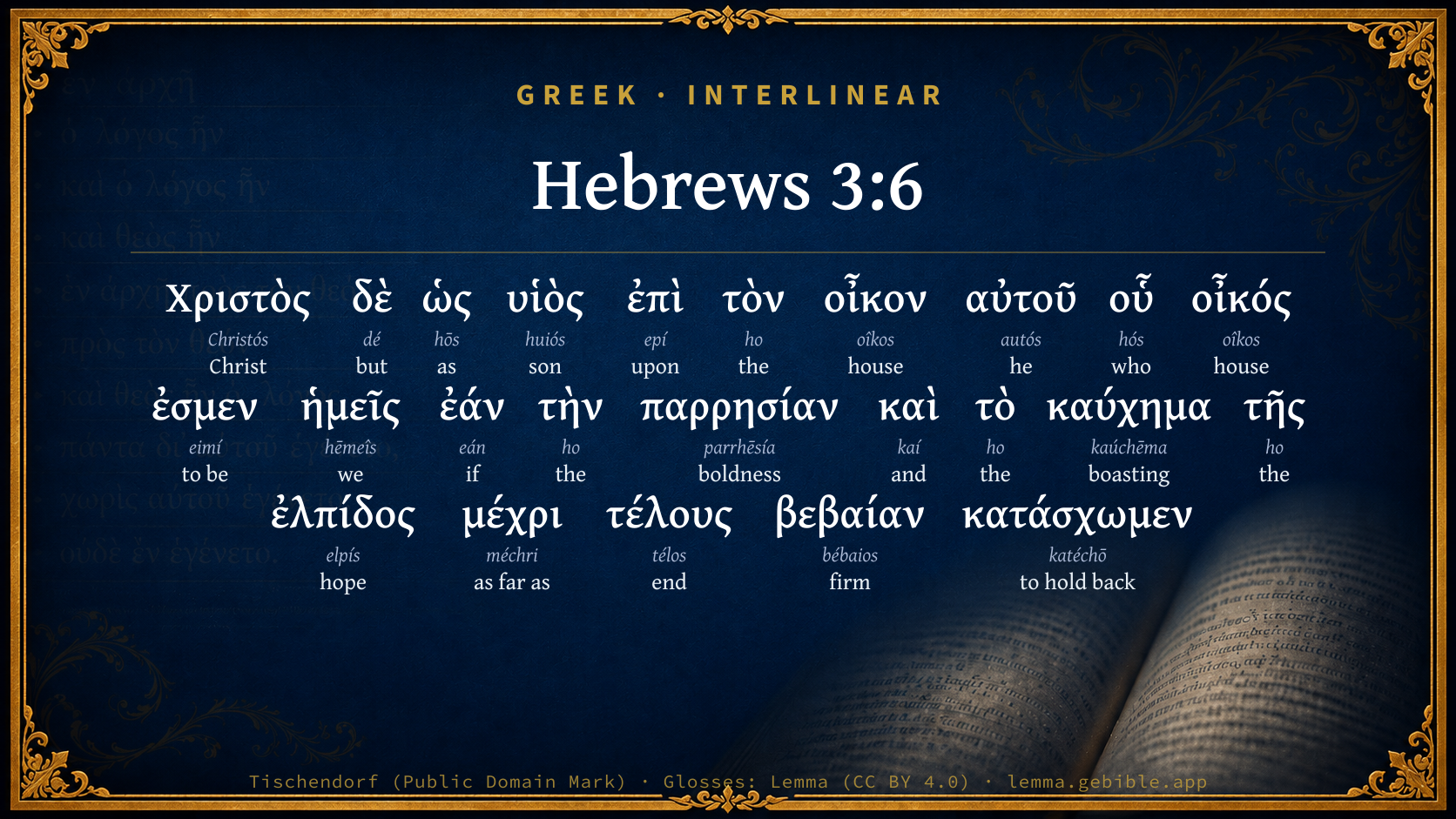
Greek (Tischendorf 8th ed.) Hebrews 3:6 appears in the Greek New Testament. The text above is from the Tischendorf 8th edition. Each word links to its Strong’s number and a concise gloss. Click any word for its full Thayer’s Greek Lexicon entry.
Download image
Cite this verse

Hebrews 3:6 (World English Bible). Public Domain. Lemma interlinear Bible study tool, https://lemma.gebible.app/v/hebrews/3/6.

Show BibTeX & RIS
BibTeX
RIS
English Translation
but Christ is faithful as a Son over his house; whose house we are, if we hold fast our confidence and the glorying of our hope firm to the end.
World English Bible · Public Domain
Download a study sheet

One document with this verse’s original text, its word-by-word gloss line, the meaning frame, cross-references with their text, attributed commentary, and full source and license credits — printable, and it pastes into notes with its structure intact.

This verse Autodidact and up

Study sheet (.html) Plain text (.txt)

A passage Seminary Student

Up to 50 verses in one chapter. A passage sheet keeps up to 6 commentary sources and 12 cross-references per verse, in the order this page ranks them, and says so on the sheet whenever that leaves anything out. Ask for a single verse and you get the Autodidact verse sheet above.

Everything on this page stays free to read, with no account — the sheet is a download of what is already on screen, not access to it.

Want to remove ads? Support Godless Engineer
Compare translations 3

The same verse in 3 English versions, stacked beneath the original-language interlinear above. Click any original word for its lexicon entry.

Each is an independent rendering of the whole verse — the interlinear is not word-aligned to these translations.

Highlighted words mark where these versions differ — a whole-verse word diff, not a word-by-word alignment.

  • World English Bible Public Domain
    but Christ is faithful as a Son over his house; whose house we are, if we hold fast our confidence and the glorying of our hope firm to the end.
  • King James Version Public Domain
    But Christ as a son over his own house; whose house are we, if we hold fast the confidence and the rejoicing of the hope firm unto the end.
  • unfoldingWord Literal Text CC BY-SA 4.0
    but Christ, as a Son over his house (whose house we are if we hold fast to the confidence and the boasting of our hope).

unfoldingWord Literal Text — © unfoldingWord, licensed CC BY-SA 4.0. Word-aligned USFM3 via Door43 (git.door43.org/unfoldingWord/en_ult).

Versions to compare (up to 4)

3 of 4 selected

Show all 19 translations

Every available English version of this verse, each an independent rendering of the whole verse.

  • World English Bible Public Domain
    but Christ is faithful as a Son over his house; whose house we are, if we hold fast our confidence and the glorying of our hope firm to the end.
  • Berean Standard Bible Public Domain
    But Christ is faithful as the Son over God’s house. And we are His house, if we hold firmly to our confidence and the hope of which we boast.
  • Majority Standard Bible Public Domain
    But Christ is faithful as the Son over God’s house. And we are His house, if we hold firmly to the end our confidence and the hope of which we boast.
  • King James Version Public Domain
    But Christ as a son over his own house; whose house are we, if we hold fast the confidence and the rejoicing of the hope firm unto the end.
  • American Standard Version (1901) Public Domain
    but Christ as a son, over his house; whose house are we, if we hold fast our boldness and the glorying of our hope firm unto the end.
  • Revised Version (1885) Public Domain
    but Christ as a son, over his house; whose house are we, if we hold fast our boldness and the glorying of our hope firm unto the end.
  • Geneva Bible (1599) Public Domain
    But Christ is as the Sonne, ouer his owne house, whose house we are, if we holde fast that confidence and that reioycing of that hope vnto the ende.
  • Douay-Rheims (1899) Public Domain
    But Christ as the Son in his own house: which house are we, if we hold fast the confidence and glory of hope unto the end.
  • Young's Literal Translation Public Domain
    and Christ, as a Son over his house, whose house are we, if the boldness and the rejoicing of the hope unto the end we hold fast.
  • Literal Standard Version CC BY-SA 4.0
    but Christ, as a Son over His house, whose house we are, if we hold fast the boldness and the rejoicing of the hope to the end.
  • Unlocked Literal Bible CC BY-SA 4.0
    But Christ is faithful as a Son who is in charge of God's house. We are his house if we hold fast to our courage and the hope of which we boast.
  • unfoldingWord Literal Text CC BY-SA 4.0
    but Christ, as a Son over his house (whose house we are if we hold fast to the confidence and the boasting of our hope).
  • Darby Bible Public Domain
    but Christ, as Son over his house, whose house are *we*, if indeed we hold fast the boldness and the boast of hope firm to the end.
  • World Messianic Bible Public Domain
    but Messiah is faithful as a Son over his house. We are his house, if we hold fast our confidence and the glorying of our hope firm to the end.
  • Webster's Bible Public Domain
    But Christ as a son over his own house: whose house are we, if we hold fast the confidence, and the rejoicing of the hope firm to the end.
  • Free Bible Version CC BY-SA 4.0
    But Christ is a son, in charge of God's house. And we are God's house as long as we hold on with confidence to the hope we boast we believe in.
  • Bible in Basic English Public Domain
    But Christ as a son, over his house; whose house are we, if we keep our hearts fixed in the glad and certain hope till the end.
  • Text-Critical English NT CC BY 4.0
    But Christ is faithful over God's house as a Son. And we are his house if indeed we hold our confidence firm to the end along with the hope in which we boast.
  • Tyndale New Testament (1534) Public Domain
    But Christ as a sonne hath rule over the housse whose housse are we so that we hold fast the confydence and the reioysynge of that hope vnto the ende.

Literal Standard Version (2020), Covenant Press — licensed CC BY-SA 4.0. Text via the HelloAO Bible API (eBible.org). Unlocked Literal Bible (unfoldingWord) — licensed CC BY-SA 4.0. Text via the HelloAO Bible API (eBible.org). unfoldingWord Literal Text — © unfoldingWord, licensed CC BY-SA 4.0. Word-aligned USFM3 via Door43 (git.door43.org/unfoldingWord/en_ult). Free Bible Version, Dr. Jonathan Gallagher — licensed CC BY-SA 4.0. Text via the HelloAO Bible API (eBible.org).

Word by word

More ways to search: Search by grammar → Find every occurrence → Compare this word →

Practice this passage: Drill this verse → Learn its vocabulary →

βεβαίαν
bébaios
G949
“firm”
Adjective, Accusative, Singular, Feminine
Part of Speech
Adjective
Case
Accusative
Number
Singular
Gender
Feminine
Full Thayer's Definition

Origin: from the base of G939 (through the idea of basality)

TDNT: 11:00,1

1. stable, fast, firm 2. metaph. sure, trusty
  1. Χριστὸς Christós G5547 “Christ” Noun, Nominative, Singular, Masculine
  2. δὲ dé G1161 “but” Conjunction
  3. ὡς hōs G5613 “as” Adverb
  4. υἱὸς huiós G5207 “son” Noun, Nominative, Singular, Masculine
  5. ἐπὶ epí G1909 “upon” Preposition
  6. τὸν ho G3588 “the” Article, Accusative, Singular, Masculine
  7. οἶκον oîkos G3624 “house” Noun, Accusative, Singular, Masculine
  8. αὐτοῦ autós G846 “he” Personal pronoun, Genitive, Singular, Masculine
  9. οὗ hós G3739 “who” Relative pronoun, Genitive, Singular, Masculine
  10. οἶκός oîkos G3624 “house” Noun, Nominative, Singular, Masculine
  11. ἐσμεν eimí G1510 “to be” Verb, Present, Active, Indicative, 1st person, Plural
  12. ἡμεῖς hēmeîs G2249 “we” Personal pronoun, 1st person, Nominative, Plural
  13. ἐάν eán G1437 “if” Conditional
  14. τὴν ho G3588 “the” Article, Accusative, Singular, Feminine
  15. παρρησίαν parrhēsía G3954 “boldness” Noun, Accusative, Singular, Feminine
  16. καὶ kaí G2532 “and” Conjunction
  17. τὸ ho G3588 “the” Article, Accusative, Singular, Neuter
  18. καύχημα kaúchēma G2745 “boasting” Noun, Accusative, Singular, Neuter
  19. τῆς ho G3588 “the” Article, Genitive, Singular, Feminine
  20. ἐλπίδος elpís G1680 “hope” Noun, Genitive, Singular, Feminine
  21. μέχρι méchri G3360 “as far as” Adverb
  22. τέλους télos G5056 “end” Noun, Genitive, Singular, Neuter
  23. κατάσχωμεν katéchō G2722 “to hold back” Verb, Aorist, Active, Subjunctive, 1st person, Plural

About this verse

These counts appear in no published source. They are computed here, from the morphology-tagged text and Lemma’s own curated glosses. What Lemma adds →

24
words
20
distinct lemmas
General Epistles
section

Notable vocabulary

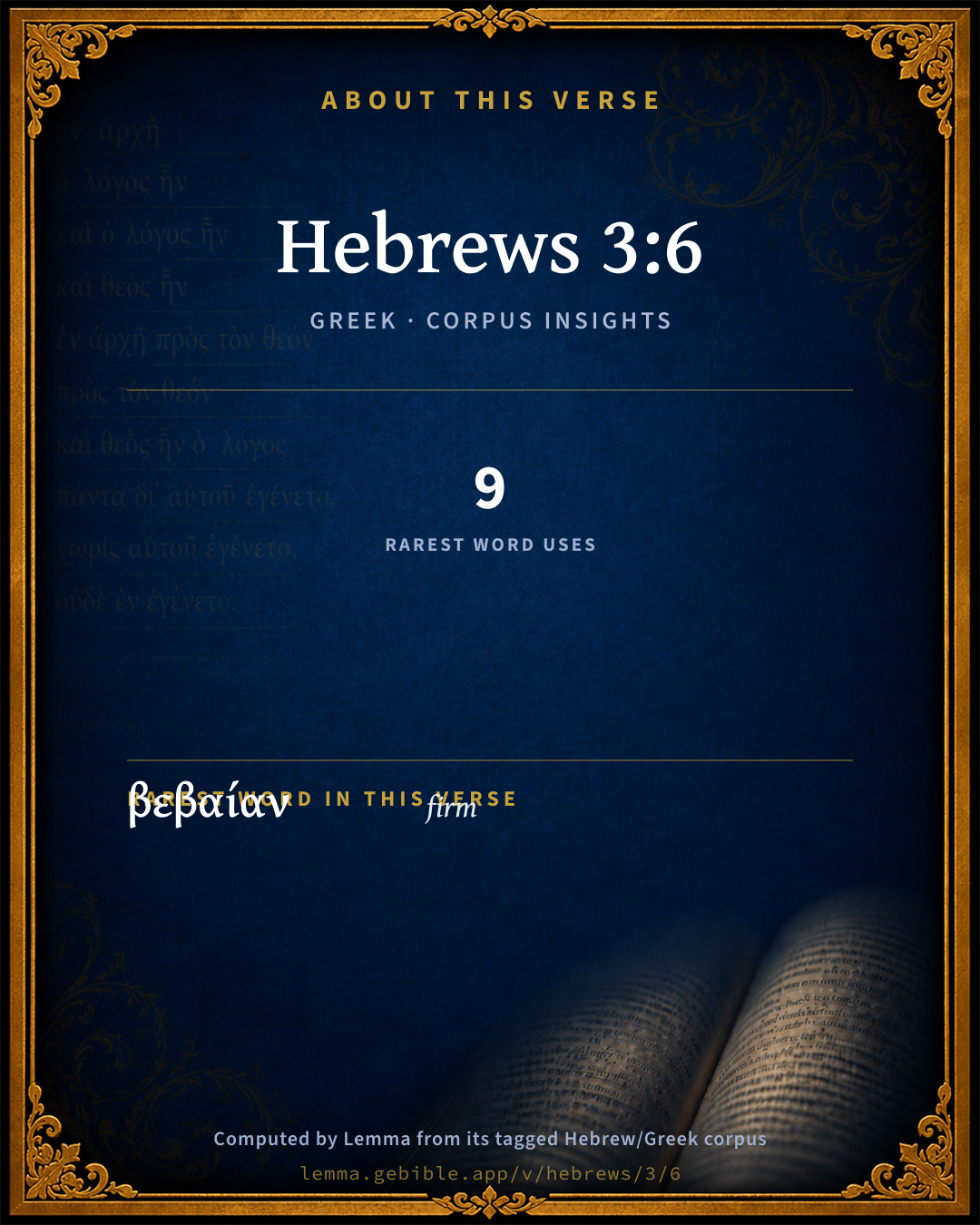
The rarest word here is βεβαίαν firm G949 — appearing just 9 times in the whole Greek New Testament.

Shared distinctive vocabulary

βεβαίαν firm G949 occurs in 9 verses of the Greek New Testament. Also found in:

Repetition

Words recur within this verse:

  • οἶκον house G3624 ×2
  • τὸν the G3588 ×4

Cross-references

35

Topical passages linked to Hebrews 3:6 in the Treasury of Scripture Knowledge — connected by theme and wording, ordered by reader-vote popularity; previews shown in the World English Bible.

  • 2 Corinthians 6:16 What agreement has a temple of God with idols? For you are a temple of the living God. Even as God said, "I will dwell in them, and walk in them; and I will be their God, and they will be my people."
  • 1 Corinthians 3:16 Don't you know that you are a temple of God, and that God's Spirit lives in you?
  • Hebrews 10:35 Therefore don't throw away your boldness, which has a great reward.
  • 1 Corinthians 6:19 Or don't you know that your body is a temple of the Holy Spirit which is in you, which you have from God? You are not your own,
  • Hebrews 6:11 We desire that each one of you may show the same diligence to the fullness of hope even to the end,
  • 1 Peter 2:5 You also, as living stones, are built up as a spiritual house, to be a holy priesthood, to offer up spiritual sacrifices, acceptable to God through Jesus Christ.
  • Hebrews 3:14 For we have become partakers of Christ, if we hold fast the beginning of our confidence firm to the end:
  • Hebrews 4:11 Let us therefore give diligence to enter into that rest, lest anyone fall after the same example of disobedience.
  • Hebrews 10:23 let us hold fast the confession of our hope unyieldingly. For he who promised is faithful.
  • Matthew 10:22 You will be hated by all men for my name's sake, but he who endures to the end will be saved.
  • Colossians 1:23 if it is so that you continue in the faith, grounded and steadfast, and not moved away from the hope of the Gospel which you heard, which is being proclaimed in all creation under heaven; of which I, Paul, was made a servant.
  • 1 Timothy 3:15 but if I wait long, that you may know how men ought to behave themselves in the house of God, which is the assembly of the living God, the pillar and ground of the truth.
  • Hebrews 1:2 has at the end of these days spoken to us by his Son, whom he appointed heir of all things, through whom also he made the worlds.
  • Hebrews 4:14 Having then a great high priest, who has passed through the heavens, Jesus, the Son of God, let us hold tightly to our confession.
  • Hebrews 10:38–39 But the righteous will live by faith. If he shrinks back, my soul has no pleasure in him."
  • 1 Peter 1:3–6 Blessed be the God and Father of our Lord Jesus Christ, who according to his great mercy became our father again to a living hope through the resurrection of Jesus Christ from the dead,
  • Revelation 3:11 I am coming quickly! Hold firmly that which you have, so that no one takes your crown.
  • Matthew 24:13 But he who endures to the end, the same will be saved.
  • Romans 15:13 Now may the God of hope fill you with all joy and peace in believing, that you may abound in hope, in the power of the Holy Spirit.
  • 1 Thessalonians 5:16 Rejoice always.
  • Psalms 2:12 Kiss the son, lest he be angry, and you perish in the way, For his wrath will soon be kindled. Blessed are all those who take refuge in him.
  • 2 Thessalonians 2:16 Now our Lord Jesus Christ himself, and God our Father, who loved us and gave us eternal comfort and good hope through grace,
  • Revelation 2:18 "To the angel of the assembly in Thyatira write: "The Son of God, who has his eyes like a flame of fire, and his feet are like burnished brass, says these things:
  • Revelation 2:25 Nevertheless, hold firmly that which you have, until I come.
  • Romans 5:2 through whom we also have our access by faith into this grace in which we stand. We rejoice in hope of the glory of God.
  • Romans 11:22 See then the goodness and severity of God. Toward those who fell, severity; but toward you, goodness, if you continue in his goodness; otherwise you also will be cut off.
  • Galatians 6:9 Let us not be weary in doing good, for we will reap in due season, if we don't give up.
  • Ephesians 2:21–22 in whom the whole building, fitted together, grows into a holy temple in the Lord;
  • Hebrews 3:2–3 who was faithful to him who appointed him, as also was Moses in all his house.
  • 1 Peter 1:8 whom not having known you love; in whom, though now you don't see him, yet believing, you rejoice greatly with joy unspeakable and full of glory--
  • Psalms 2:6–7 "Yet I have set my king on my holy hill of Zion."
  • Isaiah 9:6–7 For to us a child is born, to us a son is given; and the government shall be on his shoulder: and his name shall be called Wonderful, Counselor, Mighty God, Everlasting Father, Prince of Peace.
  • Matthew 16:18 I also tell you that you are Peter, and on this rock I will build my assembly, and the gates of Hades will not prevail against it.
  • John 3:35–36 The Father loves the Son, and has given all things into his hand.
  • Romans 12:12 rejoicing in hope; enduring in troubles; continuing steadfastly in prayer;

Cross-references courtesy of OpenBible.info (CC BY 4.0).

Where the printed editions differ

1 variant

Places in this verse where the major printed Greek editions disagree on the wording in a way that affects the translation — a comparison of editions, not a manuscript-by-manuscript collation. The editions are the modern critical texts (Nestlé-Aland 28/27, SBL, Westcott-Hort, Tregelles, Tyndale House) and the traditional texts behind the KJV (the Textus Receptus and the Byzantine/Majority text). It is not a claim about which reading is original.

  1. Extra text
    μέχρι τέλους βεβαίαν

    “until end unshakable”

    In WHTregTRByz Not in NA28NA27TynSBL

    μέχρι τέλους βεβαίαν (mechri telous bebaian) 'until end unshakable' is only in traditional manuscripts (WH+Treg+TR+Byz)

Textual data: Translators Amalgamated Greek New Testament (STEPBible TAGNT) · CC BY 4.0.

Commentary

Notes on Hebrews 3:6 from classic Christian and Jewish commentators (each source and its license shown beneath its notes). The classic Christian expositions comment on the surrounding passage and are grouped to its opening verse, so a note may address several verses; the Jewish commentaries on the Tanakh (Rashi and others) are per-verse, so they appear only where the commentator wrote on this verse.

Lemma curates 59 commentaries, every one of them public domain or Creative Commons licensed, each selected and text-cleaned for this edition rather than reprinted as found. About our sources →

Tyndale Open Study Notes

Tyndale Open Resources

3:6 We are part of Christ’s house if we keep our courage. The author could not give unqualified assurance to those who were drifting away from Christ and the church. Those who persevere in the faith have assurance that they are part of God’s house (see 3:14; Rom 8:9, 17; 11:22; 2 Cor 13:5; Col 1:22-23).

Tyndale Open Study Notes — © Tyndale Open Resources, licensed CC BY-SA 4.0. Text via the HelloAO Bible API.

Bengel's Gnomon

Johann Albrecht Bengel

Heb 3:6. Χριστὸς δὲ, but Christ) Moses yields to Him. An ambassador, in the absence of the king, is very highly distinguished—in the presence of the king, he falls back among the multitude. Here also supply πιστός ἐστι, is faithful. The Son shows His faithfulness in all that belongs to His Father and in all that is His own.—ἐπὶ, over) This ἐπὶ, על, over, shows His surpassing power: ἐν, in, is applied to Moses, Heb 3:5.—αὐτοῦ, His, of Him) of GOD, ch. Heb 10:21.—ὅς) This reading is very old.[23] Some read οὗ, from its alliteration with αὐτοῦ. In this case Paul should have written οὗ ὁ οἶκος, as Erasmus showed at the beginning. For we say, οὗ τὸ πτύον, ἧς ὁ ἀδελφος, ὧν τὸ στόμα, ὧν τὰ ὀνόματα, οὗ ἡ πληγὴ, ὧν τὰ κῶλα, οὗ ἡ φωνὴ, οὗ ἡ οἰκία. The question here is not, Whose house is it? for that very point is just now denoted by the αὐτοῦ. His; but, What is the house? as distinguished from that of which Moses was a portion.—ἐὰν, if) The same sentiment is found at Heb 3:14. An abbreviated expression: the house are we, since we have confidence: the house we shall be, if we retain our confidence. There is an expression of Paul’s very similar, Col 1:23, note.—τὴν παῤῥησίαν) A word of frequent occurrence in this epistle: παῤῥησία, ch. Heb 4:16, Heb 10:19; Heb 10:35; and ἐλπὶς ch. Heb 6:11; Heb 6:18, Heb 7:19, Heb 10:23, in like manner πληροφορία, ὑπόστασις, παῤῥήσιαν, confidence, viz. towards GOD: καύχημα, glorying, with respect to enemies.—κατάσχωμεν, if we hold fast) So Heb 3:14; ch. Heb 10:23. So κρατεῖν, Heb 4:14, Heb 6:18.

[23] The Gnomon here agrees with the 2d Ed. and the Germ. Vers., having changed the decision of the older Ed., which had given the preference to the reading οὖ.—E. B.

οὖ is the reading of ABC and Rec. Text; ὃς of D(Δ) corrected, f Vulg. Lucif.—ED.

Bengel's Gnomon of the New Testament — English translation (T&T Clark, Edinburgh, 1860) — public domain. Text from a community e-Sword module.

Meyer's Critical & Exegetical Commentary

Heinrich August Wilhelm Meyer

Heb_3:6. Χριστὸς δέ ὡς υἱός] Christ, on the other hand, in His capacity as Son, sc. πιστός ἐστιν. Upon this supplement depends ἐπὶ τὸν οἶκον αὐτοῦ (comp. Mat_25:21; Mat_25:23); and as υἱός forms an ascent from the preceding θεράπων, so does ἐπί form an ascent from the preceding ἐν. Erasmus, Paraphr.; Vatablus, Piscator, Grotius, Delitzsch, Moll, and others supply to Χριστὸς δὲ … αὐτοῦ simply ἐστίν, whereby, however, the relation of just proportion between Heb_3:5 and Heb_3:6 is destroyed. The opening words of Heb_3:5, moreover,inasmuch as they attach themselves not only to Heb_3:3, but also again to Heb_3:2,manifestly point to the fact that the author will indicate not the mere difference between Christ and Moses, but their difference within the quality common to both. Yet others, as Bleek, de Wette, and Bisping, supply a double πιστός ἐστιν, the first after Χριστὸς δέ, the second after αὐτοῦ; since, as the Vulgate, Beza, Estius, Grotius, Owen, Er. Schmid, Calov, Wolf, Carpzov, Cramer, Baumgarten, Gabler, Valckenaer, Böhme, Kuinoel, Klee, Tholuck, and others, they refer αὐτοῦ back to υἱός: Christ, however, is faithful, as a son is faithful over his house. But a satisfactory ground for taking οἶκος αὐτοῦ, Heb_3:6, otherwise than the same expression Heb_3:5, is not to be found. The house of God, or the divine kingdom, is for Moses and Christ the common sphere of operation; only by the position which the two occupy towards this house, are they distinguished the one from the other.

As αὐτοῦ, Heb_3:6, so is the relative οὗ, with which the author prepares the way for a transition to the paraenesis, not to be referred to Christ (Oecumenius, Jac. Cappellus, Piscator, Owen, Whitby, Bleek, de Wette, Bisping, Woerner, al.), but to God (Chrysostom, Theodoret, Calvin, Stengel, Stuart, Delitzsch, Alford, Maier, Moll, Kurtz, Hofmann, and others); although as regards the matter itself even the former reference would not be incorrect, since the house of God, Heb_3:2, is likewise characterized as the house of Christ, Heb_3:3.

The article before οἶκος was not imperatively required, although the whole Christian community forms a single indivisible house of God, since the notion of the word was one sufficiently well known, and, moreover, adequately defined by that which precedes.

The absolute declaration: οὗ οἶκός ἐσμεν ἡμεῖς, on the import of which 1Co_3:9; 1Co_3:16, 2Co_6:16, Eph_2:20 ff., 1Ti_3:15, 1Pe_2:5; 1Pe_4:17, is to be compared,[57] and which is taken in a strangely perverted way by Ebrard (p. 137) and Delitzsch as the logical antithesis to ΕἸς ΜΑΡΤΎΡΙΟΝ ΤῶΝ ΛΑΛΗΘΗΣΟΜΈΝΩΝ, Heb_3:5, the author limits by a condition.

The fuller ἘΆΝΠΕΡ is foreign to the epistles of Paul.

ΤῊΝ ΠΑῤῬΗΣΊΑΝ] not the bold confession (Cornelius a Lapide, Grotius, Hammond, Limborch, Whitby, Heinrichs, and others), to which βεβαίαν κατάσχωμεν would not be fitting, but cheerful confidence as a disposition. Comp. Heb_4:16, Heb_10:19; Heb_10:35. τὴν παῤῥησίαν, to which Τῆς ἘΛΠΊΔΟς[58] belongs in like manner as to τὸ καύχημα (against Riehm, Lehrbegr. des Hebräerbr. p. 739), is the main idea, whereas καὶ τὸ καύχημα adds only an explicative subsidiary factor. That is manifest from the feminine βεβαίαν (which Stengel wonderfully refers back, in a constructio ad sensum, to ἐλπίδος). Instances of the agreement of the adjective in point of gender with the remoter substantive, in cases where this forms the principal idea, occur also with the classics. Comp. Hom. Il. xv. 344: τάφρῳ καὶ σκολόπεσσιν ἐνιπλήξαντες ὀρυκτῇ; Hesiod. Theogon. 972 f.: ὃς εἶσʼ ἐπὶ γῆν τε, καὶ εὐρέα νῶτα θαλάσσης, πᾶσαν; Xenophon, Anab. 1:5, 6 : ὁ δὲ σύγλος δύναται ἑπτὰ ὀβολοὺς καὶ ἡμιοβόλιον Ἀττικούς; Thucydides, 8:63: πυθόμενος τὰ περὶ τὴν ναυμαχίαν καὶ τὸν Στρομβιχίδην καὶ τὰς ναῦς ἀπεληλυθότα. See Bernhardy, Syntax, p. 431.

The ἐλπίς is the Christians hope of the consummation of the kingdom of God, and the glorification of the Christians bound up therewith. Comp. Rom_5:2, also Heb_6:11; Heb_6:18; Heb_7:19; Heb_10:23.

καύχημα, however, is not here either equivalent to καύχησις (Bleek, de Wette, Tholuck, Stengel, Bisping, Maier, and others), any more than 2Co_5:12; 2Co_9:3, which have been unwarrantably appealed to (see Meyer ad loc.), but denotes the subject of the boasting. Sense: provided we shall have maintained the Christians hope as a cheerful confidence and subject of boasting firm unto the end.

μέχρι τέλους] not: until the death of each individual (Schlichting, Grotius, Kuinoel); not: until the final decision of the readers in favour of going over to Christianity (!Ebrard), but as Heb_3:14; Heb_6:11, 1Co_1:8, al., unto the end of the present order of the world, intervening with the coming again of Christ, and thought of as in the near future (comp. Heb_10:25; Heb_10:37), at which time faith shall pass over into sight, hope into possession.

[57] Philo, too, often employs the same figure, applying it to the human soul. Comp. de Somn. p. 587 E (ed. Mangey, I. p. 643): σπούδασον οὖν, ὦ ψυχή, θεοῦ οἶκος γενέσθαι, ἱερὸν ἅγιον κ.τ.λ.De resip. Noë, p. 282 E (ed. Mangey, I. p. 402): τίς γὰρ οἶκος παρὰ γενέσει δύναιτʼ ἂν ἀξιοπρεπέστερος εὑρεθῆναι θεῷ πλὴν ψυχῆς τελείως κεκαθαρμένης καὶ μόνον τὸ καλὸν ἡγουμένης ἀγαθόν; … κατοικεῖν δὲ λέγεται ἐν οἴκῳ ὁ θεὸς οὐχ ὡς ἐν τόπῳ (περιέχει γὰρ τὰ πάντα πρὸς μηδενὸς περιεχόμενος), ἀλλʼ ὡς πρόνοιαν καὶ ἐπιμέλειαν ἐκείνου τοῦ χωρίου διαφερόντως ποιούμενος· παντὶ γὰρ τῷ δεσπόζοντι οἰκίας ἡ ταύτης κατὰ τὸ ἀναγκαῖον ἀνῆπται φροντίς.

[58] Both words are found combined in Josephus likewise, Antiq. xvi. 3. 3 : καὶ δεινὸς ὢν τὸν τρόπον Ἀντίπατρος, ἐπειδὴ παῤῥησίας τινὸς τῆς οὐ πρότερον οὔσης ἐλπίδος ἀντεποιήσατο, μίαν ἔσχεν ὑπόθεσιν κακοῦν τοὺς ἀδελφούς, κ.τ.λ.

Meyer — Critical and Exegetical Commentary on the New Testament — English translation by Peter Christie, edited by Frederick Crombie (T&T Clark, 1880) — public domain. Text from a community e-Sword module.

Geneva Bible (1599)

Geneva Bible translators

He calleth that excellent effect of faith (whereby we cry, Abba, that is, Father) confidence, and to confidence he joineth hope.

He applieth the former doctrine to this end, exhorting all men by the words of David to hear the Son himself speak, and to give full credit to his words, seeing that otherwise they cannot enter into that eternal rest.

To wit, Christ’s.

Geneva Bible (1599) marginal notes — public domain. Text via Bolls.life.

Jamieson, Fausset & Brown

Robert Jamieson, A. R. Fausset & David Brown

But Christ--was and is faithful (Heb 3:2).

as a son over his own house--rather, "over His (GOD'S, Heb 3:4) house"; and therefore, as the inference from His being one with God, over His own house. So Heb 10:21, "having an High Priest over the house of God." Christ enters His Father's house as the Master [OVER it], but Moses as a servant [IN it, Heb 3:2, Heb 3:5] [CHRYSOSTOM]. An ambassador in the absence of the king is very distinguished--in the presence of the king he falls back into the multitude [BENGEL].

whose house are we--Paul and his Hebrew readers. One old manuscript, with Vulgate and LUCIFER, reads, "which house"; but the weightiest manuscripts support English Version reading.

the rejoicing--rather, "the matter of rejoicing."

of the hope--"of our hope." Since all our good things lie in hopes, we ought so to hold fast our hopes as already to rejoice, as though our hopes were realized [CHRYSOSTOM].

firm unto the end--omitted in LUCIFER and AMBROSE, and in one oldest manuscript, but supported by most oldest manuscripts.

Jamieson, Fausset & Brown — Commentary Critical and Explanatory on the Whole Bible (1871) — public domain (CC PDM 1.0). Text via the HelloAO Bible API.

Adam Clarke's Commentary

Verse 6. But Christ as a Son over his own house] Moses was faithful as a servant IN the house; Jesus was faithful, as the first-born Son, OVER the house of which he is the Heir and Governor. Here, then, is the conclusion of the argument in reference to Christ's superiority over Moses. Moses did not found the house or family, Christ did; Moses was but in the house, or one of the family, Christ was over the house as its Ruler; Moses was but servant in the house, Christ was the Son and Heir; Moses was in the house of another, Christ in his own house.

It is well known to every learned reader that the pronoun αυτου, without an aspirate, signifies his simply; and that with the aspirate, αυτου, it signifies his own: the word being in this form a contraction, not uncommon, of εαυτου. If we read αυτου without the aspirate, then his must refer to God, Heb 3:4.

But Christ as a Son over his (that is, God's) house: if we read αυτου, with the aspirate, as some editions do, then what is spoken refers to Christ; and the words above convey the same sense as those words, Ac 20:28: Feed the Church of God, which he hath purchased with his own blood. Some editions read the word thus; and it is evident that the edition which our translators used had the word αυτου, his own, and not αυτου, his. The Spanish and London Polyglots have the same reading. From the most ancient MSS. we can get no help to determine which is to be preferred, as they are generally written without accents. The two first editions of the Greek Testament, that of Complutum, 1514, and that of Erasmus, 1516, have αυτου, his; and they are followed by most other editions: but the celebrated edition of Robert Stephens, 1550, has αυτου, his own. The reading is certainly important; but it belongs to one of those difficulties in criticism which, if the context or collateral evidence do not satisfactorily solve it, must remain in doubt; and every reader is at liberty to adopt which reading he thinks best.

Whose house are we] We Christians are his Church and family; he is our Father, Governor, and Head.

If we hold fast the confidence] We are now his Church, and shall continue to be such, and be acknowledged by him IF we maintain our Christian profession, την παρρησιαν, that liberty of access to God, which we now have, and the rejoicing of the hope, i.e. of eternal life, which we shall receive at the resurrection of the dead. The word παρρησια, which is here translated confidence, and which signifies freedom of speech, liberty of access, c., seems to be used here to distinguish an important Christian privilege. Under the old testament no man was permitted to approach to God: even the very mountain on which God published his laws must not be touched by man nor beast and only the high priest was permitted to enter the holy of holies, and that only once a year, on the great day of atonement; and even then he must have the blood of the victim to propitiate the Divine justice. Under the Christian dispensation the way to the holiest is now laid open; and we have παρρησιαν, liberty of access, even to the holiest, by the blood of Jesus. Having such access unto God, by such a Mediator, we may obtain all that grace which is necessary to fit us for eternal glory; and, having the witness of his Spirit in our heart, we have a well grounded hope of endless felicity, and exult in the enjoyment of that hope. But IF we retain not the grace, we shall not inherit the glory.

Adam Clarke's Commentary on the Bible (1810–1826) — public domain. Text from a community e-Sword/MySword module.

John Calvin's Commentaries

6. Whose house are we, etc. As Paul in his Epistle to the Romans, after having prefaced that he was appointed to be the Apostle of the Gentiles, adds, for the sake of gaining credit among them, that they were of that number; so now the author of this epistle exhorts the Jews who had already made a profession of Christ to persevere in the faith, that they might be deemed as being in Gods household. He had said before that God’s house was subject to the authority of Christ. Suitably to this declaration is added the admonition that they would then have a place in God’s family when they obeyed Christ. But as they had already embraced the gospel, he mentions their condition if they persevered in the faith. For the word hope I take for faith; and indeed hope is nothing else but the constancy of faith. He mentions confidence and rejoicing, or glorying, in order to express more fully the power of faith. And we hence conclude that those who assent to the Gospel doubtfully and like those who vacillate, do not truly and really believe; for faith cannot be without a settled peace of mind, from which proceeds the bold confidence of rejoicing. And so these two things, confidence and rejoicing, are ever the effects of faith, as we stated in explaining Romans the 5th chapter, and Ephesians the 3rd chapter

But to these things the whole teaching of the Papists is opposed; and this very fact, were there nothing else, sufficiently proves that they pull down the Church of God rather than build it. For the certainty by which alone we are made, as the Apostle teaches us, holy temples to God, they not only darken by their glosses, but also condemn as presumption. Besides, what firmness of confidence can there be when men know not what they ought to believe? And yet that monstrous thing, implicit faith, which they have invented, is nothing else than a license to entertain errors. This passage reminds us that we are always to make progress even unto death; for our whole life is as it were a race.

John Calvin's Commentaries (1540-1563) — public domain. Text from the Calvin Translation Society English edition (1840s-50s) via the Christian Classics Ethereal Library (ccel.org). Calvin's coverage is partial (roughly two-thirds of the Bible); uncommented books and verses are honest gaps, never fabricated. The 19th-century editor's footnotes and remarks are omitted so the notes are faithfully Calvin's own voice.

Ellicott's Commentary for English Readers

(6) But Christ as a son over his own house.—Rather, over His house. Throughout this passage (Heb_3:2; Heb_3:5-6) “His house” must be taken in the sense of the quotation, as the house of God. Whereas Moses was faithful as a servant in this house of God, Christ was faithful as a son set over His Father’s house. The antithesis is complete: the one is a servant for witness, the other a Son having a natural right to rule. The concluding words in Heb_3:5 have no formal answer here, but the contrast is not the less distinctly expressed. The name Christ (which here occurs for the first time) is in this Epistle never a mere name: it contains implicitly the thought that all that to which Moses bore witness has reached its fulfilment now. Christ has come: God’s house, formerly typified by Israel, is now manifested as it really is, containing all “sons” whom God leads to glory (Heb_2:10). The terms applied by constant usage to the one nation are thus successively enlarged: the “seed of Abraham” (Heb_2:16), “the people” (Heb_2:17), the “house of God” (see Heb_10:21).

If we hold fast the confidence.—Better, If we hold the boldness and the glorying of our hope firm unto the end. Faithful to his practical purpose, the writer adds to the words “whose house are we” the indispensable condition. The “house” exists (“are we”), to it belong all who possess the Christian “hope;” but for assured and final appropriation of the promise there must be steadfastness “unto the end.” This exhortation differs from that in Heb_2:1-4, in that it more distinctly implies that those who are addressed have a possession which they may lose. The Christian “hope,” that aspect of faith which is turned towards the future, is naturally often in the writer’s thoughts. The words associated are very striking: hope gives us boldness (see 2Co_3:12), and of this hope we make our boast. “Boldness” is spoken of again (in Heb_4:16; Heb_10:19; Heb_10:35): properly meaning “freedom of speech,” it denotes the confident, bold feelings and demeanour which connect themselves with the free utterance of thought.

A Bible Commentary for English Readers, edited by Charles John Ellicott (1878–1897) — public domain. Text from a community e-Sword module.

The Cambridge Bible for Schools and Colleges

gen. ed. J. J. S. Perowne

6. as a Son over his own house] Rather, “over His (i.e. God’s) house.” In the words “Servant” and “Son “we again (as in Heb_1:5; Heb_1:8) reach the central point of Christ’s superiority to Moses. The proof of this superiority did not require more than a brief treatment because it was implicitly involved in the preceding arguments.

whose house are we] This is a metaphor which the writer may well have learnt in his intercourse with St Paul (2Co_6:16; Eph_2:21-22. Comp. 1Pe_2:5).

the confidence] Literally, “our cheerful confidence,” especially of utterance, as in Heb_10:19; Heb_10:35. The word rendered “confidence” in Heb_3:14 is different. This boldness of speech and access, which were the special glory of the old democracies, are used by St John also to express the highest Christian privilege of filial outspokenness (1Jn_3:21). Apollos, the probable writer of this Epistle, was known for this bold speech (Act_18:26), and evidently feels the duty and privilege of such a mental altitude (Heb_4:16; Heb_10:19; Heb_10:35).

the rejoicing of the hope] Rather, “the glorying of our hope.” The Greek word means “an object of boasting,” as in Rom_4:2; 1Co_5:6, &c. The way in which the writer dwells on the need for “a full assurance of hope” (Heb_6:11; Heb_6:18-19) seems to shew that owing to the delay in Christ’s coming his readers were liable to fall into impatience (Heb_10:36, Heb_12:1) and apathy (Heb_6:12, Heb_10:25).

firm unto the end] The same phrase occurs in Heb_3:14. The word “firm” being feminine does not agree with the neuter word “object of boast,” and the repetition of the phrase by a writer so faultlessly rhetorical is singular. It cannot however be regarded as a gloss, for it is found in all the best Manuscripts.

unto the end] That is, not “until death,” but until hope is lost in fruition; until this dispensation has attained to its final goal. This necessity for perseverance in well-doing is frequently urged in the N. T. because it was especially needed in times of severe trial. Mat_10:22; Col_1:23, and see infra Heb_10:35-39.

The Cambridge Bible for Schools and Colleges (gen. ed. J. J. S. Perowne; Cambridge University Press, 1878–1918) — public domain. Text from a community e-Sword module.

John Gill's Exposition

But Christ as a Son over his own house,.... As Moses was not, though the Jews say that he was (a) and (b), "lord and master of the house"; yea, and , "the Son of the house" (c); but this he was not: Christ is the Son and heir, the Lord and master; he is a Son, not by creation, or by adoption, or by office, but by nature: hence it appears that he is God, and is equal with God; and this his sonship is the foundation of his office, and he becomes the heir of all things: and when he is said to be "as a Son", it does not intend mere resemblance; but is expressive of his right to heirship and government, and of the esteem and reverence he had in his house, and of his fidelity as a Son there; and though he was a servant, as man and Mediator, and had a great piece of service to perform, and which he has performed with diligence and faithfulness, yet he was also a Son, Lord and heir, as Moses was not; and he is over the house of God, as King, priest, and prophet in it, and as the firstborn, Son and heir, and as the master and governor of it; and which is called his own, because given him by the Father, purchased by himself, and which he has built, and in which he dwells:

whose house are we; believers in Christ, whether Jews or Gentiles; who, as lively stones, are built up a spiritual house, in whom Christ dwells by faith, and over whom he presides and reigns:

if we hold fast the confidence and the rejoicing of the hope firm unto the end. These words are not to be understood as a condition of the former assertion; nor is a final falling away from grace to be inferred from hence, for the supposition proves not such an inference, but the contrary; namely, that they that have true faith, hope, and confidence, shall keep them to the end; and therefore are the house of Christ: besides, the doctrine of apostasy is quite repugnant to the apostle's argument; according to which, Christ might have no house, and can have none till men have persevered: but the apostle's design is to give a word of exhortation to himself and others, to hold fast the confidence; and so the words are rather descriptive of the persons, who are the house of Christ; such who have a good hope, through grace, wrought in them, and can rejoice in hope of the glory of God; and can use freedom of speech and boldness at the throne of grace; and have an holy confidence of interest in the love of God, and salvation by Christ, and go on in the exercise of these graces to the end of their days.

(a) Zohar in Lev. fol. 2. 2. (b) Tzeror Hammor, fol. 35. 2. (c) Lexic. Cabalist. p. 203.

John Gill's Exposition of the Whole Bible (1746–1763) — public domain (CC PDM 1.0). Text via the HelloAO Bible API.

Trapp's Complete Commentary

John Trapp

6 But Christ as a son over his own house; whose house are we, if we hold fast the confidence and the rejoicing of the hope firm unto the end.

Ver. 6. Whose house are we] And he is bound (by his own promise) to repair. He also is our dwelling house, Psa 90:1., and by the civil law, De domo sun nemo extrahi debet, aut in ius vocari. A man’s house is his castle.

If we hold fast] See here a just description of the invisible Church of Christ.

John Trapp, A Commentary or Exposition upon All the Books of the Old and New Testament (1647–1656) — public domain. Text from a community e-Sword module.

Albert Barnes' Notes on the Bible

But Christ as a Son over his own house - He is not a servant. To the whole household or family of God he sustains the same relation which a son and heir in a family does to the household. That relation is far different from that of a servant. Moses was the latter; Christ was the former. To God he sustained the relation of a Son, and recognized Him as his Father, and sought in all things to do his will; but over the whole family of God - the entire Church of all dispensations - he was like a son over the affairs of a family. Compared with the condition of a servant, Christ is as much superior to Moses as a son and heir is to the condition of a servant. A servant owns nothing; is heir to nothing; has no authority, and no right to control anything, and is himself wholly at the will of another. A son is the heir of all; has a prospective right to all; and is looked up to by all with respect. But the idea here is not merely that Christ is a son; it is that as a son he is placed over the whole arrangements of the household, and is one to whom all is entrusted as if it were His own.

Whose house we are - Of whose family we are a part, or to which we belong. That is, we belong to the family over which Christ is placed, and not to what was subject to Moses.

If we hold fast - A leading object of this Epistle is to guard those to whom it was addressed against the danger of apostasy. Hence, this is introduced on all suitable occasions, and the apostle here says, that the only evidence which they could have that they belonged to the family of Christ, would be that they held fast the confidence which they had unto the end. If they did not do that, it would demonstrate that they never belonged to his family, for evidence of having belonged to his household was to be furnished only by perseverance to the end.

The confidence - The word used here originally means “the liberty of speaking boldly and without restraint;” then it means boldness or confidence in general.

And the rejoicing - The word used here means properly “glorying, boasting,” and then rejoicing. These words are used here in an adverbial signification, and the meaning is, that the Christian has “a confident and a rejoicing hope.” It is:

(1)Confident - bold - firm. It is not like the timid hope of the Pagan, and the dreams and conjectures of the philosopher; it is not that which gives way at every breath of opposition; it is bold, firm, and manly. It is.

(2)Rejoicing” - triumphant, exulting. Why should not the hope of heaven fill with joy? Why should not he exult who has the prospect of everlasting happiness?

Unto the end - To the end of life. Our religion, our hope, our confidence in God must he persevered in to the end of life, if we would have evidence that we are his children. If hope is cherished for a while and then abandoned; if people profess religion and then fall away, no matter what were their raptures and triumphs, it proves that they never had any real piety. No evidence can be strong enough to prove that a man is a Christian, unless it leads him to persevere to the end of life.

Albert Barnes' Notes on the Bible (1834–1885) — public domain. Text from a community e-Sword/MySword module.

Haydock's Catholic Bible Commentary

Christ, as a Son in his own house: which house, or Church of the faithful are we: and Christ is our only Lord and Master, equally with the Father, and the Holy Ghost; but we are all members, and profitable members, if we retain firm confidence in him, and the glory of hope, or a glorious hope unto the end. (Witham) --- Hitherto St. Paul endeavours to detach the Hebrews from Moses and the law, to attach them to Christ and his gospel. What follows, is an exhortation to persevere in the faith, lest we come to be cast off like the Jews.

George Leo Haydock (1774–1849), Haydock's Catholic Family Bible and Commentary, 1859 edition — public domain. Excludes Psalms (Douay-Rheims chapter numbering differs from Protestant) and Deuterocanonical books (Catholic canon only).

Matthew Poole's English Annotations

But Christ as a son over his own house; the anointed gospel Prophet by God the Father, Heb 1:9, who was eminently faithful and true to his trust, who is Heir and Lord of all, and therefore by the law of nature and nations is above the best servant, Gal 4:1. Who is the Head and Lord over his own church, which he purchased by his own blood, Act 20:28, and built for himself. Moses was in it but a servant, fulfilling his Master’s will and pleasure, and ordering all in it agreeable to it.

Whose house are we; the Hebrews’ personal privilege, as well as the Prophet’s excellency, persuading and obliging them to know by consideration what is represented to them, and to influence their hearts to a perseverance under his teaching and government in their Christian course, because they are parts of his house, and members of his church; a particular house, and body, and church to him, and members of the catholic one. A temple, wherein God doth inhabit and dwell by his Spirit, 1Co 3:16,17; compare Eph 2:21; 3:17; 1Ti 3:15. A house he will glorify and perfect with his own presence, and which he will fill with transcendently more glory than he did the literal temple, Exo 40:34,35; 2Ch 7:1,2; Isa 6:1,5; compare Hag 2:6. But how completely shall it be filled with his glory in heaven! Phi 3:21. How should such a glorious state influence them to a sincere perseverance in his religion!

If we hold fast the confidence; a tenacious holding, as with both hands, with our utmost strength, against all insinuations and temptations of all adversaries whatsoever, which would either entice or force them from it. παρρησιαν της ελπιδος, is an ingenuous, bold, and confident profession of our hope before all the world, without doubting, wavering, or fearful shaking about what is the true object of it, let the persecutions or sufferings for it be what they will.

And the rejoicing of the hope: hope here is a firm expectation of salvation in eternal glory by Jesus Christ. It necessarily includes in it faith, for we cannot hope for that we do not believe; and faith representing to the soul from the gospel, Christ purchasing, and the Father in him covenanting and promising to give it to us, if we truly believe in and sincerely obey him, so as we may on the surest and best grounds look out for it, and expect it, Heb 3:14; 6:11; Act 26:6,7; compare Col 1:5,23; Tit 2:13; 1Pe 1:3. This hope keeps up the soul in a joyous and glorious condition under all threatening evil; it makes Christians glory in tribulation, Rom 5:2,3; 12:12; rejoicing in want of sensible good, 2Co 6:10; compare 1Pe 5:10.

Firm unto the end; both this confidence and glorying of hope must be retained firm to the end. Persevere they must in the exercise of them with stability and constancy, till they reach the salvation of their souls, Col 1:23; 1Pe 1:5-10; which Christians are not to trust to their own power to compass, but on the continued assistance of God in the use of those means that he hath appointed thereunto, who will never be wanting to such who do so rely on him, and constantly seek it from him, 1Co 1:8,9.

Matthew Poole's English Annotations on the Holy Bible (1683–1685) — public domain. Text from a community e-Sword/MySword module.

Whedon's Commentary on the Bible

Daniel D. Whedon

6. But—After this conceded tribute to Moses we next have Christ’s superiority. Moses was in, Christ is over, the house. Own expresses an emphasis not in the Greek; the same pronoun for his is used of Moses (Heb_3:5) and of Christ here.

Whose—Referring to Christ. For having established under this striking image of house Christ’s superiority as proprietor of the dispensations, our apostle makes a beautiful transition from this divine proprietorship to the solemn warning against apostasy from Christ, which now follows. We—The writer and his Hebrew Christian brethren. They are now part of the house; they will be permanent part, if. For it is clear that the writer assumes that they are now in possession of a true confidence and rejoicing, which they have only to hold fast. The whole of the remainder of the chapter assumes that they are now true Christians; the exhortation is, to stay just as they are: the great fear is that they will not, but that they will apostatize and finally perish.

Confidence—Greek, free, bold utterance; of which the inward foundation is confidence of faith and feeling.

Rejoicing—Or, exultation. Confidence is the firm, solid assurance; rejoicing is the joyful hope and glorying built on that solid foundation.

Firm—With unmovableness. End of our probationary life. At that end all danger is at an end. We then cannot fall. For though we still be free agents, intrinsically able to choose wrong in the blessed paradise, there is no wrong to choose. Our hearts will be so attuned with the heart of the holy Christ that an unholy emotion cannot enter. Our spirits, filled with the blessed Spirit, can give no entrance to an unholy thought. We are no longer “prisoners of hope,” but prisoners of everlasting joy. We are immovable parts of Christ’s eternal house. The clause unto the end, has been rejected, as being really inserted here from Heb_3:14. Delitzsch thinks our apostle would not use the phrase twice. Unreasonably, for it is truly an emphatic repetition, a repetition of what is really the point of the whole epistle. It is retained by the best authorities; by Tischendorf in the fourth edition of his Testament.

Daniel D. Whedon (gen. ed.), Commentary on the Old and New Testaments (1874–1909) — public domain. Text from a community e-Sword module.

The Pulpit Commentary

What we are to Christ.

To us Christ is related as Apostle and High Priest (ver. 1). To Christ we are related as the house where he holds the unique position of Son, Heir, Director.

I WE ARE MORE TO CHRIST THAN EVER HIS BRETHREN COULD BE TO MOSES. Moses had great authority, honorable position, but he was never as a son over his own house. Moses at best was the steward, and even he bad checks which reminded him that he was but the first among servants, not an all-controlling lord. And yet he was a man to be honored. Mark this in the Epistle, that its writer, in exalting Christ, exalted Moses also; whereas the enemies of Christ only exalted Moses, that by the same movement they might correspondingly depreciate Christ. The nation of Israel was as the house where Moses dwelt as appointed responsible director and custodian. A servant certainly, but a servant of a peculiar kind. He is called yerapwn . Nowhere else in the New Testament is a servant called by this name; it is as if there must be a unique description for a unique relation. If simple servitude had been all needing to be signified, doulov would have done; if simple ministry, diakonov would have done. But Moses has a servant-name to himself; as much as to say, "Among all the servants of God there has been none greater than Moses." The word indicates at one and the same time service and the greatest responsibility that could rest on mere man. Moses was the great steward of God in God"s house for the time being, even the people of Israel. Compare him with the man spoken of as Joseph"s steward. (Gen_43:19 Gen_44:4) Consider also the question of Jesus in Luk_12:42: "Who then is that faithful and wise steward (oikonomov), whom his lord shall make ruler over his household (yerapeia)?" "It is required in a steward that he shall be found faithful. " Thus the nation of Israel was a great deal to Moses, but not so much as we are to Christ. We are for the use of Christ, at his disposal, under his control, in a way far transcending the control which Moses had over Israel. Moses died and Joshua succeeded. Joshua died and others succeeded. But as a Son over his house, over the successive generations of Christians, Jesus is, emphatically, "the same yesterday, and today, and forever.

II THE CONDITIONS WHICH MAKE US ABIDINGLY THE HOUSE OF CHRIST. We are the house of Christ who is the Son of God. It is a great destiny to feel that we are of use and service to him. Bat the use and service depend on our perseverance. Christ asks great, arduous, necessarily painful things from his household. Not that he rejoices in pain everything but that; but to hold a place under him requires faithfulness in extremities. His household may have to resist unto blood, striving against sin. As to the members of Christ"s household, Christ has infused into their hearts an expectation of serving him amid surroundings and conditions far different to those of the present service. And this expectation is one which at times makes them confident and also free of speech in their approaches to their Master. It is an expectation in which they can glory as the world looks curiously on them, because of present things they give up for the sake of the expectation. But here is the peril lest the confidence and the expectation sink so low in the heart as to lose power over the life. Moses was faithful in his house, but the house was not faithful. The privations and delays of the wilderness well-nigh killed the joy of liberty from Egyptian bondage, and the noble aspirations towards the land promised by Jehovah. Jesus will be faithful in the household of God; and some in that household will always be faithful to Jesus, through whatever dubious and protracted experiences. The point is one for the individual. Will he, through impatience and want of the single eye, the straightforward gaze, lose his place and promotion in the household of God? Y.

Ver. 6. The Church, God"s temple.

But Christ as a Son over his house; whose house are we, etc. Observe

I THE CHURCH IS THE TEMPLE OF GOD. It is here designated his house." And St. Paul speaks of "the house of God, which is the Church of the living God." Individual Christians are spoken of as temples of God. (1Co_3:16) And the whole company of Christians are spoken of as "a holy temple", (Eph_2:20-22) and "a spiritual house". (1Pe_2:5) The figure suggests several ideas; e.g.:

1. Design for its construction. The tabernacle was built and furnished by Moses in accordance with minute directions from God. "Look that thou make them after their pattern, which was showed thee in the mount". (Ex 25) Solomon erected and furnished the temple from plans which he received from his father David, and for the making of which David was divinely instructed. "All this, said David, the Lord made me understand in writing by his hand upon me, even all the works of this pattern". (1Ch_28:11-19) And of the sublime spiritual temple God himself is the great Architect. This spiritual house, from its foundation to its top stone, is being built after the Divine plan. Hence, we may infer, it will be strong and stable, sublime and beautiful, ere

2. Cohesion of its several portions. This glorious edifice is "fitly framed together." There is unity of design, unity of construction, etc. The Church of Christ is one in a unity more true and deep than that of any outward forms, or symbols, or organizations. It is one in its filial relation to the great Father, in its faith in the redeeming Son, as being inhabited by the Holy Spirit, and as consecrated to the glorious cause of Christ. In these respects all true Christians are one.

3. Inhabitation by God. God dwelt in symbol in the tabernacle of Moses and in the temple of Solomon. The sacred Shechinah was there in the holy of holies. By his Spirit he dwells in every Christian. "Ye are the temple of God, and the Spirit of God dwelleth in you." He dwells also in the Church as a whole. In Christ Jesus ye are builded together for a habitation of God in the Spirit.

II CHRIST IS THE BUILDER OF THIS TEMPLE. In ver. 3 he is spoken of as "he that built the house." "On this rock," said he, "I will build my Church." Christians "are his workmanship;" they "are God"s building.

"The Lord aided to the Church daily those that were being saved." All other laborers on the glorious edifice work under him. He allots them their respective duties, appoints them their sphere of operation, sustains them in their work, and crowns their work with success. Passing to another figure, Paul "planted, Apollos watered; but God gave the increase.

III CHRIST IS THE LORD OF THIS TEMPLE. Our text teaches that Christ as a Son is over this house of God. He is "Head over all things to the Church". (Eph_1:22) "The Church is subject to Christ". (Eph_5:23, Eph_5:24) "He is the Head of the body, the Church... that in all things he might have the pre-eminence." "One is your Master, even the Christ." His authority is supreme in the Church, higher than that of conferences or councils, synods or convocations, archbishops or lopes; and it should be recognized as such and loyally obeyed. He ordained the laws of the Church; he instituted its sacraments, etc.

IV PERSONAL INCORPORATION IN THIS TEMPLE IS CONDITIONAL. "Whose house are we, if we hold fast the confidence," etc. Here are two conditions:

1. The maintenance of assured Christian confidence. This confidence, or boldness, as Ebrard says, "is nothing else than the pistiv itself in its most direct and most practical expression, manifesting itself as the inward power of the peace which dwells in the heart, in circumstances of outward difficulty It denotes that joyful boldness which flows from within and is victorious over unfavorable circumstances; it is joyfulness felt in situations in which others would despair; hence it is the immediate fruit of the objective peace obtained with God through the atonement.

2. The maintenance of their exultant hope. "If we hold fast the... glorifying of our hope." Here also Ebrard"s note is excellent. "The Jews boasted of their descent from Abraham, (Joh 8) of their temple and priesthood, of their being the chosen people of God all palpable and manifest advantages. The poor Christians had nothing of the kind in which they could glory. Regarded by the Gentiles as a Jewish sect, by the Jews as apostates from the people of Israel, forming no state, no people, without rulers, without a head except One who was crucified, the refuse and off scouring of the people, they had nothing of which to boast but the glory which they hoped to receive." But how splendid a hope was theirs! the hope of perfect holiness and of perfect blessedness. And such a hope is ours. Let us, then, "hold fast our confidence and the glorying of our hope firm unto the end. W.J.

The Pulpit Commentary (1880–1919), ed. H.D.M. Spence-Jones & Joseph S. Exell — public domain. Text from a community e-Sword module.

John Wesley's Explanatory Notes

But Christ was faithful as a Son; whose house we are, while we hold fast, and shall be unto the end, if we hold fast our confidence in God, and glorying in his promises; our faith and hope.

John Wesley, Explanatory Notes Upon the Whole Bible (1754–1765) — public domain. Text via the GEBible commentary corpus.

The People's New Testament

B. W. Johnson

6. But Christ as a son. Moses was a waiting man in the Lord's house, but Christ, the Son, is Lord over the house, his own church. Whose house we are. “Ye are God's building” (1 Cor. 3:9); “My church” (Matt. 16:18). If we hold fast the confidence. We Christians, are Christ's house, and will continue to be Christ's house, if we hold fast, etc. The possibility of falling away, as Israelites fell away from God's house of Israel, is pointed out in the following verses.

B. W. Johnson's The People's New Testament with Notes (1889–1891) — public domain. Electronic text from the Christian Classics Ethereal Library (CCEL) ThML edition.

Cambridge Greek Testament for Schools and Colleges

6. ἐάν אBD1EM. The reading ἐάνπερ (ACKL) may be right, since the author uses it in Heb 3:14 and Heb 6:3.

6. ἐπὶ τὸν οἶκον αὐτοῦ, “over His (i.e. God’s) house.” In the words “Servant” and “Son” we again (as in Heb 1:5; Heb 1:8) reach the central point of Christ’s superiority to Moses. The proof of this superiority did not require more than a brief treatment because it was implicitly involved in the preceding arguments.

οὗ οἶκός ἐσμεν ἡμεῖς. This is a metaphor which the writer may well have learnt in his intercourse with St Paul (2Co 6:16; Eph 2:21-22. Comp. 1Pe 2:5). It is also found in Philo De Somn. (Opp. I. 643), σπούδασον οὗν, ὦ ψυχή, θεοῦ οἶκος γενέσθαι.

τὴν παρρησίαν. Literally, “our cheerful confidence,” especially of utterance, as in Heb 10:19; Heb 10:35. The word rendered “confidence” in Heb 3:14 is ὑπόστασις. This boldness of speech and access, which were the special glory of the old democracies, are used by St John also to express the highest Christian privilege of filial outspokenness (1Jn 3:21). Apollos, the probable writer of this Epistle, was known for this bold speech (ἤρξατο παῤῥησιάζεσθαι Act 18:26), and evidently feels the duty and privilege of such a mental attitude (Heb 4:16; Heb 10:19; Heb 10:35).

τὸ καύχημα τῆς ἐλπίδος, “the glorying of our hope.” καύχημα means “an object of boasting,” as in Rom 4:2; 1Co 5:6, &c. The way in which the writer dwells on the need for “a full assurance of hope” (Heb 6:11; Heb 6:18-19) seems to shew that owing to the delay in Christ’s coming his readers were liable to fall into impatience (Heb 10:36, Heb 12:1) and apathy (Heb 6:12, Heb 10:25).

μέχρι τέλους βεβαίαν. The same phrase occurs in Heb 3:14. The word βεβαίαν agrees of course with παῤῥησίαν, so that τὸ καύχημα τῆς ἐλπίδος is almost parenthetical. The form of sentence is common enough in classical Greek, e.g. Hom. Il. xv. 344; Hesiod Theogon. 974; Thuc. VIII. 63 πυθόμενος … τὸν Στρομβιχίδην καὶ τὰς ναῦς ἀπεληλυθότα. The repetition of the phrase by a writer so faultlessly rhetorical is singular. It cannot however be regarded as a gloss, for it is found in all the best Manuscripts.

μέχρι τέλους. That is, not “until death,” but until hope is lost in fruition; until this dispensation has attained to its final goal. This necessity for perseverance in well-doing is frequently urged in the N. T. because it was especially needed in times of severe trial. Mat 10:22; Col 1:23, and see infra Heb 10:35-39.

Cambridge Greek Testament for Schools and Colleges (Cambridge University Press, 1896; 21 vols, various authors incl. Carr, Maclear, Plummer, Farrar, Lumby, Moule, M. R. James, Simcox) — public domain. Text from a community e-Sword module.

Alford’s Greek Testament

Henry Alford

6. Still I cannot help thinking that the word itself is led to by, and takes up that other. That regarded more the sacerdotal, this regards the apostolic office of Christ) to him that made him (so we must render ποιήσαντι, not, “that appointed him.” And so D-lat., “fidelem esse creatori suo,” Ambrose, de Fide iii. 11, vol. ii. (iii. Migne) p. 512 (quoting as above, he adds, “Videtis in quo creatum dicit; in quo assumsit, inquit, semen Abrahæ, corporalem utique generationem asserit”), (contra Varimadum, i. 4, Migne, Patr. Lat. vol. lxii. p. 366, “fidelem existentem ei qui creavit eum”), Primasius (“qui fidelis est eidem Deo Patri qui fecit eum (so vulg.), juxta quod alibi dicitur: qui factus est ei ex semine David secundum carnem (Rom 1:3).” ibid.), Schulz, Bleek, Lünemann. The ordinary rendering, “who appointed Him” (viz. ἀπόστολον κ. ἀρχιερέα) does not seem to me to be sufficiently substantiated by any of the passages brought in its defence. That ποιεῖν with two accusatives signifies to appoint, to make into, of course no one doubts: cf. Gen 27:37: Exo 18:25: Joh 6:15: Act 2:36. But our question is not of such constructions: we want to know whether ποιεῖν τινα can ever be filled up with a second accusative out of the context. Two passages are most frequently alleged to prove the affirmative. One is ref. 1 Kings, μάρτυς κύριος ὁ ποιήσας τὸν Μωυσῆν καὶ τὸν Ἀαρών (אֲשֶׁר עָשָׂה אֶת־מ״), καὶ ὁ ἀναγαγὼν τοὺς πατέρας ὑμῶν ἐξ Αἰγύπτου. But here Bleek, against Gesenius and De Wette, holds fast, and I think rightly, to the original sense of עָשָׂה, and renders “who made Moses and Aaron.” The other place, Mar 3:14, ἐποίησε δώδεκα ἵνα ὦσιν μετʼ αὐτοῦ καὶ ἵνα ἀποστέλλῃ αὐτοὺς κηρύσσειν, is less still to the point, because there the ἵνα ὦσιν κ.τ.λ. qualifies the verb, and gives the second accusative, q. d. ἐποίησε δώδεκα τοὺς ἐσομένους κ.τ.λ. And the phrase ὁ ποιήσας αὐτόν, for God the Creator, is so common in the LXX, that had our Writer had that other meaning in his view, his readers would have been sure to misunderstand him. Bleek accumulates instances: cf. Isa 17:7; Isa 43:1; Isa 51:13; Isa 54:5: Hos 8:14: Job 35:10: Psa 94:6 (95:7); 149:2: Sir. 7:30; 10:12; 39:5, and many other places. He also presses the fact that ὁ ποιῶν in the Hellenistic Greek of Philo is the constant designation of God as the Creator. The word thus taken, is of course to be understood of that constitution of our Lord as our Apostle and High Priest in which He, being human, was made by the Father: not of Him as the eternal Word (as even Bleek and Lünemann, explaining it of His generation before the worlds), which would be irrelevant here, besides being against all Scripture precedent. Even Athanasius himself, though arguing against this unwarranted inference of the Arians from the phrases, seems to have understood it as we have done above: for he says, Contra Arianos ii. (iii.) 8, vol. i. (ii. Migne), p. 376, οὐχ ὅτι ὁ λόγος, ᾗ λόγος ἐστί, πεποίηται, νοεῖν θέμις· ἀλλʼ ὅτι λόγος ὢν δημιουργὸς ὕστερον πεποίηται ἀρχιερεὺς ἐνδυσάμενος σῶμα τὸ γεννητὸν καὶ ποιητόν. And so also the orthodox Latins, Ambrose, Vigil-taps., Primasius, explaining “creatio” by “corporalis generatio.” The Greek Fathers, generally, repudiate strongly this view, as was natural, living as they did in the midst of the strife. Chrys. says, τί ποιήσαντι; ἀπόστολον κ. ἀρχιερέα· οὐδὲν ἐνταῦθα περὶ οὐσίας φησίν, οὐδὲ περὶ τῆς θεότητος, ἀλλὰ τέως περὶ ἀξιωμάτων ἀνθρωπίνων. And so Œc. and Thl. Thdrt. even more plainly, ποίησιν δὲ οὐ τὴν δημιουργίαν, ἀλλὰ τὴν χειροτονίαν κέκληκεν. And Epiphan. Hær. lxix. 38. 39, vol. ii. (Migne), p. 761, distinctly denies any reference even to the humanity of Christ as created,—οὐδὲ τὴν αὐτὴν πλάσιν ἐνταῦθα διηγεῖται τοῦ σώματος, οὐδὲ τῆς αὐτοῦ ἐνανθρωπήσεως, οὐ περὶ κτίσεως ὅλως φάσκει, ἀλλὰ μετὰ τὴν ἐνδημίαν τοῦ ἀξιώματος τὸ χάρισμα. See other testimonies from the Fathers in Suicer, ii. p. 788), as also (καί, to take another instance of faithfulness: thus, with every circumstance of honour, is Moses introduced, before any disparagement of him is entered upon) (was) Moses in all His house (from ref. Num., οὐχ οὕτως ὁ θεράπων μου Μωυσῆς ἐν ὅλῳ τῷ οἴκῳ μου πιστός ἐστι. 1. It may be well to remark, that the substitution of αὐτοῦ for μου at once indicates to whom αὐτοῦ is to be referred: viz. to God, τῷ ποιήσαντι αὐτόν: see also below on ver. 6. And so most ancient and modern Commentators. Ebrard would make it both times reflexive—“his house,” i. e. the house to which he belongs: Bleek, both times to refer to Christ, whose house, as a Son, it is: Thl. gives the alternative, οἶκον τὸν λαὸν λέγει, ὡς καὶ ἡμεῖς εἰώθαμεν λέγειν, ὁ δεῖνα τῆσδε τῆς οἰκίας ἐστίν· αὐτοῦ, δέ, ἤτοι τοῦ θεοῦ, ἢ τοῦ Μωυσέως· καὶ γὰρ καὶ τοῦ Μ. ἐλέγετο ὁ λαός, ὡς τὸ ὁ λαός σου ἥμαρτεν. But this last expression had a special reference, and did not represent a general truth. 2. The circumstance of the quotation makes it far more natural to refer ἐν ὅλῳ τ. οἴκῳ αὐτοῦ to Moses directly, and not to Christ, as Ebrard, al., putting a comma at Μωυσῆς. 3. The ellipsis is to be filled up by πιστὸς ἦν after τῷ οἴκῳ αὐτοῦ, as in the place cited. 4. The signification of ὁ οἶκος αὐτοῦ is well illustrated by 1Ti 3:15, πῶς δεῖ ἐν οἴκῳ θεοῦ ἀναστρέφεσθαι, ἥτις ἐστὶν ἐκκλησία θεοῦ ζῶντος. It imports the Church of God: and is one and the same here and in ver. 6; not two different houses, but the same, in the case of Moses taken at one time only,—in that of Christ, in its whole existence and development).

Henry Alford, The Greek Testament (1849–1861) — public domain. Text from a community e-Sword module.

Vincent's Word Studies in the New Testament

Marvin R. Vincent

But Christ. Replacing the human name Jesus, and being the official name which marks his position over the house.

As a son [ως υιος] . The fidelity of Moses and the fidelity of Christ are exhibited in different spheres : of Moses in that of servant; of Christ in that of son.

Over his own house [επι τον οικον αυτου] . Comp. ch. Heb 10:21, and notice ejpi over his house, and ejn in all his house, of Moses. For "his own house" rend. "his house," referring to God. Reference to Christ would destroy the parallel. It is said by some that the matter of respective positions is irrelevant : that the main point is fidelity, and that therefore it does not matter whether Moses was a son or a servant, provided he was faithful. But the writer evidently feels that Christ 's position as a son enhanced his fidelity. Comp. ch. Heb 5:8. The implication is that Christ 's position involved peculiar difficulties and temptations.

Whose house [ου] . God 's house. The church is nowhere called the house of Christ.

We [ημεις] . Even as was the house in which Moses served. The Christian community is thus emphatically designated as the house of God, implying the transitoriness of the Mosaic system. Comp. 1Co 3:16, 17; 2Co 6:16; Eph 2:22; 1 Peter 4. 17.

Hold fast [κατασξωμεν] . The verb is used in N. T. as here, 1Th 5:21; Phl 1:13; of restraining or preventing, Luk 4:42; of holding back or holding down with an evil purpose, Rom 1:18; 2Th 2:7; of holding one's course toward, bearing down for, Act 27:40.

The confidence and the rejoicing of the hope [την παρρησιαν και το καυχημα της ελπιδος] . The combination confidence and rejoicing N. T. o. Rejoicing or boasting of hope N. T. o, but comp. 1Th 2:19. For parrhsia confidence see on 1Ti 3:13. The entire group of words, kauchma ground of glorying, kauchsiv act of glorying, and kaucasqai to glory, is peculiarly Pauline. Outside of the Pauline letters kaucasqai occurs only Jas 1:9; Jas 4:16; kauchsiv only Jas 4:16; and kauchma only here. The thought here is that the condition of being and continuing the house of God is the holding fast of the hope in Christ (ejlpidov of the object of hope) and in the consummation of God 's kingdom in him; making these the ground of boasting, exultantly confessing and proclaiming this hope. There must be, not only confidence, but joyful confidence. Comp. Rom 5:3; Eph 3:12, 13; Phi 3:3. Firm unto the end [μεχρι τελους βεβαιαν] . Textually, there is some doubt about these words. Westcott and Hort bracket them. Tischendorf retains, and Weiss rejects them. The latter part of this verse marks the transition to the lesson of the wilderness - life of the exodus; the writer fearing that the fate of the exodus - generation may be repeated in the experience of his readers. We are God 's house if we steadfastly hold fast our Christian hope, and do not lose our faith as Israel did in the wilderness. The exhortation to faith is thrown into the form of warning against unbelief. Faith is the condition of realizing the divine promise. The section is introduced by a citation from Psa 95:7, 8.

Marvin R. Vincent, Word Studies in the New Testament (1887–1900) — public domain. Text from a community e-Sword/MySword module.

Westcott on Hebrews & the Epistles of John

Brooke Foss Westcott

6. Χριστὸς δέ] The name is changed. The human title (0. 1 Ἰησοῦν) is replaced by the ‘prophetic’ title after the full description of the relation of the Incarnate Son to Moses, Χριστός occurs again as a proper name without the article ix. 11, 24.

ds υἱός... Moses and Christ were aliko ‘ faithful’ (v. 2), but their porfect fidelity was exercised in different respects. Mosos was fuithful as a sorvant in tho administration of God's houso: Christ was faithful as a Son as sovereign over God’s house (i. 2). Comp. c. x. 21; Matt. xxi. 37 ff.

Tho form of the sontonco requires the extension of πιστὸς to Christ no lezs than in ὁ. 2; and probably of the whole phrase πιστὸς ἐν ὅλῳ τῷ οἴκῳ, οἴκῳ, Bo that ὡς υἱὸς ἐπὶ τὸν sponds with ὡς θεράπων εἰς μαρτ. τῶν λαληθησομένων.

ἐπὶ τὸν οἶκον αὐτοῦ) over His, that is God's, house. The phrase necessarily retains one meaning throughout. The Vulg. not unnaturally gives in domo sua (Old Lat. gus), making a contrast apparently betwoon ° in dumo gus’ and “32 domo sua.

For ἐπί (tho force of which is missed by the Latin version) compare ©. x. 21.

οὗ olxos...) The writer might have said, taking up the words of the quotation, οὗ ὁ οἶκον. ., but he wishes to insist on tho chuructor (οἶκος) and not upon the concrete uniqueness (ὁ οἶκος) of the Christian society. Comp. i. 2 ἐν vig.

Christians aro ‘the house of God,’ and no longer the Jews. They have the fulness of blessing in their grasp

om. μέχρι τ. Bef. B (no omission in v. 14).

oven if it is not yet manifested. On tho reference of tho relative to a romote antecedent (θεός Ὁ. 4), 866 ©. Υ. 7 note.

ἐάν...} The spiritual privileges of Christians dopend upon their firm hold upon that glorious hope which the Hebrews were on the point of losing.

Παρρησία always convoys the idea of boldness which finds oxpression in word or act.

τὸ καύχημα τῆς dw.) Old Lat. evsublutionem spei, Vuly. gloriam spei.

The Christian hope is one of couragvous exultution. ‘Comp. vi. 18 & This exultation is here rogarded in its dofiuite concreto form (καύχημα boast) and not as finding personal expression (καύχησις boasting). Contrast 2 Cor. i. 14 with 1 Cor. i 12; Rom. tii, 27 with Rom, iv. 2.

μέχρι τέλ. βεβ.} If this clause is genuine, and not an _ interpolatiun from Ὁ. 14, then τῆς ἐλπίδος must be taken with wapp. as well as καύχημα, the gender of βεβαίαν being determined by the former noun. This connexion is unlikely, aud so far the internal ovidonce is against tho authenticity of the clause,

μέχρι rédous] till hope passes into sight. Comp.c. vi. 11; Apoc. ii. 26; Matt. x. 22; 1 Oor. i. 8.

The conception of ‘hope’ occupies an important place in the Epistle (vi. a1, 18; vii. 19; x. 23, moto). ‘Hope’ is related to ‘ Fuith’ as the energetic activity of life is related to life. Through hope the power of faith is seen in regard to the future. Hope gives distinctness tu the ohjects of faith.

fi. The promise and the people tender the Old and the New Ditpensations (iii. 7—iv. 13).

The comparison of Christ with Moses leads naturally to a comparison of those who respectively received their teaching. The fuithlessncss of the Jews in the desert becomes an eloquent warning to Christians who are in dangor of unbeliof. Even the dato (about ‘forty years’ from the Passion) seemed to give additional force to the parallel. At the same time the history of thé past was fitted to prepare ‘tho remnant’ of Jewish believers for the general fnithlcasness of thoir countrymon. The Old Testament is in fact a record of successive judgments of Israel out of which a few only were saved.

The argument turns upon the Pealmist's intorpretation of the discipline of the wilderness (Ps. xcv.). (1) Faith is frst laid down as tho condition of the enjoyment of the divine blessing (iii. 7—19); and then (2) it is shewn that the promise still remains to be realised by Christians (iv. 1—

(1) Faith is the condition of the enjoyment of the divine blessing (iii. 7—19).

The condition of Faith is established by (a) tho experionce of the wildorness (7—11), which (6) is applied generally (12—15), and then (c) interpreted in detail (16—19).

The construction of the paragraph is by no means clear. It is uncertain whether oz. 12, 15 are to be connected with the verses which precede or with those which follow. On the whole it seems to be simplest to take βλέπετε (v. 12) as tho sequel of διό (σ. 7), treating ov. 7 D—11 as structurally parenthetical ; and to join Ὁ. 15 with Ὁ. 13, treating ©. 14 also as parenthetical. In any case the whole scope of the passage remains the same.

(a) The example of the wilderness (7—11).

The xcvth Psalm serves porfoctly to

1 Wherefore—even as the Holy

Ghost saith,

Today, Uf ye shall hear His voice,

® Harden not your hearts, ae in

the Provocation,

At the day of the Templation in

the wilderness,

9 Where your fathers tempted by

proving, |

And saw my works forty years.

τὸ Wherefore I was displeased with

this generation,

And said They do always err in

their heart ;

But they did not know my ways,

"τ Ae 7 sware in my

They shall not enter into my rest—

Brooke Foss Westcott (1825–1901), The Epistle to the Hebrews (1889) and The Epistles of St John (1883) — public domain (pre-1929). Text recovered from Internet Archive / Google Books OCR scans. Westcott’s Gospel of John commentary is not included (its OCR lost the chapter running-heads required for reliable verse-keying). Some Greek quoted in the Hebrews volume is imperfectly rendered by the OCR.

Lesson kit

Teaching starters — assembled from the data on this page, not authored interpretation. Every prompt links to the verse data it draws on. Edit before teaching.

Hebrews, in the General Epistles, opens this verse with 24 words (20 distinct Greek lemmas). Its most distinctive word is bébaios (“firm”). A historical commentator’s framing appears above. Read the whole chapter for the surrounding context.

Discussion questions

  1. The word bébaios carries the sense “firm.” How does it shape the verse?
  2. How does Romans 4:16, which shares the word «firm», read alongside this verse?
  3. What does the repetition of “house” (2× in this one verse) do in this verse?
  4. The translations on this page render this verse differently — a whole-verse word diff, not a word-by-word alignment. What might account for the different wordings?
  5. Compare how Tyndale Open Study Notes and Bengel's Gnomon read this verse. Where do they agree or differ?

Things to notice

  • These translations choose different wording for 7 words in this verse.
  • “house” occurs 2× in this single verse.
  • 20 distinct Greek lemmas span 24 words in this verse.

Reading settings

Reading text

Shown beneath each verse's original-language words.

Old Testament
Old Testament edition

Read the OT as the Masoretic Hebrew (MT) or the Greek Septuagint (LXX).

English shown for the Greek Septuagint (in the Hebrew ↔ Greek comparison).

Comparing translations? Open the Compare panel on any verse page to stack up to four side by side.