Hebrews 6:3

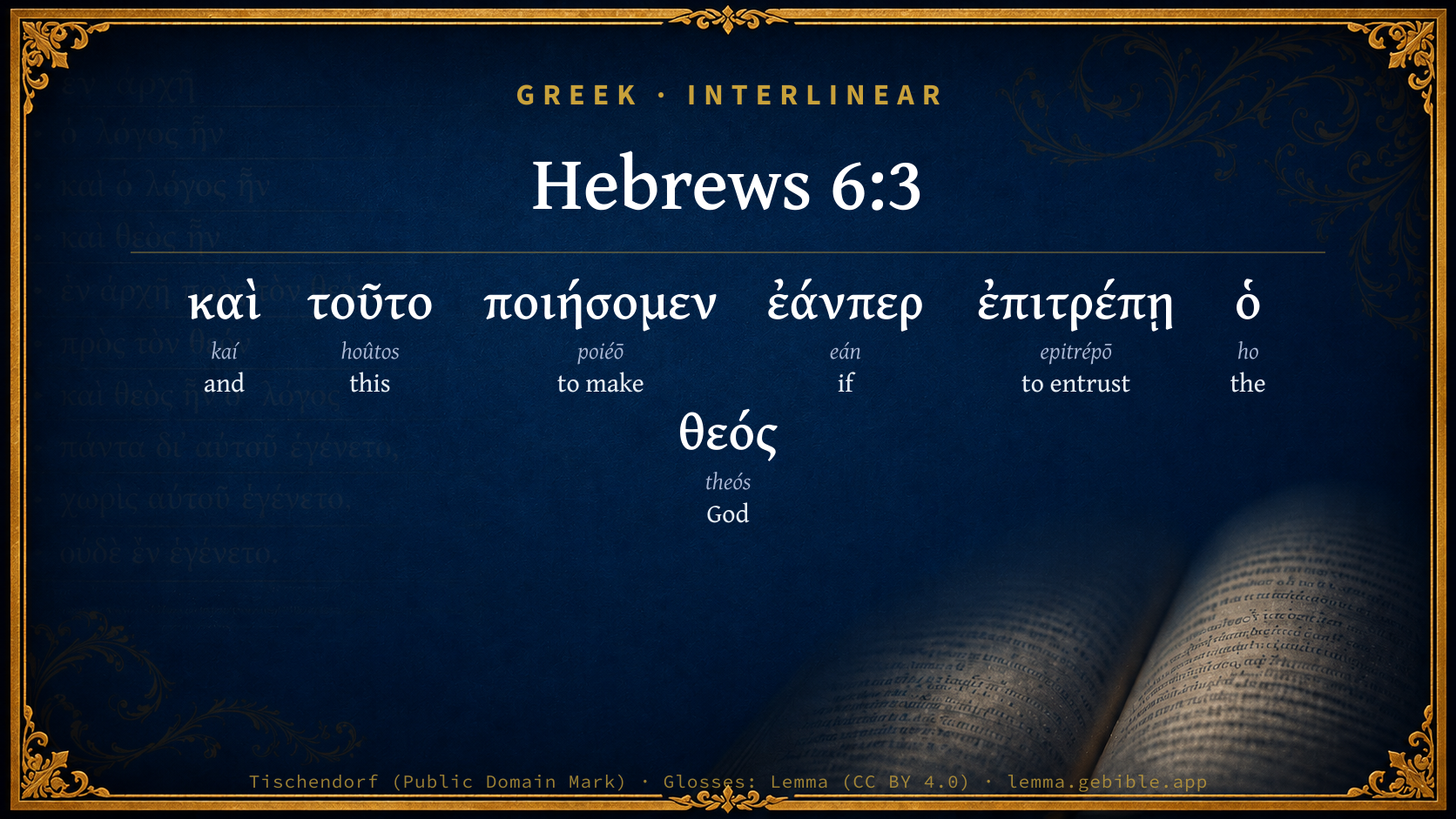
Greek (Tischendorf 8th ed.) Hebrews 6:3 appears in the Greek New Testament. The text above is from the Tischendorf 8th edition. Each word links to its Strong’s number and a concise gloss. Click any word for its full Thayer’s Greek Lexicon entry.
Download image
Cite this verse

Hebrews 6:3 (World English Bible). Public Domain. Lemma interlinear Bible study tool, https://lemma.gebible.app/v/hebrews/6/3.

Show BibTeX & RIS
BibTeX
RIS
English Translation
This will we do, if God permits.
World English Bible · Public Domain
Download a study sheet

One document with this verse’s original text, its word-by-word gloss line, the meaning frame, cross-references with their text, attributed commentary, and full source and license credits — printable, and it pastes into notes with its structure intact.

This verse Autodidact and up

Study sheet (.html) Plain text (.txt)

A passage Seminary Student

Up to 50 verses in one chapter. A passage sheet keeps up to 6 commentary sources and 12 cross-references per verse, in the order this page ranks them, and says so on the sheet whenever that leaves anything out. Ask for a single verse and you get the Autodidact verse sheet above.

Everything on this page stays free to read, with no account — the sheet is a download of what is already on screen, not access to it.

Want to remove ads? Support Godless Engineer
Compare translations 3

The same verse in 3 English versions, stacked beneath the original-language interlinear above. Click any original word for its lexicon entry.

Each is an independent rendering of the whole verse — the interlinear is not word-aligned to these translations.

Highlighted words mark where these versions differ — a whole-verse word diff, not a word-by-word alignment.

  • World English Bible Public Domain
    This will we do, if God permits.
  • King James Version Public Domain
    And this will we do, if God permit.
  • unfoldingWord Literal Text CC BY-SA 4.0
    And this we will do, if God permits.

unfoldingWord Literal Text — © unfoldingWord, licensed CC BY-SA 4.0. Word-aligned USFM3 via Door43 (git.door43.org/unfoldingWord/en_ult).

Versions to compare (up to 4)

3 of 4 selected

Show all 19 translations

Every available English version of this verse, each an independent rendering of the whole verse.

  • World English Bible Public Domain
    This will we do, if God permits.
  • Berean Standard Bible Public Domain
    And this we will do, if God permits.
  • Majority Standard Bible Public Domain
    And this we will do, if God permits.
  • King James Version Public Domain
    And this will we do, if God permit.
  • American Standard Version (1901) Public Domain
    And this will we do, if God permit.
  • Revised Version (1885) Public Domain
    And this will we do, if God permit.
  • Geneva Bible (1599) Public Domain
    And this will we doe if God permit.
  • Douay-Rheims (1899) Public Domain
    And this will we do, if God permit.
  • Young's Literal Translation Public Domain
    and this we will do, if God may permit,
  • Literal Standard Version CC BY-SA 4.0
    and this we will do, if God may permit,
  • Unlocked Literal Bible CC BY-SA 4.0
    We will also do this if God permits.
  • unfoldingWord Literal Text CC BY-SA 4.0
    And this we will do, if God permits.
  • Darby Bible Public Domain
    and this will we do if God permit.
  • World Messianic Bible Public Domain
    This will we do, if God permits.
  • Webster's Bible Public Domain
    And this will we do, if God permit.
  • Free Bible Version CC BY-SA 4.0
    So let's get on with it, as God gives us the opportunity!
  • Bible in Basic English Public Domain
    Now we will do this, if God lets us.
  • Text-Critical English NT CC BY 4.0
    And this we will do, if God permits.
  • Tyndale New Testament (1534) Public Domain
    And so will we do yf God permitte.

Literal Standard Version (2020), Covenant Press — licensed CC BY-SA 4.0. Text via the HelloAO Bible API (eBible.org). Unlocked Literal Bible (unfoldingWord) — licensed CC BY-SA 4.0. Text via the HelloAO Bible API (eBible.org). unfoldingWord Literal Text — © unfoldingWord, licensed CC BY-SA 4.0. Word-aligned USFM3 via Door43 (git.door43.org/unfoldingWord/en_ult). Free Bible Version, Dr. Jonathan Gallagher — licensed CC BY-SA 4.0. Text via the HelloAO Bible API (eBible.org).

Word by word

More ways to search: Search by grammar → Find every occurrence → Compare this word →

Practice this passage: Drill this verse → Learn its vocabulary →

About this verse

These counts appear in no published source. They are computed here, from the morphology-tagged text and Lemma’s own curated glosses. What Lemma adds →

7
words
7
distinct lemmas
General Epistles
section

Notable vocabulary

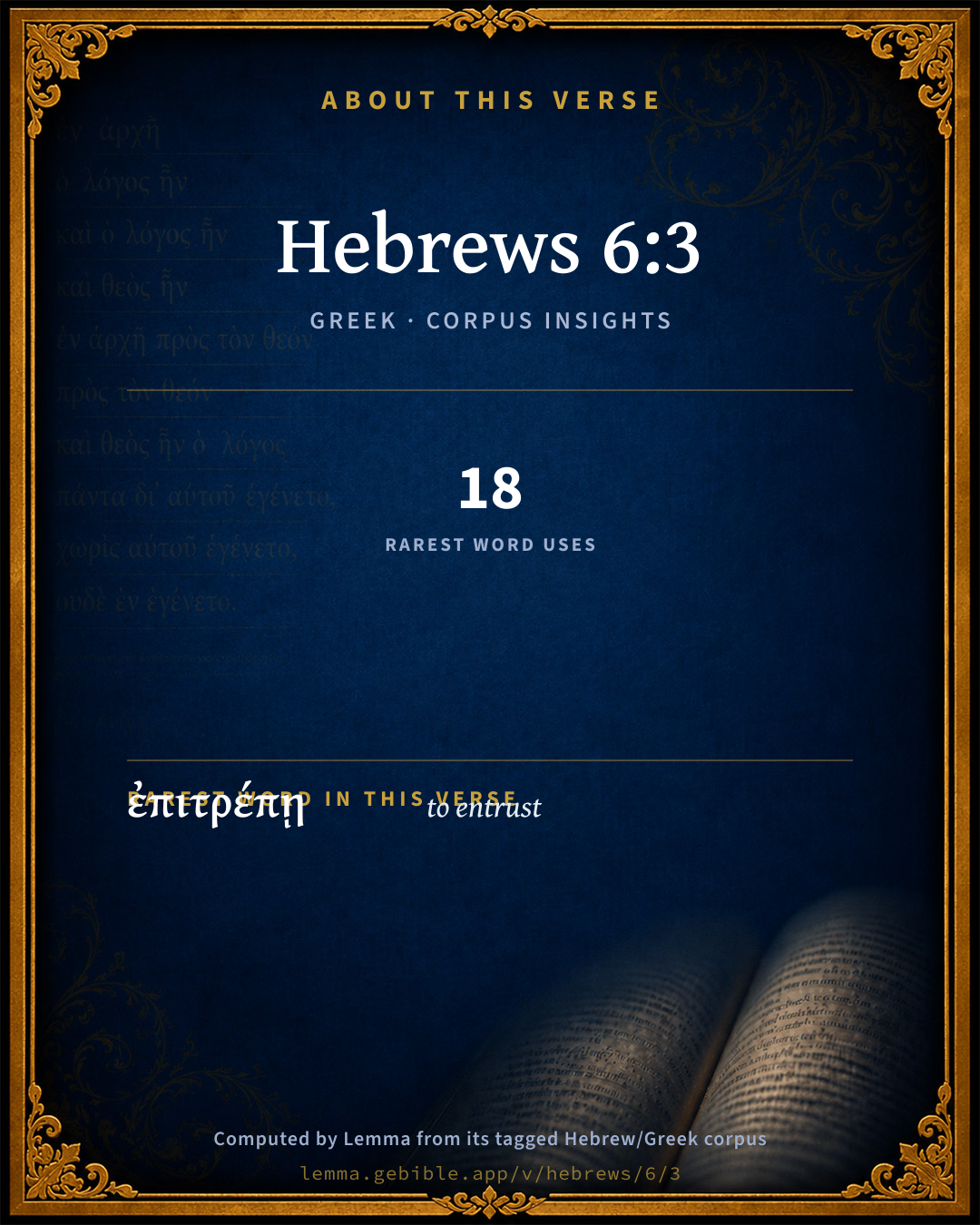
The rarest word here is ἐπιτρέπῃ to entrust G2010 — appearing just 18 times in the whole Greek New Testament.

Shared distinctive vocabulary

ἐπιτρέπῃ to entrust G2010 occurs in 17 verses of the Greek New Testament. Also found in:

Cross-references

5

Topical passages linked to Hebrews 6:3 in the Treasury of Scripture Knowledge — connected by theme and wording, ordered by reader-vote popularity; previews shown in the World English Bible.

  • Acts 18:21 but taking his leave of them, and saying, "I must by all means keep this coming feast in Jerusalem, but I will return again to you if God wills," he set sail from Ephesus.
  • 1 Corinthians 16:7 For I do not wish to see you now in passing, but I hope to stay a while with you, if the Lord permits.
  • 1 Corinthians 4:19 But I will come to you shortly, if the Lord is willing. And I will know, not the word of those who are puffed up, but the power.
  • James 4:15 For you ought to say, "If the Lord wills, we will both live, and do this or that."
  • Romans 15:32 that I may come to you in joy through the will of God, and together with you, find rest.

Cross-references courtesy of OpenBible.info (CC BY 4.0).

Commentary

Notes on Hebrews 6:3 from classic Christian and Jewish commentators (each source and its license shown beneath its notes). The classic Christian expositions comment on the surrounding passage and are grouped to its opening verse, so a note may address several verses; the Jewish commentaries on the Tanakh (Rashi and others) are per-verse, so they appear only where the commentator wrote on this verse.

Lemma curates 59 commentaries, every one of them public domain or Creative Commons licensed, each selected and text-cleaned for this edition rather than reprinted as found. About our sources →

Joseph Benson's Commentary

Heb 6:3-5. And this we will do — We will go on to perfection; if God permit — That is, afford assistance and opportunity. And we will do this the rather, and the more diligently, because it is impossible for those who were once enlightened — With the knowledge of the truth as it is in Jesus, (Eph 4:21,) and have been made free thereby from the bondage of sin and Satan, Joh 8:31-36; and have tasted the heavenly gift — The gift of righteousness imputed to them, Rom 5:17; faith counted for righteousness; or the remission of sins through faith in Christ, sweeter than honey to the taste; and have been made partakers of the Holy Ghost — Of the witness and fruits of the Spirit of God; and have tasted the good word of God — Have had a relish for and delight in the doctrine of the gospel, have fed upon it, and been nourished by it; and the powers of the world to come — Μελλοντος αιωνος, of the future age, as the Christian dispensation was termed by the Jews, the Messiah being called by the LXX. in their interpretation of Isa 9:6, (instead of the everlasting Father, which is our translation of the clause,) πατηρ του μελλοντος αιωνος, the Father of the age to come. If the expression be thus taken, by the powers, here spoken of, we are to understand the privileges and blessings of the gospel dispensation in general, including, at least with regard to some, the miraculous gifts conferred on many of the first Christians. But as the future state, or future world, may be meant, the expression may be understood of those earnests and anticipations of future felicity which every one tastes who has a hope full of immortality. “Every child that is naturally born, first sees the light, then receives and tastes proper nourishment, and partakes of the things of this world. In like manner the apostle, comparing spiritual with natural things, speaks of one born of the Spirit as seeing the light, tasting the sweetness, and partaking of the things of the world to come.” — Wesley.

Joseph Benson's Commentary on the Old and New Testaments (1811–1818) — public domain. Text from a community e-Sword module.

Tyndale Open Study Notes

Tyndale Open Resources

6:3 The author is implicitly exhorting his readers to maturity, not only in their understanding but in everything (cp. 4:11; 5:14; 10:23-39; 12:1-13).

Tyndale Open Study Notes — © Tyndale Open Resources, licensed CC BY-SA 4.0. Text via the HelloAO Bible API.

Bengel's Gnomon

Johann Albrecht Bengel

Heb 6:3. Τοῦτο, this) The reference is to φερώμεθα, let us go on.—ἐάν περ, if indeed) For, in the following verse, refers to this. Without the Divine blessing, the cultivation of the ground does not succeed; Heb 6:7.

Bengel's Gnomon of the New Testament — English translation (T&T Clark, Edinburgh, 1860) — public domain. Text from a community e-Sword module.

Meyer's Critical & Exegetical Commentary

Heinrich August Wilhelm Meyer

Heb_6:3. Repetition of the exhortation, Heb_6:1, in order immediately to give thereto so much the greater emphasis by attaching the warning, Heb_6:4 ff.

καὶ τοῦτο ποιήσωμεν] just this let us do.

τοῦτο] sc. τὸ ἐπὶ τὴν τελειότητα φέρεσθαι, Heb_6:1; Theodoret, ἀντὶ τοῦ σπουδάσωμεν, ἐπιθυμήσωμεν, πάντα πόνον ὑπὲρ τῆς τελειότητος ἀσπασώμεθα. Το τοῦτο we cannot supplement from the participial clause, Heb_6:1 : τὸ θεμέλιον καταβάλλεσθαι, as was done, on the presupposition of the reading ποιήσομεν, by Jac. Cappellus (who, however, besides this gives also the true reference, and comes to no decision), Schlichting, Grotius, Dorscheus, Wittich, Limborch, Calmet, Zachariae, Storr, Abresch, and is still done by Hofmann, as it is also regarded by Tholuck as possible; in such wise that there should issue the sense: this also, namely, the laying of the foundation, the author will do, sc. at another and more favourable time, if God permit. Forapart from the unsuitability of the sense resulting, according to which the author would declare his intention of treating the more difficult earlier than the more easy, which latter surely contains the preliminary condition for the understanding of the formeragainst such supplementing the fact is decisive, that the μή in connection with καταβαλλόμενοι, Heb_6:1, would be arbitrarily set aside; against the apprehending in this sense, the fact that for the expression of such a meaning ποιήσομεν δὲ καὶ τοῦτο must have been written.

ἐάνπερ ἐπιτρέπῃ ὁ θεός] provided that God permits it (1Co_16:7), inasmuch, namely, as all things, even the carrying into effect of good resolutions, are subordinated to the higher decree of God. Incomprehensible, therefore, is the assertion of de Wette, who has therein followed Abresch, that the addition ἐάνπερ κ.τ.λ. is plainly irreconcilable with the taking of our verse in the sense of a demand. For the supposition, that in this case the encouraging belief in Gods gracious assistance must be expressed, is an altogether erroneous assumption, since the author in the present passage is by no means aiming at the consolation of the readers, but, on the contraryas is shown by Heb_6:4-8at the alarming of them. To an encouraging and pointing to Gods gracious help the discourse first advances, Heb_6:9-10.

Meyer — Critical and Exegetical Commentary on the New Testament — English translation by Peter Christie, edited by Frederick Crombie (T&T Clark, 1880) — public domain. Text from a community e-Sword module.

Expositor's Greek Testament

ed. W. Robertson Nicoll

Heb 6:3 . καὶ τοῦτο ποιήσομεν : “and this will we do,” that is, we will go on to perfection and not attempt again to lay a foundation. So Theoph.: τὸ ἐπὶ τὴν τελειότητα φέρεσθαι . And Primasius: “et hoc faciemus, i.e. , et ad majora nos ducemus, et de his omnibus quae enumeravimus plenissime docebimus nos, ut non sit iterum necesse ex toto et a capite ponere fundamentum”. Hofmann refers the words to the participial clause, an interpretation adopted even by von Soden [“nämlich abermal Fundament Einsenken”] which only creates superfluous difficulty. The writer, feeling as he does the arduous nature of the task he undertakes, adds the condition, ἐάνπερ ἐπιτρέπῃ ὁ Θεός , “if God permit”. The addition of περ has the effect of limiting the condition or of indicating a sine qua non ; and may be rendered “if only,” “if at all events,” “if at least”. This clause is added not as if the writer had any doubt of God’s willingness, but because he is conscious that his success depends wholly on God’s will. Cf. 1Co 16:7 .

The Expositor's Greek Testament, edited by W. Robertson Nicoll (1897–1910) — public domain. Text from a community e-Sword module.

Jamieson, Fausset & Brown

Robert Jamieson, A. R. Fausset & David Brown

will we do--So some of the oldest manuscripts read; but others, "Let us do." "This," that is, "Go on unto perfection."

if God permit--For even in the case of good resolutions, we cannot carry them into effect, save through God "working in us both to will and to do of His good pleasure" (Phi 2:13). The "for" in Heb 6:4 refers to this: I say, if God permit, for there are cases where God does not permit, for example, "it is impossible," &c. Without God's blessing, the cultivation of the ground does not succeed (Heb 6:7).

Jamieson, Fausset & Brown — Commentary Critical and Explanatory on the Whole Bible (1871) — public domain (CC PDM 1.0). Text via the HelloAO Bible API.

Adam Clarke's Commentary

Verse 3. And this will we do] God being my helper, I will teach you all the sublime truths of the Gospel; and show you how all its excellences were typified by the law, and particularly by its sacrificial system.

Adam Clarke's Commentary on the Bible (1810–1826) — public domain. Text from a community e-Sword/MySword module.

John Calvin's Commentaries

3. This will we do, etc. A dreadful denunciation follows; but the Apostle thus fulminated, lest the Jews should indulge their own supineness, and trifle with the favor of God; as though he had said, “There ought not in this case it to be any delay; for there will not always be the opportunity for making progress; it is not in man’s power to bound at once, whenever he pleases, from the starting point to the goal; but progress in our course is the special gift of God.”

John Calvin's Commentaries (1540-1563) — public domain. Text from the Calvin Translation Society English edition (1840s-50s) via the Christian Classics Ethereal Library (ccel.org). Calvin's coverage is partial (roughly two-thirds of the Bible); uncommented books and verses are honest gaps, never fabricated. The 19th-century editor's footnotes and remarks are omitted so the notes are faithfully Calvin's own voice.

Ellicott's Commentary for English Readers

(3) And this will we do, if God permit.—There may be some with whom it will be impossible for him thus to press on to maturity of teaching and of Christian experience. There is a case excepted by God Himself from all efforts of the Christian teacher; in this case, though nothing can avail except the laying of a new foundation of repentance, God has appointed no agencies by which such foundation can be laid.

A Bible Commentary for English Readers, edited by Charles John Ellicott (1878–1897) — public domain. Text from a community e-Sword module.

The Cambridge Bible for Schools and Colleges

gen. ed. J. J. S. Perowne

3. this will we do] We will advance towards perfection. The mss., as in nearly all similar cases, vary between “we will do” (א, B, K, L) and “let us do” (A, C, D, E). It is difficult to decide between the two, and the variations may often be due (1) to the tendency of scribes, especially in Lectionaries, to adopt the hortative form as being more edifying; and (2) to the fact that at this period of Greek the distinction in sound between ποιήσομεν and ποιήσωμεν was small.

if God permit] These sincere and pious formulae became early current among Christians (1Co_16:7; Jas_4:15).

The Cambridge Bible for Schools and Colleges (gen. ed. J. J. S. Perowne; Cambridge University Press, 1878–1918) — public domain. Text from a community e-Sword module.

John Gill's Exposition

And this will we do, if God permit. That is, leave the rites and ceremonies of the law, which were the rudiments, or first principles of the Gospel, and go on to a more perfect knowledge of Gospel truths; and, not lay again as the foundation of the ministry, or insist upon them as if they were the main things, even the above articles of the Jewish creed, especially in the, way and manner in which they had been taught and learnt: the sense is, that the apostle and his brethren, in the ministry were determined to insist upon the more solid and substantial parts of the Gospel, and which tended to bring on their hearers to perfection; and that it became the believing Hebrews to seek after a greater degree of knowledge under the ministry of the word. It is, or at least should be, the determination of a Gospel minister, to preach Christ, and the great truths of the Gospel; and wheresoever God has called him to it, though there may be many adversaries, and though he may be reproached, calumniated, and deserted: resolution in preaching the Gospel, and adhering to it, is very commendable in a minister; and it is very laudable in hearers to attend to it, stand by it, and search further into it; and which both should determine upon with a regard to the will of God, "if God permit": God's permission is much to be observed in the ministry of the word, in giving gifts to men, in placing them out here and there, where they shall exercise them, in directing them to subjects, and in making their ministry useful and successful: and it may be observed in general, that nothing can be done, or come to pass, good or bad, but what God permits or wills to be done; no good things, no actions, civil, natural, moral, or spiritual; no evil things, the evil of punishment, afflictions, the persecutions of wicked men, the temptations of Satan, heresies, and even immoralities.

And this will we do, if God permit. That is, leave the rites and ceremonies of the law, which were the rudiments, or first principles of the Gospel, and go on to a more perfect knowledge of Gospel truths; and, not lay again as the foundation of the ministry, or insist upon them as if they were the main things, even the above articles of the Jewish creed, especially in the, way and manner in which they had been taught and learnt: the sense is, that the apostle and his brethren, in the ministry were determined to insist upon the more solid and substantial parts of the Gospel, and which tended to bring on their hearers to perfection; and that it became the believing Hebrews to seek after a greater degree of knowledge under the ministry of the word. It is, or at least should be, the determination of a Gospel minister, to preach Christ, and the great truths of the Gospel; and wheresoever God has called him to it, though there may be many adversaries, and though he may be reproached, calumniated, and deserted: resolution in preaching the Gospel, and adhering to it, is very commendable in a minister; and it is very laudable in hearers to attend to it, stand by it, and search further into it; and which both should determine upon with a regard to the will of God, "if God permit": God's permission is much to be observed in the ministry of the word, in giving gifts to men, in placing them out here and there, where they shall exercise them, in directing them to subjects, and in making their ministry useful and successful: and it may be observed in general, that nothing can be done, or come to pass, good or bad, but what God permits or wills to be done; no good things, no actions, civil, natural, moral, or spiritual; no evil things, the evil of punishment, afflictions, the persecutions of wicked men, the temptations of Satan, heresies, and even immoralities.

Hebrews 6:4

heb 6:4

heb 6:4

heb 6:4For it is impossible for those who were once enlightened,.... The Syriac and Ethiopic versions render it, "baptized"; and the word is thought to be so used in Heb 10:32. And indeed baptism was called very early "illumination" by the ancients, as by Justin Martyr (i), and Clemens Alexandrinus (k), because only enlightened persons were the proper subjects of it; and the word once here used seems to confirm this sense, since baptism, when rightly administered, was not repeated; but then this sense depends upon an use of a word, which it is not certain did as yet obtain; nor does the apostle take notice of baptism in a parallel place, Heb 10:26. This gave rise to, and seems to favour the error of Novatus, that those who fall into sin after baptism are to be cut off from the communion of the church, and never more to be restored unto it; contrary to the promises of God to returning backsliders, and contrary to facts, as well as to the directions of Christ, and his apostles, to receive and restore such persons; and such a notion tends to set aside the intercession of Christ for fallen believers, and to plunge them into despair: it is better therefore to retain the word "enlightened", in its proper sense, and to understand it of persons enlightened with Gospel knowledge; there are some who are savingly enlightened by the Spirit of God, to see the impurity of their hearts and actions, and their impotency to perform that which is good, the imperfection of their own righteousness to justify them, their lost state and condition by nature, and to see Christ and salvation by him, and their interest in it; and these being "once" enlightened, never become darkness, or ever so fall as to perish; for if God had a mind to destroy them, he would never have shown them these things, and therefore cannot be the persons designed here; unless we render the words, as the Syriac version does, "it is impossible"----Nwjxy bwtd, "that they should sin again"; so as to die spiritually, lose the grace of God, and stand in need of a new work upon them, which would be impossible to be done: but rather such are meant, who are so enlightened as to see the evil effects of sin, but not the evil that is in sin; to see the good things which come by Christ, but not the goodness that is in Christ; so as to reform externally, but not to be sanctified internally; to have knowledge of the Gospel doctrinally, but not experimentally; yea, to have such light into it, as to be able to preach it to others, and yet be destitute of the grace of God:

and have tasted of the heavenly gift; either faith, or a justifying righteousness, or the pardon of sin, or eternal life; which are all spiritual and heavenly gifts of grace, and which true believers have real tastes of; and hypocrites please themselves with, having some speculative notions about them, and some desires after them, arising from a natural principle of self-love. Some think the Holy Ghost is intended; but rather Christ himself, the unspeakable gift of God's love, given from heaven, as the bread of life. Now there are some who have a saving spiritual taste of this gift; for though God's people, while unregenerate, have no such taste; their taste is vitiated by sin, and it is not changed; sin is the food they live upon, in which they take an imaginary pleasure, and disrelish every thing else; but when regenerated, their taste is changed, sin is rendered loathsome to them; and they have a real gust of spiritual things, and especially of Christ, and find a real delight and pleasure in feeding by faith upon him; whereby they live upon him, and are nourished up unto eternal life, and therefore cannot be the persons here spoken of: but there are others who taste, but dislike what they taste; have no true love to Christ, and faith in him; or have only a carnal taste of him, know him only after the flesh, or externally, not inwardly and experimentally; or they have only a superficial taste, such as is opposed to eating the flesh, and drinking the blood of Christ, by faith, which is proper to true believers; the gust they have is but temporary, and arises from selfish principles.

And were made partakers of the Holy Ghost; not his person, nor his special grace; there are some who so partake of him, as to be united to him, in whom he becomes the principle of spiritual life, and motion: such have the fruits of the Spirit, and communion with him; they enjoy his personal presence and inhabitation in them; they have received him as a spirit of illumination and conviction, of regeneration and sanctification, as the spirit of faith, and as a comforter; and as a spirit of adoption, and the earnest and seal of future glory; but then such can never so fall away as to perish: a believer indeed may be without the sensible presence of the Spirit; the graces of the Spirit may be very low, as to their exercise; and they may not enjoy his comforts, gracious influences, and divine assistance; but the Spirit of God never is, in the above sense, in a castaway; where he takes up his dwelling, he never quits it; if such could perish, not only his own glory, but the glory of the Father, and of the Son, would be lost likewise: but by the Holy Ghost is sometimes meant the gifts of the Spirit, ordinary or extraordinary, Co1 12:4 and so here; and men may be said to be partakers of the Holy Ghost, to whom he gives wisdom and prudence in things natural and civil; the knowledge of things divine and evangelical, in an external way; the power of working miracles, of prophesying, of speaking with tongues, and of the interpretation of tongues; for the extraordinary gifts of the Holy Ghost seem chiefly designed, which some, in the first times of the Gospel, were partakers of, who had no share in special grace, Mat 7:22.

(i) Apolog. 2. p. 94. (k) Paedagog. l. 1. c. 6. p. 93.

John Gill's Exposition of the Whole Bible (1746–1763) — public domain (CC PDM 1.0). Text via the HelloAO Bible API.

Trapp's Complete Commentary

John Trapp

3 And this will we do, if God permit.

Ver. 3. If God permit] If God give me life and ability, and you capacity and stability; for many fall away, whose damnation sleepeth not.

John Trapp, A Commentary or Exposition upon All the Books of the Old and New Testament (1647–1656) — public domain. Text from a community e-Sword module.

Albert Barnes' Notes on the Bible

And this will we do - We will make these advances toward a higher state of knowledge and piety. Paul had confidence that they would do it (see Heb 6:9-10), and though they had lingered long around the elements of Christian knowledge, he believed that they would yet go on to make higher attainments.

If God permit - This is not to be interpreted as if God was “unwilling” that they should make such advances, or as if it were “doubtful” whether he would allow it if they made an honest effort, and their lives were spared; but it is a phrase used to denote their “dependence” on him. It is equivalent to saying, “if he would spare their lives, their health, and their reason; if he would continue the means of grace, and would impart his Holy Spirit; if he would favor their efforts and crown them with success, they would make these advances.” In reference to anything that we undertake, however pleasing to God in itself, it is proper to recognize our entire dependence on God; see Jam 4:13-15; compare the notes on Joh 15:5.

Albert Barnes' Notes on the Bible (1834–1885) — public domain. Text from a community e-Sword/MySword module.

Haydock's Catholic Bible Commentary

And this we will do, meaning what he said in the first verse, that his design was to proceed to things more perfect, which, after some admonitions, he comes to in the next chapter, when he speaks of the priesthood of Christ. (Witham)

George Leo Haydock (1774–1849), Haydock's Catholic Family Bible and Commentary, 1859 edition — public domain. Excludes Psalms (Douay-Rheims chapter numbering differs from Protestant) and Deuterocanonical books (Catholic canon only).

Matthew Poole's English Annotations

This connects the prime cause promoting this progress, and by whom alone it can be effected, as well as his resolution of finishing his discourse of the ministry of Christ’s priesthood.

And this will we do; we will really, certainly, and constantly, leave our entrance into these Christian, fundamental principles, and proceed unto perfection in them; all of us real Christians will do this. Others make it a purpose of the apostle to handle these doctrines at another season, and that he will now proceed to instruct them in the higher mysteries of Christ and the gospel, and so finish his designed discourse about them.

If God permit; whether it refers to their proceeding from the knowledge of the Christian principles to the perfection of knowledge, or of growth in Christian graces, or of the apostle’s proceeding to open to them the higher mysteries of the gospel, it is not a kind of passive letting things to be done, or giving leave only; God is not subject to so weak a condition: but it is all act, noting God’s assistance as well as permission; for all persons and things are in his power, who worketh to will and to do, Phi 2:13. But as to a progress in Christianity and reaching the perfect man, &c., Eph 4:13, if he, the Lord of all knowledge and grace, hath delight in us, and will work this grace in us, then we shall do this, even go on unto perfection, Heb 12:2; Hos 14:5; Mal 4:6; 1Co 3:6.

Matthew Poole's English Annotations on the Holy Bible (1683–1685) — public domain. Text from a community e-Sword/MySword module.

Whedon's Commentary on the Bible

Daniel D. Whedon

3. And this—The going on to perfection.

Will we do—There is considerable authority for the reading, this let us do.

If God permit—But why this if? Would not God, of course, permit so good a thing? Alford approves the interpretation that our apostle means here to imply that our so doing is not in our own power, but must be wrought in us by God. But for that meaning a mere permit would not be the true word, but grant grace, or empower. Delitzsch thinks that the implication is, that God may not permit, because they may be already in an irrecoverable, apostate state; but that is contradictory to Heb_6:9; and, besides, we cannot admit that this irrecoverability from apostasy arises from God’s non-permission of recovery. St. Paul uses the very same words in 1Co_16:7, an indication both of his being author of this epistle and of the meaning of the phrase, which is, if God in his providence permit, by continuing life, power, and opportunity to us.

Daniel D. Whedon (gen. ed.), Commentary on the Old and New Testaments (1874–1909) — public domain. Text from a community e-Sword module.

The Pulpit Commentary

And this will we do (cf. let us do; poihswmen , A, C, D, La) if God permit; i.e. press on to perfection, as aforesaid, if only (as we firmly hope and trust, see ver. 6, etc.) you are still in a state in which God will permit advance; for (as is set forth in the following verses) there may be a retrogression from which recovery is impossible.

Deo volente. And this will we do, if God permit. We have in these words

I AN EXCELLENT RESOLUTION EXPRESSED.

1. The thing resolved upon is good. "This will we do;" i.e. leave the first principles of the doctrine of Christ, and press on unto perfection. Wishing and hoping are of little avail without resolution.

2. The form of the resolution is good. "This will we do." The writer had himself long passed beyond the elementary principles of Christianity, and had made considerable progress towards perfection; but, placing himself by the side of his readers, he says, "This will we do." It is far more inspiring to say, "Let us do," than to say, "Do ye.

II AN IMPORTANT CONDITION RECOGNIZED. "If God permit." This does not indicate any doubt on the part of the writer as to whether Christian progress was in harmony with the will of God or not. But it is a becoming acknowledgment of:

1. The absolute sovereignty of God. Our times are in his hand. "Man proposes, God disposes." The apostles frequently realized and expressed this. St. Paul: "I will return again unto you, if God will". (Act_18:21; see also Rom_15:32 1Co_4:19 Jam_4:15)

2. The uncertainty of human life and opportunities. "God in whose hand thy breath is, and whose are all thy ways." "Thou takest away their breath, they die, and return to their dust." "Ye ought to say, If the Lord will, we shall both live, and. do this, or that.

3. Human dependence upon the Divine will and help. In the matter of Christian progress we depend upon him for many things; e.g. for the preservation of our reason, the continuance of the means of grace, the help of his Holy Spirit, etc. "Apart from me," said Christ, "ye can do nothing." Let all our plans be formed in subordination to the will of God. It is not necessary that we should frequently express this sentiment; in words, saying, "If God will," or "Please God," or "If God permit," or writing "D.V" Perhaps these expressions are most frequently used by those who but feebly realize their dependence upon him. It is to be feared that as used by many they are empty forms of speech, and that in the sight of Heaven their use is an insincerity, an irreverence, and a taking of the holy Name in vain. But in all things let us cultivate the spirit of humble and hearty dependence upon the holy will of God. W.J.

The Pulpit Commentary (1880–1919), ed. H.D.M. Spence-Jones & Joseph S. Exell — public domain. Text from a community e-Sword module.

John Wesley's Explanatory Notes

And this we will do - We will go on to perfection; and so much the more diligently, because,

John Wesley, Explanatory Notes Upon the Whole Bible (1754–1765) — public domain. Text via the GEBible commentary corpus.

The People's New Testament

B. W. Johnson

3–6. If God permit. We will go on to these higher lessons if God permit. The author is led by the Spirit in what he says, and hence humbly defers all he shall say in the rest of the epistle to the will of God.

B. W. Johnson's The People's New Testament with Notes (1889–1891) — public domain. Electronic text from the Christian Classics Ethereal Library (CCEL) ThML edition.

Cambridge Greek Testament for Schools and Colleges

3. τοῦτο ποιήσομεν. We will advance towards perfection. The MSS., as in nearly all similar cases, vary between “we will do” (אBKL) and “let us do” (ACDE). It is difficult to decide between the two, and the variations may often be due (1) to the tendency of scribes, especially in Lectionaries, to adopt the hortative form as being more edifying; and (2) to the fact that at this period of Greek the distinction in sound between ποιήσομεν and ποιήσωμεν was small.

ἐάνπερ ἐπιτρέπῃ ὁ θεός. These sincere and pious formulae became early current among Christians (1Co 16:7; Jas 4:15).

Cambridge Greek Testament for Schools and Colleges (Cambridge University Press, 1896; 21 vols, various authors incl. Carr, Maclear, Plummer, Farrar, Lumby, Moule, M. R. James, Simcox) — public domain. Text from a community e-Sword module.

Alford’s Greek Testament

Henry Alford

3.] And this (viz. ἐπὶ τὴν τελειότητα φέρεσθαι, see below) we will do (on the reading, see digest. ποιήσομεν has been variously interpreted, Schlichting, Grot., Wetst., and several others, who suppose (see above) that φερώμεθα expresses the determination of the Writer, take it as referring to the participial clause μὴ πάλ. θεμέλιον καταβαλλόμενοι, and as meaning, “even (καί) this (τὸ πάλιν θεμέλιον καταβάλλεσθαι) we will do.” But surely this is impossible: first, we have to refer τοῦτο to a dependent clause, not to the whole sentence going before: and even if this could be got over, the μή attached to καταβαλλόμενοι is put aside, and the clause taken as if it were a positive one. Besides which, no convenient sense would be yielded by such a reference. For having asserted on this hypothesis that even the relaying of the foundation should be done, if God will, he goes on to say ἀδύνατον γὰρ κ.τ.λ., which would in no way (see below) fit in to the context. This being so, others, still regarding φερώμεθα as the first, refer the future ποιήσομεν to the φερώμεθα. So Primasius, “Et hoc faciemus, i. e. et ad majora nos ducemus, et de his omnibus quæ enumeravimus plenissime docebimus nos, ut non sit iterum necesse ex toto et a capite ponere fundamentum:” and Thl., τοῦτο ποιήσομεν. ποῖον; τὸ ἐπὶ τὴν τελειότητα φέρεσθαι. And doubtless so a very good sense is given. In favour of ποιήσωμεν, it may be said, that it corresponds better with the hortatory tone of φερώμεθα, and though the less obvious reading, is more in accordance with the style of the Epistle) if, that is (the force of περ in composition is to give thoroughness and universal reference to the particle to which it is attached: ἐάν, &c.: ἐάνπερ, ‘si omnino:’ so Hom. I1. ψ. 97, μίνυνθά περ ἀμφιβαλόντε ἀλλήλους, “brevi omnino amplexu fruentes.” See this well worked out, and its relation to περί, πέρας, &c. established, in Hartung’s chapter on the particle, Partikellehre i. 327-344. The effect of this meaning in hypothetical sentences like the present, is to assume the hypothesis as altogether requisite to the previous position: so Soph. Œd. C. 999, εἴπερ ζῆν φιλεῖς, “if, that is, thou lovest life:” Æsch. Ag. 28, εἴπερ Ἰλίου πόλις ἑάλωκεν, ὡς ὁ φρυκτὸς ἀγγέλων πρέπει), God permit (Œc., τὸ ἐάνπερ οὐ πρὸς τοῦτο εἶπεν, ὡς τοῦ θεοῦ οὐ πάντως ἐπιτρέποντος—ἐπιτρέπει γὰρ ἀεὶ ὁ θεὸς τὰ καλὰ καὶ τέλεια—ἀλλʼ ὡς ἔθος ἡμῖν λέγειν·—θεοῦ θέλοντος τοῦτο ποιήσωμεν. And Thl., better, ἅμα δὲ καὶ διδάσκει ἡμᾶς ἐντεῦθεν, τὸ πᾶν τῆς ἐκείνου ἐξαρτᾶν θελήσεως, καὶ μηδὲ ἐπὶ τῶν ὁμολογουμένως καλῶν τῇ οἰκείᾳ θαῤῥεῖν κ. κρίσει κ. δυνάμει. It may here again be said, that the addition after the hortatory ποιήσωμεν is as delicate and beautiful, as it is frigid in the common acceptation after the indicative ποιήσομεν. For it is God who worketh in us both to will and to do of his good pleasure, Php 2:13. And it leads the way beautifully to what follows: ‘If,’ I say, ‘God permit: for when men have once fallen away, it is a thing impossible,’ &c.).

Henry Alford, The Greek Testament (1849–1861) — public domain. Text from a community e-Sword module.

Vincent's Word Studies in the New Testament

Marvin R. Vincent

If God permit [εανπερ επιτρεπη ο θεος] . The exact formula N. T. o. Comp. 1Co 16:7; Act 18:21. Pagan parallels are twn qewn qelontwn if the gods will; qewn ejpitrepontwn the gods permitting, and qewn boulomenwn if the gods desire. An ominous hint is conveyed that the spiritual dullness of the readers may prevent the writer from developing his theme and them from receiving his higher instruction. The issue is dependent on the power which God may impart to his teaching, but his efforts may be thwarted by the impossibility of repentance on their part. No such impossibility is imposed by God, but it may reside in a moral condition which precludes the efficient action of the agencies which work for repentance, so that God cannot permit the desired consequence to follow the word of teaching.

Marvin R. Vincent, Word Studies in the New Testament (1887–1900) — public domain. Text from a community e-Sword/MySword module.

Lesson kit

Teaching starters — assembled from the data on this page, not authored interpretation. Every prompt links to the verse data it draws on. Edit before teaching.

Hebrews, in the General Epistles, opens this verse with 7 words (7 distinct Greek lemmas). Its most distinctive word is epitrépō (“to entrust”). A historical commentator’s framing appears above. Read the whole chapter for the surrounding context.

Discussion questions

  1. The word epitrépō carries the sense “to entrust.” How does it shape the verse?
  2. How does Matthew 8:21, which shares the word «to entrust», read alongside this verse?
  3. The translations on this page render this verse differently — a whole-verse word diff, not a word-by-word alignment. What might account for the different wordings?
  4. Compare how Joseph Benson's Commentary and Tyndale Open Study Notes read this verse. Where do they agree or differ?

Things to notice

Reading settings

Reading text

Shown beneath each verse's original-language words.

Old Testament
Old Testament edition

Read the OT as the Masoretic Hebrew (MT) or the Greek Septuagint (LXX).

English shown for the Greek Septuagint (in the Hebrew ↔ Greek comparison).

Comparing translations? Open the Compare panel on any verse page to stack up to four side by side.