Hebrews 12:14

Greek (Tischendorf 8th ed.) Hebrews 12:14 appears in the Greek New Testament. The text above is from the Tischendorf 8th edition. Each word links to its Strong’s number and a concise gloss. Click any word for its full Thayer’s Greek Lexicon entry.
Download image
Cite this verse

Hebrews 12:14 (World English Bible). Public Domain. Lemma interlinear Bible study tool, https://lemma.gebible.app/v/hebrews/12/14.

Show BibTeX & RIS
BibTeX
RIS
English Translation
Follow after peace with all men, and the sanctification without which no man will see the Lord,
World English Bible · Public Domain
Download a study sheet

One document with this verse’s original text, its word-by-word gloss line, the meaning frame, cross-references with their text, attributed commentary, and full source and license credits — printable, and it pastes into notes with its structure intact.

This verse Autodidact and up

Study sheet (.html) Plain text (.txt)

A passage Seminary Student

Up to 50 verses in one chapter. A passage sheet keeps up to 6 commentary sources and 12 cross-references per verse, in the order this page ranks them, and says so on the sheet whenever that leaves anything out. Ask for a single verse and you get the Autodidact verse sheet above.

Everything on this page stays free to read, with no account — the sheet is a download of what is already on screen, not access to it.

Want to remove ads? Support Godless Engineer
Compare translations 3

The same verse in 3 English versions, stacked beneath the original-language interlinear above. Click any original word for its lexicon entry.

Each is an independent rendering of the whole verse — the interlinear is not word-aligned to these translations.

Highlighted words mark where these versions differ — a whole-verse word diff, not a word-by-word alignment.

  • World English Bible Public Domain
    Follow after peace with all men, and the sanctification without which no man will see the Lord,
  • King James Version Public Domain
    Follow peace with all men, and holiness, without which no man shall see the Lord:
  • unfoldingWord Literal Text CC BY-SA 4.0
    Pursue peace with all, and the sanctification without which no one will see the Lord,

unfoldingWord Literal Text — © unfoldingWord, licensed CC BY-SA 4.0. Word-aligned USFM3 via Door43 (git.door43.org/unfoldingWord/en_ult).

Versions to compare (up to 4)

3 of 4 selected

Show all 19 translations

Every available English version of this verse, each an independent rendering of the whole verse.

  • World English Bible Public Domain
    Follow after peace with all men, and the sanctification without which no man will see the Lord,
  • Berean Standard Bible Public Domain
    Pursue peace with everyone, as well as holiness, without which no one will see the Lord.
  • Majority Standard Bible Public Domain
    Pursue peace with everyone, as well as holiness, without which no one will see the Lord.
  • King James Version Public Domain
    Follow peace with all men, and holiness, without which no man shall see the Lord:
  • American Standard Version (1901) Public Domain
    Follow after peace with all men, and the sanctification without which no man shall see the Lord:
  • Revised Version (1885) Public Domain
    Follow after peace with all men, and the sanctification without which no man shall see the Lord:
  • Geneva Bible (1599) Public Domain
    Followe peace with all men, and holinesse, without the which no man shall see ye Lord.
  • Douay-Rheims (1899) Public Domain
    Follow peace with all men, and holiness: without which no man shall see God.
  • Young's Literal Translation Public Domain
    peace pursue with all, and the separation, apart from which no one shall see the Lord,
  • Literal Standard Version CC BY-SA 4.0
    pursue peace with all, and the separation, apart from which no one will see the LORD,
  • Unlocked Literal Bible CC BY-SA 4.0
    Pursue peace with everyone, and also the holiness without which no one will see the Lord.
  • unfoldingWord Literal Text CC BY-SA 4.0
    Pursue peace with all, and the sanctification without which no one will see the Lord,
  • Darby Bible Public Domain
    Pursue peace with all, and holiness, without which no one shall see the Lord:
  • World Messianic Bible Public Domain
    Follow after peace with all men, and the sanctification without which no man will see the Lord,
  • Webster's Bible Public Domain
    Follow peace with all men, and holiness, without which no man shall see the Lord:
  • Free Bible Version CC BY-SA 4.0
    Do your best to live in peace with everybody, and look for holiness—if you don't have this you won't see the Lord.
  • Bible in Basic English Public Domain
    Let your desire be for peace with all men, and to be made holy, without which no man may see the Lord;
  • Text-Critical English NT CC BY 4.0
    Pursue peace with everyone, and holiness, for without it no one will see the Lord.
  • Tyndale New Testament (1534) Public Domain
    Embrace peace with all men and holynes: with out the which no man shall se the Lorde.

Literal Standard Version (2020), Covenant Press — licensed CC BY-SA 4.0. Text via the HelloAO Bible API (eBible.org). Unlocked Literal Bible (unfoldingWord) — licensed CC BY-SA 4.0. Text via the HelloAO Bible API (eBible.org). unfoldingWord Literal Text — © unfoldingWord, licensed CC BY-SA 4.0. Word-aligned USFM3 via Door43 (git.door43.org/unfoldingWord/en_ult). Free Bible Version, Dr. Jonathan Gallagher — licensed CC BY-SA 4.0. Text via the HelloAO Bible API (eBible.org).

Word by word

More ways to search: Search by grammar → Find every occurrence → Compare this word →

Practice this passage: Drill this verse → Learn its vocabulary →

ἁγιασμόν
hagiasmós
G38
“purification”
Noun, Accusative, Singular, Masculine
Part of Speech
Noun
Case
Accusative
Number
Singular
Gender
Masculine
Full Thayer's Definition

Origin: from G37

TDNT: 02:53,1

1. consecration, purification 2. the effect of consecration a. sanctification of heart and life
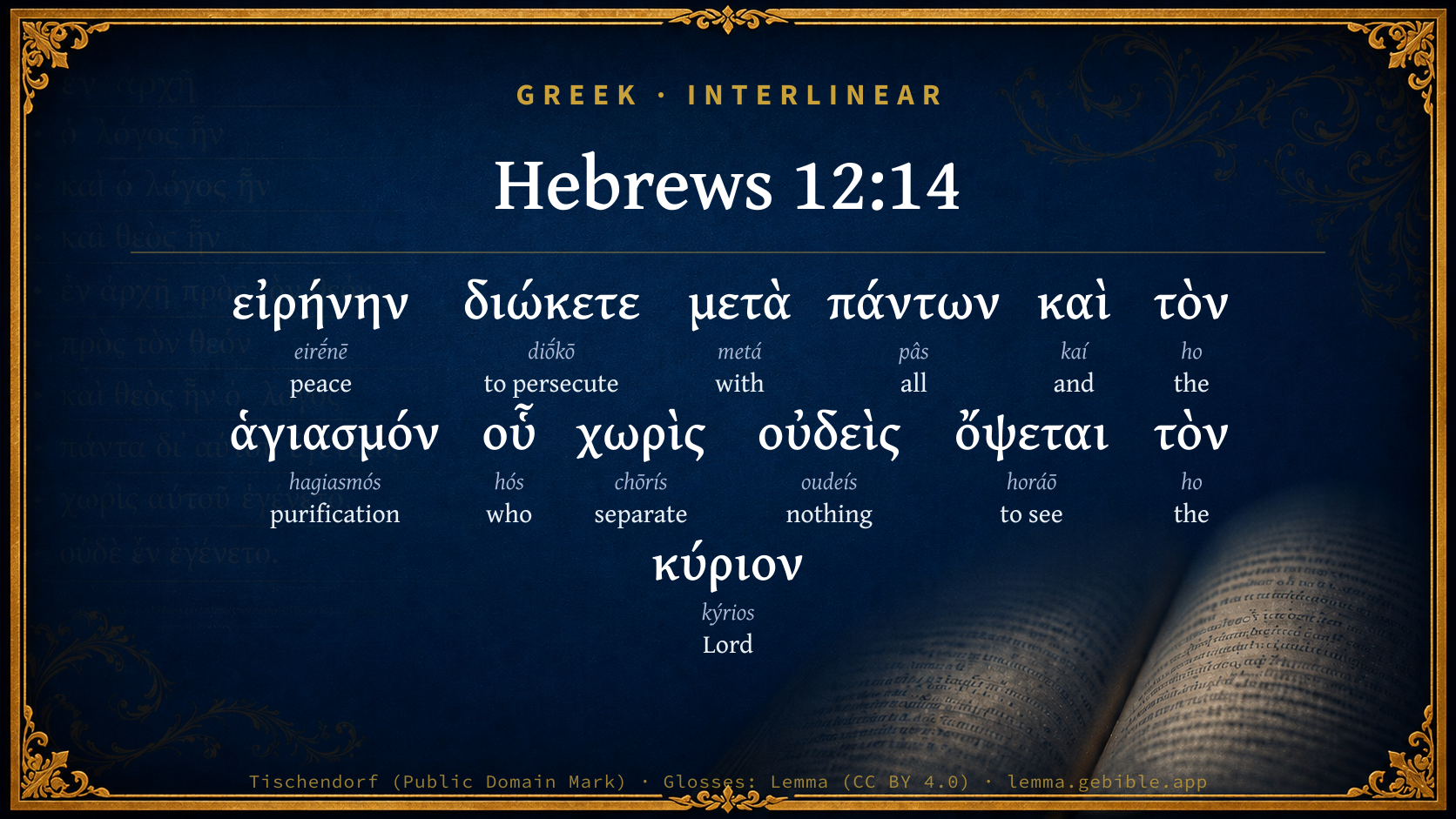
  1. εἰρήνην eirḗnē G1515 “peace” Noun, Accusative, Singular, Feminine
  2. διώκετε diṓkō G1377 “to persecute” Verb, Present, Active, Imperative, 2nd person, Plural
  3. μετὰ metá G3326 “with” Preposition
  4. πάντων pâs G3956 “all” Adjective, Genitive, Plural, Masculine
  5. καὶ kaí G2532 “and” Conjunction
  6. τὸν ho G3588 “the” Article, Accusative, Singular, Masculine
  7. οὗ hós G3739 “who” Relative pronoun, Genitive, Singular, Masculine
  8. χωρὶς chōrís G5565 “separate” Adverb
  9. οὐδεὶς oudeís G3762 “nothing” Adjective, Nominative, Singular, Masculine, Negative
  10. ὄψεται horáō G3708 “to see” Verb, Future, Middle deponent, Indicative, 3rd person, Singular
  11. τὸν ho G3588 “the” Article, Accusative, Singular, Masculine
  12. κύριον kýrios G2962 “Lord” Noun, Accusative, Singular, Masculine

About this verse

These counts appear in no published source. They are computed here, from the morphology-tagged text and Lemma’s own curated glosses. What Lemma adds →

13
words
12
distinct lemmas
General Epistles
section

Notable vocabulary

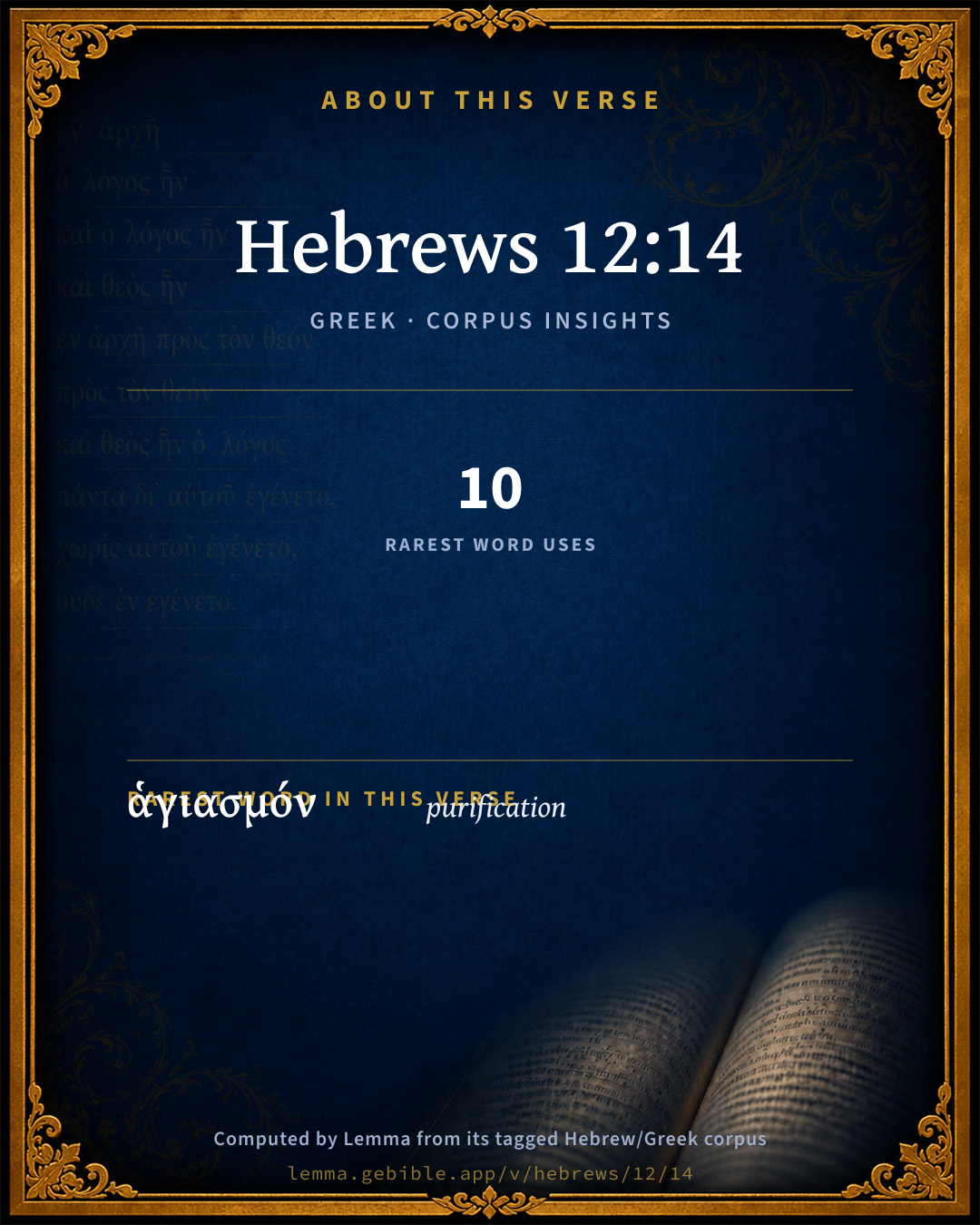
The rarest word here is ἁγιασμόν purification G38 — appearing just 10 times in the whole Greek New Testament.

Shared distinctive vocabulary

ἁγιασμόν purification G38 occurs in 10 verses of the Greek New Testament. Also found in:

Repetition

A word recurs within this verse:

Cross-references

46

Topical passages linked to Hebrews 12:14 in the Treasury of Scripture Knowledge — connected by theme and wording, ordered by reader-vote popularity; previews shown in the World English Bible.

  • 2 Corinthians 7:1 Having therefore these promises, beloved, let us cleanse ourselves from all defilement of flesh and spirit, perfecting holiness in the fear of God.
  • 1 Peter 1:15–16 but just as he who called you is holy, you yourselves also be holy in all of your behavior;
  • 1 Thessalonians 4:7 For God called us not for uncleanness, but in sanctification.
  • Matthew 5:8–9 Blessed are the pure in heart, For they shall see God.
  • Romans 12:18 If it is possible, as much as it is up to you, be at peace with all men.
  • 1 Peter 3:11 Let him turn away from evil, and do good. Let him seek peace, and pursue it.
  • Proverbs 16:7 When a man's ways please Yahweh, He makes even his enemies to be at peace with him.
  • Romans 14:19 So then, let us follow after things which make for peace, and things by which we may build one another up.
  • Psalms 34:14 Depart from evil, and do good. Seek peace, and pursue it.
  • Romans 6:22 But now, being made free from sin, and having become servants of God, you have your fruit of sanctification, and the result of eternal life.
  • 1 Thessalonians 3:13 to the end he may establish your hearts blameless in holiness before our God and Father, at the coming of our Lord Jesus with all his saints.
  • Ephesians 5:5 Know this for sure, that no sexually immoral person, nor unclean person, nor covetous man, who is an idolater, has any inheritance in the Kingdom of Christ and God.
  • 3 John 1:11 Beloved, don't imitate that which is evil, but that which is good. He who does good is of God. He who does evil hasn't seen God.
  • Isaiah 51:1 Listen to me, you who follow after righteousness, you who seek Yahweh: look to the rock whence you were hewn, and to the hold of the pit whence you were dug.
  • Revelation 22:11–15 He who acts unjustly, let him act unjustly still. He who is filthy, let him be filthy still. He who is righteous, let him do righteousness still. He who is holy, let him be holy still."
  • Hebrews 12:10 For they indeed, for a few days, punished us as seemed good to them; but he for our profit, that we may be partakers of his holiness.
  • Proverbs 15:1 A gentle answer turns away wrath, But a harsh word stirs up anger.
  • 1 Timothy 6:11 But you, man of God, flee these things, and follow after righteousness, godliness, faith, love, patience, and gentleness.
  • 1 Peter 3:13 Now who is he who will harm you, if you become imitators of that which is good?
  • Psalms 120:6 My soul has had her dwelling too long With him who hates peace.
  • Mark 9:50 Salt is good, but if the salt has lost its saltiness, with what will you season it? Have salt in yourselves, and be at peace with one another."
  • Galatians 5:22–23 But the fruit of the Spirit is love, joy, peace, patience, kindness, goodness, faithfulness,
  • James 3:17–18 But the wisdom that is from above is first pure, then peaceful, gentle, reasonable, full of mercy and good fruits, without partiality, and without hypocrisy.
  • 1 John 3:2–3 Beloved, now we are children of God, and it is not yet revealed what we will be. But we know that, when he is revealed, we will be like him; for we will see him just as he is.
  • 1 Corinthians 1:10 Now I beg you, brothers, through the name of our Lord, Jesus Christ, that you all speak the same thing and that there be no divisions among you, but that you be perfected together in the same mind and in the same judgment.
  • Genesis 13:7–9 There was a strife between the herdsmen of Abram's cattle and the herdsmen of Lot's cattle: and the Canaanite and the Perizzite lived then in the land.
  • Proverbs 17:14 The beginning of strife is like breaching a dam, Therefore stop contention before quarreling breaks out.
  • 2 Peter 3:11 Therefore since all these things are thus to be destroyed, what manner of persons ought you to be in holy living and godliness,
  • Luke 1:75 In holiness and righteousness before him all the days of our life.
  • 2 Timothy 2:22 Flee from youthful lusts; but pursue righteousness, faith, love, and peace with those who call on the Lord out of a pure heart.
  • Revelation 21:24–27 The nations will walk in its light. The kings of the earth bring the glory and honor of the nations into it.
  • Job 19:26 After my skin is destroyed, Then in my flesh shall I see God,
  • Psalms 38:20 They who also render evil for good are adversaries to me, Because I follow what is good.
  • Psalms 94:15 For judgment will return to righteousness. All the upright in heart shall follow it.
  • Psalms 133:1 See how good and how pleasant it is For brothers to live together in unity!
  • Ephesians 4:1–8 I therefore, the prisoner in the Lord, beg you to walk worthily of the calling with which you were called,
  • Revelation 22:3–4 There will be no curse any more. The throne of God and of the Lamb will be in it, and his servants serve him.
  • Genesis 32:30 Jacob called the name of the place Peniel: for, he said, "I have seen God face to face, and my life is preserved."
  • Job 33:26 He prays to God, and he is favorable to him, So that he sees his face with joy: He restores to man his righteousness.
  • Isaiah 11:6–9 The wolf shall dwell with the lamb, and the leopard shall lie down with the kid; and the calf and the young lion and the fattened calf together; and a little child shall lead them.
  • Philippians 3:12 Not that I have already obtained, or am already made perfect; but I press on, if it is so that I may take hold of that for which also I was taken hold of by Christ Jesus.
  • 1 Thessalonians 5:15 See that no one returns evil for evil to anyone, but always follow after that which is good, for one another, and for all.
  • 1 Corinthians 13:12 For now we see in a mirror, dimly, but then face to face. Now I know in part, but then I will know fully, even as I was also fully known.
  • 2 Corinthians 6:17 Therefore, "'Come out from among them, And be separate,' says the Lord, 'Touch no unclean thing. I will receive you.
  • 2 Peter 3:18 But grow in the grace and knowledge of our Lord and Savior Jesus Christ. To him be the glory both now and forever. Amen.
  • Galatians 3:21 Is the law then against the promises of God? Certainly not! For if there had been a law given which could make alive, most assuredly righteousness would have been of the law.

Cross-references courtesy of OpenBible.info (CC BY 4.0).

Commentary

Notes on Hebrews 12:14 from classic Christian and Jewish commentators (each source and its license shown beneath its notes). The classic Christian expositions comment on the surrounding passage and are grouped to its opening verse, so a note may address several verses; the Jewish commentaries on the Tanakh (Rashi and others) are per-verse, so they appear only where the commentator wrote on this verse.

Lemma curates 59 commentaries, every one of them public domain or Creative Commons licensed, each selected and text-cleaned for this edition rather than reprinted as found. About our sources →

The Biblical Illustrator

Joseph S. Exell

Heb_12:14

Follow peace.

., and holiness

The winnowing fan

I. TWO THINGS TO BE FOLLOWED. We are to follow peace and holiness; the two are consistent with each other and may be followed together. Peace is to be studied, but not such a peace as would lead us to violate holiness by conforming to the ways of unregenerate and impure men. We are only so far to yield for peace sake as never to yield a principle; we are to be so far peaceful as never to be at peace with sin: peaceful with men, but contending earnestly against evil principles. Courtesy is not inconsistent with faithfulness. It is not needful to be savage in order to be sanctified. Follow holiness, but do not needlessly endanger peace. Having thus hinted at the connection between the two, and how the two together make up a complete character, let us now take them one by one.

I. Follow PEACE, peace with all says the text--an amplification of the expression. Follow peace with all the Church. Hold what you believe with firmness, for you are not to trifle with Gods truth; but wherever you see anything of Christ, there confess relationship, and act as a brother towards your brother in Christ. Follow peace with all, especially with all your own relatives and friends at home. Call we that man a Christian who will not speak with his own brother? Follow peace with all your neighbours. & Christian man should not make himself hated by all around him, yet there are some who seem to fancy that they are true to their religion in proportion as they make themselves disagreeable. Win your neighbours by your willingness to oblige; disarm their opposition, if possible, by courtesy, by charitableness, by kindness. Follow peace with all--even with persecutors. The anvil after all breaks the hammer, because it bears every stroke and returns none; so be it with the Christian. The text says

II. FOLLOW peace, and the word follow indicates a hunter in pursuit of his game. He tracks the footsteps of his prey, he follows it over hill and dale, by the edge of the precipice, over the dangerous ridge, across the brook and along the river, through the wood and down the glen. Follow peace in this way; that is, do not merely be peaceful if nobody irritates you, but go out of your way to be peaceful; give up many things that you have a right to enjoy; the respect that is due to you be willing to forego; in fine, yield all but truth for peace sake. Charity suffereth long, and is kind. Charity beareth all things, hopeth all things, endureth all things. Often the Alpine hunter, when pursuing the chamois, will leap from crag to crag, will wear out the live-long day, will spend the night upon the mountains cold brow, and then descend to the valleys, and up again to the hills, as though he could never tire, and could never rest until he has found his prey. So perseveringly, with strong resolve to imitate your Lord and Master, follow peace with all. The next object of pursuit is a still higher attainment--would God we had reached it.

III. Follow peace with all men, and HOLINESS. The amplification of the term holiness is the solemn declaration, without which no man shall see the Lord. I understand by this sentence, in the first place, that no person who is unholy can see or understand Christ the Lord, or God His Father; that is to say, he does not know who Christ is so as to have any real fellowship with Him. He may know His name and know His history, and have some theoretical ideas of what the Redeemer did and is, but he cannot discern the spiritual character and teaching of the Lord. But perhaps the great meaning lies in this--without holiness no man can see the Lord in heaven at last. He will see Him on the throne of judgment, but he cannot see Him as his Friend, he cannot see Him in that beatific vision which is appointed for the sanctified, he cannot see Him so as to find joy and delight in the sight of Him. Now, see, the text says, Follow holiness; follow it, that is to say, you will not gain it by standing still. Nobody ever grew holy without consenting, desiring, and agonising to be holy. Sin will grow without sowing, but holiness needs cultivation. You must pursue it with determination, with eagerness, with long-continued perseverance, as a hunter pursues his prey.

II. Two THINGS TO BE AVOIDED. Looking diligently, lest any man fail of the grace of God. The first thing to be avoided is failure. There are some persons who for a time exhibit many outward evidences of being Christians, but at last the temptation comes most suitable to their depraved tastes, and they are carried away with it. They fail of the grace of God. Like a man in business who makes money for a time, but fails in the end. Some have maintained an admirable character to all appearance all their lives, and yet have failed of the grace of God because of some secret sin. It says, Looking diligently lest any man fail of the grace of God. The word is episcopountes, a word which signifies overseeing, being true bishops, looking diligently as a man on the watchtower watches for the coming foe. See the sentry pace the rampart, he looks in one direction and he sees the brushwood stirred, he half thinks it is the foe, and suspects an ambush there; he looks to the front, across the sea, does he not discern a sail in the distance? The attack may be from the seaboard; he looks to the right, across the plain, and if even a little dust should move he watches lest the foe should be on foot. So in the Church of God each one should be on his watchtower for himself and for others, watching diligently lest any man fail of the grace of God. The second thing to be avoided is uprising evil: Lest any root of bitterness springing up trouble you, and thereby many be defiled. In the centre of my lawn horse-radish will sprout up; after the smallest shower of rain it rises above the grass and proclaims its vitality. There was a garden there once, and this root maintains its old position. When the gardener cuts it down, it resolves to rise again. Now, if the gardener cannot get it quite out of the ground, it is his business constantly to cut it down. We are but men, and even when associated in church-fellowship, each one brings his own particular poisonous root, and there are sure to be bad roots in the ground. We are to watch diligently lest any of these poisonous roots spring up, for if they do they will trouble us. Sill and error always bring sorrow and division, and thereby many are defiled. (C. H. Spurgeon.)

The ideal life:

How beautiful and solemn are these words, like the swelling cadence of heavens own music. Evidently they do not emanate from this sorrow-stricken and warring world; they are one of the laws of the kingdom of heaven, intended to fashion our life on earth.

I. THERE IS OUR ATTITUDE TOWARDS GOD. Follow after holiness. In

R.V. this is rendered sanctification. And this in turn is only a Latinequivalent for setting apart, as Sinai among mountains, the Sabbath among the days of the week, the Levites among the Jews, and the Jews among the nations of the earth. But after all there is a deeper thought. Wily were people, places, and things, set apart? Was it not because God was there. We can never be holy apart from God, but when God enters the spirit of man, He brings holiness with Him. Nay, the presence of God in mall is holiness. He is the holy man in whom God dwells. He is the holier, in whom God dwells more fully. He is the holiest, who, however poor his intellect and mean his earthly lot, is most possessed and filled by the presence of God through the Holy Ghost (1Co_1:2; 1Co_6:19). Why then does the sacred writer bid us follow after holiness, as though it were an acquisition? Because, though holiness is the in-filling of mans spirit by the Spirit of God, yet there are certain very important conditions to be observed by us, if we would secure and enjoy that blessed gift.

1. Give self no quarter. It is always asserting itself in one or other of its Protean shapes. It may show itself in religious pride, in the satisfaction with which we hear ourselves remarked for our humility. It will need incessant watchfulness, because where self is there God cannot come. He will not share His glory with another.

2. Yield to God. He is ever seeking the point of least resistance in our natures. Help Him to find it, and when found, be sure to let Him have His blessed way.

3. Take time to it. This is not natural, but it may become as second nature by habitual diligence.

II. THERE IS OUR ATTITUDE TOWARDS MEN. Follow after peace. The effect of righteousness is always peace. If you are holy, you will be at peace. Peace is broken by temptation, but the holy soul has learnt to put Christ between itself and the first breath of the tempter. Peace is broken by care, dissatisfaction, and unrest, but the Lord stands round the holy soul, as do the mountains round Jerusalem, which shield off the cruel winds, and collect the rain which streams down their broad sides to make the dwellers in the valleys rejoice and sing. Others may be fretful and feverish, the subjects of wild alarms, but there is perfect peace to the soul which has God, and is satisfied. But there must be a definite following after peace. The temperaments of some are so trying. Hence the need of endeavour and patience and watchfulness, that we may exercise a wholesome influence as peacemakers.

1. Avoid becoming a party to a quarrel. It takes two to make a quarrel: never be one.

2. If opposed to the malice of men, do not avenge yourselves. Our cause is more Gods than it is our own. It is for Him to vindicate us, and He will.

3. Do not give cause of offence. If you are aware of certain susceptibilities on the part of others, where they may be easily irritated, avoid touching them, if you can do so without being a traitor to Gods holy truth.

III. THERE IS OUR ATTITUDE TOWARDS OUR FELLOW CHRISTIANS. Looking diligently lest any man fail of the grace of God. It is a beautiful provision that love to a common Lord attracts us into the fellowship of His disciples, and as no individual life truly develops in solitariness, so no Christian is right or healthy who isolates himself from the communion of saints. But we go not there only for selfish gratification, but that we may look after one another, not leaving it to the officers of the host; but each doing our own share. There are three dangers.

1. The laggards. This is the meaning of fail. The idea is borrowed from a party of travellers, some of whom lag behind, as in the retreat from

Moscow, to fall a prey to Cossacks, wolves, or the awful sleep. Let us who are in the front ranks, strong and healthy, go back to look after the weaklings, who loiter to their peril.

2. The root of bitterness. There may be some evil root lurking in some heart, hidden now, but which will bear a terrible harvest of misery to many. So was it in Israel once, when Achan conceived thoughts of covetousness, and brought evil on himself, and mourning on the host whose defeat he had brought about. If we can discover the presence of such roots of bitterness, let us, with much searching of our own souls, humility, and prayer, root them out, ere they can spring up to cause trouble.

3. The profane and earthly minded. Of these Esau is the type, who for one morsel of meat sold his birthright. Alas! are there not many such? For one momentary gratification of the flesh, they forfeit not their salvation perhaps (we are not told that even Esau forfeited that), but their power to lead, to teach, to receive and hand on blessing to the Church. (F. B. Meyer, B. A.)

Follow peace

I. THE NATURE OF THE DUTY REQUIRED: Follow peace. The word follow is full of meaning. It implies strong desire, and vigorous endeavour; both the inward and outward man are to be engaged in this necessary and delightful service. It is also implied that we shall meet with many obstacles and difficulties in the way, both from the corruptions of our own hearts, and the perverse disposition of others: so that we shall need invincible perseverance.

1. In following after peace, we must pray that our own hearts and the hearts of others may be inclined to peace; we to propose, and they to accept it, and both to maintain it when once it has been established.

2. It becomes us to avoid whatever might become an obstacle to peace. Pride must be mortified; the pride of riches, of talents, and of reputation. Let us also beware of covetousness; for the love of money has separated those who would otherwise have been happily united. In order to preserve peace it is necessary also to discountenance slander and reproach, and to guard against ill-grounded jealousies and evil surmisings. Nothing can prosper where these propensities are indulged; they are the bane of confidence, and the rottenness of friendship.

3. We must endeavour to exercise those graces which have a pacific and uniting tendency. Of this description are humility, meekness, and love. Of the exercise of such virtues it may be said, as Tertullus did of the actions of Felix, by them we enjoy much quietness.

4. As the desire of peace should excite to the exercise of grace, so also to the faithful discharge of duty. We should do unto others, as we would have others in like circumstances do unto us. It becomes us to be courteous in our deportment, neither envious of those in superior circumstances, nor haughty towards others whom providence has placed beneath us. Let us also forget ill services, and requite good ones. Above all, let us mark those who would sow the seeds of strife, and avoid them, as we would a rock or quicksand, or a house infected with the plague.

5. Let us remember that a mild and peaceable disposition is one of the greatest ornaments to the Christian character. In this we shall resemble the ever blessed God, who is emphatically styled the God of peace. Jesus is also called the Prince of Peace, and His gospel is the gospel of peace; His followers therefore ought to be men of peace.

II. THE EXTENT OF THE DUTY: FOLLOW peace with all men.

1. We must follow after peace with men of all ranks and conditions in life. We should behave with reverence towards those above us, and with courtesy towards those below us; avoiding on the one hand a proud spirit, and on the other, whatever is mean and grovelling.

2. With men of various tempers and dispositions. If masters are froward, servants should he submissive. If neighbours are unkind, ye must be patient towards them, and towards all men. Virtue of every kind shines the brighter, when contrasted with its opposite, and gains a victory over it.

3. We must follow peace with men of every character and description, let their principles be what they may; with the righteous and the unrighteous, with both saints and sinners, in (he Church and in the world.

4. Christians of other denominations, and of different religious sentiments, are entitled to our attention and benevolent regard.

5. We must follow peace, even with our enemies. We must do good, where nothing but evil is to be expected in return. (B. Beddome, M. A.)

The duty of following peace with all men

I. Attend to THE EXPLANATION OF THE TEXT, Follow peace with all men.

1. Consider, in the first place, the object which you must follow--peace with all men. All believers in Christ are the children of peace, and therefore, as far as is possible, they must live peaceably with all men. What is it that constitutes the happiness of heaven? It is the perfect and everlasting reign of peace.

2. That peace which we ought to cultivate sometimes flies away. That peace often departs from nations cannot be denied; that it often flies away front families is equally evident; and that it is not always found in the Church is a matter of deep and bitter lamentation.

3. When peace has departed it must be followed: follow peace. Some imagine that if they had no hand in driving peace away, nothing is required from them to bring it back again. But though the driving away of peace from a congregation may have been the work of a few, it is the duty of all to endeavour to bring it back again. Others, again, say, We will not prevent the return of peace, we wilt sit still and wait for its return, and when it comes we will give it a most hearty welcome. This is well so far as it goes, but it is not enough. In the pursuit of peace there must be mutual forgiveness. Have you obtained forgiveness of God? then you will reckon it both your duty and your privilege to forgive others. And be it remarked farther, that this forgiveness must be frank, and hearty, and open. In the pursuit of peace you must sacrifice your feelings, your prejudices, your angry passions, and even your interests. Blessed are the peace-makers; and blessed especially are those who make the greatest sacrifices to maintain, or to restore peace. In the pursuit of peace everything must be avoided which has a tendency to prevent the return of peace. The grounds of difference should be buried in perpetual oblivion. Even angry, discontented, suspicious looks must be avoided. A man can fight with his eyes, as well as with his tongue, or with his hands; as, therefore, there must be hearts of love, and actions of love, there must be also looks of love. In the pursuit of peace you must abound in prayer.

II. THE GREAT DUTY OF FOLLOWING PEACE MIGHT BE ENFORCED BY MANY CONSIDERATIONS.

1. The authority of God enjoins this duty. God hath called us to peace. The fruit of the Spirit is peace. If, therefore, you desire to enjoy the favour of God, which is life; or if you dread the anger of God, which is perdition, follow peace with all men.

2. Consider the Master whom you profess to serve. Is He not the Prince of Peace? Has He not made peace by the blood of His Cross? Is not His gospel, which you all profess to believe, the gospel of peace?

3. Consider the injury which you do to the Church by these unseemly contentions.

4. Consider that the hour of death is coming. You cannot die comfortably if you are not at peace with all mankind. Hasten, then, in pursuit of peace, and give yourself no rest until you have overtaken it and brought it back. (W. Smart.)

The peaceful temper:

There are many particular duties in which Christianity and worldly wisdom meet, both recommending the same course. One of these is the duty mentioned in the text, viz., that of being at peace with others. A wise adviser of this world tells any one who consults him as to his conduct in life, to beware especially of getting into quarrels with people. He tells him not only to avoid actual quarrels, but to cultivate a peaceful temper. The gospel tells us to do the same. The reason which worldly prudence suggests is the quiet and happiness of life, which are interfered with by relations of enmity to others. The reason which religion gives is the duty of brotherly-love, of which the peaceful disposition is a part. But the frequency of the advice, under either aspect, is remarkable, and shows that there is some strong prevailing tendency in human nature to which it is opposed. When we examine, then, the tempers of men, to see what there is in them which is so strongly opposed to this precept of following peace, the first thing we observe is, that people rush into quarrels from simple violence and impetuosity of temper, which prevents them from waiting a single minute to examine the merits of the case, and the facts of the case, but carries them forward possessed with a blind partiality in their own favour, and seeing nothing but what favours their own side. Again, there is the malignant temper, which fastens vindictively upon particular persons, who have been either the real or supposed authors of some disadvantage. Men of this character pursue a grudge unceasingly, and never forget or forgive. But impetuosity and malignity are not the only tempers which are opposed to the law of peace, and to the peaceful disposition. There are some very common habits of mind, which, without being so conspicuous in their manifestations, lead to a great deal of enmity of a certain kind--sometimes open enmity, sometimes, when this is avoided, still to bad relations towards others. There are many persons who can never be neutral or support a middle state of mind. If they do not positively like others, they will see some reason for disliking them; they will be irritable if they are not pleased; they will be enemies if they are not friends. They cannot bear to be in an attitude of mind which does not give active employment to the feelings on one side or the other. On this principle many of their neighbours are eyesores to them and the very sight of them interrupts their repose, when there is no real occasion for any such feelings; inasmuch as if they have furnished no cause for pleasure, they have not furnished any cause for pain either. And now, what I want to observe is, how completely this rule is opposed to the law which the apostle lays down, of following peace with all men. When we examine what the relation of peace is, we find that it is exactly that relation towards others which the temper I have described has such a difficulty in adopting, and which is so repugnant to its taste. It is not a state of active love and affection, for these we do not call being at peace, but something more: nor is it a state which admits of any ill-feeling; but it lies between the two, comprehending all kindly intentions, forbidding the least wish for anothers injury, avoiding, as much as possible, dispute and occasion of offence; consulting order, quiet, and contentment, but not arriving at more than this. Peace implies the entire absence of positive ill-will. The apostle then says that this is our proper relation toward all men. More than this applies to some, but as much as this applies to all. He would have us embrace all men within our love, so far as to be in concord with them, not to be separated from them. Be in fellowship, he says, with all men, so far as to have nothing wrong in your relation to them, nothing to disunite: follow peace with all men. Is any other principle of conduct and kind of temper indeed fit for this world in which we live? The great mass of those even whom we know and meet with in the intercourse and business of life must be comparatively nothing to us. More than this, they must be often persons who are not made after a model that we like, persons who do not sympathise with us or elicit sympathy from us. True and genuine intercourse and communication between minds, if it could be obtained, might clear up a good deal of this cloud, and remove the barrier which separates one man from another: but this is not given, and if it were, there still remains dissimilarity of tempers, gifts, and tastes, The apostle then lays down a plain rule with respect to the whole of this large section--viz., to be at peace with them. I have shown that there is a kind of temper and disposition which, without impetuosity, and without malignity, is still in opposition to the law of peace, and does in fact produce a great deal of latent, if not open enmity, in the world. I will now mention one or two reasons which have a great deal to do in promoting this temper. In the first place, it is very irksome to keep watch over ourselves, and to repel the intrusion of hostile thoughts by the simple resistance of conscience, when we are not assisted by any strong current of natural feeling in doing so. This is a difficult duty. But those who say that they either like or dislike, avoid and evade this duty. Another reason which tends to keep up the disposition which I have been describing is, that the hostile class of relations are evidently accompanied by their own pleasures in many temperaments. They furnish an excitement to them; and, at the bottom, they prefer it to a state of peace on this account, because there is agitation and a flutter of spirits in this relation; whereas peace is repose, and does not offer this play to the mind and temper. They would rather a great deal be in a state of irritation with any person for any reason than feel at all dull. To be dull is the greatest trial to them. They will stir up the scene at any rate, even at the cost of renewing vexatious subjects. It breaks the level of life; it varies the flatness of it. It is a stimulant; it keeps the spirits in motion. So, too, is the justification of dislike; the explanation how it arose and was called for. All this is much more to the taste of many than being at peace. They are not conscious of any deep malignity, but they derive a pleasure still from the disturbance of the ground, the agitation of the elements of life, which they take care shall not subside into complete repose. It was with the entire knowledge of these weaknesses and frailties of human nature, and these elements of disturbance, even in minds of average goodness, that St. Paul said--Follow peace with all men. You must not, he says, be at peace only with those to whom you are partial; that is easy enough; you must be at peace with those toward whom you entertain no partiality, who do not perhaps please you, or suit you. That is the rule of peace which the gospel lays down, and it must be fulfilled by standing guard at the entrance of our hearts, and keeping off intruding thoughts. And he says again that we must not seek excitement from the petty quarrels and discords of life, from prejudice and antipathies, and the commotion which is bred out of them. This is a poor and morbid pleasure which impoverishes and lowers every mind that indulges in it. Let us follow peace with all men, and holiness, without which no man shall see the Lord. It is not without design that these two were connected together by the apostle--following peace and holiness. A life of enmities is greatly in opposition to growth in holiness. All that commotion of petty animosity in which some people live, is very lowering, it dwarfs the spiritual growth of persons. In a state of peace the soul lives as in a watered garden, where, under the watchful eye of the Divine Source, the plant grows and strengthens. All religious habits and duties--prayer, charity, and mercy, are formed and matured when the man is in a state of peace with others--with all men; when he is not agitated by small selfish excitements and interests which divert him from himself and his own path of duty, but can think of himself, what he ought to do, and where he is going. (J. B.Mozley, D. D.)

A patterer of peace

I. WHAT IS THIS PEACE? Peace is threefold.

1. Above us: namely, reconciliation with God.

2. Within us: namely, an inward conformity of sanctified faculties, of mind, will, and affections.

3. Without us: with the creatures, especially with man, which our text speaketh of. And this external peace of man with man is nothing else but an holy agreement and consent of minds, speeches, and carriage in all good things.

II. WHAT IT IS TO FOLLOW PEACE.

1. Seek it out, and beat it out, as dogs at a loss: if we cannot find the track in one place, seek it in another.

2. Follow it with earnestness, as hunters follow their game earnestly, with strong intention, not as on a cold scent.

3. With desire to take it; for so do they.

4. With pleasure and delight in taking it. Our souls must delight in the purchase of peace. Thus Abraham hunted after peace with Lot, and obtained.

III. WITH WHOM MUST WE FOLLOW PEACE? With all men. To embrace peace with good men is not hard for a good man; for they will hardly be put out of the way, and are soon led in again; but to hold peace with evil men is praiseworthy. But with some men we must not have peace, and with many men we cannot have peace. For the former: Israel must never seek the peace of Moabites and Ammonites (Deu_23:6), and the same of the Canaanites (Ezr_9:11). If it be so by special revelation, which is no rule for the common course. But peace cannot be had with all men; some will not be at peace: wicked men will have no peace with godly men. As soon shall you reconcile darkness to light, fire and water, heaven and hell, as Cain and Abel, Isaac and Ishmael, Jews and Samaritans.

1. Though we cannot have it with all men, we must follow it with all men. If thou seekest it though thou canst not find it, it is enough for thee. First, so far as is possible (Rom_12:18). If it be not possible to recover peace but upon bad conditions, let it go; we must prefer many things before peace, as

(1) We must prefer peace with God before peace with men.

(2) We must prefer piety, and purity of religion before peace.

(3) We must prefer grace before peace: so the apostles everywhere, grace and peace. I must walk in the way of grace whether I meet with peace or not.

(4) We must prefer peace of conscience before peace with men. Secondly, there is another rule of limitation (Rom_12:18), so far as lieth in us. For it lieth not in us often to obtain peace. It may be our lot to deal with contentious, envious, proud, quarrelsome persons, that Scorn to capitulate with us, and defy peace with us, as they do our persons. Or we may have to deal with devouring men that will have no peace, unless they may swallow our names, and estates, and carry all afore them with horrible lies and suggestions. What can we do, where is so little hope of peace? Only thus: thou must have peace so far as is in thee. Motives to be considered thereunto. Christ hath died to bequeath peace. Peace with holiness makes up a full harmony in heaven and in earth. Holiness joins us with God, peace with men. Take harmony and peace out of the world, it is dissolved, heaven and earth must fall asunder. Take harmony and consent out of the body, the members are at war, and the whole tends to dissolution. Take peace from men, it is all one as to take the breath from the body, the sun out of the world. Heaven is a place of peace, and the blessedness of it belongeth only to them that make peace, and keep peace (Mat_5:9). (T. Taylor, D. D.)

A life of peace and kindness:

Dean Stanley said to the crowd of children at Westminster Abbey, on Innocents Day, December 28th: I knew once a very famous man, who lived to be very old--who lived to be eighty-eight. He was always the delight of those about him. He always stood up for what was right. His eye was like an eagles when it flashed fire at what was wrong. And how early do you think he began to do this? I have an old grammar which belonged to him, all tattered and torn, which he had when a little boy at school; and what do you think I found written, in his own hand, in the very first page? Why, these words: Still in thy right hand carry gentle peace, to silence vicious tongues--be just, and fear not. That was his rule all through life, and he was loved and honoured down to the day when he was carried to his grave. Peaceable holiness:--It was a saying of the pious Richard Baxter, recorded by himself in the History of his own Times: While we wrangle here in the dark we are dying, and passing to that world which will decide all our controversies: and the safest passage thither is by peaceable holiness.

Gods love of peace:

Of all the birds the dove is the most easily alarmed and put to flight at hearing a shot fired. Remember that the Holy Ghost is compared to a dove; and if you begin to shoot at each other, the Heavenly Dove will take wing and instantly leave you. The Holy Spirit is one of love and peace, not of tumult and confusion. He cannot live among the smoke and noise of fired shots: if you would grieve the Holy Spirit and compel Him to retire, you have only to commence firing at one another, and He will instantly depart. (Williams of Wern.)

The evil of disunion:

When the troops of Monmouth were sweeping the bridge (at the battle of Bothwell Brig), and Claverhouse, with his dragoons, was swimming the Clyde, the Covenanters, instead of closing their ranks against their common foe, were wrangling about points of doctrine and differences of opinion. In consequence, they were scattered by enemies whom, if united, they might have withstood and conquered. (T. Guthrie.)

Christianity and war:

Dr. Gutzlaff, who spent three years as a missionary in Siam, said: The Siamese looked with great anxiety upon the part which the English would take in the war between Quedah and themselves. When the king first heard of their neutrality, he exclaimed: I beheld, finally, that there is some truth in Christianity, which formerly I considered very doubtful. This favourable opinion influenced the people to become friendly with us. The consequence was that we gained access to persons of all ranks and of both sexes. (Tinlings Illustrations.)

Holiness, without which no man shall see the Lord

The highest end of being, and the only way to reach it

I. THE HIGHEST END OF BEING. TO see the Lord means to have loving fellowship with Him who is infinite Love.

II. THE ONLY WAY TO REACH IT. Holiness.

1. God cannot be so seen as to be admired through the medium of a corrupt heart.

2. God cannot be so seen as to be admired, through the medium of a guilty conscience.

CONCLUSION:

1. This subject serves to expose some popular religious errors.

(1) That the grand end of human existence is to get to heaven as a place. No; the true heaven of humanity is a loving vision of a loving God.

(2) That future happiness is to be obtained by the adoption of certain creeds, attendance to certain rites and ceremonies, and a punctual observance of all the ordinances of religion. No; holiness is wanted, nothing else.

2. This subject serves to show the infinite value of the work of Christ.

3. This subject serves to reveal wherein true wisdom consists.

(1) The choice of the highest end.

(2) The employment of the best means to attain the end.

(3) The application of the best time for the employment of the means. Now. (Homilist.)

Holiness

I. THE BLESSINGS OF HOLINESS.

II. THE WAY TO HOLINESS.

1. Grace is the source of it.

2. Constant progress is necessary to it.

3. Diligence is a requisite in it.

III. THE MOTIVES TO HOLINESS,

1. Troublers are destroyed by it.

2. Backsliding is prevented by it.

3. Influence for good is increased by it.

4. There is no heaven without it. (Homilist.)

Holiness demanded

I. First, then, YE ARE ANXIOUS TO KNOW WHETHER YE HAVE HOLINESS OR NOT. NOW, if our text said that without perfection of holiness no man could have any communion with Christ, it would shut every one of us out, for no one, who knows his own heart, ever pretends to be perfectly conformed to Gods will. It does not say, Perfection of holiness, mark; but holiness. This holiness is a thing of growth. As the Spirit of God waters it, it will grow till the mustard-seed shall become a tree. Well, now, let us note four sorts of people who try to get on without holiness.

1. First, there is the Pharisee. The Pharisee goes to work with outward ceremonies.

2. Then there is the moralist. He has never done anything wrong in his life. Ah, but this is not holiness before God.

3. Another individual who thinks to get on without holiness, and who does win a fair reputation in certain circles, is the experimentalist. You must be aware that there are some professed followers of Christ whose whole religious life is inward; to tell you the truth, there is no life at all; but their own profession is that it is all inward. You may say what you will about what you dream you have felt, you may write what you please about what yon fancy you have experienced; but if your own outward life be unjust, unholy, ungenerous, and unloving, you shall find no credit among us as to your being in Christ. Without holiness no man shall see the Lord.

4. There is another class of persons, happily fewer than they once were, but still there are some among us still--opinionists, who think they can do without holiness. They have learned a sound creed, or perhaps an unsound one; they think they have got hold of the truth, that they are the men, and that when they die the faithful will fail from among men. They understand theology very accurately. They are wiser than their teachers. Down with thy hopes! Heart-work, carried out afterwards into life-work, this is what the Lord wants, You may perish as well with true doctrines as with false, if you pervert the true doctrine into licentiousness.

5. But to help you still further, brethren, that man is destitute of true holiness who can look back upon his own past sin without sorrow.

6. And I am quite sure that you know nothing of true holiness if you can look forward to any future indulgence of sensual appetites with a certain degree of delightful anticipation.

7. Again, methinks you have great cause for questioning, unless your holiness is uniform. Some farmers I know in the country maintain a creditable profession in the village where they live; they go to a place of worship, and very good people they are: but there is a farmers dinner once a year; it is only once a year--we will not say anything about how they get home--the less that is said the better for their reputation. It is only once a year, they tell us; but holiness does not allow of dissipation even once a year. And we know some who, when they go on the Continent, for instance, say, Well, we need not be quite so exact there; and therefore the Sabbath is utterly disregarded, and the sanctities of daily life are neglected, so reckless are they in their recreations. Well, if your religion is not warranted to keep in any climate it is good for nothing.

8. Then, let me further remark, that those who can look with delight or any degree of pleasure upon the sins of others are not holy.

II. Now, then, for the second point: WITHOUT HOLINESS NO MAN SHALL SEE THE LORD; that is to say, no man can have communion with God in this life, and no man can have enjoyment with God in the life to come without holiness. Can two walk together except they be agreed? If thou goest with Belial dost thou think Christ will go with thee?

III. I come to my last point, which is PLEADING WITH YOU. What shall it profit a man if he gain the whole world and lose his own soul? Without holiness no man shall see the Lord. But I hear one say, It is impossible; I have tried it and I have broken down: I did try to get better, but I did not succeed; it is of no use, it cannot be done. You are right, my dear friend, and you are wrong. You are right, it is of no use going about it as you did; if you went in your own strength, holiness is a thing you cannot get; it is beyond you. But you are wrong to despair, for Christ can do it; He can do it for you, and He can begin it now. Believe on Him and He will begin with you; in fact, that believing will be the fruit of His having begun with you. (C. H. Spurgeon.)

Holiness alone fits for heaven

I. HOLINESS MAY BE CONSIDERED AS OBEDIENCE TO THE LAW OF GOD, OR AS CONFORMITY TO HIS MORAL CHARACTER. It is, however, quite immaterial which definition we adopt. As love is the fulfilling of the law, and as God is love, to obey the law, is to be like God in moral character.

II. HOLINESS IS THIS WORLD IS INDISPENSABLE TO OUR HAPPINESS IN ANOTHER,

1. It is so by the unalterable appointment of God.

2. It appears from the character of God.

3. From the fact that none of the sources or means of happiness, which the wicked possess in this world, will exist in heaven.

4. From the fact that the character of man becomes unchangeable at death.

5. From the nature of the soul.

6. If we consider what heaven is. Every being there reflects the image of God. Everything we hear in that world is the voice of praise and thanksgiving--the universal burst of gratitude, and wonder, and love, in songs of joy and transport, filling all its arches, and making all its pillars tremble.

Remarks:

1. Every impenitent sinner may be convinced, from his own experience, of the necessity of a new heart to fit him for heaven.

2. Christian brethren, what manner of persons ought ye to he in all holy conversation and godliness? (N. W. Taylor, D. D.)

Holiness

Valuable as peace is, we are not to sacrifice truth or righteousness in order to obtain it.

I. EXPLAIN THE EXHORTATION: Follow after holiness. Men in general make no pretension to holiness; and some who do, know not what it is. Many imagine that it consists merely in chastity, or putting a restraint upon the sensual appetite, which is only a particular branch of that purity to which we are here exhorted. Others suppose that it extends no farther than to outward decency of conduct, or general regularity of behaviour. Though these things do not constitute real holiness, but fall very far short of it; neither does it imply an absolute freedom from all imperfections as some have vainly imagined. Sorrow for sin, and a hatred of it, take place in every renewed heart, but not an entire exemption from its being. Holiness, however, though it is not in the present life what some make it to be, nor what the saints wish it to be, yet it is the beauty and ornament of the soul. All moral excellences are included in it; and all spiritual consolation, which is the most satisfying, is derived from it. It is our brightest resemblance to God; our principal glory in this world, and our highest happiness in the next.

1. Holiness is the fruit of sovereign and effectual grace (Eze_36:25-26).

2. True holiness is seated in the heart. It is not an outward name, but an inward nature; a Divine principle implanted.

3. Holiness is not a single grace, but an assemblage of all the graces, and extends to all the duties of the Christian life. It is not like a single luminary, but a constellation, where numerous planets intermingle their lustre and their beauty, and give additional brightness to the whole. It is not meekness, humility, faith, hope, or charity; but all these united. Thus the Church, the spouse of Christ, is described as coming up out of the wilderness, perfumed with myrrh, and frankincense, and all powders of the merchant.

4. All true holiness in man is through the mediation of Christ, and is derived from Him as the Head of His mystical body. In Him it is concentrated, like light in the sun; in us it is as light in the air, emanating from His fulness. We begin to be holy when we begin to know Christ; and we grow in holiness as we increase in the knowledge of Him. Real saints are a living image of the invisible Saviour.

5. True holiness is an abiding principle, consisting in the habitual rectitude of all the powers and faculties of the soul. It is a well of water springing up, amidst innumerable obstructions, to eternal life; a light that shineth more and more unto the perfect day. Those who seek after holiness, shall always find it; and those who love it shall never lose it.

6. We are to follow after holiness, so as to make it the object of intense and continual pursuit; to leave no duty unperformed, no means untried, in order to obtain it in a still higher degree. For this purpose let us search the Holy Scriptures, attend upon holy ordinances, keep company with holy men, and be daily conversant with holy things. Above all, let us earnestly implore the powerful influences of the Holy Spirit.

II. CONSIDER THE MOTIVE by which the exhortation is enforced: without holiness no man shall see the Lord.

1. Observe, no man, no individual, not one of all the human race, whatever be his expectations or attainments, whatever opinion he may have of himself, or whatever opinion others may entertain concerning him.

2. He shall not see the Lord. It is as it were written over the gate of heaven, Nothing enters here that defileth. The wicked shall indeed have a sight of God, in some respects; but it shall be to their everlasting sorrow and confusion. They shall behold Him as Balaam did, but not nigh; at an awful unapproachable distance they shall see Him, but not for themselves; as a Judge and Avenger, but not as a Friend or a Father.

3. Without holiness no man shall see the Lord. Not that holiness is the meritorious or procuring cause of salvation; for when we have done all that we can do, even through Divine assistance, we are unprofitable servants. Holiness accompanies salvation, and prepares for it, but not in a way of desert. Nevertheless, holiness is absolutely necessary to eternal life

(1) By a Divine and unalterable constitution.

(2) Holiness is necessary as a preparative for heaven. It is both our evidence and meetness, not in form or shadow, but in substance and reality. (B. Beddome, M. A.)

Holiness essential to a sight of Christ:

There are, unhappily, many who will talk of the everlasting covenant, and of the inscription of their own names on its pages, with as much assurance as though God had made them a special revelation; and it were at least to be expected, that with all this assumption of superior revelation there should keep pace a striving after superior holiness. It were, at least, to be hoped, that they who pronounce themselves sure of heaven, would put forth more than ordinary tokens of an increasing fitness for heaven; for it is indeed a strange anomaly if, knowing as we do, that there shall enter into the New Jerusalem nothing that defileth, and nothing that worketh abomination, men who have a title of admission, chartered and signed, may go on in recklessness and unrighteousness of living; and too commonly they who are fondest of solving all doubts by an appeal to Gods covenant, are just those who could obtain no satisfactory verdict from their own life and conversation. Our business is not so much the depending on our election as the ascertaining our election; and it is, therefore, to use the mildest language, a beginning at the wrong end, when men assume that they are elected, and then go on to be confident. The safe and the direct course is to observe whether they are changed men, and renewed men, and God-fearing men, and then to infer, though with the very deepest humility, that they are elected men. We have no such text in the Bible as this--Election, without which no man shall see the Lord; but we have this--Holiness, without which no man shall see the Lord. We go on to observe that there is a peculiarity in the expression, no man shall see the Lord, which marks a reference to the present life yet more than to the future. Every eye shall see Him, is St. Johns declaration, when looking on to the Second Advent of Christ. We know that without a single exception the descendants of Adam shall stand face to face with the anointed Judge of human kind, so that the holy and the unholy shall alike behold Him, though the one rejoicingly, while the other shall shrink from His presence; and therefore we cannot uphold it as literally true, that without holiness no man shall see the Lord, if it be on the future that we mainly fix our contemplations. But a most extensive, and at the same time a most interesting field of inquiry will open before you, if we consider the words as applicable to the present life, though, of course, without excluding a reference to the next life. The passage would seem decidedly to announce, that holiness, in some degree or other, is indispensable to the obtaining any knowledge whatever of Christ. We admit, indeed, that a thorough historical acquaintance may be obtained, whilst there is a bold persisting in a course of iniquity. But our text shows, that to whatever extent this scholastic knowledge of the scheme and nature of Christianity can be ascribed, there can be gained no sight of Christ Jesus Himself until some inroads be made on the sinfulness of our nature. And when a man is converted, and therefore renewed in the spirit of his mind--that is, the organ is obtained through which the Lord is beheld--the strength and clearness of his looking upon Christ will ever after be exactly proportioned to the advance of sanctification. If the Christian fall into gross sin, or if he conform himself to the passions and prejudices of the world, or if he encumber himself unnecessarily with cares and anxieties, the retardation in holiness will tell on the strength of the newly-acquired vision, and the view of Christ will become so obscure, that fresh witness will be given to the fact of holiness being indispensable to seeing the Lord. And, on the other hand, let the Christian be prosecuting an uncompromising warfare with corruption--let him be proceeding daily with a dominant step towards higher attainments in practical piety, and you will find that his sight of the Redeemer is continually improving. The mysteries of Christs person, the loveliness of His character, the might of His attributes, these open increasingly and shine out more vividly; and thus there is gathered an accession of proof that holiness is indissolubly connected with seeing the Lord. We would never give up that grand fundamental principle that faith is the gift of God, and that, consequently, no man can see the Lord, according to the definition we have sought to establish, unless a telescope, so to speak, be put into his hands by the Holy Ghost, and directed towards that illustrious Being in whom the natural eye discerns nothing of comeliness or form. But at the same time we are to the full as anxious to withstand the unwarranted opinion, that there can be no preparation made by the man himself; that because faith must be strictly the gift of God, all we have to do is to wait for its reception. We are assured from the Bible that it is very possible to resist the Holy Ghost, and to grieve the Holy Ghost, and that, consequently, the case is of common occurrence in which this Divine agent comes unto men, bringing with him the telescope, or the organ of vision, and then opposed by their passions and lusts, departs without bestowing the precious donation. And hence we set it forth as an indisputable position that it lies in mans power, and is manifestly mans business to remove impediments to the operations of Gods Spirit, and that though he cannot give himself the Spirit, he may throw off very much that may withstand the approaches of that Spirit. Let us go on to endeavour to show you how holiness would affect the clearness of all future contemplations of Christ. There remains nothing to be added to the work of the Saviour, in order that it may be available to the complete justification of the sinner. But, then, does imputed righteousness at all interfere with personal holiness? Not one jot. There is to be wrought in us a righteousness which is quite independent of that perfect righteousness which has been wrought out for us by Christ. The righteousness of Christ is that meritorious righteousness which deserves for us heaven; the righteousness which is wrought in our spirits is that qualifying righteousness which prepares us for heaven. And if it be thus certain that holiness, personal, inwrought holiness, is essential to that sight of the Lord which shall constitute the great bliss of heaven, we may justly argue that it is essential to those contemplations of the Saviour which are our foretastes of that bliss whilst we sojourn upon earth. And this, in other words, is the proposition laid down in our text, though the proof of that proposition may be thrown into easier and yet more popular shape. How can the man who is falling back into sin have his eye upon Christ, who condemned sin in the flesh? How can the individual who, after professedly renouncing the world, suffers himself to be entangled in its follies and allured by its flatteries, be looking fixedly towards Christ--Christ who said, Marvel not if the world hate you; ye know that it hated Me before it hated you? How can that disciple have a comforting assurance of the sacrifice of Christ in his own stead and in his own behalf, who by his lax and inconsistent conversation would falsify the account of Holy Writ, that the grace of God which bringeth salvation teaches us that denying ungodliness and worldly lusts, we should live soberly, righteously, and godly in the present world? Whenever you find that you have no clear evidence of an interest in Jesus--that there is a sensible interruption of the hope and assurance which have been wont to flow ill and gladden the soul-then let a recurrence to the sentiment of our text bring to your notice the reason, which in all likelihood best accounts for the change. Christ cannot be seen without holiness. Therefore search ye and determine whether the luminary be not riding as high and as bright as before in the firmament, and whether the sole cause why the murkiness is around you, and deep gloom seems wrought into the overhead canopy, be not in the passions which have been gratified, the concessions made, and the resolutions relaxed, so that from the witherings of a once flourishing holiness have gone up vapour and mist, which have darkened the sun, and intercepted the rich light which fell around your path. It is not that Christ withdraws His lustre; it is only that men, through carelessness, or lukewarmness, or conformity to the world, destroy the keenness of the spiritual vision. We reject, therefore, as presumptuous and insulting to God, all pretensions to privileges and rights which are independent on holiness, in thought, word, and deed; we refuse to take our test from what men style their experience; but we go alone, without hesitancy, to their practice. (H. Melvill, B. D.)

The connection between holiness and felicity

I. THE NATURE OF HOLINESS. The most intelligible description of holiness as it is inherent in us, may be this, It is a conformity in heart and practice to the revealed will of God. Now His revealed will comprises both the law and the gospel: the law informs us of the duty which we as creatures owe to God; and the gospel of the duty which, as sinners, we owe to God as reconcilable through a Mediator. Our obedience to the former implies the whole of morality, and to the latter the whole of evangelical graces, as faith in a Mediator, repentance, &c. From this definition of holiness it appears that it is absolutely necessary to see the Lord; for unless our dispositions are conformed to Him, we cannot be happy in the enjoyment of Him. I shall expatiate upon the dispositions and practices in which holiness consists, or which naturally result from it; and they are such as follow:

1. A delight in God for His holiness. Self-love may prompt us to love Him for His goodness to us; and so many unregenerate men may have a selfish love to God on this account. But to love God because He is infinitely holy, is a disposition natural to a renewed soul only, and argues a conformity to His image.

2. Holiness consists in a hearty complacence in the law of God, because of its purity. The law is the transcript of the moral perfections of God; and if we love the original we shall love the copy.

3. Holiness consists in a hearty complacence in the gospel method of salvation, because it tends to illustrate the moral perfections of the Deity, and to discover the beauties of holiness. The gospel informs us of two grand pre-requisites to the salvation of the fallen sons of men, namely, the satisfaction of Divine justice by the obedience and passion of Christ, that God might be reconciled to them consistently with His perfections; and the sanctification of sinners by the efficacy of the Holy Ghost that they might be capable of enjoying God, and that He might maintain intimate communion with them without any stain to His holiness.

4. Holiness consists in an habitual delight in all the duties of holiness towards God and man, and an earnest desire for communion with God in them. This is the natural result of all the foregoing particulars. If we love God for His holiness, we shall delight in that service in which our conformity to Him consists; if we love His law, we shall delight in that obedience which it enjoins; and if we take complacence in the evangelical method of salvation, we shall take delight in that holiness without which we cannot enjoy it.

5. To constitute us saints indeed, there must be universal holiness in practice. This naturally follows from the last, for as the body obeys the stronger volitions of the will, so when the heart is prevailingly disposed to the service of God, the man will habitually practise it.

II. THE ENDEAVOURS WE SHOULD USE TO OBTAIN THIS HOLINESS.

1. Endeavour to know whether you are holy or not by close examination.

2. Awake, arise, and betake yourselves in earnest to all the means of grace.

III. THE ABSOLUTE NECESSITY OF HOLINESS TO THE ENJOYMENT OF HEAVENLY HAPPINESS.

1. The unchangeable appointment of God excludes all the unholy from the kingdom of heaven; (see 1Co_9:6; Rev_21:27; Psa_5:4-5; 2Co_5:17; Gal_6:15).

2. The very nature of things excludes sinners from heaven; that is, it is impossible in the nature of things, that, while they are unholy, they could receive happiness from the employments and entertainments of the heavenly world. (Pres. Davies.)

Follow holiness:

This being the larger idea, explains and covers the lesser one of peace with all. As when the tide recedes, the waters fret and raise angry surfs upon the sunken rocks, but when it has advanced in full flow these rocks are submerged, and there is deep stillness over them, so in the full tide of consecration unto God all causes of disquietude are swallowed up and covered. (A. B. Davidson, LL. D.)

Heaven--none admitted but those like Jesus

At heavens gate there stands an angel with charge to admit none but those who in their countenances bear the same features as the Lord of the place. Here comes a monarch with a crown upon his head. The angel pays him no respect, but reminds him that the diadems of earth have no value in heaven. A company of eminent men advance dressed in robes of state, and others adorned with the gowns of learning, but to these no deference is rendered, for their faces are very unlike the Crucified. A maiden comes forward, fair and comely, but the celestial watcher sees not in that sparkling eye and ruddy cheek the beauty for which he is looking. A man of renown cometh up heralded by fame, and preceded by the admiring clamour of mankind; but the angel saith, Such applause may please the sons of men, but thou hast no right to enter here. But free admittance is always given to those who in holiness are made like their Lord. Poor they may have been; illiterate they may have been; but the angel as he looks at them smiles a welcome as he says, It is Christ again; a transcript of the holy child Jesus. Come in, come in; eternal glory thou shalt win. Thou shalt sit in heaven with Christ, for thou art like Him. (C. H. Spurgeon.)

No sin in heaven:

There shall in no wise enter into it anything that defileth. Heaven is not like Noahs ark, that received clean and unclean. A sinner is compared to swine (2Pe_2:22), and shall a swinish creature tread upon the golden pavement of heaven? Indeed the frogs came into king Pharaohs court, but in heaven there is no entertainment for such vermin. (T. Watson.)

Admittance to heaven

Governor Corwin says that some church members will have to make a great many explanations, before St. Peter, the reported keeper of the gate of heaven, will let them in. The character of others is so unequivocal that none will be required: the gate will fly wide open before them.

Holiness a generic disposition:

When we speak of holiness in man, we speak of that positive character which reveals itself by the exercises or manifestations of a high moral character, which repeatedly shows itself in some men as the occasion may call forth. It is not a separate and distinct grace like humility, truth, temperance, or meekness, neither is it a union of all the graces in such a way as light is the union of the primary rays of the sun. It is not an amalgamation of all the graces, but they are the means by which it shows itself in different directions and situations. There is a decided distinction between it and justice and meekness. The possession of one or other of these virtues does not imply holiness, but where holiness is, each of these graces will duly appear, h man may be temperate or just without being holy; but if he be holy all the graces will display themselves in him as a matter of course. Each of the graces will appear in him in their own proper occasions. Holiness is not one good quality, but the hand that moves beneath and around all of them. It is not one good action, but the principle that inspires all good actions; I might almost say it is like some essence we can hardly get at. It is not itself so much as the goodness of everything good in us; it is the virtue of virtues; or, in the words of an American theologian, it is not a head or part, but a complete whole, and by that we are to understand not a collection of properties, but a generic disposition which regulates all the movement of a Christians existence. Holiness, therefore, is the moral nature or character of God; and in man it is his moral nature, so that he who possesses it is a partaker of Gods nature. Thus we come back to the definition from which we set out. Holiness is Gods likeness, and when a man is disposed to think as God thinks, act as God acts, and seeks to live in unison with God and His character, then we have real and true holiness. (W. M. Taylor, D. D.)

Sight of God:

I cannot love God, said a thoughtless man, for I have never seen Him. Canst thou not? responded his companion; then thou canst do less than the little blind child who sits under the shade of the chestnut tree on the village green. She can love her father and mother, though she has never seen them, and will never see them to the latest hour of her life. There is truth here. It requires a special faculty to see God. And it is a terrible fact that this sense, the power of God-consciousness, is often all but entirely destroyed by sin.

The Biblical Illustrator, edited by Joseph S. Exell (c. 1880s–1900s) — public domain. Text from a community e-Sword module.

Lange's Commentary on the Holy Scriptures

III

Incipient apostasy must be counteracted by striving after union and sanctification

Heb_12:14-17

14Follow peace with all men [om. men], and holiness, without which no man [none] shall see the Lord. 15Looking diligently lest any man fail of [fall short of] the grace of God; lest any root of bitterness springing up, trouble you, and thereby5 [the] many 16be defiled; Lest there be any fornicator, or profane person, as Esau, who for one morsel of meat [one meal] sold his birthright.6 17For ye know how that [that also] afterward, when he would have inherited [though wishing to inherit] the blessing, he was rejected: for he found no place of repentance, though he sought it carefully [earnestly] with tears.

[Heb_12:14.—μετὰ πάντων with all, not “man;” the reference is doubtless to the brethren—any further reference would here be irrelevant.—

οὗ χωρὶς οὐδεὶς ὄψεται τὸν κύριον

Ἐπισκοποῦντες μή τις ὑστερῶν ἀπό.

Two strictly metrical lines of Iamb. Trimeter; poetic also in diction, as οὗ χωρίς for χωρὶς οὗ or ἄνευ οὗ.

Heb_12:15.—With ὑστερῶν either ἦ is understood or (with De W., Lün., Del., Alf., we must regard it as subject of ένοχλῇ, and in the resumption of the sentence ῥίζα πικρίας, is put in its place. In favor, however, of the other construction is that of πόρνος, which also requires ᾗ. The passage is imitated from Deu_29:18, where the Sept. ἐν χολῇ καὶ πικρι̇α, would almost seem, and is deemed by Del., to have originated the similarly sounding ἐνοχλῇ. Still this is, on the whole, improbable, “especially as the Alexandrine copy of the Sept., which our author constantly used, has ἐνοχλῇ” (Alf.).—ῥίζα πικρίας, is evidently to be taken of persons, and persons inclined and tempting to apostasy.—οἱ πολλοί, not many; but the many, the mass.

Heb_12:16.—ἀντὶ βρώσεως μιᾶς, in exchange for one meal.

Heb_12:17.—μετανοίας—εὗρε, I should put this in parenthesis in entire accordance with the usage of the author. μετανοίας also with Del., Alf., etc. (against Moll, who, however, seems undecided), I would refer to Esau, not to Isaac, and the following αὐτήν to εὐλογίαν, Alford’s objection to the latter, that ἐκζητήσας immediately takes up εὖρε, is by no means decisive. Ἐκζητήσος is the natural word, without any reference to the preceding εὗρεν and the μετὰ δακρύων ἐκζητήσας αὐτήν exactly describes Esau’s endeavors after the blessing, as recorded in Gen.—K.].

EXEGETICAL AND CRITICAL

Heb_12:15. Fall short of the grace, etc.—Ὑ̔στερῖν ἀπό expresses the idea of free agency and of guilt (Böhme, etc.). With the participle ὑστερῶν either ᾖ is to be supplied as frequently in the classics after μή (Böhm., Thol., etc., after the ancients), or the construction is broken, and subsequently so resumed, and completed with words from Deu_29:18 after the Cod. Alex. in the Sept., that while τὶς ὑστερῶν would be properly the subject of ἐνοχλῇ, yet in place of it, on the resumption of the sentence, stands ῥίζα πικρίας (Bl., Lün., Del.). Antioch. Epiph. is called, 1Ma_1:19, ῥίζα πικρίας.

Heb_12:17. For ye know, etc.—Luth. erroneously after the Vulg. takes ἴστε imperatively, and is seriously stumbled at the general thought of the passage, inasmuch as he refers αὐτήν to μετάνοια (with Chrys., Œc., Primas., Grot., etc.), and refers μετάνοια to the change in the mind of Esau. Hence sprang grave psychological difficulties, and a seeming antagonism, with the general teachings of Scripture. To take the clause with De W. objectively, would require that αὐτόν, sc. τόπον, should have been written. If we adhere to the certainly natural reference of αὐτήν to μετάνοια, we must (with most intpp. since Zwingle, Bez., among them Thol., Ebr., Bisp., Lün.) understand the change of mind as applying to Jacob, not to Esau. We might, however, be tempted, on account of the special sense of μετάνοια in the N. Test., and inasmuch as Isaac has not been previously named, to refer (with Theophyl., Calv., Beng., Bl., Hofm., Del., Riehm) αὐτήν to εὐλογίαν. This yields also the unobjectionable idea that the tears shed on account of the loss of the blessing remained ineffectual, inasmuch as he found in himself no place for repentance. But in that case we must, on the one hand, take this explanatory clause, “for he found,” etc., as parenthetical, which is entirely foreign to the style of the author (for Heb_7:11 and Heb_12:20, are by no means parallel;) and on the other hand, the sentiment which thus arises is, to be sure, in accordance with Heb_6:4-6; Heb_10:29, but not with the record of the life of Esau. The opinion of Del. that Esau is here presented as a type of that unpardonable sin of apostasy, which draws after it inevitable damnation, finds no support in the text itself. But the seeking with tears for the change of mind in his father, and the father’s repelling of his entreaties, are recorded Gen_27:34-38.

[To me Moll’s objections to the view which he rejects seem by no means conclusive. That the parenthesis is not opposed to the genius of our author’s style, can be shown by several examples, as Heb_7:11; Heb_7:19; Heb_7:20-21; Heb_10:7; Heb_10:23, in all of which a parenthesis is most naturally assumed. In the second place it seems by no means necessary to assume here that the personal character of Esau is in question, at least as to his ultimate repentance and individual salvation. But he held a position and enjoyed a prerogative of inestimable importance. As Isaac’s first-born he was his natural heir, and thus naturally the inheritor of the blessings covenanted to Abraham; naturally, in the line of Theocratic descent. That prerogative he recklessly threw away. He valued so little the privilege connected with the promise and covenant of God, that he forfeited it for the single gratification of his sensual appetite. The forfeiture was fixed and fatal. When he would have recovered it he was rejected, discarded, reprobated (ἀπεδοκιμάσθη), and no repentance was of any avail to secure the recovery of the once discarded and abandoned blessing. Thus his example is a most happy and forcible one for the author. He stands, as suggested by Del., as the type of him who wantonly turns away and rejects with carnal and sensual mind the blessings of God’s spiritual covenant. In his case, indeed, there is perhaps no necessity of supposing that the rejection was such as to shut him out from the kingdom of heaven. But he was inexorably excluded from the high position which he would have held as one of the line of God’s covenant people, and one of the ancestors of the Messiah, and his example is a most striking and pertinent one for the purpose of our author. I believe, therefore, that αὐτήν refers to εὐλογίαν, that the clause “for he found,” etc., is parenthetical, and that μετάνοια refers to the change in Esau’s own mind: repentance was impossible, i.e., any such repentance as could restore to him the once forfeited theocratic blessing, and that thus the doctrine is strikingly parallel and analogous to (though not precisely identical with) the author’s elsewhere repeatedly expressed doctrine of the hopelessness of the condition of the apostate.—K.].

DOCTRINAL AND ETHICAL

1. With a steadfast constancy in our Christian profession, there must be associated a corresponding walk, an advancement in holiness. Great hinderances to this arise when, along with outward afflictions, there spring up internal divisions, and a spirit of contention becomes prevalent in the Church. This is all the more in opposition to the Lord’s will, by as much as we are not merely to seek to come into relations of peace with all the brethren, even with those of different views from our own, and to preserve and cherish these relations, but also, so far as in us lies, to live in peace with all men (Rom_12:18).

2. Fellowship with the Lord, and the certainty by means of this, of yet beholding God, should not be made dependent on external things, but we should ever bear in mind that with unspiritual modes of feeling, and with a failure in sanctification, the possession of salvation is impossible, and our claim to the inheritance is lost. To our seeing of God a fulfilment of the required conditions is indispensable, Psa_17:15; Psa_42:3; Mat_5:8; 1Jn_3:2; Rev_22:3-4.

3. The Divine fulness of peace and holiness may and should serve as an example to the Church; but the appropriation of these, and reproduction in our own life, demands a zealous and continued endeavor, and a mutual brotherly, coöperation, in order that none may so withdraw himself from grace that it can no longer influence him, or be beyond his reach.

4. The roots of bitterness, those poisonous plants which, springing up, disquiet and molest a Church, as the field and vineyard of God, and bring contagion and ruin to the individuals who come in contact with them, and of whom there are but too many, are of various kinds; but preëminently dangerous is that impure and worldly feeling which, for the sake of fleeting charms of sense, and momentary enjoyments, half recklessly, half thoughtlessly, sacrifices the blessing of the promise, and a title to an inheritance in the kingdom of God.

5. As there are fruitless tears, which have no influence on the improvement and purifying of our own heart, because they stand in no connection with actual repentance, so there are also tears shed too late, and therefore in vain, which are of no avail to change the purposes of others, and have no power to modify the lot which a person has previously chosen for himself. A repentance, however, sought sincerely and earnestly, and yet in vain, is, according to the tenor of Scripture, as completely unsupposable as is a truly penitent and yet ineffectual seeking of the grace of God for the forgiveness of sin within the limits of our temporal life.

HOMILETICAL AND PRACTICAL

Better seasonably preserve a good than mourn for it when too late.—They who most zealously strive for their own sanctification, care most earnestly for the salvation of others.—He who is intent on seeing God must be in earnest in securing sanctification.—From what source the pursuit of peace derives its power, and wherein it finds its limits.

Starke:—It is lovely and beautiful to live in peace with all men, so far as it can be done with a good conscience. Yet if we cannot always be at peace, still we must never give occasion for quarrelling and strife (Psa_133:1; 1Co_11:16).—Great wisdom and careful keeping of our conscience are required, that we may neither from fear of men omit in our works or suppress in our words any thing which ought to be done and spoken, and that in neither do we say any thing which may breed dissension, and which either had better been entirely omitted, or might have been done or uttered in a better manner (Pro_13:10).—He who will not be born anew with Christ, to him His birth is of no avail. He who will not die to sin with Christ, to him His death is of no avail. He who will not rise from sin in Christ, His resurrection is of no avail (Act_3:26; Col_3:1; Joh_3:3; Joh_3:5; 1Pe_2:24).—If hatred has sprung from wrath, and the hatred continues until the sun has repeatedly set upon it, the seated hatred roots itself in the heart, and becomes a noxious plant not easily eradicated.—A Christian should be watchful over his fellow, that he may exhort him to that which is good.—There are in the Holy Scripture bad and good examples, which prove that the devil has for a long time carried on his wickedness, and that we must not indiscriminately appeal to ancient examples (1Co_11:1).—Oh, how many brethren of Esau are abroad in the world, who sell for temporal pleasures the prerogative of their birth-right, the kingdom of heaven! Woe to those who follow after them (2Ti_3:4).

Rieger:—We think that we are in the right, and that we are seeking nothing but the right; but we seek it in such a way that love, peace, compassion, are sacrificed in the pursuit, and we defile our spirits with many a stain, in which we also involve many others. He who cannot be induced to carefulness in regard to apparently small matters, will never be in genuine earnest. A mess of pottage could do Esau so much harm!—A cup of cold water may receive a reward.—To will while God wills, and awakens our own will, this effects good. To will, when grace and the season of grace have been neglected, and the door has been shut, will be in vain, and will prove no small part of one’s eternal shame and suffering (Mat_7:22-23; Luk_13:25).

Hahn:—A single act can work great ruin. Much is often lost in a brief space; for the sake of a small thing we often surrender that which is great. The false hope of its recovery we see in the example of Esau.

Heubner:—Peace would seem not to be sinful neglect, but connected with a strict adherence to the will of God.—The reward of Christian sanctification is glorious. It is the necessary condition of blessedness.—By deferring our reformation, Divine grace is often trifled away.—It is a duty to keep the Church pure, and to guard against the influence of seducers; the whole Church is defiled, dishonored and poisoned.—How miserable is the reward bestowed by sin, and how infinitely great the loss of the sinner.—Though those who come to late repentance may obtain indeed a Seir, yet it is not Canaan.

Ahlfeld:—In sanctification the Holy Spirit transforms us into the image of Christ: 1. Why should we be in earnest in regard to this sanctification? 2. Whence do we acquire the power to attain it? 3. Wherein do we perceive that we grow in it? 4. What is its goal and termination?

Menken:—The grace of God and the sanctification of our own nature, peace with God and with ourselves, and the love of peace, and a peaceful tone of feeling and of conduct in our relation with others, stand in indissoluble connection, and in the degree in which we are participant in the first, will the other also be found with us.

Footnotes:

[6]Heb_12:16.—Instead of ἀπέδοτο is found in A. C., the form ἀπέδετο, which is not an error of the copyist, but frequently occurs in the New Testament, as a specimen of forms of the later vulgar idiom. See Alex. Buttmann’s Gramm. of the New Test. Idiom, p. 41.

[7]Heb_12:18.—Even Tisch. has (in Edd. 11, IV., VII.) replaced in the text the indispensable ὄρει after ψηλαφ., following D. K. L. and nearly all the minusc., although it is wanting in Sin. A.C., 14, 17, and many ancient translations, and hence is suspected by Mill as a gloss, and rejected by Lachm., Tisch. I., and Alford. [With Tisch., Moll, etc., I should retain it, regarding this as a case (like Ἐχομεν, Rom_5:1) in which the internal evidence overbalances stronger external testimony on the other side.—K.].

Lange's Commentary on the Holy Scriptures (Critical, Doctrinal, and Homiletical), ed. John Peter Lange, English translation edited by Philip Schaff (1864–1880) — public domain. Text from a community e-Sword module.

Tyndale Open Study Notes

Tyndale Open Resources

12:14 Those who are living a holy life have confident hope of seeing the Lord (see 1 Jn 2:28; 3:21; 4:17).

Tyndale Open Study Notes — © Tyndale Open Resources, licensed CC BY-SA 4.0. Text via the HelloAO Bible API.

Bengel's Gnomon

Johann Albrecht Bengel

Heb 12:14. Μετὰ, with) Construed with εἰρήνην, peace; comp. πολλοὶ, many, Heb 12:15.—καὶ τὸν) The article makes an emphatic addition (Epitasis), ch. Heb 11:38.—ἁγιασμὸν, sanctification) of which the principal parts are chastity and sobriety: comp. Heb 12:16.—οὐδεὶς ὄψεται, no one shall see) as a priest; Rev 22:3-4, or as a son; comp. 2Sa 14:24.—τὸν Κύριον, the Lord) Who is holy, pure.

Heb 12:14. In like manner, on our part, faith not only has a moral power, but also in its own way a certain physical efficacy and operation for our justification and salvation.

Bengel's Gnomon of the New Testament — English translation (T&T Clark, Edinburgh, 1860) — public domain. Text from a community e-Sword module.

Meyer's Critical & Exegetical Commentary

Heinrich August Wilhelm Meyer

Heb_12:14. Μετὰ πάντων] with all, even the non-Christians. Comp. Rom_12:18. For limiting the πάντες, with Michaelis, Zachariae, Storr, Bleek, Stein, de Wette, Tholuck, Ebrard, Delitzsch, Alford, Maier, to the members of the Christian community, there exists no reason; and it has against it the mode of expression, since we should then have expected μετʼ ἀλλήλων.

καὶ τὸν ἁγιασμόν] the general virtue, of which the endeavour after concord is only a particular outflow. ἁγιασμός, namely, is here sanctification or moral purification in general; too restricted is the reference of Chrysostom, Theodoret, Oecumenius, Theophylact, Jac. Cappellus, Bengel, Bloomfield, and others, who explain it aswhat at 1Th_4:3 (see at that place) is certainly the correct explanationthe virtue of chastity.

τὸν κύριον] By this expression some understand God (comp. Mat_5:8), others Christ (comp. Heb_9:28). A certain decision is impossible. The beholding represents in an emblematic manner the idea of innermost union, and the whole is a designation of the Messianic blessedness in the consummated kingdom of God.

Heb_12:14-17. Exhortation to concord and to growth in holiness.

Meyer — Critical and Exegetical Commentary on the New Testament — English translation by Peter Christie, edited by Frederick Crombie (T&T Clark, 1880) — public domain. Text from a community e-Sword module.

Geneva Bible (1599)

Geneva Bible translators

We must live in peace, and holiness with all men.

Geneva Bible (1599) marginal notes — public domain. Text via Bolls.life.

Jamieson, Fausset & Brown

Robert Jamieson, A. R. Fausset & David Brown

follow peace with all men--with the brethren especially (Rom 14:19), that so the "lame" among them be not "turned out of the way" (Heb 12:13), and that no one of them "fail of the grace of God" (Heb 12:15).

holiness--a distinct Greek word from God's "holiness" (Heb 12:10). Translate here "sanctification." His is absolute holiness: our part is to put on His holiness, becoming "holy as He is holy," by sanctification. While "following peace with all men," we are not so to seek to please them, as to make God's will and our sanctification a secondary object; this latter must be our first aim. (Gal 1:10).

without which--Greek, "apart from which."

no man shall see the Lord--no man as a son; in heavenly glory (Rev 22:3-4). In the East, none but the greatest favorites are admitted to the honor of seeing the king (compare Sa2 14:24). The Lord being pure and holy, none but the pure and holy shall see Him (Mat 5:8). Without holiness in them, they could not enjoy Him who is holiness itself (Zac 14:20). The connection of purity with seeing the Lord, appears in Jo1 3:2-3; Eph 5:5. Contrast Heb 12:16 (compare Th1 4:3). In Mat 24:30; Rev 1:7, it is said that all shall see the Lord; but, that shall be as a Judge, not as their lasting portion and God, which is meant here. The Greek verb does not denote the mere action of seeing, but the seer's state of mind to which the object is presented: so in Mat 5:8 they shall truly comprehend God [TITTMANN]. None but the holy could appreciate the holy God, none else therefore shall abide in His presence. "The bad shall only see Him in His form as Son of man [compare Rev 1:13, with Rev 1:7; and Mat 24:30; Act 1:11; Act 17:31]; still it will be in the glory in which He shall judge, not in the lowliness in which He was judged. His form as God, wherein He is equal to the Father, without doubt the ungodly shall not see; for it is only 'the pure in heart who shall see God'" [AUGUSTINE]. "He shall come to judge, who stood before a judge. He shall come in the form in which He was judged, that they may see Him whom they pierced: He who was before hidden shall come manifested in power: He, as Judge, shall condemn the real culprits, who was Himself falsely made a culprit."

Jamieson, Fausset & Brown — Commentary Critical and Explanatory on the Whole Bible (1871) — public domain (CC PDM 1.0). Text via the HelloAO Bible API.

Adam Clarke's Commentary

Verse 14. Follow peace with all men] Cultivate, as far as you possibly can, a good understanding, both with Jews and Gentiles. ειρηνηνδιωκετε, pursue peace with the same care, attention, and diligence, as beasts do their game; follow it through all places; trace it through all winding circumstances; and have it with all men, if you can with a safe conscience.

And holiness] τον αγιασμον. That state of continual sanctification, that life of purity and detachment from the world and all its lusts, without which detachment and sanctity no man shall see the Lord-shall never enjoy his presence in the world of blessedness. To see God, in the Hebrew phrase, is to enjoy him; and without holiness of heart and life this is impossible. No soul can be fit for heaven that has not suitable dispositions for the place.

Adam Clarke's Commentary on the Bible (1810–1826) — public domain. Text from a community e-Sword/MySword module.

John Calvin's Commentaries

14. Follow peace, etc. Men are so born that they all seem to shun peace; for all study their own interest, seek their own ways, and care not to accommodate themselves to the ways of others. Unless then we strenuously labor to follow peace, we shall never retain it; for many things will happen daily affording occasion for discords. This is the reason why the Apostle bids us to follow peace, as though he had said, that it ought not only to be cultivated as far as it may be convenient to us, but that we ought to strive with all care to keep it among us. And this cannot be done unless we forget many offenses and exercise mutual forbearance.

As however peace cannot be maintained with the ungodly except on the condition of approving of their vices and wickedness, the Apostle immediately adds, that holiness is to be followed together with peace; as though he commended peace to us with this exception, that the friendship of the wicked is not to be allowed to defile or pollute us; for holiness has an especial regard to God. Though then the whole world were roused to a blazing war, yet holiness is not to be forsaken, for it is the bond of our union with God. In short, let us quietly cherish concord with men, but only, according to the proverb, as far as conscience allows.

He declares, that without holiness no man shall see the Lord; for with no other eyes shall we see God than those which have been renewed after his image.

John Calvin's Commentaries (1540-1563) — public domain. Text from the Calvin Translation Society English edition (1840s-50s) via the Christian Classics Ethereal Library (ccel.org). Calvin's coverage is partial (roughly two-thirds of the Bible); uncommented books and verses are honest gaps, never fabricated. The 19th-century editor's footnotes and remarks are omitted so the notes are faithfully Calvin's own voice.

Ellicott's Commentary for English Readers

(14) Follow peace.—More clearly (as our word “follow” is somewhat ambiguous), follow after peace. There is a manifest allusion to Psa_34:14 (quoted also in 1Pe_3:11). This charge is general (Rom_12:18), and must not be limited to peace with fellow Christians (Rom_14:19). The two admonitions of this verse were admirably suited to a period of persecution. Let all make peace their aim, yet not so as to sacrifice purity. (Comp. Jas_3:17.)

And holiness.—Better, and the sanctification without which no man shall see the Lord. In Heb_9:28 we have the promise that “Christ . . . shall be seen” by them that wait for Him: hence it might be supposed (especially as in the next verse we read of “the grace of God”) that “the Lord” is here, as in Heb_2:3, a designation of our Saviour. As, however, this Epistle especially brings Him before us as the Sanctifier (Heb_2:11; Heb_13:12), who leads us into the presence of God (Heb_10:19), we must rather look on these words as akin to Mat_5:8, “Blessed are the pure in heart, for they shall see God” (Rev_22:4).

A Bible Commentary for English Readers, edited by Charles John Ellicott (1878–1897) — public domain. Text from a community e-Sword module.

The Cambridge Bible for Schools and Colleges

gen. ed. J. J. S. Perowne

14–17. Need of earnest watchfulness

14. Follow peace with all men] The word “men” is better omitted, for doubtless the writer is thinking mainly of peace in the bosom of the little Christian community—a peace which, even in these early days, was often disturbed by rival egotisms (Rom_14:19; 2Ti_2:22).

and holiness] Rather, “and the sanctification” (Heb_9:13, Heb_10:10; Heb_10:29, Heb_13:12).

without which] We have here in succession two iambics:

οὗ χωρὶς οὐδεὶς ὄψεται τὸν Κύριον

ἐπισκοποῦντες μή τις ὑστερῶν ἀπό.

The Cambridge Bible for Schools and Colleges (gen. ed. J. J. S. Perowne; Cambridge University Press, 1878–1918) — public domain. Text from a community e-Sword module.

John Gill's Exposition

Looking diligently,.... Acting the part of bishops, or overseers, as the word signifies; and so this exhortation either respects officers of the church of the Hebrews, whose business it was more especially to inspect into the principles and practices of the members of it, and take care that they did not imbibe false doctrines, or live immoral lives; or rather the several members of the church, whose business it is to watch over one another, since this epistle seems to be written to the whole church.

Lest any man fail of the grace of God; not the free favour and love of God in Christ, which is everlasting, unchangeable, and from whence there is no separation; nor the grace of God implanted in the heart in regeneration, which is incorruptible, never failing, but always remains, as do faith, hope, and love; but either the whole doctrine of the Gospel, which is a declaration of the grace of God; or particularly the doctrine of free justification by the righteousness of Christ, which men may receive in vain, and fall from, Co2 6:1 to which these Hebrews might be prone: and such "fail" of it, who either come short of it, do not come up to it, receive and embrace it; or who having professed it, drop it and deny it: now such should be looked after, and such a case should be diligently looked into; because the glory of God, the honour of Christ, the good of souls, and the well being, and even the continuance of the church state are concerned:

lest any root of bitterness springing up trouble you, and thereby many be defiled; the Alexandrian copy reads , "the many", the common people, the private members of the church; though it may intend either things or persons: it may design things; and these either the corruption of nature in general, which is a root that lies hidden in a man's heart; and is a root or gall of bitterness; and is apt to spring up, and bring forth bitter fruit, and gives trouble both to a man's self and others; and is of a defiling nature, in particular sins; such as malice, strife, and contention, covetousness, lust, pride, oppression, idleness, &c. which make bitter work, and occasion great trouble in churches, oftentimes: or errors and heresies, which sometimes, like roots, lie under ground, secret and undiscovered; and are bitter ones in their effects, bringing ruin and swift destruction on the souls of men; and these sometimes spring up in churches, while ministers and members are asleep, or not so diligent and watchful as they should be; and occasion great trouble, and are very infectious, and defiling: moreover, persons may be designed; which agrees well with Deu 29:18 from whence this phrase is taken; and with the instance in the following verse, such as all immoral persons, and false teachers, particularly self-justiciaries, that preach the doctrine of justification by the works of the law: this was the capital mistake, and rooted error of the Jewish nation; and a bitter one it was; it produced many bitter fruits of pride and vain glory; and this sprung up in the church, and troubled and defiled many there and elsewhere, being spread by the abettors of it; see Act 15:24. Now, care should be taken, that no such person be in churches, holding such an error; because of the glory of God, Father, Son, and Spirit; the comfort of souls; the peace of the church, and the growth and increase of it, which must be hurt by such men and doctrines; so , "a sinful root", is used for a "wicked man", in the Apocrypha:

"In those days went there out of Israel wicked men, who persuaded many, saying, Let us go and make a covenant with the heathen that are round about us: for since we departed from them we have had much sorrow.'' (1 Maccabees 1:11)

and , "a root of bitterness", signifies, in Jewish writings (u), an error, or heresy, in opposition to a root of faith, or a fundamental doctrine.

(u) Cosri, Orat. 1. fol. 35. 1.

John Gill's Exposition of the Whole Bible (1746–1763) — public domain (CC PDM 1.0). Text via the HelloAO Bible API.

Trapp's Complete Commentary

John Trapp

14 Follow peace with all men, and holiness, without which no man shall see the Lord:

Ver. 14. Follow peace] Gr. pursue it, though it flee from you. I am for peace (saith David), but when I speak of it, they are for war, Psa 120:7.

And holiness] Or chastity, 1Th 4:4; such a holiness as is opposed to fornication and profaneness, Heb 12:16.

Without which] The article may be neuter; and then the sense is, without which following peace and holiness, or a holy peaceableness, none shall see God to their comfort.

John Trapp, A Commentary or Exposition upon All the Books of the Old and New Testament (1647–1656) — public domain. Text from a community e-Sword module.

Albert Barnes' Notes on the Bible

Follow peace with all men - Do not give indulgence to those passions which lead to litigations, strifes, wars; see the notes on Rom 14:19. The connection here requires us to understand this mainly of persecutors. The apostle is referring to the trials which those whom he addressed were experiencing. Those trials seem to have arisen mainly from persecution, and he exhorts them to manifest a spirit of kindness toward all - even though they were engaged in persecuting them. This is the temper of the gospel. We are to make war with sin, but not with people; with bad passions and corrupt desires, but not with our fellow-worms.

And holiness - Instead of yielding to contending passions and to a spirit of war; instead of seeking revenge on your persecutors and foes, make it rather your aim to be holy. Let that be the object of your pursuit; the great purpose of your life. Men might in such cases counsel them to seek revenge; the spirit of religion would counsel them to strive to be holy. In such times they were in great danger of giving indulgence to evil passions, and hence, the special propriety of the exhortation to endeavor to be holy.

Without which no man shall see the Lord - That is, shall see him in peace; or shall so see him as to dwell with him. All will see him in the day of judgment, but to “see” one is often used in the sense of being with one; dwelling with one; enjoying one; see the notes on Mat 5:8. The principle here stated is one which is never departed from; Rev 21:27; Isa 35:8; Isa 52:1; Isa 60:21; Joe 3:17; Mat 13:41; 1Co 6:9-10. No one has ever been admitted to heaven in his sins; nor is it desirable that anyone ever should be. Desirable as it is that lost people should be happy, yet it is benevolence which excludes the profane, the impious, and the unbelieving from heaven - just as it is benevolence to a family to exclude profligates and seducers, and as it is benevolence to a community to confine thieves and robbers in prison. This great principle in the divine administration will always be adhered to; and hence, they who are expecting to be saved without holiness or religion, are destined to certain disappointment.

Heaven and earth will pass away, but God will not admit one unrepenting and unpardoned sinner to heaven. It was the importance and the certainty of this principle which made the apostle insist on it here with so much earnestness. Amidst all their trials; when exposed to persecution; and when everything might tempt them to the indulgence of feelings which were the opposite of holiness, they were to make it their great object to be like God. For this they were to seek, to strive. to labor, to pray. This with us in all our trials should also be the great aim of life. How deeply affecting then is the inquiry whether we have that holiness which is indispensable to salvation! Let us not deceive ourselves. We may have many things else - many things which are in themselves desirable, but without this one thing we shall never see the Lord in peace. We may have wealth, genius, learning, beauty, accomplishments, houses, lands, books, friends - but without religion they will be all in vain. Never can we see God in peace without a holy heart; never can we be admitted into heaven without that religion which will identify us with the angels around the throne!

Albert Barnes' Notes on the Bible (1834–1885) — public domain. Text from a community e-Sword/MySword module.

Matthew Poole's English Annotations

Here begins the second head of counsel in this chapter. That seeing the gospel church Officer, the great Reconciler of sinners to, and Sanctifier of them for, God, was fully revealed to them, it did now concern them to promote peace with men, and perfect holiness towards God: this is pursued to the end of the chapter.

Follow peace with all men: διωκετε imports such a fierce, unwearied, unsatisfied pursuit, as persecutors make after the innocent servants of Christ, till they have their purposes on them; and so sets out the real, earnest, violent, unwearied, constant pursuit and labour after peace, i.e. concord, unanimity, and comfortable consociation in all things, good and lawful, to all sorts of persons, in thought, word, and deed, as far as it is possible for us, Psa 34:14; 1Co 10:32; 1Co 13:4,5,7; 1Pe 3:10,11.

And holiness: αγιασμον is all that habit and frame of heart, which becometh souls to have towards God, enjoying all purity from spiritual uncleanness, and a conformity to the holiness peculiar to God, Eph 4:24. The result and quintessence of all the graces of the Spirit, is holiness, 1Pe 1:15,16; 1Jo 3:2,3; labouring to the perfection of this within our kind, Psa 110:3; 2Co 7:1.

Without which no man shall see the Lord: a soul destitute of holiness is in no capacity, either of faith or sight, to

see the Lord; they can have no union to, communion with, or fruition of, God in Christ, neither in grace nor glory; implying and assuring them, that with holiness they may see and enjoy him, Mat 5:8; 1Co 6:9,10; 1Co 12:13; Gal 5:21; 1Jo 3:2,3.

Matthew Poole's English Annotations on the Holy Bible (1683–1685) — public domain. Text from a community e-Sword/MySword module.

Whedon's Commentary on the Bible

Daniel D. Whedon

14. Follow peace—The thought of peace, continued from Heb_12:11, where see note. In spite of persecution, aim at peace with all, not only in the Church, but without.

Holiness—The sanctified Christian life, the likeness to the Lord, without which none shall see him. It is queried by Delitzsch and Alford whether God or Christ is designated here, and Lunemann thinks it cannot be decided. But when the word see is used, as see God, (Mat_5:8, where see note,) or, “see the kingdom of heaven,” it is not a transient sight, nor, indeed, a sight solely at all that is meant, but a permanent acquaintance and fruition. In this true sense, though the wicked may see Christ in judgment, yet the holy will alone see the Lord.

Daniel D. Whedon (gen. ed.), Commentary on the Old and New Testaments (1874–1909) — public domain. Text from a community e-Sword module.

The Pulpit Commentary

Follow peace with all, (i.e. as required by the context, with all the brethren; cf. Rom_14:19) and holiness (more properly, sanctification), without which no man shall see the Lord. Here the figure is dropped, and two cautions given, peculiarly needed, we may suppose, by the community addressed. The exhortation to "peace with all" reminds of the tone of St. Paul"s admonitions both in Romans and in 1 Corinthians, where he so strongly warns against dissensions and party spirit, and enjoins tolerance and mutual allowance with regard to the weaker brethren. The word agiasmo ("sanctification") need not be limited (as by Chrysostom) to the idea of chastity ; the general thought implied may be (as expressed by Limborch, quoted by Alford), No, dum pact studeat, nimis slits obsequendi studio quidquam contra sanctimonism Christianam delinquat;" but the special allusion to porneia in ver. 16 (as also in Heb_13:4) is evidence that chastity was especially in the writer"s mind, with definite reference to which the word agiasmov is used. (1Th_4:3) The frequent and earnest warnings against fornication in St. Paul"s Epistles are enough to show how slow even some in the Church were to recognize the strict code of Christian morality, unknown to the heathen world, and by the Jews very imperfectly recognized, in this regard; and the case of 1Co 5 illustrates how easily such vice might creep into and infect a Christian community without general reprobation. Hence probably the special warning here.

The pursuit of peace and holiness. "Follow peace with all men, and holiness, etc. The primary meaning of the text seems to be that the Christians addressed "are to guard against differences among themselves; they are not to quarrel with one another, but every one is to be earnestly intent on his own sanctification;" for without holiness no one shall see the Lord with joy. Three chief points arise for consideration.

I PEACE AS AN OBJECT OF PURSUIT. "Follow after peace with all men." Peace here is the opposite of strife, division, or misunderstanding amongst Christian brethren. "Seek peace, and pursue it." "Behold, bow good and pleasant it is for brethren to dwell together in unity!" etc.. (Ps 133) Notice:

1. The importance of the object of pursuit. "Peace." It is essential to spiritual progress, to Christian usefulness, and to the enjoyment of the Divine presence. Discord drives away the Holy Spirit, and is fatal to personal growth in grace, to mutual edification, and to successful evangelization.

2. The extent of this pursuit. "With all men." The primary meaning is all their fellow-Christians." The context shows this. Our text immediately follows the exhortation to guard against any feeble Christian being turned out of the way, and it immediately precedes the exhortation to take heed that no one should fall short of the grace of God. And if the all" signified all mankind, the exhortation under consideration would be exceedingly unconnected. "It is clearly the brethren who are here meant by all," as in Rom_14:19, Let us follow after the things which make for peace, and things wherewith one may edify another." But in applying it to ourselves may we not take it in its widest signification? If it be possible, as much as lieth in you, live peaceably with all men.

3. The limit of this pursuit. In our endeavors after peace we must not sacrifice anything which is essential to the pursuit of holiness. "First pure, then peaceable." Follow after peace, but not at the expense of Christian principle.

II HOLINESS AS AN OBJECT OF PURSUIT. "Follow after... holiness," or, "sanctification." Delitzsch says, "Sanctification is not holiness, but is the putting on of it and becoming holy." But for popular speech we may use the term "holiness." Let us consider two inquiries.

1. What is holiness? It is, says Dr. Huntington, "that attribute which is the very crown of all the culture of humanity; for it carries the soul up nearest to the everlasting Fountain of wisdom, power, goodness, from which it came. It enters in only where repentance opens the way, and spiritual renewal puts the heart into wholesome relations with the Divine will. It is the peculiar gift for which the world stands indebted to revelation, and it is multiplied just in proportion as the heart is formed into the likeness of Christ"s. It is the summit of manhood, but no less the grace of God. It is achieved by effort, because your free will must use the means that secure it; and it is equally the benignant inspiration of that Father who hears every patient petition.

2. How shall we pursue holiness? Not by efforts, however sincere and earnest, after self-reformation or self-improvement. It is assumed that the persons who are exhorted to follow after holiness have accepted Christ as their Savior and Lord. Supposing that we are sincere Christians, we should seek for holiness.

(1) By keeping our spiritual nature open to Divine impression and action. We must let Christ enter, and dwell, and work, and reign within us.

(2) By communion with Jesus Christ. He that walketh with wise men shall be wise." We all, with unveiled face beholding as in a glass the glory of the Lord," etc. (2Co_3:18)

(3) By conscious and deliberate imitation of Christ. "Take my yoke upon you, anti learn of me." I have given you an example," etc. (Joh_13:15) "Christ suffered for you, leaving you an example, that ye should follow his steps." This imitation obviously includes endeavors to render complete and hearty obedience to the Divine will.

(4) By diligent use of Divine ordinances. The holy Book will be prayerfully and thoughtfully read, "the assembling of ourselves together" will be welcomed, and the ministry of the Word and the sacraments will be devoutly considered and accepted.

(5) This pursuit should be continuous. "It is not by fits and starts that men become holy. It is not occasional, but continuous, prolonged, and lifelong efforts that are required; to be daily at it; always at it; resting but to renew the work; falling but to rise again. It is not by a few rough, spasmodic blows of the hammer that a graceful statue is brought out of the marble block, but by the labor of continuous days, and many delicate touches of the sculptor"s chisel. It is not with a rush and a spring that we are to reach Christ"s character, attain to perfect saintship; but step by step, foot by foot, hand over hand, we are slowly and often painfully to mount the ladder that rests on earth and rises to heaven (Dr. Thomas Guthrie).

(6) The pursuit both of peace and of holiness should be zealous. The word used by the writer in enjoining it shows this. It means to pursue rapidly, to follow eagerly, to earnestly endeavor to acquire. Half-hearted efforts are of little avail. As the miser seeks to amass temporal wealth, as the enthusiastic student strives after knowledge, so let us follow after peace and holiness. And with even greater eagerness should we pursue them because of their greater importance.

III HOLINESS AS A QUALIFICATION FOR HEAVEN". "Sanctification, without which no man shall see the Lord.

1. Heaven is the place of the supreme manifestation of God. (Cf. Psa_16:11 Psa_17:15 1Jn_3:2 Rev_7:15 Rev_22:3, Rev_22:4)

2. Holiness is an essential qualification for the perception of this manifestation. "Blessed are the pure in heart: for they shall see God." "The pure heart," says Tholuck, "itself is the organ whereby the vision of God becomes attainable by us." Without holiness a person has no more fitness for heaven than a blind man has for the enjoyment of a beautiful picture-gallery or a glorious landscape.

3. If it were possible for an unholy soul to enter heaven it could find no peace or happiness there, but would realize intense misery. "Heaven would be hell to an irreligious man; How forlorn would he wander through the courts of heaven! He would find no one like himself; he would see in every direction the marks of God"s holiness, and these would make him shudder. He would feel himself always in his presence. He could no longer turn his thoughts another way, as he does now, when conscience reproaches him. He would know that the eternal eye was ever upon him; and that eye of holiness, which is joy and life to holy creatures, would seem to him an eye of wrath and punishment. God cannot change his nature. Holy he must ever be. But while he is holy, no unholy soul can be happy in heaven. Fire does not inflame iron, but it inflames straw. It would cease to be fire if it did not. And so heaven itself would be fire to those who would fain escape across the great gulf from the torments of hell. The finger of Lazarus would but increase their thirst. The very "heaven that is over their heads "will be brass" to them (Dr. S. H. Newman). Therefore, let Us follow after peace with all men, and holiness, without which no man shall see the Lord. W.J.

Vers. 14, 15. The worst perils of the Christian life.

It may be presumed that these people suffering persecution are somewhat discontented and murmuring under it. Thus persecution may become a temptation; it may bulk so largely before the eye as to hide far worse perils. It would almost seem as if the writer had the Beatitudes in mind. tie has been seeking to illustrate the blessedness of those who are persecuted for righteousness" sake. And now in ver. 14 he urges not to lose the blessedness of the peacemaker, and the blessedness of those who are made able to look on God. There are four important counsels in these two verses.

I THE DILIGENT PURSUIT OF PEACE. This is a recommendation both to the individual and the Church. The maltreated man is very likely to have a settled feeling of anger against the man who maltreats him. That we should behave rightly under suffering is far more important than that we should escape suffering. Notice the intensive force of the verb. The same verb is used to signify persecution. The same pursuing energy that persecutors employed against Christians was to be employed by Christians themselves in preserving a feeling of settled peace towards the persecutors. Animosity and irritation towards others, however justified it may seem by their conduct, will destroy all peace in our own hearts. Even when the necessities of duty bring us into marked controversy with others, we must in the very height of the dispute show that our aim is concord, not discord.

II THE EQUALLY DILIGENT PURSUIT OF HOLINESS. Holiness here may be taken as the equivalent of what is elsewhere called purity of heart. That is the blessedness of the pure in heart that they are made able to look on God. Our right state towards all men is to have perfectly peaceful inclinations towards them, and doing everything that shall incline them to reciprocate the peace. Our right state towards God is to have a heart perfectly consecrated to him. And the diligent pursuit of peace and holiness must go together. You cannot follow the one without following the other. That can be no true peace towards man which is gotten by compromising our position towards God. Nor can that be true holiness which is very profuse in services to God and yet leaves room to indulge animosities toward man.

III WATCHFULNESS TO MAKE FULL USE OF THE DIVINE GRACE. We must not lose the loving favor of God. We must keep in such paths of spiritual courage and enterprise as will preserve to us continually his loving smile. What shall we be if God be against us? It will be a poor compensation to escape trial, if at the same time we miss God"s help out of our life.

IV WATCHFULNESS TO STOP THE BEGINNINGS OF CHURCH MISCHIEF. Watch the Christian community as you would watch a garden. You have not only to nourish what has been planted so that it may bring forth the peaceable fruits of righteousness, but you must watch against the entrance of noxious plants. In a large garden something of this kind may easily make headway unless there be the most vigilant eye upon it. All mischief must be stopped in the very beginning, if possible. Y.

The Pulpit Commentary (1880–1919), ed. H.D.M. Spence-Jones & Joseph S. Exell — public domain. Text from a community e-Sword module.

John Wesley's Explanatory Notes

Follow peace with all men - This second branch of the exhortation concerns our neighbours; the third, God. And holiness - The not following after all holiness, is the direct way to fall into sin of every kind.

John Wesley, Explanatory Notes Upon the Whole Bible (1754–1765) — public domain. Text via the GEBible commentary corpus.

Kretzmann's Popular Commentary

Paul E. Kretzmann

A Warning against Apostasy on the Basis of the excellency of the New Covenant.

The warning example of Esau:

v. 14. Follow peace with all men and holiness, without which no man shall see the Lord,

v. 15. looking diligently lest any man fail of the grace of God: lest any root of bitterness springing up trouble you, and thereby many be defiled;

v. 16. lest there be any fornicator or profane person, as Esau, who for one morsel of meat sold his birthright.

v. 17. For ye know how that afterward, when he would have inherited the blessing, he was rejected; for he found no place of repentance, though he sought it carefully with tears.

From the passage in Proverbs, to which the author has just referred, Pro 4:26-27, the author now takes another thought, namely, that of maintaining peaceful relations with others: Follow peace with all and holiness, without which no one shall see the Lord. It seems that the characteristics of the Hebrews made them impatient of weakness, a feeling which might easily bring on alienation and lead to quarrels. But God wants His Church to be built up in peace, Rom 12:18; 2Ti 2:22, a peace based upon the unity of faith and making for holiness in general, for true consecration to the Lord and His cause, Eph 5:5; Mat 5:8. Sanctification grows out of faith from the same seed, the Word of God, and without this holiness it is impossible to see the Lord, to be accepted by Him as His child. Only he that has accepted the vicarious sacrifice of Christ in such a spirit as to make him a partaker of the mind which lived in Christ will finally stand in the presence of the Lord and see Him face to face.

This is not a matter to be taken lightly, for the author continues: Watching lest any man fall short of the grace of God, lest some root of bitterness growing anew trouble you and thereby many be defiled. Christians must ever be on the alert, always watch carefully, lest one of their number fall away from the grace of God. The danger is always there that the one or the other may turn aside to some sin. But the believers should always be a closed company, held closely together by their faith and fellowship in Christ. That one of their number should turn aside, should miss the grace of God, must be a matter of grave concern to them all. And as they thus keep to the path together, they also guard against such pollution, such defilement, as follows the springing up in their midst of roots of bitterness. The words at this place are borrowed from Deu 29:18. The introduction of evil, sinful practices in their midst would be much like that of a poisonous root and plant, through whose pollution they would not only be troubled, but through which they would also be rendered unfit to approach to God and to enter into fellowship with Him. See Gal 5:9.

In just what way this might happen the author now states: Lest there be any fornicator or a profane person, like Esau, who for a single meal sold his birthright; for you know that afterward, though he wished to inherit the blessing, he was repudiated, for he found no room for a change of mind (in his father), although he sought it earnestly with tears. Here are examples of the bitter roots, of the poisonous plants of sin and evil, as they may spring up in a Christian congregation. There may be someone that will be overcome and stricken down by the sin of fornication, against the Sixth Commandment. Or some person may be tempted and fall into the sin of profaning such things as are sacred in the eyes of God. When the rich feast of God’s grace and mercy is spread in the same congregation for one or two generations, there is always danger that someone may become surfeited and barter away his salvation for the enjoyment of sin for a season. That was the sin of Esau, who considered the right of the first-born, though it included the fact that the first-born was also the bearer of the Messianic blessing, so lightly that he sold his birthright for a single meal, for a mess of pottage, Gen 25:29-34. His case illustrates the danger of missed or rejected opportunities. For when Esau afterwards made an attempt to get the blessing of the first-born for himself, he did not succeed, Gen 27:30-40. He made a very serious effort to get the blessing which had been given to Jacob for himself, beseeching his father with tears to change his mind. But Isaac remained firm; he realized that it was the will of God that Jacob should have the blessing of the first-born and the Messianic promise and therefore refused to change his decision. "I do not say that he was not saved, but that he could not obtain the blessing which he had once lost, in spite of all tears."

Paul E. Kretzmann, Popular Commentary of the Bible (1921–1924) — public domain. Text from a community e-Sword module.

Burkitt's Expository Notes on the New Testament

William Burkitt

Our apostle having now finished his exhortation unto patient perseverance in the profession of the gospel under all sufferings and afflictions, he now proceeds to a prescription of practical duties incumbent upon Christians at all times in the daily course of their conversation, two of which are contained in this verse, namely to follow peace and holiness; the former contains our duty to man, the latter, our duty to God.

Here observe, that both duties are enjoined in one and the same precept, and also with one and the same penalty: Without which, that is, without following of both which without pursuing and endeavouring after both, no man shall see the Lord.

Indeed, if a person follows holiness, though he cannot obtain peace, he may see God provided he pursues peace, and the fault is none of his that he doth not find it; but if he does not pursue peace, though he pretends never so much to holiness, he cannot be happy, for a Christian must be of a peaceable as well as of a pious, conversation; peace and holiness, peacableness and purity, are here joined together, and he neither can be happy in this or the next world, that puts them asunder.

Observe farther, The manner how peace and holiness must be followed, namely, with intense endeavours: The original word imports a vehement pursuit, a metaphor taken from huntsmen, who follow the chase, and pursue their game though it flies before them; if peace be had, though it be upon hard terms, we must endeavour to secure it, for it can never be bought too dear, if it be not purchased by sin and baseness.

A frame and disposition of seeking peace with all, is eminently suited unto the doctrine and grace of the gospel. A forward spirit, ready for strife and contention, easily provoked, and retaining long a sense of injuries, is directly contrary to the spirit and temper of the gospel.

Observe likewise, How that holiness towards God must be accompanied with peaceableness towards man. It is evangelical holiness which is here required; which must be an inward holiness, an universal holiness, a sincere and real holiness, an humble and self-denying holiness, a growing and progressive holiness, and such a holiness towards God as is always accompanied with righteousness towards men.

Observe lastly, The absolute necessity of holiness in order to eternal blessedness, Without it no man shall see the Lord. The future sight of God in glory depends peremptorily on our present holiness, not as the meritorious cause of it, but as a necessary qualification and preparation for it, and as it is the indispensable condition of our obtaining of it. The soul is by holiness made meet and fit for the enjoyment of God in happiness, Col 1:12.

Lord! How miserably mistaken will they be, who expect to see God to their comfort hereafter, who have lived and died in an unholy state here!

William Burkitt's Expository Notes on the New Testament (1700–1703) — public domain. Text from a community e-Sword module.

The People's New Testament

B. W. Johnson

14–17. Follow peace with all. Live peaceful lives. And holiness. Pure and sinless lives. Without which no man, etc. Without a holy life no one shall be in fellowship with God. To see the Lord is to realize his presence with us. See Matt. 5:8.

B. W. Johnson's The People's New Testament with Notes (1889–1891) — public domain. Electronic text from the Christian Classics Ethereal Library (CCEL) ThML edition.

unfoldingWord translationNotes

Door43 World Missions Community

General Information:

The man Esau, who was told about in the writings of Moses, refers to Isaac's first son and Jacob's brother.

Pursue peace with everyone

Here the abstract noun "peace" is spoken of as if it were something that a person must chase after and can be translated with an adverb. AT: "Try to live peacefully with everyone" (See: Metaphor and Abstract Nouns)

also the holiness without which no one will see the Lord

This can be expressed as a positive encouragement. AT: "also work hard to be holy, because only holy people will see the Lord" (See: Double Negatives)

also the holiness

You can state clearly the understood information. AT: "also pursue the holiness" (See: Ellipsis)

no one lacks God's grace

"no one receives God's grace and then lets go of it" or "no one rejects God's grace after first trusting in him"

that no root of bitterness grows up to cause trouble, so that many do not become polluted by it

Hateful or resentful attitudes are spoken of as if they were a plant bitter to the taste. AT: "that no one becomes like a bitter root, which when it grows causes trouble and harms many people" (See: Metaphor)

he was rejected

This can be stated in active form. AT: "his father, Isaac, refused to bless him" (See: Active or Passive)

because he found no opportunity for repentance

The abstract noun "repentance" can be translated with a verbal phrase. AT: "because it was not possible for him to repent" or "because it was not possible for him to change his decision" (See: Abstract Nouns)

even though he sought it with tears

Here "he" refers to Esau.

translationWords

peace

holy

lord

grace

sexual immorality

godly

Esau

birthright

inherit

bless

reject

repent

unfoldingWord translationNotes — © Distant Shores Media and the Door43 World Missions Community, licensed CC BY-SA 4.0. Source: git.door43.org/Door43/en_tn.

Cambridge Greek Testament for Schools and Colleges

14–17. NEED OF EARNEST WATCHFULNESS

14. μετὰ πάντων. The word “men” is better omitted, for doubtless the writer is thinking mainly of peace in the bosom of the little Christian community—a peace which, even in these early days, was often disturbed by rival egotisms (Rom 14:19; 2Ti 2:22).

καὶ τὸν ἁγιασμόν. “And the sanctification” (Heb 9:13, Heb 10:10; Heb 10:29, Heb 13:12).

οὗ χωρίς. We have here in succession two iambics:

οὗ χωρὶς οὐδεὶς ὄψεται τὸν κύριον,

ἐπισκοποῦντες μή τις ὑστερῶν ἀπό.

Cambridge Greek Testament for Schools and Colleges (Cambridge University Press, 1896; 21 vols, various authors incl. Carr, Maclear, Plummer, Farrar, Lumby, Moule, M. R. James, Simcox) — public domain. Text from a community e-Sword module.

Alford’s Greek Testament

Henry Alford

14.] Follow peace with all (μετὰ πάντων belongs to εἰρήνην, not to the verb. Some have understood πάντων to refer not only to the brethren, but to unbelievers also. So Œc. (μεθʼ ἑαυτῶν καὶ τῶν ἐπηρεαζόντων· πολὺ γὰρ τὸ πλάτος τοῦ μετὰ πάντων), Thl. (οὐ μόνον πρὸς τοὺς οἰκείους, ἀλλὰ καὶ πρὸς τοὺς ἐχθροὺς εἰρηνεύειν παραινεῖ), Jac. Cappell., Grot., Calov., al., and Böhme, Lünem., al. But thus taken the exhortation would lose much of its proper force here. For it is introduced by a caution that the lame be not turned out of the way, and followed by taking heed that none fail of the grace of God: and between these two an exhortation to follow peace with all mankind would come in very flat and disjointed. It is clearly the brethren who are here meant by πάντων: and this is further shewn by the collocation of the words, which on the other view would more naturally be εἰρήνην μετὰ πάντων διώκετε. The sentiment thus is the same as in Rom 14:19, ἄρα οὖν τὰ τῆς εἰρήνης διώκωμεν, καὶ τὰ τῆς οἰκοδομῆς τῆς εἰς ἀλλήλους), and sanctification (“The connexion of καὶ τὸν ἁγιασμόν is much as in ver. 1; ch. 11:38: the Writer uses the art., when he appends the particular to the general.” Delitzsch. ἁγιασμός is not = ἁγιότης, but is the putting on of it and becoming ἅγιοι. Many Commentators, misled by the peculiar contextual reference of the word in 1Th 4:3, have restricted the meaning here to chastity. So Chrys. (τὸν ἁγιασμὸν τί φησι; τὴν σωφροσύνην καὶ τὴν κοσμιότητα τὴν ἐν γάμῳ), Thdrt., Œc., Thl., , , and Jac. Cappell., Bengel, al. But the wider meaning, as a rule, must always be kept where the context does not require a narrower. And thus understood, the reference of it is well given by Limborch: “ne, dum paci studeat, nimis aliis obsequendi studio quidquam contra sanctimouiam Christianam delinquat”), without (apart from) which (χωρίς seems to be put after its case for rhythm’s sake. In Palm and Rost’s art. on χωρίς, this arrangement is quoted frequently from the poets and tragedians, but does not seem to occur often in prose) none shall see the Lord (whether κύριον is to be applied to Christ, or to the Father, is uncertain. The article determines nothing. ὁ κύριος is clearly the Father in ch. 8:2: as clearly the Son in ch. 2:3. But here it would seem that the Father is intended. For we know, Mat 24:30: Rev 1:7, that every eye shall see the Son, even in His glory: whereas we have our Lord using, in an ethical sentence not much unlike this one, the expression αὐτοὶ τὸν θεὸν ὄψονται):

Henry Alford, The Greek Testament (1849–1861) — public domain. Text from a community e-Sword module.

Vincent's Word Studies in the New Testament

Marvin R. Vincent

Follow peace [ειρηνην διωκετε] . Comp. LXX, Psa 23:14, and Rom 14:19; 1Pe 3:11. The verb is used of the pursuit of moral and spiritual ends, Rom 9:30, 31; Rom 12:13; 1Co 14:1; Phi 3:12, 14; 1Th 5:15; 1Ti 6:11; 2Ti 2:22. Holiness [αγιασμον] . See on Rom 6:19.

Marvin R. Vincent, Word Studies in the New Testament (1887–1900) — public domain. Text from a community e-Sword/MySword module.

Westcott on Hebrews & the Epistles of John

Brooke Foss Westcott

14. elp. διώκ... καὶ τὸν dy....] Ps. xxxiv. 14; 1 Pet. iti. 11; Rom. xii. 18. Tho writer extends his view to tho wider relations of life; and the two commands which he gives express tho aim and the necessary limitation of the Ohristian’s intercourse with ‘the world.’ The Christian seeks peace with all alike, but he seeks holiness aico, and this cannot be sacrificed for that.

The parallel with Rom. xii. 18 suggests that πάντων must not be limited in any way. On the other hand the next verse takes account only of members of the Christian society. But

of evil is presented in successive stages of development. At first it is want of progress: this defect s as ἃ source of positive infidelity: at last there is open contempt of duties and privileges.

The first aud third clausos may bo treated as parallel with the socund, 80 that ἐνοχλῇ is taken with all three; or (which scoms a simpler construction) 7 may be supplied in them, so that they become independent clauses: ‘leat there be any among you falling short...lest there be among you any fornicator...’ In Deut. xxix. 18 the verb expressed is ἐστίν: ‘whother thoro bo...’; but ἐνοχλῇ moro naturally suggests ἦ here.

Brooke Foss Westcott (1825–1901), The Epistle to the Hebrews (1889) and The Epistles of St John (1883) — public domain (pre-1929). Text recovered from Internet Archive / Google Books OCR scans. Westcott’s Gospel of John commentary is not included (its OCR lost the chapter running-heads required for reliable verse-keying). Some Greek quoted in the Hebrews volume is imperfectly rendered by the OCR.

Lesson kit

Teaching starters — assembled from the data on this page, not authored interpretation. Every prompt links to the verse data it draws on. Edit before teaching.

Hebrews, in the General Epistles, opens this verse with 13 words (12 distinct Greek lemmas). Its most distinctive word is hagiasmós (“purification”). A historical commentator’s framing appears above. Read the whole chapter for the surrounding context.

Discussion questions

  1. How does “purification” (hagiasmós) shape what this verse is saying?
  2. Romans 6:19 shares the word «purification» with this verse. How do the two illuminate each other?
  3. “the” occurs 2× in this one verse. What is the effect of the repetition?
  4. The translations on this page render this verse differently — a whole-verse word diff, not a word-by-word alignment. What might account for the different wordings?
  5. Reading how The Biblical Illustrator and Lange's Commentary on the Holy Scriptures read this verse, where do the two commentators agree and where do they part?

Things to notice

Reading settings

Reading text

Shown beneath each verse's original-language words.

Old Testament
Old Testament edition

Read the OT as the Masoretic Hebrew (MT) or the Greek Septuagint (LXX).

English shown for the Greek Septuagint (in the Hebrew ↔ Greek comparison).

Comparing translations? Open the Compare panel on any verse page to stack up to four side by side.