

Hebrews 11:8
Greek (Tischendorf 8th ed.) Hebrews 11:8 appears in the Greek New Testament. The text above is from the Tischendorf 8th edition. Each word links to its Strong’s number and a concise gloss. Click any word for its full Thayer’s Greek Lexicon entry.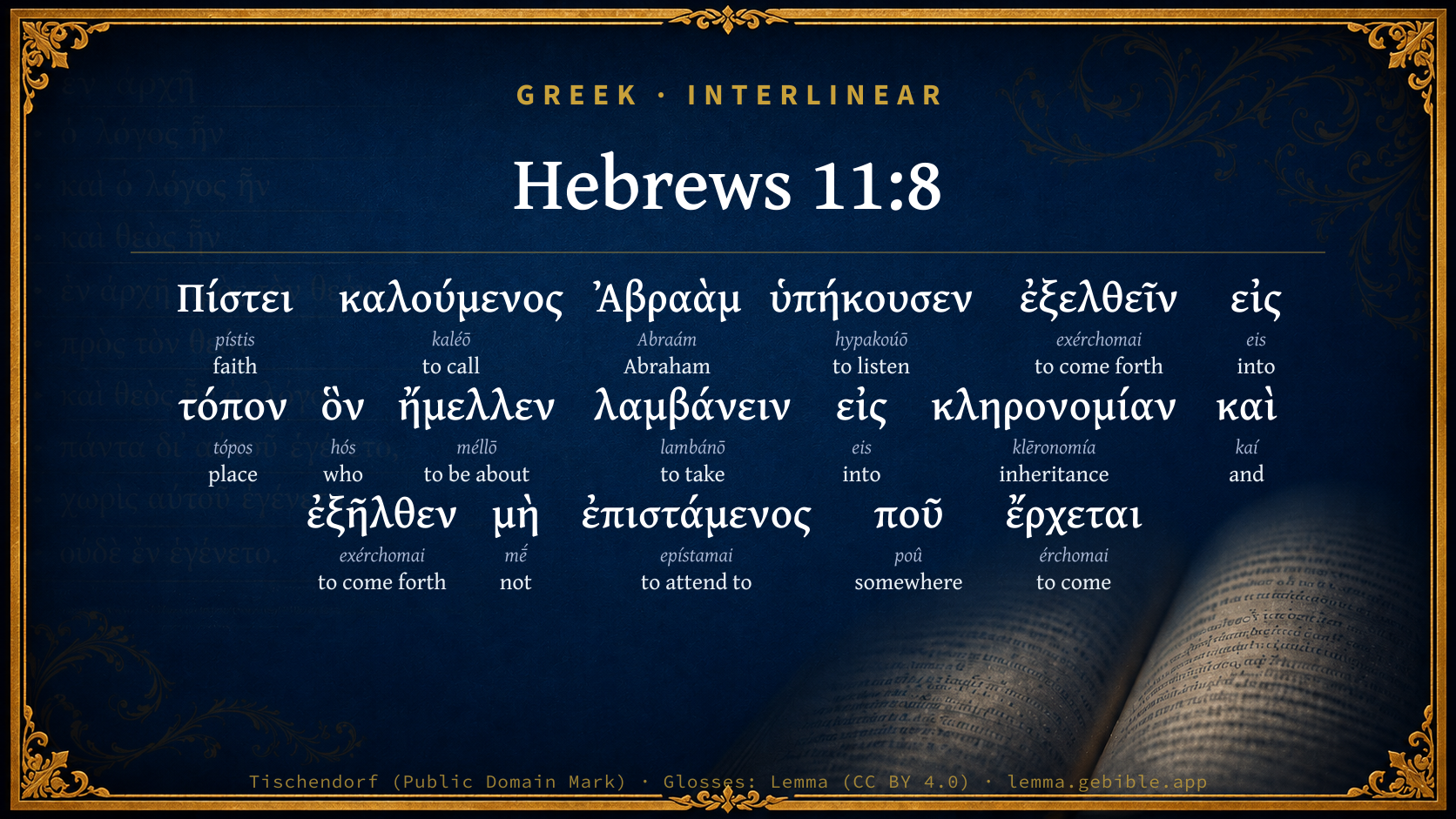
By faith, Abraham, when he was called, obeyed to go out to the place which he was to receive for an inheritance. He went out, not knowing where he went.
Download a study sheet
One document with this verse’s original text, its word-by-word gloss line, the meaning frame, cross-references with their text, attributed commentary, and full source and license credits — printable, and it pastes into notes with its structure intact.
This verse Autodidact and up
A passage Seminary Student
Up to 50 verses in one chapter. A passage sheet keeps up to 6 commentary sources and 12 cross-references per verse, in the order this page ranks them, and says so on the sheet whenever that leaves anything out. Ask for a single verse and you get the Autodidact verse sheet above.
Everything on this page stays free to read, with no account — the sheet is a download of what is already on screen, not access to it.
Compare translations 3
The same verse in 3 English versions, stacked beneath the original-language interlinear above. Click any original word for its lexicon entry.
Each is an independent rendering of the whole verse — the interlinear is not word-aligned to these translations.
Highlighted words mark where these versions differ — a whole-verse word diff, not a word-by-word alignment.
-
World English Bible Public Domain
By faith, Abraham, when he was called, obeyed to go out to the place which he was to receive for an inheritance. He went out, not knowing where he went.
-
King James Version Public Domain
By faith Abraham, when he was called to go out into a place which he should after receive for an inheritance, obeyed; and he went out, not knowing whither he went.
-
unfoldingWord Literal Text CC BY-SA 4.0
By faith, Abraham, being called, obeyed to go out to a place that he was going to receive for an inheritance and went out, not fully knowing where he is going.
unfoldingWord Literal Text — © unfoldingWord, licensed CC BY-SA 4.0. Word-aligned USFM3 via Door43 (git.door43.org/unfoldingWord/en_ult).
Show all 19 translations
Every available English version of this verse, each an independent rendering of the whole verse.
-
World English Bible Public Domain
By faith, Abraham, when he was called, obeyed to go out to the place which he was to receive for an inheritance. He went out, not knowing where he went.
-
Berean Standard Bible Public Domain
By faith Abraham, when called to go to a place he would later receive as his inheritance, obeyed and went, without knowing where he was going.
-
Majority Standard Bible Public Domain
By faith Abraham, when called to go to the place he would later receive as his inheritance, obeyed and went, without knowing where he was going.
-
King James Version Public Domain
By faith Abraham, when he was called to go out into a place which he should after receive for an inheritance, obeyed; and he went out, not knowing whither he went.
-
American Standard Version (1901) Public Domain
By faith Abraham, when he was called, obeyed to go out unto a place which he was to receive for an inheritance; and he went out, not knowing whither he went.
-
Revised Version (1885) Public Domain
By faith Abraham, when he was called, obeyed to go out unto a place which he was to receive for an inheritance; and he went out, not knowing whither he went.
-
Geneva Bible (1599) Public Domain
By faith Abraham, when he was called, obeyed God, to goe out into a place, which hee should afterward receiue for inheritance, and he went out, not knowing whither he went.
-
Douay-Rheims (1899) Public Domain
By faith he that is called Abraham, obeyed to go out into a place which he was to receive for an inheritance; and he went out, not knowing whither he went.
-
Young's Literal Translation Public Domain
By faith Abraham, being called, did obey, to go forth to the place that he was about to receive for an inheritance, and he went forth, not knowing whither he doth go;
-
Literal Standard Version CC BY-SA 4.0
By faith Abraham, being called, obeyed, to go forth into the place that he was about to receive for an inheritance, and he went forth, not knowing to where he goes.
-
Unlocked Literal Bible CC BY-SA 4.0
It was by faith that Abraham, when he was called, obeyed and went out to the place that he was to receive as an inheritance. He went out, not knowing where he was going.
-
unfoldingWord Literal Text CC BY-SA 4.0
By faith, Abraham, being called, obeyed to go out to a place that he was going to receive for an inheritance and went out, not fully knowing where he is going.
-
Darby Bible Public Domain
By faith Abraham, being called, obeyed to go out into the place which he was to receive for an inheritance, and went out, not knowing where he was going.
-
World Messianic Bible Public Domain
By faith Abraham, when he was called, obeyed to go out to the place which he was to receive for an inheritance. He went out, not knowing where he went.
-
Webster's Bible Public Domain
By faith Abraham, when he was called to remove into a place which he should afterwards receive for an inheritance, obeyed; and he went out not knowing whither he was going.
-
Free Bible Version CC BY-SA 4.0
Through trusting God Abraham obeyed when God called him to go to the land God was going to give him. He left, not knowing where he was going.
-
Bible in Basic English Public Domain
By faith Abraham did as God said when he was ordered to go out into a place which was to be given to him as a heritage, and went out without knowledge of where he was going.
-
Text-Critical English NT CC BY 4.0
By faith Abraham obeyed when he was called to go out to the place that he was to receive as an inheritance. And he went out, not knowing where he was going.
-
Tyndale New Testament (1534) Public Domain
By fayth Abraham when he was called obeyed to goo out into a place which he shuld afterwarde receave to inheritaunce and he wet out not knowynge whether he shuld goo.
Literal Standard Version (2020), Covenant Press — licensed CC BY-SA 4.0. Text via the HelloAO Bible API (eBible.org). Unlocked Literal Bible (unfoldingWord) — licensed CC BY-SA 4.0. Text via the HelloAO Bible API (eBible.org). unfoldingWord Literal Text — © unfoldingWord, licensed CC BY-SA 4.0. Word-aligned USFM3 via Door43 (git.door43.org/unfoldingWord/en_ult). Free Bible Version, Dr. Jonathan Gallagher — licensed CC BY-SA 4.0. Text via the HelloAO Bible API (eBible.org).
Word by word
More ways to search: Search by grammar → Find every occurrence → Compare this word →
Practice this passage: Drill this verse → Learn its vocabulary →
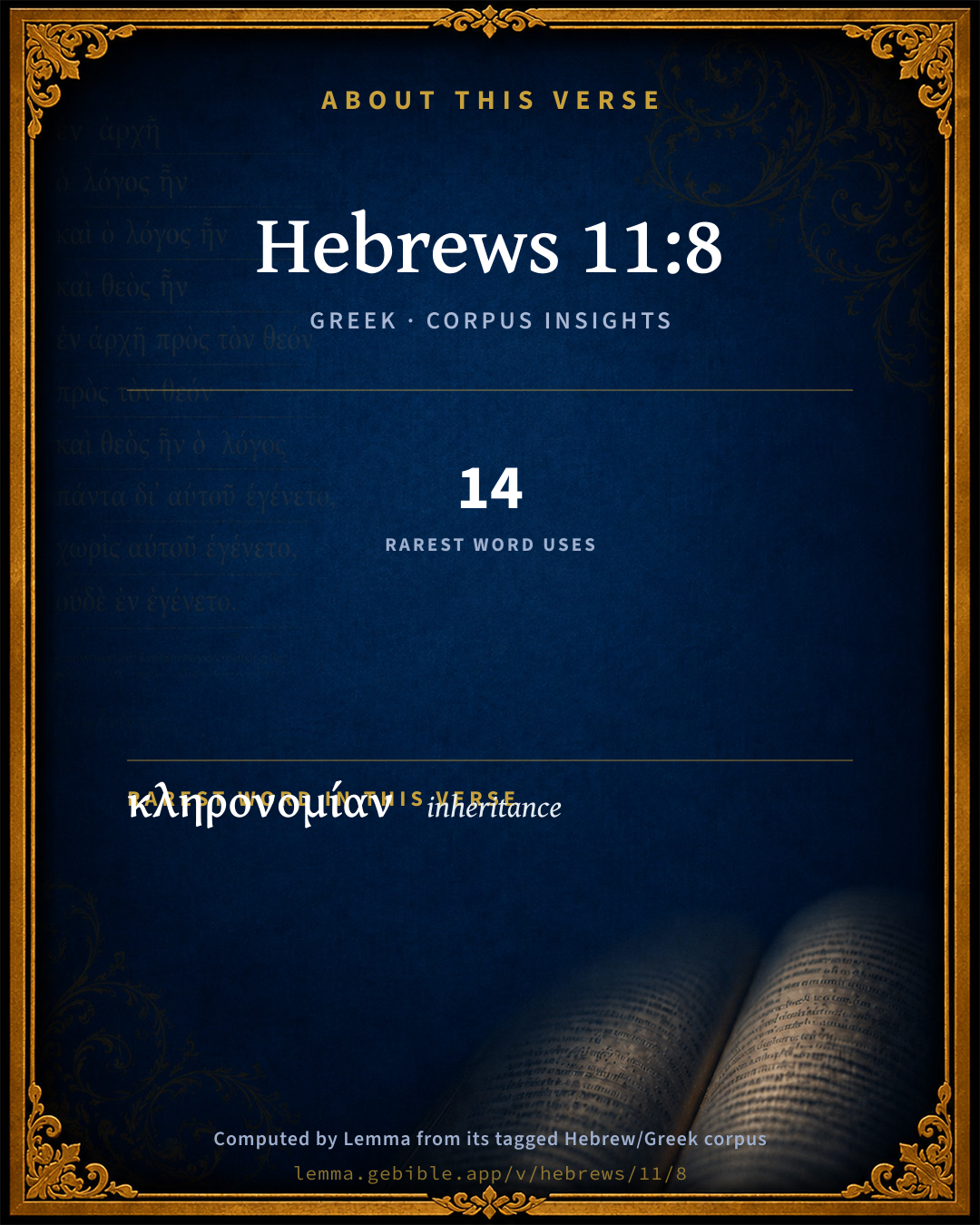
- Appears 14× in the Greek New Testament
- First appears at Matthew 21:38
- Part of Speech
- Noun
- Case
- Accusative
- Number
- Singular
- Gender
- Feminine
Full Thayer's Definition
- Πίστει pístis G4102 “faith” Noun, Dative, Singular, Feminine
- καλούμενος kaléō G2564 “to call” Verb, Present, Passive, Participle, Nominative, Singular, Masculine
- Ἀβραὰμ Abraám G11 “Abraham” Noun, Proper, indeclinable
- ὑπήκουσεν hypakoúō G5219 “to listen” Verb, Aorist, Active, Indicative, 3rd person, Singular
- ἐξελθεῖν exérchomai G1831 “to come forth” Verb, Aorist, Active, Infinitive
- εἰς eis G1519 “into” Preposition
- τόπον tópos G5117 “place” Noun, Accusative, Singular, Masculine
- ὃν hós G3739 “who” Relative pronoun, Accusative, Singular, Masculine
- ἤμελλεν méllō G3195 “to be about” Verb, Imperfect, Active, Indicative, 3rd person, Singular, Attic form
- λαμβάνειν lambánō G2983 “to take” Verb, Present, Active, Infinitive
- εἰς eis G1519 “into” Preposition
- κληρονομίαν klēronomía G2817 “inheritance” Noun, Accusative, Singular, Feminine
- καὶ kaí G2532 “and” Conjunction
- ἐξῆλθεν exérchomai G1831 “to come forth” Verb, Aorist, Active, Indicative, 3rd person, Singular
- μὴ mḗ G3361 “not” Particle, Negative
- ἐπιστάμενος epístamai G1987 “to attend to” Verb, Present, Middle or Passive deponent, Participle, Nominative, Singular, Masculine
- ποῦ poû G4226 “somewhere” Particle, Interrogative
- ἔρχεται érchomai G2064 “to come” Verb, Present, Middle or Passive deponent, Indicative, 3rd person, Singular
About this verse
These counts appear in no published source. They are computed here, from the morphology-tagged text and Lemma’s own curated glosses. What Lemma adds →
- 18
- words
- 16
- distinct lemmas
- General Epistles
- section
Cross-references
28Topical passages linked to Hebrews 11:8 in the Treasury of Scripture Knowledge — connected by theme and wording, ordered by reader-vote popularity; previews shown in the World English Bible.
- Genesis 12:1–4 Now Yahweh said to Abram, "Get out of your country, and from your relatives, and from your father's house, to the land that I will show you.
- Acts 7:2–4 He said, "Brothers and fathers, listen. The God of glory appeared to our father Abraham, when he was in Mesopotamia, before he lived in Haran,
- Genesis 15:7–8 He said to him, "I am Yahweh who brought you out of Ur of the Chaldees, to give you this land to inherit it."
- Matthew 7:24–25 "Everyone therefore who hears these words of mine, and does them, I will liken him to a wise man, who built his house on a rock.
- Genesis 22:18 In your seed will all the nations of the earth be blessed, because you have obeyed my voice."
- Genesis 12:7 Yahweh appeared to Abram, and said, "I will give this land to your seed." He built an altar there to Yahweh, who appeared to him.
- James 2:14–16 What good is it, my brothers, if a man says he has faith, but has no works? Can faith save him?
- Psalms 105:9–11 The covenant which he made with Abraham, His oath to Isaac,
- Isaiah 41:2 Who has raised up one from the east, whom he calls in righteousness to his foot? he gives nations before him, and makes him rule over kings; he gives them as the dust to his sword, as the driven stubble to his bow.
- Romans 10:16 But they didn't all listen to the glad news. For Isaiah says, "Lord, who has believed our report?"
- Hebrews 11:33 who, through faith subdued kingdoms, worked out righteousness, obtained promises, stopped the mouths of lions,
- 1 Peter 4:17 For the time has come for judgment to begin at the house of God. If it begins first with us, what will happen to those who don't obey the Gospel of God?
- Genesis 13:15–17 for all the land which you see, I will give to you, and to your offspring forever.
- Genesis 15:5 Yahweh brought him outside, and said, "Look now toward the sky, and count the stars, if you are able to count them." He said to Abram, "So shall your seed be."
- Genesis 17:8 I will give to you, and to your seed after you, the land where you are traveling, all the land of Canaan, for an everlasting possession. I will be their God."
- Genesis 26:3 Sojourn in this land, and I will be with you, and will bless you. For to you, and to your seed, I will give all these lands, and I will establish the oath which I swore to Abraham your father.
- Deuteronomy 9:5 Not for your righteousness, or for the uprightness of your heart, do you go in to possess their land; but for the wickedness of these nations Yahweh your God does drive them out from before you, and that he may establish the word which Yahweh swore to your fathers, to Abraham, to Isaac, and to Jacob.
- Joshua 24:3 I took your father Abraham from beyond the River, and led him throughout all the land of Canaan, and multiplied his seed, and gave him Isaac.
- Isaiah 51:2 Look to Abraham your father, and to Sarah who bore you; for when he was but one I called him, and I blessed him, and made him many.
- Ezekiel 36:24 For I will take you from among the nations, and gather you out of all the countries, and will bring you into your own land.
- Romans 1:5 through whom we received grace and apostleship, for obedience of faith among all the nations, for his name's sake;
- Romans 6:17 But thanks be to God, that, whereas you were bondservants of sin, you became obedient from the heart to that form of teaching whereunto you were delivered.
- 1 Peter 1:22 Seeing you have purified your souls in your obedience to the truth through the Spirit in sincere brotherly affection, love one another from the heart fervently:
- Genesis 11:31 Terah took Abram his son, Lot the son of Haran, his son's son, and Sarai his daughter-in-law, his son Abram's wife. They went forth from Ur of the Chaldees, to go into the land of Canaan. They came to Haran, and lived there.
- 2 Corinthians 10:5 throwing down imaginations and every high thing that is exalted against the knowledge of God, and bringing every thought into captivity to the obedience of Christ;
- Hebrews 5:9 Having been made perfect, he became to all of those who obey him the author of eternal salvation,
- 1 Peter 3:1 In like manner, wives, be in subjection to your own husbands; so that, even if any don't obey the Word, they may be won by the behavior of their wives without a word;
- Nehemiah 9:7–8 You are Yahweh the God, who did choose Abram, and brought him forth out of Ur of the Chaldees, and gave him the name of Abraham,
Cross-references courtesy of OpenBible.info (CC BY 4.0).
Lesson kit
Teaching starters — assembled from the data on this page, not authored interpretation. Every prompt links to the verse data it draws on. Edit before teaching.
Hebrews, in the General Epistles, opens this verse with 18 words (16 distinct Greek lemmas). Its most distinctive word is klēronomía (“inheritance”). A historical commentator’s framing appears above. Read the whole chapter for the surrounding context.
Discussion questions
- What does “inheritance” (klēronomía) contribute to the verse as a whole?
- Matthew 21:38 shares the word «inheritance» with this verse. How do the two illuminate each other?
- “to come forth” occurs 2× in this one verse. What is the effect of the repetition?
- These translations render this verse differently. What is at stake in choosing one wording over another?
- Reading how Matthew Poole's English Annotations and The Biblical Illustrator read this verse, where do the two commentators agree and where do they part?
Things to notice
- These translations choose different wording for 10 words in this verse.
- “to come forth” occurs 2× in this single verse.
- 16 distinct Greek lemmas span 18 words in this verse.
Commentary
Notes on Hebrews 11:8 from classic Christian and Jewish commentators (each source and its license shown beneath its notes). The classic Christian expositions comment on the surrounding passage and are grouped to its opening verse, so a note may address several verses; the Jewish commentaries on the Tanakh (Rashi and others) are per-verse, so they appear only where the commentator wrote on this verse.
Lemma curates 59 commentaries, every one of them public domain or Creative Commons licensed, each selected and text-cleaned for this edition rather than reprinted as found. About our sources →
Matthew Poole's English Annotations
Matthew Poole's English Annotations on the Holy Bible (1683–1685) — public domain. Text from a community e-Sword/MySword module.
The Biblical Illustrator
Joseph S. Exell
The Biblical Illustrator, edited by Joseph S. Exell (c. 1880s–1900s) — public domain. Text from a community e-Sword module.
Joseph Benson's Commentary
Joseph Benson's Commentary on the Old and New Testaments (1811–1818) — public domain. Text from a community e-Sword module.
Lange's Commentary on the Holy Scriptures
Lange's Commentary on the Holy Scriptures (Critical, Doctrinal, and Homiletical), ed. John Peter Lange, English translation edited by Philip Schaff (1864–1880) — public domain. Text from a community e-Sword module.
Tyndale Open Study Notes
Tyndale Open Resources
Tyndale Open Study Notes — © Tyndale Open Resources, licensed CC BY-SA 4.0. Text via the HelloAO Bible API.
Bengel's Gnomon
Johann Albrecht Bengel
Bengel's Gnomon of the New Testament — English translation (T&T Clark, Edinburgh, 1860) — public domain. Text from a community e-Sword module.
Meyer's Critical & Exegetical Commentary
Heinrich August Wilhelm Meyer
Meyer — Critical and Exegetical Commentary on the New Testament — English translation by Peter Christie, edited by Frederick Crombie (T&T Clark, 1880) — public domain. Text from a community e-Sword module.
Expositor's Greek Testament
ed. W. Robertson Nicoll
The Expositor's Greek Testament, edited by W. Robertson Nicoll (1897–1910) — public domain. Text from a community e-Sword module.
Geneva Bible (1599)
Geneva Bible translators
Geneva Bible (1599) marginal notes — public domain. Text via Bolls.life.
Jamieson, Fausset & Brown
Robert Jamieson, A. R. Fausset & David Brown
Jamieson, Fausset & Brown — Commentary Critical and Explanatory on the Whole Bible (1871) — public domain (CC PDM 1.0). Text via the HelloAO Bible API.
Adam Clarke's Commentary
Adam Clarke's Commentary on the Bible (1810–1826) — public domain. Text from a community e-Sword/MySword module.
John Calvin's Commentaries
John Calvin's Commentaries (1540-1563) — public domain. Text from the Calvin Translation Society English edition (1840s-50s) via the Christian Classics Ethereal Library (ccel.org). Calvin's coverage is partial (roughly two-thirds of the Bible); uncommented books and verses are honest gaps, never fabricated. The 19th-century editor's footnotes and remarks are omitted so the notes are faithfully Calvin's own voice.
Ellicott's Commentary for English Readers
A Bible Commentary for English Readers, edited by Charles John Ellicott (1878–1897) — public domain. Text from a community e-Sword module.
The Cambridge Bible for Schools and Colleges
gen. ed. J. J. S. Perowne
The Cambridge Bible for Schools and Colleges (gen. ed. J. J. S. Perowne; Cambridge University Press, 1878–1918) — public domain. Text from a community e-Sword module.
John Gill's Exposition
John Gill's Exposition of the Whole Bible (1746–1763) — public domain (CC PDM 1.0). Text via the HelloAO Bible API.
Trapp's Complete Commentary
John Trapp
John Trapp, A Commentary or Exposition upon All the Books of the Old and New Testament (1647–1656) — public domain. Text from a community e-Sword module.
Albert Barnes' Notes on the Bible
Albert Barnes' Notes on the Bible (1834–1885) — public domain. Text from a community e-Sword/MySword module.
Haydock's Catholic Bible Commentary
George Leo Haydock (1774–1849), Haydock's Catholic Family Bible and Commentary, 1859 edition — public domain. Excludes Psalms (Douay-Rheims chapter numbering differs from Protestant) and Deuterocanonical books (Catholic canon only).
Whedon's Commentary on the Bible
Daniel D. Whedon
Daniel D. Whedon (gen. ed.), Commentary on the Old and New Testaments (1874–1909) — public domain. Text from a community e-Sword module.
The Pulpit Commentary
The Pulpit Commentary (1880–1919), ed. H.D.M. Spence-Jones & Joseph S. Exell — public domain. Text from a community e-Sword module.
John Wesley's Explanatory Notes
John Wesley, Explanatory Notes Upon the Whole Bible (1754–1765) — public domain. Text via the GEBible commentary corpus.
Kretzmann's Popular Commentary
Paul E. Kretzmann
Paul E. Kretzmann, Popular Commentary of the Bible (1921–1924) — public domain. Text from a community e-Sword module.
Burkitt's Expository Notes on the New Testament
William Burkitt
William Burkitt's Expository Notes on the New Testament (1700–1703) — public domain. Text from a community e-Sword module.
The People's New Testament
B. W. Johnson
B. W. Johnson's The People's New Testament with Notes (1889–1891) — public domain. Electronic text from the Christian Classics Ethereal Library (CCEL) ThML edition.
unfoldingWord translationNotes
Door43 World Missions Community
unfoldingWord translationNotes — © Distant Shores Media and the Door43 World Missions Community, licensed CC BY-SA 4.0. Source: git.door43.org/Door43/en_tn.
Cambridge Greek Testament for Schools and Colleges
Cambridge Greek Testament for Schools and Colleges (Cambridge University Press, 1896; 21 vols, various authors incl. Carr, Maclear, Plummer, Farrar, Lumby, Moule, M. R. James, Simcox) — public domain. Text from a community e-Sword module.
Alford’s Greek Testament
Henry Alford
Henry Alford, The Greek Testament (1849–1861) — public domain. Text from a community e-Sword module.
Vincent's Word Studies in the New Testament
Marvin R. Vincent
Marvin R. Vincent, Word Studies in the New Testament (1887–1900) — public domain. Text from a community e-Sword/MySword module.