Hebrews 9:21

Greek (Tischendorf 8th ed.) Hebrews 9:21 appears in the Greek New Testament. The text above is from the Tischendorf 8th edition. Each word links to its Strong’s number and a concise gloss. Click any word for its full Thayer’s Greek Lexicon entry.
Download image
Cite this verse

Hebrews 9:21 (World English Bible). Public Domain. Lemma interlinear Bible study tool, https://lemma.gebible.app/v/hebrews/9/21.

Show BibTeX & RIS
BibTeX
RIS
English Translation
Moreover he sprinkled the tabernacle and all the vessels of the ministry in like manner with the blood.
World English Bible · Public Domain
Download a study sheet

One document with this verse’s original text, its word-by-word gloss line, the meaning frame, cross-references with their text, attributed commentary, and full source and license credits — printable, and it pastes into notes with its structure intact.

This verse Autodidact and up

Study sheet (.html) Plain text (.txt)

A passage Seminary Student

Up to 50 verses in one chapter. A passage sheet keeps up to 6 commentary sources and 12 cross-references per verse, in the order this page ranks them, and says so on the sheet whenever that leaves anything out. Ask for a single verse and you get the Autodidact verse sheet above.

Everything on this page stays free to read, with no account — the sheet is a download of what is already on screen, not access to it.

Want to remove ads? Support Godless Engineer
Compare translations 3

The same verse in 3 English versions, stacked beneath the original-language interlinear above. Click any original word for its lexicon entry.

Each is an independent rendering of the whole verse — the interlinear is not word-aligned to these translations.

Highlighted words mark where these versions differ — a whole-verse word diff, not a word-by-word alignment.

  • World English Bible Public Domain
    Moreover he sprinkled the tabernacle and all the vessels of the ministry in like manner with the blood.
  • King James Version Public Domain
    Moreover he sprinkled with blood both the tabernacle, and all the vessels of the ministry.
  • unfoldingWord Literal Text CC BY-SA 4.0
    And in a similar way, he sprinkled with the blood both the tabernacle and all the containers of the service.

unfoldingWord Literal Text — © unfoldingWord, licensed CC BY-SA 4.0. Word-aligned USFM3 via Door43 (git.door43.org/unfoldingWord/en_ult).

Versions to compare (up to 4)

3 of 4 selected

Show all 19 translations

Every available English version of this verse, each an independent rendering of the whole verse.

  • World English Bible Public Domain
    Moreover he sprinkled the tabernacle and all the vessels of the ministry in like manner with the blood.
  • Berean Standard Bible Public Domain
    In the same way, he sprinkled with blood the tabernacle and all the vessels used in worship.
  • Majority Standard Bible Public Domain
    In the same way, he sprinkled with blood the tabernacle and all the vessels used in worship.
  • King James Version Public Domain
    Moreover he sprinkled with blood both the tabernacle, and all the vessels of the ministry.
  • American Standard Version (1901) Public Domain
    Moreover the tabernacle and all the vessels of the ministry he sprinkled in like manner with the blood.
  • Revised Version (1885) Public Domain
    Moreover the tabernacle and all the vessels of the ministry he sprinkled in like manner with the blood.
  • Geneva Bible (1599) Public Domain
    Moreouer, he sprinkled likewise the Tabernacle with blood also, and all the ministring vessels.
  • Douay-Rheims (1899) Public Domain
    The tabernacle also and all the vessels of the ministry, in like manner, he sprinkled with blood.
  • Young's Literal Translation Public Domain
    and both the tabernacle and all the vessels of the service with blood in like manner he did sprinkle,
  • Literal Standard Version CC BY-SA 4.0
    and he sprinkled both the Dwelling Place and all the vessels of the service with blood in like manner,
  • Unlocked Literal Bible CC BY-SA 4.0
    In the same manner, he sprinkled the blood on the tabernacle and all the containers used in the service.
  • unfoldingWord Literal Text CC BY-SA 4.0
    And in a similar way, he sprinkled with the blood both the tabernacle and all the containers of the service.
  • Darby Bible Public Domain
    And the tabernacle too and all the vessels of service he sprinkled in like manner with blood;
  • World Messianic Bible Public Domain
    He sprinkled the tabernacle and all the vessels of the ministry in the same way with the blood.
  • Webster's Bible Public Domain
    Moreover, he sprinkled likewise with blood both the tabernacle, and all the vessels of the ministry.
  • Free Bible Version CC BY-SA 4.0
    Moses sprinkled the blood in the same way on the Tabernacle and everything used in worship.
  • Bible in Basic English Public Domain
    And the blood was put on the Tent and all the holy vessels in the same way.
  • Text-Critical English NT CC BY 4.0
    In the same way, he sprinkled with blood the tabernacle and all the vessels used in worship.
  • Tyndale New Testament (1534) Public Domain
    Morover he sprenkled the tabernacle with bloud also and all the ministrynge vessels.

Literal Standard Version (2020), Covenant Press — licensed CC BY-SA 4.0. Text via the HelloAO Bible API (eBible.org). Unlocked Literal Bible (unfoldingWord) — licensed CC BY-SA 4.0. Text via the HelloAO Bible API (eBible.org). unfoldingWord Literal Text — © unfoldingWord, licensed CC BY-SA 4.0. Word-aligned USFM3 via Door43 (git.door43.org/unfoldingWord/en_ult). Free Bible Version, Dr. Jonathan Gallagher — licensed CC BY-SA 4.0. Text via the HelloAO Bible API (eBible.org).

Word by word

More ways to search: Search by grammar → Find every occurrence → Compare this word →

Practice this passage: Drill this verse → Learn its vocabulary →

ἐράντισεν
rhantízō
G4472
“to sprinkle”
Verb, Aorist, Active, Indicative, 3rd person, Singular
Part of Speech
Verb
Tense
Aorist
Voice
Active
Mood
Indicative
Person
3rd person
Number
Singular
Full Thayer's Definition

Origin: from a derivative of rhaino (to sprinkle)

TDNT: 22:17,0

1. to sprinkle 2. to cleanse by sprinkling, hence to purify, cleanse
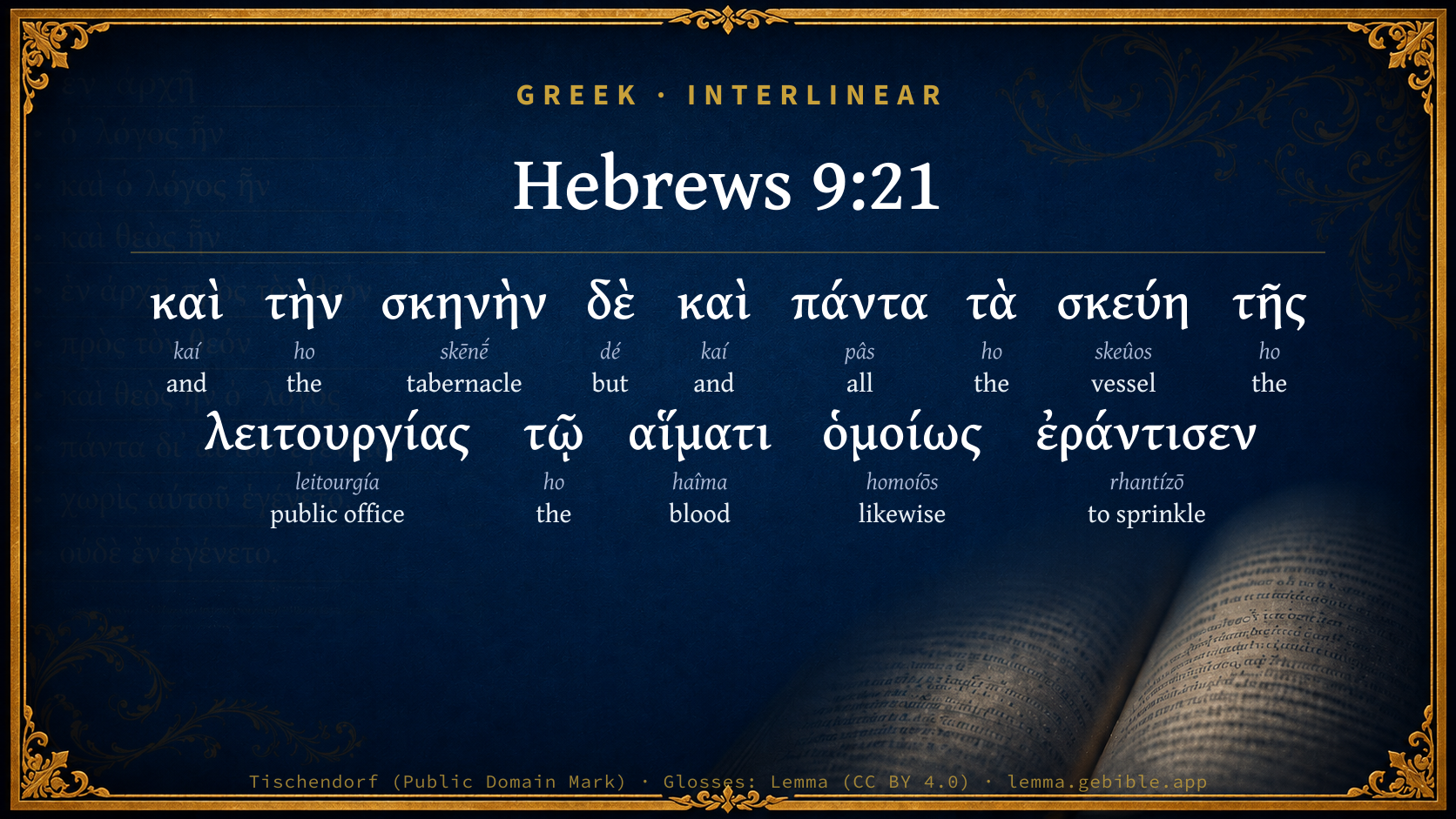
  1. καὶ kaí G2532 “and” Conjunction
  2. τὴν ho G3588 “the” Article, Accusative, Singular, Feminine
  3. σκηνὴν skēnḗ G4633 “tabernacle” Noun, Accusative, Singular, Feminine
  4. δὲ dé G1161 “but” Conjunction
  5. καὶ kaí G2532 “and” Conjunction
  6. πάντα pâs G3956 “all” Adjective, Accusative, Plural, Neuter
  7. τὰ ho G3588 “the” Article, Accusative, Plural, Neuter
  8. σκεύη skeûos G4632 “vessel” Noun, Accusative, Plural, Neuter
  9. τῆς ho G3588 “the” Article, Genitive, Singular, Feminine
  10. λειτουργίας leitourgía G3009 “public office” Noun, Genitive, Singular, Feminine
  11. τῷ ho G3588 “the” Article, Dative, Singular, Neuter
  12. αἵματι haîma G129 “blood” Noun, Dative, Singular, Neuter
  13. ὁμοίως homoíōs G3668 “likewise” Adverb

About this verse

These counts appear in no published source. They are computed here, from the morphology-tagged text and Lemma’s own curated glosses. What Lemma adds →

14
words
10
distinct lemmas
General Epistles
section

Notable vocabulary

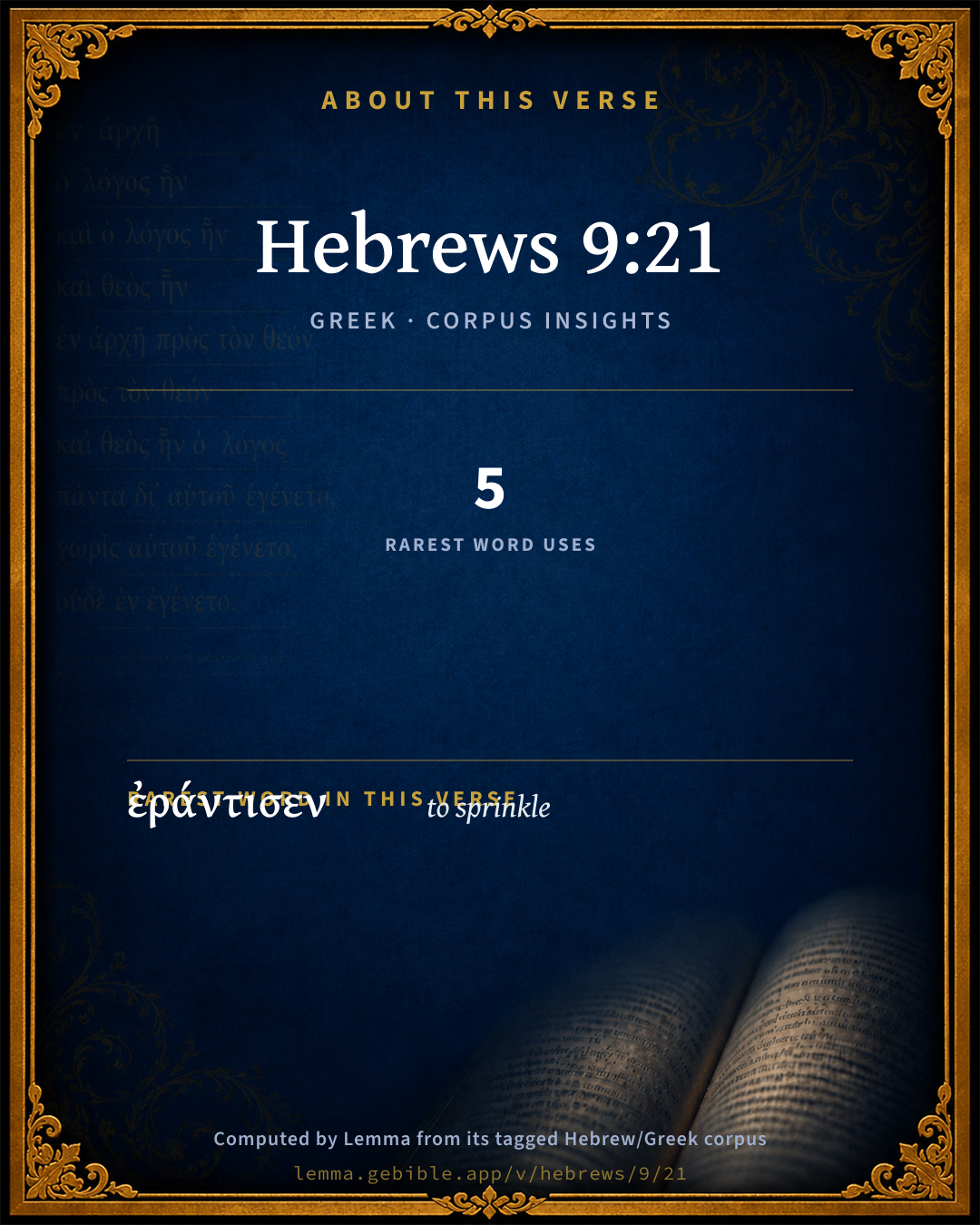
The rarest word here is ἐράντισεν to sprinkle G4472 — appearing just 5 times in the whole Greek New Testament.

Shared distinctive vocabulary

ἐράντισεν to sprinkle G4472 occurs in 5 verses of the Greek New Testament. Also found in:

Repetition

Words recur within this verse:

Cross-references

10

Topical passages linked to Hebrews 9:21 in the Treasury of Scripture Knowledge — connected by theme and wording, ordered by reader-vote popularity; previews shown in the World English Bible.

  • Leviticus 8:15 He killed it; and Moses took the blood, and put it on the horns of the altar round about with his finger, and purified the altar, and poured out the blood at the base of the altar, and sanctified it, to make atonement for it.
  • Leviticus 8:19 He killed it; and Moses sprinkled the blood on the altar round about.
  • Exodus 29:12 You shall take of the blood of the bull, and put it on the horns of the altar with your finger; and you shall pour out all the blood at the base of the altar.
  • Exodus 29:36 Every day shall you offer the bull of sin-offering for atonement: and you shall cleanse the altar, when you make atonement for it; and you shall anoint it, to sanctify it.
  • Leviticus 9:8–9 So Aaron drew near to the altar, and killed the calf of the sin offering, which was for himself.
  • Leviticus 9:18 He also killed the ox and the ram, the sacrifice of peace offerings, which was for the people: and Aaron's sons delivered to him the blood, which he sprinkled on the altar round about,
  • Leviticus 16:14–19 He shall take some of the blood of the bull, and sprinkle it with his finger on the mercy seat on the east; and before the mercy seat he shall sprinkle some of the blood with his finger seven times.
  • Ezekiel 43:18–26 He said to me, Son of man, thus says the Lord Yahweh: These are the ordinances of the altar in the day when they shall make it, to offer burnt offerings thereon, and to sprinkle blood thereon.
  • Exodus 29:20 Then you shall kill the ram, and take some of its blood, and put it on the tip of the right ear of Aaron, and on the tip of the right ear of his sons, and on the thumb of their right hand, and on the big toe of their right foot, and sprinkle the blood on the altar round about.
  • 2 Chronicles 29:19–22 Moreover all the vessels, which king Ahaz in his reign did cast away when he trespassed, have we prepared and sanctified; and, behold, they are before the altar of Yahweh.

Cross-references courtesy of OpenBible.info (CC BY 4.0).

Commentary

Notes on Hebrews 9:21 from classic Christian and Jewish commentators (each source and its license shown beneath its notes). The classic Christian expositions comment on the surrounding passage and are grouped to its opening verse, so a note may address several verses; the Jewish commentaries on the Tanakh (Rashi and others) are per-verse, so they appear only where the commentator wrote on this verse.

Lemma curates 59 commentaries, every one of them public domain or Creative Commons licensed, each selected and text-cleaned for this edition rather than reprinted as found. About our sources →

Joseph Benson's Commentary

Heb 9:21-22. Moreover — To prefigure the efficacy of the sacrifice of Christ to render our acts of worship acceptable; he sprinkled with blood the tabernacle — The altar, and mercy-seat; and all the vessels of the ministry — All that were used in the tabernacle service. See the margin. And almost all the things — Pertaining to the tabernacle and service of God, (the apostle says almost all things, because some were cleansed with water, and some with fire, Num 31:23, and some with the ashes of the red heifer, Num 19:2-10,) are by the law purged from any ceremonial defilement with blood — Offered or sprinkled; and without shedding of blood — According to the law; is no remission — Of sins, neither typical nor real. Or he means, no remission was granted on the day of atonement without blood. All this pointed to the blood of Christ, effectually cleansing from all sin, and intimated that there can be no purification from it by any other means. Because some fancy that a real pardon of sin was obtained by the atonements of the Mosaic law, and especially by those made on the tenth of the seventh month, concerning which it is said, (Lev 16:30,) on that day shall the priest make an atonement for you that you may be clean from all your sins: it may be proper to observe here, that “this cleansing of the people from all their sins could not possibly have any reference to the punishments of the life to come, because the atonement was made for all the people indiscriminately, whether penitent or not, consequently it could not be a cleansing of their consciences, but of their bodies; redeeming them from those civil penalties which God, in the character of their chief magistrate, would have inflicted on them for breaking the laws of the state, unless these atonements had been made. A remission of that kind all the people of the congregation might receive, and it was the only remission which, in a body, they could receive through the sacrifices mentioned. And from the inefficacy of the annual atonements, made on the day above mentioned, to procure for the people the eternal pardon of their sins, it follows that the daily atonements, made by the ordinary priests, had no greater efficacy in procuring their pardon.” — Macknight. See notes on Heb 9:8-10; chap. Heb 10:4.

Joseph Benson's Commentary on the Old and New Testaments (1811–1818) — public domain. Text from a community e-Sword module.

Tyndale Open Study Notes

Tyndale Open Resources

9:21 he sprinkled blood: See Exod 24:3-8; Lev 16:14-19.

Tyndale Open Study Notes — © Tyndale Open Resources, licensed CC BY-SA 4.0. Text via the HelloAO Bible API.

Bengel's Gnomon

Johann Albrecht Bengel

Heb 9:21. Τὰ σκεύη, the vessels) also the garments.—ἐῤῥάντισε) LXX., τὸ ἥμισυ τοῦ αἵματος προσέχεε πρὸς τὸ θυσιαστήριον.

Bengel's Gnomon of the New Testament — English translation (T&T Clark, Edinburgh, 1860) — public domain. Text from a community e-Sword module.

Meyer's Critical & Exegetical Commentary

Heinrich August Wilhelm Meyer

Heb_9:21 adds to that mentioned Heb_9:19-20, not a simultaneous fact, but only something occurring later. For when the law was proclaimed by Moses, and the people promised to observe the same, the tabernacle had not yet an existence. Exodus 40, where we have the account of the erection and inauguration of the tabernacle, only an anointing of the tabernacle and its vessels with oil is enjoined, not a sprinkling thereof with blood. Comp. ibid. Exo_9:9. Similarly in Leviticus, a sprinkling indeed with blood (Lev_8:15; Lev_8:19; Lev_8:24) is supposed in regard to the altar; in regard to the tabernacle and its furniture, on the other hand, only an anointing (Lev_8:10 ff.). It is possible, however, that Jewish tradition preserved more precise details. At least mention is made by Josephus also (Antiq. iii. 8. 6) of an aspersion of the tabernacle and its furniture, on the part of Moses, with blood.

Erroneously, for the rest (on account of the aorist), do Owen, Seb. Schmidt, Wittich, Cramer, and others find mentioned, Heb_9:21, in place of the one act of Moses, a sprinkling enjoined by the law of Moses, and occurring at different fixed periods, in connection with which the majority will have the sprinkling which is made on the great Day of Atonement, Lev_16:14 ff., to be meant.

καὶ … δέ] but also. Luk_2:35; Joh_8:16, al.

τὰ σκεύη τῆς λειτουργίας] the vessels designed for sacred use.

Meyer — Critical and Exegetical Commentary on the New Testament — English translation by Peter Christie, edited by Frederick Crombie (T&T Clark, 1880) — public domain. Text from a community e-Sword module.

Expositor's Greek Testament

ed. W. Robertson Nicoll

Heb 9:21 . καὶ τὴν σκηνὴν δὲ .… “And he also in like manner sprinkled with the blood the tabernacle and all the instruments of the service”. The tabernacle, however, was not yet erected when the covenant was instituted. Delitzsch supposes that a subsequent though kindred transaction is referred to; and colour is given to this supposition by the separation of this verse from Heb 9:19 . But against it is the article in τῷ αἵματι , “the blood,” apparently the blood defined in Heb 9:19-20 ; although it is just possible the writer may have meant “the blood” which formed part of the means of service. Neither was it by Moses but by Aaron the tabernacle and the altar were sprinkled with blood and so cleansed on the day of Atonement. When first erected ἡ σκηνὴ καὶ πάντα τὰ σκεύη αὐτῆς were anointed with oil (Exo 40:9 ) but Josephus records a tradition that it was consecrated not only with oil but also with blood ( Ant . iii. 8, 6). It seems that the author adopts this tradition, and ascribes to Moses at the original consecration of the tabernacle the cleansing rites which afterwards were annually performed by Aaron on the day of Atonement.

The Expositor's Greek Testament, edited by W. Robertson Nicoll (1897–1910) — public domain. Text from a community e-Sword module.

Jamieson, Fausset & Brown

Robert Jamieson, A. R. Fausset & David Brown

Greek, "And, moreover, in like manner." The sprinkling of the tabernacle with blood is added by inspiration here to the account in Exo 30:25-30; Exo 40:9-10, which mentions only Moses' anointing the tabernacle and its vessels. In Lev 8:10, Lev 8:15, Lev 8:30, the sprinkling of blood upon Aaron and his garments, and upon his sons, and upon the altar, is mentioned as well as the anointing, so that we might naturally infer, as JOSEPHUS has distinctly stated, that the tabernacle and its vessels were sprinkled with blood as well as being anointed: Lev 16:16, Lev 16:20, Lev 16:33, virtually sanctions this inference. The tabernacle and its contents needed purification (Ch2 29:21).

Jamieson, Fausset & Brown — Commentary Critical and Explanatory on the Whole Bible (1871) — public domain (CC PDM 1.0). Text via the HelloAO Bible API.

Adam Clarke's Commentary

Verse 21. He sprinkled - with blood - all the vessels of the ministry.] To intimate that every thing used by sinful man is polluted, and that nothing can be acceptable in the sight of a holy God that has not in effect the sprinkling of the atoning blood.

Adam Clarke's Commentary on the Bible (1810–1826) — public domain. Text from a community e-Sword/MySword module.

Ellicott's Commentary for English Readers

(21) He sprinkled with blood.—Rather, he sprinkled in like manner with the blood. It is singular that the word rendered “in like manner” (found in the Bishops’ Bible, “likewise,” and in other versions) should have been overlooked in the Authorised version. The incident here mentioned belongs, of course, to a later date. It is not expressly recorded in Scripture, but is related by Josephus (Ant. iii. 8, § 6); and, apart from internal probability, might almost be concluded from the narrative of the Pentateuch itself. In Exo_40:9-15 we read of the divine injunction that Moses should put the anointing oil not only upon Aaron and his sons, their garments, and the altar, but also upon the Tabernacle and its vessels. In Lev_8:10-12 is recorded the fulfilment of this command; but in the later verses of the same chapter we read that the altar was sprinkled with the blood of the sin-offering (Heb_9:15), and that Moses sprinkled Aaron and his sons and their garments with “the anointing oil and the blood which was upon the altar.” Manifestly we may infer that the Tabernacle and its vessels were included in the latter ceremony. Whatever was connected with the covenant which God made with His people must be sprinkled with the blood, which at once typified purification (Heb_9:14; Heb_9:24), and ratified the covenant (Heb_9:15; Heb_9:17).

A Bible Commentary for English Readers, edited by Charles John Ellicott (1878–1897) — public domain. Text from a community e-Sword module.

The Cambridge Bible for Schools and Colleges

gen. ed. J. J. S. Perowne

21. both the tabernacle] This again is not mentioned in the scene to which the writer seems to be referring (Exo_24:6-8), which indeed preceded the building of the Tabernacle. It is nowhere recorded in Scripture that the Tabernacle was sprinkled, although it is perhaps implied that on a later occasion this may have been done (Exo_40:9-10); and Josephus, closely following the same Hagadah as the writer, says that such was the case (Jos. Antt. iii. 8. § 6).

all the vessels] This again is not directly mentioned, though we are told that Aaron and his sons, and the altar, were consecrated by such a sprinkling (Lev_8:30), and that the “propitiatory” was so sprinkled on the Day of Atonement (Lev_16:14). By these references to unrecorded traditions the writer shews that he had been trained in Rabbinic Schools.

The Cambridge Bible for Schools and Colleges (gen. ed. J. J. S. Perowne; Cambridge University Press, 1878–1918) — public domain. Text from a community e-Sword module.

John Gill's Exposition

Moreover, he sprinkled likewise both the tabernacle,.... Not at the same time that he sprinkled the book and the people, for then there was no tabernacle; but afterwards, at the time that it was set up, when it was anointed with oil, Exo 40:9 and though no mention is there made of blood, yet Josephus, in agreement with the apostle, asserts (i), that the tabernacle, and its vessels, were not only anointed with oil, but sprinkled with the blood of bulls and goats, as well as the garments of Aaron, and his sons: the tabernacle was typical of the church, in which God dwells, being purified and cleansed by the blood of Christ; and this shows, that there is no coming into the presence of God, the place where he dwells, without blood.

And all the vessels of the ministry; which were used in the service of the tabernacle these may denote the vessels of grace and mercy, the elect of God, whose hearts are sprinkled by the blood of Christ from an evil conscience, and whose garments are washed in it, and made white by it.

(i) Antiq. l. 3. c. 8. sect. 6.

John Gill's Exposition of the Whole Bible (1746–1763) — public domain (CC PDM 1.0). Text via the HelloAO Bible API.

Trapp's Complete Commentary

John Trapp

21 Moreover he sprinkled with blood both the tabernacle, and all the vessels of the ministry.

Ver. 21. He sprinkled with blood] This sprinkling had a foreshadowing of the sprinkling of the blood of Jesus Christ, 1Pe 1:2; Isa 52:15; by his finger, that is, by his Spirit, Luk 11:20; Mat 12:28.

John Trapp, A Commentary or Exposition upon All the Books of the Old and New Testament (1647–1656) — public domain. Text from a community e-Sword module.

Albert Barnes' Notes on the Bible

He sprinkled ...both the tabernacle - This circumstance is not stated by Moses. On the probability that this was done, see notes on Heb 9:19. The account of setting up the tabernacle occurs in Exo 11:1-10. In that account it is said that Moses “anointed” the tabernacle with the holy anointing oil; Heb 9:9-11. Josephus (Ant. book iii, chapter 8, section 6), says that he consecrated it and the vessels thereto belonging with the blood of bulls and of rams. This was undoubtedly the tradition in the time of Paul, and no one can prove that it is not correct.

And all the vessels of the ministry - Employed in the service of God. The altar, the laver, Exo 40:10-11, the censers, dishes, bowls, etc., which were used in the tabernacle.

Albert Barnes' Notes on the Bible (1834–1885) — public domain. Text from a community e-Sword/MySword module.

Matthew Poole's English Annotations

Moses did not only sprinkle the book of the covenant with blood, but the tabernacle itself, yearly, on the atonement day, as is charged, Lev 16:14,16,17. For as the altar and persons were to be atoned for, so was the tabernacle itself, Heb 9:18,20. First they were sprinkled, and then anointed, Lev 8:10,11, as the gospel tabernacle was in the truth of it, 1Co 6:11. All the garments and vessels of that priesthood were thus to be purified, typifying how unclean all the persons ministering with them, and atoned for in and by them, were; and how polluting all things, and polluted by them, till they were purified by the blood of Christ.

Matthew Poole's English Annotations on the Holy Bible (1683–1685) — public domain. Text from a community e-Sword/MySword module.

Whedon's Commentary on the Bible

Daniel D. Whedon

21. Moreover—At a later period. Stuart says: “The setting up and consecration of the tabernacle with its vessels is related in Exodus xl; yet nothing is there related of sprinkling them with blood, but only of anointing them with holy oil. Exo_40:9-11. In the like manner, the anointing only of Aaron and his sons is there spoken of as a rite preparatory to entering upon the duties of their office in the tabernacle, Exo_40:12-15; while nothing is said at all of their being sprinkled with blood. But if we compare Exo_29:20-21, and Lev_8:24; Lev_8:30, we shall see it to be certain that Aaron and his sons were sprinkled with blood, as well as anointed with oil. In like manner it is probable that the tabernacle and its furniture were sprinkled with blood, although Moses has not mentioned it in Exodus 40. Josephus says: ‘Both the tabernacle and the vessels pertaining to it (Moses sprinkled and purified) with oil prepared as I have described, and with the blood of bulls and rams that were slain, one of each alternately, every day.’”

Daniel D. Whedon (gen. ed.), Commentary on the Old and New Testaments (1874–1909) — public domain. Text from a community e-Sword module.

The Pulpit Commentary

Moreover the tabernacle and all the vessels of the ministry be sprinkled in like manner with the blood. This refers to a subsequent occasion, the tabernacle not having been constructed at the time of the inauguration of the covenant, probably to the dedication of the tabernacle, enjoined Ex 40, and described Le 8. It is true that no sprinkling of the tabernacle or its furniture with blood is mentioned in the Pentateuch; only the anointing of them with oil. (Lev_8:10) But the garments of Aaron and his sons are said on that occasion to have been sprinkled with the blood as well as with the anointing oil, (Lev_8:30) and Josephus ("Ant.," 3:8. 6) says that this blood-sprinkling was extended also to the tabernacle and its vessels (thn te skhnh ta peri authh). Here, as well as in ver. 19, our writer may be supposed to follow the traditional account, with which there is still nothing in the Pentateuch inconsistent. Be it observed again that the force of the argument does not depend on these added details, but on the general principle, abundantly expressed in the original record, which is assorted in the following verse.

The Pulpit Commentary (1880–1919), ed. H.D.M. Spence-Jones & Joseph S. Exell — public domain. Text from a community e-Sword module.

John Wesley's Explanatory Notes

And in like manner he ordered the tabernacle - When it was made, and all its vessels, to be sprinkled with blood once a year.

John Wesley, Explanatory Notes Upon the Whole Bible (1754–1765) — public domain. Text via the GEBible commentary corpus.

The People's New Testament

B. W. Johnson

21. Moreover he sprinkled with blood. Afterwards, about a year later, when the tabernacle was ready, both it and its furniture were sprinkled (Exod. 40:9–15; Lev. 8:24).

B. W. Johnson's The People's New Testament with Notes (1889–1891) — public domain. Electronic text from the Christian Classics Ethereal Library (CCEL) ThML edition.

unfoldingWord translationNotes

Door43 World Missions Community

he sprinkled

"Moses sprinkled"

sprinkled

Sprinkling was a symbolic action done by the priests by which they applied the benefits of the covenant to people and to objects. See how you translated this in Hebrews 9:19. (See: Symbolic Action)

all the containers used in the service

A container is an object that can hold things. Here it may refer to any kind of utensil or tool. AT: "all the utensils used in the service"

used in the service

This can be stated in active form. AT: "the priests used in their work" (See: Active or Passive)

almost everything is cleansed with blood

Making something acceptable to God is spoken of as if it were cleansing that thing. This idea can be stated in active form. AT: "the priests use blood to cleanse almost everything" (See: Metaphor and Active or Passive)

blood

Here the animal "blood" is talking about the animal's death. (See: Metonymy)

Without the shedding of blood there is no forgiveness

Here "shedding of blood" refers to something dying as a sacrifice to God. This double negative can mean that all forgiveness comes through the shedding of blood. AT: "Forgiveness only comes when something dies as a sacrifice" or "God only forgives when something dies as a sacrifice" (See: Metonymy and Double Negatives)

forgiveness

You can state explicitly the implied meaning. AT: "forgiveness of the sins of the people" (See: Assumed Knowledge and Implicit Information)

translationWords

blood

tabernacle

law

clean

bloodshed

forgive

unfoldingWord translationNotes — © Distant Shores Media and the Door43 World Missions Community, licensed CC BY-SA 4.0. Source: git.door43.org/Door43/en_tn.

Cambridge Greek Testament for Schools and Colleges

21. καὶ τὴν σκηνὴν δέ. This again is not mentioned in the scene to which the writer seems to be referring (Exo 24:6-8), which indeed preceded the building of the Tabernacle. It is nowhere recorded in Scripture that the Tabernacle was sprinkled, although it is perhaps implied that on a later occasion this may have been done (Exo 40:9-10); and Josephus, closely following the same Haggadah as the writer, says that such was the case (Jos. Antt. III. 8, § 6).

πάντα τὰ σκεύη. This again is not mentioned, though we are told that Aaron and his sons, and the altar, were consecrated by such a sprinkling (Lev 8:30), and that the “propitiatory” was so sprinkled on the Day of Atonement (Lev 16:14). By these references to unrecorded traditions the writer shews that he had been trained in Rabbinic Schools.

Cambridge Greek Testament for Schools and Colleges (Cambridge University Press, 1896; 21 vols, various authors incl. Carr, Maclear, Plummer, Farrar, Lumby, Moule, M. R. James, Simcox) — public domain. Text from a community e-Sword module.

Alford’s Greek Testament

Henry Alford

21.] And moreover he in like manner sprinkled with the blood the tabernacle and all the vessels of the ministry (this cannot be spoken of the same occasion as that referred to in the previous verses: for at that time the tabernacle did not exist. Nor again can it be said of any practice of sprinkling with blood which existed throughout the legal ordinances: for the aorist shews the reference to be to some one act, and the subject of the verb is, as before, Moses. This being so, we must look beyond the ordinances of the law itself for the fact here detailed. For all that we have in the law respecting the dedication of the tabernacle and its vessels is in Exo 40:9, Exo 40:10, where Moses is commanded to take the anointing oil, and to anoint the tabernacle and all that is therein, and to hallow it, and all the vessels thereof. So that our Writer is probably referring to some traditional account, which added to this anointing with oil, the sprinkling with blood. And this is not merely a hypothesis. For Josephus, Antt. iii. 8. 6, gives the following remarkable account, agreeing with ours almost verbatim: Μωυσῆς δὲ.… ἐκ τοῦ αἵματος τῶν τεθυμένων τήν τε στολὴν τοῦ Ἀαρῶνος καὶ αὐτὸν σὺν τοῖς παισὶν ἔῤῥαινεν, … ἐπὶ μὲν οὖν ἡμέρας ἑπτὰ τοῦτον τὸν τρόπον αὐτούς τε καὶ τὰς στολὰς ἐθεράπευε, τήν τε σκηνὴν καὶ τὰ περὶ αὐτὴν σκεύη ἐλαίῳ τε προθυμιωμένῳ καθὼς εἶπον, καὶ τῷ αἵματι τῶν ταύρων καὶ κριῶν σφαγέντων καθʼ ἑκάστην ἡμέραν ἑνὸς κατὰ γένος. In Lev 8:30, from which the account of anointing Aaron and his sons is taken, distinct mention is made of sprinkling on them, and on their garments, the blood which was on the altar. It was a natural addition, to extend that sprinkling to the tabernacle and its vessels: especially as (Levit. ver. 15) the altar was already to be touched with the blood. Philo, Vita Mos. iii. 18, vol. ii. p. 158, cited by Carpzov and others as asserting the same as our text, does not do so, as Bleek has pointed out. He merely exactly reproduces the directions of Lev 8:10, Lev 8:30),

Henry Alford, The Greek Testament (1849–1861) — public domain. Text from a community e-Sword module.

Westcott on Hebrews & the Epistles of John

Brooke Foss Westcott

21. καί...δέ...) And the tabernacle also,...Vulg. Etiam (tabernaculum). The combination is found hero only in the Epistle. It occurs in the Epistles of St Paul, Rom. xi. 23 κἀκεῖνοι iii, 12 καὶ πάντες δέ, Oomp. 1 Jobn i. 3 note.

τῷ αἵματι) with the blood. Tho definite form (contrast Ὁ. 22 ἐν αἵματι, xii. 24 αἵματι ῥαντισμοῦ) is used to bring out the thought that this was not the ordinary blood of purification, but the blood of the covenant, the blood of inauguration.

Brooke Foss Westcott (1825–1901), The Epistle to the Hebrews (1889) and The Epistles of St John (1883) — public domain (pre-1929). Text recovered from Internet Archive / Google Books OCR scans. Westcott’s Gospel of John commentary is not included (its OCR lost the chapter running-heads required for reliable verse-keying). Some Greek quoted in the Hebrews volume is imperfectly rendered by the OCR.

Lesson kit

Teaching starters — assembled from the data on this page, not authored interpretation. Every prompt links to the verse data it draws on. Edit before teaching.

Hebrews, in the General Epistles, opens this verse with 14 words (10 distinct Greek lemmas). Its most distinctive word is rhantízō (“to sprinkle”). A historical commentator’s framing appears above. Read the whole chapter for the surrounding context.

Discussion questions

  1. How does “to sprinkle” (rhantízō) shape what this verse is saying?
  2. Hebrews 9:13 shares the word «to sprinkle» with this verse. How do the two illuminate each other?
  3. “the” occurs 4× in this one verse. What is the effect of the repetition?
  4. These translations render this verse differently; the difference is in the English rendering, not the original. What questions does that raise?
  5. Reading how Joseph Benson's Commentary and Tyndale Open Study Notes read this verse, where do the two commentators agree and where do they part?

Things to notice

Reading settings

Reading text

Shown beneath each verse's original-language words.

Old Testament
Old Testament edition

Read the OT as the Masoretic Hebrew (MT) or the Greek Septuagint (LXX).

English shown for the Greek Septuagint (in the Hebrew ↔ Greek comparison).

Comparing translations? Open the Compare panel on any verse page to stack up to four side by side.