Hebrews 10:37

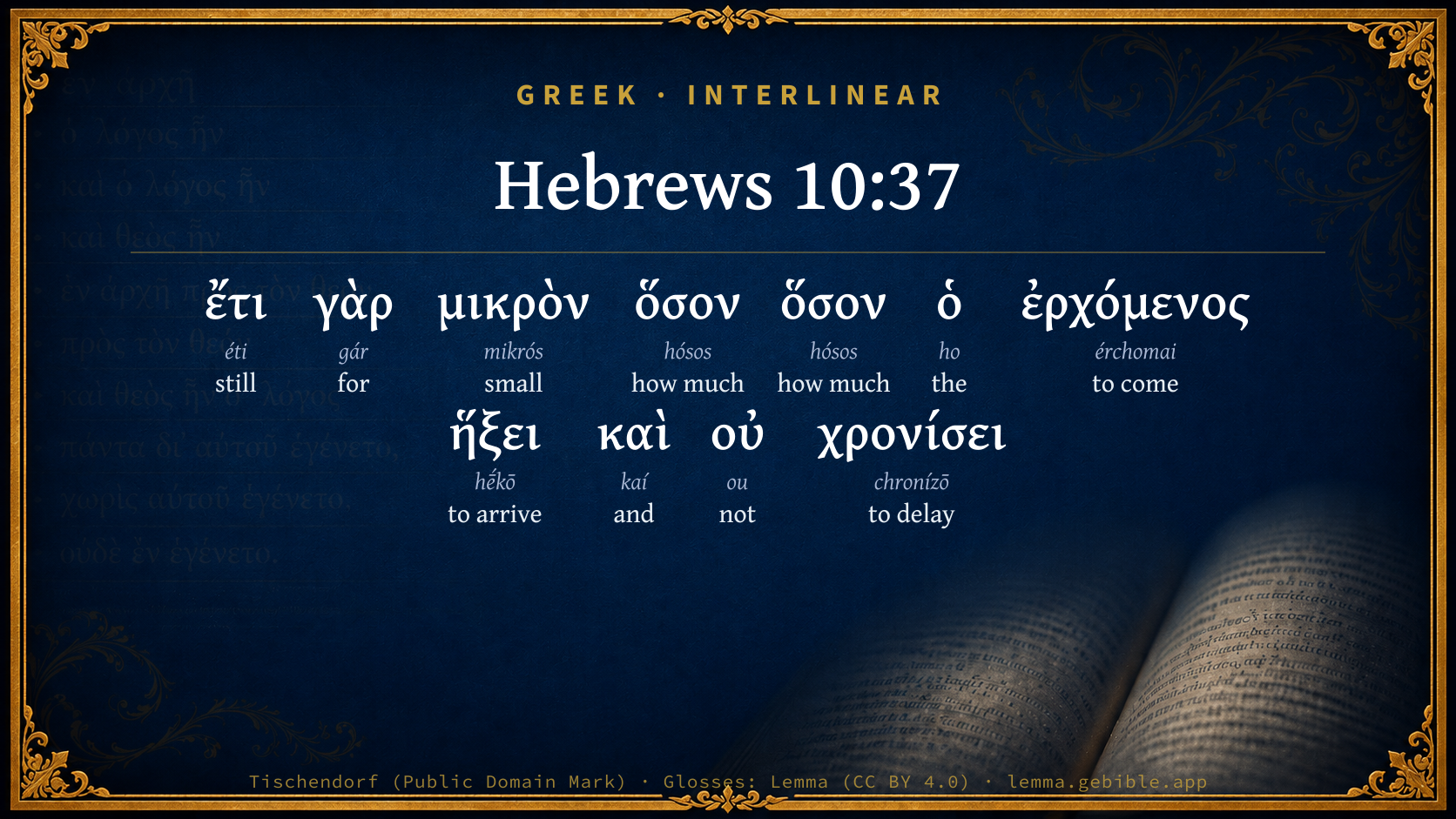
Greek (Tischendorf 8th ed.) Hebrews 10:37 appears in the Greek New Testament. The text above is from the Tischendorf 8th edition. Each word links to its Strong’s number and a concise gloss. Click any word for its full Thayer’s Greek Lexicon entry.
Download image
Cite this verse

Hebrews 10:37 (World English Bible). Public Domain. Lemma interlinear Bible study tool, https://lemma.gebible.app/v/hebrews/10/37.

Show BibTeX & RIS
BibTeX
RIS
English Translation
"In a very little while, He who comes will come, and will not wait.
World English Bible · Public Domain
Download a study sheet

One document with this verse’s original text, its word-by-word gloss line, the meaning frame, cross-references with their text, attributed commentary, and full source and license credits — printable, and it pastes into notes with its structure intact.

This verse Autodidact and up

Study sheet (.html) Plain text (.txt)

A passage Seminary Student

Up to 50 verses in one chapter. A passage sheet keeps up to 6 commentary sources and 12 cross-references per verse, in the order this page ranks them, and says so on the sheet whenever that leaves anything out. Ask for a single verse and you get the Autodidact verse sheet above.

Everything on this page stays free to read, with no account — the sheet is a download of what is already on screen, not access to it.

Want to remove ads? Support Godless Engineer
Compare translations 3

The same verse in 3 English versions, stacked beneath the original-language interlinear above. Click any original word for its lexicon entry.

Each is an independent rendering of the whole verse — the interlinear is not word-aligned to these translations.

Highlighted words mark where these versions differ — a whole-verse word diff, not a word-by-word alignment.

  • World English Bible Public Domain
    "In a very little while, He who comes will come, and will not wait.
  • King James Version Public Domain
    For yet a little while, and he that shall come will come, and will not tarry.
  • unfoldingWord Literal Text CC BY-SA 4.0
    “For yet a very little, the one coming will come and will not delay.

unfoldingWord Literal Text — © unfoldingWord, licensed CC BY-SA 4.0. Word-aligned USFM3 via Door43 (git.door43.org/unfoldingWord/en_ult).

Versions to compare (up to 4)

3 of 4 selected

Show all 19 translations

Every available English version of this verse, each an independent rendering of the whole verse.

  • World English Bible Public Domain
    "In a very little while, He who comes will come, and will not wait.
  • Berean Standard Bible Public Domain
    For, “In just a little while, He who is coming will come and will not delay.
  • Majority Standard Bible Public Domain
    For, “In just a little while, He who is coming will come and will not delay.
  • King James Version Public Domain
    For yet a little while, and he that shall come will come, and will not tarry.
  • American Standard Version (1901) Public Domain
    For yet a very little while, He that cometh shall come, and shall not tarry.
  • Revised Version (1885) Public Domain
    For yet a very little while, He that cometh shall come, and shall not tarry.
  • Geneva Bible (1599) Public Domain
    For yet a very litle while, and hee that shall come, will come, and will not tary.
  • Douay-Rheims (1899) Public Domain
    For yet a little and a very little while, and he that is to come, will come, and will not delay.
  • Young's Literal Translation Public Domain
    for yet a very very little, He who is coming will come, and will not tarry;
  • Literal Standard Version CC BY-SA 4.0
    “For yet [in] a very, very little [while], He who is coming will come, and will not linger,”
  • Unlocked Literal Bible CC BY-SA 4.0
    “For in a very little while, the one who is coming will indeed come and not delay.
  • unfoldingWord Literal Text CC BY-SA 4.0
    “For yet a very little, the one coming will come and will not delay.
  • Darby Bible Public Domain
    For yet a very little while he that comes will come, and will not delay.
  • World Messianic Bible Public Domain
    “In a very little while, he who comes will come and will not wait.
  • Webster's Bible Public Domain
    For yet a little while, and he that is coming will come, and will not tarry.
  • Free Bible Version CC BY-SA 4.0
    “In just a little while he will come, as he said—he won't delay.
  • Bible in Basic English Public Domain
    In a very little time he who is coming will come; he will not be slow.
  • Text-Critical English NT CC BY 4.0
    “For in just a little while, he who is coming will come and not delay.
  • Tyndale New Testament (1534) Public Domain
    For yet a very lytell whyle and he that shall come will come and will not tary.

Literal Standard Version (2020), Covenant Press — licensed CC BY-SA 4.0. Text via the HelloAO Bible API (eBible.org). Unlocked Literal Bible (unfoldingWord) — licensed CC BY-SA 4.0. Text via the HelloAO Bible API (eBible.org). unfoldingWord Literal Text — © unfoldingWord, licensed CC BY-SA 4.0. Word-aligned USFM3 via Door43 (git.door43.org/unfoldingWord/en_ult). Free Bible Version, Dr. Jonathan Gallagher — licensed CC BY-SA 4.0. Text via the HelloAO Bible API (eBible.org).

Word by word

More ways to search: Search by grammar → Find every occurrence → Compare this word →

Practice this passage: Drill this verse → Learn its vocabulary →

About this verse

These counts appear in no published source. They are computed here, from the morphology-tagged text and Lemma’s own curated glosses. What Lemma adds →

11
words
10
distinct lemmas
General Epistles
section

Notable vocabulary

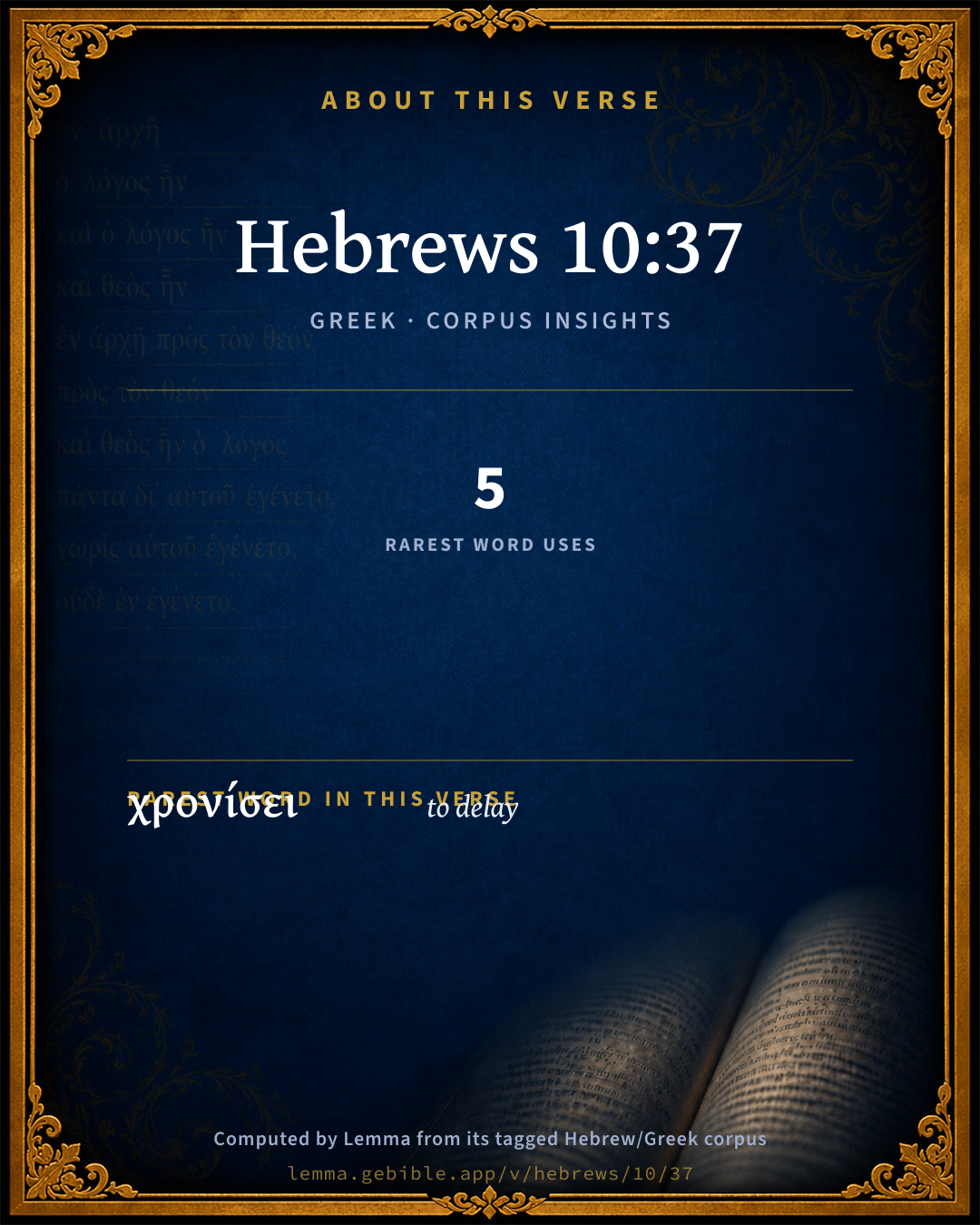
The rarest word here is χρονίσει to delay G5549 — appearing just 5 times in the whole Greek New Testament.

Shared distinctive vocabulary

χρονίσει to delay G5549 occurs in 5 verses of the Greek New Testament. Also found in:

Repetition

A word recurs within this verse:

  • ὅσον how much G3745 ×2

Cross-references

7

Topical passages linked to Hebrews 10:37 in the Treasury of Scripture Knowledge — connected by theme and wording, ordered by reader-vote popularity; previews shown in the World English Bible.

  • James 5:7–9 Be patient therefore, brothers, until the coming of the Lord. Behold, the farmer waits for the precious fruit of the earth, being patient over it, until it receives the early and late rain.
  • Habakkuk 2:3–4 For the vision is yet for the appointed time, and it hurries toward the end, and won't prove false. Though it takes time, wait for it; because it will surely come. It won't delay.
  • Luke 18:8 I tell you that he will avenge them quickly. Nevertheless, when the Son of Man comes, will he find faith on the earth?"
  • Isaiah 26:20 Come, my people, enter you into your chambers, and shut your doors about you: hide yourself for a little moment, until the indignation be past.
  • Isaiah 60:22 The little one shall become a thousand, and the small one a strong nation; I, Yahweh, will hasten it in its time.
  • Revelation 22:20 He who testifies these things says, "Yes, I come quickly." Amen! Yes, come, Lord Jesus.
  • 2 Peter 3:8 But don't forget this one thing, beloved, that one day is with the Lord as a thousand years, and a thousand years as one day.

Cross-references courtesy of OpenBible.info (CC BY 4.0).

Commentary

Notes on Hebrews 10:37 from classic Christian and Jewish commentators (each source and its license shown beneath its notes). The classic Christian expositions comment on the surrounding passage and are grouped to its opening verse, so a note may address several verses; the Jewish commentaries on the Tanakh (Rashi and others) are per-verse, so they appear only where the commentator wrote on this verse.

Lemma curates 59 commentaries, every one of them public domain or Creative Commons licensed, each selected and text-cleaned for this edition rather than reprinted as found. About our sources →

The Biblical Illustrator

Joseph S. Exell

Heb_10:37

Yet a little while, and He that shall come will come

Yet a little while:

He who has a house ready furnished does not mind the dismantling of his lodging.

True, it is not pleasant to have the furniture of even our lodging disturbed and broken, to have the things in it scattered and pulled to pieces; for even a lodging becomes dear when we are used to it, every corner an old acquaintance and almost an old friend: every part of it brings some thoughts, habits, and employments to remembrance. We do not leave it without pain, nor are we driven from it without some natural sorrow. But if we have a house ready when the lodging is gone, our sorrow is less, our regret slighter, for it is not our all: we are not left houseless. The Hebrews were in trouble: persecution had fallen upon them. Therefore, when the heathen were let loose upon them, and the malice that was not allowed to take their lives was allowed to spoil their goods, they took it joyfully, remembering that they had in heaven a better and an enduring substance, that, though men destroyed the lodging and its furniture, they could not reach or touch the home. They had thus done the will of God, not only by active obedience, but by patient submission. However, the promise on which their hopes were fixed, even the hope of eternal life, was still at a distance. They must wait on till it should be fulfilled. To be able thus to wait they needed patience; and to exercise that patience St. Paul wrote our text: Yet a little while, and He that shall come will come, and will not tarry. A little while! says the unbeliever, as he hears it--a little while! are one thousand eight hundred years a little while? Such are the thoughts of the sceptic. If we were to weigh time in mans puny scales, it would not be a little while. To us worms, creeping along the earth for a small space, for our few years, it is not a little while. But He who spoke these words, I come quickly, is the same to whom a thousand years are but as a day, the same that inhabiteth eternity. To Him years are as seconds on the stop-watch, and centuries roll round as swiftly as the hands on the dial. The humble Christian does not understand this, but he believes it; for it is the word of Him whom he has found to be the truth of God. And those words, Yet a little while, are a fruitful source of comfort to his soul. Come with me to the death-bed of a Christian missionary, and see what those words do there. Morning is just beginning to break over the eastern hills. The missionarys wife has been watching all night by the bedside of her fever-stricken husband. In an hour or two she will be a widow and desolate. Yet a little while. He knows that he is leaving her: he knows that he shall soon cease to behold that face on which for so many years he has never looked but in love, and which has never looked but in love upon his own. Yet a few more years or months and her work also will be done; and she also shall be where he is, and the loving fellow servants shall meet never to part again in their Fathers home. Come with me, yet not to foreign lands, but to our own, and not to a distant part, but near at hand. Come to the abode of poverty; poverty brought on by no crime--poverty which Gods visitations have brought on. Yet a little while. It will soon be over: I shall soon have done with this little room, this scanty furniture, these poor garments: I shall soon want not even the little food I now want for my mortal body. Yet a little while, and He who for my sake became poor will make me eternally rich through His poverty. Yes, we might run through the whole range of Christian faith: we might look into Christians of every rank of life, from the peer that wears a coronet down to the aged widow driven at last even from her little room into the shelter of a workhouse: we might ask the princely Christian merchant at his desk, the Christian tradesman at his counter, the Christian soldier at his post, the Christian mechanic at his work, yea, the Christian pauper (for such I have met) breaking stones by the roadside of the country, or picking oakum in the town, and they would all tell us, if we asked them, to what they are looking, and what assurance cheers them in their way, and they would all say, Yet a little while. But do these words bring comfort to any but the Christian? Ask the wealthy worldling with his splendid mansion, its costly furniture, its comforts and its luxuries. Oh no; it is his misery to think that all these are only for a little while--that he must leave them all so soon; and it would mar everything if on his splendid furniture, his majestic trees, his noble mansion, were written in clear, plain characters, a little while. Ask the bright girl, who is only a creature of this world, full of life and spirits, bounding with joy and health, enjoying with keen relish all the enjoyments of the world, the excitement of the dance; would that bright child of fashion, that joyous and excited creature of amusement, desire to have written on her wardrobe, on her novels, and to meet her wherever she goes--a little while? … Happy Christian! for thou dost believe what thy God has said. Thou does not believe that this life is all of life, nor this world all: thou dost believe that this is Gods school, and above is Gods home, and that thou art now under tutors, and that now afflictions are thy teachers, troubles thy discipline, temptations the searching tests of thy truth, thy purity, thy integrity, thy love to God, thy sense of sin; that this is all meant to make thee fit for thy Fathers house, to form thy Saviours likeness in thy soul; and, believing this, thou dost rejoice to think, that yet a little while, and when the fires have melted thee and taken off thy dross, thou wilt not be sorry that the heat is over--when trial is done, thou wilt not be sorry to receive the crown of righteousness. (W. W. Champneys, M. A.)

Faith during delay

I. THE DELAY OF THE ACCOMPLISHMENT OF PROMISES IS A GREAT EXERCISE OF FAITH AND PATIENCE.

II. IT IS ESSENTIAL UNTO FAITH TO BE ACTED ON THE PROMISED COMING OF CHRIST TO ALL THAT LOOK FOR HIS APPEARANCE.

III. THERE IS A PROMISE OF THE COMING OF CHRIST SUITED UNTO THE STATE AND CONDITION OF THE CHURCH IN ALL AGES.

IV. THE APPARENT DELAY OF THE ACCOMPLISHMENT OF ANY OF THESE PROMISES REQUIRES AN EXERCISE OF THE FAITH AND PATIENCE OF THE SAINTS.

V. EVERY SUCH COMING OF CHRIST HATH ITS APPOINTED SEASON BEYOND WHICH IT SHALL NOT TARRY.

VI. THIS DIVINE DISPOSITION OF THINGS GIVES A NECESSITY UNTO THE CONTINUAL EXERCISE OF FAITH, PRAYER, AND PATIENCE, ABOUT THE COMING OF CHRIST.

VII. Although we may not know the especial dispensations and moments of time that are passing over us, yet ALL BELIEVERS MAY KNOW THE STATE

IN GENERAL OF THE CHURCH UNDER WHICH THEY ARE, AND WHAT COMING OF CHRIST THEY ARE TO LOOK FOR AND EXPECT.

VIII. FAITH IN ANY CHURCH SATISFIES THE SOULS OF MEN WITH WHAT IS THE GOOD AND DELIVERANCE OF THAT STATE; ALTHOUGH A MAN DO KNOW OR IS PERSUADED THAT PERSONALLY HE SHALL NOT SEE IT HIMSELF, NOR ENJOY IT. The faith of this kind is for the Church, and not for mens individual persons.

IX. UNDER DESPONDENCIES AS TO PECULIAR APPEARANCES OR COMINGS OF CHRIST, IT IS THE DUTY OF BELIEVERS TO FIX AND EXERCISE THEIR FAITH ON HIS ILLUSTRIOUS APPEARANCE AT THE LAST DAY.

X. EVERY PARTICULAR COMING OF CHRIST, IN A WAY SUITED UNTO THE PRESENT DELIVERANCE OF THE CHURCH, IS AN INFALLIBLE PLEDGE OF HIS COMING AT THE LAST UNTO JUDGMENT.

XI. EVERY PROMISED COMING OF CHRIST IS CERTAIN, AND SHALL NOT BE DELAYED BEYOND ITS APPOINTED SEASON, WHEN NO DIFFICULTIES SHALL BE ABLE TO STAND BEFORE IT. (John Owen, D. D.)

The appointed time

As the herbs and flowers which sleep all winter in their roots underground, when the time of spring approacheth presently start forth of their beds, where they had lain so long unperceived, thus will the promise in its season do. He delays who passeth the time appointed; but he only stays that waits for the appointed time and then comes. Every promise is dated, but with a mysterious character; and for want of skill in Gods chronology we are prone to think that God forgets us, when indeed we forget ourselves in being so bold to set God a time of our own, and in being angry that He comes not just then to us. (W. Gurnall.)

The Biblical Illustrator, edited by Joseph S. Exell (c. 1880s–1900s) — public domain. Text from a community e-Sword module.

Tyndale Open Study Notes

Tyndale Open Resources

10:37-38 These verses quote Hab 2:3-4 to contrast the righteous and the wicked as they face God’s judgment (cp. Rom 1:17; Gal 3:11).

Tyndale Open Study Notes — © Tyndale Open Resources, licensed CC BY-SA 4.0. Text via the HelloAO Bible API.

Bengel's Gnomon

Johann Albrecht Bengel

Heb 10:37. Μικρὸν ὅσον ὅσον) yet a little while. So LXX., Isa 26:20. The word μικρὸν, with the addition of ὄσον ὄσον, takes the diminutive, but at the same time the indefinite form, and therefore accords very well with this passage: see Gen 27:30: אך, ἐγένετο ὅσον ἐξῆλθεν, was only just gone out.—ὁ ἐρχόμενος, He that cometh) The apostle, by the addition of the article, elegantly turns the words of the prophet to Christ.—ἥξει) will come.

Bengel's Gnomon of the New Testament — English translation (T&T Clark, Edinburgh, 1860) — public domain. Text from a community e-Sword module.

Meyer's Critical & Exegetical Commentary

Heinrich August Wilhelm Meyer

Heb_10:37-38. Ground of encouragement to the ὑπομονή, of which the readers stood in need, expressed with a free application of the words of Hab_2:3-4, according to the LXX. Continuance is necessary for the readers, and that continuance, indeed, only for a short time, since the return of Christ is to be looked for within a very short space of time, and then to those who have persevered in the faith everlasting life will be the portion conferred; the apostates, on the other hand, shall be overtaken by destruction.

The words ἔτι γὰρ μικρὸν ὅσον ὅσον are not a constituent part of the citation, but proceed from the author himself.

μικρὸν ὅσον ὅσον] is found Isa_26:20, and signifies literally: a little, how much, how much! i.e. a very, very little, or a very short time. μικρόν (Joh_14:19; Joh_16:16 ff.) is nominative,not accusative to the question when, as is supposed by Bleek (but only in his larger Comm.; otherwise in his later Vorlesungen, p. 417), Bisping, Alford, and Hofmann, as also Meyer on Joh_13:33,and nothing more than ἐστίν is to be supplemented to the same (see Winer, Gramm., 7 Aufl. p. 544). The reduplication of the ὅσον, however, serves for the significant strengthening of the notion. To be compared Aristoph. Vesp. 213: τί οὐκ ἀπεκοιμήθημεν ὅσον ὅσον στίλην; Arrian, Indic. xxix. 15: ὀλίγοι δὲ αὐτῶν σπείρουσιν ὅσον ὅσον τῆς χώρης. See Hermann, ad Viger. 726.

ὁ ἐρχόμενος ἥξει καὶ οὐ χρονιεῖ] and then He that cometh will come, and will not delay.

LXX. l.c. Heb_10:3 : διότι ἔτι ὅρασις εἰς καιρὸν καὶ ἀνατελεῖ εἰς πέρας καὶ οὐκ εἰς κενόν· ἐὰν ὑστερήσῃ, ὑπόμεινον αὐτόν, ὅτι ἐρχόμενος ἥξει καὶ οὐ μὴ χρονίσῃ. In the sense of the prophet, the discourse is of the certain fulfilment of the prophecy regarding the overthrow of the Chaldees. The LXX., however, wrongly translated the words, and as the ἐρχόμενος looked upon either God or the Messiah, of whom also the later Jewish theologians interpreted the passage (see Wetstein ad loc.). Of the Messiah the author of the Epistle to the Hebrews also understands the expression, and therefore adds the article ὁ to ἐρχόμενος. In like manner ὁ ἐρχόμενος appears, Mat_11:3, Luk_7:19, as a current appellation of the Messiah (based upon Dan_7:13; Zec_9:9; Mal_3:1; Psa_40:8 [7], Psa_118:26). Only in the instances mentioned the first appearing of the Messiah upon earth is intended, whereas in our passage (as also very frequently by ἔρχεσθαι elsewhere in the N. T., e.g. 1Co_11:26; Act_1:11; Mat_16:27-28; Joh_21:22-23) the return of Christ, as of the Messiah crucified upon earth and exalted to heaven, for the consummation of the kingdom of God, is that which is referred to. Arbitrarily Carpzov, Heinrichs, Bloomfield, Ebrard, and others: a coming for the destruction of Jerusalem, is here to be thought of.

Meyer — Critical and Exegetical Commentary on the New Testament — English translation by Peter Christie, edited by Frederick Crombie (T&T Clark, 1880) — public domain. Text from a community e-Sword module.

Geneva Bible (1599)

Geneva Bible translators

He will come within this very little while.

Geneva Bible (1599) marginal notes — public domain. Text via Bolls.life.

Jamieson, Fausset & Brown

Robert Jamieson, A. R. Fausset & David Brown

Encouragement to patient endurance by consideration of the shortness of the time till Christ shall come, and God's rejection of him that draws back, taken from Hab 2:3-4.

a little while-- (Joh 16:16).

he that shall come--literally, "the Comer." In Habakkuk, it is the vision that is said to be about to come. Christ, being the grand and ultimate subject of all prophetical vision, is here made by Paul, under inspiration, the subject of the Spirit's prophecy by Habakkuk, in its final and exhaustive fulfilment.

Jamieson, Fausset & Brown — Commentary Critical and Explanatory on the Whole Bible (1871) — public domain (CC PDM 1.0). Text via the HelloAO Bible API.

Adam Clarke's Commentary

Verse 37. For yet a little while] Ετι γαρ μικρον ὁσον· For yet a very little time. In a very short space of time the Messiah will come, and execute judgment upon your rebellious country. This is determined, because they have filled up the measure of their iniquity, and their destruction slumbereth not. The apostle seems to refer to Hab 2:3; Hab 2:4, and accommodates the words to his own purpose.

Adam Clarke's Commentary on the Bible (1810–1826) — public domain. Text from a community e-Sword/MySword module.

John Calvin's Commentaries

37. For yet a little while, or, for yet a very little time, etc. That it may not be grievous to us to endure, he reminds us that the time will not be long. There is indeed nothing that avails more to sustain our minds, should they at any time become faint, than the hope of a speedy and near termination. As a general holds forth to his soldiers the prospect that the war will soon end, provided they hold out a little longer; so the Apostle reminds us that the Lord will shortly come to deliver us from all evils, provided our minds faint not through want of firmness.

And in order that this consolation might have more assurance and authority, he adduces the testimony of the Prophet Habakkuk. (Habakkuk 2:4.) But as he follows the Greek version, he departs somewhat from the words of the Prophet. I will first briefly explain what the Prophet says, and then we shall compare it with what the Apostle relates here.

When the Prophet had spoken of the dreadful overthrow of his own nation, being terrified by his prophecy, he had nothing to do but to quit as it were the world, and to betake himself to his watchtower; and his watchtower was the Word of God, by which he was raised as it were into heaven. Being thus placed in this station, he was bidden to write a new prophecy, which brought to the godly the hope of salvation. Yet as men are naturally unreasonable, and are so hasty in their wishes that they always think God tardy, whatever haste he may make, he told them that the promise would come without delay; at the same time he added, “If it tarries, wait for it.” By which he meant, that what God promises will never come so soon, but that it seems to us to tarry, according to an old proverb, “Even speed is delay to desire.” Then follow these words, “Behold, his soul that is lifted up is not upright in him; but the just shall live by his faith.” By these words he intimates that the ungodly, however they may be fortified by defenses, should not be able to stand, for there is no life of security but by faith. Let the unbelieving then fortify themselves as they please, they can find nothing in the whole world but what is fading, so that they must ever be subject to trembling; but their faith will never disappoint the godly, because it rests on God. This is the meaning of the Prophet.

Now the Apostle applies to God what Habakkuk said of the promise; but as God by fulfilling his promises in a manner shows what he is, as to the subject itself there is not much difference; nay, the Lord comes whenever he puts forth his hand to help us. The Apostle follows the Prophet in saying, That it would be shortly; because God defers not his help longer than it is expedient; for he does not by delaying time deceive us as men are wont to do; but he knows his own time which he suffers not to pass by without coming to our aid at the moment required. Now he says, He that cometh will come, and will not tarry. Here are two clauses: by the first we are taught that God will come to our aid, for he has promised; and by the second, that he will do so in due time, not later than he ought.

John Calvin's Commentaries (1540-1563) — public domain. Text from the Calvin Translation Society English edition (1840s-50s) via the Christian Classics Ethereal Library (ccel.org). Calvin's coverage is partial (roughly two-thirds of the Bible); uncommented books and verses are honest gaps, never fabricated. The 19th-century editor's footnotes and remarks are omitted so the notes are faithfully Calvin's own voice.

Ellicott's Commentary for English Readers

(37) The connection is this: “Ye have need of endurance” for “the end is not yet” (Mat_24:6); ye shall “receive the promise,” for the Lord shall surely come, and that soon.

A little while.—Rather, a very little while. The expression is remarkable and unusual; it is evidently taken from Isa_26:20—“Come my people . . . hide thyself for a little moment until the indignation be overpast.” The subject of this passage, from which the one expressive phrase is taken, is the coming of Jehovah “to punish the inhabitants of the earth for their iniquity;” in “a little moment” shall the indignation consume His foes, then will He give deliverance to His people. Even this passing reference would serve to call up before the mind of the Hebrew readers the solemn associations of the prophecy—the promised salvation, the awful judgment.

And he that shall come will come.—Rather, He that cometh will come and will not tarry. In this and the next verse the writer of the Epistle takes up a passage, Hab_2:3-4, which occupies a very important place in the writings of St. Paul (Rom_1:17; Gal_3:11), and, as we have already seen (Note on Heb_6:1), in the later Jewish teaching. St. Paul’s citations are limited to a few words of Heb_10:4, “But the just shall live by faith;” here are quoted the whole of the fourth verse and part of the third. Perhaps it is too much to say that they are quoted, they are rather applied, for, as will be seen, the order of the clauses (see next verse) is changed, and some alterations are made in the language. It is important in this Epistle to discriminate between the instances of direct quotation from the Scripture, where the word of God is appealed to as furnishing proof, and those in which passages of the Old Testament are explained and applied (see the Note on Heb_10:5). The words before us nearly agree with the LXX., “If he delay, wait for him, because coming he will come, and will not tarry.” The subject of the sentence there is not clear; probably the translator believed that the Lord spoke thus of His own coming, or the coming of the future Deliverer. In the Hebrew all relates to the vision, “it will surely come, it will not tarry.” The only difference between the LXX. and the words as they stand here consists in the substitution of “He that cometh” for “coming.” Now the reference to the Deliverer and Judge is made plain. No designation of the Messiah, perhaps, was more familiar than “He that cometh” (Mat_11:3, et al.); but in is here employed with a new reference—to the second advent in place of the first. The departure from the sense of the Hebrew is not as great as may at first appear. When the prophet says “The vision . . . shall surely come,” it is of that which the vision revealed that he speaks, i.e., of the fall of the Chaldeans; but the salvation of Israel from present danger is throughout the prophets the symbol of the great deliverance (comp. Heb_12:26 and Hag_2:6). With this verse comp. Heb_10:25; also Php_4:5; Jas_5:8; 1Pe_4:7; Rev_1:3; Rev_22:20, et al.; and, in regard to the application of the prophecy, Heb_10:27-28; Heb_10:30.

A Bible Commentary for English Readers, edited by Charles John Ellicott (1878–1897) — public domain. Text from a community e-Sword module.

The Cambridge Bible for Schools and Colleges

gen. ed. J. J. S. Perowne

37. yet a little while] The original has a very emphatic phrase (μικρὸν ὅσον ὅσον) to imply the nearness of Christ’s return, “yet but a very very little while.” The phrase occurs in the LXX. in Isa_26:20. The quotations in this and the next verse are adapted from Hab_2:3-4. In the original it is “the vision” which will not tarry, but the writer quotes from the LXX., only inserting the definite article before ἐρχόμενος, and applying it to the Messiah. “The coming one” was a Messianic title (Mat_11:3; Luk_7:19; comp. Dan_7:13, &c). In Mat_24:34 our Lord has said, “This generation shall not pass till all these things be fulfilled;” and by the time that this Epistle was written few still survived of the generation which had seen our Lord. Hence, Christians felt sure that Christ’s coming was very near, though it is probable that they did not realise that it would consist in the close of the Old Dispensation, and not as yet in the End of the World.

The Cambridge Bible for Schools and Colleges (gen. ed. J. J. S. Perowne; Cambridge University Press, 1878–1918) — public domain. Text from a community e-Sword module.

Trapp's Complete Commentary

John Trapp

37 For yet a little while, and he that shall come will come, and will not tarry.

Ver. 37. For yet a little while] Tantillum, tantillum, adhuc pusillum. A little, little, little while, ετι γαο μικρον οσον, οσον. God’s help seems long, because we are short. Were we but ripe, he is full ready. Hence this ingemination, "he that shall come, will come," &c., q.d. he will, he will, his mind is always upon it, he is still a coming to deliver. With this sweet promise Rev. Mr Whatley comforted himself a little before his death. And Bishop Jewel, persuading many to patience, oft said, haec non durabunt aetatem, this is but for awhile. (Mr Leigh’s Annotat.)

John Trapp, A Commentary or Exposition upon All the Books of the Old and New Testament (1647–1656) — public domain. Text from a community e-Sword module.

Albert Barnes' Notes on the Bible

For yet a little while - There seems to be an allusion here to what the Saviour himself said, “A little while, and ye shall not see me; and again, a little while and ye shall see me;” Joh 16:16. Or more probably it may be to Hab 2:3. “For the vision is yet for an appointed time, but at the end it shall speak, and not he: though it tarry, wait for it; because it will surely come, it will not tarry.” The idea which the apostle means to convey evidently is, that the time of their deliverance from their trials was not far remote.

And he that shall come will come - The reference here is, doubtless, to the Messiah. But what “coming” of his is referred to here, is more uncertain. Most probably the idea is, that the Messiah who was coming to destroy Jerusalem, and to overthrow the Jewish power Matt. 24, would soon do this. In this way he would put a period to their persecutions and trials, as the power of the Jewish people to afflict them would be at an end. A similar idea occurs in Luk 21:28. “And when these things begin to come to pass, then look up, and lift up your heads; for your redemption draweth nigh;” see the notes on that passage. The Christians in Palestine were oppressed, reviled, and persecuted by the Jews. The destruction of the city and the temple would put an end to that power, and would be in fact the time of deliverance for those who had been persecuted. In the passage before us, Paul intimates that that period was not far distant. Perhaps there were already “signs” of his coming, or indications that he was about to appear, and he therefore urges them patiently to persevere in their fidelity to him during the little time of trial that remained. The same encouragement and consolation may be employed still. To all the afflicted it may be said that “he that shall come will come” soon. The time of affiction is not long. Soon the Redeemer will appear to deliver his afflicted people from all their sorrow; to remove them from a world of pain and tears; and to raise their bodies from the dust, and to receive them to mansions where trials are forever unknown; Joh 14:3 note; 1 Thes. 4:13-18 notes.

Albert Barnes' Notes on the Bible (1834–1885) — public domain. Text from a community e-Sword/MySword module.

Haydock's Catholic Bible Commentary

Yet a very little while, and the judge that is to come, and who is to judge every one, will come. (Witham) --- Greek: O erchomenos, he who is coming. It is observed by commentators, that this is the appellation given by the Jews to the Messias. See Matthew xi. 3. and xxi. 9.

George Leo Haydock (1774–1849), Haydock's Catholic Family Bible and Commentary, 1859 edition — public domain. Excludes Psalms (Douay-Rheims chapter numbering differs from Protestant) and Deuterocanonical books (Catholic canon only).

Matthew Poole's English Annotations

The reason of their retaining their confidence to the end, is the shortness of his coming, who will reward them for it, proved out of God’s promise written to and for the church, by Habakkuk, Hab 2:3. A truth sufficiently known to these Hebrews, as brought them by their own prophet; and though spoken for the comfort of the captives in Babylon then, yet it is extended to the suffering church in all ages, and so to these Hebrews, and to us also, upon whom the ends of the world are come, 1Co 10:11. And though the prophet speaks it of a vision of grace, in promise to be despatched, yet the Septuagint refers it to a person; and in this the apostle follows them, because the promise cannot be made good without the coming of its Author to fulfil it.

For yet a little while; in which promise there is the celerity or speed of it; as little, little as it may be, as is fit for Christ and them. How little is this time! A very short moment, as he speaks himself, Rev 22:7,12,20.

And he that shall come will come; he that hath promised to come and save you, and reckon with your persecutors, he will certainly come, he and his promise together, will despatch and put an end to the suffering of his, and put on their crowns. Metonymically, his coming is his saving, full refreshing, and rewarding his believing and patient sufferers.

And will not tarry; he will not spin out time to delay deliverance, beyond the set point; he will not come behind the last moment, the hour fixed and appointed, which is pitched in infinite wisdom and goodness, for the best comfort of Christ’s suffering members, Isa 46:13.

Matthew Poole's English Annotations on the Holy Bible (1683–1685) — public domain. Text from a community e-Sword/MySword module.

Whedon's Commentary on the Bible

Daniel D. Whedon

37. For—Illustrating his meaning by free quotations of Hab_2:3-4, mostly according to the Septuagint. The prophet is in vision auspicating the coming of destruction upon the Chaldean, as our author is anticipating the coming of the Roman for the destruction of Jerusalem.

Will not tarry—Though now seeming to delay.

Daniel D. Whedon (gen. ed.), Commentary on the Old and New Testaments (1874–1909) — public domain. Text from a community e-Sword module.

The Pulpit Commentary

Vers. 37, 38. For yet a little (rather, very little) while, and he that cometh will come, and will not tarry. But the just shall live by faith: and if he draw back, my soul hath no pleasure in him. In these verses, after the manner of the Epistle, what is being urged is supported by an Old Testament quotation, (Hab_2:3, Hab_2:4) its drift being

(1) the certainty, notwithstanding delay, of the fulfillment of the Divine promise;

(2) the necessity meanwhile of continuance in faith and perseverance. The quotation serves also as a step of transition (this, too, after the Epistle"s manner) to the disquisition on faith, which forms the subject of the following chapter. For the prophet speaks of faith as what the righteous one is to live by until the Lord come. It was faith a fuller faith that the Hebrew Christians wanted to preserve them from the faltering of which they showed some signs; and the requirement of faith was no new thing it had been the essential principle of all true religious life from the beginning, and thus is led up to the review which follows of the Old Testament history, showing that this had always been so. The quotation, as usual, is from the LXX, which, in this case as in some others, differs from the Hebrew. But here, as in ver. 29, supra, the LXX is not exactly followed. The writer cites freely, so as to apply the essential meaning of the passage to his purpose. The Prophet Habakkuk (writing probably during the long evil days of Manasseh) had in his immediate view the trials of faith peculiar to his own time violence and iniquity in Israel, and imminence of judgment at the hands of Chaldean conquerors, under which he had cried, "O Lord, how long?" But he stands upon his watch and sits upon his tower, to look out what the LORD will say to him in answer to his difficulties. And the LORD answered him, and said, Write the vision, and make it plain upon the tables, that he may run that readeth it. For the vision is yet for an appointed time, but at the end it shall speak, and not lie rather, "but it hasteth to the end, and doth not lie: though it tarry, wait for it; because it will surely come, and not tarry or, "be behindhand. Behold, his soul that is lifted up is not upright in him or, "behold, his soul is lifted up, it is not upright in him; but the just shall live by his faith." The drift of this Divine answer, which inspired the song of joyful confidence with which the Book of Habakkuk so beautifully concludes, is, as aforesaid, that, in spite of all appearances, the prophetic vision will ere long be realized; God"s promises to the righteous will certainly be fulfilled; and that faith meanwhile must be their sustaining principle. The variations of the LXX from the Hebrew are:

(1) Ercomenov hxei , instead of "It (i.e. the vision) shall come;

(2) Ealhtai ouk eudokei h quch mou en autw , instead of "Behold, his soul," etc.;

(3) O de dikaiov mou ek pistewv zhsetai

(A), or de O dikaiov ek pistewv mou zhsetai

(B), instead of "The just shall live by his faith." The variations in the Epistle from the LXX are:

(1) Eti mikro , (etc. Isa_26:20) interpolated at the beginning of the quotation;

(2) O ercomenov for ercomenov , so as to denote more distinctly the Messiah who was to come; (cf. Mat 10:3Jo Mat_6:14) here, of course, with a view to his second advent;

(3) the reversal of the order of the two concluding clauses, ealhtai , and o de dikaiov :

(4) in the Textus Receptus the omission of mou after either dikaiov or pistewv . (as the same text is cited by St. Paul, Rom_1:17 and Gal_3:11) There is, however, good authority for reading it here after dikaiov (equivalent to "my Righteous One"). None of these variations from the LXX affect the meaning of the passage, being only such as to point more clearly the intended application. One of the variations of the LXX from the Hebrew (ealhtai , etc.) does alter the meaning of that particular clause, though not the general purport of the whole passage. The adoption here of the LXX reading, and still more the fact that the following verse depends upon this reading, is among the strong evidences of the Epistle having been originally written, not in Hebrew, but in Greek.

Life by Faith. "now the just shall live by faith." In this place our text means that by persevering faith the righteous man would be saved fully and to the end. He who continued in the exercise of faith would be kept safely amidst all dangers and all temptations to apostasy, and inherit the recompense of reward, But we propose to regard the text as the statement of a general truth of the Christian life, as St. Paul uses it in Rom_1:17 Gal_3:11. Thus viewed, it presents to our notice

I THE CHARACTER SPECIFIED. This is marked by two leading features.

1. Righteousness. "The just," or righteous. The righteousness of the Christian is

(1) in character. He possesses the forgiveness of sins, and is accepted by God through Jesus Christ. The apostle of the Gentiles sets forth this righteousness: "That I may gain Christ, and be found in him, not having a righteousness of mine own," etc. (Php_3:9) The righteousness of the Christian is

(2) in conduct. "He that doeth righteousness, is righteous". (1Jn_3:7, 1Jn_3:10)

2. Religiousness. The Revised Version gives our text thus: "But my righteous one shall live by faith." This we regard as the correct text. It sets before us one who is godly as well as just, whose righteousness is joined with reverence, and is exalted by the union. A man cannot be righteous towards God without being religious. Unless we worship and love and obey him, we do him injustice. In the Christian character piety and principle, righteousness and reverence, must go hand in band.

II THE LIFE MENTIONED. We are not acquainted with a satisfactory definition of life. The things of deepest significance and greatest importance defy our powers of definition. So we cannot set forth adequately in a sentence the life spoken of in the text. It is far more than physical and intellectual existence and activity. "Knowledge, truth, love, beauty, goodness, faith, alone can give vitality to the mechanism of existence." The life of true personal religion is that which our text speaks of. It is the life of supreme love to God, the life of Christ in man. "Christ," says Canon Liddon, "is the quickening Spirit of Christian humanity; he lives in Christians; he thinks in Christians; he acts through Christians and with Christians; he is indissolubly associated with every movement of the Christian"s deepest life. "I live," exclaims the apostle; "yet not I, but Christ liveth in me." This felt presence of Christ it is which gives both its form and its force to the sincere Christian life. That life is a loyal homage of the intellect, of the heart, and of the will, to a Divine King, with whom will, heart, and intellect are in close and constant communion, and from whom there flows forth, through the Spirit and the sacraments, that supply of light, of love, and of resolve which enriches and ennobles the Christian soul.

III THE MEANS OF THIS LIFE. "Shall live by faith." Brief consideration of two points is essential.

1. The nature of this faith. It is far more than the assent of the reason, or apprehension by the reason. It is a moral rather than an intellectual act. "With the heart man believeth unto righteousness." "When the soul in very truth responds to the message of God, the complete responsive act of faith is threefold. This act proceeds simultaneously from the intelligence, from the heart, and from the will of the believer. His intelligence recognizes the unseen object as a fact. His heart embraces the object thus present to his understanding; his heart opens instinctively and unhesitatingly to receive a ray of heavenly light. And his will too resigns itself to the truth before it; it places the soul at the disposal of the object which thus rivets its eye and conquers its affections.

2. The Object of this faith. Our Lord Jesus Christ himself is the grand Object of the faith of the Christian. We accept him in the three great relationships which he sustains to his true disciples. As our Prophet we exercise faith in him. He claimed to be "the Truth." On all questions of morality and religion, of sin and salvation, of life and death, we bow to him as our infallible Teacher, and unhesitatingly accept his Word. We believe in him as our Priest. He has made full atonement for sins; he is our perfect Representative with the Father; he is our tender, compassionate Savior. To him the heart turns in its sins for forgiveness, in its sorrows for consolation. We loyally accept him also as our King. He is the Sovereign of our will and the Lord of our life. We believe in him as our moral Master, whose authority is supreme. Thus Christ is the Object of the Christian"s faith. "By faith the soul is to be moving ever towards Christ, resting ever upon Christ, living ever in Christ. Christ is to be the end, the support, the very atmosphere of its life." He who thus believes in him shall have eternal life. W.J. (Joh_3:10 Eph_2:8)

The Pulpit Commentary (1880–1919), ed. H.D.M. Spence-Jones & Joseph S. Exell — public domain. Text from a community e-Sword module.

John Wesley's Explanatory Notes

He that cometh - To reward every man according to his works.

John Wesley, Explanatory Notes Upon the Whole Bible (1754–1765) — public domain. Text via the GEBible commentary corpus.

The People's New Testament

B. W. Johnson

37–39. For yet a little while. Quoted from Habakkuk, chapter 2, and applied to Christ. Soon Christ will come, either in person or by his providence, in such a way as to bring relief. He did thus come very soon after and ended Jewish persecution by the overthrow of the nation. This is a frequent sense of oft-repeated allusions to the coming of the Lord found both in the Old Testament and New Testament. See Habakkuk, chapter 2. The passage there quoted refers to the destruction of Jerusalem by Nebuchadnezzar, and is here applied to the destruction by the Romans.

B. W. Johnson's The People's New Testament with Notes (1889–1891) — public domain. Electronic text from the Christian Classics Ethereal Library (CCEL) ThML edition.

Cambridge Greek Testament for Schools and Colleges

37. μικρὸν ὅσον ὅσον. A very emphatic phrase to imply the nearness of Christ’s return, “yet but a very very little while” (lit., “little, how very, how very.” Comp. Arist. Vesp. 213 ὅσον ὅσον στίλην = quantillum; Arrian, Indic. XXIX. 15 ὀλίγοι δὲ αὐτῶν σπείρουσιν ὅσον τῆς χώρας). The phrase occurs in the LXX. in Isa 26:20. The quotations in this and the next verse are adapted from Hab 2:3-4. In the original it is “the vision” which will not tarry, but the writer quotes from the LXX., only inserting the definite article before ἐρχόμενος, and applying it to the Messiah. “The coming one” was a Messianic title (Mat 11:3; Luk 7:19; comp. Dan 7:13, &c.). In Mat 24:34 our Lord has said, “This generation shall not pass till all these things be fulfilled”; and by the time that this Epistle was written few still survived of the generation which had seen our Lord. Hence, Christians felt sure that Christ’s coming was very near, though it is probable that they did not realise that it would consist in the close of the Old Dispensation, and not as yet in the End of the World. It is most probable that by the time this Epistle was written the Roman eagles were already beginning to gather to the carcase of a corrupted nationality and a decadent religionism; so that no wise man could overlook the indications of the rapidly approaching end.

Cambridge Greek Testament for Schools and Colleges (Cambridge University Press, 1896; 21 vols, various authors incl. Carr, Maclear, Plummer, Farrar, Lumby, Moule, M. R. James, Simcox) — public domain. Text from a community e-Sword module.

Alford’s Greek Testament

Henry Alford

37-38.] Encouragement to this endurance, by the fact of the time being short, and at the same time further proof of the necessity of it by God’s renunciation of him that draws back: all from the same prophecy of Habakkuk.

37.] For yet a little little while (this expression is not in Habakkuk, but is found in ref. Isa., ἀποκρύβηθι μικρὸν ὅσον ὅσον, ἕως ἂν παρέλθῃ ἡ ὀργὴ κυρίου, to which the Writer probably alludes. μικρόν is the accus. neut.: some (Lün., Del.) say, an independent nominative, referring to Joh 14:19; Joh 16:16; but neither of those places determines the case. ὅσον is often joined to adjectives and nouns, &c., which denote size, to give a certain definiteness to the idea: so μικρὸν ὅσον, Lucian Hermot. 60; ὀλίγον ὅσον, ib. p. 62: and among other places in Wetst. and Loesner, we have the ὅσον repeated in ref.: in Arrian, Indic. 29, ὀλίγοι δὲ αὐτῶν σπείρουσιν ὅσον ὅσον τῆς γῆς: cf. Hermann on Viger, p. 726: Winer, § 36. 3, note. It gives the sense of very small, “aliquantillum” as Hermann expresses it: τὸ δὲ ὅσον ὅσον τὸ πάνυ μικρὸν δηλοῖ, Thl.), He that is coming (the solemn prophetical ὁ ἐρχόμενος, ‘He that is to come:’ see reff. There is no art. in the LXX, and ἐρχόμενος refers to the vision, or as αὐτόν and ἐρχόμενος in the masc. after ὅρασις, both are naturally referred to some one indicated by the ὅρασις; and ἐρχόμενος ἥξει, “coming it will come,” is paraphrased into ὁ ἐρχόμενος ἥξει, ‘He that is coming shall come.’ So Bengel: “Apostolus, articulo addito, verba prophetæ eleganter flectit ad Christum”) shall come, and shall not tarry.

Henry Alford, The Greek Testament (1849–1861) — public domain. Text from a community e-Sword module.

Vincent's Word Studies in the New Testament

Marvin R. Vincent

A little while [μικρον οσον οσον] . Strictly, a very little while. The phrase N. T. o. It is not part of the quotation, but is taken from Isa 26:20, the only instance. See Aristoph. Wasps, 213.

He that shall come will come [ο ερχομενος ηξει] . Rend. "he that cometh will come." In the Hebrew (Hab 2:3) the subject of the sentence is the vision of the extermination of the Chaldees. "The vision - will surely come." As rendered in the LXX, either Jehovah or Messiah must be the subject. The passage was referred to Messiah by the later Jewish theologians, and is so taken by our writer, as is shown by the article before ejrcomenov. Comp. Mt 11:3; Mt 21:9; Joh 11:27. Similarly he refers hxei shall come to the final coming of Messiah to judge the world.

Marvin R. Vincent, Word Studies in the New Testament (1887–1900) — public domain. Text from a community e-Sword/MySword module.

Westcott on Hebrews & the Epistles of John

Brooke Foss Westcott

37. ἔτι γὰρ... ὅσον] For, yet a very little while... (modicum [ali]quantedum, V.). These words with which the quotation from ITabakkuk is preface by the writer of the Epistle occur in Is, xxvi. 20 (LXxx.), where the prophet charges the people to hide themselves ‘for a little moment until the indignation should be overpast.’ Tho thought of the purposes of God wrought through the discipline of Israel thus serves as a preparation for the understanding of His counsel for the Church.

For ἔτι μικρόν compnre John xiv.

Ὅσον ὅσον, which appears to be a colloquial form, occurs in Arist. Veep. 213 and Leon. Tarent. Lxx. 4(Anthol. i, 238).

37 ὃ, 38 ὁ ἐρχόμενος...ἐν αὐτῷ These words are taken with modifications and transpositions from the Lxx. version of Hab. ii. 3f. (see Additional Note). In tho original context that which is expected is the fulfilment of tho prophotio vision of the dostruction of the Chaldroans, the enomies of God’s people, to be followed bythe revelation of His glory. The judgment was executed and the promise was accomplished in due time, but not as men had hoped. The lesson had a significant application to the condition of the early Church.

iil 3,9; xv. 4; xvili. 8. He will mako His coming felt as a present fact.

w. HH.

om. καὶ ἐὰν ὑποστείληται Ὦ,".

38. The original text gives the sense: ‘His soul is puffed up with pride: it is not right within him; but the righteous shall live by his faithfulness,’ where the reference is to the vain confidence of the Chaldscan invader as contrasted with the trust of tho people upon God. The xx. ropresonts a difforont text in the first clause; and the author of the Epistle has transposed the two clauses of the LXx. in order to bring out more clearly the idea which he wishes to enforce, the necessity of endurance in the righteous.

Brooke Foss Westcott (1825–1901), The Epistle to the Hebrews (1889) and The Epistles of St John (1883) — public domain (pre-1929). Text recovered from Internet Archive / Google Books OCR scans. Westcott’s Gospel of John commentary is not included (its OCR lost the chapter running-heads required for reliable verse-keying). Some Greek quoted in the Hebrews volume is imperfectly rendered by the OCR.

Lesson kit

Teaching starters — assembled from the data on this page, not authored interpretation. Every prompt links to the verse data it draws on. Edit before teaching.

Hebrews, in the General Epistles, opens this verse with 11 words (10 distinct Greek lemmas). Its most distinctive word is chronízō (“to delay”). A historical commentator’s framing appears above. Read the whole chapter for the surrounding context.

Discussion questions

  1. How does “to delay” (chronízō) shape what this verse is saying?
  2. How does Matthew 24:48, which shares the word «to delay», read alongside this verse?
  3. What does the repetition of “how much” (2× in this one verse) do in this verse?
  4. These translations render this verse differently. What is at stake in choosing one wording over another?
  5. Compare how The Biblical Illustrator and Tyndale Open Study Notes read this verse. Where do they agree or differ?

Things to notice

  • These translations choose different wording for 10 words in this verse.
  • “how much” occurs 2× in this single verse.
  • 10 distinct Greek lemmas span 11 words in this verse.

Reading settings

Reading text

Shown beneath each verse's original-language words.

Old Testament
Old Testament edition

Read the OT as the Masoretic Hebrew (MT) or the Greek Septuagint (LXX).

English shown for the Greek Septuagint (in the Hebrew ↔ Greek comparison).

Comparing translations? Open the Compare panel on any verse page to stack up to four side by side.