

Hebrews 13:4
Greek (Tischendorf 8th ed.) Hebrews 13:4 appears in the Greek New Testament. The text above is from the Tischendorf 8th edition. Each word links to its Strong’s number and a concise gloss. Click any word for its full Thayer’s Greek Lexicon entry.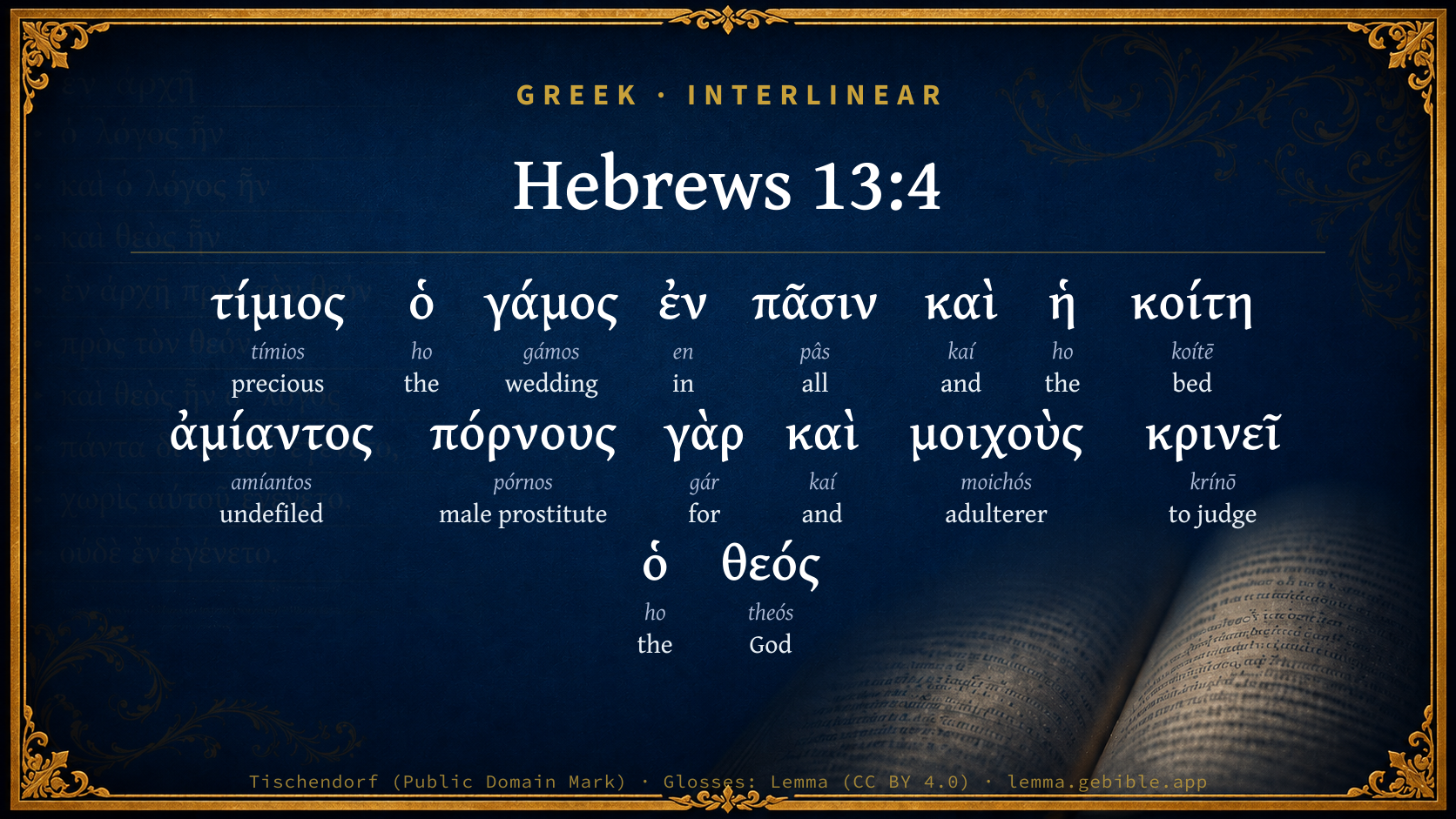
Let marriage be held in honor among all, and let the bed be undefiled: but God will judge the sexually immoral and adulterers.
Download a study sheet
One document with this verse’s original text, its word-by-word gloss line, the meaning frame, cross-references with their text, attributed commentary, and full source and license credits — printable, and it pastes into notes with its structure intact.
This verse Autodidact and up
A passage Seminary Student
Up to 50 verses in one chapter. A passage sheet keeps up to 6 commentary sources and 12 cross-references per verse, in the order this page ranks them, and says so on the sheet whenever that leaves anything out. Ask for a single verse and you get the Autodidact verse sheet above.
Everything on this page stays free to read, with no account — the sheet is a download of what is already on screen, not access to it.
Compare translations 3
The same verse in 3 English versions, stacked beneath the original-language interlinear above. Click any original word for its lexicon entry.
Each is an independent rendering of the whole verse — the interlinear is not word-aligned to these translations.
Highlighted words mark where these versions differ — a whole-verse word diff, not a word-by-word alignment.
-
World English Bible Public Domain
Let marriage be held in honor among all, and let the bed be undefiled: but God will judge the sexually immoral and adulterers.
-
King James Version Public Domain
Marriage is honourable in all, and the bed undefiled: but whoremongers and adulterers God will judge.
-
unfoldingWord Literal Text CC BY-SA 4.0
Marriage honorable among all, and the marriage bed pure, for God will judge sexually immoral and adulterers.
unfoldingWord Literal Text — © unfoldingWord, licensed CC BY-SA 4.0. Word-aligned USFM3 via Door43 (git.door43.org/unfoldingWord/en_ult).
Show all 19 translations
Every available English version of this verse, each an independent rendering of the whole verse.
-
World English Bible Public Domain
Let marriage be held in honor among all, and let the bed be undefiled: but God will judge the sexually immoral and adulterers.
-
Berean Standard Bible Public Domain
Marriage should be honored by all and the marriage bed kept undefiled, for God will judge the sexually immoral and adulterers.
-
Majority Standard Bible Public Domain
Marriage should be honored by all and the marriage bed kept undefiled; but God will judge the sexually immoral and adulterers.
-
King James Version Public Domain
Marriage is honourable in all, and the bed undefiled: but whoremongers and adulterers God will judge.
-
American Standard Version (1901) Public Domain
`Let' marriage `be' had in honor among all, and `let' the bed `be' undefiled: for fornicators and adulterers God will judge.
-
Revised Version (1885) Public Domain
Let marriage be had in honour among all, and let the bed be undefiled: for fornicators and adulterers God will judge.
-
Geneva Bible (1599) Public Domain
Mariage is honorable among all, and the bed vndefiled: but whoremongers and adulterers God will iudge.
-
Douay-Rheims (1899) Public Domain
Marriage honourable in all, and the bed undefiled. For fornicators and adulterers God will judge.
-
Young's Literal Translation Public Domain
honourable `is' the marriage in all, and the bed undefiled, and whoremongers and adulterers God shall judge.
-
Literal Standard Version CC BY-SA 4.0
The marriage [is to be] honored by all, and the bed undefiled, for God will judge whoremongers and adulterers.
-
Unlocked Literal Bible CC BY-SA 4.0
Let marriage be respected by everyone. Let the marriage bed be pure, for God will judge the sexually immoral people and adulterers.
-
unfoldingWord Literal Text CC BY-SA 4.0
Marriage honorable among all, and the marriage bed pure, for God will judge sexually immoral and adulterers.
-
Darby Bible Public Domain
[Let] marriage [be held] every way in honour, and the bed [be] undefiled; for fornicators and adulterers will God judge.
-
World Messianic Bible Public Domain
Let marriage be held in honor among all, and let the bed be undefiled; but God will judge the sexually immoral and adulterers.
-
Webster's Bible Public Domain
Marriage is honorable in all, and the bed undefiled: but lewd persons and adulterers God will judge.
-
Free Bible Version CC BY-SA 4.0
Everyone should honor marriage. Husbands and wives should be faithful to each other. God will judge adulterers.
-
Bible in Basic English Public Domain
Let married life be honoured among all of you and not made unclean; for men untrue in married life will be judged by God.
-
Text-Critical English NT CC BY 4.0
Marriage must be held in honor by all, and the marriage bed must be kept pure, but God will judge fornicators and adulterers.
-
Tyndale New Testament (1534) Public Domain
Let wedlocke be had in pryce in all poyntes and let the chamber be vndefiled: for whore kepers and advoutrars god will iudge.
Literal Standard Version (2020), Covenant Press — licensed CC BY-SA 4.0. Text via the HelloAO Bible API (eBible.org). Unlocked Literal Bible (unfoldingWord) — licensed CC BY-SA 4.0. Text via the HelloAO Bible API (eBible.org). unfoldingWord Literal Text — © unfoldingWord, licensed CC BY-SA 4.0. Word-aligned USFM3 via Door43 (git.door43.org/unfoldingWord/en_ult). Free Bible Version, Dr. Jonathan Gallagher — licensed CC BY-SA 4.0. Text via the HelloAO Bible API (eBible.org).
Word by word
More ways to search: Search by grammar → Find every occurrence → Compare this word →
Practice this passage: Drill this verse → Learn its vocabulary →
- Appears 3× in the Greek New Testament
- First appears at Luke 18:11
- Part of Speech
- Noun
- Case
- Accusative
- Number
- Plural
- Gender
- Masculine
Full Thayer's Definition
- τίμιος tímios G5093 “precious” Adjective, Nominative, Singular, Masculine
- ὁ ho G3588 “the” Article, Nominative, Singular, Masculine
- γάμος gámos G1062 “wedding” Noun, Nominative, Singular, Masculine
- ἐν en G1722 “in” Preposition
- πᾶσιν pâs G3956 “all” Adjective, Dative, Plural, Neuter
- καὶ kaí G2532 “and” Conjunction
- ἡ ho G3588 “the” Article, Nominative, Singular, Feminine
- κοίτη koítē G2845 “bed” Noun, Nominative, Singular, Feminine
- ἀμίαντος amíantos G283 “undefiled” Adjective, Nominative, Singular, Feminine
- πόρνους pórnos G4205 “male prostitute” Noun, Accusative, Plural, Masculine
- γὰρ gár G1063 “for” Conjunction
- καὶ kaí G2532 “and” Conjunction
- μοιχοὺς moichós G3432 “adulterer” Noun, Accusative, Plural, Masculine
- κρινεῖ krínō G2919 “to judge” Verb, Future, Active, Indicative, 3rd person, Singular
- ὁ ho G3588 “the” Article, Nominative, Singular, Masculine
- θεός theós G2316 “God” Noun, Nominative, Singular, Masculine
About this verse
These counts appear in no published source. They are computed here, from the morphology-tagged text and Lemma’s own curated glosses. What Lemma adds →
- 16
- words
- 13
- distinct lemmas
- General Epistles
- section
Cross-references
27Topical passages linked to Hebrews 13:4 in the Treasury of Scripture Knowledge — connected by theme and wording, ordered by reader-vote popularity; previews shown in the World English Bible.
- Genesis 2:24 Therefore a man will leave his father and his mother, and will join with his wife, and they will be one flesh.
- Proverbs 5:15–23 Drink water out of your own cistern, Running water out of your own well.
- 1 Corinthians 7:2–16 But, because of sexual immoralities, let each man have his own wife, and let each woman have her own husband.
- Galatians 5:19 Now the works of the flesh are obvious, which are: adultery, sexual immorality, uncleanness, lustfulness,
- Genesis 1:27–28 God created man in his own image. In God's image he created him; male and female he created them.
- 1 Corinthians 6:9 Or don't you know that the unrighteous will not inherit the Kingdom of God? Don't be deceived. Neither the sexually immoral, nor idolaters, nor adulterers, nor male prostitutes, nor homosexuals,
- Galatians 5:21 envyings, murders, drunkenness, orgies, and things like these; of which I forewarn you, even as I also forewarned you, that those who practice such things will not inherit the Kingdom of God.
- 1 Corinthians 5:13 But those who are outside, God judges. "Put away the wicked man from among yourselves."
- Colossians 3:5–6 Put to death therefore your members which are on the earth: sexual immorality, uncleanness, depraved passion, evil desire, and covetousness, which is idolatry;
- Ephesians 5:5 Know this for sure, that no sexually immoral person, nor unclean person, nor covetous man, who is an idolater, has any inheritance in the Kingdom of Christ and God.
- Genesis 2:21 Yahweh God caused a deep sleep to fall on the man, and he slept; and he took one of his ribs, and closed up the flesh in its place.
- Malachi 3:5 I will come near to you to judgment; and I will be a swift witness against the sorcerers, and against the adulterers, and against the perjurers, and against those who oppress the hireling in his wages, the widow, and the fatherless, and who deprive the foreigner of justice, and don't fear me," says Yahweh of Hosts.
- 1 Corinthians 7:38 So then both he who gives his own virgin in marriage does well, and he who doesn't give her in marriage does better.
- 1 Timothy 3:4 one who rules his own house well, having children in subjection with all reverence;
- 1 Timothy 3:12 Let deacons be husbands of one wife, ruling their children and their own houses well.
- Leviticus 21:13–15 "'He shall take a wife in her virginity.
- 1 Corinthians 9:5 Have we no right to take along a wife who is a believer, even as the rest of the apostles, and the brothers of the Lord, and Cephas?
- 2 Corinthians 5:10 For we must all be revealed before the judgment seat of Christ; that each one may receive the things in the body, according to what he has done, whether good or bad.
- 1 Timothy 4:3 forbidding marriage and commanding to abstain from foods which God created to be received with thanksgiving by those who believe and know the truth.
- 1 Timothy 5:14 I desire therefore that the younger widows marry, bear children, rule the household, and give no occasion to the adversary for reviling.
- Titus 1:6 if anyone is blameless, the husband of one wife, having children who believe, who are not accused of loose or unruly behavior.
- Revelation 22:15 Outside are the dogs, the sorcerers, the sexually immoral, the murderers, the idolaters, and everyone who loves and practices falsehood.
- 1 Timothy 3:2 The overseer therefore must be without reproach, the husband of one wife, temperate, sensible, modest, hospitable, good at teaching;
- 2 Kings 22:14 So Hilkiah the priest, and Ahikam, and Achbor, and Shaphan, and Asaiah, went to Huldah the prophetess, the wife of Shallum the son of Tikvah, the son of Harhas, keeper of the wardrobe (now she lived in Jerusalem in the second quarter); and they talked with her.
- Isaiah 8:3 I went to the prophetess; and she conceived, and bore a son. Then said Yahweh to me, Call his name Maher Shalal Hash Baz.
- Psalms 50:16–22 But to the wicked God says, "What right do you have to declare my statutes, That you have taken my covenant on your lips,
- Hebrews 12:16 lest there be any sexually immoral person, or profane person, as Esau, who sold his birthright for one meal.
Cross-references courtesy of OpenBible.info (CC BY 4.0).
Lesson kit
Teaching starters — assembled from the data on this page, not authored interpretation. Every prompt links to the verse data it draws on. Edit before teaching.
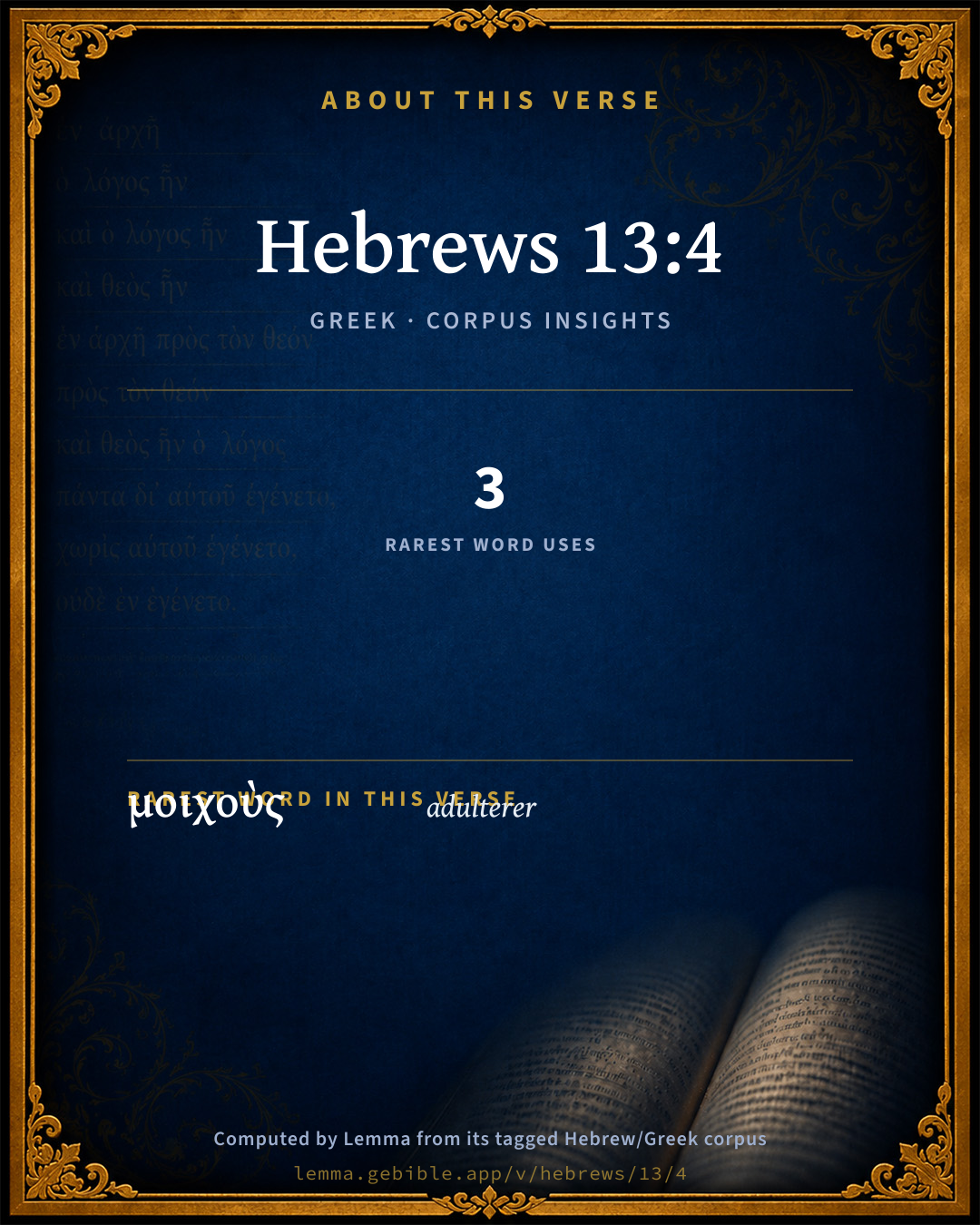
Hebrews, in the General Epistles, opens this verse with 16 words (13 distinct Greek lemmas). Its most distinctive word is moichós (“adulterer”). A historical commentator’s framing appears above. Read the whole chapter for the surrounding context.
Discussion questions
- How does “adulterer” (moichós) shape what this verse is saying?
- Luke 18:11 shares the word «adulterer» with this verse. How do the two illuminate each other?
- “the” occurs 3× in this one verse. What is the effect of the repetition?
- These translations render this verse differently. What is at stake in choosing one wording over another?
- Reading how The Biblical Illustrator and Joseph Benson's Commentary read this verse, where do the two commentators agree and where do they part?
Things to notice
- These translations choose different wording for 11 words in this verse.
- “the” occurs 3× in this single verse.
- 13 distinct Greek lemmas span 16 words in this verse.
Commentary
Notes on Hebrews 13:4 from classic Christian and Jewish commentators (each source and its license shown beneath its notes). The classic Christian expositions comment on the surrounding passage and are grouped to its opening verse, so a note may address several verses; the Jewish commentaries on the Tanakh (Rashi and others) are per-verse, so they appear only where the commentator wrote on this verse.
Lemma curates 59 commentaries, every one of them public domain or Creative Commons licensed, each selected and text-cleaned for this edition rather than reprinted as found. About our sources →
The Biblical Illustrator
Joseph S. Exell
The Biblical Illustrator, edited by Joseph S. Exell (c. 1880s–1900s) — public domain. Text from a community e-Sword module.
Joseph Benson's Commentary
Joseph Benson's Commentary on the Old and New Testaments (1811–1818) — public domain. Text from a community e-Sword module.
Tyndale Open Study Notes
Tyndale Open Resources
Tyndale Open Study Notes — © Tyndale Open Resources, licensed CC BY-SA 4.0. Text via the HelloAO Bible API.
Bengel's Gnomon
Johann Albrecht Bengel
Bengel's Gnomon of the New Testament — English translation (T&T Clark, Edinburgh, 1860) — public domain. Text from a community e-Sword module.
Meyer's Critical & Exegetical Commentary
Heinrich August Wilhelm Meyer
Meyer — Critical and Exegetical Commentary on the New Testament — English translation by Peter Christie, edited by Frederick Crombie (T&T Clark, 1880) — public domain. Text from a community e-Sword module.
Expositor's Greek Testament
ed. W. Robertson Nicoll
The Expositor's Greek Testament, edited by W. Robertson Nicoll (1897–1910) — public domain. Text from a community e-Sword module.
Geneva Bible (1599)
Geneva Bible translators
Geneva Bible (1599) marginal notes — public domain. Text via Bolls.life.
Jamieson, Fausset & Brown
Robert Jamieson, A. R. Fausset & David Brown
Jamieson, Fausset & Brown — Commentary Critical and Explanatory on the Whole Bible (1871) — public domain (CC PDM 1.0). Text via the HelloAO Bible API.
Adam Clarke's Commentary
Adam Clarke's Commentary on the Bible (1810–1826) — public domain. Text from a community e-Sword/MySword module.
John Calvin's Commentaries
John Calvin's Commentaries (1540-1563) — public domain. Text from the Calvin Translation Society English edition (1840s-50s) via the Christian Classics Ethereal Library (ccel.org). Calvin's coverage is partial (roughly two-thirds of the Bible); uncommented books and verses are honest gaps, never fabricated. The 19th-century editor's footnotes and remarks are omitted so the notes are faithfully Calvin's own voice.
Ellicott's Commentary for English Readers
A Bible Commentary for English Readers, edited by Charles John Ellicott (1878–1897) — public domain. Text from a community e-Sword module.
The Cambridge Bible for Schools and Colleges
gen. ed. J. J. S. Perowne
The Cambridge Bible for Schools and Colleges (gen. ed. J. J. S. Perowne; Cambridge University Press, 1878–1918) — public domain. Text from a community e-Sword module.
John Gill's Exposition
John Gill's Exposition of the Whole Bible (1746–1763) — public domain (CC PDM 1.0). Text via the HelloAO Bible API.
Trapp's Complete Commentary
John Trapp
John Trapp, A Commentary or Exposition upon All the Books of the Old and New Testament (1647–1656) — public domain. Text from a community e-Sword module.
Albert Barnes' Notes on the Bible
Albert Barnes' Notes on the Bible (1834–1885) — public domain. Text from a community e-Sword/MySword module.
Haydock's Catholic Bible Commentary
George Leo Haydock (1774–1849), Haydock's Catholic Family Bible and Commentary, 1859 edition — public domain. Excludes Psalms (Douay-Rheims chapter numbering differs from Protestant) and Deuterocanonical books (Catholic canon only).
Matthew Poole's English Annotations
Matthew Poole's English Annotations on the Holy Bible (1683–1685) — public domain. Text from a community e-Sword/MySword module.
Whedon's Commentary on the Bible
Daniel D. Whedon
Daniel D. Whedon (gen. ed.), Commentary on the Old and New Testaments (1874–1909) — public domain. Text from a community e-Sword module.
The Pulpit Commentary
The Pulpit Commentary (1880–1919), ed. H.D.M. Spence-Jones & Joseph S. Exell — public domain. Text from a community e-Sword module.
John Wesley's Explanatory Notes
John Wesley, Explanatory Notes Upon the Whole Bible (1754–1765) — public domain. Text via the GEBible commentary corpus.
Burkitt's Expository Notes on the New Testament
William Burkitt
William Burkitt's Expository Notes on the New Testament (1700–1703) — public domain. Text from a community e-Sword module.
The People's New Testament
B. W. Johnson
B. W. Johnson's The People's New Testament with Notes (1889–1891) — public domain. Electronic text from the Christian Classics Ethereal Library (CCEL) ThML edition.
Cambridge Greek Testament for Schools and Colleges
Cambridge Greek Testament for Schools and Colleges (Cambridge University Press, 1896; 21 vols, various authors incl. Carr, Maclear, Plummer, Farrar, Lumby, Moule, M. R. James, Simcox) — public domain. Text from a community e-Sword module.
Alford’s Greek Testament
Henry Alford
Henry Alford, The Greek Testament (1849–1861) — public domain. Text from a community e-Sword module.
Vincent's Word Studies in the New Testament
Marvin R. Vincent
Marvin R. Vincent, Word Studies in the New Testament (1887–1900) — public domain. Text from a community e-Sword/MySword module.