
Hebrews 13:17

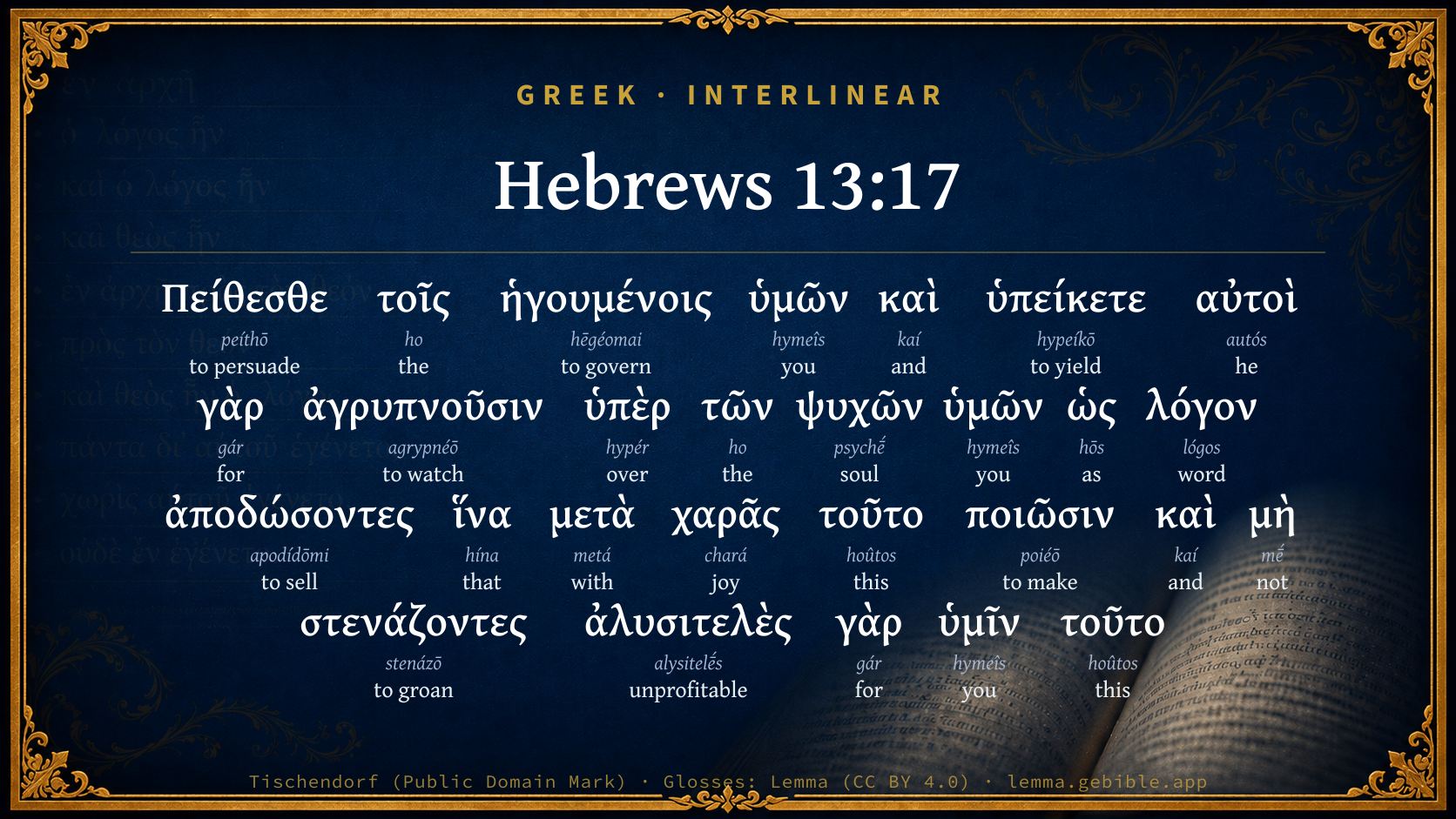
Greek (Tischendorf 8th ed.) Hebrews 13:17 appears in the Greek New Testament. The text above is from the Tischendorf 8th edition. Each word links to its Strong’s number and a concise gloss. Click any word for its full Thayer’s Greek Lexicon entry.
Download image
Cite this verse

Hebrews 13:17 (World English Bible). Public Domain. Lemma interlinear Bible study tool, https://lemma.gebible.app/v/hebrews/13/17.

Show BibTeX & RIS
BibTeX
RIS
English Translation
Obey your leaders and submit to them, for they watch on behalf of your souls, as those who will give account, that they may do this with joy, and not with groaning, for that would be unprofitable for you.
World English Bible · Public Domain
Highlights
  • 2 hapax legomena — only here in the Greek New Testament
  • 2 first appearances in the Greek New Testament
Full analysis ↓
Download a study sheet

One document with this verse’s original text, its word-by-word gloss line, the meaning frame, cross-references with their text, attributed commentary, and full source and license credits — printable, and it pastes into notes with its structure intact.

This verse Autodidact and up

Study sheet (.html) Plain text (.txt)

A passage Seminary Student

Up to 50 verses in one chapter. A passage sheet keeps up to 6 commentary sources and 12 cross-references per verse, in the order this page ranks them, and says so on the sheet whenever that leaves anything out. Ask for a single verse and you get the Autodidact verse sheet above.

Everything on this page stays free to read, with no account — the sheet is a download of what is already on screen, not access to it.

Want to remove ads? Support Godless Engineer
Compare translations 3

The same verse in 3 English versions, stacked beneath the original-language interlinear above. Click any original word for its lexicon entry.

Each is an independent rendering of the whole verse — the interlinear is not word-aligned to these translations.

Highlighted words mark where these versions differ — a whole-verse word diff, not a word-by-word alignment.

  • World English Bible Public Domain
    Obey your leaders and submit to them, for they watch on behalf of your souls, as those who will give account, that they may do this with joy, and not with groaning, for that would be unprofitable for you.
  • King James Version Public Domain
    Obey them that have the rule over you, and submit yourselves: for they watch for your souls, as they that must give account, that they may do it with joy, and not with grief: for that is unprofitable for you.
  • unfoldingWord Literal Text CC BY-SA 4.0
    Obey your leaders and submit, for they keep watch over your souls, as ones will give account, in order that they might do this with joy and not groaning, for this unprofitable to you.

unfoldingWord Literal Text — © unfoldingWord, licensed CC BY-SA 4.0. Word-aligned USFM3 via Door43 (git.door43.org/unfoldingWord/en_ult).

Versions to compare (up to 4)

3 of 4 selected

Show all 19 translations

Every available English version of this verse, each an independent rendering of the whole verse.

  • World English Bible Public Domain
    Obey your leaders and submit to them, for they watch on behalf of your souls, as those who will give account, that they may do this with joy, and not with groaning, for that would be unprofitable for you.
  • Berean Standard Bible Public Domain
    Obey your leaders and submit to them, for they watch over your souls as those who must give an account. To this end, allow them to lead with joy and not with grief, for that would be of no advantage to you.
  • Majority Standard Bible Public Domain
    Obey your leaders and submit to them, for they watch over your souls as those who must give an account. To this end, allow them to lead with joy and not with grief, for that would be of no advantage to you.
  • King James Version Public Domain
    Obey them that have the rule over you, and submit yourselves: for they watch for your souls, as they that must give account, that they may do it with joy, and not with grief: for that is unprofitable for you.
  • American Standard Version (1901) Public Domain
    Obey them that have the rule over you, and submit `to them': for they watch in behalf of your souls, as they that shall give account; that they may do this with joy, and not with grief: for this `were' unprofitable for you.
  • Revised Version (1885) Public Domain
    Obey them that have the rule over you, and submit to them: for they watch in behalf of your souls, as they that shall give account; that they may do this with joy, and not with grief: for this were unprofitable for you.
  • Geneva Bible (1599) Public Domain
    Obey them that haue the ouersight of you, and submit your selues: for they watche for your soules, as they that must giue accountes, that they may doe it with ioy, and not with griefe: for that is vnprofitable for you.
  • Douay-Rheims (1899) Public Domain
    Obey your prelates, and be subject to them. For they watch as being to render an account of your souls; that they may do this with joy, and not with grief. For this is not expedient for you.
  • Young's Literal Translation Public Domain
    Be obedient to those leading you, and be subject, for these do watch for your souls, as about to give account, that with joy they may do this, and not sighing, for this `is' unprofitable to you.
  • Literal Standard Version CC BY-SA 4.0
    Be obedient to those leading you, and be subject, for these watch for your souls, as about to give account, that they may do this with joy, and not sighing, for this [is] unprofitable to you.
  • Unlocked Literal Bible CC BY-SA 4.0
    Obey and submit to your leaders, for they keep watch over your souls, as those who will give account. Obey so that your leaders will do this with joy, and not with groaning, which would be useless to you.
  • unfoldingWord Literal Text CC BY-SA 4.0
    Obey your leaders and submit, for they keep watch over your souls, as ones will give account, in order that they might do this with joy and not groaning, for this unprofitable to you.
  • Darby Bible Public Domain
    Obey your leaders, and be submissive; for *they* watch over your souls as those that shall give account; that they may do this with joy, and not groaning, for this [would be] unprofitable for you.
  • World Messianic Bible Public Domain
    Obey your leaders and submit to them, for they watch on behalf of your souls, as those who will give account, that they may do this with joy and not with groaning, for that would be unprofitable for you.
  • Webster's Bible Public Domain
    Obey them that have the rule over you, and submit yourselves: for they watch for your souls, as they that must give account, that they may do it with joy, and not with grief: for that is unprofitable for you.
  • Free Bible Version CC BY-SA 4.0
    Follow your leaders, and do what they tell you, for they are watching out for you and are accountable. Act in such a way that they can do this happily—and not with sadness, for that wouldn't help you!
  • Bible in Basic English Public Domain
    Give ear to those who are rulers over you, and do as they say: for they keep watch over your souls, ready to give an account of them; let them be able to do this with joy and not with grief, because that would be of no profit to you.
  • Text-Critical English NT CC BY 4.0
    Obey your leaders and submit to them, for they keep watch over your souls as those who must give an account. Let them do this with joy and not with groaning, for that would be of no benefit to you.
  • Tyndale New Testament (1534) Public Domain
    Obeye the that have the oversight of you and submit youre selves to them for they watch for youre soules even as they that must geve a comptes: that they maye do it with ioye and not with grefe. For that is an vnproffitable thynge for you.

Literal Standard Version (2020), Covenant Press — licensed CC BY-SA 4.0. Text via the HelloAO Bible API (eBible.org). Unlocked Literal Bible (unfoldingWord) — licensed CC BY-SA 4.0. Text via the HelloAO Bible API (eBible.org). unfoldingWord Literal Text — © unfoldingWord, licensed CC BY-SA 4.0. Word-aligned USFM3 via Door43 (git.door43.org/unfoldingWord/en_ult). Free Bible Version, Dr. Jonathan Gallagher — licensed CC BY-SA 4.0. Text via the HelloAO Bible API (eBible.org).

Word by word

More ways to search: Search by grammar → Find every occurrence → Compare this word →

Practice this passage: Drill this verse → Learn its vocabulary →

ὑπείκετε
hypeíkō
G5226
“to yield”
Verb, Present, Active, Imperative, 2nd person, Plural
Part of Speech
Verb
Tense
Present
Voice
Active
Mood
Imperative
Person
2nd person
Number
Plural
Full Thayer's Definition

Origin: "from G5259 and eiko (to yield, be "weak")"

TDNT: None

1. to resist no longer, but to give way, yield (of combatants) 2. metaph. to yield to authority and admonition, to submit
  1. Πείθεσθε peíthō G3982 “to persuade” Verb, Present, Middle, Imperative, 2nd person, Plural
  2. τοῖς ho G3588 “the” Article, Dative, Plural, Masculine
  3. ἡγουμένοις hēgéomai G2233 “to govern” Verb, Present, Middle or Passive deponent, Participle, Dative, Plural, Masculine
  4. ὑμῶν hymeîs G5210 “you” Personal pronoun, 2nd person, Genitive, Plural
  5. καὶ kaí G2532 “and” Conjunction
  6. αὐτοὶ autós G846 “he” Personal pronoun, Nominative, Plural, Masculine
  7. γὰρ gár G1063 “for” Conjunction
  8. ἀγρυπνοῦσιν agrypnéō G69 “to watch” Verb, Present, Active, Indicative, 3rd person, Plural
  9. ὑπὲρ hypér G5228 “over” Preposition
  10. τῶν ho G3588 “the” Article, Genitive, Plural, Feminine
  11. ψυχῶν psychḗ G5590 “soul” Noun, Genitive, Plural, Feminine
  12. ὑμῶν hymeîs G5210 “you” Personal pronoun, 2nd person, Genitive, Plural
  13. ὡς hōs G5613 “as” Adverb
  14. λόγον lógos G3056 “word” Noun, Accusative, Singular, Masculine
  15. ἀποδώσοντες apodídōmi G591 “to sell” Verb, Future, Active, Participle, Nominative, Plural, Masculine
  16. ἵνα hína G2443 “that” Conjunction
  17. μετὰ metá G3326 “with” Preposition
  18. χαρᾶς chará G5479 “joy” Noun, Genitive, Singular, Feminine
  19. τοῦτο hoûtos G3778 “this” Demonstrative pronoun, Accusative, Singular, Neuter
  20. ποιῶσιν poiéō G4160 “to make” Verb, Present, Active, Subjunctive, 3rd person, Plural
  21. καὶ kaí G2532 “and” Conjunction
  22. μὴ mḗ G3361 “not” Particle, Negative
  23. στενάζοντες stenázō G4727 “to groan” Verb, Present, Active, Participle, Nominative, Plural, Masculine
  24. ἀλυσιτελὲς alysitelḗs G255 “unprofitable” Adjective, Nominative, Singular, Neuter
  25. γὰρ gár G1063 “for” Conjunction
  26. ὑμῖν hymeîs G5210 “you” Personal pronoun, 2nd person, Dative, Plural
  27. τοῦτο hoûtos G3778 “this” Demonstrative pronoun, Nominative, Singular, Neuter

About this verse

These counts appear in no published source. They are computed here, from the morphology-tagged text and Lemma’s own curated glosses. What Lemma adds →

28
words
22
distinct lemmas
General Epistles
section

Notable vocabulary

2 hapax legomena — words that appear only here in the entire Greek New Testament:

  • ὑπείκετε to yield G5226
  • ἀλυσιτελὲς unprofitable G255

First appearance in Scripture

These words make their first canonical appearance in the Greek New Testament here:

  • ὑπείκετε to yield G5226
  • ἀλυσιτελὲς unprofitable G255

Shared distinctive vocabulary

ἀγρυπνοῦσιν to watch G69 occurs in 4 verses of the Greek New Testament. Also found in:
Repetition

Words recur within this verse:

Cross-references

34

Topical passages linked to Hebrews 13:17 in the Treasury of Scripture Knowledge — connected by theme and wording, ordered by reader-vote popularity; previews shown in the World English Bible.

  • 1 Thessalonians 5:12–13 But we beg you, brothers, to know those who labor among you, and are over you in the Lord, and admonish you,
  • 1 Timothy 5:17 Let the elders who rule well be counted worthy of double honor, especially those who labor in the word and in teaching.
  • Hebrews 13:7 Remember your leaders, men who spoke to you the word of God, and considering the results of their conduct, imitate their faith.
  • Acts 20:28 Take heed, therefore, to yourselves, and to all the flock, in which the Holy Spirit has made you overseers, to shepherd the assembly of the Lord and God which he purchased with his own blood.
  • 1 Peter 5:5 Likewise, you younger ones, be subject to the elder. Yes, all of you gird yourselves with humility, to subject yourselves to one another; for "God resists the proud, but gives grace to the humble."
  • 1 Peter 5:2–3 Shepherd the flock of God which is among you, exercising the oversight, not under compulsion, but voluntarily, not for dishonest gain, but willingly;
  • 1 Corinthians 16:16 that you also be in subjection to such, and to everyone who helps in the work and labors.
  • Jeremiah 13:17 But if you will not hear it, my soul shall weep in secret for [your] pride; and my eye shall weep sore, and run down with tears, because Yahweh's flock is taken captive.
  • Ezekiel 3:17–21 Son of man, I have made you a watchman to the house of Israel: therefore hear the word at my mouth, and give them warning from me.
  • Ezekiel 33:7–9 So you, son of man, I have set you a watchman to the house of Israel; therefore hear the word at my mouth, and give them warning from me.
  • Philippians 2:12 So then, my beloved, even as you have always obeyed, not only in my presence, but now much more in my absence, work out your own salvation with fear and trembling.
  • Exodus 32:31 Moses returned to Yahweh, and said, "Oh, this people have sinned a great sin, and have made themselves gods of gold.
  • Philippians 2:29 Receive him therefore in the Lord with all joy, and hold such in honor,
  • Romans 14:12 So then each one of us will give account of himself to God.
  • 2 Corinthians 5:10–11 For we must all be revealed before the judgment seat of Christ; that each one may receive the things in the body, according to what he has done, whether good or bad.
  • 1 Corinthians 4:1–2 So let a man think of us as Christ's servants, and stewards of God's mysteries.
  • 1 Thessalonians 2:19–20 For what is our hope, or joy, or crown of rejoicing? Isn't it even you, before our Lord Jesus at his coming?
  • 2 Thessalonians 3:14 If any man doesn't obey our word in this letter, note that man, that you have no company with him, to the end that he may be ashamed.
  • 1 Samuel 15:19–20 Why then didn't you obey the voice of Yahweh, but flew on the spoil, and did that which was evil in the sight of Yahweh?"
  • Isaiah 62:6 I have set watchmen on your walls, Jerusalem; they shall never hold their peace day nor night: you who call on Yahweh, take no rest,
  • Philippians 4:1 Therefore, my brothers, beloved and longed for, my joy and crown, so stand firm in the Lord, my beloved.
  • Hebrews 13:24 Greet all of your leaders and all the saints. The Italians greet you.
  • Philippians 3:18 For many walk, of whom I told you often, and now tell you even weeping, as the enemies of the cross of Christ,
  • Genesis 16:9 The angel of Yahweh said to her, "Return to your mistress, and submit yourself under her hands."
  • 1 Samuel 8:19 But the people refused to listen to the voice of Samuel; and they said, No: but we will have a king over us,
  • Proverbs 5:13 Neither have I obeyed the voice of my teachers, Nor turned my ear to those who instructed me!
  • Luke 16:2 He called him, and said to him, 'What is this that I hear about you? Give an accounting of your management, for you can no longer be manager.'
  • Philippians 1:4 always in every request of mine on behalf of you all making my requests with joy,
  • 1 Thessalonians 3:9–10 For what thanksgiving can we render again to God for you, for all the joy with which we rejoice for your sakes before our God;
  • James 4:7 Be subject therefore to God. But resist the devil, and he will flee from you.
  • Acts 20:24–26 But these things don't count; nor do I hold my life dear to myself, so that I may finish my race with joy, and the ministry which I received from the Lord Jesus, to fully testify to the Gospel of the grace of God.
  • Philippians 2:16 holding up the word of life; that I may have something to boast in the day of Christ, that I didn't run in vain nor labor in vain.
  • Ezekiel 33:2 Son of man, speak to the children of your people, and tell them, When I bring the sword on a land, and the people of the land take a man from among them, and set him for their watchman;
  • Ephesians 5:21 subjecting yourselves one to another in the fear of Christ.

Cross-references courtesy of OpenBible.info (CC BY 4.0).

Commentary

Notes on Hebrews 13:17 from classic Christian and Jewish commentators (each source and its license shown beneath its notes). The classic Christian expositions comment on the surrounding passage and are grouped to its opening verse, so a note may address several verses; the Jewish commentaries on the Tanakh (Rashi and others) are per-verse, so they appear only where the commentator wrote on this verse.

Lemma curates 59 commentaries, every one of them public domain or Creative Commons licensed, each selected and text-cleaned for this edition rather than reprinted as found. About our sources →

Ellicott's Commentary for English Readers

(17) The present section of the chapter begins (Heb_13:7) and ends (Heb_13:17) with a reference to the rulers of the Church: Remember your former leaders, and imitate their faith; obey them that lead you now.

Submit yourselves.—Better, yield (to them). Besides fulfilling their injunctions, be ready to comply with their wishes and requests.

For they watch.—The Greek is emphatic: “For it is they that watch on behalf of your souls as having to give account.”

That they may do it.—Be obedient and yielding to them, that they may do this (may watch for your souls) with joy and not sighing (or, groaning), for this would be unprofitable for you; if ye so live that they must watch over you with grief, this will both weaken their hands and bring on you the divine displeasure. No words could more powerfully present to members of the Church the motives for obedience to their spiritual guides; and to these guides themselves the ideal of their work and life, as men who are keeping watch for souls, either with rejoicing or with mourning (Act_20:31), ever mindful of the account they must give to God for the flock which He entrusted to their care (Eze_3:18; Eze_33:7; Eze_34:10; 1Pe_5:4).

A Bible Commentary for English Readers, edited by Charles John Ellicott (1878–1897) — public domain. Text from a community e-Sword module.

The Biblical Illustrator

Joseph S. Exell

Heb_13:17

Obey them that have the rule

Rulership in the Church

I.

THAT THE DUE OBEDIENCE OF THE CHURCH, IN ALL ITS MEMBERS, UNTO THE RULERS OF IT, IN THE DISCHARGE OF THEIR OFFICE AND DUTY, IS THE BEST MEANS OF ITS EDIFICATION, AND THE CHIEF CAUSE OF ORDER AND PEACE IN THE WHOLE BODY. Therefore is it here placed by the apostle, as comprehensive of all ecclesiastical duties.

II. AN ASSUMPTION OF RIGHT AND POWER BY ANY TO RULE OVER THE CHURCH, WITHOUT EVIDENCING THEIR DESIGN AND WORK TO BE A WATCHING FOR THE GOOD OF THEIR SOULS, IS PERNICIOUS UNTO THEMSELVES, AND RUINOUS UNTO THE CHURCH ITSELF.

III. Those who do attend with conscience and diligence unto the discharge of the work of the ministry towards their flocks, committed in an especial manner unto their charge, HAVE NO GREATER JOY OR SORROW IN THIS WORLD THAN WHAT ACCOMPANIES THE DAILY ACCOUNT WHICH THEY GIVE UNTO CHRIST OF THE DISCHARGE OF THEIR DUTY AMONGST THEM, AS THEIR SUCCESS FALLS OUT TO BE.

IV. Much of the life of the ministry and benefit of the Church DEPENDS ON THE CONTINUAL GIVING AN ACCOUNT UNTO CHRIST, BY PRAYER AND THANKSGIVING, OF THE STATE OF THE CHURCH, AND SUCCESS OF THE WORD THEREIN. Those guides who esteem themselves obliged thereunto, and do live in the practice of it, will find their minds engaged thereby unto constant diligence and earnest labouring in the discharge of their duty. And the dealings of Christ with the Church itself are regulated according unto this account, as the last words do manifest. (John Owen, D. D.)

The reciprocal duties of ministers and people:

The relation which is formed between a minister of the gospel and the people committed to his charge is highly important. It is a relation most sacred in itself, and most awful in its consequences; and the duties which spring from it are such as ought to be well understood by both parties.

I. THE DUTY OF MINISTERS TO THEIR PEOPLE IS THUS DESCRIBED. They have the rule over them, or, as the word may properly moan, have the guidance of them; and watch for their souls. This expression denotes that no small degree of diligence, perseverance, and anxiety is necessary for the discharge of the ministerial office. At least it implies that a minister in the faithful exercise of his calling is required to perform two things.

1. Solemnly to admonish the people of their danger.

2. To look out for every convenient opportunity of doing good to their souls. Now observe the obligation which they are under to a faithful performance of their duty. They watch for your souls as they that must give account (see Eze_3:17-19; Eze_34:4; Eze_43:7-10).

II. It must be plain THAT DUTY BEGETS DUTY. If ministers be required to have the rule over their people and to watch for their souls, what must be required of their people in return but obedience and submission?

1. It is the duty of the people to attend on their minister with a disposition to receive and follow his instructions.

2. It is the duty of the people to bear with the importunity and solicitude of their minister in watching for their souls. They are not to take offence at his plain speaking, nor be impatient under his friendly admonitions.

3. It is the duty of the people to join with their minister in such plans and attempts as may best promote the object of his ministry. Does he, for example, point out any particular means by which immorality and ungodliness may be checked, or the cause of true religion may be encouraged and strengthened? In these cases his people are justly required to attend to his proposals; and by their support to forward his endeavours. From this view of the peoples duty towards their minister let us turn to the obligations which they are under to discharge it.

(1) In the first place, the very office of the minister imposes it on them. The same authority which prescribes to him his duty prescribes also to them their duty. And the same reasons in both cases enforce the performance of it.

(2) But, in the second place, the object which the minister has in view strongly obliges the people to discharge their duty towards him. For whose souls does he watch but for theirs?

(3) But let it be considered, thirdly, that in this, as well as in every other instance, duty and interest are closely joined together. It is the peoples interest to obey them that have the rule over them, and to submit to those who watch for their souls. (E. Cooper, M. A.)

Ministerial duty, responsibility, and reward

I. MINISTERIAL DUTY.

1. The objects of ministerial solicitude. Your souls.

(1) The origin of souls. Gods offspring. Immaterial, intellectual, immortal.

(2) The price at which they were redeemed. Precious blood of Christ.

(3) Their destiny. Eternal life or death.

2. The expression of ministerial solicitude. They watch. This includes love for immortal souls, manifested in a constant attention to their interests, and a devotedness to their welfare.

II. MINISTERIAL RESPONSIBILITY.

1. This responsibility refers to their commission. Christ will employ in His work a friend that loves Him; not a stranger, much less an enemy. It has been well remarked that the Church had formerly wooden vessels, but golden priests; since that she has had golden vessels and wooden priests.

2. This responsibility refers to the fidelity which is required on their part.

3. It refers to the account which they must finally render.

III. MINISTERIAL REWARD.

1. What they deprecate. That they may not give their account with grief.

2. What they desire. That they may give account with joy. How animating to the labourer is success!

3. The interest of the people in both. Both in what ministers deprecate and in what they desire. Our disappointment may have an influence on us. It may weaken us in the way; it may bring us down broken-hearted to the grave. But our disappointment is your ruin! It may grieve us, but it will destroy you. Our satisfaction is your conversion. Your increase is delightful to us, but it is your salvation. (John Davis.)

Duties owing to ministers

1. Reverence in regard of their office. Alexander reverenced Jaddus. Herod, John the Baptist. Obadiah called Elias Lord. My father, said Josiah to Elisha. If we reverence them not the word will not have so free a passage among us. They that use their pastors unreverently sin against God.

2. Love. Have them in exceeding love for their works sake. It is the best work in the world, the saving of your souls; therefore love them for it. You love the fathers of your bodies that brought you into the world, and wilt ye not love them that beget you with the word of truth and bring you to a kingdom?

3. Obedience to their doctrine, exhortations, and admonitions. You will obey the prescript of the physician for the health of your bodies; though it be a bitter potion, you take it well at his hands; and will you not obey them that give you counsel for your souls, though their reproofs be bitter, their rebukes sharp (Tit_1:13)?

4. Maintenance. All rulers must be maintained. The king hath maintenance due from the people, and so must the minister. In the fear of God, if ye be good and religious people, discharge the duties that God requireth to them that have the spiritual government of you. Why? There be two reasons to excite us to it; the one taken from the matter of their work, the other from the manner of their working. They are your watchmen; therefore submit yourselves to them, love them, regard them. Not over your goods and bodies, as the magistrate is, but over your souls, which are more precious; not as the fowler watcheth for the bird to catch it and kill it, but they watch for the preservation and eternal salvation of your souls; therefore submit yourselves to them. The second reason is taken from the manner of their working; they would gladly do their work with joy; they would watch over you with joy, which they cannot do if you be peevish, perverse, and froward. Therefore submit yourselves to them. What though we grieve them? What care we? Will such a thing grieve him? He shall be sure to have it then; we will do it for the nonce. Some are at this pass. But you shall have no benefit by that; you hurt yourselves more than them. (W. Jones, D. D.)

Ministers as generals:

The ancient knight was a cleaver of skulls, a fighting man rather than a leader; his great force lay in muscle, not brain. But who ever thought of estimating the value of Napoleon upon a battle-field by the blows he gave? He wielded an army, not a sword. Ministers should covet earnestly the generals gift. The man who has the faculty of getting others to work, keeping them at their work and wisely directing their work, will get more done than any solitary labourer can do, though he be strong as Samson and diligent as Paul. (S. Coley.)

They watch for your souls

Ministers are watchmen

I. THE OFFICE OF WATCHMAN IS ONE OF APPOINTMENT.

II. THE OFFICE OF WATCHMAN IS ONE OF TRUST.

III. THE OFFICE OF WATCHMAN IS ONE OF RESPONSIBILITY.

1. For his time.

2. For his diligence.

3. For his vigilance.

4. For his fidelity.

Application: We learn

1. The solemn character of the ministerial calling. A calling which demands great personal piety, as well as high spiritual gifts.

2. The arduous duties of the ministerial office. So arduous as to claim all the faculties of the mind and all the energies of the body.

3. The great necessity that they should receive Christian sympathy and comfort.

4. The personal responsibility of those over whom they watch.

5. Jesus, the great and blessed keeper of Zion, is the model every Christian minister should study and imitate. (J. Buras, D. D.)

Solicitude for souls:

In one of McCheynes manuscripts there occurs this sentence--As I was walking in the fields, the thought came over me with almost overwhelming power that every one of my flock most soon be in heaven or hell. Oh, how I wished that I had a tongue like thunder that I might make all hear; or that I had a frame like iron that I might visit every one and say, Escape for thy life! Ah, sinners! you little know how I fear that you will lay the blame of your damnation at my door. (Life of R. M. McCheyne.)

The solemnity of the ministers work

"I continually hear the surges of eternity beating against my study door, said an eminent minister of the gospel.

Responsibility recognised

A captain whose ship was nearing a reel gave orders to keep off. To a remark of approval the captain replied, It is necessary that I should be very careful, because I have souls on board. I think of my responsibility, and remember that souls are very valuable.

Ministerial responsibility

I verily believe that had I been adequately affected by the whole matter, even as I might have apprehended it then, I should never have gone to Stepney (the college) after all. It strikes me with awe at this hour that I should have undertaken what I have found to be so veritably the burden of the Lord. A vision of my Norwich life, had I seen it at Fen Court, would have led me to withdraw my application to the committee on the spot. A vision of my Bloomsbury Chapel life, had I seen it as I passed that evening into my college chamber, would have sent me back to my bench at Mr. Fields and to my occasional services to the rustics at Colliers End. However, no such visions did appear to me; and perhaps in mercy the weightier ultimate responsibilities which were involved were hidden from my eyes. (W. Brock, D. D.)

Care for souls:

Dr. Bushnell greatly interested himself in providing a park for the town in which he lived. Writing to Dr. Bartol, he said, One thing I have learned by this undertaking--namely, to wonder why it is that as a Christian teacher and pastor I am so feebly exercised, so little burdened by my work. It fills me with doubt and shame and grief; and the result has been to make me fully resolved that I will either be a more responsible, more efficient minister of Jesus Christ or none. I cannot shake off those words of Paul--they are ringing continually in my ears--I have great heaviness and continual sorrow in my heart. This park matter has been a kind of revelation to me, which I pray God I may never forget. Why should I carry a park to bed with me, and work it over in my dreams during the night, and wake with it in the morning, and yet be so little exercised in the magnificent work of the gospel and the care of souls? It makes me doubt whether doing a thing professionally we do not sometimes do it idly and, perfunctorily, as if we did it not. Do we really believe that Jesus is a Saviour, and that in any significant sense of the words He brings salvation? Thoughts of this kind have been working in me of late with such power that I have become wholly dissatisfied with myself. I thought I meant something when I preached Christ to men; but I see that I must do more, that I must have the men upon my spirit, that I must bear them as a burden and hold myself responsible for them. God help me! (Life of Dr. Bushnell.)

Ministerial faithfulness

Gladstone once said to an audience, I dont come here to tell you what you want to hear; but what I think is true and just. (J. Clifford, D. D.)

The gospel the best message:

He (the late Rev. W. O. Simpson) never reasoned with the gospel; he reasoned with sinners: the gospel was his message. (E. E. Jenkins, D. D.)

The Biblical Illustrator, edited by Joseph S. Exell (c. 1880s–1900s) — public domain. Text from a community e-Sword module.

Joseph Benson's Commentary

Heb 13:17. Obey them that have the rule over you — The expression, τοις ηγουμενοις, implies also, that lead or guide you, namely, in truth and holiness; and submit yourselves — To them with a becoming respect, even though their office should render it sometimes necessary for them to reprove you for some instances of misconduct, or to urge you to duties which you are averse to perform. Give up to them, not your conscience or judgment, but your own will, in all things purely indifferent; for they watch for your souls — With all zeal and diligence they guard and caution you against all danger; as they that must give an account — To the great Shepherd for every part of their behaviour toward you. Chrysostom says, he never read these words of the apostle without trembling, though he often preached several times in a day. How vigilant then ought every pastor to be, how careful of every soul committed to his charge; that they may do it — May watch over you; with joy and not with grief — Greek, μη στεναζοντες, not groaning, under discouragement and grief on account of the little success of their ministry among you; for that is — Or would be; unprofitable for you — Both, here and hereafter; for besides discouraging your guides, it would displease the Lord Jesus, and preclude or endanger your eternal salvation. “He is not a good shepherd, who does not either rejoice over his flock or groan for them. The groans of other creatures are heard: how much more shall these come up into the ears of God! Whoever answers this character of a Christian pastor, may undoubtedly demand this obedience.” — Wesley.

Joseph Benson's Commentary on the Old and New Testaments (1811–1818) — public domain. Text from a community e-Sword module.

Tyndale Open Study Notes

Tyndale Open Resources

13:17 The relationship between the spiritual leaders and the members of the church may have been strained, so the author exhorts the members to obey them and do what they say. • The Greek word translated obey can also mean follow, place confidence in, or be persuaded by. • Christian leaders watch over people’s souls (Acts 20:28-31; 1 Pet 5:1-4), a role that carries grave responsibility, making them accountable to God (Jas 3:1). • The word sorrow could be translated groaning; it speaks of emotional burden and stress. Having leaders who are stressed and burdened because of an unruly church does not benefit the church.

Tyndale Open Study Notes — © Tyndale Open Resources, licensed CC BY-SA 4.0. Text via the HelloAO Bible API.

Bengel's Gnomon

Johann Albrecht Bengel

Heb 13:17. Πείθεσθε, obey) Evince (have) remembrance towards your deceased teachers, Heb 13:7; obedience towards them that are still alive.—ὑπείκετε, submit) This is more than to obey. Obey in those things which they command you to do as salutary: submit, even when they seem to demand a little more. Ἵνα, that, depends on this verb.—αὐτοὶ, they) As they are zealously careful, so, when they wish you to be careful, you ought to submit.—ὡς λόγον ἀποδώσοντες, as they that are to give an account) Truly this consideration both causes a man to be watchful, and to avoid any abuse of authority. The soul of Chrysostom was always struck with these words, as he himself confesses at the beginning of the 6th Book de Sacerdotio, on which passage we have made some observations, p. 490.—μετὰ χαρᾶς, with joy) if they see you respond to their vigilance.—τοῦτο, this) This τοῦτο does not refer to they who are to give an account, but to they watch. Disciples ought to obey and submit to their teachers, so that with joy, etc. It would be not a joyous (μετὰ χαρᾶς) thing for the teachers themselves to give in their account with sorrow [therefore τοῦτο does not refer to the giving in the account]: on the contrary, to watch with sorrow, is not hurtful to the teachers, it is “unprofitable” to the hearers.—καὶ μὴ, and not) He is not a good minister who does not either rejoice or grieve, or do both.—στενάζοντες, with grief) The groans of other creatures are heard; how much more of pastors?—ἀλυσιτελὲς, unprofitable) Sorrow, opposed to joy, from which griefs (groans, implied in στενάζοντες) are derived, greatly weakens the teachers; and their sighs are not profitable, nay, are very injurious to the disciples.

Bengel's Gnomon of the New Testament — English translation (T&T Clark, Edinburgh, 1860) — public domain. Text from a community e-Sword module.

Meyer's Critical & Exegetical Commentary

Heinrich August Wilhelm Meyer

Heb_13:17. Exhortation to obedience to the presidents of the assembly. Comp. 1Th_5:12-13.

Πείθεσθε τοῖς ἡγουμένοις ὑμῶν καὶ ὑπείκετε] Obey your leaders, and yield to them. Bengel: Obedite in iis, quae praecipiunt vobis tanquam salutaria; concedite, etiam ubi videntur plusculum postulare. The demand presupposes, for the rest, that the author knew the ἡγούμενοι as men like-minded with himself, who had kept themselves free from the hankering after defection.

αὐτοὶ γὰρ ἀγρυπνοῦσιν ὑ̔πὲρ τῶν ψυχῶν ὑμῶν] for it is they who watch for your souls, for the salvation thereof.

ὡς λόγον ἀποδώσοντες] as those who must give an account (of the same), sc. to God and the Lord at His return.

ἵνα] is the subsequently introduced note of design to πείθεσθε καὶ ὑπείκετε. On that account, however, it is not permitted, with Grotius, Carpzov, and others, to enclose αὐτοὶ γὰρ … ὑμῶν within a parenthesis; because the subject-matter of the clause of design refers back to the subject-matter of the foregoing establishing clause.

μετὰ χαρᾶς] with joy, namely, over your docility.

τοῦτο] sc. τὸ ἀγρυπνεῖν. Erroneously do Owen, Whitby, Michaelis, MLean, Heinrichs, Stuart, and others supplement τὸ λόγον ἀποδιδόναι. For the latter takes place only in the future, whereas the conjunctive of the present ποιῶσιν points to that which is already to be done in the present.

καὶ μὴ στενάζοντες] and without sighing, sc. over your intractableness.

ἀλυσιτελές] unprofitable, inasmuch as it will bring you no gain, but, on the contrary, will call down upon you the chastisement of God. A litotes.

τοῦτο] sc. τὸ στενάζειν.

Meyer — Critical and Exegetical Commentary on the New Testament — English translation by Peter Christie, edited by Frederick Crombie (T&T Clark, 1880) — public domain. Text from a community e-Sword module.

Expositor's Greek Testament

ed. W. Robertson Nicoll

Heb 13:17 End. The conclusion of the Epistle.

Heb 13:17 . “Obey your rulers and submit; for they watch for your souls, knowing they are to give account, that they may do this with joy not with lamentation for this would be profitless to you.”

Having exhorted the Hebrews to keep in mind their former rulers and adhere to their teaching, the writer now admonishes them, probably in view of a certain mutinous and separatist spirit (Heb 10:25 ) encouraged by their reception of strange doctrines, to obey their present leaders, and yield themselves trustfully ( ὑπείκετε ) to their teaching an admonition which, as Weiss remarks, shows that these teachers held the same views as the writer. The reasonableness of this injunction is confirmed by the responsibility of the rulers and their anxious discharge of it. They watch, like wakeful shepherds ( ἀγρυπνοῦσιν ), or those who are nursing a critical case, in the interest of your souls ( ὑπὲρ τῶν ψυχῶν ὑμῶν ) to which they may sometimes seem to sacrifice your other interests. They do this under the constant pressure of a consciousness that they must one day render to the Chief Shepherd (Heb 13:20 ) an account of the care they have taken of His sheep ( ὡς λόγον ἀποδώσοντες ). Obey them, then, that they may discharge their responsibility and peform these kindly offices for you ( τοῦτο referring not to λόγον ἀποδώσοντες as Vaughan, etc., which would require a much stronger expression than ἀλυσιτελές , but to ἀγρυπνοῦσιν ) joyfully and not with groaning ( στενάζοντες , the groaning with which one resumes a thankless task, and with which he contemplates unappreciated and even opposed work). And even for your own sakes you should make the work of your rulers easy and joyful, for otherwise it cannot profit you. Your unwillingness to listen to them means that you are out of sympathy with their teaching and that it can do you no good ( ἀλυσιτελὲς γὰρ ὑμῖν τοῦτο ).

The Expositor's Greek Testament, edited by W. Robertson Nicoll (1897–1910) — public domain. Text from a community e-Sword module.

Geneva Bible (1599)

Geneva Bible translators

We must obey the warnings and admonitions of our Ministers and Elders, which watch for the salvation of the souls which are committed unto them.

Geneva Bible (1599) marginal notes — public domain. Text via Bolls.life.

Jamieson, Fausset & Brown

Robert Jamieson, A. R. Fausset & David Brown

Obey them that have the rule over you--(Compare Heb 13:7, Heb 13:24). This threefold mention of the rulers is peculiar to this Epistle. In other Epistles Paul includes the rulers in his exhortations. But here the address is limited to the general body of the Church, in contrast to the rulers to whom they are charged to yield reverent submission. Now this is just what might be expected when the apostle of the Gentiles was writing to the Palestine Christians, among whom James and the eleven apostles had exercised a more immediate authority. It was important he should not seem to set himself in opposition to their guides, but rather strengthen their hands; he claims no authority directly or indirectly over these rulers themselves [BIRKS]. "Remember" your deceased rulers (Heb 13:7). "Obey" your living rulers; nay, more, not only obey in cases where no sacrifice of self is required, and where you are persuaded they are right (so the Greek, for "obey"), but "submit yourselves" as a matter of dutiful yielding, when your judgment and natural will incline you in an opposite direction.

they--on their part; so the Greek. As they do their part, so do you yours. So Paul exhorts, Th1 5:12-13.

watch--"are vigilant" (Greek).

for--Greek, "in behalf of."

must give account--The strongest stimulus to watchfulness (Mar 13:34-37). CHRYSOSTOM was deeply struck with these words, as he tells us [On the Priesthood, 6], "The fear of this threat continually agitates my soul."

do it--"watch for your soul's eternal salvation." It is a perilous responsibility for a man to have to give account for others' deeds, who is not sufficient for his own [ESTIUS, from AQUINAS]. I wonder whether it be possible that any of the rulers should be saved [CHRYSOSTOM]. Compare Paul's address to the elders, Act 20:28; Co1 4:1-5, where also he connects ministers' responsibility with the account to be hereafter given (compare Pe1 5:4).

with joy--at your obedience; anticipating, too, that you shall be their "joy" in the day of giving account (Phi 4:1).

not with grief--at your disobedience; apprehending also that in the day of account you may be among the lost, instead of being their crown of rejoicing. In giving account, the stewards are liable to blame if aught be lost to the Master. "Mitigate their toil by every office of attention and respect, that with alacrity, rather than with grief, they may fulfil their duty, arduous enough in itself, even though no unpleasantness be added on your part" [GROTIUS].

that--Grief in your pastors is unprofitable for you, for it weakens their spiritual power; nay, more, "the groans (so the Greek for 'grief') of other creatures are heard; how much more of pastors!" [BENGEL]. So God will be provoked to avenge on you their "groaning" (Greek). If they must render God an account of their negligence, so must you for your ingratitude to them [GROTIUS].

Jamieson, Fausset & Brown — Commentary Critical and Explanatory on the Whole Bible (1871) — public domain (CC PDM 1.0). Text via the HelloAO Bible API.

Adam Clarke's Commentary

Verse 17. Obey them that have the rule over you] Obey your leaders, τοις ηγουμενοις. He is not fit to rule who is not capable of guiding. See Clarke on Heb 13:7. In the former verse the apostle exhorts them to remember those who had been their leaders, and to imitate their faith; in this he exhorts them to obey the leaders they now had, and to submit to their authority in all matters of doctrine and discipline, on the ground that they watched for their souls, and should have to give an account of their conduct to God. If this conduct were improper, they must give in their report before the great tribunal with grief; but in it must be given: if holy and pure, they would give it in with joy. It is an awful consideration that many pastors, who had loved their flocks as their own souls, shall be obliged to accuse them before God for either having rejected or neglected the great salvation.

Adam Clarke's Commentary on the Bible (1810–1826) — public domain. Text from a community e-Sword/MySword module.

John Calvin's Commentaries

17. Obey them, etc. I doubt not but that he speaks of pastors and other rulers of the Church, for there were then no Christian magistrates; and what follows, for they watch for your souls, properly belongs to spiritual government. He commands first obedience and then honor to be rendered to them. These two things are necessarily required, so that the people might have confidence in their pastors, and also reverence for them. But it ought at the same time to be noticed that the Apostle speaks only of those who faithfully performed their office; for they who have nothing but the title, nay, who use the title of pastors for the purpose of destroying the Church, deserve but little reverence and still less confidence. And this also is what the Apostle plainly sets forth when he says, that they watched for their souls, — a duty which is not performed but by those who are faithful rulers, and are really what they are called.

Doubly foolish, then, are the Papists, who from these words confirm the tyranny of their own idol: “The Spirit bids us obediently to receive the doctrine of godly and faithful bishops, and to obey their wholesome counsels; he bids us also to honor them.” But how does this favor mere apes of bishops? And yet not only such are all those who are bishops under the Papacy, but they are cruel murderers of souls and rapacious wolves. But to pass by a description of them, this only will I say at present, that when we are bidden to obey our pastors, we ought carefully and wisely to find out those who are true and faithful rulers; for if we render this honor to all indiscriminately, first, a wrong will be done to the good; and secondly, the reason here added, to honor them because they watch for souls, will be rendered nugatory. In order, therefore, that the Pope and those who belong to him may derive support from this passage, they must all of necessity first prove that they are of the number of those who watch for our salvation. If this be made evident, there will then be no question but that they ought to be reverently treated by all the godly.

For they watch, etc. His meaning is, that the heavier the burden they bear, the more honor they deserve; for the more labor anyone undertakes for our sake, and the more difficulty and danger he incurs for us, the greater are our obligations to him. And such is the office of bishops, that it involves the greatest labor and the greatest danger; if, then, we wish to be grateful, we can hardly render to them that which is due; and especially, as they are to give an account of us to God, it would be disgraceful for us to make no account of them.

He further reminds us in what great a concern their labor may avail us, for, if the salvation of our souls be precious to us, they ought by no means to be deemed of no account who watch for it. He also bids us to be teachable and ready to obey, that what pastors do in consequence of what their office demands, they may also willingly and joyfully do; for, if they have their minds restrained by grief or weariness, though they may be sincere and faithful, they will yet become disheartened and careless, for vigor in acting will fail at the same time with their cheerfulness. Hence the Apostle declares, that it would be unprofitable to the people to cause sorrow and mourning to their pastors by their ingratitude; and he did this, that he might intimate to us that we cannot be troublesome or disobedient to our pastors without hazarding our own salvation.

As hardly one in ten considers this, it is hence evident how great generally is the neglect of salvation; nor is it a wonder how few at this day are found who strenuously watch over the Church of God. For besides, there are very few who are like Paul, who have their mouth open when the people’s ears are closed, and who enlarge their own heart when the heart of the people is straitened. The Lord also punishes the ingratitude which everywhere prevails. Let us then remember that we are suffering the punishment of our own perverseness, whenever the pastors grow cold in their duty, or are less diligent than they ought to be.

John Calvin's Commentaries (1540-1563) — public domain. Text from the Calvin Translation Society English edition (1840s-50s) via the Christian Classics Ethereal Library (ccel.org). Calvin's coverage is partial (roughly two-thirds of the Bible); uncommented books and verses are honest gaps, never fabricated. The 19th-century editor's footnotes and remarks are omitted so the notes are faithfully Calvin's own voice.

The Cambridge Bible for Schools and Colleges

gen. ed. J. J. S. Perowne

17. them that have the rule over you] See Heb_13:7. The repetition on the injunction perhaps indicates a tendency to self-assertion and spurious independence among them. “Bishops” in the modern sense did not as yet exist, but in the importance here attached to due subordination to ecclesiastical authority we see the gradual growth of episcopal powers. See 1Th_5:12-13; 1Ti_5:17.

they watch] Lit. “are sleepless.”

that must give account] See Act_20:26; Act_20:28.

with joy] See 1Th_2:19-20.

with grief] Lit. “groaning.”

unprofitable] A litotes—i.e. a mild expression purposely used that the reader may correct it by a stronger one—for “disadvantageous.”

The Cambridge Bible for Schools and Colleges (gen. ed. J. J. S. Perowne; Cambridge University Press, 1878–1918) — public domain. Text from a community e-Sword module.

John Gill's Exposition

Obey them that have the rule over you,.... Not the ecclesiastical rulers among the Jews, for to these they were no longer obliged, they being no longer under such tutors and governors; nor civil magistrates, though it was their duty to obey them, even Heathen ones; for as for Christian magistrates, as yet there were none; but their spiritual guides and governors, the same that are mentioned Heb 13:7 these the apostle exhorts them to "obey": by constantly tending upon the word preached by them, and hearkening to it; by receiving it with faith and love, as it appears agreeable to the Scriptures; for a contrary behaviour is pernicious to souls, and highly resented by God; and by being present at, and joining with them in the ordinances of Christ, as administered by them; and by regarding their admonitions, counsels, and advice:

and submit yourselves; to the laws of Christ's house, as put in execution by them; and to their censures and reproofs, as delivered by the authority of the church; for they are spiritual fathers, and children should obey their parents, and submit to them; they are the ambassadors of Christ, stand in his stead, and represent him, wherefore their authority is great; and they are pastors or shepherds of the flock, whom the sheep should follow:

for they watch for your souls, as they that must give account: they watch not for themselves, for their worldly gain and advantage, and for the estates of men; but for the souls of men, to do them good, to comfort and edify them, to feed them with knowledge and understanding, and for the salvation of them; as such that must give an account to their own consciences, that they discharge their work aright, or they cannot be satisfied; and to the church, to whom they minister, to whom they are accountable, if they are dilatory and negligent; and especially as such as must stand before the judgment seat of Christ, and give an account to him of their ministry, of their use of talents committed to them, and of souls that are put under their care and charge; how they have discharged their duty to the souls of men, and how these have behaved towards them under the ministry of the word: the Alexandrian copy and the Vulgate Latin version read, "for they watch, as those that must give an account for your souls": the sense is much the same:

that they may do it with joy, and not with grief; either do their work with joy, cheerfully; which they do, when they are obeyed and submitted to; when men attend upon the word and ordinances administered by them, and receive advantage, and grow in grace and spiritual knowledge; when they abide by the Gospel, and walk worthy of it; otherwise they do their work heavily, and with sorrow: or else give up their account with joy, and not with grief; either at the throne of grace, where they either rejoice or complain; or at the great day, when they will be witnesses, either for or against those that have been committed to them:

for that is unprofitable unto you; for whose souls they watch; that is, the latter would be so, either to do their work sorrowing, or to give up their account by way of complaint; either of them must be to the disadvantage of such persons that occasion grief and sorrow.

John Gill's Exposition of the Whole Bible (1746–1763) — public domain (CC PDM 1.0). Text via the HelloAO Bible API.

Trapp's Complete Commentary

John Trapp

17 Obey them that have the rule over you, and submit yourselves: for they watch for your souls, as they that must give account, that they may do it with joy, and not with grief: for that is unprofitable for you.

Ver. 17. That have the rule over you] Gr. That are your leaders or captains. But now, as once in Alcibiades’ army, most will be leaders, few learners. {See Trapp on "Heb 13:7"}

And submit yourselves] Obey their doctrine, submit to their discipline.

As they that must give an account] These are fulmina, non verba, as Erasmus saith of a like place, Eze 3:18; not words, but thunderbolts. Chrysostom (though he usually preached every day, and so excellently that it grew to a proverb, Better the sun shine not than that Chrysostom preach not, yet he) was exceedingly affected and affrighted with this dreadful passage: being ready to say with Job, "What shall I do, when God riseth up? and when he calleth to reckoning, what shall I answer?" Job 31:14.

John Trapp, A Commentary or Exposition upon All the Books of the Old and New Testament (1647–1656) — public domain. Text from a community e-Sword module.

Albert Barnes' Notes on the Bible

Obey them that have the rule over you - Margin, guide; see notes on Heb 13:7. The reference here is to their religious teachers, and not to civil rulers. They were to show them proper respect, and to submit to their authority in the church, so far as it was administered in accordance with the precepts of the Saviour. The obligation to obedience does not, of course, extend to anything which is wrong in itself, or which would be a violation of conscience. The doctrine is, that subordination is necessary to the welfare of the church, and that there ought to be a disposition to yield all proper obedience to those who are set over us in the Lord; compare notes on 1Th 5:12-13.

And submit yourselves - That is, to all which they enjoin that is lawful and right. There are in relation to a society:

(1)Those things which God has positively commanded - which are always to be obeyed.

(2)Many things which have been agreed on by the society as needful for its welfare - and these are to be submitted to unless they violate the rights of conscience; and

(3)Many things which are in themselves a matter of no express divine command, and of no formal enactment by the community. They are matters of convenience; things that tend to the order and harmony of the community, and of the propriety of these, “rulers” in the church and elsewhere should be allowed to judge, and we should submit to them patiently.

Hence, in the church we are to submit to all the proper regulations for conducting public worship; for the promotion of religion; and for the administration of discipline.

For they watch for your souls - They have no selfish aim in this. They do not seek “to lord it over God’s heritage.” It is for your own good that they do this, and you should therefore submit to these arrangements. And this shows also the true principle on which authority should be exercised in a church. It should be in such a way as to promote the salvation of the people; and all the arrangements should be with that end. The measures adopted, therefore, and the obedience enjoined, should not be arbitrary, oppressive, or severe, but should be such as will really promote salvation.

As they that must give account - To God. The ministers of religion must give account to God for their fidelity. For all that they teach, and for every measure which they adopt, they must soon be called into judgment. There is, therefore, the best security that under the influence of this solemn truth they will pursue only that course which will be for your good.

That they may do it with joy, and not with grief - Greek μὴ στενάζοντες mē stenazontes - not sighing, or groaning; as they would who had been unsuccessful. The meaning is, that they should so obey, that when their teachers came to give up their account they need not do it with sorrow over their perverseness and disobedience.

For this is unprofitable for you - That is, their giving up their account in that manner - as unsuccessful in their efforts to save you - would not be of advantage to you, but would be highly injurious. This is a strong mode of expressing the idea that it must be attended with eminent peril to their souls to have their religious teachers go and give an account against them. As they would wish, therefore, to avoid that, they should render to them all proper honor and obedience.

Albert Barnes' Notes on the Bible (1834–1885) — public domain. Text from a community e-Sword/MySword module.

Haydock's Catholic Bible Commentary

Obey your prelates, &c. Join the sacrifice of obedience to your bishops and pastors, whom God has placed over you, who must render an account even of your souls, i.e. whether they have discharged their duty towards you, and whether it be not by their neglect that you have remained in your sins. Follow their commands and instructions, with such a ready willingness, that you do not contristate them, but that you may be a subject of comfort and joy to them, in their heavy and dangerous employments. --- Fail not to pray for me, who am such a minister of God. (Witham)

George Leo Haydock (1774–1849), Haydock's Catholic Family Bible and Commentary, 1859 edition — public domain. Excludes Psalms (Douay-Rheims chapter numbering differs from Protestant) and Deuterocanonical books (Catholic canon only).

Matthew Poole's English Annotations

Obey them that have the rule over you, and submit yourselves: the further duty required by Christ from the subjects of his kingdom, is their due demeanour to their present pastors, and church guides, or rulers. He chargeth them to esteem and account of them, as they are, and he hath constituted them in his church, to attend on their ministry and teaching, yielding full obedience of faith to the doctrine which they delivered from Christ, and to be subject to the power and authority Christ hath given them over them for their edification, and not for destruction; and that they imitate them in their believing and holy conversation, Act 20:18. And this as to all of them, set over them by the Holy Ghost, whether ordinary or extraordinary, as the apostles, evangelists, elders, pastors, teachers, doing all as commissioned by Christ, and in his name exercising their power and authority, according to his express written law about it, Eph 4:11,12; knowing that who receiveth or despiseth them, dealeth so with Christ and God, who sent them, Mat 10:40; Luk 10:16.

For they watch for your souls, as they that must give account: good reason have they to perform this duty, because of their concern in and care for their souls. How great, by Christ’s law, are the night watchings, and day cares, and tears, studies, exhortations, reproofs, comfortings, their preachings, and prayers with tears, and strong cries to God for their souls! Will you pay duty to those who watch to preserve and protect your natural life, and not unto those spiritual watchers, and God’s charge given to them? Act 20:28-31; 2Ti 4:5; Rev 3:2,3. And God will exact an account of them for your souls; and they must render it at a dear rate, Eze 3:17-21; 33:7,9. It is at their peril, if they are faithless and neglect their duty, and your souls miscarry, Mat 18:23; 25:14,30.

That they may do it with joy, and not with grief; that they may not only do their work cheerfully and comfortably among you, but that they may give up their account joyfully about you to God, when they have brought you home to him, 1Th 2:19,20; and which will be an eternal comfort unto you, 2Th 1:7,10. If you be disobedient to them, though they will have their reward for their fidelity from their Lord, yet with what sighs, tears, groans, sorrow, and heaviness of heart, must they see their labours and your souls lost, and to charge you before God with it! 2Co 3:15,16; 12:21.

For that is unprofitable for you: and what damage will both your disobedience to the word of God and them, and their account of it to God, bring on yourselves! Will it then quit the cost to find your punishment more intolerable than that of Sodom and Gomorrah, Mat 10:15; Mat 11:22,24, when he will give you your portion with hypocrites, Mat 24:51, and punish you with everlasting destruction? 2Th 1:7-9.

Matthew Poole's English Annotations on the Holy Bible (1683–1685) — public domain. Text from a community e-Sword/MySword module.

Whedon's Commentary on the Bible

Daniel D. Whedon

17. Have the rule over you—A prolix and not very correct rendering of words signifying (as in Heb_13:7) your leaders, or guides. Both verses imply certainly a distinction between laity and ministry. We have rather a distinct view of the Church polity at Jerusalem in Act_21:18, (where see notes,) indicating that St. James was resident apostle with subordinate elders. The words obey, or trust, and submit, or yield, concede to, imply a mental position of trust and acknowledged authority. Our author endorses their ministry as true and faithful.

They watch—That is, are sleepless, as vigilant shepherds.

Account—To God in judgment. That refers to grief.

Daniel D. Whedon (gen. ed.), Commentary on the Old and New Testaments (1874–1909) — public domain. Text from a community e-Sword module.

The Pulpit Commentary

Obey them that have the rule over you (toiv hgoumenoiv umwn , as in ver. 7), and submit yourselves (to them): for they watch for your souls, as they that must give account, that they may do it With joy, and not With grief (literally, groaning); for that is (rather, were) unprofitable for you (i.e. their ministry is for your profit; if its result be their giving in their account with groans, its whole purpose will be frustrated). In this allusion to the hgoumenoi as in vers. 7 and 24, there is evidence of the existence of a regular order of ministry in the Hebrew Churches, such as many allusions in St. Paul"s Epistles show to have formed part of the constitution of the Churches to whom those Epistles were addressed. (cf. also Act_14:23 and Act_20:17, Act_20:28, etc.) The word itself (hgoumenoi) which is here used might, indeed, denote any persons who took the lead in the congregations; but the urging of the duty of submission to them, in virtue of their office of watching for souls for which they would have to give account, shows plainly that a special order is here, as elsewhere, referred to. Observe also below, ver. 24, where all the saints," i.e. what we should call the laity, are mentioned in distinction from the hgoumenoi . (For similar injunctions, cf. 1Th_5:12 and 1Ti_5:17, tounouv umwn and oi proestwtev presbuteroi being the words there used) The special injunction here to obey and submit may have been called for by some deficiency in this respect among the Hebrew Christians. Possibly it was among the people rather than the pastors that there were any signs of wavering between the Church and the synagogue, and that one purpose of the admonition is to strengthen the hands of the former, in whom confidence is placed.

Vers. 17-19. Duty to present pastors. In ver. 7 the apostle had exhorted the Hebrews to honor the memory of their deceased ministers. But, if this was a duty incumbent on them, it was equally their duty to render Christian obedience to their living spiritual guides. These precepts connected with the pastoral relation remind us that even in the earliest times the Churches possessed a definite organization, and were presided over by regularly appointed spiritual office-bearers. A twofold duty towards their leaders is pointed out in these verses.

I TO OBEY THEM. (Ver. 17) The spiritual government of the Church is an ordinance of Christ, and a means of grace to his people. It is not, however, a despotic government. Pastors and presbyters are simply to administer the Law of Christ. They may not demand submission to what is based only upon their own will or caprice. But, within the limits of their rightful authority, they are to be honored and obeyed. Their public teaching is to be received with a view to personal edification. Their private pastoral admonitions are to be accepted as "an excellent oil." (Psa_141:5) The censures of the Church, administered after conviction of scandalous sin, are to be submitted to, not as a penance, but as a means of spiritual benefit. The exhortation of this verse is needed in our own time. The present age is characterized not only by a healthy independence of thought, but also by an unhealthy impatience of legitimate authority at once in the family, in the state, and in the Church. Yet there must be both government and discipline in every ecclesiastical society; and the proper administration of such is indispensable to the order and purity of the Church, if not even to her visible existence. In the latter part of the verse some reasons and motives are presented by which to enforce this duty of obedience in spiritual things.

1. The solemn work of the pastor. He "watches in behalf of your souls." If the Church ruler be worthy of his office, he will be full of vigilant solicitude for the salvation of the people whom the Lord Jesus has committed to his care. He will take trouble for their souls. He will seek to know the flock personally their individual condition, character, and needs. He will try to establish true sympathy between himself and them. He will watch, that he may teach and warn and comfort, with a view to their salvation.

2. His responsibility to the chief Shepherd. Every minister knows that he "shall give account." In his private communion with his Master he ought from time to time to report to him upon the condition of his charge. And he must not forget that at the end of the days, when the Son of man shall separate the sheep from the goats, he shall address to him the solemn question, "Where is the flock that was given thee, thy beautiful flock?". (Jer_13:20)

3. The hurtful recoil upon the souls of the people if they fail in obedience.

A spirit of docility in the congregation will encourage its spiritual guides to do their responsible work with cheerfulness and joy. But when there is resistance to counsel and contumacy under discipline, the heart of the pastor will become cast down; he will be prone to feel his work irksome, and to do it "with grief," if indeed he be not tempted to abandon it altogether. And such a frame of mind in him will react in turn upon the congregation. A dejected minister will be more or less inefficient. The people will suffer much spiritual loss, for which they can only have themselves to blame.

II TO PRAY FOR THEM. (Vers. 18, 19) In the verse preceding, the apostle has had in view the anxieties and burdens of the Christian ministry; so he now requests the prayers of the Hebrews for the pastors of the Church, and specially for himself. Here, for the first time in the course of this Epistle, the author whoever he was allows his personality to appear. He claims to stand in a pastoral relation to the Hebrews, not only on the ground of former intercourse, but in virtue of this letter, which he has weighted with precious instruction and affectionate appeal, Now, if apostles and inspired men felt the need of the intercessions of the Church, how earnestly ought she to pray for her ordinary pastors and teachers! And a congregation should not only implore Divine grace for "our beloved pastor a duty which is sometimes done in a spirit of parochial selfishness; we should also embrace in our intercessions the ministers of all the congregations with which we are associated in Church fellowship, and all the Lord"s servants in the gospel everywhere. The writer advances two considerations in support of his request.

1. His purity of conduct. (Ver. 18) He had the testimony of "a good conscience;" and yet he yearned for the sympathy of his brethren in all his labors and sufferings. Jewish zealots might asperse his motives and defame his character; but the prayers of his fellow-Christians would fortify him against such trials. And the Church ought still to pray for her godly pastors, that they may have grace "to live honestly in all things," preserving "a good conscience" in keeping their own hearts, in maintaining habits of study, in faithfully preaching the gospel, and in watching for souls by means of pastoral work.

2. His desire to revisit the Christian Hebrews. (Ver. 19) The writer had resided among them at some former period, and he strongly wished to return to them so soon as circumstances might permit. He solicits their prayers, that the hindrances presently in his way may be removed. He makes this request very earnestly, and as a great personal favor to himself. We are reminded here, accordingly, that prayer is one of the powers which co-operate in the government of the world. The author of this Epistle was persuaded that the almighty energy of God is roused into action by the supplications of his people. He was quite sure that human prayers, not less than human deeds, are a factor in the Divine government. So he begged that the "voice" of the Church might "rise like a fountain for him night and day.

The watchful leaders. Under the details of this exhortation there seems to lie a reference to the shepherding of sheep. The shepherd goes before his sheep, leading them out and in, and finding pasture. This reference made probable by the further reference in ver. 20. Consider, then

I THE SHEPHERD"S AUTHORITY. Christians must maintain the liberty wherewith Christ hath set them free, but at the same time there is a discipline also to be maintained, a provision and protection to be accepted. Few are the Christians who can do without counsel, comfort, and spiritual supply from those who in various ways are qualified to give these. We must look for the shepherd ability and tenderness wherever we can find it. Those formally constituted shepherds may have very few of the qualifications. Let intrinsic authority be recognized; more than that, let it be looked for. It is quite possible to be the shepherd in relation to certain fellow-Christians and the sheep in relations to others.

II THE SHEPHERD"S FIDELITY. He remembers that he has to give account. If any of the sheep be lost or slain he has to explain how it happened, and show that the blame did not lie with him. This makes a true shepherd ever vigilant and foreseeing, always ready to suspect danger under an appearance of the greatest safety.

III THE SHEPHERD"S DIFFICULTY. The literal shepherd has difficulties enough. He has to do with stupid sheep who have to be watched continually. But, then, he can always employ main force. The spiritual shepherd, on the other hand, deals with human beings. They have to be persuaded. If they are bent on going into pasture-less and dangerous places, then the shepherd cannot stop. He warns, he expostulates, he entreats, with tears in his eyes, again and again; and that is all he can do. Hence the need of appeal to those who add the responsibility of a human being to the helplessness of the sheep.

IV. THE SHEPHERD"S ACCOUNT. The faithful shepherd can keep the day of account before him, with a calm and ready heart. He can justify himself for every sheep committed to his trust. But all this will not prevent him bewailing the sheep that are lost. Every one with the shepherd instinct in him will think with deepest sorrow of those who would listen to no counsel and believe in no peril.

V THE SHEPHERD"S REWARD. He is rewarded according to his faithfulness. He may have to present a most deplorable list of lost sheep; but if he can show that no blame is his that every one has been lost purely through self-will then his profiting will appear all the same. The shepherd will have sorrow for a season, but he cannot suffer in the end. The sole suffering and loss remain in the end with those who reject the counsels. Y.

The Pulpit Commentary (1880–1919), ed. H.D.M. Spence-Jones & Joseph S. Exell — public domain. Text from a community e-Sword module.

John Wesley's Explanatory Notes

Obey them that have the rule over you - The word implies also, that lead or guide you; namely, in truth and holiness. And submit yourselves - Give up (not your conscience or judgment, but) your own will, in all things purely indifferent. For they watch over your souls - With all zeal and diligence, they guard and caution you against all danger. As they that must give account - To the great Shepherd, for every part of their behaviour toward you. How vigilant then ought every pastor to be! How careful of every soul committed to his charge! That they may do this - Watch over you. With joy and not with groans - He is not a good shepherd, who does not either rejoice over them, or groan for them. The groans of other creatures are heard: how much more shall these come up in the ears of God! Whoever answers this character of a Christian pastor may undoubtedly demand this obedience.

John Wesley, Explanatory Notes Upon the Whole Bible (1754–1765) — public domain. Text via the GEBible commentary corpus.

Burkitt's Expository Notes on the New Testament

William Burkitt

Two things are here observable:

1. The minister’s duty towards his people.

2. The people’s duty towards their ministers.

In the former note, 1. The duty required, To rule, to watch. God makes the bishops and pastors of his church here guiding rulers in the church affairs; they rule not with rigour, but with rational guidance and conduct.

Note, 2. The subject of this ruling power and authority; it is not over their states, but their persons, particularly and principally their souls. They watch for your souls; as Jacob watched over Laban’s, so do the ministers watch over Christ’s flock by day and night.

Note, 3. The great engagement and obligation that lies upon them thus to rule, and thus to watch: They must give an account, that is, of their work and office, of their duty and discharge: there is a great shepherd, a chief shepherd, as Christ is called the prince of shepherds, to whom all inferior shepherds must give an account of their office, of their work, and of the flock committed to their work, and of the flock committed to their charge.

Note, 4. The different accounts that will be given by the ministers of God at the great day, some with joy, others with grief. It is matter of the greatest joy to us when we find any souls thriving under our ministry, and blessing God for the benefit they find by it; but, on the other hand, the sadness of our hearts under the barrenness and unprofitableness of many under our ministerial labours, is not easily to be expressed.

O God, with what sighing, with what groaning, with what inward heaviness and mourning, our accounts unto Christ are now given and accompanied, thou only knowest, and wilt make manifest at the great day!

Observe, 2. The people’s duty declared with reference to their spiritual guides and rulers, and that is, to obey them, and submit themselves. Obey them that rule over you, and submit yourselves; obey their doctrine, and submit to their discipline, but neither with a blind and implicit obedience. Obey their doctrine, teaching you all things, whatsoever Christ has commanded them; and submit to their rule whilst it is exercised in the name of Christ, and according to his institution.

Learn hence, 1. That the Lord Jesus Christ, as supreme head of his church, has ordered and ordained that there shall be officers of his church, to guide and teach, to rule and watch over it, to the end of the world.

Learn, 2. That due obedience of the church in all its members unto the rulers of it, in the discharge of their office and duty, is the best means of its edification, and an happy cause of order and peace in the whole body. Obey them, &c.

William Burkitt's Expository Notes on the New Testament (1700–1703) — public domain. Text from a community e-Sword module.

The People's New Testament

B. W. Johnson

17. Obey them that have the rule over you. Your elders or bishops. They watch for your souls. Give them deference on this account, and because they must give account to the Master of those committed to their trust.

B. W. Johnson's The People's New Testament with Notes (1889–1891) — public domain. Electronic text from the Christian Classics Ethereal Library (CCEL) ThML edition.

Cambridge Greek Testament for Schools and Colleges

17. THE DUTY OF OBEDIENCE TO SPIRITUAL AUTHORITY

17. τοῖς ἡγουμένοις. See Heb 13:7. The repetition of the injunction perhaps indicates a tendency to self-assertion and spurious independence among them. “Bishops” in the modern sense did not as yet exist, but in the importance here attached to due subordination to ecclesiastical authority we see the gradual growth of episcopal powers. See 1Th 5:12-13; 1Ti 5:17.

ἀγρυπνοῦσιν. Lit., “are sleepless.”

λόγον. See Act 20:26; Act 20:28.

μετὰ χαρᾶς. See 1Th 2:19-20.

στενάζοντες. Lit., “groaning.”

ἀλυσιτελές. A litotes—i.e. a mild expression purposely used that the reader may correct it by a stronger one—for “disadvantageous.”

Cambridge Greek Testament for Schools and Colleges (Cambridge University Press, 1896; 21 vols, various authors incl. Carr, Maclear, Plummer, Farrar, Lumby, Moule, M. R. James, Simcox) — public domain. Text from a community e-Sword module.

Alford’s Greek Testament

Henry Alford

17-end.] Concluding exhortations and notices.

17.] Having already in ver. 7 spoken of their deceased leaders in the church, and thereby been reminded of their stedfastness in the faith, he has taken occasion in the intervening verses to admonish them respecting the danger of apostasy to Judaism, and to exhort them to come fearlessly out of it to Christ. Now he returns to their duty to their leaders. Obey your leaders (περὶ ἐπισκόπων λέγει, Œc., Thl.), and submit (to them) (πείθεσθαι, in the regular course of your habits, guided by them, persuaded that their rule is right: ὑπείκειν, where that rule interferes with your own will: πείθεσθαι has more of free following, ὑπείκειν of dutiful yielding): for they (on their part, brought out by the αὐτοί) keep watch on behalf of your souls (not = ὑπερ ὑμῶν as Böhme, but rather = ὑπερ ὑμῶν εἰς σωτηρίαν: the ψυχή bringing in the idea of immortality), as having to give an account (Thdrt. well-remarks, παραινεῖ μὲν τοῖς μαθηταῖς ὑπακούειν τοῖς διδασκάλοις· διήγειρε δὲ κατὰ ταὐτὸν καὶ τοὺς διδασκάλους εἰς πλείονα προθυμίαν· διδάσκει γὰρ αὐτοὺς ἀγρυπνεῖν καὶ τὰς εὐθύνας δειμαίνειν. Chrys. de Sacerdotio, lib. vi. init., vol. i. 2, p. 677 (Migne), says, τὸ γὰρ πείθεσθε τοῖς ἡγ. κ.τ.λ.… ἀποδώσοντες, εἰ καὶ πρότερον εἶπον, ἀλλʼ οὐδὲ νῦν σιωπήσομαι· ὁ γὰρ φόβος ταύτης τῆς ἀπειλῆς συνεχῶς κατασείει μου τὴν ψυχήν): that they may do this (viz. watch, not give an account, for thus the present ποιῶσιν, and τοῦτο γὰρ ἀλυσιτελὲς ὑμῖν would be inapplicable) with joy, and not lamenting (over your disobedience): for this (their having to lament over you) is unprofitable for you (λυσιτελεῖ is found in Luk 17:2. “The exhortation is like Paul in its spirit, cf. 1Th 5:12, 1Th 5:13, but more like Luke in its expression. And as we proceed, St. Luke’s and St. Paul’s expressions are found mingled together.” Delitzsch).

Henry Alford, The Greek Testament (1849–1861) — public domain. Text from a community e-Sword module.

Vincent's Word Studies in the New Testament

Marvin R. Vincent

They watch (ajgrupnousin). See on Mr 13:33, and comp. Luk 21:36; Eph 6:18.

With grief [στεναζοντες] . Lit. groaning. See Rom 8:23, 2Co 5:2, 4; Jas 5:9.

Unprofitable [αλυσιτελες] . N. T. o, o LXX From aj not, and lusitelhv paying for expenses. Hence, what does not pay; unprofitable.

I may be restored to you [αποκατασταθω υμιν] . Not implying imprisonment, but enforced absence through sickness or other cause.

Marvin R. Vincent, Word Studies in the New Testament (1887–1900) — public domain. Text from a community e-Sword/MySword module.

Westcott on Hebrews & the Epistles of John

Brooke Foss Westcott

17. πείθεσθε... καὶ ὑπείκετε) Vulg. obedite...e¢- subjacete, Obedience to ox press injunctions is crownod by submiasion toa wish. Tho word ὑπείκειν is not fuund clsowhoro in N. T. or LxX. For τοῖς ἦγ. 800 ὃ. 7 note.

αὐτοὶ γάρ...) Vulg. tpsi enim porvigilant...he cmphatic pronoun serves to bring out the personal obligation of the rulers with which the loyal obedience of the ruled corresponded ;

Sor they, aud no other...Comp. James

ii.6£; 1 Theas.i.9; Matt.v. 16. The image in ἀγρυπνοῦσιν v. τ. V. is that of the ‘watchmen’ in the O. T.: Is. xii. 6; Ezek. iii. 17.

For the word ἀγρυπνεῖν compare μὴ ὁ κύριος φυλάξῃ πόλων, εἰς μάτην ἠγρύπνησεν ὁ φνλάσσων. Wisd. vi. 15.

ws A. dwod. ὑπὲρ τ. P. ὑμ. A vg.

The Epistle closes with wide-reaching words of personal solicitude and tenderness. The writer asks for the prayers of his readers (18, 19) and offers a prayer for them (20, 21). He then adds one or two details which shew tho closeness of the connexion by which they wore bound to him, (22, 23) and complotos his salutations (24) with a final blossing (25).

8 Pray for us; forweare persuaded that we have an honest conscience, desiring to live honestly in all things. '9 And the more exceedingly do I exhort you to do this, that I may be restored to you the sooner.

0 Now the God of peace, who brought - up from the dead the Shepherd of His sheep, the great Shopherd, in the blood af an eternal covenant, even our Lord Jesus, **make you perfect in every good thing, to the end that you do Hie will, doing in us that which ts wall-ploasing in His sight, through Jesus Christ; to whom be the glory Jor ever and ever. Amen.

* But 7 exhort you, brethren, bear with the word of exhortation ; for I hare written unto you in few words. 3 Know ye that our brother Timothy hath been discharged, with whom, ff he come shortly, I will 866 you.

24 Salute ali them that have the rule over you, and ali the saints. They of Italy salute you.

*sGrace be with you all, Amen.

18, 19. The thought of the duty which the Hebrews owed to their own leaders leads the writer naturally to think of their wider dutics, of what they owed to him and his fellowworkers. The samo spirit which led to wilful self-assertion at home was likely to cherish distrust towards

ὑμῖν (Chrys, (cum., Theophict.).

xad}y...xades...] an honest con-

science...to live honestly..., in the old sense of the word. Comp. v. 22 (sapaxade...wapaxAfoews); Matt, xxi. 41.

Ofdovres} desiring and not merely being willing: « xii. 17. Whatever the issue might be this was the Apostlo’s earnest wish. Compare 1 Thess. ti. 18; 2 Tim. iii. 12.

ἀναστρέφεσθαι) Vulg. conversari, to enter into the vicissitudes and activities of social life. See v. 7 note.

Brooke Foss Westcott (1825–1901), The Epistle to the Hebrews (1889) and The Epistles of St John (1883) — public domain (pre-1929). Text recovered from Internet Archive / Google Books OCR scans. Westcott’s Gospel of John commentary is not included (its OCR lost the chapter running-heads required for reliable verse-keying). Some Greek quoted in the Hebrews volume is imperfectly rendered by the OCR.

Lesson kit

Teaching starters — assembled from the data on this page, not authored interpretation. Every prompt links to the verse data it draws on. Edit before teaching.

Hebrews, in the General Epistles, opens this verse with 28 words (22 distinct Greek lemmas). Its most distinctive word is hypeíkō (“to yield”). A historical commentator’s framing appears above. Read the whole chapter for the surrounding context.

Discussion questions

  1. The word hypeíkō carries the sense “to yield.” How does it shape the verse?
  2. This verse holds 2 words here found nowhere else in the Greek New Testament. What might the rare words draw attention to?
  3. 2 words here appear for the first time in Scripture. What is being introduced at this debut?
  4. Mark 13:33 shares the word «to watch» with this verse. How do the two illuminate each other?
  5. “you” occurs 3× in this one verse. What is the effect of the repetition?
  6. The translations on this page render this verse differently — a whole-verse word diff, not a word-by-word alignment. What might account for the different wordings?
  7. Reading how Ellicott's Commentary for English Readers and The Biblical Illustrator read this verse, where do the two commentators agree and where do they part?

Things to notice

  • 2 words in this verse appear nowhere else in the Greek New Testament.
  • 2 words make their first canonical appearance in Scripture here.
  • These translations choose different wording for 17 words in this verse.
  • “you” occurs 3× in this single verse.
  • 22 distinct Greek lemmas span 28 words in this verse.

Reading settings

Reading text

Shown beneath each verse's original-language words.

Old Testament
Old Testament edition

Read the OT as the Masoretic Hebrew (MT) or the Greek Septuagint (LXX).

English shown for the Greek Septuagint (in the Hebrew ↔ Greek comparison).

Comparing translations? Open the Compare panel on any verse page to stack up to four side by side.