

Hebrews 10:25
Greek (Tischendorf 8th ed.) Hebrews 10:25 appears in the Greek New Testament. The text above is from the Tischendorf 8th edition. Each word links to its Strong’s number and a concise gloss. Click any word for its full Thayer’s Greek Lexicon entry.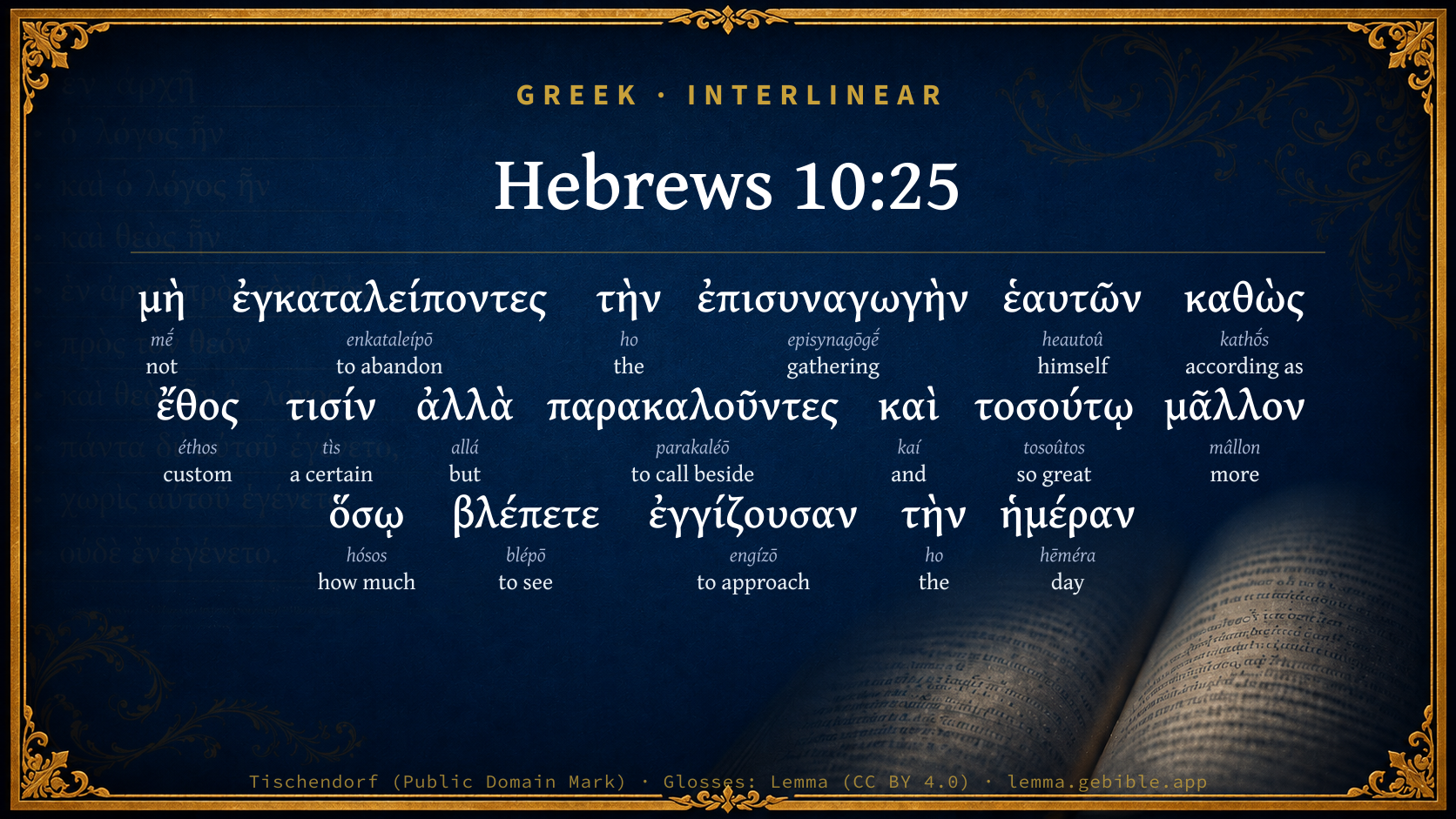
not forsaking our own assembling together, as the custom of some is, but exhorting one another; and so much the more, as you see the Day approaching.
Download a study sheet
One document with this verse’s original text, its word-by-word gloss line, the meaning frame, cross-references with their text, attributed commentary, and full source and license credits — printable, and it pastes into notes with its structure intact.
This verse Autodidact and up
A passage Seminary Student
Up to 50 verses in one chapter. A passage sheet keeps up to 6 commentary sources and 12 cross-references per verse, in the order this page ranks them, and says so on the sheet whenever that leaves anything out. Ask for a single verse and you get the Autodidact verse sheet above.
Everything on this page stays free to read, with no account — the sheet is a download of what is already on screen, not access to it.
Compare translations 3
The same verse in 3 English versions, stacked beneath the original-language interlinear above. Click any original word for its lexicon entry.
Each is an independent rendering of the whole verse — the interlinear is not word-aligned to these translations.
Highlighted words mark where these versions differ — a whole-verse word diff, not a word-by-word alignment.
-
World English Bible Public Domain
not forsaking our own assembling together, as the custom of some is, but exhorting one another; and so much the more, as you see the Day approaching.
-
King James Version Public Domain
Not forsaking the assembling of ourselves together, as the manner of some is; but exhorting one another: and so much the more, as ye see the day approaching.
-
unfoldingWord Literal Text CC BY-SA 4.0
not abandoning our own meeting together, just as the habit for some, but exhorting, and so much more in as much as you see that day approaching.
unfoldingWord Literal Text — © unfoldingWord, licensed CC BY-SA 4.0. Word-aligned USFM3 via Door43 (git.door43.org/unfoldingWord/en_ult).
Show all 19 translations
Every available English version of this verse, each an independent rendering of the whole verse.
-
World English Bible Public Domain
not forsaking our own assembling together, as the custom of some is, but exhorting one another; and so much the more, as you see the Day approaching.
-
Berean Standard Bible Public Domain
Let us not neglect meeting together, as some have made a habit, but let us encourage one another, and all the more as you see the Day approaching.
-
Majority Standard Bible Public Domain
Let us not neglect meeting together, as some have made a habit, but let us encourage one another, and all the more as you see the Day approaching.
-
King James Version Public Domain
Not forsaking the assembling of ourselves together, as the manner of some is; but exhorting one another: and so much the more, as ye see the day approaching.
-
American Standard Version (1901) Public Domain
not forsaking our own assembling together, as the custom of some is, but exhorting `one another'; and so much the more, as ye see the day drawing nigh.
-
Revised Version (1885) Public Domain
not forsaking the assembling of ourselves together, as the custom of some is, but exhorting one another; and so much the more, as ye see the day drawing nigh.
-
Geneva Bible (1599) Public Domain
Not forsaking the fellowship that we haue among our selues, as the maner of some is: but let vs exhort one another, and that so much the more, because ye see that the day draweth neere.
-
Douay-Rheims (1899) Public Domain
Not forsaking our assembly, as some are accustomed; but comforting one another, and so much the more as you see the day approaching.
-
Young's Literal Translation Public Domain
not forsaking the assembling of ourselves together, as a custom of certain `is', but exhorting, and so much the more as ye see the day coming nigh.
-
Literal Standard Version CC BY-SA 4.0
not forsaking the assembling of ourselves together, as [is] a custom of some, but exhorting, and so much the more as you see the Day coming near.
-
Unlocked Literal Bible CC BY-SA 4.0
Let us not stop meeting together, as some have done. Instead, encourage one another more and more, and all the more as you see the day coming closer.
-
unfoldingWord Literal Text CC BY-SA 4.0
not abandoning our own meeting together, just as the habit for some, but exhorting, and so much more in as much as you see that day approaching.
-
Darby Bible Public Domain
not forsaking the assembling of ourselves together, as the custom [is] with some; but encouraging [one another], and by so much the more as ye see the day drawing near.
-
World Messianic Bible Public Domain
not forsaking our own assembling together, as the custom of some is, but exhorting one another, and so much the more as you see the Day approaching.
-
Webster's Bible Public Domain
Not forsaking the assembling of ourselves, as the manner of some is; but exhorting one another: and so much the more, as ye see the day approaching.
-
Free Bible Version CC BY-SA 4.0
We should not give up meeting together, as some have done. In fact we should be encouraging one another, especially as you see the End approaching.
-
Bible in Basic English Public Domain
Not giving up our meetings, as is the way of some, but keeping one another strong in faith; and all the more because you see the day coming near.
-
Text-Critical English NT CC BY 4.0
not neglecting to meet together, as is the habit of some, but encouraging one another, and all the more as you see the Day drawing near.
-
Tyndale New Testament (1534) Public Domain
and let vs not forsake the felishippe that we have amonge oure selves as the maner of some is: but let vs exhorte one another and that so moche the more because ye se that the daye draweth nye.
Literal Standard Version (2020), Covenant Press — licensed CC BY-SA 4.0. Text via the HelloAO Bible API (eBible.org). Unlocked Literal Bible (unfoldingWord) — licensed CC BY-SA 4.0. Text via the HelloAO Bible API (eBible.org). unfoldingWord Literal Text — © unfoldingWord, licensed CC BY-SA 4.0. Word-aligned USFM3 via Door43 (git.door43.org/unfoldingWord/en_ult). Free Bible Version, Dr. Jonathan Gallagher — licensed CC BY-SA 4.0. Text via the HelloAO Bible API (eBible.org).
Word by word
More ways to search: Search by grammar → Find every occurrence → Compare this word →
Practice this passage: Drill this verse → Learn its vocabulary →
- Appears 2× in the Greek New Testament
- First appears at 2 Thessalonians 2:1
- Part of Speech
- Noun
- Case
- Accusative
- Number
- Singular
- Gender
- Feminine
Full Thayer's Definition
- μὴ mḗ G3361 “not” Particle, Negative
- ἐγκαταλείποντες enkataleípō G1459 “to abandon” Verb, Present, Active, Participle, Nominative, Plural, Masculine
- τὴν ho G3588 “the” Article, Accusative, Singular, Feminine
- ἐπισυναγωγὴν episynagōgḗ G1997 “gathering” Noun, Accusative, Singular, Feminine
- ἑαυτῶν heautoû G1438 “himself” Reflexive pronoun, 1st person, Genitive, Plural, Masculine
- καθὼς kathṓs G2531 “according as” Adverb
- ἔθος éthos G1485 “custom” Noun, Nominative, Singular, Neuter
- τισίν tìs G5100 “a certain” Indefinite pronoun, Dative, Plural, Masculine
- ἀλλὰ allá G235 “but” Conjunction
- παρακαλοῦντες parakaléō G3870 “to call beside” Verb, Present, Active, Participle, Nominative, Plural, Masculine
- καὶ kaí G2532 “and” Conjunction
- τοσούτῳ tosoûtos G5118 “so great” Demonstrative pronoun, Dative, Singular, Neuter
- μᾶλλον mâllon G3123 “more” Adverb
- ὅσῳ hósos G3745 “how much” Correlative pronoun, Dative, Singular, Neuter
- βλέπετε blépō G991 “to see” Verb, Present, Active, Indicative, 2nd person, Plural
- ἐγγίζουσαν engízō G1448 “to approach” Verb, Present, Active, Participle, Accusative, Singular, Feminine
- τὴν ho G3588 “the” Article, Accusative, Singular, Feminine
- ἡμέραν hēméra G2250 “day” Noun, Accusative, Singular, Feminine
About this verse
These counts appear in no published source. They are computed here, from the morphology-tagged text and Lemma’s own curated glosses. What Lemma adds →
- 18
- words
- 17
- distinct lemmas
- General Epistles
- section
Notable vocabulary
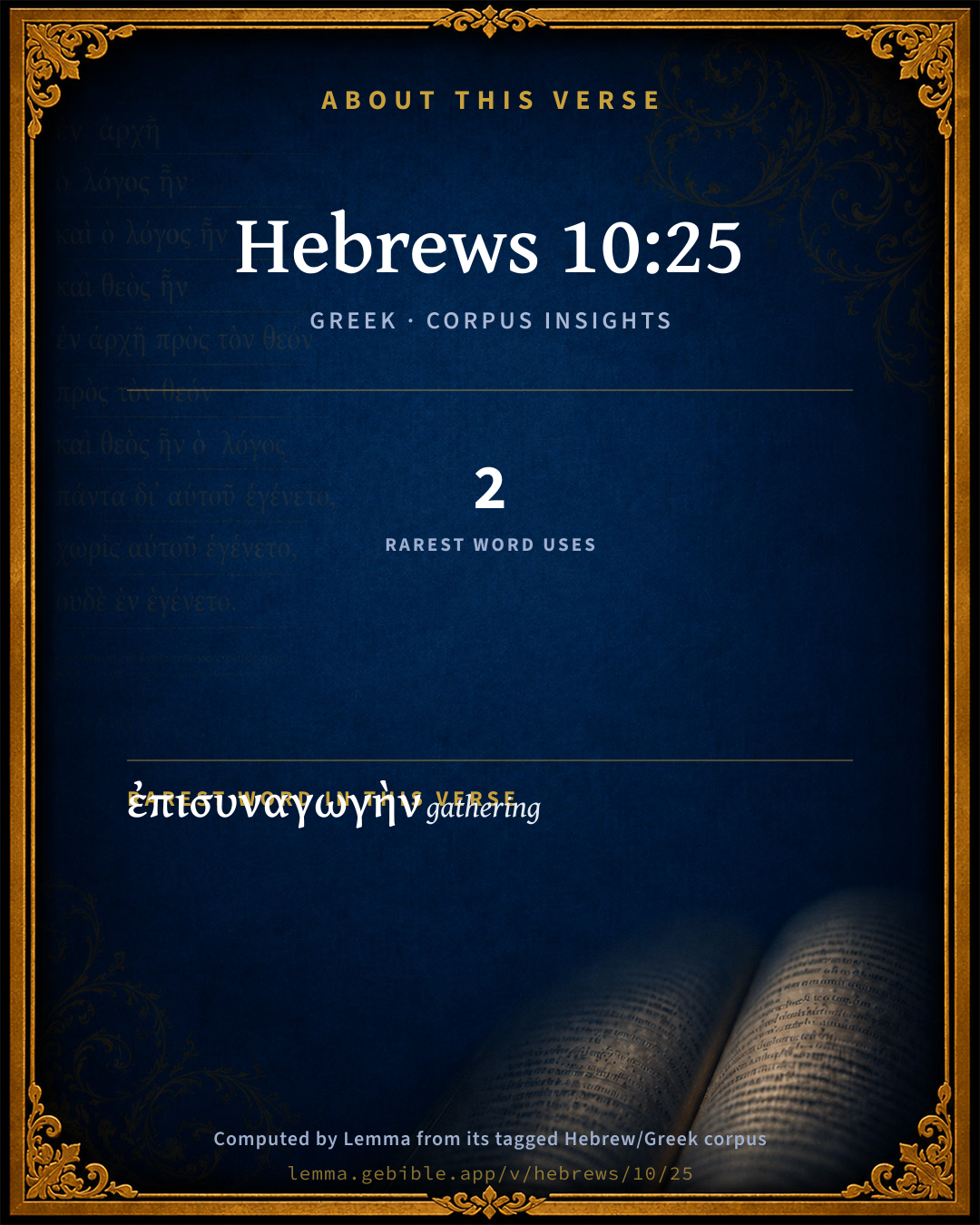
The rarest word here is ἐπισυναγωγὴν gathering G1997 — appearing just 2 times in the whole Greek New Testament.
Shared distinctive vocabulary
ἐπισυναγωγὴν gathering G1997 occurs in 2 verses of the Greek New Testament. Also found in:
Repetition
A word recurs within this verse:
- τὴν the G3588 ×2
Cross-references
28Topical passages linked to Hebrews 10:25 in the Treasury of Scripture Knowledge — connected by theme and wording, ordered by reader-vote popularity; previews shown in the World English Bible.
- Acts 2:42 They continued steadfastly in the apostles' teaching and fellowship, in the breaking of bread, and prayer.
- 1 Thessalonians 5:11 Therefore exhort one another, and build each other up, even as you also do.
- Matthew 18:20 For where two or three are gathered together in my name, there I am in the midst of them."
- Hebrews 3:13 but exhort one another day by day, so long as it is called "today;" lest any one of you be hardened by the deceitfulness of sin.
- Hebrews 10:24 Let us consider how to provoke one another to love and good works,
- 1 Corinthians 5:4 In the name of our Lord Jesus Christ, you being gathered together, and my spirit, with the power of our Lord Jesus Christ,
- 1 Thessalonians 4:18 Therefore comfort one another with these words.
- Acts 20:7 On the first day of the week, when the disciples were gathered together to break bread, Paul talked with them, intending to depart on the next day, and continued his speech until midnight.
- Acts 2:1 Now when the day of Pentecost had come, they were all with one accord in one place.
- Romans 13:11–13 Do this, knowing the time, that it is already time for you to awaken out of sleep, for salvation is now nearer to us than when we first believed.
- 1 Corinthians 11:17–18 But in giving you this command, I don't praise you, that you come together not for the better but for the worse.
- 1 Corinthians 14:3 But he who prophesies speaks to men for their edification, exhortation, and consolation.
- Acts 1:13–14 When they had come in, they went up into the upper room, where they were staying; that is Peter, John, James, Andrew, Philip, Thomas, Bartholomew, Matthew, James the son of Alphaeus, Simon the Zealot, and Judas the son of James.
- Romans 12:8 or he who exhorts, to his exhorting: he who gives, let him do it with liberality; he who rules, with diligence; he who shows mercy, with cheerfulness.
- 2 Peter 3:9 The Lord is not slow concerning his promise, as some count slowness; but is patient with us, not wishing that any should perish, but that all should come to repentance.
- 1 Corinthians 14:23 If therefore the whole assembly is assembled together and all speak with other languages, and unlearned or unbelieving people come in, won't they say that you are crazy?
- Philippians 4:5 Let your gentleness be known to all men. The Lord is at hand.
- James 5:8 You also be patient. Establish your hearts, for the coming of the Lord is at hand.
- Matthew 24:33–34 Even so you also, when you see all these things, know that it is near, even at the doors.
- John 20:19–29 When therefore it was evening, on that day, the first day of the week, and when the doors were locked where the disciples were assembled, for fear of the Jews, Jesus came and stood in the midst, and said to them, "Peace be to you."
- 2 Peter 3:14 Therefore, beloved, seeing that you look for these things, be diligent to be found in peace, without blemish and blameless in his sight.
- Jude 1:19 These are they who cause divisions, and are sensual, not having the Spirit.
- 2 Peter 3:11 Therefore since all these things are thus to be destroyed, what manner of persons ought you to be in holy living and godliness,
- Mark 13:29–30 even so you also, when you see these things coming to pass, know that it is near, at the doors.
- 1 Peter 4:7 But the end of all things is near. Therefore be of sound mind, self-controlled, and sober in prayer.
- 1 Corinthians 11:20 When therefore you assemble yourselves together, it is not possible to eat the Lord's supper.
- Acts 16:16 It happened, as we were going to prayer, that a certain girl having a spirit of divination met us, who brought her masters much gain by fortune telling.
- 1 Corinthians 3:13 each man's work will be revealed. For the Day will declare it, because it is revealed in fire; and the fire itself will test what sort of work each man's work is.
Cross-references courtesy of OpenBible.info (CC BY 4.0).
Lesson kit
Teaching starters — assembled from the data on this page, not authored interpretation. Every prompt links to the verse data it draws on. Edit before teaching.
Hebrews, in the General Epistles, opens this verse with 18 words (17 distinct Greek lemmas). Its most distinctive word is episynagōgḗ (“gathering”). A historical commentator’s framing appears above. Read the whole chapter for the surrounding context.
Discussion questions
- What does “gathering” (episynagōgḗ) contribute to the verse as a whole?
- 2 Thessalonians 2:1 shares the word «gathering» with this verse. How do the two illuminate each other?
- “the” occurs 2× in this one verse. What is the effect of the repetition?
- The translations on this page render this verse differently — a whole-verse word diff, not a word-by-word alignment. What might account for the different wordings?
- Reading how The Biblical Illustrator and Tyndale Open Study Notes read this verse, where do the two commentators agree and where do they part?
Things to notice
- These translations choose different wording for 13 words in this verse.
- “the” occurs 2× in this single verse.
- 17 distinct Greek lemmas span 18 words in this verse.
Commentary
Notes on Hebrews 10:25 from classic Christian and Jewish commentators (each source and its license shown beneath its notes). The classic Christian expositions comment on the surrounding passage and are grouped to its opening verse, so a note may address several verses; the Jewish commentaries on the Tanakh (Rashi and others) are per-verse, so they appear only where the commentator wrote on this verse.
Lemma curates 59 commentaries, every one of them public domain or Creative Commons licensed, each selected and text-cleaned for this edition rather than reprinted as found. About our sources →
The Biblical Illustrator
Joseph S. Exell
The Biblical Illustrator, edited by Joseph S. Exell (c. 1880s–1900s) — public domain. Text from a community e-Sword module.
Tyndale Open Study Notes
Tyndale Open Resources
Tyndale Open Study Notes — © Tyndale Open Resources, licensed CC BY-SA 4.0. Text via the HelloAO Bible API.
Bengel's Gnomon
Johann Albrecht Bengel
Bengel's Gnomon of the New Testament — English translation (T&T Clark, Edinburgh, 1860) — public domain. Text from a community e-Sword module.
Meyer's Critical & Exegetical Commentary
Heinrich August Wilhelm Meyer
Meyer — Critical and Exegetical Commentary on the New Testament — English translation by Peter Christie, edited by Frederick Crombie (T&T Clark, 1880) — public domain. Text from a community e-Sword module.
Geneva Bible (1599)
Geneva Bible translators
Geneva Bible (1599) marginal notes — public domain. Text via Bolls.life.
Jamieson, Fausset & Brown
Robert Jamieson, A. R. Fausset & David Brown
Jamieson, Fausset & Brown — Commentary Critical and Explanatory on the Whole Bible (1871) — public domain (CC PDM 1.0). Text via the HelloAO Bible API.
Adam Clarke's Commentary
Adam Clarke's Commentary on the Bible (1810–1826) — public domain. Text from a community e-Sword/MySword module.
John Calvin's Commentaries
John Calvin's Commentaries (1540-1563) — public domain. Text from the Calvin Translation Society English edition (1840s-50s) via the Christian Classics Ethereal Library (ccel.org). Calvin's coverage is partial (roughly two-thirds of the Bible); uncommented books and verses are honest gaps, never fabricated. The 19th-century editor's footnotes and remarks are omitted so the notes are faithfully Calvin's own voice.
Ellicott's Commentary for English Readers
A Bible Commentary for English Readers, edited by Charles John Ellicott (1878–1897) — public domain. Text from a community e-Sword module.
The Cambridge Bible for Schools and Colleges
gen. ed. J. J. S. Perowne
The Cambridge Bible for Schools and Colleges (gen. ed. J. J. S. Perowne; Cambridge University Press, 1878–1918) — public domain. Text from a community e-Sword module.
John Gill's Exposition
John Gill's Exposition of the Whole Bible (1746–1763) — public domain (CC PDM 1.0). Text via the HelloAO Bible API.
Trapp's Complete Commentary
John Trapp
John Trapp, A Commentary or Exposition upon All the Books of the Old and New Testament (1647–1656) — public domain. Text from a community e-Sword module.
Albert Barnes' Notes on the Bible
Albert Barnes' Notes on the Bible (1834–1885) — public domain. Text from a community e-Sword/MySword module.
Haydock's Catholic Bible Commentary
George Leo Haydock (1774–1849), Haydock's Catholic Family Bible and Commentary, 1859 edition — public domain. Excludes Psalms (Douay-Rheims chapter numbering differs from Protestant) and Deuterocanonical books (Catholic canon only).
Matthew Poole's English Annotations
Matthew Poole's English Annotations on the Holy Bible (1683–1685) — public domain. Text from a community e-Sword/MySword module.
Whedon's Commentary on the Bible
Daniel D. Whedon
Daniel D. Whedon (gen. ed.), Commentary on the Old and New Testaments (1874–1909) — public domain. Text from a community e-Sword module.
The Pulpit Commentary
The Pulpit Commentary (1880–1919), ed. H.D.M. Spence-Jones & Joseph S. Exell — public domain. Text from a community e-Sword module.
John Wesley's Explanatory Notes
John Wesley, Explanatory Notes Upon the Whole Bible (1754–1765) — public domain. Text via the GEBible commentary corpus.
Burkitt's Expository Notes on the New Testament
William Burkitt
William Burkitt's Expository Notes on the New Testament (1700–1703) — public domain. Text from a community e-Sword module.
The People's New Testament
B. W. Johnson
B. W. Johnson's The People's New Testament with Notes (1889–1891) — public domain. Electronic text from the Christian Classics Ethereal Library (CCEL) ThML edition.
Cambridge Greek Testament for Schools and Colleges
Cambridge Greek Testament for Schools and Colleges (Cambridge University Press, 1896; 21 vols, various authors incl. Carr, Maclear, Plummer, Farrar, Lumby, Moule, M. R. James, Simcox) — public domain. Text from a community e-Sword module.
Alford’s Greek Testament
Henry Alford
Henry Alford, The Greek Testament (1849–1861) — public domain. Text from a community e-Sword module.
Vincent's Word Studies in the New Testament
Marvin R. Vincent
Marvin R. Vincent, Word Studies in the New Testament (1887–1900) — public domain. Text from a community e-Sword/MySword module.
Westcott on Hebrews & the Epistles of John
Brooke Foss Westcott
Brooke Foss Westcott (1825–1901), The Epistle to the Hebrews (1889) and The Epistles of St John (1883) — public domain (pre-1929). Text recovered from Internet Archive / Google Books OCR scans. Westcott’s Gospel of John commentary is not included (its OCR lost the chapter running-heads required for reliable verse-keying). Some Greek quoted in the Hebrews volume is imperfectly rendered by the OCR.