

Hebrews 4:13
Greek (Tischendorf 8th ed.) Hebrews 4:13 appears in the Greek New Testament. The text above is from the Tischendorf 8th edition. Each word links to its Strong’s number and a concise gloss. Click any word for its full Thayer’s Greek Lexicon entry.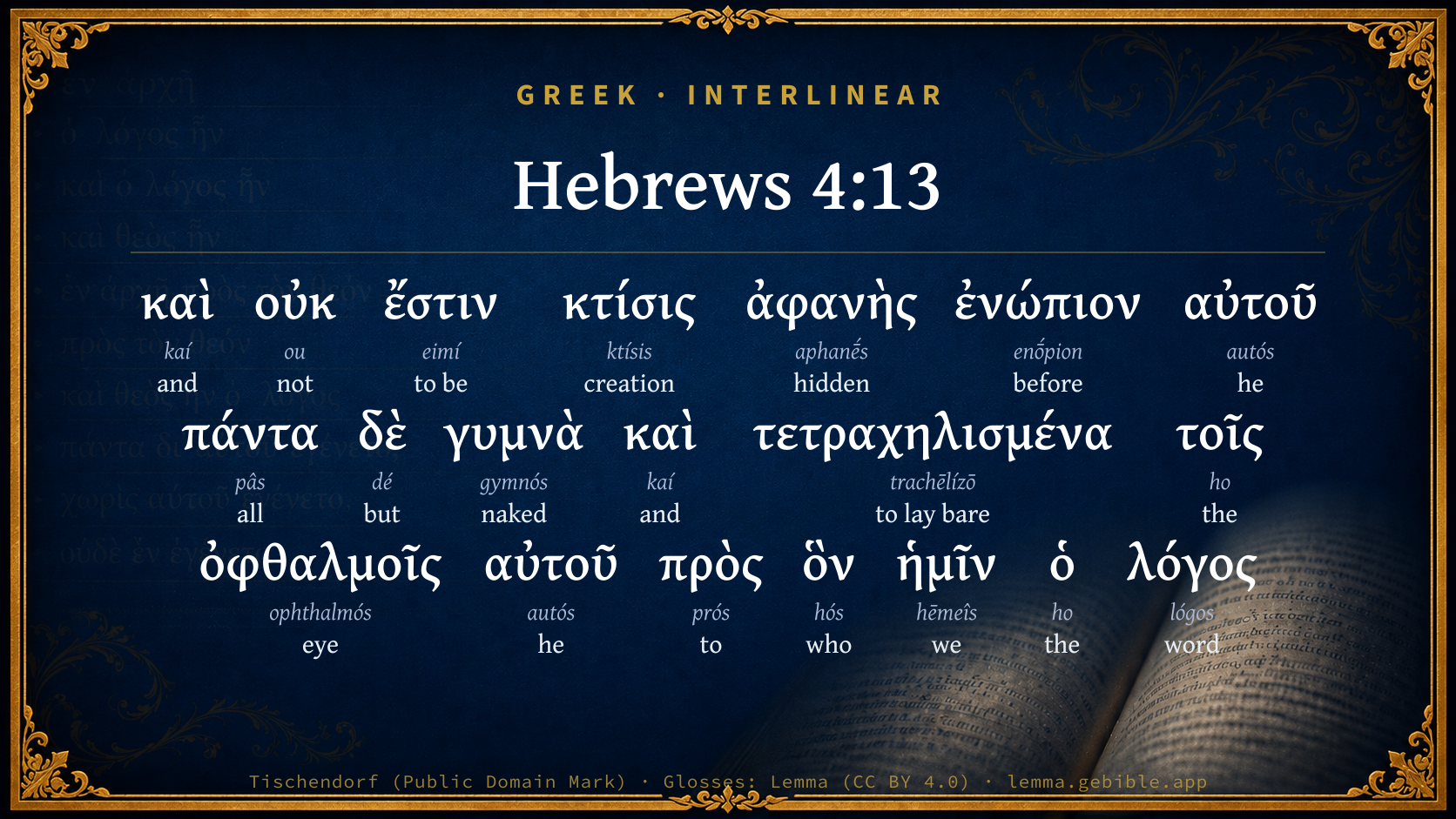
There is no creature that is hidden from his sight, but all things are naked and laid open before the eyes of him with whom we have to do.
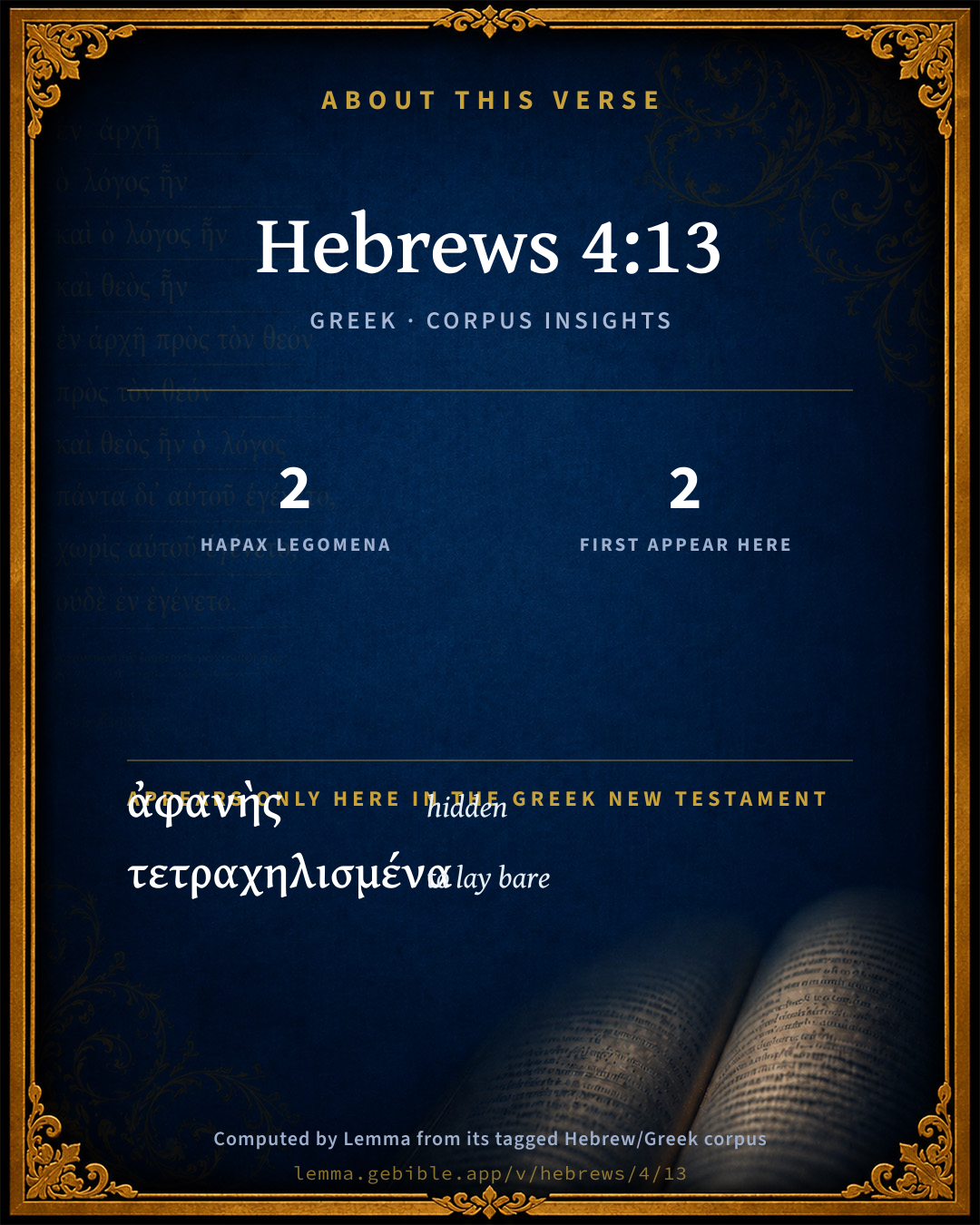
- 2 hapax legomena — only here in the Greek New Testament
- 2 first appearances in the Greek New Testament
Download a study sheet
One document with this verse’s original text, its word-by-word gloss line, the meaning frame, cross-references with their text, attributed commentary, and full source and license credits — printable, and it pastes into notes with its structure intact.
This verse Autodidact and up
A passage Seminary Student
Up to 50 verses in one chapter. A passage sheet keeps up to 6 commentary sources and 12 cross-references per verse, in the order this page ranks them, and says so on the sheet whenever that leaves anything out. Ask for a single verse and you get the Autodidact verse sheet above.
Everything on this page stays free to read, with no account — the sheet is a download of what is already on screen, not access to it.
Compare translations 3
The same verse in 3 English versions, stacked beneath the original-language interlinear above. Click any original word for its lexicon entry.
Each is an independent rendering of the whole verse — the interlinear is not word-aligned to these translations.
Highlighted words mark where these versions differ — a whole-verse word diff, not a word-by-word alignment.
-
World English Bible Public Domain
There is no creature that is hidden from his sight, but all things are naked and laid open before the eyes of him with whom we have to do.
-
King James Version Public Domain
Neither is there any creature that is not manifest in his sight: but all things are naked and opened unto the eyes of him with whom we have to do.
-
unfoldingWord Literal Text CC BY-SA 4.0
And no creature is hidden before him. Instead, all things bare and laid open to the eyes of him to whom our word.
unfoldingWord Literal Text — © unfoldingWord, licensed CC BY-SA 4.0. Word-aligned USFM3 via Door43 (git.door43.org/unfoldingWord/en_ult).
Show all 19 translations
Every available English version of this verse, each an independent rendering of the whole verse.
-
World English Bible Public Domain
There is no creature that is hidden from his sight, but all things are naked and laid open before the eyes of him with whom we have to do.
-
Berean Standard Bible Public Domain
Nothing in all creation is hidden from God’s sight; everything is uncovered and exposed before the eyes of Him to whom we must give account.
-
Majority Standard Bible Public Domain
Nothing in all creation is hidden from God’s sight; everything is uncovered and exposed before the eyes of Him to whom we must give account.
-
King James Version Public Domain
Neither is there any creature that is not manifest in his sight: but all things are naked and opened unto the eyes of him with whom we have to do.
-
American Standard Version (1901) Public Domain
And there is no creature that is not manifest in his sight: but all things are naked and laid open before the eyes of him with whom we have to do.
-
Revised Version (1885) Public Domain
And there is no creature that is not manifest in his sight: but all things are naked and laid open before the eyes of him with whom we have to do.
-
Geneva Bible (1599) Public Domain
Neither is there any creature, which is not manifest in his sight: but all things are naked and open vnto his eyes, with whome we haue to doe.
-
Douay-Rheims (1899) Public Domain
Neither is there any creature invisible in his sight: but all things are naked and open to his eyes, to whom our speech is.
-
Young's Literal Translation Public Domain
and there is not a created thing not manifest before Him, but all things `are' naked and open to His eyes -- with whom is our reckoning.
-
Literal Standard Version CC BY-SA 4.0
and there is not a created thing hidden before Him, but all things [are] naked and open to His eyes—with whom is our reckoning.
-
Unlocked Literal Bible CC BY-SA 4.0
Nothing created is hidden before God. Instead, everything is bare and open to the eyes of the one to whom we must give account.
-
unfoldingWord Literal Text CC BY-SA 4.0
And no creature is hidden before him. Instead, all things bare and laid open to the eyes of him to whom our word.
-
Darby Bible Public Domain
And there is not a creature unapparent before him; but all things [are] naked and laid bare to his eyes, with whom we have to do.
-
World Messianic Bible Public Domain
There is no creature that is hidden from his sight, but all things are naked and laid open before the eyes of him to whom we must give an account.
-
Webster's Bible Public Domain
Neither is there any creature that is not manifest in his sight: but all things are naked and opened to the eyes of him with whom we have to do.
-
Free Bible Version CC BY-SA 4.0
No living being is hidden from his sight; everything is exposed and visible to the one we're accountable to.
-
Bible in Basic English Public Domain
And there is nothing made which is not completely clear to him; there is nothing covered, but all things are open to the eyes of him with whom we have to do.
-
Text-Critical English NT CC BY 4.0
No creature is hidden from his sight, but all are naked and exposed to the eyes of him to whom we must give an account.
-
Tyndale New Testament (1534) Public Domain
nether is there eny creature invisible in the sight of it. For all thynges are naked and bare vnto the eyes of him of whom we speake.
Literal Standard Version (2020), Covenant Press — licensed CC BY-SA 4.0. Text via the HelloAO Bible API (eBible.org). Unlocked Literal Bible (unfoldingWord) — licensed CC BY-SA 4.0. Text via the HelloAO Bible API (eBible.org). unfoldingWord Literal Text — © unfoldingWord, licensed CC BY-SA 4.0. Word-aligned USFM3 via Door43 (git.door43.org/unfoldingWord/en_ult). Free Bible Version, Dr. Jonathan Gallagher — licensed CC BY-SA 4.0. Text via the HelloAO Bible API (eBible.org).
Word by word
More ways to search: Search by grammar → Find every occurrence → Compare this word →
Practice this passage: Drill this verse → Learn its vocabulary →
- Appears 1× in the Greek New Testament
- First appears here
- Part of Speech
- Adjective
- Case
- Nominative
- Number
- Singular
- Gender
- Feminine
Full Thayer's Definition
- καὶ kaí G2532 “and” Conjunction
- οὐκ ou G3756 “not” Particle, Negative
- ἔστιν eimí G1510 “to be” Verb, Present, Active, Indicative, 3rd person, Singular
- κτίσις ktísis G2937 “creation” Noun, Nominative, Singular, Feminine
- ἀφανὴς aphanḗs G852 “hidden” Adjective, Nominative, Singular, Feminine
- ἐνώπιον enṓpion G1799 “before” Adverb
- αὐτοῦ autós G846 “he” Personal pronoun, Genitive, Singular, Masculine
- πάντα pâs G3956 “all” Adjective, Nominative, Plural, Neuter
- δὲ dé G1161 “but” Conjunction
- γυμνὰ gymnós G1131 “naked” Adjective, Nominative, Plural, Neuter
- καὶ kaí G2532 “and” Conjunction
- τετραχηλισμένα trachēlízō G5136 “to lay bare” Verb, Perfect, Passive, Participle, Nominative, Plural, Neuter
- τοῖς ho G3588 “the” Article, Dative, Plural, Masculine
- ὀφθαλμοῖς ophthalmós G3788 “eye” Noun, Dative, Plural, Masculine
- αὐτοῦ autós G846 “he” Personal pronoun, Genitive, Singular, Masculine
- πρὸς prós G4314 “to” Preposition
- ὃν hós G3739 “who” Relative pronoun, Accusative, Singular, Masculine
- ἡμῖν hēmeîs G2249 “we” Personal pronoun, 1st person, Dative, Plural
- ὁ ho G3588 “the” Article, Nominative, Singular, Masculine
- λόγος lógos G3056 “word” Noun, Nominative, Singular, Masculine
About this verse
These counts appear in no published source. They are computed here, from the morphology-tagged text and Lemma’s own curated glosses. What Lemma adds →
- 20
- words
- 17
- distinct lemmas
- General Epistles
- section
Notable vocabulary
2 hapax legomena — words that appear only here in the entire Greek New Testament:
First appearance in Scripture
These words make their first canonical appearance in the Greek New Testament here:
Shared distinctive vocabulary
γυμνὰ naked G1131 occurs in 15 verses of the Greek New Testament. Also found in:
Cross-references
29Topical passages linked to Hebrews 4:13 in the Treasury of Scripture Knowledge — connected by theme and wording, ordered by reader-vote popularity; previews shown in the World English Bible.
- 1 Corinthians 4:5 Therefore judge nothing before the time, until the Lord comes, who will both bring to light the hidden things of darkness, and reveal the counsels of the hearts. Then each man will get his praise from God.
- Psalms 33:13–15 Yahweh looks from heaven. He sees all the sons of men.
- Proverbs 15:3 Yahweh's eyes are everywhere, Keeping watch on the evil and the good.
- Ecclesiastes 12:14 For God will bring every work into judgment, with every hidden thing, whether it is good, or whether it is evil.
- 1 Samuel 16:7 But Yahweh said to Samuel, "Don't look on his face, or on the height of his stature; because I have rejected him: for [Yahweh sees] not as man sees; for man looks at the outward appearance, but Yahweh looks at the heart."
- Jeremiah 17:10 I, Yahweh, search the mind, I try the heart, even to give every man according to his ways, according to the fruit of his doings.
- 2 Corinthians 5:10 For we must all be revealed before the judgment seat of Christ; that each one may receive the things in the body, according to what he has done, whether good or bad.
- Job 34:21 "For his eyes are on the ways of a man, He sees all his goings.
- Proverbs 15:11 Sheol and Abaddon are before Yahweh-- How much more then the hearts of the children of men!
- Psalms 44:21 Won't God search this out? For he knows the secrets of the heart.
- Romans 2:16 in the day when God will judge the secrets of men, according to my Gospel, by Jesus Christ.
- Job 26:6 Sheol is naked before God, And Abaddon has no covering.
- 2 Chronicles 6:30 then hear from heaven, your dwelling-place and forgive, and render to every man according to all his ways, whose heart you know; (for you, even you only, know the hearts of the children of men;)
- Revelation 2:23 I will kill her children with Death, and all the assemblies will know that I am he who searches the minds and hearts. I will give to each one of you according to your deeds.
- Psalms 7:9 Oh let the wickedness of the wicked come to an end, But establish the righteous; Their minds and hearts are searched by the righteous God.
- Psalms 90:8 You have set our iniquities before you, Our secret sins in the light of your presence.
- 1 Chronicles 28:9 You, Solomon my son, know the God of your father, and serve him with a perfect heart and with a willing mind; for Yahweh searches all hearts, and understands all the imaginations of the thoughts: if you seek him, he will be found of you; but if you forsake him, he will cast you off forever.
- Matthew 25:31–32 "But when the Son of Man comes in his glory, and all the holy angels with him, then he will sit on the throne of his glory.
- Romans 14:9–12 For to this end Christ died, rose, and lived again, that he might be Lord of both the dead and the living.
- 2 Chronicles 16:9 For the eyes of Yahweh run back and forth throughout the whole earth, to show himself strong in the behalf of them whose heart is perfect toward him. Herein you have done foolishly; for from henceforth you shall have wars.
- John 2:24 But Jesus didn't trust himself to them, because he knew everyone,
- John 21:17 He said to him the third time, "Simon, son of Jonah, do you have affection for me?" Peter was grieved because he asked him the third time, "Do you have affection for me?" He said to him, "Lord, you know everything. You know that I have affection for you." Jesus said to him, "Feed my sheep.
- Job 38:17 Have the gates of death been revealed to you? Or have you seen the gates of the shadow of death?
- Jeremiah 17:23–24 But they didn't listen, neither turn their ear, but made their neck stiff, that they might not hear, and might not receive instruction.
- John 5:22–29 For the Father judges no one, but he has given all judgment to the Son,
- Acts 17:31 because he has appointed a day in which he will judge the world in righteousness by the man whom he has ordained; of which he has given assurance to all men, in that he has raised him from the dead."
- Revelation 20:11–15 I saw a great white throne, and him who sat on it, from whose face the earth and the heaven fled away. There was found no place for them.
- Psalms 139:11–12 If I say, "Surely the darkness will overwhelm me; The light around me will be night;"
- Matthew 7:21–22 Not everyone who says to me, 'Lord, Lord,' will enter into the Kingdom of Heaven; but he who does the will of my Father who is in heaven.
Cross-references courtesy of OpenBible.info (CC BY 4.0).
Lesson kit
Teaching starters — assembled from the data on this page, not authored interpretation. Every prompt links to the verse data it draws on. Edit before teaching.
Hebrews, in the General Epistles, opens this verse with 20 words (17 distinct Greek lemmas). Its most distinctive word is aphanḗs (“hidden”). A historical commentator’s framing appears above. Read the whole chapter for the surrounding context.
Discussion questions
- The word aphanḗs carries the sense “hidden.” How does it shape the verse?
- This verse holds 2 words here found nowhere else in the Greek New Testament. What might the rare words draw attention to?
- 2 words here appear for the first time in Scripture. What is being introduced at this debut?
- Matthew 25:36 shares the word «naked» with this verse. How do the two illuminate each other?
- “and” occurs 2× in this one verse. What is the effect of the repetition?
- These translations render this verse differently; the difference is in the English rendering, not the original. What questions does that raise?
- Reading how Joseph Benson's Commentary and Whedon's Commentary on the Bible read this verse, where do the two commentators agree and where do they part?
Things to notice
- 2 words in this verse appear nowhere else in the Greek New Testament.
- 2 words make their first canonical appearance in Scripture here.
- These translations choose different wording for 17 words in this verse.
- “and” occurs 2× in this single verse.
- 17 distinct Greek lemmas span 20 words in this verse.
Commentary
Notes on Hebrews 4:13 from classic Christian and Jewish commentators (each source and its license shown beneath its notes). The classic Christian expositions comment on the surrounding passage and are grouped to its opening verse, so a note may address several verses; the Jewish commentaries on the Tanakh (Rashi and others) are per-verse, so they appear only where the commentator wrote on this verse.
Lemma curates 59 commentaries, every one of them public domain or Creative Commons licensed, each selected and text-cleaned for this edition rather than reprinted as found. About our sources →
Joseph Benson's Commentary
Joseph Benson's Commentary on the Old and New Testaments (1811–1818) — public domain. Text from a community e-Sword module.
Whedon's Commentary on the Bible
Daniel D. Whedon
Daniel D. Whedon (gen. ed.), Commentary on the Old and New Testaments (1874–1909) — public domain. Text from a community e-Sword module.
Tyndale Open Study Notes
Tyndale Open Resources
Tyndale Open Study Notes — © Tyndale Open Resources, licensed CC BY-SA 4.0. Text via the HelloAO Bible API.
Bengel's Gnomon
Johann Albrecht Bengel
Bengel's Gnomon of the New Testament — English translation (T&T Clark, Edinburgh, 1860) — public domain. Text from a community e-Sword module.
Meyer's Critical & Exegetical Commentary
Heinrich August Wilhelm Meyer
Meyer — Critical and Exegetical Commentary on the New Testament — English translation by Peter Christie, edited by Frederick Crombie (T&T Clark, 1880) — public domain. Text from a community e-Sword module.
Geneva Bible (1599)
Geneva Bible translators
Geneva Bible (1599) marginal notes — public domain. Text via Bolls.life.
Jamieson, Fausset & Brown
Robert Jamieson, A. R. Fausset & David Brown
Jamieson, Fausset & Brown — Commentary Critical and Explanatory on the Whole Bible (1871) — public domain (CC PDM 1.0). Text via the HelloAO Bible API.
Adam Clarke's Commentary
Adam Clarke's Commentary on the Bible (1810–1826) — public domain. Text from a community e-Sword/MySword module.
John Calvin's Commentaries
John Calvin's Commentaries (1540-1563) — public domain. Text from the Calvin Translation Society English edition (1840s-50s) via the Christian Classics Ethereal Library (ccel.org). Calvin's coverage is partial (roughly two-thirds of the Bible); uncommented books and verses are honest gaps, never fabricated. The 19th-century editor's footnotes and remarks are omitted so the notes are faithfully Calvin's own voice.
Ellicott's Commentary for English Readers
A Bible Commentary for English Readers, edited by Charles John Ellicott (1878–1897) — public domain. Text from a community e-Sword module.
The Cambridge Bible for Schools and Colleges
gen. ed. J. J. S. Perowne
The Cambridge Bible for Schools and Colleges (gen. ed. J. J. S. Perowne; Cambridge University Press, 1878–1918) — public domain. Text from a community e-Sword module.
John Gill's Exposition
John Gill's Exposition of the Whole Bible (1746–1763) — public domain (CC PDM 1.0). Text via the HelloAO Bible API.
Trapp's Complete Commentary
John Trapp
John Trapp, A Commentary or Exposition upon All the Books of the Old and New Testament (1647–1656) — public domain. Text from a community e-Sword module.
Albert Barnes' Notes on the Bible
Albert Barnes' Notes on the Bible (1834–1885) — public domain. Text from a community e-Sword/MySword module.
Haydock's Catholic Bible Commentary
George Leo Haydock (1774–1849), Haydock's Catholic Family Bible and Commentary, 1859 edition — public domain. Excludes Psalms (Douay-Rheims chapter numbering differs from Protestant) and Deuterocanonical books (Catholic canon only).
Matthew Poole's English Annotations
Matthew Poole's English Annotations on the Holy Bible (1683–1685) — public domain. Text from a community e-Sword/MySword module.
The Pulpit Commentary
The Pulpit Commentary (1880–1919), ed. H.D.M. Spence-Jones & Joseph S. Exell — public domain. Text from a community e-Sword module.
John Wesley's Explanatory Notes
John Wesley, Explanatory Notes Upon the Whole Bible (1754–1765) — public domain. Text via the GEBible commentary corpus.
Burkitt's Expository Notes on the New Testament
William Burkitt
William Burkitt's Expository Notes on the New Testament (1700–1703) — public domain. Text from a community e-Sword module.
The People's New Testament
B. W. Johnson
B. W. Johnson's The People's New Testament with Notes (1889–1891) — public domain. Electronic text from the Christian Classics Ethereal Library (CCEL) ThML edition.
Cambridge Greek Testament for Schools and Colleges
Cambridge Greek Testament for Schools and Colleges (Cambridge University Press, 1896; 21 vols, various authors incl. Carr, Maclear, Plummer, Farrar, Lumby, Moule, M. R. James, Simcox) — public domain. Text from a community e-Sword module.
Alford’s Greek Testament
Henry Alford
Henry Alford, The Greek Testament (1849–1861) — public domain. Text from a community e-Sword module.
Vincent's Word Studies in the New Testament
Marvin R. Vincent
Marvin R. Vincent, Word Studies in the New Testament (1887–1900) — public domain. Text from a community e-Sword/MySword module.