Hebrews 1:2

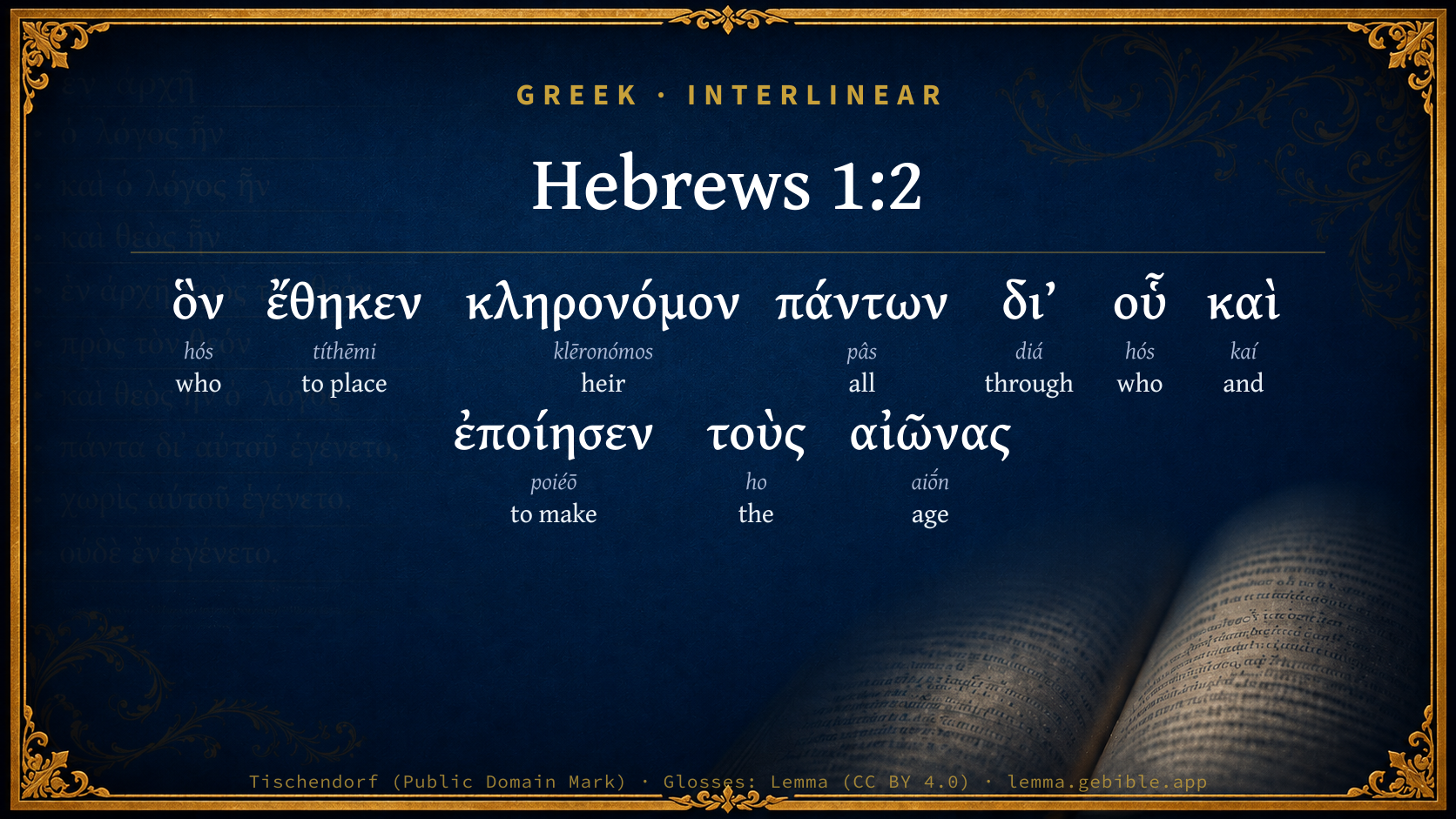
Greek (Tischendorf 8th ed.) Hebrews 1:2 appears in the Greek New Testament. The text above is from the Tischendorf 8th edition. Each word links to its Strong’s number and a concise gloss. Click any word for its full Thayer’s Greek Lexicon entry.
Download image
Cite this verse

Hebrews 1:2 (World English Bible). Public Domain. Lemma interlinear Bible study tool, https://lemma.gebible.app/v/hebrews/1/2.

Show BibTeX & RIS
BibTeX
RIS
English Translation
has at the end of these days spoken to us by his Son, whom he appointed heir of all things, through whom also he made the worlds.
World English Bible · Public Domain
Download a study sheet

One document with this verse’s original text, its word-by-word gloss line, the meaning frame, cross-references with their text, attributed commentary, and full source and license credits — printable, and it pastes into notes with its structure intact.

This verse Autodidact and up

Study sheet (.html) Plain text (.txt)

A passage Seminary Student

Up to 50 verses in one chapter. A passage sheet keeps up to 6 commentary sources and 12 cross-references per verse, in the order this page ranks them, and says so on the sheet whenever that leaves anything out. Ask for a single verse and you get the Autodidact verse sheet above.

Everything on this page stays free to read, with no account — the sheet is a download of what is already on screen, not access to it.

Want to remove ads? Support Godless Engineer
Compare translations 3

The same verse in 3 English versions, stacked beneath the original-language interlinear above. Click any original word for its lexicon entry.

Each is an independent rendering of the whole verse — the interlinear is not word-aligned to these translations.

Highlighted words mark where these versions differ — a whole-verse word diff, not a word-by-word alignment.

  • World English Bible Public Domain
    has at the end of these days spoken to us by his Son, whom he appointed heir of all things, through whom also he made the worlds.
  • King James Version Public Domain
    Hath in these last days spoken unto us by his Son, whom he hath appointed heir of all things, by whom also he made the worlds;
  • unfoldingWord Literal Text CC BY-SA 4.0
    at the last of these days spoke to us through a Son, whom he appointed heir of all things, through whom also he made the ages;

unfoldingWord Literal Text — © unfoldingWord, licensed CC BY-SA 4.0. Word-aligned USFM3 via Door43 (git.door43.org/unfoldingWord/en_ult).

Versions to compare (up to 4)

3 of 4 selected

Show all 19 translations

Every available English version of this verse, each an independent rendering of the whole verse.

  • World English Bible Public Domain
    has at the end of these days spoken to us by his Son, whom he appointed heir of all things, through whom also he made the worlds.
  • Berean Standard Bible Public Domain
    But in these last days He has spoken to us by His Son, whom He appointed heir of all things, and through whom He made the universe.
  • Majority Standard Bible Public Domain
    But in these last days He has spoken to us by His Son, whom He appointed heir of all things, and through whom He made the universe.
  • King James Version Public Domain
    Hath in these last days spoken unto us by his Son, whom he hath appointed heir of all things, by whom also he made the worlds;
  • American Standard Version (1901) Public Domain
    hath at the end of these days spoken unto us in `his' Son, whom he appointed heir of all things, through whom also he made the worlds;
  • Revised Version (1885) Public Domain
    hath at the end of these days spoken unto us in his Son, whom he appointed heir of all things, through whom also he made the worlds;
  • Geneva Bible (1599) Public Domain
    Whom he hath made heire of al things, by whome also he made the worldes,
  • Douay-Rheims (1899) Public Domain
    In these days hath spoken to us by his Son, whom he hath appointed heir of all things, by whom also he made the world.
  • Young's Literal Translation Public Domain
    in these last days did speak to us in a Son, whom He appointed heir of all things, through whom also He did make the ages;
  • Literal Standard Version CC BY-SA 4.0
    in these last days speaks to us in [His] Son, whom He appointed heir of all things, through whom He also made the ages;
  • Unlocked Literal Bible CC BY-SA 4.0
    But in these last days, he has spoken to us through a Son, whom he appointed to be the heir of all things. It is through him that God also made the universe.
  • unfoldingWord Literal Text CC BY-SA 4.0
    at the last of these days spoke to us through a Son, whom he appointed heir of all things, through whom also he made the ages;
  • Darby Bible Public Domain
    at the end of these days has spoken to us in [the person of the] Son, whom he has established heir of all things, by whom also he made the worlds;
  • World Messianic Bible Public Domain
    has at the end of these days spoken to us by his Son, whom he appointed heir of all things, through whom also he made the worlds.
  • Webster's Bible Public Domain
    Hath in these last days spoken to us by his Son, whom he hath appointed heir of all things, by whom also he made the worlds;
  • Free Bible Version CC BY-SA 4.0
    has in these last days spoken to us through his Son. God appointed the Son heir of everything, and made the universe through him.
  • Bible in Basic English Public Domain
    But now, at the end of these days, it has come to us through his Son, to whom he has given all things for a heritage, and through whom he made the order of the generations;
  • Text-Critical English NT CC BY 4.0
    whom he appointed heir of all things, and through whom he made the universe.
  • Tyndale New Testament (1534) Public Domain
    but in these last dayes he hath spoken vnto vs by his sonne whom he hath made heyre of all thinges: by who also he made the worlde.

Literal Standard Version (2020), Covenant Press — licensed CC BY-SA 4.0. Text via the HelloAO Bible API (eBible.org). Unlocked Literal Bible (unfoldingWord) — licensed CC BY-SA 4.0. Text via the HelloAO Bible API (eBible.org). unfoldingWord Literal Text — © unfoldingWord, licensed CC BY-SA 4.0. Word-aligned USFM3 via Door43 (git.door43.org/unfoldingWord/en_ult). Free Bible Version, Dr. Jonathan Gallagher — licensed CC BY-SA 4.0. Text via the HelloAO Bible API (eBible.org).

Word by word

More ways to search: Search by grammar → Find every occurrence → Compare this word →

Practice this passage: Drill this verse → Learn its vocabulary →

About this verse

These counts appear in no published source. They are computed here, from the morphology-tagged text and Lemma’s own curated glosses. What Lemma adds →

10
words
9
distinct lemmas
General Epistles
section

Notable vocabulary

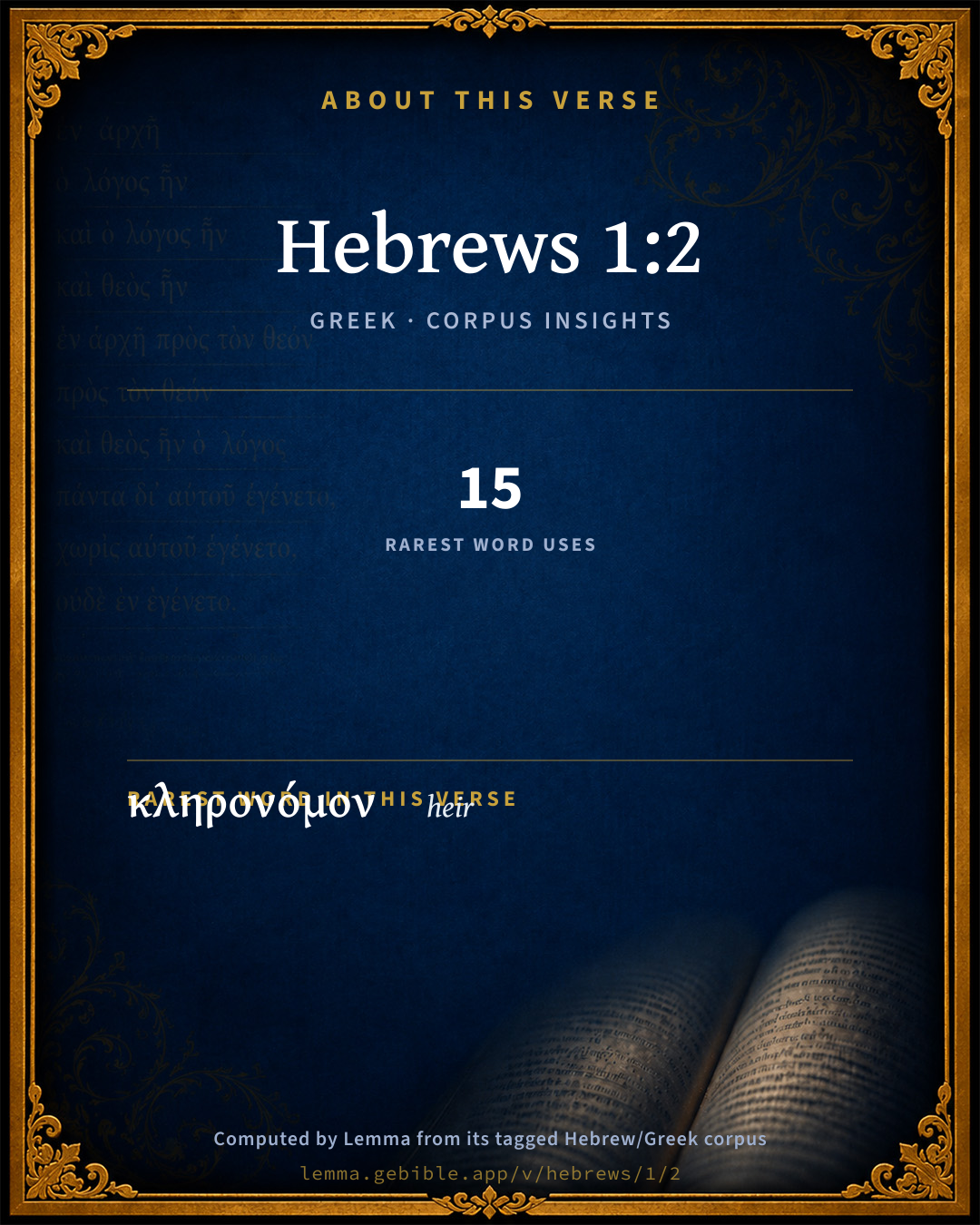
The rarest word here is κληρονόμον heir G2818 — appearing just 15 times in the whole Greek New Testament.

Shared distinctive vocabulary

κληρονόμον heir G2818 occurs in 14 verses of the Greek New Testament. Also found in:

Repetition

A word recurs within this verse:

Cross-references

58

Topical passages linked to Hebrews 1:2 in the Treasury of Scripture Knowledge — connected by theme and wording, ordered by reader-vote popularity; previews shown in the World English Bible.

  • John 1:3 All things were made through him. Without him was not anything made that has been made.
  • 1 Corinthians 8:6 yet to us there is one God, the Father, of whom are all things, and we for him; and one Lord, Jesus Christ, through whom are all things, and we live through him.
  • Colossians 1:16–18 For by him were all things created, in the heavens and on the earth, things visible and things invisible, whether thrones or dominions or principalities or powers; all things have been created through him, and for him.
  • John 1:14 The Word became flesh, and lived among us. We saw his glory, such glory as of the one and only Son of the Father, full of grace and truth.
  • 1 Peter 1:20 who was foreknown indeed before the foundation of the world, but was revealed at the end of times for your sake,
  • Matthew 28:18 Jesus came to them and spoke to them, saying, "All authority has been given to me in heaven and on earth.
  • John 13:3 Jesus, knowing that the Father had given all things into his hands, and that he came forth from God, and was going to God,
  • Philippians 2:9–11 Therefore God also highly exalted him, and gave to him the name which is above every name;
  • Matthew 17:5 While he was still speaking, behold, a bright cloud overshadowed them. Behold, a voice came out of the cloud, saying, "This is my beloved Son, in whom I am well pleased. Listen to him."
  • Romans 8:17 and if children, then heirs; heirs of God, and joint-heirs with Christ; if indeed we suffer with him, that we may also be glorified with him.
  • John 1:17–18 For the law was given through Moses. Grace and truth came through Jesus Christ.
  • Hebrews 5:8 though he was a Son, yet learned obedience by the things which he suffered.
  • Hebrews 11:3 By faith, we understand that the universe has been framed by the word of God, so that what is seen has not been made out of things which are visible.
  • Matthew 21:38 But the farmers, when they saw the son, said among themselves, 'This is the heir. Come, let's kill him, and seize his inheritance.'
  • Ephesians 1:10 to an administration of the fullness of the times, to sum up all things in Christ, the things in the heavens, and the things on the earth, in him;
  • Isaiah 44:24 Thus says Yahweh, your Redeemer, and he who formed you from the womb: I am Yahweh, who makes all things; who stretches forth the heavens alone; who spreads abroad the earth (who is with me?);
  • Matthew 26:63 But Jesus held his peace. The high priest answered him, "I adjure you by the living God, that you tell us whether you are the Christ, the Son of God."
  • John 3:16 For God so loved the world, that he gave his one and only Son, that whoever believes in him should not perish, but have eternal life.
  • Deuteronomy 18:15 Yahweh your God will raise up to you a prophet from the midst of you, of your brothers, like me; to him you shall listen;
  • Deuteronomy 4:30 When you are in oppression, and all these things are come on you, in the latter days you shall return to Yahweh your God, and listen to his voice:
  • Isaiah 2:2 It shall happen in the latter days, that the mountain of Yahweh's house shall be established on the top of the mountains, And shall be raised above the hills; And all nations shall flow to it.
  • John 15:15 No longer do I call you servants, for the servant doesn't know what his lord does. But I have called you friends, for everything that I heard from my Father, I have made known to you.
  • Ephesians 3:9 and to make all men see what is the administration of the mystery which for ages has been hidden in God, who created all things through Jesus Christ;
  • Hebrews 1:5 For to which of the angels did he say at any time, "You are my Son, Today have I become your father?" and again, "I will be to him a Father, And he will be to me a Son?"
  • Hebrews 2:3 how will we escape if we neglect so great a salvation-- which at the first having been spoken through the Lord, was confirmed to us by those who heard;
  • Hebrews 7:3 without father, without mother, without genealogy, having neither beginning of days nor end of life, but made like the Son of God), remains a priest continually.
  • Isaiah 53:10–12 Yet it pleased Yahweh to bruise him; he has put him to grief: when you shall make his soul an offering for sin, he shall see [his] seed, he shall prolong his days, and the pleasure of Yahweh shall prosper in his hand.
  • Jeremiah 30:24 The fierce anger of Yahweh shall not return, until he has executed, and until he have performed the intents of his heart: in the latter days you shall understand it.
  • Micah 4:1 But in the latter days, It will happen that the mountain of Yahweh's temple will be established on the top of the mountains, And it will be exalted above the hills; And peoples will stream to it.
  • Acts 10:36 The word which he sent to the children of Israel, preaching good news of peace by Jesus Christ--he is Lord of all--
  • Galatians 4:4 But when the fullness of the time came, God sent out his Son, born to a woman, born under the law,
  • Proverbs 8:22–31 "Yahweh possessed me in the beginning of his work, Before his deeds of old.
  • Isaiah 9:6–7 For to us a child is born, to us a son is given; and the government shall be on his shoulder: and his name shall be called Wonderful, Counselor, Mighty God, Everlasting Father, Prince of Peace.
  • Mark 1:1 The beginning of the Gospel of Jesus Christ, the Son of God.
  • Mark 12:6 Therefore still having one, his beloved son, he sent him last to them, saying, 'They will respect my son.'
  • John 16:15 All things whatever the Father has are mine; therefore I said that he takes of mine, and will declare it to you.
  • John 17:2 even as you gave him authority over all flesh, he will give eternal life to all whom you have given him.
  • Acts 2:17 'It will be in the last days, says God, That I will pour out my Spirit on all flesh. Your sons and your daughters will prophesy. Your young men will see visions. Your old men will dream dreams.
  • Romans 1:4 who was declared to be the Son of God with power, according to the Spirit of holiness, by the resurrection from the dead, Jesus Christ our Lord,
  • Jude 1:18 They said to you that "In the last time there will be mockers, walking after their own ungodly lusts."
  • Deuteronomy 31:29 For I know that after my death you will utterly corrupt yourselves, and turn aside from the way which I have commanded you; and evil will happen to you in the latter days; because you will do that which is evil in the sight of Yahweh, to provoke him to anger through the work of your hands.
  • Psalms 2:6–9 "Yet I have set my king on my holy hill of Zion."
  • Isaiah 45:18 For thus says Yahweh who created the heavens, the God who formed the earth and made it, who established it and didn't create it a waste, who formed it to be inhabited: I am Yahweh; and there is no one else.
  • Ezekiel 38:16 and you shall come up against my people Israel, as a cloud to cover the land: it shall happen in the latter days, that I will bring you against my land, that the nations may know me, when I shall be sanctified in you, Gog, before their eyes.
  • Daniel 10:14 Now I have come to make you understand what shall happen to your people in the latter days; for the vision is yet for [many] days:
  • 1 Corinthians 15:25–27 For he must reign until he has put all his enemies under his feet.
  • Hebrews 2:8–9 You have put all things in subjection under his feet." For in that he subjected all things to him, he left nothing that is not subject to him. But now we don't see all things subjected to him, yet.
  • Genesis 49:1 Jacob called to his sons, and said: "Gather yourselves together, that I may tell you that which will happen to you in the days to come.
  • Hosea 3:5 Afterward the children of Israel shall return, and seek Yahweh their God, and David their king, and shall come with trembling to Yahweh and to his blessings in the last days.
  • Ephesians 1:20–23 which he worked in Christ, when he raised him from the dead, and made him to sit at his right hand in the heavenly places,
  • Hebrews 1:8 but of the Son he says, "Your throne, O God, is forever and ever; The scepter of uprightness is the scepter of your Kingdom.
  • 2 Peter 3:3 knowing this first, that in the last days mockers will come, walking after their own lusts,
  • Numbers 24:14 Now, behold, I go to my people: come, [and] I will advertise you what this people shall do to your people in the latter days.
  • Isaiah 45:12 I have made the earth, and created man on it: I, even my hands, have stretched out the heavens; and all their host have I commanded.
  • Jeremiah 48:47 Yet will I bring back the captivity of Moab in the latter days, says Yahweh. Thus far is the judgment of Moab.
  • Daniel 2:28 but there is a God in heaven who reveals secrets, and he has made known to the king Nebuchadnezzar what shall be in the latter days. Your dream, and the visions of your head on your bed, are these:
  • John 3:25 There arose therefore a questioning on the part of John's disciples with some Jews about purification.
  • Hebrews 9:26 or else he must have suffered often since the foundation of the world. But now once at the end of the ages, he has been revealed to put away sin by the sacrifice of himself.

Cross-references courtesy of OpenBible.info (CC BY 4.0).

Commentary

Notes on Hebrews 1:2 from classic Christian and Jewish commentators (each source and its license shown beneath its notes). The classic Christian expositions comment on the surrounding passage and are grouped to its opening verse, so a note may address several verses; the Jewish commentaries on the Tanakh (Rashi and others) are per-verse, so they appear only where the commentator wrote on this verse.

Lemma curates 59 commentaries, every one of them public domain or Creative Commons licensed, each selected and text-cleaned for this edition rather than reprinted as found. About our sources →

Jamieson, Fausset & Brown

Robert Jamieson, A. R. Fausset & David Brown

in these last days--In the oldest manuscripts the Greek is. "At the last part of these days." The Rabbins divided the whole of time into "this age," or "world," and "the age to come" (Heb 2:5; Heb 6:5). The days of Messiah were the transition period or "last part of these days" (in contrast to "in times past"), the close of the existing dispensation, and beginning of the final dispensation of which Christ's second coming shall be the crowning consummation.

by his Son--Greek, "IN (His) Son" (Joh 14:10). The true "Prophet" of God. "His majesty is set forth: (1) Absolutely by the very name "Son," and by three glorious predicates, "whom He hath appointed," "by whom He made the worlds," "who sat down on the right hand of the Majesty on high;" thus His course is described from the beginning of all things till he reached the goal (Heb 1:2-3). (2) Relatively, in comparison with the angels, Heb 1:4; the confirmation of this follows, and the very name "Son" is proved at Heb 1:5; the "heirship," Heb 1:6-9; the "making the worlds," Heb 1:10-12; the "sitting at the right hand" of God, Heb 1:13-14." His being made heir follows His sonship, and preceded His making the worlds (Pro 8:22-23; Eph 3:11). As the first begotten, He is heir of the universe (Heb 1:6), which He made instrumentally, Heb 11:3, where "by the Word of God" answers to "by whom"' (the Son of God) here (Joh 1:3). Christ was "appointed" (in God's eternal counsel) to creation as an office; and the universe so created was assigned to Him as a kingdom. He is "heir of all things" by right of creation, and especially by right of redemption. The promise to Abraham that he should be heir of the world had its fulfilment, and will have it still more fully, in Christ (Rom 4:13; Gal 3:16; Gal 4:7).

worlds--the inferior and the superior worlds (Col 1:16). Literally, "ages" with all things and persons belonging to them; the universe, including all space and ages of time, and all material and spiritual existences. The Greek implies, He not only appointed His Son heir of all things before creation, but He also (better than "also He") made by Him the worlds.

Jamieson, Fausset & Brown — Commentary Critical and Explanatory on the Whole Bible (1871) — public domain (CC PDM 1.0). Text via the HelloAO Bible API.

Joseph Benson's Commentary

Heb 1:2. Hath in these last days — Namely, the last of the Jewish Church and state, which were then drawing to their final abolition. Or the times of the Messiah may be intended, as 2Ti 3:1. Here we have the second fact of which the apostle proposed to discourse, namely, that the person by whom God hath revealed the gospel is his Son, appearing in the human nature; a person far superior to the highest creatures, even a person properly divine; from which it is reasonable to infer, that the revelation made by him to mankind is more perfect than that made to the Jews by angels, and that the dispensation founded thereon is a better and more permanent dispensation than the law. In saying, God hath spoken to us, the apostle chiefly intends the members of the Jewish Church. The Jews of those times were very apt to think if they had lived in the days of the former prophets, and had heard them deliver their message from God, they would have received it with cheerful obedience. Their only unhappiness, as they thought, was, that they were born out of due time, as to prophetical revelations, Mat 23:30. Now the apostle, aware of this prejudice, informs them that God, in the revelation of the gospel, had spoken to themselves what they so much desired; and that if they did not attend to this word, they must needs be self-condemned. Besides that, the care and love which God had manifested toward them, in speaking to them in this immediate manner, requiring the most indisputable obedience, especially considering how far this mode excelled what he had before used toward their fathers. For this revelation, by the Son of God, is more perfect than any preceding one, because, 1st, It is more clear, even respecting things formerly revealed; as, for instance, God’s spiritual nature, (Joh 4:24,) and some of his attributes, particularly his love; the fall and depravity of man; his redemption; the person, offices, and work of the Redeemer; the salvation that is through him, particularly as it is future and eternal; that it is attained by faith, the fruits of which, and the spirituality of God’s law, are set in a clearer point of view in the gospel than formerly. 2d, More full, giving us explicit information of things hardly intimated before, as the abolition of the Jewish dispensation, the temporary rejection of their nation because of their unbelief, a general and solemn judgment; that the consequences of it will be eternal; that the heavens and the earth shall be destroyed, and a new heaven and new earth shall be prepared for the habitation of the righteous. So that whereas the former dispensations might be compared to starlight, or moonshine, this last revelation is called the day-spring from on high visiting us, (Luk 1:78-79,) and the Sun of righteousness arising upon us: and no wonder, considering that the messenger of this new covenant is the Son of God, to whom God’s will was known not by dreams, visions, voices, &c., or in any of the ways before mentioned, but, as St. John speaks, he was in the bosom of the Father; that is, was intimately and perfectly acquainted with his eternal mind and counsels, being his wisdom, word, and truth, and therefore fully qualified to give mankind a revelation every way perfect and complete.

Whom he hath appointed heir of all things — That is, of the whole creation; of all creatures, visible and invisible, which were all made for him, as well as by him, Col 1:16. The apostle’s grand design throughout this epistle being to engage the Hebrews to constancy and perseverance in their attachment to the gospel, with its fundamental doctrines, he takes his main argument for that purpose from its immediate author, the promised Messiah, the Son of God. Him, therefore, in this chapter he describes at large, declaring what he is absolutely, in his person and offices; and comparatively, with respect to other ministerial revealers of the mind and will of God, principally insisting on his excellence and pre- eminence above angels. After the name of Son, his inheritance is mentioned. God appointed him the heir long before he made the worlds, Eph 3:11; Pro 8:22. Crellius, a noted Socinian, with whom some other Socinians have agreed, allowed that Christ hath the highest dominion and empire over men and angels. But still they would persuade us that all this was spoken of him as a mere man, as the son of Mary. But how a mere man, or mere creature, should have this empire over all men and angels, and all creatures in the universe, or even should know them all, and have power over death, is as impossible to understand as the mystery of the incarnation, or that of the Trinity. But to guard us against this error, the inspired writers have taken care to inform us that he existed before he was born of Mary; before Abraham, Joh 8:58; before all things, Col 1:17; that he was loved by the Father, and had glory with him before the foundation of the world, Joh 17:5; Joh 17:24. Nay, and, as the apostle here asserts, that the worlds were made by him. It is true, the word αιωνας, here used by the apostle, may be rendered ages, or dispensations; yet in Heb 11:3, it must mean, as it is rendered, worlds. And we know, from Joh 1:2-3; Joh 1:10; Col 1:16; Eph 3:9; 1Co 8:6, and Heb 1:10 of this chapter, that the Son of God did in fact make the worlds; and agreeably to the apostle’s words here, (God hath spoken unto us by his Son, by whom he made the worlds,) in their plain and literal meaning, he was the Son of God when the worlds were made by him. Accordingly, He, without whom was not any thing made that was made, is called the only-begotten of the Father, Joh 1:1-14, where see the notes. Therefore, the Son, as the Son, was before all worlds: and his glory reaches from everlasting to everlasting, though God spake by him to us only in these last days. This is the third fact of which the apostle proposes to discourse, namely, that the Author of the gospel, in consequence of his having made the worlds, is Heir, or Lord, and Governor of all. And although, after becoming man, he died, yet, being raised from the dead, he had the government of the world restored to him in the human nature. To the faithful, this is a source of the greatest consolation; because if the world is governed by their Master, he certainly hath power to protect and bless them; and every thing befalling them will issue in good to them. Besides, being the Judge as well as the Ruler of the world, he hath authority to acquit them at the judgment, and power to reward them for all the evils they have suffered on his account. This, that the author of the gospel is the Son of God, is the main hinge on which all the apostle’s subsequent arguments throughout the epistle turn, and this bears the stress of all his inferences; and, therefore, having mentioned it, he proceeds immediately to that description of him which gives evidence to all he deduces from this consideration.

Joseph Benson's Commentary on the Old and New Testaments (1811–1818) — public domain. Text from a community e-Sword module.

The Pulpit Commentary

In these last days. The true reading being ep escaton twn hmerwn toutwn , not ep escatwn , as in the Textus Receptus, translate, at the end of these days", The Received Text would, indeed, give the same meaning, the position of the article denoting" "the lustier these days," not "these last days." The reference appears to be to the common rabbinical division of time into aiw , and aiwllwn , or ercomenov : the former denoting the pro-Messianic, the latter the Messianic period. Thus "these days" is equivalent to aiw , "the present age," and the whole expression to epi sunteleia twn aiwnwn , "at the end of the ages"; (infra, Heb_9:26) cf. 1Co_10:11," for our admonition, upon whom the ends of the ages are come." The term, aiwllwn , is also used in this Epistle; (Heb_6:5) of. Heb_2:5, thnhn thllousan . For allusions elsewhere to the two periods, of Mar_10:30 Luk_18:30 Luk_20:35 Eph_1:21Ti Eph_2:12. Cf. also in Old Testament, Isa_9:6, where, for "Everlasting Father," Cod. Alex. has pathntov aiwnov . A subject of discussion has been the point of division between the two ages whether the commencement of the Christian dispensation, ushered in by the exaltation of Christ, or his second advent. The conception in the Jewish mind, founded on Messianic prophecy, would, of course, be undefined. It would only be that the coming of the Messiah would inaugurate a new order of things. But how did the New Testament writers after Christ"s ascension conceive the two ages? Did they regard themselves as living at the end of the former age or at the beginning of the new one? The passage before us does not help to settle the question, nor does Heb_9:26; for the reference in both cases is to the historical manifestation of Christ before his ascension. But others of the passages cited above seem certainly to imply that "the coming age" was regarded as still future. It has been said, indeed, with regard to this apparent inference from some of them, that the writers were regarding their own age from the old Jewish standing-point when they spoke of it as future, or only used well-known phrases to denote the two ages, though they were no longer strictly applicable. (see Alford"s note on Heb_2:5) But this explanation cannot well be made to apply to such passages as 1Co_10:11 and Eph_1:21, or to those in the Gospels. It would appear from them that it was not till the parousia (or, as it is designated in the pastoral Epistles, the epifaneia ) of Christ that "the coming age" of prophecy was regarded as destined to begin, ushering in "new heavens and a new earth, wherein dwelleth righteousness". (2Pe_3:13) Still, though "that day" was in the future, the first coming of Christ had been, as it were, its dawn, signifying its approach and preparing believers for meeting it. "The darkness was passing away; the true light was already shining". (1Jn_2:8) Hence the apostolic writers sometimes speak as if already in the "coming age;" as being already citizens of heaven; (Php_3:20) as already "made to sit with Christ in the heavenly places"; (Eph_1:6) having already "tasted the powers of the age to come". (Heb_6:5) In a certain sense they felt themselves in the new order of things, though, strictly speaking, they still regarded their own age as but the end of the old one, irradiated by the light of the new. To understand fully their language on the subject, we should remember that they supposed the second advent to be more imminent than it was. St. Paul, at one time certainly, thought that it might be before his own death. (1Th_4:15) Thus they might naturally speak of their own time as the conclusion of the former age, though regarding the second advent as the commencement of the new one. But the prolongation of" the end of these (lays," unforeseen by them, does not affect the essence of their teaching on the subject. In the Divine counsels "one day is as a thousand years, and a thousand years as one day." Hath spoken unto us (more properly, spake to us) in his Son. "His" is here properly supplied to give the meaning of en uiw . The rendering, a SON, which seems to have the advantage of literalism, would be misleading if it suggested the idea of one among many sons, or a son in the same sense in which others are sons. For though the designation, "son of God," is undoubtedly used in subordinate senses applied e.g. to Adam, to angels, to good men, to Christians yet what follows in the Epistle fixes its peculiar meaning here. The entire drift of the curlier part of the Epistle is to show that the idea involved in the word "Son," as applied to the Messiah in prophecy, is that of a relation to God far above that of the angels or of Moses, and altogether unique in its character. This idea must have been in the writer"s mind when he selected the phrases of his exordium. Nor is the article required for the sense intended. Its omission, in fact, brings it out. En tw uiw would have drawn especial attention to "the personage in whom God spake; en uiw does so rather to the mode of the speaking it is equivalent to "in one who was SON." Son-revelation (as afterwards explained), is contrasted with previous prophetic revelations. (cf. for omission of the article before uiov , Heb_3:6 Heb_5:8 Heb_7:28) Whom he appointed (or, constituted) heir of all things; not, as in the A.V, "hath appointed." The verb is in the aorist, and here the indefinite sense of the aorist should be preserved. Convenienter statim sub Filii nomen memoratur haereditas" (Bengel). Two questions arise.

(1) Was it in respect of his eternal Divinity, or of his manifestation in time, that the Son was appointed "Heir of all things?

(2) When is God to be conceived as so appointing him? i.e. What is the time, if any, to be assigned to the indefinite aorist?

In answer to question

(1) the second alternative is to be preferred. For

(a) his eternal pre-existence has not yet been touched upon: it is introduced, as it were parenthetically, in the next and following clauses.

(b) Though the term Son is legitimately used in theology to denote the eternal relation to the Father expressed by the Logov of St. John, yet its application in this Epistle and in the New Testament generally (excepting, perhaps, the monogenhv peculiar to St. John, on which see Bull, "Jud. Eccl. Cath.," 5:4, etc.), is to the Word made flesh, to the Son as manifested in the Christ. And hence it is to him as such that we may conclude the heirship to be here assigned.

(c) This is the view carried out in the sequel of the Epistle, where the SON is represented as attaining the universal dominion assigned to him after, and in consequence of, his human obedience. The conclusion of the exordium in itself expresses this; for it is not till after he had made purification of sins that he is said to have "sat down," etc.; i.e. entered on his inheritance; having become (genomenov not wn) so much better," etc. This is the view of Chrysostom, Theodoret, and the Fathers generally. (cf. the cognate passage, Php_2:9)

(2) It seems best to refer the aorist eyhke , not to any definite time, as that of the prophetic utterances afterwards cited, or that of the actual exaltation of Christ, but indefinitely to the eternal counsels, which were indeed declared and fulfilled in time, but were themselves enarch . A similar use of the aorist, coupled with other aorists pointing to events in time, is found Rom_8:29, Rom_8:30. What this heirship of all things implies will appear in the sequel, By whom also he made the worlds. Interposed clause to complete tits true conception of the SON; showing who and what he was originally and essentially through whom God "spake" in time, and who, as SON, inherited. Here certainly, and in the expressions which follow, we have the same doctrine as that of the Logov of St. John. And the testimony of the New Testament to the pre-existence and deity of Christ is the more striking from our finding the same essential idea under different forms of expression, and in writings differing so much from each other in character and style. He who appeared in the world as Christ is, in the first place, here said (as by St. Joh_1:3) to have been the Agent of creation; cf. Col_1:15-17, where the original creative agency of "the Son of his love" is emphatically set forth, as well as his being "the Head of the body, the Church." This cognate passage is of weight against the view of interpreters who would take the one before us as referring to the initiation of the gospel ages; with respect to which view see also the quotation from Bull given below under ver. 3. Here tou is equivalent to "the worlds," as in the A.V For though the primary meaning of aiwn has reference to time limited in periods, or unlimited in eternity it is used to denote also the whole system of things called into being by the Creator in time and through which alone we are able to conceive time. Oi aiwnev , saecula, pro rerum creatarum universitate est Hebraismus" (Bull); Heb_11:3, katartisyai toumati Yeou : also 1Co_2:7, pro twn aiwnwn : and 2Ti_1:9 Tit_1:2, pro cronwn aiwniwn .

Vers. 2-4. The glory of the God-Man. So soon as the apostle mentions the "Son," there spreads out before his mind a vast expanse of the territory of revelation the loftiest shining table-land of truth which the Scriptures open to our gaze. Indeed, this sentence supplies a sublime basis for all true Christology. It describes at once the Redeemer"s essential glory as the preexistent One, and his mediatorial glory as the incarnate Messiah.

I THE GLORY OF CHRIST IN RELATION TO GOD. The clauses which speak of this solemnize us by their mystery, and dazzle us by their splendor.

1. He is the Son of God. (Ver. 2.) "Son" is not merely an official title; it designates the natural and eternal relation of the Second Person of the Godhead to the First. Christ is God"s "only-begotten Son his Son in a sense absolutely unique, as implying sameness of essence with the Father.

2. He is the Manifestation of God. (Ver. 3.) "The effulgence of his glory;i.e. Christ is an eternal radiation of splendor from the majesty of the absolute Jehovah. He is "Light of from light." The rays which stream from the sun reveal the sun itself; so Christ is the ever-visible radiance of the unapproachable Light. We have but to look to him who is "the Word" for a display of the attributes and perfections of Deity.

3. He is the Counterpart of God. (Ver. 3.) "The very image of his substance," i.e. the adequate imprint of his substantial essence. The Shechinah in the tabernacle had not the personal form of God; but the Son bears his real and perfect likeness. Christ has upon himself the exact impress of Deity. He is the Father"s alter ego his very image. "In him dwelleth all the fullness of the Godhead bodily." So perfectly does the Son bear the impress of God, that he could say, "He that hath seen me hath seen the Father.

II THE GLORY OF CHRIST IN RELATION TO THE UNIVERSE. What is said on this point proves his Deity, the very same acts and prerogatives being elsewhere ascribed to God.

1. He is its Creator. (Ver. 2.) The life of the God-Man did not begin only nineteen centuries ago. He is himself "the Beginning" the Alpha the Firstborn before every creature. (Col_1:15-18) He made the natural universe every star that adorns the arch of night. He ordained all periods and dispensations ("ages") all geological formations, all historical eras, all economies of religion.

2. He is its Sustainer. (Ver. 3.) It is his fiat that holds the universe together. "In him all things consist." On his fingers hang the suns and systems of immensity. It is the Lord Christ who adjusts and governs all the tremendous forces physical, intellectual, and spiritual which operate throughout creation. The pulses of universal life are regulated by the throbbing of his mighty heart. He is the Soul of providence, and the Center of history.

3. He is its Possessor. Whom he appointed Heir of all things." (Ver. 2.) As the Son of God, Christ received this appointment and gift in the past eternity. As the God-Man, his Father has constituted him, by another deed of gift, the mediatorial Monarch of the universe. The keys of death and of Hades hang at his girdle. He is the Lord of angels. He has "authority over all flesh." His own people are his peculiar inheritance the very jewels of his crown.

III THE GLORY OF CHRIST IN RELATION TO THE CHURCH. The Lord"s mediatorial honors have cast a new luster over even his original renown.

1. He is its Prophet. (Ver. 2.) It is as the Teacher of the Church that the writer introduces his name in this magnificent prologue. The eternal "Logos the manifestation and counterpart of God has become "the light of the world." When on earth he taught his followers by personal instruction; and now that he is in heaven, he enlightens the Church by his Word and by the influences of his Spirit.

2. He is its Priest. (Ver. 3.) Jesus is more than a teacher, and his gospel is more than simply a philosophy. Mankind, being sinners, have not liberty of access to God; we need some one to approach God on our behalf. We require a priest, and an altar with a sacrifice on it, in order to the "purification of sins." Now, Christ is our Priest. He made "purification" eighteen centuries ago by his life in Palestine and his death on Calvary. He accomplished a work of expiation an objective atonement. And the efficacy of his sacrifice is chiefly due to the infinite dignity of his person as "the effulgence of God"s glory, and the very image of his substance.

3. He is its King. (Ver. 3.) This royalty is the reward of his work of "purification." Having made perfect satisfaction for human sin, he ascended on high and sat down upon the throne of sovereign authority. From the right hand of the Father, as the place of supereminent dignity and power, he rules his people by the might of his cross. The "Heir of all things" is fully qualified to be the Head of the Church, and Head over all for the advantage of the Church. The loftiest seraph is immeasurably his inferior. Jesus has been raised as high above Michael and Gabriel as he was eternally above them, and as he therefore inherited a more illustrious name than they (ver. 4). in conclusion, why does the apostle expatiate thus upon the greatness and glory of the Prophet of the New Testament? Not merely because he delights to do so; but rather, also, to attract our hearts to the love and worship and service of the Lord Jesus, whose creatures we are, and to whom we belong by the purchase of his blessed blood.

Vers. 2, 3. The transcendent glory of the Son of God.

"His Son, whom he hath appointed Heir of all things," etc. The Divine Son, the last and brightest revelation of God to man, is here set before us as supremely glorious in several respects.

I IN THE VASTNESS OF HIS POSSESSIONS. Whom he appointed heir of all things." Because he is the Son of God he is constituted Heir of all things. The whole universe is his. "He is Lord of all." "All things that the Father hath are mine; "All mine are thine, and thine are mine? His lordship is universal. His possessions are unlimited. His wealth is infinite. What an encouragement we have in this to trust in him! "The unsearchable riches of Christ" are available for the supply of all who follow him.

II IN THE GREATNESS OF HIS WORKS.

1. He is the Creator of all things. "By whom also he made the worlds." The innumerable worlds in the universe of God were made by the Divine Son as the" acting Power and personal Instrument" of the Father. Alford: The universe, as well in its great primeval conditions the reaches of space and the ages of time, as in all material objects and all successive events, which famish out and people space and time, God made by Christ." He "laid the foundations of the earth, and the heavens are the works of his hands." "All things were made by him, and without him was not anything made that hath been made;" "In him were all things created, in the heavens and upon the earth," etc. (Col_1:16) All creatures in all worlds were created by him. Creation is a revelation of his mind and might. The glory of creation, rightly understood, is the glory of the Creator the Son of God.

2. He is the Sustainer of all things. And upholding all things by the word of his power." The universe which he created is upheld and preserved in being by the expression of his almighty power. "In him all things consist;" they are held together by him. The universe is neither self-sustaining nor is it forsaken by God. It is not a great piece of mechanism constructed by the Creator, and then left to work of itself, or to be worked by others. His almighty energy is always and everywhere present in it. "My Father worketh hitherto, and I work." How stupendous the conception that the boundless universe, with its countless worlds and much more countless inhabitants, is constantly sustained in existence and. in beautiful order by the word which utters his power!

3. He is the Savior from sin. He by himself purged our sins;" Revised Version, "He made purification of sins." This does not mean purification by the moral influence of his teaching and example. There is a reference to the purifications of the Levitical law, by which ceremonial uncleanness was typically removed. "According to the Law, I may almost say, all things are cleansed with blood, and apart from shedding of blood there is no remission He put away sin by the sacrifice of himself." "In the atonement," says Ebrard, "in the gracious covering of the guilt of sin, consists purification in the scriptural sense. So that an Israelitish reader, a Christian Jew, would never, on reading the words kayarismo , think on what we commonly call "moral amelioration," which, if not springing out of the living ground of a heart reconciled to God, is mere self-deceit, and only external avoidance of evident transgression; but the kayarismo which Christ brought in would, in the sense of our author and his readers, only be understood of that gracious atonement for all guilt of sin of all mankind, which Christ our Lord and Savior has completed for us by his sinless sufferings and death; and out of which flows forth to us, as from a fountain, all power to love in return, all love to him, our heavenly Pattern, and all hatred of sin which caused his death." This atonement is completed. It admits of no repetition; and nothing can be added unto it. "When he had made purification of sins." The purification is finished, and it is perfect. Thus we see that in his works, as Creator, Sustainer, and Savior, our Lord is supremely glorious,

III IN THE DIVINITY OF HIS BEING. "Who being the Brightness of his glory, and the express Image of his person; Revised Version, "the effulgence of his glory, and the very Image of his substance." These words suggest:

1. That the Son is of one essence with the Father. Canon Liddon: "That he is one with God as having streamed forth eternally from the Father"s essence, like a ray of light from the parent fire with which it is unbrokenly joined, is implied in the expression apaugasma thv doxhv ." Let us not think of this glory as a material thing. It is moral and spiritual. Moses prayed," I beseech thee, show me thy glory. And he said, "I will make all my goodness pass before thee," etc. (Exo_33:15-23) Beyond this, perhaps, it becomes us not to speak of the glory of the Divine essence; it is mysterious, ineffable. Jehovah said to Moses, "While my glory passeth by, I will put thee in a cleft of the rock, and will cover thee with my hand while I pass by," etc. . (cf. 1Ti_6:16)

2. That the Son is the perfect revelation of the Father. He is "the very Image of his substance," or essential being. The word carakthr signifies the impression produced by a stamp, a seal, or a die. As the impression on the wax corresponds with the engraving on the seal, so the Divine Son is the perfect likeness of the essence of the Father. Hence he said, "He that beholdeth me beholdeth him that sent me." "He that hath seen me hath seen the Father." And St. Paul, "He is the Image of the invisible God.

3. That the Son is personally distinct from the Father. As the impression on the wax is quite distinct from the seal by which it was made, so the figure suggests that our Lord is personally distinct from him of whose essence he is the adequate imprint.

IV IN THE EXALTATION OF HIS POSITION. Sat down on the right hand of the Majesty on high.

1. Here is a glorious position. "At the right hand of the Majesty on high." This is spoken of his exaltation as the Messiah and in his human nature, after the completion of his work upon earth and his ascension into heaven. "For the joy that was set before him, he endured the cross," etc. (Heb_12:2) "Being in the form of God, he counted it not a prize to be of an equality with God," etc. (Php_2:6-11)

2. Here is the highest realm. "On high;" i.e. in heaven. "Christ entered, into heaven itself". (Heb_9:24) "Heaven, in Holy Scripture, signifies... usually, that sphere of the created world of space and time, where the union of God with the personal creature is not severed by sin, where no death reigns, where the glorification of the body is not a mere hope of the future" (Ebrard). Into that sphere our Lord in his crucified but now risen and glorified humanity has entered, and is enthroned "on the right hand of God, angels and authorities and powers being made subject unto him". (1Pe_3:22)

3. Here is a waiting attitude. "Sat down." "Sit thou on my right hand until I make thine enemies thy footstool." He is waiting for all things to be subjected unto him, "in the majestic certainty of his triumph over all who shall oppose the advance of his kingdom.

CONCLUSION.

1. In him who made purification of sins let us trust as our Savior.

2. Unto him who is essentially Divine let us render the full homage of our heart and life. W.J.

Vers. 2, 3. The surpassing glory of Christ, who is the Substance of type Christian revelation.

I THIS PASSAGE SETS FORTH THE PERFECT DEITY OF CHRIST. If the doctrine of the Trinity is not here, it is at least implied that in the Godhead there are more Persons than one. "God hath spoken by his Son;" "God hath appointed him;" "Through him God made," etc. Then the Father and Son are distinct Persons. But, as clearly, they are one God, for there are statements here with reference to the Son which could not be made of one less than Deity. The Deity of Christ is here set forth in three particulars.

1. In his possession of the Divine nature. "The effulgence of his glory, the very image of his substance." Not "the brightness of his glory," as though there were one point where God"s glory is greatest, and that point Christ; but the effulgence," the shining forth of what else would be hidden. The beams of light are the effulgence of the sun; without them we could not see the sun or know he is there. So Christ is" God manifest in the flesh." Not "the image of God," as though parallel with "Let us make man in our image;" but "the very image of his substance." The idea is that of a showing forth what else would be concealed. "The Image of the invisible God;" "No man hath seen God," ...the only begotten ...hath declared him." Christ is the showing forth, shining forth on man of God, so that "he that hath seen me hath seen the Father." But this would be impossible unless he were himself God. A created being can utter something about God, or bear faint resemblance to him, but he who reveals God perfectly must be God"s coequal self.

2. In his fulfillment of the Divine work. "Through whom he made the worlds,... upholding all things by the word of his power." Only God can create. But "all things were made by Christ; without him was not," etc. Take the hundred and fourth psalm, "the natural theology of the Jews," and in every verse in which David speaks of the natural world subsisting on God"s bounty you may insert the word "Jesus." Where Coleridge, in his "Ode to Sunrise in the Vale of Chamounix," makes snow-clad peak, and thundering avalanche, and mysterious glacier, and verdant valley, and azure sky, echo back the one word "God," we may substitute the word "Jesus." Isaiah heard the angels sing," Holy, holy, holy, is the Lord of hosts: the whole earth is full of his glory." But "this spake he of Jesus;" that greatness is that of Deity.

3. In his occupation of the Divine position. "Whom he hath appointed Heir of all things." Christ on the throne of the universe, "Lord of all." That involves a right to the homage of all, the position of Controller of all, and the end for which all things exist. That can only be true of God. "Jehovah reigneth; he doeth his will," etc.; "Thou shalt worship the Lord thy God, and him only;" "The Lord hath made all things for himself." Christ can look abroad on everything that is and happens, and say, "It is mine." And when the end comes, ten thousand times ten thousand, and thousands of thousands of angels will be heard crying, "Worthy is the Lamb to receive power, and riches, and wisdom, and. strength, and honor, and glory, and blessing;" and every creature which is in heaven and on the earth, and such as are in the sea, and all that are in them, will respond, "Blessing, and honor, and glory, and power be unto him that sitteth upon the throne.

II THIS PASSAGE SETS FORTH THE UNION OF DEITY AND HUMANITY IN ONE GLORIOUS PERSON. No word about Christ"s humanity, but the idea is here. The passage could not have been written had not God become man. For it declares his Godhead. Then he was God from everlasting. But mark the expressions: Appointed Heir of all things;" "Made better than the angels." Neither of those expressions can you apply to Deity. As God, Christ has an inalienable property in the universe, and cannot be "appointed" heir to it; so, too, he is better than the angels, and cannot be "made" better. He who can be "appointed heir" anti "made better" must be a creature. Here, then, is a great mystery; there must be a sense in which Christ who was God, was also, at some time, a creature. This would be inexplicable but for our knowledge of the Incarnation. See what this points to.

1. The assumption by him of human nature. We depend for our knowledge of that entirely on Scripture; but there it is stated plainly, "The Word was God... the Word was made flesh." He who creates and upholds and is Heir of all things, he who is "the effulgence, etc., was born, and lived, and suffered, and worked, and obeyed, and died, and was buried as man.

2. The necessity for the union of these two natures for his mediatorial work. Apart from the Incarnation Christ could be no Savior. Since the Law had been given to man, man must keep it if God"s moral government is to be vindicated; and since man had broken the Law, by man must the penalty be endured. The Savior, therefore, must be man. But the race had sinned; no man, therefore, could redeem his brother; none, moreover, who was not under personal obligation to fulfill the Law. The Savior, therefore, must be God. The Incarnation alone met the necessity.

3. The reassumption of Divine glory in the capacity of Mediator. Christ ascended to the throne of the universe as God-Man; that explains his being "appointed" to that position. As God he had an inalienable right to it; his appointment to it was in that twofold nature he had adopted as Redeemer; he was always Head over all things," but on his ascension he was made "Head over all things to the Church. " He has now received his eternal glory for the good of his people. All he is and has as God, he holds in pursuance of his redemptive work. What a future for the world, when the glory and resources of the Godhead are given over to secure its salvation! What security and benediction for the people of God!

III THIS PASSAGE SETS FORTH THE RELATION OF THIS GLORIOUS PERSON TO A SINFUL WORLD. The worth of dwelling on the glory of Christ is in the fact of the relation he has entered into with regard to men; to cherish the thought of his greatness is to find redemption glow with a new meaning. What is Christ to man as Redeemer? The Old Testament speaks of him as Prophet, Priest, and King. All these are in our text. "God hath spoken unto us by his Son" there is Christ our Prophet. "He made purification of sins there is Christ our Priest. He sat down on the right hand of the Majesty on highthere is Christ our King.

1. Think of his prophetic work in the light of his glorious nature. What does he teach? He is not merely the voice, he is "the Word." He himself is what God says to us; the substance of the gospel is just Christ. How much we hear in him when we know that he who, as Jesus of Nazareth, was humbled, sorrowful, bruised, accursed for us, was the God of such surpassing glory! In proportion as we understand that glory will be the force and sweetness of the message heard in beholding Jesus, that "God is love.

2. Think of his priestly work in the light of his glorious nature. The expression, "he made purification of sins," was used in the sense in which the Hebrews would naturally understand it the sense of cleansing of sin by sacrifice and evidently refers to Christ"s substitutionary sacrifice, the offering of his body once for all." But what wonderful light beams on that redemption when we know the glory of him who made it! What grace is in it then! what security! It is the glory of Jesus that makes him able to save the worst. It is because he is God that his blood cleanseth us from all sin.

3. Think of his kingly work in the light of his glorious nature. The sitting down on the right hand of the Majesty on high must refer to his mediatorial kingship, for it was after he had made purification of sins. But think of the glory of that kingship. Christ "Heir of all things" for us. For us he is Lord of providence; then providence is on our side. For us he is Lord of all temporal resources; then the supply of our needs is assured. For us he is Lord of the spiritual world; then no foe above our strength shall assail us. He Who on the highest throne is crowned with glory is as truly there for us as for us he was crowned with thorns. The hand which now wields the scepter of the universe, wields it as truly for us as for us it was pierced at Calvary. What safety, what blessing, that means for the Church!

We cannot speak of the glory of the Son of God as we would, nor think of it as it is; but we may meditate on it, rejoice in it, try to understand it better, and praise him for it, till in the fuller light and with the fuller powers of the higher world"We at his feet shall fall, Join in the everlasting song, And crown him Lord of all. C.N.

The Pulpit Commentary (1880–1919), ed. H.D.M. Spence-Jones & Joseph S. Exell — public domain. Text from a community e-Sword module.

Tyndale Open Study Notes

Tyndale Open Resources

1:2 These final days refers to the historical era inaugurated at Christ’s coming (see Isa 2:2; Acts 2:17). Whereas the revelation of the Old Testament era came in a wide variety of forms over time, God’s ultimate revelation was given through his Son, Jesus (see Heb 2:3-4). • as an inheritance: Christ is God’s royal heir; the author probably had Ps 2:8 in mind.

Tyndale Open Study Notes — © Tyndale Open Resources, licensed CC BY-SA 4.0. Text via the HelloAO Bible API.

Bengel's Gnomon

Johann Albrecht Bengel

Heb 1:2. Ὃν ἔθηκε κληρονόμον πάντων, whom He appointed heir of all things) Immediately following the name of Son, mention is appropriately made of the inheritance or heirship; and God really appointed Him heir, before that He made the worlds, Eph 3:11; Pro 8:22-23; hence in the text the making of the worlds follows after the heirship. As the Son, He is the first-begotten: as the Heir, He is the heir of the whole universe, Heb 1:6.—διʼ οὗ καὶ ἐποίησε τοὺς αἰῶνας) This is the ancient order of the words: by whom also He made the worlds. The emphasis of the particle καὶ, also, falls on the verb made in this sense: He not only appointed the Son heir of all things before creation, but also made the worlds by Him.[4] The particle διὰ, by, takes away nothing from the majesty of the Son. On the fact, see Heb 1:10; and on the particle, comp. ch. Heb 2:10. By the Son He made the worlds, and all things that are therein; ch. Heb 11:3. Therefore the Son was before all worlds; and His glory is evident, looking backwards to anterior times, although it is not until these last days that God has spoken to us in Him. Indeed in this way He has conferred on these last days complete salvation.

[4] Therefore in the Germ. Vers., which has put the word gemacht last, we must compensate by pronunciation for what the author has here conceded to convenience of arrangement.—E. B.

ABD(Δ) corrected, f Vulg. Memph. Syr. read the order as Bengel does. But Rec. Text, without any very old authority, save Orig. 4, 60c, and later Syr., read τοὺς αἰῶνας ἐποίησεν.—ED.

Bengel's Gnomon of the New Testament — English translation (T&T Clark, Edinburgh, 1860) — public domain. Text from a community e-Sword module.

Meyer's Critical & Exegetical Commentary

Heinrich August Wilhelm Meyer

Heb_1:2. As far as τῆς δυνάμεως αὐτοῦ, Heb_1:3. The dignity of the Son as the premundane Logos.

Τιθέναι with double accusative, in the sense of ποιεῖν τινά τι, is no Hebraism (שׂוּם, שִׁית), but is very frequent with the classics. Comp. e.g. Herodian, Hist. v. 7. 10 : Ἐφʼ οἷς Ἀντωνῖνος πάνυ ἤσχαλλε καὶ μετεγίγνωσκε, θέμενος αὐτὸν υἱὸν καὶ κοινωνὸν τῆς ἀρχῆς; Xenophon, Cyrop. iv. 6. 3 : ὥσπερ ἄν εὐδαίμονα πατέρα παῖς τιμῶν τιθείη; Aelian, Var. Hist. xiii. 6; Homer, Odyss. ix. 404, al. Comp. also Elsner ad loc.; Kühner, II. p. 226.

Ἔθηκεν, however, has reference not so much to the time when Christ, having completed the work of redemption, has returned to the Father in heaven (so the Greek expositors; and in like manner Primasius, Erasmus (Paraphr.), Calvin, Cameron, Corn. a Lapide, Grotius, Schlichting, Calov, Hammond, Braun, Limborch, Storr, Ebrard, Delitzsch, Riehm, Lehrbegr. des Hebräerbr. p. 295 ff.;[30] Maier, Moll, and others), but relates to the appointment made in the eternal decree of God before all time; thus has reference to Christ as the premundane Logos. This application is required in order to a due proportion with the declarations immediately following, and to the logical development of the well thought-out periods, in which the discourse reaches the exaltation of the incarnate Redeemer only with ἐκάθισεν ἐν δεξιᾷ τῆς μεγαλωσύνης ἐν ὑψηλοῖς, Heb_1:3. The idea of the pre-existence of Christ or the Son of God as the eternal Logos with its nearer definitions, as this comes forth here and in that which immediately follows, is the same as is met with also in Pauls writings. Comp. Col_1:15 ff.; Php_2:6; 1Co_8:6; 1Co_10:4; 1Co_15:47; 2Co_4:4; 2Co_8:9. Yet, in the shaping of this idea on the part of the author of the Epistle to the Hebrews, not only the teaching of Paul, but likewise the Logos-speculations of Philo, with whose writings the Epistle to the Hebrews has manifold points in common, have not been without influence.

κληρονόμον πάντων] heir, i.e. (future) Possessor and Lord of all things, namely, of the world. Chrysostom: Τῷ δὲ τοῦ κληρονόμου ὀνόματι κέχρηται, δύο δηλῶν, καὶ τὸ τῆς υἱότητος γνήσιον, καὶ τὸ τῆς κυριότητος ἀναπόσπαστον. Comp. Gal_4:7; Rom_8:17.

διʼ οὗ] by whom. Grammatically unwarranted, Grotius: propter quern (διʼ ὅυ). Comp. also Heb_2:10.

καὶ ἐποίησεν] The emphasis falls upon the word ἐποίησεν, on that account preposed, while τοὺς αἰῶνας only takes up again under a varying form a notion already expressed in that which precedes, and καί indicates no heightening of the expression (even, or more than this; Wolf and others), but is intended to bring out the accordance between the statement in the second relative clause and that in the first; so that the fact that by the Son the αἰῶνες were created is made to follow as something quite natural, from the fact that He was by God constituted κληρονόμος πάντων (by whom He also created, etc.). Wrongly does Riehm (Lehrbegr. des Hebräerbr. p. 298 f.) invert the relation of the two members indicated by καί, in finding out the sense: the installation of the Son in the office of the worlds dominion is in entire accordance with the fact that by the Son the world was created; in other words, from the relation of the Son to God and the world, revealed in the latter fact, His installation in the office of the worlds dominion presents nothing extraordinary, but rather appears something which we could not at all expect to be otherwise. [So in substance Owen, who seeks to combine the two meanings of τιθέναι.] Had this been meant, then δι ̓ οὗ ἐποίησεν τοὺς αἰῶνας, ὃν καὶ ἔθηκεν κληρονόμον πάντων must have been written. For the καί of the second clause accentuates the fact that what follows is in accord with that which precedes, not that what precedes is in accord with that which follows. Comp. Php_3:20, where by means of καί the fact that we expect the Lord Jesus Christ from heaven as a deliverer is represented as something quite natural, since our πολίτευμα is in heaven; but not conversely is the fact that our πολίτευμα is in heaven deduced from the presupposition of our expecting Christ from thence.

τοὺς αἰῶνας] does not here denote the ages; either in such wise that the totality of the periods of time from the creation of the world to its close is meant (Chrysostom, Theodoret, Oecumenius, Theophylact, Thomas Aquinas, Daniel Heinsius), for this thought would be too abstract; or in such wise that the two main periods in the worlds historythe pre-Messianic and the Messianicare to be understood thereby (Paulus, Stein), for in connection with the absolute τοὺς αἰῶνας no one could have thought of this special division into two parts. Nor must we either apprehend τοὺς αἰῶνας of the Aeons in the sense of the Gnostics (Amelius in Wolf, Fabricius, Cod. Apocryph. N. T. I. p. 710); for at the time when our author wrote this notion of the word did not yet exist. τοὺς αἰῶνας is to be understood of the worlds, of the totality of all things existing in time (and space), so that it is identical with the preceding πάντων and the following τὰ πάντα of Heb_1:3. ὁ αἰών, it is true, has always with the classics the strict notion of duration of time; but, as in the case of the Hebrew עו̇לָם, this notion might easily pass over into the wider notion of that which forms the visible contents of time, thus into that of the complex of all created things. This interpretation is confirmed by the reading of Heb_11:3, where αἰῶνες cannot possibly be used in any other sense.

As parallel passages to this second relative clause of Heb_1:2, expressing the thought of a creation of the universe by the premundane Son of God, comp. in Pauls writings, Col_1:16; 1Co_8:6; in those of John, Joh_1:3; Joh_1:10. Philo, too, supposes the world was created by the Logos, as the earliest or first-born Son of God. Comp. de Cherubim, p. 129 (ed. Mangey, I. p. 162): ἼΔΕ ΤῊΝ ΜΕΓΊΣΤΗΝ ΟἸΚΊΑΝ Ἢ ΠΌΛΙΝ, ΤΌΝΔΕ ΤῸΝ ΚΌΣΜΟΝ· ΕὙΡΉΣΕΙς ΓᾺΡ ΑἼΤΙΟΝ ΜῈΝ ΑὐΤΟῦ ΤῸΝ ΘΕΌΝ, ὙΦ ̓ ΟὟ ΓΈΓΟΝΕΝ, ὝΛΗΝ ΔῈ ΤᾺ ΤΈΣΣΑΡΑ ΣΤΟΙΧΕῖΑ, ἘΞ ὯΝ ΣΥΝΕΚΡΆΘΗ, ὌΡΓΑΝΟΝ ΔῈ ΛΌΓΟΝ ΘΕΟῦ, ΔΙ ̓ ΟὟ ΚΑΤΕΣΚΕΥΆΣΘΗ, Τῆς ΔῈ ΚΑΤΑΣΚΕΥῆς [ΑἸΤΊΑΝ ΤῊΝ ἈΓΑΘΌΤΗΤΑ ΤΟῦ ΔΗΜΙΟΥΡΓΟῦ.

De Monarch. lib. ii. p. 823 B (ed. Mangey, II. p. 225): λόγος δέ ἐστιν εἰκὼν θεοῦ, δι ̓ οὗ σύμπας ὁ κόσμος ἐδημιουργεῖτο.

Legg. allegor. lib. iii. p. 79 A (ed. Mangey, I. p. 106): ΣΚΙᾺ ΘΕΟῦ ΔῈ Ὁ ΛΌΓΟς ΑὐΤΟῦ ἘΣΤΙΝ, ᾯ ΚΑΘΆΠΕΡ ὈΡΓΆΝῼ ΠΡΟΣΧΡΗΣΆΜΕΝΟς ἘΚΟΣΜΟΠΟΊΕΙ.

[30] According to Riehm, the author first (ver. 2) glanced at the final point of the power of the Redeemer, and then at the beginning thereof, and after this (ver. 3) described the way to that final point with respect to the beginning. But however delicate and acute this conception of the subject, it is too greatly refined and artificial. In point of simplicity and naturalness it falls short of the view that at vv. 2, 3 the various phases of the life of Christ are described in their historic succession, so that only in connection with the intermediate member

ὢν … φέρων τε κ.τ.λ., ver. 3 (see on the verse)there resounds throughout, in addition to the main reference to an earlier condition of the life of Christ, at the same time the subordinate reference to a later condition of His life. That which Riehm urges in support of his own view, and in refutation of the opposite one, is easily disposed of. When he thinks, in the first place, that only by his apprehension the whole structure of the period becomes thoroughly clear, this is already shown to be inaccurate by the fact that the simple is always more clear than the complex. For even if it be admitted in some respects that a new division of thought begins with the ὅς, ver. 3, which specially brings into relief the subject, whereas before ὁ θεός was the subject, yet nothing is to be inferred from this, because the character of the relative statements, ver. 2, is not changed thereby, inasmuch as the reference to God assuredly appears in the third relative clause, namely, in κεκληρονόμηκεν, ver. 4. When Riehm further contends that in his explanation ver. 2 agrees much better with that which precedes,inasmuch as by the υἱός, ver. 1, the historic Christ is confessedly to be understood, but now an inexplicable leap in the thought would arise, if the author had first ascribed to the historic Christ a number of predicates, which were appropriate to Him only as the premundane Logos, and should only afterwards speak of His present glory,this contention is already sufficiently refuted by the wholly parallel procedure of the Apostle Paul, Php_2:5 ff., who likewise takes his departure from the historic Christ, and then, in the same order which Riehm calls an inexplicable leap in the thought, attaches thereto further statements with regard to the person of the Redeemer. Moreover, in our passage the order of succession censured as an inexplicable leap in the thought is perfectly justified, because υἱός, ver. 1, is the total expression, which, as such, includes in itself all the stadia in the life of Christ; and thus from it one might proceed with equal justice immediately to the premundane Christ as to the exalted Christ. If Riehm further supposes that in connection with the appointment as heir, ver. 2, we cannot think of a destination made in the eternal decree of God, then the analogous declaration of Scripture: πατέρα πολλῶν ἐθνῶν τέθεικά σε, Rom_4:17, already proves the opposite; and if he finds the expression κληρονόμος appropriate only to the incarnate Son, inasmuch as the name could hardly otherwise occur in connection with τιθέναι than in reference to a possession which the κληρονόμος once had not, there underlies this objection only this amount of truth, namely, that the expression κληρονόμος no doubt includes in itself a reference pointing to the future; but that which it is designed to express by the first relative clause is assuredly also only the thought that Christ was in the ideal sense before all time appointed or made something, which in the real sense He could only be in the full extent at the end of all time. When, finally, Riehm believes that ὃν ἔθηκεν κληρονόμον πάντων, ver. 2, must be understood of the dominion of the exalted Christ, for the reason that the passage Heb_1:8-9, bearing upon the dominion of the exalted Christ, is supposed to refer back to those words, this is altogether erroneous, since a special referring back on the part of Heb_1:8-9 to the opening proposition of ver. 2 is not by any means to be admitted. See below, the analysis of contents of vv. 514.

Heb_1:2-4. The author unfolds the idea of superiority contained in υἱῷ, Heb_1:1, in sketching a brief portraiture in full of the Son of God, and setting vividly before the readers the incomparable dignity of this Son, as manifested in each single one of the various periods of His life.

Meyer — Critical and Exegetical Commentary on the New Testament — English translation by Peter Christie, edited by Frederick Crombie (T&T Clark, 1880) — public domain. Text from a community e-Sword module.

Geneva Bible (1599)

Geneva Bible translators

The second part of the same proposition: The same Son is appointed by the Father to be our King and Lord, by whom also he made all things, and in whom only he setteth forth his glory, yea and himself also to be beholden of us, who beareth up and sustaineth all things by his will and pleasure.

Possessor and equal compartner of all things with the Father.

That is, whatsoever hath been at any time, is, or shall be.

Geneva Bible (1599) marginal notes — public domain. Text via Bolls.life.

Adam Clarke's Commentary

Verse 2. Last days] The Gospel dispensation, called the last days and the last time, because not to be followed by any other dispensation; or the conclusion of the Jewish Church and state now at their termination.

By his Son] It is very remarkable that the pronoun αυτου, his, is not found in the text; nor is it found in any MS. or version. We should not therefore supply the pronoun as our translators have done; but simply read ενυιω, BY A SON, or IN A SON, whom he hath appointed heir of all things. God has many sons and daughters, for he is the Father of the spirits of all flesh; and he has many heirs, for if sons, then heirs, heirs of God, and joint heirs with Jesus Christ; but he has no Son who is heir of all things, none by whom he made the worlds, none in whom he speaks, and by whom he has delivered a complete revelation to mankind, but Jesus the Christ.

The apostle begins with the lowest state in which Christ has appeared:

1. His being a SON, born of a woman, and made under the law. He then ascends,

2. So his being an Heir, and an Heir of all things.

3. He then describes him as the Creator of all worlds.

4. As the Brightness of the Divine glory.

5. As the express Image of his person, or character of the Divine substance.

6. As sustaining the immense fabric of the universe; and this by the word of his power.

7. As having made an atonement for the sin of the world, which was the most stupendous of all his works.

"'Twas great to speak a world from nought;.

Twas greater to redeem."

8. As being on the right hand of God, infinitely exalted above all created beings; and the object of adoration to all the angelic host.

9. As having an eternal throne, neither his person nor his dignity ever changing or decaying.

10. As continuing to exercise dominion, when the earth and the heavens are no more! It is only in God manifested in the flesh that all these excellences can possibly appear, therefore the apostle begins this astonishing climax with the simple Sonship of Christ, or his incarnation; for, on this, all that he is to man, and all that he has done for man, is built.

Adam Clarke's Commentary on the Bible (1810–1826) — public domain. Text from a community e-Sword/MySword module.

John Calvin's Commentaries

2. Whom he has appointed, heir, etc. He honors Christ with high commendations, in order to lead us to show him reverence; for since the Father has subjected all things to him, we are all under his authority. He also intimates that no good can be found apart from him, as he is the heir of all things. It hence follows that we must be very miserable and destitute of all good things except he supplies us with his treasures. He further adds that this honor of possessing all things belongs by right to the Son, because by him have all things been created. At the same time, these two things are ascribed to Christ for different reasons.

The world was created by him, as he is the eternal wisdom of God, which is said to have been the director of all his works from the beginning; and hence is proved the eternity of Christ, for he must have existed before the world was created by him. If, then, the duration of his time be inquired of, it will be found that it has no beginning. Nor is it any derogation to his power that he is said to have created the world, as though he did not by himself create it. According to the most usual mode of speaking in Scripture, the Father is called the Creator; and it is added in some places that the world was created by wisdom, by the word, by the Son, as though wisdom itself had been the creator, [or the word, or the Son.] But still we must observe that there is a difference of persons between the Father and the Son, not only with regard to men, but with regard to God himself. But the unity of essence requires that whatever is peculiar to Deity should belong to the Son as well as to the Father, and also that whatever is applied to God only should belong to both; and yet there is nothing in this to prevent each from his own peculiar properties.

But the word heir is ascribed to Christ as manifested in the flesh; for being made man, he put on our nature, and as such received this heirship, and that for this purpose, that he might restore to us what we had lost in Adam. For God had at the beginning constituted man, as his Son, the heir of all good things; but through sin the first man became alienated from God, and deprived himself and his posterity of all good things, as well as of the favor of God. We hence only then begin to enjoy by right the good things of God, when Christ, the universal heir, admits to a union with himself; for he is an heir that he may endow us with his riches. But the Apostle now adorns him with this title, that we may know that without him we are destitute of all good things.

If you take all in the masculine gender, the meaning is, that we ought all to be subject to Christ, because we have been given to him by the Father. But I prefer reading it in the neuter gender; then it means that we are driven from the legitimate possession of all things, both in heaven and on earth, except we be united to Christ.

John Calvin's Commentaries (1540-1563) — public domain. Text from the Calvin Translation Society English edition (1840s-50s) via the Christian Classics Ethereal Library (ccel.org). Calvin's coverage is partial (roughly two-thirds of the Bible); uncommented books and verses are honest gaps, never fabricated. The 19th-century editor's footnotes and remarks are omitted so the notes are faithfully Calvin's own voice.

Ellicott's Commentary for English Readers

(2) Hath in these last days . . .—Better, at the end of these days spake unto us in a Son. The thought common to the two verses is “God hath spoken to man”; in all other respects the past and the present stand contrasted. The manifold successive partial disclosures of God’s will have given place to one revelation, complete and final; for He who spake in the prophets hath now spoken “in a Son.” The whole stress lies on these last words. The rendering “a Son” may at first cause surprise, but it is absolutely needed; not, “Who is the Revealer?” but, “What is He?” is the question answered in these words. The writer does not speak of a Son in the sense of one out of many; the very contrast with the prophets (who in the lower sense were amongst God’s sons) would be sufficient to prove this, but the words which follow, and the whole contents of this chapter, are designed to show the supreme dignity of Him who is God’s latest Representative on earth. The prophet’s commission extended no farther than the special message of his words and life; “a Son” spoke with His Father’s authority, with complete knowledge of His will and purpose. It is impossible to read these first lines (in which the whole argument of the Epistle is enfolded) without recalling the prologue of the fourth Gospel. The name “Word” is not mentioned here, and the highest level of St. John’s teaching is not reached; but the idea which “the Word” expresses, and the thought of the Only Begotten as declaring and interpreting the Father (Joh_1:18; also Joh_14:10; Joh_14:24) are present throughout. There is something unusual in the words, “at the end of these days.” St. Peter speaks of the manifestation of Christ “at the end of the times” (1Pe_1:20); and both in the Old Testament and in the New we not unfrequently read “at the end (or, in the last) of the days.” (See 2Pe_3:3; Jud_1:18; Num_24:14; Dan_10:14, &c.) The peculiarity of the expression here lies in “these days.” The ages preceding and following the appearance of Messiah are in Jewish writers known as “this world” (or, age) and the “coming world” (or, age); the “days of Messiah” seem to have been classed sometimes with the former, sometimes with the latter period; but “the end of these days” would be understood by every Jewish reader to denote the time of His appearing.

Whom he hath appointed.—Better, whom He appointed: in the divine counsels He was constituted “Heir of all things.” The clauses which follow describe the successive steps in the accomplishment of this purpose. The words have often been understood as referring to the Son’s essential Lordship: as Eternal Son He is and must be Heir of all. But this explanation is less consistent with the word “appointed,” with the strict significance of “Heir,” and with the development of the thought in the following verses; and it is on all grounds more probable that in these words is expressed the great theme of the Epistle, the consummation of all things in the Christ.

By whom.—Rather, through whom. So in Joh_1:3 we read that all things came into being through the Word; and in Col_1:16, “All things have been created through Him.” In this manner Philo repeatedly describes the creative work of the Logos. Here, however, “this mediatorial function has entirely changed its character. To the Alexandrian Jew it was the work of a passive tool or instrument; but to the Christian Apostle it represented a co-operating agent” (Lightfoot on Col_1:16).

The worlds.—A word of very common occurrence in the New Testament as a designation of time occurs in two passages of this Epistle (here and in Heb_11:3) where the context shows more than “age” to be intended. Under time is included the work that is done in time, so that “the ages” here must be (to quote Delitzsch’s words) “the immeasurable content of immeasurable time.” “Also” may seem an unnecessary addition, but (almost in the sense accordingly) it points to creation as the first step towards the fulfilment of the design expressed in the preceding clause.

A Bible Commentary for English Readers, edited by Charles John Ellicott (1878–1897) — public domain. Text from a community e-Sword module.

The Cambridge Bible for Schools and Colleges

gen. ed. J. J. S. Perowne

2. Hath … spoken] Rather, “spake.” The whole revelation is ideally summed up in the one supreme moment of the Incarnation. This aoristic mode of speaking of God’s dealings, and of the Christian life, as single acts, is common throughout the New Testament, and especially in St Paul, and conveys the thought that

“Are, and were, and will be are but is

And all creation is one act at once.”

The word “spoke” is here used in its fullest and deepest meaning of Him whose very name is “the Word of God.” It is true that this author, unlike St John, does not actually apply the Alexandrian term “Logos” (“Word”) to Christ, but it always seems to be in his thoughts, and, so to speak, to be trembling on his lips. The essential and ideal Unity which dominated over the “many parts” and “many modes” of the older revelation is implied in the most striking way by the fact that it was the same God who spake to the Fathers in the Prophets and to us in a Son.

in these last days] The better reading (א, A, B, D, E, &c.) is “at the end of these days.” The phrase represents the technical Hebrew expression be-acharîth ha-yâmîm (Num_24:14). The Jews divided the religious history of the world into “this age” (Olam hazzeh) and “the future age” (Olam habba). The “future age” was the one which was to begin at the coming of the Messiah, whose days were spoken of by the Rabbis as “the last days.” But, as Christians believed that the Messiah had now come, to them the former period had ended. They were practically living in the age to which their Jewish contemporaries alluded as the “age to come” (Heb_2:5, Heb_6:5). They spoke of this epoch as “the fulness of the times” (Gal_4:4); “the last days” (Jas_5:3); “the last hour” (1Jn_2:18); “the crisis of rectification” (Heb_9:10); “the close of the ages” (Heb_9:26). And yet, even to Christians, there was one aspect in which the new Messianic dispensation was still to be followed by “a future age,” because the kingdom of God had not yet come either completely or in its final development, which depended on the Second Advent. Hence “the last crisis,” “the later crises” (1Pe_1:5; 1Ti_4:1) are still in the future, though they thought that it would be a near future; after which would follow the “rest,” the “Sabbatism” (Heb_4:4; Heb_4:10-11; Heb_11:40; Heb_12:28) which still awaits the people of God. The indistinctness of separation between “this age” and “the future age” arises from different views as to the period in which the actual “days of the Messiah” are to be reckoned. The Rabbis also sometimes include them in the former, sometimes in the latter. But the writer regarded the end as being at hand (Heb_10:13; Heb_10:25; Heb_10:37). He felt that the former dispensation was annulled and outworn, and anticipated rightly that it could not have many years to run.

by his Son] Rather, “in a Son.” The contrast is here the Relation rather than the Person of Christ, “in Him who was a Son.” The preposition “in” is here most applicable in its strict meaning, because “in Him dwelleth all the fulness of the Godhead bodily.” “The Father, that dwelleth in me, He doeth the works” (Joh_14:10). The contrast of the New and Old is expressed by St John (Joh_1:17), “The Law was given by Moses, but grace and truth came by Jesus Christ.” In Christ all the fragments of previous revelation were completed; all the methods of it concentrated; and all its apparent perplexities and contradictions solved and rendered intelligible.

he hath appointed] Rather, “He appointed.” The question as to the special act of God thus alluded to, is hardly applicable. Our temporal expressions may involve an inherent absurdity when applied to. Him whose life is the timeless Now of Eternity and in Whom there is neither before nor after, nor variableness, nor shadow cast by turning, but Who is always in the Meridian of an unconditioned Plenitude (Pleroma). See Jas_1:17.

heir of all things] Sonship naturally suggests heirship (Gal_4:7) and in Christ was fulfilled the immense promise to Abraham that his seed should be heir of the world. The allusion, so far as we can enter into these high mysteries of Godhead, is to Christ’s mediatorial kingdom. We only darken counsel by the multitude of words without knowledge when we attempt to define and explain the relations of the Persons of the Trinity towards each other. The doctrine of the περιχώρησις, circuminsessio or communicatio idiomatum as it was technically called—that is the relation of Divinity and Humanity as effected within the Divine Nature itself by the Incarnation—is wholly beyond the limit of our comprehension. We may in part see this from the fact that the Son Himself is (in Heb_1:3) represented as doing what in this verse the Father does. But that the Mediatorial Kingdom is given to the Son by the Father is distinctly stated in Joh_3:35; Mat_28:18 (comp. Heb_2:6-8 and Psa_2:8).

by whom] i.e. “by whose means;” “by whom, as His agent.” Comp. “All things were made by Him” (i.e. by the Word) (Joh_1:3). “By Him were all things created” (Col_1:16). “By Whom are all things” (1Co_8:6). What the Alexandrian theosophy attributed to the Logos, had been attributed to “Wisdom” (see Pro_8:22-31) in what was called the Chokhmah or the Sapiential literature of the Jews. Christians were therefore familiar with the doctrine that Creation was the work of the Pnæ-existent Christ; which helps to explain Heb_1:10-12. We find in Philo, “You will discover that the cause of it (the world) is God … and the Instrument the Word of God, by whom it was equipped (kateskeuasthç)” De Cherub. (Opp. i. 162); and again “But the shadow of God is His Word, whom He used as an Instrument in making the World,” De Leg. Alleg. (Opp. i. 106).

also] He who was the heir of all things was also the agent in their creation.

he made the worlds] Literally, “the aeons” or “ages.” This word “aeon” was used by the later Gnostics to describe the various “emanations” by which they tried at once to widen and to bridge over the chasm between the Human and the Divine. Over that imaginary chasm St John had thrown the one wide arch of the Incarnation when he wrote “the Word became flesh.” In the N.T. the word “aeons” never has this Gnostic meaning. In the singular the word means “an age;” in the plural it sometimes means “ages” like the Hebrew olamim. Here it is used in its Rabbinic and post-biblical sense of “the world” as in Heb_11:3, Wis_13:9, and as in 1Ti_1:17 where God is called “the king of the world” (comp. Tob_13:6). The word kosmos (Heb_10:5) means “the material world” in its order and beauty; the word aiones means the world as reflected in the mind of man and in the stream of his spiritual history; oikoumene (Heb_1:6) means “the inhabited world.”

The Cambridge Bible for Schools and Colleges (gen. ed. J. J. S. Perowne; Cambridge University Press, 1878–1918) — public domain. Text from a community e-Sword module.

John Gill's Exposition

Hath in these last days spoken unto us by his Son,.... This is the Gospel revelation, or the revelation in the Gospel dispensation; which though it comes from the same author the other does, yet in many things differs from it, and is preferable to it; and indeed the general design of this epistle is to show the superior excellency of the one to the other; the former was delivered out in time past, but this "in these last days"; the Alexandrian copy, the Complutensian edition, and several other copies, read, "in the last of these days": perfectly agreeable to the phrase , used in Gen 49:1 to which the apostle refers, and in which places the days of the Messiah are intended; and it is a rule with the Jews (m), that wherever the phrase, "the last days", is mentioned, the days of the Messiah are designed: and they are to be understood not of the last days of the natural world, but of, the Jewish world and state; indeed the times of the Messiah, or Gospel dispensation, may be called the last days of the natural world, according to the tradition of the house of Elias; which teaches, that the duration of the world will be six thousand years, and divides it into three parts, the last of which is assigned to the Messiah, thus; two thousand years void, (or without the law,) two thousand years the law, and two thousand years the days of the Messiah (n): but it is best to understand this of the last days of the Mosaic economy, or Jewish dispensation; for the Messiah was to come before the Jewish civil and church states were dissolved; before the sceptre departed from Judah, and before the second temple was destroyed; and he was to come at the end, or toward the close of both these states; and which is called the end, or ends of the world, Hab 2:3 and quickly after Jesus, the true Messiah was come, an end was put to both these: from whence it may be observed, that the Messiah must be come; that the Mosaic economy, and Jewish worship, will never be restored again; that the Gospel revelation being made in the last days, ought to be regarded the more, it being the last revelation God will ever make. Moreover, this differs from the former in this respect, that was made to the fathers, this "to us"; meaning either the apostles in particular, or the Jews in general, to whom the apostle is writing: this shows that the Gospel revelation was first made to the Jews; and it being made to them personally, they were under great obligation to regard it; and that God had not cast off his people; and that though he had greatly indulged their fathers, he had showed greater favour to them, having provided some better thing for them: and there is a difference between these two revelations in the manner in which they were made; the former was at sundry times, and in divers manners, the latter was made at once, and in one way; that was delivered out in parts, and by piece meal, this the whole together; the whole mind and will of God, all his counsel, all that Christ heard of the Father; it is the faith that was once, and at once, delivered to the saints; and it has been given out in one way, by the preaching of the word: to which may be added, that formerly God spoke by many persons, by the prophets, but now by one only, "by his Son"; who is so not by creation, nor by adoption, nor by office, but by nature; being his own Son, his proper Son, begotten of him, of the same nature with him, and equal to him; and so infinitely preferable to the prophets: he is a Son, and not a servant, in whom the Father is, and he in the Father, and in whom the Spirit is without measure; and God is said to speak by him, or in him, because he was now incarnate; and what he says from God should be attended to, both on account of the dignity of his person, as the Son of God, and because of the authority he came with as Mediator: whom he hath appointed heir of all things; which must be understood of him not as God, and Creator; for as such he has a right to all things; all that the Father has are his; the kingdom of nature and providence belongs to him, he being the Former and Maker of all things; but as Mediator, who has all things committed to him, to subserve the ends of his office; and has a kingdom appointed him, and which he will deliver up again the word all may refer either to persons or things; to persons, not angels, good or bad, though both are subject to him, yet neither are called his inheritance; but elect men, who are his portion, and the lot of his inheritance; and to things relating to these persons, and for their use and service, in time, and to all eternity; as all temporal things, and all spiritual ones, the blessings and promises of the covenant of grace, the gifts and graces of the Spirit, and eternal glory and happiness, the saints' inheritance, who are joint heirs with Christ.

By whom also he made the worlds; this is said in agreement with the notions of the Jews, and their way of speaking, who make mention of three worlds, which they call, the upper world (the habitation of God), the middle world (the air), and the lower world (o) (the earth); and sometimes they call them the world of angels (where they dwell), the world of orbs (where the sun, moon, and stars are), and the world below (p) (on which we live); and it is frequent in their writings, and prayer books (q), to call God , "Lord of all worlds"; See Gill on Heb 11:3, these God made by his Son, not as an instrument, but as an efficient cause with him; for by him were all things made, whether visible or invisible; and the preposition "by" does not always denote instrumentality, but sometimes efficiency; and is used of God the Father himself, and in this epistle, Heb 2:10.

(m) Kimchi & Aben Ezra in Isa. ii. 2. (n) T. Bab. Sanhedrin, fol. 97. 1. (o) Tzeror Hammor, fol. 1. 4. & 3. 2, 3. Caphtor, fol. 79. 1. (p) Tzeror Hammor, fol. 83. 2. Caphtor, fol. 90. 1. (q) Seder Tephillot, fol. 5. 2. & 40. 2. Ed. Amstelod.

John Gill's Exposition of the Whole Bible (1746–1763) — public domain (CC PDM 1.0). Text via the HelloAO Bible API.

Trapp's Complete Commentary

John Trapp

2 Hath in these last days spoken unto us by his Son, whom he hath appointed heir of all things, by whom also he made the worlds;

Ver. 2. Hath in these last days] God doth his best works last (our last also should be our best, as Thyatira’s, Rev 2:19); the sweetest of honey lies in the bottom. Contrarily, Satan (Laban-like) shows himself at parting; and (as the panther doth the wild beasts) inveigleth silly souls (into sin), and then devoureth them, Jas 1:14-15 1Pe 5:8.

Heir of all things] Be married to this heir, and have all. Ubi tu Caius, ego Caia, may the Shulamite say to her husband, as the Roman ladies said to theirs.

By whom also he made the worlds] Visible and invisible, Col 1:16; or the ages under the Old and New Testament; which last {Heb 2:5} he calleth the world to come.

John Trapp, A Commentary or Exposition upon All the Books of the Old and New Testament (1647–1656) — public domain. Text from a community e-Sword module.

Albert Barnes' Notes on the Bible

Hath in these last days - In this the final dispensation; or in this dispensation under which the affairs of the world will be wound up. Phrases similar to this occur frequently in the Scriptures. They do not imply that the world was soon coming to an end, but that that was the “last” dispensation, the “last” period of the world. There had been the patriarchal period, the period under the Law, the prophets, etc., and This was the period during which God’s “last” method of communication would be enjoyed, and under which the world would close. It might be a very long period, but it would be the “last” one; and so far as the meaning of the phrase is concerned, it might be the longest period, or longer than all the others put together, but still it would be the “last” one. See Act 2:17 note; Isa 2:2 note.

Spoken unto us - The word “us” here does not of necessity imply that the writer of the Epistle had actually heard him, or that they had heard him to whom the Epistle was written. It means that God had now communicated his will to man by his Son. It may be said with entire propriety that God has spoken to us by his Son, though we have not personally heard or seen him. We have what he spoke and caused to be recorded for our direction.

By his Son - The title commonly given to the Lord Jesus, as denoting his unique relation to God. It was understood by the Jews to denote equality with God (notes, Joh 5:18; compare Joh 10:33, Joh 10:36), and is used with such a reference here. See notes on Rom 1:4, where the meaning of the phrase “Son of God” is fully considered. It is implied here that the fact that the Son of God has spoken to us imposes the highest obligations to attend to what he has said; that he has an authority superior to all those who have spoken in past times; and that there will be special guilt in refusing to attend to what he has spoken. See Heb 2:1-4; compare Heb 12:25. The reasons for the superior respect which should be shown to the revelations of the Son of God may be such as these:

(1) His rank and dignity. He is the equal with God Joh 1:1, and is himself called God in this chapter; Heb 1:8. He has a right, therefore, to command, and when he speaks, people should obey.

(2) The clearness of the truths which he communicated to man on a great variety of subjects that are of the highest moment to the world. Revelation has been gradual - like the breaking of the day in the east. At first there is a little light; it increases and expands until objects become more and more visible, and then the sun rises in full-orbed glory. At first we discern only the existence of some object - obscure and undefined; then we can trace its outline; then its color, its size, its proportions, its drapery - until it stands before us fully revealed. So it has been with revelation. There is a great variety of subjects which we now see clearly, which were very imperfectly understood by the teaching of the prophets, and would be now if we had only the Old Testament. Among them are the following:

(a) The character of God. Christ came to make him known as a merciful being, and to show how he could be merciful as well as just. The views given of God by the Lord Jesus are far more clear than any given by the ancient prophets; compared with those entertained by the ancient philosophers, they are like the sun compared with the darkest midnight,

(b) The way in which man may be reconcile to God. The New Testament - which may be considered as what God “has spoken to us by his Son” - has told us how the great work of being reconciled to God can be effected. The Lord Jesus told us that he came to “give his life a ransom for many;” that he laid down his life for his friends; that he was about to die for man; that he would draw all people to him. The prophets indeed - particularly Isaiah - threw much light on these points. But the mass of the people did not understand their revelations. They pertained to future events always difficult to be understood. But Christ has told us the way of salvation, and he has made it so plain that he who runs may read.

(c) The moral precepts of the Redeemer are superior to those of any and all that had gone before him. They are elevated, pure, expansive, benevolent - such as became the Son of God to proclaim. Indeed this is admitted on all hands. Infidels are constrained to acknowledge that all the moral precepts of the Saviour are eminently pure and benignant. If they were obeyed, the world would be filled with justice, truth, purity, and benevolence. Error, fraud, hypocrisy, ambition, wars, licentiousness, and intemperance, would cease; and the opposite virtues would diffuse happiness over the face of the world. Prophets had indeed delivered many moral precepts of great importance, but the purest and most extensive body of just principles of good morals on earth are to be found in the teachings of the Saviour.

(d) He has given to us the clearest view which man has had of the future state; and he has disclosed in regard to that future state a class of truths of the deepest interest to mankind, which were before wholly unknown or only partially revealed.

1. He has revealed the certainty of a state of future existence - in opposition to the Sadducees of all ages. This was denied before he came by multitudes, and where it was not, the arguments by which it was supported were often of the feeblest kind. The “truth” was held by some - like Plato and his followers - but the “arguments” on which they relied were feeble, and such as were untitled to give rest to the soul. The “truth” they had obtained by tradition; the “arguments” were their own.

2. He revealed the doctrine of the resurrection of the body. This before was doubted or denied by nearly all the world. It was held to be absurd and impossible. The Saviour taught its certainty; he raised up more than one to show that it was possible; he was himself raised, to put the whole matter beyond debate.

3. He revealed the certainty of future judgment - the judgment of all mankind.

4. It disclosed great and momentous truths respecting the future state. Before he came, all was dark. The Greeks spoke of Elysian fields, but they were dreams of the imagination; the Hebrews had some faint notion of a future state where all was dark and gloomy, with perhaps an occasional glimpse of the truth that there is a holy and blessed heaven; but to the mass of mind all was obscure. Christ revealed a heaven, and told us of a hell. He showed us that the one might be gained and the other avoided. He presented important motives for doing it; and had he done nothing more, his communications were worthy the profound attention of mankind. I may add:

(3) That the Son of God has claims on our attention from the manner in which he spoke. He spoke as one having “authority;” Mat 7:29. He spoke as a “witness” of what he saw and knew; Joh 3:11. He spoke without doubt or ambiguity of God, and heaven, and hell. His is the language of one who is familiar with all that he describes; who saw all, who knew all. There is no hesitancy or doubt in his mind of the truth of what he speaks; and he speaks as if his whole soul were impressed with its unspeakable importance. Never were so momentous communications made to people of hell as fell from the lips of the Lord Jesus (see notes on Mat 23:33); never were announcements made so suited to awe and appall a sinful world.

Whom he hath appointed heir of all things - see Psa 2:8; compare notes, Rom 8:17. This is language taken from the fact that he is “the Son of God.” If a son, then he is an heir - for so it is usually among people. This is not to be taken literally, as if he inherits anything as a man does. An heir is one who inherits anything after the death of its possessor - usually his father. But this cannot be applied in this sense to the Lord Jesus. The language is used to denote his rank and dignity as the Son of God. As such all things are his, as the property of a father descends to his son at his death. The word rendered “heir” - κληρονόμος klēronomos - means properly:

(1) One who acquires anything by lot; and,

(2) An “heir” in the sense in which we usually understand the word. It may also denote a “possessor” of anything received as a portion, or of property of any kind; see Rom 4:13-14. It is in every instance rendered “heir” in the New Testament. Applied to Christ, it means that as the Son of God he is possessor or lord of all things, or that all things are his; compare Act 2:36; Act 10:36; Joh 17:10; Joh 16:15. “All things that the Father hath are mine.” The sense is, that all things belong to the Son of God. Who is so “rich” then as Christ? Who so able to endow his friends with enduring and abundant wealth?

By whom - By whose agency; or who was the actual agent in the creation. Grotins supposes that this means, “on account of whom;” and that the meaning is, that the universe was formed with reference to the Messiah, in accordance with an ancient Jewish maxim. But the more common and Classical usage of the word rendered “by” (διὰ dia), when it governs a genitive, as here, is to denote the instrumental cause; the agent by which anything is done; see Mat 1:22; Mat 2:5, Mat 2:15, Mat 2:23; Luk 18:31; Joh 2:17; Acts , Act 2:22, Act 2:43; Act 4:16; Act 12:9; Rom 2:16; Rom 5:5. It may be true that the universe was formed with reference to the glory of the Son of God, and that this world was brought into being in order to show his glory; but it would not do to establish that doctrine on a passage like this. Its obvious and proper meaning is, that he was the agent of the creation - a truth that is abundantly taught elsewhere; see Joh 1:3, Joh 1:10; Col 1:16; Eph 3:9; 1Co 8:6. This sense, also, better agrees with the design of the apostle in this place. His object is to set forth the dignity of the Son of God. This is better shown by the consideration that he was the creator of all things, than that all things were made for him.

The worlds - The universe, or creation. So the word here - αἰών aiōn - is undoubtedly used in Heb 11:3. The word properly means “age” - an indefinitely long period of time; then perpetuity, ever, eternity - “always” being. For an extended investigation of the meaning of the word, the reader may consult an essay by Prof. Stuart, in the Spirit of the Pilgrims, for 1829, pp. 406-452. From the sense of “age,” or “duration,” the word comes to denote the present and future age; the present world and the world to come; the present world, with all its cares, anxieties, and evils; the people of this world - a wicked generation, etc. Then it means the world - the material universe creation as it is. The only perfectly clear use of the word in this sense in the New Testament is in Heb 11:3, and there there can be no doubt. “Through faith we understand that the worlds were made by the Word of God, so that things which are seen were not made of things which do appear.” The passage before us will bear the same interpretation, and this is the most obvious and intelligible. What would be the meaning of saying that the “ages” or “dispensations” were made by the Son of God? The Hebrews used the word - צולם ‛owlaam - in the same sense. It properly means “age, duration;” and thence it came to be used by them to denote the world - made up of “ages” or generations; and then the world itself. This is the fair, and, as it seems to me, the only intelligible interpretation of this passage - an interpretation amply sustained by texts referred to above as demonstrating that the universe was made by the agency of the Son of God. Compare Heb 1:10 note, and Joh 1:3 note.

Albert Barnes' Notes on the Bible (1834–1885) — public domain. Text from a community e-Sword/MySword module.

Haydock's Catholic Bible Commentary

Whom he hath appointed heir of all things. Heir is here not taken for one that succeeds another at his death, but for the same as Master or Lord. And though Christ be inseparably God and man, yet this applies to him, as man, because, as God, he was not constituted in time, but was always from eternity, Lord of all things, with the Father and the Holy Ghost: by whom also he made the world. That is, all created beings, and in such a manner, that all creatures were equally produced by the three divine persons. See John i. 3. and the annotations on that place. (Witham)

George Leo Haydock (1774–1849), Haydock's Catholic Family Bible and Commentary, 1859 edition — public domain. Excludes Psalms (Douay-Rheims chapter numbering differs from Protestant) and Deuterocanonical books (Catholic canon only).

Matthew Poole's English Annotations

Hath in these last days; the gospel day, last, as after the days of the old world, and after the law given to Israel by Moses: the days of the fourth kingdom of the Roman empire, in the height of which Christ came into the world, and at the end of it shall accomplish his kingdom, Dan 2:40,44. The last, because the perfection of those types which went before, when Christ settled in the church that religion which must remain unalterable, to the end of the world, Heb 12:25-28; the best days for clearest light and greatest mercies.

Spoken; revealed his will to us once and entirely, Joh 1:17,18; Jude 1:3,4; discovering the excellent things of God more clearly than they were before, Eph 3:3-11; 1Pe 1:10-12.

To us: the believing Hebrews were so favoured beyond their fathers, to have the best revelation of God in Christ made to them, Mat 13:16,17; Lu 10:23,24.

By his Son; our Lord Jesus Christ, who cometh out of the Father as a Son, Joh 1:14; 16:28. He is his bosom Son, nearest his heart, Joh 1:18; the complete Word of him, creating the new world as well as the old, Joh 1:1; his wisdom, who teacheth without any mistake, declaring all of God, being truth itself, and exhibiting of it, what he hath seen as well as heard, Joh 3:11.

Whom; this Son, who naturally issueth from his Father by a Divine and anutterable generation, Pro 8:22-31; 30:4. On him all the Father’s love doth terminate, Col 1:13. He is to be the Founder and Builder of God’s family, propagating being to a holy seed for him, Heb 3:3-6.

He hath appointed; the Father hath chosen and ordained him as God-man to heirship by an inviolable ordinance of his decree, as 1Pe 1:20; compare Eph 1:10; giving him thereby right and title to all things; appointing to him his nature, Heb 2:16, compare Heb 10:5; his offices in this nature, his kingly, Psa 2:6,7, his priestly, Heb 3:1,2, his prophetical, Act 3:22; being heir by nature, as God the Son, and heir by an irresistible ordinance, as God-man Mediator: so as he had a super-added right from the Father, which right he was able to make over to us, but his natural right he could not, Rom 8:17. And he was by solemn investiture put in possession of it at his ascension, when he sat down on the Father’s right hand, Heb 12:2; Mat 28:18; Eph 1:20-22; Phi 2:9-11.

Heir; Lord Proprietor, who hath sovereign and universal power over all, being the firstborn, and receiving the right of it in the whole inheritance, Psa 89:27; Rom 8:29; Col 1:15,18. The lot and portion is fallen to him by God’s law, the heir being Lord of all, Gal 4:1; being heir of his brethren, Psa 2:8, and the builder and purchaser of his inheritance, Rev 5:9-14; compare 1Pe 1:3,4,18,19; possessing the inheritance during his Father’s life, and making all his brethren heirs of it with him.

Of all things; of all things within the compass of God, all that God is, all that God hath, all that God can or will do. All dominions of God, heaven, earth, and hell, are his. He is Lord of angels, Eph 1:21 Col 1:18, and hath made them fellow servants with us, to himself, and ministering guards to us, Heb 1:14; Rev 5:11; 19:10; of devils, to overrule them, who cannot go or come but as he permits them, Mat 8:31 Col 2:15; of saints, Joh 17:13; Rom 8:29; of wicked men, his enemies, 2Th 1:8,9; of all creatures, Col 1:15-17; of all God’s works, spiritual, temporal, past, present, or to come; pardon, peace, righteousness, life, glory; all blessings of all sorts, for time and for eternity. This Son-prophet hath right to, actual possession of, and free and full disposal of them. All, both in law and gospel, his, Moses himself, and all his work, to order, change, and do his pleasure with.

By whom; his Son God-man, a joint cause, a primary and principal agent with the Father, and not a mere instrument, second in working as in relation; by this Word and Wisdom of God, who was the rule and idea of all things, all things were modelled, received their shapes, forms, and distinct beings, Joh 1:1-3; 5:19,20; Col 1:16. In the works of the Trinity, what one relation is said to do the other do, but in their order, answerable to the three principles in every action, wisdom, will, and power.

He made; created and framed, giving being where there was none, causing to subsist; suggesting herein his ability for redemption work. He who made the world can remove it, Heb 11:3.

The worlds; touv aiwnav, scarce to be met with in any part of Scripture but this Epistle; strictly it signifieth ages, and things measured by time; answer it doth to the Hebrew עולם which imports both an age and the world: so ages are here well translated worlds, all creatures and things measured by them. The Scriptures acquaint us with an upper world, and the inhabitants thereof, angels and glorified saints; the heavenly world, Heb 1:10, where the morning stars sang together, Job 38:7; compare Gen 1:1. There is a lower earthly world, with its inhabitants, men, who live on the things in it, Psa 24:1. And there is a regenerate world, the new heavens and new earth made by Christ, and a new sabbath for them, Heb 12:26-28; compare 2Pe 3:13. There is Adam’s world that now is, this present world, Eph 1:21; and the world to come, which as it is made by, so for, the Second Adam, the Lord from heaven, in which he eminently is to reign, Psa 8:5-8; of which see Heb 2:5.

Matthew Poole's English Annotations on the Holy Bible (1683–1685) — public domain. Text from a community e-Sword/MySword module.

Whedon's Commentary on the Bible

Daniel D. Whedon

2. These last days—The English gives accurately the general sense of the peculiar phrase, επ’ εσχατου των ημερων τουτων, the ultimatum or finality of these days. We take it that επ’ εσχατου, at the finality, is the true antithesis to time past, or of old; and that of these… days defines the finality as consisting of these Messianic, in contrast to the old prophetic, days. So Delitzsch defines the phrase as signifying “for our author here, as for Peter, (1Pe_1:20,) that ‘last time’ which he viewed as already begun, and as in process of unfolding itself before his eyes.”

His Son— Greek, a son. The old seers were but prophets; this last is no less than a son. But inferentially, as the prophets were his prophets, so the son is no less than his Son. And how lofty a being, how infinitely superior to the prophets of old is this Son, Paul proceeds to unfold. Render the whole sentence thus: In many parts and by many methods God, having spoken to the fathers in the olden time by the prophets, has in the finality, consisting of these days, spoken unto us by a Son. There is in the sentence an elegant antithesis, consisting of a series of neatly adjusted contrastive terms. Compare remarks on Paul’s rhythmical passages in our vol. iii, p. 287, and our note on Rom_1:1. Perhaps there is not another as finely rounded a period in this epistle as this introductory one.

In the sublime three descriptive clauses that follow, the writer goes deeper and deeper at each step, if we may so express it, back into eternity. He traces his predicates regressively. First, the Son’s heirship of all things; preceded by his creation of all things; and that preceded by his inmost emanative identity with the divine Essence. The predicate phrase, whom he hath appointed heir of all things, is based upon, by whom also he made the worlds; and that upon the being and upholding of Heb_1:3, all furnishing a description of the infinite superiority of the eternal Son.

And, undoubtedly, we must here avail ourselves of the important distinction between “the order of nature” and “the order of time.” One eternal may, in the order of nature, precede another eternal. An eternal cause eternally precedes an eternal effect, as an eternal Father precedes an eternal Son. God’s eternal nature and person precede in order his foreknowledge, as his foreknowledge precedes his predeterminations. So the heirship of Christ, if eternal, is preceded by his creation of the worlds, which means not merely the production of planets and earths, but the eternal self-revelation of God in production of creature existence. And this creation is preceded by God’s self-expression in the eternal Word; or, as it is otherwise mentally conceived, the generation by the Father of the Son.

We are now prepared to answer the questions here aroused before the commentators, When did the Son become heir of all things? And what are the all things of which he became heir? To the first question the answer has been made by many annotators that his heirship took place at the resurrection and ascension. And undoubtedly it did take place, for the divine-human Son, at that time; but that was only an objectivizing of the eternal heirship of the Logos of John and the Son of our present writer. More erroneous is the answer of some commentators, that it was an heirship in God’s eternal purpose, as if the Logos by whom (Joh_1:3) every thing became existent which has become, were not eternal Son, and, if Son, then heir. The back-ground of the divine Essence becomes manifest through the Word resulting in creation; which is existence different from the divine Being.

Heir—Not simply lord, possessor, (which would be true of the Father,) but derived possessor, as Son of a Father, though a Father that never dies.

All things—Not only earth, planets, suns, fixed stars, and nebulae, but all the real universe of which these are but external glimpses perceptible to our little optics. Were we endowed with an additional number of senses, vast additional volumes of God’s created universe would open before our perceptions and our knowledge.

Worlds—All the mundane systems of which the universe ever consisted. As between the two terms, cosmos, frame-world, and aeon, time-world, the latter is here used. So that the term worlds, here, first suggests systems successive in time, and then by secondary implication, takes in their space-filling or frame-work character, if such they have. So, also, is the same word used at Heb_11:3. That this is the meaning is absolutely proved by ver.

Daniel D. Whedon (gen. ed.), Commentary on the Old and New Testaments (1874–1909) — public domain. Text from a community e-Sword module.

John Wesley's Explanatory Notes

Whom he hath appointed heir of all things - After the name of Son, his inheritance is mentioned. God appointed him the heir long before he made the worlds, Eph. iii, 11; Prov. viii, 22, &c. The Son is the firstborn, born before all things: the heir is a term relating to the creation which followed, ver. 6. By whom he also made the worlds - Therefore the Son was before all worlds. His glory reaches from everlasting to everlasting, though God spake by him to us only "in these last days."

John Wesley, Explanatory Notes Upon the Whole Bible (1754–1765) — public domain. Text via the GEBible commentary corpus.

Godbey's Commentary on the New Testament

William B. Godbey

2. “Whom he set forth the heir of all things, through whom also he ordained the ages.” Satan conquered this world in Eden when he captured Adam and Eve, its king and queen. God recognized his conquest. 2Co 4:4. If Satan had carried out his scheme he would have added this world to hell. Christ volunteered, bled and died, gloriously redeeming this world from Satan’s conquest. When he flew up to heaven God received him as a conqueror and said: “Well done.” Hence Christ is the rightful heir of all things, i.e., the whole earth and all the people. Hence he saves all the people who will let him and will completely save the whole earth and firmament, not only from sin, but all the effects of sin, completely sanctifying and restoring it back to the heavenly state in which Satan found it. This world was a part of heaven before the devil broke it loose in order to add it to hell. Christ is going to purify it by the fiery baptism (2Pe 3:10-13), and add it back to heaven. Rev 21:1. Where the old English says, “made the world,” the Greek has aioonas, i.e., the ages. Hence we translate it, “ordained the ages.” The popular opinion, proclaimed from a hundred thousand pulpits, that the world is to have an end, originated from a wrong translation of this word aioon. It does not mean “world,” as the old English has it, but “age,” while cosmos means world. The Bible positively reveals the eternal perpetuity of this world. Time, which is simply the measure of the mediatorial kingdom, will have an end. After the glorious millennial ages shall have come and gone, during the final judgment the earth will be cremated and thoroughly sanctified by fire, made over and transformed into a heaven, and given to the occupancy of the redeemed saints and glorified angels forever. The last two chapters in the Bible present a vivid and glorious description of this earth and firmament after their glorious transformation into the heavenly state. In this verse we see the ages were instituted in the divine restitutionary economy in the progressive development of this miserable, fallen world, preparatory for the coming kingdom. The antediluvian, patriarchal, Mosaic, Judaic ages have come and gone, each verifying its office in the grand preparatory drama. The Gentile age winds up the grand panorama and ushers in the glorious kingdom.

William B. Godbey, Commentary on the New Testament (1896–1900) — public domain. Text from a community e-Sword module.

The People's New Testament

B. W. Johnson

2. Hath in these last days. “At the end of these days” (Revision). At the end of the Jewish dispensation. Spoken unto us by his Son. “Last of all he sent his Son.” The importance of the message is shown by the messenger. No longer an inspired prophet, but, instead, the Son of God is the speaker. Whom he hath appointed heir of all things. The Father delivered all things into the hands of the Son (Acts 2:36; John 17:10). “The heir is lord of all” (Gal. 4:1). By whom also he made the worlds. Through his agency or instrumentality. Christ, the Logos, is represented as God's medium in creation. See note on John 1:1.

B. W. Johnson's The People's New Testament with Notes (1889–1891) — public domain. Electronic text from the Christian Classics Ethereal Library (CCEL) ThML edition.

Cambridge Greek Testament for Schools and Colleges

2. ἐπʼ ἐσχάτου. So אABDEKLM. The rec. ἐσχάτων rose from the following τῶν.

2. ἐπʼ ἐσχάτου τῶν ἡμερῶν τούτων, “at the end of these days.” This is the better reading of אABDE, &c. for the ἐπʼ ἐσχάτων of the Textus receptus. The phrase represents the technical Hebrew expression be-acharîth ha-yâmîm (Num 24:14). The Jews divided the religious history of the world into “this age” (Olam hazzeh) and “the future age” (Olam habba). The “future age” was the one which was to begin at the coming of the Messiah, whose days were spoken of by the Rabbis as “the last days.” But, as Christians believed that the Messiah had now come, to them the Olam hazzeh had ended. They were practically living in the age to which their Jewish contemporaries alluded as the “age to come” (Heb 2:5, Heb 6:5). They spoke of this epoch as “the fulness of the times” (Gal 4:4); “the last days” (Jas 5:3); “the last hour” (1Jn 2:18); “the crisis of rectification” (Heb 9:10); “the close of the ages” (Heb 9:26). And yet, even to Christians, there was one aspect in which the new Messianic dispensation was still to be followed by “a future age,” because the kingdom of God had not yet come either completely or in its final development, which depended on the Second Advent. Hence “the last crisis,” “the later crises” (1Pe 1:5; 1Ti 4:1) are still in the future, though Christians thought that it would be a near future; after which would follow the “rest,” the “Sabbatism” (Heb 4:4; Heb 4:10-11; Heb 11:40; Heb 12:28) which still awaits the people of God. The indistinctness of separation between “this age” and “the future age” arises from different views as to the period in which the actual “days of the Messiah” are to be reckoned. The Rabbis also sometimes include the Messianic reign in the former, sometimes in the latter. But the writer regarded the end as being at hand (Heb 10:13; Heb 10:25; Heb 10:37). He felt that the former dispensation was annulled and outworn, and anticipated rightly that it could not have many years to run.

ἐλάλησεν, “spake.” The whole revelation is ideally summed up in the one supreme moment of the Incarnation. The aoristic mode of speaking of God’s dealings, and of the Christian life, as single acts, is common throughout the New Testament, and especially in St Paul. It conveys the thought that

“Are, and were, and will be are but is,

And all creation is one act at once.”

The word “spake” is here used in its fullest and deepest meaning of Him whose very name is “the Word of God.” It is true that this author, unlike St John, does not actually apply the Alexandrian term “Logos” (“Word”) to Christ, but it always seems to be in his thoughts, and, so to speak, to be trembling on his lips. The essential and ideal Unity which dominated over the “many parts” and “many modes” of the older revelation is implied in the most striking way by the fact that it was the same God who spake to the Fathers in the Prophets and to us in a Son.

ἐν υἱῷ, “in a Son,” rather than (as in A. V.) “in His Son.” The article is purposely omitted to shew that the contrast is in the Relation rather than the Person of Christ, “in Him who was a Son.” The preposition “in” is here most applicable in its strict meaning, because “in Him dwelleth all the fulness of the Godhead bodily.” “The Father, that dwelleth in me, He doeth the works” (Joh 14:10). The contrast of the New and Old is expressed by St John (Joh 1:17), “The Law was given by Moses, but grace and truth came by Jesus Christ.” In Christ all the fragments of previous revelation were completed; all the methods of it concentrated; and all its apparent perplexities and contradictions solved and rendered intelligible.

ἔθηκεν, “He appointed.” This usage of the word is classic. The question as to the special act of God thus alluded to is hardly applicable. Our temporal expressions may involve an inherent absurdity when applied to Him whose life is the timeless Now of Eternity and in Whom there is neither before nor after, nor variableness, nor shadow cast by turning, but Who is always in the Meridian of an unconditioned Plenitude (Pleroma). See Jas 1:17. The fatal and fundamental blunder of the Arian heresy consisted in the failure of Arius and his followers to see that expressions of time cannot possibly be a measure of eternal relationship.

κληρονόμον πάντων. Sonship naturally suggests heirship (Gal 4:7), and in Christ was fulfilled the immense promise to Abraham that his seed should be heir of the world. The allusion, so far as we can enter into these high mysteries of Godhead, is to Christ’s mediatorial kingdom. We only darken counsel by the multitude of words without knowledge when we attempt to define and explain the relations of the Persons of the Trinity towards each other. The doctrine of the περιχώρησις, circuminsessio or communicatio idiomatum as it was technically called—that is the relation of Divinity and Humanity as effected within the Divine Nature itself by the Incarnation—is wholly beyond the limit of our comprehension. We may in part see this from the fact that the Son Himself is (in Heb 1:3) represented as doing what in this verse the Father does. But that the Mediatorial Kingdom is given to the Son by the Father is distinctly stated in Joh 3:35; Mat 28:18 (comp. Heb 2:6-8 and Psa 2:8).

διʼ οὗ, i.e. “by whose means”; “by whom, as His agent.” Comp. “All things were made by Him” (i.e. by the Word) (Joh 1:3). “By Him were all things created” (Col 1:16). “By Whom are all things” (1Co 8:6). What the Alexandrian theosophy attributed to the Logos, had been attributed to “Wisdom” (see Pro 8:22-31) in what was called the Chokhmah or the Sapiential literature of the Jews. Christians were therefore familiar with the doctrine that Creation was the work of the Prae-existent Christ; which helps to explain Heb 1:10-12. We find in Philo, “You will discover that the cause of it (the world) is God … and the Instrument the Word of God, by whom it was equipped (κατασκευάσθη),” De Cherub. (Opp. I. 162); and again “But the shadow of God is His Word, whom he used as an Instrument in making the World,” De Leg. Alleg. III. (Opp. I. 106). The prepositions are carefully distinguished in the N.T. Thus we find in 1Co 8:6 εἶς θεὸς ἐξ οὗ τὰ πάντα … καὶ εἶς κύριος διʼ οὗ τὰ πάντα, i.e. all things derive their origin (ἐξ) from God, and are made by Christ’s agency (διʼ οὗ). The other reading διʼ ὃν in that verse would mean that all things exist for His sake (propter Illum).

καί. He who was the heir of all things was also the agent in their creation.

τοὺς αἰῶνας, עוֹלָמִים. One of the comprehensive plurals common in Hebrew Hellenistic Greek (Winer, ed. Moulton, p. 220). Literally, “the aeons” or “ages.” This word “aeon” was used by the later Gnostics to describe the various “emanations” by which they tried at once to widen and to bridge over the chasm between the Human and the Divine. Over that imaginary chasm St John had thrown the one wide arch of the Incarnation when he wrote “the Word became flesh.” In the N.T. the word “aeons” never has this Gnostic meaning. In the singular the word means “an age”; in the plural it sometimes means “ages” like the Hebrew olamim. Here it is used in its Rabbinic and post-biblical sense of “the world” as in Heb 11:3, Wis 13:9, and as in 1Ti 1:17 where God is called “the king of the world” (comp. Tob 13:6). The word κόσμος (Heb 10:5) means “the material world” in its order and beauty; the word αἰῶνες means the world as reflected in the mind of man and in the stream of his spiritual history; ἡ οἰκουμένη (Heb 1:6) means “the inhabited world.”

Cambridge Greek Testament for Schools and Colleges (Cambridge University Press, 1896; 21 vols, various authors incl. Carr, Maclear, Plummer, Farrar, Lumby, Moule, M. R. James, Simcox) — public domain. Text from a community e-Sword module.

Alford’s Greek Testament

Henry Alford

2.] whom He constituted (aor., not perfect, referring, as also ἐποίησεν, to the ἐν ἀρχῇ—the date of the eternal counsel of God.

τίθημι with this double accusative is commonly reputed a Hebraism. But as Bleek remarks, our Epistle is singularly free from Hebraistic constructions, and there is in fact no reason whatever for deducing our present expression from such a source. Elsner gives from Xen. de Rep. Lac. p. 684, θεὶς τοὺς γέροντας κυρίους τοῦ περὶ τῆς ψυχῆς ἀγῶνος: Arrian. Epict. p. 264, τοιοῦτόν σε θῶμεν πολίτην κορωθίων: Eur. Hec. 722: and Bleek from Xen. Cyr. iv. 6. 2, ὥσπερ ἂν εὐδαίμονα πατέρα παῖς τιμῶν τιθείη) heir (ἔθηκε κληρονόμον, τουτέστι τοῦτον κύριον ἁπάντων ἐποίησεν … τῷ δὲ τοῦ κληρονόμου ὀνόματι κέχρηται δύο δηλῶν, καὶ τὸ τῆς υἱότητος γνήσιον, καὶ τὸ τῆς κυριότητος ἀναπόσπαστον. Chrys.: and so Thl. “Convenienter statim sub Filii nomen memoratur hæreditas.” Bengel. That κληρ. is not equivalent to κύριον simply, is plain: the same expression could not, as Bleek well remarks, have been used of the Father. It is in virtue of the Sonship of our Lord that the Father constituted Him heir of all things, before the worlds began. “In Him also,” says Delitzsch, “culminates the fulfilment of the promise given to the seed of Abraham, τὸ κληρονόμον εἶναι τοῦ κόσμου.” See below. See for St. Paul’s use of the word and image, reff.: and Gal 4:7) of all things (neuter: τουτέστι, τοῦ κόσμου παντός, Chr. And we cannot give this a more limited sense, nor restrict it to this world; especially as the subsequent portion of the chapter distinctly includes the angels in it. It is much disputed whether this heirship of Christ is to be conceived as belonging to Him essentially in his divine nature, or as accruing to Him from his work of redemption in the human nature. The Fathers, and the majority of the moderns, decide for the latter alternative. So Chrys., and even more emphatically Thdrt.: ἀπὸ τῶν ἀνθρωπίνων ὁ θεῖος ἀπόστολος ἤρξατο, καὶ τὰ ταπεινότερα πρῶτον λέγων οὕτως ἅπτεται μειζόνων. κληρονόμος γὰρ πάντων ὁ δεσπότης χριστὸς οὐχ ὡς θεός, ἀλλʼ ὡς ἄνθρωπος. ὡς γὰρ θεός, ποιητής ἐστι πάντων· ὁ δὲ πάντων δημιουργὸς φύσει πάντων δεσπότης. And so the Socinian and quasi-Socinian interpreters, arriving at the same view by another way, not believing the præ-existence of Christ. But it is plain that such an interpretation will not suit the requirements of the passage. For this humiliation of his, with its effects, first comes in at the end of ver. 3. All this, now adduced, is referable to his essential Being as Son of God; not merely in the Godhead before his Incarnation, but also in the Manhood after it, which no less formed a part of His ‘constitution’ by the Father, than his Godhead itself. So that the ἔθηκεν, as observed above, must be taken not as an appointment in prospect of the Incarnation, but as an absolute appointment, coincident with the σήμερον γεγέννηκά σε, belonging to the eternal Sonship of the Lord, though wrought out in full by his mediatorial work. Delitzsch contends for its exclusive application to the exaltation of Christ in his historical manifestation, beginning with the creation of the world: but I cannot see that he has proved his point), by whom (see ref. John: as His acting Power and personal instrument: so Thl., aft. Chrys.: ἐπειδὴ δὲ αἴτιος ὁ πατὴρ τοῦ υἱοῦ, εἰκότως καὶ τῶν ὑπʼ αὐτοῦ γενομένων· διὰ τοῦτό φησι, διʼ οὗ. ὁ πατὴρ γὰρ δοκεῖ ποιεῖν, ὁ τὸν ποιήσαντα υἱὸν γεννήσας. The idea of Grotius, fortified by a misrendering of Beza’s, Rom 6:4,—that “διʼ οὗ, per quem, videtur hic recte accipi posse pro διʼ ὅν, propter quem,” is only worth recording, to make us thankful that the labours of the great scholars of Germany have brought in a day when it no longer needs refutation) He also made (created. According to the ancient arrangement of the words, adopted in the text, the word brought into emphasis by καί is not τοὺς αἰῶνας, but ἐποίησεν. And so Bengel, “Emphasis particulæ καί, et, cadit super verbum fecit, hoc sensu: Filium non solum definiit hæredem rerum omnium, ante creationem: sed etiam fecit per eum sæcula”) the ages (the meaning of τοὺς αἰῶνας has been much disputed. The main classes of interpreters are two. 1. Those who see in the word its ordinary meaning of “an age of time;” 2. those who do not recognize such meaning, but suppose it to have been merged in that of “the world,” or “the worlds.” To (1) belong the Greek Fathers: Chrys. (see however note on ch. 11:3), Thdrt. (τοῦτο δηλωτικὸν τῆς θεότητος. οὐ μόνον γὰρ αὐτὸν δημιουργόν, ἀλλὰ καὶ ἀΐδιον ἔδειξεν· ὁ γὰρ αἰὼν οὐκ οὐσία τίς ἐστιν, ἀλλʼ ἀνυπόστατον χρῆμα, συμπαρομάρτουν τοῖς γεννητὴν ἔχουσι φύσιν. καλεῖται γὰρ ‘αἰὼν’ καὶ τὸ ἀπὸ τῆς τοῦ κόσμου συστάσεως μέχρι τῆς συντελείας διάστημα. This he then supports by Mat 28:20: Psa 89:8, LXX: Eph 1:21; Eph 2:7; and concludes, αἰὼν τοίνυν ἐστὶ τὸ τῇ κτιστῇ φύσει παρεζευγμένον διάστημα. τῶν αἰώνων δὲ ποιητὴν εἴρηκε τὸν υἱόν, ἀΐδιον αὐτὸν εἶναι διδάσκων, καὶ παιδεύων ἡμᾶς ὡς ἀεὶ ἦν παντὸς οὑτινοσοῦν ὑπερκείμενος χρονικοῦ διαστήματος), Thl. (ποῦ δέ εἰσιν οἱ λέγαντες, ἦν ὅτε οὐκ ἦν; αὐτὸς τοὺς αἰῶνας ἐποίησε, καὶ πῶς ἦν αἰὼν ὅτε οὐκ ἦν αὐτός;), Œc. &c., and Thom. Aquin., and Heinsius. On the other hand, (2) is the view of the majority of Commentators. It is explained and defended at length by Bleek, none of whose examples however seem to me to be void of the same ambiguity which characterizes the expression here. The Jews, it appears, came at length to designate by their phrase הָעוֹלָם הַוֶּה (see above on ἐπʼ ἐσχάτου κ.τ.λ.), not only the present age, but all things in and belonging to it—and so of the “future age” likewise. He produces a remarkable instance of this from Wisd. 13:9, εἰ γὰρ τοσοῦτον ἴσχυσαν εἰδέναι, ἵνα δύνωνται στοχάσασθαι τὸν αἰῶνα, τὸν τούτων (of the things in the world) δεσπότην πῶς τάχιον οὐχ εὗρον; He therefore would regard τοὺς αἰῶνας as strictly parallel with πάντα above, and would interpret, “Whom He has constituted lord, possessor and ruler over all, over the whole world, even as by Him He has made all, the universe.” And nearly so Delitzsch, Ebrard, and Lünemann: these two latter adding however somewhat, inasmuch as they take it of all this state of things constituted in time and space. Ebrard says: Die ewige Selbst-offenbarung Gottes in sich, durch das emige Aussprechen seiner Fulle im ewigen personlichen Wort, das Gott zu sich (Joh 1:1) redet, und im Wehen des Ewigen Geistes, bildet den Grund und somit das Ewige (nicht zeitliche) Prius der vom Willen des Dreieinigen ausgehenden Offenbarung seiner in einer Sphare, die nicht ewig, sondern zeitlich raumlich, nicht Gott, sondern Creatur ist. And this last view I should be disposed to adopt, going however somewhat further still: for whereas Ebrard includes in τοὺς αἰῶνας God’s revelation of Himself in a sphere whose conditions are Time and Space, and so would understand by it all things existing under these conditions, I would include in it also these conditions themselves,—which exist not independently of the Creator, but are His work—His appointed conditions of all created existence. So that the universe, as well in its great primæval conditions,—the reaches of Space, and the ages of Time, as in all material objects and all successive events, which furnish out and people Space and Time, God made by Christ. It will be plain that what has been here said will apply equally to ch. 11:3, which is commonly quoted as decisive for the material sense here. Some (Schlichting, al.) have endeavoured to refer τοὺς αἰῶνας, 3. to the new or spiritual world, or the ages of the Messiah, or of the Christian Church: principally in the interests of Socinianism: or, 4. as Sykes and Pyle, to the various dispensations of God’s revelation of Himself: or even, 5. as Fabricius (Cod. Apocr. i. p. 710, Bl.), to the Gnostic æons, or emanations from the Divine Essence, and so to the higher spiritual order of beings, the angels. Against all these, besides other considerations, ch. 11:3 is a decisive testimony). It will be seen by consulting the note on Joh 1:1, how very near the teaching of Philo approached to this creation of the universe by the Son. See, among the quotations in my Vol. I. Edn. 6, p. 679, especially those from Philo, vol. i. p. 106: and that in p. 681 from ib. p. 162. See Isa 9:6 Heb. and LXX-.

Henry Alford, The Greek Testament (1849–1861) — public domain. Text from a community e-Sword module.

Vincent's Word Studies in the New Testament

Marvin R. Vincent

In these last times [επ] . Lit. at the last of these days. The exact phrase only here; but comp 1Pe 5:20 and Jude 1:18. LXX, ejp' ejscatou twn hJmerwn at the last of the days, Num 24:14; Deu 4:30; Jer 23:20; Jer 25:18; Dan 10:14. The writer conceives the history of the world in its relation to divine revelation as falling into two great periods. The first he calls aiJ hJmerai au=tai these days (i. 2), and oj kairov oJ ejnesthkwv the present season (ix. 9). The second he describes as kairov diorqwsewv the season of reformation (ix. 10), which is oj kairov oJ mellwn the season to come : comp. hJ oijkoumenh hJ mellousa the world to come (ii. 5); mellwn aijwn the age to come (vi. 5); poliv hJ mellousa the city to come (xii. 14). The first period is the period of the old covenant; the second that of the new covenant. The second period does not begin with Christ 's first appearing. His appearing and public ministry are at the end of the first period but still within it. The dividing - point between the two periods is the sunteleia tou aijwnov the consummation of the age, mentioned in Heb 9:26. This does not mean the same thing as at the last of these days (i. 2), which is the end of the first period denoted by these days, but the conclusion of the first and the beginning of the second period, at which Christ appeared to put away sin by the sacrifice of himself. This is the end of the kairov ejnesthkwv the present season : this is the limit of the validity of the old sacrificial offerings : this is the inauguration of the time of reformation. The phrase ejp' ejscatou twn hJmerwn toutwn therefore signifies, in the last days of the first period, when Christ was speaking on earth, and before his crucifixion, which marked the beginning of the second period, the better age of the new covenant.

Hath spoken unto us [ελαλησεν ημιν] . Rend. spake, referring to the time of Christ 's teaching in the flesh. To us God spake as to the fathers of old.

By his son [εν υιω] . Lit. in a son. Note the absence of the article. Attention is directed, not to Christ 's divine personality, but to his filial relation. While the former revelation was given through a definite class, the prophets, the new revelation is given through one who is a son as distinguished from a prophet. He belongs to another category. The revelation was a son - revelation. See ch. Heb 2:10 - 18. Christ 's high priesthood is the central fact of the epistle, and his sonship is bound up with his priesthood. See ch. Heb 5:5. For a similar use of uiJov son without the article, applied to Christ, see ch. Heb 3:6; Heb 5:8; Heb 7:28.

Whom he hath appointed heir of all things [ον εθηκεν κληρονομον παντων] . For eqhken appointed, see on Joh 14:16. For klhronomov heir, see on inheritance, lPe 1:4; and comp. on Christ as heir, Mr 12:1 - 12. God eternally predestined the Son to be the possessor and sovereign of all things. Comp. Psa 89:28. Heirship goes with sonship. See Rom 8:17; Gal 4:7. Christ attained the messianic lordship through incarnation. Something was acquired as the result of his incarnation which he did not possess before it, and could not have possessed without it. Equality with God was his birthright, but out of his human life, death, and resurrection came a type of sovereignty which could pertain to him only through his triumph over human sin in the flesh (see ver. 3), through his identification with men as their brother. Messianic lordship could not pertain to his preincarnate state : it is a matter of function, not of inherent power and majesty. He was essentially Son of God; he must become Son of man.

By whom also he made the worlds [δι ου και εποιησεν τους αιωνας] . Dia commonly expresses secondary agency, but, in some instances, it is used of God 's direct agency. See 1Co 1:1; 2Co 1:1; Gal 4:7. Christ is here represented as a mediate agency in creation. The phrase is, clearly, colored by the Alexandrian conception, but differs from it in that Christ is not represented as a mere instrument, a passive tool, but rather as a cooperating agent. "Every being, to reach existence, must have passed through the thought and will of the Logos" (Godet); yet "the Son can do nothing of himself but what he seeth the Father doing" (Joh 5:19). With this passage Col 1:16 should be studied. There it is said that all things, collectively [τα παντα] , were created in him [εν αυτω] and through him (di' aujtou as here). The former expression enlarges and completes the latter. Di' aujtou represents Christ as the mediate instrument. jEn aujtw indicates that "all the laws and purposes which guide the creation and government of the universe reside in him, the Eternal Word, as their meeting - point." 164 Comp. Joh 1:3; 1Co 8:6. For touv aijwnav the worlds, see additional note on 2Th 1:9. Rend. for by whom also he made, by whom he also made. The emphasis is on made, not on worlds : on the fact of creation, not on what was created. In the writer's thought heirship goes with creation. Christ is heir of what he made, and because he made it. As pantwn, in the preceding clause, regards all things taken singly, aijwnav regards them in cycles. jAiwnas does not mean times, as if representing the Son as the creator of all time and times, but creation unfolded in time through successive aeons. All that, in successive periods of time, has come to pass, has come to pass through him. Comp. 1Co 10:11; Eph 3:21; Heb 9:26; 1Ti 1:17; LXX, Tob. 13 6, 10; Ecc 3:11. See also Clement of Rome, Ad Corinth. 35, oJ dhmiourgov kai pathr twn aijwnwn the Creator and Father of the ages. Besides this expression, the writer speaks of the world as kosmov (Heb 4:3; Heb 10:5); hJ oijkoumenh (i. 6), and ta panta (i. 3).

Marvin R. Vincent, Word Studies in the New Testament (1887–1900) — public domain. Text from a community e-Sword/MySword module.

Westcott on Hebrews & the Epistles of John

Brooke Foss Westcott

2. ἐπ' ἐσχάτον τῶν iy. τ΄) at the end of these days: Vulg. novissime diebus istis, O.L. in noviesimis diebus $2.

The phrase is moulded on a Lxx rendering of the Ο. T. phrase N83? DY ‘in the latter days,’ ἐπ᾿ daxdrov 39 (xxv. 18]; comp. Deut. iv. 30; xxxi 29), which is used generally of the timos of Messiah (Is. ii. 2; Dan. x. 14 and notes).

Starting from this goneral conception Jewish teachers distinguished ‘a

present age,’ ‘this age’ (nin ody, ὁ ald» otros, ὁ νῦν καιρός) from ‘that age,’ ‘the age to come’ (R37 DOI, ὁ μέλλων αἱών, ὁ αἰὼν ἐκεῖνος, ὁ aldy ὁ ἐρχόμενοο).

Between ‘the present age’ of imperfection and conflict and trial and ‘ the age to come’ of the perfect roign of God they placed ‘the days of Messiah,’ which they sometimes reckoned in the former, sometimes in the latter, and sometimes as distinct from both. They were however commonly agreed that the passage from one age to the other would be through a period of intonso sorrow and anguish, ‘tho travail-pains’ of the new birth (Son mwon, ὠδῖνες Matt. xxiv. 8).

The apostolic writors, fully conscious of the spiritual crisis through which they were passing, speak of their own time as the ‘last days’ (Acts ii. 17; James v. 3: comp. 2 Tim. iii. 1); the ‘last hour’ (1 John it. 18); ‘the end of the times’ (1 Pet. i. iii. 3 the true reading is ἐπ᾽ ἐσχάτων ἐσχάτου χρόνου).

see but part’ may fix our attention on incoptive fulfilmenta.

xxxii. 9), ἀλλὰ πάντες (Theophict.). Non

(3) The sum of the ‘periods of timo’ including all that is manifesto in and through thom This vouso appears first in Eccles, iii. 11, answering to the correspondiug use of phy which is first found there, The plural D is found with this meaning in later Jewish writers, ag. Dow 2. Comp. Wisd. xiii. 9.

There can be little doubt that this is the right sense here (comp. xi 3 note) Tho universe may be regardod either in its actual constitation as a whole (ὁ κόσμος), or as an order which oxists through timo developed in successive stages. There are obvious reasons why the latter mode of representation should be adopted here.

The difference between ὁ aldy»—the age—one part of the whole development, and οἱ alé»ves—the ages—the sum Of all the parts, is well illustrated by the divine title ‘the King of the

6 (ἐξ, εἷς, διά). Tho preposition ὑπό

17. The ἂν in particular guards against the idea of mero ‘adoption’ in the Sonship, and affirma the permanence of the divine essence of the Son during His historic work.

At the same time the divine being of the Son can be represented to men

And again, while the general figure guards the conception of the permanence of the relation between the source and the light, the ‘effulgence’ is regarded in ite completeness (drav-

yacpa)—the light flashed forth, and not the light in the continuity of the stream.

τῆς 8648 αὐτοῦ] The ‘glory of God’ is the full manifestation of His attributes according to man’s power of apprehending them, ‘all His goodness’ (Ex. xxxiii, 19 ff). This ‘glory’ was the subject of His crowning revelation as contemplated by the prophets

t Oor. xi. 7; Col. iii. 10) which gives a complete representation under the condition of earth of that which it

of which a thing is what it is, the essence of any being (Ps. xxxviii. (xxxix.) 6; Pa. Ixxxviil. (Ixxxix.) 48; Wied. xvi. 21: compare Jerem. x. 17; Ezek. xxvi. 11).

When this meaning of ‘essence’ was applied to the Divine Being two distinct arose in tho course of debate. If men looked at the Holy Trinity under the aspect of the ono Godhead there was only one ὑπόστασις, one divine essence. If, on the other hand, they looked at each Person in the Holy Trinity, then that by which each Person is what He is, His ὑπόστασις, was necessarily regarded as distinct, and there were three ὑποστάσεις. In the first case ὑπόστασις a8 applied to the One Godhead was treated as equivalent to οὐσία: in the other case it was treated as equivalent to πρόσωπον.

Asageneral rule the Eastern (Alexandrine) Fathers adopted the second mode of speech affirming the existence of three ὑποστάσεις (real Persons) in the Godhead; while the Western Fathers affirmed the unity of one ὑπόστασις (essence) in the Holy Trinity (compare the letter of Dionysins of Alexandria to Dionysius of Rome, Routh, Rell. sacra, iii. 390 ff.

be noticed (comp. Ὁ. 2 ἐν vig).

φέρων re] and so bearing...We now pass from the thought of the absolute Being of the Son to His action in the finite creation under the conditions of time and space. The particle re indicates the new relation of the statement which it introduces. It is obvious that the familiar distinction holds truo here: ‘xai conjungit, re adjungit.’ The providential action of the Son is a special manifestation of Ilis Nature and is not described in a coordinate statement : what He does fiows from what He is.

The particle re is rarely used as an independent conjunction in the N.T. It is so used again c. vi. 5; ix. 1; xii. 2; and in St Paul only Rom. ii. 19; xvi. 26; 1 Oor. iv. 21; Eph. iii. 19.

φέρων... bearing or guiding, Vulg. portans, O. L. ferens v. gerens. This present and continuous support and carrying forward to their end of all created things was attributed by Jewish writers to God no less than their creation. ‘God, blessed be He, bears (5210) the world’ (Shem. R § 36 referring to Is. xlvi. 4; compare Num. xi. 14; Deut. i.9). The action of God is here referred to the Son (comp. Col. i 17).

The word φέρειν is not to be understood simply of the passive support of a burden (yet notice c. xiii. 13; xii.

entered into the conditions of life ina world disordered by sin.

Tho comploted atonement wrought by Obrist (having made) is distiaguished from His eternal being and [is work through all time in thesupport of created things (sing, bearing); and it is connected with His assumption of sovereign power in His double Nature at the right hand of God (having made,..fle sat...). Thus the phrase prepares for the main thought of the Epistle, the High-priestly work of Christ, which is first distinctly introduced in o. ii. 37.

ποιησάμενος) The Vulgate, from the

τὸν πατέρα (Thoophlet.). Non cet putandum gqnod omnipotens Pater qui spiritus est incircumscriptus omnia replons dexteram aut sinistram habeat...Quid est ergo ‘sedit ad dexteram majestatis’ nisi ut dicatur, habitat in plenitudine patornss majestatis? (Primas.) Comp. Eph. iv. 10 We, as we at present are, are forced to think in terms of space, but it does not follow that this limitation bolongs to the perfection of humanity.

Herveius (on Ὁ. 13) notices the double contrast between the Son and the Angels: Soraphin stant ut ministri, Filius sedet ut Dominus: Seraphin in circuitu, Filius ad dexteram.

iii, Tyransition to the detailed development of the argument (4).

The fourth verse forms a transition to the special development of the argument of the Epistle. The general contrast betwoen ‘the Son’ as the modiator of the new revelation and ‘the prophets’ as mediators of the old, is offored in the extreme case, According to Jewish belief the Law was ministered by angels (c. li. 2; Gal. fii, 19; comp. Acts vil. 53), but even

Oomp. viii. 6. The combination is found in Philo (de mund. ορῦ § 50

His redemptive work must be referred to the fulness of His One Person.

3 ©The unity of Christ’s work.

The Oreation, Redemption, Oonsummation of all things are indissolubly connected. The heirship of Obrist is placed side by side with His creative work. The oxaltation of humanity in Him is in no way dependent on the Fall. The Fall made Redemption necessary, and altered the mode in which the divine counsel of love, the consummation of creation, was fulfilled, but it did not alter the counsel itself,

A mysterious question has been raised whether the terms ‘Son’ and ‘Father’ are used of the absolute relations of the divine Porsons apart from all referenco to the Incarnation. In regard to this it may be observed that Scripture tells us very little of God apart from His relation to man and the world. At the same time tho description of God as essentially ‘love’ helps us to see that the terms ‘ Father’

of humanity, loftier than that of angels, in spite of the fall, has been fulfilled by the Son of Man (ii. 5—18).

i. The testimony of Scripture to the preeminence of the Son over angels (i. 5—14).

The series of seven quotations which follows the genoral statement of the subject of the Epistle shews that the truths which have been affirmed are a fulfilment of the teaching of the Old Testament. The quotations illustrate in succossion tho superiority of the Son, tho Modiator of tho new Revelation and Oovonant, over the angels, and therefore far more over the prophets, (1) as Son, (ve. 5,6) and then in two main

(a) as ‘heir of all things’ (ee. 7—9),

and Apoc. xxi. 7.

Both passages bring out the rola-

This gloss is quoted also by Justin M. Dial. c. 130. It was probably derived from the Psalm (comp. Is. xliv. 23), and may easily havo gainod currency from tho liturgical uso of tho original hymn. If (as socms certain) the gloas was found in the current text of the Lrx. in the apostolic age, it is most natural to suppose that the writer of the Epistle took the words directly from the version of Deuteronomy.

The quotation of words not found in the Hebrew text is to be explainod by the general character of Deut. xxxii. which gives a prophetic bistory of the Course of Israel, in the final and decisive revelation of Johovah in judgment. When this revelation is made all powers shall recognise His dominion, oxercised, as the writer of the Epistle explains, through Christ. The coming of Christ is thus identified with the coming of Jehovah. Oomp. Luke i. 76; Acta ii, 20, 21.

In the Targum on Deut. xxxii 44 which bears the name of Jonathan ben Uzsziel there is the remarkable clause: ‘He by His Word (ΠΥ 2) shall atone for His people and for His land.’

It may be added that the thought both in Deuteronomy and in the Psalm is essentially the same. The Hymn and the Psalm both look forward to the time when the subordinate spiritual powers, idolised by the nations, shall recognise the absolute sovereignty of Jehovah. '

Part of the same verse (Deut. xxxii. 43) is quoted by St Paul in Rom. xv. 10.

Brooke Foss Westcott (1825–1901), The Epistle to the Hebrews (1889) and The Epistles of St John (1883) — public domain (pre-1929). Text recovered from Internet Archive / Google Books OCR scans. Westcott’s Gospel of John commentary is not included (its OCR lost the chapter running-heads required for reliable verse-keying). Some Greek quoted in the Hebrews volume is imperfectly rendered by the OCR.

Lesson kit

Teaching starters — assembled from the data on this page, not authored interpretation. Every prompt links to the verse data it draws on. Edit before teaching.

Hebrews, in the General Epistles, opens this verse with 10 words (9 distinct Greek lemmas). Its most distinctive word is klēronómos (“heir”). A historical commentator’s framing appears above. Read the whole chapter for the surrounding context.

Discussion questions

  1. The word klēronómos carries the sense “heir.” How does it shape the verse?
  2. How does Matthew 21:38, which shares the word «heir», read alongside this verse?
  3. What does the repetition of “who” (2× in this one verse) do in this verse?
  4. These translations render this verse differently; the difference is in the English rendering, not the original. What questions does that raise?
  5. Compare how Jamieson, Fausset & Brown and Joseph Benson's Commentary read this verse. Where do they agree or differ?

Things to notice

  • These translations choose different wording for 8 words in this verse.
  • “who” occurs 2× in this single verse.
  • 9 distinct Greek lemmas span 10 words in this verse.

Reading settings

Reading text

Shown beneath each verse's original-language words.

Old Testament
Old Testament edition

Read the OT as the Masoretic Hebrew (MT) or the Greek Septuagint (LXX).

English shown for the Greek Septuagint (in the Hebrew ↔ Greek comparison).

Comparing translations? Open the Compare panel on any verse page to stack up to four side by side.