
Hebrews 7:12

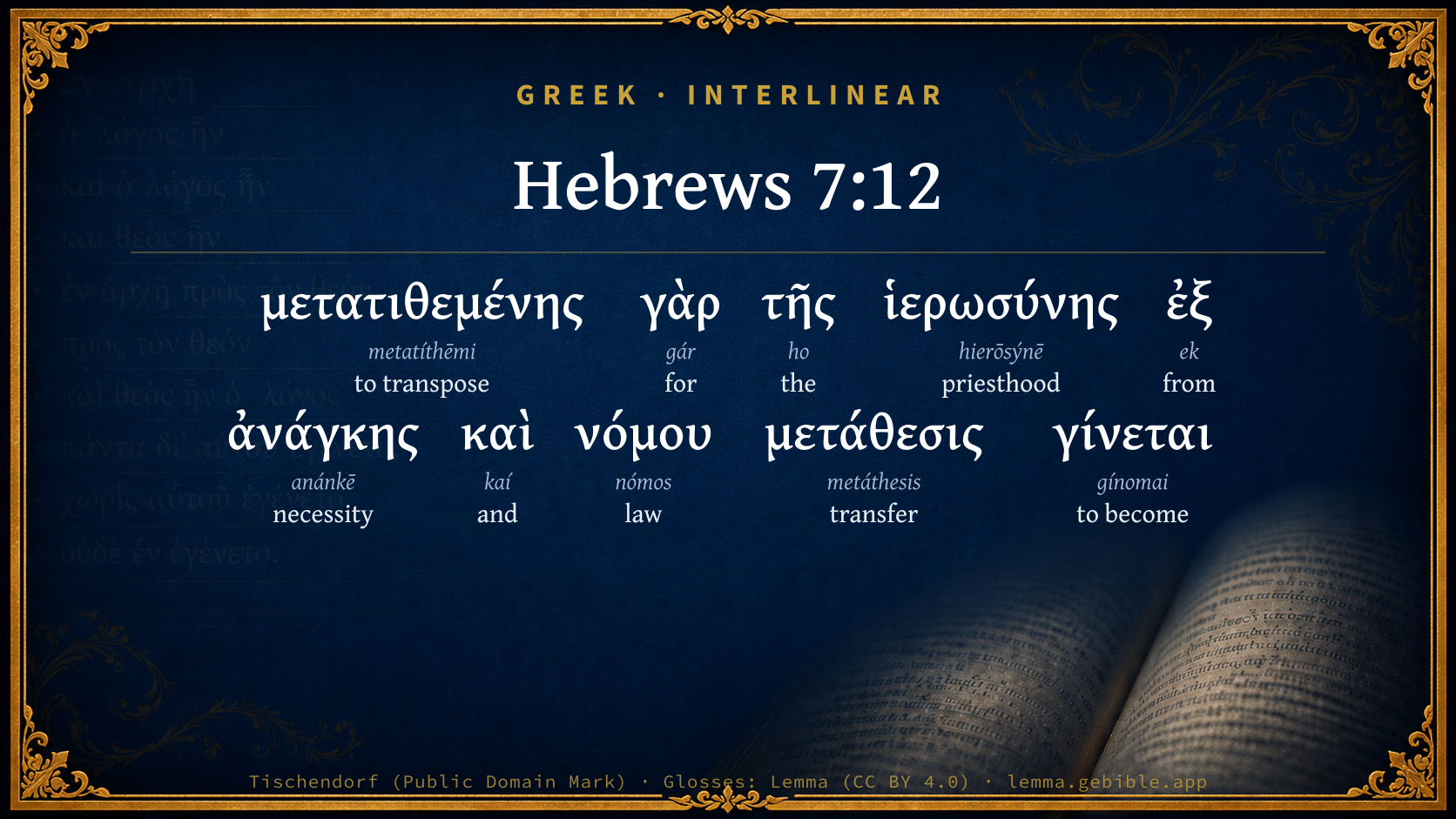
Greek (Tischendorf 8th ed.) Hebrews 7:12 appears in the Greek New Testament. The text above is from the Tischendorf 8th edition. Each word links to its Strong’s number and a concise gloss. Click any word for its full Thayer’s Greek Lexicon entry.
Download image
Cite this verse

Hebrews 7:12 (World English Bible). Public Domain. Lemma interlinear Bible study tool, https://lemma.gebible.app/v/hebrews/7/12.

Show BibTeX & RIS
BibTeX
RIS
English Translation
For the priesthood being changed, there is of necessity a change made also in the law.
World English Bible · Public Domain
Highlights
  • 1 first appearance in the Greek New Testament
Full analysis ↓
Download a study sheet

One document with this verse’s original text, its word-by-word gloss line, the meaning frame, cross-references with their text, attributed commentary, and full source and license credits — printable, and it pastes into notes with its structure intact.

This verse Autodidact and up

Study sheet (.html) Plain text (.txt)

A passage Seminary Student

Up to 50 verses in one chapter. A passage sheet keeps up to 6 commentary sources and 12 cross-references per verse, in the order this page ranks them, and says so on the sheet whenever that leaves anything out. Ask for a single verse and you get the Autodidact verse sheet above.

Everything on this page stays free to read, with no account — the sheet is a download of what is already on screen, not access to it.

Want to remove ads? Support Godless Engineer
Compare translations 3

The same verse in 3 English versions, stacked beneath the original-language interlinear above. Click any original word for its lexicon entry.

Each is an independent rendering of the whole verse — the interlinear is not word-aligned to these translations.

Highlighted words mark where these versions differ — a whole-verse word diff, not a word-by-word alignment.

  • World English Bible Public Domain
    For the priesthood being changed, there is of necessity a change made also in the law.
  • King James Version Public Domain
    For the priesthood being changed, there is made of necessity a change also of the law.
  • unfoldingWord Literal Text CC BY-SA 4.0
    For the priesthood is changed, from necessity a change of the law also takes place.

unfoldingWord Literal Text — © unfoldingWord, licensed CC BY-SA 4.0. Word-aligned USFM3 via Door43 (git.door43.org/unfoldingWord/en_ult).

Versions to compare (up to 4)

3 of 4 selected

Show all 19 translations

Every available English version of this verse, each an independent rendering of the whole verse.

  • World English Bible Public Domain
    For the priesthood being changed, there is of necessity a change made also in the law.
  • Berean Standard Bible Public Domain
    For when the priesthood is changed, the law must be changed as well.
  • Majority Standard Bible Public Domain
    For when the priesthood is changed, the law must be changed as well.
  • King James Version Public Domain
    For the priesthood being changed, there is made of necessity a change also of the law.
  • American Standard Version (1901) Public Domain
    For the priesthood being changed, there is made of necessity a change also of the law.
  • Revised Version (1885) Public Domain
    For the priesthood being changed, there is made of necessity a change also of the law.
  • Geneva Bible (1599) Public Domain
    For if the Priesthood be changed, then of necessitie must there be a change of the Lawe.
  • Douay-Rheims (1899) Public Domain
    For the priesthood being translated, it is necessary that a translation also be made of the law.
  • Young's Literal Translation Public Domain
    for the priesthood being changed, of necessity also, of the law a change doth come,
  • Literal Standard Version CC BY-SA 4.0
    For the priesthood being changed, of necessity also, a change comes of the Law,
  • Unlocked Literal Bible CC BY-SA 4.0
    For when the priesthood is changed, the law must also be changed.
  • unfoldingWord Literal Text CC BY-SA 4.0
    For the priesthood is changed, from necessity a change of the law also takes place.
  • Darby Bible Public Domain
    For, the priesthood being changed, there takes place of necessity a change of law also.
  • World Messianic Bible Public Domain
    For the priesthood being changed, there is of necessity a change made also in the law.
  • Webster's Bible Public Domain
    For the priesthood being changed, there is made of necessity a change also of the law.
  • Free Bible Version CC BY-SA 4.0
    If the priesthood is changed, then the law needs to be changed too.
  • Bible in Basic English Public Domain
    Because if the priests are changed, it is necessary to make a change in the law.
  • Text-Critical English NT CC BY 4.0
    For when the priesthood is changed, the law must also be changed.
  • Tyndale New Testament (1534) Public Domain
    Now no dout yf the presthod be translated then of necessitie must the lawe be translated also.

Literal Standard Version (2020), Covenant Press — licensed CC BY-SA 4.0. Text via the HelloAO Bible API (eBible.org). Unlocked Literal Bible (unfoldingWord) — licensed CC BY-SA 4.0. Text via the HelloAO Bible API (eBible.org). unfoldingWord Literal Text — © unfoldingWord, licensed CC BY-SA 4.0. Word-aligned USFM3 via Door43 (git.door43.org/unfoldingWord/en_ult). Free Bible Version, Dr. Jonathan Gallagher — licensed CC BY-SA 4.0. Text via the HelloAO Bible API (eBible.org).

Word by word

More ways to search: Search by grammar → Find every occurrence → Compare this word →

Practice this passage: Drill this verse → Learn its vocabulary →

About this verse

These counts appear in no published source. They are computed here, from the morphology-tagged text and Lemma’s own curated glosses. What Lemma adds →

10
words
10
distinct lemmas
General Epistles
section

Notable vocabulary

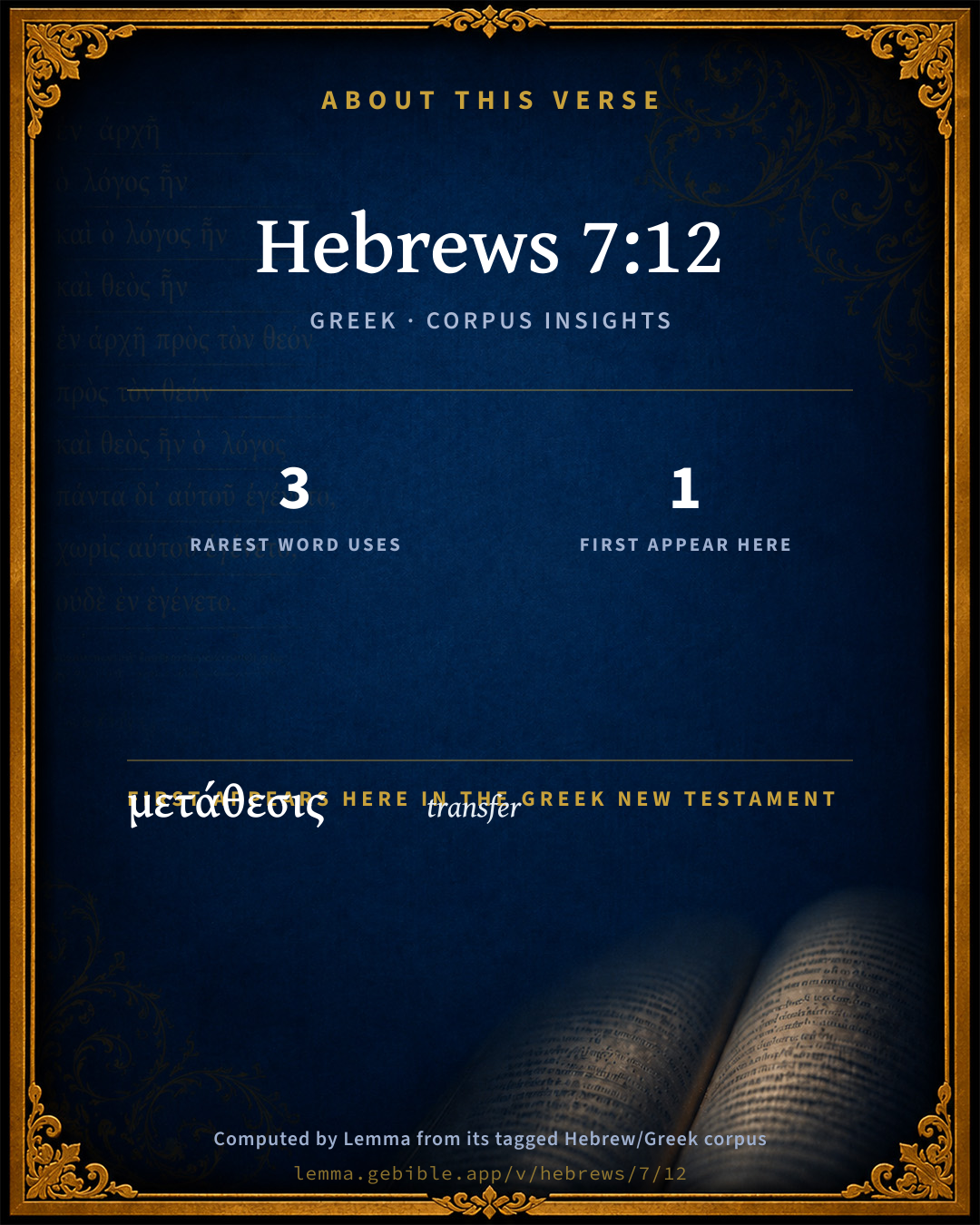
The rarest word here is ἱερωσύνης priesthood G2420 — appearing just 3 times in the whole Greek New Testament.

First appearance in Scripture

This word makes its first canonical appearance in the Greek New Testament here:

  • μετάθεσις transfer G3331

Shared distinctive vocabulary

ἱερωσύνης priesthood G2420 occurs in 3 verses of the Greek New Testament. Also found in:
Cross-references

4

Topical passages linked to Hebrews 7:12 in the Treasury of Scripture Knowledge — connected by theme and wording, ordered by reader-vote popularity; previews shown in the World English Bible.

  • Jeremiah 31:31–34 Behold, the days come, says Yahweh, that I will make a new covenant with the house of Israel, and with the house of Judah:
  • Isaiah 66:21 Of them also will I take for priests [and] for Levites, says Yahweh.
  • Ezekiel 16:61 Then shall you remember your ways, and be ashamed, when you shall receive your sisters, your elder [sisters] and your younger; and I will give them to you for daughters, but not by your covenant.
  • Acts 6:13–14 and set up false witnesses who said, "This man never stops speaking blasphemous words against this holy place and the law.

Cross-references courtesy of OpenBible.info (CC BY 4.0).

Commentary

Notes on Hebrews 7:12 from classic Christian and Jewish commentators (each source and its license shown beneath its notes). The classic Christian expositions comment on the surrounding passage and are grouped to its opening verse, so a note may address several verses; the Jewish commentaries on the Tanakh (Rashi and others) are per-verse, so they appear only where the commentator wrote on this verse.

Lemma curates 59 commentaries, every one of them public domain or Creative Commons licensed, each selected and text-cleaned for this edition rather than reprinted as found. About our sources →

Joseph Benson's Commentary

Heb 7:12-14. For, or, wherefore, the priesthood — On account of which the law was given; being changed, of necessity there must be a change also of the law — As if he had said, Since there is such a near relation between the priesthood and the law, and since the whole administration of the law, as the rule of worship, depended absolutely on the Aaronical priesthood, therefore the one being changed, the other must be changed also. “Under the law the offices of the priesthood consisted in offering the sacrifices of beasts, and in performing various rites for purifying the bodies of the worshippers from ceremonial defilement, that they might be fit to join the congregation in the public worship of God. But when the priesthood was changed by raising up from another tribe a priest after the order of Melchisedec, whose services had for their object to purify the conscience of the worshippers, not by the sacrifice of beasts, but by the sacrifice of himself,” and to sanctify their souls by the influences of the Holy Spirit; “the whole law concerning the sacrifices of beasts, and the sanctifying of the flesh of the Israelites by washing, was of necessity entirely abolished.” For he of whom — Or, to whom; these things are spoken — That is, he to whom it was said, Thou art a priest for ever, &c., was of a different tribe, namely, that of Judah; of which no man gave attendance at the altar — Or, was suffered by the law to minister there, so that the priesthood is manifestly changed from one order to another, and from one tribe to another. For it is evident that our Lord sprang out of Judah — “That the Messiah was to spring up from Judah is plain from the prophecies concerning his descent: and it is likewise plain that this part of his character was verified in our Lord, whose genealogy Matthew and Luke have traced up to King David from the public tables. For that such tables of their descent were kept by the Jews Josephus testifies, (section 1. of his Life, at the end,) saying, ‘I give you these successions of our family as I find them written in the public tables.’ By these tables Paul knew himself to be of the tribe of Benjamin.”

Joseph Benson's Commentary on the Old and New Testaments (1811–1818) — public domain. Text from a community e-Sword module.

Tyndale Open Study Notes

Tyndale Open Resources

7:12 According to the law given to Moses, the appointed priests were descendants of Aaron (Exod 28:41-43; 29:9). The priesthood is changed because Jesus is now the High Priest. Thus, God himself had changed the law concerning priests.

Tyndale Open Study Notes — © Tyndale Open Resources, licensed CC BY-SA 4.0. Text via the HelloAO Bible API.

Bengel's Gnomon

Johann Albrecht Bengel

Heb 7:12. Μετατιθεμένης, being transferred or changed) from order to order, from tribe to tribe.—γὰρ, for) He shows why, in Heb 7:11, he presses the words of the psalm concerning the order of Melchisedec, because it follows from this, that the law was also changed along with the priesthood, and that both are brought to Christ.—νόμου, of the law) Heb 7:5; Heb 7:16; Heb 7:19; Heb 7:28; ch. Heb 8:4. Τάξις, order (not νόμος), is the expression used of Christ.

Bengel's Gnomon of the New Testament — English translation (T&T Clark, Edinburgh, 1860) — public domain. Text from a community e-Sword module.

Meyer's Critical & Exegetical Commentary

Heinrich August Wilhelm Meyer

Heb_7:12. In the parenthesis, Heb_7:11, the author has brought forward in general the close connectedness of the Levitical priesthood with the Mosaic law, and thereby already indicated that if the former is an imperfect and unsatisfying one, the same also is true of the latter; the perishing of the one involves also the perishing of the other. This truth the author now further specially urges, by means of a corroboration of the parenthetical remark, Heb_7:11. So in recent times also Alford and Woerner. Otherwise is the connection apprehended by Bleek, de Wette, Bisping, Delitzsch, Riehm (Lehrbegr. des Hebräerbr. p. 484), Maier, and Moll. They refer γάρ to the main thought in Heb_7:11, and find in Heb_7:12 an indication of the reason why a change of the sacerdotal order would not have ensued without an urgent cause, namely, because such change would have involved also a change of the law in general. But subject-matter and form of expression in Heb_7:12 point back to the parenthesis, Heb_7:11. For in both the author is speaking of the inseparable conjunction of the Levitical priesthood with the Mosaic law; and ἐπʼ αὐτῆς, Heb_7:11, is resumed by τῆς ἱερωσύνης, Heb_7:12; νενομοθέτηται, Heb_7:11, by νόμου, Heb_7:12.

μετατιθεμένης] denotes, like the μετάθεσις immediately following, certainly as to its verbal signification, only a transformation or change, (not specially, as Chrysostom, Piscator, Grotius, Bengel, Heinrichs, Stuart, and others suppose, a transference of the priesthood to another tribe of the Jewish people, or to a non-Aaronides). As regards the thing intended, however,as is manifest from the parallel ἀθέτησις, Heb_7:18,an actual rendering obsolete or abrogation is spoken of. The author thus still expresses himself with delicacy of feeling.

That, further, νόμος is to be limited, neither, with Beza, Pareus, Piscator, Grotius, Wittich, Chr. Fr. Schmid, Zachariae, Whitby, Schulz, to the law of the priesthood, nor, with Calvin, Cornelius a Lapide, Jac. Cappellus, Carpzov, Kuinoel, Klee, and others, to the ceremonial law, but is to be interpreted of the Mosaic law in general, is self-evident.

Meyer — Critical and Exegetical Commentary on the New Testament — English translation by Peter Christie, edited by Frederick Crombie (T&T Clark, 1880) — public domain. Text from a community e-Sword module.

Expositor's Greek Testament

ed. W. Robertson Nicoll

Heb 7:12 . μετατιθεμένης γὰρ .… “For if the priesthood is changed, there is of necessity a change also of the law”. Or, This change of priesthood being made, as it is now being made, a change of the law is also being made. The connection is: What need was there for a new priesthood? It must have been a crying need, for to change the priesthood is to change all. It means nothing short of revolution. Chrysostom rightly τοῦτο δὲ πρὸς τοὺς λέγοντας , τί ἔδει καινῆς διαθήκης ;

The Expositor's Greek Testament, edited by W. Robertson Nicoll (1897–1910) — public domain. Text from a community e-Sword module.

Geneva Bible (1599)

Geneva Bible translators

He showeth how that by the institution of the new Priesthood, not only the imperfection of the Priesthood of Levi was declared, but also that it was changed for this: for these two cannot stand together, because that first appointment of the tribe of Levi, did shut forth the tribe of Judah, and made it also inferior to Levi: and this latter doth place the Priesthood in the tribe of Judah.

Of the institution of Aaron.

Geneva Bible (1599) marginal notes — public domain. Text via Bolls.life.

Jamieson, Fausset & Brown

Robert Jamieson, A. R. Fausset & David Brown

For--the reason why Paul presses the words "after the order of Melchisedec" in Psa 110:4, namely, because these presuppose a change or transference of the priesthood, and this carries with it a change also of the law (which is inseparably bound up with the priesthood, both stand and fall together, Heb 7:11). This is his answer to those who might object, What need was there of a new covenant?

Jamieson, Fausset & Brown — Commentary Critical and Explanatory on the Whole Bible (1871) — public domain (CC PDM 1.0). Text via the HelloAO Bible API.

Adam Clarke's Commentary

Verse 12. The priesthood being changed] That is, The order of Aaron being now abrogated, to make way for that which had preceded it, the order of Melchisedec.

There is made of necessity a change also of the law.] The very essence of the Levitical law consisting in its sacrificial offerings; and as these could not confer perfection, could not reconcile God to man, purify the unholy heart, nor open the kingdom of heaven to the souls of men, consequently it must be abolished, according to the order of God himself; for he said, Sacrifice and offering, and burnt-offering, and sacrifice for sin, he would not; see Ps 40:6; Ps 40:7, compared with Heb 10:5-10, and with Ps 110:4, where it is evident God designed to change both the law and the priesthood, and to introduce Jesus as the only Priest and Sacrifice, and to substitute the Gospel system for that of the Levitical institutions. The priesthood, therefore, being changed, Jesus coming in the place of Aaron, the law of ordinances and ceremonies, which served only to point out the Messiah, must of necessity be changed also.

Adam Clarke's Commentary on the Bible (1810–1826) — public domain. Text from a community e-Sword/MySword module.

John Calvin's Commentaries

12. For the priesthood being changed, or, transferred, etc. As the authority of the Law and the priesthood is the same, Christ became not only a priest, but also a Lawgiver; so that the right of Aaron, as well as of Moses, was transferred to him. The sum of the whole is, that the ministry of Moses was no less temporary than that of Aaron; and hence both were annulled by the coming of Christ, for the one could not stand without the other. By the word Law, we understand what peculiarly belonged to Moses; for the Law contains the rule of life, and the gratuitous covenant of life; and in it we find everywhere many remarkable sentences by which we are instructed as to faith, and as to the fear of God. None of these were abolished by Christ, but only that part which regarded the ancient priesthood.

For Christ is here compared with Moses; whatever then they had in common, is not to be taken to the account, but only the things in which they differ. They in common offer God’s mercy to us, prescribe the rule of a holy and godly life, teach us the true worship of God, and exhort us to exercise faith and patience, and all the duties of godliness. But Moses was different from Christ in this respect, that while the love of the Gospel was not as yet made known, he kept the people under veils, set forth the knowledge of Christ by types and shadows, and, in short, accommodated himself to the capacity of ignorant people, and did not rise higher than to puerile elements. We must then remember, that the Law is that part of the ministration which Moses had as peculiarly his own, and different from that of Christ. That law, as it was subordinate to the ancient priesthood, was abolished when the priesthood was abolished. And Christ, being made a priest, was invested also with the authority of a legislator, that he might be the teacher and interpreter of the new covenant. At the same time, the word Law is applied, though not in its strict sense, to the Gospel; but this impropriety of language is so far from having anything harsh in it, that on account of the contrast it adds beauty to the sentence, as we find in the seventh chapter of the Epistle to the Romans

Moreover, the impiety of the Pope is extremely arrogant, who has inserted this article in his decretals, that he himself is now invested with the same authority as Aaron formerly had, because the Law and also the priesthood have been transferred to him. We see what the Apostle says; he maintains that ceremonies have ceased since the time when Christ came forth with command to proclaim the new covenant. It is then absurd hence to conclude, that anything has been transferred to the ministers of Christ; for Christ himself is alone contrasted here with Moses and Aaron. Under what pretext then can Antichrist arrogate to himself any such authority? I do not indeed speak now for the sake of disproving so gross an arrogance; but it is worth while to remind readers of this sacrilegious audacity, that they may know that this notorious servant of the servants of Christ wholly disregards the honor of his Master, and boldly mangles the Scriptures, that he may have some cloak for his own tyranny.

John Calvin's Commentaries (1540-1563) — public domain. Text from the Calvin Translation Society English edition (1840s-50s) via the Christian Classics Ethereal Library (ccel.org). Calvin's coverage is partial (roughly two-thirds of the Bible); uncommented books and verses are honest gaps, never fabricated. The 19th-century editor's footnotes and remarks are omitted so the notes are faithfully Calvin's own voice.

Ellicott's Commentary for English Readers

(12) This verse connects itself with the parenthesis in Heb_7:11. “For if the priesthood is changed there takes place also of necessity a change of law.” It is no light matter to speak of the order of Aaron as set aside: this carries with it a change of law.

A Bible Commentary for English Readers, edited by Charles John Ellicott (1878–1897) — public domain. Text from a community e-Sword module.

The Cambridge Bible for Schools and Colleges

gen. ed. J. J. S. Perowne

12. being changed] He here uses the comparatively mild and delicate term “being transferred” When he has prepared the mind of his readers by a little further argument, he substitutes for “transference” the much stronger word “annulment” (Heb_7:18). It is a characteristic of the writer to be thus careful not to shock the prejudices of his readers more than was inevitable. His whole style of argument, though no less effective than that of St Paul in its own sphere, is more conciliatory, more deferential, less vehemently iconoclastic. This relation to St Paul is like that of Melanchthon to Luther.

of necessity] The Law and the Priesthood were so inextricably united that the Priesthood could not be altered without disintegrating the whole complex structure of the Law.

The Cambridge Bible for Schools and Colleges (gen. ed. J. J. S. Perowne; Cambridge University Press, 1878–1918) — public domain. Text from a community e-Sword module.

John Gill's Exposition

For he of whom these things are spoken,.... In Psa 110:4 and in the type of him Melchizedek, in the preceding verses; for not Melchizedek is here meant, but the Lord Jesus Christ, as appears by what follows; the antitype of Melchizedek, the Lord our righteousness, the Prince of peace, the priest of God, that lives for ever, without father, without mother, &c.

pertaineth to another tribe; the tribe of Judah, and not the tribe of Levi:

of which no man gave attendance at the altar; either of burnt offering or of incense; that is, no man waited there, or took upon him and exercised the priest's office that was of the tribe of Judah: no man might lawfully do it; Uzziah, indeed, thrust himself into the priest's office, who was of that tribe, and went into the temple and burnt incense upon the altar of incense; but then he had no right to do it, and was punished for it.

John Gill's Exposition of the Whole Bible (1746–1763) — public domain (CC PDM 1.0). Text via the HelloAO Bible API.

Trapp's Complete Commentary

John Trapp

12 For the priesthood being changed, there is made of necessity a change also of the law.

Ver. 12. A change also of the law] "For we are not under the taw, but under grace." The gospel is post naufragium tabula, a plank after shipwreck, and hath its remuneration, Heb 11:6, viz. of grace and mercy. By law here some understood only the law of priesthood.

John Trapp, A Commentary or Exposition upon All the Books of the Old and New Testament (1647–1656) — public domain. Text from a community e-Sword module.

Albert Barnes' Notes on the Bible

For the priesthood being changed - According to the prediction in Ps. cx., that it would be. When that occurs, the consequence specified will also follow.

There is made of necessity a change also of the law - The Law so far as it grew out of that, or was dependent on it. The connection requires us to understand it only of the Law “so far as it was connected with the Levitical priesthood.” This could not apply to the ten commandments - for they were given before the institution of the priesthood; nor could it apply to any other part of the moral law, for that was not dependent on the appointment of the Levitical priests. But the meaning is, that since a large number of laws - constituting a code of considerable extent and importance - was given for the regulation of the priesthood, and in reference to the rites of religion, which they were to observe or superintend, it followed that when their office was superseded by “one of a wholly different order,” the Law which had regulated them vanished also, or ceased to be binding. This was a very important point in the introduction of Christianity, and hence, it is that it is so often insisted on in the writings of Paul. The argument to show that there had been a change or transfer of the priestly office, he proceeds to establish in the sequel.

Albert Barnes' Notes on the Bible (1834–1885) — public domain. Text from a community e-Sword/MySword module.

Haydock's Catholic Bible Commentary

After giving a decided preference to Melchisedech, and his priesthood, over the Levitical priesthood, St. Paul proves the abrogation of the latter, and even of the law, by the introduction of a new priesthood, according to the order of Melchisedech.

George Leo Haydock (1774–1849), Haydock's Catholic Family Bible and Commentary, 1859 edition — public domain. Excludes Psalms (Douay-Rheims chapter numbering differs from Protestant) and Deuterocanonical books (Catholic canon only).

Matthew Poole's English Annotations

For the priesthood being changed: for refers to the expiration of the Aaronical order, to which these Hebrews now were not bound, for that a better priesthood and law were to fill up their room in the church. The Levitical priesthood was changed and abolished to make way for this; God designing that to continue for a time, and then to expire, when the truth perfecting it should take place.

There is made of necessity a change also of the law; the mutation of the priesthood indispensably requireth the change of the law, i.e. the legal dispensation of the covenant of grace, and the bringing in with another priesthood a better hope, Gal 3:17-27; compare Heb 7:18,19 of this chapter; even the covenant of grace in the gospel dispensation of it. This was made necessary by the decree of God, who determined, that both priesthood and law should expire together, and accordingly hath fulfilled it. For when Christ, the gospel High Priest, had in his person and work perfected all of it in heaven, he roots out that order of priesthood, abolisheth the law, scatters the people which would cleave to it; demolisheth the temple and city to which he confined the administration, so as all designs and endeavours of Jews, or of apostate Christhins, to repair, or to restore it, have been ineffectual to this day.

Matthew Poole's English Annotations on the Holy Bible (1683–1685) — public domain. Text from a community e-Sword/MySword module.

Whedon's Commentary on the Bible

Daniel D. Whedon

12. A change of the priesthood so predicted necessitated a change also of the law of succession, limiting it no longer to the tribe of Levi.

Daniel D. Whedon (gen. ed.), Commentary on the Old and New Testaments (1874–1909) — public domain. Text from a community e-Sword module.

John Wesley's Explanatory Notes

For - One of these cannot be changed without the other.

John Wesley, Explanatory Notes Upon the Whole Bible (1754–1765) — public domain. Text via the GEBible commentary corpus.

The People's New Testament

B. W. Johnson

12. For the priesthood being changed. The law as given “under the Levitical priesthood” (verse 11), and was all grouped around the priesthood as its very center. Of course, if the priesthood was changed the law of the old priesthood, the law of Moses, must go with it, and give place to a new law.

B. W. Johnson's The People's New Testament with Notes (1889–1891) — public domain. Electronic text from the Christian Classics Ethereal Library (CCEL) ThML edition.

Cambridge Greek Testament for Schools and Colleges

12. μετατιθεμένης. He here uses the comparatively mild and delicate term “being transferred.” When he has prepared the mind of his readers by a little further argument, he substitutes for μετάθεσις the much stronger word “annulment” (ἀθέτησις, Heb 7:18). It is a characteristic of the writer to be thus careful not to shock the prejudices of his readers more than was inevitable. His whole style of argument, though no less effective than that of St Paul in its own sphere, is more conciliatory, more deferential, less vehemently iconoclastic. His relation to St Paul is like that of Melanchthon to Luther.

ἐξ ἀνάγκης. The Law and the Priesthood were so inextricably united that the Priesthood could not be altered without disintegrating the whole complex structure of the Law.

Cambridge Greek Testament for Schools and Colleges (Cambridge University Press, 1896; 21 vols, various authors incl. Carr, Maclear, Plummer, Farrar, Lumby, Moule, M. R. James, Simcox) — public domain. Text from a community e-Sword module.

Alford’s Greek Testament

Henry Alford

12.] For if the priesthood is changed (better thus than E. V., “the priesthood being changed,” which gives the reader the idea of μετατιθείσης), there takes place of necessity a change of the law (not ‘of law,’ which would be decidedly wrong, and would require τοῦ νόμου, as in a general sentence, implying ‘the law’ of the particular case in view; νόμου, anarthrous, means that law, which had already begun to be used as a proper name, the well-known law of Moses) also (viz. of that law, which, as above, is legislated upon the ground of that priesthood: not, as Beza, Grot., al., of the law of the priesthood only, nor as Calvin, a-Lapide, Jac. Cappell., Böhme, Kuinoel, al., of the ceremonial law only. Chrys. says rightly: εἰ δὲ ἕτερον δεῖ ἱερέα εἶναι, μᾶλλον δὲ ἑτέραν ἱερωσύνην, ἀνάγκη καὶ νόμον ἕτερον εἶναι· τοῦτο δὲ πρὸς τοὺς λέγοντας· τί ἔδει καινῆς διαθήκης; The connexion is with the parenthesis in ver. 11, which was inserted to prepare the way for our verse. Bleek, De Wette, al. deny the reference to the parenthetical clause in ver. 11, and regard our verse as preparing the way for what follows: “It lays down the ground, why not without urgent cause a change of the priesthood took place” (De W.), that cause being that the law itself was to be abrogated. The Writer as yet expresses himself mildly and cautiously: the μετάθεσις here in fact amounts to the ἀθέτησις in ver. 18, but is not yet so expressed).

Henry Alford, The Greek Testament (1849–1861) — public domain. Text from a community e-Sword module.

Vincent's Word Studies in the New Testament

Marvin R. Vincent

Being changed [μετατιθεμενης] . Or transferred to another order. See on Gal 1:6.

A change [μεταθεσις] . A transfer to a new basis. Only in Hebrews. See ch. Heb 11:5; Heb 12:27. The inferiority of the Levitical priesthood is inferred from the fact that another priesthood was promised. If perfection was possible at all under the Mosaic economy, it must come through the Levitical priesthood, since that priesthood was, in a sense, the basis of the law. The whole legal system centered in it. The fundamental idea of the law was that of a people united with God. Sin, the obstacle to this ideal union, was dealt with through the priesthood. If the law failed to effect complete fellowship with God, the priesthood was shown to be a failure, and must be abolished; and the change of the priesthood involved the abolition of the entire legal system.

Marvin R. Vincent, Word Studies in the New Testament (1887–1900) — public domain. Text from a community e-Sword/MySword module.

Westcott on Hebrews & the Epistles of John

Brooke Foss Westcott

12. μετατιθ. ydp.. «γίνεται) For when the priesthood ts changed...Tho yap may refer to the main thought of 5.11 or to the parenthesis (ὁ λαὸς γάρ... The former connexion appears to be the more natural. The change of priesthood involves the change of Law. Such a change must have been called for by an overwhelming necessit

The change of the priesthood is presented as the transference, the removal, of the priesthood from one order, one line, to another: translatum esteacerdotium detribu in tribum, de sacerdotali videlicot ad regalem

4 ⸗ , καὶ νόμον μετάθεσις γίνεται.

pres. partic, (μετατιθεμένης) makes the two processes absolutely coincident (this thought is lost in the Vulg. translato enim).

Brooke Foss Westcott (1825–1901), The Epistle to the Hebrews (1889) and The Epistles of St John (1883) — public domain (pre-1929). Text recovered from Internet Archive / Google Books OCR scans. Westcott’s Gospel of John commentary is not included (its OCR lost the chapter running-heads required for reliable verse-keying). Some Greek quoted in the Hebrews volume is imperfectly rendered by the OCR.

Lesson kit

Teaching starters — assembled from the data on this page, not authored interpretation. Every prompt links to the verse data it draws on. Edit before teaching.

Hebrews, in the General Epistles, opens this verse with 10 words (10 distinct Greek lemmas). Its most distinctive word is hierōsýnē (“priesthood”). A historical commentator’s framing appears above. Read the whole chapter for the surrounding context.

Discussion questions

  1. The word hierōsýnē carries the sense “priesthood.” How does it shape the verse?
  2. The word “transfer” first appears here in Scripture. What is being introduced at this debut?
  3. Hebrews 7:11 shares the word «priesthood» with this verse. How do the two illuminate each other?
  4. These translations render this verse differently. What is at stake in choosing one wording over another?
  5. Reading how Joseph Benson's Commentary and Tyndale Open Study Notes read this verse, where do the two commentators agree and where do they part?

Things to notice

  • 1 word makes its first canonical appearance in Scripture here.
  • These translations choose different wording for 5 words in this verse.
  • 10 distinct Greek lemmas span 10 words in this verse.

Reading settings

Reading text

Shown beneath each verse's original-language words.

Old Testament
Old Testament edition

Read the OT as the Masoretic Hebrew (MT) or the Greek Septuagint (LXX).

English shown for the Greek Septuagint (in the Hebrew ↔ Greek comparison).

Comparing translations? Open the Compare panel on any verse page to stack up to four side by side.