
Hebrews 10:29

Greek (Tischendorf 8th ed.) Hebrews 10:29 appears in the Greek New Testament. The text above is from the Tischendorf 8th edition. Each word links to its Strong’s number and a concise gloss. Click any word for its full Thayer’s Greek Lexicon entry.
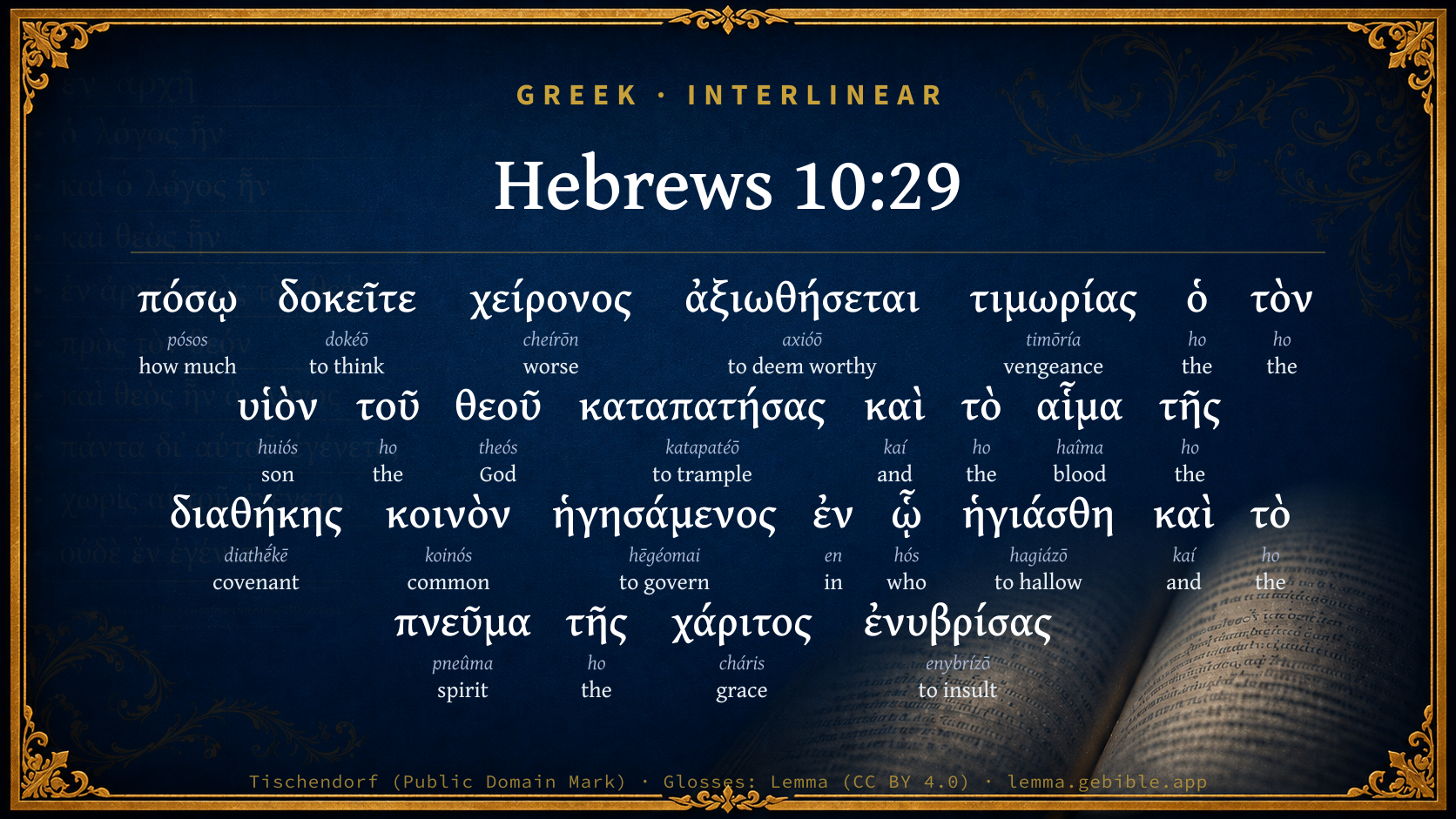
Download image
Cite this verse

Hebrews 10:29 (World English Bible). Public Domain. Lemma interlinear Bible study tool, https://lemma.gebible.app/v/hebrews/10/29.

Show BibTeX & RIS
BibTeX
RIS
English Translation
How much worse punishment, do you think, will he be judged worthy of, who has trodden under foot the Son of God, and has counted the blood of the covenant with which he was sanctified an unholy thing, and has insulted the Spirit of grace?
World English Bible · Public Domain
Highlights
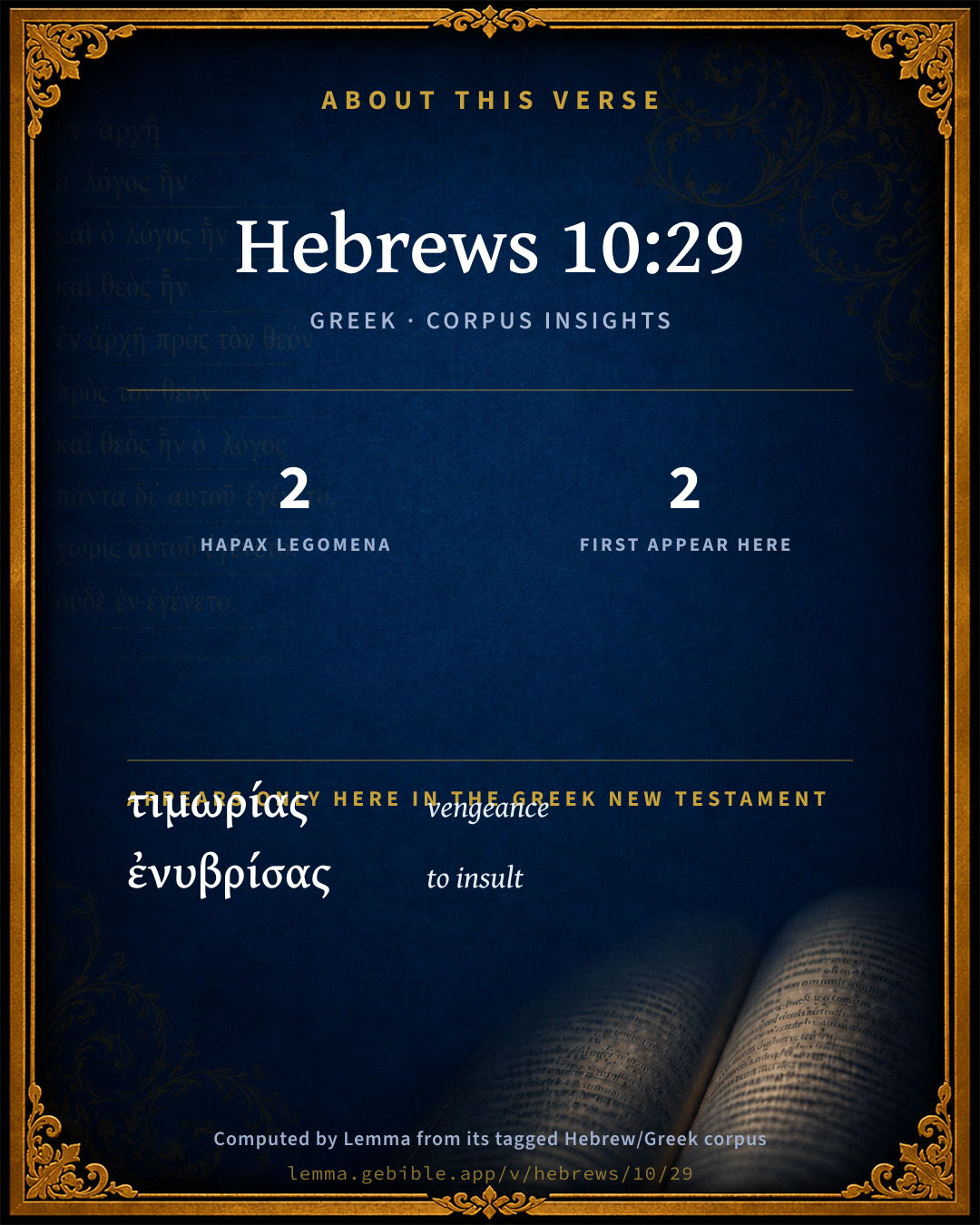
  • 2 hapax legomena — only here in the Greek New Testament
  • 2 first appearances in the Greek New Testament
Full analysis ↓
Download a study sheet

One document with this verse’s original text, its word-by-word gloss line, the meaning frame, cross-references with their text, attributed commentary, and full source and license credits — printable, and it pastes into notes with its structure intact.

This verse Autodidact and up

Study sheet (.html) Plain text (.txt)

A passage Seminary Student

Up to 50 verses in one chapter. A passage sheet keeps up to 6 commentary sources and 12 cross-references per verse, in the order this page ranks them, and says so on the sheet whenever that leaves anything out. Ask for a single verse and you get the Autodidact verse sheet above.

Everything on this page stays free to read, with no account — the sheet is a download of what is already on screen, not access to it.

Want to remove ads? Support Godless Engineer
Compare translations 3

The same verse in 3 English versions, stacked beneath the original-language interlinear above. Click any original word for its lexicon entry.

Each is an independent rendering of the whole verse — the interlinear is not word-aligned to these translations.

Highlighted words mark where these versions differ — a whole-verse word diff, not a word-by-word alignment.

  • World English Bible Public Domain
    How much worse punishment, do you think, will he be judged worthy of, who has trodden under foot the Son of God, and has counted the blood of the covenant with which he was sanctified an unholy thing, and has insulted the Spirit of grace?
  • King James Version Public Domain
    Of how much sorer punishment, suppose ye, shall he be thought worthy, who hath trodden under foot the Son of God, and hath counted the blood of the covenant, wherewith he was sanctified, an unholy thing, and hath done despite unto the Spirit of grace?
  • unfoldingWord Literal Text CC BY-SA 4.0
    How much worse punishment do you think will deserve the one having trampled underfoot the Son of God and having considered the blood of the covenant—by which he was sanctified— profane and having insulted the Spirit of grace!

unfoldingWord Literal Text — © unfoldingWord, licensed CC BY-SA 4.0. Word-aligned USFM3 via Door43 (git.door43.org/unfoldingWord/en_ult).

Versions to compare (up to 4)

3 of 4 selected

Show all 19 translations

Every available English version of this verse, each an independent rendering of the whole verse.

  • World English Bible Public Domain
    How much worse punishment, do you think, will he be judged worthy of, who has trodden under foot the Son of God, and has counted the blood of the covenant with which he was sanctified an unholy thing, and has insulted the Spirit of grace?
  • Berean Standard Bible Public Domain
    How much more severely do you think one deserves to be punished who has trampled on the Son of God, profaned the blood of the covenant that sanctified him, and insulted the Spirit of grace?
  • Majority Standard Bible Public Domain
    How much more severely do you think one deserves to be punished who has trampled on the Son of God, profaned the blood of the covenant that sanctified him, and insulted the Spirit of grace?
  • King James Version Public Domain
    Of how much sorer punishment, suppose ye, shall he be thought worthy, who hath trodden under foot the Son of God, and hath counted the blood of the covenant, wherewith he was sanctified, an unholy thing, and hath done despite unto the Spirit of grace?
  • American Standard Version (1901) Public Domain
    of how much sorer punishment, think ye, shall he be judged worthy, who hath trodden under foot the Son of God, and hath counted the blood of the covenant wherewith he was sanctified an unholy thing, and hath done despite unto the Spirit of grace?
  • Revised Version (1885) Public Domain
    of how much sorer punishment, think ye, shall he be judged worthy, who hath trodden under foot the Son of God, and hath counted the blood of the covenant, wherewith he was sanctified, an unholy thing, and hath done despite unto the Spirit of grace?
  • Geneva Bible (1599) Public Domain
    Of howe much sorer punishment suppose ye shall hee be worthy, which treadeth vnder foote the Sonne of God, and counteth the blood of the Testament as an vnholy thing, wherewith he was sanctified, and doeth despite the Spirit of grace?
  • Douay-Rheims (1899) Public Domain
    How much more, do you think he deserveth worse punishments, who hath trodden under foot the Son of God, and hath esteemed the blood of the testament unclean, by which he was sanctified, and hath offered an affront to the Spirit of grace?
  • Young's Literal Translation Public Domain
    of how much sorer punishment shall he be counted worthy who the Son of God did trample on, and the blood of the covenant did count a common thing, in which he was sanctified, and to the Spirit of the grace did despite?
  • Literal Standard Version CC BY-SA 4.0
    Of how much worse punishment will he be counted worthy who trampled on the Son of God, and counted the blood of the covenant a common thing, by which he was sanctified, and having insulted the Spirit of grace?
  • Unlocked Literal Bible CC BY-SA 4.0
    How much worse punishment do you think one deserves who has trampled underfoot the Son of God, who treated the blood of the covenant as unholy—the blood by which he was sanctified—and insulted the Spirit of grace?
  • unfoldingWord Literal Text CC BY-SA 4.0
    How much worse punishment do you think will deserve the one having trampled underfoot the Son of God and having considered the blood of the covenant—by which he was sanctified— profane and having insulted the Spirit of grace!
  • Darby Bible Public Domain
    of how much worse punishment, think ye, shall he be judged worthy who has trodden under foot the Son of God, and esteemed the blood of the covenant, whereby he has been sanctified, common, and has insulted the Spirit of grace?
  • World Messianic Bible Public Domain
    How much worse punishment do you think he will be judged worthy of who has trodden under foot the Son of God, and has counted the blood of the covenant with which he was sanctified an unholy thing, and has insulted the Spirit of grace?
  • Webster's Bible Public Domain
    Of how much more severe punishment, suppose ye, shall he be thought worthy, who hath trodden under foot the Son of God, and hath counted the blood of the covenant, by which he was sanctified, an unholy thing, and hath done despite to the Spirit of grace?
  • Free Bible Version CC BY-SA 4.0
    How much worse do you think someone will deserve their punishment if they have trampled underfoot the Son of God, if they have disregarded the blood that sealed the agreement and makes us holy, treating it as ordinary and trivial, and have abused the Spirit of grace?
  • Bible in Basic English Public Domain
    But will not the man by whom the Son of God has been crushed under foot, and the blood of the agreement with which he was washed clean has been taken as an unholy thing, and who has had no respect for the Spirit of grace, be judged bad enough for a very much worse punishment?
  • Text-Critical English NT CC BY 4.0
    How much worse punishment do you think will be deserved by someone who has trampled the Son of God underfoot, who has profaned the blood of the covenant by which he was sanctified, and who has insulted the Spirit of grace?
  • Tyndale New Testament (1534) Public Domain
    Of how moche sorer punyshment suppose ye shall he be counted worthy which treadeth vnderfote the sonne of god: and counteth the bloude of the testament as an vnholy thynge wherwith he was sanctified and doth dishonoure to the sprete of grace.

Literal Standard Version (2020), Covenant Press — licensed CC BY-SA 4.0. Text via the HelloAO Bible API (eBible.org). Unlocked Literal Bible (unfoldingWord) — licensed CC BY-SA 4.0. Text via the HelloAO Bible API (eBible.org). unfoldingWord Literal Text — © unfoldingWord, licensed CC BY-SA 4.0. Word-aligned USFM3 via Door43 (git.door43.org/unfoldingWord/en_ult). Free Bible Version, Dr. Jonathan Gallagher — licensed CC BY-SA 4.0. Text via the HelloAO Bible API (eBible.org).

Word by word

More ways to search: Search by grammar → Find every occurrence → Compare this word →

Practice this passage: Drill this verse → Learn its vocabulary →

τιμωρίας
timōría
G5098
“vengeance”
Noun, Genitive, Singular, Feminine
Part of Speech
Noun
Case
Genitive
Number
Singular
Gender
Feminine
Full Thayer's Definition

Origin: from G5097

TDNT: None

1. a rendering help 2. assistance 3. vengeance, punishment, penalty
  1. πόσῳ pósos G4214 “how much” Correlative/interrogative pronoun, Dative, Singular, Neuter
  2. δοκεῖτε dokéō G1380 “to think” Verb, Present, Active, Indicative, 2nd person, Plural
  3. χείρονος cheírōn G5501 “worse” Adjective, Genitive, Singular, Feminine
  4. ἀξιωθήσεται axióō G515 “to deem worthy” Verb, Future, Passive, Indicative, 3rd person, Singular
  5. ὁ ho G3588 “the” Article, Nominative, Singular, Masculine
  6. τὸν ho G3588 “the” Article, Accusative, Singular, Masculine
  7. υἱὸν huiós G5207 “son” Noun, Accusative, Singular, Masculine
  8. τοῦ ho G3588 “the” Article, Genitive, Singular, Masculine
  9. θεοῦ theós G2316 “God” Noun, Genitive, Singular, Masculine
  10. καταπατήσας katapatéō G2662 “to trample” Verb, Aorist, Active, Participle, Nominative, Singular, Masculine
  11. καὶ kaí G2532 “and” Conjunction
  12. τὸ ho G3588 “the” Article, Accusative, Singular, Neuter
  13. αἷμα haîma G129 “blood” Noun, Accusative, Singular, Neuter
  14. τῆς ho G3588 “the” Article, Genitive, Singular, Feminine
  15. διαθήκης diathḗkē G1242 “covenant” Noun, Genitive, Singular, Feminine
  16. κοινὸν koinós G2839 “common” Adjective, Accusative, Singular, Neuter
  17. ἡγησάμενος hēgéomai G2233 “to govern” Verb, Aorist, Middle deponent, Participle, Nominative, Singular, Masculine
  18. ἐν en G1722 “in” Preposition
  19. ᾧ hós G3739 “who” Relative pronoun, Dative, Singular, Neuter
  20. ἡγιάσθη hagiázō G37 “to hallow” Verb, Aorist, Passive, Indicative, 3rd person, Singular
  21. καὶ kaí G2532 “and” Conjunction
  22. τὸ ho G3588 “the” Article, Accusative, Singular, Neuter
  23. πνεῦμα pneûma G4151 “spirit” Noun, Accusative, Singular, Neuter
  24. τῆς ho G3588 “the” Article, Genitive, Singular, Feminine
  25. χάριτος cháris G5485 “grace” Noun, Genitive, Singular, Feminine
  26. ἐνυβρίσας enybrízō G1796 “to insult” Verb, Aorist, Active, Participle, Nominative, Singular, Masculine

About this verse

These counts appear in no published source. They are computed here, from the morphology-tagged text and Lemma’s own curated glosses. What Lemma adds →

27
words
20
distinct lemmas
General Epistles
section

Notable vocabulary

2 hapax legomena — words that appear only here in the entire Greek New Testament:

  • τιμωρίας vengeance G5098
  • ἐνυβρίσας to insult G1796

First appearance in Scripture

These words make their first canonical appearance in the Greek New Testament here:

  • τιμωρίας vengeance G5098
  • ἐνυβρίσας to insult G1796

Shared distinctive vocabulary

καταπατήσας to trample G2662 occurs in 5 verses of the Greek New Testament. Also found in:
Repetition

Words recur within this verse:

Cross-references

27

Topical passages linked to Hebrews 10:29 in the Treasury of Scripture Knowledge — connected by theme and wording, ordered by reader-vote popularity; previews shown in the World English Bible.

  • Ephesians 4:30 Don't grieve the Holy Spirit of God, in whom you were sealed for the day of redemption.
  • Hebrews 6:6 and then fell away, it is impossible to renew them again to repentance; seeing they crucify the Son of God for themselves again, and put him to open shame.
  • Isaiah 63:10 But they rebelled, and grieved his holy Spirit: therefore he was turned to be their enemy, [and] himself fought against them.
  • Luke 12:10 Everyone who speaks a word against the Son of Man will be forgiven, but those who blaspheme against the Holy Spirit will not be forgiven.
  • 1 Corinthians 11:27 Therefore whoever eats this bread or drinks the Lord's cup in a manner unworthy of the Lord will be guilty of the body and the blood of the Lord.
  • Matthew 12:31–32 Therefore I tell you, every sin and blasphemy will be forgiven men, but the blasphemy against the Spirit will not be forgiven men.
  • Acts 7:51 "You stiff-necked and uncircumcised in heart and ears, you always resist the Holy Spirit! As your fathers did, so you do.
  • Hebrews 2:3 how will we escape if we neglect so great a salvation-- which at the first having been spoken through the Lord, was confirmed to us by those who heard;
  • 1 Corinthians 11:29 For he who eats and drinks in an unworthy manner eats and drinks judgment to himself, if he doesn't discern the Lord's body.
  • Hebrews 9:13 For if the blood of goats and bulls, and the ashes of a heifer sprinkling those who have been defiled, sanctify to the cleanness of the flesh:
  • Hebrews 12:25 See that you don't refuse him who speaks. For if they didn't escape when they refused him who warned on the Earth, how much more will we not escape who turn away from him who warns from heaven,
  • Zechariah 12:10 I will pour on the house of David, and on the inhabitants of Jerusalem, the spirit of grace and of supplication; and they will look to me whom they have pierced; and they shall mourn for him, as one mourns for his only son, and will grieve bitterly for him, as one grieves for his firstborn.
  • Matthew 7:6 "Don't give that which is holy to the dogs, neither throw your pearls before the pigs, lest perhaps they trample them under their feet, and turn and tear you to pieces.
  • John 17:19 For their sakes I sanctify myself, that they themselves also may be sanctified in truth.
  • Hebrews 2:11 For both he who sanctifies and those who are sanctified are all from one, for which cause he is not ashamed to call them brothers,
  • Hebrews 6:4 For concerning those who were once enlightened and tasted of the heavenly gift, and were made partakers of the Holy Spirit,
  • 2 Kings 9:33 He said, Throw her down. So they threw her down; and some of her blood was sprinkled on the wall, and on the horses: and he trod her under foot.
  • Isaiah 14:19 But you are cast forth away from your tomb like an abominable branch, clothed with the slain, who are thrust through with the sword, who go down to the stones of the pit; as a dead body trodden under foot.
  • Micah 7:10 Then my enemy will see it, And shame will cover her who said to me, Where is Yahweh your God? Then my enemy will see me and will cover her shame. Now she will be trodden down like the mire of the streets.
  • John 10:36 Do you say of him whom the Father sanctified and sent into the world, 'You blaspheme,' because I said, 'I am the Son of God?'
  • Hebrews 13:20 Now may the God of peace, who brought again from the dead the great shepherd of the sheep with the blood of an eternal covenant, our Lord Jesus,
  • Psalms 143:10 Teach me to do your will, For you are my God. Your Spirit is good. Lead me in the land of uprightness.
  • Lamentations 1:15 The Lord has set at nothing all my mighty men in the midst of me; He has called a solemn assembly against me to crush my young men: The Lord has trodden as in a winepress the virgin daughter of Judah.
  • Matthew 26:28 for this is my blood of the new covenant, which is poured out for many for the remission of sins.
  • Romans 16:20 And the God of peace will quickly crush Satan under your feet. The grace of our Lord Jesus Christ be with you.
  • 1 Corinthians 15:25 For he must reign until he has put all his enemies under his feet.
  • Hebrews 9:20 saying, "This is the blood of the covenant which God has commanded you."

Cross-references courtesy of OpenBible.info (CC BY 4.0).

Commentary

Notes on Hebrews 10:29 from classic Christian and Jewish commentators (each source and its license shown beneath its notes). The classic Christian expositions comment on the surrounding passage and are grouped to its opening verse, so a note may address several verses; the Jewish commentaries on the Tanakh (Rashi and others) are per-verse, so they appear only where the commentator wrote on this verse.

Lemma curates 59 commentaries, every one of them public domain or Creative Commons licensed, each selected and text-cleaned for this edition rather than reprinted as found. About our sources →

Bengel's Gnomon

Johann Albrecht Bengel

Heb 10:29. Χείρονος) which is worse and more horrible than any punishment of the body.—ὁ) i.e. he who most atrociously sins against GOD, whose Son is the Priest, ch. Heb 5:5, and against the Son, whose own blood is the blood of the New Testament, and against the Holy Spirit, who is the Spirit of grace. A man of this sort retracts the whole form and confession of his baptism, and rejects the whole economy of the New Testament; comp. Heb 6:6, note.—καταπατήσας, who has trodden) whereas he ought to adore. But he who sins spontaneously, treads under foot, as it is described at Heb 10:26.—τῆς διαθήκης) of the testament, that is, the better testament or covenant which GOD has made.—κοινὸν, common) as if it were the blood of a mere man, common or even guilty. The antithesis is, he was sanctified.—ἡγησάμενος, and has counted) without discernment; comp. 1Co 11:29.—ἐν ᾧ ἡγιάσθη, by which he was sanctified) Therefore Christ died even for such a man as this. The same word is used concerning the redeemed, Heb 10:10; Heb 10:14, ch. Heb 2:11 (where they are distinguished from the Redeemer, who sanctifies); ch. Heb 13:12, where mention is likewise made of the blood.—τῆς χάριτος, of grace) See note on Heb 10:26.—ἐνυβρίσας, and has treated insultingly, [and hath done despite to]) by repelling Him. Insult or despite is done by deeds; blasphemy is vented by words: comp. 1Ti 1:13, note. Where blasphemy is added, the guilt is in the very worst degree aggravated; Mar 3:29.

Bengel's Gnomon of the New Testament — English translation (T&T Clark, Edinburgh, 1860) — public domain. Text from a community e-Sword module.

Meyer's Critical & Exegetical Commentary

Heinrich August Wilhelm Meyer

Heb_10:29. Of how much more severe punishment, think ye, will he be counted worthy, who, etc.

With δοκεῖτε the author leaves the decision to the readers, inasmuch as on the question how this will be given, no doubt whatever can prevail.

ἀξιωθήσεται] sc. by God at the judgment.

τιμωρία in the N. T. only here.

ὁ καταπατήσας] who has trodden under foot, as though it were a contemptible, useless thing. A strong expression. Designation of the bold contemning and insulting of Him who is nevertheless the Son of God, and with whom one has become personally acquainted as the Redeemer.

τὸ αἶμα τῆς διαθήκης] the blood of the covenant, i.e. the blood which Christ shed for the sealing of the New Covenant for the redemption of mankind. Comp. Heb_9:15 ff.

κοινόν] either: as common, ordinary blood, not distinguished in any respect from other blood (Peshito, Oecumenius, Theophylact, Clarius, Beza, Schlichting, Bengel, Schulz, Stuart, Bleek, Stein, de Wette, Bloomfield, Bisping, Delitzsch, Alford, and others), orwhat is better, because stronger, and on that account more in accord with the other statementsas impure (Vulgate, Luther, Grotius, Carpzov, Michaelis, Chr. Fr. Schmid, Storr, Böhme, Tholuck, Ebrard, Riehm, Lehrbegr. des Hebräerbr. p. 769; Maier, Moll, Kurtz, and others), i.e. as the blood of a transgressor, which Christ must be, if He was not the Son of God and the Redeemer.

ἐν ᾧ ἡγιάσθη] contrasting addition to κοινὸν ἡγησάμενος, and paronomasia: by the communion with which he was nevertheless sanctified, or: the sanctifying efficacy of which he has nevertheless felt in his own person.

καὶ τὸ πνεῦμα τῆς χάριτος ἐνυβρίσας] and has done despite to the Spirit of Grace, sc. by scorn and mockery of the wondrous unfolding of that Spirits power in the life of the Christians. The compound form ἐνυβρίζειν τινί or τί, found, apart from the poets (Soph. Phil. 342), only with the later Greeks. In the N. T. a ἅπαξ λεγόμενον.

τὸ πνεῦμα τῆς χάριτος] the Holy Spirit, who is a gift of the divine grace.

Meyer — Critical and Exegetical Commentary on the New Testament — English translation by Peter Christie, edited by Frederick Crombie (T&T Clark, 1880) — public domain. Text from a community e-Sword module.

Expositor's Greek Testament

ed. W. Robertson Nicoll

Heb 10:29 . πόσῳ δοκεῖτε χείρονος .… “Of how much sorer punishment, think ye, will he be counted worthy, who, etc.” The argument of Heb 2:1-4 and Heb 12:25 . By the parenthetically interjected δοκεῖτε he appeals to their own sense of proportion and fitness; although the judgment alluded to in ἀξιωθήσεται is not theirs but God’s. ὁ … καταπατήσας … The guilt of the apostate which justifies this sorer punishment is detailed in three particulars. He has trampled on the Son of God. The highest of Beings who has deserved best at his hands is spurned with outrageous scorn. καὶ τὸ αἷμα … ἡγιάσθη “and has reckoned the blood of the covenant with which he was sanctified, a common thing”. “The blood of the covenant” is the blood of Christ ( cf. Heb 9:15 ff., Heb 13:20 ); here it is thus designated because repudiation of the covenant is in question. This blood is the purifying agent by which men are fitted for the fellowship and service of God, and so brought within the covenant. Cf. ἡγιάσθη with ἁγιάζει of Heb 9:13 and καθαριεῖ of Heb 9:14 . This sole means of purification, the sanctifying virtue of which the supposed apostate has experienced, he now counts κοινὸν , common or unclean. [The Vulg. has “pollutum,” the Old Latin “communem”. Chrysostom ἀκάθαρτον ἢ τὸ μηδέν πλέον ἔχον τῶν λοιπῶν ; and so Kübel, “which has no more worth than the blood of other men”. All these meanings lie close to one another. Cf. Mar 7:2 , Act 10:14 . What is “common” is unsanctified, ceremonially unclean.] The third point in the heinousness of the sin of apostasy is τὸ πνεῦμα τῆς χάριτος ἐνυβρίσας , “and has insulted the spirit of grace”. This seems the direct antithesis to “Moses’ law” of Heb 10:28 . The spirit of grace is the distinctive gift of Christian times, and is not only the Pauline but the universal antithesis to the law. To have blasphemed this gracious Spirit, who brings the assurance of God’s presence and pardon, and gifts suited to each believer, is to renounce all part in things spiritual. Cf. Heb 6:4 , Heb 2:4 ; Eph 4:7 .

The Expositor's Greek Testament, edited by W. Robertson Nicoll (1897–1910) — public domain. Text from a community e-Sword module.

Jamieson, Fausset & Brown

Robert Jamieson, A. R. Fausset & David Brown

sorer--Greek, "worse," namely, "punishment" (literally, "vengeance") than any mere temporal punishment of the body.

suppose ye--an appeal to the Hebrews' reason and conscience.

thought worthy--by God at the judgment.

trodden under foot the Son of God--by "wilful" apostasy. So he treads under foot God Himself who "glorified His Son as an high priest" (Heb 5:5; Heb 6:6).

an unholy thing--literally, "common," as opposed to "sanctified." No better than the blood of a common man, thus involving the consequence that Christ, in claiming to be God, was guilty of blasphemy, and so deserved to die!

wherewith he was sanctified--for Christ died even for him. "Sanctified," in the fullest sense, belongs only to the saved elect. But in some sense it belongs also to those who have gone a far way in Christian experience, and yet fall away at last. The higher such a one's past Christian experiences, the deeper his fall.

done despite unto--by repelling in fact: as "blasphemy" is despite in words (Mar 3:29). "Of the Jews who became Christians and relapsed to Judaism, we find from the history of Uriel Acosta, that they required a blasphemy against Christ. 'They applied to Him epithets used against Molech the adulterous branch,' &c." [THOLUCK].

the Spirit of grace--the Spirit that confers grace. "He who does not accept the benefit, insults Him who confers it. He hath made thee a son: wilt thou become a slave? He has come to take up His abode with thee; but thou art introducing evil into thyself" [CHRYSOSTOM]. "It is the curse of evil eternally to propagate evil: so, for him who profanes the Christ without him, and blasphemes the Christ within him, there is subjectively no renewal of a change of mind (Heb 6:6), and objectively no new sacrifice for sins" (Heb 10:26) [THOLUCK].

Jamieson, Fausset & Brown — Commentary Critical and Explanatory on the Whole Bible (1871) — public domain (CC PDM 1.0). Text via the HelloAO Bible API.

Adam Clarke's Commentary

Verse 29. Of how much sorer punishment] Such offences were trifling in comparison of this, and in justice the punishment should be proportioned to the offence.

Trodden under foot the Son of God] Treated him with the utmost contempt and blasphemy.

The blood of the covenant-an unholy thing] The blood of the covenant means here the sacrificial death of Christ, by which the new covenant between God and man was ratified, sealed, and confirmed. And counting this unholy, or common, κοινον, intimates that they expected nothing from it in a sacrificial or atoning way. How near to those persons, and how near to their destruction, do they come in the present day who reject the atoning blood, and say, "that they expect no more benefit from the blood of Christ than they do from that of a cow or a sheep!" Is not this precisely the crime of which the apostle speaks here, and to which he tells us God would show no mercy?

Despite unto the Spirit of grace?] Hath insulted the Spirit of grace. The apostle means the Holy Spirit, whose gifts were bestowed in the first age on believers for the confirmation of the Gospel. See Heb 6:4-6. Wherefore, if one apostatized in the first age, after having been witness to these miraculous gifts, much more after having possessed them himself, he must, like the scribes and Pharisees, have ascribed them to evil spirits; than which a greater indignity could not be done to the Spirit of God. Macknight. This is properly the sin against the Holy Ghost, which has no forgiveness.

Adam Clarke's Commentary on the Bible (1810–1826) — public domain. Text from a community e-Sword/MySword module.

John Calvin's Commentaries

29. Who has trodden under foot the Son of God, etc. There is this likeness between apostates under the Law and under the Gospel, that both perish without mercy; but the kind of death is different; for the Apostle denounces on the despisers of Christ not only the deaths of the body, but eternal perdition. And therefore he says that a sorer punishment awaits them. And he designates the desertion of Christianity by three things; for he says that thus the Son of God is trodden under foot, that his blood is counted an unholy thing, and that despite is done to the Spirit of grace. Now, it is a more heinous thing to tread under foot than to despise or reject; and the dignity of Christ is far different from that of Moses; and further, he does not simply set the Gospel in opposition to the Law, but the person of Christ and of the Holy Spirit to the person of Moses.

The blood of the covenant, etc. He enhances ingratitude by a comparison with the benefits. It is the greatest indignity to count the blood of Christ unholy, by which our holiness is effected; this is done by those who depart from the faith. For our faith looks not on the naked doctrine, but on the blood by which our salvation has been ratified. He calls it the blood of the covenant, because then only were the promises made sure to us when this pledge was added. But he points out the manner of this confirmation by saying that we are sanctified; for the blood shed would avail us nothing, except we were sprinkled with it by the Holy Spirit; and hence come our expiation and sanctification. The apostle at the same time alludes to the ancient rite of sprinkling, which availed not to real sanctification, but was only its shadow or image.

The Spirit of grace. He calls it the Spirit of grace from the effects produced; for it is by the Spirit and through his influence that we receive the grace offered to us in Christ. For he it is who enlightens our minds by faith, who seals the adoption of God on our hearts, who regenerates us unto newness of life, who grafts us into the body of Christ, that he may live in us and we in him. He is therefore rightly called the Spirit of grace, by whom Christ becomes ours with all his blessings. But to do despite to him, or to treat him with scorn, by whom we are endowed with so many benefits, is an impiety extremely wicked. Hence learn that all who willfully render useless his grace, by which they had been favored, act disdainfully towards the Spirit of God.

It is therefore no wonder that God so severely visits blasphemies of this kind; it is no wonder that he shows himself inexorable towards those who tread under foot Christ the Mediator, who alone reconciles us to himself; it is no wonder that he closes up the way of salvation against those who spurn the Holy Spirit, the only true guide.

John Calvin's Commentaries (1540-1563) — public domain. Text from the Calvin Translation Society English edition (1840s-50s) via the Christian Classics Ethereal Library (ccel.org). Calvin's coverage is partial (roughly two-thirds of the Bible); uncommented books and verses are honest gaps, never fabricated. The 19th-century editor's footnotes and remarks are omitted so the notes are faithfully Calvin's own voice.

Ellicott's Commentary for English Readers

(29) Shall he be thought worthy.—Better, shall he be accounted (or, judged) worthy, by God the Judge of all, when “the Day” shall come. In the act of apostasy the sinner trampled under foot the Son of God, treated with contempt and scorn Him to whom belongs this highest Name (Heb_1:1-4); and the principle of this act becomes the principle of the whole succeeding life. That “blood” by which the new covenant was established (Heb_9:15-17)—the blood in which he himself had received the sanctification which the law could not give—he has esteemed an unholy thing. There is no medium between highest reverence and utter contumely in such a case: to those who did not receive Jesus as Lord He was a deceiver (Mat_27:63), and one who deserved to die.

Hath done despite.—Hath treated with outrage and insult the Spirit of whose gifts he had been partaker (Heb_6:4), for “grace” returning arrogant scorn.

A Bible Commentary for English Readers, edited by Charles John Ellicott (1878–1897) — public domain. Text from a community e-Sword module.

The Cambridge Bible for Schools and Colleges

gen. ed. J. J. S. Perowne

29. of how much sorer punishment] The word for “punishment” in the N.T. is in every other passage kolasis, which means, in accordance with its definition, and in much of its demonstrable usage, “remedial punishment.” Here the word (though the difference is not observed by our A.V. which has created so many needless variations, and obliterated so many necessary distinctions) is timoria which means “vengeance” or “retribution.” It need hardly be said that “vindictive punishment” can only be attributed to God by the figure of speech known as anthropopathy, i.e. the representation of God by metaphors drawn from human passions. It is also obvious that we misuse Scripture when we press casual words to unlimited inferences. “Vengeance” is here used because (1) the author is alluding to defiant and impenitent apostates, in language derived from the earthly analogies, and (2) because he is referring to the temporal ruin and overthrow of the Jewish polity at the fast-approaching Day of Christ’s Coming. The passage which he proceeds to quote (Deu_32:35) refers directly to national and temporal punishments. The verb “to avenge” is only used twice in the N.T. (Act_22:5; Act_26:11)—both times of the persecution of Christians by Saul.

trodden under foot the Son of God] The writer could hardly use stronger language to imply the extremity of wilful rebellion which he has in view. It scarcely applies to any except blaspheming infidels and to those Jews who have turned the very name of Jesus in Hebrew into an anagram of malediction, and in the Talmud rarely allude to Him except in words of scorn and execration.

the blood of the covenant] He uses the same phrase in Heb_13:20.

an unholy thing] Lit., “a common thing,” i.e. either “unclean” or “valueless.” Clearly such conduct as this must be the nearest approach we can conceive to “the sin against the Holy Ghost,” “the unpardonable sin,” “the sin unto death,” for which no remedy is provided in any earthly means of grace (Mat_12:31; 1Jn_5:16).

done despite unto] Lit., “insulted;” e.g. “by blasphemy against the Holy Ghost” (Mat_12:31-32). It is possible to grieve utterly that Holy Spirit (Eph_4:30) and so to become “reprobate.” The apostates whose case is here imagined despise alike the Father (Heb_5:5), the Son, and the Holy Spirit (Heb_6:4-6). They reject the very promises of their baptismal profession and abnegate the whole economy of grace. The verb for “to do despite” occurs here only in the N.T.

The Cambridge Bible for Schools and Colleges (gen. ed. J. J. S. Perowne; Cambridge University Press, 1878–1918) — public domain. Text from a community e-Sword module.

John Gill's Exposition

It is a fearful thing to fall into the hands of the living God. For this is to be understood not in a good sense; so in general all mankind may be said to fall into, or be in the hands of God, as they are the work of his hands, the care of his providence, and are subject to his sovereignty; and in especial manner, believers, whose times and persons are in God's hand, which bespeaks his great affection for them, their nearness to him, the support they have by him, and protection from him; and they choose to fall into the hands of him as a chastising Father, rather than into the hands of men, and at death commend themselves into his hands: but here it is taken in a bad sense, and signifies to be arrested by justice as a criminal, and be brought to the bar of God, and receive the sentence of condemnation; when such will feel the weight of his hand, and the fierceness of his wrath; and this is "a fearful thing": it is a dreadful thing to fall into the hands of men, injured and affronted, and that have power, and will show no mercy; it is very tremendous to fall into the hands of God, in the way of his judgments in this world; the apprehensions of a future judgment are terrible before hand; and the apparatus of the judgment, when it comes, will be very striking and surprising; but to stand before the Judge, charged with sin, naked, and without righteousness, speechless, and no one to speak in favour of them; to hear the dreadful sentence pronounced, and feel the wrath of God to the uttermost, how horrible must this be! the aggravations of this are, that it is into the hands "of God" that such fall, and not into the hands of men, or mere creatures; but of God, who is omniscient, and sees through all pretences; omnipotent, and none can rescue out of his hands by force; omnipresent, and so no escaping from him; just and faithful, and not to bribed, inexorable, immutable, and unalterable: and that he is "the living God"; in opposition to the lifeless deities of the Gentiles, and to mortal men; and is expressive of his eternity, and so of the duration of the sinner's punishment, that falls into his hands.

It is a fearful thing to fall into the hands of the living God. For this is to be understood not in a good sense; so in general all mankind may be said to fall into, or be in the hands of God, as they are the work of his hands, the care of his providence, and are subject to his sovereignty; and in especial manner, believers, whose times and persons are in God's hand, which bespeaks his great affection for them, their nearness to him, the support they have by him, and protection from him; and they choose to fall into the hands of him as a chastising Father, rather than into the hands of men, and at death commend themselves into his hands: but here it is taken in a bad sense, and signifies to be arrested by justice as a criminal, and be brought to the bar of God, and receive the sentence of condemnation; when such will feel the weight of his hand, and the fierceness of his wrath; and this is "a fearful thing": it is a dreadful thing to fall into the hands of men, injured and affronted, and that have power, and will show no mercy; it is very tremendous to fall into the hands of God, in the way of his judgments in this world; the apprehensions of a future judgment are terrible before hand; and the apparatus of the judgment, when it comes, will be very striking and surprising; but to stand before the Judge, charged with sin, naked, and without righteousness, speechless, and no one to speak in favour of them; to hear the dreadful sentence pronounced, and feel the wrath of God to the uttermost, how horrible must this be! the aggravations of this are, that it is into the hands "of God" that such fall, and not into the hands of men, or mere creatures; but of God, who is omniscient, and sees through all pretences; omnipotent, and none can rescue out of his hands by force; omnipresent, and so no escaping from him; just and faithful, and not to bribed, inexorable, immutable, and unalterable: and that he is "the living God"; in opposition to the lifeless deities of the Gentiles, and to mortal men; and is expressive of his eternity, and so of the duration of the sinner's punishment, that falls into his hands.

Hebrews 10:32

heb 10:32

heb 10:32

heb 10:32But call to remembrance the former days,.... The words may be considered either as a declaration of what they had done, and be read, "but ye do call to remembrance", &c. or as an exhortation to remember the days of their espousals, the times of their first conversion: and the apostle's design in this is, to mitigate the terror the preceding words might strike them with; and to aggravate the disgrace of turning back, when they had behaved so bravely in former times; and to encourage their faith and trust in God:

in which after ye were illuminated, by the Spirit of God, to see their impurity, impotence, and unrighteousness, and their lost and miserable state by nature; and to behold Christ and salvation by him; and to have some light into the doctrines of the Gospel; and some glimmering of the glories of another world. The Syriac and Ethiopic versions render it "baptized"; now such as are converted, and are brought to make a public profession of their faith, and submit to the ordinances of Christ, are, in common, immediately called to suffer reproach and persecution of one kind or another; so Christ, after his baptism, was led into the wilderness to be tempted by the devil: Satan is spiteful and malicious, and God suffers afflictions to befall his people to try their graces, and to inure them to troubles early, as follows;

ye endured a great fight of afflictions; meaning some violent persecution from their own countrymen, either at the death of Stephen, in which the apostle, being then unconverted; was concerned himself; or rather some other time of trouble, after the apostle was converted, to which he seems to have respect in Th1 2:14, these Hebrews, being enlisted as soldiers under Christ, the Captain of their salvation, were quickly engaged in a warfare, and were called forth to fight a fight of afflictions, and a very great one; and which they endured with patience, courage, and intrepidity.

John Gill's Exposition of the Whole Bible (1746–1763) — public domain (CC PDM 1.0). Text via the HelloAO Bible API.

Trapp's Complete Commentary

John Trapp

29 Of how much sorer punishment, suppose ye, shall he be thought worthy, who hath trodden under foot the Son of God, and hath counted the blood of the covenant, wherewith he was sanctified, an unholy thing, and hath done despite unto the Spirit of grace?

Ver. 29. Who hath trodden under foot] Respecting him no more than the vilest and filthiest dirt in the street, or the most abject thing iu the world, as Ambrose expounds it; he disdains to receive benefit by Christ’s propitiatory and expiatory sacrifice, he would not if he might, he is so Satanized. King Henry VI, going against Richard Duke of York (that ambitious rebel), offered them a general pardon. (Speed, 898.) This was rejected by them, and called "A staff of reed," or "glass-buckler." In Ket’s conspiracy, when King Edward VI’s pardon was offered to the rebels by a herald, a lewd boy turned toward him his naked posteriors, and used words suitable to that gesture. (Sir John Hayward.) Desperate apostates deal as coarsely with Christ; they hold him for a scorn, as an offender that is carted, Heb 6:6.

The blood of the covenant] That is, the blood of Christ, whereby the covenant is sealed, the Church purchased, the atonement procured, and heaven opened for our more happy entrance.

Wherewith he was sanctified] By external profession, and by participation of the sacraments.

An unholy thing] Gr. A common profane thing, as if it were the blood of a common thief, or unhallowed person, yea, or of a dead dog. In the Passover they sprinkled the door and lintel with blood, but not the threshold, to teach them that they must not tread upon the blood of Jesus, as they do in a high degree that sin against the Holy Ghost.

And hath done despite, &c.] Spitting at him their hellish venom, persecuting and blaspheming his immediate effect, work, and office; and this out of desperate malice and desire of revenge, without any colour of cause or measure of dislike. One that had committed this sin, wished that his wife and children and all the world might be damned together with him.

John Trapp, A Commentary or Exposition upon All the Books of the Old and New Testament (1647–1656) — public domain. Text from a community e-Sword module.

Albert Barnes' Notes on the Bible

Of how much sorer punishment, suppose ye, shall he be thought worthy - That is, he who renounces Christianity ought to be regarded as deserving a much severer punishment than the man who apostatized from the Jewish religion, and if he ought to be so regarded he will be - for God will treat every man as he ought to be treated. This must refer to future punishment, for the severest punishment was inflicted on the apostate from the Jewish religion which can be in this world - death; and yet the apostle here says that a severer punishment than that would be deserved by him who should apostatize from the Christian faith. The reasons why so much severer punishment would be deserved, are such as these - the Author of the Christian system was far more exalted than Moses, the founder of the Jewish system; he had revealed more important truths; he had increased and confirmed the motives to holiness; he had furnished more means for leading a holy life; he had given himself as a sacrifice to redeem the soul from death, and he had revealed with far greater clearness the truth that there is a heaven of glory and of holiness. He who should apostatize from the Christian faith, the apostle goes on to say, would also be guilty of the most aggravated crime of which man could be guilty - the crime of trampling under foot the Son of God, of showing contempt for his holy blood. and despising the Spirit of grace.

Who hath trodden under foot the Son of God - This language is taken either from the custom of ancient conquerors who were accustomed to tread on the necks of their enemies in token of their being subdued, or from the fact that people tread on what they despise and contemn. The idea is, that he who should apostatize from the Christian faith would act as if he should indignantly and contemptuously trample on God’s only Son. What crime could be more aggravated than this?

And hath counted the blood of the covenant - The blood of Jesus by which the new covenant between God and man was ratified; see the notes on Heb 9:16-20; compare the notes on Mat 26:28.

Wherewith he was sanctified - Made holy, or set apart to the service of God. The word “sanctify” is used in both these senses. Prof. Stuart renders it, “by which expiation is made;” and many others, in accordance with this view, have supposed that it refers to the Lord Jesus. But it seems to me that it refers to the person who is here supposed to renounce the Christian religion, or to apostatize from it. The reasons for this are such as these:

(1)It is the natural and proper meaning of the word rendered here “sanctified.” This word is commonly applied to Christians in the sense that they are made holy; see Act 20:32; Act 26:18; 1Co 1:2; Jud 1:1; compare Joh 10:36; Joh 17:17.

(2)It is unusual to apply this word to the Saviour. It is true, indeed, that he says Joh 17:19, “for their sakes I sanctify myself,” but there is no instance in which he says that he was sanctified by his own blood. And where is there an instance in which the word is used as meaning “to make expiations?”

(3)The supposition that it refers to one who is here spoken of as in danger of apostasy, and not of the Lord Jesus, agrees with the scope of the argument. The apostle is showing the great guilt, and the certain destruction, of one who should apostatize from the Christian religion. In doing this it was natural to speak of the dishonor which would thus be done to the means which had been used for his sanctification - the blood of the Redeemer. It would be treating it as if it were a common thing, or as if it might be disregarded like anything else which was of no value.

An unholy thing - Greek common; often used in the sense of unholy. The word is so used because what was holy was separated from a common to a sacred use. What was not thus consecrated was free to all, or was for common use, and hence, also the word is used to denote what is unholy.

And hath done despite unto the Spirit of grace - The Holy Spirit, called “the Spirit of grace,” because he confers favor (grace) upon people. The meaning of the phrase “done despite unto” - ἐνυβρίσας enubrisas - is, “having reproached, or treated with malignity, or contempt.” The idea is, that if they were thus to apostatize, they would by such an act treat the Spirit of God with disdain and contempt. It was by him that they had been renewed; by him that they had been brought to embrace the Saviour and to love God; by him that they had any holy feelings or pure desires; and if they now apostatized from religion, such an act would be in fact treating the Holy Spirit with the highest indignity. It would be saying that all his influences were valueless, and that they needed no help from him. From such considerations, the apostle shows that if a true Christian were to apostatize, nothing would remain for him but the terrific prospect of eternal condemnation. He would have rejected the only Saviour; he would have in fact treated him with the highest indignity; he would have considered his sacred blood, shed to sanctify people, as a common thing, and would have shown the highest disregard for the only agent who can save the soul - the Spirit of God. How could such an one afterward be saved? The apostle does not indeed say that anyone ever would thus apostatize from the true religion, nor is there any reason to believe that such a case ever has occurred, but if it should occur the doom would be inevitable. How dangerous then is every step which would lead to such a precipice! And how strange and unscriptural the opinion held by so many that sincere Christians may “fall away” and be renewed, again and again!

(See the supplementary note on Heb 6:6. where certain principles are laid down, for the interpretation of this and similar passages, in consistency with the doctrine of the saints’ perseverance. If that doctrine be maintained, and our author’s view of the passage at the same be correct, then plainly it contains an impossible case. It is descriptive of real Christians, yet they never can fall away. The utility of the warning, in this case, may indeed successfully be vindicated, on the ground that it is the means of preventing apostasy in the saints, the means by which the decree of God in reference to their stability is effected. Most, however, will incline to the view which regards this case, as something more than imaginary, as possible, as real. The warning is addressed to professors generally, without any attempt of distinguishing or separating into true or false. Doubtless there might be some even of the latter class in the churches whose members the apostles, presuming on their professed character, addressed as “saints, “elect,” and “faithful,” without distinction.

Of course, in consistency with the doctrine of perseverance only the “false,” in whom the “root of the matter” had never existed, could apostatize; yet at the same time, when no distinction was made, when the apostle made none, but addressed all in the language of charity, when Christians themselves might find it difficult at all times to affirm decidedly on their own case, universal vigilance was secured, or at all events designed. But is not the party whose apostasy is here supposed, described by two attributes which belong to none but genuine Christians, namely, the “reception of the knowledge of the truth,” and “sanctification through the blood of the covenant?” The answer which has been given to this question is generally, that neither of these things necessarily involves more than external dedication to God. The first is parallel to the “once enlightened” of Heb 6:4, and of course admits of the same explanation; see supplementary note there.

The second thing, namely, the sanctification of the party “is not real or internal sanctification, and all the disputes concerning the total and final apostasy from the faith of them who have been really and internally sanctified from this place, are altogether vain. As at the giving of the Law, the people being sprinkled with blood, were sanctified or dedicated to God in a special manner, so those who, by baptism and confession of faith in the church of Christ, were separated from all others were especially dedicated to God thereby.” - “Owen.” Yet, this eminent writer is rather disposed to adopt the opinion of those who construe, ἐν ᾡ ἡγιασθη en hō hēgiasthē with the immediate antecedent, τον Υἱον του Θεου ton Huion tou Theou, thus referring the sanctification to Christ, and not to the apostate; see Joh 17:19. Whichever of these views we receive, the great doctrine of perseverance is, of course, unaffected. In reference to an objection which the author has urged that “the sentiment (in the Heb 10:26 and Heb 10:27 verses) would not be correct, if it referred to any but true Christians,” let it be noticed that while many may be saved, who have long resisted the Spirit, yet the assertion must appear hazardous in the extreme, that any can be saved, who do all that the apostate in this passage is alleged to do. The sin described seems to be that of a determined, insulting, final rejection of the only remedy for sin.)

Albert Barnes' Notes on the Bible (1834–1885) — public domain. Text from a community e-Sword/MySword module.

Matthew Poole's English Annotations

Of how much sorer punishment: the expostulation aggravates both the sin and the punishment in the consequent on the former assertion; a punishment heavier, bitterer, sorer, more grievous, and unexpressibly greater, than death.

Suppose ye; you yourselves being judges, to whom I appeal about it; what can you suppose, think, or determine of it?

Shall he be thought worthy; doth he fully deserve, and is liable to, by the judgment of man, but much more by the righteous and inexorable judgment of God?

Who hath trodden underfoot the Son of God; who sinneth at a higher rate than a Jew against Moses’s law, being an apostate from the gospel, a revolter from and a rebel against it, discovering it by as much as in him lieth, tearing from his throne God the Son incarnate, and treading him under his feet, wickedly undervaluing and horribly vilifying him, treating him with the greatest contempt that can be expressed by such an action, as if he were the vilest malefactor. A person so much greater and more excellent than Moses, to be so used; so as, if he were here on earth, he would tread him (who is higher than the heavens, and had done and suffered so much for him) as the dust and dirt under his feet; and this by a contemptuous forsaking his church assemblies, wherein he was set out in all his excellencies.

And hath counted the blood of the covenant an unholy thing; accounting and so deserting the blood of Christ, (which ratified the everlasting covenant of grace, by whose virtue was made unalterable, firm, and effectual in all the promises of it of pardon, righteousness, holiness, grace, and glory, unto penitent believing sinners), as either the common blood of men, or the blood of a malefactor, to have not so much excellency in it as the blood of bulls, or goats, or rams, or birds, under the law; as not sanctifying souls, but polluted.

Wherewith he was sanctified; en w hgiasyh, in or by which he was sanctified, is by most interpreters referred to the apostate, as aggravating his sin, to despise that blood by which he thought he was so, and boasted of it, and was so reputed by the church upon his baptism and profession of his faith, and, as a member of the church, had a visible relation to it, partaking of those ordinances wherein its fruits were conveyed, and enjoying the external privileges purchased by it. Others refer it unto Christ himself, the blood whereby he was consecrated to God as a holy sacrifice, Joh 17:19. All this was discovered by his forsaking the church assembly, wherein this was declared to be the only way and means to justification of life and salvation.

And hath done despite unto the Spirit of grace; injuring, wronging, despising, greatly grieving, not a creature, but God the Spirit, the quickening Spirit of dead sinners, who fits them for union to God, and in order to it, uniteth him to Christ and his God, animateth it; who graciously communicated to these apostates the knowledge natural and supernatural which they had and abused, Heb 6:5, by the desertion of the assemblies, where he manifested his gifts and graces. They reject him with them, and treat his gifts and motions as if they were the delusions and impostures of an evil spirit; and this wilfully done out of malice to Christ, and abhorrence of his church and religion. A sin like the devil’s, for them to forsake God loving, Christ redeeming, his blood justifying, his Spirit renewing, and so wilfully refuse to be saved, and expose themselves to the severest punishment God can inflict on such sinners, and they do deserve.

Matthew Poole's English Annotations on the Holy Bible (1683–1685) — public domain. Text from a community e-Sword/MySword module.

Whedon's Commentary on the Bible

Daniel D. Whedon

29. How much sorer punishment—As much sorer as the revealing Son was superior to the revealing Moses. The same argumentative aggravation as in Heb_2:3, derived from the greatness of the Son, then just unfolded.

Trodden under foot—By nothing less than most guilty apostasy. The intensity of the language implies the flagrancy of the sin.

Blood of the covenant—That blood which inaugurates and consecrates the new covenant, as the blood of calves and goats did the old “testament,” (Heb_9:20.)

He was sanctified—The expedients adopted to avoid the fact that the apostate was once truly sanctified are worthy of compassion. Lightfoot makes he refer to Christ, who was sanctified by his own blood! “It is worthy of remark,” says Alford, “how Calvin evades the deep truth contained in the words he was sanctified: ‘Very unworthy is it to profane the blood of Christ, which is the source of our sanctification: this do they who depart from the faith:’ thus making he was sanctified into we may be sanctified.”

An unholy thing—Literally, a common thing; as if the blood of the Redeemer was no more than ordinary matter. So 1Co_11:29, “Not discerning the Lord’s body.” Justin Martyr says, in Greek of the Communion, “We receive these elements, not as common bread or common drink.” So Act_10:14-15 : “Call not thou common,” where see note.

Done despite—Insulted. Bloomfield says, that in every known instance this verb has a person for its object; and hence he infers the personality of the Spirit from this passage.

Spirit of grace—As either coming to us from God’s grace, or as dispensing his grace upon us.

Daniel D. Whedon (gen. ed.), Commentary on the Old and New Testaments (1874–1909) — public domain. Text from a community e-Sword module.

The Pulpit Commentary

Vers. 29, 30. Of how much sorer punishment, suppose ye, shall he be thought worthy, who hath trodden underfoot the Son of God, and hath counted the blood of the covenant, wherewith he was sanctified, an unholy thing ( koinon , a word commonly denoting things unclean; cf. Mar_7:2 Act_10:14, 28 11:8 Rom_14:14; and supra, Heb_9:13; and so probably here, meaning more than common, i.e. ordinary human blood. If vilified by denial of its atoning efficacy, it was relegated into the class of unclean things themselves requiring purification. The word is used in opposition to hgiasyh), and hath done despite unto the Spirit of grace? It has been already remarked how these very strong expressions (answering to those in Heb_6:6) further denote the kind of sin. intended by amartanontwn in ver. 26. Three characteristics of it are given:

(1) Contumelious repudiation of Christ;

(2) Vilification of his atonement;

(3) Despite to the Holy Spirit that has been given and enjoyed.

Citations from the Old Testament follow, according to the general plan of the Epistle, to show that there is a terrible as well as a gracious side of the revelation of the God of Israel, and especially (as intimated by the second quotation) that his own people may be the objects of his vengeance. For we know him that said, Vengeance belongeth unto me, I will recompense, saith the Lord. And again, The Lord shall judge his people. Both citations are from Deu_32:35, Deu_32:36, the second being introduced also into Psa_135:14. The first is remarkable as a combination of the texts of the Hebrew and the LXX, neither being exactly followed. The Hebrew has (A.V), "To me belongeth vengeance and recompense;" the LXX, En hmera ekdikhsewv antapodwsw . And in the same form as in the text the passage is cited Rom_12:19. It may be, in this and some other cases of variation from the LXX, that a text different from ours was used by the New Testament writers. The difference here is quite immaterial with regard to the drift of the quotation.

The Pulpit Commentary (1880–1919), ed. H.D.M. Spence-Jones & Joseph S. Exell — public domain. Text from a community e-Sword module.

John Wesley's Explanatory Notes

Of how much sorer punishment is he worthy, who - By wilful, total apostasy. It does not appear that this passage refers to any other sin. Hath, as it were, trodden underfoot the Son of God - A lawgiver far more honourable than Moses. And counted the blood wherewith the better covenant was established, an unholy, a common, worthless thing. By which he hath been sanctified - Therefore Christ died for him also, and he was at least justified once. And done despite to the Spirit of grace - By rejecting all his motions.

John Wesley, Explanatory Notes Upon the Whole Bible (1754–1765) — public domain. Text via the GEBible commentary corpus.

Scofield Reference Notes

C. I. Scofield

Spirit of grace

Grace (in salvation). 1Pe 1:10; 1Pe 1:13; Rom 3:24

(See Scofield "Joh 1:17").

The Scofield Reference Bible (1917 edition), notes by C. I. Scofield — public domain. Text from a community e-Sword module.

The People's New Testament

B. W. Johnson

29. Of how much sorer punishment. Where much is given much is required. How great the sin of the apostate! Trodden under foot the Son of God. Despised him instead of Moses. Counted the blood of the covenant, the blood of Christ, the blood by which he was sanctified (cleansed from the guilt of sin), treated this blood as if it was unholy. Done despite unto the spirit of grace. Rejected all the work, the words, the preaching, the pleadings of the Holy Spirit.

B. W. Johnson's The People's New Testament with Notes (1889–1891) — public domain. Electronic text from the Christian Classics Ethereal Library (CCEL) ThML edition.

Cambridge Greek Testament for Schools and Colleges

29. δοκεῖτε. This word is parenthetic, and does not affect the construction.

τιμωρίας. The word for “punishment” in the N.T. is in every other passage κόλασις, which means, in accordance with its definition, and in much of its demonstrable usage, “remedial punishment.” Here the word (though the difference is not observed by our A. V., which has created so many needless variations, and obliterated so many necessary distinctions) means “vengeance” or “retribution.” It need hardly be said that “vindictive punishment” can only be attributed to God by the figure of speech known as anthropopathy, i.e. the representation of God by metaphors drawn from human passions. It is also obvious that we misuse Scripture when we press casual words to unlimited inferences. “Vengeance” is here used because (1) the author is alluding to defiant and impenitent apostates, in language derived from the earthly analogies, and (2) because he is referring to the temporal ruin and overthrow of the Jewish polity at the fast-approaching Day of Christ’s Coming. The passage which he proceeds to quote (Deu 32:35) refers directly to national and temporal punishments. The verb τιμωρεῖν is only used twice in the N. T. (Act 22:5; Act 26:11)—both times of the persecution of Christians by Saul.

καταπατήσας. The writer could hardly use stronger language to imply the extremity of wilful rebellion which he has in view. It scarcely applies to any except blaspheming infidels and to those Jews who have turned the very name of Jesus in Hebrew into an anagram of malediction, and in the Talmud rarely allude to Him except in words of scorn and execration.

τὸ αἶμα τῆς διαθήκης. He uses the same phrase in Heb 13:20; and naturally, since the thoughts are full of the analogy of Jewish sacrifices.

κοινόν. Lit., “a common thing,” i.e. either “unclean” or “valueless.” Clearly such conduct as this must be the nearest approach we can conceive to “the sin against the Holy Ghost,” “the unpardonable sin,” “the sin unto death,” for which no remedy is provided in any earthly means of grace (Mat 12:31; 1Jn 5:16).

ἐνυβρίσας. Lit., “insulted”; e.g. “by blasphemy against the Holy Ghost” (Mat 12:31-32). It is possible to grieve utterly that Holy Spirit (Eph 4:30) and so to become “reprobate.” The apostates whose case is here imagined despise alike the Father (Heb 5:5), the Son, and the Holy Spirit (Heb 6:4-6). They reject the very promises of their baptismal profession and abnegate the whole economy of grace. The verb ἐνυβρίζειν occurs here only in the N. T. It may also govern the dative.

Cambridge Greek Testament for Schools and Colleges (Cambridge University Press, 1896; 21 vols, various authors incl. Carr, Maclear, Plummer, Farrar, Lumby, Moule, M. R. James, Simcox) — public domain. Text from a community e-Sword module.

Alford’s Greek Testament

Henry Alford

29.] Argument ‘a minori,’ to shew how grievous will be the punishment of the apostate from Christ. There is a very similar inference in ch. 2:2, 3; 12:25.

29.] of how much worse punishment (though τιμωρία does not elsewhere occur in the N. T., we have the verb, Act 22:5; Act 26:11), think ye (δοκεῖτε stands separate from the construction, and forms an appeal to the judgment of the readers themselves), shall he be found worthy (viz. by God. The participle is in the aor., as pointing to the single fact of the doom, not to a continued estimate), who trampled under foot (aor. part. as spoken at that day, and looking back upon this life. τί δέ ἐστι καταπατήσας; τουτέστι καταφρονήσας· ὥσπερ γὰρ τῶν καταπατουμένων οὐδένα λόγον ἔχομεν, οὕτω καὶ τοῦ χριστοῦ μηδένα λόγον ἔχοντες οὕτως ἐπὶ τὸ ἁμαρτάνειν ἐρχόμεθα. Thl. See reff., and cf. Joh 13:18. Stier remarks, “Some of us remember the cry, ‘Ecrasez I’infame!’ ”) the Son of God (the higher title of the Mediator of the new covenant is used, to heighten the enormity of the crime), and accounted common the blood of the covenant (the αἷμα τῆς διαθήκης, being the τίμιον αἷμα of Christ Himself, far above all blood of sprinkling under the old covenant. Even that (Lev 16:19) had hallowing power: how much more this. But the apostate κοινὸν ἡγήσατο this blood—accounted it mere ordinary blood of a common man, and if so, consented to its shedding, for then Christ deserved to die as a blasphemer. And this, of that holy Blood, by which we have access to God! So that we have quite enough for the solemn sense, by rendering κοινόν common, without going to the further meaning, unclean. Chrys. gives both meanings: κοινόν, τί ἐστι; τὸ ἀκάθαρτον, ἢ τὸ μηδὲν πλέον ἔχον τῶν λοιπῶν: Œc., κοινόν, τὸ μηδὲν τῶν ἄλλων διαφέρον, οἷον λέγουσιν οἱ φάσκοντες αὐτὸν ψιλὸν ἄνθρωπον· οὗτοι γὰρ οὐδὲν τοῦ ἡμετέρου διαλλάττον εἰς τιμὴν λέγουσιν αὐτό: Beza compares 1Co 11:29, μὴ διακρίνων τὸ σῶμα: and Bretschneider quotes Justin Mart. Apol. i. 66, p. 83, οὐ γὰρ ὡς κοινὸν ἄρτον οὐδὲ κοινὸν πόμα ταῦτα λαμβάνομεν. Cf. Act 10:28, ἐμοὶ ὁ θεὸς ἔδειξεν μηδένα κοινὸν ἢ ἀκάθαρτον λέγειν ἄνθρωπον, where the two are distinguished. Syr. has “hath counted the blood of the covenant of him by which (whom?) he hath been sanctified as that of every man.” The reader will recall our Lord’s own τὸ αἷμα τὸ τῆς κ. διαθήκης, cf. ref. Matt. Mark. See also our ch. 13:20) in which (as sprinkled with which; as his element and condition of sanctification) he was sanctified (see Lev 16:19 LXX, and our ch. 13:12 and 9:13. He had advanced so far in the reality of the spiritual life, that this blood had been really applied to his heart by faith, and its hallowing and purifying effects were visible in his life: which makes the contrast the more terrible. And Delitzsch finely remarks, as against the assertors of mere shallow supralapsarianism, that without former experience of grace, without a life of faith far more than superficial, so irrecoverable a fall into the abyss is not possible. It is worthy of remark how Calvin evades the deep truth contained in the words ἐν ᾧ ἡγιάσθη: “Valde indignum est sanguinem Christi, qui sanctificationis nostræ materia est, profanare: hoc vero faciunt, qui desciscunt a fide:” thus making ἡγιάσθη into ἁγιαζόμεθα. Lightfoot’s idea, that Christ is the subject of ἡγιάσθη, is hardly worth refutation (Hor. Hebr. in 1Co 11:29): as neither is that of Claudius, in Wolf, that διαθήκη is the subject), and insulted (ἐνυβρίζω, in prose, belongs to later Greek: but is found in the poets, e. g. Eur. Electr. 68, ἐν τοῖς ἐμοῖς οὐκ ἐνυβρίσας κακοῖς: Aristoph. Thesm. 719, τάχʼ οὐ χαίρων ἴσως ἐνυβρίσεις: Soph. Philoct. 342, with an accus. as here, πρᾶγμʼ ὅτῳ σʼ ἐνύβρισαν. In prose it is found in Ælian, Polybius, Herodian, Josephus, principally with a dative of the object) the Spirit of grace (for τὸ πν. τῆς χάριτος, see ref. No two things can be more opposed, as Del. remarks, than ὕβρις and χάρις. And this remark guides us to the answer to the question whether χάριτος here is a gen. objective or subjective: whether it is the πνεῦμα which belongs to χάρις, so that it is the gift of the divine χάρις (so Grot., Schlicht., De W., Bleek, Lünem., and most of the moderns), or χάρις which belongs to πνεῦμα, so that it is the gift of and the character of the πνεῦμα. The latter is adopted by Calv., Estius, a-Lapide, Justiniani (altern., but prefers it. He gives the alternative very neatly put by Pseudo-Anselm: “Spiritui sancto gratis dato, vel gratiam danti”), Beza, Owen, al., Böhme, Von Gerlach, Delitzsch, al., and is much the more probable, both on account of the prophecy which is referred to, ἐκχεῶ … πνεῦμα χάριτος κ. οἰκτιρμοῦ,—and on account of ἐνυβρίσας, which is most naturally referred to a Person as its object. Chrys. strikingly says, ὁ τὴν εὐεργεσίαν μὴ παραδεχόμενος, ὕβρισε τὸν εὐεργετήσαντα. ἐποίησέ σε υἱόν· σὺ δὲ θέλεις γενέσθαι δοῦλος; ἦλθε κατασκηνῶσαι πρός σε· σὺ δὲ ἐπεισάγεις σαυτῷ πονηροὺς λογισμούς. He does not hold with any definiteness that apostasy is here meant, but applies the whole text homiletically to wilful sin of any kind. Thl., in reproducing Chrys.’s sentence, puts τὸν διάβολον for πονηροὺς λογισμούς)?

30,

Henry Alford, The Greek Testament (1849–1861) — public domain. Text from a community e-Sword module.

Vincent's Word Studies in the New Testament

Marvin R. Vincent

Of how much [ποσω] . Not qualifying ceironov sorer, but the whole clause : "by how much think ye shall he be thought worthy of sorer punishment."

Punishment [τιμωριας] . N. T. o. Occasionally in LXX, frequent in Class. Originally assistance; assistance to one who has been wronged; punishment. With no sense of chastisement. It is purely retributive. 221 Trodden under foot [καταπατησας] Only here in Hebrews. o P. Frequent in LXX for spoiling, defeating, treating contemptuously. The strong term is purposely selected in order to convey the sense of the fearful outrage involved in forsaking Christ and returning to Judaism.

Hath counted an unholy thing [κοινον ηγησαμενος] . JHgeisqai to count or deem means a conscious judgment resting on a deliberate weighing of the facts. See Rom 12:10; Phi 2:3. Here it implies a deliberate, contemptuous rejection of the gifts of the new covenant. The fundamental idea of koinov is shared by all, public. Thus Act 2:44; Act 4:39; Tit 1:4; Jude 1:3. Out of this grows the idea of not sacred; not set apart for particular uses by purification, and so (ceremonially) unclean or defiled, as Mr 7:2, 5; Act 10:14, 28; Act 11:8. In these cases it is not implied that the thing is defiled or filthy in itself, but only unclean through the absence of that which would set it apart. Comp. Rom 14:14. Here the word admits of two explanations :

(1) that Christ 's blood was counted common, having no more sacred character or specific worth than the blood of any ordinary person; (2) that in refusing to regard Christ 's blood as that of an atoner and redeemer, it was implied that his blood was unclean as being that of a transgressor. The former seems preferable.

There was no specific virtue in Christ 's blood as blood; but a peculiar and unique virtue attached to it as the offering of his eternal spirit (ch. 9 14), as the blood shed in ratification of a sacred covenant established by God, and as having sanctifying virtue. This view is further justified by the combination of blood and spirit, as sources of sanctification allied in the writer's mind.

Hath done despite unto the spirit of grace [και το πνευμα της χαριτος ενυβρισας] . jEnubrizein to insult, N. T. o. The simple verb uJbrizein in Matthew, Luke, Acts, and Pastorals. It will be observed that the work of the Holy Spirit does not receive in this epistle the emphasis which marks it in some other portions of the N. T.

Marvin R. Vincent, Word Studies in the New Testament (1887–1900) — public domain. Text from a community e-Sword/MySword module.

Westcott on Hebrews & the Epistles of John

Brooke Foss Westcott

29. πόσῳ δοκεῖτε...) Vulg. guanto magis pulatis deteriora mereri supplicia (0. L. deteriora deprecabitur vindicia). The parenthetical δοκεῖτε makes the appeal to the readers moro ἐπιτρέπει". ὅπερ εἰώθαμεν ποιεῖν ἐπὶ τῶν σφόδρα ὁμολογουμένων, τοὺς ἀκροατὰς δικαστὰς ποιοῦντες (Theophi ct

The verb ἀξιωθήσεται, which is commonly used in connexion with words of reward (c iii 3; 1 Tim. v. 17), is used also of meet punishment, like ἄξιος Acts xxiii. 20.

τιμωρίας) The noun occurs nowhere else in the N. Τὶ (the verb τιμωρεῖν is found Actes xxii. 5; xxvi. 11). It expresses simply the notion of retributive punishment in regard of tho offence. It will bo seen that in the case of the perfect fulfilment of a perfect law the ends of retribution and correction absolutely coincide.

ὁ... καταπατήσας... ἡγησάμενος... ἐνυBpleas} There is a triple indictment. The manifestation of the apos-

tasy of the offender is described under three distinct aspects, as an act (caraπατήσας), a8 an opinion (ἡ γησάμενοε), as ἃ persoual and wilfal assault (ἐνυS8picas). His conduct shews that he has already abandoned his faith, and that too after he had made trial of its blessings. His decision, expressed in “eo, is regarded as complete and final.

Tho language usod suggests the open repudiation of the baptismal confession and covenant: 1 Cor. xii. 3. Pliny reports to Trajan that those who were brought away from the Faith imaginem tuam deorumquo simulacra venocrati sunt et Christo male dixerunt (Epp. x. 96).

The strangeness of the metaphor in καταπατεῖν a8 applied to a peraun is enhanced by the uso of the title ‘the Son of God’ (comp. vi. 6 note). The

‘word xaramareiy occurs Matt. v. 13;

vii. 6 in connexions which illustrate the image. That which claims to be precious is not only regarded as having no value: it is also treated with utter contempt.

Καταπατεῖν is not uufrequent in the Lxx. in a similar connexion for different Hebrew words: Pa, lvi. (Iv.) 2, 35 lvii. (Ivi.) 4 (ANY); Is, Ixiii 6, 18 (033).

The act of contemptuous rejection of Christ is joined with or rests upon a deliberate judgment. The apostate held the blood of the covenant to be a common thing. The word ἡγεῖσθαι occurs again in this sense: xi, 11, 26.

τὸ αἷμα τῆς διαθήκη.) The phrase suggests the contrast on which tho writer has already dwelt between the inaugurations of the Old and New Covenants: Ex. xxiv. 8 (c. ix. 20). Comp. ο. xiii. 20; Matt. xxvi. 28;

occurs in the same form in Rom. xii. 19, and had probably takon this shape in popular use. The clause is rendered very nearly in the same way in the Targum of Onkelos (Vengeance is before me, and I will repay). Philo quotes the words differently: Zeg. . Aldeg. hit § 34 (i. 108 M.).

The second quotation is also taken from the same passage of DouteroἫν (xxxii. 36 ; comp. Ps. cxxxv. 14).

© original context the idea of

3. Ava-

+r xp.

judgment is that of just vindication. But the character of God requires that the same act which upholds the righteous should punish the wicked. Tho point of this quotation is that God’s people will bo judgod, that they from their peculiar position will bo specially objects of Ilis care. What the judgment will be for them lios in thomsolves (0. 27).

Brooke Foss Westcott (1825–1901), The Epistle to the Hebrews (1889) and The Epistles of St John (1883) — public domain (pre-1929). Text recovered from Internet Archive / Google Books OCR scans. Westcott’s Gospel of John commentary is not included (its OCR lost the chapter running-heads required for reliable verse-keying). Some Greek quoted in the Hebrews volume is imperfectly rendered by the OCR.

Lesson kit

Teaching starters — assembled from the data on this page, not authored interpretation. Every prompt links to the verse data it draws on. Edit before teaching.

Hebrews, in the General Epistles, opens this verse with 27 words (20 distinct Greek lemmas). Its most distinctive word is timōría (“vengeance”). A historical commentator’s framing appears above. Read the whole chapter for the surrounding context.

Discussion questions

  1. What does “vengeance” (timōría) contribute to the verse as a whole?
  2. This verse holds 2 words here found nowhere else in the Greek New Testament. What might the rare words draw attention to?
  3. 2 words here appear for the first time in Scripture. What is being introduced at this debut?
  4. Matthew 5:13 shares the word «to trample» with this verse. How do the two illuminate each other?
  5. “the” occurs 7× in this one verse. What is the effect of the repetition?
  6. The translations on this page render this verse differently — a whole-verse word diff, not a word-by-word alignment. What might account for the different wordings?
  7. Reading how Bengel's Gnomon and Meyer's Critical & Exegetical Commentary read this verse, where do the two commentators agree and where do they part?

Things to notice

  • 2 words in this verse appear nowhere else in the Greek New Testament.
  • 2 words make their first canonical appearance in Scripture here.
  • These translations choose different wording for 33 words in this verse.
  • “the” occurs 7× in this single verse.
  • 20 distinct Greek lemmas span 27 words in this verse.

Reading settings

Reading text

Shown beneath each verse's original-language words.

Old Testament
Old Testament edition

Read the OT as the Masoretic Hebrew (MT) or the Greek Septuagint (LXX).

English shown for the Greek Septuagint (in the Hebrew ↔ Greek comparison).

Comparing translations? Open the Compare panel on any verse page to stack up to four side by side.