Hebrews 3:5

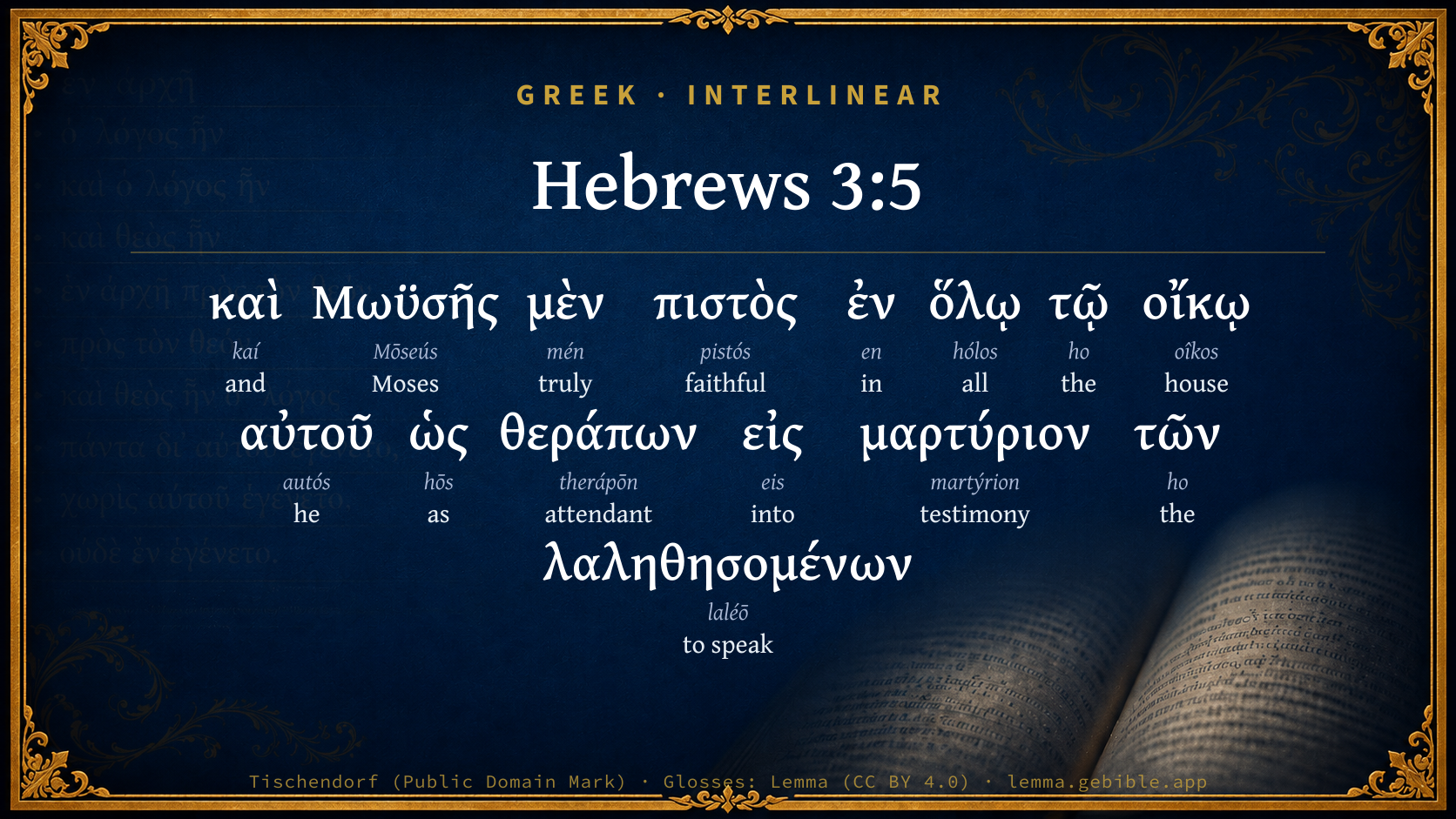
Greek (Tischendorf 8th ed.) Hebrews 3:5 appears in the Greek New Testament. The text above is from the Tischendorf 8th edition. Each word links to its Strong’s number and a concise gloss. Click any word for its full Thayer’s Greek Lexicon entry.
Download image
Cite this verse

Hebrews 3:5 (World English Bible). Public Domain. Lemma interlinear Bible study tool, https://lemma.gebible.app/v/hebrews/3/5.

Show BibTeX & RIS
BibTeX
RIS
English Translation
Moses indeed was faithful in all his house as a servant, for a testimony of those things which were afterward to be spoken,
World English Bible · Public Domain
Highlights
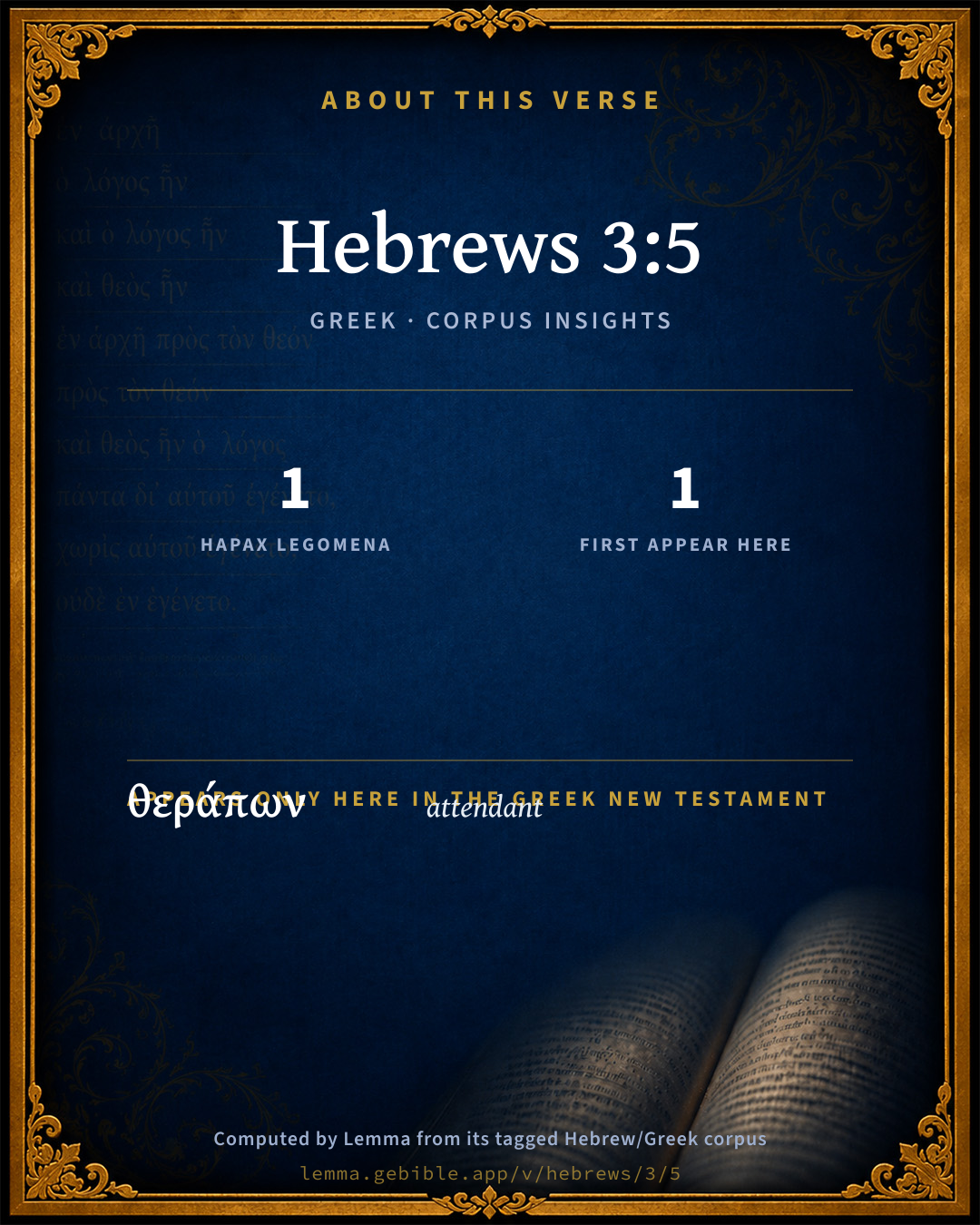
  • 1 hapax legomenon — only here in the Greek New Testament
  • 1 first appearance in the Greek New Testament
Full analysis ↓
Download a study sheet

One document with this verse’s original text, its word-by-word gloss line, the meaning frame, cross-references with their text, attributed commentary, and full source and license credits — printable, and it pastes into notes with its structure intact.

This verse Autodidact and up

Study sheet (.html) Plain text (.txt)

A passage Seminary Student

Up to 50 verses in one chapter. A passage sheet keeps up to 6 commentary sources and 12 cross-references per verse, in the order this page ranks them, and says so on the sheet whenever that leaves anything out. Ask for a single verse and you get the Autodidact verse sheet above.

Everything on this page stays free to read, with no account — the sheet is a download of what is already on screen, not access to it.

Want to remove ads? Support Godless Engineer
Compare translations 3

The same verse in 3 English versions, stacked beneath the original-language interlinear above. Click any original word for its lexicon entry.

Each is an independent rendering of the whole verse — the interlinear is not word-aligned to these translations.

Highlighted words mark where these versions differ — a whole-verse word diff, not a word-by-word alignment.

  • World English Bible Public Domain
    Moses indeed was faithful in all his house as a servant, for a testimony of those things which were afterward to be spoken,
  • King James Version Public Domain
    And Moses verily was faithful in all his house, as a servant, for a testimony of those things which were to be spoken after;
  • unfoldingWord Literal Text CC BY-SA 4.0
    And Moses indeed faithful as a servant in his entire house, for a testimony of the would be spoken in the future;

unfoldingWord Literal Text — © unfoldingWord, licensed CC BY-SA 4.0. Word-aligned USFM3 via Door43 (git.door43.org/unfoldingWord/en_ult).

Versions to compare (up to 4)

3 of 4 selected

Show all 19 translations

Every available English version of this verse, each an independent rendering of the whole verse.

  • World English Bible Public Domain
    Moses indeed was faithful in all his house as a servant, for a testimony of those things which were afterward to be spoken,
  • Berean Standard Bible Public Domain
    Now Moses was faithful as a servant in all God’s house, testifying to what would be spoken later.
  • Majority Standard Bible Public Domain
    Now Moses was faithful as a servant in all God’s house, testifying to what would be spoken later.
  • King James Version Public Domain
    And Moses verily was faithful in all his house, as a servant, for a testimony of those things which were to be spoken after;
  • American Standard Version (1901) Public Domain
    And Moses indeed was faithful in all his house as a servant, for a testimony of those things which were afterward to be spoken;
  • Revised Version (1885) Public Domain
    And Moses indeed was faithful in all his house as a servant, for a testimony of those things which were afterward to be spoken;
  • Geneva Bible (1599) Public Domain
    Now Moses verely was faithfull in all his house, as a seruant, for a witnesse of the thinges which should be spoken after.
  • Douay-Rheims (1899) Public Domain
    And Moses indeed was faithful in all his house as a servant, for a testimony of those things which were to be said:
  • Young's Literal Translation Public Domain
    and Moses indeed `was' stedfast in all his house, as an attendant, for a testimony of those things that were to be spoken,
  • Literal Standard Version CC BY-SA 4.0
    and Moses [was] indeed steadfast in all His house, as an attendant, for a testimony of those things that were to be spoken—
  • Unlocked Literal Bible CC BY-SA 4.0
    For Moses was faithful as a servant in God's entire house, bearing witness about the things that were to be spoken of in the future.
  • unfoldingWord Literal Text CC BY-SA 4.0
    And Moses indeed faithful as a servant in his entire house, for a testimony of the would be spoken in the future;
  • Darby Bible Public Domain
    And Moses indeed [was] faithful in all his house, as a ministering servant, for a testimony of the things to be spoken after;
  • World Messianic Bible Public Domain
    Moses indeed was faithful in all his house as a servant, for a testimony of those things which were afterward to be spoken,
  • Webster's Bible Public Domain
    And Moses verily was faithful in all his house, as a servant, for a testimony of those things which were afterwards to be spoken.
  • Free Bible Version CC BY-SA 4.0
    As a servant, Moses was faithful in God's house. He provided evidence of what would be announced later.
  • Bible in Basic English Public Domain
    And Moses certainly kept faith as a servant, in all his house, and as a witness of those things which were to be said later;
  • Text-Critical English NT CC BY 4.0
    Now Moses was faithful in all God's house as a servant, which provided testimony to what would be spoken later.
  • Tyndale New Testament (1534) Public Domain
    And Moses verely was faythfull in all his housse as a minister to beare witnes of tho thinges which shuld be spoken afterwarde.

Literal Standard Version (2020), Covenant Press — licensed CC BY-SA 4.0. Text via the HelloAO Bible API (eBible.org). Unlocked Literal Bible (unfoldingWord) — licensed CC BY-SA 4.0. Text via the HelloAO Bible API (eBible.org). unfoldingWord Literal Text — © unfoldingWord, licensed CC BY-SA 4.0. Word-aligned USFM3 via Door43 (git.door43.org/unfoldingWord/en_ult). Free Bible Version, Dr. Jonathan Gallagher — licensed CC BY-SA 4.0. Text via the HelloAO Bible API (eBible.org).

Word by word

More ways to search: Search by grammar → Find every occurrence → Compare this word →

Practice this passage: Drill this verse → Learn its vocabulary →

θεράπων
therápōn
G2324
“attendant”
Noun, Nominative, Singular, Masculine
Part of Speech
Noun
Case
Nominative
Number
Singular
Gender
Masculine
Full Thayer's Definition

Origin: apparently a participle from an otherwise obsolete derivative of the base of G2330

TDNT: 05:12,3

1. an attendant, servant: of God a. spoken of Moses discharging the duties committed to him by God
  1. καὶ kaí G2532 “and” Conjunction
  2. Μωϋσῆς Mōseús G3475 “Moses” Noun, Nominative, Singular, Masculine
  3. μὲν mén G3303 “truly” Particle
  4. πιστὸς pistós G4103 “faithful” Adjective, Nominative, Singular, Masculine
  5. ἐν en G1722 “in” Preposition
  6. ὅλῳ hólos G3650 “all” Adjective, Dative, Singular, Masculine
  7. τῷ ho G3588 “the” Article, Dative, Singular, Masculine
  8. οἴκῳ oîkos G3624 “house” Noun, Dative, Singular, Masculine
  9. αὐτοῦ autós G846 “he” Personal pronoun, Genitive, Singular, Masculine
  10. ὡς hōs G5613 “as” Adverb
  11. εἰς eis G1519 “into” Preposition
  12. μαρτύριον martýrion G3142 “testimony” Noun, Accusative, Singular, Neuter
  13. τῶν ho G3588 “the” Article, Genitive, Plural, Neuter
  14. λαληθησομένων laléō G2980 “to speak” Verb, Future, Passive, Participle, Genitive, Plural, Neuter

About this verse

These counts appear in no published source. They are computed here, from the morphology-tagged text and Lemma’s own curated glosses. What Lemma adds →

15
words
14
distinct lemmas
General Epistles
section

Notable vocabulary

1 hapax legomenon — a word that appears only here in the entire Greek New Testament:

  • θεράπων attendant G2324

First appearance in Scripture

This word makes its first canonical appearance in the Greek New Testament here:

  • θεράπων attendant G2324

Shared distinctive vocabulary

μαρτύριον testimony G3142 occurs in 20 verses of the Greek New Testament. Also found in:

Repetition

A word recurs within this verse:

Cross-references

31

Topical passages linked to Hebrews 3:5 in the Treasury of Scripture Knowledge — connected by theme and wording, ordered by reader-vote popularity; previews shown in the World English Bible.

  • Numbers 12:7 My servant Moses is not so; he is faithful in all my house:
  • Exodus 14:31 Israel saw the great work which Yahweh did to the Egyptians, and the people feared Yahweh; and they believed in Yahweh, and in his servant Moses.
  • Hebrews 3:2 who was faithful to him who appointed him, as also was Moses in all his house.
  • Psalms 105:26 He sent Moses, his servant, And Aaron, whom he had chosen.
  • Acts 28:23 When they had appointed him a day, many people came to him at his lodging. He explained to them, testifying about the Kingdom of God, and persuading them concerning Jesus, both from the law of Moses and from the prophets, from morning until evening.
  • Deuteronomy 18:15–19 Yahweh your God will raise up to you a prophet from the midst of you, of your brothers, like me; to him you shall listen;
  • Deuteronomy 34:5 So Moses the servant of Yahweh died there in the land of Moab, according to the word of Yahweh.
  • Joshua 1:2 Moses my servant is dead; now therefore arise, go over this Jordan, you, and all this people, to the land which I do give to them, even to the children of Israel.
  • 1 Timothy 1:12 And I thank him who enabled me, Christ Jesus our Lord, because he counted me faithful, appointing me to service;
  • Hebrews 8:5 who serve a copy and shadow of the heavenly things, even as Moses was warned by God when he was about to make the tabernacle, for he said, "See, you shall make everything according to the pattern that was shown to you on the mountain."
  • Joshua 8:31 as Moses the servant of Yahweh commanded the children of Israel, as it is written in the book of the law of Moses, an altar of uncut stones, on which no man had lifted up any iron: and they offered thereon burnt offerings to Yahweh, and sacrificed peace-offerings.
  • Luke 24:27 Beginning from Moses and from all the prophets, he explained to them in all the Scriptures the things concerning himself.
  • Luke 24:44 He said to them, "This is what I told you, while I was still with you, that all things which are written in the law of Moses, the prophets, and the psalms, concerning me must be fulfilled."
  • John 5:39 "You search the Scriptures, because you think that in them you have eternal life; and these are they which testify about me.
  • John 5:46–47 For if you believed Moses, you would believe me; for he wrote about me.
  • Acts 3:22–23 For Moses indeed said to the fathers, 'The Lord God will raise up a prophet for you from among your brothers, like me. You shall listen to him in all things whatever he says to you.
  • Romans 3:21 But now apart from the law, a righteousness of God has been revealed, being testified by the law and the prophets;
  • Hebrews 9:24 For Christ hasn't entered into holy places made with hands, which are representations of the true, but into heaven itself, now to appear in the presence of God for us;
  • 1 Peter 1:10–12 Concerning this salvation, the prophets sought and searched diligently, who prophesied of the grace that would come to you,
  • Deuteronomy 3:24 Lord Yahweh, you have begun to show your servant your greatness, and your strong hand: for what god is there in heaven or in earth, that can do according to your works, and according to your mighty acts?
  • Joshua 1:7 Only be strong and very courageous, to observe to do according to all the law, which Moses my servant commanded you: don't turn from it to the right hand or to the left, that you may have good success wherever you go.
  • Joshua 1:15 until Yahweh have given your brothers rest, as [he has given] you, and they also have possessed the land which Yahweh your God gives them: then you shall return to the land of your possession, and possess it, which Moses the servant of Yahweh gave you beyond the Jordan toward the sunrise.
  • Joshua 8:33 All Israel, and their elders and officers, and their judges, stood on this side of the ark and on that side before the priests the Levites, who bore the ark of the covenant of Yahweh, as well the foreigner as the native; half of them in front of Mount Gerizim, and half of them in front of Mount Ebal; as Moses the servant of Yahweh had commanded at the first, that they should bless the people of Israel.
  • Matthew 24:45 "Who then is the faithful and wise servant, whom his lord has set over his household, to give them their food in due season?
  • Matthew 25:21 "His lord said to him, 'Well done, good and faithful servant. You have been faithful over a few things, I will set you over many things. Enter into the joy of your lord.'
  • Luke 12:42 The Lord said, "Who then is the faithful and wise steward, whom his lord will set over his household, to give them their portion of food at the right times?
  • Luke 16:10–12 He who is faithful in a very little is faithful also in much. He who is dishonest in a very little is also dishonest in much.
  • Acts 7:37 This is that Moses, who said to the children of Israel, 'The Lord our God will raise up a prophet for you from among your brothers, like me.'
  • 1 Corinthians 4:2 Here, moreover, it is required of stewards, that they be found faithful.
  • Hebrews 9:8–13 The Holy Spirit is indicating this, that the way into the Holy Place wasn't yet revealed while the first tabernacle was still standing;
  • Nehemiah 9:14 and made known to them your holy Sabbath, and commanded them commandments, and statutes, and a law, by Moses your servant,

Cross-references courtesy of OpenBible.info (CC BY 4.0).

Commentary

Notes on Hebrews 3:5 from classic Christian and Jewish commentators (each source and its license shown beneath its notes). The classic Christian expositions comment on the surrounding passage and are grouped to its opening verse, so a note may address several verses; the Jewish commentaries on the Tanakh (Rashi and others) are per-verse, so they appear only where the commentator wrote on this verse.

Lemma curates 59 commentaries, every one of them public domain or Creative Commons licensed, each selected and text-cleaned for this edition rather than reprinted as found. About our sources →

Joseph Benson's Commentary

Heb 3:5-6. And Moses verily — Another proof of the pre-eminence of Christ above Moses; was faithful in all his house as a servant — Θεραπων, minister, or officer. In describing the faithfulness of Moses, when, under God, he built the Jewish Church, God called him, (Num 12:7,) My servant Moses. From this the apostle justly inferred that Moses was not a legislator, but only a messenger from the legislator, or his minister. This was his place, this his dignity and honour; and it was amplified by the considerations, that he was faithful in his service — was a servant in the house of God — and was not thus employed, and thus faithful, in this or that part, this or that service of God’s house, but in his whole house, and all the concernments of it. Herein was he different from all others in the same service in the Old Testament; one was employed in one part of it, another in another; one to instruct, another to reform it, one to renew a neglected ordinance, another to give new instructions; no one but he was used in the service of the whole house. For a testimony of the things, &c. — That is, because the Jewish Church was designed for a testimony of the things which were afterward to be spoken by Christ and his apostles. This shows that Moses’s faithfulness consisted not only in forming the tabernacle and its services, according to the pattern showed him by God, but in recording all the preceding revelations, exactly as they were discovered to him by the Spirit. For these revelations, equally with the types and figures of the Levitical ritual, were intended to exhibit the things afterward to be spoken by Christ. Hence our Lord said to the Jews, (Joh 5:46,) Had ye believed Moses, ye would have believed me, for he wrote of me; namely, in the figures, but especially in the prophecies of his law, where the gospel dispensation, the coming of its author, and his character as Messiah, are all described with a precision which adds the greatest lustre of evidence to Jesus and his gospel. See Luk 24:44. But Christ as a Son — That is, was faithful as a Son; over his own house — “Every word proves the asserted pre-eminence of Christ; he is a Son, Moses a servant; he over the house, Moses in the house; he over his own house, Moses in the house of another. The argument of the apostle therefore is obvious.” — Owen. But Pierce objects to this version, over his own house, and thinks the reading ought to be his, that is, God’s house; “1st, Because if the church be Christ’s own house, to speak of him as a Son was improper, by reason that he would have presided over it as its master. 2d, Because the apostle’s argument requires that Christ be faithful to the same person as a Son, to whom Moses was faithful as a servant.” Wherefore his house, he thinks, in this verse, is God’s house or church. Inasmuch, however, as Christ is the heir of all things, it may with the utmost propriety be said that the church is his own house, that is, the house in which he hath not only a trust and office, but also a property; which is appointed for him to inhabit and preside over, and which is still more especially his own, as it was purchased with his own blood, Act 20:28. Whose house we — All true believers; are — Or shall make it appear that we are, namely, lively stones in the spiritual temple built upon him, 1Pe 2:5; and inhabited by him, Eph 2:20-22; 1Co 3:16; 1Co 6:19; and true members of his family, his servants, yea, even his brethren and sisters; if we hold fast the confidence — Την παρρησιαν, properly, the liberty of speech; that is, that bold profession of the Christian faith which in the first age was so dangerous, exposing those who made it frequently to imprisonment and martyrdom, but which was absolutely necessary to the continuance of the gospel in the world; and therefore it was expressly required by Christ, Mat 10:32-33. See Heb 10:22-23. The apostle uses another word, namely, υποστασις, to express confidence, as Heb 3:14. And the rejoicing — Or, glorying, as καυχημα signifies; of hope — Hope of eternal life founded on God’s promises, namely, the hope which we professed at our baptism; firm — Without declining from or being shaken in it; keeping it up against all that fluctuating uncertainty of mind, which is apt to invade and possess unstable persons; unto the end — That is, as long as we live; not for the present season only, but in all future occurrences until we come to the end of our faith, the final salvation of our souls. Now, in order to this, great care and watchfulness, zeal, diligence, and resolution must be exercised, because of the opposition and violence that will be used to wrest them from us. Hence the exhortation contained in the following paragraph.

Joseph Benson's Commentary on the Old and New Testaments (1811–1818) — public domain. Text from a community e-Sword module.

Bengel's Gnomon

Johann Albrecht Bengel

Heb 3:5. Καὶ, and) Another reason for the superiority of Christ to Moses.—θεράπων, servant) So the LXX., Num 12:7. This intimates the excellence of Moses in comparison with all other prophets; but again it speaks of Moses as inferior to Christ the Lord.—εἰς, for) He was a servant, in order that testimony should be given by him.—τῶν λαληθησομένων, of those things which were to be spoken) which Moses was to speak (ch. Heb 9:19), chiefly of Christ; and subsequently Christ Himself was about to speak. In ch. Heb 9:19, there is a verbal parallelism, which however at the same time infers a like reason, viz. what Moses, in accordance with the time, Numbers 12, both had spoken and was about to speak. Miriam did not assail the authority of Moses respecting the past; but she wished to claim just as much for herself for the future, on account of certain past specimens (of God speaking by her and Aaron).

Bengel's Gnomon of the New Testament — English translation (T&T Clark, Edinburgh, 1860) — public domain. Text from a community e-Sword module.

Meyer's Critical & Exegetical Commentary

Heinrich August Wilhelm Meyer

Heb_3:5 as far as αὐτοῦ, Heb_3:6. Return to the point of comparison between Christ and Moses, Heb_3:2 (πιστός), and the exaltedness of the former above the latter, Heb_3:3 (υἱός, ἐπί … θεράπων, ἐν).

καί] is the more sharply-defining and indeed; whereas μέν serves to bring into relief the personal name Μωϋσῆς, and finds in Χριστὸς δέ, Heb_3:6, its emphatic opposition. Heb_3:5-6 init. does not, accordingly, contain a second proof for the superiority of Christ to Moses (Calvin, Bengel, Tholuck, Ebrard, Woerner), but is only a more detailed unfolding of the thoughts, Heb_3:2 and Heb_3:3.

πιστός] sc. ἦν, or else ἐστίν, in connection with which latter mode of supplementing, the thought would be less of the historic fact as such, than of the fact as it still continues present in the O. T. narrative.

αὐτοῦ] refers not to Μωϋσῆς (as Ebrard assumes, since he starts with the erroneous presupposition that the author speaks of a twofold οἶκος, and that the design of Heb_3:5-6 was just that of rendering clearly apparent the difference of the house entrusted to Moses on the one hand, and that entrusted to Christ on the other), but to θεός, Heb_3:4.

ὡς θεράπων] in his capacity as servant, comp. Num_12:7. Upon this, as upon the preceding ἐν, rests the emphasis of Heb_3:5.

εἰς μαρτύριον] belongs to θεράπων. It is unnaturally referred back by Estius, Seb. Schmidt, Stengel, and others to πιστός

εἰς μαρτύριον τῶν λαληθησομένων] to give testimony to that which should be spoken, or proclaimed to the people. Τὰ λαληθησόμενα are not the revelations afterwards to be given in Christ (Erasmus, Calvin, Cameron, Calov, Seb. Schmidt, Owen, Limborch, Wolf, Wetstein, Ebrard, Delitzsch, Alford, Moll, Ewald, MCaul, Woerner, and others), which must have been more precisely specified; and still less does the expression indicate: dicenda a nobis in hac epistola de cerimoniis earumque significatione et usu (Pareus), but the law to be proclaimed by Moses, at the mandate of God, to the Jewish people is intended.

Meyer — Critical and Exegetical Commentary on the New Testament — English translation by Peter Christie, edited by Frederick Crombie (T&T Clark, 1880) — public domain. Text from a community e-Sword module.

Expositor's Greek Testament

ed. W. Robertson Nicoll

Heb 3:5 . καὶ Μωϋσῆς .… Another reason for expecting to find fidelity in Jesus and for ascribing to Him greater glory. Moses was faithful as a servant in the house ( ἐν ), Christ as a Son over ( ἐπὶ ) his house. θεράπων denotes a free servant in an honourable position and is the word applied to Moses in Num 12:7 . [“Apud Homerum nomen est non servile sed ministros significat voluntarios, nec raro de viris dicitur nobili genere natis” (Stephanus). It is especially used of those who serve the gods. See Pindar Olymp . iii. 29.] Both the fidelity and the inferior position of Moses are indicated in the words which occur like a refrain in Exodus: “According to all that the Lord commanded, so did he”. Nothing was left to his own initiative; he had to be instructed and commanded; but all that was entrusted to him, he executed with absolute exactness. The crowning proof of his fidelity was given in the extraordinary scene (Exo 37 ), where Moses refused to be “made a great nation” in room of Israel. He is said to have been faithful εἰς μαρτύριον τῶν λαληθησομένων . The meaning is, the testimony to his faithfulness which God had pronounced was the guarantee of the trustworthiness of the report he gave of what the Lord afterwards spoke to him. This meaning seems to be determined by the context in Num 12 . “My servant Moses … is faithful in all my house. I will speak to him mouth to mouth, apparently and not in dark speeches.” Grotius says “ut pronuntiaret populo ea quae Deus ei dicenda quoquo tempore mandabat”. Bleek and Davidson refer the μαρτύριον to Moses not to God. “He was a servant for a testimony, i.e. , to bear testimony of those things which were to be spoken, i.e. , from time to time revealed. Reference might be made to Barnabas viii. 3, εἰς μαρτ . τῶν φυλῶν . The meaning advocated by Calvin, Delitzsch, Westcott and others is attractive. They understand the words as referring to the things which were to be spoken by Christ, and that the whole of Moses’ work was for a testimony of those things. Thus Westcott translates “for a testimony of the things which should be spoken by God through the prophets and finally through Christ”. This gives a fine range to the words, but the context in Numbers is decisively against it. The idea seems to be that Moses being but a θεράπων needed a testimonial to his fidelity that the people might trust him; and also that he had no initiative but could only report to the people the words that God might speak to him. In contrast to this position of Moses, Χριστὸς ὡς υἱὸς ἐπὶ τὸν οἶκον αὐτοῦ , Christ’s fidelity was that of “a Son over his house”. It was not the fidelity which exactly performs what another commands and faithfully enters into and fulfils His will. It is the fidelity of one who himself is possessed by the same love and conceives the same purposes as the Father. The interests of the house and the family are the Son’s interests. “We are His house” and in Christ we see that the interests of God and man, of the Father and the family are one. [Grotius quotes the jurisconsults: “etiam vivente patre filium quodam modo dominum esse rerum paternarum”.] But this house so faithfully administered by the Son Himself is the body of Christian people, οὗ οἶκός ἐσμεν ἡμεῖς , we are those on whom this fidelity is spent. The relative finds its antecedent in αὐτοῦ . The “house of God” is, in the Gospels, the Temple; but in 1Pe 4:17 and 1Ti 3:15 it has the same meaning as here, the people or Church of God. “Whose house are we,” but with a condition ἐὰν τὴν παρρησίαν … κατάσχωμεν , “if we shall have held fast our confidence and the glorying of our hope firm to the end”. For, as throughout the Epistle, so here, all turns on perseverance, παρρησία originally “frank speech,” hence the boldness which prompts it. Cf. Heb 4:16 , Heb 10:19 ; Heb 10:35 ; so in Paul and John. καύχημα , not as the form of the word might indicate, “the object of boasting,” but the disposition as in 1Co 5:6 : οὐ καλὸν τὸ καύχημα ὑμῶν and 2Co 5:12 : ἀφορμὴν διδόντες ὑμῖν καυχήματος . [ Cf. the interchange of βρῶσις and βρῶμα in Joh 4:32 ; Joh 4:34 , and Jannaris, Hist. Gk. Gram. , 1021 and 1155.] Whether ἐλπίδος belongs to both substantives is doubtful. The Christian’s hope of a heavenly inheritance (Heb 3:1 ), of perfected fellowship with God, should be so sure that it confidently proclaims itself, and instead of being shamefaced glories in the future it anticipates. And this attitude must be maintained μέχρι τέλους βεβαίαν , until difficulty and trial are past and hope has become possession. βεβαίαν In agreement with the remoter substantive, which might give some colour to the idea that the expression was lifted from Heb 3:14 and inserted here; but Bleek shows by several instances that the construction is legitimate.

The Expositor's Greek Testament, edited by W. Robertson Nicoll (1897–1910) — public domain. Text from a community e-Sword module.

Geneva Bible (1599)

Geneva Bible translators

Another comparison: Moses was a faithful servant in this house, that is, in the Church, seeing the Lord that was to come, but Christ ruleth and governeth his house as Lord.

Geneva Bible (1599) marginal notes — public domain. Text via Bolls.life.

Jamieson, Fausset & Brown

Robert Jamieson, A. R. Fausset & David Brown

faithful in all his house--that is in all GOD'S house (Heb 3:4).

servant--not here the Greek for "slave," but "a ministering attendant"; marking the high office of Moses towards God, though inferior to Christ, a kind of steward.

for a testimony of, &c.--in order that he might in his typical institutions give "testimony" to Israel "of the things" of the Gospel "which were to be spoken afterwards" by Christ (Heb 8:5; Heb 9:8, Heb 9:23; Heb 10:1).

Jamieson, Fausset & Brown — Commentary Critical and Explanatory on the Whole Bible (1871) — public domain (CC PDM 1.0). Text via the HelloAO Bible API.

Adam Clarke's Commentary

Verse 5. As a servant] The fidelity of Moses was the fidelity of a servant; he was not the framer of that Church or house; he was employed, under God, to arrange and order it: he was steward to the Builder and Owner.

For a testimony of those things] Every ordinance under the law was typical; every thing bore a testimony to the things which were to be spoken after; i.e. to Jesus Christ, his suffering, death, and the glory which should follow; and to his Gospel in all its parts. The faithfulness of Moses consisted in his scrupulous attention to every ordinance of God; his framing every thing according to the pattern showed him by the Lord; and his referring all to that Christ of whom he spoke as the prophet who should come after him, and should be raised up from among themselves; whom they should attentively hear and obey, on pain of being cut off from being the people of the Lord. Hence our Lord told the Jews, Joh 5:46: If ye had believed Moses, ye would have believed me, for he wrote of me; "namely;" says Dr. Macknight, "in the figures, but especially in the prophecies, of the law, where the Gospel dispensation, the coming of its Author, and his character as Messiah, are all described with a precision which adds the greatest lustre of evidence to Jesus and to his Gospel."

Adam Clarke's Commentary on the Bible (1810–1826) — public domain. Text from a community e-Sword/MySword module.

John Calvin's Commentaries

5. And Moses verily was faithful in all his house, as a servant, etc. The second difference is, that to Moses was committed a doctrine to which he, in common with others, was to submit; but Christ, though he put on the form of a servant, is yet Master and Lord, to whom all ought to be subject; for, as we found in chap. 1:2, he is constituted heir of all things.

For a testimony of those things which were to be spoken after, or which were afterwards to be said or declared. I explain this simply in this way, — that Moses, while a herald of that doctrine which was to be published for a time to the ancient people, did at the same time render a testimony to the Gospel, the publication of which was not as yet to be made; for it is doubtless evident, that the end and completion of the Law is that perfection of wisdom contained in the Gospel. This exposition seems to comport with the future tense of the participle. The meaning indeed is, that Moses faithfully delivered to the people what the Lord had committed to him, but that limits were prescribed to him which it was not lawful for him to pass. God formerly spoke at different times and in various ways by the prophets, but he deferred to the fullness of time the complete revelation of the Gospel.

John Calvin's Commentaries (1540-1563) — public domain. Text from the Calvin Translation Society English edition (1840s-50s) via the Christian Classics Ethereal Library (ccel.org). Calvin's coverage is partial (roughly two-thirds of the Bible); uncommented books and verses are honest gaps, never fabricated. The 19th-century editor's footnotes and remarks are omitted so the notes are faithfully Calvin's own voice.

Ellicott's Commentary for English Readers

(5) As a servant.—What was before implied is now clearly expressed. Heb_3:3 associated Moses with the house, Jesus with Him who builded it; of what nature this relation was, is stated in this verse and the next. Moses was “in God’s house;” however exalted his position, he was in the house as a servant. The Greek word used here does not occur elsewhere in the New Testament, but is taken from the LXX. version of Num_12:7. There is nothing special in the Hebrew word in that place, but the translators seem to have felt that “bond-servant” was less suitable in such a context than “attendant” or “minister.” The object of his service was that he might bear “testimony of the things that should hereafter be spoken.” Are we to understand by these the divine commands that would from time to time be given to Moses? If so, then the statement “Moses was faithful” must be regarded as a pure quotation, equivalent to “Moses was at that time declared faithful.” This does not seem probable. If, however, the words of Num_12:7 are taken as descriptive of the whole life of Moses, his “witness” must relate to the things spoken “in these last days;” of these, by his writings, his acts, his life, Moses bore constant witness. (See Heb_3:2; Heb_8:5; Heb_9:19; Heb_11:26; Joh_5:46, et al.) The latter interpretation is confirmed by Heb_3:6, in which the name given to our Lord is not Jesus, as in Heb_3:1, but Christ.

A Bible Commentary for English Readers, edited by Charles John Ellicott (1878–1897) — public domain. Text from a community e-Sword module.

The Cambridge Bible for Schools and Colleges

gen. ed. J. J. S. Perowne

5. in all his house] i.e. in all God’s house. Two “houses” are contemplated, Mosaism and Christianity, the Law and the Gospel. Both were established by God. In the household of the Law, Moses was the faithful minister; in the household of the Gospel, Christ took on Him, indeed, “the form of a slave,” and as such was faithful even unto death, but yet was Son over the House. This seems a more natural explanation than that the writer regards both the covenants as one Household, in which Moses was a servant, and over which Christ was a Son.

as a servant] The word used is not doulos “slave,” nor diakonos “minister,” but therapôn “voluntary attendant.” It is also applied to Moses in the Ep. of Barnabas and in Exo_14:31 (LXX.).

for a testimony of those things which were to be spoken after] They were to be spoken afterwards by Christ, the Prophet to whom Moses had pointed, Deu_18:15. The Law and the Prophets did but witness to the righteousness of God which was to be fully revealed in Christ (Rom_3:21). They were but a shadow of the coming reality (Heb_10:1). But although it is natural for us to understand the expression in this way, the author possibly meant no more than that the faithfulness of Moses was an attestation of the Law which was about to be delivered.

The Cambridge Bible for Schools and Colleges (gen. ed. J. J. S. Perowne; Cambridge University Press, 1878–1918) — public domain. Text from a community e-Sword module.

John Gill's Exposition

And Moses verily was faithful in all his house as a servant,.... Moses was not only a servant to the Israelites, but he was also the Lord's servant, a servant of his choosing, sending, and approving; he was a servant in holy things, and served the Lord heartily, sincerely, and ingenuously, with all becoming fear and reverence, respect, and honour, and with all ready and cheerful obedience; the house in which he was a servant, was not his own, but belonged to God, even the Son of God, as appears from the following verse; he was not a servant in the world, and with respect to civil things, and the affairs of Providence, but in the church of God, and in divine things; and he was faithful here, and that in all things; he did all things exactly according to the pattern showed him in the Mount; and the apostle strongly affirms all this, as well he might, since there was full proof of it, and God himself had bore a testimony to it: and the end of his being a servant here was,

for a testimony of those things which were to be spoken after; these words may regard his faithful testification of God's will to the people of Israel, after he was fixed as a servant in God's house; or what he said afterwards concerning the Messiah, of whom he spake and wrote, and of whom he bore an honourable testimony, Deu 18:1 or they may have respect to the things spoken after Moses's time, by the prophets, Christ, and his apostles, which agreed with the testimony of Moses; or to the things afterwards spoken of in this epistle; to which may be added, that Moses in his office was typical of things to be spoken and done by the Messiah, when he came; as his deliverance of the children of Israel out of Egypt; his leading them through the Red sea and wilderness, to Canaan's land; his giving them the law from Mount Sinai; the erection of the tabernacle, with all its furniture, and the institution of sacrifices and the like.

John Gill's Exposition of the Whole Bible (1746–1763) — public domain (CC PDM 1.0). Text via the HelloAO Bible API.

Trapp's Complete Commentary

John Trapp

5 And Moses verily was faithful in all his house, as a servant, for a testimony of those things which were to be spoken after;

Ver. 5. As a servant] Famulus ingenuus, a servant of the better sort, a man of worship, as the word seemet.h to import (θεραπων, ex verbo θεραπευειν); though it be honour enough to be Christ’s servant, of the meaner in his family. Constantinus, Valentinianus, and Theodosius, three emperors, called themselves Vassallos Christi, the vassals of Christ as Socrates testifieth.

John Trapp, A Commentary or Exposition upon All the Books of the Old and New Testament (1647–1656) — public domain. Text from a community e-Sword module.

Albert Barnes' Notes on the Bible

Moses was faithful ...as a servant - Not as the head of the dispensation; not as having originated it; but as in the employ and under the direction of its great Founder and Author - the Messiah. As such a servant he deserves all the honor for fidelity which has ever been claimed for him, but it cannot be the honor which is due to him who is at the head of the family or house. Paul “assumed” that Moses was a “servant,” and argued on that supposition, without attempting to prove it, because it was so often affirmed in the Old Testament, and must have been conceded by all the Jews. In numerous instances he is spoken of as “the servant of the Lord;” see Jos 1:1-2; Jos 9:24; 1Ch 6:49; 2Ch 24:9; Neh 10:29; Dan 9:11; Exo 14:31; 1Ki 8:56; Psa 105:26. As this point was undisputed, it was only necessary to show that the Messiah was superior to a “servant,” in order to make the argument clear.

For a testimony - To bear witness to those truths which were to be revealed; that is, he was the instrument of the divine communications to the people, or the medium by which God made his will known. He did not originate the truths himself; but he was the mere medium by which God made known his truth to his people - a servant whom He employed to make his will known. The word after here is not necessary in order to a just translation of this passage, and obscures the sense. It does not mean that he was a witness of those truths which were to be spoken “subsequently” to his time under another dispensation, nor those truths which the apostle proposed to consider in another part of the Epistle, as Doddridge supposes; but it means merely that Moses stood forth as a public witness of the truths which God designed to reveal, or which were to be spoken. God did not speak to his people “directly,” and face to face, but he spoke through Moses as an organ, or medium. The sense is, Moses was a mere servant of God to communicate his will to man.

Albert Barnes' Notes on the Bible (1834–1885) — public domain. Text from a community e-Sword/MySword module.

Matthew Poole's English Annotations

The gospel Minister doth not only excel Moses as much as a builder doth his work, but as a son doth a servant, proved in this and Heb 3:6.

And Moses verily was faithful in all his house, as a servant; your great legal prophet, in whom many of you Hebrews trust, Joh 5:45, did truly and fully reveal and do what God charged him, in ministering his will to his church, Exo 40:16-33; he did not diminish from, nor add the least to, God’s charge, θεραπων, Num 12:7. As a minister, Moses was as faithful as any God had; not a slave or a drudge, but a free, willing, ingenuous servant, most entirely and obsequiously addicting himself in that honourable place and office of great trust, to which God called him; a stewardly servant, a prophet and a prince, inspecting and ordering all according to God’s will; in all Christ’s house and family, his church, he is but a servant.

For a testimony of those things which were to be spoken after: his faithfulness was evident in his bearing true witness to the church, of all God made known to him, that they might not be uncertain of the truth; even all that truth, which was more fully and clearly to be spoken by the prophets after him, and by Christ and his apostles; but which the Spirit shall speak to them further concerning Christ and his church in this Epistle, Joh 5:46. In which is insinuated, that Christ was the truth himself witnessed to by Moses, who was a witness of an inferior degree, though in his work faithful, and conformed unto Christ.

Matthew Poole's English Annotations on the Holy Bible (1683–1685) — public domain. Text from a community e-Sword/MySword module.

Whedon's Commentary on the Bible

Daniel D. Whedon

5. Was faithful—Against the Marcionites, who renounced Moses and the old dispensation, our author is generous and just to Moses. He depreciates not him; he only exalts Christ. The Hebrews are not shocked by any repudiation of their great founder; they are only pointed to a greater.

As a servant—Not a slave, but a steward, superior to the family domestics, yet subordinate to the Son.

Things… spoken after—Namely, the revelations made in the after, or gospel, dispensation. It was the office of Moses to establish a dispensation which should be a testimony, a witness, a memento of future things to be done and spoken after his dispensation was past. Hence, he is prior in time but subordinate in position and purpose. And our gospel dispensation verifies itself by his testimony.

Daniel D. Whedon (gen. ed.), Commentary on the Old and New Testaments (1874–1909) — public domain. Text from a community e-Sword module.

The Pulpit Commentary

Vers. 5, 6. And Moses verily was faithful in all his house, as a servant, for a testimony of those things which were afterwards to be spoken; but Christ, as Son over his house. We have already anticipated the explanation of this passage, which, according to the view taken above, is a setting forth of the distinction between Christ and Moses intended from the first; that of one being "Son over," the other but "servant in," the house of God. The rendering of the A.V, "his own house," in ver. 6, where Christ is spoken of, is not justifiable. It is true that we have no means of knowing whether autou or autou was intended, and that even autou might, according to the usage of Hellenistic Greek, refer to Christ; but if the writer bad so intended it, he might easily have avoided ambiguity by writing eautou , etc. He has not done so; and, therefore, it is most natural to take his house" in the same sense throughout the passage; viz. as" God"s house," referred to in Num_12:7, whence the expression is taken. We observe further that "the things that were afterwards to be spoken (twn lalhyhsomenwn)" must be taken as denoting the future "speaking" of God to man "in his SON"; (of Heb_1:1) not, as some interpret, the speaking through Moses himself in the Law. Moses was inferior to Christ, not only in respect to his personal position as a servant, but also in respect to his work as such; which was only to testify beforehand, typically and prophetically, to a fuller revelation to come. Whose house we are. Here begins the transition to the warning intended when the "holy brethren" were first called on to "consider the Apostle and High Priest of our confession," who has now been seen to be so much greater than Moses. We Christians constitute this completed "house of God," over which Christ reigns as Son; if only warned by the example of the Israelites under Moses, we forfeit not our higher calling. This condition is expressed by If we hold fast the confidence (or, our confidence) and the rejoicing (rather, boast) of the (i.e. our) hope firm unto the end. Parrhsia (often rendered "boldness;" see below, Heb_4:16 Heb_10:19, Heb_10:35) is the confidence felt by assured believers; kauchma is the boast thereupon ensuing. This word (as also kaucasyai) is often used by St. Paul. (cf. Rom_4:2 Rom_5:2 1Co_5:6:9:15 2Co_1:14 2Co_5:12 2Co_9:3 Gal_6:4 Php_1:26 2:16) Its proper meaning is not (as is by many sup- posed) the materies gloriandi, but the uttered boast itself (see note on 1Co_5:6, in the "Speaker"s Commentary"). The con- eluding words, mecri telouv bebaian , are omitted in the Codex Vatican, and, notwithstanding the preponderance of authority in their favor, may have been interpolated (as is supposed by Mill, Tischendorf, Alford, and Delitzsch) from ver. 14, especially as the reading is not bebaion , so as to agree with the substantive immediately preceding, but bebaian , as in ver. 14.

The Pulpit Commentary (1880–1919), ed. H.D.M. Spence-Jones & Joseph S. Exell — public domain. Text from a community e-Sword module.

John Wesley's Explanatory Notes

And Moses verily - Another proof of the preeminence of Christ above Moses. Was faithful in all his house, as a servant, for a testimony of the things which were afterwards to be spoken - That is, which was a full confirmation of the things which he afterward spake concerning Christ.

John Wesley, Explanatory Notes Upon the Whole Bible (1754–1765) — public domain. Text via the GEBible commentary corpus.

The People's New Testament

B. W. Johnson

5. Moses was faithful, etc. See Numbers 12:7. As a servant. Not as the builder, or as the master, but as a waiting man in the house. For a testimony. The whole ministry of Moses was a “testimony” to what would follow after, a shadow of what was to come. This will be brought out more fully in subsequent chapters.

B. W. Johnson's The People's New Testament with Notes (1889–1891) — public domain. Electronic text from the Christian Classics Ethereal Library (CCEL) ThML edition.

unfoldingWord translationNotes

Door43 World Missions Community

in God's entire house

The Hebrew people to whom God revealed himself are spoken of as if they were a literal house. See how you translated this in Hebrews 3:2. (See: Metaphor)

bearing witness about the things

This phrase probably refers to all of Moses' work. AT: "Moses' life and work pointed to the things" (See: Metonymy)

were to be spoken of in the future

This can be stated in active form. AT: "Jesus would say in the future" (See: Active or Passive)

Son

This is an important title for Jesus, the Son of God. (See: Translating Son and Father)

in charge of God's house

This speaks about God's people as if they were a literal house. AT: "who rules over God's people" (See: Metaphor)

We are his house

This speaks of God's people as if they are a literal house. AT: "We are God's people" (See: Metaphor)

if we hold fast to our courage and the hope of which we boast

Here "courage" and "hope" are abstract and can be stated as verbs. AT: "if we continue to be courageous and joyfully expect God to do what he has promised" (See: Abstract Nouns)

translationWords

faithful

testimony

Christ

proud

confidence

unfoldingWord translationNotes — © Distant Shores Media and the Door43 World Missions Community, licensed CC BY-SA 4.0. Source: git.door43.org/Door43/en_tn.

Cambridge Greek Testament for Schools and Colleges

5. ἐν ὅλῳ τῷ οἴκῳ αὐτοῦ, i.e. in all God’s house. Two “houses” are contemplated, Mosaism and Christianity, the Law and the Gospel. Both were established by God. In the household of the Law, Moses was the faithful minister; in the household of the Gospel, Christ took on Him, indeed, “the form of a slave,” and as such was faithful even unto death, but yet was Son over the House. This seems a more natural explanation than that the writer regards both the covenants as one Household, in which Moses was a servant, and over which Christ was a Son.

θεράπων, “voluntary attendant.” The word used is not δοῦλος “slave,” nor διάκονος “minister.” It is also applied to Moses in the Ep. of Barnabas and in Exo 14:31 (LXX.).

τῶν λαληθησομένων. The fut. pass. part. is rare in the N. T. The things were to be spoken afterwards by Christ, the Prophet to whom Moses had pointed, Deu 18:15. The Law and the Prophets did but witness to the righteousness of God which was to be fully revealed in Christ (Rom 3:21). They were but a shadow of the coming reality (Heb 10:1). But although it is natural to understand the expression in this way, the author possibly meant no more than that the faithfulness of Moses was an attestation of the Law which was about to be delivered. If he had directly meant that Moses witnessed to the Gospel he would perhaps have written τῶν μελλόντων λαλεῖσθαι.

Cambridge Greek Testament for Schools and Colleges (Cambridge University Press, 1896; 21 vols, various authors incl. Carr, Maclear, Plummer, Farrar, Lumby, Moule, M. R. James, Simcox) — public domain. Text from a community e-Sword module.

Alford’s Greek Testament

Henry Alford

5.] The argument proceeds, resuming the common ground of ver. 2: and Moses indeed (inasmuch as δέ following has the effect of bringing out, and thus emphasizing, χριστός, this μέν may almost be treated as a particle of disparagement: cf. Isocr. Panegyr. p. 178, ἡ καλουμένη μὲν ἀρχή, οὖσα δὲ συμφσρά—“which is called indeed … but really is …”) (was) faithful in all His (God’s, cf. above the words of the citation, on ver. 2) house, as a servant (cf. as above; the word θεράπων (see reff.) is often applied by the LXX to Moses. So also Wisd. 10:16: Barnabas, Ep. c. 14, Μωυσῆς θεράπων ὢν ἔλαβεν (τὰς πλάκας), αὐτὸς δὲ ὁ κύριος ἡμῖν ἔδωκεν. θεράπων differs from δοῦλος, in embracing all who are, whether by occasion or by office, subservient to another: thus the Etym. Mag.: θεράποντας οὐχ, ὥσπερ οἱ νεώτεροι, δούλους, ἀλλὰ πάντας τοὺς θεραπευτικῶς ἔχοντας, ὡς “Δαναοὶ θεράποντες Ἄρηος·” καί, τὸν ἐν δευτέρᾳ τάξει φίλον, ὡς “Πάτροκλος Ἀχιλλέως θεράπων.” Wetst., who also cites Apollonius, Ammonius, and Eustathius, to the same effect. This of course would allow the same person to be called by both names, as Moses is in Jos 1:1 and 2 F. (not A), and al. Bleek well remarks here, that δοῦλος, had it been used of Moses in the place cited, would have served the Writer’s purpose here just as well for the argument, but not for the words εἰς μαρτ. τῶν λαληθησομένων, which here follow, indicating the nature of his θεραπεία), for testimony of the things which were to be (afterwards) spoken (these words are not to be joined with θεράπων, as Bleek, Lün., al., nor, as Estius, al., with πιστός; but with the whole preceding sentence: the purpose of the faithful service of Moses in God’s house was, εἰς μαρτ. κ.τ.λ. In considering the meaning of the words, surely we must look further than the commonly received shallow interpretation which refers them to the things which Moses himself was to speak to the people by God’s command. For how could his fidelity ἐν ὅλῳ τῷ οἴκῳ θεοῦ, comprehending as it does the whole of his official life, be said to be εἰς μαρτύριον τῶν λαληθησομένων by him to the people? It seems to me that neither εἰς μαρτύριον (ἐν τῇ μαρτυρίᾳ) nor τῶν λαληθησομένων (τῶν λαληθέντων) will bear such an interpretation. And yet it is acquiesced in by Syr. (“in testimonium eorum quæ loquenda erant in ejus manu”), Chrys. (not perhaps exactly: τί ἐστιν, εἰς μαρτύριον; ἵνα ὦσι, φησί, μάρτυρες, ὅταν ἀναισχυντῶσιν οὗτοι: but this surely will not suit the gen. τῶν λαληθ.), Thdrt. (ἐκεῖνος μὲν πιστὸς ἐκλήθη, ἵνα δειχθῇ ἀξιόχρεως νομοθέτης. τοῦτο γὰρ εἶπεν, εἰς μαρτ. τῶν λαλ.), Thl. (ἵνα λαλῇ τὰ τοῦ δεσπότου τοῖς λοιποῖς οἰκέταις, κ. μάρτυς ᾖ τῷ θεῷ ἐν τῇ κρίσει τῶν λαληθέντων), Œc., Primas., Est., Corn.-a-Lap., Grot., Hamm., &c., Stuart, De W., Bleek, Lünem. But, 1. the εἰς with μαρτύριον seems best to express an ulterior purpose of the whole of that which is spoken of in the preceding clause: cf. the same combination in reff. Gospp.:—2. the neut. gen. after μαρτύριον is best understood of that to which the testimony referred, as in Act 4:33: 1Co 1:6; 1Co 2:1: 2Ti 1:8:—and 3. the future participle requires that the λαληθησόμενα should be referred to a time wholly subsequent to the ministry of Moses. This has been felt by some of the expositors, and curiously evaded: e. g. by Jac. Cappellus, “Rationi consentaneum erat ut statim initio fidelissimus comperiretur Moses, quo fide dignius esset testimonium quod postea perhibiturus erat in monte Sinai.” But unfortunately for this view, the incident from which this divine testimony to Moses is quoted, was long subsequent to the delivery of the law from Sinai. If then we are pointed onward to future time for τὰ λαληθησόμενα, what are they? What, but the matter of the divine ἐλάλησεν ἡμῖν ἐν υἱῷ of our ch. 1:1? The whole ministry of Moses was, εἰς μαρτύριον of these λαληθησόμενα. And when Bleek says that the participle would not be put thus absolutely with such a signification, but would be qualified by ἐπʼ ἐσχάτου τῶν ἡμερῶν, or διὰ τοῦ υἱοῦ, or the like, or expressed τῶν μελλόντων λαληθῆναι, we may well answer that the Writer, having in ch. 1:1 laid down λαλεῖσθαι as a common term for the revelations of the two dispensations, and again taken it up ch. 2:2, 3, had no need again to qualify it further than by the future participle. I interpret it then to mean the Gospel, with Calvin (“Moses, dum est ejus doctrinæ præco, quæ pro temporis ratione veteri populo erat prædicanda, simul testimonium Evangelio, cujus nondum matura prædicatio erat, reddidit. Nam certe constat, finem et complementum legis esse hanc perfectionem sapientiæ quæ evangelio continetur. Atque hanc expositionem exigere viaetur futurum participii tempus”), Owen (“λαληθ. represents things future unto what he did in his whole ministry. This our translation rightly observes, rendering it, ‘the things that should be spoken after.’ And this as well the order of the words as the import of them doth require. In his ministry he was a testimony, or, by what he did in the service of the house he gave testimony: whereunto? to the things that were afterwards to be spoken, viz. in the fulness of time, the appointed season, by the Messiah: i. e. the things of the gospel. And this indeed was the proper end of all that Moses did or ordered in the house of God”), Cameron, Calov., Seb. Schmidt, Limborch, Wolf, Peirce, Wetstein, Cramer, Baumg., al., Ebrard, and, as I have found since writing the above note, Hofmann and Delitzsch): but Christ (scil. πιστός (ἐστιν), to correspond with the πιστὸν ὄντα, ὡς καὶ κ.τ.λ. above, ver. 2. Some would supply ἐστιν only, as Erasm. (paraphr.), “At Christus, ut conditor ac filius, administravit suam ipsius domum:” but thus the parallelism would be broken. Then, supplying πιστός, are we to join it with ἐπὶ τὸν οἶκ. αὐτοῦ, as in Mat 25:21, Mat 25:23, ἐπὶ ὀλίγα ἦς πιστός, or to insert it before ὡς υἱός, and take it absolutely? Certainly the latter, as shewn by the order of the words in the previous sentence; the ellipsis here being, to judge by that order, between δέ and ὡς, not between υἱός and ἐπί) as a Son over his house (αὐτοῦ here again of God,—not primarily, though of course by inference, of Christ. The house is God’s throughout: but Christ is of primary authority and glory in it, inasmuch as He is the Son in the house, and actually established the house. This, which I am persuaded is required by the context, is shewn decisively by ch. 10:21, ἔχοντες … ἱερέα μέγαν ἐπὶ τὸν οἶκον τοῦ θεοῦ. So Chrys. (ἐκεῖνος μὲν εἰς τὰ πατρῷα ὡς δεσπότης εἰσέρχεται, οὗτος δὲ ὡς δοῦλος), Thdrt. (on the following words: οἶκον τοῦ θεοῦ κέκληκε τοὺς πιστεύοντας κατὰ τὴν προφητείαν τὴν λέγουσαν, ἐνοικήσω ἐν αὐτοῖς κ.τ.λ.), D-lat. (but with “in,”—“Christus autem tanquam filius in domo ejus:” vulg. has “in domo sua”), Jerome (Ep. 18, ad Damas. § 5, vol. i. p. 49, “Christus autem ut filius super domum ejus”), Corn.-a-Lap., Schlichting, Peirce, Bengel, Storr, Morus, Abresch, Dindorf, al.: and recently, Stuart (but only as a question between ἑαυτοῦ and αὐτοῦ, and apparently without being aware that αὐτοῦ may have both meanings), and Lünemann. The greater number of Commentators refer it to Christ: many of them writing it αὑτοῦ, to which Bleek well replies, that had the Writer intended the emphatic reflexive pronoun to be understood, writing as he did without accents, he would certainly have used ἑαυτοῦ, in a matter so easily confused. Of the rest, some, e. g. Ebrard, take αὐτοῦ as referring to Christ: and others, as simply the reflexive pronoun after the generic υἱός: “as a son over his (own) house:” thus Böhme, Bleek, De Wette, al. But thus the parallelism is destroyed, and in fact the identity of the house in the two cases, on which depends the strictness of the comparison between Moses and Christ. Most of the expositors have not felt this: but Ebrard has distinctly maintained that two houses are intended: “In the one house serves Moses for a testimony of the future revelations of God, the οἶκος itself being part of the μαρτύριον: the other οἶκος, the οἶκος of Christ, are we: it is a living house, built of living stones.” But this introduces a complicated comparison, and to my mind infinitely weakens the argument. There is but one house throughout, and that one, the Church of God, in which both are faithful; one as a servant, the other as a son: this house was Israel, this house are we, if we are found faithful in the covenant. So also I am glad to see Delitzsch takes the sentence. Dec. 31, 1858), whose (not (except by inference) Christ’s, as Œc., Jac. Cappellus, Estius, Owen, Bleek, De Wette, Ebrard, al., but, God’s,—as Chrys. (οἶκος γάρ, φησίν, ἐσόμεθα τοῦ θεοῦ … ἐάνπερ κ.τ.λ.), Thdrt. (see above on αὐτοῦ), Thl. (as Chrys., recognizing, however, Christ also, as the possessor of the house, οἶκον ἔχει καὶ ὁ χριστός, ἡμᾶς), Calvin (“Additur hæc admonitio, tunc eos in Dei familia locum habituros, si Christo pareant”), al., and Delitzsch. Besides the considerations urged above as affecting the question, we have the strong argument from Scripture analogy, cf. besides reff., 1Co 3:16, 1Co 3:17: 2Co 6:16: Eph 2:22: ch. 10:21; 12:22: Rev 3:12: which alone, especially ch. 10:21, would go very far with me to decide the question) house (some, e. g. Bengel who would read ὃς οἶκος, urge the omission of the article here as against οὗ οἶκος: adducing such expressions as οὗ τὸ πτύον, ἧς ὁ ἀδελφός, ὧν τὸ στόμα, ὧν τὰ ὀνόματα, οὗ ἡ πληγή, ὧν τὰ κῶλα, οὗ ἡ φωνή, οὗ ἡ οἰκία. But in every one of these the subject is distributed: whereas here οἶκος and ἡμεῖς are not commensurate, the proposition merely expressing categorical inclusion, and God’s house being far wider than ἡμεῖς. Compare the precisely similar passage, 1Pe 3:6, ἧς (Σάῤῥας) ἐγενήθητε τέκνα ἀγαθοποιοῦσαι κ.τ.λ.) are we (the Writer and his Hebrew readers: = of whose house we are, even as Moses was), if we hold fast (reff. Bleek objects to the shorter text here, that the Writer has twice besides used this verb, and both times with a tertiary adjectival predicate: see reff. But such a consideration can hardly override critical evidence) the confidence (reff.: not, “free and open confession,” as Grot. (“professio Christianismi aperta”), Hamm., Limborch, al., which would not suit κατάσχωμεν, a purely subjective word) and the (notice the article, which shews that this second noun is not merely explicative of the first, nor To Be Ranked In The Same category with it) matter of boasting (the concrete: not here to be confounded (although the confusion certainly did take place sometimes) with καύχησις, the abstract, as is done by Bleek, De Wette, Tholuck, &c. As παῤῥησία was subjective, our confidence, so is this objective, the object whereon that confidence is founded: see notes on reff. 2 Cor., where the same mistake has been made. And κατάσχωμεν is no objection to this: we may ‘hold fast’ an object of faith, though (see above) we could not ‘hold fast,’ except in a very far-off sense, an outward practice, such as a bold profession) of our hope (καλῶς εἶπε τῆς ἐλπίδος, ἐπειδὴ πάντα ἦν ἐν ἐλπίσι τὰ ἀγαθά· οὕτω δὲ αὐτὴν δεῖ κατέχειν, ὡς ἤδη καυχᾶσθαι ὡς ἐπὶ γεγενημένοις: Chrys. See reff. and Rom 5:2).

Henry Alford, The Greek Testament (1849–1861) — public domain. Text from a community e-Sword module.

Vincent's Word Studies in the New Testament

Marvin R. Vincent

And Moses. Kai and introduces the further development of the thought of vers. 2, 3 - fidelity, and the corresponding honor. It is not a second proof of the superiority of Christ to Moses. See Num 12:7. A servant [θεραπων] . N. T. o. Comp. Rev 14:3. Often in LXX, mostly as translation of 'eber, servant, slave, bondman. Also, when coupled with the name of a deity, a worshipper, devotee. Sometimes applied to angels or prophets. Of Moses, qerapwn kuriou servant of the Lord, Wisd. 10 16. In Class. and N. T. the word emphasizes the performance of a present service, without reference to the condition of the doer, whether bond or free. An ethical character attaches to it, as to the kindred verb qerapeuein : service of an affectionate, hearty character, performed with care and fidelity. Hence the relation of the qerapwn is of a nobler and freer character than that of the doulov or bondservant. The verb is used of a physician 's tendance of the sick. Xenophon (Mem. 4 3, 9) uses it of the gods taking care of men, and, on the other hand, of men's worshipping the gods (ii. 1. 28). See Eurip. Iph. Taur. 1105; and on heal, Mt 8:7; Luk 10:15, and on is worshipped, Act 17:25. For a testimony of those things which were to be spoken [εις μαρτυριον των λαληθησομενων] . jEiv for, with the whole preceding clause. Moses ' faithful service in God 's house was for a testimony, etc. The things which were to be spoken are the revelations afterward to be given in Christ. Others, however, explain of the things which Moses himself was afterward to speak to the people by God 's command, referring to Num 12:8. According to this explanation, the fidelity hitherto exhibited by Moses ought to command respect for all that he might say in future. But (1) in the present connection that thought is insignificant.

(2) It would be an exaggeration to speak of Moses 's fidelity to God throughout his whole official career as a witness of the things which he was to speak to the people by God 's command.

(3) The future participle requires a reference to a time subsequent to Moses 's ministry. The meaning is that Moses, in his entire ministry, was but a testimony to what was to be spoken in the future by another and a greater than he. Comp. Deu 18:15, explained of Christ in Act 3:22, 23.

Marvin R. Vincent, Word Studies in the New Testament (1887–1900) — public domain. Text from a community e-Sword/MySword module.

Westcott on Hebrews & the Epistles of John

Brooke Foss Westcott

5. ἐν ὅλῳ τῷ οἴκῳ αὐτοῦ) in all God's house, as before. The phrase which marks the inferiority of Moses to Christ marks at the same time his superiority to all the other pro-

phe

ds θεράπων] Vulg.tanqguam famulus (O. L. serves), Here only in N. T. Num. xii. 7 Lxx. (say); Jos. i. 2; vill. 31, 33; Wisd.x.16. Comp. Clom. 1 Cor. 6. 43 (660 also cc. 17, 51) ὁ μακάριος πιστὸς θεράπων ἐν ὅλῳ τῷ οἴκῳ Μωυσῆς. Θεράπων suggests a porsonal servico freely rendered. Δοῦλος expresses a permanent social condition. The same person may be described by both words under different aspects. Comp. Ps. cv. (civ.) 26; Apoc. xv. 3 (δοῦλος uf Moses).

els papr. τῶν λαληθησομένων) for a testimony of the things which should be spoken by God through the prophets and finally through Christ (i. 1). Old Lat. in testimonio loquendorum. Vulg. in testimonium eorum que dicenda erant. The position of Mesos aud of the Mosaic Dispensation was provisional. Moses not only witnessed to tho truths which his logislation plainly declared, but also to the truths which were to be made plain afterwards. Tho O. T. in all its parts pointed forward to spiritual antitype. Comp. Deut. xviii. 15 ff.

The rendering, ‘to be spoken by him’ (Pesh.) or ‘by the prophets of

NAC (not disturbed in v. 14; vi. 3).

tho O. T.' wholly obscures the contrast of the Old and New.

On the rarity of the future participle in the N. T. see Winer-Moulton, Ῥ. 428.

Brooke Foss Westcott (1825–1901), The Epistle to the Hebrews (1889) and The Epistles of St John (1883) — public domain (pre-1929). Text recovered from Internet Archive / Google Books OCR scans. Westcott’s Gospel of John commentary is not included (its OCR lost the chapter running-heads required for reliable verse-keying). Some Greek quoted in the Hebrews volume is imperfectly rendered by the OCR.

Lesson kit

Teaching starters — assembled from the data on this page, not authored interpretation. Every prompt links to the verse data it draws on. Edit before teaching.

Hebrews, in the General Epistles, opens this verse with 15 words (14 distinct Greek lemmas). Its most distinctive word is therápōn (“attendant”). A historical commentator’s framing appears above. Read the whole chapter for the surrounding context.

Discussion questions

  1. The word therápōn carries the sense “attendant.” How does it shape the verse?
  2. This verse holds 1 word here found nowhere else in the Greek New Testament. What might the rare word draw attention to?
  3. The word “attendant” first appears here in Scripture. What is being introduced at this debut?
  4. Matthew 8:4 shares the word «testimony» with this verse. How do the two illuminate each other?
  5. “the” occurs 2× in this one verse. What is the effect of the repetition?
  6. The translations on this page render this verse differently — a whole-verse word diff, not a word-by-word alignment. What might account for the different wordings?
  7. Reading how Joseph Benson's Commentary and Bengel's Gnomon read this verse, where do the two commentators agree and where do they part?

Things to notice

  • 1 word in this verse appears nowhere else in the Greek New Testament.
  • 1 word makes its first canonical appearance in Scripture here.
  • These translations choose different wording for 10 words in this verse.
  • “the” occurs 2× in this single verse.
  • 14 distinct Greek lemmas span 15 words in this verse.

Reading settings

Reading text

Shown beneath each verse's original-language words.

Old Testament
Old Testament edition

Read the OT as the Masoretic Hebrew (MT) or the Greek Septuagint (LXX).

English shown for the Greek Septuagint (in the Hebrew ↔ Greek comparison).

Comparing translations? Open the Compare panel on any verse page to stack up to four side by side.