Hebrews 6:12

Greek (Tischendorf 8th ed.) Hebrews 6:12 appears in the Greek New Testament. The text above is from the Tischendorf 8th edition. Each word links to its Strong’s number and a concise gloss. Click any word for its full Thayer’s Greek Lexicon entry.
Download image
Cite this verse

Hebrews 6:12 (World English Bible). Public Domain. Lemma interlinear Bible study tool, https://lemma.gebible.app/v/hebrews/6/12.

Show BibTeX & RIS
BibTeX
RIS
English Translation
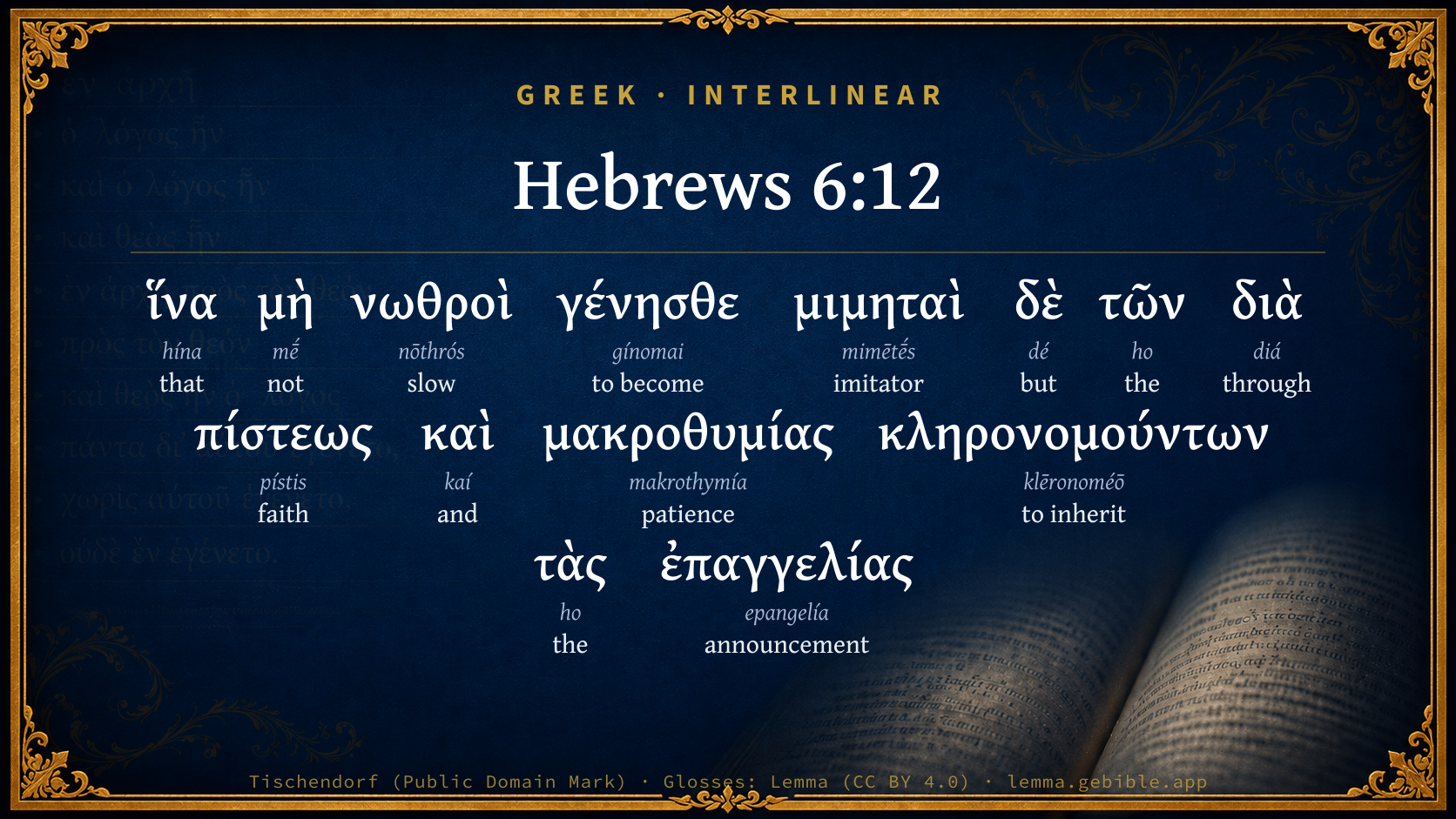
that you won't be sluggish, but imitators of those who through faith and patience inherited the promises.
World English Bible · Public Domain
Download a study sheet

One document with this verse’s original text, its word-by-word gloss line, the meaning frame, cross-references with their text, attributed commentary, and full source and license credits — printable, and it pastes into notes with its structure intact.

This verse Autodidact and up

Study sheet (.html) Plain text (.txt)

A passage Seminary Student

Up to 50 verses in one chapter. A passage sheet keeps up to 6 commentary sources and 12 cross-references per verse, in the order this page ranks them, and says so on the sheet whenever that leaves anything out. Ask for a single verse and you get the Autodidact verse sheet above.

Everything on this page stays free to read, with no account — the sheet is a download of what is already on screen, not access to it.

Want to remove ads? Support Godless Engineer
Compare translations 3

The same verse in 3 English versions, stacked beneath the original-language interlinear above. Click any original word for its lexicon entry.

Each is an independent rendering of the whole verse — the interlinear is not word-aligned to these translations.

Highlighted words mark where these versions differ — a whole-verse word diff, not a word-by-word alignment.

  • World English Bible Public Domain
    that you won't be sluggish, but imitators of those who through faith and patience inherited the promises.
  • King James Version Public Domain
    That ye be not slothful, but followers of them who through faith and patience inherit the promises.
  • unfoldingWord Literal Text CC BY-SA 4.0
    so that you might not become dull, but imitators of the ones by faith and patience inheriting the promises.

unfoldingWord Literal Text — © unfoldingWord, licensed CC BY-SA 4.0. Word-aligned USFM3 via Door43 (git.door43.org/unfoldingWord/en_ult).

Versions to compare (up to 4)

3 of 4 selected

Show all 19 translations

Every available English version of this verse, each an independent rendering of the whole verse.

  • World English Bible Public Domain
    that you won't be sluggish, but imitators of those who through faith and patience inherited the promises.
  • Berean Standard Bible Public Domain
    Then you will not be sluggish, but will imitate those who through faith and patience inherit what has been promised.
  • Majority Standard Bible Public Domain
    Then you will not be sluggish, but will imitate those who through faith and patience inherit what has been promised.
  • King James Version Public Domain
    That ye be not slothful, but followers of them who through faith and patience inherit the promises.
  • American Standard Version (1901) Public Domain
    that ye be not sluggish, but imitators of them who through faith and patience inherit the promises.
  • Revised Version (1885) Public Domain
    that ye be not sluggish, but imitators of them who through faith and patience inherit the promises.
  • Geneva Bible (1599) Public Domain
    That ye be not slouthfull, but followers of them, which through faith and patience, inherite the promises.
  • Douay-Rheims (1899) Public Domain
    That you become not slothful, but followers of them, who through faith and patience shall inherit the promises.
  • Young's Literal Translation Public Domain
    that ye may not become slothful, but followers of those who through faith and patient endurance are inheriting the promises.
  • Literal Standard Version CC BY-SA 4.0
    that you may not become slothful, but followers of those who through faith and patient endurance are inheriting the promises.
  • Unlocked Literal Bible CC BY-SA 4.0
    This is so that you will not become lazy, but imitators of those who by faith and patience inherit the promises.
  • unfoldingWord Literal Text CC BY-SA 4.0
    so that you might not become dull, but imitators of the ones by faith and patience inheriting the promises.
  • Darby Bible Public Domain
    that ye be not sluggish, but imitators of those who through faith and patience have been inheritors of the promises.
  • World Messianic Bible Public Domain
    that you won’t be sluggish, but imitators of those who through faith and perseverance inherited the promises.
  • Webster's Bible Public Domain
    That ye be not slothful, but followers of them who through faith and patience inherit the promises.
  • Free Bible Version CC BY-SA 4.0
    Don't be spiritually lazy, but follow the example of those who through trusting in God and patience inherit what God has promised.
  • Bible in Basic English Public Domain
    So that you may not be slow in heart, but may take as your example those to whom God has given their heritage, because of their faith and their long waiting.
  • Text-Critical English NT CC BY 4.0
    so that you will not be sluggish, but imitators of those who inherit the promises through faith and patience.
  • Tyndale New Testament (1534) Public Domain
    that ye faynt not but folowe them which thorow fayth and pacience inheret the promyses.

Literal Standard Version (2020), Covenant Press — licensed CC BY-SA 4.0. Text via the HelloAO Bible API (eBible.org). Unlocked Literal Bible (unfoldingWord) — licensed CC BY-SA 4.0. Text via the HelloAO Bible API (eBible.org). unfoldingWord Literal Text — © unfoldingWord, licensed CC BY-SA 4.0. Word-aligned USFM3 via Door43 (git.door43.org/unfoldingWord/en_ult). Free Bible Version, Dr. Jonathan Gallagher — licensed CC BY-SA 4.0. Text via the HelloAO Bible API (eBible.org).

Word by word

More ways to search: Search by grammar → Find every occurrence → Compare this word →

Practice this passage: Drill this verse → Learn its vocabulary →

νωθροὶ
nōthrós
G3576
“slow”
Adjective, Nominative, Plural, Masculine
Part of Speech
Adjective
Case
Nominative
Number
Plural
Gender
Masculine
Full Thayer's Definition

Origin: from a derivative of G3541

TDNT: 22:46,7

1. slow, sluggish, indolent, dull, languid
  1. ἵνα hína G2443 “that” Conjunction
  2. μὴ mḗ G3361 “not” Particle, Negative
  3. γένησθε gínomai G1096 “to become” Verb, Aorist, Middle deponent, Subjunctive, 2nd person, Plural
  4. μιμηταὶ mimētḗs G3402 “imitator” Noun, Nominative, Plural, Masculine
  5. δὲ dé G1161 “but” Conjunction
  6. τῶν ho G3588 “the” Article, Genitive, Plural, Masculine
  7. διὰ diá G1223 “through” Preposition
  8. πίστεως pístis G4102 “faith” Noun, Genitive, Singular, Feminine
  9. καὶ kaí G2532 “and” Conjunction
  10. μακροθυμίας makrothymía G3115 “patience” Noun, Genitive, Singular, Feminine
  11. κληρονομούντων klēronoméō G2816 “to inherit” Verb, Present, Active, Participle, Genitive, Plural, Masculine
  12. τὰς ho G3588 “the” Article, Accusative, Plural, Feminine
  13. ἐπαγγελίας epangelía G1860 “announcement” Noun, Accusative, Plural, Feminine

About this verse

These counts appear in no published source. They are computed here, from the morphology-tagged text and Lemma’s own curated glosses. What Lemma adds →

14
words
13
distinct lemmas
General Epistles
section

Notable vocabulary

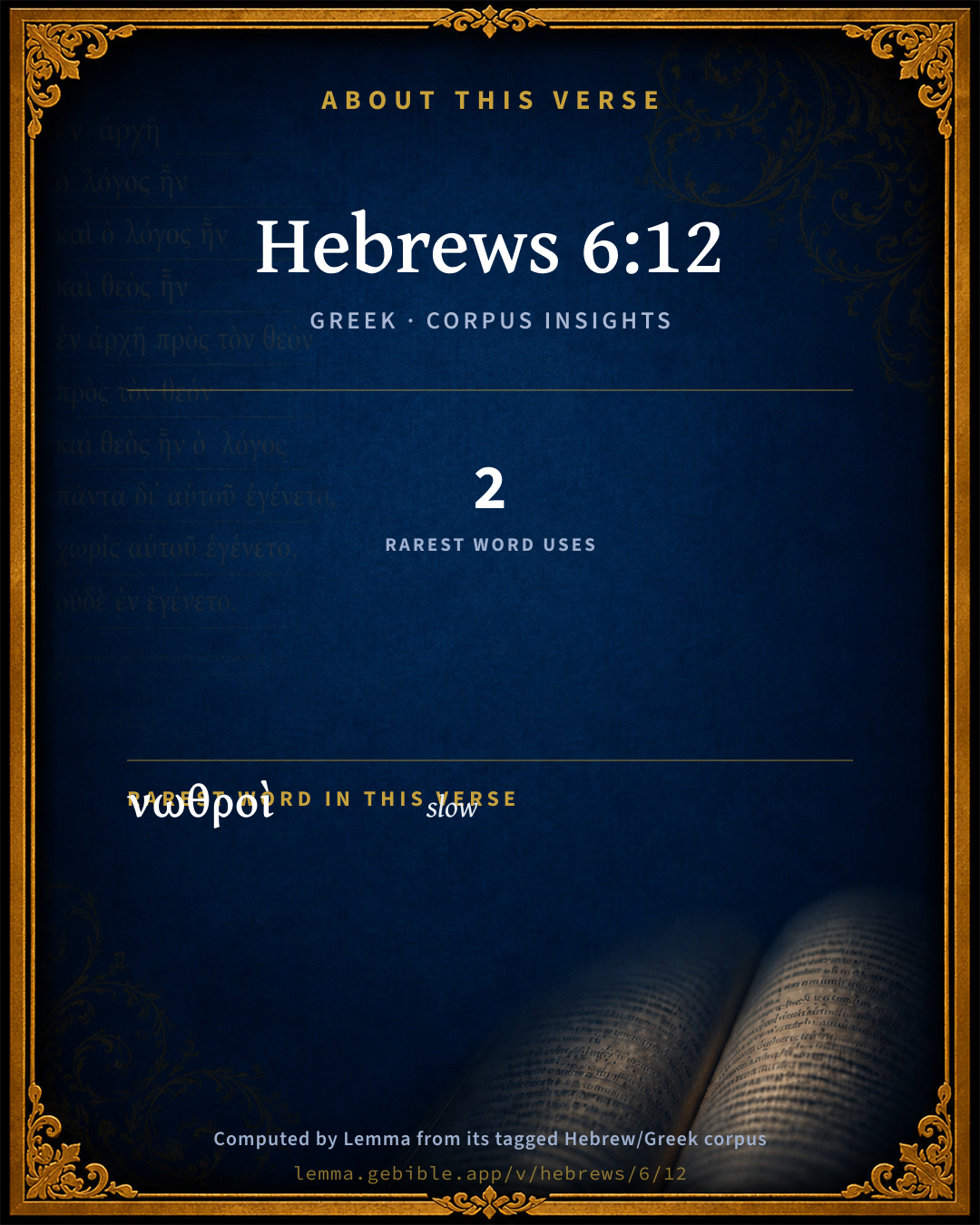
The rarest word here is νωθροὶ slow G3576 — appearing just 2 times in the whole Greek New Testament.

Shared distinctive vocabulary

νωθροὶ slow G3576 occurs in 2 verses of the Greek New Testament. Also found in:

Repetition

A word recurs within this verse:

Cross-references

33

Topical passages linked to Hebrews 6:12 in the Treasury of Scripture Knowledge — connected by theme and wording, ordered by reader-vote popularity; previews shown in the World English Bible.

  • Hebrews 13:7 Remember your leaders, men who spoke to you the word of God, and considering the results of their conduct, imitate their faith.
  • Hebrews 10:36 For you need endurance so that, having done the will of God, you may receive the promise.
  • Romans 12:11 not lagging in diligence; fervent in spirit; serving the Lord;
  • 1 John 2:25 This is the promise which he promised us, the eternal life.
  • Jeremiah 6:16 Thus says Yahweh, Stand you in the ways and see, and ask for the old paths, where is the good way; and walk therein, and you shall find rest for your souls: but they said, We will not walk [therein].
  • Romans 2:7 to those who by patience in well-doing seek for glory and honor and incorruptibility, eternal life;
  • Proverbs 18:9 One who is slack in his work Is brother to him who is a master of destruction.
  • Proverbs 24:30–34 I went by the field of the sluggard, By the vineyard of the man void of understanding;
  • Hebrews 5:11 About him we have many words to say, and hard to interpret, seeing you have become dull of hearing.
  • James 1:3 knowing that the testing of your faith produces endurance.
  • 2 Peter 1:10 Therefore, brothers, be more diligent to make your calling and election sure. For if you do these things, you will never stumble.
  • Revelation 14:12–13 Here is the patience of the saints, those who keep the commandments of God, and the faith of Jesus."
  • Luke 8:15 That in the good ground, these are such as in an honest and good heart, having heard the word, hold it tightly, and bring forth fruit with patience.
  • Romans 4:12 The father of circumcision to those who not only are of the circumcision, but who also walk in the steps of that faith of our father Abraham, which he had in uncircumcision.
  • Romans 8:25–26 But if we hope for that which we don't see, we wait for it with patience.
  • Hebrews 1:14 Aren't they all ministering spirits, sent out to do service for the sake of those who will inherit salvation?
  • Hebrews 6:15 Thus, having patiently endured, he obtained the promise.
  • Hebrews 12:1 Therefore let us also, seeing we are surrounded by so great a cloud of witnesses, lay aside every weight and the sin which so easily entangles us, and let us run with patience the race that is set before us,
  • James 5:10–11 Take, brothers, for an example of suffering and of patience, the prophets who spoke in the name of the Lord.
  • Proverbs 12:24 The hands of the diligent ones shall rule, But laziness ends in slave labor.
  • Proverbs 13:4 The soul of the sluggard desires, and has nothing, But the desire of the diligent shall be fully satisfied.
  • Proverbs 15:19 The way of the sluggard is like a thorn patch, But the path of the upright is a highway.
  • Matthew 22:32 'I am the God of Abraham, and the God of Isaac, and the God of Jacob?' God is not the God of the dead, but of the living."
  • Luke 20:37–38 But that the dead are raised, even Moses showed at the bush, when he called the Lord 'The God of Abraham, the God of Isaac, and the God of Jacob.'
  • 2 Thessalonians 1:4 so that we ourselves boast about you in the assemblies of God for your patience and faith in all your persecutions and in the afflictions which you endure.
  • Hebrews 11:8–17 By faith, Abraham, when he was called, obeyed to go out to the place which he was to receive for an inheritance. He went out, not knowing where he went.
  • Hebrews 11:33 who, through faith subdued kingdoms, worked out righteousness, obtained promises, stopped the mouths of lions,
  • Revelation 13:10 If anyone has captivity, he will go. If anyone is with the sword, he must be killed. Here is the endurance and the faith of the saints.
  • Song of Solomon 1:8 If you don't know, most beautiful among women, Follow the tracks of the sheep. Graze your young goats beside the shepherds' tents.
  • Matthew 25:26 "But his lord answered him, 'You wicked and slothful servant. You knew that I reap where I didn't sow, and gather where I didn't scatter.
  • Luke 16:22 It happened that the beggar died, and that he was carried away by the angels to Abraham's bosom. The rich man also died, and was buried.
  • 1 Thessalonians 1:3 remembering without ceasing your work of faith and labor of love and patience of hope in our Lord Jesus Christ, before our God and Father.
  • 1 Peter 3:5–6 For this is how the holy women before, who hoped in God, also adorned themselves, being in subjection to their own husbands:

Cross-references courtesy of OpenBible.info (CC BY 4.0).

Commentary

Notes on Hebrews 6:12 from classic Christian and Jewish commentators (each source and its license shown beneath its notes). The classic Christian expositions comment on the surrounding passage and are grouped to its opening verse, so a note may address several verses; the Jewish commentaries on the Tanakh (Rashi and others) are per-verse, so they appear only where the commentator wrote on this verse.

Lemma curates 59 commentaries, every one of them public domain or Creative Commons licensed, each selected and text-cleaned for this edition rather than reprinted as found. About our sources →

Joseph Benson's Commentary

Heb 6:12. That ye be not slothful — Νωθροι, careless and negligent, or dull, sluggish, and indolent, namely, in the use of the means of grace, or in those works of piety and virtue which are the proper fruits of faith and love; but followers — μιμηται, imitators; of them who through faith — In God, and in the truths and promises of his holy word; and patience — Or, long-suffering, as Μακροθυμιας rather signifies, enduring long in the constant exercise of faith, hope, and love, notwithstanding any or all opposition, and the bearing all trials and troubles, of whatever kind, with composure of mind and resignation to the divine will; inherit the promises — Dr. Whitby would render it, inherited the promises, supposing that the expression refers to the promises made to Abraham and the other patriarchs respecting the multiplication of their seed, their being put in possession of Canaan, and the various other promises made to them, the accomplishment of which they afterward received. But the participle, κληρονομουντων, being in the present tense, will hardly bear to be so rendered, signifying literally, are inheriting, namely, the promises. Pierce and Macknight, therefore, understand it of the believing Gentiles, who at the time when the apostle wrote were inheriting those promises made to Abraham concerning all nations of the earth being blessed in him and his seed. But, as Dr. Doddridge observes, if this were intended as a hint to stir up the Jews to emulation, as is supposed, “it was indeed a very obscure one; for, comparatively, it is a low sense in which Christians, in this imperfect state, can be said to inherit the promises. It seems rather to refer to all good men, who were departed out of our world, whether in former or latter days, and under whatever dispensation they died. Taking it in this view, it is a conclusive argument against the soul’s continuing in a state of sleep during the intermediate period between death and the resurrection.” This certainly seems the most natural interpretation of the verse, namely, that “the apostle meant to lead his readers to meditate on the happiness of Abraham, Moses, Joshua, Job, and all those who had on earth lived by faith in the promises of God, especially the great promise of a Saviour, and eternal salvation by him; and had patiently waited, laboured, and suffered in the obedience of faith; and in consequence were at the time, when the apostle wrote this, inheriting the promises of God, of eternal blessings, through Christ, to all believers.” — Scott.

Joseph Benson's Commentary on the Old and New Testaments (1811–1818) — public domain. Text from a community e-Sword module.

Tyndale Open Study Notes

Tyndale Open Resources

6:12 A focused commitment (6:10-11) is the antidote to being spiritually dull (5:11-12). By loving God and others, we follow the example of great people of the faith. The author puts a great deal of emphasis on both faith and endurance as normal requirements for God’s people (see 11:4-38).

Tyndale Open Study Notes — © Tyndale Open Resources, licensed CC BY-SA 4.0. Text via the HelloAO Bible API.

Bengel's Gnomon

Johann Albrecht Bengel

Heb 6:12. Νωθροὶ, slothful) There follows presently after the antithesis, διὰ πίστεως, by faith, etc. They were νωθροὶ ταῖς ἀκοαῖς, dull of hearing, ch. Heb 5:11: he now cautions them, not to become slothful absolutely, viz. also in mind.—διὰ πίστεως καὶ μακροθυμίας, through faith and patience) So Paul, 2Ti 3:10, and Jas 5:8. There is the patience or long-suffering of love, 1Co 13:4: there is also the long-suffering of faith, Heb 6:15.—κληρονομούντων) The participle of the imperfect tense; comp. Heb 6:15: for Abraham is referred to.—ἐπαγγελίας, promises) By this very word their confidence is roused; and ἐπαγγειλάμενος, having promised, presently follows.

Bengel's Gnomon of the New Testament — English translation (T&T Clark, Edinburgh, 1860) — public domain. Text from a community e-Sword module.

Meyer's Critical & Exegetical Commentary

Heinrich August Wilhelm Meyer

Heb_6:12. Further prosecution of πρὸς τὴν πληροφορίαν τῆς ἐλπίδος ἄχρι τέλους, Heb_6:11.

ἵνα μὴ νωθροὶ γένησθε] that ye become not sluggish. The γένησθε, pointing to the future, stands in no contradiction with γεγόνατε at v. 11. There, the sluggishness of the intellect was spoken of; here, it is sluggishness in the retaining of the Christian hope. There is therefore no need of the conjecture νόθοι (after Heb_12:8) for νωθροι (Heinrichs).

μιμηταὶ δὲ τῶν διὰ πίστεως καὶ μακροθυμίας κληρονομούντων τὰς ἐπαγγελίας] but rather imitators of those who, through faith and perseverance, inherit the promises. Of the two substantives πίστεως καὶ μακροθυμίας, the latter forms the leading idea; comp. Heb_6:15, where only μακροθυμήσας is placed. καί is therefore the more nearly defining and indeed. Thus: by faith, and indeed by persevering constancy in the same.

The μακροθυμία, elsewhere usually the divine attribute of long-suffering or forbearance, is likewise predicated of men, Col_1:11; Jam_5:7-8; Jam_5:10; LXX. Isa_57:15 (ὀλιγοψύχοις διδοὺς μακροθυμίαν), and frequently, and in the first-named passage combined with ὑπομονή as a synonym.

The ἐπαγγελίαι are those given by God in the time of the Old Covenant, which by means of Christianity attain to their full realization. Comp. Heb_7:6, Heb_8:6, Heb_11:13; Heb_11:17; Heb_11:33; Rom_9:4; Rom_15:8; 2Co_1:20; 2Co_7:1; Gal_3:16. Comp. also the singular ἡ ἐπαγγελία, Heb_9:15, Heb_10:36, Heb_11:39.

κληρονομεῖν τὰς ἐπαγγελίας denotes: to enter into the heritage of these promises, i.e. to attain to the enjoyment or possession of the blessings placed in prospect by them. That in our passage (comp. Heb_9:15, Heb_10:36, Heb_11:39) κληρονομεῖν τὰς ἐπαγγελίας cannot be understood, with Schulz and Bleek, of the mere receiving of the imparting of the promises as such, apart from their fulfilment, is shown by the very position of the words, according to which the main force of the statement is contained not in τὰς ἐπαγγελίας, but in κληρονομούντων. Comp. also Heb_6:15, where for the same reason ἐπέτυχεν is placed before the substantive τὰς ἐπαγγελίας. Besides, it is also evident from the fact that in such case there would be nothing in Heb_6:12 to correspond to the conception of the ensuing possession itself, indicated as this is in the ἄχρι τέλους of Heb_6:11.

In connection with τῶν κληρονομούντων almost all expositors, including Böhme, Bleek, de Wette, Tholuck, Bloomfield, Bisping, Delitzsch, Kluge, think of the patriarchs, especially Abraham, and of them either alone or with the inclusion of all believers of the New Covenant. This interpretation, however, to which they were without any necessity led by the consideration of Heb_6:13, is untenable. For, in order to harmonize with it in its first-named form, the writing of κληρονομησάντων would have been necessary,for which, accordingly, many will have the participle present to be taken; to harmonize with it in its last-named form, the writing of κληρονομησάντων τε καὶ κληρονομούντων would have been required. The characterizing οἱ διὰ πίστεως καὶ μακροθυμίας κληρονομοῦντες τὰς ἐπαγγελίας is, on the contrary, quite a general one, and the participle present marks out that which assuredly takes place, or in accordance with a constant and fixed rule (as a rewarding of the fulfilled preliminary condition of πίστις καὶ μακροθυμία). The thought is therefore, not that the readers should take the patriarchs as a model, but in general that they should take as such those who manifest persevering constancy in the faith, and, on that very account, beyond doubt attain to the possession of that which is promised.

Meyer — Critical and Exegetical Commentary on the New Testament — English translation by Peter Christie, edited by Frederick Crombie (T&T Clark, 1880) — public domain. Text from a community e-Sword module.

Expositor's Greek Testament

ed. W. Robertson Nicoll

Heb 6:12 . ἵνα μὴ νωθροὶ γένησθε : “that ye become not sluggish,” “be not, misses the fine delicacy of the writer” (Alford). “The γένησθε , pointing to the future, stands in no contradiction with γεγόνατε at Heb 5:11 . There, the sluggishness of the intellect was spoken of; here, it is sluggishness in the retaining of the Christian hope” (Lünemann). Sluggishness would result if they did not “manifest diligence”. μιμηταὶ δὲ τῶν …: “but imitators of those who, through faith and patient waiting, are now inheriting the promises”. The positive aspect of the conduct that should accompany cultivation of hope. They were not the first who had launched into that apparently shoreless ocean. Others before them had crossed it, and found solid land on the other side. There are many who are fairly described as κληρον . τὰς ἐπαγγελίας . Whether alive or now dead, they have entered on possession of that good thing which they could not see but which God had promised. Alford, apparently following Peirce, denies that κληρονομούντων can mean “who are inheriting,” and renders “who are inheritors”. To this conclusion he is led, as also Peirce, by the consideration that in c. xi. it is said of Abraham and the other heroes of faith that they did not receive the promise. But it is also indicated in the same passage that by the coming of Christ the fulness of the promise was fulfilled. It was only “without us” of the Christian period that the patriarchs were imperfect. Those who are presently enjoying the promises attained their present victory and joy, διὰ πίστεως καὶ μακροθυμίας . Necessarily, they first had to believe the promises, but faith had to be followed up by patient waiting. Alford translates μακροθ . by “endurance,” but this word rather represents ὑπομονή , while μακροθ . indicates the long-drawn-out patience which is demanded by hope deferred.

The Expositor's Greek Testament, edited by W. Robertson Nicoll (1897–1910) — public domain. Text from a community e-Sword module.

Geneva Bible (1599)

Geneva Bible translators

He showeth what virtues chiefly they have need of to go forward constantly, and also to profit: to wit, of charity, and patience: and lest any man should object and say, that these things are impossible to be done, he willeth them to set before themselves the examples of their ancestors, and to follow them.

Geneva Bible (1599) marginal notes — public domain. Text via Bolls.life.

Jamieson, Fausset & Brown

Robert Jamieson, A. R. Fausset & David Brown

be not--Greek, "become not." In Heb 5:11, he said, "Ye have become dull (Greek, 'slothful') of hearing"; here he warns them not to become "slothful absolutely," namely, also in mind and deed. He will not become slothful who keeps always the end in view; hope is the means of ensuring this.

followers--Greek, "imitators"; so in Eph 5:1, Greek; Co1 11:1.

patience--Greek, "long-suffering endurance." There is the long-suffering patience, or endurance of love, Co1 13:4, and that of faith, Heb 6:15.

them who . . . inherit the promises--Greek, "who are inheriting," &c.; to whom the promises are their inheritance. Not that they have actually entered on the perfect inheritance, which Heb 11:13, Heb 11:39-40 explicitly denies; though doubtless the dead in Christ have, in the disembodied soul, a foretaste of it; but "them (enumerated in Heb. 11:2-40) who in every age have been, are, or shall be, inheritors of the promises"; of whom Abraham is an illustrious example (Heb 6:13).

Jamieson, Fausset & Brown — Commentary Critical and Explanatory on the Whole Bible (1871) — public domain (CC PDM 1.0). Text via the HelloAO Bible API.

Adam Clarke's Commentary

Verse 12. That ye be not slothful] This shows how the full assurance of hope is to be regulated and maintained. They must be diligent; slothfulness will deprive them both of hope and faith. That faith which worketh by love will maintain hope in its full and due exercise.

Followers of them] Μιμηται δε - κληρονομουντων τας επαγγελιας· That ye be mimics or imitators of them who are inheriting the promises. And they inherited these promises by faith in him who is invisible, and who, they knew, could not lie; and they patiently endured, through difficulties and adversities of every kind, and persevered unto death. "The promises made to Abraham and to his seed were,

1. That Abraham should have a numerous seed by faith as well as by natural descent.

2. That God would be a God to him and to his seed in their generations, by being the object of their worship and their protector.

3. That he would give them the possession of Canaan.

4. That he would bless all the nations of the earth in him.

5. That he would thus bless the nations through Christ, Abraham's seed.

6. That through Christ, likewise, he would bless the nations with the Gospel revelation. Four of these promises the believing Gentiles were inheriting at the time the apostle wrote this letter.

1. They were become Abraham's seed by faith.

2. God was become the object of their worship and their protector.

3. They were enjoying the knowledge of God in the Gospel Church, and the gifts of the Spirit. Gal. 3: 4.

All these blessings were bestowed upon them through Christ. By observing that the believing Gentiles were actually inheriting the promises; i.e. the four promised blessings above mentioned, the apostle appealed to an undeniable fact, in proof that the believing Gentiles, equally with the believing Jews, were heirs of the promises made to Abraham and his seed." See Dr. Macknight. The promises may be considered as referring to the rest of faith here, and the rest of glory hereafter.

Adam Clarke's Commentary on the Bible (1810–1826) — public domain. Text from a community e-Sword/MySword module.

John Calvin's Commentaries

12. But followers, or imitators, etc. To sloth he opposes imitation; it is then the same thing as though he said, that there was need of constant alacrity of mind; but it had far more weight, when he reminded them, that the fathers were not made partakers of the promises except through the unconquerable firmness of faith; for examples convey to us a more impressive idea of things. When a naked truth is set before us, it does not so much affect us, as when we see what is required of us fulfilled in the person of Abraham. But Abraham’s example is referred to, not because it is the only one, but because it is more illustrious than that of any other. For though Abraham had this faith in common with all the godly; yet it is not without reason that he is called the father of the faithful. It is, then, no wonder that the Apostle selected him from all the rest, and turned towards him the eyes of his readers as to the clearest mirror of faith.

Faith and patience, etc. What is meant is, a firm faith, which has patience as its companion. For faith is what is, chiefly required; but as many who make at first a marvelous display of faith, soon fail, he shows, that the true evidence of that faith which is not fleeting and evanescent, is endurance. By saying that the promises were obtained by faith, he takes away the notion of merits; and still more clearly by saying, that they came by “inheritance”; for we are in no other way made heirs but by the right of adoption.

John Calvin's Commentaries (1540-1563) — public domain. Text from the Calvin Translation Society English edition (1840s-50s) via the Christian Classics Ethereal Library (ccel.org). Calvin's coverage is partial (roughly two-thirds of the Bible); uncommented books and verses are honest gaps, never fabricated. The 19th-century editor's footnotes and remarks are omitted so the notes are faithfully Calvin's own voice.

Ellicott's Commentary for English Readers

(12) That ye be not slothful.—Rather, that ye become not sluggish. The same word is used as in Heb_5:11, there applied to apprehension of truth, here to the Christian hope and life; if the truth be not welcomed, there will be no vigour in the life.

Followers.—Better, imitators. (Comp. Heb_13:7; 1Co_11:1, et al.). They are not the first to whom “hope” has been given, and who have needed zeal that they might not fail of their hope. As in Hebrews 11 the writer appeals to precursors of faith, so here of hope; to men who, having lived in hope, passed to the actual possession of the promised blessings by means of faith (which accepted and clung to the promise) and patience. The last word is not that which occurs in the similar exhortation in Heb_10:36. That is a brave endurance; this is the word usually rendered “long-suffering,” which here and in Jas_5:7 signifies patient waiting.

A Bible Commentary for English Readers, edited by Charles John Ellicott (1878–1897) — public domain. Text from a community e-Sword module.

The Cambridge Bible for Schools and Colleges

gen. ed. J. J. S. Perowne

12. that ye be not slothful] Rather, “that ye become not slothful” in the advance of Christian hope as you already are (Heb_5:11) in acquiring spiritual knowledge.

followers] Rather, “imitators,” as in 1Co_4:16; Eph_5:1; 1Th_1:6, &c.

through faith and patience inherit the promises] See Heb_6:15, Heb_12:1; Rom_2:7. The word rendered “patience” (makrothumia) is often applied to the “long suffering” of God, as in Rom_2:4; 1Pe_3:20; but is used of men in Col_1:11; 2Co_6:6, &c., and here implies the tolerance of hope deferred. It is a different word from the “endurance” of Heb_12:1, Heb_10:36.

inherit] Partially, and by faith, here; fully and with the beatific vision in the life to come.

The Cambridge Bible for Schools and Colleges (gen. ed. J. J. S. Perowne; Cambridge University Press, 1878–1918) — public domain. Text from a community e-Sword module.

John Gill's Exposition

For when God made promise to Abraham,.... The apostle proposes Abraham as a pattern, because he was the father of these Hebrews, and of all believers; and because they were interested in the promise made to him, and had a right to the same blessing with him; and because he was remarkable for his faith and patience: the promise made to him is not that in Gen 12:1 nor that in Gen 15:1 but that in Gen 22:16 for that only had an oath annexed to it: and this was made by Jesus Christ, there called the Angel of the Lord, and here God; and who is truly and properly so; and than whom there is none greater; and who elsewhere, as here, is said to swear by himself, Isa 45:23 as follows:

because he could swear by no greater, he sware by himself; swearing is ascribed to a divine person after the manner of men, and in condescension to them; and who is never introduced swearing, but in matters of moment and of great importance; the note of Philo the Jew (n) on the passage in Gen 22:16 from whence the following words are cited, is worthy of observation, being very near the apostle's words;

"well does he (God) confirm the promise with an oath, and with an oath that becomes God; for you see that God does not swear by another, for nothing is better than himself, but by himself, who is the best of all; but some have suggested as if it was inconvenient to swear, for an oath is taken for the sake of faith; but God alone is faithful, &c.''

(n) Leg. Allegor. l. 2. p. 98.

John Gill's Exposition of the Whole Bible (1746–1763) — public domain (CC PDM 1.0). Text via the HelloAO Bible API.

Trapp's Complete Commentary

John Trapp

12 That ye be not slothful, but followers of them who through faith and patience inherit the promises.

Ver. 12. That ye be not slothful] A ready heart makes riddance of God’s work. Shake off sloth. Spontaneae lassitudines morbos loquuntur, saith Hippocrates. Sure I am that dulness and luskishness argue a diseased soul.

But followers of them] It was a good law that the Ephesians made, that men should propound to themselves the best patterns, and ever bear in mind some eminent man, αιεν υπομιμνησκεοθαι τινος των τη αρετη χρωμενων..

John Trapp, A Commentary or Exposition upon All the Books of the Old and New Testament (1647–1656) — public domain. Text from a community e-Sword module.

Albert Barnes' Notes on the Bible

That ye be not slothful - Indolent; inactive. This was what he was especially desirous of guarding them against. By diligent and strenuous effort only could they secure themselves from the danger of apostasy.

But followers - Imitators - that you may live as they lived.

Of them who through faith and patience - By faith, or confidence in God, and by patience in suffering - referring to those who in times of trial had remained faithful to God, and had been admitted to heaven. In Heb. 11, the apostle has given a long list of such persevering and faithful friends of God; see the notes on that chapter.

The promise - The promise of heaven.

Albert Barnes' Notes on the Bible (1834–1885) — public domain. Text from a community e-Sword/MySword module.

Matthew Poole's English Annotations

That ye be not slothful: if you will be diligent, away with sloth: you are inclined to it, Heb 5:11, and though you be quick in affection, yet slow in understanding the mysteries of God; and though you have laboured, yet not with that intense labour to which he here presseth them, even to an utter abolition of all the degrees of sloth.

But followers of them; mimhtai, strictly, imitators, in diligence and pains-taking, of the believers who have performed this duty before you.

Who through faith and patience inherit the promises: in their graces imitate them, as in faith, by which they rested on, as credited, God’s promises revealed to them of things invisible, excellent, and distant, and which by no creature power but only God’s could be attained, Heb 11:1,9,10,16; 13:7. In patience, because the things promised are future, and at a great distance from them, waiting for them, suffering many evils from many, passing through fire and water, Isa 43:2, and staying God’s leisure to obtain them, Heb 10:36; 12:1; Rom 15:4,5; Jas 1:3. Those they were to imitate, were heirs of blessed promises, Heb 6:14, of spiritual blessings in Christ, the blessed Seed, in whom themselves and all nations were to be blessed, Gen 22:18. It may be queried: How did Abraham inherit the promises, when he did not receive them, as is testified, Heb 11:13? This is certain as to the promises of spiritual saving, and universal concernment to them, as of justification, sanctification, adoption, and salvation by Jesus Christ; these they received, as is evident, Heb 11:10,14,16; Ro 4:8-25; such promises as were of special consideration and reserved to a set time, as the possession of Canaan, and Christ’s incarnation, Joh 8:56. These they did not receive, though they saw them sure to their seed by faith, but for salvation, and glory, and heaven, carried in the covenant of grace, they did personally enjoy; of the others they were heirs as given by God to them.

Matthew Poole's English Annotations on the Holy Bible (1683–1685) — public domain. Text from a community e-Sword/MySword module.

Whedon's Commentary on the Bible

Daniel D. Whedon

12. Not slothful in perseverance as they had been dull (same Greek word, Heb_5:11) of hearing.

Followers—Literally, imitators; “a favourite word of Paul’s,” says Alford.

Through faith and patience— Equally persevering on their part as God is faithful on his part.

Who… inherit—Universally, all who are faithful and thereby are heirs. For in this persevering faith we are imitators of the entire Church militant, and with it marching forward to join the Church triumphant.

The promises—What promises? The entire volume of all the promises of grace and glory, to persevering faith made with increasing clearness through the advancing dispensations.

Daniel D. Whedon (gen. ed.), Commentary on the Old and New Testaments (1874–1909) — public domain. Text from a community e-Sword module.

The Pulpit Commentary

That ye become not slothful (nwyroi , the same word as was used in Heb_5:11, nwyroi taiv akoaiv . There, with regard to intelligence, they were accused of having already become so; here, n here a hopeful view is taken of their prospects, the writer delicately avoids implying that they were so yet in regard to their desire of making progress), but followers (i.e. following the example surely a better English word than imitators) of them who through faith and patience inherit the promises. The present participle klhronomountwn does not confine the sense of the expression to those who are now so inheriting. Abraham being presently adduced as an example, it refits to all who at any time so inherit, equivalent to, "the inheritors of." The drift is Faith and patience are ever required in order that the Divine promises, however assured, may be inherited: these qualifications (in opposition to your being nwyroi) are what you want for securing your own inheritance.

Imitating the inheritors of the promises.

That ye be not slothful, but followers of them, etc. Great is our ignorance as to the life and condition of those who have left this world. The ancient heathens speculated as to the state and circumstances of the departed. The Old Testament Scriptures afforded some light on the question; but not very much. "Our Savior Jesus Christ abolished death, and brought life and incorruption to light through the gospel." But still at times anxious inquiries arise within us. When the awful subject has been pressed upon us as we have looked upon some one passing through the experience of death, the questions arise, "Where is he? Where are the departed? And what are they? Are they asleep or awake? In heaven or in hell? or in some not final, intermediate state?" In addition to the light which comes directly from Christ, we learn from our text that the good have entered upon the promised blessings, have taken possession of their patrimony. This should afford us great satisfaction and encouragement. We may profitably dwell upon three facts suggested by our text.

I THERE ARE THOSE WHO HAVE ENTERED UPON THE POSSESSION OF THE BLESSINGS PROMISED BY GOD TO HIS FAITHFUL PEOPLE. "Them who through faith and patience inherit the promises." What are these promises? What is this inheritance? It is variously described. "Perfection" (ver. 1); "the joy of our Lord"; (Mat_25:21) a "mansion" in our "Father"s house"; (Joh_14:2) the rest which remaineth for the people of God; (Heb_4:9) "an inheritance incorruptible and undefiled," etc. (1Pe_1:4) In a word, it is "eternal life heaven. There are some who have taken possession of tiffs inheritance. With them it is not future, but present; not believed in, but realized; not hoped for, but enjoyed. The eleventh chapter of this Epistle refers to a great number who have entered upon the inheritance. St. John saw "a great multitude, which no man could number," etc. (Rev_7:9, Rev_7:10) Millions more have joined them from prison-cells, from the martyr"s gory block and fiery stake, from dread battle-fields, from wrecks on furious seas, from the wards of noble hospitals, and from the quiet chambers and gentle ministries of loving homes. The countless hosts are increasing every hour. How inspiring is this fact!

II THEY HAVE ENTERED UPON THIS POSSESSION BY THE EXERCISE OF FAITH AND PATIENCE. Faith in the existence of the promised blessings and in the promise to bestow them, is what is meant here. Faith in the unseen, in the future life, in heaven, in God and his promises. Many who inherit the promises were giants in faith. (Heb_11:33-35) And patience. They were sorely tried, but they patiently endured. They had to wait the fulfillment of the promises, and they waited patiently. But "patience" here does not simply mean passive endurance, but active fidelity; not merely quiet waiting, but diligent working. It is "patience in well-doing". (Rom_2:7) By these means they entered upon the inheritance faith, patience, and diligence; believing, waiting, and working.

III THESE INHERITORS OF THE PROMISED BLESSINGS ARE EXAMPLES TO US. "That ye be not slothful, but imitators of them," etc. We are greatly influenced by examples. We are imitators by nature. To a great extent we have become what we are by imitation. Unconsciously we imitate others. Unconsciously others imitate us. But as to intentional imitation whom shall we imitate? There is but One whom we may imitate in all things; but one perfect Example. But to a certain extent all holy men are examples to us; all who have entered heaven are worthy of imitation in some respects. We tread the same path which they trod King"s highway of holiness." We aim at the same end perfection, eternal life, heaven. They have gained their end, succeeded in their pursuit, reached the goal. Let us imitate them:

1. In their faith. Believe in God"s promises of perfection and blessedness. But this involves faith in Jesus Christ; because

(1) he revealed to us perfection, eternal life, and heaven;

(2) he is for us the only way to perfection and heaven. "In none other is there salvation," etc. (Act_4:12) Hold fast your confidence in eternal life, and trust in the Lord and Savior for its attainment.

2. In their patience. In darkness and tempest, in sin and sorrow, let us not lose heart or hope; but trust and wait. And, like theirs, let our waiting be joined with working. "Be not slothful." Their lives were active and earnest. Shall we be slothful in an age like this? slothful in a life like ours? slothful when heaven is at stake? Let us be imitators of the illustrious host who inherit the promises. Be ye steadfast, immovable, always abounding in the work of the Lord," etc. (1Co_15:58) Are any of you imitators of those who inherit the threatenings? Change your course; for your way is evil and the end terrible. "Come thou with us, and we will do thee good," etc. W.J.

Imitation of those who inherit the promises.

I THOSE WHO ARE TO BE IMITATED. "Followers" they are called in our version, but they are followers in that particular respect which is known as imitation. And if we are to imitate, we must have some distinct and sufficient view of those whom we imitate. Abraham is singled out here, and truly there could be no better example of the firm believer in God"s promises. We have him receiving those promises, acting upon them as real messages coming from a veracious Being; excluding from his life any natural purposes of his own, and becoming the willing and docile agent of the purposes of God. But, after all, he is only one. Wherever we see any one who has grasped a promise of God, feeling all that there is of authority and supreme importance in it, there we look for the habit of faith, there we shall find a long-suffering endurance of the consequent trials. When a man goes forth under some deep conviction, we must trace that conviction to its practical result, and see what comes of it; for only so shall we know that he was not believing a lie. In other words, we must see the man believing, the man long-suffering, the man inheriting the promises.

II WHY WE ARE TO IMITATE. Because promises are made to us also. This was what so grieved and alarmed the writer of the Epistle, that he saw his friends indifferent to the promises made to them. It is worth our while to search the New Testament through and see how it abounds in promises. Now, these promises must trove stood very conspicuously before these apostles these men who in the first days of the gospel had such peculiar authority to proclaim and. enforce the essential elements of the Divine message. Hence the uncompromising, searching way in which the writer hero presses a duty home. It is the same God who in Christ Jesus makes promises to us, who made promises so solemnly to Abraham of old. We have much need to study the course of such men as Abraham and Moses; for one day we shall be asked as to our treatment of the promises made to us in common with all who have come to know the New Testament Scriptures. Moreover, it will be asked why we so neglected to consider the inheritors of the promises.

III HOW WE ARE TO IMITATE. By showing in our lives the same qualities as those which brought the inheritors of the promises to their inheritance. God keeps his promises to those who can believe and wait. God said after the Flood, "While the earth remaineth, seed-time and harvest shall not cease." But this very promise implied that men would have faith to sow the seed and patience to wait for the harvest. Here we are shown what God means by imitation. It is not copying outward appearance, but taking into the heart inward principles, which, if we only encourage them to take root and get fast hold, will show themselves more and more, keeping to the fulfillment of the promises. God"s truth stands before us, exhibited in manifold ways, solemnly, lovingly, repeatedly. The first question is Can we believe it? and the second Can we wait God"s time for him to make his righteousness clear as the light? God is true; the corresponding attitude on our part is to believe ever more deeply. God is loving and gracious; the corresponding attitude on our part is to wait as serenely and hopefully as we can. Y.

The Pulpit Commentary (1880–1919), ed. H.D.M. Spence-Jones & Joseph S. Exell — public domain. Text from a community e-Sword module.

John Wesley's Explanatory Notes

Inherited the promises - The promised rest; paradise.

John Wesley, Explanatory Notes Upon the Whole Bible (1754–1765) — public domain. Text via the GEBible commentary corpus.

Burkitt's Expository Notes on the New Testament

William Burkitt

Our apostle, having exhorted the Hebrews to great diligence in good works in the former verse, in this verse endeavours to excite and provoke them to it by the examples of deceased saints, who are now reaping the reward of their former pains, and inheriting the promises.

Here note, 1. A cautionary direction given, that ye be not slothful, either timorous and faint-hearted, or remiss and negligent. God having engaged so firmly on his part, to let nothing he wanting which is requisite to enable us to persevere; if we miss of the promise, that is, of heaven, the good promise, we must thank our own sloth for it.

Note, 2. The great duty exhorted to, and that is, to be followers of the saints: be followers of them; that is, vigorously and constantly imitate them in their graces and gracious conversations. The graces of the saints (whether living or dead) are patterns presented to our imitation.

Note, 3. The particular and special graces in the saints which we are to imitate and follow, namely, their faith and patience: their faith, that is, their firm trust in God, and belief of his promises, relying on his word under all trials: and their patience, that is, their perseverance in well doing, and patient expectation under all delays, and constant adherence to him under all difficulties.

Learn hence, 1. That heaven is not ours by purchase, but by promise.

2. That heaven is a promised inheritance, which saints, by faith and patience, have possessed.

3. That by being followers of them in their faith and patience, he may also come with them to inherit the promises.

William Burkitt's Expository Notes on the New Testament (1700–1703) — public domain. Text from a community e-Sword module.

The People's New Testament

B. W. Johnson

12. That ye be … followers of them. Of the glorious heroes of the faith, like Abraham and Moses, and the martyrs, like Stephen and James. Faith and patience. These qualities, essential to steadfastness, must be found in those who “inherit the promises.”

B. W. Johnson's The People's New Testament with Notes (1889–1891) — public domain. Electronic text from the Christian Classics Ethereal Library (CCEL) ThML edition.

Cambridge Greek Testament for Schools and Colleges

12. ἵνα μὴ νωθροὶ γένησθε. “That ye become not slothful” in the advance of Christian hope as you already are (Heb 5:11) in acquiring spiritual knowledge.

μιμηταί. “Imitators,” as in 1Co 4:16; Eph 5:1; 1Th 1:6, &c.

διὰ πίστεως καὶ μακροθυμίας. See Heb 6:15, Heb 12:1; Rom 2:7. Μακροθυμία is often applied to the “long suffering” of God, as in Rom 2:4; 1Pe 3:20; but is used of men in Col 1:11; 2Co 6:6, &c., and here implies the tolerance of hope deferred. It is a different word from the “endurance” of Heb 12:1, Heb 10:36 (ὑπομονή).

κληρονομούντων. Partially, and by faith, here; fully and with the beatific vision in the life to come.

Cambridge Greek Testament for Schools and Colleges (Cambridge University Press, 1896; 21 vols, various authors incl. Carr, Maclear, Plummer, Farrar, Lumby, Moule, M. R. James, Simcox) — public domain. Text from a community e-Sword module.

Alford’s Greek Testament

Henry Alford

12.] that ye become not (“be not” misses the fine delicacy of the Writer: as Chrys., ἵνα μὴ νωθροὶ γένησθε, ἀκμὴν γένησθε. καὶ μὴν ἀνωτέρω ἔλεγεν, ἐπεὶ νωθροὶ γεγόνατε ταῖς ἀκοαῖς. ἀλλʼ ὅρα πῶς ἐκεῖ μέχρι τῆς ἀκοῆς τὴν νωθρότητα ἔστησεν. ἐνταῦθά τε καὶ αὐτὸ τοῦτο φθέγγεται, ἀλλʼ ἕτερόν τι αἰνίττεται· ἀντὶ γὰρ τοῦ εἰπεῖν, μὴ ἐναπομείνητε τῇ ῥᾳθυμίᾳ, μὴ νωθροὶ γένησθε, εἶπε. πάλιν αὐτοὺς εἰς τὸν μέλλοντα ἐξάγει καιρὸν τὸν ἀνεύθυνον, εἰπών, ἵνα μὴ νωθροὶ γένησθε· ἐκείνου γὰρ τοῦ μήπω παρόντος οὐκ ἂν εἴημεν ὑπεύθυνοι. ὁ μὲν γὰρ εἰς τὸ παρὸν παρακαλούμενος σπουδάζειν, ὡς ῥᾳθυμῶν, ἴσως καὶ ὀκνηρότερος ἔσται· ὁ δὲ εἰς τὸ μέλλον, οὐχ οὕτως) sluggish (see on ref. Lünemann observes that this μὴ νωθ. γένησθε is in no contradiction to νωθ. γεγόνατε there, the one being of sluggishness in hearing, the other in Christian practice. See Chrys. above), but (this again is a δέ bringing in a strong contrast—‘nay, but rather:’ passing to another subject altogether, as it were. See on ch. 2:6) imitators (a favourite word with St. Paul, see reff.: Xen. Mem. i. 6. 3, οἱ διδάσκαλοι τοὺς μαθητὰς μιμητὰς ἑαυτῶν ἀποδεικνύουσι. Herodian vi. 8. 5, ὡς μὴ μαθητὰς εἶναι μόνον, ἀλλὰ ζηλωτὰς καὶ μιμητὰς τῆς ἐκείνου ἀνδρείας) of them who through faith and endurance (see ref. Col., also ver. 15: Jas 5:7, Jas 5:8. Both the noun and the verb belong to later Greek. They form a contrast to ὀξύ-θυμος, -έω, earlier and classical words. Here, that constant and patient waiting is implied, without which faith would be made void: of which it is said, “It is good that a man should both hope and wait for the salvation of the Lord.” But there is no Hendiadys: faith is one thing, endurance another, superadded upon it) inherit the promises (what is meant by κληρονομούντων τὰς ἐπαγγελίας, and who are indicated by the expression? The two questions are very closely connected together. First observe that the participle is not κληρονομησάντων, but present: said not of any one act by which these persons entered on the inheritance of the promises, but of either, 1. a state now going on, ‘who are inheriting,’ or, 2. in mere predication, ‘who are inheritors of.’ That the first cannot be meant, is clear: for in ch. 11 where he enumerates the examples of faith and patience, he says, οὗτοι πάντες … οὐκ ἐκομίσαντο τὴν ἐπαγγελίαν. This same consideration will prevent the reference very commonly here supposed, to Abraham and the patriarchs. Taking then (2), we may regard the participle as ὁ πειράζων and the like, used without reference to time, but as indicative of office, or standing, or privilege. Thus the reference of the words will be perfectly general: not, who have inherited, nor who shall inherit, nor who are inheriting, but ‘who are inheritors of,’ who inherit, in all times and under all circumstances. Of these, Abraham is chosen as the most illustrious example).

Henry Alford, The Greek Testament (1849–1861) — public domain. Text from a community e-Sword module.

Vincent's Word Studies in the New Testament

Marvin R. Vincent

Slothful [νωθροι] . See on ch. Heb 5:11. Or sluggish, as you will become if you lose hope.

Followers [μιμηται] . Rend. imitators.

Faith and patience [πιστεως και μακροθυμιας] . For patience rend. long - suffering, and see on Jas 5:7. Faith and long - suffering go together. Faith does not win its inheritance without persevering endurance; hence long - suffering is not only presented as an independent quality, but is predicated of faith.

Inherit [κληρονομουντων] . Notice the present participle, are inheriting. Their present faith and perseverance are now making for their final inheritance. Comp. Eph 1:14.

Marvin R. Vincent, Word Studies in the New Testament (1887–1900) — public domain. Text from a community e-Sword/MySword module.

Lesson kit

Teaching starters — assembled from the data on this page, not authored interpretation. Every prompt links to the verse data it draws on. Edit before teaching.

Hebrews, in the General Epistles, opens this verse with 14 words (13 distinct Greek lemmas). Its most distinctive word is nōthrós (“slow”). A historical commentator’s framing appears above. Read the whole chapter for the surrounding context.

Discussion questions

  1. How does “slow” (nōthrós) shape what this verse is saying?
  2. How does Hebrews 5:11, which shares the word «slow», read alongside this verse?
  3. What does the repetition of “the” (2× in this one verse) do in this verse?
  4. The translations on this page render this verse differently — a whole-verse word diff, not a word-by-word alignment. What might account for the different wordings?
  5. Compare how Joseph Benson's Commentary and Tyndale Open Study Notes read this verse. Where do they agree or differ?

Things to notice

Reading settings

Reading text

Shown beneath each verse's original-language words.

Old Testament
Old Testament edition

Read the OT as the Masoretic Hebrew (MT) or the Greek Septuagint (LXX).

English shown for the Greek Septuagint (in the Hebrew ↔ Greek comparison).

Comparing translations? Open the Compare panel on any verse page to stack up to four side by side.