Hebrews 10:21

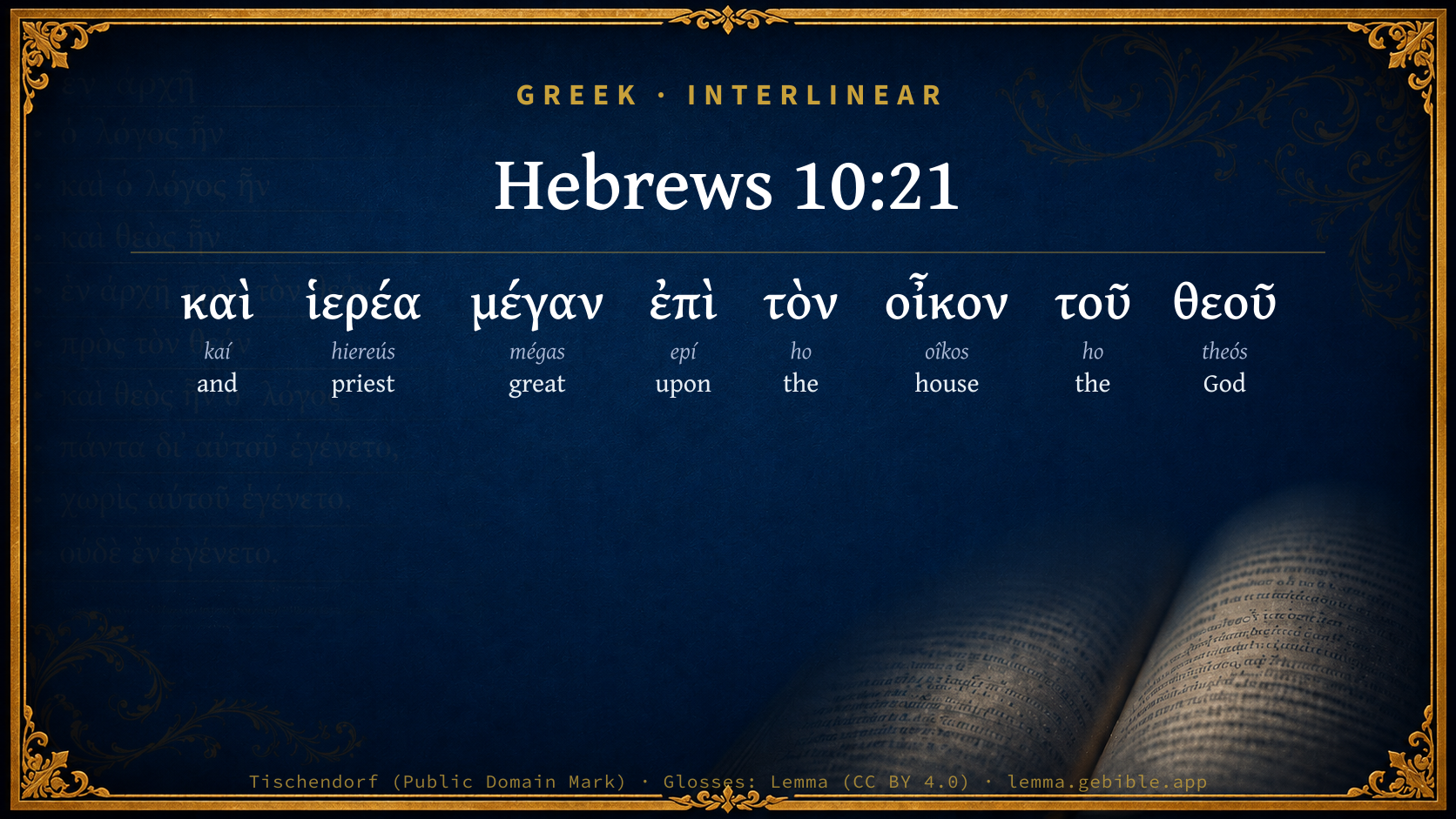
Greek (Tischendorf 8th ed.) Hebrews 10:21 appears in the Greek New Testament. The text above is from the Tischendorf 8th edition. Each word links to its Strong’s number and a concise gloss. Click any word for its full Thayer’s Greek Lexicon entry.
Download image
Cite this verse

Hebrews 10:21 (World English Bible). Public Domain. Lemma interlinear Bible study tool, https://lemma.gebible.app/v/hebrews/10/21.

Show BibTeX & RIS
BibTeX
RIS
English Translation
and having a great priest over the house of God,
World English Bible · Public Domain
Download a study sheet

One document with this verse’s original text, its word-by-word gloss line, the meaning frame, cross-references with their text, attributed commentary, and full source and license credits — printable, and it pastes into notes with its structure intact.

This verse Autodidact and up

Study sheet (.html) Plain text (.txt)

A passage Seminary Student

Up to 50 verses in one chapter. A passage sheet keeps up to 6 commentary sources and 12 cross-references per verse, in the order this page ranks them, and says so on the sheet whenever that leaves anything out. Ask for a single verse and you get the Autodidact verse sheet above.

Everything on this page stays free to read, with no account — the sheet is a download of what is already on screen, not access to it.

Want to remove ads? Support Godless Engineer
Compare translations 3

The same verse in 3 English versions, stacked beneath the original-language interlinear above. Click any original word for its lexicon entry.

Each is an independent rendering of the whole verse — the interlinear is not word-aligned to these translations.

Highlighted words mark where these versions differ — a whole-verse word diff, not a word-by-word alignment.

  • World English Bible Public Domain
    and having a great priest over the house of God,
  • King James Version Public Domain
    And having an high priest over the house of God;
  • unfoldingWord Literal Text CC BY-SA 4.0
    and a great priest over the house of God,

unfoldingWord Literal Text — © unfoldingWord, licensed CC BY-SA 4.0. Word-aligned USFM3 via Door43 (git.door43.org/unfoldingWord/en_ult).

Versions to compare (up to 4)

3 of 4 selected

Show all 19 translations

Every available English version of this verse, each an independent rendering of the whole verse.

  • World English Bible Public Domain
    and having a great priest over the house of God,
  • Berean Standard Bible Public Domain
    and since we have a great priest over the house of God,
  • Majority Standard Bible Public Domain
    and since we have a great priest over the house of God,
  • King James Version Public Domain
    And having an high priest over the house of God;
  • American Standard Version (1901) Public Domain
    and `having' a great priest over the house of God;
  • Revised Version (1885) Public Domain
    and having a great priest over the house of God;
  • Geneva Bible (1599) Public Domain
    And seeing we haue an hie Priest, which is ouer the house of God,
  • Douay-Rheims (1899) Public Domain
    And a high priest over the house of God:
  • Young's Literal Translation Public Domain
    and a high priest over the house of God,
  • Literal Standard Version CC BY-SA 4.0
    and a Great Priest over the house of God,
  • Unlocked Literal Bible CC BY-SA 4.0
    Because we have a great priest over the house of God,
  • unfoldingWord Literal Text CC BY-SA 4.0
    and a great priest over the house of God,
  • Darby Bible Public Domain
    and [having] a great priest over the house of God,
  • World Messianic Bible Public Domain
    and having a great priest over God’s house,
  • Webster's Bible Public Domain
    And having a high priest over the house of God;
  • Free Bible Version CC BY-SA 4.0
    Since we have such a great priest placed in charge over the house of God,
  • Bible in Basic English Public Domain
    And having a great priest over the house of God,
  • Text-Critical English NT CC BY 4.0
    and since we have a great priest over the house of God,
  • Tyndale New Testament (1534) Public Domain
    And seynge also that we have an hye prest which is ruler over the housse of god

Literal Standard Version (2020), Covenant Press — licensed CC BY-SA 4.0. Text via the HelloAO Bible API (eBible.org). Unlocked Literal Bible (unfoldingWord) — licensed CC BY-SA 4.0. Text via the HelloAO Bible API (eBible.org). unfoldingWord Literal Text — © unfoldingWord, licensed CC BY-SA 4.0. Word-aligned USFM3 via Door43 (git.door43.org/unfoldingWord/en_ult). Free Bible Version, Dr. Jonathan Gallagher — licensed CC BY-SA 4.0. Text via the HelloAO Bible API (eBible.org).

Word by word

More ways to search: Search by grammar → Find every occurrence → Compare this word →

Practice this passage: Drill this verse → Learn its vocabulary →

About this verse

These counts appear in no published source. They are computed here, from the morphology-tagged text and Lemma’s own curated glosses. What Lemma adds →

8
words
7
distinct lemmas
General Epistles
section

Shared distinctive vocabulary

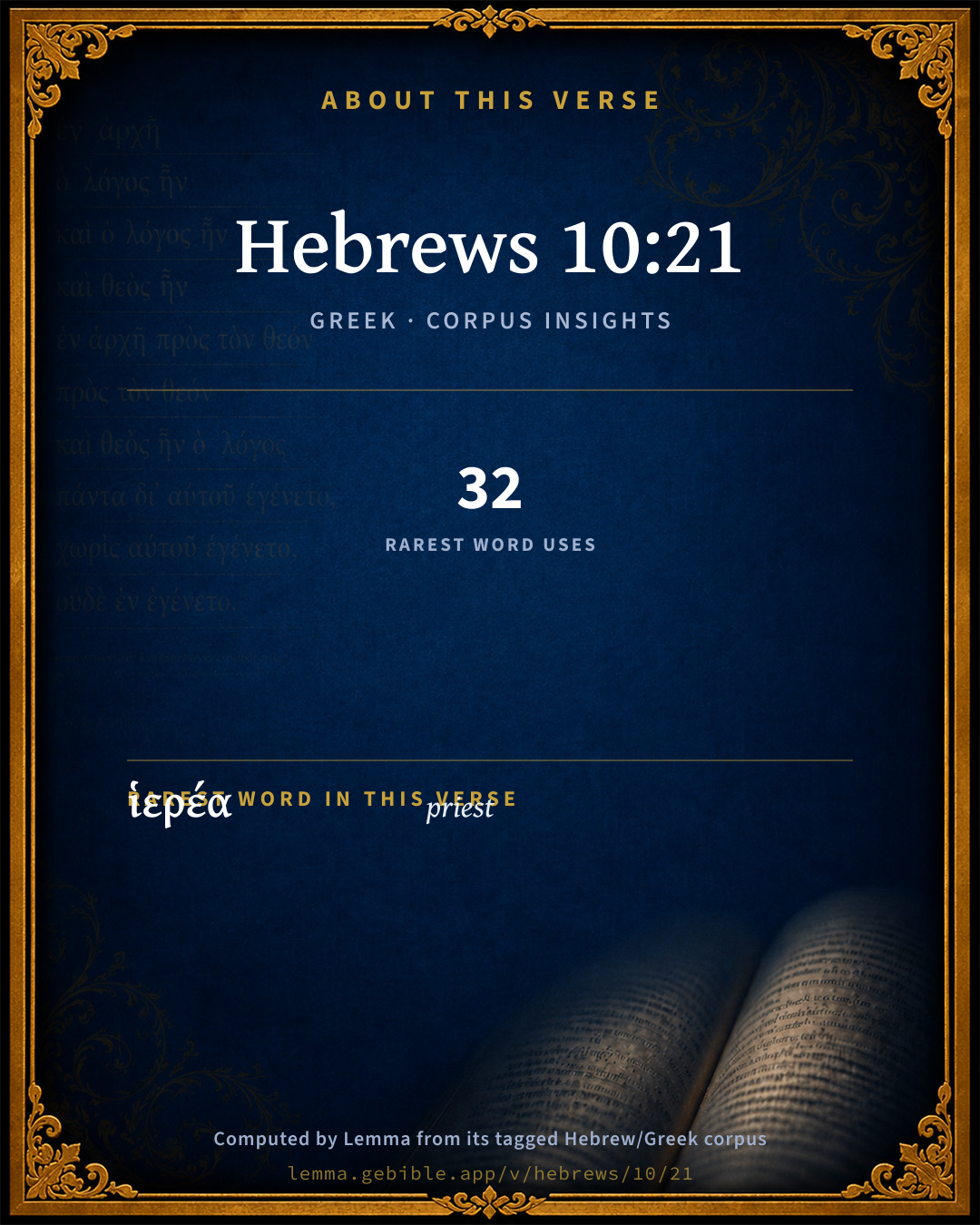
ἱερέα priest G2409 occurs in 32 verses of the Greek New Testament. Also found in:

Repetition

A word recurs within this verse:

Cross-references

12

Topical passages linked to Hebrews 10:21 in the Treasury of Scripture Knowledge — connected by theme and wording, ordered by reader-vote popularity; previews shown in the World English Bible.

  • Hebrews 2:17 Therefore he was obligated in all things to be made like his brothers, that he might become a merciful and faithful high priest in things pertaining to God, to make atonement for the sins of the people.
  • Hebrews 4:14–16 Having then a great high priest, who has passed through the heavens, Jesus, the Son of God, let us hold tightly to our confession.
  • Hebrews 6:20 where as a forerunner Jesus entered for us, having become a high priest forever after the order of Melchizedek.
  • Hebrews 8:1 Now in the things which we are saying, the main point is this. We have such a high priest, who sat down on the right hand of the throne of the Majesty in the heavens,
  • Ephesians 2:19–22 So then you are no longer strangers and foreigners, but you are fellow citizens with the saints, and of the household of God,
  • Hebrews 3:1 Therefore, holy brothers, partakers of a heavenly calling, consider the Apostle and High Priest of our confession, Jesus;
  • Hebrews 7:26 For such a high priest was fitting for us: holy, guiltless, undefiled, separated from sinners, and made higher than the heavens;
  • Hebrews 3:3–6 For he has been counted worthy of more glory than Moses, inasmuch as he who built the house has more honor than the house.
  • 2 Corinthians 6:16–17 What agreement has a temple of God with idols? For you are a temple of the living God. Even as God said, "I will dwell in them, and walk in them; and I will be their God, and they will be my people."
  • 1 Timothy 3:15 but if I wait long, that you may know how men ought to behave themselves in the house of God, which is the assembly of the living God, the pillar and ground of the truth.
  • 1 Corinthians 3:9–17 For we are God's fellow workers. You are God's farming, God's building.
  • Matthew 16:18 I also tell you that you are Peter, and on this rock I will build my assembly, and the gates of Hades will not prevail against it.

Cross-references courtesy of OpenBible.info (CC BY 4.0).

Commentary

Notes on Hebrews 10:21 from classic Christian and Jewish commentators (each source and its license shown beneath its notes). The classic Christian expositions comment on the surrounding passage and are grouped to its opening verse, so a note may address several verses; the Jewish commentaries on the Tanakh (Rashi and others) are per-verse, so they appear only where the commentator wrote on this verse.

Lemma curates 59 commentaries, every one of them public domain or Creative Commons licensed, each selected and text-cleaned for this edition rather than reprinted as found. About our sources →

Tyndale Open Study Notes

Tyndale Open Resources

10:21 Jesus, as Messiah, is the High Priest and king who rules over God’s house, the people of God (see 3:1-6; 2 Sam 7:13).

Tyndale Open Study Notes — © Tyndale Open Resources, licensed CC BY-SA 4.0. Text via the HelloAO Bible API.

Bengel's Gnomon

Johann Albrecht Bengel

Heb 10:21. Ἱερέα μέγαν, the High Priest) ch. 7.—ἐτὶ τὸν οἶκον τοῦ Θεοῦ, over the house of God) ch. Heb 3:6.

Bengel's Gnomon of the New Testament — English translation (T&T Clark, Edinburgh, 1860) — public domain. Text from a community e-Sword module.

Meyer's Critical & Exegetical Commentary

Heinrich August Wilhelm Meyer

Heb_10:21 is still governed by ἔχοντες, Heb_10:19. As τὰ ἅγια, Heb_10:19, was chosen as a general designation instead of the special τὰ ἅγια ἁγίων, so here (comp. Heb_5:6, Heb_7:1; Heb_7:3, al.) the general ἱερέα stands in the sense of the special ἀρχιερέα, and μέγαν is, as Heb_4:14, expression of the exaltedness of this High Priest (against Stuart, Klee, Stein, Ewald, MCaul, and others, who take ἱερέα μέγαν together as a designation of the High Priest).

ἐπὶ τὸν οἶκον τοῦ θεοῦ] over the house of God. Comp. Heb_3:6. Theodoret, Oecumenius, Estius, Grotius, Calov, Tholuck, Stengel, Hofmann (Schriftbew. II. 1, 2 Aufl. p. 454), Maier, Kurtz, and others understand by these words, in accordance with Heb_3:2; Heb_3:6, the household of God, or the believers, by which, however, the unity of the figure is needlessly destroyed. The allusion is to heaven or the heavenly sanctuary, as the dwelling-place of God, over which Christ rules as High Priest.[101]

[101] That Delitzschwho is followed therein by Alfordwill have us understand, as the οἶκος τοῦ θεοῦ in our passage at the same time the church and the heaven of glory, can he looked upon only as an instance of manifest error.

Meyer — Critical and Exegetical Commentary on the New Testament — English translation by Peter Christie, edited by Frederick Crombie (T&T Clark, 1880) — public domain. Text from a community e-Sword module.

Expositor's Greek Testament

ed. W. Robertson Nicoll

Heb 10:21 . καὶ ἱερέα μέγαν . The opened way into the holiest is not the only advantage possessed by the Christian, he has also “a great priest,” cf. Heb 4:14 ἔρχοντες οὖν ἀρχιερέα μέγαν … προσερχώμεθα . Philo ( Leg. ad Gai. , p. 1035) calls the High Priest ὁ μἐγας ἱερεύς , and so Lev 21:10 , Num 35:25 . But it is not to the fact that He is High Priest that this designation here points, but to His greatness as Son of God and as one who has passed into the Holy Presence. Especially is His greatness manifested in His administration ἐπὶ τὸν οἶκον τοῦ θεοῦ , over God’s house ( cf. Heb 3:6 ) that is, over those heavenly realities which replace the house of God on earth, and necessarily over those for whom the priest is appointed to minister τὰ πρὸς τὸν θεόν (Heb 5:1 ).

The Expositor's Greek Testament, edited by W. Robertson Nicoll (1897–1910) — public domain. Text from a community e-Sword module.

Jamieson, Fausset & Brown

Robert Jamieson, A. R. Fausset & David Brown

high priest--As a different Greek term (archiereus) is used always elsewhere in this Epistle for "high priest," translate as Greek here, "A Great Priest"; one who is at once King and "Priest on His throne" (Zac 6:13); a royal Priest, and a priestly King.

house of God--the spiritual house, the Church, made up of believers, whose home is heaven, where Jesus now is (Heb 12:22-23). Thus, by "the house of God," over which Jesus is, heaven is included in meaning, as well as the Church, whose home it is.

Jamieson, Fausset & Brown — Commentary Critical and Explanatory on the Whole Bible (1871) — public domain (CC PDM 1.0). Text via the HelloAO Bible API.

Adam Clarke's Commentary

Verse 21. A high priest over the house of God] The house or family of God is the Christian Church, or all true believers in the Lord Jesus. Over this Church, house, or family, Christ is the High Priest-in their behalf he offers his own blood, and their prayers and praises; and as the high priest had the ordering of all things that appertained to the house and worship of God, so has Christ in the government of his Church. This government he never gave into other hands. As none can govern and preserve the world but God, so none can govern and save the Church but the Lord Jesus: He is over the house; He is its President; he instructs, protects, guides, feeds, defends, and saves the flock. Those who have such a President may well have confidence; for with him is the fountain of life, and he has all power in the heavens and in the earth.

Adam Clarke's Commentary on the Bible (1810–1826) — public domain. Text from a community e-Sword/MySword module.

John Calvin's Commentaries

21. And having a high priest, etc. Whatever he has previously said of the abrogation of the ancient priesthood, it behoves us now to bear in mind, for Christ could not be a priest without having the former priests divested of their office, as it was another order. He then intimates that all those things which Christ had changed at his coming ought to be relinquished; and God has set him over his whole house for this end, — that every one who seeks a place in the Church, may submit to Christ and choose him, and no other, as his leader and ruler.

John Calvin's Commentaries (1540-1563) — public domain. Text from the Calvin Translation Society English edition (1840s-50s) via the Christian Classics Ethereal Library (ccel.org). Calvin's coverage is partial (roughly two-thirds of the Bible); uncommented books and verses are honest gaps, never fabricated. The 19th-century editor's footnotes and remarks are omitted so the notes are faithfully Calvin's own voice.

Ellicott's Commentary for English Readers

(21) An high priest.—The Greek words properly signify a great priest (comp. Heb_4:14), which is one of the names by which the high priest is frequently designated, both in the Hebrew (Leviticus 21, et al.), and in the LXX. It may seem strange that the writer should here make use of a new word in the place of that which has occurred so frequently. But there is strong reason for believing that the language of one of the prophecies of Zechariah (Zec_6:11-13) is here before his mind. In the preceding verses (Zec_6:12-14) he has used words which united sacerdotal and kingly imagery; and it would be remarkable if this did not lead his thought to that prophecy. On the head of Joshua, “the great priest” (Zec_6:11), are placed crowns of silver and gold in token of royal dignity: then follows the prediction of Him of whom Joshua was the type. “He shall build the house of the Lord: and He shall bear the glory, and shall sit and rule upon His throne; and He shall be a priest upon His throne.” In the verse before us are combined several of the characteristic thoughts of that passage—the great priest, the priestly ruler, the house of God. The last-mentioned words are repeatedly used throughout the Old Testament, both in the Pentateuch and in later books, for the Tabernacle or Temple of God. In Heb_3:6 (to which there is a manifest allusion here) the meaning is enlarged, but only so that under “the house” is also comprised the household of God. Here the two thoughts are combined. Into the house of God we may enter; over it Jesus rules as “the great Priest.” The family of God subject to His rule includes the whole community of “the people of God” in heaven and upon earth.

A Bible Commentary for English Readers, edited by Charles John Ellicott (1878–1897) — public domain. Text from a community e-Sword module.

The Cambridge Bible for Schools and Colleges

gen. ed. J. J. S. Perowne

21. a high priest] Lit. “a great Priest” (as in Lev_21:10), here meaning a Kingly Priest (Zec_6:11-13).

over the house of God] See Heb_3:6; 1Ti_3:15.

The Cambridge Bible for Schools and Colleges (gen. ed. J. J. S. Perowne; Cambridge University Press, 1878–1918) — public domain. Text from a community e-Sword module.

John Gill's Exposition

Let us hold fast the profession of our faith without wavering,.... Either in the grace or doctrine of faith, or in the profession of both; See Gill on Heb 4:14.

For he is faithful that promised; that is God; and it is true of Father, Son, and Spirit; but God the Father may be more especially designed: he is a promising God, and is known to be so by his people; he is eminently and emphatically the Promiser; and all other promisers, and the promises made by them, signify little; but the promises of God are exceeding great and precious, very ancient, free, and unconditional, irrevocable and immutable, and are admirably suited to the cases of his people, and will be fulfilled everyone of them: they include in them things temporal, spiritual, and eternal; things temporal, as that his people shall not want, that their afflictions shall work for good, and that he will support them under all their troubles; things spiritual, as that he will be their God, which takes in his everlasting love to them, and his gracious presence with them, and his protection of them; and that all grace shall be wrought in them, and every blessing of grace bestowed on them: and things eternal; as everlasting glory and happiness; the promise of eternal life was in God's heart, made in the covenant, and put into Christ's hands before the world began, and is declared in the Gospel: now God is faithful to all his promises, nor can he fail, or deceive; he is all wise and foreknowing of everything that comes to pass; he never changes his mind, nor forgets his word; and he is able to perform, and is the God of truth, and cannot lie; nor has he ever failed in anyone of his promises, nor will he suffer his faithfulness to fail; and this is a strong argument to hold fast a profession of faith.

John Gill's Exposition of the Whole Bible (1746–1763) — public domain (CC PDM 1.0). Text via the HelloAO Bible API.

Trapp's Complete Commentary

John Trapp

21 And having an high priest over the house of God;

Ver. 21. Over the house of God] As Jehoiadah was over the temple, presided and commanded there, 2Ki 2:5. All power is given to Christ both in heaven and earth, for our behoof and benefit.

John Trapp, A Commentary or Exposition upon All the Books of the Old and New Testament (1647–1656) — public domain. Text from a community e-Sword module.

Albert Barnes' Notes on the Bible

And having an High Priest over the house of God - Over the spiritual house of God; that is, the church; compare the notes on Heb 3:1-6. Under the Jewish dispensation there was a great high priest, and the same is true under the Christian dispensation. This the apostle had shown at length in the previous part of the Epistle. The idea here is, that as under the former dispensation it was regarded as a privilege that the people of God might have access to the mercy-seat by means of the high priest; so it is true in a much higher sense that we may now have access to God through our greater and more glorious High Priest.

Albert Barnes' Notes on the Bible (1834–1885) — public domain. Text from a community e-Sword/MySword module.

Haydock's Catholic Bible Commentary

And a high priest; i.e. and having a great priest, to wit, Christ, over the house of God, that is, over the Church, or over all the faithful, both in the Church militant on earth and in the Church triumphant in heaven. (Witham)

George Leo Haydock (1774–1849), Haydock's Catholic Family Bible and Commentary, 1859 edition — public domain. Excludes Psalms (Douay-Rheims chapter numbering differs from Protestant) and Deuterocanonical books (Catholic canon only).

Matthew Poole's English Annotations

Christians have not only a liberty of coming, but a way wherein, and a help whereby, to reach home to God; which help is a surpassing Priest to all others, the great and eminent one for real worth and dignity, Christ himself, God-man, exalted to the right hand of the Majesty on high, after he had fulfilled his work here; where he was invested with all authority and power, and set over the church of the living God, consisting both of Hebrew and Gentile Israelites, Heb 3:6; Act 20:28; whose sacrifices of praise and prayer offered up to God, he presenteth, perfumed with the incense of his own merits, before the throne, representing their persons, pleading their cause, and continually interceding for their good, making all they are and perform acceptable to his Father by his own blood, Heb 8:2.

Matthew Poole's English Annotations on the Holy Bible (1683–1685) — public domain. Text from a community e-Sword/MySword module.

Whedon's Commentary on the Bible

Daniel D. Whedon

21. House of God—The new temple, embracing primarily the entire new structure of salvation through the atonement, of which the temple and its ritual were typical. Hence this new temple, in its full physical significance, embraces earth, the firmament, and the highest heaven; the entire scene and structure of the divine history.

Daniel D. Whedon (gen. ed.), Commentary on the Old and New Testaments (1874–1909) — public domain. Text from a community e-Sword module.

The People's New Testament

B. W. Johnson

21. And having an high priest. Our high priest hath opened the way by rending the veil. He is priest over the House of God, the church on earth, and our high priest in the Holiest of all above.

B. W. Johnson's The People's New Testament with Notes (1889–1891) — public domain. Electronic text from the Christian Classics Ethereal Library (CCEL) ThML edition.

Cambridge Greek Testament for Schools and Colleges

21. ἱερέα μέγαν. Lit., “a great Priest” (as in Lev 21:10), by which is meant not only a High Priest, but also a Kingly Priest (Zec 6:11-13).

ἐπὶ τὸν οἶκον τοῦ θεοῦ. See Heb 3:6; 1Ti 3:15.

Cambridge Greek Testament for Schools and Colleges (Cambridge University Press, 1896; 21 vols, various authors incl. Carr, Maclear, Plummer, Farrar, Lumby, Moule, M. R. James, Simcox) — public domain. Text from a community e-Sword module.

Alford’s Greek Testament

Henry Alford

21.] and (‘having:’ τὸ ἔχοντες ἀπὸ κοινοῦ, Œc.) a great Priest (i. e. a great High Priest; but here his Priesthood, not his High-priesthood, is more brought into prominence. Do not suppose that μέγας ἱερεύς imports ‘High Priest,’ as ὁ ἱερεὺς ὁ μέγας in the LXX and Philo: our Writer always uses ἀρχιερεύς for it, and in ch. 4:14, calls our Lord ἀρχιερέα μέγαν. He is ἱερεὺς μέγας, because He is a Priest on his throne, a “sacerdos regius et rex sacerdotalis,” as Delitzsch quotes from Seb. Schmidt) over the house of God (this substitution of the preposition of motion for that of rest, is indicative of a later phase of a language, and requires the supplying of τεταγμένον, or some similar word, to make it good Greek: so Ξενοκλέα ἔταξεν ἐπὶ τοὺς ἱππεῖς, Xen. Cyr. iv. 5. 19. The οἶκος θεοῦ here need not be more limited in meaning than in the similar passage ch. 3:2: οἶκον δὲ θεοῦ τοὺς πιστοὺς προσηγόρευσεν, Thdrt., Œc., Estius, al. But it is alleged that the expression here must mean the heaven: Thl. having mentioned the other, says, ἤ, ὅπερ οἶμαι μᾶλλον, τὸν οὐρανόν· ἐκεῖνον γὰρ καὶ ἅγια καλεῖ, καὶ ἐν ἐκείνῳ λειτουργεῖν τὸν ἱερέα λέγει, ὑπὲρ ἡμῶν ἐντυγχάνοντα: and so many Commentators. But Delitzsch well observes that the one meaning, the narrower, need not exclude the other, the wider. It is hardly probable, to begin with, that our Writer should in two places describe Christ as set ἐπὶ τὸν οἶκον τοῦ θεοῦ, in meanings entirely different from each other. Clearly, the heavenly sanctuary is regarded by him as also including the earthly, the Church above as the home of the Church below: see ch. 12:22 ff.),

Henry Alford, The Greek Testament (1849–1861) — public domain. Text from a community e-Sword module.

Vincent's Word Studies in the New Testament

Marvin R. Vincent

A high priest [ιερεα μεγαν] . Lit. a great priest. Comp. Lev 21:10, LXX Not merely = ajrciereuv high priest, but emphasizing Christ 's superior greatness as high priest.

House of God [οικον του θεου] . In the Gospels always of the temple. Not found in Paul. Once in the Pastorals, of the church, 1Ti 3:15, and so 1Pe 4:17. Here the whole Christian family. Comp. 1Co 3:16, 17; 2Co 6:16; Eph 2:22.

Marvin R. Vincent, Word Studies in the New Testament (1887–1900) — public domain. Text from a community e-Sword/MySword module.

Westcott on Hebrews & the Epistles of John

Brooke Foss Westcott

21. καὶ ἱερέα μέγαν] Christians have open access to tho Divino Presence; and in tho court of tho Divine Majesty they havo an offectual Intercessor.

Tho epithet great describes tho sovereign power of our Priest (a great High-priest ο. iv. 14), and doos not simply sorve in combination with ἱερεύς as an cquivalent for ἀρχιερεύς (Lev. xxi. 10 6 ἱερεὺς ὁ μέγας).

ἐπὶ τὸν οἶκον τ. 6.) Vulg. super domum (O. L. in domo) Dei. The House of God includes the whole Christian economy both in its earthly and in its heavenly elements; in ite organisation and in its members. The Church on earth, so far as it has a true existence, lives by its embodiment of the heavenly idea. Under other aspects this ‘house’ is spoken of as ‘the order to come’ (4 οἰκουμένη ἡ μέλλουσα ¢. fi. 5) and ‘the city to come’ ([7 warts] ἡ μέλLoven ©. xiii. 14).

Bee c. iti. 4; 6 (wf); and comparc

6. xii. 22; Phil. ill. 20; Zech. vi. 11 ff.

Philo speaks of the righteous soul, and again, hy a remarkablo image, of the Word itself, as ‘the house of God’: τίς yap οἶκος παρὰ γενέσει (in things created) δύναιτ᾽ ἂν ἀξιοπρεπέστερος εὑρεθῆναι θεῷ πλὴν ψυχῆς τελείας κεκασπούδασον οὖν, 3 ψυχή, θεοῦ οἶκος γενέσοἶκον ἔχειν φησὶ τὸν ἑαυτοῦ λόγον (de migr. Abr. §i.; i. 437 M.).

22. These privileges of Christians are to be used. They must personally exercise their right of access to God. . And this they must do in sincerity and faith, even as they have received the fulness of divine blessing in preparation for the fulfilment of their priestly work.

The connexion of the clauses in vv. 22—24 is uncertain. It is possible to begin each main sentence with the μεθα.. καὶλελουσμένοι.. κατέχωμεν.. «καὶ after πίστεως. Tho last arrangement may be dismissed at once. In favour of the second, it may be urged that it gives a natural succession of conditions; internal and external, both personal and social: and further that the separation of Baptism (Ae. τὸ σῶμα) from the confession naturally included in it is harsh; while the accumulation of fresh thoughts by καί is in the style of the writer (let us come to God...; and having our body bathed...let us hold fast...; and la us consider...).

But on the other hand it seems most likely that tho writer would complete the description of the con- - ditions of personal approach, corresponding with the priestly preparations in the Levitical code, and then pass

τὴν συνείδησιν inkled, that is with Christ's Blood and not with any water of purification, aud so cleansed from an evil conscience; and our budy is bathed with pure water. In the latter clause there is a reference both to the consecration of priests (Ex. xxix. 4), and to the bathing of the High-priest

use of the privilege of approach to God is followed by the charge to fulfil the social duties of believers, Christians are required to maintain the open confession of their hope (σ. 23); to regard one another with a view to bringing the influence of example to bear upon the development of life (v. 24); and to use occasions of meeting together in the pros-

pect of a near crisis (p. 25).

The reference to Baptism in the last clause furnishes a direct’ transition. The confession then publicly and gladly made must be firmly held:

Brooke Foss Westcott (1825–1901), The Epistle to the Hebrews (1889) and The Epistles of St John (1883) — public domain (pre-1929). Text recovered from Internet Archive / Google Books OCR scans. Westcott’s Gospel of John commentary is not included (its OCR lost the chapter running-heads required for reliable verse-keying). Some Greek quoted in the Hebrews volume is imperfectly rendered by the OCR.

Lesson kit

Teaching starters — assembled from the data on this page, not authored interpretation. Every prompt links to the verse data it draws on. Edit before teaching.

Hebrews, in the General Epistles, opens this verse with 8 words (7 distinct Greek lemmas). Its most distinctive word is hiereús (“priest”). A historical commentator’s framing appears above. Read the whole chapter for the surrounding context.

Discussion questions

  1. How does “priest” (hiereús) shape what this verse is saying?
  2. Matthew 8:4 shares the word «priest» with this verse. How do the two illuminate each other?
  3. “the” occurs 2× in this one verse. What is the effect of the repetition?
  4. The translations on this page render this verse differently — a whole-verse word diff, not a word-by-word alignment. What might account for the different wordings?
  5. Reading how Tyndale Open Study Notes and Bengel's Gnomon read this verse, where do the two commentators agree and where do they part?

Things to notice

  • These translations choose different wording for 3 words in this verse.
  • “the” occurs 2× in this single verse.
  • 7 distinct Greek lemmas span 8 words in this verse.

Reading settings

Reading text

Shown beneath each verse's original-language words.

Old Testament
Old Testament edition

Read the OT as the Masoretic Hebrew (MT) or the Greek Septuagint (LXX).

English shown for the Greek Septuagint (in the Hebrew ↔ Greek comparison).

Comparing translations? Open the Compare panel on any verse page to stack up to four side by side.